Learn how Ten-Step Kumbhak for stress relief may prepare one for the Samprajñāta, Nirbīja, Vedāntic, Bhakti, and Buddhist Samādhis.
A comprehensive guide across Patañjali’s Yoga Sūtras, later Vedānta, Haṭha Yoga, Buddhism, science and Ayurveda—with a personal, relational understanding of the highest absorption 🫁🧠❤️
By Kumbhaki Yogi Dhruvaji (MSc), founder of the Antistress Foundation 501(c)(3)
• How to Practice Ten-Step Kumbhak • Scientific Proof • Ancient Texts Proof • Bio • Subscribe By Email
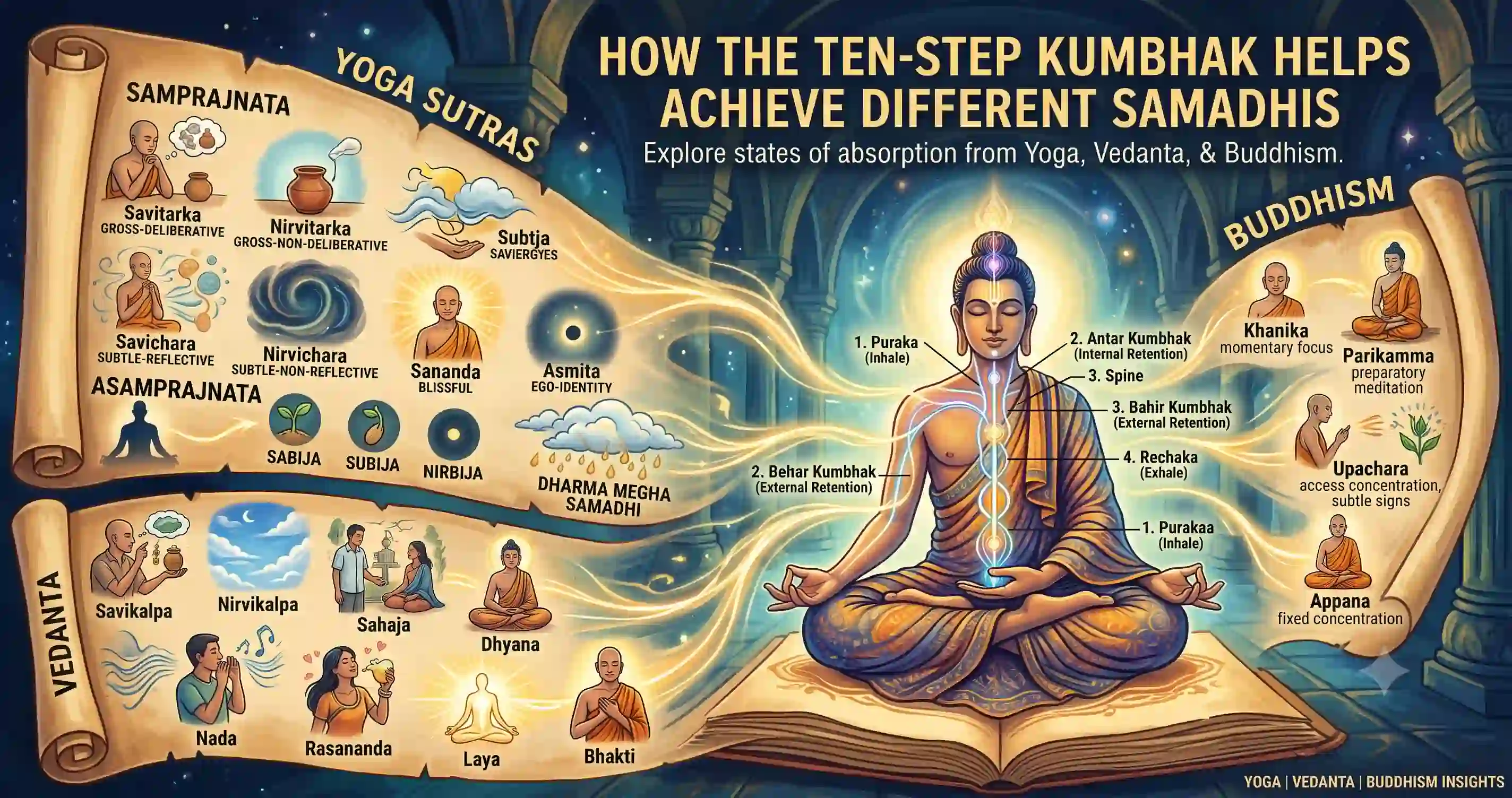
Sometimes a sincere person sits to meditate after a day of pressure and finds that the body has arrived, but the mind is still answering yesterday’s voices. The jaw remembers a disagreement. The chest holds an unfinished fear. Attention is asked to contemplate the highest truth while the nervous system is still guarding the door.
That person has not failed at meditation. The instrument is carrying stress.
The Ten-Step Kumbhak for Stress Relief may help by giving the body, breath and attention a short, orderly transition from reactivity toward collectedness. It does not manufacture Samādhi. It does not replace ethical living, devotion, contemplative training, grace or a qualified teacher. Its most defensible role is both humbler and more useful: it may prepare a less distracted, less threatened and more inwardly available mind for Dhāraṇā, Dhyāna and, eventually, the Samādhi appropriate to the practitioner’s path.
This distinction protects both truth and hope. A hand that stops trembling has not yet embroidered the sacred cloth—but now it may be able to hold the needle. 🪡
The Ten-Step Kumbhak is best understood as preparatory ground, not a mechanical shortcut to Samādhi. Stress relief clears some of the noise; love, wisdom, practice and grace determine what fills the resulting quiet.
For the complete method, safeguards and beginner guidance, use the separate How to Practice the Ten-Step Kumbhak for Stress Relief page. The process itself is intentionally not repeated here.
The Short Answer: How Can Kumbhak Help With Samādhi? 🎯
The strongest answer is a chain of preparation:
- Stress can scatter attention. Patañjali lists distress, mental dejection, bodily unsteadiness and disturbed breathing among the companions of distraction in Yoga Sūtra 1.31.1
- Breath regulation can help steady the mind. Yoga Sūtra 1.34 names expulsion and retention of Prāṇa as one means in the surrounding sequence for settling consciousness.2
- Prāṇāyāma prepares concentration. After describing external, internal and suspended regulation, Patañjali says the covering over inner luminosity diminishes and the mind becomes fit for Dhāraṇā in 2.49–2.53.3
- Dhāraṇā matures into Dhyāna and Samādhi. Patañjali defines these as fixation, uninterrupted continuity and absorption in which the object alone shines, respectively, in 3.1–3.3.5
- Therefore, Kumbhak may support a prerequisite of Samādhi. The source-backed claim is fitness for concentration, not automatic attainment of any named Samādhi.
That is the article’s central conclusion. Everything else explains how far this bridge can honestly be extended—and where it must stop.
Four Levels of Claim—Please Do Not Mix Them ⚖️
Level 1 — Direct classical statement: Patañjali connects Prāṇāyāma with the mind’s fitness for Dhāraṇā. This is textual evidence.
Level 2 — Traditional yogic interpretation: Haṭha texts connect the movement of Prāṇa and the movement of mind. This is an authentic traditional model, not a laboratory measurement.2021
Level 3 — Modern evidence for precursor skills: Small trials suggest that some breath-regulation practices containing comfortable retention may affect perceived stress, anxiety, attention or response inhibition. The studies rarely isolate retention from rhythm, expectancy, meditation or instructor contact.272829
Level 4 — An unproven leap: No clinical trial has established that the Ten-Step Kumbhak causes Samprajñāta, Nirvikalpa, Nirbīja, Appanā, Dharma-Megha or any other Samādhi discussed below.
The article will use “may prepare,” “may support” and “may become relevant” deliberately. These are not timid phrases. They place each claim exactly where the available proof can carry it.
Samādhi Is Not Breath-Holding Performance 🛑
A longer retention is not a higher Samādhi. A dramatic inner sensation is not proof of realization. Dizziness is not transcendence. Numbness is not Nirvikalpa. Dissociation is not Asamprajñāta. Euphoria is not Dharma-Megha.
The Ten-Step method’s insistence on ending both retentions while they remain completely easy is contemplatively important. It discourages three common substitutions:
- strain for steadiness;
- intensity for depth;
- unusual physiology for spiritual maturity.
The relevant achievement is not “I defeated the urge to breathe.” It is “I remained relaxed, attentive and free to stop.” That attitude is closer to non-grasping than any personal record.
The Most Relevant Classical Proof: Breath, Dhāraṇā, Dhyāna and Samādhi 📜
Yoga Sūtra 1.31: Stress-Like Disruption Is Already in the Map
Patañjali’s phrase in 1.31 includes duḥkha (distress or pain), daurmanasya (mental dejection), aṅgamejayatva (bodily unsteadiness) and śvāsa-praśvāsa (inhalation and exhalation) as companions of distraction.1
This does not say that every modern stress symptom is a yogic obstacle, nor that one breathing practice cures them. It does establish something psychologically recognisable: a scattered mind is often accompanied by an unsettled body and unsettled breathing.
For a modern reader, stress relief is therefore not a lesser goal placed beneath meditation. It can be maintenance of the instrument through which meditation occurs.
Yoga Sūtra 1.34: Exhalation and Retention as a Means of Mental Settling
The sūtra reads:
pracchardana-vidhāraṇābhyāṃ vā prāṇasya — Yoga Sūtra 1.34
The precise practice intended by this compact sentence is debated. Classical translations commonly understand it as expulsion and retention of Prāṇa; some read it specifically in relation to holding after exhalation.2
The legitimate connection is narrower: Patañjali includes breath expulsion and retention among methods relevant to steadying the mind. The Ten-Step Kumbhak contains both Antar Kumbhak and Bāhya Kumbhak within a structured, submaximal stress-relief practice. That makes the sūtra relevant without making the two techniques identical.
Yoga Sūtras 2.49–2.53: The Direct Bridge to Dhāraṇā
Patañjali places Prāṇāyāma after a stable posture and describes it through the interruption or regulation of the movements of inhalation and exhalation. He then distinguishes external, internal and suspended dimensions regulated by place, time and number.3
Two results follow:
- 2.52: the covering over luminosity is diminished;
- 2.53: dhāraṇāsu ca yogyatā manasaḥ—the mind acquires fitness for Dhāraṇā.4
The word fitness matters. Prāṇāyāma does not erase the remaining limbs. It prepares capacity. A violin may be tuned without yet playing the rāga; tuning is neither the whole music nor an optional irrelevance.
Yoga Sūtras 3.1–3.3: The Inner Sequence Kumbhak Can Only Prepare
Patañjali’s progression is precise:5
- Dhāraṇā: attention is bound to a chosen place or field.
- Dhyāna: a continuous stream of the same cognition flows toward that object.
- Samādhi: the object alone becomes luminous, while the mind’s self-display becomes “as if” absent.
The phrase “as if” is vital. It does not require the crude conclusion that the conscious person has become literally nonexistent. Phenomenologically, it can mean that self-commentary—“I am meditating well; I am having an experience”—no longer interrupts the meeting with the object.
In a personal reading, the meditator is not erased into vacancy. Rather, self-preoccupation ceases to obstruct full presence to the Beloved.
Yoga Sūtras 1.23 and 2.45: Samādhi Can Be Devotionally Oriented ❤️
Any claim that Patañjali’s Samādhi must be explained only impersonally overlooks Īśvara-praṇidhāna. Yoga Sūtra 1.23 offers dedication to Īśvara as a way forward, and 2.45 states that perfection of Samādhi comes through Īśvara-praṇidhāna.67
The Bhagavad Gītā further says that the foremost yogī is the one whose inner being is fixed on the universal consciousness with love (6.47). It also places supreme love beyond the serene brahma-bhūta condition (18.54), refusing the assumption that serenity must terminate relationship.89
Accordingly, this article will not describe the higher Samādhis as the death of love, individuality or relationship. Where a source belongs to a tradition with a different metaphysical vocabulary, that difference will be stated honestly; no tradition will be made to say what it does not say.
A Source-Corrected Map of the Requested Samādhis 🧭
Popular articles often flatten several centuries and traditions into a single staircase. That creates confidence at the cost of accuracy. The requested terms actually belong to different maps.
Map One: Patañjali’s Yoga Sūtras
Patañjali gives at least two overlapping ways of organising object-directed absorption:
A fourfold description in 1.17:
- Vitarka
- Vicāra
- Ānanda
- Asmitā
A refinement of Samāpatti in 1.42–1.44:
- Savitarka and Nirvitarka with gross objects
- Savicāra and Nirvicāra with subtle objects
These are often presented as one neat six-stage ladder: Savitarka, Nirvitarka, Savicāra, Nirvicāra, Sānanda and Sāsmitā. That summary is useful pedagogically, but the sūtras themselves do not state that exact flat list. Yoga Sūtra 1.46 calls the object-supported Samāpattis Sabīja Samādhi.1011
Patañjali then discusses the “other” absorption associated in commentary with Asamprajñāta (1.18), Nirbīja Samādhi (1.51) and, much later, Dharma-Megha Samādhi (4.29). These terms are related, but they should not be treated as casual synonyms.121314
Map Two: Later Vedānta and Haṭha Yoga
Savikalpa and Nirvikalpa receive systematic definition in later Vedāntic manuals such as the Vedāntasāra. The same text places Prāṇāyāma in an eightfold sequence leading through Dhāraṇā and Dhyāna to Samādhi.15
Sahaja is prominent in later yogic and Vedāntic discourse; the Haṭha Yoga Pradīpikā includes sahajā among terms for the accomplished state and says it is difficult without the grace of the true teacher.16
Dhyāna, Nāda, Rasānanda, Laya and Bhakti Samādhi are not one standard “Vedānta list.” They occur in the sixfold Samādhi teaching of the Gheraṇḍa Saṃhitā, a Haṭha-yoga text. The sixth, often omitted in internet lists, is Rāja-yoga Samādhi.17
Map Three: Theravāda Buddhist Concentration
Parikamma (preparatory work), Upacāra (access) and Appanā (absorption) belong primarily to Theravāda Abhidhamma and commentarial analysis. Khaṇika means momentary concentration and is especially important in insight-oriented explanation.
They are not four universally agreed stages spoken as a single ladder in the earliest Buddhist discourses. The Visuddhimagga formally distinguishes access from absorption and also recognises momentary concentration in relevant contexts.1819
What “Personal, Not Impersonal” Means in This Article
It means four things:
- Objectless will not be translated as personless. Absence of a mental support is not automatically a doctrine that no conscious subject or universal conscousness exists.
- Quiet concepts will not be confused with extinguished love. Non-discursive awareness can be full of love, response and presence.
- Devotion will be treated as a mature contemplative power. It is not merely an emotional beginner’s aid to be abandoned when concentration deepens.
- Traditions will not be falsified. Buddhist concentration categories will be explained as Buddhist attentional categories, not secretly rewritten as Vedānta. Their practical relevance can remain relational through compassion, loving-kindness, teacher, community and ethical intention.
How the Design of the Ten-Step Kumbhak Supports Samādhi-Readiness 🫁
This section discusses design principles, not instructions. Use the full practice page for the actual method.
Stress Relief Comes Before Metaphysical Ambition
The Ten-Step Kumbhak begins with a recognisable human need: the system is overactivated, attention is fragmented, and the person wants a safe way to become more settled.
This ordering is contemplatively intelligent. If the practice were advertised first as a method for Nirbīja Samādhi, the beginner might strain, chase visions or imitate imagined signs. Stress relief gives an immediate and honest criterion:
Do I feel more settled, more present and more able to attend—or more pressured, dizzy and afraid?
The practitioner does not have to believe a metaphysical claim before beginning. Direct experience may earn the next step. This preserves autonomy and reduces the temptation to report the result a teacher wants to hear.
One Chosen Bodily Field Trains the Beginning of Dhāraṇā
The continuous focus at the centre of the chest gives attention a stable bodily field. That does not make chest-centre awareness identical to Patañjali’s Dhāraṇā, but it rehearses a core skill: noticing departure and returning without aggression.
The classical Bhāṣya on Yoga Sūtra 3.1 includes the heart-lotus among possible loci of Dhāraṇā.22 This provides a precise traditional connection without claiming that every chest sensation is a chakra event or divine message.
For a devotionally inclined practitioner, the chest-centre may later become associated—under appropriate guidance—with remembrance, prayer, mantra, sacred form or loving offering. The Ten-Step method itself should remain clear and not be overloaded with imagery while its breathing sequence is being learned.
Antar Kumbhak Can Rehearse Remaining Present After Fullness
Antar Kumbhak comes after Pūrak. Phenomenologically, this is a pause after receiving. The mind learns that fullness need not immediately become grasping, narration or another action.
This can become useful for object-directed absorptions. After a mantra, sacred name, form, teaching or felt sense becomes vivid, the practitioner needs the capacity to remain with it rather than immediately adding commentary.
The connection is preparatory, not magical. Antar Kumbhak does not convert an ordinary thought into Savitarka or Savikalpa Samādhi. It may help train unhurried continuity after an object has entered awareness.
Bāhya Kumbhak Can Rehearse Remaining Present Without Immediate Replacement
Bāhya Kumbhak comes after Rechak. Its most relevant contemplative lesson is not oxygen deprivation; it is the possibility of a brief, completely easy interval in which the mind does not rush to fill absence.
That can become psychologically relevant to transitions from object-rich toward quieter absorption. The practitioner tastes a moment in which “nothing new is happening” without turning that interval into fear, boredom or achievement.
Yet Bāhya Kumbhak is not Asamprajñāta, Nirvikalpa or Nirbīja Samādhi. A respiratory pause is a physiological event. Objectless Samādhi is a highly developed contemplative condition. Confusing them makes both less intelligible.
The Intermediate and Recovery Breaths Teach Integration
The method does not stack one retention immediately upon another. It includes ordinary respiratory movement between the two kinds of Kumbhak and normal recovery breathing after a round.
That architecture may help prevent the practitioner from becoming intoxicated with interruption itself. The lesson becomes:
- enter quiet;
- return without disappointment;
- remain composed during ordinary breathing;
- let the effect integrate before repeating.
This is particularly relevant to Sahaja. The deepest sign of practice is not that one can enter an unusual state and resent coming out. It is that something of clarity, humility and loving attention accompanies the return.
Dhyāna Mudrā and Relaxed Posture Reduce Unnecessary Tasks
Supported hands, an upright but non-rigid seat, closed mouth, relaxed face and lowered shoulders reduce avoidable postural decision-making. They do not confer Samādhi. They make it easier for attention to stop negotiating with the body every few seconds.
This is quiet practical intelligence: when fewer muscles are performing the practitioner’s ambition, attention has a better chance of serving the chosen object.
Ending Before the Urge to Breathe Trains Nonviolence Toward Oneself
The instruction to end each retention while it remains completely easy is not merely a safety clause. It shapes the mind that practises.
- A competitive hold reinforces acquisitiveness: “More seconds will make me more advanced.”
- A frightening hold reinforces aversion: “I must escape this sensation.”
- A comfortable hold can reinforce discernment: “I can remain, notice and stop freely.”
Samādhi traditions repeatedly value steadiness, non-grasping and freedom from agitation. A practice performed with violence toward the body rehearses the opposite disposition.
Patañjali’s Samādhis and How the Ten-Step Kumbhak May Help 🕉️
Samprajñāta Samādhi: Object-Directed, Cognitively Luminous Absorption
What it is: Yoga Sūtra 1.17 describes Samprajñāta through Vitarka, Vicāra, Ānanda and Asmitā.10 It is not ordinary concentration. Awareness is highly collected and an object or determinate content remains.
Personal, relational reading: The object need not be spiritually empty. It may be a sacred form, name, teaching, quality or presence received in a living relationship of love. “Object-directed” means consciousness has a support; it does not mean the support is dead or merely material.
How the Ten-Step Kumbhak may help: It can rehearse returning to one field, sustaining attention across changing respiratory phases, and remaining relaxed when inner sensation becomes vivid. By easing stress-related distraction, it may make later object-directed meditation more viable.
What it cannot do: One calm breathing round is not Samprajñāta. The necessary depth, continuity, ethical formation and insight lie far beyond temporary quiet.
Savitarka Samāpatti: Gross-Object Absorption With Word, Meaning and Knowledge Still Mixed
What it is: In 1.42, Patañjali describes Savitarka Samāpatti as an absorption in which word, object, knowledge and conceptual construction remain intermingled.11 A tangible or gross object is commonly used in classical explanation.
Personal, relational reading: A practitioner may contemplate a visible sacred form, a meaningful symbol, a quality such as love, or the felt centre of the chest while name, meaning and memory are still present. Concept is not yet an enemy; it is part of the meeting.
How the Ten-Step Kumbhak may help: Chest-centred attention offers an immediately perceivable field. The orderly alternation of breathing and pausing asks the mind to stay with one embodied theme instead of following every thought. This resembles the preliminary skill Savitarka requires: stable contact with a clear support while language still functions.
Limit: The breathing field remains a training support. Savitarka is a depth of Samāpatti, not merely thinking about breathing with concentration.
Nirvitarka Samāpatti: Gross-Object Absorption Without Discursive Overlay
What it is: Yoga Sūtra 1.43 says that when memory is purified, the object alone shines and the mind appears as if emptied of its own form.23 This is not unconsciousness. The gross object remains vivid without the usual overlay of labels and associations.
Personal, relational reading: Imagine looking into the eyes of someone beloved so completely that inner commentary falls silent. Relationship has not vanished; commentary has. Nirvitarka can be approached in that spirit: direct presence, not impersonal erasure.
How the Ten-Step Kumbhak may help: During repeated practice, the practitioner may notice the difference between the sensation itself and the commentary about it. The pause can expose how quickly memory says “good,” “bad,” “long,” “short,” “success” or “failure.” Learning not to feed that commentary can prepare non-discursive contact.
Limit: Suppressing words by force is not Nirvitarka. Nor is forgetting the instructions, becoming light-headed or entering a blank state.
Savicāra Samāpatti: Subtle-Object Absorption With Reflective Cognition
What it is: Yoga Sūtra 1.44 extends the same distinction to subtle objects, naming Savicāra and Nirvicāra.24 Savicāra retains refined examination or reflection in relation to what is not grossly sensory.
Personal, relational reading: A subtle object may be the meaning of a mantra, the quality of love, the movement of Prāṇa as understood within yoga, or the living significance of a divine attribute. The object is subtle, but relationship can remain warm and intentional.
How the Ten-Step Kumbhak may help: The practice may sharpen sensitivity to transitions—movement becoming pause, fullness becoming release, effort becoming ease. That discrimination can prepare attention for subtler contemplative distinctions.
Limit: Physiological sensations should not automatically be interpreted as subtle-energy attainments. Tingling, pressure or warmth may have ordinary bodily explanations.
Nirvicāra Samāpatti: Subtle-Object Absorption Beyond Reflective Processing
What it is: Nirvicāra is subtle-object absorption without reflective construction. Patañjali associates mastery or clarity here with inner serenity and truth-bearing insight in 1.47–1.48.25
Personal, relational reading: Conceptual reflection gives way to immediate, loving presence. The sacred meaning is no longer being analysed, yet it has not become meaningless. Love often knows this difference: explanation ceases because nearness has become enough.
How the Ten-Step Kumbhak may help: Comfortable pauses can train the practitioner not to interrupt every interval with analysis. Normal recovery breaths then test whether quiet can remain without being clutched.
Limit: Patañjali’s Nirvicāra involves a refined Samāpatti and its own clarity. The Ten-Step Kumbhak may prepare composure; it does not confer truth-bearing wisdom.
Sānanda or Ānanda-Associated Samprajñāta: Absorption With Bliss
What it is: Patañjali uses Ānanda in 1.17; “Sānanda” is a common explanatory label meaning accompanied by bliss. The sūtra does not present “Sānanda” as a separate term in the later six-item wording often found online.10
Personal, relational reading: Bliss need not be an impersonal substance swallowed by consciousness. It may be the quiet joy of unobstructed loving presence—joy received, not possessed.
How the Ten-Step Kumbhak may help: Stress relief can uncover ease that was hidden by vigilance. A relaxed face, chest and abdomen may reduce the body’s constant message that danger is near. That quieter baseline can make contemplative joy easier to recognise.
Limit: Pleasantness after breath regulation is not automatically Ānanda Samādhi. Carbon-dioxide change, relief, expectation and novelty can all produce unusual feelings. The safest response to bliss is gratitude without inflation.
Asmitā-Associated Samprajñāta: Absorption in Bare “I-Am-Ness”
What it is: Asmitā in Yoga Sūtra 1.17 is the most subtle term in the fourfold description. Commentarial traditions distinguish the refined sense of existing or “I-am-ness” here from ordinary boastful ego, although the vocabulary requires careful handling.
Personal, relational reading: Bare identity need not culminate in “I alone am all that exists.” It may become a purified awareness: I am a conscious knower, dependent, present, able to love and be addressed. The noisy biography recedes; responsible personhood remains.
How the Ten-Step Kumbhak may help: The pause reveals a difference between the stream of mental content and the simple fact that one is aware of it. The recovery period can then prevent this recognition from hardening into a grand identity claim.
Limit: Feeling detached from the body, unreal or emotionally numb can be dissociation and should not be romanticised as Asmitā absorption. Distress calls for stopping the practice and, when needed, qualified care.
Asamprajñāta Samādhi: The “Other” Absorption Beyond an Active Object-Cognition
What it is: Yoga Sūtra 1.18 calls it anyaḥ, “the other,” preceded by practice of cessation, with latent impressions remaining. “Asamprajñāta Samādhi” is supplied by the classical commentarial explanation rather than appearing as the noun in the sūtra itself.12
Personal, relational reading: The absence of an active mental object need not mean the absence of the consciousness. It can be understood as cessation of constructed content while the deepest relational reality is not reduced to an ordinary object placed before the mind.
How the Ten-Step Kumbhak may help: Bāhya Kumbhak may give a safe, very brief rehearsal in not immediately filling an interval. The method’s non-striving rule is even more relevant: Asamprajñāta cannot be seized by adding force.
Limit: A breath pause remains full of respiratory and interoceptive content. It is not genuinely objectless. Sleep, faintness and blankness are not Asamprajñāta.
Sabīja Samādhi: Absorption “With Seed”
What it is: Yoga Sūtra 1.46 states that the four Samāpattis just described are Sabīja, with seed.26 The “seed” can be understood as an objective support and, in broader commentary, the continuing potential for mental impressions and future cognition.
Personal, relational reading: Seeded does not mean spiritually inferior in a dismissive sense. A sacred name, form, quality or remembered teaching can be a fertile seed of attention. The goal is not to despise form, meaning or relationship, but to remove distraction from them.
How the Ten-Step Kumbhak may help: The chest-centre is a consistent seed-like support through the round. The practitioner learns that one chosen field can organise attention more deeply than ten competing thoughts.
Limit: The chest focus is not itself proof of Sabīja Samādhi. It is an attentional support that may prepare seeded meditation.
“Subīja Samādhi”: A Necessary Terminology Correction
What it is: Subīja is not a separately named stage in Patañjali’s Yoga Sūtras. The attested term in 1.46 is Sabīja (sa-bīja, “with seed”). “Subīja” may occur online as a spelling variation, transcription error or confusion with a different Sanskrit formation, but it should not be presented as another Patanjalian level without a specific source.26
How the Ten-Step Kumbhak may help: There is no separate “Subīja” attainment for the practice to target. If the intended word is Sabīja, use the explanation above.
Why this correction matters: A trustworthy contemplative article should reduce confusion, not create an impressive but unsupported staircase.
Nirbīja Samādhi: Seedless Absorption
What it is: In Yoga Sūtra 1.51, even the impression produced by truth-bearing Samādhi is restrained; with all restraint, Nirbīja Samādhi is named.13 It is not merely concentration without a visible object. “Seedless” concerns the exhaustion of the operative basis that can generate further mental activity.
Personal, relational reading: Seedlessness need not be explained as extinction of the soul or negation of the universal consciousness. It can mean that no conditioned mental seed obstructs pure conscious presence. The deepest reality is not one more seed manufactured by mind.
How the Ten-Step Kumbhak may help: Its contribution is remote but meaningful: practise a pause without grasping it, finish a round without demanding repetition, and let recovery occur without building identity around the experience. These habits oppose the continual sowing of ambition.
Limit: No number of breath retentions mathematically accumulates into Nirbīja. Patañjali’s sequence involves Abhyāsa, Vairāgya, discriminative insight and the progressive restraint of impressions.
Dharma-Megha Samādhi: The Cloud of Dharma
What it is: Yoga Sūtra 4.29 names Dharma-Megha Samādhi for one who is uninterested even in the highest discriminative knowledge and remains established in complete discernment. The following sūtra says afflictions and karma cease.14
“Cloud of virtue” or “cloud of Dharma” is more faithful than treating it as a pleasant trance. The image suggests abundance that rains without possessiveness.
Personal, relational reading: Mature absorption does not make the practitioner cold, self-enclosed or superior. It flowers as unobstructed virtue, humility and service. A cloud does not drink its own rain.
How the Ten-Step Kumbhak may help: The method’s refusal to chase maximal retention can train a tiny but relevant disposition: relinquishing attainment as personal property. If stress relief makes a person kinder, less reactive and more available to others, it is moving in a direction ethically consonant with Dharma—though immeasurably short of Dharma-Megha.
Limit: Calmness, charisma, visions, knowledge claims and long practice hours do not establish Dharma-Megha. Its ethical fruit matters more than self-description.
Savikalpa, Nirvikalpa and Sahaja: Later Vedāntic and Yogic Language 🌺
These terms should not be equated one-for-one with Patañjali’s Samprajñāta, Asamprajñāta and Nirbīja categories. There are family resemblances, but each textual system has its own purpose.
Savikalpa Samādhi: Absorption With a Determinate Mode
What it is: In later Vedāntic analysis, Savikalpa Samādhi retains a determinate mental mode. Knower, knowing and known may remain distinguishable, even while the mind is fully oriented toward the contemplated reality. The Vedāntasāra identifies the previously described absorption as Savikalpaka and places it within a sequence that includes Prāṇāyāma, Dhāraṇā and Dhyāna.15
Personal, relational reading: Savikalpa is naturally hospitable to love. The practitioner, the act of loving meditation remain meaningful—not as distractions, but as a completely unified relationship. There is no need to apologise for sacred distinction.
How the Ten-Step Kumbhak may help: It trains coherent attention with an embodied support. Used separately before prayer or meditation, it may reduce the momentum of stress so that name, form, meaning and loving intention can occupy the mind more fully.
Nirvikalpa Samādhi: Absorption Without Discursive Alternatives
What it is: The Vedāntasāra defines Nirvikalpaka Samādhi through a mind free from torpor, distraction, latent attachment and attachment to meditative enjoyment, resting unwaveringly like a lamp protected from wind.15
Personal, relational reading used here: Nirvikalpa means that conceptual alternatives and self-commentary have fallen quiet; it does not require the conclusion that the lover, love and the object of love are metaphysically unreal. Relationship may become non-discursive without becoming nonexistent.
A mother holding a sleeping child may have no sentence in mind. The silence is not impersonal; it is crowded with love.
How the Ten-Step Kumbhak may help: The pauses may familiarise the practitioner with quiet that does not need to be filled. The normal recovery phase teaches an equally important lesson: do not become attached to the flavour of quiet, one of the obstacles the Vedāntasāra itself warns about.
Limit: Breathlessness, thought suppression and sensory dullness are not Nirvikalpa. A true non-discursive absorption cannot be authenticated by physiology alone.
Sahaja Samādhi: Natural Continuity in Life
What it is: Sahaja means natural, innate or spontaneous. The Haṭha Yoga Pradīpikā includes Sahajā among names associated with the consummate state and emphasises the true teacher’s grace.16 Later traditions often use Sahaja for realization that remains present through ordinary activity rather than only in formal absorption.
Personal, relational reading: Sahaja is not a permanent blank. It is the naturalisation of clear, loving awareness through work, speech, relationship and service. A person does not cease to respond; response becomes less governed by self-centred turbulence.
How the Ten-Step Kumbhak may help: Its recovery phase is more relevant here than the dramatic pause. Can the practitioner return to normal breathing without losing kindness? Can quiet survive an email, a queue, a disagreement and a tired evening? The stress-relief purpose makes daily integration the test.
Limit: Breath retention should never be performed while driving, swimming, bathing, operating machinery, walking in an unsafe place or doing anything that requires full attention. Sahaja means natural awareness in action—not continuous retention during action.
The Gheraṇḍa Saṃhitā’s Samādhis: Dhyāna, Nāda, Rasānanda, Laya, Bhakti and Rāja 🎶
The Gheraṇḍa Saṃhitā 7.5–7.6 names six approaches and then describes them in 7.7–7.16.17 Each uses a specific practice. The Ten-Step Kumbhak should be presented as preparation, not as a replacement for those methods.
Dhyāna-Yoga Samādhi
What it is in the source: The text associates it with Śāmbhavī Mudrā and contemplation of Bindu in 7.7–7.8.17
Personal, relational reading: Dhyāna becomes a meeting sustained beyond distraction. The contemplated light or sacred focus is not merely an optical phenomenon; it can serve reverent awareness under the tradition’s guidance.
How the Ten-Step Kumbhak may help: It may settle gross stress and strengthen the ability to remain at one locus. That is useful preparation before a separate Dhyāna practice.
Limit: The Ten-Step method does not teach Śāmbhavī Mudrā or Bindu contemplation. They should not be improvised from a summary.
Nāda Samādhi
What it is in the source: Gheraṇḍa Saṃhitā 7.9–7.10 connects Nāda Samādhi with Bhrāmarī Kumbhak, a bee-like sound and directing the mind toward the inner Nāda.17
Personal, relational reading: Sound can be heard as call and response. Attention is not absorbed in an impersonal vibration alone; Nāda may become a doorway to listening so complete that the practitioner’s inner argument falls silent.
How the Ten-Step Kumbhak may help: It can strengthen auditory non-reactivity indirectly by reducing stress and teaching attention to remain collected through a pause.
Limit: The Ten-Step method uses normal Pūrak and Rechak and does not become Bhrāmarī merely because Nāda Samādhi is desired. Do not add humming or change the breathing sequence and still call it the same practice.
Rasānanda Samādhi
What it is in the source: Gheraṇḍa Saṃhitā 7.11 associates Rasānanda with Khecarī Mudrā and a transformed relation to taste or essence.17
Personal, relational reading: Rasa can be understood as tasted meaning—not a cold merger, but the savour of sacred relationship. In devotional aesthetics, love is known by being tasted, not merely defined.
How the Ten-Step Kumbhak may help: Stress often makes experience flat or compulsive. A settled nervous system may support finer discrimination between craving for sensation and grateful receptivity to meaning.
Limit: The Ten-Step practice does not include Khecarī Mudrā and should not be advertised as producing nectar, altered taste or Rasānanda. Those are traditional claims and specialised practices, not scientifically verified outcomes of this method.
Laya Samādhi
What it is in the source: Gheraṇḍa Saṃhitā 7.12–7.13 associates Laya with Yoni Mudrā and absorption in the universal consciousness.17 Other Haṭha texts use laya for the subsiding or absorption of mind.
Personal, relational reading: What dissolves is not the worth of the person or the reality of love. It is the tyranny of separative self-occupation—the constant demand that every experience refer back to “me.” The person becomes available to a greater centre.
How the Ten-Step Kumbhak may help: A brief pause can reveal that mental momentum is not compulsory. The recovery breath then teaches that subsiding need not mean disappearance or dysfunction.
Limit: Dullness, sleep and loss of orientation are not Laya Samādhi. The Vedāntasāra even uses laya in another context for torpor—proof that the same word can carry different technical meanings in different texts.15
Bhakti-Yoga Samādhi
What it is in the source: This is the clearest classical support for a fully personal explanation. Gheraṇḍa Saṃhitā 7.14–7.15 directs the practitioner to contemplate the chosen form of the universe in the heart with supreme joy; tears and horripilation are described as devotional responses.17
Personal, relational reading: Bhakti Samādhi is not attention emptied of Thou. It is attention so wholly given that self-conscious performance falls away. The practitioner does not possess the Beloved as an object; the practitioner is possessed by loving meditation.
How the Ten-Step Kumbhak may help: The continuous chest-centre focus can prepare a stable inward field. Stress relief may soften defensive contraction, making prayer less like one more task. The Dhyāna Mudrā and supported posture can reduce unnecessary bodily negotiation before separate devotional meditation.
Limit: Breath regulation cannot manufacture devotion, tears or sacred emotion. Trying to reproduce outward signs creates imitation. Love must remain free.
Rāja-Yoga Samādhi—the Sixth Method Often Left Out
What it is in the source: Gheraṇḍa Saṃhitā 7.16 associates Rāja-yoga Samādhi with Mano-Mūrcchā and union with Paramātman.17
Personal, relational reading: The verse itself permits a relational formulation through Paramātman. The finite conscious person becomes wholly oriented to the universal consciousness, not reduced to a meaningless void.
How the Ten-Step Kumbhak may help: Only as general preparation—less agitation, more stable attention and greater familiarity with non-reactive pauses.
Limit: The Ten-Step method is not Mano-Mūrcchā, and nothing in this article should be used to induce faintness or swooning. Any symptom of faintness is a reason to stop, not evidence of Rāja-yoga Samādhi.
Buddhist Concentration: Khaṇika, Parikamma, Upacāra and Appanā ☸️
These categories describe degrees or functions of mental collectedness in Theravāda analysis. They are not assertions that a divine Person exists, nor are they necessarily assertions that one does not. To remain accurate and universal, this section will explain their contemplative function and preserve their relational ethical world: teacher, community, compassion, loving-kindness and freedom from harm.
The Ten-Step Kumbhak is not a traditional substitute for Ānāpānasati or Jhāna instruction.
Parikamma Samādhi: Preparatory Concentration
What it is: Parikamma means preliminary work or preparation. It includes repeatedly orienting attention to the meditation subject before access or absorption is established.
Relational possibility: The chosen subject may be loving-kindness, compassion or recollection within the practitioner’s tradition. Preparation is not spiritually empty; intention and ethical quality already shape attention.
How the Ten-Step Kumbhak may help: This is the closest Buddhist category to the method’s honest role. A short stress-relief practice before formal meditation may reduce bodily restlessness and make returning to the chosen object easier.
Limit: Because the Ten-Step sequence has its own chest focus and retentions, it should be completed first; then Buddhist meditation can begin as a separate practice. Mixing instructions can create confusion.
Khaṇika Samādhi: Momentary Concentration
What it is: Khaṇika Samādhi is momentary unification—attention collected from moment to moment, especially as discussed in insight practice. The Visuddhimagga and its subcommentarial apparatus recognise momentary concentration in relevant contexts; it is not simply a weaker version of every other Samādhi.19
Relational possibility: Momentary presence can protect relationship. One fully attended breath, word or expression of another person may be more compassionate than a long meditation followed by automatic reaction.
How the Ten-Step Kumbhak may help: Each change of phase offers a fresh occasion to notice and return. The practitioner may learn that continuity is built from faithful moments, not from a single heroic act.
Limit: Counting isolated attentive moments does not automatically produce insight or liberation. Buddhist practice embeds concentration in ethics and wisdom.
Upacāra Samādhi: Access or Neighbourhood Concentration
What it is: In the Visuddhimagga, access concentration is the collectedness in which the hindrances are suppressed, while full Jhāna factors have not yet stabilised as absorption. The text explicitly contrasts the plane of access with the plane of attainment.18
Relational possibility: As hindrances quiet, the practitioner becomes more available to the chosen wholesome object. If the object is Mettā, the result is not cold self-enclosure but less obstructed goodwill.
How the Ten-Step Kumbhak may help: Reduced stress and better attentional inhibition may make the threshold of formal meditation more approachable. Familiarity with remaining composed during an easy internal sensation may also reduce premature abandonment of the object.
Limit: Temporary relief after breath regulation is not Upacāra. A Buddhist teacher evaluates the practice within its own system, including the chosen object and hindrances.
Appanā Samādhi: Full Absorption
What it is: Appanā is absorption concentration, classically associated with Jhāna. The Visuddhimagga distinguishes it from access through the manifestation and stabilisation of Jhāna factors.18
Relational possibility: Buddhist Jhāna should not be rewritten as love for the universal consciousness. Yet it is also not “impersonal” in the sense of being emotionally barren or ethically isolated. Joy, happiness, equanimity, loving-kindness and compassion have important places in the Buddhist contemplative world.
How the Ten-Step Kumbhak may help: Only indirectly. It may make the body-mind less noisy before a separate concentration session and rehearse returning from distraction.
Limit: Appanā requires specialised, sustained training. Breath retention can itself become a prominent bodily object and may obstruct rather than assist a Jhāna method. Follow the meditation teacher’s system instead of combining techniques casually.
Why the Four Buddhist Terms Should Not Be Forced Into One Universal Ladder
The Visuddhimagga’s cleanest formal pair is Upacāra and Appanā—access and absorption. Khaṇika has a distinct role, especially for insight, while Parikamma names preparatory work. Modern teachers arrange them differently according to method.1819
The useful comparison with the Ten-Step Kumbhak is functional, not doctrinal:
- preparatory settling;
- moment-to-moment return;
- reduced hindrance;
- possible support for later absorption.
Nothing here proves that yogic Kumbhak and Buddhist Jhāna share one physiology, one phenomenology or one final goal.
What Modern Science Can—and Cannot—Say About Kumbhak and Samādhi 🔬
No Scientific Study Has Validated These Samādhi Categories
There is no accepted biomarker for Savitarka, Nirvicāra, Bhakti Samādhi, Nirbīja, Appanā or Dharma-Megha. Brain imaging, heart-rate variability, blood gases and questionnaires can measure correlates of breathing or meditation. They cannot certify liberation, devotion, truth-bearing wisdom or the ethical maturity of a practitioner.
Science is most helpful here when it studies precursors and constraints:
- perceived stress;
- anxiety and emotional reactivity;
- attentional stability and response inhibition;
- interoceptive tolerance;
- respiratory and cardiovascular load;
- adverse events.
The Best Direct Attention Finding Is Modest
In a study of 36 yoga-trained adults, twenty minutes of a four-phase breathing sequence containing internal and external retention improved stop-signal response inhibition—but breath awareness improved it too. The Kumbhak-containing method was not superior.27
This supports a limited statement: a structured practice containing retention can accompany an acute improvement in inhibitory control. It does not show that retention caused the change or that participants approached Samādhi.
An eight-week randomised study in 116 young yoga practitioners reported greater improvements in mindfulness, mind wandering and anxiety when a structured intermittent-retention practice was added to usual yoga.28 The sample and bundled intervention still prevent a claim about the Ten-Step method or any named absorption.
Stress Evidence Supports Preparation, Not Spiritual Attainment
A randomised study of 100 healthy young men reported reduced perceived stress after twelve weeks of alternate-nostril breathing with a Pūrak–Kumbhak–Rechak ratio.29 Retention was only one part of a lengthy routine, so its independent contribution is unknown.
A larger, single-blind trial of 200 healthy adults found that cyclic hyperventilation with long retention was not superior to a credible active breathing comparator for the primary stress outcome.30 This is important. More intense retention is not proven to be a more powerful stress intervention.
In a four-week randomised comparison, mindfulness and several five-minute breathwork methods improved mood and anxiety. Exhale-focused cyclic sighing produced the clearest average benefit, not the retention-heavy methods.31
The scientifically responsible inference is:
Structured breathing can help some people regulate mood and stress. Evidence does not show that stronger Kumbhak uniquely produces deeper contemplative states.
A Plausible Precursor Model
The following mechanisms are reasonable hypotheses, not proof of Samādhi:
1. Attentional anchoring: A repeated chest-centre focus may reduce stimulus switching and rehearse return.
2. Response inhibition: Remaining with a completely easy pause may exercise the ability not to act on every passing impulse.
3. Interoceptive learning: The practitioner may learn that a manageable internal sensation can arise and pass without panic.
4. Reduced stress noise: If subjective arousal falls, fewer cognitive resources may be consumed by threat monitoring.
5. Predictable transitions: The round has a known shape, which may reduce uncertainty and support continuity.
6. Recovery learning: Normal breaths after a round may help the nervous system associate contemplative practice with completion and safety rather than compulsion.
Every mechanism could also fail for a particular person. Breath retention may increase panic, trauma recall, dizziness or physiological load. Individual response is part of the evidence, not an inconvenience to be dismissed.
Cerebral Blood Flow Is Not Samādhi
Direct studies show that sufficiently long internal or external Kumbhak can change middle cerebral artery blood-flow velocity.32 This is acute haemodynamic compensation, not evidence that a person has gained wisdom, bliss or divine perception.
The brain may receive a strong physiological challenge while the mind remains distracted. Conversely, a person may be deeply prayerful without dramatic blood-gas change. Spiritual meaning cannot be inferred from the size of a vascular response.
The Scientific Verdict by Claim Strength
Reasonably supported: Breath-regulation practices can alter acute physiology; some structured practices containing retention can reduce stress or improve selected attentional measures in some populations.
Plausible but unproven: A comfortable, repeatable Kumbhak routine may prepare attention for meditation by reducing stress and strengthening non-reactive awareness.
Not established: The Ten-Step Kumbhak independently causes any named Samādhi, awakens a specific subtle channel, produces divine love, eliminates karma, creates Nirbīja absorption or guarantees liberation.
Traditional texts may make claims that modern studies have not tested. They may be presented as traditional claims. They should not be relabelled as biomedical facts.
The Ayurvedic Lens: Prāṇa, Mind, Heart and Individual Fitness 🌿
Ayurveda does not supply Patañjali’s Samādhi taxonomy, nor does it clinically validate the Ten-Step method as a route to liberation. Its contribution is a traditional whole-person lens: body, senses, mind and conscious self participate in health and practice.
Prāṇa Vāyu Connects Head, Chest, Heart, Senses and Mind in the Classical Map
Aṣṭāṅga Hṛdaya, Sūtrasthāna 12.4–12.5, locates Prāṇa Vāyu primarily in the head, moving through the chest and throat, and attributes to it support of intellect, heart, senses and mind, along with respiratory and swallowing functions.33
This makes the Ten-Step method’s coordination of nasal breathing, chest-centre attention and mental focus intelligible within an Ayurvedic-yogic worldview.
It does not mean that Prāṇa Vāyu is a modern anatomical nerve, that chest-centre movement has been proved to balance a Doṣa, or that one can diagnose Vāta by timing a retention. The verse is traditional physiological language and should remain labelled as such.
Ayurveda Treats Life as More Than a Mechanical Body
Caraka Saṃhitā, Sūtrasthāna 1.42, defines life through the conjunction of body, senses, mind and self.34 This supports an integrated question after practice:
- What changed in the body?
- What changed in sensory reactivity?
- What changed in the mind?
- Did the person become more inwardly clear and ethically available?
That is more useful than reducing the whole practice to oxygen saturation or pulse rate.
A Sāttvic Practice Is Defined by Quality, Not Weakness
Within classical Indian psychology, Rajas is associated with agitation and Tamas with dullness, while Sattva supports clarity. Applied cautiously:
- forcing the hold, bracing and chasing achievement resemble an agitating mode;
- sleepiness, fog and dissociation resemble dullness, not transcendence;
- relaxed alertness, clear choice and stable attention better match the contemplative value of Sattva.
This is a traditional interpretive framework, not a laboratory diagnosis of Guṇas. It is useful because it prevents two mistakes: calling agitation “energy awakening” and calling dullness “objectless absorption.”
Individual Constitution Does Not Override Safety
Ayurvedic individualisation may encourage attention to age, strength, season, digestion, fatigue and constitutional tendencies. But no Doṣa label authorises a person to ignore dizziness, chest pain, faintness, panic or medical risk.
Modern clinical conditions require qualified medical guidance. Traditional constitution and biomedical diagnosis answer different questions.
A Personal and Relational Understanding of “Objectless” and “Non-Conceptual” ❤️
Objectless Does Not Have to Mean Loveless
An ordinary object stands before the mind: a sound, image, sensation, memory or concept. The universal consciousness, however, need not be reduced to one finite item inside the practitioner’s field of cognition.
When object-directed thought ceases, one possible personal interpretation is not “nothing remains,” but the Source of consciousness is no longer being handled as a mental object. The practitioner’s conceptual grip releases; dependence, presence and loving orientation need not vanish.
This distinction allows reverence without pretending that every tradition makes the same metaphysical claim.
Non-Conceptual Does Not Mean Unconscious
A silent mind, a sleeping mind and a fainting brain are not identical.
- In sleep, wakeful contemplative clarity is absent.
- In syncope, cerebral perfusion is inadequate and consciousness is lost.
- In dissociation, experience may become unreal or disconnected.
- In mature non-discursive absorption, traditions describe heightened stability or clarity, not accidental impairment.
Therefore, “I cannot remember anything” is not sufficient evidence of Nirvikalpa or Asamprajñāta Samādhi.
Devotion Is Not a Distraction to Be Outgrown
Patañjali gives Īśvara-praṇidhāna a direct relation to Samādhi.67 The Gheraṇḍa Saṃhitā explicitly includes Bhakti Samādhi centred on one’s chosen object in the heart.17 The Bhagavad Gītā calls the inwardly loving yogī the highest among yogīs.8
These sources permit a mature conclusion:
The deepest concentration can refine relationship rather than abolish it. Silence can become perfect listening. Stillness can become undivided offering.
How to Place the Ten-Step Kumbhak Within a Larger Path 🪷
This is a framework for integration, not a new set of breathing instructions.
Before Formal Meditation
Use the Ten-Step Kumbhak only as learned from the complete practice guidance. Let its immediate purpose remain stress relief and collectedness. After recovery and fully normal breathing, begin the separate meditation taught in your tradition.
This clean boundary helps the practitioner know which practice produced which experience.
Choose One Contemplative Destination at a Time
Do not attempt Savitarka, Nāda, Bhakti, Nirvikalpa and Appanā in one sitting. These names arise from different systems and require different objects, methods and interpretive disciplines.
Ask instead:
- What is my actual lineage or contemplative commitment?
- What object or relationship has my teacher given?
- Is the Ten-Step Kumbhak making me more ready for that practice?
- Am I becoming humbler, steadier and kinder—or more fascinated with status?
Let the Practice Serve Love and Ethics
Concentration without ethical direction can make a harmful intention more efficient. Across Yoga, Vedānta and Buddhism, serious contemplative systems place discipline, non-harm, truthfulness, restraint, compassion or devotion around Samādhi.
The most meaningful everyday signs of preparation are therefore not exotic:
- a little less reactivity in conflict;
- a little more patience before replying;
- a little more freedom from compulsive thought;
- a little more capacity to listen;
- a little more sincerity in prayer or meditation;
- a little less need to display attainment.
Use a Teacher for Advanced Claims
A qualified teacher should be able to do more than admire unusual experiences. The teacher should:
- know the source tradition and its terminology;
- distinguish stress relief from advanced Prāṇāyāma;
- welcome questions and disagreement;
- take medical and trauma history seriously;
- discourage breath-hold competition;
- recognise dissociation, panic and spiritual inflation;
- avoid declaring every sensation a Siddhi;
- preserve the student’s freedom to pause or stop.
Authority without accountability is not proof of realization.
Keep a Two-Column Inner Journal—Without Needing a Wide Table
After practice, record two short groups vertically:
Observable effects
- perceived stress before and after;
- bodily ease or discomfort;
- ability to sustain later meditation;
- sleep, attention and emotional reactivity over time;
- any dizziness, panic or pressure.
Interpretation held lightly
- “This may have supported concentration.”
- “This felt devotional.”
- “This resembled a quiet interval.”
- “I do not yet know what it means.”
Keeping observation separate from interpretation protects wonder from exaggeration.
Common Mistakes When Linking Kumbhak to Samādhi 🚧
Mistake 1: Treating Every Named Samādhi as a Level in One Game
Patañjali, later Vedānta, Haṭha Yoga and Theravāda Buddhism do not use one shared ladder. Comparison is useful; forced equivalence is not.
Mistake 2: Calling a Respiratory Pause “Objectless Consciousness”
During Kumbhak, the practitioner may notice chest sensation, heartbeat, effort, anticipation and time. That is abundant content, not automatic objectlessness.
Mistake 3: Chasing Bliss
Pleasure can become another object of attachment. The Vedāntasāra specifically lists enjoyment of Savikalpa bliss as a possible obstacle to Nirvikalpa.15 Receive ease gratefully; do not demand its return.
Mistake 4: Using Ancient Proof as Modern Clinical Proof
A yogic text can authentically state a traditional relationship between Prāṇa and mind. It cannot, by itself, establish a change in vagal tone, cortisol, blood pressure or psychiatric outcome. Those require appropriate modern studies.
Mistake 5: Using Science to Certify Theology
A brain scan cannot decide whether the highest reality is personal, impersonal, both, neither or beyond the categories. Science can study reported experience and physiology; it does not adjudicate the object of devotion.
Mistake 6: Assuming No Discomfort Means No Risk
Hyperventilation can reduce the warning urge to breathe while increasing blackout risk. The Ten-Step method specifies normal Pūrak and Rechak and does not use preparatory over-breathing. Never change that in pursuit of duration.
Mistake 7: Assuming More Rounds Mean More Grace
Spiritual ambition can hide inside disciplined language. More is not automatically deeper. The appropriate dose is the one that remains safe, voluntary and supportive of the intended stress-relief outcome.
Safety: Protect Consciousness Rather Than Trying to Overpower the Body ⚠️
Breath retention is biologically active. During a sufficiently long hold, carbon dioxide rises, oxygen may fall, blood pressure and vascular resistance can change, and fainting can occur. A one-minute experimental Kumbhak has been shown to raise arterial pressure during the hold, even though some breathing programmes lower resting measurements afterward.35
Non-Negotiable Boundaries
- Practise seated in a stable, safe place.
- Never practise in water, in a bath, while driving, while operating machinery or where brief impairment could cause injury.
- Do not hyperventilate before retention.
- Keep both retentions completely easy and submaximal.
- Stop immediately for dizziness, faintness, unusual breathlessness, chest pain or tightness, panic, tingling, visual disturbance, confusion or any other discomfort.
- Resume only normal breathing and do not continue the round.
- Seek appropriate medical help for severe, persistent or unusual symptoms.
Obtain Clinical Guidance First When Relevant
People with significant heart, lung, blood-pressure, neurological, fainting, pregnancy-related, retinal, glaucoma, panic or trauma-related concerns should obtain individual guidance from a qualified healthcare professional before breath retention.
This is particularly important for people with suffocation-related trauma. In a PTSD trial of a Prāṇāyāma programme containing retention and Bandha, the primary intention-to-treat result was negative; recurrent anxiety, breathlessness, dizziness and constriction were reported, and one participant withdrew after a suffocation-related flashback.36
A person who cannot comfortably retain the breath should use another breathing or meditation practice. Declining Kumbhak is not a spiritual deficiency.
Never Diagnose Samādhi From Warning Signs
Stop rather than spiritualise:
- greying or tunnel vision;
- ringing ears;
- loss of coordination;
- involuntary jerking;
- blue lips;
- confusion;
- panic or dissociation;
- chest pain;
- a severe headache;
- loss of consciousness.
The tradition’s highest states do not need accidental injury as their certificate.
Frequently Asked Questions About Kumbhak and Samādhi ❓
Can the Ten-Step Kumbhak Give Me Samādhi?
It may help prepare attention by supporting stress relief, interoceptive composure and readiness for Dhāraṇā. No text or scientific study proves that this specific method automatically produces any named Samādhi. Treat it as preparation within a larger path.
Which Samādhi Is Closest to the Ten-Step Kumbhak?
No Samādhi is identical to the practice. Functionally, its clearest relationship is to preparation for Dhāraṇā and, in Buddhist vocabulary, Parikamma or preparatory work. Its stable bodily support also has a distant resemblance to the beginning requirements of object-directed or seeded concentration.
Is the Chest Centre a Gross or Subtle Object?
The directly felt movement and sensation are gross or embodied supports. Meanings later associated with the heart, Prāṇa, devotion or sacred presence are subtler interpretive objects. Do not confuse a bodily sensation with proof of a subtle attainment.
Does Antar Kumbhak Lead to Samprajñāta and Bāhya Kumbhak to Asamprajñāta?
Not in any automatic or one-to-one way. Antar Kumbhak may be a useful analogy for remaining with fullness or a support; Bāhya Kumbhak may be an analogy for not rushing to replace an absence. Both remain physiological pauses. The Samādhis are much more developed contemplative states.
Is Sabīja the Same as Samprajñāta?
They overlap strongly in classical commentarial mapping because object-supported Samāpattis are called Sabīja in 1.46. But it is better to preserve the textual distinction: Samprajñāta is described through Vitarka, Vicāra, Ānanda and Asmitā in 1.17, while Sabīja explicitly characterises the Samāpattis of 1.42–1.46 as “with seed.”
Is “Subīja Samādhi” a Separate Stage?
Not in Patañjali’s Yoga Sūtras. The verified term is Sabīja. Anyone presenting Subīja as an additional Patanjalian stage should provide the exact Sanskrit source and verse.
Are Savikalpa and Samprajñāta the Same?
They are often compared, but they belong to different systematic vocabularies. Both can involve determinate content or support; their philosophical contexts and technical definitions are not identical.
Are Nirvikalpa, Asamprajñāta and Nirbīja the Same?
No. Popular summaries often equate them, but careful study should not. Nirvikalpa is prominent in later Vedāntic analysis; Asamprajñāta is the classical commentarial name associated with Yoga Sūtra 1.18; Nirbīja is explicitly named in 1.51 after the restraint even of the Samādhi-born impression.
Is Bhakti Samādhi Lower Because It Has a Personal Object?
The Gheraṇḍa Saṃhitā presents Bhakti Samādhi as one of its six authentic methods, not as an embarrassing concession.17 Patañjali also connects dedication to Īśvara with Samādhi. Depth is not measured by how little love remains.
Can I Add a Mantra, Sacred Name or Visualisation During the Ten Steps?
First learn the Ten-Step Kumbhak exactly as taught. Additional content increases cognitive load and may change the method. If you have a mantra or devotional meditation, the cleanest arrangement is usually to complete the Kumbhak, recover with fully normal breathing, and then begin the separate contemplation under appropriate guidance.
Should I Lengthen the Hold to Reach a Deeper State?
No. Never test the limit. End each retention while it remains completely easy. Greater duration can reflect altered discomfort tolerance or unsafe preparation, not wisdom. Samādhi is not scored in seconds.
What If Kumbhak Makes Meditation More Anxious?
Stop retention and return to normal breathing. A no-hold practice, grounding method or clinician-informed approach may be more appropriate. An honest “this is unsuitable for me” is better than a coerced positive report.
Can a Buddhist Practitioner Use the Ten-Step Kumbhak?
Possibly as a separate stress-relief preparation if it is safe, comfortable and compatible with the teacher’s method. It should not be presented as canonical Buddhist breath meditation or inserted into Ānāpānasati without guidance.
How Will I Know the Practice Is Helping?
Look first for ordinary, testable outcomes:
- less stress after practice;
- easier transition into meditation;
- fewer impulsive departures from the chosen object;
- less fear of completely easy internal sensations;
- more patience and kindness afterward;
- no concerning symptoms.
Do not ask first, “Which Samādhi did I reach?” Ask, “Did I become more available to truth, love and disciplined attention?”
Final Synthesis: The Pause Prepares the Meeting 🌌
The Ten-Step Kumbhak does not place every Samādhi inside one breathing round. Its contribution is more intimate.
It may help the person who arrives at meditation carrying too much noise. It may teach attention to return to one centre. Antar Kumbhak may rehearse staying present after receiving; Bāhya Kumbhak may rehearse not rushing to fill an easy interval. Normal recovery may teach that quiet can return to life without breaking. The safety boundary may teach nonviolence. The stress-relief purpose may protect the practitioner from turning transcendence into another contest.
From there, different paths open:
- toward the gross and subtle Samāpattis of Patañjali;
- toward Samprajñāta, the “other” absorption, Sabīja and Nirbīja;
- toward Dharma-Megha’s freedom from possessive attainment;
- toward Savikalpa’s complete contemplation and Nirvikalpa’s non-discursive stillness;
- toward Sahaja’s continuity in ordinary life;
- toward Dhyāna, Nāda, Rasānanda, Laya, Bhakti or Rāja-yoga Samādhi in the Gheraṇḍa Saṃhitā;
- or toward the preparatory, momentary, access and absorption concentrations of Theravāda analysis.
The paths cannot be collapsed, and the Ten-Step Kumbhak cannot walk them for us.
But preparation matters. A heart crowded by alarm may struggle to listen. When the alarm eases, the silence does not have to become impersonal emptiness. It can become attention. It can become prayer. It can become the space in which the practitioner no longer tries to possess the Highest—and becomes ready to be wholly present.
Kumbhak does not guarantee Samādhi. Practised safely and without ambition, it may help make the mind more fit for the concentration, devotion and grace through which Samādhi becomes possible.
References and Verification Notes 📚
Editorial terminology note: Editorial prose standardises Kumbhak, Pūrak and Rechak. Source titles and linked editions may use other transliterations. Traditional assertions are labelled as traditional; modern health statements are limited to what the cited human evidence can support.
-
Patañjali, Yoga Sūtra 1.31, Sanskrit with the classical Yoga Bhāṣya and Vācaspati Miśra’s gloss: distress, dejection, bodily unsteadiness and breathing as companions of distraction. ↩↩
-
Patañjali, Yoga Sūtra 1.34, Sanskrit with classical commentaries: pracchardana-vidhāraṇābhyāṃ vā prāṇasya. The sūtra is compact; translations differ on the exact respiratory sequence. ↩↩
-
Patañjali, Yoga Sūtras 2.49–2.53. See 2.49 with classical commentaries and 2.53 with Sanskrit Bhāṣya and Bhoja Vṛtti. ↩↩
-
Patañjali, Yoga Sūtra 2.53: dhāraṇāsu ca yogyatā manasaḥ. ↩
-
Patañjali, Yoga Sūtras 3.1, Dhāraṇā, 3.2, Dhyāna and 3.3, Samādhi. ↩↩
-
Patañjali, Yoga Sūtra 1.23, Sanskrit and classical commentaries: Samādhi through Īśvara-praṇidhāna. ↩↩
-
Patañjali, Yoga Sūtra 2.45: samādhi-siddhir īśvara-praṇidhānāt. ↩↩
-
Bhagavad Gītā 6.47, Sanskrit and multiple traditional commentaries: the inwardly devoted practitioner as the most deeply united yogī. ↩↩
-
Bhagavad Gītā 18.54, Sanskrit and traditional commentaries: the serene brahma-bhūta condition and attainment of supreme devotion. ↩
-
Patañjali, Yoga Sūtra 1.17, Sanskrit with Yoga Bhāṣya and Vācaspati Miśra: Samprajñāta associated with Vitarka, Vicāra, Ānanda and Asmitā. ↩↩↩
-
Patañjali, Yoga Sūtras 1.42, Savitarka, 1.43, Nirvitarka, 1.44, Savicāra and Nirvicāra, and 1.46, Sabīja. ↩↩
-
Patañjali, Yoga Sūtra 1.18, Sanskrit and classical commentary: the “other” absorption, preceded by cessation-practice, with impressions remaining. ↩↩
-
Patañjali, Yoga Sūtra 1.51, Sanskrit and classical commentaries: Nirbīja Samādhi. ↩↩
-
Patañjali, Yoga Sūtra 4.29, Sanskrit and classical commentaries: Dharma-Megha Samādhi. See the following sūtra in the same edition for cessation of afflictions and karma. ↩↩
-
Sadānanda, Vedāntasāra 200 and 206–215. The Sanskrit source text and a Sanskrit-English edition, pp. 83–89 document the eightfold sequence, Savikalpa, the four obstacles and Nirvikalpaka Samādhi. ↩↩↩↩↩
-
Svātmārāma, Haṭha Yoga Pradīpikā 4.3–4.11: Samādhi terminology, Sahajā, teacher’s grace and Kumbhak-related claims. These are traditional claims, not modern clinical findings. ↩↩
-
Gheraṇḍa Saṃhitā 7.5–7.16, verified against the Sanskrit text. Verses 7.7–7.16 describe Dhyāna, Nāda, Rasānanda, Laya, Bhakti and Rāja-yoga Samādhi with their specific methods. ↩↩↩↩↩↩↩↩↩↩
-
Buddhaghosa, Visuddhimagga, translated by Bhikkhu Ñāṇamoli, IV.32–33: the distinction between access and absorption concentration, pp. 120–121 in the text edition. Buddhist Publication Society, 2010/2011 digital edition. ↩↩↩↩
-
Buddhaghosa, Visuddhimagga and its subcommentarial notes: momentary, access and absorption concentration in the BPS digital edition. The terms occur in different analytical contexts and should not be flattened into one universal ladder. ↩↩↩
-
Svātmārāma, Haṭha Yoga Pradīpikā 2.2, Sanskrit and translation: movement of breath and movement of mind. ↩
-
Svātmārāma, Haṭha Yoga Pradīpikā 4.21–4.22, Sanskrit with translation: breath and mind described as mutually governable. ↩
-
Vyāsa’s Yoga Bhāṣya on Yoga Sūtra 3.1 lists possible Dhāraṇā loci including the heart-lotus: Sanskrit Bhāṣya. ↩
-
Patañjali, Yoga Sūtra 1.43: Nirvitarka and the object alone shining after purification of memory. ↩
-
Patañjali, Yoga Sūtra 1.44: Savicāra and Nirvicāra in relation to subtle objects. ↩
-
Patañjali, Yoga Sūtras 1.47, inner serenity with clarity of Nirvicāra and 1.48, truth-bearing insight. ↩
-
Patañjali, Yoga Sūtra 1.46: tā eva sabījaḥ samādhiḥ. ↩↩
-
Saoji AA et al. “Immediate effects of yoga breathing with intermittent breath holding on response inhibition among healthy volunteers.” International Journal of Yoga (2018): full text. ↩↩
-
Saoji AA et al. “Effects of an eight-week yoga breathing program with intermittent breath holding on psychological functions in healthy young adults.” Randomised trial record: PubMed. ↩↩
-
Sharma VK et al. Modified breath-regulation trial with a 1:1:1 Pūrak–Kumbhak–Rechak ratio in healthy young men: full text. ↩↩
-
Fincham GW et al. Single-blind randomised placebo-controlled trial of cyclic hyperventilation with retention in 200 healthy adults: full text. ↩
-
Balban MY et al. “Brief structured respiration practices enhance mood and reduce physiological arousal.” Randomised trial comparing breathwork with mindfulness: full text. ↩
-
Nivethitha L et al. Direct Kumbhak studies: internal retention and cerebral haemodynamics and external retention study record. These show acute physiology, not contemplative attainment. ↩
-
Vāgbhaṭa, Aṣṭāṅga Hṛdaya, Sūtrasthāna 12.4–12.5: Sanskrit text of Prāṇa Vāyu’s location and functions. This is cited as a traditional Ayurvedic map, not modern anatomy. ↩
-
Caraka Saṃhitā, Sūtrasthāna 1.42, definition of life through body, senses, mind and self: textual discussion and Sanskrit phrase. ↩
-
Direct study of three one-minute Kumbhak attempts in 20 healthy participants: acute cardiovascular effects. The experimental duration and population differ from brief beginner practice. ↩
-
Pragmatic randomised trial adding a retention- and Bandha-containing Prāṇāyāma programme to trauma-focused therapy: full text, including adverse events. ↩