Learn why Ten-Step Kumbhak for stress relief avoids hyperventilation, maximum holds, competition and endurance testing—and why comfort matters.
By Kumbhaki Yogi Dhruvaji (MSc), founder of the Antistress Foundation 501(c)(3)
• How to Practice Ten-Step Kumbhak • Scientific Proof • Ancient Texts Proof • Bio • Subscribe By Email
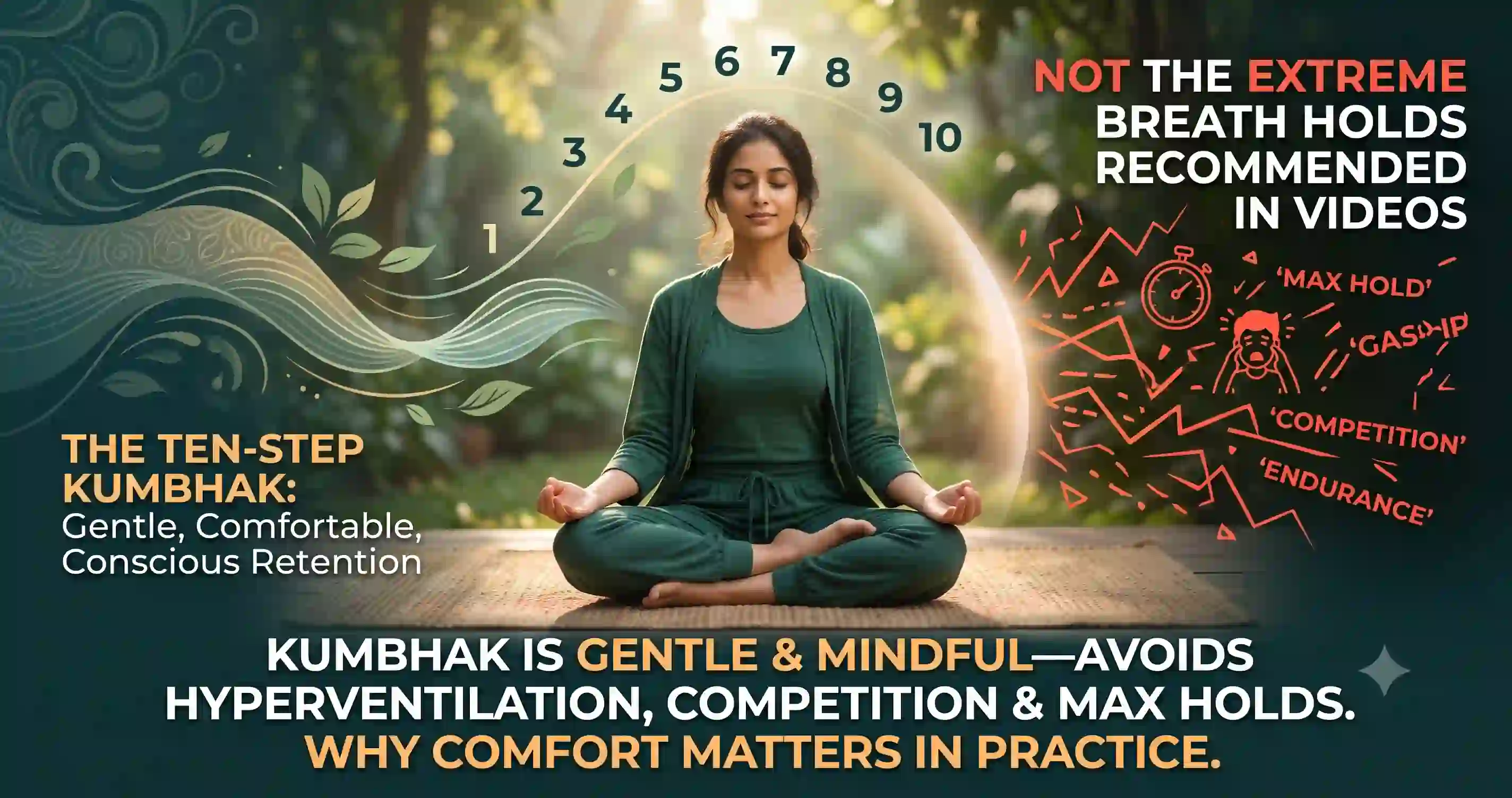
You press play. A timer climbs in the corner of the screen. Someone takes a series of enormous breaths, holds for an astonishing length of time and rises smiling. Beneath the video, the comments fill with numbers:
“Two minutes today.”
“Can anyone beat three?”
“Push through the urge—it is only your mind.”
The performance may be real. The person may be highly trained. The method may even have a valid purpose of its own.
But it is not Ten-Step Kumbhak for Stress Relief.
Ten-Step Kumbhak is not a diluted version of extreme breathwork, a beginner’s route to competitive apnoea or a test that becomes more valuable as the seconds increase. Its purpose is different. The normal Pūrak and Rechak are not used to wash out carbon dioxide. Neither retention is taken to the limit. No score is kept, no rival is needed and discomfort is never treated as an opponent.
The practice asks a quieter question:
Can you leave the breath completely at ease—and return before ease is lost?
That boundary is not a concession for weak lungs. It is the design.
The Short Answer: Four Things Ten-Step Kumbhak Is Not 🧭
Ten-Step Kumbhak for stress relief is:
- not hyperventilation: normal Pūrak and Rechak are used; there is no rapid, oversized pre-breathing intended to extend a hold;
- not a maximum breath hold: each retention ends while it still feels completely easy;
- not a competition: another person’s duration—and even your own previous duration—is irrelevant;
- not an endurance test: success is judged by relaxed practice and the after-effect, not by suffering, willpower or seconds.
Most importantly, the safety margin is now expressed as follows:
End each retention while it still feels completely easy and while you remain certain that you could have continued comfortably for at least another one to three seconds. If any urge to breathe, strain or uneasiness appears sooner, end the hold immediately.
That one-to-three-second margin is unused reserve, not a required holding time. A person who cannot comfortably hold for three seconds is not expected to do so. Their pause may be much briefer. If even a momentary retention does not remain comfortable, they should return to normal breathing and choose a practice without retention.
This article explains the boundaries, not the technique. For the complete method, read How to Practice the Ten-Step Kumbhak for Stress Relief.
1. Ten-Step Kumbhak Is Not Hyperventilation 🫁
Hyperventilation is often imagined as nothing more than visibly fast breathing. Physiologically, it means ventilating more than the body’s present metabolic need. It can arise from hurried breathing, unusually large repeated breaths or a combination of both.
Ten-Step Kumbhak does not use that preparation. Its Pūrak and Rechak remain normal—neither hurried nor deliberately drawn out—and the breath is not repeatedly enlarged to manufacture a longer pause.
Hyperventilation Can Extend the Number While Weakening the Warning
During hyperventilation, the body expels extra carbon dioxide. The fall in carbon dioxide, called hypocapnia, can delay the familiar urge to breathe. Oxygen does not receive an equally large boost because haemoglobin is ordinarily already highly saturated in a healthy person breathing room air.1
The result can be deceptive:
- carbon dioxide begins unusually low;
- the urge to breathe arrives later;
- oxygen continues to be consumed during the hold;
- the timer displays more seconds;
- yet the body’s normal warning has been postponed.
Longer, in this situation, does not necessarily mean stronger lungs, greater calm or better oxygenation. It may simply mean less warning.
A 2024 laboratory study illustrates the difference. Nine non-divers performed repeated maximal holds after either normal breathing or 30 seconds of hyperventilation. Hyperventilation lengthened the holds, but eight of the nine occasions on which participants reached the study’s 65% oxygen-saturation safety threshold occurred in the hyperventilation condition.2 This was an extreme research protocol, not Ten-Step Kumbhak, but it demonstrates why extra seconds cannot be assumed to represent extra safety.
Why Hyperventilation May Feel Like “Energy” or “Release”
Low carbon dioxide can be accompanied by light-headedness, tingling, altered bodily sensation, tightness, visual changes or a feeling of unreality. Hyperventilation-induced hypocapnia also constricts cerebral blood vessels and reduces cerebral blood flow.3
Those sensations may feel dramatic, cathartic or unusual. They are real experiences. But intensity is not proof of stress relief, detoxification, spiritual progress or a superior Kumbhak.
Ten-Step Kumbhak does not require an altered state to validate it. A quiet, uneventful round may be exactly right.
Different Breathwork Is Not Automatically Bad—It Is Simply Different
Some athletic, laboratory and specialist breathwork protocols deliberately use high ventilation, deep hypoxic exposure or long retentions. They should be evaluated according to their own goals, screening, supervision and evidence.
The mistake is not that another method exists. The mistake is importing its preparation, risks and scoreboard into a practice designed for stress relief.
A climbing rope, a sprint track and a resting chair can all serve the body. They do not ask the body to do the same thing.
2. Ten-Step Kumbhak Is Not a Maximum Breath Hold ⏱️
A maximum hold ends at the latest point a person can tolerate or physiologically sustain. Ten-Step Kumbhak ends at an earlier point: while comfort and voluntary choice are still fully present.
That single difference changes the meaning of the pause.
In a maximum attempt, the practitioner may watch for a record, endure air hunger, brace the chest or abdomen, suppress distress and wait until continuing feels impossible.
In Ten-Step Kumbhak, any urge to breathe, strain or uneasiness is already the instruction to stop.
“One to Three Seconds in Reserve” Is a Boundary, Not a Target
The phrase does not mean:
- hold for at least three seconds;
- calculate the final three seconds of your capacity;
- guess the moment oxygen will “run out”;
- reach discomfort and then subtract three seconds next time;
- or add time whenever yesterday’s retention felt easy.
It means:
- finish while the hold is still completely easy;
- leave a personally appropriate reserve of one to three comfortable seconds unused;
- and end earlier if any warning appears.
For someone with very little comfortable retention capacity, the unused reserve might be one second, not three. The actual hold may be only a moment. There is no minimum duration that must be achieved to make the practice “count.”
If you cannot honestly say, “I could have remained here comfortably for at least another second,” the pause has already gone beyond this practice’s intended boundary.
The Breath Does Not Behave Like a Countdown Clock
People often say their “breath ran out,” but the first urge to breathe is usually driven largely by rising carbon dioxide, while falling oxygen becomes increasingly important as a hold continues. The timing differs with starting lung volume, prior breathing, metabolism, health, training, expectation and individual chemosensitivity.4
That is why a universal stopwatch prescription cannot identify the right ending for everyone.
One person may remain untroubled for several seconds. Another may feel air hunger almost immediately. A third may become anxious before strong physiological signals appear. The correct boundary for stress relief is not whichever person lasts longest. It is the earliest point at which your own ease would begin to diminish.
A One-Minute Laboratory Kumbhak Is Not Evidence for a Brief Comfortable Pause
In a study of 20 healthy participants, a one-minute Kumbhak produced significant increases in systolic, diastolic and mean arterial pressure and total peripheral resistance, while stroke volume and cardiac output fell during the hold.5
This is valuable evidence that retention is physiologically active. It is not evidence that every short retention is harmful. It is also not permission to seek the same cardiovascular load.
The correct conclusion is narrower:
The dose matters. A substantial hold cannot be treated as interchangeable with a brief, easy pause.
3. Ten-Step Kumbhak Is Not a Competition 🏁
Competition changes attention.
The chest may still be still, but the mind begins running:
- “Was that longer than yesterday?”
- “What number did the teacher reach?”
- “Will anyone be impressed?”
- “Can I defeat the urge this time?”
The breath then becomes a scoreboard, and an inward stress-relief practice quietly turns into a performance under evaluation.
There Is No Fair Breath-Hold Comparison
Hold duration varies with many factors, including:
- starting lung volume;
- prior ventilation;
- oxygen availability;
- metabolic rate;
- body size and composition;
- respiratory-muscle activity;
- familiarity with air hunger;
- attention and expectation;
- illness, medication, fatigue and anxiety;
- and specialist training.
Because these variables differ, another person’s duration says very little about the dose that is appropriate for you. Even comparing today’s hold with yesterday’s can tempt you to ignore day-to-day changes in sleep, stress, congestion, energy or health.
The fairest comparison is not “Did I last longer?” It is:
Did I remain more honest about the first trace of effort?
The Internet Selects for Spectacle
Extreme breathwork videos naturally reward what can be seen: large movements, dramatic reactions, exceptional durations and triumphant endings. Comfort leaves no impressive thumbnail.
A video may also omit the performer’s training history, screening, failed attempts, recovery, safety team or the difference between demonstrating a capability and prescribing a wellbeing practice.
This does not make the performer dishonest. It means the viewer lacks the full context.
An advanced musician can accurately show a difficult solo without implying that a beginner should strike every note at maximum force. An exceptional breath hold can be genuine and still be the wrong model for stress relief.
Ending Earlier Is Not Losing
Imagine two people.
One holds until the face tightens, waits through the first urgent contraction and ends with a gasp. The timer is impressive.
The other ends several breaths earlier than expected, with no drama at all, because a faint trace of effort has appeared.
In Ten-Step Kumbhak, the second person has understood the assignment.
There is no medal for overriding a protective signal. The capacity to stop without embarrassment may be the deeper self-regulation skill.
4. Ten-Step Kumbhak Is Not an Endurance Test 💪
An endurance test asks, “How long can you continue under increasing demand?”
Ten-Step Kumbhak asks, “Can you remain within a dose that serves ease?”
Both can involve discipline, but they train different relationships with sensation.
Breath-Hold Performance Is Trainable—but That Does Not Make It a Health Score
Six weeks of voluntary apnoea training increased participants’ longest average hold from about 80 to 107 seconds in one randomised study. Yet it did not significantly reduce acute mountain sickness or improve oxygen saturation, anxiety, insomnia, perceived exertion, heart rate or blood pressure at altitude compared with the control group.6
The study offers a clean lesson:
A better breath-hold time proves that breath-hold time improved. It does not automatically prove broader resilience, superior oxygenation or better health.
Similarly, a brief high-ventilation practice with long retentions was tested against an active breathing comparator in 200 healthy young adults. Both groups’ stress improved over three weeks, but the intense protocol was not significantly superior for stress, anxiety, depression, wellbeing or sleep-related impairment.7
More respiratory drama did not produce a clearly better mental-health result.
Stress Relief Needs a Different Set of Outcomes
For a stress-relief practice, useful questions include:
- Did the round remain relaxed from beginning to end?
- Did your face, throat, shoulders, chest and abdomen remain free of bracing?
- Did you return to normal breathing without a recovery gasp?
- Did you feel settled, neutral or uncomfortable afterward?
- Did the practice reduce pressure—or create another duty to perform?
- Could you stop immediately without feeling that you had failed?
These observations are more relevant than a stopwatch.
The purpose is not to become good at enduring respiratory distress. It is to practise a pause that never has to become distressing.
5. Why the Boundary Matters Specifically for Stress Relief 🧠❤️
Stress often arrives as urgency: fix it now, escape now, prove yourself now, do more now.
A breath practice can accidentally reproduce that pattern. A timer becomes a deadline. A teacher’s number becomes an expectation. The urge to breathe becomes an enemy. The body braces while the practitioner calls it discipline.
Ten-Step Kumbhak is protected from that contradiction by ending before the struggle begins.
The Practice Does Not Ask the Nervous System to Earn Safety
The intended experience is not:
“I survived the discomfort, so I am strong.”
It is closer to:
“I noticed the boundary and respected it before discomfort took over.”
That distinction is psychologically important even though the exact Ten-Step sequence has not yet been isolated in a controlled clinical trial.
For some people, a brief voluntary pause may feel steadying. For others—especially people with panic, breathlessness or suffocation-related trauma—it can feel threatening. In a trial involving adults with post-traumatic stress disorder, a broader prāṇāyāma programme containing retention produced recurrent minor adverse events including anxiety, breathlessness, dizziness and constriction; one participant experienced a suffocation-related flashback.8
Choice is therefore part of safety. A person is free to shorten the retention, end it immediately or not practise retention at all.
A Calm Result Cannot Be Forced
There is a small paradox at the heart of stress relief:
The harder you try to manufacture calm, the more the attempt itself can feel like pressure.
Ten-Step Kumbhak does not promise a particular feeling after every round. A practitioner may feel quieter, unchanged or uncomfortable. Honest observation is more useful than performing the response a teacher or video predicted.
If the result is discomfort, that is not disobedience. It is information.
6. The Scientific Difference Between an Easy Pause and an Extreme Hold 🔬
Science does not support treating every breath retention as the same exposure. Duration, starting lung volume, prior breathing, body movement, repetitions and individual health can all change the response.
Carbon Dioxide
During a closed-airway hold, carbon dioxide generally rises. This contributes strongly to the urge to breathe and dilates cerebral blood vessels.
Hyperventilation reverses the starting condition: carbon dioxide is lowered before the hold, delaying the warning and constricting cerebral vessels.
Therefore:
A hold after normal breathing and a hold after hyperventilation may display the same number of seconds while creating different internal conditions.
Oxygen
Oxygen is consumed throughout a hold. A brief comfortable pause may cause little meaningful desaturation in a healthy person, whereas a prolonged or repeated maximal apnoea can create substantial hypoxaemia.
There is no universal second at which this happens. Pulse-oximeter readings can also be unreliable with movement or reduced peripheral circulation. The US Food and Drug Administration advises interpreting readings alongside symptoms and notes that several factors can affect accuracy.16 A wearable should never be used as permission to ignore symptoms or extend a retention.
Blood Pressure and Circulation
Retention can change heart rate, vascular resistance, stroke volume, cardiac output and blood pressure. The direction and size of these changes depend on the protocol and the phase measured.
This prevents two simplistic claims:
- “Kumbhak always activates rest-and-digest.”
- “Any rise in pressure means Kumbhak is harmful.”
Both erase dose, timing and population. The evidence supports precision, not slogans.
Brain Blood Flow
Long Kumbhak and maximal apnoea can increase cerebral blood-flow velocity as carbon dioxide rises and the body defends oxygen delivery. That response should not be translated into “more blood flow means more brain power.”
In 11 trained male apnoea divers, maximal dry breath holding acutely impaired dynamic cerebral autoregulation by the end of the attempt, and the impairment was strongly related to the rise in carbon dioxide.9 This extreme exposure cannot be projected onto a brief Ten-Step pause. Its relevance is the opposite: it shows why the two should not be spoken about as if they were identical.
What the Evidence Can—and Cannot—Say About Ten-Step Kumbhak
The available research supports these statements:
- voluntary retention is physiologically active;
- pre-hold hyperventilation can lengthen a hold by delaying the carbon-dioxide warning;
- substantial or maximal holds can create cardiovascular, cerebrovascular and hypoxic stress;
- hold duration can improve without the health outcome someone expected;
- and intense retention is not proven superior for stress reduction.
The research does not yet establish:
- the exact physiological dose produced by the complete Ten-Step sequence;
- that its retentions alone cause stress relief;
- that one-to-three seconds of unused reserve is a clinically validated universal threshold;
- or that the practice treats any medical or psychiatric disorder.
The reserve is a conservative practice rule intended to prevent limit-seeking. It is not a laboratory-derived guarantee.
7. What Classical Yoga Actually Warns About 🕉️
Classical yoga contains powerful claims about Kumbhak, but it does not present careless force as a virtue. Two especially relevant passages protect the difference between disciplined practice and respiratory aggression.
Haṭha Yoga Pradīpikā 2.15: Train by Degrees, Not by Violence
yathā siṃho gajo vyāghro bhaved vaśyaḥ śanaiḥ śanaiḥ
tathaiva sevito vāyur anyathā hanti sādhakam || 2.15 ||
Close translation: “As lion, elephant and tiger are tamed by degrees, so should breath be approached; otherwise it harms the practitioner.”10
The metaphor is exact for this discussion. A wild animal is not made trustworthy through one heroic contest. The relationship is cultivated through measure, attention and respect for consequences.
This verse does not give the Ten-Step safety margin, and it should not be misrepresented as if it did. It does provide a traditional principle that strongly contradicts maximum-hold bravado: force can turn practice against the practitioner.
Yoga Sūtra 2.50: Place, Time, Number—and Subtlety
bāhyābhyantara-stambha-vṛttir deśa-kāla-saṅkhyābhiḥ paridṛṣṭo dīrgha-sūkṣmaḥ || 2.50 ||
Patañjali describes the external, internal and suspended movements of prāṇāyāma as observed or regulated through place, time and number, becoming extended and subtle.11
The important word beside dīrgha—extended—is sūkṣma: subtle, fine or refined. Reading only “long” and ignoring “subtle” turns a paired description into a duration contest.
Time and number are parameters of practice, not trophies. Measurement is useful when it protects proportion. It becomes distortion when the number replaces the purpose.
Haṭha Yoga Pradīpikā 2.16: A Traditional Claim—and an Important Warning
The next verse says that properly applied prāṇāyāma destroys disease, whereas improper practice gives rise to disease.12 Its universal disease claim belongs to the traditional yogic worldview and has not been verified as a universal biomedical fact.
Yet the verse’s ethical structure remains relevant: technique is not automatically beneficial merely because it is called yoga. Method, dose and manner matter.
The traditional text and modern physiology do not make identical claims. They do, however, converge on one practical caution:
“More” and “harder” are not synonyms for “more skilful.”
8. The Ayurvedic Lens: Right Measure Before More Measure 🌿
Ayurveda does not describe the modern Ten-Step Kumbhak, so it cannot be cited as proof of this exact method. Its classical logic can nevertheless illuminate why an individual limit matters.
Prāṇa Vāta Connects Breath With a Wider Human System
Aṣṭāṅga Hṛdaya, Sūtrasthāna 12.4–5, describes Prāṇa Vāta as located in the head and moving through the chest and throat, with functions involving mind, heart, senses, intellect, breathing and swallowing.13
This is a traditional Ayurvedic model, not a scientifically established synonym for the autonomic nervous system, cranial nerves or respiratory control centres. It should be allowed to speak in its own language.
Within that language, breathing is not merely air moved by respiratory muscles. It participates in an interdependent field of attention, sensory life, chest function and mental activity. A retention that produces fear, agitation, bracing or breathlessness would therefore not become more desirable simply because its duration increased.
Caraka’s Principle of Proper Exertion
The Caraka Saṃhitā, Sūtrasthāna 7.31–35, defines physical exercise as activity intended to bring stability and strength, says it should be practised in the right measure and lists exhaustion, fatigue, thirst, cough, fever, vomiting and severe breathlessness among consequences of excess.14
This passage concerns physical exercise, not Kumbhak. Applying it here is an analogy, not a claim that Caraka taught the Ten-Step method.
The analogy is still useful: an activity intended to strengthen should not be judged only by how much hardship a person can survive. Ayurveda repeatedly asks whether a dose suits the person and the condition. A stress-relief retention that becomes an endurance feat has left the logic of right measure.
What Has Not Been Scientifically Verified
The following traditional interpretations should not be presented as proven biomedical mechanisms:
- that comfortable Ten-Step Kumbhak balances Prāṇa Vāta;
- that it clears Nāḍīs or redistributes Prāṇa in a measurable anatomical pathway;
- that it destroys all diseases;
- or that a particular retention duration produces a specific Doṣa effect in every person.
Readers may value these as yogic or Ayurvedic truths, hypotheses or interpretive frameworks. They should not be disguised as findings from clinical trials.
Respect does not require collapsing every traditional word into a modern nerve, hormone or gas measurement. Accuracy protects both traditions.
9. For Teachers, Authors and Video Creators: Name the Practice Honestly 🎥
A teacher can demonstrate extreme capacity responsibly. An author can write about the physiology of maximum apnoea accurately. A video creator can explore an intense practice without pretending it is Ten-Step Kumbhak.
The protective action is clear labelling.
State the Goal Before Showing the Method
Tell the audience whether the content concerns:
- stress relief;
- general breath awareness;
- traditional advanced prāṇāyāma;
- athletic hypoventilation training;
- freediving;
- a laboratory challenge;
- or a personal maximum-hold experiment.
Do not move evidence from one category into another without saying so. A freediving result does not become proof of stress relief merely because both activities contain a breath hold.
Do Not Let the Timer Become the Teacher
If duration is displayed, viewers may naturally infer that a higher number is the intended result. For Ten-Step Kumbhak content, a creator can prevent that assumption by stating plainly:
- the hold ends before the urge to breathe;
- one to three seconds are deliberately left in comfortable reserve;
- three seconds is not a minimum holding time;
- beginners should not copy the demonstrator’s duration;
- and no viewer is asked to beat a previous attempt.
Showing one intentionally brief round may teach the method’s purpose better than displaying an exceptional hold.
Never Manufacture Agreement Through Shame
Avoid messages such as:
- “Your mind gives up before your body.”
- “Discomfort means the technique is working.”
- “Serious practitioners push through.”
- “Anyone can reach this number if they stop making excuses.”
- “If you felt anxious, you did it incorrectly.”
These phrases make stopping socially expensive. They can lead a viewer to conceal symptoms or treat a protective response as personal failure.
A more responsible invitation is:
“You do not need to match me. End while it is completely easy, observe what you feel and stop altogether if retention does not suit you.”
That does not weaken instruction. It makes consent real.
10. How to Recognise When a Practice Has Quietly Become a Test 🚦
A Ten-Step Kumbhak round is drifting away from its purpose if you notice:
- taking repeated large breaths to make the coming hold easier;
- breathing rapidly before the pause;
- starting a stopwatch or counting with the aim of setting a record;
- checking another person’s duration;
- postponing the end after the first urge to breathe;
- tightening the face, jaw, throat, shoulders, chest or abdomen;
- pulling the abdomen inward during Bāhya Kumbhak;
- gulping, gasping or needing several recovery breaths;
- feeling disappointed by a shorter hold;
- adding rounds to prove that the practice “worked”;
- hiding symptoms because others appear comfortable;
- or believing that discomfort is evidence of purification, weakness leaving the body or superior progress.
None of these makes someone a bad practitioner. They are simply signs that the goal has shifted.
The correction is not self-criticism. It is a return to normal breathing, honest observation and the freedom to stop.
11. A Better Definition of Progress 🌱
Progress in Ten-Step Kumbhak is not necessarily a longer retention.
It may look like:
- noticing effort earlier;
- ending without bargaining for another second;
- remaining relaxed with a briefer pause;
- feeling no need to compare;
- returning to normal breathing without urgency;
- reducing the number of rounds on a tiring day;
- accepting a neutral result without manufacturing a positive one;
- or choosing not to retain when your body or mind says no.
These changes do not photograph dramatically. They may never become viral.
But stress relief is often built from quiet moments in which the body discovers that it will be listened to.
12. Essential Safety Boundaries ⚠️
Practise only while seated safely in an appropriate place. Never practise breath retention while driving, swimming, bathing, in water, operating machinery, walking somewhere unsafe or doing any activity in which dizziness or a brief loss of awareness could cause injury.
The American Red Cross, YMCA of the USA and USA Swimming jointly warn that voluntary hyperventilation before underwater swimming and extended underwater breath holding are dangerous and potentially deadly.15 Ten-Step Kumbhak is a dry, seated stress-relief practice; it must never be converted into an underwater challenge.
Stop immediately and return to normal breathing if you experience:
- dizziness, light-headedness, faintness or visual disturbance;
- tingling, numbness, confusion or loss of coordination;
- unusual breathlessness;
- chest pain, pressure, tightness or palpitations;
- severe headache;
- panic, dissociation or a traumatic memory;
- involuntary jerking;
- or any other discomfort.
Seek appropriate medical care if a serious or unusual symptom persists. Loss of consciousness, chest pain, severe breathlessness or persistent neurological symptoms warrants urgent evaluation.
People with heart or lung conditions should obtain guidance from a qualified healthcare professional before breath retention. The same conservative approach is appropriate for people with significant blood-pressure, neurological, fainting, pregnancy-related, glaucoma or retinal, panic-related or trauma-related concerns.
This article is educational. Ten-Step Kumbhak is not a substitute for diagnosis, prescribed treatment, psychotherapy, emergency care or a clinician-approved plan.
13. Frequently Asked Questions ❓
Is Ten-Step Kumbhak a Form of Hyperventilation?
No. Its Pūrak and Rechak remain normal, and it does not use repeated hurried or oversized breaths to lower carbon dioxide before retention.
How Long Should a Ten-Step Kumbhak Hold Last?
There is no universal number of seconds. End while the retention still feels completely easy and while you are certain you could have continued comfortably for at least another one to three seconds. End sooner at the first urge, strain or uneasiness.
What If I Cannot Hold My Breath for Three Seconds?
You do not have to. The one-to-three-second instruction describes the comfortable reserve left unused, not the minimum length of the retention. Your pause may be only a moment. If even that does not remain comfortable, do not retain the breath.
Should I Time My Retentions?
Not for the purpose of Ten-Step Kumbhak stress relief. Timing readily turns a comfort boundary into a performance target. The relevant measure is whether the pause remained entirely easy.
Does a Longer Hold Mean Better Stress Relief?
No such dose-response has been established. Research shows that hold duration can improve without improving unrelated health outcomes, and an intense high-ventilation method with long retentions was not superior to an active breathing comparator for stress.
Is the First Urge to Breathe Something I Should Overcome?
No. In this practice it is an instruction to end the retention immediately. Ten-Step Kumbhak is intentionally completed before that urge appears whenever possible.
Are Extreme Breathwork Videos Wrong?
Not necessarily. They may depict athletic training, a different therapeutic ritual, specialist practice or personal experimentation. The error is assuming that their aim, physiology, dose and safety conditions belong inside Ten-Step Kumbhak for stress relief.
Can I Use a Pulse Oximeter to Decide How Long to Hold?
No. Consumer readings can be inaccurate, and an acceptable-looking number does not cancel symptoms. The practice ends by its comfort rule, not by waiting for a device to grant permission.
The Real Achievement Is Returning Before Struggle Begins 🌌
Extreme breathwork can make the breath look like a mountain: climb higher, remain longer, conquer the body, collect the number.
Ten-Step Kumbhak for stress relief offers another image.
The pause is a small, sheltered room. You enter without force. You stay only while the room remains peaceful. You leave the door open behind you—and return before peace has to become endurance.
No hyperventilation.
No maximum hold.
No competition.
No test of worth.
The unused one-to-three-second reserve is not empty time. It is the part of your capacity you deliberately refuse to turn into pressure.
In Ten-Step Kumbhak, restraint is not measured by how long you prevent the next breath. It is revealed by how early you choose ease over excess.
References and Evidence Notes 📚
Evidence reviewed 24 July 2026. This is a narrative, source-linked article rather than a registered systematic review. Future research may change the conclusions.
-
Divers Alert Network. “Hypoxia in Breath-Hold Diving.” Explains that hyperventilation produces a large fall in carbon dioxide but only a small increase in oxygen content, delaying the urge to breathe. Read the safety explanation. ↩
-
Elia A, Gennser M, Eiken O, Keramidas ME. “Effects of hyperventilation on repeated breath-holding while in a fasting state: do risks outweigh the benefits?” American Journal of Physiology-Regulatory, Integrative and Comparative Physiology. 2024;326(4):R319–R329. doi:10.1152/ajpregu.00260.2023. PubMed record. ↩
-
Godoy DA, Seifi A, Garza D, Lubillo-Montenegro S, Murillo-Cabezas F. “Hyperventilation in neurological patients: from physiology to outcome evidence.” Current Opinion in Critical Care. 2019;25(2):108–114. Full text. ↩
-
Lindholm P, Conniff M, Gennser M, Pendergast D, Lundgren CEG. “Effects of fasting and carbohydrate consumption on voluntary resting apnea duration.” European Journal of Applied Physiology. 2007;100(4):417–425. doi:10.1007/s00421-007-0442-7. PubMed record. ↩
-
Nivethitha L, Mooventhan A, Manjunath NK. “Evaluation of cardiovascular functions during the practice of different types of yogic breathing techniques.” International Journal of Yoga. 2021;14(2):158–162. Full text. ↩
-
Shah N, Bye K, Marshall A, et al. “The effects of apnea training, using voluntary breath holds, on high altitude acclimation: Breathe-High Altitude Study.” High Altitude Medicine & Biology. 2020;21(2):152–159. doi:10.1089/ham.2019.0087. PubMed record. ↩
-
Fincham GW, Epel E, Colasanti A, Strauss C, Cavanagh K. “Effects of brief remote high ventilation breathwork with retention on mental health and wellbeing: a randomised placebo-controlled trial.” Scientific Reports. 2024;14:16893. Full text. ↩
-
Haller H, Mitzinger D, Cramer H. “The integration of yoga breathing techniques in cognitive behavioral therapy for post-traumatic stress disorder: A pragmatic randomized controlled trial.” Frontiers in Psychiatry. 2023;14:1101046. doi:10.3389/fpsyt.2023.1101046. The primary intention-to-treat result did not establish superiority, and the study documented retention-relevant adverse experiences. Full text. ↩
-
Cross TJ, Kavanagh JJ, Breskovic T, et al. “Dynamic cerebral autoregulation is acutely impaired during maximal apnoea in trained divers.” PLOS ONE. 2014;9(2):e87598. doi:10.1371/journal.pone.0087598. Full text. ↩
-
Haṭha Yoga Pradīpikā 2.15. Sanskrit and historical English translation available in the linked chapter. The close translation in this article is deliberately conservative. Verified chapter text. ↩
-
Yoga Sūtra 2.50 with Vyāsa’s Bhāṣya. Verified Sanskrit text and commentary. ↩
-
Haṭha Yoga Pradīpikā 2.16. The verse’s disease language is reported as a traditional claim, not endorsed as a universal medical fact. Verified chapter text. ↩
-
Aṣṭāṅga Hṛdaya, Sūtrasthāna 12.4–5. Sanskrit text and translation describing Prāṇa Vāta. Read the verses. ↩
-
Caraka Saṃhitā, Sūtrasthāna 7.31–35. The text defines exercise, recommends right measure and describes consequences of excess. Sanskrit and translation. ↩
-
American Red Cross, YMCA of the USA and USA Swimming. “Joint Statement on Hypoxic Blackout and Inaccurate Use of the Terminology Shallow Water Blackout.” January 2022. Read the joint statement. ↩
-
US Food and Drug Administration. “Pulse Oximeter Basics.” The agency advises using readings in context and lists poor circulation, skin pigmentation, skin temperature and other factors that may affect accuracy. Read the FDA guidance. ↩