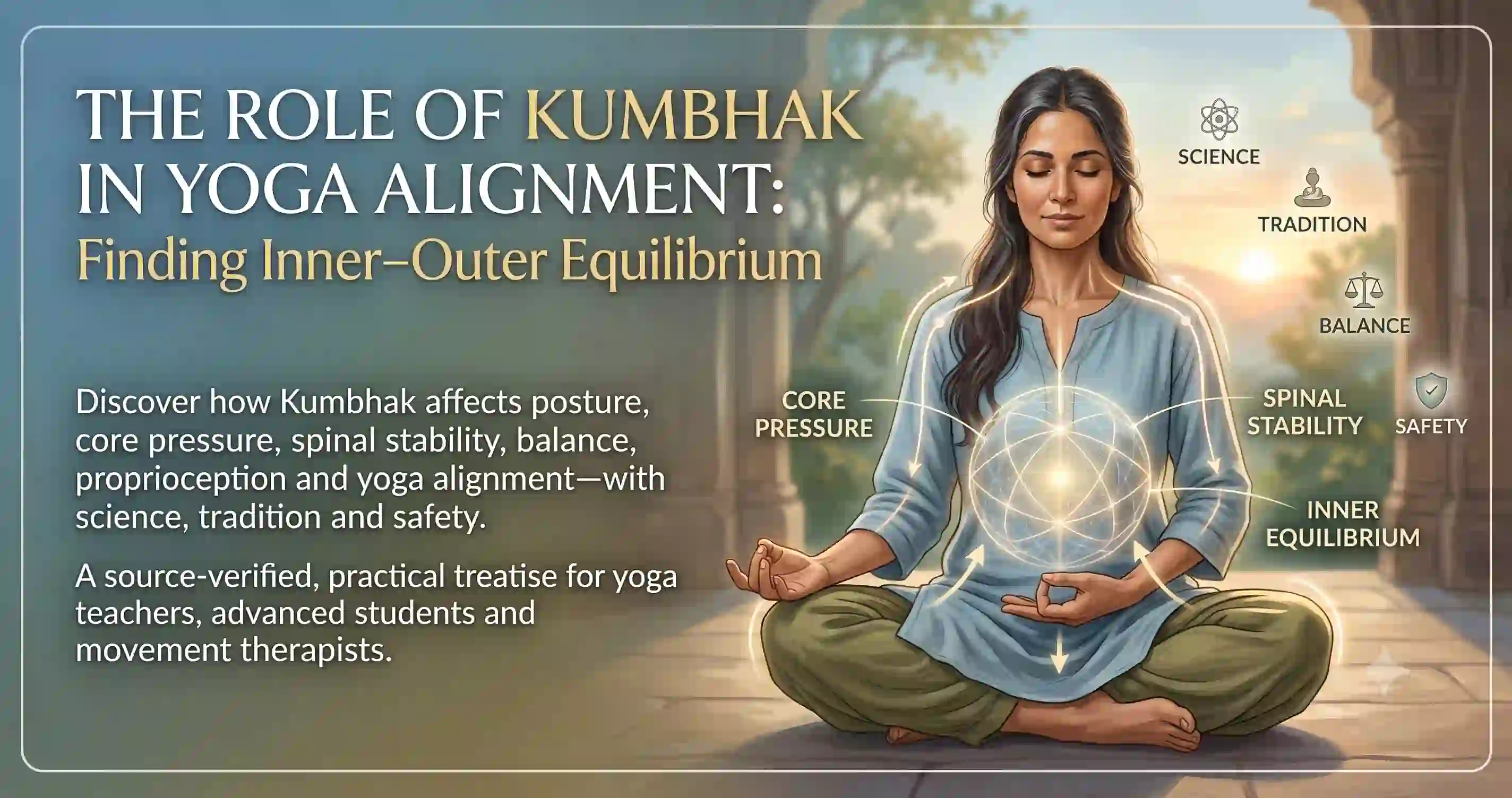
Discover how Kumbhak affects posture, core pressure, spinal stability, balance, proprioception and yoga alignment—with science, tradition and safety. A source-verified, practical treatise for yoga teachers, advanced students and movement therapists.
By Kumbhaki Yogi Dhruvaji (MSc), founder of the Antistress Foundation 501(c)(3)
• How to Practice Ten-Step Kumbhak • Scientific Proof • Ancient Texts Proof • Bio • Subscribe
For years, Maya heard the same correction: “Pull your shoulders back.” She obeyed until her photographs looked straighter—and her neck hurt more. One day, a teacher asked her to stop performing the shape and notice three things instead: where the ribs were moving, where the feet were carrying her, and whether the jaw could remain free.
Maya’s shoulders did not suddenly become perfect. Something more important happened: her body stopped feeling like a diagram she kept failing.
That is the doorway into this subject.
Yoga alignment is often described from the outside: knee over ankle, pelvis level, sternum lifted, crown rising. Those landmarks matter. Yet a living posture is never only a geometry of bones. It is a negotiated equilibrium among gravity, ground reaction force, joint shape, muscle activity, connective-tissue tension, internal pressure, vision, vestibular input, sensation, attention—and breath.
Kumbhak, the pause in respiratory movement, changes several of those conditions at once. It temporarily fixes lung volume. It alters the shape and pressure state of the trunk. It removes some of the mechanical oscillation produced by breathing. It may make weight distribution easier to notice. In an appropriate context, that still interval can become a somatic “measurement window” in which inner organization and outer form are felt together.
But precision matters. A comfortable Kumbhak is not automatically a weightlifter’s brace. Held air alone is not a protective corset. Bāhya Kumbhak is not automatically an abdominal vacuum. No clinical trial has established that Kumbhak prevents injury in a backbend, improves a handstand, corrects rounded shoulders permanently or treats low-back pain.
The credible conclusion is both humbler and more useful:
Kumbhak can temporarily change the mechanical and perceptual conditions under which alignment is sensed. When trunk pressure is also coordinated appropriately, it may contribute to stiffness and force transfer. Its safest role in the Ten-Step Kumbhak for Stress Relief is not to force an advanced pose, but to cultivate relaxed uprightness, chest-centre awareness, internal stillness and honest self-observation.
This treatise explains that claim from scientific, somatic, yogic and Ayurvedic perspectives—without asking one framework to impersonate another.
The Answer First: What Kumbhak Can—and Cannot Yet—Be Said to Do 🔎
What is directly supported by human research
-
🫁 Lung volume changes spinal and rib-cage geometry. In a radiographic study of 48 healthy adults, maximal inspiration reduced measured thoracic kyphosis, while maximal expiration increased it. This demonstrates an acute positional relationship; it does not prove permanent postural correction.1
-
🧍 Breathing perturbs standing balance. A 2024 systematic review found that respiratory demand and chest-wall motion affect centre-of-pressure behaviour. Across the included studies, breath holding tended to reduce sway compared with quiet breathing, although individual experiments and measurement conditions were not fully consistent.2
-
🧱 Intra-abdominal pressure can increase lumbar stiffness. Experimental work shows that raising intra-abdominal pressure can increase spinal stiffness, and biomechanical models support a stabilizing role when pressure is coordinated with the abdominal wall and other trunk muscles.34
-
🎯 The diaphragm has a postural role. It activates in anticipation of rapid limb movement and coordinates with transversus abdominis as pressure rises before the limb moves.56
-
❤️ Kumbhak is physiologically active, not neutral. During one-minute retentions in healthy participants, arterial pressure and vascular resistance rose while stroke volume and cardiac output fell. Starting lung volume, posture, effort and duration all matter.78
What is plausible but not directly proven in yoga poses
- A brief pause may give a practitioner a less mobile thorax from which to notice a hiked hip, collapsed arch or rotated pelvis.
- A high-lung-volume Antar Kumbhak may make axial lift and anterior–lateral rib expansion more palpable.
- A low-lung-volume Bāhya Kumbhak may reduce the respiratory bulk between torso and thighs and make folding feel less obstructed.
- Retention combined with appropriate muscular co-contraction may help the trunk behave as a more unified force-transmission segment.
- Reduced respiratory movement may improve the subjective signal-to-noise ratio for somatic observation.
These are reasonable biomechanical or experiential inferences. They have not been established as injury-prevention effects in Tāḍāsana, Caturaṅga Daṇḍāsana, Ūrdhva Dhanurāsana, Bakāsana or handstand.
What should not be claimed
- Kumbhak “automatically activates” transversus abdominis, multifidus or the pelvic floor.
- Antar Kumbhak necessarily creates enough intra-abdominal pressure to protect the lower back.
- Bāhya Kumbhak by itself creates negative intra-abdominal pressure or lifts the organs.
- A breath hold decompresses the discs, rehydrates the spine or centres a joint.
- Less postural sway always means better proprioception, better balance or a safer pose.
- A straighter-looking posture is always a healthier posture.
- Longer retention produces better alignment.
The boundary between a compelling metaphor and a factual mechanism is where credibility lives.
Alignment Redefined: The Agreement Between Inner Pressure and Outer Form 🧭
External alignment is real—but incomplete
External alignment describes observable relationships:
- the line of the tibia relative to the foot;
- the relation of the femoral head to the pelvis;
- the distribution of spinal curves;
- the orientation of the scapulae on the rib cage;
- the projection of the centre of mass over the base of support;
- and the direction in which force travels through the hands or feet.
Those relationships cannot be judged by one universal photograph. Bone proportions, joint surfaces, injury history, age, pain, mobility, strength and purpose differ. “Knee over ankle” may be a useful starting cue, not a moral law. The relevant question is not only Does the body match the model? but also:
Can this person organize force, breathe, sense, adapt and exit the position without pain, panic or loss of control?
Internal alignment is a pressure–tension relationship
The torso is not an empty cage around a stack of vertebrae. It contains two pressure-sensitive cavities separated by the diaphragm:
Thoracic cavity 🫁
- bounded by the ribs, sternum, thoracic spine and diaphragm;
- changes volume with rib and diaphragm movement;
- contains lungs, heart and major vessels;
- develops pressure changes that influence circulation as well as mechanics.
Abdominal–pelvic cavity 🧱
- bounded above by the diaphragm;
- bounded below by the pelvic floor;
- enclosed circumferentially by the abdominal wall, fascia and posterior trunk structures;
- contains tissues and fluids that are relatively incompressible compared with gas.
When the diaphragm and trunk wall coordinate, pressure inside the abdominal cavity can contribute to trunk stiffness. When the rib cage changes volume, spinal shape and shoulder-girdle position can also change. Alignment therefore emerges from a conversation:
Outer form ↔ muscular tension ↔ cavity pressure ↔ gravity ↔ sensation ↔ attention
Kumbhak does not control every term in that equation. It changes enough of them to make the conversation easier to hear.
Why kumbha, the vessel, remains a useful metaphor
The word Kumbhak is related to kumbha, a pot or vessel. The metaphor fits because the torso is treated as a contained field rather than as isolated bones and muscles.
Yet a human torso is not literally a clay pot or pneumatic tyre:
- the airway may be open or closed in different kinds of pause;
- the glottis may close firmly or only partially;
- the lung tissue remains compliant;
- the diaphragm may hold, relax or respond posturally;
- the abdominal wall may brace, hollow or remain relaxed;
- pressure can change while volume appears similar;
- and the cardiovascular system is affected by thoracic pressure.
“Internal scaffold” is therefore a teaching image, not a complete material description.
Antar Kumbhak: The Expansive Internal Scaffold 🫁
What actually changes after Pūrak
During Pūrak, thoracic volume increases. The diaphragm descends, the ribs rotate and elevate, and the chest expands in anterior–posterior and lateral dimensions. At the end of a comfortable Pūrak, Antar Kumbhak temporarily preserves that higher-lung-volume geometry.
The upper ribs contribute a “pump-handle” movement that carries the sternum forward and upward; the lower ribs contribute more “bucket-handle” widening. The exact pattern varies with posture, effort, anatomy and where attention is directed.9
In the Ten-Step Kumbhak for Stress Relief, the centre of the chest is lifted during normal Pūrak, while the shoulders remain down and the back is not arched. The hold remains completely easy; the abdomen, jaw, throat, shoulders and chest are not braced.
That matters. In this method, the most faithful version of the “internal scaffold” is not a hard cylinder. It is an expanded but relaxed thoracic reference shape.
What the scaffold metaphor can legitimately mean
During a comfortable Antar Kumbhak, a practitioner may perceive:
- a sternum that remains lifted without repeated movement;
- more lateral width across the rib cage;
- a clearer distinction between thoracic lift and lumbar arching;
- an axial direction through the crown;
- a more stable visual and tactile reference for noticing weight distribution;
- and a vivid contrast between shoulders that are relaxed and shoulders that are being used to manufacture height.
This can be structurally educational even if intra-abdominal pressure remains modest.
What Antar Kumbhak does not guarantee
A high lung volume can coexist with:
- rib flare;
- lumbar hyperextension;
- elevated shoulders;
- cervical compression;
- abdominal gripping;
- excessive intra-thoracic pressure;
- or a Valsalva-like effort.
The shape is not aligned merely because the chest is full. The diagnostic questions are:
- Did the centre of the chest lift without the lower ribs thrusting forward?
- Did the shoulders remain released?
- Did the back stay naturally upright rather than become rigid?
- Did the face, jaw, throat and abdomen remain relaxed?
- Did the pause end well before urgency?
If not, the “scaffold” has become a brace, a compensation or a stress signal.
Thoracic expansion can change posture without curing posture
In the radiographic study noted earlier, maximal inspiration reduced thoracic kyphosis by a median of about four degrees relative to the reference lung volume; maximal expiration increased it by about ten degrees. The head, pelvis and spinal curves also compensated to preserve an upright orientation.1
This supports a precise claim:
Changing lung volume can acutely change spinal geometry.
It does not support these stronger claims:
- Antar Kumbhak permanently corrects hyperkyphosis.
- Held inhalation reverses structural scoliosis.
- Expanded lungs mechanically “pull” the scapulae into one ideal position.
- More thoracic extension is always desirable.
For someone already living in rib flare, extension bias or excessive lumbar lordosis, “lift the chest more” may amplify the problem. The chest-centre cue must remain married to relaxed shoulders, a non-arched back and subjective ease.
Bāhya Kumbhak: Low-Volume Stillness, Compression and Folding 🌙
What actually changes after Rechak
During Rechak, thoracic volume decreases, the ribs descend and narrow, and the diaphragm returns upward. A Bāhya Kumbhak preserves this lower-lung-volume configuration for a brief interval.
In the Ten-Step method, Rechak is normal and the chest centre is lowered without collapsing the back or forcing out air. During Bāhya Kumbhak, the chest centre remains lowered, while the abdomen and diaphragm are not pulled inward. The body remains relaxed.
That makes the practice categorically different from full Uḍḍīyāna Bandha.
Why low lung volume can make folding feel less obstructed
At lower lung volume:
- the rib cage occupies a smaller expanded volume;
- the anterior thorax may move closer to the pelvis or thighs;
- the spine may move toward more flexion;
- and the practitioner may feel less respiratory resistance in a twist or fold.
The same radiographic research that found reduced kyphosis at maximal inspiration found increased thoracic kyphosis at maximal expiration.1 This offers a credible mechanical basis for the familiar experience that Rechak accompanies flexion and rotation well.
The claim must remain proportional: lower lung volume permits a different geometry; it does not automatically make that geometry safe, deep or therapeutically beneficial.
Bāhya Kumbhak is not automatically a vacuum
Several popular descriptions make a basic error:
“Exhale, hold, and negative pressure automatically lifts the organs and decompresses the lumbar spine.”
A simple post-exhale hold does not necessarily produce that event. Uḍḍīyāna Bandha adds a distinct manoeuvre: after Rechak, the practitioner expands the thorax against a closed airway so that the abdominal wall moves inward and upward. That compound action changes pressures differently from relaxed Bāhya Kumbhak.10
The Ten-Step practice specifically does not ask for abdominal suction, diaphragm manipulation or bandha. Its Bāhya Kumbhak is a completely easy pause at comfortable emptiness.
Compression is not collapse
In a well-organized fold, “compression” can mean that body surfaces approach one another while force remains distributed across many joints. Collapse is different: one region gives way because another region has not contributed.
Examples:
- In Paścimottānāsana, the torso moving toward the thighs should not be purchased by forcing only the lumbar spine into end-range flexion.
- In Ardha Matsyendrāsana, a smaller rib volume may permit rotation, but it does not justify levering the arms against the knee.
- In standing forward flexion, Bāhya Kumbhak should never become a reason to remain inverted while dizzy.
Low-volume stillness may reveal a fold. It should never be used to overpower one.
Kumbhak, Intra-Abdominal Pressure and Core Stabilization 🧱
The “core canister” model
A useful rehabilitation model describes the deep trunk as a pressure-regulating canister:
Roof: respiratory diaphragm
Floor: pelvic floor
Front and sides: transversus abdominis, internal and external obliques and other abdominal tissues
Back: multifidus, erector spinae and posterior fascial structures
This is a model of coordination, not a claim that only four muscles matter. Latissimus dorsi, quadratus lumborum, psoas, hip musculature, fascia and global trunk muscles can all contribute depending on the task.
How intra-abdominal pressure can stabilize the lumbar spine
Intra-abdominal pressure may contribute through several interacting mechanisms:
- increasing the stiffness of the trunk as a whole;
- resisting spinal buckling under load;
- transmitting force between the rib cage and pelvis;
- working with abdominal muscle tension to provide an extensor moment in some tasks;
- and redistributing how muscular and external forces act on the lumbar segments.
In an experiment using diaphragm stimulation, a pressure increase without concurrent voluntary abdominal or back-extensor activation increased measured lumbar stiffness by 8–31% in three participants.3 A separate physical model found that IAP plus abdominal-wall force increased the critical load before simulated spinal buckling.4
Those studies establish a mechanism. They do not establish a Kumbhak prescription for back pain or advanced āsana.
Breath retention is not the same as intra-abdominal pressure
This distinction is the centre of the entire biomechanical discussion:
Kumbhak fixes respiratory movement for a time. IAP depends on how the diaphragm, abdominal wall, pelvic floor and other trunk muscles behave during that time.
A 2023 study comparing breathing patterns and postures found that abdominal muscle activity and IAP varied markedly by task. Quiet and deep breathing produced low IAP in the tested conditions, while forced Rechak and exertional breathing with contraction produced different activation patterns.11
Therefore:
- a relaxed Antar Kumbhak may preserve thoracic expansion without producing a large IAP;
- a hard breath hold with abdominal pressurization may produce high IAP and become Valsalva-like;
- a relaxed Bāhya Kumbhak may remain a low-volume pause;
- full Uḍḍīyāna adds a separate abdominal–thoracic action;
- and two people holding at the same lung volume may generate very different pressure profiles.
Transversus abdominis: important, but not a magic belt
Transversus abdominis activates anticipatorily with rapid limb movement and helps regulate the abdominal wall. Yet the instruction “draw the navel to the spine” is not interchangeable with stability.
Abdominal bracing, which recruits a broader wall, can produce much higher IAP than abdominal hollowing. In one small study of seven men, bracing created far higher measured IAP than hollowing.12
For teachers, the practical implication is not “brace harder.” It is:
- match muscle strategy to load;
- do not assume a visible hollow abdomen equals a protected spine;
- do not assume a breath hold recruits transversus abdominis selectively;
- and do not import high-load lifting mechanics into a stress-relief Kumbhak round.
Multifidus: segmental control, not automatic firing
Multifidus contributes to segmental stiffness and control. However, no cited Kumbhak study demonstrates that Antar or Bāhya Kumbhak automatically recruits multifidus in a way that prevents yoga injury.
If a student’s lumbar region collapses in a backbend, possible contributors include:
- limited thoracic or shoulder mobility;
- insufficient hip extension;
- fatigue;
- poorly distributed load;
- inadequate abdominal or posterior-chain capacity;
- fear or over-effort;
- pose depth beyond current capacity;
- or an instruction that rewards appearance over sensation.
“Use more Kumbhak” is not a diagnosis.
Pelvic floor: responsive boundary, not compulsory Mūla Bandha
The pelvic floor changes with breathing and pressure, but its response varies among people and tasks. Evidence does not support treating ordinary breathing exercises as a substitute for specific pelvic-floor rehabilitation; a 2023 systematic review found little evidence that breathing training adds to or replaces pelvic-floor muscle training for pelvic-floor disorders.13
This matters in yoga because:
- a downward pressure strategy may be inappropriate for prolapse symptoms;
- an already overactive pelvic floor may not need more “lifting”;
- pregnancy and postpartum conditions require individual assessment;
- and Mūla Bandha should not be equated casually with one maximal pelvic-floor contraction.
The Ten-Step Kumbhak does not require Mūla Bandha. Its lower abdomen and pelvic region remain unforced.
Intra-thoracic pressure: the missing half of the story
Closing the airway and pressurizing the trunk can alter intra-thoracic pressure, venous return, stroke volume, blood pressure and autonomic responses. A Valsalva manoeuvre combines breath holding with pressurization; its cardiovascular consequences are not reducible to “core stability.”14
This is why any proposed structural benefit must be weighed against the cost of pressure and air hunger. More rigidity is not automatically more health.
Can Kumbhak Protect the Lower Back in Backbends and Arm Balances? 🛡️
The biomechanical hypothesis
Deep backbends and arm balances require the trunk to manage extension, flexion, rotation, shear and force transfer. Because IAP can increase trunk stiffness, it is mechanically plausible that an appropriately coordinated pressure strategy could help distribute load.
The proposed sequence is:
Task demand rises → diaphragm and trunk wall coordinate → IAP and trunk stiffness rise → the spine behaves as a more unified segment → limb force transfers with less unwanted trunk deformation
This sequence is supported in lifting and laboratory biomechanics. It has not been directly tested as Kumbhak inside complex āsana.
Why “the breath protects L4–L5” is too strong
It is tempting to turn a general mechanism into a specific promise: “Antar Kumbhak protects L4–L5 and L5–S1 in Ūrdhva Dhanurāsana.” The available research cannot support that sentence.
To establish it, a study would need to compare the same practitioners and pose:
- with and without retention;
- at matched pose depth and muscular effort;
- with measured IAP, lung volume and blood pressure;
- with lumbar segment motion or loading estimates;
- and with pain, control and adverse events recorded.
No such trial was identified.
The safer teaching claim is:
A coordinated trunk-pressure strategy may increase stiffness under load, but a comfortable stress-relief Kumbhak has not been proved to protect any spinal segment during a backbend.
Deep backbends: what to observe
In Ūrdhva Dhanurāsana, Uṣṭrāsana or Kapotāsana, observe whether:
- the extension is shared through hips, thoracic spine and shoulders rather than concentrated in one lumbar hinge;
- the front ribs project while the lower back compresses;
- the gluteal and abdominal strategies match the individual’s structure;
- the practitioner can maintain awareness and exit with control;
- the face and jaw reveal hidden strain;
- or breath is being trapped reflexively because the pose exceeds present capacity.
A spontaneous hold under high effort may be a sign of bracing. It is not proof of refined Kumbhak. If the practitioner cannot resume normal breathing without destabilizing the pose, reduce the pose demand.
Arm balances: rigidity helps, but breathing remains information
Bakāsana, Aṣṭāvakrāsana and Eka Pāda Kauṇḍinyāsana require force to travel from the hands through the shoulder girdle, trunk and legs. A stiffer trunk can make that transfer more efficient.
Yet a teacher should distinguish:
Useful organization
- pressure is distributed through hands;
- scapulae respond to load;
- pelvis and rib cage move as a coherent unit;
- the practitioner remains able to exit;
- no urgency, visual disturbance or panic appears.
Over-bracing
- throat clamps;
- face reddens;
- abdomen hardens maximally;
- shoulders crowd the neck;
- the practitioner chases seconds;
- normal breathing returns with a gasp;
- or the pose can be entered but not safely left.
In a stress-relief framework, the second pattern contradicts the purpose even if the pose looks impressive.
The Valsalva comparison: useful and limited
Strength athletes commonly use a brief Valsalva manoeuvre during high-load exertion because it raises IAP and can increase trunk rigidity. Reviews also document substantial blood-pressure effects.14
This comparison teaches two things:
- Breath holding under load can have real mechanical value.
- The same manoeuvre can impose a real cardiovascular load.
It does not mean that Kumbhak and Valsalva are identical. A completely easy seated Antar Kumbhak with relaxed abdomen differs from maximal pressurization under a barbell. Purpose, muscular effort, airway closure, posture, lung volume, duration and emotional state all change the exposure.
Axial Extension: How Breath Volume Changes the Vertical Body ⬆️
What axial extension really means
Axial extension is not simply “stand taller.” It is an organization in which the spine lengthens along its axis while its physiological curves remain available. It requires the head, rib cage and pelvis to relate without one segment borrowing excessive movement from another.
Good axial extension can coexist with:
- cervical lordosis;
- thoracic kyphosis;
- lumbar lordosis;
- mobile ribs;
- relaxed shoulders;
- and adaptable knees and feet.
Flattening every curve is not alignment. Making the back rigid is not steadiness.
Why Antar Kumbhak can make axial lift more perceptible
At a comfortable high lung volume:
- the sternum is higher;
- the thoracic cage is wider;
- thoracic kyphosis may be temporarily reduced;
- the diaphragm is at a lower position than after Rechak;
- and the usual inspiratory expansion has momentarily stopped.
This can create a clearer felt line from pelvic base through chest centre to crown. The effect is partly geometric and partly attentional. The pause gives time to distinguish:
- lifting the chest centre from arching the low back;
- lengthening the neck from lifting the chin;
- relaxing the shoulders from depressing them forcibly;
- and uprightness from rigidity.
Rounded shoulders and a collapsed chest: correction or temporary contrast?
Rounded shoulders, forward head position and increased thoracic kyphosis often coexist, but they are not one diagnosis and do not have one cause.15
Antar Kumbhak can create a temporary contrast to a collapsed thorax. It may help someone feel:
- sternum elevation;
- posterior and lateral rib space;
- separation between shoulder position and chest shape;
- or the effort hidden in habitual shoulder retraction.
It should not be sold as a permanent cure. Long-standing posture may reflect work environment, pain, vision, bone shape, mood, muscle capacity, respiratory disease, habit or a strategy that is currently protective.
The aim is not to hold an inspiratory posture all day. It is to expand the person’s available options.
Tāḍāsana as a Laboratory for Kumbhak and Alignment 🏔️
Why Mountain Pose reveals so much
Tāḍāsana looks simple because the floor carries the feet and the body remains upright. It is demanding because every segment must negotiate gravity without a visible external support.
The pose reveals:
- how pressure is distributed through each foot;
- whether knees lock or adapt;
- whether the pelvis translates or tilts;
- how the rib cage stacks over the pelvis;
- whether the head is balanced or held;
- and how breath motion is absorbed throughout the chain.
The foot tripod is a sensory map, not a mathematical formula
Many teachers use three reference areas:
- base of the great toe;
- base of the little toe;
- heel.
This “tripod” helps students compare medial–lateral and forefoot–heel loading. It does not mean pressure must be exactly equal at all three points. Foot structure, centre-of-mass position and task change the pattern.
During a comfortable pause, the practitioner may notice:
- a great toe lifting;
- one heel carrying more weight;
- an arch gripping;
- the pelvis drifting behind the ankles;
- or a habitual lean that breathing motion previously obscured.
This is a perceptual use of Kumbhak—not a promise that the pause redistributes weight automatically.
Neutral spine is a range, not one rigid angle
In Tāḍāsana, “neutral” is best understood as a zone in which:
- spinal curves are available rather than erased;
- ribs are not thrust far in front of the pelvis;
- the pelvis is not being forced into one universal tilt;
- the head can balance without chin lift or throat compression;
- and the body can respond to a small perturbation.
Antar Kumbhak may reveal rib flare. Bāhya Kumbhak may reveal collapse. The useful alignment is the organization that can remain after normal breathing resumes—not the extreme configuration at either end of lung volume.
A practical Tāḍāsana observation—not a Kumbhak protocol
For teachers and therapists, use three questions while the person stands and breathes normally:
- What moves? Observe ribs, pelvis, shoulders, knees and foot pressure.
- What does not move? Look for rigid regions that force compensation elsewhere.
- What changes after a seated Ten-Step round? Reassess only after the person has practised the official method safely while seated.
Do not teach the Ten-Step sequence inside Tāḍāsana. The complete method and its safeguards belong on the dedicated How to Practice page.
Possible post-practice observations include:
- the head feels easier to balance;
- shoulders feel lower without being pressed down;
- foot pressure is clearer;
- uprightness requires less performance;
- there is no change;
- or standing feels less stable.
All six reports are valid data.
Static Poses and the Micro-Adjustment Window ⏸️
Breathing is a continuous postural perturbation
Every respiratory cycle moves the ribs, diaphragm, abdominal contents and spinal curves. The body normally compensates so vision and balance remain functional. Research shows that head-to-pelvis alignment is maintained through coordinated changes in spinal curvature and pelvic orientation across lung volumes.1
This movement is not noise in a defective system. It is ordinary life.
Kumbhak temporarily removes part of that rhythmic perturbation. The trunk still contains heartbeat, vascular pulsation, muscle tremor and postural sway, but one major cyclical movement has paused.
Why a pause may help a micro-adjustment
During that still interval, a skilled practitioner may more easily compare:
- left and right foot pressure;
- front and back pelvic orientation;
- humeral head position;
- rib rotation;
- scapular contact with the rib cage;
- or knee direction relative to the foot.
The key word is may. No study has shown that Kumbhak lets people detect a two-millimetre pelvic shift or increases mechanoreceptor sensitivity. The credible mechanism is simpler: less respiratory movement may make other sensations more noticeable.
Static stillness can also mislead
Reduced sway is not always better. Healthy balance is adaptive, and excessive stiffening can reduce the body’s ability to respond. A person can become visually motionless by co-contracting, locking the knees and gripping the feet—none of which proves refined alignment.
Ask:
- Is stillness coming from ease or fear?
- Can the person resume normal breathing without losing the pose?
- Does the adjustment reduce effort or merely move it elsewhere?
- Does joint comfort improve?
- Is the person becoming more responsive or more frozen?
“More still” and “more aligned” are not synonyms.
Evidence on breath holding and standing sway is nuanced
The 2024 systematic review found that breath holding generally reduced centre-of-pressure motion compared with quiet breathing.2 An older study of ten adults found different sway distances depending on whether the hold followed Pūrak or Rechak.16 Another experiment in athletes and non-athletes found breath holding increased the velocity and frequency of centre-of-pressure displacement even while hyperventilation destabilized balance more broadly.17
The apparent contradiction is instructive. Results depend on:
- whether amplitude, velocity, frequency or total path is measured;
- whether the hold follows Pūrak or Rechak;
- whether it is maximal or comfortable;
- visual conditions;
- participant training;
- hold duration;
- and whether respiratory coupling is separated from other postural control.
Kumbhak changes postural control. The direction and meaning are not universal.
Dynamic Transitions: The Pause Between Force and Form ⚡
Why advanced practitioners may hold naturally
Before a demanding jump, lift, catch or inversion, the nervous system often organizes anticipatory postural activity. The diaphragm and transversus abdominis can activate before rapid arm movement, with pressure rising before the limb begins to move.5
In vinyāsa, a practitioner may therefore show a brief natural pause during:
- the jump from Uttānāsana toward Caturaṅga Daṇḍāsana;
- a float toward seated position;
- a press or kick toward Adho Mukha Vṛkṣāsana;
- a transition into Bakāsana;
- or a rapid change in base of support.
This may reflect functional bracing. It should not automatically be named a deliberate yogic Kumbhak.
Functional micro-retention versus reflexive breath gripping
A functional pause tends to be:
- brief;
- matched to the exact high-force moment;
- accompanied by coordinated trunk stiffness;
- released once the demand passes;
- and followed by normal breathing without distress.
Reflexive breath gripping tends to be:
- longer than the force demand;
- paired with jaw, throat or facial tension;
- driven by fear, overload or loss of motor options;
- repeated through an entire sequence;
- and followed by urgency or fatigue.
The first may assist force transfer. The second is a reason to reduce complexity, load, speed or pose depth.
Jump-backs and handstands: what evidence does not permit us to teach
There is no direct evidence that every jump-back should occur in Antar Kumbhak, that Rechak during the transition makes the lumbar spine “sag,” or that breath retention makes handstand entry safer.
The risks are obvious:
- a brief loss of consciousness during an inversion or airborne transition can cause serious injury;
- high pressure may be inappropriate for cardiovascular or ocular conditions;
- attention divided between breath control and a difficult motor task may reduce safety;
- and a practitioner may mistake effort intolerance for advanced technique.
For this reason, the Ten-Step Kumbhak is practised seated in a stable place—not during dynamic āsana, balancing or inversion.
The teacher’s most useful transition question
Do not begin with: “Should this transition use Antar or Bāhya Kumbhak?”
Begin with:
Can the student organize the transition at a lower demand while continuing normal breathing, and can they stop or exit at any point?
If the answer is no, adding deliberate retention is unlikely to solve the underlying motor-control problem.
Proprioception, Interoception and Spatial Awareness 🧠
Proprioception is not the same as “body awareness”
Proprioception is the nervous system’s representation of body position, movement and force. It draws on muscle spindles, Golgi tendon organs, joint and skin receptors, vestibular information, vision and central prediction.
Interoception concerns the sensing and interpretation of the body’s internal physiological state—breathing effort, heartbeat, pressure, temperature, visceral sensation, air hunger and more.
Postural control integrates multiple sensory streams to keep the body oriented and the centre of mass manageable relative to the base of support.
Kumbhak is especially potent interoceptively: pressure, heartbeat and respiratory urge become difficult to ignore. Its proprioceptive contribution is more indirect.
The signal-to-noise hypothesis
A useful hypothesis is:
Respiratory movement pauses → rib and diaphragm oscillation decreases → attention has a more stable reference → other positional signals may become easier to compare
This does not mean mechanoreceptors become “heightened.” It means the perceptual task may become simpler for a moment.
Imagine listening for a loose screw inside a moving suitcase. Stopping the suitcase does not make the screw louder. It removes competing motion.
That is the most credible way to understand Kumbhak as a spatial-awareness tool.
Interoception can clarify—or amplify fear
Attention to breath and internal sensation can support body awareness. Neuroimaging research shows that deliberate attention to respiration engages networks involved in interoceptive and attentional processing.18
But greater awareness is not automatically greater accuracy. A person can feel the body vividly and interpret it catastrophically. During Kumbhak:
- heartbeat may feel louder;
- chest pressure may feel emotionally charged;
- air hunger may be read as danger;
- a trauma memory involving suffocation may emerge;
- or the person may dissociate rather than become more embodied.
For people with panic, respiratory trauma or strong fear of internal sensations, normal breath awareness without retention may be the better alignment practice.
Does Kumbhak quiet mental chatter?
The classical tradition repeatedly links breath steadiness and mental steadiness. Scientifically, the evidence is suggestive but not specific enough to say that retention reliably “switches off” mental chatter.
In a small crossover study, a 20-minute sequence containing equal phases of Pūrak, Antar Kumbhak, Rechak and Bāhya Kumbhak improved response inhibition—but breath awareness also improved it, and the hold-containing sequence was not superior.19
For alignment, the useful possibility is attentional rather than mystical:
- fewer competing thoughts may leave more bandwidth for sensation;
- a clear task can interrupt self-judgment;
- the pause may reveal where effort is unnecessary;
- and returning to normal breathing may train the transition from stillness to movement.
The practitioner should report what occurred. The teacher should not announce the result for them.
A somatic inquiry for teachers and therapists
After an appropriate seated practice, ask open questions:
- What became clearer, if anything?
- Did you sense position, pressure, effort or emotion most strongly?
- Which area felt supported, and which felt trapped?
- Did your left–right weight distribution change or only become easier to notice?
- When normal breathing resumed, did the new organization remain?
- Did the pause create steadiness, rigidity, agitation or no change?
Avoid leading questions such as:
- “You feel more aligned now, don’t you?”
- “Can you feel your multifidus switching on?”
- “Did your Suṣumṇā straighten?”
An honest neutral answer is more valuable than a compliant miracle.
Pose-by-Pose Structural Applications—and Their Limits 🧩
Seated stress-relief practice
Potential role: strongest and most relevant to the Ten-Step method.
The supported, comfortable seat makes it possible to observe chest-centre movement, uprightness, shoulder release and internal stillness without adding balance, inversion or external load.
Useful question: Can the spine remain naturally upright while the face, jaw, throat, chest, abdomen, legs and shoulders remain relaxed?
Boundary: back support is allowed. A rigid unsupported seat is not a higher achievement. See why a comfortable, non-stiff upright back supports stress relief.
Tāḍāsana
Potential role: post-practice assessment of axial organization and foot pressure.
Useful question: What alignment learned in the seated pause remains when standing with normal breathing?
Boundary: do not transplant the Ten-Step sequence into standing. Fainting risk becomes fall risk.
Standing poses such as Vīrabhadrāsana II
Potential role: a brief pause may make front–back foot loading, pelvic orientation and rib position more noticeable in experienced, screened practitioners under direct supervision.
Useful question: Does the front knee track in relation to the foot because hip and foot forces are organized, or because the practitioner is forcing a visual line?
Boundary: continuous normal breathing remains the safer default. A static hold should not become an apnoea endurance test.
Forward folds and twists
Potential role: lower lung volume after Rechak can reduce thoracic expansion and permit a more compact torso; the Bāhya pause may reveal where the fold or rotation is occurring.
Useful question: Is the shape shared across hips and spine, or purchased from one vulnerable segment?
Boundary: Bāhya Kumbhak is not permission to force range. Do not add Uḍḍīyāna unless it belongs to a separately taught practice and is appropriate for the person.
Backbends
Potential role: high lung volume can make thoracic expansion perceptible; a task-specific brace may increase trunk stiffness.
Useful question: Can thoracic lift occur without lumbar collapse, rib thrust or shoulder elevation?
Boundary: no direct evidence shows Kumbhak prevents backbend injury. A comfortable Ten-Step hold is not a load-bearing brace.
Arm balances
Potential role: natural micro-retention may accompany a brief high-force demand; trunk stiffness can improve force transfer in principle.
Useful question: Is the practitioner organized enough to enter and exit at will?
Boundary: deliberately holding for the duration of an arm balance is not recommended as a stress-relief application and may increase physiological and fall risk.
Inversions
Potential role: this treatise makes no general recommendation for deliberate Kumbhak in inversion.
Useful question: Can the person breathe normally, maintain orientation and exit safely?
Boundary: breath holding plus inversion changes pressure, attention and consequence of fainting. It belongs, if anywhere, to specialized teaching—not public experimentation.
Dynamic vinyāsa transitions
Potential role: observe natural anticipatory bracing and distinguish it from panic-driven breath gripping.
Useful question: Does reducing transition difficulty restore normal breathing and control?
Boundary: never teach a ballistic transition as a place to train retention duration.
Bandhas and Kumbhak: Classical Locks Are Not Anatomical Shortcuts 🔒
Why bandhas belong in the traditional discussion
Premodern Haṭha sources frequently coordinate breath control with bandha, a “binding” or “lock” that contains and redirects prāṇa within the traditional subtle-body map.
The three commonly discussed are:
- Jālandhara Bandha: a throat–neck configuration;
- Uḍḍīyāna Bandha: an upward abdominal–thoracic action, classically celebrated for making prāṇa “fly upward”;
- Mūla Bandha: a root or perineal binding action.
The Haṭha Yoga Pradīpikā 3.55 explains the name Uḍḍīyāna through the upward movement of prāṇa in Suṣumṇā.20 That is a traditional energetic claim, not a description of IAP discovered centuries early.
Where the anatomical analogy helps
Bandhas involve body regions that also influence pressure regulation:
- throat and airway behaviour affect thoracic pressure;
- abdominal-wall and rib-cage action change abdominal and thoracic geometry;
- pelvic-floor action affects the inferior boundary of the abdominal cavity.
This makes biomechanical comparison useful.
Where the analogy breaks
It is inaccurate to say:
- Jālandhara is merely a glottic safety valve;
- Uḍḍīyāna is merely transversus abdominis hollowing;
- Mūla is merely a Kegel contraction;
- Suṣumṇā is the spinal cord;
- or the three bandhas are identical to a modern “core canister.”
Classical bandha aims at prāṇa, bindu, nāḍī and liberation within a specific practice world. Modern rehabilitation describes pressures, tissues, motor control and function. The maps can converse without becoming identical.
The Ten-Step Kumbhak does not require bandhas
The Bhairavī Dhyāna Mudrā used in the Ten-Step practice supports the hands and creates a stable attentional container. It is not Mūla, Uḍḍīyāna or Jālandhara Bandha.
During the Ten-Step retentions:
- abdomen and diaphragm are not pulled in or out;
- throat and jaw remain relaxed;
- shoulders remain down;
- the hold ends while substantial comfort remains.
Adding advanced locks changes the method and its physiological dose.
Yogic Truths: Steadiness, Ease and the Still Breath 🕉️
Haṭha Yoga begins with steadiness of āsana
The Haṭha Yoga Pradīpikā 1.17 says that āsana brings sthairya (steadiness), ārogya (well-being or freedom from illness) and aṅga-lāghava (lightness of limb).21
The next chapter does not begin by telling an unstable practitioner to use Kumbhak to manufacture alignment. Verse 2.1 first places prāṇāyāma after āsana has become firm and says it is to be learned according to the teacher’s instruction.22
That sequence has a profound modern implication:
Kumbhak is not a substitute for an established seat, motor capacity or qualified guidance. The body should not be made structurally safe by gambling on the hold.
The pillar-like steadiness of sthāṇutva
The most relevant Haṭha verse is Haṭha Yoga Pradīpikā 2.2:
चले वाते चलं चित्तं निश्चले निश्चलं भवेत् ।
योगी स्थाणुत्वमाप्नोति ततो वायुं निरोधयेत् ॥ २.२ ॥cale vāte calaṁ cittaṁ niścale niścalaṁ bhavet |
yogī sthāṇutvam āpnoti tato vāyuṁ nirodhayet || 2.2 ||“When the breath moves, the mind moves; when the breath is still, the mind becomes still. The yogī attains sthāṇutva—pillar-like steadiness; therefore the breath is restrained.”23
The verse genuinely contains the word sthāṇutva, derived from a standing post, trunk or pillar. That makes it unusually relevant to alignment.
It still should not be misquoted as “Kumbhak anatomically stabilizes the vertebrae.” The verse speaks within a psychophysical yoga framework: breath, mind and yogic steadiness become linked.
Patañjali: sthira and sukha must remain together
Yoga Sūtra 2.46 is concise:
स्थिरसुखम् आसनम् ॥ २.४६ ॥
sthira-sukham āsanam || 2.46 ||
“Āsana is steady and easeful.”24
The pairing prevents two common errors:
- steadiness without ease becomes rigid bracing;
- ease without steadiness becomes collapse.
Kumbhak is aligned with āsana only when the pause does not destroy sukha.
Patañjali’s sequence protects the practitioner
Yoga Sūtra 2.49 defines prāṇāyāma after āsana is established, through regulation or interruption of the movements of inhalation and exhalation. Sūtra 2.50 describes external, internal and suspended operations, observed according to place, time and number, becoming extended and subtle.25
The text’s discipline is striking:
- there is a prerequisite;
- the breath phases are distinguished;
- context and duration are observed;
- and refinement moves toward subtlety, not spectacle.
These are not instructions to hold longer inside a harder pose. They are an ethics of precision.
Suṣumṇā and inner alignment
Within Haṭha’s subtle-body model, alignment is not exhausted by skeletal stacking. Prāṇa ordinarily moves through a network of nāḍīs; advanced practice aims to direct it into Suṣumṇā, the central channel. Bandhas and Kumbhak become technologies of inner centralization.
A practitioner may experience this as:
- an inner vertical axis;
- reduced left–right fragmentation;
- collected attention;
- a sense that movement originates from the centre;
- or a quiet body organized around one line.
These experiences are authentic as traditional and phenomenological reports. Science has not established Suṣumṇā as an anatomical tube or shown that postural asymmetry results from unequal flow in Idā and Piṅgalā.
The traditional insight can stand without being converted into a medical claim:
Outer alignment prepares an inhabitable vessel; Kumbhak gathers attention and prāṇa toward inner centrality.
The yogic advantage of stillness, fully stated
Within the classical framework, Kumbhak may support alignment by:
- reducing the outward movement that carries attention away;
- linking bodily steadiness with mental steadiness;
- making dhāraṇā, the placement of attention, more available;
- preparing pratyāhāra by reducing domination by external sensory objects;
- supporting bandha and mudrā in advanced Haṭha practice;
- gathering prāṇa rather than allowing it to remain dispersed;
- and orienting the practitioner toward the central path described as Suṣumṇā.
These are complete traditional claims. They are not established explanations of vertebral stiffness, joint centration or injury prevention.
Ayurvedic Truths: Alignment as Ordered Movement of Vāta 🌿
Ayurveda does not offer a modern Kumbhak biomechanics manual
Classical Ayurveda does not describe Tāḍāsana force plates, transversus abdominis activation or lumbar stiffness during Antar Kumbhak. It should not be made to sound as though it does.
What it does offer is a sophisticated functional language for direction of movement, containment and dispersal, support and effort, respiration and sensory coordination, digestion and centralization, flexion, extension and locomotion, and the consequences of disturbed Vāta.
That language can illuminate “inner alignment” as a traditional interpretation.
The five Vāta functions relevant to alignment
Caraka Saṃhitā, Cikitsāsthāna 28.5–11, describes five forms of Vāta and their normal regions and functions.26
Prāṇa Vāta 🫁 — Associated with head, chest, throat, tongue, mouth and nose; classical functions include respiration, swallowing and related vital coordination. Alignment interpretation: the relationship among chest, throat, head, sensory attention and breath.
Udāna Vāta ⬆️ — Associated with navel, chest and throat; classical functions include speech, endeavour, enthusiasm and vitality. Alignment interpretation: upward effort, expression and lift without collapse.
Samāna Vāta 🔥 — Associated with digestive fire and internal channels. Alignment interpretation: gathering toward the centre so limb action is not disconnected from the trunk.
Vyāna Vāta 🌐 — Pervades the whole body; classical functions include movement, extension and contraction. Alignment interpretation: distribution of organized force from centre to limbs and back again.
Apāna Vāta ⬇️ — Associated with lower abdominal and pelvic regions; classical functions concern elimination, reproduction and downward processes. Alignment interpretation: grounding, pelvic support and a reliable downward vector.
These alignment interpretations are contemporary applications, not direct quotations from Caraka.
Why the five directions matter together
Prāṇa and Udāna help frame the meeting of chest, throat, respiration and upward effort. Samāna and Vyāna offer a rich image of central gathering and whole-body distribution. Apāna restores the dignity of downward function: the pelvis does not become healthy by pulling every structure upward all the time.
Kumbhak may be interpreted traditionally as a brief act of gathering, after which movement can distribute with greater coherence. This does not prove increased fascial force transmission or motor-unit synchronization. It provides a meaningful map for collected action.
Vāta disturbance, stress and the guṇas
In Ayurvedic reasoning, aggravated Vāta is associated with irregularity, excessive movement, tremor, variable pain, fear, disturbed sleep and unstable attention. A predictable, comfortable, seated Kumbhak practice may traditionally offer a stable base, repeated order, containment without force, chest-centre attention and recovery before repetition.
The guṇas add another lens:
- Rajas: over-correction, striving, shaking and urgency.
- Tamas: collapse, dullness and inability to respond.
- Sattva: clarity, proportion, responsiveness and easeful steadiness.
Kumbhak used well may create a sattvic interval. Used as a contest, it can intensify rajas; used to escape sensation, it can reinforce tamas. This is a philosophical interpretation, not a laboratory measure.
Ayurvedic advantages, fully stated and carefully bounded
From an Ayurvedic perspective, an appropriate Kumbhak practice may be understood to:
- bring order to Prāṇa Vāta’s relationship with respiration, senses and chest;
- support Udāna’s upward effort without scattered strain;
- gather Samāna at the centre;
- allow Vyāna to distribute organized movement through the limbs;
- respect Apāna’s grounding and downward functions;
- reduce rājasic restlessness and tāmasic collapse in favour of sattvic clarity;
- and strengthen the sense that the body’s many directions belong to one organism.
No clinical evidence proves that the Ten-Step Kumbhak normalizes a Vāta subtype, increases Ojas, treats a postural disorder or corrects a musculoskeletal lesion.
The Ten-Step Kumbhak for Stress Relief: Its True Alignment Relevance ❤️
Why it is not an āsana-retention sequence
The Ten-Step Kumbhak is practised seated in a stable place. It uses normal nasal Pūrak and Rechak, a lifted or lowered centre of the chest, completely easy Antar and Bāhya Kumbhak, relaxed body regions, Bhairavī Dhyāna Mudrā and normal recovery breathing.
This article intentionally does not reproduce the process. Use the complete How to Practice the Ten-Step Kumbhak for Stress Relief page for the exact method and safeguards.
Its alignment value lies in the conditions it creates:
- uprightness without stiffness;
- support without shame;
- shoulders released rather than staged;
- attention at the centre of the chest;
- expansion without back-arching;
- lowering without collapse;
- stillness without testing the limit;
- and recovery without rushing into another round.
Chest-centre movement is not ordinary “bad chest breathing”
The method asks the practitioner to lift or lower the centre of the chest while keeping the shoulders down and the back unarched. It does not glorify shallow clavicular heaving or abdominal rigidity. The distinction is explored in Is Chest Breathing Bad? A Defence of Anāhata-Centred Breathing.
For alignment, chest-centre attention provides an internal landmark. It can help distinguish sternum–rib lift from shoulder elevation, lumbar arching or throat effort. The landmark organizes attention; it does not prescribe one breathing pattern for every activity.
Shoulder release and back support are structural instructions
The scapula has no bony joint attaching it directly to the rib cage. Unnecessary shoulder elevation transfers work toward the neck, confuses chest lift with scapular lift and can turn an easy hold into strain. See the dedicated discussion on unclenching the shoulders during Kumbhak.
A chair or back support may produce better stress-relief alignment than an unsupported seat maintained through gripping. Support can reduce irrelevant effort, make chest-centre movement clearer and let attention remain with the intended practice. A comfortable, non-stiff upright back is not a lesser posture.
When stress becomes posture
Under stress, shoulders prepare to defend, the jaw prepares to speak or bite, the abdomen braces, the gaze narrows and weight shifts as if the next demand has already arrived.
A completely easy seated Kumbhak does not erase the stressor. It may create a small interval in which the body discovers that alertness need not remain welded to preparation for impact.
Sometimes alignment is not a straighter spine. Sometimes it is the first moment in the day when the body realizes it may put its armour down.
A Practical Assessment Framework for Teachers and Therapists 📝
Before, during and after
Before practice: observe the chosen supported seat and, if appropriate, ordinary standing. Note pain, dizziness history, breathing ease, shoulder and jaw effort, rib motion, foot pressure, sway, emotional response to breath attention and the person’s actual goal.
During seated practice: without changing the official method, observe whether the shoulders remain released, the low back arches as the chest lifts, the trunk collapses as the chest lowers, body regions remain relaxed, each hold ends with ample reserve and recovery breathing returns easily.
After practice: return to ordinary standing or a familiar low-risk movement with normal breathing. Compare perceived verticality, effort, left–right pressure, shoulder and jaw tone, ease of reaching, mental noise and any adverse sensation.
Then ask: “What changed, if anything?” Do not tell the person what they should have felt.
Four valid outcomes
Helpful ✅ — Greater ease or clearer body information without adverse effects.
Neutral ➖ — No meaningful change. This does not justify immediately increasing the dose.
Mixed ↔️ — One area feels clearer while another feels pressured, agitated or fatigued. Modify or stop.
Unsuitable ⛔ — Dizziness, fear, pain, visual change, palpitations, confusion or persistent breathlessness. End the practice and follow the safety guidance below.
Document what was observed: “The student reported more even foot pressure,” not “Kumbhak realigned the pelvis.” Accuracy turns experience into teachable evidence.
Fascia, Biotensegrity and Whole-Body Alignment 🕸️
A useful model with strict limits
The abdominal wall, thoracolumbar fascia, ribs, diaphragm, spine, pelvis and limbs are mechanically and neurologically connected. A change in rib position or trunk pressure can alter muscular force, joint moments and sensory feedback beyond the place where it began.
Tensegrity describes stability through an interplay of continuous tension and discontinuous compression. Donald Ingber applied it from molecules to cells and tissues.27 Used cautiously, the model reminds teachers that bones do not act alone and that local tension changes wider geometry.
Cellular tensegrity research does not prove that Kumbhak “realigns the fascial web,” releases adhesions, lengthens every myofascial chain or centres all joints. “My whole body felt organized” is a legitimate report. “Kumbhak reset the fascial matrix” is an unproved mechanism.
The zone of apposition
The zone of apposition is where the diaphragm lies against the inner lower rib cage. Its geometry affects how diaphragm tension, abdominal pressure and rib movement interact.9
A rib cage held far forward or collapsed changes that geometry. Efficient pressure regulation therefore depends on coordination rather than one isolated “belly” or “chest” strategy. This supports the Ten-Step distinction: lift the chest centre without arching the back; lower it without collapsing.
Safety: When Structural Stillness Becomes Physiological Strain ⚠️
A steady shape can hide a demanding hold
During a closed-airway hold, carbon dioxide rises and oxygen may fall if duration is sufficient. Blood pressure, vascular resistance, venous return and cerebral flow can change. In one-minute Kumbhak attempts, healthy adults showed substantial acute cardiovascular changes.7
The essential warning is:
A hold can feel mechanically steady while becoming physiologically demanding.
For the Ten-Step method, practise seated; keep normal Pūrak and normal Rechak; keep both holds completely easy; end with ample reserve; never test a maximum; keep the body relaxed; and allow the prescribed normal recovery breathing. Use the official practice page for the exact instructions.
Never practise retention here
- while driving or operating machinery;
- in water, a bath or shower;
- near traffic, stairs, heights or other hazards;
- during an unsupported balance where fainting could cause injury;
- during a ballistic transition;
- or after deliberate hyperventilation.
Hyperventilation can delay the urge to breathe without providing equivalent oxygen protection, increasing blackout risk.28
Stop signs and clinical guidance
Stop immediately and return to normal breathing for dizziness, faintness, visual disturbance, ringing in the ears, chest pain, palpitations, severe headache, unusual eye pressure, confusion, numbness, lost coordination, involuntary movement, panic, dissociation, blue lips or breathlessness that does not settle promptly. Serious or persistent symptoms require medical evaluation.
Seek individualized clinical guidance first for pregnancy; uncontrolled blood pressure; cardiovascular, cerebrovascular or significant lung disease; aneurysm; stroke or fainting history; glaucoma or retinal concerns; epilepsy; recent abdominal, thoracic, spinal or eye surgery; symptomatic hernia; significant pelvic-floor disorder; panic, PTSD or suffocation trauma; or any condition in which pressure or brief loss of awareness creates special risk.
Trauma-sensitive alignment teaching
A prāṇāyāma trial in people with PTSD documented anxiety, breathlessness, constriction, dizziness and a suffocation-related flashback.29 Explain that retention is optional, offer normal breath awareness without holding, avoid blocking exits, obtain consent before touch and accept “no” immediately. Fear is not proof of ego resistance.
Common Claims Audited 🧪
Internal scaffold, vacuum and core
- “Antar Kumbhak creates an internal scaffold.” Accurate as a qualified metaphor: it preserves expanded thoracic geometry. If coordination also raises IAP, stiffness may increase.
- “Bāhya Kumbhak creates a vacuum.” Unsupported for the hold alone. A low-volume pause permits a smaller thoracic shape; Uḍḍīyāna adds another manoeuvre.
- “Kumbhak activates the deep core.” Too broad. Activation depends on posture, task, effort and instruction.
- “Kumbhak protects the lumbar spine.” Mechanically plausible under particular conditions; clinically unproved in āsana.
Posture, balance and perception
- “Antar Kumbhak corrects rounded shoulders.” A temporary geometric contrast is plausible; permanent correction is unproved.
- “Breath holding improves balance.” Condition-dependent. Reduced sway is not always better functional balance.
- “Kumbhak heightens proprioceptors.” Unsupported wording. A quieter thorax may make other signals easier to notice.
- “Kumbhak decompresses discs.” Unsupported.
- “A steadier pose is better aligned.” Not necessarily; it may reflect excessive global stiffening.
Bandha and subtle anatomy
Bandhas overlap anatomically with pressure-regulating regions, but they are not simply ancient labels for the modern core. Suṣumṇā should not be renamed the spinal cord, and an energetic centralization experience should not be presented as a radiological correction.
Frequently Asked Questions ❓
Does Kumbhak improve posture?
It can temporarily change thoracic volume, spinal shape and sway, and may make alignment easier to sense. It has not been proved to permanently correct posture.
Is Antar Kumbhak good for a collapsed chest?
It may help a suitable person experience thoracic lift and width. The chest centre should lift without shoulder elevation or lumbar arching. Pain or structural deformity requires assessment, not stronger retention.
Is Bāhya Kumbhak best for forward folds?
Low lung volume can make a fold feel less obstructed, but Bāhya Kumbhak should not force range. In the Ten-Step method it is performed seated, not inside a forward fold.
Does Kumbhak strengthen the core or prevent back pain?
Not automatically. A hold may occur with little abdominal activity or strong bracing. Core capacity needs task-specific training, and no direct evidence shows Kumbhak alone prevents or treats low-back pain.
Should I hold in Caturaṅga or handstand?
Do not use this article as an instruction to do so. A natural high-force pause may occur in advanced movement, but deliberate retention adds pressure, attentional and fall risk. The Ten-Step practice belongs in a safe seat.
Is Kumbhak the same as Valsalva?
No. Valsalva combines holding with pressurization and characteristic cardiovascular effects. A completely easy Kumbhak with relaxed abdomen may be far less pressurized; an effortful hold can become Valsalva-like.
What is the safest exploration?
Practise the official Ten-Step method while seated within all safeguards, then compare ordinary seated or standing comfort before and afterward. Do not train retention inside difficult poses.
What Future Research Must Test 🧬
Direct studies should compare the same posture during normal breathing, comfortable Antar Kumbhak, comfortable Bāhya Kumbhak, matched attention without holding and—where appropriate—task-specific bracing.
They should measure lung volume, exact hold duration, IAP, intra-thoracic pressure, diaphragm and abdominal-wall behaviour, beat-to-beat blood pressure, oxygen and carbon dioxide, spinal–pelvic kinematics, multiple centre-of-pressure measures, joint-position and force sense, pain, perceived stability, carryover after normal breathing resumes and adverse events.
Participants must extend beyond healthy young men to include women, older adults, people with low-back pain or hypermobility, trauma-sensitive populations and different levels of yoga experience.
The decisive question is not, “Did the pose look straighter for five seconds?” It is:
Did the person gain safer, more comfortable and more adaptable control that remained available during normal breathing and daily movement?
Conclusion: Equilibrium Is a Relationship, Not a Photograph 🌌
Antar Kumbhak can preserve an expanded thoracic shape and make axial lift easier to feel. Bāhya Kumbhak can preserve a lower-volume shape and make compression or folding easier to perceive. Coordinated IAP can increase trunk stiffness. Suspending respiratory movement can alter postural sway and create a window for somatic comparison.
Yet held air does not automatically protect the spine. Emptiness does not automatically vacuum the organs upward. Stillness does not prove perfect alignment.
The older texts offer a deeper criterion. Āsana is sthira and sukha: steady and easeful. Haṭha speaks of sthāṇutva, pillar-like steadiness, when moving breath and mind become still. Ayurveda asks whether the movements of Vāta remain ordered. Modern biomechanics asks how pressure, stiffness, load and sensory control interact.
All four perspectives converge:
Alignment is not the defeat of movement. It is the agreement among movements—upward and downward, expanding and containing, stabilizing and yielding, attending and releasing.
For the Ten-Step Kumbhak, that agreement begins in a safe seat. The chest centre lifts without the back arching. It lowers without collapse. The shoulders release. The hold ends before urgency. Normal breathing returns.
The body does not become a monument. It becomes a place where you can live.
Verified Sources and Evidence Notes 📚
Evidence, verse and link audit completed 10 August 2026. Scientific statements are limited to what the cited design measured. Yogic and Ayurvedic claims are presented in their own traditional register. This educational treatise is not a medical diagnosis, treatment plan, substitute for the official Ten-Step instructions, or authorization to practise Kumbhak inside complex āsana.
-
Attali et al. (2019), “Compensation of Respiratory-Related Postural Perturbation Is Achieved by Maintenance of Head-to-Pelvis Alignment in Healthy Humans,” PubMed Central. Forty-eight healthy adults were imaged at three lung volumes. The result shows acute geometry changes, not lasting correction. ↩↩↩↩
-
Janssens et al. (2024), “The effect of acute respiratory demand on postural control: A systematic review,” PubMed. Twenty-one healthy-participant studies and four low-back-pain studies were included. ↩↩
-
Hodges et al. (2005), “Intra-abdominal pressure increases stiffness of the lumbar spine,” PubMed. Diaphragm stimulation in three participants raised IAP and lumbar stiffness; this is mechanistic evidence, not an āsana trial. ↩↩
-
Cholewicki, Juluru and McGill (1999), “Intra-abdominal pressure mechanism for stabilizing the lumbar spine,” PubMed. A physical and mathematical model supported IAP with abdominal force as a stabilizing mechanism. ↩↩
-
Hodges et al. (1997), “Contraction of the human diaphragm during rapid postural adjustments,” PubMed and free full text. Diaphragm and transversus abdominis activity preceded rapid shoulder movement, with pressure rising before movement. ↩↩
-
Hodges and Gandevia (2000), “Changes in intra-abdominal pressure during postural and respiratory activation of the human diaphragm,” PubMed. The study distinguishes postural coactivation from respiratory coordination. ↩
-
Nivethitha, Mooventhan and Manjunath (2021), “Evaluation of Cardiovascular Functions during the Practice of Different Types of Yogic Breathing Techniques,” PubMed Central. One-minute Kumbhak changed arterial pressure, vascular resistance, stroke volume and cardiac output in healthy participants. ↩↩
-
Taneja et al. (2010), “Postural Change Alters Autonomic Responses to Breath-Holding,” PubMed Central. Inspiratory holding showed phase-, gas- and posture-dependent cardiovascular and sympathetic responses. ↩
-
Mendes et al. (2020), “Influence of posture, sex, and age on breathing pattern and chest wall motion in healthy subjects,” PubMed Central. It describes diaphragm action, the zone of apposition and rib-cage expansion; it does not test Kumbhak. ↩↩
-
Kim et al. (2018), “Positive Effects of Yoga on Physical and Respiratory Functions in Healthy Inactive Middle-Aged People,” PubMed Central. Its method distinguishes Uḍḍīyāna’s false-inspiratory thoracic expansion after Rechak from a simple external hold. ↩
-
Kawabata and Shima (2023), “Interaction of breathing pattern and posture on abdominal muscle activation and intra-abdominal pressure,” PubMed Central. Breathing task and posture produced different activation and pressure patterns. ↩
-
Tayashiki et al. (2016), “Intra-abdominal Pressure and Trunk Muscular Activities during Abdominal Bracing and Hollowing,” PubMed. In seven men, bracing produced much greater IAP than hollowing. ↩
-
Bø et al. (2023), “Can you breathe yourself to a better pelvic floor? A systematic review,” PubMed. Evidence for substituting breathing exercise for specific pelvic-floor training was scant or absent. ↩
-
Hackett and Chow (2013), “The Valsalva maneuver: its effect on intra-abdominal pressure and safety issues during resistance exercise,” PubMed; Blazek et al. (2019), systematic review of IAP and intra-thoracic pressure during high-intensity resistance exercise, PubMed Central. These support comparison, not identity, between Valsalva and Kumbhak. ↩↩
-
Singla and Veqar (2017), “Association Between Forward Head, Rounded Shoulders, and Increased Thoracic Kyphosis,” PubMed Central. The review reports associations, not one universal cause or retention treatment. ↩
-
Jeong (1991), “Respiration effect on standing balance,” PubMed. Ten adults showed different sway patterns during breathing and holds after Pūrak or Rechak. ↩
-
Malakhov, Makarenkova and Melnikov (2014), “The Influence of Different Modes of Ventilation on Standing Balance of Athletes,” PubMed Central. Some centre-of-pressure velocity and frequency measures rose during holding. ↩
-
Farb et al. (2023), “Interoceptive Awareness of the Breath Preserves Attention and Language Networks,” PubMed; Farb et al. (2013), “Attentional Modulation of Primary Interoceptive and Exteroceptive Cortices,” PubMed Central. These concern attention to respiration, not proof that Kumbhak improves proprioception. ↩
-
Saoji et al. (2018), “Immediate Effects of Yoga Breathing with Intermittent Breath Holding on Response Inhibition,” PubMed Central. Both the hold-containing sequence and breath awareness improved performance, limiting retention-specific attribution. ↩
-
Haṭha Yoga Pradīpikā 3.55, checked against Sanskrit, word analysis and translation and the continuous Sanskrit witness. The verse describes the upward flight of prāṇa, not modern pressure physiology. ↩
-
Haṭha Yoga Pradīpikā 1.17, checked at the Centre for Yoga Studies and Sanskrit Documents. The verse names steadiness, well-being and lightness in relation to āsana. ↩
-
Haṭha Yoga Pradīpikā 2.1, checked against Sanskrit and word analysis and Sanskrit Documents. It places prāṇāyāma after a firm āsana and under teacher guidance. ↩
-
Haṭha Yoga Pradīpikā 2.2, cross-checked in the Gorakṣaśataka parallel at GRETIL, the chapter text and Sanskrit Documents. The editorial translation preserves sthāṇutva without adding an anatomical claim. ↩
-
Pātañjalayogaśāstra, Yoga Sūtra 2.46, Sanskrit at Wisdomlib, cross-checked at Sanskrit Documents. “Steady and easeful” is a conservative editorial rendering. ↩
-
Yoga Sūtra 2.49–50, Sanskrit and translations at 2.49 and 2.50–51, cross-checked at Sanskrit Documents. Patañjali does not use the later term Kevala Kumbhak here. ↩
-
Caraka Saṃhitā, Cikitsāsthāna 28.5–11, public-domain English witness at Wisdomlib. The alignment applications in this treatise are labelled as contemporary interpretations. ↩
-
Ingber (2003), “Tensegrity I. Cell structure and hierarchical systems biology,” Journal of Cell Science. Cellular tensegrity is not direct proof of whole-body Kumbhak claims. ↩
-
American Red Cross, YMCA of the USA and USA Swimming, joint statement on hypoxic blackout. It establishes why retention and hyperventilation must never be practised in water. ↩
-
Seppälä et al. (2023), pragmatic randomized trial of prāṇāyāma for PTSD, PubMed Central. The primary outcome was not significantly improved; adverse experiences included anxiety, breathlessness, dizziness, constriction and a suffocation-related flashback. ↩