Do not judge the stitch while you are pulling it,” she told him. “Judge it by how the cloth rests after your hand has passed.
By Kumbhaki Yogi Dhruvaji (MSc), founder of the Antistress Foundation 501(c)(3)
• How to Practice Ten-Step Kumbhak • Scientific Proof • Ancient Texts Proof • Bio • Subscribe
On the evening before a child's first day at a new school, his grandmother was repairing a small tear in his uniform. He wanted to help. Each time he pulled the thread, he pulled with all his strength. The tear closed—but the cloth gathered into a hard, wrinkled knot.
His grandmother loosened the stitch and placed the shirt flat across his knees.
“Do not judge the stitch while you are pulling it,” she told him. “Judge it by how the cloth rests after your hand has passed.”
That is also a profound way to judge Kumbhak.
A beginner may be able to pull in more air, push out more air or continue a retention for more seconds. Yet if the next Rechak breaks inner focus after Antar Kumbhak, or the next Pūrak breaks inner balance after Bāhya Kumbhak, the preceding effort was not well matched to the person. The apparent achievement has left a wrinkle in the nervous system.
The answer is not defeat. It is calibration: a partial Pūrak before Antar Kumbhak, a partial Rechak before Bāhya Kumbhak, a briefer retention, or all three. The best present dose is the one after which calm attention can continue.
The central principle: Do not measure a Kumbhak only by what happens while the breath is held. Measure it by what survives when breathing resumes.
This article explains two connected truths:
- Why partial Pūrak and partial Rechak are valid for beginners. A person does not need to reach the farthest available inhalation or exhalation before receiving value from a completely easy breath retention.
- How to know whether the partial Kumbhak is working. Inner focus and balance should continue into normal Rechak after Antar Kumbhak and into normal Pūrak after Bāhya Kumbhak. A breath-linked collapse of that steadiness indicates excess, not progress.
This is a treatise on those principles, not a replacement for the full practice instructions. To learn the posture, Bhairavī Dhyāna Mudra, chest-centre action, order of the retentions and recovery breaths, use the How to Practice the Ten-Step Kumbhak for Stress Relief guide.
📜 The Most Relevant Classical Proof Comes First: Retain According to Capacity
Haṭha Yoga Pradīpikā 2.7 says yathā-śakti
The most precise ancient phrase for this entire article appears in Haṭha Yoga Pradīpikā 2.7:
बद्धपद्मासनो योगी प्राणं चन्द्रेण पूरयेत् ।
धारयित्वा यथाशक्ति भूयः सूर्येण रेचयेत् ॥ ७ ॥
In the specific alternate-nostril practice described there, the practitioner performs Pūrak through the lunar nostril, retains according to capacity—yathā-śakti—and then performs Rechak through the solar nostril.1
The verse does not say, “retain according to ambition,” “retain according to another person's count,” or “retain at the greatest volume your will can force today.” Its governing word is capacity.
The Ten-Step Kumbhak is a different method from the alternate-nostril sequence in this verse. The verse should therefore not be claimed as a description of the Ten-Step practice. Its directly relevant principle is that retention is scaled to the practitioner.
The same text commands measure in Pūrak, Rechak and Kumbhak
Haṭha Yoga Pradīpikā 2.18 reinforces the point:
युक्तं युक्तं त्यजेद्वायुं युक्तं युक्तं च पूरयेत् ।
युक्तं युक्तं च बध्नीयादेवं सिद्धिमवाप्नुयात् ॥ १८ ॥
A close reading is: release the breath appropriately; fill appropriately; retain appropriately—through this, accomplishment is attained. The repeated yuktam means something fitted, proportionate, regulated or appropriate. It does not mean maximal.1
This is why partial Pūrak and partial Rechak need not be defended as modern dilution. When the partial volume is the volume at which the body and attention can remain integrated, it is the more yukta practice.
The lion verse is a warning about premature force
Haṭha Yoga Pradīpikā 2.15 compares the cultivation of Vāyu to bringing a lion, elephant or tiger under control by degrees; mishandling it, the text warns, harms the practitioner. Verses 2.16–17 then contrast appropriate and inappropriate practice and name hiccup, breathlessness, coughing, and pain in the head, ears and eyes among the traditionally described consequences of disturbed Vāyu.1
These verses are premodern yoga teachings, not modern adverse-event trials. Their diseases should not be converted into biomedical diagnoses. Yet their practical ethic is unmistakable: respiratory power must be cultivated by proportion, not seized by force.
The Bhāgavata also places progression inside the instruction
Śrīmad Bhāgavat Mahāpurāṇa 11.14.33 names Pūrak, Kumbhak and Rechak, mentions their reverse order, and says the disciplined practitioner should cultivate them śanaiḥ—by degrees, progressively.2
It is a mistake to borrow the authority of an advanced traditional text while discarding the gradualness built into its sentence. Tradition does not become more traditional when caution is removed from it.
🧭 First Make the Vocabulary Exact
“Partial Pūrak Kumbhak” is a useful working term, not a universal classical category
The language can otherwise become confusing.
- Pūrak is normal inhalation.
- Antar Kumbhak is breath retention after Pūrak.
- Rechak is normal exhalation.
- Bāhya Kumbhak is breath retention after Rechak.
If a person performs only a partial Pūrak and then pauses, the pause is still located after inhalation. In standard positional terminology, it remains a form of Antar Kumbhak. A technically clear name is partial-Pūrak Antar Kumbhak.
If a person performs only a partial Rechak and then pauses, the pause remains located after exhalation. It is still a form of Bāhya Kumbhak. A technically clear name is partial-Rechak Bāhya Kumbhak.
Throughout this article, the shorter expressions partial Pūrak Kumbhak and partial Rechak Kumbhak are retained because they clearly identify which preceding breath movement has been reduced. They should not be presented as though every classical yoga school uses these exact labels.
Partial does not mean that the breath merely stops halfway by accident
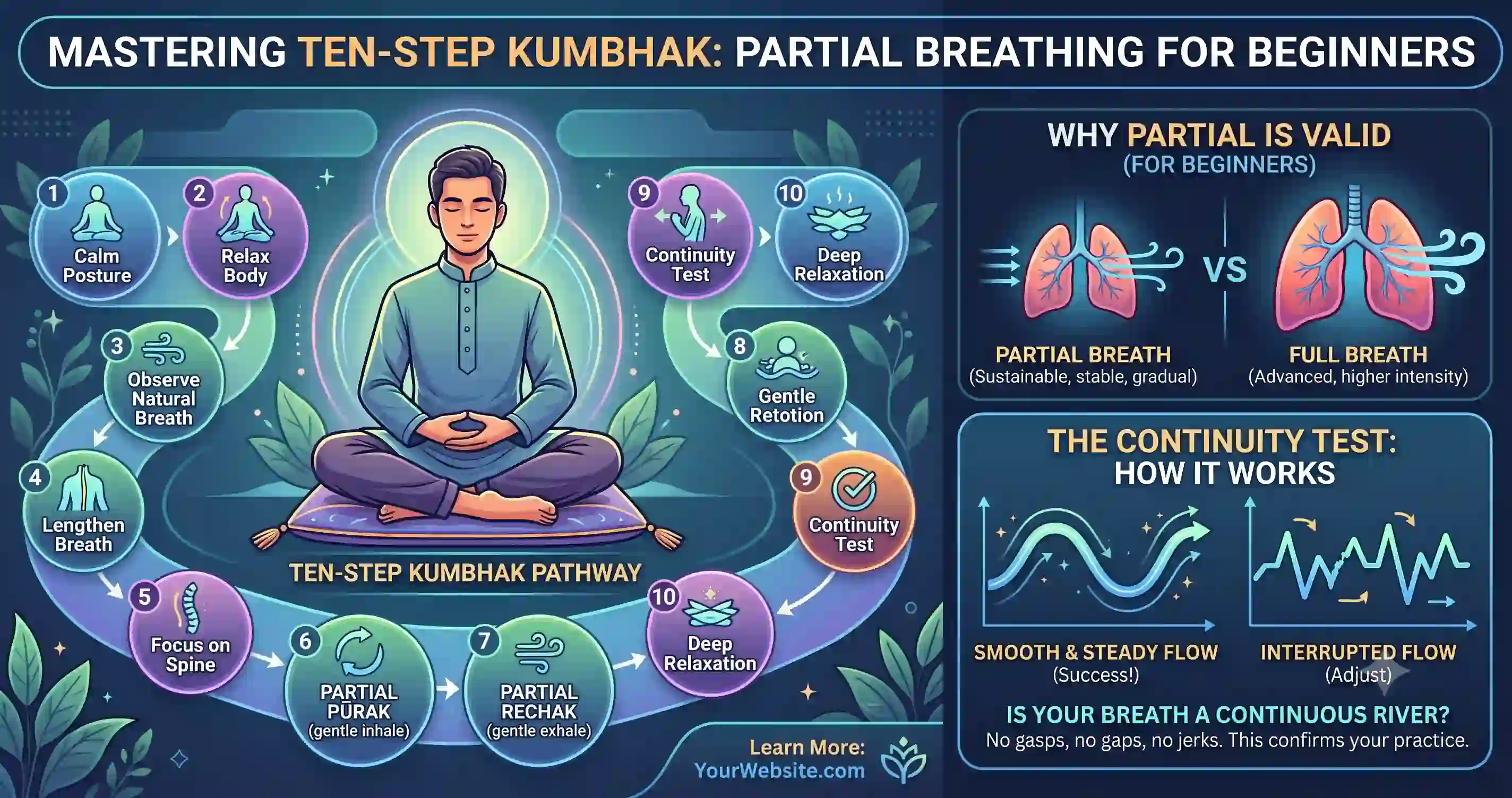
A genuine partial-volume Kumbhak has three deliberate elements:
- the preceding normal Pūrak or Rechak ends before the person's farthest comfortable endpoint;
- a distinct and completely easy pause follows;
- the practitioner remains free to resume breathing before urgency, strain or uneasiness.
The pause is still a pause. It is not “hidden inside” an unfinished inhalation or exhalation, and it is not shallow breathing renamed as Kumbhak.
“Full” in this method never means anatomical maximum
In the Ten-Step Kumbhak, a full Pūrak means comfortably full, not maximal inhalation. A full Rechak means comfortably empty, not squeezing out every available reserve. Even after the greatest possible exhalation, residual volume remains in the lungs; a living person's lungs are not literally empty.5
This gives three different boundaries that must not be collapsed:
Anatomical or laboratory maximum
The endpoint approached during a maximal pulmonary-function manoeuvre. This is not the target of a stress-relief round.
Comfortable full or comfortable empty
The ordinary intended boundary in the Ten-Step method: normal Pūrak or normal Rechak without gulping, squeezing, arching or collapsing.
Partial present-day boundary
An earlier endpoint chosen because even the ordinary comfortable endpoint does not yet allow a completely easy hold and an undisturbed transition today.
The partial form does not contradict “comfortably full” or “comfortably empty.” It applies a still more conservative boundary when the practitioner needs it.
🫁 Part One—Why Partial Pūrak and Rechak Kumbhak Are Valid for Beginners
The real issue is functional capacity, not the size of the lungs alone
“Lung capacity” is often used as though it were one number. In practice, capacity for Kumbhak has several interacting dimensions:
- Volume capacity: how much air can be moved without recruiting excess effort.
- Mechanical comfort: whether the ribs, chest wall, diaphragm, throat, neck and shoulders remain free from strain.
- Retention comfort: whether the pause can end before any urge to breathe.
- Chemical tolerance: how the person responds as carbon dioxide rises and oxygen may begin to fall during a sufficiently long hold.
- Cardiovascular tolerance: how blood pressure, vascular resistance, cardiac output and heart rate respond.
- Interoceptive tolerance: whether internal respiratory sensations remain non-threatening.
- Attentional capacity: whether chest-centre focus remains available rather than being captured by discomfort.
- Recovery capacity: whether normal breathing resumes without a gasp, jolt, confusion or prolonged disturbance.
Two people with similar measured vital capacity can therefore have very different comfortable Kumbhak capacity. The same person can also have different capacity after poor sleep, illness, emotional shock, a large meal, travel, heat, altitude or a period without practice.
Medical references describe vital capacity as the maximal exhalable volume following maximal inspiration, and show that it varies with factors including age, sex, height, weight and health.6 That laboratory measure is important for pulmonary assessment. It is not a prescription for how much air a beginner should move during stress-relief Kumbhak.
Your present Kumbhak capacity is not the largest breath you can produce. It is the largest completely easy dose from which attention and normal breathing can return intact.
Why a forced maximum Pūrak can defeat the purpose
As inhalation travels beyond an ordinary breath toward total lung capacity, additional inspiratory reserve is used. The respiratory pump must continue expanding the chest. A person who lacks current comfort or mobility may begin to lift the shoulders, tighten the neck, arch the back, brace the throat or grip the chest.
Holding after that forced endpoint begins the retention on top of existing effort. The practitioner may appear motionless, yet inwardly be occupied with pressure and the need to release it.
The next Rechak often reveals the excess:
- air escapes before the person feels they have chosen to release it;
- the first part of Rechak is pushed or dumped;
- the shoulders or face change abruptly;
- relief overwhelms chest-centre attention;
- the mind becomes concerned only with getting air out.
A partial Pūrak may reduce end-range stretch and the muscular effort used to reach it. However, starting a hold at a lower lung volume can also shorten breath-hold time because the gas reserve and mechanical conditions differ.78 Therefore the correct response is not “use a partial inhale but keep the old count.” It is use the earlier volume and make the retention correspondingly brief enough to remain completely easy.
Why a forced maximum Rechak can defeat the purpose
Normal expiration at rest relies substantially on elastic recoil. Exhaling below the usual resting range into expiratory reserve requires active muscular contribution. A maximal forced expiration is a pulmonary-test manoeuvre, not a requirement for a stress-relief pause.5
When a beginner presses far beyond comfortable emptying, common signs of excess effort can include abdominal gripping, rib-cage compression, throat tension, facial effort or collapse of upright posture. A Bāhya Kumbhak begun there may become a contest with the urge to inhale.
The next Pūrak exposes the mismatch:
- inhalation arrives as a grab or gasp;
- the upper chest or shoulders jump;
- the mouth opens involuntarily;
- attention is pulled away from the centre of the chest;
- the person feels rescued by the breath rather than calmly resuming it.
A partial Rechak leaves a larger cushion of air than a forced full Rechak. That may reduce mechanical effort and respiratory urgency. The relevant success, however, is not the air cushion by itself. It is the quality of the pause and the continuity that follows.
Chest-region pain is a stop signal, not proof that the lungs are “expanding”
Many people say “my lungs hurt” when they feel discomfort in the rib cage or chest during a large breath. The location may involve respiratory muscles, ribs, joints, chest wall, airways or the pleural region; a person cannot reliably identify the cause from sensation alone.
It would be inaccurate to promise that every forced full breath will cause lung pain, or to claim that normal beginner discomfort proves alveolar injury. It is equally unsafe to normalize pain as purification or capacity building.
The practical rule is simple:
- Do not continue through pain.
- Return to natural breathing.
- Do not try to diagnose the pain through yoga theory.
- Seek medical assessment for new, recurrent, sharp, severe or unexplained chest pain—especially with breathlessness, dizziness, sweating, nausea, faintness, pain spreading to the arm, jaw or back, or symptoms that do not resolve promptly.12
Chest pain that worsens with breathing can have causes unrelated to practice, including inflammation of the pleura, infection, a blood clot or a collapsed lung.13 Safety requires humility: “It happened during Kumbhak” does not prove “Kumbhak is the only cause.”
Air hunger is information, not an obstacle to conquer
During breath retention, metabolism continues. Carbon dioxide rises, oxygen may fall if the pause is long enough, respiratory drive continues, and the sensations created by lung volume and absent ventilation change. Modern reviews describe air hunger as a major component of the discomfort that terminates maximal voluntary holds.78
The breakpoint is not the Ten-Step target. The Ten-Step method ends each retention while it remains completely easy and while the practitioner still knows that another one to three comfortable seconds would have been available. If the first urge to breathe appears earlier, breathing resumes immediately.
This reserve principle is examined more fully in Never Hold Your Breath to the Limit in Kumbhak.
This reserve is especially important in a partial-Pūrak hold. Because the starting volume is lower, the comfortable hold may need to be shorter than the person expects. Partial volume and brief duration work together.
A Kumbhak can be short yet physiologically active
The belief that only a dramatic hold “does something” is not supported by the way respiratory physiology works. Any actual pause temporarily stops ventilation while metabolism continues. The size of the change depends on starting lung volume, duration, preceding breathing, posture, health, training and individual physiology.
Direct Kumbhak research is still limited. Small studies show that retention can acutely change cerebral blood-flow velocity and cardiovascular variables. One study in healthy participants found increases in systolic and diastolic blood pressure and total peripheral resistance during Kumbhak, alongside reductions in stroke volume and cardiac output.9 This is one reason not to tell beginners that every hold automatically means “rest-and-digest.”
The stress evidence is more modest. Some programmes containing Kumbhak have reported improvements in perceived stress, anxiety, mindfulness or mind-wandering, but most combine retention with breathing rhythm, nostril control, attention, yoga experience and repeated practice. They do not isolate the pause as the sole active ingredient.1011
The credible conclusion is:
- a completely easy partial Kumbhak can be a real respiratory and attentional event;
- longer or fuller has not been shown to be better for stress relief;
- the exact Ten-Step method still requires direct clinical study;
- personal calm is meaningful experience, not proof of treatment for a disease.
Partial volume is not inferiority; it is accurate dosing
Imagine two practitioners.
Practitioner A reaches the far edge of Pūrak, holds for twelve seconds, then releases air abruptly and loses all chest-centre focus.
Practitioner B stops Pūrak earlier, holds for three completely easy seconds, and continues through normal Rechak with the face, shoulders and attention undisturbed.
Practitioner A moved and retained more air. Practitioner B practised the stress-relief skill more faithfully.
The purpose is not to reward smallness for its own sake. The purpose is to find the dose at which stillness is real rather than performed.
Do not assign a universal percentage
The supplied drafts proposed figures such as 60%, 70%, 80% or 85% of capacity. These numbers sound precise, but a person at home cannot reliably sense a percentage of total lung capacity. Even a laboratory distinguishes several volumes and uses spirometry, gas dilution or plethysmography to measure them.65
A fixed percentage also ignores daily variation. Seventy percent of yesterday's perceived range may be too much today; a deliberately tiny breath may also feel awkward and shorten the completely easy pause.
Use a qualitative boundary instead:
- stop Pūrak before the last portion requires extra effort;
- stop Rechak before the last portion requires squeezing;
- keep the pause very brief;
- confirm success in the next breathing phase.
The person is not estimating a tank gauge. The person is observing whether effort, awareness and recovery remain in agreement.
Capacity grows through consistency, but growth must not be promised on a schedule
Breath-hold performance is trainable, and respiratory muscle function can also be trained. Yet improvement is not identical for everyone and does not mean that adult lungs physically become larger in a simple way.
Progress may appear as:
- less accessory-muscle effort at the same breath volume;
- greater ease at the same brief retention duration;
- clearer awareness of the first sign of excess;
- an increasingly normal transition into Rechak or Pūrak;
- steadier attention across the complete round;
- less need to prove anything through a count.
Only after those qualities remain stable should a greater comfortable volume or duration be allowed to emerge. There is no deadline by which a partial Kumbhak must become a fuller one.
🎯 Part Two—How to Know Your Partial Kumbhaks Are Working
Define “working” before searching for a sign
For this article, “working” does not mean:
- curing stress, anxiety or a lung condition;
- producing a certain oxygen or carbon-dioxide value;
- opening a Nāḍī that has been scientifically measured;
- holding longer than yesterday;
- feeling unusual, euphoric, detached or light-headed;
- proving that a future full Kumbhak is now safe.
“Working” means something narrower and more honest:
The selected breath volume and retention duration permit completely easy stillness, and the inner focus and balance cultivated there continue when normal breathing resumes.
That is a practical self-observation criterion within this method. It has not yet been validated as a medical biomarker or a standardized scientific test.
What “inner focus” means here
Inner focus is the continuing ability to stay aware of the centre of the chest while also remaining sensibly aware of the whole body and surroundings.
It is not a narrow trance. It does not require the absence of every thought. It does not mean ignoring pain. It does not mean dissociation, numbness or losing track of where one is.
A passing thought, a sound outside or ordinary mental movement does not automatically prove that the Kumbhak was excessive. The relevant disturbance is breath-linked: it arises at the transition and is driven by pressure, urgency, discomfort or loss of respiratory control.
What “inner balance” means here
Inner balance is a felt continuity of composure and choice:
- the face, jaw, throat, shoulders, chest, abdomen and legs remain relaxed;
- the person still feels able to end the pause by choice;
- the next breath remains normal;
- attention does not collapse into respiratory urgency;
- no pain, panic, dizziness or disturbing pressure appears;
- the following seconds feel coherent rather than like recovery from an ordeal.
Balance is not the suppression of a warning. If the body signals distress, responding immediately is balance.
The continuity principle: examine the seam, not only the pause
Haṭha Yoga Pradīpikā 2.2 gives the famous relationship:
चले वाते चलं चित्तं निश्चले निश्चलं भवेत् ।
योगी स्थाणुत्वमाप्नोति ततो वायुं निरोधयेत् ॥ २ ॥
When Vāyu is moving, Citta moves; when it becomes still, Citta becomes still. Therefore the yogi restrains Vāyu.1
The verse establishes a traditional relationship between respiratory movement and mental movement. It does not explicitly teach the modern “continuity test” presented here. That test is a careful application: if an externally motionless hold contains inward panic, or if its release immediately scatters attention, the quality of stillness was incomplete.
Yoga Sūtra 2.50 also describes external, internal and suspended modes of Prāṇāyāma as regulated by place, time and number, becoming extended and subtle.3 “Subtle” is a better direction for stress-relief practice than “spectacular.”
Test One: Antar Kumbhak into Rechak
After a partial Pūrak and a completely easy Antar Kumbhak, normal Rechak begins.
Ask:
Does my chest-centre focus and inner balance continue as I breathe out normally?
Signs of a well-matched preceding dose
- Rechak begins by choice, before respiratory urgency.
- Air does not burst or leak out uncontrollably.
- The face and shoulders do not suddenly change.
- The back does not collapse.
- Attention remains at the centre of the chest while the chest centre lowers.
- The mind does not celebrate escape from the hold.
- Rechak ends comfortably empty without squeezing.
Signs that Pūrak volume, Antar Kumbhak duration or both were excessive
- the release feels compulsory;
- air is dumped at the beginning of Rechak;
- throat, jaw or shoulders tighten;
- there is a sudden jolt of relief;
- the next phase must be managed urgently;
- chest-centre awareness disappears into discomfort;
- pain, dizziness, panic or unusual pressure appears.
The corrective lesson is not “concentrate harder.” Attention lost because the respiratory dose was excessive is best protected by reducing the dose.
Test Two: Bāhya Kumbhak into Pūrak
After a partial Rechak and a completely easy Bāhya Kumbhak, normal Pūrak begins.
Ask:
Does my chest-centre focus and inner balance continue as I breathe in normally?
Signs of a well-matched preceding dose
- Pūrak begins while choice is still present.
- The mouth remains closed without struggle.
- Air is received through the nose without a gasp.
- The shoulders remain down.
- The back does not arch.
- Attention continues as the centre of the chest lifts.
- Pūrak feels like the next phase of one coherent round, not rescue from suffocation.
Signs that Rechak volume, Bāhya Kumbhak duration or both were excessive
- inhalation arrives suddenly or noisily;
- the mouth opens to obtain air;
- the shoulders lift or chest heaves;
- the person feels frightened, trapped or disoriented;
- focus disappears at the first moment of Pūrak;
- the next breaths remain abnormal;
- pain, dizziness, visual change, tingling or palpitations appears.
An urgent Pūrak after Bāhya Kumbhak is especially clear feedback. It means the person stayed beyond the intended Ten-Step boundary, exhaled beyond the present workable boundary, or both.
One sentence that protects both transitions
After Antar Kumbhak, Rechak should carry the stillness forward; after Bāhya Kumbhak, Pūrak should carry the stillness forward.
If the stillness can exist only while breathing is absent, it has not yet become stable enough for stress relief in ordinary life—where movement, speech, decisions and relationships must resume.
The transition is more informative than seconds alone
Seconds answer one question: “How long did ventilation stop?”
They do not answer:
- Was the breath volume forced?
- Did the person brace?
- Was air hunger already present?
- Did blood pressure rise excessively?
- Did the next breath remain normal?
- Did the person feel calmer afterward?
- Was the practice voluntary and repeatable without fear?
The continuity test adds quality to quantity. It does not make timing useless; it prevents timing from becoming the only judge.
The three-time-horizon assessment
Do not evaluate only the instant of release. Observe three horizons.
1. The seam—within the next breath
- Did focus continue through Rechak after Antar Kumbhak?
- Did focus continue through Pūrak after Bāhya Kumbhak?
- Was the next breath normal rather than urgent?
2. The settling—through the recovery breaths
- Did the three normal recovery breaths feel ordinary?
- Did the face, throat, chest, shoulders and abdomen remain relaxed?
- Was another round genuinely inviting, or did compulsion demand it?
3. The usefulness—after the practice
- Is stress less consuming a few minutes later?
- Is attention clearer without dullness?
- Does the person feel more able to choose a response?
- Did any headache, pressure, panic, chest discomfort or breathlessness remain?
A Kumbhak that looks elegant at the seam but leaves delayed discomfort was not an appropriate dose.
A vertical traffic-light guide for self-observation 🚦
GREEN—present dose appears well matched
- Both retentions remain completely easy.
- The practitioner exits with one to three comfortable seconds in reserve.
- Rechak after Antar Kumbhak is normal and controlled.
- Pūrak after Bāhya Kumbhak is normal and unhurried.
- Inner focus and balance continue across both transitions.
- Recovery breaths are normal.
- No adverse symptom appears during or after the round.
Response: Keep the dose where it is. Do not increase merely because it worked.
AMBER—dose needs reduction or the observation is unclear
- A shoulder rises, the jaw tightens or posture changes.
- The transition is slightly pushed or grabbed.
- Focus briefly disappears exactly as breathing resumes.
- The person is unsure whether the hold remained easy.
- The same count feels noticeably harder than usual.
- Recovery needs more than the expected normal breaths.
Response: Return to natural breathing. At a later practice, use less volume, less retention time or both. If uncertainty persists, omit retention and seek qualified guidance.
RED—stop the practice
- Pain, chest tightness or severe breathlessness.
- Dizziness, faintness, greying or tunnel vision.
- Confusion, involuntary jerking or loss of coordination.
- Panic, dissociation, a flashback or a trapped feeling.
- Sustained palpitations, severe headache or unusual eye pressure.
- Blue lips, loss of consciousness or symptoms that do not resolve promptly.
Response: Stop immediately and return to natural breathing. Obtain appropriate medical care; urgent or severe symptoms require emergency evaluation.
The “disturbance” must be linked to the breath transition
Not every broken focus means the partial Kumbhak failed.
The sound of a door, an itchy nose, remembering an appointment or a passing thought can interrupt concentration without saying anything about lung capacity. Conversely, a person can be so determined to “succeed” that they fail to admit obvious bodily strain.
Use three questions:
- Timing: Did the disturbance occur exactly as Rechak or Pūrak resumed?
- Body link: Did it arrive with urgency, pressure, gasping, bracing or loss of respiratory control?
- Repeatability: Does the same pattern reappear when the same dose is tried on another appropriate day?
One uncertain moment is not a diagnosis. A repeated breath-linked pattern is useful calibration evidence.
Inner quiet is not always safety
Light-headedness, unusual euphoria, dreamlike distance, narrowing vision or emotional numbness can sometimes be misread as spiritual absorption. They can also accompany disturbed breathing chemistry, faintness, panic or dissociation.
The safe continuity test includes alertness, orientation and voluntary control. If awareness becomes less clear, stop. The aim is calm presence, not altered consciousness produced by physiological stress.
🔧 How to Calibrate a Partial Kumbhak Without Rewriting the Ten Steps
Keep the architecture; reduce the dose
The complete Ten-Step procedure is intentionally not repeated here. Use the central practice guide for the exact sequence.
The partial-capacity principle changes only the dose at the two retention entries:
- before Antar Kumbhak, end normal Pūrak earlier than the farthest comfortable-full point if reaching that point would disturb the hold or following Rechak;
- before Bāhya Kumbhak, end normal Rechak earlier than the farthest comfortably-empty point if reaching that point would disturb the hold or following Pūrak;
- shorten the corresponding Kumbhak so it remains completely easy;
- preserve normal inhalation and normal exhalation, the centre-of-chest focus, relaxed body, seated safety and required recovery breaths.
No other element needs to be invented.
The central practice guide explains why inhalation and exhalation remain normal. For the attentional anchor used in the continuity test, see Why the Focus Remains on the Centre of the Chest.
Adjust volume and duration as one combined dose
A person can exceed capacity in four ways:
- appropriate volume with excessive retention duration;
- excessive volume with brief retention duration;
- excessive volume with excessive retention duration;
- too many rounds without adequate recovery.
Therefore “I held only briefly” does not prove the preceding Pūrak or Rechak was appropriate. Likewise “I used partial volume” does not justify extending the hold.
A useful formula is:
Kumbhak dose = starting lung volume + retention duration + muscular effort + number of rounds + today's condition
The continuity test reports the combined result.
Never map capacity by first forcing a maximum
One supplied draft recommended taking a maximal inhalation and maximal exhalation to discover 100%, then stepping back. That experiment is unnecessary and conflicts with the stress-relief purpose.
There is no need to visit a painful boundary to prove that a safer boundary exists. Pulmonary-function testing uses standardized instructions, equipment, interpretation and clinical context. Home Kumbhak is not spirometry.
Start inside comfort. Let continuity—not an encounter with the maximum—show whether the dose fits.
Change only enough to make the next round informative
After a mild amber signal has completely resolved, the next appropriate practice should be simpler, not more analytical. Reduce the preceding volume, retention duration or both by an obvious but comfortable amount. Then observe the transition again.
Avoid constant percentage calculations, repeated checking and same-session limit testing. Those behaviours can turn stress relief into performance surveillance.
The best progression rule is “repeat before you increase”
Do not enlarge the dose after one successful round. First confirm that the same dose remains:
- completely easy on several appropriate days;
- compatible with normal Rechak after Antar Kumbhak;
- compatible with normal Pūrak after Bāhya Kumbhak;
- free from adverse after-effects;
- emotionally non-compulsive.
When greater capacity truly develops, the present dose begins to feel naturally smaller. Progress does not need to be dragged forward.
🧠 Why Continuity Matters Specifically for Stress Relief
Stress often appears as a broken transition
Many stressful moments are not harmful only because something happened. They remain harmful because the nervous system cannot pass cleanly into what comes next.
- The meeting ends, but the argument continues in the mind.
- The phone stops ringing, but the chest remains prepared for bad news.
- The child is safe, but the parent's jaw does not release.
- The workday ends, but the body never receives the message.
The practical value of the continuity test is that it asks whether calm can survive movement. Stillness during a held breath is one skill. Carrying that steadiness into Rechak, Pūrak, speech and ordinary life is the larger skill.
A seamless transition trains agency, not endurance
When breathing resumes before urgency, the practitioner experiences:
- “I noticed my boundary.”
- “I responded before distress.”
- “I did not need to prove my worth through pain.”
- “Movement returned without taking my centre away.”
That sequence may be emotionally important for a person whose stress pattern alternates between over-control and collapse. This is a psychologically plausible interpretation, not a proven therapy mechanism.
The next breath is an honest witness
During a retention, ambition can imitate steadiness. A practitioner may hold the face still, suppress movement and insist inwardly that everything is fine.
The next normal breath is harder to persuade.
- A dumped Rechak reveals excessive fullness or duration.
- A gasped Pūrak reveals excessive emptying or duration.
- A normal transition with continuing focus suggests better agreement between intention and capacity.
This is why the next phase deserves as much attention as the hold itself.
🌿 The Ayurvedic Perspective: Prāṇa, Mind and the Cost of Excess
What the classical Ayurvedic model actually says
Aṣṭāṅga Hṛdaya, Sūtrasthāna 12.4–5 describes Prāṇa Vāta as located in the head and moving through the chest and throat, associated with Buddhi, Hṛdaya, the senses and Citta; the continuation includes functions such as expectoration, sneezing, belching, breathing and swallowing.4
This provides a genuine traditional connection among breath, chest, throat, mind and sensory coordination. It does not prove that a partial Kumbhak treats a Vāta disorder, changes a measured neurotransmitter or cures anxiety.
A traditional reading of partial Pūrak and Rechak
Within Ayurvedic reasoning, Vāta is characterized by movement and is considered vulnerable to irregularity and excess. A forced respiratory extreme can therefore be interpreted as provoking rather than governing movement.
A partial-volume Kumbhak may be read traditionally as choosing:
- proportion instead of excess;
- rhythm instead of irregular struggle;
- supported chest-centre awareness instead of scattered effort;
- alert restraint instead of suppression;
- recovery instead of repeated depletion.
This is an Ayurvedic interpretation of practice quality. It has not been verified as a biomedical mechanism.
Vāta, Pitta and Kapha should not be turned into a simplistic scorecard
It may be tempting to say:
- gasping always equals aggravated Vāta;
- burning always equals Pitta;
- heaviness always equals Kapha.
That is too crude. The same sensation can have several medical, psychological and situational causes. A doshic interpretation should never override a red flag or postpone medical assessment.
At its most credible, the Ayurvedic contribution here is ethical and qualitative: a practice intended to organize Prāṇa should not leave movement more chaotic, heat more distressed or heaviness more oppressive.
🕉️ The Deeper Yogic Meaning: From Measured Vāyu to Stable Citta
Ahiṃsā begins before the breath becomes painful
Ahiṃsā is not only the decision to stop after harm is obvious. In breath practice, it includes refusing to create avoidable conflict between instruction and capacity.
Partial Pūrak and partial Rechak become expressions of Ahiṃsā when they are chosen from accurate listening rather than fear. The practitioner does not attack the lungs for failing to resemble an advanced practitioner's lungs. Nor does the practitioner use scripture to shame the body.
Tapas is disciplined calibration, not punishment
Tapas can be misunderstood as the willingness to endure anything. Yet disciplined practice includes returning, observing, refining and remaining truthful. It takes more Tapas to repeat a modest, clean Kumbhak for months than to force one dramatic attempt and become injured or frightened.
Pratyāhāra and Dhāraṇā must remain available after the pause
If sensory urgency seizes the mind at the end of every hold, inward attention has not been stabilized; it has only been temporarily enclosed by the absence of breath movement.
When chest-centre focus continues through normal Rechak and normal Pūrak, the practitioner begins to discover attention that is portable. That continuity resembles the functional direction of Pratyāhāra and Dhāraṇā: attention is less compelled by each changing sensation.
This is a yogic interpretation, not proof that one partial Kumbhak produces mastery of a higher limb.
Kevala Kumbhak should not be used to romanticize strain
Classical Haṭha texts distinguish deliberately accompanied retention from Kevala Kumbhak, the more spontaneous suspension described at an advanced stage. A beginner's forced maximal hold is not closer to Kevala merely because breathing has stopped for longer.
Spontaneity cannot be manufactured by coercion. The relevant direction is decreasing conflict, not increasing drama.
🔬 What Science Can and Cannot Say About the Continuity Test
What physiology supports
Science supports several pieces of the framework:
- starting lung volume affects breath-hold experience and duration;
- carbon dioxide, oxygen, respiratory drive and lung-volume sensation contribute to air hunger;
- a maximal forced expiration uses active expiratory muscles and still leaves residual volume;
- breath retention can change blood pressure and cardiovascular dynamics during the hold;
- strain, dizziness, panic, breathlessness and chest pain are not therapeutic endpoints;
- a normal rather than gasped recovery breath is a sensible safety-oriented observation.
What has not been scientifically established
No study located for this review has validated the precise claim that:
continuity of chest-centre focus during Rechak after Antar Kumbhak and during Pūrak after Bāhya Kumbhak proves that a partial Kumbhak is physiologically effective.
That proposition should be called what it is: a practice-specific experiential diagnostic. It is plausible, coherent with the purpose of stress relief and useful for self-calibration. It is not a substitute for oxygen saturation, blood pressure, lung-function testing, clinical evaluation or controlled outcome research.
Feeling calm is data, but it is not a universal claim
The practitioner is the authority on whether the experience felt comfortable, threatening, focusing or destabilizing. That report deserves respect.
Yet subjective calm cannot establish that:
- blood pressure remained safe;
- oxygen never fell;
- an underlying lung or heart condition is absent;
- the method will help another person;
- a clinical anxiety disorder has been treated.
Credibility grows when experience is neither dismissed nor inflated.
The research question this article creates
A future study could compare full-comfortable and partial-volume versions of the Ten-Step Kumbhak while measuring:
- perceived effort and air hunger;
- transition smoothness;
- respiratory inductance or airflow during the recovery breath;
- end-tidal carbon dioxide and oxygen saturation;
- beat-to-beat blood pressure and heart rate;
- chest, neck and shoulder muscle activity;
- momentary state anxiety;
- continuity of chest-centre attention;
- adverse events;
- later stress response in daily life.
Until such research exists, the continuity test should guide restraint—not advertise certainty.
👩🏫 Guidance for Teachers: Teach Capacity Without Creating Shame
Do not make “full” the social norm of the room
In a class, students cannot see one another's lung volumes, health history, panic sensitivity or internal effort. If a teacher celebrates the longest or fullest-looking retention, students may hide distress to avoid appearing weak.
Offer three equally legitimate choices:
- the comfortably full or comfortably empty version;
- the partial-volume version;
- normal Pūrak and Rechak with no retention.
The third option is essential. A person unable to retain without distress should not be persuaded that any hold is compulsory.
Ask questions whose answers are not predetermined
After practice, avoid “You feel calm now, don't you?”
Ask instead:
- “What happened to your focus during the next Rechak?”
- “What happened during the first Pūrak after Bāhya Kumbhak?”
- “Did breathing resume normally, urgently or somewhere between?”
- “Did anything feel painful, frightening or unclear?”
- “Would less volume or no hold feel more appropriate?”
Calm, neutral, uncomfortable and uncertain are all valid reports. Honest negative feedback protects students and improves teaching.
Visible signs do not replace consent or self-report
A teacher can observe shoulder lifting, facial strain, gulping, posture collapse or an urgent recovery breath. The teacher cannot infer every internal state.
If a student reports pain, panic or uneasiness, do not tell them their Prāṇa is “purifying” or their ego is resisting. Stop the retention and respond to the report.
Teach the after-phase, not only the hold
Many classes count the retention carefully and then treat the next breath as disposal. The continuity principle reverses that neglect.
The teacher's central question becomes:
“Can the steadiness remain while breathing returns?”
That question moves the room from performance toward self-regulation.
⚠️ Safety Boundaries for Any Partial or Full Kumbhak
Partial does not mean risk-free
A partial Kumbhak is still breath retention. It can still be unsuitable for a particular person, condition, day or context.
Never practise retention:
- in water or a bath;
- while driving, walking somewhere unsafe or operating machinery;
- while standing where faintness could cause a fall;
- after deliberate hyperventilation;
- during an acute asthma attack or serious breathlessness;
- in competition with another person or a timer.
The American Heart Association advises beginners trying counted breathing techniques to limit initial cycles, stop for dizziness or light-headedness, and consult a healthcare professional when heart or lung conditions are present.14
Seek individual clinical guidance first when relevant
Medical advice is prudent before any retention practice for people who are pregnant or who have significant heart or lung disease, uncontrolled blood pressure, cerebrovascular disease, epilepsy, fainting, glaucoma or retinal concerns, recent thoracic or abdominal surgery, or another condition affected by respiratory pressure or air hunger.
People with panic, PTSD, choking or suffocation trauma, or strong fear of internal respiratory sensations may need a trauma-informed approach with no retention at first. A Prāṇāyāma trial in people with PTSD reported episodes including anxiety, breathlessness, dizziness, constriction and a suffocation-related flashback.15
Stop immediately for adverse symptoms
Stop Kumbhak and return to natural breathing for:
- dizziness, faintness or visual disturbance;
- unusual breathlessness;
- chest pain, tightness or sustained palpitations;
- severe or unusual headache;
- panic, dissociation or a flashback;
- numbness, confusion, loss of coordination or involuntary movement;
- any symptom that feels concerning.
Loss of consciousness, severe or persistent breathlessness, chest pain or neurological symptoms require urgent medical evaluation.
❓ Frequently Asked Questions About Partial Pūrak and Rechak Kumbhak
Is partial Pūrak Kumbhak a real Kumbhak?
Yes, if a distinct breath retention follows the partial Pūrak. Positionally, it is a partial-Pūrak Antar Kumbhak. The shortened label is useful but is not a universally standardized classical category.
Is partial Rechak Kumbhak a real Bāhya Kumbhak?
Yes, if a distinct breath retention follows the partial Rechak. Positionally, it is a partial-Rechak Bāhya Kumbhak. More air remains than after the person's fuller comfortable Rechak, but the pause is still after exhalation.
Must beginners perform full inhalations and exhalations before Kumbhak?
No beginner should force maximal lung volume. The usual Ten-Step instruction is comfortably full Pūrak and comfortably empty Rechak. If even those endpoints disturb the hold or following transition, an earlier partial boundary is appropriate.
What percentage of lung capacity should I use?
There is no evidence-based universal percentage for this method. Do not chase 60%, 70% or 80%. Use less than the point where extra effort begins, keep the hold brief, and assess the next normal breath.
How many seconds should a partial Kumbhak last?
No fixed count suits everyone. It must end while completely easy and while another one to three comfortable seconds clearly remain. If an urge to breathe appears sooner, breathe immediately. A lower starting volume may require a shorter hold.
How do I know the partial Antar Kumbhak worked?
The immediate practice sign is that inner focus and balance continue during the following normal Rechak. Rechak should begin by choice without dumped air, sudden bracing or relief that scatters attention.
How do I know the partial Bāhya Kumbhak worked?
The immediate practice sign is that inner focus and balance continue during the following normal Pūrak. Pūrak should begin by choice without gasping, shoulder lifting, panic or loss of chest-centre awareness.
If my focus breaks, does that always mean I exceeded lung capacity?
No. An external distraction or ordinary thought can interrupt focus. Excess is more likely when the break occurs exactly as breathing resumes and is accompanied by urgency, gasping, dumped air, pressure, bracing or discomfort.
Is chest or “lung” pain normal when capacity is growing?
No. Pain is not a progress marker. Stop and return to natural breathing. New, recurrent, severe or unexplained chest pain requires appropriate medical assessment.
Should I practise a maximal breath first to discover my percentage?
No. The Ten-Step stress-relief method does not require a home maximum test. Start within comfort and let the quality of the hold, transition and recovery guide calibration.
When may I move from partial to fuller Kumbhak?
There is no scheduled promotion. Allow more volume only when the present version has remained completely easy across repeated appropriate days, both transitions remain normal, and no adverse after-effect appears.
What if even a partial retention disturbs me?
Omit the hold. Continue only with normal Pūrak and Rechak if those feel suitable, or choose another stress-relief practice. Seek guidance where needed. No person must perform Kumbhak to prove discipline or spiritual seriousness.
Does an undisturbed transition prove that Kumbhak is treating my stress disorder?
No. It suggests that the immediate dose fits the practice criterion. It does not diagnose, prevent or treat a medical or psychiatric condition, and it does not replace professional care.
🌌 The Most Important Conclusion: Let the Next Breath Tell the Truth
A partial Pūrak before Antar Kumbhak and a partial Rechak before Bāhya Kumbhak can be entirely appropriate for a beginner—or for an experienced practitioner on a lower-capacity day. They are not failures to reach “real” Kumbhak. They are ways of making the real principle possible: a completely easy pause that does not destroy the steadiness it was meant to cultivate.
The classical language is yathā-śakti—according to capacity—and yuktam—appropriately, proportionately. Modern respiratory physiology adds that lung volume, respiratory drive, air hunger, muscular effort and cardiovascular response all matter. Ayurveda adds a traditional warning against disordering the very movement one hopes to regulate. The continuity test brings these perspectives into one immediate question:
After the hold ends, does inner focus and balance remain?
After Antar Kumbhak, let normal Rechak answer.
After Bāhya Kumbhak, let normal Pūrak answer.
If the answer is yes, stay humble and repeat before increasing.
If the answer is no, reduce the preceding volume, shorten the retention, omit the hold or seek guidance. Do not punish the body for giving accurate information.
The grandmother's repaired shirt did not become strong because the thread was pulled hardest. It became strong because every stitch closed the tear while allowing the cloth to lie at peace.
So too with Kumbhak: the deepest sign is not how much breath you can command at the peak of effort. It is how much inner steadiness remains when life begins moving again.
📚 Verified Sources and Notes
-
Svātmārāma, Haṭha Yoga Pradīpikā, chapter 2, especially verses 2, 7 and 15–18. Sanskrit text cross-checked in Sanskrit Documents. Translations in this article are close contextual translations; 2.7 describes an alternate-nostril practice, not the Ten-Step Kumbhak. ↩↩↩↩
-
Śrīmad Bhāgavat Mahāpurāṇa 11.14.33. Sanskrit cross-checked at Wisdom Library and the compound meanings checked against Vedabase 11.14.32–33. The verse names Pūrak–Kumbhak–Rechak, their reverse sequence and progressive practice. ↩
-
Patañjali, Yoga Sūtra 2.50, with Sanskrit and classical commentary in Rama Prasada's translation of the Yoga Sūtras with commentaries. The Sūtra speaks of external, internal and suspended modes regulated by place, time and number. ↩
-
Vāgbhaṭa, Aṣṭāṅga Hṛdaya, Sūtrasthāna 12.4–5. Sanskrit and English rendering available at Siva.sh, chapter 12. The traditional categories should not be equated with modern anatomical or psychiatric diagnoses. ↩
-
Lofrese JJ, Tupper C, Denault D, et al. “Physiology, Residual Volume.” StatPearls. Updated 2023. NCBI Bookshelf. Residual volume remains after maximal forceful expiration; forced expiratory reserve uses active chest and abdominal muscles. ↩↩↩
-
David S, Sharma S. “Vital Capacity.” StatPearls. Updated 2023. NCBI Bookshelf. Vital capacity is a maximal pulmonary-function measure and varies with individual characteristics and health. ↩↩
-
Parkes MJ. “Breath-holding and its breakpoint.” Experimental Physiology. 2006;91(1):1–15. PubMed record. The review emphasizes that breath-hold duration is highly variable and that the involuntary breakpoint is not explained by one signal alone. ↩↩
-
Banzett RB, Lansing RW, Binks AP. “Air Hunger: A Primal Sensation and a Primary Element of Dyspnea.” Comprehensive Physiology. Full text in PMC. The review discusses respiratory drive, lung volume and progressive discomfort during breath holding. ↩↩
-
Kuppusamy M, Kamaldeen D, Pitani R, et al. “Evaluation of Cardiovascular Functions during the Practice of Different Types of Yogic Breathing Techniques.” International Journal of Yoga. 2021;14(2):158–162. PubMed. This small healthy-volunteer study found substantial phase-specific cardiovascular changes during Kumbhak. ↩
-
Sharma VK, Trakroo M, Subramaniam V, et al. Randomized controlled study of a paced alternate-nostril protocol containing Kumbhak in young health-care students. International Journal of Yoga. 2018. Full text in PMC. The combined protocol reduced perceived stress, but it did not isolate retention. ↩
-
Saoji AA, Raghavendra BR, Madle K, Manjunath NK. Randomized study of additional yoga breathing with intermittent retention in existing yoga practitioners. Explore. 2018;14(5):379–384. PubMed. The study does not establish the effect in beginners or isolate every component. ↩
-
U.S. National Library of Medicine. Chest Pain—MedlinePlus. Immediate medical care is advised for persistent or pressure-like chest pain and for pain accompanied by symptoms such as shortness of breath, dizziness, sweating or nausea. ↩
-
U.S. National Library of Medicine. Pleurisy—MedlinePlus Medical Encyclopedia. Pain affected by breathing can arise from pleural inflammation and has many possible causes. ↩
-
American Heart Association. Stress Management: Breathing Techniques. Its public guidance advises limited cycles for first attempts, stopping for dizziness or light-headedness, and clinical consultation for heart or lung conditions. ↩
-
Prāṇāyāma feasibility trial in people with post-traumatic stress disorder, including reported adverse experiences. Full text in PMC. The findings support choice, careful screening and trauma-informed modification rather than assuming retention is calming for everyone. ↩