Discover the scientific, yogic and Ayurvedic benefits of a few daily Ten-Step Kumbhak rounds—and what may change over weeks, months and years.
By Kumbhaki Yogi Dhruvaji (MSc), founder of the Antistress Foundation 501(c)(3)
• How to Practice Ten-Step Kumbhak • Scientific Proof • Ancient Texts Proof • Bio • Subscribe By Email
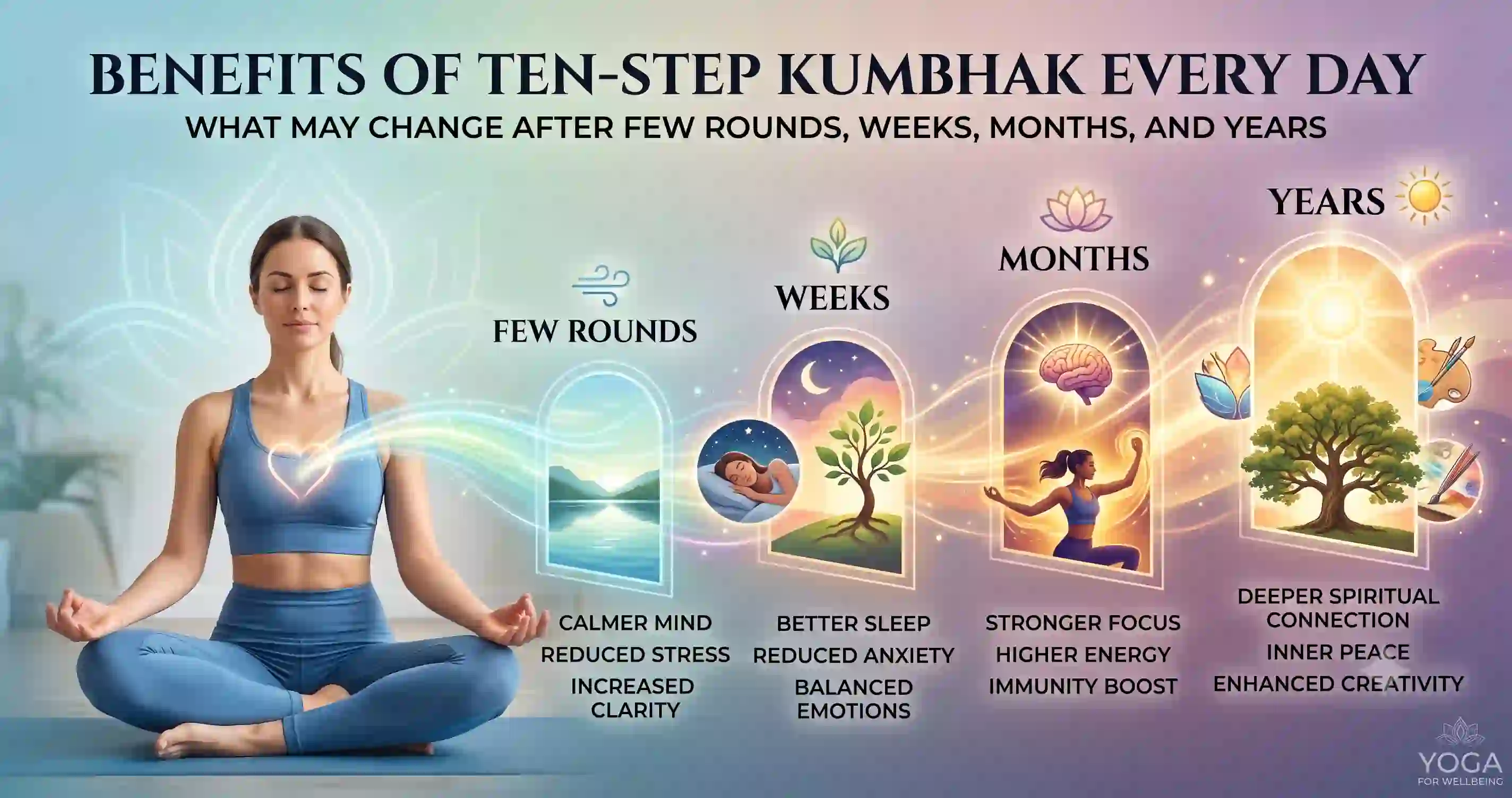
A scientific, yogic and Ayurvedic guide to immediate relief, cumulative practice, comfortable progress and the important difference between practising longer and holding longer.
There are days when stress feels too large for anything small to matter.
The unfinished message is still open. The difficult conversation keeps replaying. Your jaw is tight, your chest feels busy, and your mind has already lived tomorrow three times.
Then you sit for a few rounds of Ten-Step Kumbhak.
The outer problem may still be there when you finish. Yet something more intimate may have changed: the problem is no longer occupying every room inside you.
That is the first possible benefit of a brief daily practice—not the disappearance of life’s demands, but the recovery of a little inner space from which to meet them.
What, then, might happen if those few rounds are repeated for weeks, months or years? Would spending more time each day produce more benefit? Would longer comfortable retentions add something further? And where does useful progression end and unnecessary strain begin?
This article examines those questions through three different lenses:
- 🔬 Science: what human studies have actually measured, and what they have not.
- 🕉️ Yoga: what classical texts say about breath, mind, repetition, duration and refinement.
- 🌿 Ayurveda: how the practice may be interpreted through Prāṇa Vāta, Udāna Vāta, mental steadiness and daily rhythm.
The Ten-Step method itself is intentionally not reproduced here. Learn it from the dedicated How to Practice the Ten-Step Kumbhak for Stress Relief guide before using this article to think about frequency or duration.
Important: Ten-Step Kumbhak is a stress-relief practice, not a test of breath-holding capacity and not a substitute for medical or mental-health care. The exact Ten-Step method has not yet been tested in a large clinical trial. The scientific evidence below comes from direct Kumbhak studies and from related breathing methods that contain retention; those findings support plausibility, not a guarantee of identical results.
The Short Answer: A Few Rounds Can Change a State; Repetition May Build a Skill 🌱
Just a few comfortable rounds may help interrupt a stress episode, collect scattered attention, reveal unnecessary muscular tension and create a clearer transition from activation toward rest. Some people notice a quieter mind immediately. Others first notice the shoulders dropping, the face softening, or a little distance from repetitive thoughts. Some notice nothing dramatic—and that is also a valid result.
Repeated across weeks, the practice may become easier to begin and easier to remain relaxed within. Research on related retention-containing routines reports improvements in state anxiety, mindfulness, mind wandering, mood and perceived stress over periods ranging from four to twelve weeks.123 The important limitation is that most of those studies did not isolate retention from rhythm, attention, expectation or the protected time devoted to practice.
Across months, the possible benefit is less about making one session spectacular and more about making self-regulation familiar. The body learns the setting. The mind recognizes the chest-centred task. The practitioner detects strain earlier. A pause that once felt unusual may become ordinary enough to remain relaxed within.
Across years, yoga offers the stronger claim and science the more modest one. Classical yoga says long, uninterrupted, respectfully sustained practice becomes firmly grounded.14 Modern science has no multi-year trial of the Ten-Step method, so it cannot promise accumulating biological benefits, permanent calm or disease prevention. What can reasonably deepen over years is skill: attention, discernment, consistency, economy of effort and an increasingly honest knowledge of one’s own limits.
Four different meanings of “longer”
Before discussing benefits, separate four clocks that are often confused:
Clock 1 — The length of one retention
This increases the physiological intensity of that particular hold. It can mean more carbon-dioxide accumulation, a stronger urge to breathe and, if extended sufficiently, falling oxygen. It is the most risk-sensitive clock.
Clock 2 — The number of rounds or total minutes in one session
This increases the amount of attention practice and the number of stress-to-recovery transitions rehearsed. It does not require lengthening either retention.
Clock 3 — The number of days, weeks, months or years of practice
This is calendar consistency. It may improve familiarity, adherence, self-observation and access to the skill without making any one session more intense.
Clock 4 — The quality of ease
This is not measured in seconds. It is seen in an unstrained face and throat, absence of gasping, stable posture, retained comfort and the feeling that the practice has left you more settled rather than more driven.
For stress relief, Clock 4 governs the other three.
The most defensible progression principle
Extend familiarity before intensity, calendar continuity before retention length, and ease before numbers.
A longer calendar practice with the same easy dose is not the same experiment as a longer hold. A person can deepen for years without turning each retention into a contest.
What Just a Few Daily Rounds May Do 🫁
The first few rounds matter because stress is not only a thought. It is a whole-body event involving attention, breathing, muscle tone, cardiovascular activity, expectation, memory and action readiness.
Ten-Step Kumbhak places several organised signals inside that event: a stable seat, supported hands, chest-centred attention, normal nasal Pūrak and Rechak, brief Antar and Bāhya Kumbhak, deliberate relaxation, an easy reserve and recovery breaths between rounds. No single feature needs to perform a miracle. Their coordination may be the strength.
1. It may interrupt rumination without arguing with the thought
Trying to command an anxious mind to “stop thinking” often creates another struggle. Ten-Step Kumbhak gives attention a concrete responsibility instead: remain aware of the centre of the chest, notice bodily ease, observe the pause and leave the pause before strain.
This does not defeat a stressful thought in debate. It temporarily stops feeding it with uninterrupted attention.
That distinction can feel like opening a window in a room that had become emotionally airless.
Scientifically, this is a plausible attentional and interoceptive mechanism rather than a proven Ten-Step-specific effect. In one acute study, a twenty-minute four-phase yogic breathing session containing internal and external Kumbhak improved response inhibition—but so did breath awareness, meaning the holds were not shown to be the unique cause.4
Possible immediate benefit: less mental fusion with the stressor, a cleaner attentional field and greater ability to choose the next action.
2. It may create a manageable encounter with urgency
Stress often speaks in the grammar of urgency:
Answer now. Escape now. Fix everything now.
An easy Kumbhak introduces a small sensation of “not yet” without requiring helplessness. The practitioner experiences a rising internal signal, remains relaxed and then responds before discomfort. Repeated honestly, this may teach a subtle lesson: an urge can be noticed without being obeyed at its first whisper—and safety does not require waiting until it screams.
This resembles carefully bounded interoceptive learning, but it should not be romanticised. A comfortable pause may help one person; it may evoke panic, suffocation memories or traumatic distress in another. A prāṇāyāma study in people with PTSD recorded anxiety, breathlessness, dizziness, constriction and a suffocation-related flashback in some participants.5
Possible immediate benefit: a little more choice between sensation and reaction.
Boundary: if retention feels trapping rather than containing, the stress-relief purpose has already been lost.
3. It makes relaxation observable rather than abstract
“Relax” can be frustrating advice because it gives no object against which relaxation can be tested.
During Kumbhak, tension becomes easier to detect:
- Is the jaw joining the hold?
- Has the throat hardened?
- Are the shoulders trying to help?
- Is the abdomen braced?
- Is the next breath becoming a rescue?
The practitioner does not merely hope to relax; they receive moment-by-moment information about whether relaxation is actually present.
Possible immediate benefit: improved discrimination between real ease and concealed effort.
Over time, that distinction may transfer beyond practice. You may notice the clenched jaw while writing an email, the raised shoulders during traffic, or the held abdomen during a difficult conversation—earlier than you once did.
4. It may shift autonomic and cardiovascular activity—but not in one simple direction
Breathing, heart rhythm, blood pressure and vascular resistance interact continuously. Structured breathing can change those relationships within minutes. Yet it is inaccurate to say that every Kumbhak simply “activates the vagus nerve.”
In a study of twenty healthy adults, a one-minute Kumbhak increased systolic, diastolic and mean arterial pressure and total peripheral resistance during the hold, while stroke volume and cardiac output fell.6 Another four-phase breathing study found changes in heart rate, stroke volume, cardiac output, baroreflex sensitivity and heart-rate-variability measures after practice, but the autonomic pattern was mixed rather than a clean switch into permanent “parasympathetic dominance.”7
These results are not contradictions. A hold can be a cardiovascular load while it is occurring, while the complete breathing session and recovery period may feel settling afterward.
Possible immediate benefit: a change in physiological state and a clearer recovery transition.
What cannot be claimed: that every hold lowers blood pressure, that a few rounds treat hypertension, or that a stronger pressure response means a stronger stress benefit.
5. It may alter cerebral circulation without proving a brain-health benefit
Direct studies of internal and external Kumbhak have found acute changes in middle cerebral artery blood-flow velocity.89 Rising carbon dioxide during a sufficiently long closed-airway pause is a potent cerebral vasodilator, so such changes are physiologically coherent.
But increased flow during retention is a compensatory response, not automatic evidence of improved memory, brain “detoxification,” neurogenesis or stroke prevention.
For a few easy Ten-Step rounds, the most relevant conclusion is modest:
The pause is biologically active, but the stress-relief value should be judged by comfort and the after-state—not by imagining hidden brain upgrades.
6. It may make the end of practice feel different from the beginning
The Ten-Step method contains recovery rather than treating it as wasted time. That matters.
A retention ends, normal breathing returns, and the system is given room to settle. In stress terms, this repeatedly pairs activation with completion. The practitioner does not remain suspended in an unfinished challenge.
The two normal breaths between rounds may help prevent the session from becoming a continuous accumulation of respiratory load. They also create a small assessment window:
- Has calm increased?
- Has effort increased?
- Is another round welcome?
- Would stopping now be wiser?
Possible immediate benefit: practice includes its own invitation to reassess instead of automatically escalating.
Why the Complete Ten-Step Design May Be Stronger Than “Just Holding the Breath” 🧩
The Ten-Step Kumbhak is not merely a breath-hold timer. Its stress-relieving potential comes from an arrangement of safety, attention, posture, movement, stillness and recovery.
The stable seat reduces avoidable uncertainty
Seated practice removes the fall and task-performance risks that would exist while walking, driving, swimming or operating equipment. A naturally upright back also provides a clearer base from which the chest can move without turning the practice into a slump or a backbend.
From a learning perspective, repeated posture becomes a context cue: this is the place where I stop performing and begin observing.
From an Ayurvedic perspective, physical support and predictable position may be interpreted as grounding for a stress state with Vāta-like qualities such as restlessness, irregularity and scattered attention. That is a traditional interpretation, not a clinical finding.
Dhyāna Mudra gives the hands somewhere quiet to belong
Stressed hands often continue the mind’s agitation—typing, gripping, tapping, reaching for the phone.
In Dhyāna Mudra, the hands are supported against the body and by one another. The gesture reduces unnecessary action and offers tactile continuity at the lower centre of the torso.
No trial has shown that this exact Mudra independently treats stress. Its likely practical contribution is simpler and still valuable: symmetry, support, reduced fidgeting and a bodily signal of non-doing.
Chest-centred attention narrows the field without making it vague
Attention to “the breath” can become abstract. Attention to the centre of the chest is locational.
That single reference point coordinates several features of the practice:
- the physical movement associated with Pūrak and Rechak;
- the maintained position during each Kumbhak;
- awareness of unnecessary shoulder or back involvement;
- and a stable object to return to when thoughts wander.
In yogic language, this may support Dhāraṇā-like steadiness. In psychological language, it is an attentional anchor. In Ayurvedic language, the chest is relevant to Prāṇa Vāta and especially Udāna Vāta. These languages overlap in human experience, but they should not be presented as interchangeable anatomy.
Antar and Bāhya Kumbhak provide two different internal landscapes
A pause after Pūrak and a pause after Rechak do not feel the same. Starting lung volume, chest configuration, respiratory drive and subjective spaciousness differ.
Experiencing both may broaden interoceptive literacy: fullness need not become bracing, and emptiness need not become panic. Yet Bāhya Kumbhak may feel more vulnerable for some people and must remain completely easy.
Direct research also suggests internal and external Kumbhak can produce different cerebral haemodynamic patterns.89 That difference is one reason not to treat all retention as a single dose.
The normal breath between the two retentions limits stacking
The method does not place Antar Kumbhak and Bāhya Kumbhak back-to-back without a full breath cycle between them. That separation gives carbon dioxide, respiratory sensation and attention a transition.
Scientifically, the exact value of this design choice has not been isolated in a trial. Mechanistically, it is reasonable to view it as a way of preventing the two different holds from becoming one continuous challenge.
The “easy reserve” changes the meaning of success
Stopping while several comfortable seconds still seem available protects the practice from the most seductive mistake in breath retention: confusing maximum duration with maximum benefit.
The desired learning is:
I remained at ease and listened early.
It is not:
I defeated the urge for one more second.
This changes Kumbhak from self-conquest into self-knowledge.
What May Change After Several Weeks 📅
Weeks are long enough for novelty to diminish but short enough for changes to remain responsive. This is often where a practice stops feeling like an event and starts becoming available as a skill.
The beginning may require less negotiation
In the first days, practice may need a committee meeting inside the mind:
Should I do it now? Am I too busy? Will it help? Maybe later.
After repeated use, the cue and response can become more familiar. The posture, hand position and chest focus no longer require the same amount of cognitive organisation. This does not prove a neurological habit circuit specific to Kumbhak; it is the ordinary advantage of rehearsing a stable behaviour.
Possible benefit after weeks: lower friction between feeling stressed and beginning a known response.
Attention may become easier to retrieve
The mind will still wander. Progress is not a blank mind. Progress may be the shortening of the distance between wandering and returning.
In a randomised trial of 116 young adult yoga practitioners, adding twenty minutes of yogic breathing with intermittent retention for eight weeks produced greater improvements in state mindfulness, mind wandering and state anxiety than regular yoga practice alone.2
This is encouraging, but the study:
- involved people who already practised yoga;
- used a longer session than a few Ten-Step rounds;
- tested a related breathing sequence, not the Ten-Step method;
- and could not identify which component produced the difference.
The honest conclusion is promising transfer, not proof of identical results.
Mood and anxiety may improve through repetition of the whole routine
A randomised study comparing five minutes a day of three breathwork methods with mindfulness meditation over twenty-eight days found improved positive affect and reduced anxiety or negative affect across the groups. Box breathing and a hyperventilation-retention method were included, but an exhale-focused method without a long hold produced the clearest average mood and respiratory-rate pattern.1
This gives two useful messages:
- A brief daily practice can matter.
- Retention is not automatically the most powerful ingredient.
For Ten-Step Kumbhak, the likely value lies in the complete architecture—attention, normal breathing, two easy pauses, relaxed form and recovery—not in declaring the pauses superior to every other feature.
The practitioner may notice stress earlier
At first, you may recognise stress only when it has become a headache, an argument or a sleepless night.
Repeated chest-centred practice may improve awareness of earlier signals:
- a slightly lifted shoulder;
- a shorter temper;
- a breath that has become irregular;
- pressure behind the eyes;
- or the first loop of repetitive thought.
This benefit is difficult to capture in a stopwatch. It may still be one of the most valuable. Earlier detection offers more options than late crisis.
Ayurvedic interpretation after weeks: rhythm begins to oppose irregularity
Ayurveda places great value on appropriate daily rhythm. Although classical Ayurvedic texts do not describe this exact Ten-Step method, repeated practice at a realistic time can be interpreted as a small act of dinacharyā—a dependable daily measure.
For a stress pattern experienced as mobile, changeable or scattered, predictability itself may feel regulating. For a pattern experienced as driven and overheated, the non-competitive limit may be more important than increasing duration. For a pattern experienced as heavy or withdrawn, a brief practice may be more realistic than a long session that becomes another burden.
This is why an Ayurvedic lens should individualise rather than proclaim, “Kumbhak balances all three doṣas for everyone.”
What May Change After Several Months 🗓️
Months reveal something that a dramatic first session cannot: whether the practice can coexist with ordinary life.
Perceived stress may fall, although retention-specific proof remains limited
In a randomised study of one hundred healthy men, a twelve-week alternate-nostril breathing programme containing a 1:1:1 Pūrak–Kumbhak–Rechak ratio reduced perceived stress.3 Other twelve-week paced-breathing research has also reported lower psychological stress, even when different breath ratios did not produce a clear difference from one another.10
A meta-analysis of randomised breathwork trials found a small-to-medium overall benefit for self-reported stress, anxiety and depression, while also warning that study quality, methods and publication bias require caution.11
The same meta-analysis did not find a significant relationship between estimated practice duration and effect size. Poor reporting of adherence made true dose–response analysis difficult, but the result is still important:
Current evidence does not show that more daily minutes reliably create more psychological benefit.
Recovery may become more familiar than escalation
Chronic stress can make activation feel normal and calm feel unfamiliar. A few daily rounds repeated for months may give the nervous system many experiences of:
arrive activated → organise attention → pause without strain → recover → stop
Science has not yet measured this exact Ten-Step learning sequence. Yet as a behavioural model, it is coherent: the body receives repeated experiences of completion rather than endless mobilisation.
The benefit may appear outside formal practice as a shorter recovery after a tense call, a less impulsive reply, or an earlier return to sleep after waking.
These are outcomes worth noticing precisely because they matter in real life.
Comfortable retention time may increase—but that is not the same as stress relief
Breath-hold duration is trainable. A fourteen-day study found a substantial increase in maximum breath-hold time without a corresponding change in ventilatory sensitivity to carbon dioxide.12 A six-week training trial improved holding time but did not improve altitude sickness, oxygen saturation, anxiety, sleep or perceived effort at altitude.13
Longer performance may come from:
- greater familiarity;
- improved technique;
- reduced unnecessary muscular activity;
- altered tolerance of respiratory sensation;
- expectation;
- or changes in starting lung volume.
It does not automatically prove stronger lungs, better oxygen delivery, greater calm or better health.
For Ten-Step Kumbhak, an increase is meaningful only if it arrives with equal or greater ease and without becoming the goal.
The practice may expose ambition disguised as discipline
Months are also when a quiet practice can become a scoreboard.
The mind may begin to say:
Yesterday was longer. Today should be longer still.
That is not always dedication. Sometimes it is the original stress pattern wearing yoga clothes.
The mature practitioner asks a different question:
Am I becoming more relaxed, more perceptive and more free—or merely better at tolerating a self-imposed demand?
What May Change After Years 🌳
Years should be discussed with humility. The traditional literature speaks confidently about long practice; modern retention research rarely follows people beyond a few months.
Yogic benefit: practice may become firmly grounded
Patañjali’s Yoga Sūtra 1.14 gives one of the clearest classical statements about calendar duration:
sa tu dīrgha-kāla-nairantarya-satkārāsevito dṛḍha-bhūmiḥ
Practice becomes firmly grounded when cultivated for a long time, without interruption and with devoted care.14
This verse does not say that each individual effort must become extreme. It says that the ground becomes firm through duration, continuity and quality of relationship.
Applied to Ten-Step Kumbhak, years may deepen:
- the ability to settle without elaborate preparation;
- recognition of strain before it becomes obvious;
- steadiness of attention at the chest centre;
- non-reactivity toward temporary inner sensations;
- willingness to stop without feeling defeated;
- and trust in a modest practice that does not need to perform dramatically every day.
These are traditional and experiential possibilities, not guarantees.
Scientific benefit: a durable self-regulation habit is plausible; permanent calm is not
No credible study shows that years of Ten-Step Kumbhak permanently switch the autonomic nervous system into a calm mode. Human physiology must remain flexible enough to mobilise under genuine demand.
The more realistic long-term goal is not permanent relaxation. It is better range and recovery:
- activation when action is needed;
- awareness when activation is excessive;
- and access to a practised route back toward baseline.
Science can reasonably support the value of repeated skill use, but it cannot yet assign a Ten-Step-specific biological dividend to five, ten or twenty years of practice.
Ayurvedic benefit: regularity may become part of the person’s way of living
An Ayurvedic reading values not only what a technique does in one sitting, but how it participates in a life.
Over years, a brief daily Kumbhak practice may support:
- niyama or regularity in daily rhythm;
- greater awareness of one’s changing capacity;
- earlier recognition of excess effort;
- a quieter relationship with sensory overload;
- and a more deliberate transition between outward activity and inward rest.
Ayurveda would also ask whether the same practice remains appropriate across season, age, illness, exhaustion, pregnancy, medication changes and major life stress. A habit is not wise merely because it is old. Long practice should increase responsiveness, not rigidity.
Long practice may produce subtlety, not spectacle
A beginner often looks for a sensation powerful enough to confirm that “something happened.”
An experienced practitioner may value smaller signs:
- one unnecessary muscle releases sooner;
- one thought is seen before it becomes a story;
- one retention ends before pride takes control;
- one stressful evening does not become a stressful night.
Long practice may not make every session bigger. It may make the practitioner less dependent on bigness.
Should You Gradually Increase the Daily Duration? ⏳
Possibly—but “daily duration” should mean total comfortable practice time or number of rounds before it means longer retentions.
No study has established the ideal dose of the Ten-Step method. A cautious progression therefore depends more on response quality than on a universal schedule.
Increasing total session time may add rehearsal
Adding a small number of rounds while keeping both retentions easy may provide:
- more repetitions of returning attention;
- more opportunities to release unnecessary tension;
- more complete stress-to-recovery transitions;
- and a longer protected interval away from stimulation.
The extra benefit may come from attention and repetition, not greater respiratory intensity.
However, a longer session can also add boredom, performance pressure, time burden or cumulative light-headedness. More rounds are useful only while the session remains genuinely restorative.
Increasing an individual retention changes the physiological dose
Lengthening Antar or Bāhya Kumbhak is not just “doing more meditation.” It changes internal gases, respiratory drive and cardiovascular response.
As a hold continues:
- carbon dioxide generally rises;
- the urge to breathe becomes stronger;
- oxygen may begin to fall, depending on duration and preparation;
- vascular resistance and blood pressure may change;
- and compensatory cerebral blood flow may increase.
These effects prove biological activity. They do not prove increasing stress relief.
Longer Kumbhak may offer additional familiarity with internal sensation, but current evidence does not show that it produces proportionally greater calm.
A vertical benefit–risk map
Longer calendar duration, same easy session
- Likely gain: familiarity, adherence, self-knowledge and easier access to the skill.
- Added physiological risk: relatively low if health status and practice suitability remain unchanged.
- Evidence position: plausible and supported by general breathwork research; no multi-year Ten-Step trial.
More rounds, same easy retentions
- Likely gain: more attentional rehearsal and more recovery transitions.
- Added physiological risk: cumulative symptoms are possible.
- Evidence position: dose–response is unknown.
Longer retention, same number of rounds
- Likely gain: stronger internal stimulus and perhaps greater tolerance of respiratory sensations.
- Added physiological risk: higher.
- Evidence position: hold time is trainable, but extra stress-relief benefit is unproven.
More rounds and longer retentions together
- Likely gain: uncertain.
- Added physiological risk: highest of these four choices.
- Evidence position: not a general stress-relief recommendation.
Add only what remains invisible to the face
A useful non-numerical test is whether progression can occur without appearing as strain:
- no tightened jaw;
- no hardened throat;
- no shoulder lift;
- no abdominal bracing;
- no urgent or gasping recovery;
- no dizziness, pressure, tingling, panic or visual change;
- and no restless desire to beat the previous session.
If increased duration announces itself through these signs, the body is not agreeing to the proposed dose.
Increase one clock at a time
If a person simultaneously adds days, rounds and retention seconds, they cannot know which change helped or which caused discomfort.
A more informative personal experiment changes one dimension while the others remain stable. The result is then judged by:
- immediate comfort;
- the ten-minute after-state;
- later energy and clarity;
- sleep that night;
- and willingness to practise again without dread.
This is not a competitive progression schedule. It is a way to preserve honest feedback.
What Do the Classical Yoga Texts Say About Duration and Gradual Progress? 🕉️
Classical yoga does not reduce development to one larger number. It speaks about repetition, measure, subtlety, continuity and correct practice.
Patañjali measures Prāṇāyāma by time and number
Yoga Sūtra 2.50 describes external, internal and stationary aspects of Prāṇāyāma as observed by place, time and number, becoming long and subtle:
sa tu bāhyābhyantarastambhavṛttirdeśakālasaṅkhyābhiḥ paridṛṣṭo dīrghasūkṣmaḥ15
This is remarkably relevant to the “four clocks.” Time and number matter, but refinement is also described as sūkṣma—subtle. The verse does not give permission to ignore individual capacity.
For stress relief, “long and subtle” should not be interpreted as “long and forceful.”
Patañjali places mental readiness after breath regulation
Yoga Sūtra 2.53 states:
dhāraṇāsu ca yogyatā manasaḥ
The mind becomes fit for Dhāraṇā, or sustained placement of attention.17
This is among the most precise traditional benefits relevant to the Ten-Step method. It does not promise that every stressful event disappears. It proposes that breath regulation can prepare the mind to stay where it is placed.
Chest-centred attention makes that claim practical: the mind is repeatedly placed, lost and replaced.
The Haṭha Yoga Pradīpikā links moving breath and moving mind
Haṭha Yoga Pradīpikā 2.2 states that when the breath is disturbed, the mind is disturbed; when breath becomes steady, mind becomes steady.18
This is a yogic proposition rather than a modern neurological equation. Still, it resonates with lived experience: emotional agitation alters breathing, and deliberate breathing can alter emotional experience.
Verse 2.6 recommends daily practice with a sāttvic intellect. The emphasis is not merely “daily,” but the quality of mind brought to the practice.18
The same text gives a fierce warning against haste
Haṭha Yoga Pradīpikā 2.15 compares the breath to lions, elephants and tigers that must be brought under control by degrees; hasty or forceful practice harms the practitioner. Verse 2.16 contrasts properly conducted Prāṇāyāma with improper practice, which it says can generate illness. Verse 2.18 again emphasises skilful Pūrak, Rechak and confinement.18
Traditional claims elsewhere in the chapter are expansive and should not be converted directly into biomedical promises. Yet its safety logic is unmistakable:
Power is not an argument for haste. It is the reason for precision.
A three-month classical claim must not be misapplied
Haṭha Yoga Pradīpikā 2.10 describes purification of the nāḍīs after three months or more—but it is speaking about the specific alternate-nostril method prescribed in the surrounding verses, not the modern Ten-Step Kumbhak.18
Therefore:
- it is valid to report the traditional claim in its own context;
- it is not valid to promise that Ten-Step practitioners will experience “nāḍī purification in exactly three months”;
- and it is not valid to redefine nāḍī purification as a proven change in arteries, nerves or lymphatic vessels.
Careful tradition is deeper than careless certainty.
The Ayurvedic View: What Might Regular Kumbhak Support? 🌿
Classical Ayurveda and classical Haṭha Yoga are related knowledge traditions, but they are not the same textual system. The Charaka Saṃhitā and Aṣṭāṅga Hṛdaya do not describe the modern Ten-Step Kumbhak or provide a trial-like list of its benefits.
Ayurvedic connections should therefore be presented as reasoned traditional interpretations—not as proof that this method balances every doṣa or treats a named disease.
Prāṇa Vāta connects breath, mind, heart and senses in Ayurvedic physiology
Aṣṭāṅga Hṛdaya, Sūtrasthāna 12.4–5, locates Prāṇa Vāta in the head and describes its movement through the chest and throat, connecting it with the heart, senses, intellect, mind and inhalation-related functions.19
The following verse places Udāna Vāta in the chest and associates it with speech, effort, energy, strength and memory-related function.19
This gives an Ayurvedic rationale for why a chest-centred breathing practice may be experienced as more than a mechanical lung exercise. Within that model, breath, attention, heart, sensory activity and mental function are coordinated aspects of Vāta.
It does not prove that chest movement manipulates a measurable “Prāṇa Vāta level,” nor that Kumbhak corrects a medical disorder.
The practice may resemble a brief act of Sattvāvajaya
Charaka Saṃhitā, Sūtrasthāna 11.54, defines Sattvāvajaya as restraining or withdrawing the mind from unwholesome objects.20
Ten-Step Kumbhak is not identical to classical Sattvāvajaya therapy. Yet its attentional structure may serve a related purpose in an everyday stress episode: attention is temporarily withdrawn from the endlessly replayed stressor and placed on a bounded bodily task.
The stressor is not denied. The mind is simply not required to keep consuming it every second.
Possible Ayurvedic benefit: strengthened mano-nigraha—the capacity to guide the mind rather than be carried helplessly by every object it encounters.
It may support Sattva without demanding passivity
Ayurvedic psychology commonly describes:
- Rajas as movement, activation and restlessness;
- Tamas as inertia, obscuration and heaviness;
- Sattva as clarity, balance and discernment.
Stress can look rajasic—speed, irritation, racing thought—or tamasic—shutdown, fog and withdrawal. The aim is not to erase Rajas or Tamas; both have necessary functions. The aim is appropriate proportion under the guidance of clearer discernment.
An easy, attentive Kumbhak session may be interpreted as sāttvic when it leaves the person:
- clearer rather than duller;
- steadier rather than suppressed;
- more able to act wisely rather than merely less able to act;
- and more honest about limits rather than proud of endurance.
If a session produces agitation, headache, fear, heaviness or depletion, calling it “balancing” does not make it so.
Regularity may be more Vāta-supportive than intensity
Ayurveda often understands irregularity, excess movement and overexertion as unfavourable for Vāta. From that perspective, a modest daily practice may be more suitable than occasional heroic sessions.
The relevant long-term benefits may therefore be:
- predictable rhythm;
- measured effort;
- stable posture;
- sensory simplification;
- and repeated return to one bodily centre.
This is a traditional logic of fit, not a universal prescription.
Why more Kumbhak is not automatically more “doṣa balance”
Breath retention is a potent intervention. Excess may feel drying, constricting, heating, depleting or destabilising depending on the person, season, health condition, state of nourishment and style of practice.
An Ayurvedic practitioner would not ordinarily infer the correct dose from ambition alone. They would consider:
- constitution and current imbalance;
- digestive strength and nourishment;
- sleep and fatigue;
- climate and season;
- age;
- pregnancy;
- illness and convalescence;
- emotional state;
- and the person’s response after practice.
The claim “Kumbhak balances Vāta, Pitta and Kapha” is too broad to be useful. A better traditional statement is:
Appropriately dosed Kumbhak may support regulation; inappropriately dosed Kumbhak may itself become a disturbance.
Benefits by Time Horizon: A Practical Evidence Timeline 🔬
This timeline separates what may be felt, what related studies suggest and what remains unproven.
After one session or a few rounds
Reasonable possibilities
- an interruption in repetitive thinking;
- increased awareness of bodily tension;
- a quieter or more collected subjective state;
- a noticeable transition into recovery;
- improved readiness for focused attention.
What related research shows
- acute Kumbhak changes cardiovascular and cerebral haemodynamic measurements;689
- a four-phase breathing session can improve response inhibition, though breath awareness may do the same;4
- short retention-containing routines can change heart rate or blood pressure after practice in small studies.
What is not established
- that a few Ten-Step rounds create durable stress reduction;
- that they “reset” the vagus nerve;
- or that they produce clinically important changes in brain, immunity, hormones or disease.
After two to four weeks
Reasonable possibilities
- easier initiation;
- less novelty or apprehension;
- improved recognition of strain;
- more reliable access to a brief calming ritual;
- early mood or anxiety improvement.
What related research shows
- five minutes of daily breathwork over twenty-eight days improved mood and reduced anxiety across several breathing methods;1
- box breathing and a retention method helped, but retention was not shown to be the superior ingredient.
What is not established
- an ideal daily minute target;
- a Ten-Step-specific dose–response;
- or a reason to lengthen retentions.
After six to eight weeks
Reasonable possibilities
- better attentional return;
- reduced mind wandering;
- greater familiarity with easy respiratory sensations;
- stronger separation between urge and reaction.
What related research shows
- eight weeks of added yogic breathing with intermittent retention improved mindfulness, mind wandering and state anxiety in existing yoga practitioners;2
- breath-hold performance itself can improve with training.
What is not established
- that improved holding time is the mechanism of psychological benefit;
- or that these results generalise to every beginner or clinical population.
After three months
Reasonable possibilities
- lower perceived stress;
- a more established daily cue;
- earlier detection of stress;
- more efficient practice with less unnecessary effort.
What related research shows
- twelve-week breathing programmes, including some with retention, have reduced perceived stress or anxiety measures;310
- broad breathwork meta-analysis supports a modest average mental-health benefit.11
What is not established
- that three months is a biological threshold;
- that nāḍī purification has been scientifically measured;
- or that longer daily practice is necessarily better.
After one or more years
Reasonable possibilities
- a deeply familiar self-regulation habit;
- greater subtlety and discernment;
- less attachment to performance;
- easier transition toward Dhāraṇā or meditation;
- greater continuity between formal practice and daily self-awareness.
What science shows
- no direct multi-year Ten-Step evidence.
What yoga proposes
- long, continuous, respectfully maintained practice becomes firmly grounded;14
- Prāṇāyāma prepares the mind for sustained attention.17
What must remain unclaimed
- permanent calm;
- immunity from stress;
- reversal of ageing;
- disease prevention;
- or a cumulative biological “hypoxia benefit account.”
What Extra Benefits Might Come From More Daily Time and More Calendar Time? 📈
Increasing both axes can produce a deeper practice, but only if the added time remains compatible with the purpose.
More daily time can broaden the session
With more easy rounds, a person may move beyond the first layer of restlessness. The opening rounds may reveal tension; later rounds may allow attention to become less effortful.
Potential extra benefits include:
- a longer break from digital and cognitive stimulation;
- additional opportunities to refine relaxation;
- greater continuity of chest-centred attention;
- and a fuller transition before returning to activity.
These remain plausible experiential gains. Science has not established a linear relation between daily minutes and stress reduction.11
More calendar time can deepen access
Weeks and years do something daily minutes cannot: they expose the practice to many versions of you.
You practise when rested and tired, hopeful and disappointed, busy and spacious. Over time, you may learn:
- which stress states respond well;
- which states require a shorter practice;
- when retention is unsuitable;
- whether morning or evening is more realistic for you;
- and what “easy” actually feels like across changing conditions.
This knowledge cannot be downloaded from a ratio. It is formed through honest repetition.
Together, the two axes may improve efficiency rather than intensity
An experienced practitioner may spend more total time yet use less effort per round. Instructions that once occupied the whole mind become embodied. Attention returns with fewer internal words. The face and shoulders release earlier.
This is a valuable long-term gain: the practice can become longer without becoming harder.
Diminishing returns are possible
More practice time may eventually add little while taking time from sleep, exercise, relationships, treatment or responsibilities that also protect against stress.
Watch for these signs:
- you feel guilty when you miss a session;
- you double the next session as punishment;
- you neglect sleep to preserve a streak;
- you chase altered sensations;
- you become irritated when interrupted;
- or your self-worth begins to depend on duration.
At that point, the practice may be rehearsing rigidity rather than relieving stress.
How Benefits May Appear Across Mind, Body and Daily Life 🌐
Stress travels through a network, not a single organ. A useful Kumbhak practice may therefore be noticed in several domains even when its primary aim remains stress relief.
These possibilities have very different evidence strengths. A change that is plausible is not necessarily proven, and a benefit reported for another breathing method is not automatically a Ten-Step benefit.
Attention, decision-making and emotional reactivity
The most immediate mental gain may be response space.
A calmer person is not one who never feels anger, fear or urgency. It is someone who sometimes notices the first wave early enough to choose what happens next.
Over weeks, repeated chest-centred attention may support:
- returning to a task after distraction;
- recognising a repetitive thought before following it;
- delaying an impulsive message;
- and remaining present while another person speaks.
Related studies support possible improvements in response inhibition, mindfulness, mind wandering and state anxiety, although retention was not isolated as the active ingredient.42
Muscle tension, jaw clenching and stress-related discomfort
The Ten-Step practice repeatedly asks whether the face, jaw, throat, shoulders, chest and abdomen are actually relaxed. That body scan may reveal effort a person had stopped noticing.
Releasing unnecessary effort can plausibly reduce the immediate burden of stress-related tension. It should not be advertised as treatment for chronic pain, migraine, temporomandibular disorders or musculoskeletal disease.
The meaningful everyday benefit may be earlier:
You notice the clench at 20% instead of meeting it only after it becomes pain.
Sleep and the transition out of the day
Stress often persists because the body has left the situation while the mind is still working the shift.
A familiar evening practice may function as a boundary between activity and rest. Early randomised trials of the retention-containing 4-7-8 method have reported better self-rated sleep in nursing students after four weeks, but the studies did not test Ten-Step Kumbhak, did not isolate retention and did not establish changes in objective sleep architecture.24
Reasonable possibility: easier psychological transition toward sleep.
Unreasonable promise: cure of chronic insomnia or guaranteed deeper sleep.
If evening practice feels activating, creates air hunger or delays sleep, timing or suitability should be reconsidered rather than defended.
Stress hormones and the HPA axis
Psychological stress engages the hypothalamic–pituitary–adrenal axis and other hormonal systems. It is therefore tempting to say that Kumbhak “switches off cortisol.”
That statement is too strong.
Some breathing and multi-component mind–body studies report hormonal changes; others do not. The exact Ten-Step method has not been shown to lower cortisol, adrenaline or another stress hormone by a defined amount.
The more defensible pathway is indirect:
if a practice reduces perceived threat, repetitive thinking or prolonged activation, then it may reduce some of the conditions that keep the stress response active. The hormonal step still requires direct measurement.
Heart rate, blood pressure and vascular load
The complete after-effect of a comfortable session may feel quiet, yet retention itself can increase blood pressure and vascular resistance while it is occurring.6
This produces a crucial distinction:
- post-session settling may be desirable;
- within-hold cardiovascular loading is not evidence of treatment.
People with high blood pressure or cardiovascular disease should not lengthen retentions in pursuit of lower readings. Medication decisions must remain with the treating clinician.
Respiratory confidence and breath-hold capacity
Repeated practice may reduce unnecessary effort and increase familiarity with respiratory sensations. Comfortable retention time may then increase.
What this may mean:
- improved skill;
- better relaxation during a pause;
- and less alarm in response to a mild, familiar urge.
What it does not necessarily mean:
- physically larger lungs;
- cured asthma;
- improved oxygen saturation;
- or superior aerobic fitness.
Research repeatedly shows that breath-hold performance can improve without producing every hoped-for health or performance outcome.1213
Digestion and the gut–stress relationship
Stress can alter appetite, gut sensation, motility and symptom perception. A practice that reduces a person’s stress state may indirectly make eating, digesting or resting after a difficult day feel easier.
From an Ayurvedic perspective, Samāna Vāta is closely associated with digestion, while Prāṇa, Udāna and Vyāna connect other aspects of breath, mind, effort and circulation. Yet the Aṣṭāṅga Hṛdaya does not say that this Ten-Step method treats weak agni, reflux, constipation, irritable bowel syndrome or another digestive disorder.19
Traditional Haṭha literature associates established Prāṇāyāma practice with kindling anala or digestive fire in its own yogic framework.18 This is a traditional claim, not proof of a digestive treatment.
Immune function and inflammation
No direct evidence shows that a few comfortable Ten-Step rounds “boost immunity.”
A well-known laboratory study found altered inflammatory signalling after participants learned a compound method involving meditation, forceful cyclic breathing, retention and cold exposure before experimental endotoxin administration.25 The result is scientifically interesting, but its effect cannot be assigned to Kumbhak alone or transferred to this method.
Reasonable conclusion: stress management may support general health behaviour and reduce the burden of prolonged stress.
Unsupported conclusion: Ten-Step Kumbhak prevents infection or treats inflammatory disease.
Metabolism, oxygen-sensing pathways and haemoglobin
Strong or repeated apnoea can affect spleen contraction, circulating haemoglobin and, under specialised conditions, erythropoietin or oxygen-sensing pathways. These findings usually come from demanding breath holds, trained divers or medically controlled low-oxygen exposure—not a few easy stress-relief rounds.21
There is no good evidence that ordinary Ten-Step Kumbhak:
- creates a durable rise in red-cell mass;
- activates HIF-1α enough to improve health;
- treats anaemia;
- improves diabetes control;
- or produces a useful “intermittent hypoxia dose.”
For stress relief, chasing hypoxia is a category error.
Relationships, work and self-trust
Some of the most important long-term benefits will never appear on a pulse oximeter.
If practice helps you recover before re-entering a conversation, you may listen with less defensiveness. If it helps you recognise activation before replying, one pause may protect a relationship. If it offers a reliable end to the workday, you may arrive home more available to the people you love.
And each time you end a retention before strain—not because you failed, but because you listened—you rehearse a form of self-trust.
That may be the quietest benefit and the one that travels furthest.
Scientific Benefits: What Is Supported, Promising and Still Unknown? 🧪
The most useful science is not the science that praises Kumbhak most loudly. It is the science that tells us exactly what kind of confidence each claim deserves.
Supported as immediate physiology
There is good evidence that sufficiently long voluntary breath holding can:
- raise carbon dioxide and, with enough duration, reduce oxygen;
- change cerebral blood-flow velocity;
- alter blood pressure, stroke volume, cardiac output and vascular resistance;
- trigger spleen contraction during repeated apnoeas;
- and temporarily increase circulating haemoglobin in sufficiently demanding protocols.21
These are real responses.
They are not automatically stress-relief benefits, and several may be minimal during brief, comfortable Ten-Step Kumbhak.
Promising for stress-related outcomes
Retention-containing breathing programmes have reported:
- reduced state anxiety;
- improved mindfulness;
- less mind wandering;
- improved mood;
- reduced perceived stress;
- and changes in selected autonomic or cardiovascular measures.1237
Confidence remains limited because:
- retention was usually bundled with other breathing features;
- samples were often small or narrow;
- blinding is difficult;
- outcomes were frequently self-reported;
- and the Ten-Step method itself was not tested.
Evidence that “more intense” is not “more effective”
A single-blind, placebo-controlled trial in two hundred healthy adults compared cyclic hyperventilation with long retention against an active breathing placebo using normal-rate breathing and short holds. Both groups improved stress, but the long-retention intervention did not show a clear primary advantage.22
That study did not test Ten-Step Kumbhak. Its lesson is nevertheless relevant:
A stronger respiratory event does not guarantee a stronger stress outcome.
Benefits that may come from the whole context
Some gains may arise from factors that are easy to dismiss because they are not exotic:
- sitting down intentionally;
- reducing sensory input;
- taking a break from the stressor;
- following a clear structure;
- expecting to care for oneself;
- directing attention toward bodily sensation;
- and repeating a practice one chose voluntarily.
These are not “fake” benefits. They are components of a real human intervention. The scientific mistake would be giving all their credit to oxygen, carbon dioxide, the vagus nerve or retention alone.
Claims not established for Ten-Step Kumbhak
Current evidence does not establish that the practice:
- activates stem cells;
- lengthens telomeres;
- reverses ageing;
- permanently increases haemoglobin;
- reliably increases erythropoietin;
- produces lasting “vagal dominance”;
- detoxifies the brain;
- prevents dementia, stroke or heart attack;
- or cures anxiety, depression, PTSD, asthma, hypertension, diabetes or insomnia.
Breathing practices may complement care. They should not replace diagnosis, medication, psychotherapy, inhalers or other clinician-directed treatment.
Traditional Yogic and Ayurvedic Benefits Not Yet Scientifically Verified 🌌
The absence of modern verification does not require deleting traditional knowledge. It requires labelling it honestly.
The following belong to classical or later traditional frameworks. They should be contemplated within those frameworks rather than advertised as measured biomedical facts.
Yogic claims and interpretations
Traditional texts and commentaries associate well-conducted Prāṇāyāma with:
- steadiness of citta as the movement of breath becomes steady;18
- weakening of the covering over inner light or discriminative knowledge;16
- fitness of the mind for Dhāraṇā;17
- refinement from gross effort toward subtle practice;15
- purification of nāḍīs in the context of specified classical methods;18
- increased capacity to remain inwardly collected;
- and deeper readiness for Pratyāhāra, Dhyāna and Samādhi.
These are not equivalent to lower cortisol, increased cerebral blood flow, improved heart-rate variability or a clinical diagnosis changing.
Ayurvedic claims and interpretations
Within an Ayurvedic model, appropriate Kumbhak may be understood as supporting:
- more orderly functioning of Prāṇa and Udāna Vāta;
- coordination of breath, mind, senses and heart-centred awareness;
- reduction of excessive rajasic scattering;
- greater sāttvic clarity;
- improved mano-nigraha, or guidance of the mind;
- and a steadier daily rhythm.
These interpretations have not been verified in clinical trials of Ten-Step Kumbhak. There is no laboratory test that establishes “Prāṇa Vāta balance” or “increased Sattva” as biomedical outcomes.
A respectful way to hold both kinds of truth
Science may ask, “Did anxiety scores fall more than in an active control?”
Yoga may ask, “Did the mind become fit to remain where it was placed?”
Ayurveda may ask, “Did the practice leave movement, clarity, nourishment and stability in a more appropriate relationship for this person?”
One question should not impersonate another.
Safety: Long-Term Benefit Depends on Not Turning the Pause Into a Threat ⚠️
A practice intended to reduce stress should not repeatedly teach the body that sitting down means suffocation, competition or loss of control.
Keep both retentions completely easy
End each retention while you still feel certain you could have continued comfortably for at least several more seconds. Never wait for an urgent signal merely because yesterday’s number was larger.
If the reserve becomes uncertain, the retention is already too long for the stated purpose.
Stop immediately for warning symptoms
Return to natural breathing if you experience:
- dizziness, faintness or light-headedness;
- visual dimming, tunnel vision or ringing in the ears;
- unusual breathlessness;
- chest pain, pressure or palpitations;
- severe headache;
- tingling, confusion or loss of coordination;
- panic, dissociation or a traumatic flashback;
- or any symptom that feels wrong or unsafe.
Do not resume until breathing and the rest of the body feel completely normal. Persistent, severe or unusual symptoms require appropriate medical care.
Never practise where a brief loss of awareness could injure you
Do not perform Kumbhak:
- in water or a bath;
- while driving;
- while walking somewhere unsafe;
- while operating machinery;
- or during any task that requires full attention.
Never hyperventilate to extend a hold. Hyperventilation can reduce the warning urge to breathe without providing equivalent protection from falling oxygen, increasing blackout risk—especially in water.23
Seek individual clinical guidance first when appropriate
Professional guidance is advisable for people with significant:
- heart or lung disease;
- uncontrolled blood pressure;
- cerebrovascular or neurological conditions;
- fainting or seizure history;
- pregnancy-related concerns;
- glaucoma or retinal concerns;
- recent surgery;
- panic disorder;
- PTSD or suffocation-related trauma;
- or any condition for which breath retention may be unsuitable.
Health status can change across years. Previous comfort is not a lifetime exemption from reassessment.
How to Know Whether the Practice Is Actually Helping You 🔎
The strongest personal evidence is not belief, praise from a teacher or a record retention. It is a repeatable change in outcomes that matter.
Use a four-window check
Window 1 — Before practice
- How strong is stress from 0 to 10?
- Where is it felt?
- What does the mind keep doing?
Window 2 — Immediately after
- Is the body more settled, unchanged or more activated?
- Is attention clearer or duller?
- Is breathing natural?
Window 3 — Ten minutes later
- Did the effect last beyond the ritual?
- Can you approach the next task with more choice?
Window 4 — Across the week
- Is recovery becoming easier?
- Is sleep, patience or concentration changing?
- Are adverse symptoms appearing?
- Do you want to continue voluntarily?
This keeps experience honest. A dramatic sensation during retention matters less than what the practice enables afterward.
Track function, not only feeling
Useful long-term outcomes may include:
- fewer stress-driven replies you later regret;
- less time lost to repetitive thinking;
- an easier transition out of work;
- improved ability to remain present in a conversation;
- earlier recognition of tension;
- or faster return toward baseline after an ordinary stressor.
A practice may be quiet and still change a life at its hinges.
Allow neutral results
Not every session must feel profound. Expecting a special state can itself create tension and biased reporting.
Possible honest outcomes are:
- helpful;
- mildly helpful;
- neutral;
- unpleasant;
- or unsuitable today.
The ability to say “nothing changed” protects the practice from becoming a demand for positive testimony.
Frequently Asked Questions About Daily and Long-Term Kumbhak 🙋
How many Ten-Step Kumbhak rounds should a beginner do?
Begin with the amount given in the complete practice and safety guide: first test one normal round, then only consider a few more if you remain completely comfortable. This article intentionally does not replace those instructions with a numerical progression plan.
Can just a few rounds really help stress?
They may. Brief breathwork routines have improved mood and anxiety in controlled research, and Kumbhak produces measurable immediate physiology.16 The exact Ten-Step method still requires direct testing, and individual responses vary.
When should I expect long-term benefits?
Some effects may be felt in one session. Research on related methods reports psychological changes after four, eight and twelve weeks.123 There is no universal deadline, and a lack of dramatic sensation does not prove that practice is failing.
Is a longer Kumbhak more calming?
Not necessarily. Longer holds create a stronger physiological challenge, and one large active-controlled trial found no clear stress advantage for a long-retention hyperventilation method over a milder breathing comparator.22 Ease is more relevant to stress relief than maximum duration.
Should I increase the retention every day?
No evidence supports compulsory daily increases. Comfortable retention may lengthen naturally with familiarity. Let that be an observation, not a quota.
Is it better to add rounds or add seconds?
For stress relief, adding a small amount of total practice while preserving easy retentions is generally the more cautious interpretation. Increasing hold length changes the physiological dose more directly. Neither should be increased when the after-state worsens.
What if I miss a day?
Resume with your normal comfortable practice. Do not double the next session as repayment. Patañjali values continuity, but continuity is not the same as guilt.
Will years of Kumbhak make me permanently stress-free?
No practice removes uncertainty, grief, conflict or the need for a healthy stress response. Long practice may improve recognition, range, recovery and wise response. It does not make a person biologically or emotionally untouchable.
Does Kumbhak permanently increase haemoglobin?
Repeated demanding apnoeas can contract the spleen and temporarily raise circulating haemoglobin, but that is a short-lived release of stored cells—not proof of permanently increased red-cell mass or treatment for anaemia.21 A few easy rounds have not been shown to produce this effect.
Can Ten-Step Kumbhak treat anxiety, high blood pressure or insomnia?
It may be a supportive stress-management practice for some people, but it is not an established standalone treatment. Retention can raise blood pressure during the hold, and people with medical or psychiatric concerns should obtain appropriate guidance.6
Are the Ayurvedic benefits scientifically proven?
No. Prāṇa Vāta, Udāna Vāta, Sattva, Rajas and doṣa balance belong to Ayurvedic explanatory models. They can offer meaningful traditional insight without being misrepresented as laboratory-verified Ten-Step outcomes.
Final Perspective: Let the Practice Become Deeper, Not Harder 💛
A few rounds can be enough to create a doorway.
Weeks may make the doorway easier to find. Months may teach you to recognise when you need it. Years may reveal that you no longer have to force it open.
The yogic texts honour long practice, measured practice and subtle practice. Ayurveda honours appropriate rhythm, individual capacity and the relationship between breath, mind, senses and heart. Science confirms that retention is biologically active and that several breathing methods containing it can support stress-related outcomes—while repeatedly warning us that intensity is not the same as benefit.
The wisest long-term progression is therefore not:
How many seconds can I add?
It is:
How completely can I remain relaxed, how honestly can I listen, and how reliably can this small practice help me return to my life with greater freedom?
Do not make every session prove itself. Do not make your body earn rest. Practise a few easy rounds when they are useful. Let continuity deepen familiarity. Let added time remain comfortable. Let every retention end with reserve.
The purpose of the pause is not to make life stop.
It is to help you stop being carried away by life for one clear, recoverable moment.
References and Evidence Notes 📚
Evidence and source review completed: 24 July 2026.
-
Balban, M. Y., et al. (2023). “Brief structured respiration practices enhance mood and reduce physiological arousal.” Cell Reports Medicine, 4(1), 100895. Five minutes daily for 28 days; included box breathing and cyclic hyperventilation with retention, although cyclic sighing produced the clearest average benefit. Full text ↩↩↩↩↩↩
-
Saoji, A. A., Raghavendra, B. R., Madle, K., & Manjunath, N. K. (2018). “Additional Practice of Yoga Breathing With Intermittent Breath Holding Enhances Psychological Functions in Yoga Practitioners: A Randomized Controlled Trial.” Explore, 14(5), 379–384. PubMed ↩↩↩↩↩↩
-
Sharma, V. K., et al. (2018). Randomised study of modified alternate-nostril breathing with a 1:1:1 Pūrak–Kumbhak–Rechak ratio for 12 weeks. Perceived stress fell in healthy young men; retention was not isolated from the full method. Full text ↩↩↩↩↩
-
Saoji, A. A., et al. (2018). “Immediate Effects of Yoga Breathing with Intermittent Breath Holding on Response Inhibition among Healthy Volunteers.” Both intermittent-retention breathing and breath awareness improved response inhibition. Full text ↩↩↩
-
Seppälä, E. M., et al. Prāṇāyāma added to trauma-focused therapy for PTSD. The primary intention-to-treat result was not significant, and some participants reported anxiety, breathlessness, dizziness, constriction or a suffocation-related flashback. Full text ↩
-
Kuppusamy, M., et al. (2021). “Evaluation of Cardiovascular Functions during the Practice of Different Types of Yogic Breathing Techniques.” A one-minute Kumbhak increased blood pressure and peripheral resistance during retention in 20 healthy adults. Full text ↩↩↩↩↩
-
Saoji, A. A., et al. (2018). Four-phase yogic breathing containing Pūrak, internal Kumbhak, Rechak and external Kumbhak changed cardiac and autonomic measures; results did not support a simplistic claim of uniform parasympathetic dominance. Journal PDF ↩↩
-
Nivethitha, L., et al. (2017). “Cerebrovascular hemodynamics during the practice of Bhramari Prāṇāyāma, Kumbhak and Bhastrika Prāṇāyāma.” Direct internal Kumbhak study in experienced practitioners. Full text ↩↩↩
-
Nivethitha, L., et al. (2018). Exploratory comparison of external Kumbhak, internal Kumbhak and Bhramari on cerebral haemodynamics. PubMed ↩↩↩
-
Birdee, G. S., et al. (2023). Twelve-week paced-breathing trial comparing equal-length inhalation and exhalation with an extended-exhalation pattern. Psychological stress fell, while the two tested ratios did not differ significantly. This study did not test the Ten-Step method. Full text ↩↩
-
Fincham, G. W., et al. (2023). “Effect of breathwork on stress and mental health: A meta-analysis of randomised-controlled trials.” Scientific Reports, 13, 432. The analysis found modest benefits but no significant correlation between estimated practice duration and effect size; adherence reporting limited dose–response conclusions. Full text ↩↩↩
-
Bain, A. R., et al. (2015). Fourteen days of breath-hold training increased maximum duration without significantly changing carbon-dioxide chemosensitivity. PubMed ↩↩
-
Six-week apnoea-training randomised trial. Holding time improved, but acute mountain sickness, oxygen saturation, blood pressure, heart rate, anxiety, insomnia and perceived exertion at altitude did not. PubMed ↩↩
-
Patañjali, Yoga Sūtra 1.14, with Vyāsa and Vācaspati Miśra commentary: sa tu dīrgha-kāla-nairantarya-satkārāsevito dṛḍha-bhūmiḥ. Verified Sanskrit and classical commentary ↩↩↩
-
Patañjali, Yoga Sūtra 2.50: external, internal and stationary functions observed by place, time and number, becoming long and subtle. Verified Sanskrit and Bhoja commentary ↩↩
-
Patañjali, Yoga Sūtra 2.52: tataḥ kṣīyate prakāśāvaraṇam—traditionally interpreted as the diminishing of the covering over inner light or discriminative knowledge. Verified Sanskrit and classical commentary ↩
-
Patañjali, Yoga Sūtra 2.53: dhāraṇāsu ca yogyatā manasaḥ—the mind’s fitness for Dhāraṇā. Verified Sanskrit and Bhoja commentary ↩↩↩
-
Svātmārāma, Haṭha Yoga Pradīpikā, Chapter 2, especially verses 2, 6, 10 and 15–18. The linked 1914 translation is checked against the displayed Sanskrit. Traditional claims are reported as traditional claims, not biomedical proof. Sanskrit and translation ↩↩↩↩↩↩↩
-
Vāgbhaṭa, Aṣṭāṅga Hṛdaya, Sūtrasthāna 12.4–6, on Prāṇa, Udāna and Vyāna Vāta. Verified Sanskrit text and commentary · Verse-by-verse English rendering ↩↩↩
-
Charaka Saṃhitā, Sūtrasthāna 11.54: Sattvāvajaya as restraint of the mind from unwholesome objects. English translation ↩
-
2024 systematic review and meta-analysis of nine acute apnoea studies involving 160 participants. Haemoglobin and haematocrit rose temporarily; this does not establish increased red-cell mass from ordinary Kumbhak. PubMed ↩↩↩
-
Fincham, G. W., et al. (2024). Single-blind randomised placebo-controlled trial in 200 healthy adults. Hyperventilation with long retention was not clearly superior to a normal-rate breathing comparator with short holds for the primary stress outcome. Full text ↩↩
-
American Red Cross, YMCA of the USA and USA Swimming. Joint safety statement on hyperventilation, extended breath holding and hypoxic blackout in water. Official safety statement PDF ↩
-
2026 randomised controlled trial of nightly 4-7-8 breathing in 82 nursing students. Self-rated sleep quality improved after four weeks; the method and population differ from Ten-Step Kumbhak. Journal article ↩
-
Kox, M., et al. (2014). “Voluntary activation of the sympathetic nervous system and attenuation of the innate immune response in humans.” The intervention combined meditation, forceful cyclic breathing, retention and cold exposure. Full text ↩