Build a one-round Kumbhak habit around work, meetings, conflict and rest, with verified guidance on meals, alcohol, illness, exercise and bedtime.
By Kumbhaki Yogi Dhruvaji (MSc), founder of the Antistress Foundation 501(c)(3)
• How to Practice Ten-Step Kumbhak • Scientific Proof • Ancient Texts Proof • Bio • Subscribe By Email
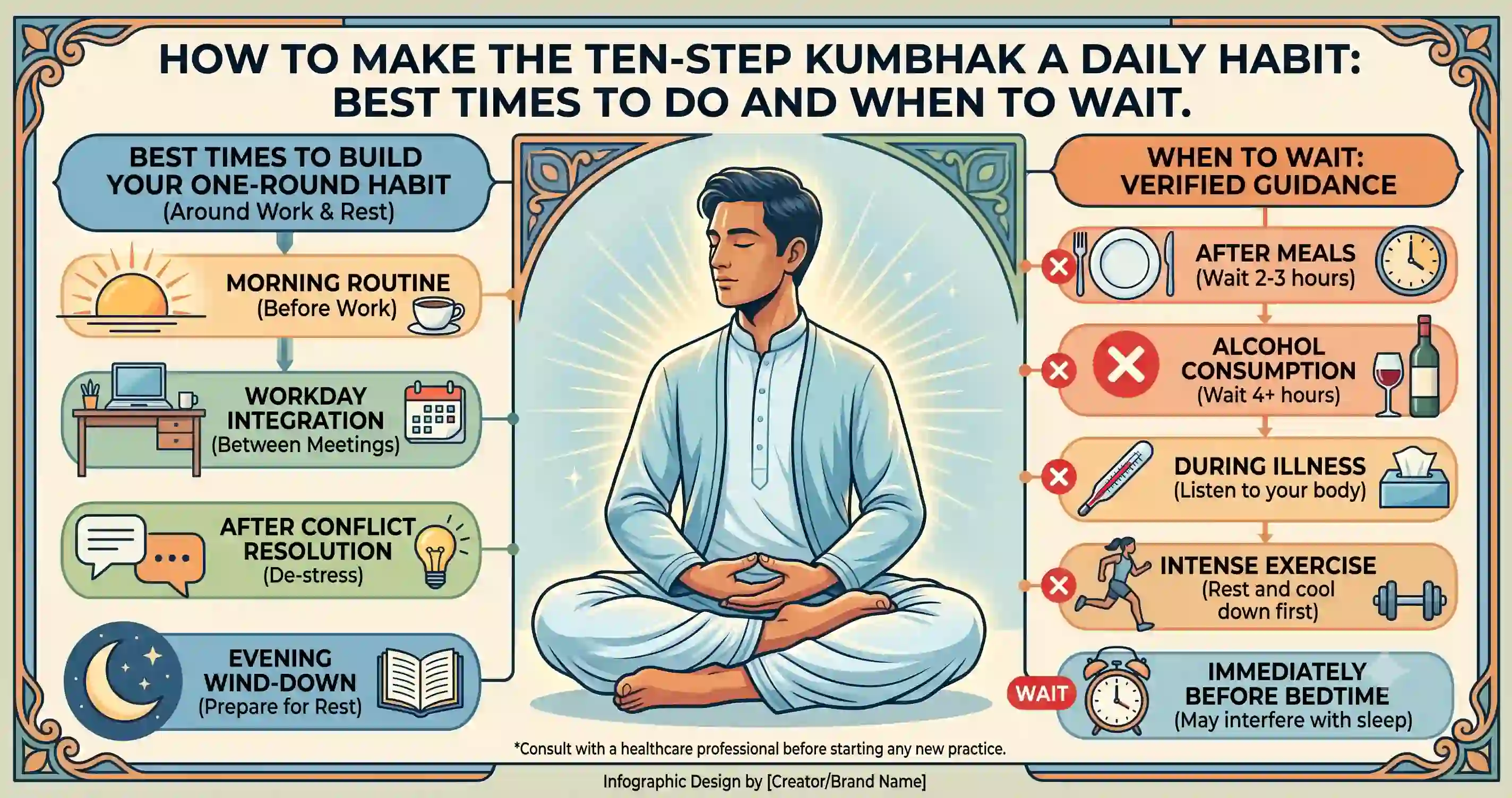
How to Make Kumbhak a Daily Habit When You Are Busy, Tired or Forgetful
You may genuinely want a daily stress-relief practice and still forget it by lunchtime.
That is not necessarily a failure of sincerity. “Practise Kumbhak every day” is an intention, but it does not tell a busy mind when to remember. A transition does:
After I sit at my desk, I will practise one round.
After I return home and sit down safely, I will practise one round.
Before I begin my evening routine, I will practise one round.
These sentences give the practice a doorway. The event opens; the round follows.
This article does not repeat the Ten-Step method. Learn it first from the separate How to Practice the Ten-Step Kumbhak for Stress Relief article on Kumbhaki.com. In every retention, end while it still feels completely easy and while you remain certain that you could have continued comfortably for another one to three seconds. If the urge to breathe, strain or uneasiness appears sooner, end the retention immediately. Never test your limit.
The daily goal is not to hold longer. It is to remember safely.
The Short Answer: When Does One Round Fit Best? ⏱️
Practise at a quiet transition, not in the middle of a demand
The most practical opportunities are:
- after you sit at your desk, before opening email;
- after work, once the commute and immediate responsibilities are over;
- before a meeting, after you are seated and while nobody needs your attention;
- following conflict, after immediate safety and practical action have been addressed;
- before beginning an evening routine, while you are still alert and seated safely; or
- before rest, provided a recent meal, alcohol, illness or post-exercise breathlessness is not a reason to wait.
Brief daily breathwork has improved mood and reduced anxiety in a randomised study, but that research tested five-minute methods, not one round of the Ten-Step Kumbhak.6 One round is therefore a realistic habit-building minimum, not a scientifically established therapeutic dose.
Postpone when your body or surroundings are asking for something else
Wait rather than practise when:
- you are driving, cycling, swimming, bathing, operating machinery, cooking over heat, climbing, walking somewhere unsafe, supervising a vulnerable person or doing anything requiring uninterrupted attention;
- you have consumed alcohol and are not completely sober, clear-headed and physically normal;
- you have fever, acute breathlessness, an asthma flare, a strong cough, vomiting, diarrhoea, dehydration, marked weakness or a respiratory illness that has changed your normal breathing;
- you have just completed vigorous exercise and your breathing, heart rate, temperature or balance has not returned near its usual resting state;
- a meal has left you full, bloated, nauseated or refluxing;
- you are so drowsy that you may drift off or cannot follow the safeguards attentively; or
- the previous round produced dizziness, faintness, chest discomfort, panic, visual disturbance or unusual breathlessness.
These are not lost practice days. They are examples of correct timing.
Why Concrete Cues Work Better Than “I Will Do It Later” 🧠
A habit needs an event it can recognise
Habit research describes a learned link between a repeated behaviour and a stable context. In everyday studies, repetition in a consistent setting increased automaticity; later research found that greater context stability supported stronger automaticity and goal attainment.12
This is why “after I sit at my desk” is usually more useful than “sometime this morning.” The first phrase contains a visible event. The second asks memory to keep searching through an entire morning.
A review of 20 health-habit studies found wide variation in formation time: medians were roughly 59–66 days in the studies that reported them, and individual estimates varied far more widely.3 There is no honest twenty-one-day promise. The practical lesson is simpler: keep repeating the same small action after the same clear cue.
Use one if–then plan
Psychologists call this an implementation intention: if this situation occurs, then I will perform this action. A meta-analysis of 94 tests found that these plans improved goal attainment overall. In a prospective-memory experiment, older adults who formed a detailed implementation intention were more than twice as likely to self-initiate the intended action.45
Write one primary sentence:
If I have sat down at my desk and I am safe to pause, then before opening email I will practise one round of Kumbhak.
Notice the safety clause. A cue is an invitation to check conditions—not an order to ignore the body.
Prefer an event cue to a clock cue
“At 7:00 p.m.” can fail when traffic, children, travel or a late meeting moves the entire day. “After I change out of work clothes and sit down” travels more easily with real life.
Useful event cues include:
- placing the work bag down;
- sitting in the desk chair;
- closing the final work window;
- entering the room used for evening rest;
- finishing a difficult phone call;
- setting a meeting status to “available”; or
- putting the phone on charge before the evening routine.
Choose an event that already occurs on most days. Do not build a complicated preliminary ritual that becomes another reason to postpone.
Make one round the floor, not a quota you must exceed
On an energetic day, “I should do a serious session” can sound attractive. On a tired Wednesday, it can make the practice disappear.
One round lowers the effort required to begin. If you remain completely comfortable, you may choose more rounds in accordance with the How to Practice article. You never owe yourself extra rounds because yesterday was missed.
In the original real-world habit study, missing one opportunity did not materially disrupt the habit-formation process.1 Resume at the next suitable cue. Do not punish one forgotten day with longer retentions, forced breathing or doubled practice.
Where One Round Fits Naturally During a Real Day 🌿
After sitting at the desk
Best cue: Your body touches the chair; your hands have not yet gone to the keyboard.
Habit sentence:
After I sit at my desk, I will check that I am undisturbed and practise one round before opening messages.
Sitting is concrete, repeated and already compatible with the required stable posture. It also places the round before messages and alerts begin choosing the next action for you.
Postpone if: You are joining an urgent call, responsible for immediate monitoring, acutely unwell, unusually breathless, dizzy or too drowsy to attend to the practice.
Make it easier: Place a small neutral card where the keyboard normally rests. Let it say only: Sit → check → one round. The object is a memory cue, not a claim that every day will feel the same.
After work or after returning home
Best cue: The commute is completely finished, immediate caregiving or safety duties are covered, and you are seated.
Habit sentence:
After I put down my work bag and sit safely, I will practise one round before opening a leisure app.
This moment can prevent work and home from becoming one continuous emotional room. The round does not erase what happened. It simply marks: that part of the day has ended; I can meet this part deliberately.
Imagine someone outside their own front door, still replaying a harsh email. The door opens, but the office enters with them. A safe seated round cannot solve the email; it can become the small threshold at which they notice they are home.
Postpone if: You remain in a vehicle that may need to move; a child, older adult, animal, hot pan or another responsibility needs attention; you drank alcohol; or exercise, heat or illness has left you physiologically unsettled.
Before a meeting, presentation or difficult conversation
Best cue: You are seated safely, preparations are complete and there is a private buffer before the event.
Habit sentence:
After I finish preparing and before I join the meeting, I will practise one round if I have an undisturbed minute.
The American Heart Association has described box breathing—not the Ten-Step Kumbhak—as an option for people who want to remain focused, alert and calm before a test or public speaking.8 Yet one Ten-Step round before a meeting has not been tested in a clinical trial. Treat it as a personal experiment:
- How activated did you feel before?
- How do you feel after the two normal recovery breaths?
- Are you clearer, unchanged, sleepy or uncomfortable?
- Does the round help you listen, or make you monitor your body excessively?
Do not practise while driving to the meeting, while someone is speaking to you, while you are responsible for a live system or after the meeting has begun. Kumbhak deserves your full attention, and the other person deserves it too.
Following conflict
Best cue: The immediate danger has passed, urgent action is complete and you have chosen to sit somewhere safe.
Habit sentence:
After I step away from a resolved or paused conflict and sit safely, I will decide whether one round feels supportive.
The word decide matters. Retention can feel containing to one person and constricting to another. In a trial involving people with post-traumatic stress disorder, a prāṇāyāma programme containing retention produced recurrent minor adverse experiences in some participants, including anxiety, breathlessness, dizziness and constriction; one participant had a suffocation-related flashback.9
Therefore:
- If anger is present but your breathing is normal and you feel physically safe, one easy round may serve as a boundary before the next action.
- If you are gasping, panicking, dissociating, feeling trapped or reliving suffocation, do not insist on Kumbhak. Return to unrestricted normal breathing and seek appropriate support.
- If there is threat, violence, chest pain, severe breathlessness or a medical emergency, act on safety first.
- Do not use a round to avoid an apology, boundary, medical assessment or necessary conversation.
The practice may change the state in which you respond. It does not replace the response life still requires.
Before an evening routine or before rest
Best cue: You are seated and alert, before brushing your teeth, changing for bed, reading or beginning another consistent evening action.
Habit sentence:
Before I begin my evening routine, I will sit safely and practise one round if my stomach, alertness and breathing feel normal.
Early randomised trials of 4-7-8 breathing reported improvements in self-rated sleep outcomes, including a four-week trial in nursing students and a six-week trial in adults with tinnitus.1011 Those studies tested a different breathing ratio containing retention. They do not prove that the Ten-Step Kumbhak treats insomnia, that its holds caused the outcomes or that bedtime is superior to another time.
The habit value is more certain than the sleep claim: an evening routine is repetitive and therefore memorable.
Practise before getting into bed, while you can maintain the safe seated posture and remain attentive. If dinner was recent and you feel full or refluxing, if you drank alcohol, or if you are struggling to stay awake, use an earlier cue or postpone.
What to Do When You Are Busy, Tired or Forgetful 🔁
When you are busy: shrink the beginning
Do not negotiate with the whole future session. Ask:
Is one safe round available now?
If yes, practise one. If no because the situation needs your attention, name the next real cue:
After this call ends and I sit without interruption, I will practise one round.
This is different from “later.” It transfers the action to another identifiable event.
Avoid using stress itself as the only cue. Stress can be vague, and by the time you recognise it you may already be driving, arguing, presenting or physically breathless. A transition cue is more dependable.
When you are tired: separate low motivation from unsafe drowsiness
Two conditions can sound identical—“I am tired”—but require different decisions.
Low motivation, but fully awake: If you can sit upright, follow the method accurately and attend to every sensation, one round may be the whole practice.
Drowsy, nodding off or cognitively foggy: Postpone. Fatigue can impair attention and decision-making, and people do not always recognise the extent of that impairment.12 Kumbhak should not become a test of whether you can overpower sleep.
Tired because you are ill, dehydrated, overheated or unusually breathless: Address that condition first. A daily record can still say, “Correctly postponed.”
When you are forgetful: move memory into the environment
Use one visible cue at the precise action point:
- a card on the closed laptop;
- a small dot on the meeting notebook;
- an empty cushion placed on the chair;
- a phone reminder named “Sit safely, then decide”; or
- a calendar event attached to the end—not the beginning—of work.
The reminder should never merely say “Kumbhak.” Let it contain the conditions:
Seated? Safe? Undisturbed? Normal breathing? Then one round.
If the cue becomes invisible through familiarity, change its appearance or location while keeping the underlying transition the same.
When you miss a day: protect the relationship, not the streak
A broken streak can whisper, “You have failed; start again on Monday.” Habit research offers a kinder and more accurate response: automaticity develops through repeated context–behaviour pairing over time, not through moral perfection.3
Use the next appropriate cue. Do not:
- lengthen the next Antar Kumbhak or Bāhya Kumbhak;
- add rounds to “make up” for the missed day;
- practise after alcohol, illness or a large meal merely to preserve a streak; or
- call a safety-based postponement laziness.
The habit you want is not Kumbhak at any cost. It is Kumbhak when appropriate.
When your schedule changes: keep the sequence, move the clock
For shift work, travel, parenting or irregular employment, anchor to the order of events:
- after waking and completing urgent needs;
- after arriving and sitting at the work station;
- after the main work period ends; or
- before the first settled evening activity.
The clock can move. The sequence remains recognisable.
When Should You Practise Kumbhak—and When Should You Postpone It? ✅⏸️
After eating: prefer a settled stomach; do not invent a universal timer
Recommendation: Prefer practising before a meal or when the stomach feels settled. Postpone if a meal has left you full, bloated, nauseated, uncomfortable or refluxing.
Traditional verification: India’s Ministry of AYUSH recommends regular yoga practice on an empty stomach, while the Haṭha Yoga Pradīpikā 2.1 places prāṇāyāma alongside moderate, suitable eating.1314
Scientific verification: Food produces gastric accommodation and post-meal changes in pressure, sensation and thoracoabdominal behaviour. People with reflux or functional digestive symptoms can experience fullness and distension differently.15 However, post-meal diaphragmatic-breathing studies in gastro-oesophageal reflux have sometimes reduced reflux measures.1617 Science therefore does not support the sweeping statement that every breathing exercise after food is dangerous.
Honest boundary: Those reflux studies did not test the chest-centred Ten-Step Kumbhak or its two retentions. No direct study establishes a universal two-, three- or four-hour waiting period for this method.
Practical decision:
- Before food or with a settled stomach: reasonable.
- After a small meal with no fullness or reflux: there is no evidence-based universal clock ban, but a beginner may still prefer to wait until fully comfortable.
- After a large meal or whenever symptoms are present: postpone until they have resolved.
- Known reflux, hiatal hernia, delayed gastric emptying or another digestive condition: follow individual medical advice rather than a generic web timer.
After alcohol: postpone until completely sober and physically normal
Recommendation: Do not practise Kumbhak after drinking alcohol. Wait until you are completely sober, alert, coordinated, hydrated and free of dizziness, nausea, unusual fatigue or hangover symptoms.
Alcohol can impair judgement, reaction time, coordination and decision-making before intoxication looks obvious. At higher exposure, alcohol overdose can suppress brain functions that support breathing and other vital functions.1819 Alcohol can also aggravate sleep-disordered breathing.20
There is no direct trial identifying a safe number of hours between alcohol and the Ten-Step Kumbhak. Because alcohol absorption and clearance vary with dose, food, body size, sex, medicines and health, do not convert this into a universal countdown. “I feel relaxed” is not the same as “my judgement is unimpaired.”
If alcohol is part of the evening, choose an earlier sober cue—or correctly postpone the practice.
During acute illness: let normal breathing return first
Recommendation: Postpone retention during fever, an acute asthma flare, significant nasal blockage that prevents the method’s normal nasal breathing, strong or repeated coughing, chest infection symptoms, vomiting, diarrhoea, dehydration, marked weakness or any new or unusual breathlessness.
Respiratory illnesses commonly produce cough, congestion, fatigue, weakness and sometimes breathing difficulty. The CDC identifies difficulty breathing, chest pain, confusion and severe weakness among warning signs requiring medical attention.21 Clinical breathing guidance advises practising breathing control when relaxed rather than already short of breath.22 The Global Initiative for Asthma defines an exacerbation as worsening shortness of breath, cough, wheeze or chest tightness; an acute attack requires the person’s asthma action plan and medical care, not experimental retention.23
No research defines an exact “return to Kumbhak” day after infection. Resume only when:
- fever and acute systemic symptoms have resolved;
- normal nasal breathing is available for the method;
- breathing and energy have returned to your usual baseline;
- you can remain seated, alert and comfortable; and
- your clinician has cleared you if the illness was significant or involved the heart or lungs.
Do not use Kumbhak to test whether your lungs have recovered.
After exercise: complete recovery before retention
Recommendation: Do not insert Kumbhak into vigorous exercise or begin it immediately after stopping. Complete a normal cool-down; then wait until you are seated safely, your breathing and heart rate are near their usual resting state, and you have no dizziness, overheating, nausea, chest discomfort or unusual breathlessness.
The American Heart Association explains that heart rate, body temperature and vascular dilation remain elevated after exercise and recommends a gradual five-to-ten-minute cool-down rather than an abrupt stop.24 It also warns that holding the breath during exertion can raise blood pressure.25
Direct Kumbhak physiology supports caution. In a study of one-minute holds in healthy participants, blood pressure and total peripheral resistance increased during retention while stroke volume and cardiac output fell.26 Those long laboratory holds are not the brief, easy retentions of this practice, but they demonstrate that a hold is an active cardiovascular event—not a recovery shortcut.
Five to ten minutes is a common cool-down window, not a guaranteed Kumbhak clearance time. Recovery varies. If your pulse, breathing, temperature or balance still feels abnormal, continue recovering and postpone.
At bedtime: use the beginning of the routine, not the edge of sleep
Recommendation: Bedtime can be a useful cue when you practise while seated, awake and attentive before getting into bed. Postpone if you are dozing, have recently consumed alcohol, feel full or refluxing, or have taken a sedating medicine that makes attentive practice uncertain.
The emerging sleep studies of retention-containing breathwork are promising but method-specific and based mainly on self-reported outcomes.1011 They do not show that breath retention is a treatment for sleep apnoea or that longer holds induce better sleep.
If you snore heavily, wake gasping, have witnessed breathing pauses or experience marked daytime sleepiness, seek assessment for sleep apnoea. Deliberate Kumbhak is not a substitute for diagnosis or prescribed treatment.
During any task requiring full attention: never multitask Kumbhak
Recommendation: Practise only when a temporary change in attention—or an unexpected episode of dizziness—cannot endanger you or someone else.
That means no Kumbhak:
- while driving or controlling a vehicle;
- while cycling in traffic;
- while swimming, bathing or in any water;
- while operating machinery, tools or heat;
- while climbing or balancing at height;
- while crossing a road or walking on unsafe ground;
- while carrying a baby or supervising someone who needs continuous attention;
- during live clinical, security, caregiving or industrial monitoring; or
- during any conversation in which another person reasonably expects your full presence.
The CDC states that driving requires full attention and that any non-driving task reduces the attention available for detecting and responding to hazards.27 Water adds a separate and potentially fatal risk: the American Red Cross, YMCA of the USA and USA Swimming warn that extended breath-holding and pre-hold hyperventilation in water can cause hypoxic blackout.28
The Ten-Step Kumbhak does not use preparatory hyperventilation. The rule remains absolute: never practise breath retention in water.
During emotional distress: distinguish activation from emergency
Recommendation: One round may be tried after ordinary work stress or a resolved disagreement only when you are physically safe, able to attend inwardly and breathing normally. Postpone during panic, dissociation, a suffocation memory, uncontrolled sobbing, gasping, self-harm risk, violence or any crisis needing immediate human or medical help.
This recommendation is supported by the adverse-event pattern in the PTSD prāṇāyāma trial.9 If focusing on retention makes distress stronger, return to unrestricted normal breathing. A no-hold practice or professional support may be more suitable.
A Seven-Day Habit Experiment That Does Not Demand Belief 🗓️
Day 0: choose one primary cue and one backup
Complete:
Primary: After ________, I will sit safely, check the conditions and practise one round.
Backup: If the primary cue is missed, then after ________, I will check again.
Examples:
- Primary: after I sit at my desk;
- Backup: after lunch has settled and before the first afternoon work block.
or
- Primary: after I return home and sit down;
- Backup: before I begin my evening routine, provided I have not consumed alcohol and do not feel full or drowsy.
One backup is enough. Five backup times recreate the vague burden you are trying to remove.
Days 1–3: practise the cue, not duration
Your success question is:
Did I notice the cue and make a safe decision?
Record one answer:
- Practised one round
- Correctly postponed
- Forgot
“Correctly postponed” protects safety from being mistaken for failure.
Days 4–6: observe the transition
After the two normal recovery breaths, use one neutral sentence:
I feel more settled / unchanged / more activated / uncomfortable.
Do not tell yourself what you are supposed to feel. In a randomised comparison, several five-minute breathing and mindfulness methods improved mood, while the retention-containing methods were not uniquely superior.6 Your direct response matters.
If the round repeatedly feels uncomfortable, stop using habit pressure to continue it. Recheck the method, timing and suitability with a qualified professional.
Day 7: keep, move or release the cue
Ask:
- Did the cue occur on most days?
- Was I usually safe and undisturbed when it occurred?
- Did one round feel realistic?
- What changed, if anything?
- Did the cue conflict with meals, alcohol, exercise, caregiving or sleepiness?
Then choose:
- Keep it if the cue was visible and suitable.
- Move it if the cue occurred at an unsafe or inconvenient time.
- Release it if the method felt unsuitable.
A voluntary experiment gives better information than a promise made under enthusiasm.
Yogic and Ayurvedic Perspectives on Daily Timing 🕉️
Patañjali: place, time and number belong inside the practice
Yoga Sūtra 2.50 describes external, internal and suspended movements of prāṇāyāma as observed or regulated through place, time and number, becoming extended and subtle.29
bāhyābhyantarastambhavṛttir deśakālasaṃkhyābhiḥ paridṛṣṭo dīrghasūkṣmaḥ — Yoga Sūtra 2.50
For a modern stress-relief practitioner, the most relevant truth is not a demand for long duration. It is that context and measure are part of the discipline. A round in a stable seat is not interchangeable with a hold attempted in traffic. A brief, easy retention is not interchangeable with a maximum test.
The Haṭha Yoga Pradīpikā: daily practice is paired with restraint
The Haṭha Yoga Pradīpikā 2.6 recommends daily prāṇāyāma practice with a clear quality of mind. Yet the same chapter compares training the breath to taming a powerful animal by degrees (2.15), warns that improper practice can generate illness (2.16), and instructs that Rechak, Pūrak and retention be handled skilfully and carefully (2.18).14
The text also places over-eating, excessive exertion and unsteadiness among obstacles (1.15), while perseverance and discrimination appear among supports for success (1.16).30
These verses do not describe the Ten-Step Kumbhak, and their wider metaphysical and physiological claims have not been scientifically established. Their relevant practical connection is precise:
- daily does not mean careless;
- perseverance does not mean strain;
- discipline includes choosing the right place and time; and
- measure matters more than display.
The Gheraṇḍa Saṃhitā: time, place and moderate food are prerequisites
At the opening of its prāṇāyāma chapter, the Gheraṇḍa Saṃhitā 5.2 lists a suitable place, suitable time and moderate food before practice.31 This is a traditional instruction, not a modern trial, but it directly contradicts the idea that a practitioner should perform retention anywhere simply to maintain a streak.
Ayurveda: let routine carry the practice
Ayurveda’s dinacaryā is the organisation of health-supporting actions into the recurring shape of a day. That classical framework has not scientifically validated “habit stacking” or this Kumbhak method. Yet its practical insight is compatible with modern habit research: a useful action becomes easier to remember when it belongs to an established sequence.32
The Aṣṭāṅga Hṛdaya, Sūtrasthāna 2.19, advises measured, suitable eating after previous food has digested; it also warns against forcing natural urges and against neglecting treatable illness.33 The verse is not a Kumbhak protocol. Applied here as an Ayurvedic analogy, it supports three attitudes:
- do not pile practice on top of digestive discomfort;
- do not fight the body’s clear signal to breathe; and
- do not let a wellness routine distract from necessary treatment.
These Ayurvedic concepts are traditional clinical philosophy, not experimentally proven explanations of carbon dioxide, vagal activity or stress hormones.
Scientific Truths: What a Daily One-Round Habit Can and Cannot Claim 🔬
What the evidence supports
- Stable, repeated context cues can strengthen automaticity.23
- If–then planning can improve the likelihood that an intended action is remembered and initiated.45
- Brief daily breathwork can improve mood and anxiety measures in some healthy adults.6
- Breathing protocols containing Kumbhak have produced promising stress, anxiety and sleep findings in some studies.3410
- Breath retention produces real cardiovascular and cerebrovascular changes; dose, lung volume, preceding breathing and individual health matter.2635
What the evidence does not establish
- No trial has shown that one round of the Ten-Step Kumbhak is the optimal daily dose.
- No trial has shown that after-work, pre-meeting or post-conflict timing is biologically superior.
- No direct study defines a universal waiting time after a meal, alcohol, exercise or acute illness for this method.
- Evidence from box breathing, 4-7-8 breathing, alternate-nostril breathing or clinical intermittent hypoxia cannot be assigned automatically to the Ten-Step Kumbhak.
- A helpful transition ritual does not prove that retention alone caused the effect.
- A daily habit is not a treatment for hypertension, asthma, insomnia, trauma, depression or another medical condition.
One large active-controlled trial found that cyclic hyperventilation with long retention was not superior to a credible breathing comparator for stress after three weeks.36 That finding does not invalidate comfortable Kumbhak. It reminds us that attention, expectancy, rhythm and protected recovery time may all contribute.
Why the one-to-three-second reserve matters every day
The reserve is not a target hold time. It is a stopping margin:
End the retention while you still feel completely at ease and remain certain you could continue another one to three seconds.
“Another one to three seconds” is an individual range, not a three-second minimum. If you cannot retain comfortably for three seconds, do not try to leave three seconds in reserve. Use the shortest margin within that range that remains completely easy and certain for you. If even a one-second reserve does not feel completely easy, end the retention immediately or choose a no-retention practice. The first urge, strain or uneasiness overrides every plan, timer, streak and article.
This turns daily practice away from performance. You are not collecting seconds. You are practising the ability to stop before compulsion begins.
Essential Safety Check Before Every Round ⚠️
Ask six questions
- Am I seated in a stable, safe place?
- Does anything or anyone need my full attention?
- Am I sober, awake and clear-headed?
- Are my breathing, heartbeat and body near their usual resting state?
- Is my stomach comfortable?
- Can I end both retentions before any urge, strain or uneasiness?
If any answer is no, postpone.
Stop immediately for warning symptoms
Return to unrestricted normal breathing if you experience:
- dizziness, light-headedness, faintness or loss of balance;
- tunnel, grey or otherwise disturbed vision;
- chest pain, chest tightness or unusual palpitations;
- unusual breathlessness, wheezing or a strong cough;
- severe headache, confusion, tingling or loss of coordination;
- panic, dissociation, constriction or a traumatic flashback; or
- any unfamiliar or worrying symptom.
Do not resume until breathing and the whole body feel completely normal. Seek urgent medical care for loss of consciousness, chest pain, severe or persistent breathlessness, new neurological symptoms or another serious symptom.
Obtain individual medical guidance first when appropriate
Consult a qualified healthcare professional before breath-retention practice if you are pregnant or have a significant heart, lung, blood-pressure, cerebrovascular, neurological, fainting, panic-related or trauma-related concern.726359 If you have recently had surgery or take medicine that materially affects breathing, alertness, heart rate or blood pressure, ask the clinician responsible for that care. These are precautionary screening recommendations; they do not mean that harm has been demonstrated for every person in these groups.
The American Heart Association advises people with heart or lung conditions to consult a healthcare professional before breathing techniques and tells beginners to stop if dizziness or light-headedness occurs.7
Frequently Asked Questions 🙋
What is the best time of day to practise Kumbhak?
There is no scientifically proven best clock time for the Ten-Step Kumbhak. The best practical time is a repeatable transition when you are seated, sober, alert, undisturbed, physically settled and breathing normally. For many people, that is after sitting at a desk, after returning home or before beginning an evening routine.
Is morning better than evening?
Not universally. Morning may offer an empty or settled stomach and fewer interruptions. Evening may offer a stronger transition away from work. Choose the time that repeatedly satisfies the safety conditions. If an evening cue often collides with dinner, alcohol or drowsiness, use morning or the start of work.
Can I practise Kumbhak immediately after eating?
Prefer a settled stomach. Postpone when full, bloated, nauseated or refluxing. Traditional yoga guidance commonly recommends an empty stomach, but science has not established a universal multi-hour ban for this Ten-Step method. Some different breathing exercises have even been studied after meals for reflux. Comfort, meal size and individual digestive health matter.
Can I practise after one alcoholic drink?
No. Postpone until completely sober, alert, coordinated, hydrated and free of hangover or other symptoms. No research provides a universal “safe after X hours” rule for alcohol and Kumbhak.
Can I practise when I have a cold?
Postpone if congestion prevents normal nasal breathing, or if you have fever, significant cough, chest symptoms, weakness, dehydration or any altered breathing. A minor isolated symptom does not create a research-proven prohibition, but the Ten-Step method should never be forced around obstruction or illness.
How long should I wait after exercise?
Complete a normal cool-down—often five to ten minutes in general exercise guidance—and wait longer if necessary. Practise only after you are safely seated and breathing, heart rate, temperature and balance are near your usual resting state. There is no universal Kumbhak-specific number of minutes.
Is one round enough to build the habit?
One round is enough to complete the habit action. It is not a proven clinical dose. The initial aim is a repeatable, safe cue–action link. If one round remains completely comfortable, additional practice can follow the separate How to Practice guidance.
What if I forget for several days?
Use the next safe occurrence of your cue. Do not compensate with longer retentions or extra rounds. If the same cue keeps failing, move the practice to a more visible transition.
What if Kumbhak makes me more anxious?
Stop and return to unrestricted normal breathing. Do not force exposure to air hunger. Review the method and consider a no-retention practice or qualified clinical guidance, especially if you have panic, trauma involving suffocation or significant respiratory concerns.
A Daily Habit Worth Keeping 🌅
Let the cue carry what motivation cannot
Some days you will feel ready. Some days you will be tired. Some days the practice will feel quiet; some days it may feel neutral. The cue does not promise an emotion. It simply creates a place where you can listen.
The most sustainable plan is small:
After one real event, in one safe place, practise one completely unforced round—or correctly postpone it.
That final phrase matters. A practice meant for stress relief should not become another voice demanding obedience from an exhausted body.
The day does not need to become less busy before Kumbhak can belong inside it. The practice needs a clear doorway, an easy stopping margin and your permission to wait when waiting is wiser.
Verification Notes and Sources 📚
How the recommendations were checked
Each timing recommendation above was checked separately against the closest available evidence:
- Habit cues: primary habit-formation, context-stability, implementation-intention and prospective-memory research.
- One-round minimum: identified as a behavioural design choice because direct one-round efficacy research is absent.
- Meals: official yoga guidance, gastrointestinal physiology and post-meal breathing research; no universal waiting time asserted.
- Alcohol: official evidence on judgement, coordination, respiratory danger and sleep-disordered breathing; no Kumbhak-specific interval asserted.
- Acute illness: public-health symptom guidance, respiratory physiotherapy guidance and asthma standards.
- Exercise recovery: cardiovascular cool-down guidance plus direct Kumbhak haemodynamic research.
- Bedtime: direct trials of a different retention-containing breathing method, with non-transferability made explicit.
- Full-attention situations: transport-safety and water-safety guidance.
- Conflict, panic and trauma: adverse events from a prāṇāyāma trial in PTSD.
- Yogic and Ayurvedic claims: original verse text or historical translations, labelled as traditional rather than scientifically verified.
Evidence and guidance were last checked on 24 July 2026.
-
Phillippa Lally et al., “How Are Habits Formed: Modelling Habit Formation in the Real World,” European Journal of Social Psychology 40, no. 6 (2010): 998–1009. DOI record. ↩↩
-
Marco Stojanovic, Axel Grund and Stefan Fries, “Context Stability in Habit Building Increases Automaticity and Goal Attainment,” Frontiers in Psychology 13 (2022): 883795. Full text. ↩↩
-
Ben Singh et al., “Time to Form a Habit: A Systematic Review and Meta-Analysis of Health Behaviour Habit Formation and Its Determinants,” Healthcare 12 (2024): 2488. Full text. ↩↩↩
-
Peter M. Gollwitzer and Paschal Sheeran, “Implementation Intentions and Goal Achievement: A Meta-analysis of Effects and Processes,” Advances in Experimental Social Psychology 38 (2006): 69–119. University record and DOI. ↩↩
-
Alison L. Chasteen, Denise C. Park and Norbert Schwarz, “Implementation Intentions and Facilitation of Prospective Memory,” Psychological Science 12, no. 6 (2001): 457–461. Article abstract. ↩↩
-
Melis Yilmaz Balban et al., “Brief Structured Respiration Practices Enhance Mood and Reduce Physiological Arousal,” Cell Reports Medicine 4, no. 1 (2023): 100895. Full text. ↩↩↩
-
American Heart Association, “Stress Management,” including breathing-technique precautions for beginners and people with heart or lung conditions. Official guidance. ↩↩
-
American Heart Association, “It’s Not Just Inspiration—Careful Breathing Can Help Your Health,” distinguishing several methods and describing box breathing as an option before a test or public speaking when calm alertness is wanted. AHA News. ↩
-
Heidemarie Haller, Dietmar Mitzinger and Holger Cramer, “The Integration of Yoga Breathing Techniques in Cognitive Behavioral Therapy for Post-Traumatic Stress Disorder: A Pragmatic Randomized Controlled Trial,” Frontiers in Psychiatry 14 (2023): 1101046. Full text. ↩↩↩
-
“The Effect of 4-7-8 Breathing Exercise Training on Sleep Quality of Undergraduate Nursing Students: A Randomized Controlled Study,” European Journal of Integrative Medicine 82 (2026): 102620. Publisher record and DOI. ↩↩↩
-
Gulce Kirazli et al., “The Effect of 4-7-8 Breathing Exercise Technique on Tinnitus Handicap, Psychological Factors, and Sleep Quality in Tinnitus Patients: A Randomized Controlled Study,” Brain and Behavior 16, no. 2 (2026): e70854. PubMed record. ↩↩
-
US National Institute for Occupational Safety and Health, “Driver Fatigue on the Job,” describing impaired reactions and decision-making with fatigue. CDC/NIOSH guidance. ↩
-
Ministry of AYUSH, Government of India, Yoga Guidelines, recommending regular yoga practice on an empty stomach. Official PDF. ↩
-
Svātmārāma, Haṭha Yoga Pradīpikā, chapter 2, especially verses 2.1, 2.6 and 2.15–2.18. Historical English translation. ↩↩
-
Dan M. Livovsky and Fernando Azpiroz, “Gastrointestinal Contributions to the Postprandial Experience,” Nutrients 13, no. 3 (2021): 893. Full text. ↩
-
Magnus Halland et al., “Effects of Diaphragmatic Breathing on the Pathophysiology and Treatment of Upright Gastroesophageal Reflux: A Randomized Controlled Trial,” American Journal of Gastroenterology 116, no. 1 (2021): 86–94. PubMed record. ↩
-
Lucie Zdrhova et al., “Breathing Exercises in Gastroesophageal Reflux Disease: A Systematic Review,” Dysphagia 38, no. 2 (2023): 609–621. Full text. ↩
-
US National Institute on Alcohol Abuse and Alcoholism, “Too Soon = Too Dangerous,” explaining that decision-making and coordination decline before overt intoxication. Official guidance. ↩
-
US National Institute on Alcohol Abuse and Alcoholism, “Understanding the Dangers of Alcohol Overdose,” including suppression of vital brain functions such as breathing. Official PDF. ↩
-
National Institute on Alcohol Abuse and Alcoholism, “Alcohol Use Disorder and Co-occurring Mental Health Conditions,” noting that alcohol may aggravate sleep-disordered breathing. Official clinical resource. ↩
-
US Centers for Disease Control and Prevention, “About Respiratory Illnesses,” including symptoms and emergency warning signs. Official guidance. ↩
-
Gloucestershire Hospitals NHS Foundation Trust, “Managing Breathlessness,” advising practice when relaxed rather than already short of breath. Patient guidance. ↩
-
Global Initiative for Asthma, 2025 Summary Guide for Asthma Management and Prevention. Official PDF. ↩
-
American Heart Association, “Warm Up, Cool Down,” explaining post-exercise cardiovascular conditions and a gradual five-to-ten-minute cool-down. Official guidance. ↩
-
American Heart Association, “Getting Active to Control High Blood Pressure,” advising regular breathing during exercise because holding the breath can raise blood pressure. Official guidance. ↩
-
L. Nivethitha, A. Mooventhan and N. K. Manjunath, “Evaluation of Cardiovascular Functions during the Practice of Different Types of Yogic Breathing Techniques,” International Journal of Yoga 14, no. 2 (2021): 158–162. Full text. ↩↩↩
-
US National Institute for Occupational Safety and Health, “Distracted Driving at Work,” stating that driving requires full attention. CDC/NIOSH guidance. ↩
-
American Red Cross, YMCA of the USA and USA Swimming, “Joint Statement on Hypoxic Blackout” (2022). Official PDF. ↩
-
Patañjali, Yoga Sūtra 2.50, with Sanskrit, transliteration, translation and classical commentaries. Verified text. ↩
-
Svātmārāma, Haṭha Yoga Pradīpikā, 1.15–1.16. Historical English translation. ↩
-
Gheraṇḍa, Gheraṇḍa Saṃhitā 5.1–5.2, translated by Śrīśa Chandra Vasu (1895), introducing place, time and moderate food before prāṇāyāma. Digitised historical edition. ↩
-
Charaka Saṃhitā Online, “Dinacharya: Daily Regimen for Preservation of Health,” with classical textual references. Textual overview. ↩
-
Vāgbhaṭa, Aṣṭāṅga Hṛdaya, Sūtrasthāna 2.19, Sanskrit, transliteration and translation. Verse text. ↩
-
G. Sunil Naik, G. S. Gaur and G. K. Pal, “Effect of Modified Slow Breathing Exercise on Perceived Stress and Basal Cardiovascular Parameters,” International Journal of Yoga 11, no. 1 (2018): 53–58. The tested method contained equal Pūrak, Kumbhak and Rechak phases. Full text. ↩
-
L. Nivethitha et al., “Cerebrovascular Hemodynamics during Prāṇāyāma Techniques,” Journal of Neurosciences in Rural Practice 8, no. 1 (2017): 60–63. Full text. ↩↩
-
Guy W. Fincham et al., “Effects of Brief Remote High Ventilation Breathwork with Retention on Mental Health and Wellbeing: A Randomised Placebo-Controlled Trial,” Scientific Reports 14 (2024): 16893. Full text. ↩