Correct eight common Ten-Step Kumbhak mistakes—maximum filling, forced emptying, tense posture and rushed repetition—without strain.
By Kumbhaki Yogi Dhruvaji (MSc), founder of the Antistress Foundation 501(c)(3)
• How to Practice Ten-Step Kumbhak • Scientific Proof • Ancient Texts Proof • Bio • Subscribe By Email
The most dangerous misunderstanding in Ten-Step Kumbhak is also the most tempting:
If a little retention feels useful, more air, more effort, more seconds or more rounds must work better.
That is not the purpose of this stress-relief practice.
Ten-Step Kumbhak asks for a comfortably full Pūrak, a comfortably empty Rechak, completely easy retentions, a relaxed body and the complete breathing transitions between holds and rounds. The hold ends while you still know you could have continued for at least another one to three seconds. If strain or an urge to breathe appears sooner, you do not wait for that reserve—you end the hold immediately.
The one-to-three-second rule is a remaining reserve, not a minimum hold time. Someone who cannot retain the breath comfortably for three seconds is not expected to do so. A retention may be one second, less than one second or omitted altogether.
This article corrects errors; it does not reproduce the full method. Learn the complete sequence first from How to Practice the Ten-Step Kumbhak for Stress Relief.
Imagine a person who tries to make the pause peaceful by tightening everything around it. The shoulders rise. The abdomen hardens. The face waits for permission to breathe. Nothing has “failed”—but the body has quietly changed the exercise from receiving a pause to surviving one.
The corrections below bring the practice home again. 🌿
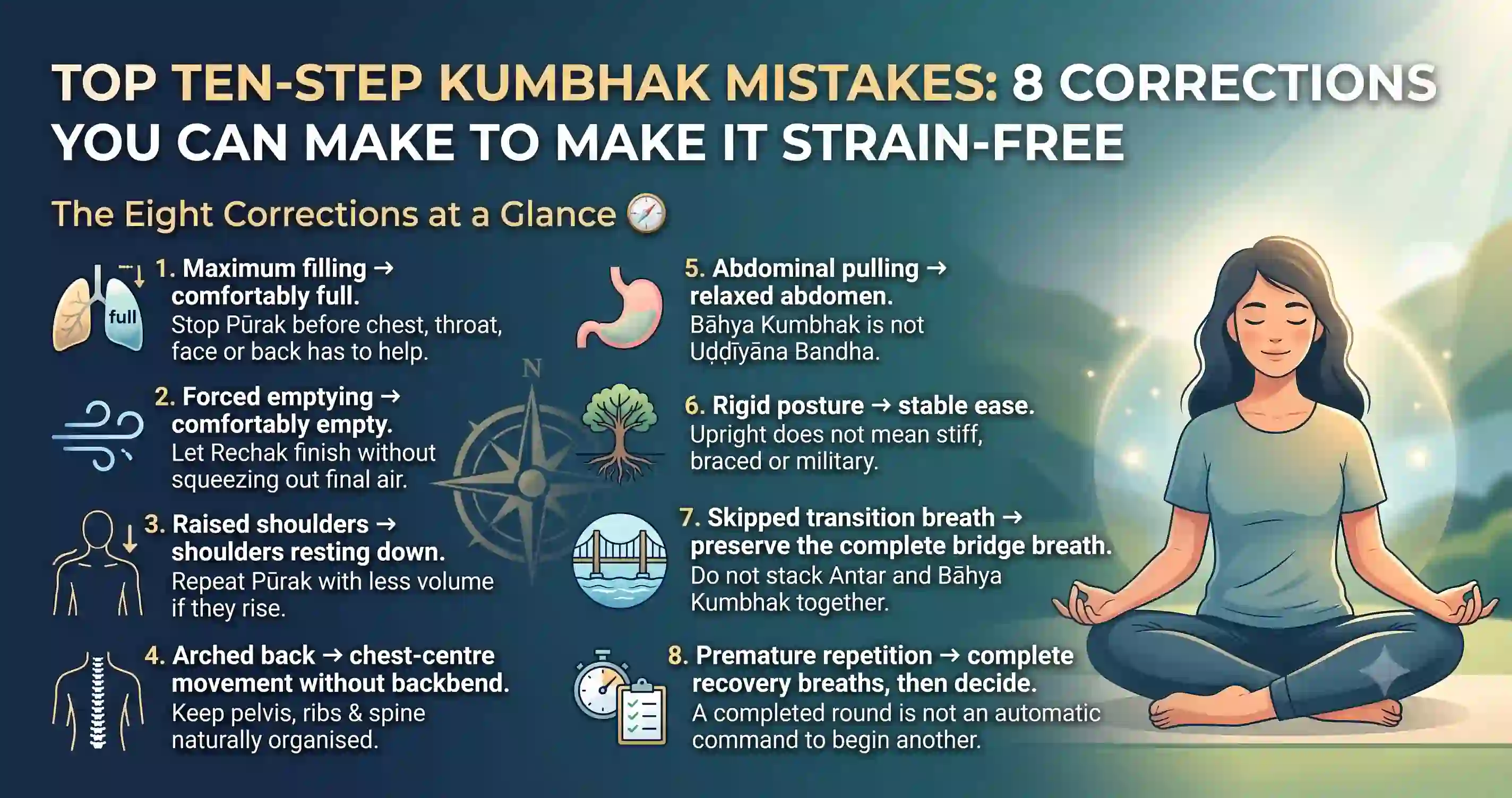
The Eight Corrections at a Glance 🧭
- Maximum filling → comfortably full. Stop Pūrak before the chest, throat, face or back has to help.
- Forced emptying → comfortably empty. Let Rechak finish without squeezing out the final air.
- Raised shoulders → shoulders resting down. Repeat Pūrak with less volume if they rise.
- Arched back → chest-centre movement without a backbend. Keep the pelvis, ribs and spine naturally organised.
- Abdominal pulling → relaxed abdomen. Bāhya Kumbhak is not Uḍḍīyāna Bandha.
- Rigid posture → stable ease. Upright does not mean stiff, braced or military.
- Skipped transition breath → preserve the complete bridge breath. Do not stack Antar and Bāhya Kumbhak together.
- Premature repetition → complete the recovery breaths, then decide. A completed round is not an automatic command to begin another.
These are not eight cosmetic refinements. They all defend one central agreement:
No part of a stress-relief round should require the body to behave as though it is under threat.
First Clarify Three Words That Cause Most Mistakes 🔎
“Full” does not mean maximum
In this method, “full” is shorthand for comfortably full. It is not total lung capacity, a last sip of air, the biggest chest circumference you can create or a number on a breathing device.
Likewise, “empty” means comfortably empty. Human lungs are not literally emptied by Rechak; residual air remains even after a maximal forced expiration.1
The method uses felt boundaries:
- enough air to feel comfortably full;
- enough release to feel comfortably empty;
- no gulping;
- no squeezing;
- no competition with yesterday’s round.
“Normal” describes the moving breath
Pūrak and Rechak are normal in pace—not deliberately too fast or manipulated into an extended rhythm. The centre of the chest moves in the instructed direction, but the rest of the body does not have to dramatise that movement.
If a breathing phase can be completed only by shrugging, backbending, clenching or pulling the abdomen, its volume or effort has exceeded the intended normal quality.
For the detailed rationale, see Kumbhaki’s article explaining why Pūrak and Rechak remain normal in pace.
“One to three seconds” describes what remains
The reserve is not:
- a three-second target;
- a compulsory minimum;
- a countdown that begins after air hunger;
- permission to continue because discomfort is still “bearable.”
It means this:
End the retention while it is completely easy and while you remain certain that at least one to three comfortable seconds were still available.
If you cannot truthfully sense that reserve, shorten or omit the hold. If any urge, strain or uneasiness comes first, breathe immediately. Read the fuller safety explanation in Why You Should Never Hold Your Breath to the Limit in Kumbhak.
Mistake 1: Filling the Lungs to Maximum Capacity 🎈
Maximum filling often begins innocently. The practitioner hears “full,” decides that success must be measurable and adds one final sip of air. Then another. The upper chest becomes tight, the collarbones lift and the next event—the hold—begins inside effort.
How to recognise maximum filling
You may notice:
- a last gulp or top-up after you already felt full;
- pressure across the upper chest;
- a stretched or gripped throat;
- raised shoulders or flared lower ribs;
- the back moving into an arch;
- the face becoming serious before Antar Kumbhak even begins;
- relief when Rechak starts, rather than ease throughout the pause.
The clearest clue is simple: you have to hold the body as well as the breath.
Step-by-step correction
- Return to normal breathing and release any residual effort.
- Let the face, jaw, throat, shoulders, chest, abdomen and legs settle.
- Begin the next Pūrak from the centre of the chest.
- Stop when the inhalation feels comfortably full—even if more air could physically be taken in.
- Check whether the shoulders stayed down and the back stayed naturally upright.
- If either moved, reduce the volume on the next attempt.
- Enter Antar Kumbhak only if the starting position already feels completely easy.
“I could take in more” is not evidence that you should. The unused capacity is part of the safety architecture.
Why maximum filling changes the task
At larger inspiratory lung volumes, elastic recoil increases and greater inspiratory pressure and muscular work are required.2 Higher starting lung volume can also extend breath-hold performance.3 That longer time can be misleading: it may reflect a larger initial air store rather than a more settled nervous system.
Ten-Step Kumbhak is not trying to win seconds by changing the starting line. No controlled study has shown that maximum filling produces greater stress relief than a comfortably full, normal Pūrak.
The correction protects something more valuable than duration: a clean, unstrained entrance into stillness.
Mistake 2: Forcing the Lungs “Completely Empty” 🫁
Forced emptying often looks disciplined. The ribs are pressed inward, the abdomen tightens and Rechak continues after comfortable emptiness has already arrived.
But the body cannot be wrung out like a wet cloth. Even a maximal forced expiration leaves residual air in the lungs.1 Trying to reach literal zero creates effort without reaching the imagined destination.
How to recognise forced emptying
Look for:
- squeezing after the normal flow of air has ended;
- a hardening abdomen;
- ribs pressed inward;
- narrowed lips, facial tension or throat effort;
- the spine collapsing forward;
- a strong immediate urge during Bāhya Kumbhak;
- the next Pūrak arriving as a rescue breath.
If Bāhya Kumbhak feels threatened from its first moment, inspect the Rechak that preceded it.
Step-by-step correction
- Stop the current attempt if there is strain or an urge to breathe.
- Take normal breaths until the entire body feels ordinary again.
- On the next Rechak, lower the centre of the chest as instructed.
- Let the air leave through the nose without pressing the ribs or abdomen.
- Stop at comfortably empty, before the final squeezing impulse.
- Keep the back upright rather than collapsing to obtain more expiration.
- Enter Bāhya Kumbhak only if the abdomen, throat, chest and face remain relaxed.
The correction is not “leave the lungs half full.” It is “do not cross from comfortable completion into forced extraction.”
What normal physiology clarifies
Normal resting expiration is largely passive: inspiratory muscles release and elastic recoil moves air outward. Forced expiration is different; it actively recruits chest and abdominal muscles and raises pressures.1
This distinction maps neatly onto the method:
- normal Rechak: compatible with relaxed stress-relief practice;
- forced emptying: an active effort layered onto an upcoming post-exhale hold.
Forced emptying may also reduce the comfort available at the start of Bāhya Kumbhak. That does not prove injury from one mistaken attempt, but it does show why “more empty” is not automatically “more correct.”
Mistake 3: Raising the Shoulders During Pūrak 🧍
The shoulders sometimes climb so quietly that the practitioner notices only when they drop during Rechak. Their movement may indicate that the neck and upper chest have joined the effort to obtain more air.
The instruction is not to pin the shoulders down. It is to let them remain resting away from the ears while the centre of the chest does the intended movement.
How to recognise shoulder lifting
Check for:
- collarbones visibly rising;
- shoulders approaching the ears;
- neck cords becoming prominent;
- tension at the base of the skull;
- elbows or hands lifting from their support;
- a sensation that Pūrak begins in the throat rather than the chest centre.
A mirror may help during learning, but sensation matters more than appearance. Bodies differ, and a tiny visible movement is not automatically a mistake. The question is whether the movement is effortful, repeated and linked with strain.
Step-by-step correction
- Finish the attempt and return to normal breathing.
- Feel the weight of both hands supported in Dhyāna Mudra.
- Let the upper arms hang rather than holding them away from the body.
- Release the sides of the neck.
- Begin a smaller normal Pūrak from the chest centre.
- Stop before the shoulders need to assist.
- If they still rise, reduce the volume again; do not force them downward.
The best correction is usually less inhalation, not more shoulder control.
Why this matters for stress relief
In clinical respiratory examination, prominent use of the sternocleidomastoid, scalene and abdominal muscles is treated as additional breathing effort; these accessory muscles are not ordinarily prominent during resting ventilation.2 This does not mean that any neck activity is pathological. It means that shoulder and neck recruitment can be a practical signal that an intended normal Pūrak has become an effortful one.
A person may arrive at practice after hours of carrying the shoulders like protective armour. Allowing them to rest does not merely “improve form.” It prevents the old stress posture from becoming the container of the new practice.
Mistake 4: Arching the Back to Lift the Chest Centre 🏹
Lifting the centre of the chest is a local directional cue. It is not an instruction to push the ribs forward, tilt the pelvis or bend the lumbar spine.
The confusion is understandable: a backbend can make the chest appear higher. Yet it achieves that appearance by moving the whole trunk, not by preserving the precise chest-centre action of the method.
How to recognise a hidden backbend
You may notice:
- the lower ribs thrusting forward;
- the lower back compressing;
- the pelvis tipping forward;
- the chin lifting;
- body weight shifting toward the front of the sitting bones;
- a loss of abdominal relaxation;
- the back returning suddenly when Rechak begins.
Place no hand on the lower back while practising retention. Instead, notice whether the pelvis or lower ribs travel each time the chest centre moves.
Step-by-step correction
- Re-establish a supported seat before trying another round.
- Let the pelvis be neutral rather than tucked or tipped.
- Allow the spine to rise naturally without pulling it into a rigid line.
- Keep the chin neutral and the lower ribs quiet.
- Use a smaller chest-centre lift during Pūrak.
- If the lower back still arches, reduce the range until the movement can occur without compensation.
- Do not proceed into Antar Kumbhak with lumbar pressure or discomfort.
The chest-centre cue should feel like direction without drama.
Posture science: helpful, but not permission for rigidity
A study of 35 healthy young men found lower inspiratory muscle strength in a slouched position than in an upright one.4 A systematic review of 43 studies also found that several pulmonary measurements were often higher in more erect positions, although the optimal position varied by population and condition.5
These findings support avoiding collapse. They do not show that exaggerated spinal extension is better, and they do not establish one “perfect” spine for every body.
The useful middle is:
upright enough to preserve space, easy enough to preserve calm.
Mistake 5: Pulling the Abdomen In During Bāhya Kumbhak 🌀
Some practitioners have learned that every post-exhale hold should include an abdominal lock. They therefore draw the belly inward or inward-and-upward after Rechak.
That is not the Ten-Step instruction.
The abdomen remains relaxed during Bāhya Kumbhak. Pulling it inward adds muscular work, changes pressure and may turn a brief stress-relief retention into another yogic technique.
How to recognise abdominal pulling
Notice:
- the navel moving decisively toward the spine;
- the abdominal wall becoming hollow;
- the lower ribs lifting or spreading;
- a vacuum-like sensation beneath the rib cage;
- the pelvic floor or throat tightening at the same time;
- Bāhya Kumbhak feeling like an abdominal exercise.
Do not confuse a natural settling of the abdominal wall after Rechak with deliberate retraction. The mistake is active pulling.
Step-by-step correction
- End the hold and take normal breaths.
- Release the abdomen completely; do not push it outward either.
- Repeat Rechak without squeezing the final air.
- At comfortably empty, keep the belly in the shape it naturally assumes.
- Let the face, throat, chest and shoulders remain relaxed.
- If the abdomen contracts automatically with urgency, end Bāhya Kumbhak.
- Begin the next Pūrak while at least one to three comfortable seconds still remain.
The abdomen is not a lever for extracting more retention time.
Yogic precision: Bāhya Kumbhak is not Uḍḍīyāna Bandha
The Gheraṇḍa Saṃhitā describes Uḍḍīyāna as drawing the abdomen back above the navel:
udare paścimaṃ tānaṃ nābher ūrdhvaṃ tu kārayet — Gheraṇḍa Saṃhitā 3.106
That textual description matters because it confirms that abdominal retraction is a named Bandha with its own technique and traditional aims. Its existence does not make it an invisible requirement inside every Bāhya Kumbhak.
Ten-Step Kumbhak deliberately does not add Uḍḍīyāna Bandha here. Mixing practices is not “advanced correction”; it is changing the method.
Mistake 6: Turning Upright Posture Into Rigidity 🗿
Some people hear “upright” and become a soldier on inspection: chest pushed out, abdomen braced, knees fixed, jaw firm and attention devoted to maintaining a perfect silhouette.
The pose may look disciplined while the nervous system experiences it as work.
How to recognise rigidity
Ask:
- Can the jaw remain unclenched?
- Can the shoulders rest without being pulled back?
- Can the abdomen remain unbraced?
- Can the chest centre move without the whole torso locking?
- Can you stop the practice immediately without feeling that the posture will collapse?
- Is there discomfort from trying to look straight?
If maintaining the seat consumes most of your attention, add support or change the seat.
Step-by-step correction
- Choose a chair, cushion or floor position that can support you safely.
- Adjust the seat height so the pelvis is not being dragged backward.
- Let the back be naturally upright rather than perfectly straight.
- Release the face, jaw, throat, shoulders, chest, abdomen and legs in sequence.
- Keep only the muscular tone needed to remain stable.
- Use support if pain, disability, fatigue or anatomy makes unsupported sitting effortful.
- Begin only when steadiness and ease coexist.
A chair is not a lesser practice. Support that removes avoidable effort may make the breath cues more precise.
Patañjali’s two-word balance
Yoga Sūtra 2.46 defines Āsana as:
sthira-sukham āsanam — “Posture is steady and easeful.”7
The next sūtra includes prayatna-śaithilya—a relaxation or loosening of effort. The traditional message is not limpness. It is stability without surplus exertion.
For Ten-Step Kumbhak, this becomes practical:
- steadiness without stiffness;
- uprightness without backbending;
- relaxation without collapse.
Mistake 7: Skipping the Complete Transition Breath Between the Two Holds 🌉
The full breathing transition between Antar Kumbhak and Bāhya Kumbhak can look unnecessary to someone who focuses only on the two retentions. They may move from the first hold toward the second with no complete bridge, or insert another retention where none belongs.
This is not a time-saving modification. It stacks two distinct respiratory events into a denser challenge.
How to recognise a skipped transition
The sequence feels compressed when:
- the practitioner is thinking only “hold in, hold out”;
- the complete intervening Pūrak–Rechak is missing;
- an extra retention is added after the transition Pūrak;
- Bāhya Kumbhak begins while breathing still feels unsettled after Antar Kumbhak;
- there is no clear sense that the first hold ended before the second began.
Step-by-step correction
- Stop the round if you lose the sequence.
- Return to normal breathing rather than improvising.
- Review only the relevant part in the complete practice guide.
- On the next attempt, let the intervening Pūrak and Rechak form one complete breathing bridge.
- Do not add a hold after that Pūrak.
- If one bridge breath is not enough to restore complete ease, stop the round; do not continue to Bāhya Kumbhak.
The bridge is not an ornament around “the real practice.” It helps keep the two holds from becoming one continuous demand.
For the full explanation, read Why One Complete Breath Is Placed Between Antar and Bāhya Kumbhak.
What evidence can honestly say
No controlled study has isolated this exact bridge breath and proved that one cycle is optimal. It is a conservative design choice within the Ten-Step method.
Physiology does establish that breath holds can alter blood gases, cardiovascular variables and cerebral circulation. In 20 healthy participants, one-minute Kumbhak increased systolic, diastolic and mean arterial pressure and total peripheral resistance during the hold, while stroke volume and cardiac output fell.8 Those one-minute laboratory holds are far more demanding than the brief, easy Ten-Step retentions. They do not prove harm from skipping one bridge breath.
They do show why stacking respiratory load is not a neutral modification.
Mistake 8: Beginning Another Round Too Soon 🔁
The first round feels calming, so the mind reaches for another before the method has finished. Or the practitioner takes the two normal recovery breaths as a formality and begins again even though the second breath still feels larger, urgent or uneven.
This is premature repetition.
The two normal breaths are a minimum transition inside Step 10, not a promise that every body is ready after exactly two.
How to recognise premature repetition
Do not begin another round when:
- you have not completed both normal recovery breaths;
- either breath is a gasp, sigh, top-up or corrective breath;
- the heart feels forceful or unusual;
- the face, jaw, shoulders or abdomen have not released;
- you feel eager to “beat” the previous hold;
- the next round feels compulsory;
- any dizziness, tingling, breathlessness, pressure, panic or uneasiness remains.
Calm enthusiasm can still rush. The correction is not distrust; it is observation.
Step-by-step correction
- Complete the two normal breaths without modifying their pace or volume.
- After the second normal Rechak, pause the decision—not the breath.
- Ask: “Do my breathing and whole body feel completely normal?”
- If the answer is uncertain, continue normal breathing and end the session.
- If there was any discomfort, do not resume that session.
- For a first trial, let one normal round be enough.
- Add rounds only when the completed practice remains entirely comfortable; never add them to chase a stronger effect.
The first calm round can feel like finding shade on a burning afternoon. Premature repetition is the urge to run out and search for “more shade” before you have even sat down.
Why recovery cannot be reduced to a number
A 2025 study had 15 non-divers perform three maximal breath holds separated by two-minute rests. Cerebral deoxygenated haemoglobin rose progressively across attempts, showing that a fixed recovery interval did not erase all carry-over from severe holds.9 This is extreme breath-hold research, not direct evidence about brief Ten-Step Kumbhak.
Its relevant lesson is modest: the existence of a recovery interval does not guarantee recovery.
Ten-Step Kumbhak therefore uses both:
- a structural minimum—two normal breaths; and
- a personal readiness test—breathing and the whole body must feel completely normal before any repetition.
Read more in Why Step 10 Includes Two Normal Breaths Between Rounds.
A Symptom-to-Correction Guide Without a Wide Table 🧰
If the first hold begins with chest pressure
Most likely error: Maximum filling or a backbend.
Correction: Return to normal breathing. Use less volume on the next Pūrak and keep the lower ribs and pelvis quiet.
If the shoulders rise
Most likely error: Excess inhalation volume or upper-body effort.
Correction: Do not pull the shoulders down. Release the neck, reduce the next Pūrak and stop before assistance is needed.
If Bāhya Kumbhak feels urgent immediately
Most likely error: Forced emptying, abdominal pulling or an unsuitable hold.
Correction: Breathe immediately. Next time stop Rechak at comfortably empty and leave the abdomen relaxed. If urgency remains, omit the hold.
If the lower back feels compressed
Most likely error: The chest-centre lift has become a backbend.
Correction: Reset the pelvis, reduce the range and use support. Do not continue with pain.
If the next breath is much larger than normal
Most likely error: The previous hold continued too long.
Correction: End the session or shorten the next retention substantially. A recovery breath should not have to rescue the round.
If you forget where you are in the sequence
Most likely error: Cognitive overload, rushing or premature repetition.
Correction: Stop and breathe normally. Do not guess the missing step. Review the practice guide before another attempt.
If you feel calm but driven to repeat
Most likely error: Turning a useful experience into a performance chase.
Correction: Complete the recovery period and ask whether another round is needed, not merely whether it is possible.
The Scientific Perspective: What Is Established and What Is Not 🔬
What component evidence supports
Modern physiology supports several corrections:
- Large inspiratory volumes require more pressure and muscular work than ordinary resting volumes.2
- Starting near total lung capacity can lengthen a breath hold, making duration an unreliable sign of relaxation or benefit.3
- Normal expiration is largely passive; forced expiration recruits chest and abdominal muscles.1
- Accessory neck muscles and active abdominal expiration indicate additional respiratory effort rather than ordinary resting ventilation.2
- Body position changes pulmonary mechanics, although no single position is ideal for every medical condition.5
- Demanding Kumbhak can alter blood pressure, vascular resistance, stroke volume and cardiac output during the hold.8
- Repeated maximal holds can show carry-over even after timed recovery.9
Together, these findings make an unforced, supported and submaximal design reasonable.
What has not been proved
Research has not yet:
- compared all eight mistakes within the exact Ten-Step Kumbhak;
- proved that the chest-centre cue itself reduces stress;
- established the one-to-three-second reserve as a universal biological threshold;
- proved that exactly one bridge breath or exactly two recovery breaths is optimal for everyone;
- shown that a stronger hold produces more stress relief;
- shown that perfect posture guarantees a particular autonomic state;
- shown that the corrections treat anxiety, hypertension, asthma or another disease.
The reserve, bridge breath and recovery breaths should be described as safety-oriented method design, supported by related physiology—not as laboratory-discovered constants.
Why “more” has no evidence advantage here
Breathwork studies often combine rhythm, attention, expectation, Pūrak, Rechak and Kumbhak. Even when stress or mood improves, the hold is rarely isolated as the cause. Some active-controlled trials have found that non-retention breathwork or breath awareness can perform as well as, or better than, retention-containing methods for selected outcomes.10
There is therefore no evidence-based reason to convert:
- comfortably full into maximum;
- comfortably empty into forced;
- a completely easy hold into tolerated struggle;
- one completed round into immediate repetition.
For the broader evidence map, see Kumbhak Benefits: The Complete Scientific Research Review.
The Yogic Perspective: Control Is Not Violence 🕉️
Classical yoga does not treat force as proof of sincerity.
Haṭha Yoga asks for progressive mastery
The Haṭha Yoga Pradīpikā compares the training of breath with training powerful animals:
yathā siṃho gajo vyāghro bhaved vaśyaḥ śanaiḥ śanaiḥ
tathaiva sevito vāyur anyathā hanti sādhakam — 2.1511
A careful translation is: As a lion, elephant or tiger is brought under control by degrees, so the breath is to be approached by degrees; otherwise it harms the practitioner.
Verse 2.18 repeats yuktaṃ yuktaṃ while describing release, filling and binding of the breath—language of fitness, appropriateness and due measure.11
That is more relevant to these eight errors than any promise of extraordinary attainment. Maximum filling, forced emptying and premature repetition all replace yukta—what is suitable—with adhika—what is more.
Patañjali joins steadiness with ease
The sequence of Yoga Sūtra 2.46–2.50 is revealing:
- Āsana is steady and easeful.
- Surplus effort is relaxed.
- Then regulation of inhalation and exhalation is introduced.
- External, internal and suspended phases are observed through place, time and number.12
This does not describe the Ten-Step sequence. It offers a deeper principle: breath regulation rests on an established seat and discriminating measure.
Rigid posture breaks the first condition. Rushed transitions weaken the second.
Separate techniques should remain separate
Haṭha texts contain forceful practices, Bandhas, Mudrās and demanding ratios. Their traditional legitimacy does not mean they belong inside every Kumbhak method.
Ten-Step Kumbhak for stress relief intentionally excludes abdominal pulling during Bāhya Kumbhak. Respecting that boundary is not “watering yoga down.” It is practising one method accurately instead of blending several methods without guidance.
The Ayurvedic Perspective: Right Measure Before Maximum Measure 🌾
Ayurveda does not scientifically validate the Ten-Step method, and its doṣa framework is not interchangeable with respiratory physiology. It can still offer a relevant traditional lens.
Mātrā: the dose must fit the person
In a passage about physical exercise—not Kumbhak—Aṣṭāṅga Hṛdaya, Sūtrasthāna 2.11 advises even strong, well-nourished people to practise only to half their strength.13
The verse cannot be converted into a 50% breath-hold rule. Its useful connection is the older medical principle of mātrā, appropriate measure:
- the same dose does not suit every body;
- capacity changes with age, health, season, fatigue and digestion;
- reserve is not wasted capacity;
- the presence of strength does not require maximum use of strength.
The Ten-Step one-to-three-second reserve belongs to its own method, yet it shares this refusal to equate capacity with obligation.
A traditional Vāta reading
In Ayurvedic interpretation, Vāta is associated with movement, variability, respiration and nervous activity. From that lens, breath forcing, irregular sequencing, abrupt repetition and unnecessary muscular gripping may be described as adding disturbance to movement rather than organising it.
This is a traditional interpretation, not a measured biomedical mechanism. Science has not shown that correcting these eight errors “balances Vāta,” nor that a doṣa change explains stress relief.
The Ayurvedic contribution here is not a laboratory claim. It is a question:
Does this practice leave movement more ordered—or more agitated?
The body’s answer may appear as an easy return to normal breathing, or as urgency, tension and unrest. The second answer deserves respect.
The Psychological and Trauma-Sensitive Perspective 🫶
Breath retention is not calming for everyone. Air hunger, chest pressure or loss of control may resemble sensations associated with panic, asthma, choking, trauma or previous medical emergencies.
A trial that added a retention-containing prāṇāyāma programme to trauma-focused therapy found no significant benefit in its primary intention-to-treat analysis. Recurrent minor adverse events included anxiety, breathlessness, dizziness and constriction; one participant withdrew after a suffocation-related flashback.14
This does not prove that Ten-Step Kumbhak causes the same reactions. The tested programme was different. It does establish a humane boundary: a person’s fear response is data, not disobedience.
When the correction is “do not hold”
Omit or stop retention when:
- even a very brief pause feels threatening;
- you cannot preserve the one-to-three-second reserve;
- the body braces automatically;
- panic, dissociation or traumatic memory appears;
- you feel trapped by the instruction;
- a clinician has advised against breath retention.
Breath awareness without Kumbhak may be the appropriate practice. No belief, courage or spiritual maturity has to be proved through air hunger.
How to Know a Correction Has Worked ✅
The best marker is not a longer timer. It is a different quality before, during and after the round.
Before the hold
- Pūrak or Rechak ends without a gulp or squeeze.
- The shoulders remain down.
- The back remains naturally upright.
- The abdomen is relaxed.
- The face and throat do not prepare for a struggle.
During the hold
- The pause remains completely easy.
- There is no urge to breathe.
- You remain certain that one to three comfortable seconds are still available.
- Attention can remain at the chest centre without being seized by discomfort.
- You know you may end the hold immediately.
After the hold
- The next moving breath is normal, not a rescue.
- The transition sequence remains clear.
- Both recovery breaths feel ordinary.
- The whole body returns to baseline.
- You do not feel compelled to repeat.
If seconds increase but these qualities deteriorate, the practice has not improved.
Safety Boundaries That Override Every Technique ⚠️
Practise seated in a stable, safe place. Never practise breath retention while driving, swimming, bathing, walking somewhere unsafe, operating machinery or doing any activity in which dizziness or loss of consciousness could cause injury.
Stop immediately and return to normal breathing if you experience:
- dizziness, light-headedness or faintness;
- unusual breathlessness;
- chest pain, pressure or tightness;
- panic, dissociation or a traumatic flashback;
- tingling, visual disturbance, confusion or loss of coordination;
- unusual palpitations;
- any other discomfort.
Do not resume until breathing and the entire body feel completely normal. Obtain urgent medical help for loss of consciousness, chest pain, severe breathlessness or persistent neurological symptoms.
People with heart or lung conditions, significant blood-pressure concerns, neurological conditions, fainting, pregnancy-related concerns, panic or trauma-related concerns should seek individual guidance from a qualified healthcare professional before practising breath retention. Review the fuller Ten-Step Kumbhak contraindications and stop signs.
Frequently Asked Questions ❓
Should Pūrak fill 100% of my lung capacity?
No. Ten-Step Pūrak ends at comfortably full, not at an anatomical or personal maximum. There should be no top-up gulp, raised shoulders, back arch or throat pressure.
Should Rechak remove every possible bit of air?
No. Rechak ends at comfortably empty, without squeezing. Residual air remains even after a forced expiration, so literal emptiness is neither possible nor the goal.1
Is the one-to-three-second reserve the length of the hold?
No. It is the comfortable capacity that should still remain when you end the hold. The actual hold may be shorter than three seconds. If an urge, strain or uneasiness appears, breathe immediately even if no reserve remains.
What if I cannot hold my breath for three seconds?
Shorten the hold to whatever remains completely easy, even if it is one second or less. If no completely easy retention is available, omit Kumbhak and use another breathing practice.
Why do my shoulders rise even when I try to keep them down?
The Pūrak volume may be too large, the upper body may already be tense or the hands may lack support. Do not press the shoulders downward. Reset the body, support the hands and use a smaller normal Pūrak.
Should I pull the abdomen inward during Bāhya Kumbhak?
No. The abdomen remains relaxed in this method. Deliberate inward-and-upward retraction belongs to Uḍḍīyāna Bandha, a separate yogic technique.
Can experienced practitioners skip the transition or recovery breaths?
Not while claiming to practise the Ten-Step method. These phases are part of its design. If you need more than the stated recovery, take more normal breaths or end the session; do not take fewer.
How many rounds should a beginner perform?
For a first trial, one normal round is enough. If it remains completely comfortable, a few more may be explored gradually. Do not increase rounds to intensify the experience. The full practice guide and individual medical context take priority.
Does perfect correction guarantee stress relief?
No. It improves fidelity to the method and removes avoidable strain. Individual responses vary. The practice may feel helpful, neutral or unsuitable, and none of those reports should be manufactured.
Final Perspective: The Best Correction Is Often Earlier, Smaller and Kinder 🌌
Most of these mistakes begin after the body has already given the correct answer:
- comfort arrived, but Pūrak continued;
- comfortable emptiness arrived, but Rechak continued;
- the shoulders asked for less volume, but the mind asked for more air;
- the abdomen wanted to rest, but technique became ambition;
- the round ended, but repetition began before recovery.
The Ten-Step method does not ask you to defeat those signals. It asks you to notice them early enough that defeat never becomes the relationship.
A successful Kumbhak round is not the one in which you used every second you had. It is the one in which ease, choice and reserve were never lost.
Maximum filling, forced emptying, raised shoulders, an arched back, abdominal pulling, rigid posture, skipped transitions and premature repetition all have the same correction beneath their specific corrections:
Return to normal. Use less. Preserve the sequence. End before strain.
That is not hesitation. It is precision.
References and Verification Notes 📚
-
Lofrese JJ, Tupper C, Denault D, et al. “Physiology, Residual Volume.” StatPearls. NCBI Bookshelf. Residual volume remains after maximal forced expiration; quiet expiration is passive, while forceful expiration recruits chest and abdominal muscles. NCBI Bookshelf ↩↩↩↩↩
-
Braun SR. “Respiratory Rate and Pattern.” In: Clinical Methods. NCBI Bookshelf. Describes resting ventilation, accessory respiratory muscles and increasing work at larger inspiratory lung volumes. NCBI Bookshelf ↩↩↩↩
-
“The application of breath-holding in sports: physiological effects, challenges, and future directions.” Review noting that higher starting lung volumes can extend breath-hold performance. This sports evidence is mechanistically relevant but much more intense than Ten-Step Kumbhak. PubMed Central ↩↩
-
Albarrati A, Zafar H, Alghadir AH, Anwer S. “Effect of Upright and Slouched Sitting Postures on the Respiratory Muscle Strength in Healthy Young Males.” BioMed Research International. 2018. PubMed Central ↩
-
Katz S, Arish N, Rokach A, Zaltzman Y, Marcus E-L. “The effect of body position on pulmonary function: a systematic review.” BMC Pulmonary Medicine. 2018;18:159. PubMed Central ↩↩
-
Gheraṇḍa Saṃhitā 3.10–11, Sanskrit text and source list. The verse describes deliberate abdominal retraction as Uḍḍīyāna Bandha; its traditional benefit claims are not presented here as biomedical facts. Sanskrit Documents ↩
-
Patañjali, Yoga Sūtra 2.46 with Sanskrit, translation and classical commentary: sthira-sukham āsanam. Wisdom Library ↩
-
Nivethitha L, Mooventhan A, Manjunath NK. “Evaluation of Cardiovascular Functions during the Practice of Different Types of Yogic Breathing Techniques.” International Journal of Yoga. 2021;14(2):158–162. PubMed ↩↩
-
“Systemic and regional hemodynamic and (de)oxygenation responses across repeated breath-holds.” Journal of Applied Physiology. 2025. Three maximal holds in non-divers, separated by two-minute intervals; extreme physiology, not a Ten-Step trial. PubMed ↩↩
-
Balban MY, Neri E, Kogon MM, et al. “Brief structured respiration practices enhance mood and reduce physiological arousal.” Cell Reports Medicine. 2023;4(1):100895. The study compared several five-minute practices and does not isolate a Ten-Step Kumbhak effect. PubMed Central ↩
-
Svātmārāma, Haṭha Yoga Pradīpikā, chapter 2, verses 15–18. Sanskrit text with Pancham Sinh’s historical translation. Traditional health claims in the chapter are not treated as clinical proof. Internet Sacred Text Archive ↩↩
-
Patañjali, Yoga Sūtra 2.49–2.50. Sanskrit, translation and classical commentary describing regulation of inhalation and exhalation and the external, internal and suspended phases by place, time and number. Yoga Sūtra 2.49 · Yoga Sūtra 2.50 ↩
-
Vāgbhaṭa, Aṣṭāṅga Hṛdaya, Sūtrasthāna 2.11. Sanskrit text and translation of the exercise-capacity passage. The verse concerns exercise and is used only as an Ayurvedic analogy for individualised measure, not as a Kumbhak prescription. Source text ↩
-
Haller H, Mitzinger D, Cramer H. “The integration of yoga breathing techniques in cognitive behavioral therapy for post-traumatic stress disorder: A pragmatic randomized controlled trial.” Frontiers in Psychiatry. 2023;14:1101046. The retention-containing programme differed from Ten-Step Kumbhak; its adverse-event findings support trauma-sensitive choice, not direct equivalence. PubMed ↩