Dizzy, tingly, breathless or uncomfortable during Kumbhak? Learn when to stop, how to recover safely and when symptoms need urgent medical care.
By Kumbhaki Yogi Dhruvaji (MSc), founder of the Antistress Foundation 501(c)(3)
• How to Practice Ten-Step Kumbhak • Scientific Proof • Ancient Texts Proof • Bio • Subscribe By Email
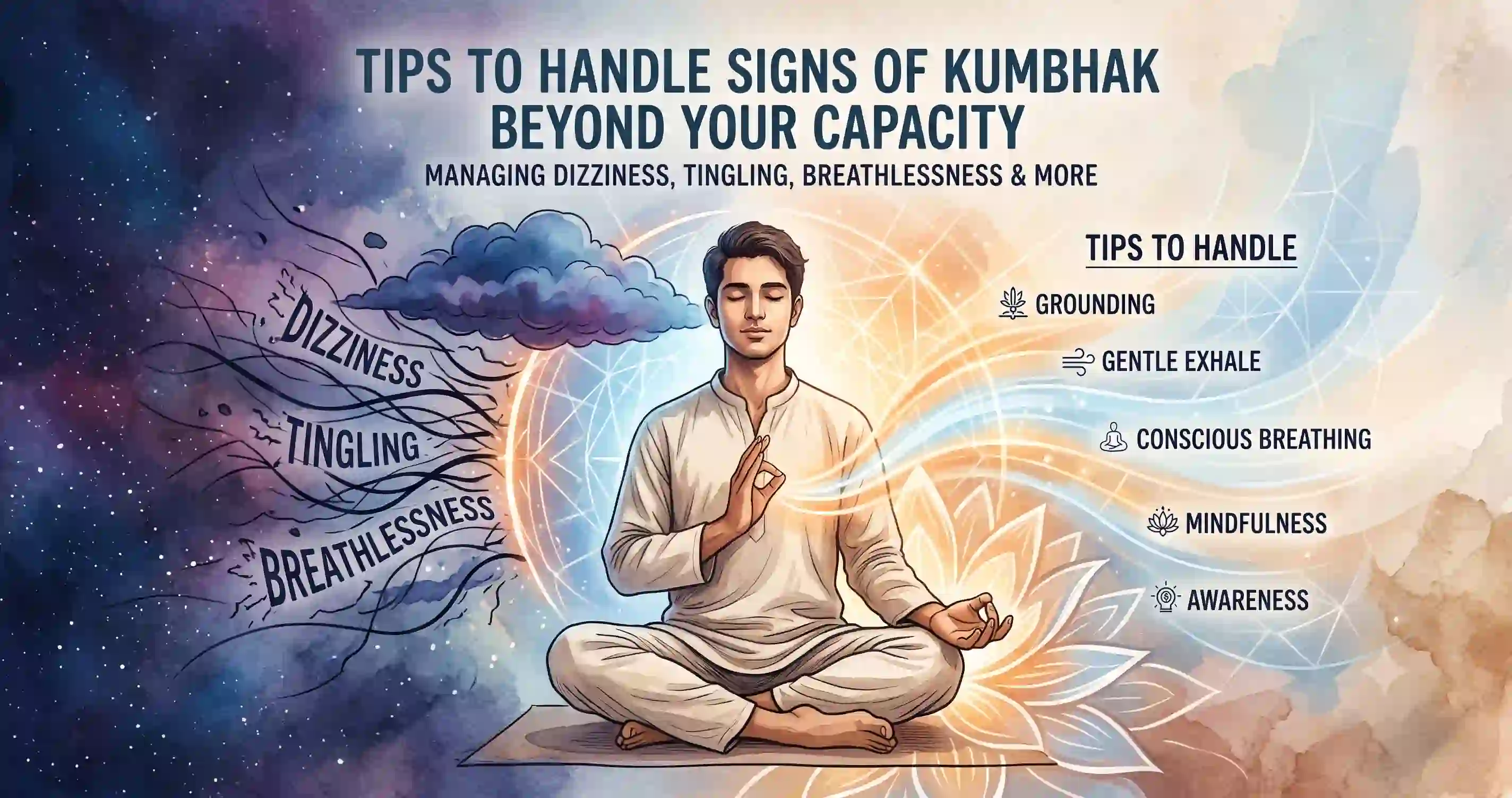
Perhaps you expected a quiet pause. Instead, the room seems to tilt. Your fingers prickle. Your chest feels trapped. Your heart suddenly seems louder than everything else.
At that moment, you do not need to prove that you can complete the round.
The safest Kumbhak is not the longest hold. It is the hold you can leave before your body has to fight for the next breath.
For the Ten-Step Kumbhak for Stress Relief, end both Antar Kumbhak and Bāhya Kumbhak while the pause still feels completely easy and while you remain certain you could continue comfortably for roughly another 1–3 seconds. This is a reserve, not a duration to achieve. If an urge to breathe, strain or uneasiness appears sooner—even immediately—end the hold. If no retention feels completely easy, omit retention and choose another breathing practice.
This article does not repeat the Ten-Step process. For the complete method, read How to Practice the Ten-Step Kumbhak for Stress Relief.
If symptoms are happening now: stop the practice, release the hold, breathe normally and move immediately to the recovery guidance below. Chest pain, severe breathing difficulty, blue or grey lips or skin, fainting, seizure, sudden one-sided weakness, confused speech or any failure to recover normally requires urgent medical help.
This article is educational and cannot diagnose the cause of a symptom. A sensation that begins during Kumbhak may come from the breathing pattern, the retention, fear, posture, heat, dehydration, medication or an unrelated medical condition. When in doubt, protect the person first and interpret the event later.
What to Do Immediately If You Feel Unwell During Kumbhak 🛑
1. End the hold now
Do not wait for the count, the teacher, the recording or the end of the round. After Antar Kumbhak, let Rechak begin normally. After Bāhya Kumbhak, let Pūrak begin normally. Do not force, gulp or snatch at the breath.
If breathing through the nose feels obstructed or difficult, use the airway that lets you breathe normally. Safety takes priority over maintaining the form of the practice.
2. Stop the entire practice—not only that retention
Do not move into the next step or “try once more to see.” Return to ordinary, uncounted breathing. Remove any Bandha, abdominal pull, throat lock or muscular bracing you may have added. The Ten-Step Kumbhak for Stress Relief does not require you to strain against respiratory urgency.
3. Choose the safest recovery position
- If you feel faint, remain seated with support or lie down where you cannot fall. If lying flat makes breathing harder, sit upright instead.
- If breathlessness is the main problem, an upright supported seat or a supported forward-leaning position may feel easier.1
- Do not stand abruptly, walk away alone, climb stairs, enter water or drive.
- If another person is present, tell them what you are feeling and ask them to remain nearby.
4. Let breathing return to its normal size and rhythm
Keep the face, jaw, throat, shoulders, chest and abdomen relaxed. Allow normal breaths rather than repeated oversized breaths. Over-breathing can reduce carbon dioxide and intensify dizziness, tingling, chest discomfort and the feeling that you cannot get enough air.2
Do not breathe into a paper or plastic bag. The cause has not been diagnosed, and rebreathing can worsen an unrecognised low-oxygen or medical problem.3
5. Orient yourself to the room
Open your eyes if that feels safer. Notice the floor supporting you, name a few objects you can see and allow someone to speak to you in a calm, ordinary voice. This can be especially useful if the symptom includes panic, unreality, dissociation or a suffocation memory.
Do not let grounding delay emergency care when red-flag symptoms are present.
6. Wait for complete recovery
Remain at rest until breathing, vision, balance, thinking, heartbeat and bodily sensation have returned fully to your usual baseline. If symptoms are not beginning to improve within a few minutes, do not completely resolve promptly, return during recovery or feel serious or unfamiliar, obtain medical help.
Even after a mild symptom resolves, do not restart Kumbhak that day.
7. Use an existing medical action plan when relevant
If you have asthma, a heart condition, diabetes, a seizure disorder or another diagnosed condition with a clinician-prepared action plan, follow that plan. Use prescribed rescue treatment exactly as directed. Do not substitute Kumbhak for the plan, and do not change medication because of this article.
The Three Safety Levels: Ease, Stop and Emergency 🚦
Not every warning has the same urgency, but every warning deserves a response.
Level 1 — End the retention before a symptom develops
These are signs that the comfortable reserve is ending:
- the first definite urge to breathe;
- uncertainty that another 1–3 seconds would remain completely easy;
- tightening of the face, jaw, tongue, throat, neck, chest, shoulders, abdomen, hands or legs;
- raising the shoulders, arching the back or pulling the abdomen inward;
- bearing down, throat locking or pushing pressure into the head;
- needing to swallow repeatedly, flare the nostrils, open the mouth or prepare to gasp;
- losing the relaxed focus at the centre of the chest because respiratory urgency has taken over;
- feeling trapped, competitive or determined to “beat” the previous hold;
- knowing that the first recovery breath will be large, noisy or desperate.
Action: end the retention normally. If ease returns completely and no symptom occurred, finish only according to the established practice. If any discomfort has already appeared, move to Level 2.
Level 2 — Stop the session and recover
Stop the entire session for any of the following, even if mild:
- dizziness, light-headedness, weakness, unsteadiness or a faint feeling;
- tingling, pins and needles, numbness or unusual coldness in the lips, face, hands, arms, feet or legs;
- hand or foot stiffness, twitching, cramping or clawing;
- unusual air hunger, breathlessness, choking, smothering or inability to take a satisfying breath;
- repeated gasping, yawning, sighing or an uncontrolled change in breathing;
- blurred vision, flashing spots, greying vision, tunnel vision or ringing in the ears;
- headache or pressure in the head, ears or eyes;
- pounding, racing, fluttering, skipping or unusually forceful heartbeat;
- chest tightness, chest pressure, chest discomfort or pain;
- throat tightness, wheezing, noisy breathing, persistent cough or voice change;
- nausea, belching, bloating, sweating, trembling, hot or cold flushes;
- confusion, poor concentration, unusual drowsiness or feeling detached from the body or room;
- fear, panic, dread, dissociation, a traumatic flashback or a sense of being trapped;
- any new pain, pressure, movement, emotion or bodily sensation that feels wrong to you.
Action: release the hold, return to normal breathing, use the immediate recovery steps and do not practise again that day. A mild symptom is not permission to shorten the next hold and continue immediately.
No list can name every possible symptom. Any new, unusual or distressing experience during Kumbhak is enough reason to stop.
Level 3 — Seek emergency medical help
Call your local emergency number immediately for:
- loss of consciousness, inability to wake normally or collapse;
- absent, abnormal or only gasping breathing;
- severe breathlessness, choking, inability to speak normally or rapidly worsening breathing;
- lips, tongue, face, skin or nail beds turning blue or grey; on darker skin, colour change may be easier to see on the lips, gums, tongue, palms, soles or inside the eyelids;4
- chest pressure, squeezing, fullness or pain—especially if it persists, returns, spreads to the arm, back, neck, jaw or stomach, or occurs with sweating, nausea, light-headedness or breathlessness;5
- a very fast, unusually low or irregular heartbeat with chest pain, breathlessness, dizziness or fainting;
- sudden facial droop, one-sided weakness or numbness, confused or slurred speech, sudden loss of vision, severe loss of balance or a sudden severe headache;6
- seizure, repeated jerking, loss of coordination or persistent confusion;
- a severe asthma attack, severe wheezing, marked throat swelling or inability to move air normally;
- coughing blood, severe eye pain with sudden visual change, repeated vomiting or any rapidly worsening symptom;
- serious injury caused by a fall or collapse.
Do not drive yourself when you may be having a heart, lung or neurological emergency. Even if stroke-like symptoms disappear after a few minutes, emergency assessment is still necessary.6
If a person becomes unresponsive:
- Call emergency services and get an automated external defibrillator (AED) if one is available.
- If the person is not breathing normally or is only gasping, begin CPR and follow the emergency dispatcher’s instructions.7
- If the person is unconscious but breathing normally and no spinal injury is suspected, place them in the recovery position and keep monitoring their breathing.8
- Do not give food, drink or medication to an unconscious or confused person.
What Each Common Symptom May Be Telling You 🔍
The sensation can guide the response, but it cannot confirm the diagnosis.
Dizziness, light-headedness, visual dimming or ringing ears
These can occur when breathing too much before or after a hold lowers carbon dioxide, when blood pressure or heart output changes, when fear accelerates breathing, or when a person is hot, dehydrated, unwell or prone to fainting. They may also precede loss of consciousness.
What to do: stop, stay seated or lie safely, breathe normally and do not stand until fully recovered. Greying or tunnel vision, loss of balance, confusion or collapse moves the situation toward emergency care.
Dizziness is not purification, improved oxygenation or evidence that Kumbhak is “working.” The American Heart Association advises stopping a breathing technique if dizziness or light-headedness occurs.9
Tingling, pins and needles, numb lips or stiff hands
Tingling around both sides of the mouth or in both hands and feet can occur with over-breathing. Excess ventilation reduces blood carbon dioxide, producing respiratory alkalosis and symptoms that may include dizziness, tingling, tremor and hand or foot spasm.2
It can also come from posture or compression of a nerve. Because symptoms alone cannot establish the cause, stop the session before deciding which explanation fits.
Emergency distinction: sudden numbness or weakness mainly on one side, facial droop, speech change, severe imbalance or sudden visual loss can be a stroke sign. Call emergency services immediately.6
Breathlessness, air hunger, choking or a desperate recovery breath
Some respiratory drive develops as carbon dioxide rises during a closed-airway hold and oxygen is consumed. For stress-relief Kumbhak, however, the practice boundary comes before a definite urge or struggle. A gasp means the pause exceeded the intended reserve or another problem interfered.
Over-breathing can paradoxically make someone feel unable to obtain enough air. Asthma, airway irritation, a breathing-pattern disorder, panic and heart or lung conditions can produce a similar feeling. Do not diagnose the cause from the sensation alone.
What to do: end the hold, sit in a position that makes breathing easiest and allow normal breathing. Follow a prescribed asthma or medical action plan. Severe, sudden, unexplained or persistent breathlessness needs urgent assessment.
Chest tightness, chest pain or pressure
Muscular bracing, panic, airway narrowing and altered chest pressure can all cause discomfort—but heart and lung emergencies can begin with the same words. It is unsafe to assume that chest symptoms are “just anxiety.”
What to do: stop immediately. Sudden or persistent pressure, squeezing or pain; pain spreading beyond the chest; or chest discomfort with sweating, nausea, dizziness or breathlessness requires emergency help.5
Palpitations, pounding or an irregular heartbeat
Heightened attention can make an ordinary heartbeat more noticeable. Fear, over-breathing and breath retention can also change heart rate. Yet a new racing, fluttering, skipping, very fast or unusually low rhythm—particularly with dizziness, faintness, breathlessness or chest pain—requires medical assessment.10
What to do: stop and rest. If the rhythm remains abnormal, recurs, or accompanies another warning sign, obtain urgent care. Do not perform another hold in an attempt to “reset” the heart.
Headache, head pressure, eye pressure or ear discomfort
Rising carbon dioxide, circulatory changes, muscular effort and pressure from straining can contribute to head discomfort. Studies in trained healthy adults show that internal and external retentions can measurably change middle cerebral artery blood-flow velocity.1112 That finding is acute physiology—not proof that head pressure is beneficial.
What to do: stop. A sudden severe headache, new neurological symptom, sudden loss of vision or severe eye pain with visual change needs urgent evaluation. Recurrent pressure or headache requires clinical advice before another attempt.
Cough, wheeze, throat tightness, hiccup or swallowing difficulty
These may reflect airway irritation, nasal obstruction, asthma, reflux, throat tension or an incompatible retention dose. Hiccup, cough and respiratory distress also appear in classical yoga’s own warnings about poorly regulated breath practice.
What to do: stop and breathe normally. Use prescribed rescue treatment if your medical plan directs it. Marked throat swelling, noisy breathing, inability to swallow, blue or grey colour or severe wheeze is an emergency.
Nausea, sweating, trembling, temperature change or weakness
These symptoms can accompany a panic response, fainting response, low blood sugar, heat, dehydration, illness or a cardiovascular event. The context matters: a person with diabetes, for example, should follow their clinician’s plan for checking and treating low blood glucose.
What to do: stop, rest and assess the whole situation. Do not give food or drink unless the person is fully alert and swallowing normally. Persistent, severe or recurrent symptoms need medical review.
Panic, dread, dissociation or a suffocation flashback
Breath retention makes internal sensations prominent. For some people that feels manageable; for another body, it can resemble a past moment of choking, restraint, illness or helplessness.
In a pragmatic PTSD trial, participants reported recurrent anxiety, breathlessness, dizziness and constriction during a Kumbhak-containing programme, and one participant withdrew after a suffocation-related flashback.13 This does not mean everyone with anxiety or trauma will react badly. It means choice and titration are part of safety.
What to do: release the hold, open the eyes, orient to the room and return to normal breathing. Do not repeat the trigger. A trauma-informed mental-health professional or clinician can help determine whether breath awareness without retention is a better starting point.
Confusion, poor coordination, jerking, blue or grey colour, or collapse
These are not advanced Kumbhak experiences. They can indicate inadequate oxygen delivery, a seizure, a cardiovascular problem or another emergency.
What to do: activate emergency care. Do not wait for the person to “complete the process,” and do not place anything in the mouth of someone having a seizure.
Why Symptoms Can Happen: The Scientific View 🧠🫁❤️
A breath hold changes gases in opposite directions
During Kumbhak, metabolism continues: oxygen is used and carbon dioxide accumulates. The amount of change depends on the hold duration, whether it follows Pūrak or Rechak, the starting lung volume, preceding breathing, health, training and individual physiology.
Carbon dioxide is a major driver of respiratory urgency and a powerful regulator of cerebral blood vessels. With enough duration, oxygen can also fall. A timer cannot reveal either gas reliably, and two people holding for the same number of seconds may have very different internal conditions.
Over-breathing can happen around the hold
If normal Pūrak or Rechak becomes repeatedly too large or too fast, or if the practitioner gulps several recovery breaths, too much carbon dioxide may be exhaled. The result can be dizziness, tingling, chest discomfort, breathlessness, tremor, visual disturbance and a feeling of unreality.2
This is why the Ten-Step Kumbhak uses normal Pūrak and Rechak—not forceful ventilation—and why the recovery response should not become a chain of oversized breaths.
Tingling does not automatically prove low oxygen. Dizziness does not automatically prove low carbon dioxide. Similar symptoms have multiple causes.
Retention can alter circulation while it is happening
In a study of 20 healthy participants, cardiovascular measurements changed during Kumbhak: arterial pressure and peripheral resistance rose while stroke volume and cardiac output fell.14 These acute changes do not prove that a brief comfortable pause is harmful, but they do show why a strained hold should not be described as universally relaxing or used as a self-treatment for blood pressure.
Internal and external Kumbhak can also affect cerebral haemodynamics differently.1112 More blood-flow velocity during a hold is a compensatory response, not evidence that dizziness or pressure is improving the brain.
Muscular strain changes the event
Bracing the chest or abdomen, bearing down, squeezing the throat, adding a Bandha or forcing the lungs toward maximum fullness or emptiness changes pressure inside the chest. The event is no longer the relaxed, submaximal retention intended for stress relief.
A comfortably full Pūrak is not maximum inflation. A comfortably empty Rechak is not the squeezing out of every last amount of air.
Fear can amplify a real physical sensation
Respiratory urgency may create fear; fear may enlarge the next breath; over-breathing may intensify dizziness and tingling; those sensations may then create more fear. The symptoms are real even when anxiety contributes to them.
Breaking this loop begins with permission: you may stop immediately, and stopping is the correct response.
The symptom may not be caused by Kumbhak
Heart rhythm disorders, asthma, infection, anaemia, low blood sugar, medication effects, dehydration, heat illness, pregnancy-related changes, neurological conditions and other medical problems may first become noticeable during a quiet practice.
The timing gives a clue, not a diagnosis. Recurrent or unexplained symptoms deserve clinical evaluation.
A pulse oximeter cannot grant permission to continue
A fingertip device estimates oxygen saturation; it does not measure carbon dioxide. Consumer readings can be affected by movement, circulation, skin pigmentation, skin temperature, nail products and device quality. The FDA advises interpreting readings together with symptoms rather than relying on the number alone.15
Do not use a normal-looking reading, wearable score or timer to override dizziness, breathlessness, chest symptoms, confusion or visual change.
Recovery After a Mild Symptom 🌱
For the rest of that day
- Do not perform more Kumbhak.
- Avoid any breath-hold challenge, forceful breathwork or hyperventilation.
- Do not drive, swim, bathe alone, climb or operate machinery until you feel completely normal.
- Rest in a comfortable position and return to ordinary activity only when balance, vision, breathing and thinking are fully normal.
- If symptoms return without practising, seek medical advice.
Write down what happened
A brief record can help you and a clinician identify the cause:
- Was it during Antar Kumbhak, Bāhya Kumbhak or recovery?
- How many rounds had you completed?
- Did Pūrak and Rechak remain normal?
- Did you strain, brace, use a Bandha or take a maximum breath?
- What was the first symptom?
- How long did it take to return completely to baseline?
- Were you hot, unwell, sleep-deprived, dehydrated, fasting or taking a new medication?
- Did the symptom occur on both sides or mainly one side?
Do not turn the record into a breath-hold performance log. Its purpose is safety, not comparison.
Before any future attempt
Do not retry until the symptom has been understood well enough to make another attempt reasonable. When medical review is not required and a future attempt is appropriate:
- use a stable supported seat;
- have another responsible person nearby if the previous symptom was frightening;
- begin with only one round;
- keep Pūrak and Rechak normal;
- make both retentions substantially shorter than before;
- preserve a clear 1–3-second comfortable reserve;
- omit the hold entirely if you cannot preserve that reserve;
- stop at the first loss of ease.
If the symptom returns, discontinue retention and seek guidance rather than repeatedly adjusting it alone.
When to Contact a Healthcare Professional 🩺
Obtain same-day urgent medical advice
Seek urgent assessment the same day when:
- you came close to fainting without losing consciousness;
- dizziness, breathlessness, tingling, headache, palpitations or visual disturbance does not resolve completely and promptly;
- a symptom returns during rest after the practice;
- breathing remains different from your normal baseline;
- you develop new wheeze, persistent cough, fever or signs of illness;
- a heartbeat remains fast, irregular or unusually forceful;
- you were injured during a near-faint or fall;
- you are pregnant and experience a new or concerning faint, breathing, chest or neurological symptom;
- you are uncertain whether a symptom belongs in the emergency category.
If symptoms are severe or worsening, use emergency services rather than waiting for routine advice.
Arrange a clinical review before practising again
Do this when:
- mild symptoms have happened in more than one session;
- symptoms occur after a very brief retention;
- you cannot retain at all without an urge, strain or uneasiness;
- you have a history of fainting, seizures, panic attacks, PTSD, choking trauma or unexplained dizziness;
- you have high blood pressure, heart disease, an arrhythmia, stroke or TIA history, significant lung disease, asthma that is not well controlled, glaucoma or retinal concerns;
- you recently had eye, chest, abdominal or other relevant surgery;
- you are pregnant;
- a new medication or dose change affects breathing, heart rate, blood pressure, alertness or balance;
- a clinician has previously advised you to avoid breath holding or straining.
Ask a concrete question: “Is brief, completely comfortable breath retention appropriate for me, and are there symptoms or limits specific to my condition?” A qualified professional who knows your history can answer more safely than a universal online ratio.
The Revised 1–3-Second Reserve: What It Means ⏱️
It is reserve—not the length of the hold
“Keep 1–3 seconds in reserve” does not mean everyone should retain for 1–3 seconds. It means you end the retention while you still feel certain you could have continued comfortably for approximately that much longer.
For one person, the actual retention may be several seconds. For another, the correct retention may be almost immediate. No one is required to cross discomfort in order to earn a valid round.
It is subjective—not a guarantee
No internal estimate can guarantee oxygen level, carbon dioxide level, blood pressure or freedom from fainting. The reserve is a behavioural safety margin that helps prevent limit-testing; it is not a medical monitoring device.
Do not spend the reserve. If you think, “I still have three seconds, so I should use them,” the instruction has been reversed.
The first urge outranks the estimate
If air hunger, strain, dizziness or uneasiness appears before you believe the reserve has ended, breathe immediately. The body’s present signal outranks the earlier prediction.
The aim is not to become skilled at enduring warning signs. The aim is to remain relaxed throughout the pause.
Yogic Truth: Classical Texts Warn Against Force 🕉️
Classical Haṭha Yoga does not present careless breath control as bravery.
Haṭha Yoga Pradīpikā 2.15 — mastery is gradual
yathā siṃho gajo vyāghro bhaved vaśyaḥ śanaiḥ śanaiḥ |
tathaiva sevito vāyur anyathā hanti sādhakam ||
Meaning: As powerful animals are brought under control gradually, the vital breath is approached gradually; handled otherwise, it harms the practitioner.16
The verse’s fierce animals matter. A tiger is not made trustworthy by pretending it has no strength. In the same way, the capacity to hold the breath is respected through proportion, patience and restraint.
Haṭha Yoga Pradīpikā 2.16–2.17 — improper practice has consequences
The next verses state that appropriate prāṇāyāma is beneficial while inappropriate practice can generate illness. They then name hiccup, respiratory trouble, cough, and pain in the head, ears and eyes among disorders associated with disturbed breath regulation.16
These are premodern yogic claims, not modern diagnoses and not proof that every headache during Kumbhak has one cause. Their safety message is still remarkably precise: symptoms are reasons to correct or stop the practice, not badges of advancement.
Yoga Sūtra 2.50 — place, time, number and subtlety
Patañjali describes the external, internal and suspended movements of prāṇāyāma as observed or regulated by place, time and number, becoming extended and subtle.17
For a stress-relief beginner, the word worth hearing first is subtle. A dramatic gasp, shaking body, grey vision or frightened mind is not subtle. The sūtra does not turn “long” into a command to ignore individual capacity.
Ayurvedic Truth: Do Not Suppress a Body That Is Asking to Breathe 🌿
Ayurveda uses a different map from respiratory physiology. It interprets breathing, movement, sensation and mental fluctuation through Vāta and its functions, especially Prāṇa Vāyu. That traditional model should not be confused with oxygen, carbon dioxide, nerves or a biomedical diagnosis.
Prāṇa Vāyu as a traditional interpretive lens
Classical Ayurvedic descriptions associate Prāṇa Vāyu with respiration, swallowing, sensory function and mental activity in the regions of the head, throat and chest.18 From this viewpoint, forced, irregular or distressing breath practice may be read as disruption rather than successful regulation.
An Ayurvedic practitioner might therefore attend to the whole pattern: dryness, tremor, fear, irregularity, spasm, dizziness, disturbed sleep, digestive changes and the person’s broader constitution. This is a traditional clinical framework; it has not been scientifically validated as the mechanism of Kumbhak symptoms.
Caraka Saṃhitā on the urge for breath after exertion
Caraka Saṃhitā, Sūtrasthāna 7.3–4, includes deep breathing after exertion among natural urges that should not be suppressed. Verse 7.24 associates suppressing that urge with gulma, heart disease and sammoha—a term translated in this context as fainting or loss of awareness—and recommends rest.19
This passage concerns the urge to breathe after exertion, not a direct prohibition of brief voluntary Kumbhak at rest. Its relevance is analogical but powerful: once the body is clearly demanding breath, the traditional response is not to imprison that demand.
Ayurvedic interpretations and remedies in classical texts have not been scientifically verified for treating symptoms during modern Kumbhak. Emergency signs still require modern emergency care; herbs, oils, food, massage or a doṣa explanation must never delay it.
Psychological Safety: Stopping Without Shame 🤝
“I felt something” is information—not failure
In a class, students often endure symptoms because others appear comfortable or because stopping feels embarrassing. A safe teacher says before practice:
“You may end any hold, omit retention or stop the session without explaining yourself.”
Silence is not consent. Stillness is not proof of comfort. A person may be frozen, dissociated or afraid to interrupt.
The teacher should watch for visible signs
A teacher or practice partner should stop the round if a person:
- sways, slumps or loses postural control;
- becomes pale, blue or grey;
- appears confused or does not respond normally;
- gasps, wheezes, coughs repeatedly or cannot speak normally;
- develops unusual jerking, rigid hands or loss of coordination;
- presses the chest or head;
- looks frightened, detached or trapped;
- continues holding after being told to breathe.
Do not tell the person that symptoms are detoxification, energy release, spiritual resistance or proof that the practice is effective. Ask what they are experiencing, protect privacy and let their report guide the next action.
A useful class agreement
The person who stops first may be demonstrating the clearest awareness in the room.
That agreement replaces competition with discernment. It also makes honest reporting more likely, which gives the teacher better safety information.
Preventing the Next Uncomfortable Episode 🛡️
Keep the setting safe
- Practise seated in a stable place.
- Never practise breath retention in water, in a bath or shower, while driving, at height, near traffic, while operating machinery or during any activity in which brief confusion or fainting could cause injury.
- Never use hyperventilation to extend a hold. It can delay the warning urge without creating an equivalent oxygen reserve and increases blackout risk, especially in water.20
- Do not practise when alertness is impaired by alcohol, recreational drugs or a sedating substance.
- Do not begin if you already feel dizzy, breathless, faint, feverish, acutely unwell or unlike your normal baseline.
Keep the breathing normal
In the Ten-Step Kumbhak for Stress Relief:
- Pūrak and Rechak are normal, not too fast or too extended;
- comfortably full does not mean maximum lung inflation;
- comfortably empty does not mean forcing out every last amount of air;
- the body remains relaxed;
- both retentions end before the urge to breathe;
- two normal breaths separate rounds;
- the first trial is one round, with more only if the entire experience remains comfortable.
Read the complete practice separately rather than reconstructing it from this safety article.
Remove the performance target
Do not compare seconds, rounds, ratios or sensations. Do not use a timer to persuade yourself that a symptom “cannot be serious yet.” Comfortable capacity changes with sleep, stress, altitude, illness, menstrual cycle, pregnancy, medication, meals and many other factors.
The practical comparison is not with yesterday’s time or another person’s capacity. It is with the quality of ease in the body now.
Frequently Asked Questions About Kumbhak Side Effects ❓
Is dizziness during Kumbhak normal?
No. It is a stop sign, even when brief. It may be related to over-breathing, circulatory change, fear, fainting tendency or another medical cause. Stop the session, recover fully and do not dismiss recurrent dizziness.
Why do my hands or lips tingle during breath retention?
Bilateral tingling around the mouth, hands or feet can occur when over-breathing lowers carbon dioxide, but posture, nerve compression and medical conditions can also cause it. Stop rather than trying to diagnose it during the round. One-sided numbness or weakness, facial droop or speech change is an emergency.
Is air hunger a normal part of Kumbhak?
Respiratory drive is a normal biological response to a sufficiently long hold. It is not the intended operating zone of the Ten-Step Kumbhak for Stress Relief. End the hold while it remains completely easy and with approximately 1–3 comfortable seconds still in reserve.
Should I take a very large breath to recover?
Return to normal breathing. Repeated oversized breaths can worsen symptoms when over-breathing is contributing. If normal breathing does not return promptly, or breathing is severe or difficult, obtain medical help.
Should I breathe into a paper bag for tingling or dizziness?
No. Without a diagnosis, paper-bag rebreathing can be dangerous because symptoms attributed to anxiety may actually involve low oxygen or another medical condition.3
Can I continue if a pulse oximeter looks normal?
No. The device does not measure carbon dioxide, readings have limitations and a displayed number does not cancel symptoms.15 Stop first.
Can I resume as soon as the symptom disappears?
Not that day. A concerning sensation means the session is over. Recurrent, unexplained or medically significant symptoms need professional review before another attempt.
Is Bāhya Kumbhak more likely to feel uncomfortable than Antar Kumbhak?
The two begin at different lung volumes and can produce different sensations and haemodynamic responses. Neither is permission to strain. The correct duration for each is whatever preserves complete ease and a clear 1–3-second comfortable reserve—which may mean no hold at all.
What if I cannot retain even for three seconds?
You do not need to. The 1–3 seconds describes the reserve left when you stop, not a minimum holding time. If a comfortable retention is not available today, omit it and use a suitable no-retention breathing practice.
What if my teacher tells me to push through?
End the hold. No instruction, ratio, group rhythm or authority should override dizziness, tingling, breathlessness, pain, panic or your decision to stop. A responsible teacher will respect that boundary.
Are uncomfortable sensations a release of toxins or blocked Prāṇa?
There is no reliable medical basis for using “detox” to explain dizziness, tingling, chest symptoms, visual changes or collapse. Yogic and Ayurvedic models may provide meaning, but they should never erase the immediate safety response or replace medical assessment.
A One-Minute Safety Summary to Remember ❤️
Before: Sit somewhere safe. Keep Pūrak and Rechak normal. Treat both holds as brief, completely easy pauses—not tests.
During: End the hold while you are certain roughly another 1–3 comfortable seconds remain. The first urge, strain or uneasiness means breathe now.
If symptomatic: Stop the whole session. Breathe normally. Stay seated or lie safely. Do not hyperventilate, use a paper bag or try again.
Get help: Recurrent or persistent symptoms need medical advice. Collapse, severe breathlessness, blue or grey colour, chest-pressure patterns, seizure or stroke-like signs require emergency care.
The body that asks you to stop is not opposing your practice. It is participating in it.
Medical and Evidence Note 📚
This article distinguishes three kinds of statement:
- Medical guidance comes from public-health, emergency-care and clinical sources.
- Scientific explanations describe measured respiratory, cardiovascular, cerebrovascular and psychological responses; they do not prove the cause of an individual symptom.
- Yogic and Ayurvedic teachings are presented as traditional frameworks. Their metaphysical or doṣic explanations have not been scientifically verified and should not replace diagnosis or treatment.
No article can determine whether your personal symptom is benign. If you are unsure, seek care.
Medical and source review completed: 24 July 2026.
Sources and Footnotes
-
Cambridge University Hospitals NHS Foundation Trust. Breathing pattern disorders and physiotherapy. Advises reducing a respiratory pause if it increases breathlessness or faintness and describes supported positions for breathlessness. ↩
-
MedlinePlus Medical Encyclopedia, U.S. National Library of Medicine. Hyperventilation. Explains that excessive ventilation lowers blood carbon dioxide and can produce dizziness, breathlessness, pounding heartbeat, tingling and muscle spasm. ↩↩↩
-
Royal Cornwall Hospitals NHS Trust. Prescription, Administration and Monitoring of Oxygen in Adults Policy, p. 26. States that paper-bag rebreathing may cause hypoxaemia and is not recommended. ↩↩
-
NHS. Blue or grey skin or lips (cyanosis). Describes sudden blue or grey colour as an emergency sign and notes where colour changes may be more visible on darker skin. ↩
-
American Heart Association. Heart attack, stroke and cardiac arrest symptoms. Lists chest pressure, squeezing, fullness or pain; upper-body discomfort; breathlessness; sweating; nausea and light-headedness as warning signs. ↩↩
-
U.S. Centers for Disease Control and Prevention. Signs and symptoms of stroke. Includes sudden one-sided weakness or numbness, speech difficulty, visual change, imbalance and severe headache, and advises emergency action even when symptoms resolve. ↩↩↩
-
American Heart Association. Treatment of cardiac arrest. Advises calling emergency services, obtaining an AED and starting CPR when an unresponsive person is not breathing normally or is only gasping. ↩
-
NHS. First aid: recovery position. Advises the recovery position for an unconscious person who is breathing and has no other immediately life-threatening condition. ↩
-
American Heart Association. Stress management: deep breathing benefits and techniques. Advises beginners to limit initial cycles, stop for dizziness or light-headedness, and consult a professional when heart or lung conditions are present. ↩
-
American Heart Association. How serious are heart palpitations?. Advises medical attention when palpitations occur with light-headedness, breathlessness, chest pain or fainting. ↩
-
Nivethitha L, et al. Cerebrovascular hemodynamics during prāṇāyāma techniques. Journal of Neurosciences in Rural Practice. 2017;8(1):60–63. Studied one-minute internal Kumbhak in 15 trained healthy men. ↩↩
-
Nivethitha L, et al. Cerebrovascular haemodynamics during Bhrāmarī, Kapālabhāti and external Kumbhak: an exploratory study. Applied Psychophysiology and Biofeedback. 2018;43(1):87–92. ↩↩
-
Haller H, Mitzinger D, Cramer H. The integration of yoga breathing techniques in cognitive behavioral therapy for post-traumatic stress disorder: a pragmatic randomized controlled trial. Frontiers in Psychiatry. 2023;14:1101046. Reports recurrent minor adverse events and a suffocation-related flashback in a retention-containing programme. ↩
-
Nivethitha L, et al. Evaluation of cardiovascular functions during the practice of different types of yogic breathing techniques. International Journal of Yoga. 2021;14(2):158–162. ↩
-
U.S. Food and Drug Administration. Pulse oximeter basics. Explains device limitations, factors affecting accuracy and the need to interpret readings together with symptoms. See also UK MHRA guidance noting that pulse oximeters do not measure carbon dioxide: The use and regulation of pulse oximeters. ↩↩
-
Svātmārāma. Haṭha Yoga Pradīpikā, 2.15–2.17. Sanskrit and public-domain English translation available at Wikisource, Chapter 2. Verse numbering and Sanskrit were cross-checked against the Haṭha Yoga Pradīpikā digital text. ↩↩
-
Patañjali. Yoga Sūtra 2.50: bāhyābhyantarastambhavṛttir deśakālasaṅkhyābhiḥ paridṛṣṭo dīrghasūkṣmaḥ. Text, word meanings and multiple translations: Yoga Sutra Study, Sūtra 2.50. ↩
-
Vāgbhaṭa. Aṣṭāṅga Hṛdaya, Sūtrasthāna 12.4, traditional locations and functions of Prāṇa Vāyu. See the chapter overview with Sanskrit: Doṣabhedīya—Aṣṭāṅga Hṛdaya Chapter 12, and a scholarly review of the term’s multiple meanings in classical Ayurveda: A review on the concept of Prāṇa in Caraka Saṃhitā. ↩
-
Caraka Saṃhitā, Sūtrasthāna 7.3–4 and 7.24. Sanskrit and translation: Navegāndhāraṇīya—Non-suppression of natural urges. Cross-checked against the 1949 Gulabkunverba translation: Natural urges should not be suppressed. ↩
-
American Red Cross, YMCA of the USA and USA Swimming. Hypoxic blackout: joint safety statement. Warns against hyperventilation before underwater swimming and extended breath holding. ↩