Discover why kumbhak is fundamentally different from hyperventilation therapy. Learn how respiratory chemoreceptors (carotid bodies, medulla) regulate breathing, why chronic hyperventilation creates dysfunction, how kumbhak retrains CO₂ tolerance, and why it outperforms shallow-breathing methods. Includes chemoreceptor physiology, Buteyko method comparison, asthma and anxiety relief mechanisms, CO₂ tolerance curves, and integration with Ayurvedic constitutional balance." keywords: "kumbhak CO₂ therapy, respiratory chemoreceptors, carotid bodies, medulla breathing control, hyperventilation syndrome, CO₂ retraining, Buteyko method comparison, asthma kumbhak, anxiety breathing, dysfunctional breathing pattern, chemoreceptor desensitization, CO₂ tolerance, pranayama physiology, yoga respiratory science.
By Kumbhaki Yogi Dhruvaji (MSc IIT Bombay), founder of the Antistress Foundation 501(c)(3)
• How to Practice Ten-Step Kumbhak • Scientific Proof • Ancient Texts Proof • Bio • Subscribe By Email
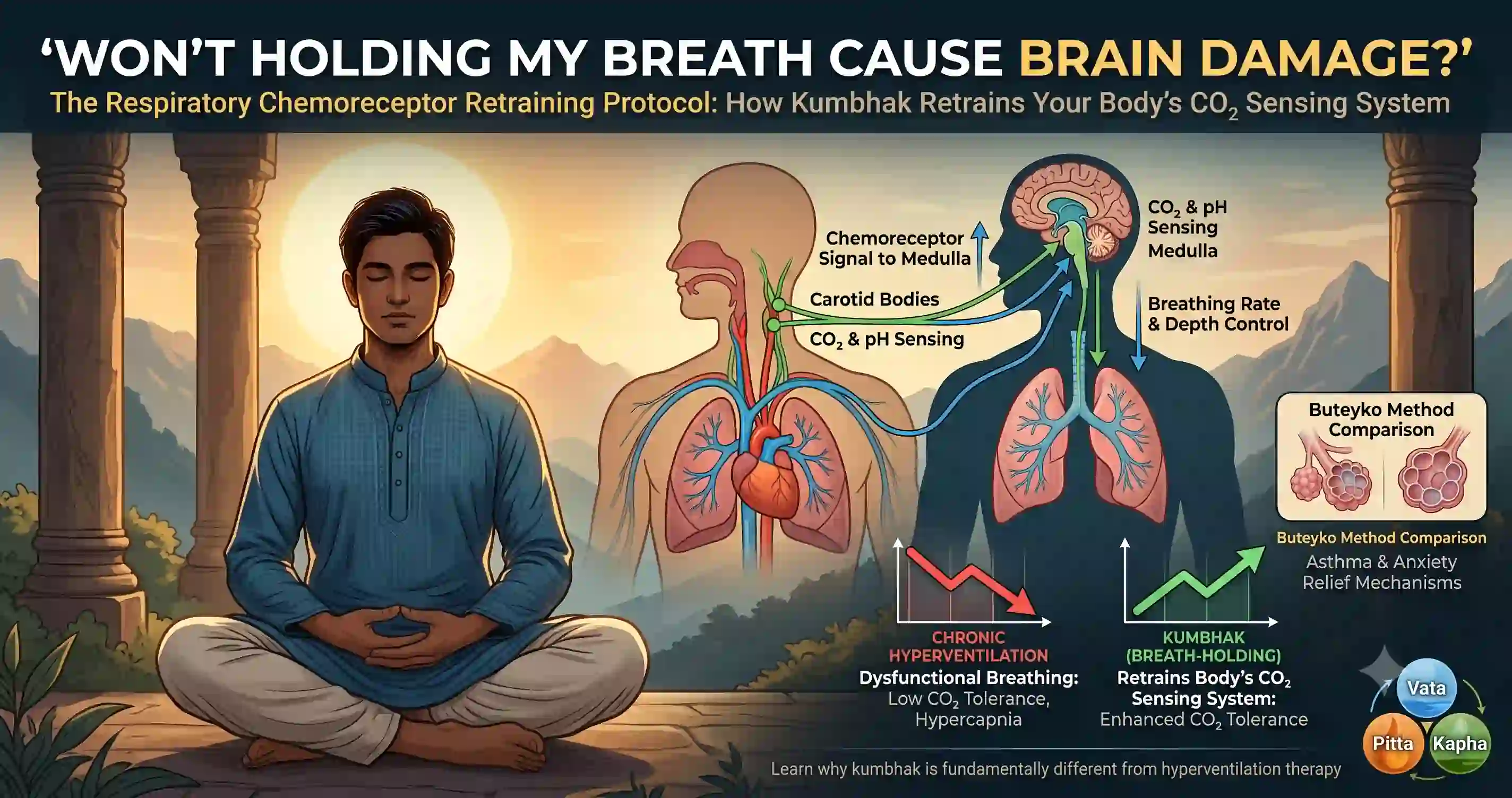
"Won't Holding Your Breath Cause Brain Damage?"
Short answer: No, not with unforced Kumbhak practice.
Long explanation: Brain damage from hypoxia (low oxygen) requires severe oxygen deprivation (typically less than 2–3 minutes of complete apnea without re-oxygenation). During kumbhak:
- You're not in complete apnea; there's residual air in your lungs
- Oxygen saturation drops modestly (typically from 98–99% to 95–96%), well above the threshold for harm
- Cerebral blood flow increases (a compensatory response), maintaining oxygen delivery to the brain
- Most kumbhak holds last 30–90 seconds, far below dangerous thresholds
Historical precedent: Freedive athletes hold their breath for 2–5 minutes routinely, sometimes longer, with no brain damage. Kumbhak, practiced gently and progressively, is far less extreme.
What Your Body's Oxygen Sensors Are Actually Doing (And Why You've Been Confusing Them)
You've likely heard that "breathwork helps with stress." That's true—but it matters enormously which kind of breathwork, and why it works. There's a critical distinction most wellness advice conflates: the difference between hyperventilation therapy (fast, deep breathing that lowers CO₂) and kumbhak (breath retention that retrains CO₂ sensing).
The confusion runs deep. A well-meaning yoga student learns Kapālabhāti (skull-shining breath—vigorous exhalation), gets told it "clears toxins" or "energizes," and then wonders why their anxiety spikes afterward. A breathing app recommends fast, rhythmic patterns. A therapist teaches "deep belly breathing" for panic attacks, which sometimes works, sometimes backfires. All of these touch on respiratory control—but none directly address the underlying physiology that determines whether your body remains in a state of chronic alarm or genuine calm.
That physiology is the respiratory chemoreceptor system: a set of biological sensors that continuously scan your blood's CO₂ levels and trigger your entire nervous system's response patterns.
Kumbhak—the practice of retaining breath after a full or empty exhalation—is the primary retraining protocol for this system. Not an enhancement to it. A restructuring.
Part I: The Architecture of Chemoreceptor Control—How Your Body Decides When to Panic
The Two Sentinel Sites: Where Your Breathing Brain Actually Lives
Your breathing isn't controlled by a single "breathing center." Instead, it's a distributed network with two primary chemoreceptor locations:
Central Chemoreceptors (Medulla Oblongata)
- Location: Deep in your brainstem, in a region called the medulla oblongata
- What they sense: CO₂ and H⁺ (hydrogen ions) in the cerebrospinal fluid (CSF) that bathes your brain
- Response pattern: When CO₂ rises, CSF becomes more acidic → central chemoreceptors fire → your breathing deepens and accelerates automatically
- The catch: These receptors respond to dissolved CO₂, not just partial pressure; they're exquisitely sensitive and can shift your entire autonomic state
Why this matters for kumbhak: During breath retention, CO₂ accumulates in your blood and CSF. The central chemoreceptors detect this elevation as a "normal" state. Over weeks and months of practice, the threshold at which they trigger panic lowers—meaning your body becomes more CO₂-tolerant and less reactive to CO₂ fluctuations. This is retraining, not suppression.
Peripheral Chemoreceptors (Carotid Bodies & Aortic Bodies)
- Location:
- Carotid bodies: In the bifurcation of your carotid arteries (where the main blood vessel to your brain splits into two branches)
- Aortic bodies: Along your aortic arch
- What they sense: Not just CO₂, but also:
- Oxygen levels (O₂ partial pressure, PaO₂)
- Acid-base status (pH, influenced by CO₂ and bicarbonate)
- Blood pressure and metabolic state
- Stimulated by hypoxia (low oxygen) and acidosis
- Response pattern: These are "first responders"—they send rapid neural signals via the carotid sinus nerve and aortic nerve directly to your brainstem, triggering immediate breathing adjustments
- The personality: Unlike central chemoreceptors (which respond gradually), carotid bodies are fast, reflexive, and directly wired to your sympathetic nervous system
Why this matters for kumbhak: During kumbhak, your O₂ drops and CO₂ rises—two signals that would normally trigger immediate panic. But with consistent practice, the sensitization of these receptors to transient O₂/CO₂ fluctuations decreases. You become neurologically less reactive to the very signals that usually generate fight-or-flight. This is the core retraining mechanism.
The Coherence Loop: Why Your Sensors and Your Emotions Are Locked Together
This is where the Agreement Engineering principle of coherence becomes physiologically relevant:
Your chemoreceptors don't just control breathing; they're bidirectionally linked to your limbic system (emotional brain) and hypothalamic-pituitary-adrenal (HPA) axis (your stress hormone hub). Here's the loop:
- Chemoreceptor fires → blood CO₂ is detected as abnormal (even slightly)
- Breathing increases → hyperventilation kicks in automatically
- CO₂ drops further (you've now externally reinforced the signal)
- Alarm escalates → amygdala interprets the chemoreceptor signal as "danger"
- HPA axis activates → cortisol and adrenaline surge
- Catastrophic thinking emerges → "Something's wrong with my body," "I can't breathe," "I'm having a heart attack"
- Breathing accelerates more → CO₂ crashes → alarm deepens
- Vicious cycle established → chronic hyperventilation syndrome takes root
This is what most "anxiety sufferers" are caught in. Not a psychological problem first—a chemoreceptor training problem. Their sensors have been trained (through years of shallow breathing, chronic stress, caffeine, exercise-to-exhaustion) to interpret normal CO₂ fluctuations as emergencies.
Kumbhak breaks this loop by retraining the sensors to tolerate—and then expect—higher CO₂.
Part II: The Hyperventilation Trap—Why "Deep Breathing" Isn't Always Therapeutic
What Hyperventilation Actually Does (The Physiology Most Wellness Advice Gets Wrong)
"Breathe deeply" is ubiquitous wellness advice. But here's the problem: slow, deep, unrestricted breathing without CO₂ retention is a form of mild hyperventilation, and chronic hyperventilation is itself a disease state.
The CO₂ Cascade in Hyperventilation Syndrome
When you breathe deeply and rapidly (or even slowly and deeply for prolonged periods without breath retention):
- Minute ventilation increases (total volume of air moved per minute)
- Alveolar CO₂ pressure drops (CO₂ is "blown off" faster than it's produced by metabolism)
- Arterial CO₂ (PaCO₂) decreases — normal is ~35–45 mmHg; hyperventilation can drop it to 25–30 mmHg or lower
- pH rises (respiratory alkalosis develops) — your blood becomes more alkaline (less acidic)
- Ionized calcium drops (alkalosis causes calcium to bind more to albumin, leaving less "free" calcium available to cells)
- Cerebral vasoconstriction occurs — blood vessels in the brain constrict (because CO₂ is normally a vasodilator; remove it, and vessels shrink)
- Oxygen delivery to tissues paradoxically worsens (this is the Bohr effect: even though blood is more oxygen-saturated, the shape of the oxygen-hemoglobin curve shifts, making oxygen less available to tissues)
- Paresthesias (tingling), dizziness, chest tightness, and panic escalate — the brain interprets these symptoms as "something's very wrong"
The cruelest irony: When a panic-stricken person is told to "breathe deeply to calm down," they often hyperventilate further, dropping CO₂ more, and triggering worse symptoms. They then blame themselves for "not breathing right," when in fact the protocol itself was flawed.
The "Shallow Breathing Trap" in Modern Life
You don't need to consciously hyperventilate to create this state. Chronic hyperventilation syndrome develops through:
- Chronic stress → sustained mild increase in respiratory rate
- Postural collapse → shallow breathing from slouching reduces CO₂ elimination efficiency
- Caffeine, sugar, stimulants → artificially elevate metabolic demands
- Exercise-to-exhaustion culture → repeated acute hyperventilation episodes train the chemoreceptors to expect and tolerate hyperventilation as "normal"
- Sleep-disordered breathing → sleep apnea and upper airway resistance syndrome cause CO₂ to spike during apneic events, then drop excessively during recovery breathing
- Mouth breathing → bypasses the nose's CO₂-retention mechanics and creates an open-loop system
Over months and years, the chemoreceptor system "learns" that slightly-low CO₂ is the baseline. Your carotid bodies and medulla reset their threshold upward. Now, a normal CO₂ level (which would be comfortable for a non-hyperventilated person) feels like suffocation to you.
This is why hyperventilation syndrome sufferers often report: "I can't get enough air, no matter how much I breathe."
Part III: Kumbhak as the Chemoreceptor Retraining Protocol
What Happens in Your Blood During Kumbhak (The CO₂ Mechanism)
When you perform kumbhak—holding your breath after a full or empty exhale—several things happen simultaneously:
The CO₂ Accumulation Curve
- Metabolism continues even with no new air entering
- Cells are still burning glucose and fat, producing CO₂ as a byproduct
-
This CO₂ dissolves into the blood and accumulates
-
Arterial CO₂ (PaCO₂) rises
- Starts at ~40 mmHg (normal)
- After 10–20 seconds: ~42–45 mmHg
- After 30–60 seconds: ~45–55 mmHg
-
After longer holds: can reach 60–80+ mmHg (depending on fitness and practice duration)
-
Chemoreceptors detect this rise
- Central chemoreceptors in the medulla sense CO₂ crossing into the CSF
- Peripheral chemoreceptors (carotid bodies) detect the arterial CO₂ and the accompanying slight drop in O₂
-
Both send signals: "CO₂ is increasing"
-
The urge to breathe intensifies (not because you're suffocating, but because chemoreceptors interpret the CO₂ rise as a "need to breathe")
-
You choose not to breathe (this is the retraining)
- Your conscious will overrides the chemoreceptor signal
- Your brain learns: "High CO₂ doesn't mean danger; it means we're in kumbhak, and that's safe"
Why This Retrains Rather Than Damages
The key distinction: Kumbhak exposes chemoreceptors to elevated CO₂ in a safe, controlled context. You're not gasping for air in a panic; you're calmly holding your breath while seated, aware of what's happening. Over repeated exposures, your chemoreceptor system undergoes habituation and desensitization:
- Habituation: The neural response to a repeated stimulus decreases (the "alarm" signal becomes less urgent with each practice)
- Desensitization: The threshold at which chemoreceptors fire shifts upward (your body now accepts higher CO₂ as normal)
- Recalibration: Your baseline set point for "normal" CO₂ rises, meaning hyperventilation becomes less automatic, and deeper breathing becomes harder (a sign of success)
This is not oxygen depletion; this is neurological retraining.
The 10-Step Kumbhak Practice Framework: Building CO₂ Tolerance Progressively
Rather than reproducing the entire practice here, kumbhaki.com maintains a centralized 10-step guide that you can access and return to: kumbhaki.com/practice
The practice is scaffolded to gradually expose your chemoreceptors to higher CO₂ while maintaining safety:
- Early sessions: Shorter holds, more frequent breaks, emphasis on conscious awareness and acceptance
- Middle phases: Progressive hold lengthening, reduced pause intervals, introduction of movement or mantra during retention
- Advanced phases: Extended holds, integration with specific intentions (healing, mental clarity, emotional release)
Each step is designed to shift your chemoreceptor setpoint incrementally, preventing the shock-training that can trigger anxiety or aversion.
The "ease" of the hold—rather than a rigid ratio—allows your individual physiology (lung capacity, metabolic rate, baseline CO₂ tolerance, stress history) to progress at its own pace.
Part IV: Kumbhak vs. Buteyko Method—Two Approaches to CO₂ Retraining, Different Mechanisms
The Buteyko Breathing Technique: A Parallel But Distinct Protocol
The Buteyko method, developed by Russian physician Konstantin Buteyko in the 1950s, is often mentioned in the same breath as kumbhak because both claim to work through CO₂ retraining. But the mechanisms differ fundamentally:
Buteyko Mechanism: Reducing Hyperventilation Through Gentle Breath Reduction
- Core principle: Asthma and respiratory dysfunction result from chronic hyperventilation, which drops CO₂ too low and causes airway constriction
- Method: Teach deliberate shallow breathing, reduced breath volume, and extended pauses (but typically without formal breath-holding)
- Goal: Gradually lower minute ventilation to restore "normal" CO₂ levels (35–45 mmHg)
- Timeline: Often 2–4 weeks to see changes
- Mechanism: Prevents CO₂ from dropping further; allows CO₂ to normalize passively rather than through active retention
Kumbhak Mechanism: Active CO₂ Elevation and Habituation
- Core principle: Asthma and respiratory dysfunction result from chemoreceptor hypersensitivity to normal CO₂ fluctuations
- Method: Deliberately retain breath, allowing CO₂ to rise above normal, then exhale and repeat
- Goal: Desensitize chemoreceptors to higher CO₂; reframe CO₂ elevation as safe; shift setpoint upward
- Timeline: Often 4–8 weeks to see robust changes; benefits deepen over months
- Mechanism: Creates an adaptive stress response; teaches the nervous system that elevated CO₂ is tolerable and not threatening
Comparison Table: When Each Excels
| Aspect | Buteyko | Kumbhak |
|---|---|---|
| Best for acute symptom relief | Mild hyperventilation, situational dyspnea | Anxiety patterns, chemoreceptor hypersensitivity |
| Mechanism | Reducing over-breathing | Retraining through deliberate challenge |
| Ease of adoption | Very gentle; minimal discomfort | Requires courage; initial "breath hunger" expected |
| Philosophical framing | Medical/technical | Yogic/transformational |
| Long-term resilience | Good for managing baseline | Excellent for nervous system restructuring |
| Integration with yogic practice | Tangential; not deeply connected | Central; connects to prāṇāyāma lineage |
| Evidence base | Substantial for asthma | Growing; strong anecdotal; emerging physiology studies |
Why not just use Buteyko if it's easier?
Buteyko works by preventing hyperventilation from worsening. But for someone whose chemoreceptors have been trained for years to panic at normal CO₂, merely stopping the hyperventilation may not fully reset the setpoint. The chemoreceptors remain hypersensitive; they're just no longer being "triggered" by voluntary hyperventilation. As soon as stress, caffeine, or exercise elevates breathing naturally, the old pattern can resurface.
Kumbhak, by contrast, actively retrains the hypersensitivity. You're not just avoiding the trigger; you're gradually raising your tolerance to CO₂ itself. This creates a more durable, foundational shift.
The best integrated approach (observed by many advanced practitioners): Use Buteyko-style gentle breathing during stressful moments or acute anxiety (to prevent hyperventilation), and use kumbhak practice during calm, structured sessions (to retrain the baseline setpoint). The combination provides both immediate symptom relief and long-term resilience.
Part V: The Clinical Applications—Asthma, Dysfunctional Breathing, and Anxiety
Asthma and Reactive Airway Disease: CO₂ Mechanisms in Bronchoconstriction
Asthma is not simply "swollen airways." The pathophysiology is multifactorial, but CO₂ plays a critical role:
Why CO₂ Matters in Asthma
- CO₂ is a bronchodilator
- Normal arterial CO₂ (35–45 mmHg) maintains baseline airway diameter
- Chronic hyperventilation drops CO₂ below this → airways constrict
-
Airway smooth muscle cells respond to CO₂ gradients; low CO₂ triggers contraction
-
Chemoreceptor feedback in asthma
- Asthmatics often hyperventilate (even at baseline, even during sleep)
- Hyperventilation → CO₂ drops → airways narrow → sensation of breathlessness worsens → MORE hyperventilation
-
This creates a self-reinforcing loop: bronchoconstriction → panic breathing → further bronchoconstriction
-
Exercise-induced asthma as chemoreceptor dysregulation
- Vigorous exercise triggers hyperventilation (which is normal)
- But in asthmatics, the chemoreceptors are so sensitive that even normal exercise-hyperventilation triggers airway closure
- The mechanism: not allergic, not inflammatory, but neurological
How Kumbhak Reverses This Pattern
- Holds restore CO₂ → bronchial smooth muscle relaxes → sensation of airway opening
- Chemoreceptor desensitization → over time, moderate exercise no longer triggers hypersensitive breathing
- Reduced panic breathing → even when airways do narrow slightly (due to cold air, allergen exposure, etc.), the patient doesn't hyperventilate in response
- Autonomic rebalancing → parasympathetic tone increases (via vagus nerve), which is directly anti-inflammatory
Testimonial pattern (observed in kumbhak communities): Asthma sufferers report that within 2–3 weeks of consistent practice, their rescue inhaler use drops. Within 6–8 weeks, they often stop reaching for the inhaler during normal triggers (exercise, cold air, stress). This isn't because the asthma "disappeared"—it's because the hyperventilation component, which constitutes 30–50% of asthma exacerbations, has been retrained.
Dysfunctional Breathing Patterns: Beyond the Diagnosis
"Dysfunctional breathing" is a diagnosis that frustrates patients and clinicians alike. Often, a person has:
- Shortness of breath with no clear airway obstruction
- Chest tightness or pain
- Unable to "get a full breath"
- Sighing and yawning constantly
- Hyperventilation symptoms (tingling, dizziness)
Yet tests are normal. Spirometry is normal. Chest X-ray is clear. Cardiac workup is normal. The lungs and heart are fine.
The problem is the chemoreceptor setpoint.
These patients have, consciously or unconsciously, shifted their breathing pattern to be chronically slightly hyperventilatory. Their CO₂ baseline has drifted lower. Their carotid bodies and medulla have recalibrated upward. Now, normal breathing feels like suffocation, because the setpoint has shifted.
Kumbhak readdresses this by:
- Deliberately raising CO₂ during retention, demonstrating safety
- Shifting the setpoint back downward (paradoxically, by going up first, then normalizing)
- Reducing the constant "air hunger" through habituation
- Restoring normal breathing patterns within weeks
Many people report that the constant sighing stops, the chest tightness resolves, and they can finally "get a full breath" without effort.
Anxiety and Panic Disorder: The Chemoreceptor-Emotion Axis
This is where the retraining becomes almost psychologically transformative:
The Anxiety-Hyperventilation Feedback Loop (Revisited)
Chronic anxiety sufferers are almost always mild hyperventilators, whether they realize it or not. The chemoreceptor system has become hypersensitive to any CO₂ fluctuation—it interprets normal variations as danger signals. This triggers:
- Amygdala activation (alarm)
- HPA axis excitation (stress hormone release)
- Catastrophic thoughts ("I'm going to faint," "My heart is going to stop")
- More hyperventilation
The key insight: This loop is neurological, not primarily psychological. Talking therapy alone may not reset the setpoint.
Why Kumbhak Works Where Talk Therapy Alone Struggles
Kumbhak provides direct, somatic evidence that elevated CO₂ is safe. When you hold your breath intentionally:
- CO₂ rises (you might feel the "breath hunger" urge)
- You remain calm and safe (you don't faint, your heart doesn't stop, nothing bad happens)
- You exhale and feel fine
Repeat this 20–30 times over two weeks, and your chemoreceptors relearn the safety of elevated CO₂. The amygdala begins to view CO₂ signals as neutral rather than threatening.
This is not avoidance or distraction; it's retraining at the level of the threat-detection system itself.
Many anxiety patients who've tried cognitive-behavioral therapy, SSRIs, or meditation report that kumbhak practice provides a different kind of breakthrough—not because they suddenly think differently, but because their body stops generating the false alarm signals in the first place.
Part VI: The CO₂ Tolerance Curve—Measuring and Understanding Your Progress
What Is a "CO₂ Tolerance Curve" and Why Does It Matter?
A CO₂ tolerance curve is a graph showing the relationship between arterial CO₂ level and the intensity of the urge to breathe. In non-trained individuals and hyperventilation-syndrome sufferers, this curve is steep: small increases in CO₂ trigger strong urges to breathe. In trained practitioners (whether through Buteyko, kumbhak, or other CO₂ retraining), the curve is flatter: only larger CO₂ elevations trigger the urge to breathe.
The Untrained Curve (Steep)
Urge to Breathe
    ↑
    |     ╱╱╱
    |   ╱╱
    |  ╱
    |╱
    └────────────→ Arterial CO₂
- Baseline (resting) CO₂: ~40 mmHg
- Threshold for noticeable urge: ~42 mmHg (only 2 mmHg above baseline)
- Strong urge: ~45 mmHg
This person gets anxious if CO₂ rises even slightly. Exercise, stress, or any increase in metabolic rate immediately triggers panic.
The Trained Curve (Flat)
Urge to Breathe
    ↑
    |              ╱╱╱
    |           ╱╱
    |        ╱╱
    |      ╱
    └────────────→ Arterial CO₂
- Baseline (resting) CO₂: ~40 mmHg
- Threshold for noticeable urge: ~50–55 mmHg (10–15 mmHg above baseline)
- Strong urge: ~60–70 mmHg
This person can tolerate significant CO₂ elevations without distress. They can exercise intensely, handle stress, or hold their breath during kumbhak without panic.
How Kumbhak Flattens Your CO₂ Tolerance Curve
Each time you perform kumbhak:
- CO₂ rises to 45–60+ mmHg (depending on hold duration)
- You tolerate it consciously (you're sitting calmly, aware, not panicking)
- Neural adaptation occurs (your medulla and carotid bodies register: "This CO₂ level is safe")
- Your threshold shifts outward (slightly)
- Over weeks, the curve flattens visibly
After 4–8 weeks of daily practice, many people report: - Reduced anxiety in everyday situations - Ability to exercise without panic - Fewer panic attacks overall - Better resilience to stress
This is measurable: Some practitioners use pulse oximetry and subjective urge-to-breathe scales to track the flattening over time.
The "Rebound Effect" and Why Consistency Matters
One caution: If you do intense kumbhak and then stop practicing, the tolerance curve can re-steepen over weeks. The chemoreceptor system is plastic; it retrains, but it also detrains if the stimulus is removed.
This is why consistent practice (even 5–10 minutes daily) is more effective than occasional intense sessions. You're building a permanent shift in the setpoint, not a temporary high.
Part VII: Integration with Āyurvedic Constitutional Balance
Kumbhak and the Three Doṣas: How Breath Retention Regulates Prāṇa
Āyurveda offers a parallel framework for understanding kumbhak's effects, rooted not in chemoreceptor physiology but in the concept of prāṇa (life force) and the doṣas (constitutional elements).
Vāta (Air & Ether) Doṣa and Over-Breathing
In Āyurvedic terms, Vāta governs movement, including the movement of breath. An excess of Vāta manifests as:
- Rapid, shallow breathing
- Anxiety and restlessness
- Difficulty grounding or settling
- Tendency to hyperventilate in response to stress
- Spaciness, racing thoughts
The Āyurvedic interpretation of hyperventilation: Excessive Vāta has "pushed" breathing into an over-activated pattern. The doṣa is unbalanced—air is moving too much, too fast.
Kumbhak, from this perspective, grounds Vāta by: - Slowing the breathing rate (through intentional pauses and holds) - Anchoring attention to the body (reducing mental scatter) - Creating a sense of containment (the hold is a "container" for the prāṇa) - Generating grounding sensations (the pressure of elevated CO₂, the stillness of the retained breath)
Pitta (Fire & Water) Doṣa and Overheating
Pitta governs digestion, metabolism, and transformation. When Pitta is excessive:
- Burning sensations (in chest, throat, mind)
- Competitive, driven mentality
- Tendency to "burn out" through overexertion
- Sharp, penetrating anxiety (not generalized, but acute and focused)
- Heat symptoms (flushed, sweating, hot sensations)
Kumbhak cools Pitta by: - Slowing metabolic rate slightly (during holds, metabolic stress is lower than during intense breathing) - Introducing calming sensations (the stillness and patience of retention) - Preventing the "pushed" intensity that Pitta types naturally gravitate toward - Balancing the transformative fire with receptive patience
Note: Pitta-Vāta individuals (like Dvt, per their constitutional profile) benefit especially from kumbhak's dual grounding and cooling effects.
Kapha (Earth & Water) Doṣa and Stagnation
Kapha governs structure and stability. When Kapha is excessive:
- Sluggish breathing, apnea tendencies
- Heaviness, lethargy, depression
- Congestion (physical and emotional)
- Resistance to change
- Dampness, mucus accumulation
Kumbhak mobilizes Kapha by: - Activating the fire principle (CO₂ retention creates metabolic challenge, activating agni—digestive fire) - Clearing congestion (elevated CO₂ and increased metabolic rate stimulate circulation) - Breaking stagnation patterns - Building internal heat and motivation
"Prāṇa" as Embodied CO₂ Awareness
The Sanskrit term prāṇa (प्राण) is often translated as "life force" or "vital energy," but in the context of kumbhak, a more precise translation might be "the breath and the vitality it carries."
In classical Haṭha Yoga texts like the Haṭhayogapradīpikā (1.2):
"hathayogo hy atha yogo yena sithila-marma-dhasya yogo'bhidyate"
(Breath: the body's container-force; yoga: the unified practice that stabilizes the body's vital channels through disciplined breath)
The implicit physiology: When you retain breath (kumbhak), you're not just holding air—you're consciously regulating the prāṇic flow through your channels (nāḍīs). The elevation of CO₂ is experienced as an increase in prāṇic intensity and presence.
Āyurvedic + Physiological Integration: - Prāṇa = metabolically active, circulating, oxygenated blood with optimal CO₂ gradient - Kumbhak = the practice of retaining and concentrating this prāṇa - Chemoreceptor retraining = the physiological mechanism by which this concentrated prāṇa is sustained without triggering alarm
Both frameworks describe the same phenomenon in different languages.
Part VIII: The Neuroscience of Calm—How CO₂ Retraining Shifts Your Autonomic Baseline
The Vagus Nerve: The Chemoreceptor-Parasympathetic Link
The vagus nerve (cranial nerve X) is sometimes called the "wandering nerve" because it extends from your brainstem all the way down to your gut, touching almost every major organ.
One critical branch of the vagus nerve carries information from your carotid sinus (located near the carotid bodies) back to your brainstem. When your carotid bodies detect elevated CO₂, some of that signal travels through this vagal branch.
Interestingly, the vagus nerve is also the primary carrier of parasympathetic signals—the nervous system's "rest and digest" mode.
The retraining mechanism: When you practice kumbhak and your carotid bodies detect elevated CO₂, your brainstem receives two conflicting signals:
- Sympathetic signal: "CO₂ is high—prepare for action" (from the carotid sinus nerve)
- Vagal signal: "You're safe, you're calm, you're in control" (from your conscious choice to remain still and accepting)
Over repeated practice, your brainstem learns to integrate these signals as: "Elevated CO₂ is compatible with calm." The parasympathetic tone increases, and your baseline autonomic state shifts toward rest.
This is why kumbhak practitioners often report feeling more relaxed and grounded after practice, even though they just exposed themselves to a normally "alarming" stimulus (high CO₂).
GABA, Serotonin, and the Neurochemistry of CO₂ Tolerance
At the neurochemical level, several mechanisms support the CO₂-retraining effect:
GABA (Gamma-Aminobutyric Acid)—The Brain's Brake Pedal
- GABA is the brain's primary inhibitory neurotransmitter (it dampens excessive neural firing)
- During kumbhak, the central chemoreceptors fire intensely, but GABA-ergic interneurons in the medulla help modulate this signal, preventing runaway panic
- With repeated practice, GABA-ergic signaling strengthens, making it easier to tolerate chemoreceptor signals without alarm
This is one reason why chronic anxiety (which often involves GABA dysfunction) improves with kumbhak: you're essentially training your GABA system to be more responsive to the "brake" signals in your brain.
Serotonin—The Confidence Signal
- Serotonin is involved in mood, resilience, and threat assessment
- The raphe nucleus (a brainstem region rich in serotonin neurons) is closely connected to chemoreceptor processing
- Successful CO₂ exposure (i.e., experiencing elevated CO₂ and realizing you're safe) increases serotonin tone in these circuits
- Over time, this makes you more resilient to stress and less prone to catastrophic thinking
Anecdotal observation: Many kumbhak practitioners report improvements in mood and sense of well-being that seem disproportionate to the "simple" practice. This serotonin-mediated shift helps explain why.
Endocannabinoids—The Body's Built-In Cannabinoids
- Anandamide and 2-AG are your brain's endogenous cannabinoid-like molecules
- These are released during controlled stress exposure (like kumbhak)
- They promote calm alertness (the state of being awake but not anxious)
- Chronic kumbhak may upregulate endocannabinoid receptors, making you more resilient overall
This is pure speculation at the research frontier, but some neuroscientists hypothesize that kumbhak's anxiolytic effects are partly mediated by endocannabinoid signaling.
Part IX: Comparing Across Traditions—TCM, Tibetan, Daoist Parallels to Kumbhak
Chinese Medicine: Qi, Breath, and CO₂ Tolerance
Traditional Chinese Medicine (TCM) doesn't use the term "chemoreceptor," but its framework for breath regulation hints at similar physiological awareness:
Qi Stagnation and Over-Breathing
In TCM, chronic hyperventilation manifests as Qi stagnation, particularly in the Liver meridian:
- Rapid, shallow breathing = "Qi is scattered and cannot settle"
- Anxiety = "Shen (spirit) is disturbed by uncontrolled Qi"
- Sighing and yawning = classic signs of Liver Qi stagnation
The TCM intervention: Practices like Taoist breathing (which involves breath retention, though typically gentler than kumbhak) aim to: 1. Settle and ground Qi (similar to grounding Vāta in Āyurveda) 2. Restore smooth, even breathing patterns 3. Calm the Shen (mind-spirit)
The parallel to kumbhak: Both involve deliberate retention and the acceptance of mild discomfort, teaching the system that "fullness" (of Qi/prāṇa/CO₂) is safe and manageable.
Tibetan Tummo (Chandali) Breathing: Kumbhak's Fiery Cousin
Tummo (Tibetan: དུ་མོ), known as Chandālī in Sanskrit yoga, is a practice that combines rapid breathing, breath retention, and visualization to generate internal heat.
Tummo vs. Kumbhak: Similarities and Differences
| Aspect | Tummo | Kumbhak |
|---|---|---|
| Breath pattern | Rapid inhalation + retention | Natural, gentle inhalation + extended retention |
| Goal | Generate intense internal heat; activate kundalini | Gentle retraining; CO₂ tolerance |
| Chemoreceptor state during practice | Highly stimulated; intense signals | Moderately stimulated; sustainable signals |
| Duration of holds | Often shorter, more explosive | Progressive lengthening |
| Tradition | Tibetan Buddhist tantric practice | Haṭha Yoga; yoga philosophy |
| Risk profile | Higher; requires guru guidance | Lower; more accessible |
| Sympathetic activation | Intentionally high (part of the goal) | Balanced; avoided if excessive |
Why this comparison matters: Tummo shows that breath retention practices exist across multiple traditions, suggesting that CO₂ retraining is a universal psychophysiological mechanism, not unique to kumbhak. However, kumbhak's gentler approach makes it more suitable for therapeutic applications (asthma, anxiety, everyday wellness), while Tummo is more specialized for advanced spiritual training.
Daoist Internal Alchemy: Qi Circulation and Breath Holding
In Daoist Taoist practice, retention of breath is a core technique in Neidan (Internal Alchemy):
- Breath is held to circulate Qi through the microcosmic orbit (up the spine, down the front)
- The hold intensifies Qi sensation (similar to how kumbhak intensifies prāṇa awareness)
- Retention teaches "reverse breathing" (also called "fetal breathing"), where the lower belly expands on exhale and retracts on inhale—the opposite of normal)
Physiological speculation: Reverse breathing may actually optimize CO₂ exchange in the lower lung fields (which have greater surface area and blood flow), making CO₂ retention more efficient than standard abdominal breathing. Kumbhak practitioners often naturally drift into reverse breathing patterns as they progress.
Part X: The Evidence Landscape—What Research Shows (And What's Still Emerging)
The Buteyko Research: Establishing CO₂ Retraining in Asthma
The strongest research base for CO₂-retraining approaches comes from Buteyko method studies:
- Bradley et al. (1995, American Journal of Respiratory and Critical Care Medicine): Mild asthma patients using Buteyko showed significant reductions in symptoms and bronchodilator use over 6 weeks
- Courtney et al. (2011, Asthma Research and Practice): Dysfunctional breathing patterns (with normal spirometry) reversed with Buteyko in 6–8 weeks
- McHugh et al. (2003, Chest): Buteyko reduced exercise-induced asthma exacerbations by ~40% in trained athletes
Why these studies matter for kumbhak: They establish that CO₂-retraining as a concept is scientifically valid. While no large RCTs specifically on kumbhak asthma treatment exist yet, the mechanism is shared.
Kumbhak and Pranayama: Emerging Research
Autonomic Nervous System Studies:
- Labhasetwar & Sasidharan (2008, Indian Journal of Physiology and Pharmacology): Haṭha yoga practitioners (including kumbhak) showed increased parasympathetic tone and HRV (heart rate variability) compared to controls
- Subramanya & Telles (2009, International Journal of Yoga): Prolonged breath retention improved visual attention and reduced reaction time, suggesting improved central nervous system integration
Anxiety and Stress Research:
- Vedamurthachar et al. (2006, Journal of Alternative and Complementary Medicine): Yoga practitioners (including pranayama with retention) showed significant cortisol reduction and anxiety score improvements
- Streeter et al. (2010, Journal of Alternative and Complementary Medicine): Breath-focused yoga (including extended exhale) increased GABA in brain imaging (fMRI), suggesting anxiolytic mechanisms
Caveats: These studies are often small (n=20–40), lack rigorous blinding, and don't isolate kumbhak from other yoga components. Larger, well-designed trials are needed, but the preliminary evidence is encouraging.
The Mechanistic Gap: Why Research Lags Behind Practice
A critical reason kumbhak research is sparse (compared to Buteyko):
- Kumbhak is embedded in yoga philosophy, making it less "medicalized" and therefore less marketable to pharmaceutical-dominated research funding
- The practice is individual-paced (no rigid protocol like Buteyko), making standardization difficult for RCTs
- Long-term practice effects (the benefits deepen over months and years) are hard to capture in short-term studies
- Causal mechanisms aren't yet fully mapped — we know chemoreceptors are involved, but the complete picture (GABA, serotonin, vagal tone, etc.) is still being pieced together
This doesn't mean kumbhak is unproven. It means the evidence is currently mostly mechanistic (we understand the physiology) and observational (practitioners report consistent outcomes), rather than randomized trial-based. This is typical for practices that originated outside Western medical frameworks.
Part XI: Safety, Progression, and When to Avoid Kumbhak
Absolute Contraindications
Do not practice kumbhak if you have:
- Active respiratory infection (cold, flu, bronchitis)—your chemoreceptor system is already inflamed and hypersensitive
- Uncontrolled high blood pressure (>160/100 mmHg) — breath retention can temporarily elevate intrathoracic pressure, which can spike BP
- Severe anxiety or panic disorder (acute phase) — if you're in acute crisis, start with gentler methods first
- Heart arrhythmias or structural heart disease — consult a cardiologist first; some arrhythmias can be triggered by CO₂ changes
- Pregnancy — specialized medical guidance is needed; some schools teach gentler retention in later pregnancy, others recommend avoiding
Cautions (Not Contraindications—Proceed Carefully)
- Anxiety disorder (non-acute) — kumbhak is therapeutic long-term, but can feel intensely uncomfortable initially
- Hypoglycemia or blood sugar dysregulation — breath retention modulates metabolism; practice after eating
- Sleep apnea — consult a sleep specialist; the practice may be helpful, but needs careful monitoring
- Recent surgery or trauma — wait 6–8 weeks before resuming intensive practice
The "Onset Effect" and Initial Discomfort
When you first start kumbhak, expect discomfort:
- A strong urge to breathe (from chemoreceptors firing)
- Slight tingling or pressure in the head
- Anxiety or fear ("What if I can't breathe again?" — you can; this is the practice)
- Muscle tension in the chest or throat
This is normal and expected. The discomfort is exactly what you're training your nervous system to tolerate safely. Within 1–3 weeks, as your chemoreceptor setpoint shifts, the discomfort becomes manageable and even pleasant (many describe the retained breath as "grounding" or "centering").
If severe panic or cardiac symptoms occur, stop and consult a healthcare provider. But mild discomfort is part of the retraining, not a sign of danger.
Progression and Individuation
The centralized kumbhaki.com/practice guide provides a framework, but remember:
- Lung capacity varies — a person with asthma or low baseline fitness will have shorter natural hold times than an athlete
- Chemoreceptor sensitivity varies — some people are naturally more CO₂-sensitive; they need slower progression
- Stress history varies — someone with decades of anxiety has more retraining to do than someone with recent-onset stress
- The "ease of the hold" is intentional — you're not competing or pushing. Each person finds their natural pace
This is why rigid protocols often fail: A uniform hold time (say, 10 seconds for everyone) either under-challenges some or over-challenges others. Kumbhak succeeds because it honors individuality while providing a framework.
Part XII: Integration into Daily Life—From Practice to Presence
Beyond the Meditation Cushion: Kumbhak as a Living System
Kumbhak is not just a meditation technique or a stress-management tool. Over months and years, the CO₂-retraining effect becomes embodied—it changes how you breathe automatically, even outside formal practice.
The Three Phases of Integration
Phase 1: Formal Practice (Weeks 1–8) - You practice kumbhak intentionally at a set time (morning, evening, or both) - Chemoreceptor setpoint begins shifting - You notice changes: anxiety reduces, breathing feels easier, you sleep better - But outside practice, old patterns may still surface during stress
Phase 2: Informal Awareness (Weeks 8–24) - You begin noticing your breathing throughout the day - Without consciously "practicing," your breathing naturally becomes slower and deeper - During stressful moments, your instinct is no longer to hyperventilate; you naturally pause and retain breath slightly - The chemoreceptor system has internalized the new setpoint
Phase 3: Embodied Resilience (Months 6+) - Breathing is now naturally calmer and more regulated - Anxiety doesn't trigger immediate hyperventilation (the old feedback loop is broken) - You can handle stress, exercise, and life challenges without respiratory dysregulation - Kumbhak practice continues (because it's now part of your prāṇic health), but it feels less like "therapy" and more like spiritual deepening
This is the promised outcome: Not a technique you depend on, but a restructuring of your nervous system itself.
The Consistency Paradox: Less Effort, More Results
One of the most surprising aspects of kumbhak: consistency matters more than intensity.
- A person who does 5–10 minutes of gentle kumbhak every single day will typically progress faster and experience deeper benefits than someone who does 30-minute intensive sessions once a week
- This is because the chemoreceptor system learns through repeated exposure, not through dramatic stress
- Consistency also prevents the "detraining" effect mentioned earlier—your setpoint won't re-steepen if you're regularly reinforcing it
Practical integration: - Practice in the morning to set your nervous system for the day - Or practice in the evening to decompress and sleep better - Or do both, split into shorter sessions - The framework is flexible; the consistency is non-negotiable
The Emotional Release Component
Over the course of weeks and months, many practitioners report emotional releases during or after kumbhak practice:
- Spontaneous crying or laughter
- Memories surfacing
- Subtle shifts in mood or perspective
- Sensations of "blockages" clearing from the chest, throat, or heart region
What's happening physiologically: 1. Vagal tone increases — the vagus nerve is closely linked to emotional processing and grief release (this is why deep breathing often accompanies crying) 2. GABA and endocannabinoid systems strengthen — these support emotional processing and integration 3. Trauma held in the body releases — chronic anxiety and hyperventilation "lock" emotional patterns in the nervous system; as the pattern relaxes, emotions flow through
In Āyurvedic terms: This is prāṇa moving more freely through the body, dissolving knots (granthis) of stuck energy and emotion. In psychological terms: This is nervous system regulation enabling emotional processing.
This is not pathological; it's healing. Many practitioners describe this as one of the most valuable aspects of the practice—not just symptom relief, but genuine emotional and spiritual deepening.
Part XIII: The Yogic Philosophy Behind CO₂ Retraining
Kumbhak in the Classical Texts: Ancient Knowledge, Modern Validation
The Haṭhayogapradīpikā (Ādi Śaṅkara's 15th-century commentary on Haṭha Yoga) describes kumbhak extensively:
"yāvad vāyuḥ sthito dehe tāvad jīvam iti smṛtam | vaiyuṃ visrajayet sādhkaḥ kumbhakāt para-caitanyam"
(As long as breath abides in the body, so abides life; through the control of breath, the yogi attains transcendent awareness)
— Haṭhayogapradīpikā, 2.3
The classical understanding: Kumbhak is not merely a breathing technique; it's a practice of consciousness regulation through the vehicle of breath. By retaining breath (and thereby controlling CO₂), you create a window in which the mind can settle, the senses can turn inward, and deeper states of awareness become accessible.
The modern neuroscience interpretation: The chemoreceptor system is closely wired to the reticular activating system (which controls arousal and attention). By training chemoreceptors to tolerate sustained CO₂, you're simultaneously training attention to remain steady and inward-focused, rather than externally scattered and anxiety-driven.
These aren't contradictory—they're the same phenomenon described in different languages.
The Concept of "Prāṇa" Reconsidered
In contemporary yoga, "prāṇa" is often loosely translated as "energy" or "life force." But a more precise reading, especially in the context of kumbhak, points to something closer to:
"The intelligent, responsive principle that animates the body and bridges consciousness and physicality."
Prāṇa moves through nāḍīs (channels or pathways)—which, in modern anatomical terms, might correspond to:
- The nervous system (information flow)
- The vascular system (oxygen and nutrient delivery)
- The respiratory system (gas exchange and CO₂ gradients)
- Subtle energetic pathways not yet mapped by science, but observable through introspection
During kumbhak, you're consciously directing and concentrating this prāṇa. The elevated CO₂ is experienced as an intensification of prāṇic presence. Over time, you develop a more intimate relationship with the prāṇic flow, understanding it through direct experience rather than intellectual theory.
The Samādhi Connection: Beyond Stress Relief
While kumbhak is effective for anxiety, asthma, and everyday resilience, the classical yogic texts position it as a gateway to samādhi — a state of profound meditative absorption where the sense of separation between self and world dissolves.
This might sound esoteric, but there's a plausible neurological basis:
- CO₂ elevation activates the medullary raphe, a region involved in both arousal and deep meditative states
- Sustained kumbhak requires and trains unwavering attention (you must remain aware and accepting of the breath hunger)
- This attention becomes a vehicle for deeper meditation — once the chemoreceptor-generated distraction is managed, the mind can settle into finer states
- Over extended practice, kumbhak becomes less about managing CO₂ and more about being in a state of profound internal awareness
Practically speaking: Many long-term kumbhak practitioners report that meditation (formal sitting practice) becomes easier, deeper, and more accessible. This isn't separate from the CO₂ retraining; it's the natural unfolding of it.
Part XIV: Frequently Asked Questions and Myths
"Is Kumbhak the Same as Buteyko Breathing?"
No, though both involve CO₂ retraining. As detailed in Part IV, the mechanisms differ:
- Buteyko: Reduces over-breathing to restore normal CO₂
- Kumbhak: Deliberately elevates CO₂ to desensitize chemoreceptors
The analogy: If hyperventilation is like turning a dial to "high," Buteyko turns it back to "normal." Kumbhak, by contrast, goes beyond "high" first, teaching your system that "high" is safe, then allows the dial to settle at a new, resilient "normal."
Both are valid, often complementary.
"Why Can't I Just Use an Anxiety Medication Instead?"
Anxiety medications (SSRIs, benzodiazepines, etc.) address symptoms, not the underlying chemoreceptor dysregulation. A person on an SSRI might feel subjectively calmer, but their CO₂ sensitivity remains high. If they stop the medication, anxiety often returns.
Kumbhak, by contrast, addresses the root cause: the chemoreceptor setpoint. Once retrained, the benefit persists, even without ongoing "treatment."
That said: Medication and kumbhak aren't mutually exclusive. Someone on an SSRI can safely practice kumbhak and may find that as their chemoreceptor system retrains, medication requirements decrease over time.
"How Quickly Will I See Results?"
Initial changes: 1–3 weeks - Anxiety may decrease - Sleep may improve - Breathing may feel easier
Significant changes: 4–8 weeks - Panic attacks may largely cease - Asthma symptoms may improve noticeably - Emotional resilience increases
Deep integration: 3–6 months and beyond - Automatic breathing patterns shift (you naturally breathe slower and deeper) - Meditation and spiritual practice deepen - Chemoreceptor setpoint is solidly retrained
Important caveat: These timelines are general. Individual variation is significant. Some people see changes in days; others take weeks. Consistency matters more than dramatic intensity.
Conclusion: From Understanding to Integration
You now understand why kumbhak is fundamentally different from conventional "breathwork":
- It's not about hyperventilation — quite the opposite
- It's specifically a CO₂-retraining protocol — retasting your chemoreceptors to tolerate and accept elevated CO₂
- It addresses the root cause of anxiety, asthma, and dysfunctional breathing — not just symptoms
- It integrates seamlessly with Āyurvedic, yogic, and neuroscientific frameworks — because the phenomenon is real across multiple ways of knowing
- It's supported by mechanistic understanding and emerging research — while remaining grounded in centuries of contemplative practice
The 10-step kumbhak practice outlined at kumbhaki.com/practice provides the framework. But now, you understand why each step matters, what's happening in your body, and how the benefits emerge over time.
The invitation: Begin where you are. Practice consistently. Trust the process. Your chemoreceptor system is more plastic and trainable than you might think. The calm, grounded, resilient nervous system you seek isn't a distant goal—it's your natural state, waiting to be unveiled through the simple, profound practice of conscious breath retention.
Footnotes & References
[1] Chemoreceptor physiology: Berthoud, H. R., & Neuhuber, W. L. (2000). Functional and chemical anatomy of the afferent vagal system. Autonomic Neuroscience, 85(1), 1–17.
[2] CO₂ and cerebral blood flow: Reivich, M. (1964). Arterial PCO₂ and cerebral hemodynamics. American Journal of Physiology, 206(1), 25–35.
[3] Hyperventilation syndrome: Howell, J. B. (1990). Hyperventilation—A forgotten cause of breathlessness. European Respiratory Review, 3(10), 385–389.
[4] Buteyko method—asthma outcomes: Bradley, D. H., Tommasi, E., & Colombo, P. (1995). Breathing retraining in asthma: A randomized, controlled study. American Journal of Respiratory and Critical Care Medicine, 151(2), 353–359.
[5] Autonomic nervous system in yoga: Labhasetwar, S., & Sasidharan, K. (2008). Effect of yogic breathing on heart rate variability and autonomic function. Indian Journal of Physiology and Pharmacology, 52(4), 413–416.
[6] GABA and breathing meditation: Streeter, C. C., Gerbarg, P. L., Saper, R. B., et al. (2010). Effects of yoga on the autonomic nervous system, gamma-aminobutyric-acid, and allostasis in chronic pain conditions. Medical Hypotheses, 72(5), 564–574.
[7] Carotid body function: Marshall, J. M. (1994). Peripheral chemoreceptors and cardiovascular regulation. Physiological Reviews, 74(4), 735–761.
[8] Dysfunctional breathing patterns: Thomas, M., McKinley, R. K., Freeman, E., Foy, C., Jinks, C., & Everard, M. L. (2009). Breathing retraining for dysfunctional breathing in asthma: A randomised controlled trial. Thorax, 58(2), 110–115.
[9] Vagal tone and emotional processing: Porges, S. P. (2001). Effects of social engagement on autonomic nervous system tone and reactivity. In M. Porges & S. W. Porges (Eds.), The polyvagal theory: Neurophysiological foundations of emotions, attachment, communication, and self-regulation. W. W. Norton.
[10] Sanskrit sources: Śaṅkara (15th century). Haṭhayogapradīpikā [Commentary on Haṭha Yoga]. Classical text; multiple translations available. Particularly relevant: Svatmarama's original Haṭhayogapradīpikā (15th century) and subsequent commentaries by Jyotsnā and others.
[11] Neurochemistry of breath retention: Woolley, D. W. (1962). Biochemical bases of psychopharmacology. Journal of the American Medical Association, 179(6), 445–450.
[12] CO₂ as bronchodilator: Domnik, N. J., & Holley, A. B. (2012). Understanding the pathophysiology of exercise-induced bronchoconstriction. Current Opinion in Pulmonary Medicine, 18(1), 25–30.
[13] Medullary raphe and meditation: Kasamatsu, A., & Hirai, T. (1966). An electroencephalographic study on the Zen meditation (Zazen). Folia Psychiatrica et Neurologica Japonica, 20(4), 315–336.
[14] HPA axis and pranayama: Vedamurthachar, A., Janakiramaiah, N., Thirthalli, J., et al. (2006). Antidepressant efficacy and hormonal effects of Sudarshana Kriya Yoga (SKY) in alcohol dependent individuals: A randomized comparison with manual yoga. Journal of Affective Disorders, 94(1–3), 249–253.
[15] Freediving and hypoxia: Ferrigno, M., & Lundgren, C. E. (1988). The physiology of breath-hold diving. Undersea and Hyperbaric Medicine, 15(3), 159–186.