Compare Ten-Step Kumbhak with Box Breathing, 4-7-8, Buteyko, Wim Hof, Nadi Shodhana, Bhramari and more through science, yoga and Ayurveda.
By Kumbhaki Yogi Dhruvaji (MSc), founder of the Antistress Foundation 501(c)(3)
• How to Practice Ten-Step Kumbhak • Scientific Proof • Ancient Texts Proof • Bio • Subscribe By Email
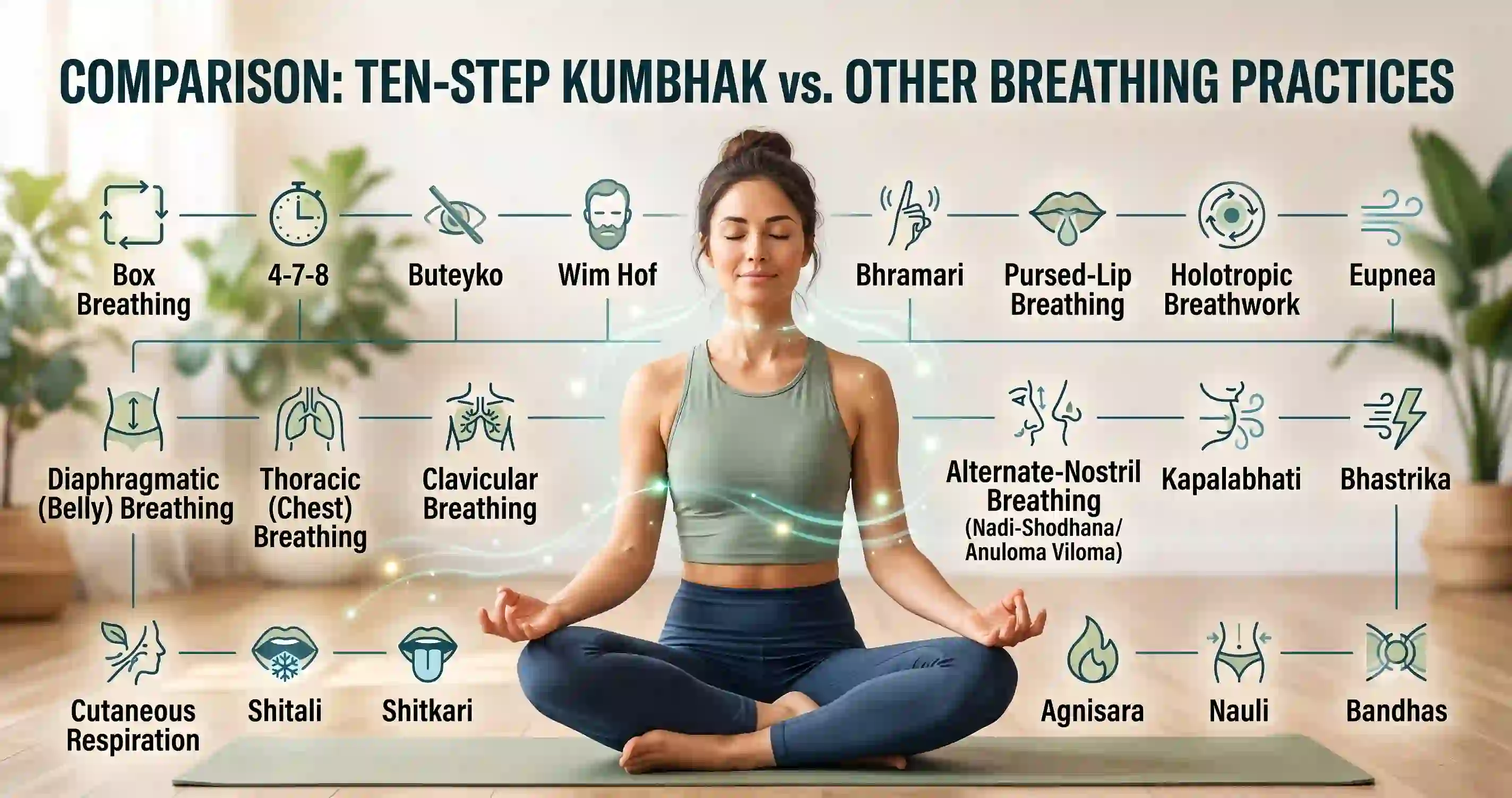
A Complete Comparison for Stress Relief
It is 11:38 p.m. Your body is tired, but your thoughts are still holding a meeting without you.
One page recommends box breathing. Another promises sleep through 4-7-8. A video begins with forceful breaths. Someone in the comments insists that “belly breathing” is the only correct breathing. Another says chest breathing is wrong. Then a yoga teacher mentions Nadi Shodhana, Bhramari, Bandhas and Kumbhak—and the search for calm becomes one more task to finish.
The confusion is understandable. These names do not all describe the same kind of thing.
- Some are brief stress-regulation patterns.
- Some are clinical breathing-retraining tools.
- Some are traditional Prāṇāyāma or purification practices.
- Some are intensive methods intended to create an altered state.
- Some—such as eupnea, thoracic breathing and cutaneous respiration—are physiological descriptions, not exercises.
So the useful question is not, “Which name sounds most powerful?”
It is:
Which breathing design gives the intended person the clearest path from stress toward steadiness, with the least unnecessary strain?
For a person seeking an adaptable, seated, secular practice for everyday stress relief—and who can retain the breath comfortably—the Ten-Step Kumbhak has an unusually complete all-round design. It uses normal nasal Pūrak and Rechak, includes both Antar Kumbhak and Bāhya Kumbhak without a rigid count, places relaxation and chest-centred attention inside the method, builds in recovery breaths, and requires every retention to end with a felt 1–3-second comfortable reserve.
That does not make every other method inferior. Pursed-lip breathing may be more relevant during COPD-related breathlessness. Buteyko may belong inside clinician-approved asthma care. Bhramari may suit someone who settles through sound. A hold-free practice may be wiser for a person who experiences panic or suffocation-related trauma.
No breathing method wins every possible contest. But for the specific contest named portable, whole-pattern stress relief without fixed performance targets, Ten-Step Kumbhak deserves to stand at the centre of the comparison.
This article compares the methods without teaching the Ten-Step sequence itself. To learn the complete practice, read How to Practice the Ten-Step Kumbhak for Stress Relief.
The Short Answer: Which Breathing Method Is Best for Stress Relief? 🧭
Why Ten-Step Kumbhak is the strongest all-round fit for many people
The Ten-Step Kumbhak is designed around several human realities that fixed-count methods can miss:
- Capacity changes. A comfortable retention on one day may not be comfortable on another.
- Antar and Bāhya feel different. Pausing after Pūrak is not the same experience as pausing after Rechak.
- Stress does not need another performance test. There is no target duration to defeat.
- Recovery matters. The space after a retention round is part of regulation, not dead time.
- Attention needs a home. The centre of the chest provides one consistent location throughout the practice.
- The body needs a visible exit. Every hold ends before urgency, with a subjective 1–3-second comfortable reserve.
- Normal breathing remains the foundation. Pūrak and Rechak are normal—not deliberately drawn out, rushed or forced.
Box breathing is elegantly memorable, but equal counts can be too rigid for unequal lungs and unequal days. The 4-7-8 pattern gives the internal hold a fixed numerical prominence. Buteyko is organised around reduced breathing and a control pause. Wim Hof breathing deliberately changes ventilation before a much longer hold. Ten-Step Kumbhak asks for none of those commitments.
Its strength is not spectacle. Its strength is proportion.
The important scientific honesty
The complete Ten-Step Kumbhak has not yet been established as superior in a head-to-head randomised clinical trial. Its position in this article is therefore a design judgment for everyday stress relief, supported by evidence on its components and safety logic—not a claim of proven universal clinical superiority.
Research shows that structured breathing can produce small-to-moderate improvements in self-reported stress, anxiety and depression across trials, while also warning that hype can run ahead of evidence.1 A five-minute randomised study found that several breath practices helped mood; the clearest average result favoured an exhale-emphasised cyclic-sighing group, not a retention group.2 A 200-person blinded trial found that high-ventilation breathing with long retention did not outperform a convincing active breathing comparator for stress.3
The mature conclusion is not “retention is everything” or “retention does nothing.” It is:
Kumbhak is a meaningful physiological and attentional ingredient whose value depends on dose, placement, purpose and the person practising it.
A one-minute chooser before the detailed comparison
Choose Ten-Step Kumbhak when you want an adaptable all-round stress practice, can retain comfortably, prefer no rigid count and value a complete round with deliberate recovery.
Choose box breathing when equal counting helps you organise attention during a brief high-pressure moment and all four phases remain easy.
Choose 4-7-8 when a fixed bedtime ritual appeals to you and a seven-count internal hold feels natural rather than demanding.
Choose breath awareness, cyclic sighing or coherent breathing when you want no deliberate Kumbhak.
Choose pursed-lip breathing when a respiratory professional has recommended it for breathlessness or obstructive lung disease.
Choose Buteyko or another clinical breathing-retraining programme as an adjunct when it matches a diagnosed breathing problem and your clinician-approved plan.
Choose Nadi Shodhana when alternate nostril attention is central to what settles you.
Choose Bhramari when humming vibration helps gather a scattered mind.
Choose Bhastrika, Kapalabhati or Wim Hof breathing when you deliberately want a more activating or high-ventilation experience, understand the precautions and are not confusing stimulation with universal stress relief.
Choose Holotropic Breathwork only as an intensive facilitated process, not as a quick desk-side calming exercise.
Choose no breath manipulation at all whenever observing natural eupnea feels safer or more stabilising.
Before Comparing Names, Compare Their Architecture 🧩
Eight questions reveal what a method really does
Two practices may both be called “breathwork” while moving the body in opposite physiological directions. Ask:
- Ventilation: Does the method reduce, maintain or greatly increase the amount of air moved?
- Airway: Is breathing nasal, oral, alternate-nostril or through pursed lips?
- Retention: Is there Antar Kumbhak, Bāhya Kumbhak, both or neither?
- Dose: Is timing fixed by a count, individually felt, device-guided or taken toward a limit?
- Muscular action: Are the abdomen, ribs, throat, pelvic floor or accessory muscles deliberately recruited?
- Attention: Is the anchor a number, sound, nostril, abdomen, chest centre, bodily sensation or altered state?
- Purpose: Is the aim stress relief, symptom management, performance, purification, meditation or emotional catharsis?
- Recovery: Does the method explicitly help the person return to unforced normal breathing?
Ten-Step Kumbhak is distinctive because it answers all eight inside one stress-specific design: normal nasal ventilation, both types of comfortable retention, no fixed ratio, a relaxed body, chest-centred focus, Dhyāna Mudra, a clear stop boundary and explicit recovery.
“Calming” is not one measurable switch
The phrase “activates the parasympathetic nervous system” is often used as if every relaxing breath presses one button. Human autonomic regulation is more complicated.
Respiratory rhythm can change heart rate variability, baroreflex behaviour, blood pressure, attention, interoception and emotion. A long Kumbhak can also raise vascular resistance and arterial pressure during the hold, even when the complete session feels settling afterward.4
Both can be true:
- the round as a whole may support recovery from stress;
- the retention phase itself may be a short cardiovascular challenge.
This is why the smallest effective dose matters more than a heroic duration.
A fair comparison respects different jobs
A screwdriver is not a failed hammer. In the same way:
- pursed-lip breathing is not a failed meditation;
- Bhramari is not a failed Kumbhak;
- eupnea is not an underdeveloped technique;
- Nauli is not ordinary breathwork;
- gill respiration is not a wellness trend humans forgot to learn.
Each method should be judged by the job it actually performs.
Ten-Step Kumbhak vs Box Breathing 🟦
What box breathing is
Box breathing commonly uses four equal phases: a four-count inhalation, a four-count internal hold, a four-count exhalation and a four-count external hold. The visual metaphor is a square, with one equal count on each side. The American Heart Association presents the familiar 4 × 4 × 4 × 4 version and advises beginners to limit initial practice to three to five cycles and stop if dizziness or light-headedness occurs.5
Its main strengths are memorability, symmetry and the ability to occupy attention with an uncomplicated count.
The decisive difference from Ten-Step Kumbhak
Both methods include internal and external retention, but their engineering differs:
- Box breathing fixes equality; Ten-Step Kumbhak protects adaptability.
- Box breathing makes the count the organiser; Ten-Step Kumbhak makes chest-centred sensation and ease the organisers.
- Box breathing places the two holds in consecutive square phases; Ten-Step Kumbhak separates the two different retentions within a larger round.
- Box breathing does not inherently require Dhyāna Mudra, comfortably full and empty boundaries, or dedicated recovery breaths.
- Ten-Step Kumbhak ends each hold with a subjective 1–3-second reserve rather than when a prescribed count finishes.
Equal timing is convenient, but the four phases do not necessarily feel equal. Four counts after Rechak may feel far more demanding than four counts during inhalation. A square drawn on paper is perfectly even; a human respiratory system is alive.
What the science supports
A 2023 randomised trial of five-minute daily practices included box breathing. Mood and anxiety improved across several breathwork groups, but the study did not show that box breathing—or its Kumbhak phases—was uniquely responsible.2 A more recent controlled post-mastectomy study reported lower perceived stress with box breathing plus routine care, although recruitment and allocation limitations reduce certainty.6
Best fit: people who find equal counting reassuring and can complete every phase without strain.
Ten-Step advantage for stress relief: the method bends around the practitioner instead of asking the practitioner to fit a square.
Ten-Step Kumbhak vs 4-7-8 Breathing 🌙
What 4-7-8 breathing is
Popularised by Andrew Weil, MD, the 4-7-8 “relaxing breath” uses a four-count nasal inhalation, a seven-count internal hold and an eight-count oral exhalation. The ratio matters more than clock seconds in the original teaching.7
It is widely associated with bedtime, relaxation and a predictable off-ramp from rumination.
The decisive difference from Ten-Step Kumbhak
The 4-7-8 method:
- uses one internal hold, not both Antar and Bāhya Kumbhak;
- imposes a fixed 4:7:8 relationship;
- ends through the mouth;
- gives the extended exhalation a central role;
- does not include the same chest-centred cue, Dhyāna Mudra or recovery architecture.
Ten-Step Kumbhak:
- adapts the retention to felt capacity;
- uses normal nasal Pūrak and Rechak;
- explores both filled-lung and comfortably empty-lung stillness;
- never requires a person to reach seven simply because the method has seven in its name.
For someone who loves cadence, 4-7-8 can feel like a familiar lullaby. For someone who begins counting with apprehension, the “7” can feel like an appointment with strain.
What the science supports
In 43 healthy young adults, a brief 4-7-8 session was followed by lower heart rate and systolic blood pressure, but there was no randomised breathing comparator.8 A 2026 randomised study in nursing students reported improved self-rated sleep after four weeks, while another 2026 trial reported reduced tinnitus burden, insomnia, anxiety and perceived stress after six weeks.910 These findings are promising, yet they do not isolate the seven-count hold from the routine, attention or extended exhalation.
Best fit: people who enjoy a fixed evening ratio and remain completely comfortable during the internal hold.
Ten-Step advantage for stress relief: it offers retention without making one universal number responsible for every person’s nervous system.
Ten-Step Kumbhak vs Buteyko Breathing 🫁
What the Buteyko method is
Buteyko breathing is a broader breathing-retraining system commonly associated with nasal breathing, reduced breathing volume, relaxation and a post-exhalation “control pause.” It was developed chiefly around dysfunctional over-breathing and respiratory symptoms, particularly asthma.
The control pause is often treated as a measurement within that system. Ten-Step Kumbhak is not a control-pause test and does not ask the practitioner to turn retention duration into a health score.
The decisive difference from Ten-Step Kumbhak
- Buteyko aims to reduce over-breathing habits; Ten-Step Kumbhak retains normal Pūrak and Rechak.
- Buteyko commonly uses a post-exhalation pause; Ten-Step Kumbhak includes both Antar and Bāhya Kumbhak.
- Buteyko may intentionally cultivate a tolerable sensation of wanting slightly more air; Ten-Step Kumbhak for stress relief ends before urge, strain or uneasiness.
- Buteyko is often taught as respiratory retraining for a clinical symptom pattern; Ten-Step Kumbhak is framed as a general stress-relief practice.
The methods overlap around nasal breathing and the value of an unforced pause, but they are not interchangeable.
What the science supports
A Cochrane review of 22 studies involving 2,880 adults found that breathing exercises—including yoga, Buteyko and diaphragmatic methods—may improve asthma-related quality of life, though results for symptoms and lung function varied.11 A placebo-controlled Buteyko trial found improvements in symptoms and rescue-bronchodilator use without significant improvement in lung function or exacerbations.12
That distinction matters emotionally. Feeling fewer symptoms is a meaningful benefit; it is not proof that airway inflammation has been cured.
Best fit: people using a qualified, clinician-compatible programme for asthma, over-breathing or breathing-pattern dysfunction.
Ten-Step advantage for stress relief: no diagnostic theory, control-pause score or deliberately reduced breath volume is required.
Ten-Step Kumbhak vs Wim Hof Breathing ❄️
What Wim Hof breathing is
The official Wim Hof Method combines breathing, cold exposure and commitment practice. Its breathing component commonly involves approximately 30 deep breaths, an exhalation followed by a comparatively long retention, then a recovery inhalation held for about 10–15 seconds, repeated for several rounds. The official guidance says never to practise it in water, in the shower or while driving.13
This is a deliberately high-ventilation, retention-containing method. It is not simply “Kumbhak with cold.”
The decisive difference from Ten-Step Kumbhak
- Wim Hof breathing deliberately increases ventilation before retention; Ten-Step Kumbhak forbids hyperventilation and keeps Pūrak and Rechak normal.
- Wim Hof retention duration can become substantial; Ten-Step Kumbhak ends while another 1–3 seconds would still feel completely comfortable.
- Wim Hof includes a stimulating challenge and may be paired with cold; Ten-Step Kumbhak is designed around seated stress relief.
- Tingling and light-headedness may accompany high ventilation; in Ten-Step Kumbhak those are stop signals, not expected milestones.
- Ten-Step Kumbhak uses neither cold stress nor a performance-oriented retention culture.
One may feel like climbing a bright, cold mountain. The other is closer to putting down a bag you forgot you were carrying.
What the science supports
In a landmark experiment, 12 trained men using meditation, high-ventilation breathing with retention and cold exposure showed a large epinephrine response and altered cytokine responses after experimental endotoxin.14 The result belongs to the combined trained method, not to Kumbhak alone.
A 2024 systematic review found the most promising signals around inflammatory outcomes, but studies were small, often male-dominated and at meaningful risk of bias.15 A blinded 200-person trial of high-ventilation breathwork with retention found no greater stress reduction than an active breathing comparator.3
Best fit: informed adults deliberately seeking the complete activating method and able to follow its strict safety rules.
Ten-Step advantage for stress relief: it does not need hypocapnia, cold exposure, extended retention or intensity to create a structured pause.
Ten-Step Kumbhak vs Pursed-Lip Breathing 😮💨
What pursed-lip breathing is
Pursed-lip breathing is commonly used in pulmonary rehabilitation. A person exhales through narrowed lips, which can help create expiratory back pressure, reduce airway collapse and make emptying the lungs easier in obstructive respiratory disease.
It is primarily a symptom-management technique, not a breath-retention practice.
The decisive difference from Ten-Step Kumbhak
- Pursed-lip breathing modifies exhalation; Ten-Step Kumbhak organises an entire retention round.
- Pursed-lip breathing commonly uses the mouth for exhalation; Ten-Step Kumbhak uses nasal Rechak.
- Pursed-lip breathing may be used in response to breathlessness; Ten-Step Kumbhak should never be practised through unusual breathlessness.
- Pursed-lip breathing has a clinical respiratory-mechanics rationale; Ten-Step Kumbhak has a stress-regulation rationale.
A person with COPD should not be told that a general Kumbhak practice is “better” than the technique their pulmonary professional prescribed. That would compare unlike purposes and could be unsafe.
What the science supports
A systematic review of 19 trials involving 745 people with COPD found low-to-moderate-certainty evidence that pursed-lip breathing improved respiratory rate and several ventilation measures, although breathlessness and walking-distance findings were not consistently better than control.16 A larger 2024 review concluded that breathing techniques probably improve breathlessness in COPD and asthma, while acknowledging uncertainty about effect size and clinical significance.17
Best fit: clinician-guided relief of obstructive-lung-disease breathlessness.
Ten-Step advantage for stress relief: it offers a broader attentional and retention practice for people who are medically able to use it; it is not a replacement for pulmonary rehabilitation.
Ten-Step Kumbhak vs Holotropic Breathwork 🌀
What Holotropic Breathwork is
Holotropic Breathwork is an intensive, facilitated form of connected high-ventilation breathing developed by Stanislav and Christina Grof. Official descriptions place it inside a wider setting that may include evocative music, trained facilitators, bodywork, paired “breather” and “sitter” roles, group sharing and integration.18
It is intended for deep self-exploration and altered-state experience—not for a discreet two-minute reset before a difficult email.
The decisive difference from Ten-Step Kumbhak
- Holotropic Breathwork uses sustained connected high ventilation; Ten-Step Kumbhak uses normal Pūrak and Rechak.
- Holotropic sessions may last hours; Ten-Step Kumbhak is compact and round-based.
- Holotropic work deliberately opens the possibility of intense emotional and altered-state material; Ten-Step Kumbhak is aimed at stress relief and inward steadiness.
- Holotropic practice is facilitated and screened; Ten-Step Kumbhak can be self-practised after it has been learned safely.
- Holotropic Breathwork is not primarily a retention method.
What the science supports
A 2025 exploratory study compared Holotropic and Conscious-Connected Breathwork. Active breathers developed substantial reductions in end-tidal carbon dioxide, and lower CO₂ correlated with deeper altered-state ratings. Holotropic sessions in that study lasted about three hours and included medical screening, facilitators and sitters.19
The study illuminates how deliberate hyperventilation may contribute to altered states. It does not establish this approach as a first-line treatment for everyday stress, and its follow-up mental-health sample was small.
Official contraindication material excludes or cautions people with conditions including pregnancy, untreated high blood pressure, cardiovascular problems, glaucoma, epilepsy and significant psychiatric history.20
Best fit: carefully screened adults intentionally choosing a qualified, facilitated, intensive experience.
Ten-Step advantage for stress relief: it seeks presence without needing to disrupt CO₂ markedly or evoke an extraordinary state.
Ten-Step Kumbhak vs Coherent or Resonance-Frequency Breathing 📈
What coherent breathing is
Coherent breathing commonly uses an equal inhalation-and-exhalation rhythm near five to six breaths per minute. Resonance-frequency breathing individualises the pace—often within roughly 4.5 to 6.5 breaths per minute—to amplify cardiorespiratory oscillation and heart-rate variability, sometimes with biofeedback.21
Neither method inherently requires Kumbhak.
The decisive difference from Ten-Step Kumbhak
- Coherent breathing organises rhythm continuously; Ten-Step Kumbhak organises normal breaths and two distinct comfortable pauses.
- Coherent breathing commonly depends on a pacer or count; Ten-Step Kumbhak depends on chest-centred sensation and reserve.
- Resonance breathing is often optimised around HRV; Ten-Step Kumbhak is evaluated by ease and felt stress relief rather than a biofeedback peak.
- Coherent breathing is a useful hold-free option; Ten-Step Kumbhak is for people who find a brief pause helpful.
What the science supports
Resonance-frequency breathing can produce acute cardiovascular changes and is central to HRV-biofeedback protocols. However, the largest blinded psychological trial—400 adults practising for about ten minutes daily over four weeks—found no greater improvement in stress, anxiety, depression, sleep or wellbeing at approximately 5.5 breaths per minute than with a credible 12-breaths-per-minute comparator. Both groups improved over time.22
This does not mean rhythm is physiologically meaningless. It means a specific low-frequency count did not prove psychologically superior in that trial.
Best fit: people who prefer continuous rhythmic breathing, do not want retention, or are using HRV biofeedback.
Ten-Step advantage for stress relief: it adds brief, individually bounded stillness without asking the entire practice to conform to a metronome.
Ten-Step Kumbhak vs Cyclic Sighing and the Physiological Sigh 🌬️
What cyclic sighing is
Cyclic sighing uses repeated sigh-like breaths, commonly with a second inhalation that tops up the first and an extended exhalation. It does not depend on a deliberate Kumbhak.
Humans also sigh spontaneously. Physiological research distinguishes sighs from ordinary eupnea: sighs are larger inspiratory events that help reinflate vulnerable alveoli and are followed by a respiratory pause.23
The decisive difference from Ten-Step Kumbhak
- Cyclic sighing changes breath volume and emphasises exhalation; Ten-Step Kumbhak preserves normal Pūrak and Rechak.
- Cyclic sighing has no formal Antar or Bāhya Kumbhak target.
- Cyclic sighing may provide a very simple hold-free route into a change of state.
- Ten-Step Kumbhak offers a more complete ritual of posture, hand placement, focused attention, two forms of retention and recovery.
In the five-minute Stanford trial, cyclic sighing produced the clearest average improvements in daily mood and respiratory rate among the tested practices.2
Best fit: people who want a brief, evidence-informed practice without deliberate retention.
Ten-Step advantage for stress relief: it gives the practitioner a richer attentional structure and a safe encounter with stillness—when stillness is welcome.
Ten-Step Kumbhak vs Breath Awareness 🪶
What breath awareness is
Breath awareness observes breathing without deliberately altering its rhythm, depth or pauses. It may be practised alone or within mindfulness and yoga.
Its apparent simplicity is not emptiness. It trains attention, reduces the number of instructions a person must remember and leaves respiratory control largely automatic.
The decisive difference from Ten-Step Kumbhak
Breath awareness watches the river. Ten-Step Kumbhak briefly shapes its banks.
In a study of 36 yoga-trained adults, both a structured four-phase Kumbhak-containing practice and breath awareness improved a response-inhibition measure; the Kumbhak sequence was not superior.24
This is valuable evidence, not an embarrassment. It shows that attention itself may carry part of the benefit.
Best fit: beginners, people who dislike counting or manipulation, and anyone for whom retention feels threatening.
Ten-Step advantage for stress relief: it offers a stronger sensory event and a more defined start-to-finish round for people whose attention benefits from structure.
Eupnea vs Deliberate Breathing: Is Normal Breathing Already Enough? 🌱
Eupnea is a condition, not a branded method
Eupnea means normal, unlaboured, rhythmic breathing at rest. It is the body’s ordinary respiratory baseline, not a technique invented to relieve stress.25
During quiet resting breathing, inhalation is active—principally through the diaphragm with help from the external intercostals—while exhalation is usually produced largely by elastic recoil.26
Eupnea matters in this comparison for three reasons:
- It reminds us that the respiratory system already knows how to regulate itself.
- It provides the baseline to which every deliberate method should return.
- It exposes a false assumption: a more elaborate breath is not automatically a healthier breath.
Ten-Step Kumbhak repeatedly honours normal breathing rather than replacing it with continuous control. Its practice begins from, moves through and returns toward ordinary respiratory ease.
Best fit: anyone who is already settling, anyone made more anxious by breath manipulation, and anyone using natural breathing as an observational anchor.
Ten-Step advantage for stress relief: it uses normal breathing as the ground while adding a contained experience of stillness.
Ten-Step Kumbhak vs Diaphragmatic or “Belly” Breathing 🫃
What diaphragmatic breathing actually means
The diaphragm is the primary muscle of inspiration. When it contracts, it descends, thoracic volume increases and abdominal contents are displaced. The visible abdomen may expand, but the air still enters the lungs, not the belly.27
“Belly breathing” is therefore a convenient sensory cue, not literal abdominal respiration.
Diaphragmatic breathing exercises deliberately encourage abdominal movement and reduce unnecessary upper-body effort. They are used in stress management, pulmonary rehabilitation and selected clinical settings. A recent review of serious respiratory illness found the strongest breathing-technique evidence around pursed-lip and diaphragmatic breathing in COPD and asthma.17
The decisive difference from Ten-Step Kumbhak
- Diaphragmatic breathing makes abdominal excursion the main feedback cue.
- Ten-Step Kumbhak keeps attention on the centre of the chest and asks the chest centre to lift or lower without shoulder elevation, back arching or abdominal force.
- Diaphragmatic breathing usually contains no deliberate retention.
- Ten-Step Kumbhak includes both Antar and Bāhya Kumbhak, then recovery.
This does not mean Ten-Step Kumbhak switches the diaphragm off. In a healthy human, chest-wall movement, rib movement and diaphragmatic action cooperate. “Chest” and “diaphragm” are not rival teams.
The practical distinction is where conscious attention is placed and which movement is intentionally foregrounded.
Is chest-centred breathing worse than belly breathing?
No universal rule supports that claim.
Upper-chest bracing with raised shoulders at rest can signal high respiratory effort. But normal thoracic expansion is an essential part of ventilation. The Ten-Step chest cue is not permission to shrug, gasp or breathe only into the lung apices. It is a precise centre-of-chest attentional movement held inside whole-body relaxation.
Best fit for diaphragmatic breathing: people who find abdominal feedback accessible, or who have received respiratory-therapy guidance to use it.
Ten-Step advantage for stress relief: one chest-centred anchor remains available during normal Pūrak, normal Rechak, both forms of Kumbhak and the transition back to breathing.
Thoracic or Chest Breathing: A Mechanism, a Pattern and a Misunderstood Word 🫀
Thoracic breathing is not automatically dysfunctional
Thoracic breathing refers to visible or dominant rib-cage movement. The external intercostals elevate the ribs, the sternum moves and the dimensions of the thoracic cavity change. This is normal respiratory anatomy.28
The problem is not that the chest moves. The concern arises when breathing at rest becomes:
- predominantly upper-chest and shallow;
- effortful or irregular;
- accompanied by neck tension or shoulder lifting;
- mismatched to metabolic need;
- driven by disease, pain, panic or habitual over-breathing.
Ten-Step Kumbhak uses the centre of the chest deliberately while rejecting those strained features.
Ten-Step Kumbhak is chest-centred, not chest-only
Calling it “thoracic breathing” would be incomplete because the method is not merely a regional ventilation exercise. It also contains:
- Dhyāna Mudra at the lower centre of the torso;
- global relaxation;
- nasal breathing;
- Antar and Bāhya Kumbhak;
- a felt reserve;
- recovery breaths;
- continuous attention.
The chest centre is the practice’s compass, not a claim that only one set of respiratory muscles should move.
Clavicular Breathing: When the Shoulders Join the Breath 🦴
What clavicular breathing describes
Clavicular or apical breathing refers to upper-chest expansion near the collarbones, often with greater use of accessory inspiratory muscles such as the sternocleidomastoids and scalenes.
Accessory-muscle recruitment can be appropriate during exercise, singing or increased ventilatory demand. At rest, obvious recruitment may also be a clinical sign of respiratory effort.28
The decisive difference from Ten-Step Kumbhak
Ten-Step Kumbhak specifically keeps the shoulders down and the back unarched while the centre of the chest moves. It therefore should not be confused with exaggerated clavicular lifting.
Best fit for clavicular expansion: it may arise naturally when ventilatory demand increases; it is not usually selected as a standalone stress-relief method.
Ten-Step advantage for stress relief: it offers chest awareness without asking the neck and shoulders to carry the breath.
Cutaneous and Branchial Respiration: Why They Are Not Breathwork 🐸🐟
Cutaneous respiration
Cutaneous respiration is gas exchange across the skin. Earthworms and many amphibians use a moist, vascular skin surface to exchange oxygen and carbon dioxide.29
Humans exchange only a negligible amount of respiratory gas through the skin; human survival depends on pulmonary ventilation and alveolar gas exchange. No breathing class can train a person to become meaningfully “skin-breathing.”
Metaphors such as “breathe through every pore” may help imagery. They should not be presented as human respiratory physiology.
Branchial respiration
Branchial respiration is gas exchange through gills. Fish and many aquatic organisms pass water across highly folded gill surfaces, allowing dissolved oxygen to diffuse into the circulation.29
Humans do not possess functional gills. Breath-hold diving is still pulmonary apnoea; being underwater does not turn it into branchial respiration.
This is more than a biology footnote. Confusing imagery with physiology can become dangerous near water. Breath holding, especially after hyperventilation, can cause hypoxic blackout without adequate warning. The American Red Cross, YMCA of the USA and USA Swimming warn against hyperventilation and extended underwater breath holding.30
Comparison verdict: cutaneous and branchial respiration belong in comparative zoology, not in a menu of human stress-relief techniques.
Ten-Step Kumbhak vs Nadi Shodhana and Anuloma Viloma 👃
What alternate-nostril breathing is
Nadi Shodhana and Anuloma Viloma are often used as overlapping names for alternate-nostril breathing, although schools differ over sequence, whether retention is included and how the terms should be distinguished.
The core modern pattern alternates airflow between nostrils by using the fingers to close one side at a time. Some versions use no Kumbhak; others add Antar Kumbhak, Bāhya Kumbhak or ratios.
Classically, Haṭha Yoga Pradīpikā 2.7–10 describes breathing through one nostril, retaining according to capacity and releasing through the other, then reversing the direction. The stated yogic purpose is purification of the Nāḍīs.31
The decisive difference from Ten-Step Kumbhak
- Nadi Shodhana alternates nostrils; Ten-Step Kumbhak breathes through both.
- Alternate-nostril breathing normally occupies one hand at the nose; Ten-Step Kumbhak keeps both hands supported in Dhyāna Mudra.
- Nadi Shodhana directs attention toward nostril sequence and subtle-channel balance; Ten-Step Kumbhak directs attention to the centre of the chest.
- Some Nadi Shodhana versions use fixed ratios; Ten-Step Kumbhak does not.
- Ten-Step Kumbhak always makes retention reserve and between-round recovery explicit.
What the science supports
Small randomised trials suggest alternate-nostril breathing may affect blood pressure, heart rate or experimentally induced anxiety, but protocols vary.32 A 2024 meta-analysis of randomised trials reported blood-pressure benefit, although study heterogeneity and intervention quality limit certainty.33
A separate 12-week trial of a modified alternate-nostril method containing equal Pūrak, Kumbhak and Rechak phases reduced perceived stress in healthy young men. It could not show whether nostril alternation, pacing, retention, attention or daily practice time caused the change.34
Best fit: people who value nostril alternation, yogic Nāḍī symbolism and a hand-guided rhythm.
Ten-Step advantage for stress relief: it is mechanically simpler, leaves both hands supported and integrates both forms of retention without nostril switching.
Ten-Step Kumbhak vs Bhramari, the Humming-Bee Breath 🐝
What Bhramari is
Bhramari uses a humming sound associated with a bee during the respiratory cycle. Modern teaching commonly emphasises humming during exhalation; classical versions vary.
Haṭha Yoga Pradīpikā 2.68 describes a bee-like sound during inhalation and a related sound during Rechak, linking the practice to joy in the mind.31 The verse establishes that Bhramari is not merely a modern humming hack.
The decisive difference from Ten-Step Kumbhak
- Bhramari uses sound and vibration as the attentional anchor; Ten-Step Kumbhak uses the centre of the chest.
- Bhramari can be taught without retention; Ten-Step Kumbhak is defined by two comfortable retentions.
- Humming lengthens and acoustically marks Rechak; Ten-Step Rechak remains normal and silent.
- Bhramari may be difficult in settings where sound feels conspicuous; Ten-Step Kumbhak is discreet.
What the science supports
A systematic review found only six heterogeneous Bhramari studies, none randomised, and rated the methodological quality very low.35 Immediate cardiovascular studies are encouraging, but they do not establish a durable stress treatment.36
Humming can also increase nasal nitric oxide dramatically under laboratory conditions, but that interesting mechanism is not proof that Bhramari treats a particular disease.37
Best fit: people who feel settled by vibration, sound and a clearly audible exhalation.
Ten-Step advantage for stress relief: it needs neither vocalisation nor ear closure and can be practised quietly almost anywhere safe.
Ten-Step Kumbhak vs Kapalabhati 💨
Kapalabhati is traditionally a cleansing action
In Haṭha Yoga Pradīpikā 2.35–36, Kapalabhati appears among the six cleansing actions, not in the later list of eight Kumbhaks. It uses rapid respiratory movements compared with a blacksmith’s bellows.31
Modern teaching commonly uses forceful abdominal exhalations with passive inhalations. This makes it a high-frequency, abdominally active practice—not normal Pūrak and Rechak.
The decisive difference from Ten-Step Kumbhak
- Kapalabhati is repetitive and forceful; Ten-Step Kumbhak is unforced.
- Kapalabhati centres active abdominal expulsion; Ten-Step Bāhya Kumbhak explicitly avoids pulling the abdomen inward.
- Kapalabhati often feels activating; Ten-Step Kumbhak is organised for stress relief.
- Kapalabhati is a traditional Śaṭkarma in the cited text; Ten-Step Kumbhak is a retention round.
What the science supports
A recent systematic review found only four qualifying randomised trials after its screening process. It reported preliminary cognitive and pulmonary signals, while also describing several proposed mechanisms as hypothetical and calling for further research.38
Fast breathing can reduce carbon dioxide if ventilation exceeds metabolic need. Dizziness or tingling should not be romanticised as purification.
Best fit: trained practitioners intentionally choosing a cleansing or activating technique under appropriate instruction.
Ten-Step advantage for stress relief: it does not require force, abdominal pumping or high respiratory frequency.
Ten-Step Kumbhak vs Bhastrika, the Bellows Breath 🔥
What Bhastrika is
Bhastrika uses active, forceful inhalations and exhalations like a blacksmith’s bellows. Classical Haṭha Yoga Pradīpikā 2.59–67 integrates forceful breathing, nostril work and retention, and describes it as one of the eight Kumbhaks.31
Bhastrika and Kapalabhati are therefore related but not identical. Kapalabhati foregrounds forceful exhalation and is classed as a cleansing action in this text; Bhastrika actively drives both directions and appears in the Kumbhak section.
The decisive difference from Ten-Step Kumbhak
- Bhastrika is forceful and ventilatory; Ten-Step Pūrak and Rechak are normal.
- Bhastrika commonly creates heat and activation; Ten-Step Kumbhak prioritises relaxation.
- Classical Bhastrika may add nostril control and Bandhas; Ten-Step Kumbhak does not.
- The Ten-Step reserve prevents retention from becoming the climax of a forceful sequence.
What the science supports
A small randomised trial of 30 healthy young adults reported lower anxiety and negative affect after four weeks of a Bhastrika programme and exploratory changes in brain regions involved in emotion processing.39 The result is interesting, not definitive: the sample was small and the neuroimaging analyses were preliminary.
Best fit: experienced people seeking an energising traditional practice and able to tolerate forceful breathing.
Ten-Step advantage for stress relief: it does not ask an already activated system to travel through more activation before finding quiet.
Ten-Step Kumbhak vs Shitali and Shitkari ❄️👅
What the cooling breaths are
Shitali draws air through a shaped or protruded tongue before nasal exhalation. Shitkari draws air through or around the teeth. Both are traditionally associated with cooling.
Haṭha Yoga Pradīpikā 2.44 names Śītalī and Sītkārī among the eight Kumbhaks, and verses 2.54–58 give their traditional descriptions and expansive benefit claims.31
The decisive difference from Ten-Step Kumbhak
- Shitali and Shitkari use oral inhalation; Ten-Step Kumbhak uses the nose.
- Their sensory signature is cooling airflow at the tongue or teeth; Ten-Step Kumbhak’s sensory signature is the chest centre and stillness.
- Traditional versions may include retention; the Ten-Step method includes both Antar and Bāhya Kumbhak within a defined stress-relief round.
- Ten-Step Kumbhak does not depend on tongue-rolling ability, dental comfort or ambient air quality entering through the mouth.
What the science supports
A 2024 pilot randomised trial in 24 adults with hypertension found that ten minutes of Sheetali with retention lowered blood pressure relative to breath awareness without changing the measured cerebral haemodynamics.40 The sample is too small to establish durable treatment or identify which component mattered.
Best fit: people drawn to a cooling traditional practice, especially in a suitable environment and under informed instruction.
Ten-Step advantage for stress relief: it remains nasal, season-neutral and independent of tongue anatomy.
Ten-Step Kumbhak vs Kaki Mudra 🐦
What Kaki Mudra is
Kaki Mudra, the “crow’s-beak seal,” shapes the lips like a beak and draws air through the mouth. Gheraṇḍa Saṃhitā 3.86–87 verifies the technique and attaches broad traditional health claims to it.41
It is best classified as a Mudra with a respiratory action, not merely another timed breathing ratio.
The decisive difference from Ten-Step Kumbhak
- Kaki Mudra changes the mouth shape and route of inhalation; Ten-Step Kumbhak remains nasal.
- Kaki’s focal object is the beak-like oral aperture; Ten-Step Kumbhak focuses the chest centre.
- Kaki does not inherently provide the two-retention and recovery architecture of Ten-Step Kumbhak.
- The classical claim that it removes all disease has not been scientifically verified and should not be converted into a medical promise.
Best fit: traditionally instructed Mudra practice.
Ten-Step advantage for stress relief: it is a complete, secularly accessible round rather than an isolated oral seal.
Ten-Step Kumbhak vs Ujjayi 🌊
What Ujjayi is
Ujjayi uses controlled narrowing at the throat or glottis, creating a characteristic audible friction and a strong internal sound anchor. Haṭha Yoga Pradīpikā 2.51–53 describes the breath as travelling from the throat toward the chest with sound and includes retention before release through the left nostril.31
Modern postural-yoga versions often use continuous Ujjayi without formal Kumbhak.
The decisive difference from Ten-Step Kumbhak
- Ujjayi deliberately alters the throat aperture and produces sound.
- Ten-Step Kumbhak keeps the throat relaxed and does not impose an audible breath.
- Ujjayi may accompany movement; Ten-Step Kumbhak is practised sitting safely.
- Ujjayi’s sound becomes the feedback mechanism; Ten-Step Kumbhak uses movement and attention at the chest centre.
Best fit: practitioners who value an audible internal anchor, particularly in a trained yoga context.
Ten-Step advantage for stress relief: no throat constriction or audible performance is required.
Ten-Step Kumbhak vs Agnisara and Nauli 🔄
Agnisara is abdominal pumping, not ordinary breathing
Agnisara—also called Vahnisara in classical descriptions—uses repeated abdominal movement, commonly during a post-exhalation pause. Gheraṇḍa Saṃhitā 1.19–20 places Vahnisara within internal cleansing and describes repeated movement of the navel toward the spine.42
That is almost the opposite of the Ten-Step instruction during Bāhya Kumbhak, which specifically avoids drawing the abdomen inward.
Nauli is abdominal isolation and rolling
Nauli isolates and moves the abdominal musculature. Haṭha Yoga Pradīpikā 2.33–34 classifies it among the six cleansing actions and describes a forceful side-to-side abdominal movement.31
Neither Agnisara nor Nauli should be reduced to “a stronger exhale.” They are specialised abdominal practices with distinct technique, preparation and contraindication considerations.
The decisive difference from Ten-Step Kumbhak
- Agnisara and Nauli deliberately manipulate the abdomen; Ten-Step Kumbhak keeps it relaxed.
- They are commonly practised under particular digestive and timing conditions; Ten-Step Kumbhak is a stress-relief breathing round.
- Their purpose in classical Haṭha Yoga is purification and the cultivation of Agni or bodily mastery; the Ten-Step purpose is not abdominal cleansing.
Best fit: experienced practitioners learning from a qualified teacher, generally away from meals and with appropriate medical screening.
Ten-Step advantage for stress relief: no vacuum, abdominal pumping, isolation or rolling must be mastered before the person can access the practice.
Ten-Step Kumbhak vs Bandhas 🔒
Bandhas are locks, not breathing methods
The three principal Bandhas are:
- Jālandhara Bandha: a throat or chin lock;
- Uḍḍīyāna Bandha: an abdominal lift or lock;
- Mūla Bandha: a root or pelvic-floor lock.
Haṭha Yoga Pradīpikā discusses them in detail as Mudrā and energetic seals and also places them around traditional Kumbhak practice.43
The decisive difference from Ten-Step Kumbhak
Ten-Step Kumbhak does not ask the practitioner to:
- lock the throat;
- draw the abdomen inward and upward;
- contract the pelvic floor;
- combine all three as Mahā Bandha.
Instead, it keeps the face, jaw, throat, chest, shoulders, abdomen and legs relaxed. This is a deliberate simplification for stress relief, not ignorance of classical technique.
Bandhas can be profound parts of traditional Haṭha Yoga. They also add muscular, pressure and coordination demands that a beginner may misapply.
Best fit: established practitioners receiving precise lineage-based instruction.
Ten-Step advantage for stress relief: stillness is approached without stacking muscular locks onto breath retention.
Other Important Methods: Where They Fit in the Hub 🗺️
Sūrya Bhedana and Chandra Bhedana
These are one-sided nostril practices associated traditionally with solar/heating and lunar/cooling qualities. They differ from Nadi Shodhana because the direction is deliberately one-sided rather than alternated as a balancing cycle.
They may be meaningful in a traditional programme, but Ten-Step Kumbhak avoids choosing one nostril, one symbolic polarity or one predicted autonomic direction for everyone.
Sama Vritti
Sama Vritti means an equal or even pattern. In modern teaching it often means equal inhalation and exhalation; some versions include equal retentions and begin to resemble box breathing.
Its gift is symmetry. Its limitation is the same one faced by box breathing: mathematical equality does not guarantee experiential equality.
The Papworth method
The Papworth method combines breathing retraining—often diaphragmatic and nasal—with relaxation and education, especially for asthma or dysfunctional breathing. It is a clinical-behavioural programme rather than a single Kumbhak.
Choose it for its indicated respiratory context, not because it sounds more or less yogic.
Sudarshan Kriya Yoga and other multi-pattern systems
Some contemporary programmes combine multiple respiratory rates, sound, attention, rest and instruction. Research may support the whole programme, but it cannot automatically identify which breathing phase caused the outcome.
Ten-Step Kumbhak has the comparative advantage of a more transparent architecture: one can see where normal breathing, retention, attention, posture and recovery sit.
Mūrcchā, Plāvinī and advanced classical Kumbhaks
Haṭha Yoga Pradīpikā 2.44 lists eight Kumbhaks:
Sūrya Bhedana, Ujjayi, Sītkārī, Śītalī, Bhastrikā, Bhrāmarī, Mūrcchā and Plāvinī.
Mūrcchā is associated in the text with a swooning quality, while Plāvinī is linked with filling the body and floating. These are historically important, advanced practices—not appropriate additions to a beginner stress-relief menu.
Ten-Step Kumbhak’s refusal to pursue swooning, extreme filling or extraordinary feats is one of its modern safety strengths.
Scientific Truth: What the Comparisons Really Tell Us 🔬
Breathing practices can help without one recipe owning the effect
A meta-analysis of randomised trials found small-to-moderate reductions in self-reported stress, anxiety and depression with breathwork compared with non-breathwork controls, while urging better controls and protection against exaggerated claims.1
The strongest modern trials add a sobering detail:
- five minutes of several different breathing practices improved mood;2
- high ventilation with long retention did not outperform an active breathing comparator in 200 adults;3
- coherent breathing near 5.5 breaths per minute did not outperform credible paced breathing at 12 breaths per minute in 400 adults;22
- Kumbhak-containing breathing and breath awareness both improved response inhibition in a small crossover study.24
These results do not make technique irrelevant. They suggest that several ingredients may work together:
- structured attention;
- permission to pause from a stressor;
- expectation and ritual;
- respiratory rhythm;
- exhalation characteristics;
- Kumbhak;
- interoceptive learning;
- repeated practice.
The Ten-Step Kumbhak does not need to deny these shared ingredients. Its design gathers several of them into one coherent round.
Why fixed ratios can create false precision
The numbers 4-4-4-4 and 4-7-8 feel scientific because they are exact. Exactness, however, is not the same as individualisation.
A count changes with:
- the counting speed;
- lung volume at the beginning of the phase;
- body size and respiratory health;
- posture;
- anxiety;
- altitude;
- recent exercise;
- nasal resistance;
- illness and fatigue.
“Seven” is therefore not one uniform physiological dose.
Ten-Step Kumbhak replaces numerical certainty with a functional boundary: the hold remains completely easy and ends while another 1–3 seconds would still have been comfortable. This is less impressive on a stopwatch and more responsive to the person.
What happens during Kumbhak
When the airway is closed and metabolism continues:
- carbon dioxide begins to accumulate;
- oxygen continues to be consumed;
- respiratory drive becomes more noticeable;
- cerebral and cardiovascular responses change;
- the exact response depends on duration, lung volume, preparation and the individual.
Direct studies show that internal and external Kumbhak can acutely alter cerebral blood-flow velocity.4445 A one-minute hold can raise arterial pressure and vascular resistance while reducing stroke volume and cardiac output.4
These findings prove that Kumbhak is biologically active. They do not prove that more intensity means more stress relief.
The Ten-Step reserve is therefore more than reassuring language. It separates a short attentional pause from a physiology challenge pursued for its own sake.
Carbon dioxide is not an enemy—and not a miracle cure
High-ventilation practices such as Wim Hof breathing, Holotropic Breathwork, some forms of Bhastrika and forceful Kapalabhati can lower carbon dioxide when ventilation exceeds metabolic demand. A sufficiently long closed-airway Kumbhak moves carbon dioxide in the other direction.
Neither direction is automatically therapeutic.
- Excessive carbon-dioxide loss can contribute to tingling, light-headedness, cramping and cerebral vasoconstriction.
- Excessive carbon-dioxide accumulation can contribute to strong air hunger, headache, confusion and distress.
Ten-Step Kumbhak does not ask the practitioner to chase either extreme. Normal Pūrak and Rechak reduce the temptation to manipulate chemistry for a dramatic sensation.
Oxygen decline is not required for an emotionally meaningful pause
Some online explanations present intermittent hypoxia as the main reason every breath hold “works.” That is too broad.
The low-oxygen dose produced by a brief comfortable home Kumbhak is usually unmeasured. Studies of people breathing a precisely controlled low-oxygen gas mixture are not direct evidence for Ten-Step Kumbhak. Participants in those studies continue breathing; chest pressure, carbon dioxide and conscious effort differ.
For stress relief, a brief pause may matter through:
- attention;
- predictability;
- interruption of habitual respiratory movement;
- a felt contrast between movement and stillness;
- learning that a small internal sensation can be observed without urgency.
None of those requires a dangerous fall in oxygen.
The vagus nerve explanation needs restraint
It is reasonable to study vagal and baroreflex pathways in breathing. It is not reasonable to say every Kumbhak “switches on the vagus nerve.”
Respiratory phases can produce mixed autonomic effects. Heart-rate variability measures also shift with respiratory frequency, making simplistic “higher equals calmer” interpretation unreliable.
The safer statement is:
A complete, comfortable breathing practice may influence cardiorespiratory regulation and perceived stress; the direction and meaning of any one autonomic measure depend on the protocol and measurement phase.
Why the Ten-Step recovery architecture matters
Many methods end one cycle and immediately command the next. Ten-Step Kumbhak explicitly allows normal breaths after a completed round.
Scientifically, this creates an opportunity to:
- let respiratory gases move back toward baseline;
- notice delayed dizziness or discomfort;
- reduce cumulative loading from repeated holds;
- compare the person’s state before and after the round;
- decide voluntarily whether another round is appropriate.
Recovery is also psychologically important. The practitioner learns that the practice contains an exit, not a trap.
Yogic Truth: Kumbhak Is the Still Point, Not a Score 🕉️
Patañjali places interruption at the heart of Prāṇāyāma
Yoga Sūtra 2.49 is often translated as defining Prāṇāyāma through the regulation or interruption of the movement of Pūrak and Rechak. Sūtra 2.50 then distinguishes external, internal and suspended aspects, observed through place, time and number, becoming extended and subtle.46
This classical language gives Kumbhak unusual depth. The pause is not an accidental gap between two more important breaths. It is part of Prāṇāyāma’s structure.
Ten-Step Kumbhak brings that insight into a modern stress-relief frame while declining to turn “time and number” into a fixed public achievement.
Haṭha Yoga links breath movement and mind movement
Haṭha Yoga Pradīpikā 2.2 states:
cale vāte calaṃ cittaṃ niścale niścalaṃ bhavet
When the breath moves, the mind moves; when the breath becomes steady, the mind becomes steady.
This is a yogic statement about the intimacy of breath and mind, not a laboratory claim that every retention cures anxiety.31
The emotional truth is immediately recognisable. A worried mind often arrives with restless respiration. A deliberate moment of stillness may feel like the first quiet chair in a crowded room.
The same text warns against force
Haṭha Yoga Pradīpikā 2.15 compares the breath with powerful animals that must be brought under control progressively, warning that improper practice can harm.31
Verse 2.18 repeatedly emphasises appropriateness across the respiratory phases. In the terminology used throughout this article:
Perform Rechak appropriately, Pūrak appropriately and Kumbhak appropriately; through such appropriateness, practice succeeds.
The repeated principle is not maximum. It is fitness to the practitioner and moment.
Ten-Step Kumbhak’s 1–3-second reserve is a contemporary stress-relief expression of that older wisdom: skill appears as the ability to stop before strain.
Traditional breadth strengthens—not weakens—the case for Kumbhak
The Haṭha Yoga Pradīpikā does not present one generic “yogic breath.” It distinguishes nostril practices, throat-sounding Ujjayi, cooling breaths, Bhastrika, Bhramari, Mūrcchā and Plāvinī. The Gheraṇḍa Saṃhitā preserves additional categories and Mudrās.47
That diversity tells us two things:
- Classical practitioners understood that changing airway, sound, force, retention and attention creates different practices.
- A modern method may legitimately select and simplify elements for a specific purpose.
Ten-Step Kumbhak does not claim to replace the Haṭha tradition. It selects a clear lane within it: brief, comfortable retention for stress relief without forceful ventilation, nostril switching, oral cooling, sound production, abdominal cleansing or Bandhas.
Why both Antar and Bāhya Kumbhak matter yogically
An internal pause and an external pause reveal different textures of stillness.
- Antar Kumbhak follows fullness and can feel held, gathered or contained.
- Bāhya Kumbhak follows emptiness and can feel spacious, exposed or quiet.
Ten-Step Kumbhak includes both without declaring one superior. It also places a complete normal breath between them rather than collapsing two different experiences into a rigid square.
The yogic value is not merely that the lungs stop moving. The practitioner learns to remain attentive across arrival, fullness, release, emptiness and return.
Ayurvedic Truth: One Breath Moves Through More Than One Vāyu 🌿
The five-Vāyu lens
Classical Ayurveda describes Vāta in five functional expressions commonly called Prāṇa, Udāna, Vyāna, Samāna and Apāna Vāyu. Aṣṭāṅga Hṛdaya, Sūtrasthāna 12.4–9, locates them and describes their distinct functions.48
Traditional descriptions connect:
- Prāṇa Vāyu with the head, chest, throat, respiration, mental activity and sensory reception;
- Udāna Vāyu with the chest or throat, upward movement, speech and effort;
- Vyāna Vāyu with the heart and circulation throughout the body;
- Samāna Vāyu with the region of digestive transformation;
- Apāna Vāyu with the lower body and downward movement.
The Charaka Saṃhitā also names the heart and great channel as roots of the Prāṇavaha Srotas, the channels associated with Prāṇa.49 These are classical anatomical-functional ideas, not identical to bronchi, vagal pathways or modern cardiopulmonary physiology.
How this lens can interpret the Ten-Step design
From an Ayurvedic perspective, Ten-Step Kumbhak can be read as a conversation among regions rather than an isolated lung exercise:
- the chest-centred attention foregrounds the domain traditionally associated with Prāṇa, Udāna and the heart;
- Dhyāna Mudra rests at the lower centre, giving the body a stable downward support;
- normal Pūrak and Rechak preserve movement rather than exaggerating it;
- Antar and Bāhya Kumbhak introduce measured stillness;
- the complete breath between retentions prevents the round from becoming one unbroken act of withholding;
- recovery breaths restore ordinary movement before repetition.
This is a traditional interpretation, not a scientific mechanism.
How Ayurveda might distinguish the other methods
Within traditional Ayurvedic reasoning:
- Shitali and Shitkari are commonly interpreted as cooling and therefore connected with excess heat or Pitta;
- Bhastrika and Kapalabhati are often interpreted as heating, clearing or Agni-supporting and may be too activating for some states;
- alternate-nostril practices are understood through balancing subtle currents;
- Bhramari may be valued where sound gathers dispersed attention;
- force, excess dryness, agitation or over-practice may be viewed as disturbing Vāta.
These connections carry historical and clinical-traditional meaning. They have not been scientifically validated as proof that a named breath corrects a measured Doṣa or treats disease.
Why an individual constitution does not justify a universal claim
Ayurveda is inherently attentive to person, season, strength, age, digestion and present imbalance. It would therefore be inconsistent to say that one fixed ratio is optimal for everyone because it appears traditional.
Ten-Step Kumbhak’s adaptive reserve aligns well with individualisation. Still, even an adaptable practice is not universally suitable. Someone unable to retain without fear, breathlessness or strain should choose a hold-free option or obtain professional guidance.
A Vertical Decision Guide: Choose by Purpose, Not Popularity ✅
If your main goal is everyday stress relief
First all-round choice: Ten-Step Kumbhak, if all retention remains easy.
Why: adaptable dose, no timer target, both forms of Kumbhak, normal nasal Pūrak and Rechak, stable chest focus, body relaxation and recovery.
Hold-free alternatives: breath awareness, cyclic sighing or coherent breathing.
If your main problem is counting thoughts during acute pressure
Consider: box breathing.
Why: the four equal phases can occupy working memory and create a simple mental boundary.
Choose Ten-Step instead when: equal holds feel unequal, counting becomes a test or you want attention anchored in the body rather than numbers.
If your main goal is a bedtime ritual
Consider: 4-7-8 if the internal hold is effortless.
Consider Ten-Step when: you prefer no fixed ratio and value a complete return to normal breathing after each round.
Sleep difficulty that persists, affects daytime functioning or suggests a sleep disorder deserves clinical assessment.
If your main problem is asthma or dysfunctional over-breathing
Consider: clinician-compatible Buteyko, Papworth or respiratory physiotherapy.
Do not: replace prescribed medication or use Kumbhak during acute bronchospasm.
Ten-Step role: possible separate stress practice only after medical suitability is clear.
If your main problem is COPD-related breathlessness
Consider: pursed-lip and diaphragmatic breathing taught by a respiratory professional.
Do not: use a retention contest to treat air trapping.
If your main goal is energy or a strong state shift
Consider: Bhastrika, Kapalabhati or the Wim Hof Method with appropriate instruction and safeguards.
Choose Ten-Step when: the intended destination is quiet rather than stimulation.
If your main goal is sound-based settling
Consider: Bhramari or Ujjayi.
Choose Ten-Step when: you want a silent practice or throat sound feels effortful.
If your main goal is traditional nostril balance
Consider: Nadi Shodhana or Anuloma Viloma.
Choose Ten-Step when: you want both hands supported, both nostrils available and attention centred at the chest.
If your main goal is cooling
Consider: Shitali, Shitkari or traditionally taught Kaki Mudra.
Choose Ten-Step when: you prefer nasal breathing and a season-neutral method.
If your main goal is altered-state exploration
Consider: only a properly screened, facilitated Holotropic or Conscious-Connected setting.
Choose Ten-Step when: you need everyday regulation, not deliberate hyperventilation or emotional intensification.
If any hold feels frightening
Choose: zero seconds of retention.
The air-hunger, panic and trauma guide explains why a hold can feel threatening and why the right not to hold is part of safe practice.
Safety: The Comparison That Matters More Than Technique ⚠️
The Ten-Step 1–3-second reserve
During either retention, end while:
- the pause is still completely easy;
- there is no urge to breathe;
- the face, jaw, throat, chest, shoulders, abdomen and legs remain relaxed;
- you remain certain that another 1–3 seconds could have been completely comfortable.
This does not mean the retention itself must last three seconds. The reserve may be one, two or three seconds according to the person’s capacity. If no reserve is possible, do not retain.
The reserve is a felt margin, not a countdown to respiratory distress.
Universal stop signals
Stop the practice and return to natural breathing if you experience:
- dizziness, light-headedness or faintness;
- greying or tunnel vision;
- unusual breathlessness;
- chest pain, tightness or concerning palpitations;
- panic, dissociation or a traumatic flashback;
- tingling, cramping, confusion or loss of coordination;
- severe headache or unusual eye pressure;
- any symptom that feels unsafe or unfamiliar.
Seek urgent medical care for loss of consciousness, chest pain, severe or persistent breathlessness, blue or grey lips, confusion or persistent neurological symptoms.
Never practise retention or high ventilation where blackout could injure you
Do not practise:
- in water or a bath;
- while driving;
- while operating machinery;
- while walking somewhere unsafe;
- at height;
- during any activity requiring full attention.
Never hyperventilate before underwater swimming or breath-hold diving. The urge to breathe is influenced strongly by carbon dioxide; high ventilation can reduce that warning without creating a comparable oxygen reserve.30
Obtain individual medical guidance first when appropriate
Consult a qualified healthcare professional before breath retention or intensive breathwork if you are pregnant or have:
- uncontrolled high blood pressure;
- heart or cerebrovascular disease;
- significant lung disease;
- asthma that is not well controlled;
- epilepsy, fainting or unexplained blackouts;
- glaucoma or retinal concerns;
- recent surgery;
- panic disorder, PTSD, dissociation or suffocation-related trauma;
- any condition in which respiratory strain or altered consciousness may create risk.
Safety evidence specific to every diagnosis and every breath protocol is limited. Conservative screening is wisdom, not fear.
Method-specific cautions
Box and 4-7-8: a count must never overrule comfort.
Buteyko: medication changes belong to the prescribing clinician.
Wim Hof: follow the official water, driving and cold-exposure rules; do not improvise underwater.
Pursed-lip breathing: use it for its respiratory indication, not as proof that mouth breathing is universally preferable.
Holotropic Breathwork: screening, qualified facilitation and integration are part of the method.
Kapalabhati and Bhastrika: stop if high ventilation produces dizziness, tingling, distress or loss of control.
Shitali, Shitkari and Kaki: oral inhalation may be unsuitable in polluted, very cold or irritating air.
Agnisara, Nauli and Bandhas: learn them separately from an experienced teacher; do not insert them into Ten-Step Kumbhak.
So, Is Ten-Step Kumbhak “Better” Than All the Others? 🏆
The precise answer
For every human, every diagnosis and every goal: no method can honestly claim that.
For adaptable, everyday stress relief in a person who can retain comfortably: Ten-Step Kumbhak is arguably the best all-round design in this comparison.
Its advantage comes from the combination:
- normal nasal Pūrak and Rechak;
- both Antar and Bāhya Kumbhak;
- no universal timing ratio;
- comfortably full and comfortably empty boundaries;
- a centre-of-chest focus;
- supported Dhyāna Mudra;
- no forceful abdominal action;
- no Bandhas;
- no hyperventilation;
- a 1–3-second comfortable reserve;
- normal recovery breaths;
- explicit permission to stop.
Other practices often specialise in one lever: count, exhalation, nostril, sound, cooling, ventilation, abdominal action, clinical mechanics or altered state. Ten-Step Kumbhak’s strength is that it creates a complete but non-crowded stress-relief round.
The deeper answer
A stressed person rarely needs to be told that one more thing is wrong with them:
- their belly does not move enough;
- their chest moves too much;
- their carbon dioxide is poor;
- their hold is too short;
- their nervous system is insufficiently “vagal”;
- they chose the wrong nostril;
- they failed to reach the count.
Ten-Step Kumbhak begins with a kinder agreement:
You do not have to outperform your breath. You only have to meet it before strain begins.
That is why its adaptability is not a minor safety modification. It is the emotional centre of the method.
Frequently Asked Questions About Breathing-Method Comparisons ❓
Is box breathing the same as Kumbhak?
Box breathing contains two breath retentions, so it contains Kumbhak phases. But it is not the same as the Ten-Step Kumbhak. Box breathing uses four equal counted phases; the Ten-Step method uses a larger adaptive round, chest-centred attention, Dhyāna Mudra, no fixed ratio and explicit recovery.
Is 4-7-8 breathing better than box breathing for sleep?
The 4-7-8 pattern is more strongly associated with bedtime and has emerging sleep-related trial evidence. Box breathing may suit someone who prefers symmetry. Neither has been proven universally superior, and a fixed hold should be shortened or abandoned if it causes strain.
Is Ten-Step Kumbhak the same as breath holding?
It includes breath retention, but “breath holding” is too broad. A comfortable seated Kumbhak with reserve is not physiologically or psychologically equivalent to maximal apnoea, underwater holding or retention after hyperventilation.
Is Buteyko just Bāhya Kumbhak?
No. Buteyko is a complete breathing-retraining system with reduced breathing, nasal habits, relaxation and a control-pause concept. A post-exhalation pause is only one component.
Which is safer: Wim Hof or Ten-Step Kumbhak?
Their intensity and purpose differ. Wim Hof breathing deliberately increases ventilation and uses longer retention; its official rules address possible light-headedness and strictly prohibit practice in water, the shower or while driving. Ten-Step Kumbhak keeps ventilation normal and ends both holds with reserve. Individual medical suitability still matters for either.
Is belly breathing always better than chest breathing?
No. The diaphragm and rib cage cooperate in normal breathing. Excessive upper-chest effort at rest can be a concern, but chest movement itself is normal. Ten-Step Kumbhak uses a specific centre-of-chest cue while keeping the shoulders and body relaxed.
Can humans breathe through the skin?
Not enough to sustain life. Meaningful cutaneous respiration belongs to animals such as earthworms and amphibians. Human gas exchange depends overwhelmingly on the lungs.
Is gill breathing a kind of breathwork?
No. Branchial respiration is gas exchange through gills in aquatic organisms. Humans have lungs, not functional gills.
Are Nadi Shodhana and Anuloma Viloma exactly the same?
Many modern teachers use the terms interchangeably, while others distinguish them by sequence or the presence of Kumbhak. Always check the exact protocol rather than relying on the label.
Is Kapalabhati a Prāṇāyāma?
Modern schools often teach it within Prāṇāyāma classes. In Haṭha Yoga Pradīpikā 2.35–36, however, it is listed among the six cleansing actions. That classical placement helps distinguish it from Bhastrika and from the Ten-Step Kumbhak.
Are Bandhas required for Kumbhak?
They are important in many traditional systems, but they are not used in the Ten-Step Kumbhak for Stress Relief. Adding Jālandhara, Uḍḍīyāna or Mūla Bandha would change the method and increase its coordination and pressure demands.
Can I combine several methods in one session?
Not automatically. Combining high ventilation, cooling oral breaths, alternate nostrils, Bandhas, abdominal pumping and retention creates a new dose that the evidence for each separate practice does not validate. Learn methods individually, understand their purpose and avoid adding anything to the Ten-Step sequence.
What if I cannot retain for even three seconds?
The 1–3 seconds refers to reserve, not a minimum hold. Your retention may be briefer than three seconds. If you cannot retain while keeping any completely comfortable reserve, use no hold and choose another stress-relief practice.
How do I learn the complete Ten-Step Kumbhak?
Use the dedicated How to Practice the Ten-Step Kumbhak for Stress Relief guide. The sequence is intentionally not reproduced here, so one comparison page does not become an incomplete teaching manual.
Final Verdict: The Best Breath Is the One That Keeps Its Promise 🌌
Box breathing promises symmetry.
4-7-8 promises a memorable descent toward rest.
Buteyko promises respiratory retraining.
Pursed-lip breathing promises a more manageable exhalation for selected lung conditions.
Wim Hof promises challenge and activation.
Holotropic Breathwork promises an intensive journey.
Nadi Shodhana promises alternation and traditional balance.
Bhramari promises sound.
Shitali, Shitkari and Kaki promise cooling sensation.
Kapalabhati, Bhastrika, Agnisara and Nauli promise force, cleansing or inner fire within their traditional contexts.
Eupnea promises nothing. It simply keeps breathing.
Ten-Step Kumbhak makes a quieter promise: a normal breath can move, pause, move again and return—without your having to fight it.
That promise is unusually well matched to stress. Stress has already asked the body to brace, hurry, predict and endure. A practice for relief should not repeat the same demand under a more beautiful name.
For the person who can retain comfortably, Ten-Step Kumbhak offers the widest balanced middle: more structure than passive observation, less rigidity than fixed ratios, more stillness than continuous pacing, less activation than high-ventilation methods, and less technical burden than advanced traditional Kumbhaks, Śatkarmas and Bandhas.
The best all-round stress-relief method is not the one that makes the breath most dramatic. It is the one that makes ease repeatable.
Learn the full practice in How to Practice the Ten-Step Kumbhak for Stress Relief, keep a completely comfortable 1–3-second reserve, and let your own honest experience—not a stopwatch, slogan or comparison chart—tell you whether the practice belongs in your life.
References and Verification Notes 📚
Medical and evidence note: Evidence and links were checked through 24 July 2026. This article is educational, not a diagnosis, prescription or substitute for personalised healthcare. Traditional yogic and Ayurvedic descriptions are reported as traditional frameworks unless scientific evidence is explicitly identified. The complete Ten-Step Kumbhak has not yet been tested against all listed methods in a head-to-head clinical trial; its “best all-round” position is a transparent design assessment for everyday stress relief, not a universal treatment claim.
-
Fincham GW, Strauss C, Montero-Marin J, Cavanagh K. “Effect of breathwork on stress and mental health: A meta-analysis of randomised-controlled trials.” Scientific Reports. 2023;13:432. Full text. ↩↩
-
Balban MY, Neri E, Kogon MM, et al. “Brief structured respiration practices enhance mood and reduce physiological arousal.” Cell Reports Medicine. 2023;4(1):100895. The trial compared mindfulness meditation, cyclic sighing, box breathing and cyclic high ventilation with retention. Full text. ↩↩↩↩
-
Fincham GW, Epel E, Colasanti A, Strauss C, Cavanagh K. “Effects of brief remote high ventilation breathwork with retention on mental health and wellbeing: a randomised placebo-controlled trial.” Scientific Reports. 2024;14:16893. Full text. ↩↩↩
-
Nivethitha L, Mooventhan A, Manjunath NK, et al. “Evaluation of Cardiovascular Functions during the Practice of Different Types of Yogic Breathing Techniques.” In 20 healthy participants, the one-minute Kumbhak condition increased systolic pressure, diastolic pressure, mean arterial pressure and total peripheral resistance during practice, while stroke volume and cardiac output fell. This protocol was far more demanding than Ten-Step Kumbhak and should not be treated as an efficacy trial of it. Full text. ↩↩
-
American Heart Association. “Stress Management: Deep Breathing—Benefits and Techniques.” The page presents 4-7-8, pursed-lip, box and diaphragmatic methods, recommends no more than three to five cycles for first-time practice, and advises stopping for dizziness or light-headedness. American Heart Association guidance. ↩
-
Banu N, et al. “Effectiveness of Box Breathing Exercises in Reducing Stress among Women Postmastectomy.” The study reported favourable perceived-stress changes but has recruitment and allocation limitations. Full text. ↩
-
Weil A. “The Relaxing Breath.” The official guide describes the 4:7:8 relationship and identifies it as derived from yogic tradition. Official PDF. ↩
-
Vierra J, Boonla O, Prasertsri P. “Effects of sleep deprivation and 4-7-8 breathing control on heart rate variability, blood pressure, blood glucose, and endothelial function in healthy young adults.” Physiological Reports. 2022;10:e15389. Full text. ↩
-
2026 randomised trial of four weeks of nightly 4-7-8 breathing in nursing students. The study reported improved self-rated sleep outcomes and no observed adverse events; retention-specific efficacy was not isolated. Journal article. ↩
-
Kirazli G, et al. “The Effect of 4-7-8 Breathing Exercise Technique on Tinnitus Handicap, Psychological Factors, and Sleep Quality in Tinnitus Patients.” Brain and Behavior. 2026;16:e70854. Full text. ↩
-
Cochrane. “Breathing exercises for asthma.” Review of 22 studies and 2,880 adults. Evidence summary. ↩
-
Cooper S, et al. “Effect of two breathing exercises (Buteyko and Prāṇāyāma) in asthma.” Thorax. 2003;58:674–679. Full text. ↩
-
Wim Hof Method. Official breathing description and safety warning. The site prohibits practice in water, in the shower or while driving. Official method page. ↩
-
Kox M, et al. “Voluntary activation of the sympathetic nervous system and attenuation of the innate immune response in humans.” Proceedings of the National Academy of Sciences. 2014;111:7379–7384. Full text. ↩
-
Almahayni O, Hammond L. “Does the Wim Hof Method have a beneficial impact on physiological and psychological outcomes in healthy and non-healthy participants? A systematic review.” PLOS ONE. 2024;19:e0286933. Full text. ↩
-
Ubolnuar N, Tantisuwat A, Thaveeratitham P, et al. “Effects of Breathing Exercises in Patients With Chronic Obstructive Pulmonary Disease: Systematic Review and Meta-Analysis.” Annals of Rehabilitation Medicine. 2019;43:509–523. Full text. ↩
-
Brighton LJ, et al. “Breathing techniques to reduce symptoms in people with serious respiratory illness: a systematic review.” 2024. Full text. ↩↩
-
Grof Transpersonal Training / Institute for Holotropics. Official explanation of what Holotropic Breathwork is and is not. Official description. ↩
-
Havenith MN, et al. “Decreased CO₂ saturation during circular breathwork supports emergence of altered states of consciousness.” Communications Psychology. 2025;3. Full text. ↩
-
Grof Legacy Training / Brigitte Grof. Official contraindication summary for intensive breathwork. Contraindications. ↩
-
Lalanza JF, et al. “Methods for Heart Rate Variability Biofeedback: A Systematic Review and Guidelines.” Applied Psychophysiology and Biofeedback. 2023. Full text. ↩
-
Fincham GW, Strauss C, Cavanagh K. “Effect of coherent breathing on mental health and wellbeing: a randomised placebo-controlled trial.” Scientific Reports. 2023;13:22141. Full text. ↩↩
-
Ramirez JM. “Role of Synaptic Inhibition in the Coupling of the Respiratory Rhythms that Underlie Eupnea and Sigh Behaviors.” Frontiers in Neural Circuits. 2020. Full text. ↩
-
Saoji AA, Raghavendra BR, Rajesh SK, Manjunath NK. “Immediate Effects of Yoga Breathing with Intermittent Breath Holding on Response Inhibition among Healthy Volunteers.” In a 36-person repeated-measures study, both the four-phase Kumbhak-containing condition and breath awareness improved stop-signal reaction time from baseline; the two active conditions did not differ significantly. Full text. ↩↩
-
Kaur J, et al. “Abnormal Respirations.” StatPearls. Eupnea is defined as normal, unlaboured and rhythmic breathing at rest. NCBI Bookshelf. ↩
-
Braun SR. “Respiratory Rate and Pattern.” In: Clinical Methods. Normal ventilation and quiet-breath mechanics. NCBI Bookshelf. ↩
-
Kokatnur L, Rudrappa M. “Diaphragm Disorders.” StatPearls. The diaphragm is the primary muscle of respiration. NCBI Bookshelf. ↩
-
Donley ER, Holme MR, Loyd JW. “Anatomy, Thorax, Wall Movements.” StatPearls. Thoracic-wall motion, inspiratory muscles and accessory-muscle use. NCBI Bookshelf. ↩↩
-
OpenStax. Biology 2e, “Systems of Gas Exchange: Skin and Gills.” Open textbook. ↩↩
-
American Red Cross Scientific Advisory Council, YMCA of the USA and USA Swimming. “Hypoxic Blackout.” Joint safety statement warning against hyperventilation before underwater swimming and extended breath holding. Official PDF. ↩↩
-
Svātmārāma. Haṭha Yoga Pradīpikā, chapter 2. Linked public-domain translation provides the alternate-nostril sequence, cautions in 2.15–18, six cleansing actions, eight Kumbhaks and descriptions of Ujjayi, Sītkārī, Śītalī, Bhastrikā, Bhrāmarī, Mūrcchā and Plāvinī. Editorial terminology here is standardised to Pūrak, Rechak and Kumbhak. Verified chapter text. ↩↩↩↩↩↩↩↩↩
-
Telles S, et al. “Effect of Alternate Nostril Breathing Exercise on Experimentally Induced Anxiety in Healthy Volunteers Using the Simulated Public Speaking Model: A Randomized Controlled Pilot Study.” PubMed record. ↩
-
“Effectiveness of Alternate Nostril Breathing on Blood Pressure: A Systematic Review and Meta-Analysis of Randomized Controlled Trials.” 2024. PubMed record. ↩
-
Sharma VK, et al. Randomised study of modified alternate-nostril breathing with an equal Pūrak–Kumbhak–Rechak ratio in 100 healthy men. Full text. ↩
-
Kuppusamy M, et al. “Effects of Bhramari Prāṇāyāma on health—a systematic review.” Journal of Traditional and Complementary Medicine. 2018;8:11–16. Full text. ↩
-
Kuppusamy M, Kamaldeen D, Pitani R, Amaldas J. “Immediate Effects of Bhramari Prāṇāyāma on Resting Cardiovascular Parameters in Healthy Adolescents.” Full text. ↩
-
Weitzberg E, Lundberg JON. “Humming greatly increases nasal nitric oxide.” American Journal of Respiratory and Critical Care Medicine. 2002;166:144–145. PubMed record. ↩
-
“Yogic Bellows, Neural Sparks: Unravelling the Neurophysiological Mechanisms of Kapalbhati—A Systematic Review.” 2025. The review retained four randomised trials and identifies important methodological limits. Full text. ↩
-
Novaes MM, et al. “Effects of Yoga Respiratory Practice (Bhastrika Prāṇāyāma) on Anxiety, Affect, and Brain Functional Connectivity and Activity: A Randomized Controlled Trial.” Frontiers in Psychiatry. 2020;11:467. Full text. ↩
-
Radhiga S, et al. 2024 pilot randomised trial of Sheetali breathing with Kumbhak in adults with hypertension. Journal article. ↩
-
Gheraṇḍa Saṃhitā 3.86–87. Sanskrit and translation of Kaki Mudra. The sweeping disease claim is treated here as traditional and unverified. Verified verse. ↩
-
Gheraṇḍa Saṃhitā 1.19, Vahnisara/Agnisara, describes repeated movement of the navel toward the spine. Its sweeping traditional benefit claim is not presented here as scientifically established. Verified Sanskrit and translation. ↩
-
Svātmārāma. Haṭha Yoga Pradīpikā, chapter 3, verses 55–76 on Uḍḍīyāna, Mūla and Jālandhara Bandha. Sanskrit and translation hub. ↩
-
Nivethitha L, Mooventhan A, Manjunath NK. “Cerebrovascular hemodynamics during Prāṇāyāma techniques.” The study tested a one-minute internal retention in 15 trained healthy men. Full text. ↩
-
Nivethitha L, et al. Exploratory comparison of external Kumbhak, Bhramari and internal Kumbhak in 18 healthy participants. PubMed record. ↩
-
Patañjali. Yoga Sūtra 2.49–2.50. Sūtra 2.49 defines Prāṇāyāma through interruption or regulation of respiratory movement; 2.50 identifies external, internal and suspended aspects and the dimensions of place, time and number. Sanskrit, translation and classical commentary. ↩
-
Gheraṇḍa Saṃhitā, chapter 5 overview and text map. The text distinguishes Sahita and Kevala and preserves named Kumbhak methods. Sanskrit-text project. ↩
-
Aṣṭāṅga Hṛdaya, Sūtrasthāna 12.4–9, on Prāṇa, Udāna, Vyāna, Samāna and Apāna Vāyu. Verified Sanskrit and translation, beginning at verse 12.4. ↩