Trace Kumbhak from Vedic breath ideas to Upaniṣads, Patañjali, Haṭha Yoga, Ayurveda and modern stress science—with verified verses and careful history.
By Kumbhaki Yogi Dhruvaji (MSc), founder of the Antistress Foundation 501(c)(3)
• How to Practice Ten-Step Kumbhak • Scientific Proof • Ancient Texts Proof • Bio • Subscribe
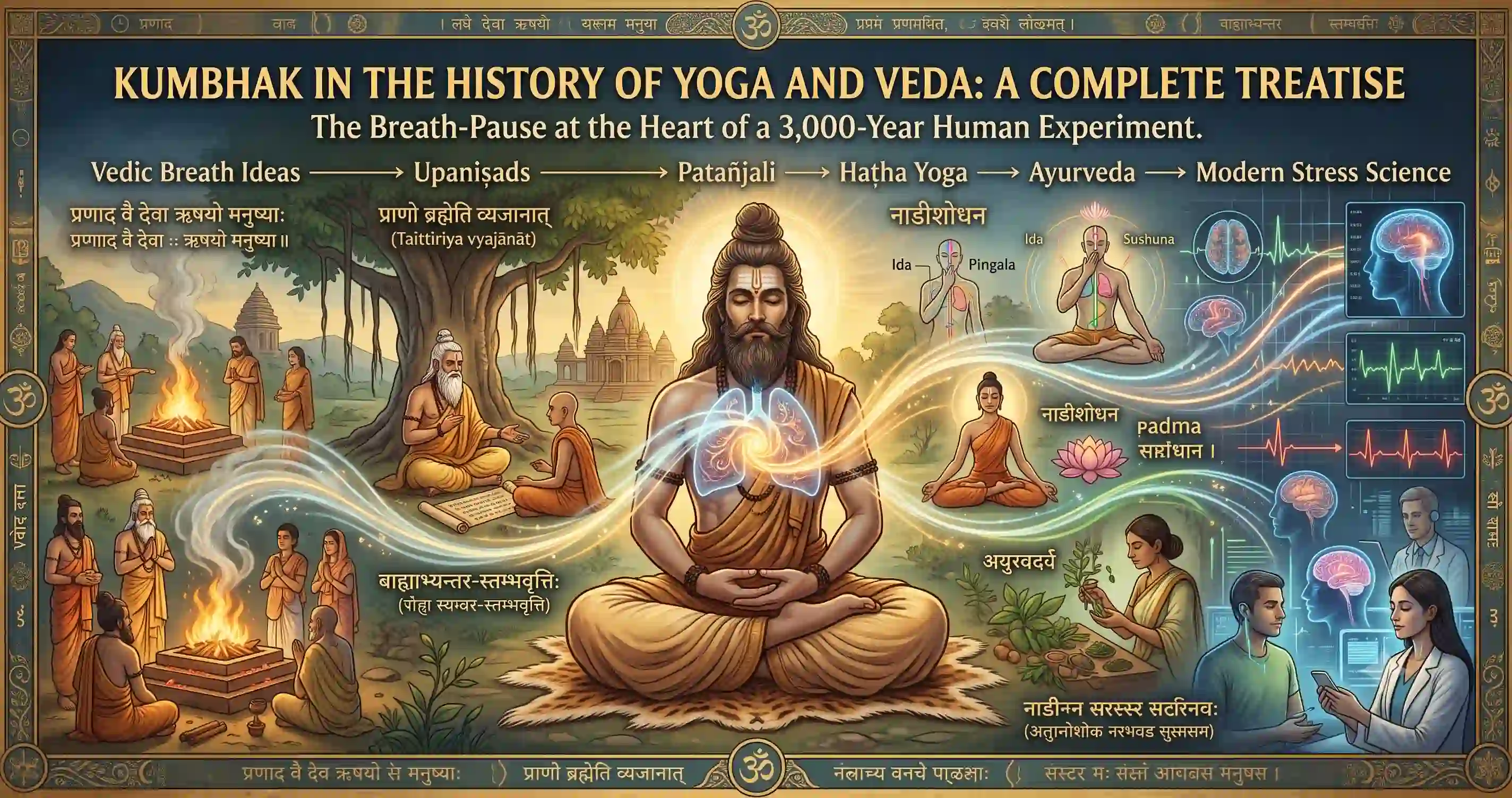
Kumbhak in the History of Yoga and Veda: The Breath-Pause at the Heart of a 3,000-Year Human Experiment
A comprehensive, chronological history lesson on breath retention—from early Vedic ideas of life-breath to the modern use of comfortable Kumbhak for stress relief
Imagine laying three thousand years of Indian texts across the floor of one enormous library. The earliest leaves praise breath as life. Later pages ask whether breath can be gathered, measured or restrained. Still later manuals classify retentions, pair them with bodily locks, and treat the unforced suspension of breathing as a threshold where ordinary mental activity may become quiet.
The vocabulary changes. The aims change. The imagined body changes. Yet the pause keeps returning.
That return is the real history of Kumbhak.
It would be tempting to make the story grander than the evidence: to claim that the Vedas taught the complete modern technique, that every school of Yoga made Kumbhak its final goal, or that contemporary physiology has proved every medieval explanation. None of those claims is historically defensible. The more truthful story is also more interesting. Kumbhak did not appear fully formed at a single moment. It emerged through a long process in which breath became an object of attention, restraint became a method, and the pause became a bridge between body and mind.
This treatise follows that process chronologically. It gives traditional Yogic and Ayurvedic interpretations their full voice while distinguishing them from modern scientific findings. It also explains why a comfortable, non-competitive form of Kumbhak can remain meaningful for stress relief today—without turning history into a medical promise or asking the reader to imitate demanding premodern practices.
Reading note: This is a history and interpretation article, not a practice manual. It does not reproduce the Ten-Step Kumbhak method. Readers who wish to practise should use the separate, safety-first guide: How to Practice the Ten-Step Kumbhak for Stress Relief.
🫁 The Answer First: Was Kumbhak Really the Core Foundation and Goal of Yoga?
The most accurate answer is: Kumbhak became one of Yoga’s most important technologies, but not at the same time, in the same form, or with the same status in every tradition.
Its historical importance can be understood in five layers.
1. The Vedas supplied the foundation: breath as life, power and cosmic participation
The oldest Vedic material does not present the named, systematised Kumbhak of later manuals. It does, however, give prāṇa extraordinary importance. Breath is not treated as a disposable mechanical detail. It is bound to life, vitality, wind, speech, ritual efficacy and the ordering of the living person.
That conceptual elevation mattered. A culture that had learned to regard breath as a concentrated expression of life was prepared to ask a transformative question: what happens when the movement of that life-breath is deliberately interrupted?
2. Early contemplative traditions turned breath from an idea into a discipline
In Brāhmaṇa, Upaniṣadic, epic, ascetic, Buddhist and Jain environments, practitioners experimented with the relation between respiration, attention, sensory withdrawal and mental stability. The surviving texts do not form one neat lineage. Some esteem restraint; some describe it cautiously; some reject painful suppression while retaining breath awareness.
The history is therefore not a single river. It is a delta of experiments.
3. Patañjali made interruption of breath a formal limb of Yoga
The Yoga Sūtra defines prāṇāyāma through a break in the movement of inhalation and exhalation. It places this after posture and before the inward-facing disciplines of sensory withdrawal, concentration and meditation. In this architecture, breath regulation is a hinge: bodily enough to be enacted, mental enough to alter attention.
Patañjali does not say that every form of Yoga is Kumbhak, nor does he use the later Haṭha vocabulary in its fully developed form. Nevertheless, the interruption or suspension at the heart of his definition makes retention structurally important.1
4. Medieval Haṭha Yoga made Kumbhak an organising technology
This is where the strongest version of the “core” argument becomes historically persuasive. In several premodern physical-Yoga systems, breath control—not the large repertoire of postures familiar today—was a defining practice. Named prāṇāyāmas were commonly called Kumbhaks. Retention was combined with mudrā, bandha, mantra, visualisation and models of subtle physiology. Some manuals arranged training as a movement from intentionally supported retention toward Kevala Kumbhak, a spontaneous suspension no longer dependent upon an ordinary Pūrak or Rechak.
Here Kumbhak could be both foundation and horizon: the method used to prepare the system and the sign that the system had become profoundly quiet.
5. Modern Yoga reinterpreted Kumbhak through health, therapy and stress regulation
From the late nineteenth century onward, Yoga entered new worlds: physical culture, nationalism, biomedical laboratories, psychotherapy, global wellness and clinical research. Kumbhak was sometimes preserved, sometimes softened, sometimes omitted, and sometimes repackaged as performance training.
Modern science has verified several immediate physiological effects of holding the breath, including changes in carbon dioxide, cerebral blood-flow velocity, blood pressure and cardiac output. It has not verified all traditional accounts of nāḍīs, bindu, doṣas or liberation, and research has not yet established that retention itself is the unique active ingredient in every stress-reduction programme.2
The result is not a defeat for tradition. It is a cleaner map: historical doctrine, lived experience and laboratory measurement can converse without pretending to be identical.
🔎 How This Treatise Separates Proof, Tradition and Hypothesis
Ancient texts were not written as modern clinical guidelines. Scientific papers were not designed to decide the spiritual or philosophical meaning of an ancient practice. To preserve both kinds of knowledge without confusing them, this article uses four evidence levels.
📜 Primary-text evidence
This means a claim is found in an identifiable historical text. A verse may prove that an author or redactor taught a certain idea. It does not by itself prove that the claimed effect occurs biologically.
For example, the Haṭhapradīpikā can prove that a premodern Yoga tradition linked breath stability with mental stability. It cannot, by its authority alone, prove a twenty-first-century medical outcome.
🧭 Historical reconstruction
This is the work of dating, comparing manuscripts, tracing borrowings and locating texts in Buddhist, Jain, Śaiva, Vaiṣṇava or ascetic settings. Dates are often ranges rather than certainties. A surviving text shows that an idea existed by a certain time; it rarely proves the exact day or community in which the practice began.
🌿 Traditional Yogic or Ayurvedic interpretation
This includes explanations using prāṇa, apāna, nāḍīs, agni, ojas, doṣas, guṇas, bindu and kuṇḍalinī. These are coherent historical models within their own knowledge systems. They deserve accurate explanation even when they have not been mapped to modern anatomy or tested in a clinical trial.
🔬 Modern scientific evidence
This requires observation under contemporary research methods. Evidence may be direct—research on a defined breath hold—or indirect, such as a study of a multi-part Yoga programme containing posture, breathing, meditation and retention. Direct and indirect evidence should never be merged as if they answered the same question.
Throughout this article, phrases such as “the text claims,” “the tradition interprets,” “research observed,” and “remains unverified” are intentional guardrails. Credibility is not the enemy of wonder. It is what lets wonder survive examination.
🏺 What Does “Kumbhak” Mean—and When Did the Word Become Technical?
The vessel image
The Sanskrit noun kumbha means a pot, jar or vessel. In Yogic usage, Kumbhak came to suggest the body held in a vessel-like condition during a pause in respiration. The image is useful but should not be forced into one literal anatomy lesson. Texts and teachers explain it in different ways: a vessel filled after Pūrak, emptied after Rechak, or simply sealed against ordinary movement.
On this website, Kumbhak is the preferred form. Many academic books and catalogue records retain a longer conventional Sanskrit ending. They refer to the same broad term, though the exact practice denoted by it depends upon the text.
The essential historical distinction: prāṇāyāma is broader than Kumbhak
In modern conversation the two words are often used interchangeably. Historically, that is too simple.
- Prāṇāyāma can describe the wider regulation, extension or restraint of respiration and vital activity.
- Pūrak is inhalation.
- Rechak is exhalation.
- Kumbhak is the retained or suspended phase, though later manuals may use “Kumbhak” as the name of an entire compound breathing method.
This distinction explains why a text can discuss prāṇāyāma without giving a later Haṭha-style list of Kumbhaks—and why a medieval manual can name eight “Kumbhaks” even though each contains more than the pause alone.
Four influential kinds of pause
Antar Kumbhak is retention after Pūrak, with air inside.
Bāhya Kumbhak is retention after Rechak, while the lungs feel comfortably empty.
Stambha-vṛtti, in Patañjali’s terminology, is a stopped or suspended mode. Commentators differ over how it relates to the inhaled and exhaled phases.
Kevala Kumbhak is the later ideal of an independent or spontaneous suspension, described in Haṭha sources as not relying on the usual sequence of Pūrak and Rechak. It should not be casually inserted into the Yoga Sūtra as though Patañjali used the later technical label; he did not.
🗓️ A Chronological Map of Kumbhak in the History of Yoga
The dates below are approximate. They map the history of surviving evidence, not the unknowable first performance of each practice.
Before the texts: the Indus seal and the danger of attractive certainty
An Indus Valley seal, often called the “Paśupati seal,” depicts a horned figure in a seated posture surrounded by animals. It has frequently been presented as proof of Yoga around the third millennium BCE.
That conclusion remains disputed. The script is undeciphered, the pose has several possible interpretations, and no breath practice can be seen in a static image. A museum label may reasonably discuss the history of the “proto-Śiva” interpretation, but the seal cannot verify Kumbhak.3
This is the first lesson in the history of Yoga: an ancient-looking image is not a breathing instruction. The honest history begins with texts that can actually tell us something about breath.
c. 1500–500 BCE: Vedic worlds make breath cosmically important
The Vedic corpus is layered and its chronology debated. Within it, prāṇa is never merely a modern lung-volume term. Depending on period and context, it can indicate breath, life, vital function or an animating power. Apāna also has changing meanings; later diagrams that make prāṇa rise and apāna descend should not automatically be projected onto every early occurrence.
The Atharvaveda hymn to Prāṇa, 11.4, is especially vivid. It places living beings under the power of breath, honours breath as coming and going, and calls it lord of what breathes and what does not. It is an exaltation of life-breath—not a set of Kumbhak instructions.4
The famous Keśin hymn of the Ṛgveda (10.136) describes long-haired ascetics associated with wind and extraordinary states. It is relevant to the deep prehistory of Indian asceticism, but it does not explicitly teach a measured breath retention. To make it do so would turn possibility into proof.5
What, then, is the Vedic contribution?
- It establishes breath as a privileged sign of life.
- It connects the inner person with wind and wider cosmic processes.
- It develops ritual habits of concentration, recitation and bodily control.
- It creates an intellectual world in which governing breath can plausibly mean governing life-force.
The Vedas are therefore the conceptual soil of Kumbhak, not a complete Kumbhak handbook.
Late Vedic ritual evidence: moments when not breathing mattered
Some late Vedic ritual instructions contain brief breath restraint. A passage in the Jaiminīya Upaniṣad Brāhmaṇa (3.3.1), for example, instructs the sacrificer not to breathe during a portion of Gāyatrī recitation. The context is ritual and vocal, not modern stress care, yet it is important evidence that interrupting respiration could carry disciplined significance before the mature Yoga manuals.6
This modest evidence is historically stronger than a spectacular unsupported claim. It shows a real behavioural bridge:
breath as sacred or vital idea → breath deliberately managed during concentrated action.
c. 800–200 BCE and after: the Upaniṣads interiorise the sacrifice
The early Upaniṣads repeatedly ask what sustains the person when other faculties fail. In their debates, prāṇa often emerges as indispensable. Breath, speech, sight, hearing, food, mind and consciousness are compared, ranked and connected. The human body becomes a field in which older ritual questions are internalised.
This does not yet produce one standard Kumbhak routine. It changes the direction of inquiry. Instead of attending only to an external fire, the seeker can attend to a living process within.
The Bṛhadāraṇyaka and Chāndogya Upaniṣads give prāṇa a commanding role in the organism. The Praśna Upaniṣad develops a more articulated account of vital functions and their distribution. These are crucial to the later Yogic body, but a doctrine of five vital winds is not identical to a modern map of nerves, lungs or circulation.
The Kaṭha and Śvetāśvatara Upaniṣads: restraint becomes more recognisably Yogic
The Kaṭha Upaniṣad defines Yoga through firm control of the senses and a vigilant steadiness. Its chariot allegory makes disciplined governance of the embodied person central. It does not present a later taxonomy of Kumbhaks, but it helps establish the logic in which uncontrolled movement disperses attention and restraint recollects it.
The Śvetāśvatara Upaniṣad 2.8–2.10 contains one of the early recognisable descriptions of Yogic preparation: an upright body, restrained senses, management of the breaths, and a suitable environment. Verse 2.9 compares the mind to a vehicle drawn by difficult horses and refers to restraining the breaths before releasing respiration through the nostrils.7
The same textual passage makes traditional claims about bodily lightness and freedom from illness. Historically, those claims show what practitioners hoped Yoga could accomplish. Medically, they are not clinical proof that breath retention prevents disease.
The Maitrī Upaniṣad: prāṇāyāma enters a sixfold Yoga
The Maitrī or Maitrāyaṇīya Upaniṣad describes a six-limbed Yoga: prāṇāyāma, withdrawal, meditation, concentration, inquiry and absorption. The exact history of this section is complex; scholars have argued that parts may be later additions, and its relationship to Pātañjala Yoga cannot be reduced to a simple one-way borrowing.8
Its importance for Kumbhak is architectural. Breath discipline is not an isolated trick. It belongs to a sequence that proceeds from regulating embodied activity toward collected attention and absorption.
That placement will recur. Across very different systems, breath becomes the doorway practice: close enough to physiology to be voluntarily influenced, close enough to attention to disclose mental reactivity.
Later Yoga Upaniṣads: the vocabulary becomes increasingly technical
Texts commonly grouped today as the Yoga Upaniṣads were composed and redacted over long periods, many in the medieval era. They are not all ancient in the same sense as the oldest prose Upaniṣads. They nevertheless preserve a rich development of practice: nāḍīs, vital winds, mantra counts, bodily locks, internal sound, kuṇḍalinī, liberation and multiple forms of breath regulation.
Works such as the Amṛtanāda, Dhyānabindu, Yogatattva, Triśikhibrāhmaṇa and Śāṇḍilya Upaniṣads integrate prāṇāyāma into multi-limbed Yoga systems. Their detailed physiology differs from text to text. That variation matters. There is no single, timeless “Upaniṣadic subtle body” whose every channel and centre was universally agreed.
For the historian, these texts show technical accumulation. For the modern reader, they warn against taking a diagram assembled from several centuries of sources and calling it one unchanged Vedic map.
c. 400 BCE–400 CE: epic Yoga gathers diverse disciplines
The Mahābhārata contains multiple Yogas rather than a single manual. Its didactic books discuss restraint of the senses, meditation, renunciation, bodily winds and the control of prāṇa. Some passages present breath control as austerity, purification or a method of gathering the mind. Others place knowledge, conduct or devotion in the foreground.
This plurality is not disorder. It reveals that “Yoga” was becoming a shared language used by communities with different final commitments.
The Bhagavad Gītā: breath offered into breath
The Bhagavad Gītā uses the imagery of sacrifice to describe inward disciplines. In 4.29 it says:
अपाने जुह्वति प्राणं प्राणेऽपानं तथापरे ।
प्राणापानगती रुद्ध्वा प्राणायामपरायणाः ॥ ४.२९ ॥
Meaning: Some offer prāṇa into apāna and apāna into prāṇa; devoted to prāṇāyāma, they restrain the courses of prāṇa and apāna.9
This is strong evidence for a breath-restraint discipline interpreted through the Gītā’s inner-sacrifice framework. It is not a complete prescription for a modern retention ratio. Nor does the root verse itself promise a precisely extended lifespan. Such additions may occur in later commentarial or devotional explanations; they should not be attributed to the Sanskrit verse.
Gītā 5.27–5.28 adds the equalising of prāṇa and apāna moving within the nostrils as part of a collected, sense-governed state. Again the emphasis is integrated: respiration, senses, attention and freedom from reactive desire are treated together.10
For a non-religious reader, the sacrificial metaphor can be understood psychologically: the breath is no longer something that merely happens unnoticed. It becomes the place where impulsive movement is observed, contained and reorganised.
c. fourth–fifth century CE: Patañjali gives breath interruption a classical definition
The Pātañjalayogaśāstra—the Yoga Sūtra together with its early commentary—became the most influential classical formulation of Yoga. Its date remains debated; many contemporary scholars place its compilation around the fourth or fifth century CE rather than in an undifferentiated Vedic antiquity.11
Patañjali’s eight limbs are ethical restraints, observances, posture, prāṇāyāma, sensory withdrawal, concentration, meditation and absorption. The fourth limb is defined in Yoga Sūtra 2.49:
तस्मिन् सति श्वासप्रश्वासयोर्गतिविच्छेदः प्राणायामः ॥ २.४९ ॥
Meaning: Once that [posture] is established, prāṇāyāma is the interruption of the movement of inhalation and exhalation.1
The key expression is gati-viccheda: a break or interruption in movement. The verse does not define prāṇāyāma merely as taking a larger breath. A pause is conceptually central.
The next sūtra expands the map:
बाह्याभ्यन्तरस्तम्भवृत्तिर्देशकालसंख्याभिः परिदृष्टो दीर्घसूक्ष्मः ॥ २.५० ॥
Meaning: Its external, internal and suspended modes are observed according to place, time and number, becoming extended and subtle.
“External” and “internal” have generated interpretive discussion. Broadly, the verse recognises regulation associated with the exhaled state, the inhaled state and suspension. Deśa, kāla and saṃkhyā indicate that attention was paid to location or range, duration and count. The verse describes disciplined observation, not competitive maximisation.
Then comes the “fourth”:
बाह्याभ्यन्तरविषयाक्षेपी चतुर्थः ॥ २.५१ ॥
Meaning: The fourth surpasses or goes beyond the domain of the external and internal.
Later traditions often read this through the idea of Kevala Kumbhak. That is a meaningful retrospective comparison, but it is not a licence to say that Patañjali used the later term. Commentators have interpreted the terse line in different ways.
Finally, Patañjali states the results:
ततः क्षीयते प्रकाशावरणम् ॥ २.५२ ॥
धारणासु च योग्यता मनसः ॥ २.५३ ॥
Meaning: From it, the covering over illumination is diminished, and the mind becomes fit for acts of concentration.
This is perhaps the clearest classical answer to why Kumbhak matters in a history of stress and attention. The text does not describe “stress hormones.” It says that breath discipline makes the mind fit to stay. Anyone who has watched an anxious mind leap from prediction to prediction can feel the human importance of that claim, even while recognising that its ancient language is not a clinical measurement.
For a fuller text-specific analysis, see Kumbhak for Stress Relief in the Original Yoga Sūtras of Patañjali.
What Patañjali did—and did not—make Kumbhak
Patañjali made breath regulation:
- dependent upon a stable posture;
- observable through duration, count and other parameters;
- preparatory to concentration;
- concerned with interruption, not respiration alone;
- one limb within an ethical and contemplative whole.
He did not make it:
- the only limb of Yoga;
- an athletic contest;
- a guarantee of physical immortality;
- a list of the eight later Haṭha Kumbhaks;
- a substitute for ethical or mental discipline.
That balance—high importance without historical inflation—is essential.
Early Buddhist evidence: awareness of breathing, experiments with suppression, and a decisive warning
Early Buddhist sources are indispensable because they show that South Asian contemplatives did not unanimously evaluate breath suppression in the same way.
The Ānāpānasati Sutta (Majjhima Nikāya 118) teaches sustained awareness of inhalation and exhalation: knowing long and short breaths, experiencing the whole bodily process and calming bodily activity. It does not make deliberate retention the centre of the method.12
The Mahāsaccaka Sutta (Majjhima Nikāya 36) is even more important for a safe history. It describes the Buddha-to-be’s attempt at a severe “non-breathing meditation.” Blocking respiration through the mouth and nose is associated with intense pressure, pain and heat. The narrative then places this experiment among austerities that did not produce awakening.13
The conclusion should be precise. Early Buddhism did not reject every quieting of respiration, and later Buddhist tantric systems developed sophisticated vase-breath methods. But this early narrative powerfully rejects the equation more pain = more progress.
That warning reaches across time. A breath pause that becomes a battle with the body has already changed its psychological meaning.
Jain Yoga: late adoption, exact discipline and philosophical caution
Early Jain scriptures emphasise ethical restraint, austerity, meditation and liberation from karmic bondage, but they do not present the familiar later threefold language of Pūrak, Rechak and Kumbhak. Explicit systematisation appears much later.
In the twelfth century, Hemacandra’s Yogaśāstra discusses prāṇāyāma and defines it through interruption of inhalation and exhalation, including the three phases. Yet it does not simply enthrone breath mastery above all other disciplines. Hemacandra also voices caution about painful and difficult breath control, and treats it as an auxiliary whose value depends upon its relation to mental and ethical work.14
This is a crucial counterexample to universal claims. Jain Yoga could absorb breath technology while subordinating it to its own path. The same technique changes meaning when it enters a different philosophy.
c. sixth–tenth centuries: Tantra multiplies the uses of breath
Tantric traditions were diverse, but many expanded the ritual and contemplative uses of the body. Breath could carry mantra, support visualisation, guide internal worship, move through imagined channels, dissolve elements, awaken power or stabilise awareness at a transition.
The Vijñānabhairava, a Kashmirian Śaiva text probably composed around the eighth or ninth century, gives contemplations centred on the turning points of respiration. Verses 24–27 direct attention toward the places where the incoming and outgoing vital movements rest, turn or dissolve. These are not a modern ten-step protocol, but they show how the pause could be treated less as brute suppression and more as a perceptual threshold.15
Other tantric systems combine retention with mantra and visualised subtle anatomy. Their aims may be deity-identification, liberation, power or absorption—not stress relief in the contemporary sense. Still, their close observation of transitions is psychologically intelligible: a transition is a moment in which habit has not yet completed its next movement.
c. late tenth–eleventh century: the Amṛtasiddhi changes the history of Haṭha Yoga
One of the most important corrections to older histories concerns the Amṛtasiddhi. Scholarship now identifies it as the earliest known text to teach a system of physical Yoga that became foundational for later Haṭha traditions. It was composed no later than the second half of the eleventh century, probably in the Deccan, and emerged in a tantric Buddhist milieu.16
This matters for two reasons.
First, Haṭha Yoga did not arise inside one sealed religious institution. Its technologies crossed and transformed sectarian boundaries.
Second, the early Haṭha project was not primarily a catalogue of photogenic postures. It was concerned with the internal economy of breath, bindu, fire and time. The Amṛtasiddhi teaches the three great mudrās—mahāmudrā, mahābandha and mahāvedha—and a model in which vital processes can be sealed and redirected.
Its physiology is premodern. Bindu is not a laboratory fluid, the central channel is not proved to be the spinal cord, and the sun and moon of the Yogic body are not anatomical organs. Yet historically these ideas explain why retention became so consequential: to retain breath was to intervene in the imagined circuitry of life and mortality.
c. twelfth–fourteenth centuries: early Haṭha systems crystallise
The Dattātreyayogaśāstra, probably composed in the twelfth or thirteenth century, is the earliest known text to call its physical method “Haṭha Yoga.” It presents Haṭha as one approach within a wider Yogic field and teaches breath control, locks and seals.
The Gorakṣaśataka teaches four Kumbhaks that later appear in the Haṭhapradīpikā: Sūryabhedana, Ujjāyī, Śītalī and Bhastrikā. In its system, breath retention with the three bandhas is meant to direct vital activity into the central channel and raise kuṇḍalinī.17
Texts associated with Gorakṣanātha and Nāth Yogis helped make a distinctive chain visible:
posture stabilises the body → Kumbhak contains vital movement → bandha redirects it → mudrā seals it → the mind enters absorption.
This is not the only history of Yoga, but it is the historical zone in which Kumbhak most clearly becomes the engine room.
Early fifteenth century: the Haṭhapradīpikā makes Kumbhak canonical
Svātmārāma’s Haṭhapradīpikā, compiled in the early fifteenth century, synthesised earlier teachings into the most influential premodern manual of Haṭha Yoga. It presents Haṭha as a stairway to Rāja Yoga. Āsana matters, but the second chapter’s treatment of prāṇāyāma and Kumbhak reveals the practice hierarchy of its world.18
Its famous second verse states:
चले वाते चलं चित्तं निश्चले निश्चलं भवेत् ।
योगी स्थाणुत्वमाप्नोति ततो वायुं निरोधयेत् ॥ २.२ ॥
Meaning: When the breath moves, the mind moves. When it becomes motionless, the mind becomes motionless. The Yogi therefore restrains the vital breath in order to attain steadiness.
This is traditional psychophysiology in one compact observation. It does not prove that every thought is mechanically caused by airflow. It records a repeatedly perceived reciprocity: agitation affects breathing, and deliberately structured breathing can affect agitation.
The same chapter gives one of Yoga history’s most responsible warnings:
यथा सिंहो गजो व्याघ्रो भवेद्वश्यः शनैः शनैः ।
तथैव सेवितो वायुरन्यथा हन्ति साधकम् ॥ २.१५ ॥
Meaning: As a lion, elephant or tiger is brought under control gradually, so the breath is to be cultivated; otherwise it harms the practitioner.19
The force of the warning should not be sentimentalised. The text that makes large traditional claims for prāṇāyāma also says that mishandling it can harm. Safety is not an embarrassed modern footnote to the tradition; it is present inside the tradition.
The eight Kumbhaks—and a manuscript lesson in humility
The received Haṭhapradīpikā tradition commonly lists Sūryabhedana, Ujjāyī, Sītkārī, Śītalī, Bhastrikā, Bhrāmarī, Mūrcchā and Plāvinī. Some manuscript and edition traditions read Kevala in the final position instead of Plāvinī.20
That small variation teaches a large historical lesson. “The ancient text says…” can conceal a family of manuscripts that do not all say exactly the same thing. Responsible quotation identifies the edition or acknowledges a consequential variant.
These eight are called Kumbhaks even though each is a compound practice containing particular forms of Pūrak, Rechak, retention, sound, temperature sensation or bodily action. This naming convention shows how central the retained phase had become: the whole method could be named after its defining pause.
The text also distinguishes intentional, phase-supported practice from Kevala Kumbhak, an independent suspension without reliance on ordinary Pūrak and Rechak. It instructs practice of the supported form until Kevala is accomplished. In that limited but powerful sense, Kumbhak is both curriculum and culmination.
For a dedicated study, see Kumbhak for Stress Relief in the Haṭha Yoga Pradīpikā.
c. fifteenth–eighteenth centuries: the age of elaboration
Later Haṭha works did not merely repeat the Haṭhapradīpikā. They reorganised, expanded and sometimes disagreed with it. More postures appeared, but so did more retentions, seals, cleansing actions, sequences and therapeutic claims.
The Śivasaṃhitā, a composite work often dated somewhere between the fifteenth and seventeenth centuries, presents Yoga in a setting more open to householders than the stereotypical wilderness ascetic. It integrates breath discipline with a subtle-body cosmology, mantra and liberation. Its historical value lies partly in showing that intensive inner Yoga was no longer imagined only for a single social type.
The seventeenth-century Haṭharatnāvalī expands and rearranges the Haṭha inheritance. Its lists remind us that the famous number “eight” never exhausted the creativity of breath practice. Techniques circulated, acquired new names and were fitted into new systems.
Raghuvīra’s Kumbhak Paddhatiḥ, composed before its use by the eighteenth-century author Sundaradeva, is the most specialised surviving premodern compendium of breath retentions. It describes more varieties than any other known Yoga text. Its existence alone is historical evidence of extraordinary specialisation: Kumbhak had become a subject large enough to deserve its own technical treatise.21
The growth of catalogues should not be confused with a modern recommendation to try everything. A history of pharmacology can describe powerful substances without prescribing them; a history of Kumbhak can do the same with powerful respiratory techniques.
Late seventeenth or early eighteenth century: the Gheraṇḍa Saṃhitā builds a sevenfold Yoga
The Gheraṇḍa Saṃhitā presents itself as instruction from Gheraṇḍa to Caṇḍakāpāli and arranges Yoga in seven disciplines: cleansing, posture, mudrā, sensory withdrawal, prāṇāyāma, meditation and absorption. This differs from Patañjali’s eightfold arrangement. Yoga history develops by redesign as well as preservation.
Its list of eight Kumbhaks reads:
सहितः सूर्यभेदश्च उज्जायी शीतली तथा ।
भस्त्रिका भ्रामरी मूर्च्छा केवली चाऽष्टकुम्भिकाः ॥ ५.४६ ॥
Meaning: The eight Kumbhaks are Sahita, Sūryabheda, Ujjāyī, Śītalī, Bhastrikā, Bhrāmarī, Mūrcchā and Kevalī.22
Compare this with the received Haṭhapradīpikā list. The overlap is large, but the framing is not identical. Sahita and Kevalī make the developmental logic unusually visible: retention performed together with the other phases is distinguished from independent suspension.
The Gheraṇḍa Saṃhitā also distinguishes mantra-supported and non-mantra forms of Sahita. It attributes purification, bodily transformation and contemplative effects to the practices. Those claims are historically authentic expressions of the text’s worldview; they are not automatically verified health outcomes.
For detailed context, see Kumbhak for Stress Relief in the Gheraṇḍa Saṃhitā.
The premodern summit: why breath, not posture, defined physical Yoga
In much contemporary global Yoga, a class can contain dozens of postures and no retention. In premodern physical-Yoga texts, the balance was often reversed. A small number of seated postures prepared the practitioner for long work with breath, mudrā, mantra and attention.
The Hatha Yoga Project summarises the contrast sharply: while posture is the most visible feature of contemporary transnational Yoga, breath control was the defining practice of premodern physical-Yoga methods. Some texts even calculate concentration, meditation and absorption as extensions in the duration of breath control.23
This does not mean that Kumbhak secretly “is” every higher limb. It means that time held in breath became a unit through which some authors imagined an ascent from bodily regulation to contemplative absorption.
Nineteenth century: older technologies meet print, empire and global audiences
Colonial modernity changed what counted as authoritative knowledge. Sanskrit texts entered print editions. Indian teachers responded to Orientalist scholarship, Christian critique, physical-culture movements and emerging biomedical prestige. “Yoga” was reformulated for lecture halls, nationalist projects and global readers.
Swami Vivekananda’s Raja Yoga (1896) was especially influential in presenting Patañjali and prāṇāyāma to English-language audiences. He described prāṇa as a universal force and discussed regulated breathing and retention, while placing mental mastery above bodily display.24
This presentation was not a transparent window onto all earlier Yoga. It was a creative modern synthesis. Yet it helped establish a pattern still familiar today: ancient terminology explained through the scientific vocabulary available to the speaker’s era.
That pattern can illuminate, but it can also age badly. “Electricity,” “magnetism,” “nervous energy,” “oxygenation” and “vagal tone” have each been used in different periods as master explanations. No fashionable word should be allowed to erase the exact claim of the older text or outrun the evidence of the newer science.
1924 onward: Kumbhak enters the laboratory
Swami Kuvalayananda founded Kaivalyadhama in 1924 and began publishing Yoga Mīmāṃsā, widely recognised as the first journal devoted to scientific investigation of Yoga. Early experiments measured pressures, circulation and other bodily changes during Yogic practices.25
This was a historic turn. The question was no longer only, “What does the lineage say Kumbhak does?” It became, “What changes can an instrument detect, in which people, under what protocol?”
The laboratory did not simply confirm or refute tradition. It changed the object being studied. A medieval adept practising within a full regimen of diet, ethics, celibacy, mudrā and meditation is not the same research object as a healthy volunteer performing one supervised breath hold. Both are real. They answer different questions.
Late twentieth century to the present: from esoteric attainment to stress skill
Modern schools preserved Kumbhak unevenly. Some retained detailed ratios and bandhas. Some reserved retention for advanced students. Some therapeutic systems avoided it for people with cardiovascular or respiratory concerns. Fitness culture also adopted breath-hold training for swimming, altitude preparation and performance—contexts with aims and risks different from stress relief.
At the same time, psychology gave the pause a new secular relevance. Modern life often feels like a chain of unexamined reactions: notification, tightening, thought, reply. A comfortable Kumbhak can make one link in that chain visible. The historical claim that breath restraint prepares attention is thus translated, not duplicated, in the language of interoception, self-regulation and tolerance of transient internal sensation.
The Ten-Step Kumbhak for Stress Relief belongs to this modern chapter. It does not attempt to recreate severe austerities or every medieval technique. It uses a carefully limited, comfortable retention practice within a normal breathing pattern. Its aim is not record-setting. Its aim is to help a person discover that a pause can be inhabited without panic.
🌳 The Wider History of Yoga: What Changed Around Kumbhak?
Kumbhak becomes clearer when the rest of Yoga is allowed to change around it. Yoga was never one sealed institution moving unchanged from the Vedas to a modern studio. It was a family of disciplines repeatedly rebuilt around new questions.
“Yoga” did not always mean the same practice
The Sanskrit root yuj carries senses of yoking, joining, harnessing or concentrating. Across texts, “Yoga” can name a method, a state, disciplined action, equanimity, control of mind, meditative absorption, a path to liberation, a system of bodily techniques or a modern class.
This semantic breadth explains why no single artefact can be crowned “the invention of Yoga.” Historians instead track clusters: ascetic restraint, meditation, posture, breath control, sensory withdrawal, subtle-body practice, devotion, knowledge and ethical discipline.11
Kumbhak belongs powerfully to some clusters and lightly to others.
First transformation: from external performance to an inner field
Vedic ritual was highly disciplined, but much of its action occurred through altar, offering, recitation and cosmic correspondence. Upaniṣadic thought increasingly relocated crucial correspondences inside the person: speech, mind, breath, food, awareness and the internal fires.
This did not abolish ritual. It interiorised it. The Gītā’s image of prāṇa offered into apāna shows the result: the body itself can become the altar, respiration the offering, and disciplined attention the officiant.
Kumbhak grew inside this transformation because a pause could be understood as more than absence. It could be an intentional offering of movement.
Second transformation: the śramaṇa laboratory
From the middle of the first millennium BCE, Buddhist, Jain, Ājīvika and other renunciant movements participated in a competitive and collaborative culture of liberation. Practitioners investigated fasting, celibacy, posture, pain, attention, breath, karma, rebirth and the causes of suffering.
The word “laboratory” is metaphorical, but useful. These communities did not use randomised trials; they did compare methods through disciplined bodies over time. They also disagreed. Severe respiratory suppression could be praised as mastery in one setting and remembered as a failed austerity in another.
Yoga developed through this disagreement. Its history contains selection, correction and rejection—not only accumulation.
Third transformation: system-building
Epic and classical authors organised practices into paths and limbs. The Gītā integrated disciplined action, knowledge, meditation and devotion. Pātañjala Yoga arranged eight limbs around ethical preparation and meditative insight. The Maitrī Upaniṣad and several Buddhist, Jain and tantric works used sixfold schemes. The Gheraṇḍa Saṃhitā later used seven.
The eight limbs are therefore enormously influential but never the only architecture of Yoga. What matters for Kumbhak is its repeated middle position. It often appears after some form of bodily or ethical preparation and before concentration or absorption.
The pause was not the whole building. It was a staircase placed where the direction changed.
Fourth transformation: Tantra makes the body a ritual cosmos
Tantric systems intensified mantra, initiation, visualisation and subtle-body practice. Instead of treating the body only as an obstacle to transcend, many mapped it as a site where cosmic processes could be enacted and reversed.
This gave Kumbhak new work. Retention could hold mantra, pressurise an imagined channel system, unite winds, awaken a latent force or focus awareness at the gap between movements. The technique acquired different metaphysical explanations across Buddhist and Hindu settings.
The modern habit of presenting “chakras and breathing” as one timeless package hides this historical creativity. The subtle body was not discovered once; it was continually composed.
Fifth transformation: Haṭha makes liberation technology portable
Early Haṭha texts gathered techniques that could be practised with relatively little external ritual equipment: seats, breaths, locks, seals and internal concentration. These methods travelled between ascetic orders and sectarian environments. They promised that the trained body itself could become an instrument of liberation.
Posture had a practical role—stability, sealing, pressure, endurance—but the early repertoire was far smaller than that of contemporary postural Yoga. Breath control and mudrā carried much of the transformative burden.23
This portability helps explain Haṭha’s long influence. A temple may be inaccessible; a ritual patron may disappear; a political order may change. Breath travels with the practitioner.
Sixth transformation: the modern postural turn
During the late nineteenth and twentieth centuries, Indian Yoga interacted with gymnastics, military drill, medicine, photography, print, nationalism, women’s physical culture and international health movements. Large āsana repertoires became increasingly central to public presentation.
This was not simply corruption of an ancient original. It was another historical reconstruction. Posture made Yoga visible, teachable in groups and compatible with physical-education settings. It also shifted the centre of gravity. What had often been a seated gateway to Kumbhak and meditation could become the majority of a class.
Many modern practitioners therefore encounter an inversion:
Premodern physical Yoga: few seats, extensive breath and mudrā work.
Many modern classes: extensive postural movement, little or no formal retention.
Neither sentence covers every lineage. Together they reveal a real historical change.
Seventh transformation: from liberation language to therapeutic language
Modern Yoga is frequently justified by flexibility, pain reduction, sleep, mood, blood pressure or stress. This translation opened practice to people who did not seek initiation, renunciation or a doctrine of rebirth.
It also created a risk: the old promise of liberation can be replaced by an equally inflated promise of medical cure.
Kumbhak’s most credible modern place lies between those extremes. It can be respected as a historically central contemplative technology and investigated as a bounded psychophysiological skill. It need not be made religious for a secular reader, nor made clinically omnipotent to seem valuable.
Kumbhak’s changing status in one glance
Vedic period: breath is elevated; technical Kumbhak is not yet systematised.
Upaniṣadic and epic period: breath becomes internal discipline and contemplative offering.
Classical period: respiratory interruption becomes a formal limb preparing concentration.
Tantric and early Haṭha period: retention becomes a method for transforming the subtle body.
Mature Haṭha period: named Kumbhaks, supported-to-independent progression and extensive claims make retention central.
Modern postural period: Kumbhak is preserved, restricted, modified or omitted as posture gains visibility.
Contemporary therapeutic period: comfortable retention is reframed through stress, interoception and self-regulation, while science begins to test specific effects.
This is why Kumbhak can seem both ancient and newly invented. The pause is old; its present purpose and pedagogy are modern.
🧭 How Different Schools of Yoga Understand and Teach Kumbhak
“What does Yoga teach about Kumbhak?” is like asking what European philosophy teaches about the mind. There is no single answer. The most useful comparison is school by school.
Classical or Pātañjala Yoga: Kumbhak as the hinge of inwardness
Primary aim: stilling the fluctuations of mind and cultivating discriminative insight.
Role of Kumbhak: prāṇāyāma follows posture and prepares withdrawal and concentration. Interruption of inhalation and exhalation is part of the definition, but Kumbhak is one limb within a larger discipline.
Distinctive contribution: it makes breath regulation a bridge. The practice is not valued only for lungs or vitality; it reduces an obscuring condition and makes the mind capable of staying with an object.
Limit: later Haṭha concepts such as a standard eight-Kumbhak list, a fully elaborated central-channel physiology or the name Kevala Kumbhak should not be backdated into Patañjali without explanation.
Early Haṭha Yoga: Kumbhak as the engine of transformation
Primary aims: Rāja Yoga, liberation, preservation or redirection of vital essences, mastery of the Yogic body, and in some texts extraordinary powers.
Role of Kumbhak: central. The retained breath works with bandhas and mudrās to seal, reverse or redirect vital processes.
Distinctive contribution: Haṭha turns retention into a technology with named variants, progressive training, bodily signs and advanced states. The central question is not merely how to watch breathing but how to change the direction of embodied vitality.
Limit: textual promises of disease-removal, death-conquest or extraordinary powers belong to premodern soteriology and physiology. They must not be marketed as proven medical outcomes.
Nāth Yoga: Kumbhak, the central channel and the mind-breath bond
Primary aims: mastery, absorption, liberation and the awakened Yogic body.
Role of Kumbhak: strongly central in texts associated with the Nāth milieu. Retention combined with the three bandhas is used to bring vital activity into suṣumṇā and stimulate kuṇḍalinī.
Distinctive contribution: Nāth-oriented sources helped stabilise the idea that the mind and vital wind are mutually linked. Instead of fighting thought directly, the practitioner works with the movement that accompanies thought.
Limit: “Nāth Yoga” spans communities, periods and texts. Not every teaching can be assigned confidently to the historical Gorakṣanātha, and later attributions are not eyewitness biographies.
Tantric Yoga: Kumbhak as ritual power and a doorway at the turning point
Primary aims: vary widely—initiation, deity-identification, liberation, power, subtle-body transformation or non-conceptual recognition.
Role of Kumbhak: one instrument among mantra, visualisation, mudrā, ritual and contemplation. Some systems emphasise forceful redirection; others attend to the natural interval where incoming and outgoing breath turn.
Distinctive contribution: it expands the meaning of a pause. Kumbhak can be a seal, a carrier of mantra, a point of dissolution or a flash in which awareness is noticed before the next mental construction.
Limit: there is no single “Tantric breathing system.” Hindu and Buddhist tantras differ, and modern workshops often combine elements that were historically separate.
Mantra Yoga: Kumbhak as the chamber in which sound is contained
Primary aim: transformation through sacred or concentrated sound.
Role of Kumbhak: mantra may be counted or mentally repeated during regulated phases. In some systems, retention contains the mantra and focuses its imagined force.
Distinctive contribution: it joins timing, attention and meaning. The pause is not empty; it is internally articulated by sound or remembrance.
Secular translation: a word or phrase can organise attention during a pause, but historical mantras should not be stripped of their original contexts and then misrepresented as neuroscience.
Laya and Nāda Yoga: Kumbhak as preparation for absorption in inner sound
Primary aim: dissolution of ordinary mental activity into absorption, sometimes through internal resonance or nāda.
Role of Kumbhak: retention and bandhas quiet gross respiratory movement so subtler sensory phenomena become prominent.
Distinctive contribution: it treats silence as textured. When external action and respiration become less dominant, faint internal sensations or sounds may enter awareness.
Limit: internal sounds can have ordinary physiological explanations, and persistent or distressing tinnitus requires appropriate health evaluation. A traditional contemplative meaning does not cancel a medical possibility.
Vedānta and Jñāna-oriented Yoga: useful support, not final knowledge
Primary aim: insight into the nature of self and reality.
Role of Kumbhak: often preparatory. Breath discipline may steady the mind, but stopping respiration is not identical to removing ignorance.
Distinctive contribution: these traditions protect against mistaking a state for understanding. A dramatic internal experience may pass; insight must transform how experience is interpreted.
Limit: Vedānta is internally diverse. Some later Advaitic Yoga works adopt substantial Haṭha methods; others regard them as optional.
Bhakti Yoga: Kumbhak as an optional support to remembrance
Primary aim: devotion, relationship, surrender and remembrance.
Role of Kumbhak: usually secondary. Breath can support repetition, singing, prayer or concentration, but affective devotion rather than respiratory mastery remains central.
Distinctive contribution: it reminds the history of Yoga that regulation without meaning is not the only path. For some people, trust and emotional connection settle the breath more effectively than technical control.
Limit: it would be inaccurate to describe Bhakti traditions as universally centred on Kumbhak.
Buddhist Yoga: from early caution to tantric vase breathing
Primary aims: freedom from suffering, insight, compassion, awakening; the methods vary greatly by school.
Role of Kumbhak: early mindfulness of breathing does not centre deliberate retention, and early biographies warn against painful respiratory suppression. Later Vajrayāna completion-stage practices use forms of vase breathing in work with channels, winds and inner heat.
Distinctive contribution: Buddhism supplies both a critique and an elaboration. The critique rejects self-torment; the later tantra shows sophisticated breath containment within an initiatory system.
Tibetan vase breathing and Indian Haṭha Kumbhak should be compared carefully. They belong to an entangled Indo-Tibetan history, not a simplistic story in which one sealed tradition copied another. The Buddhist milieu of the Amṛtasiddhi itself makes that entanglement impossible to ignore.16
Jain Yoga: Kumbhak under the authority of non-violence and insight
Primary aims: purification from karmic bondage, non-violence, restraint and liberation.
Role of Kumbhak: explicitly adopted in medieval systematic Yoga, but not universally treated as indispensable.
Distinctive contribution: it evaluates technique ethically. A practice that causes needless torment or strengthens pride can fail even if it demonstrates control.
Limit: presenting Kumbhak as an unchanged feature of Jain practice from the earliest canon would be anachronistic.
Modern postural Yoga schools: preservation, modification and omission
Twentieth-century lineages inherited the older breath vocabulary but made different pedagogical choices.
Krishnamacharya-related traditions often integrate breathing with movement and may teach retention through individualised ratios, but the use and timing differ across his students’ systems.
B. K. S. Iyengar’s teaching gives prāṇāyāma extensive, technically detailed treatment and distinguishes internal and external retention, with repeated cautions about preparation and strain.
Pattabhi Jois’s Aṣṭāṅga Vinyāsa lineage foregrounds movement coordinated with breathing in ordinary classes and has traditionally reserved formal prāṇāyāma for later study.
Sivananda and Bihar School systems commonly retain named prāṇāyāmas, counts, bandhas and staged progression, though exact instructions and entry requirements differ.
Therapeutic and stress-focused approaches may use shorter, comfortable pauses, omit bandhas and prioritise accessibility. Their aim is regulation in daily life rather than replication of an ascetic curriculum.
No school name alone guarantees that a particular retention is suitable for a particular person. The actual method, duration, supervision and health context matter more than the label.
A useful comparison outside India: Daoist breath retention
Chinese Daoist sources describe practices such as biqi—retaining or sealing breath—and “embryonic breathing.” These traditions show that humans in more than one civilisation explored respiratory stillness, internal vitality and longevity.26
Similarity does not prove direct borrowing. It may reflect contact, parallel invention or a mixture of both. The careful comparative conclusion is psychological: breath is a rare bodily rhythm that becomes perceptible, partly voluntary and symbolically rich across cultures. It naturally attracts experiments in self-regulation.
🧱 Why Kumbhak Could Be Both Foundation and Goal
The strongest case is not that every Yogi in every century performed the same retention. It is that the pause solved several recurring problems at once.
Kumbhak joins body and attention in one event
A thought can be hard to observe because it immediately becomes another thought. Breath offers a more tangible event. Its movement can be felt; its interruption can be noticed; its return cannot be faked indefinitely.
That gives Kumbhak unusual educational power. It makes attention answerable to the body.
A person may tell themselves, “I am calm,” while their jaw grips and their mind races. During a comfortable pause, the body gives faster feedback. The wish to control, the first hint of urgency, the choice to release—each becomes visible.
It creates a bounded encounter with impermanence
Every Kumbhak ends. That obvious fact carries philosophical weight. One cannot possess the pause; one can only inhabit it and release it.
The pause is therefore not a tiny monument to control. Properly understood, it is a rehearsal in control without clinging.
Picture a crowded railway platform when the departure board suddenly goes blank. For one second, everyone looks up. The crowd has not vanished; its automatic direction has been interrupted. Kumbhak can create a similar inner second. The thoughts remain, but momentum is no longer invisible.
It offers a mechanism for pratyāhāra
Sensory withdrawal is often misunderstood as forcibly shutting out the world. In practice, it can mean that attention stops being dragged by every signal.
During Kumbhak, respiratory movement briefly ceases to dominate. The moment may become internally vivid. Premodern authors understood this as gathering prāṇa; a modern psychologist might describe enhanced interoception and reduced behavioural response. The explanations differ, but both recognise a change in attentional direction.
It can expose the difference between effort and excess effort
Kumbhak is exceptionally honest about dosage. Too little attention and the pause is vague. Too much ambition and the face, throat, shoulders or abdomen recruit into struggle.
This makes a comfortable submaximal retention a lesson in fine adjustment. The practitioner learns to end while ease is still present. That skill contradicts a common stress habit: waiting until distress becomes undeniable before responding.
Kevala Kumbhak turns a method into a sign
In later Haṭha theory, supported Kumbhak is something one does; Kevala Kumbhak is something that occurs when respiratory compulsion and mental movement have become deeply quiet. The effortful method is meant to culminate in an effortless sign.
This pattern appears throughout human training. A musician counts until rhythm becomes embodied. A reader sounds out letters until meaning arrives directly. A Yogi structures the breath until structure is no longer the centre of experience.
The metaphor is historically apt, but it must not become a dare. Intentionally extending a hold to imitate an advanced textual state is not the same as spontaneous suspension.
The limit of the thesis
Kumbhak is best called a core technology within major strands of Yoga history, especially classical breath discipline and medieval Haṭha Yoga. It is not accurate to call it the sole foundation or universal goal of all Yoga.
The final goals named across traditions include liberation, isolation of awareness, union, knowledge, devotion, cessation of suffering, non-dual recognition, immortality, bodily perfection and absorption. Kumbhak may prepare, enact, symbolise or accompany those aims. It does not erase their differences.
🌌 The Traditional Yogic Physiology of Kumbhak—Explained Without Pretending It Is Anatomy
To understand why premodern Yogis gave Kumbhak such importance, one must enter their models on their own terms. If every traditional term is prematurely replaced with a modern organ or nerve, the history disappears.
Prāṇa as vitality, not just inhaled air
In Yogic texts, prāṇa can mean breath, a particular vital wind, or the broader vitality sustaining embodied activity. Oxygen is a chemical element measured by modern science. The two concepts overlap only in limited contexts and are not synonyms.
This matters because Kumbhak was not understood merely as “keeping oxygen in.” It was imagined as containing and directing vital movement.
Traditional accounts commonly divide embodied vitality into five principal winds:
Prāṇa-vāyu is associated with the chest, intake, respiration and reception.
Apāna-vāyu is associated with lower-body functions, elimination and downward movement.
Samāna-vāyu is associated with digestion, assimilation and the navel region.
Udāna-vāyu is associated with upward movement, speech, effort and transition.
Vyāna-vāyu is associated with distribution and movement throughout the body.
The precise locations and functions vary among sources. This fivefold model developed across ascetic and medical literature; it should not be retrojected unchanged into the oldest Vedic word occurrences.27
Prāṇa and apāna: the meeting that reverses dispersion
Many later Yoga texts treat ordinary life as a dispersal of vitality: senses move outward, breath alternates, attention fragments, bindu falls and time consumes the body. Kumbhak, often aided by bandhas, is supposed to bring prāṇa and apāna into a transformed relation.
Traditionally, their union may:
- kindle internal fire;
- drive vital force into suṣumṇā;
- awaken kuṇḍalinī;
- pierce psycho-energetic knots or granthis;
- still the mind;
- prevent the loss of bindu;
- prepare absorption.
These are central claims in Haṭha and tantric models. Modern science has not established that a physical channel called suṣumṇā carries a measurable substance called prāṇa, or that kuṇḍalinī is a defined biomedical structure. The responsible response is not to delete the claims. It is to name their evidence category correctly: historically documented traditional physiology.
Nāḍīs: routes in a practice-dependent subtle body
Nāḍīs are channels of vital movement in Yogic and tantric literature. Their number, names, courses and importance vary. Iḍā, piṅgalā and suṣumṇā became especially prominent, but the familiar modern diagram is a selective synthesis rather than a photograph of one universally accepted ancient system.
It is common to equate iḍā with the parasympathetic nervous system and piṅgalā with the sympathetic nervous system. This is an attractive teaching analogy, not an established anatomical identity. Autonomic nerves have demonstrable tissues and pathways; nāḍīs belong to a different explanatory model.
The tradition’s practical proposition can still be stated fully: when breath is dispersed through alternating channels, ordinary dual activity continues; when Kumbhak brings vital movement into the central channel, discursive mind subsides. That proposition may be contemplated or studied without pretending a modern dissection has found suṣumṇā.
Agni: the transformative fire
Yogic sources frequently connect breath practice with fire. Agni may mean digestive fire, transformative heat or a subtle internal power. Bhastrikā and Sūryabhedana are often presented as heating; Śītalī and Sītkārī as cooling. Retention is said to concentrate the result.
Possible modern correlates—metabolic change, muscular work, vascular response and altered temperature perception—can be studied. They do not exhaust the traditional meaning, which joins digestion, discipline, vitality and transformation in one symbol.
Bindu: preserving what time ordinarily spends
Early Haṭha texts often present bindu as a life-sustaining essence threatened by downward loss. Mudrā and Kumbhak reverse or prevent this loss. In some sources bindu is linked with semen; in others it has broader or differently gendered forms.
The doctrine is historically crucial because it explains the older promise of longevity: retention was imagined as plugging the leak through which life was being spent. It is not credible to convert bindu directly into testosterone, cerebrospinal fluid or a particular hormone. Those identifications are modern speculation.
Kuṇḍalinī: why Kumbhak became a key rather than an ornament
In many later texts, kuṇḍalinī blocks the entrance to the central channel until awakened. Kumbhak, bandha and mudrā apply internal pressure or heat that is said to rouse and direct her upward.
Within that system, posture without retention may prepare the seat, but Kumbhak turns the key. This is one reason a history written only through āsanas misses the centre of the medieval project.
Modern readers report many sensations under the label “kuṇḍalinī”—heat, tremor, emotion, imagery, dissociation, clarity or distress. No single report proves the entire traditional physiology. Intense, frightening or persistent symptoms deserve grounded health support, not automatic romanticisation.
Traditional benefits attributed to Kumbhak
Across Yoga texts and lineages, properly taught Kumbhak is traditionally said to support:
- purification of nāḍīs;
- steadiness of prāṇa and mind;
- readiness for concentration and meditation;
- withdrawal from distracting sensory impulses;
- balance of prāṇa and apāna;
- activation of agni;
- preservation of bindu and vitality;
- awakening of kuṇḍalinī;
- perception of internal resonance;
- lightness, clarity and composure;
- reduction of certain disorders;
- extension of life or victory over decay;
- Kevala Kumbhak and samādhi;
- liberation, in systems where breath mastery serves that end.
The list should be neither censored nor marketed carelessly. Mental steadiness has meaningful experiential and some indirect scientific support. Specific disease cures, literal conquest of death, subtle-channel purification and liberation are not established biomedical results. Traditional authority and clinical efficacy are different questions.
The Haṭhapradīpikā itself supplies the balance: it celebrates breath discipline and warns that wrong practice harms.
🌿 Kumbhak Through an Ayurvedic Lens: The Full Traditional View and Its Limits
Ayurveda and Yoga have interacted for centuries, but they are not one unchanged system. The classical Carakasaṃhitā does not give a recognisable Kumbhak curriculum, and modern Ayurvedic practitioners’ detailed prāṇāyāma prescriptions are often products of later Yoga-Ayurveda synthesis.28
This historical caution lets us explain the Ayurvedic view more accurately, not less fully.
Vāta: why breath regulation is interpreted as regulation of movement
Vāta governs movement in Ayurvedic theory, including respiration, circulation, elimination, speech and neural-like activity. Because breath is a visible rhythm of movement, later Ayurvedic-informed Yoga often treats it as an accessible doorway to vāta.
From this perspective, a comfortable and predictable Kumbhak may temporarily gather scattered prāṇic movement and help an overactive mind experience containment. This is why it is traditionally associated with composure, grounding and steadiness.
The same framework predicts the opposite when retention is excessive. Struggle, gasping, tremor, fear, dryness, dizziness or erratic practice may aggravate vāta. Traditional reasoning therefore supports a crucial safety principle: the quality of the pause matters more than its impressive duration.
This is an Ayurvedic interpretation, not proof that a laboratory-measured substance called vāta has changed.
Pitta: concentration, heat and the danger of turning discipline into conquest
Pitta is associated with heat, transformation, digestion, precision and intensity. Heating breath practices with retention are traditionally thought to increase internal fire. In a suitable context this may be interpreted as sharpening digestion, alertness or discipline.
For a person already dominated by heat, irritability, inflammation-like symptoms or competitive perfectionism, an aggressive Kumbhak is traditionally considered capable of worsening imbalance. Cooling preparations and moderation may be preferred in a complete Ayurvedic programme.
The psychological insight is valuable even outside doṣa theory: a stressed person who turns every skill into a test may reproduce stress inside the very exercise intended to relieve it.
Kapha: mobilisation without violence
Kapha is associated with cohesion, stability, heaviness and lubrication. More activating prāṇāyāmas are traditionally used to counter lethargy or congestion-like qualities. Kumbhak may be interpreted as intensifying their concentrating effect.
Yet a stress-relief Kumbhak is not designed as an aggressive Kapha-reduction treatment. Its purpose is regulated attention. Ayurvedic individualisation would consider season, strength, age, digestion, symptoms and the exact breathing method rather than prescribing “more retention” to everyone labelled Kapha.
Agni, āma and the idea of better assimilation
Ayurveda treats agni as the power that digests and transforms food, sensation and experience. Āma is the harmful product of incomplete processing in many later explanations. Ayurvedic-informed Yoga may say that skilful Kumbhak steadies samāna, supports agni and helps clear obstruction in the srotas or channels.
The full traditional hypothesis is that more coherent prāṇic movement supports digestion, assimilation, tissue nourishment and mental clarity. Contemporary research can examine gastrointestinal symptoms, metabolic measures and stress-related digestion, but it has not validated āma or srotas as direct biomedical entities.
Ojas: conserved resilience rather than a hormone
Ojas is described in classical Ayurveda as a vital essence associated with stability, strength and life. Later Yoga-Ayurveda syntheses may present measured breath discipline as conserving ojas by reducing wasteful agitation and supporting balanced transformation.29
Ojas should not be translated as immunity, oxytocin, testosterone or any single molecule. “Resilience” is a useful analogy, not an identity. The traditional advantage can be stated without pseudo-science: a person whose life is less scattered, whose digestion and rest are supported, and whose practices do not exhaust them is thought to preserve the essence of stability.
The mental guṇas: rajas, tamas and sattva
In Yoga and Ayurveda, rajas signifies activation and restless drive, tamas inertia or obscuration, and sattva clarity and balance. Kumbhak is traditionally used to interrupt rājasic momentum and, in more activating contexts, to pierce tamasic dullness. The desired result is not blankness but sattvic clarity.
For stress relief, this offers a nuanced aim. The person is not trying to sedate every feeling. They are learning to become clear enough to choose a response.
Ayurvedic claims: a credibility ledger
Historically defensible: Ayurveda developed five-wind theories; Yoga and Ayurveda influenced one another; later practitioners interpret breath through vāta, agni, doṣa, ojas and guṇa frameworks.
Traditionally plausible within that system: skilful Kumbhak may collect prāṇa, steady vāta, support agni, preserve ojas and increase sattva; unsuitable intensity may aggravate vāta or pitta.
Not yet medically established: that Kumbhak cleans a measurable srotas, removes āma as a laboratory substance, directly increases ojas, or treats a named disease by correcting a quantified doṣa.
Clinically important: traditional language should never delay diagnosis or replace needed medical care.
🔬 What Modern Science Actually Shows About Kumbhak
Science is most useful here when it asks narrow questions. “Does Kumbhak work?” is too vague. Work for what outcome, in whom, for how long, with which preceding breath, at what lung volume, and compared with what?
What happens during a breath hold
When breathing pauses, metabolism continues. Oxygen is still consumed and carbon dioxide is still produced. As the hold continues, arterial oxygen tends to decline and carbon dioxide tends to rise, though the trajectory depends upon starting lung volume, prior ventilation, fitness, health, posture and duration.
Chemoreceptors and other sensory systems detect the changing internal state. The urge to breathe is not a moral failure; it is a protective signal. Contractions of respiratory muscles may emerge during extended holds. A comfort-based stress practice ends well before a contest with those signals.
Antar Kumbhak and Bāhya Kumbhak are physiologically different. Holding after Pūrak begins with a larger lung volume and different pressure mechanics. Holding after Rechak begins with less stored air and may produce an earlier respiratory urge. Research on one cannot simply be transferred to the other.
Cerebral circulation: direct Kumbhak evidence
In a study of 15 trained healthy men performing a one-minute internal Kumbhak, peak systolic, end-diastolic and mean flow velocities in the middle cerebral artery increased, while the pulsatility index declined between 30 and 60 seconds. The researchers did not measure oxygen or carbon dioxide; their proposed gas mechanism therefore remained a hypothesis. The study shows that Kumbhak is a real cerebrovascular stimulus, but it does not prove stress treatment or improved brain health.30
A separate study of 18 healthy volunteers examined Bāhya Kumbhak. During the external hold, mean and end-diastolic flow velocities in the middle cerebral artery increased and the pulsatility index declined. Again, this is an acute physiological observation, not evidence that longer outer retention is better.31
Carbon dioxide is a potent regulator of cerebral vessels. Rising CO₂ can increase cerebral blood flow, while pressure changes and the recovery breath add further dynamics. Describing this as merely “more oxygen to the brain” is inaccurate.
Cardiovascular load: the pause is not physiologically empty
A study of 20 healthy participants found that during Kumbhak, systolic, diastolic and mean arterial pressure and total peripheral resistance rose, while stroke volume and cardiac output fell. The exact response depends upon technique and participant, but the main lesson is clear: a hold can impose an acute cardiovascular load.32
That is why a comfortable feeling does not make every duration appropriate for every medical condition. It also explains why forceful bandhas, bearing down or competitive maximal holds should not be casually folded into a general stress recommendation.
Psychological evidence: promising, but retention is rarely isolated
One randomised study involved 116 young Yoga practitioners. An intervention adding 20 minutes a day of breathing practice with intermittent holds for eight weeks improved mindfulness-related measures, mind-wandering and anxiety compared with regular Yoga alone. This is encouraging, but the protocol contained multiple breathing elements and the participants already practised Yoga; the specific contribution of Kumbhak cannot be isolated.33
In a 2023 randomised study, participants practised five minutes a day of one of three structured breath practices or mindfulness meditation for 28 days. All groups improved in mood and anxiety-related measures. The exhalation-emphasised cyclic-sighing group showed the strongest daily positive-affect benefit; the breath-hold-containing method was not uniquely superior.34
In a 2024 active-controlled trial of 200 adults, a high-ventilation practice with longer retentions was compared with paced breathing containing shorter holds for three weeks. Both groups improved, but the more intensive retention-inclusive practice did not show superior effects on stress, anxiety, depression, wellbeing or sleep.35
The fair conclusion is neither “Kumbhak has no value” nor “science has proved it is the master cure.” Structured breath practices can support mental wellbeing. Retention may contribute through interoception, attentional training or the experience of tolerable challenge, but the retention-specific dose and advantage remain under-researched.
Five plausible pathways from Kumbhak to stress relief
1. Interoceptive precision. A pause makes internal signals prominent. With safe repetition, the practitioner may become better at noticing early tension before it becomes overwhelming.
2. Reappraisal of bodily urgency. A brief, chosen sensation of air hunger can be experienced as temporary and manageable. This may weaken the reflexive equation “uncomfortable sensation = immediate danger.” This remains a psychological hypothesis, not a universal effect.
3. Attentional interruption. Counting or observing a bounded pause competes with rumination for attentional resources. Patañjali’s language of fitness for concentration has a modern family resemblance here, though it is not the same theory.
4. Agency. Stress often carries the feeling that events are happening faster than choice. Choosing when to begin and, crucially, when to end an easy Kumbhak can restore a small experience of control.
5. Recovery learning. The breath after a pause teaches the nervous system that activation can resolve. Recovery is not failure; it is part of the regulatory lesson.
These pathways are most credible when the pause is comfortable and voluntary. If the practice creates panic, dizziness or prolonged distress, the learning may reverse: the body may associate breath practice with threat.
What direct science does not prove
Current research does not establish that comfortable Kumbhak:
- cleans nāḍīs as anatomical tubes;
- activates a measurable kuṇḍalinī organ;
- permanently resets the autonomic nervous system;
- “floods” the brain with oxygen during the hold;
- detoxifies the body through retained carbon dioxide;
- regenerates organs through stem cells;
- cures anxiety disorders, hypertension, asthma or other diseases;
- lengthens telomeres or human lifespan;
- reproduces intermittent-hypoxia therapies used in specialist research;
- is superior to all non-retention breathing practices.
Some of these ideas are testable hypotheses; some are category errors; some are marketing claims assembled from unrelated studies. Evidence on altitude, sleep apnoea, free-diving, hyperbaric oxygen or clinical intermittent-hypoxia equipment cannot be transferred automatically to Kumbhak.
For the complete evidence map, see Kumbhak Benefits: The Complete Scientific Research Review.
A four-level scientific verdict
Demonstrated acutely: breath holding changes blood gases, respiratory urge, cerebral haemodynamics and cardiovascular variables.
Supported in multi-component programmes: structured breathing that may contain holds can improve some stress, mood, anxiety or mindfulness measures for some participants.
Plausible but not isolated: comfortable Kumbhak may train interoception, attentional control, recovery and tolerance of temporary internal sensation.
Unverified or overclaimed: specific disease cures, guaranteed hormonal optimisation, subtle anatomy as gross anatomy, radical longevity and automatic superiority over other breath practices.
🧘 Why This History Matters to the Ten-Step Kumbhak for Stress Relief
The Ten-Step practice is modern in its exact design, but it answers old problems with historically recognisable principles.
It preserves the pause without copying the austerity
The practice retains both Antar Kumbhak and Bāhya Kumbhak, but removes the idea that value comes from reaching a limit. This is consistent with the Haṭhapradīpikā’s warning about mishandled breath and the Buddhist critique of painful suppression.
It treats normal Pūrak and Rechak as the frame
The method does not require dramatic preliminary ventilation. Normal inhalation and exhalation keep the practice recognisable as daily self-regulation rather than endurance training. This also avoids the particular blackout risk created when hyperventilation suppresses the normal carbon-dioxide warning before a prolonged hold.
It makes ease an observable criterion
Ancient texts often speak of duration, number and progression. A modern stress method needs a more immediate safeguard: the practitioner ends the pause while it remains completely easy and before any urge, strain or uneasiness.
That is not timidity. It is an agreement the body can actually keep. Repeatedly breaking that agreement for a few extra seconds would teach the opposite of stress relief.
It gives attention a home
Focusing on the centre of the chest makes the practice concrete. It does not claim that the centre is a proven chakra gland or that the heart is being mechanically controlled. It gives awareness one embodied place to return when thought begins to scatter.
It includes recovery instead of worshipping the hold
The historical imagination often celebrates suspension; physiology insists on recovery. The Ten-Step method honours both. The return to ordinary breathing lets the practitioner feel that activation completes and ease resumes.
The full sequence, posture, mudrā and safety instructions belong in the dedicated guide, not in this historical article. Use How to Practice the Ten-Step Kumbhak for Stress Relief rather than improvising from ancient verses.
⚖️ Seven Popular History Claims—Audited
Claim 1: “The Vedas explicitly teach Kumbhak”
Verdict: overstated. Vedic texts provide rich prāṇa concepts and some late Vedic ritual evidence of not breathing during recitation. They do not present the mature named Kumbhak system of medieval Haṭha Yoga.
Claim 2: “The Indus Paśupati seal proves Kumbhak existed in 2500 BCE”
Verdict: unsupported. The figure’s identity and posture are disputed, the script remains undeciphered, and a seal cannot show respiratory suspension.
Claim 3: “Bhagavad Gītā 4.29 promises that Kumbhak adds many years to life”
Verdict: not in the root verse. The verse describes restraining the courses of prāṇa and apāna through an inner-sacrifice image. Specific lifespan claims come from later interpretation, not the Sanskrit line itself.
Claim 4: “Patañjali called the fourth prāṇāyāma Kevala Kumbhak”
Verdict: anachronistic wording. Yoga Sūtra 2.51 describes a “fourth” that goes beyond the external and internal domains. Later traditions compare it with Kevala Kumbhak, but the sūtra does not use that term.
Claim 5: “All Yoga schools made Kumbhak their supreme goal”
Verdict: false. It is central in important Haṭha and related systems, structurally important in Pātañjala Yoga, optional or subordinate in many Bhakti and Jñāna contexts, cautiously adopted in Jain Yoga, and absent from the centre of early Buddhist breath mindfulness.
Claim 6: “Classical Ayurveda prescribed today’s Kumbhak routines”
Verdict: historically misleading. Classical Ayurveda developed vital-wind and constitutional theories. Detailed Kumbhak prescriptions usually reflect later interaction with Yoga and modern integrative teaching.
Claim 7: “Science has now proved the ancient subtle body”
Verdict: false. Research verifies measurable respiratory, circulatory and psychological effects. It has not demonstrated nāḍīs, doṣas, bindu or kuṇḍalinī as biomedical structures. Similarity of function is not identity of ontology.
🛡️ Safety: The Most Historically Faithful Rule Is Not to Force the Breath
The body does not care whether a dangerous hold was inspired by an ancient verse, a sports video or a wellness promise. Loss of consciousness is still loss of consciousness.
Never combine breath holds with water or a fall hazard
Breath-hold training in water can cause hypoxic blackout and drowning, sometimes without the dramatic warning a person expects. Hyperventilation increases the danger by lowering carbon dioxide and delaying the urge to breathe. Major aquatic-safety organisations warn against prolonged underwater breath holding and hyperventilation.36
Do not practise Kumbhak while swimming, bathing, driving, operating machinery, or standing where dizziness could cause injury.
Stop at the first sign that ease has ended
End the hold and breathe normally if there is an urge to breathe, strain, uneasiness, dizziness, visual change, chest pain, palpitations, tingling, panic, confusion or unusual headache. A stress practice should not require overriding protective signals.
Retention-inclusive Yoga studies have reported adverse experiences including breathlessness, dizziness, anxiety and, in vulnerable participants, distressing recollections. “Natural” does not mean adverse-event-free.37
Seek individual medical guidance when health context could change the risk
People who are pregnant, have cardiovascular or cerebrovascular disease, uncontrolled blood pressure, fainting or seizure history, significant lung disease, eye conditions affected by pressure, recent surgery, panic triggered by air hunger, or another relevant condition should obtain qualified guidance before retention practice.
Medication, age and current illness can also change tolerance. A historical text cannot screen an individual reader.
Traditional warnings and modern safety agree on the central point
The Haṭhapradīpikā says wrong cultivation of breath can harm. Early Buddhist narrative rejects painful non-breathing austerity. Modern physiology shows acute pressure and gas changes. Three very different evidence systems converge on one practical principle:
Kumbhak for stress relief ends before the body has to fight for the next breath.
❓ Frequently Asked Questions About Kumbhak in Yoga History
Is Kumbhak mentioned by name in the Vedas?
Not as the mature technical retention system found in later Yoga texts. The Vedas contain foundational ideas about prāṇa and life-breath, and late Vedic ritual sources include brief respiratory restraint. Calling the complete later method “Vedic” without qualification overstates the evidence.
What is the earliest clear evidence of deliberate breath restraint in India?
Late Vedic ritual material such as Jaiminīya Upaniṣad Brāhmaṇa 3.3.1 gives early explicit evidence of not breathing during recitation. Upaniṣadic and epic sources then provide increasingly recognisable Yogic breath discipline. Exact dating and the boundary between ritual restraint and Yoga remain debated.
Did Patañjali define prāṇāyāma as Kumbhak?
He defined it as interruption of the movement of inhalation and exhalation and described external, internal and suspended modes. Retention is therefore central to the definition, although the later Haṭha taxonomy should not be projected wholesale into his terse sūtras.
Why did Haṭha Yoga call whole breathing methods “Kumbhaks”?
Because retention was treated as their defining operation. The methods also used Pūrak, Rechak, sound, seals or other actions, but the contained phase gave the compound practice its identity.
Is Kevala Kumbhak the final goal of Yoga?
In several later Haṭha sources it is an advanced accomplishment and a gateway or sign of Rāja Yoga. Across Yoga as a whole, final goals differ. Kevala Kumbhak is not universally the supreme end.
Did ancient Yogis practise Kumbhak for stress relief?
They did not use the modern diagnostic category of stress in the way we do. They sought steadiness, concentration, withdrawal, purification, mastery or liberation. Modern stress relief is a responsible reinterpretation when it remains clear about the historical difference.
Does Ayurveda say Kumbhak balances the doṣas?
Later Ayurvedic-informed Yoga commonly interprets breath practices through vāta, pitta and kapha. The effect depends on the exact method, person and dosage. This is a traditional constitutional framework, not a clinically validated doṣa measurement.
Does science prove Kumbhak reduces anxiety?
Some multi-component breathing studies that include retention report improved anxiety or mindfulness measures. Direct retention-specific evidence is limited, and more intensive hold-based methods have not consistently outperformed simpler structured breathing. Kumbhak should be presented as a potentially useful skill, not a proven stand-alone cure.
Is Kumbhak the same as box breathing?
No. Box breathing is a modern equal-count sequence containing an inhalation, a hold, an exhalation and another hold. Kumbhak is a much older and broader category of retention embedded in several different Yoga systems.
How long should a beginner hold the breath?
History cannot supply one safe number for every body. In the Ten-Step Kumbhak, duration is governed by ease: the hold ends while the practitioner remains certain that a little comfortable capacity is still available. Exact instructions are in the practice guide.
Can Kumbhak be practised non-religiously?
Yes. A person can study and practise respiratory attention without adopting a theology. Historical honesty still requires acknowledging that many source texts pursued religious or liberative aims. Non-religious use should translate the aim, not erase the history.
Is breath retention necessary for everyone who practises Yoga?
No. Many effective forms of movement, meditation and breath regulation contain no deliberate hold. Some people may be medically or psychologically unsuited to retention. Historical importance does not create universal obligation.
🌅 Conclusion: The Small Pause That Changed the Shape of Yoga
Kumbhak did not begin as a finished technique hidden in the earliest Veda. Its history is more human than that.
First, breath became a sign of life. Then ritualists learned that not breathing for a moment could intensify an act. Upaniṣadic thinkers drew breath into the inner search. Epic and ascetic traditions made it a discipline. Patañjali placed interruption of respiration between posture and concentration. Buddhist and Jain sources supplied cautions and alternatives. Tantric and early Haṭha innovators turned retention into a technology of the subtle body. The Haṭhapradīpikā made the bond of breath and mind canonical. Later compendia multiplied Kumbhaks until retention became a field of knowledge in its own right. Modern laboratories then translated the pause into gases, pressures, flow velocities and psychological outcomes.
Across that long history, Kumbhak has been at least four things:
- A foundation—because attention to breath prepared the inward disciplines.
- A method—because retention was used to organise body, vitality and mind.
- A threshold—because the pause marked the turn from movement toward stillness.
- A goal-sign—because spontaneous suspension came to represent a mind no longer driven by ordinary compulsion.
But its importance is greatest when stated without exaggeration. The Vedas prepared its conceptual world; they did not publish the later manual. Haṭha Yoga made it central; not every Yoga school did. Traditional physiology gives it profound meaning; modern science does not certify every traditional mechanism. Research shows a consequential physiological event and promising psychological applications; it does not reward reckless duration.
The enduring lesson is beautifully modest. Between taking something in and letting something go, human beings discovered a space in which they could study themselves.
For someone under stress today, that space need not promise immortality. It may offer something smaller and immediately precious: one moment in which urgency is present, but does not make the decision.
📚 Verified Sources and Notes
The primary-text translations above are deliberately concise. Verse numbering can differ among editions, particularly in composite or manuscript-rich Haṭha works. Links are provided so readers can inspect the evidence and its context.
-
Patañjali, Yoga Sūtra 2.49 with the Yoga Bhāṣya and later commentary, Wisdom Library critical-source presentation. The Sanskrit text of 2.49–2.53 was checked against established editions; translations in this article are original and deliberately literal. ↩↩
-
For direct physiology and representative psychological trials, see the studies in notes 30–35 below. The distinction between direct, protocol-level and indirect evidence follows the evidence-grading approach in Kumbhak Benefits: The Complete Scientific Research Review. ↩
-
Dr. Arathi Menon, “The ‘Shiva Pashupati’ seal,” Smarthistory. The discussion explicitly notes the uncertainty surrounding both the figure’s identity and the supposed Yogic posture. ↩
-
Atharvaveda 11.4, “Extolling Breath,” in William Dwight Whitney’s translation, Wikisource text. The hymn praises Prāṇa in cosmic and life-sustaining terms but does not teach a Kumbhak sequence. ↩
-
Karel Werner, “Yoga and the Ṛg Veda: An Interpretation of the Keśin Hymn (RV 10, 136),” Religious Studies 13, no. 3 (1977): 289–302, bibliographic record and DOI. Werner argues for a Yogic reading; the hymn’s precise practice remains open to interpretation. ↩
-
James Mallinson and Mark Singleton, Roots of Yoga (Penguin Classics, 2017), chapter 4, breath control, including Jaiminīya Upaniṣad Brāhmaṇa 3.3.1. An open-access author/project PDF is available for scholarly consultation. ↩
-
Śvetāśvatara Upaniṣad 2.8–2.10; for contextual dating and the development of early Yoga, see Karen O’Brien-Kop, “Yoga,” St Andrews Encyclopaedia of Theology. ↩
-
Maitrī Upaniṣad 6.18 and the discussion of its sixfold Yoga and textual layering in O’Brien-Kop, “Yoga,” St Andrews Encyclopaedia of Theology. ↩
-
Bhagavad Gītā 4.29, Gita Supersite, Indian Institute of Technology Kanpur. The root verse restrains the courses of prāṇa and apāna; it does not specify an added number of years. ↩
-
Bhagavad Gītā 5.27–5.28, Gita Supersite, Indian Institute of Technology Kanpur. ↩
-
O’Brien-Kop, “Yoga,” St Andrews Encyclopaedia of Theology, surveys the dating, composite commentary tradition and relationships among Brahmanical, Buddhist and Jain Yogas. ↩↩
-
Ānāpānasati Sutta, Majjhima Nikāya 118, SuttaCentral translation. It teaches continuous awareness and calming of the breathing process rather than a formal Kumbhak curriculum. ↩
-
Mahāsaccaka Sutta, Majjhima Nikāya 36, the painful “non-breathing meditation” and its abandonment, Pali Text Society translation archive. ↩
-
On Hemacandra’s treatment and critique of prāṇāyāma, see Roots of Yoga, chapter 4. For a later comparative discussion of breath control in Śvetāmbara Jain Yoga, see Nataliia Pavlyk, “Ascetic Practices in Interfaith Dialogue: Jain Yoga and Orthodox Hesychasm,” The Ecumenical Review 73 (2021): 804–820, open full text at Wiley. ↩
-
Vijñānabhairava 24–27. For a Sanskrit text and translation in context, see the Lakshman Joo Academy edition. The article paraphrases rather than conflating these contemplations with a modern practice sequence. ↩
-
James Mallinson and Péter-Dániel Szántó, The Amṛtasiddhi and Amṛtasiddhimūla project overview, SOAS University of London. The project dates the work no later than the second half of the eleventh century and identifies its tantric Buddhist milieu. ↩↩
-
Jason Birch, “The Quest for Liberation-in-Life: A Survey of Early Works on Haṭha- and Rājayoga,” in Hindu Practice, especially the discussion of the Gorakṣaśataka, SOAS open manuscript. ↩
-
Jason Birch, “Haṭha Yoga,” Oxford Bibliographies, for the chronology of the Amṛtasiddhi, earliest works designated Haṭha and the early-fifteenth-century Haṭhapradīpikā. ↩
-
Haṭhapradīpikā 2.15, Sanskrit and a public-domain English edition available through Ayurveda Online’s text archive. The translation above is original. ↩
-
Haṭhapradīpikā 2.44 in the Haṭhapradīpikā Online critical edition. The apparatus documents the variant between Kevala and Plāvinī across manuscript groups and editions. ↩
-
Jason Birch, “Premodern Yoga Traditions and Ayurveda: Preliminary Remarks on Shared Terminology, Theory, and Praxis,” History of Science in South Asia 6 (2018): 1–83, SOAS open-access PDF. Birch discusses the dating boundary and exceptional scope of the Kumbhak Paddhatiḥ. ↩
-
Gheraṇḍa Saṃhitā 5.46, Sanskrit text at Siva.sh; compare S. C. Vasu’s 1895 translation in the Heidelberg University digital collection. ↩
-
Hatha Yoga Project, “Chapters—Roots of Yoga,” SOAS, chapter 4. The project describes breath control as the defining practice of premodern physical-Yoga methods and notes texts that measure higher practices by extensions of breath-control duration. ↩↩
-
Swami Vivekananda, Raja Yoga (1896), chapter “Prana,” in The Complete Works of Swami Vivekananda, Wikisource. ↩
-
Kaivalyadhama, “The Legacy”, on the institute’s 1924 founding and Yoga Mīmāṃsā. For a modern historical review of early Yoga research and therapy, see PubMed record PMID 40359248. ↩
-
“Religious Daoism,” Stanford Encyclopedia of Philosophy, including its overview of breath-retention and embryonic-breathing practices. ↩
-
Kenneth G. Zysk, “The Bodily Winds in Ancient India Revisited,” Journal of the Royal Anthropological Institute 13 (2007), publisher page, on the development and movement of wind theories between ascetic and medical traditions. ↩
-
Dr. David Frawley, “Pranayama, Yoga and Ayurveda,” California College of Ayurveda. The article explicitly notes that the Carakasaṃhitā does not specifically mention prāṇāyāma while explaining its later integration into Ayurvedic practice. ↩
-
“Ojas,” Charak Samhita New Edition, a scholarly collaborative presentation of classical passages on ojas. This source supports the Ayurvedic concept, not a direct Kumbhak outcome. ↩
-
“Cerebrovascular Hemodynamics During Pranayama Techniques,” full text in PubMed Central. The small trained-male sample and acute design limit generalisation. ↩
-
L. Nivethitha et al., “Cerebrovascular Hemodynamics During the Practice of Bhramari Pranayama, Kapalbhati and Bahir-Kumbhak: An Exploratory Study,” PubMed PMID 29188396. ↩
-
“Evaluation of Cardiovascular Functions During the Practice of Different Types of Yogic Breathing Techniques,” PubMed PMID 34188389. ↩
-
A. A. Saoji et al., “Additional Practice of Yoga Breathing With Intermittent Breath Holding Enhances Psychological Functions in Yoga Practitioners: A Randomized Controlled Trial,” PubMed PMID 30122326. Because the intervention was multi-component, it does not isolate Kumbhak. ↩
-
Melis Yilmaz Balban et al., “Brief Structured Respiration Practices Enhance Mood and Reduce Physiological Arousal,” Cell Reports Medicine 4 (2023), PubMed PMID 36630953. ↩
-
Guy W. Fincham et al., “Effects of Brief Remote High Ventilation Breathwork With Retention on Mental Health and Wellbeing: A Randomised Placebo-Controlled Trial,” Scientific Reports 14 (2024): 16893, Nature full text. ↩
-
American Red Cross, YMCA of the USA and USA Swimming, “Hypoxic Blackout: Joint Scientific Advisory Statement” (2022). ↩
-
Adverse-event discussion in a randomised trial of prāṇāyāma for post-traumatic stress disorder, PubMed Central full text. The report supports screening and monitoring; it does not imply that every comfortable retention is unsafe. ↩