Is your nose blocked or the air smoky, dusty or polluted? Learn when to postpone Kumbhak, move indoors or choose another stress-relief practice.
By Kumbhaki Yogi Dhruvaji (MSc), founder of the Antistress Foundation 501(c)(3)
• How to Practice Ten-Step Kumbhak • Scientific Proof • Ancient Texts Proof • Bio • Subscribe By Email
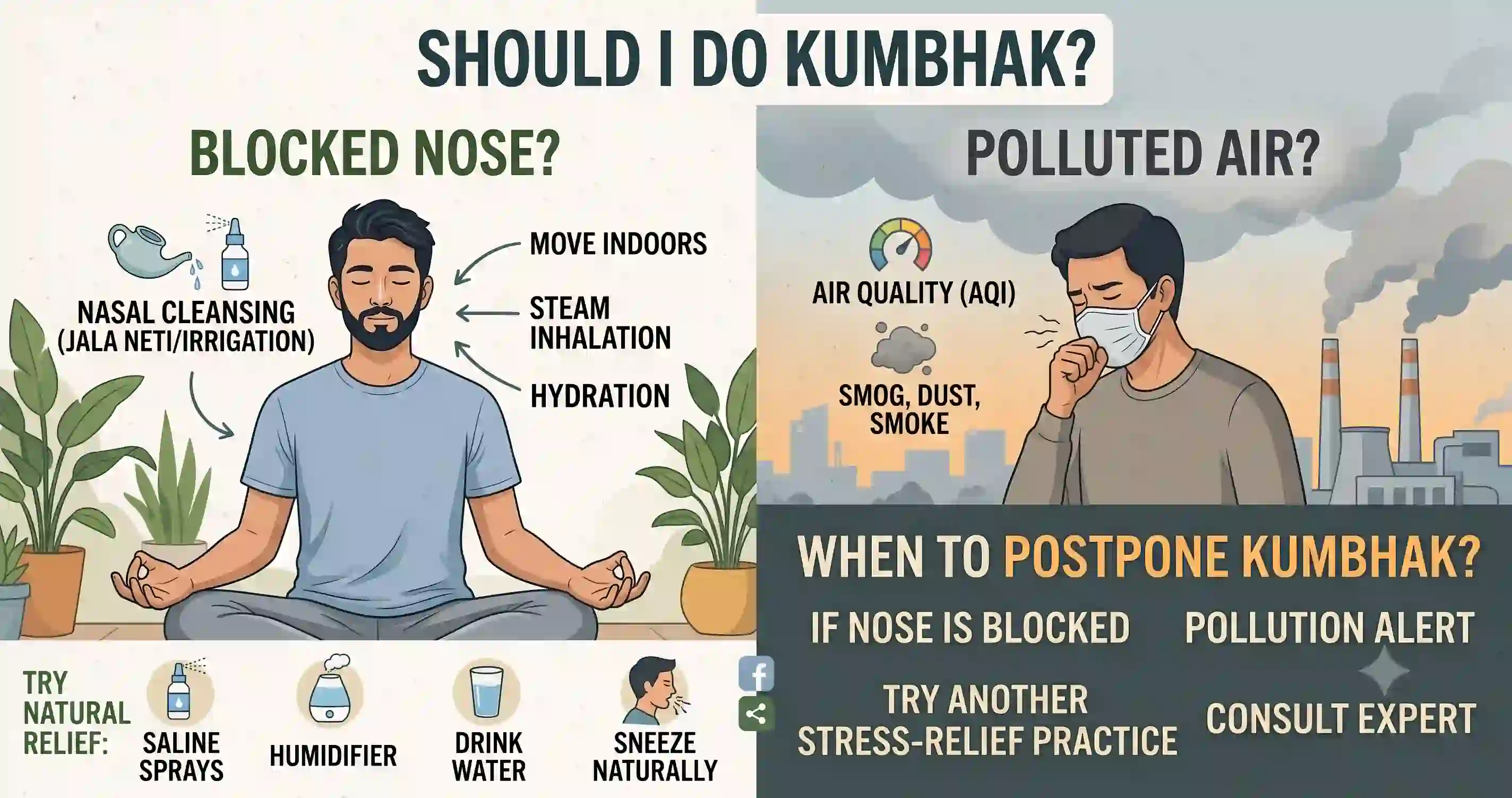
Blocked Nose or Polluted Air? When to Postpone Kumbhak—and What to Do Instead
You sit down because your mind needs relief. Then reality interrupts: one nostril feels sealed, smoke hangs outside, cooking fumes fill the room, or traffic exhaust enters the car.
Should you continue because the practice is “good for the respiratory system”?
No—not automatically.
If normal nasal breathing is not easy, the available air is polluted or irritating, or your respiratory system is unwell today, postpone Kumbhak or move to cleaner air. Do not force air through a blocked nose, replace the nasal Pūrak and Rechak with mouth breathing, or use a respirator, decongestant or air purifier as permission to push through unsuitable conditions.
Try Nasal cleaning like jala neti or any other type of nasal irrigation, nasal saline irrigation or a nasal rinse under expert guidance. Try saline sprays, stream inhalation, humidifiers, lot of hydration, and sneezing naturally. Try Cardiovascular exercises like HIIT (High-Intensity Interval Training) or Vigorous Aerobic Exercise if your body permits them.
The simplest rule: Kumbhak needs both an open-enough nasal route and clean-enough air. If either one is missing, the practice can wait.
Waiting is not losing a day of practice. It is practising judgement—the skill that protects every future day.
This article does not repeat the Ten-Step method. For the complete instructions, read How to Practice the Ten-Step Kumbhak for Stress Relief. This is an educational safety guide, not a diagnosis or a substitute for medical care.
The Five-Gate Kumbhak Readiness Check ✅
Use these five questions before beginning. They place the most relevant decision first.
Gate 1: Can I breathe normally through my nose?
Sit without changing your breathing. Keep your mouth closed only if that is comfortable.
- Yes: Air passes through the nose without pulling, gulping, flaring the nostrils, lifting the shoulders or feeling starved of air.
- No: You need your mouth, make an effort to draw air in, hear marked whistling, or already feel breathless.
If the answer is no, do not begin the Ten-Step Kumbhak.
Gate 2: Is the air reasonably clean where I am?
Check the official local Air Quality Index (AQI) when outdoor pollution, wildfire smoke, dust or smog is possible. Indoors, notice recent cooking, smoking, incense, candles, cleaning chemicals, paint, renovation dust, mold, fuel-burning appliances or outdoor pollution entering the room.
If the air is visibly smoky or dusty, smells strongly chemical, irritates your eyes or throat, or causes coughing or tightness, relocate or postpone even when an app looks reassuring.
Gate 3: Is my respiratory system well today?
Postpone when you have fever, a worsening respiratory infection, repeated coughing, acute sinus pressure, wheezing, an asthma or COPD flare, unusual breathlessness, chest tightness, a recent nosebleed, or recovery instructions after nasal, chest or abdominal surgery.
Gate 4: Is the setting safe?
You must be seated in a stable place and free to stop immediately. Never practise while driving, swimming, bathing, operating machinery, walking somewhere unsafe or doing anything that requires continuous attention.
A moving vehicle does not become a meditation room merely because someone else is driving. Traffic exposure, motion and the inability to change the air promptly can still make it a poor setting.
Gate 5: Can every retention end with a real reserve?
The one-to-three-second rule is a reserve rule—not a minimum hold and not a countdown.
End each retention while it remains completely easy and while you still feel certain that you could have continued comfortably for at least another one to three seconds. Your actual retention may be very brief. If you cannot retain at all while preserving that reserve, omit Kumbhak and choose another practice.
All five answers are yes: You may follow the separate Ten-Step practice guide.
Any answer is no: Relocate, postpone, or use a no-retention alternative.
Severe symptoms are present: Stop evaluating the practice and seek appropriate medical care.
Is One “Blocked” Nostril Always a Reason to Postpone? 👃
Not necessarily. The important distinction is between normal asymmetry and problematic obstruction.
One nostril may naturally carry less air
Healthy noses commonly alternate which side carries more airflow. This is called the nasal cycle: tissue on one side becomes more congested while the other side becomes more open, and dominance changes over time. Research has detected a recognizable cycle in roughly 70%–80% of healthy adults, although its pattern varies considerably.1
Therefore, you do not need both nostrils to feel mathematically equal.
What matters is the total experience:
- Can you take a normal nasal breath without effort?
- Can you keep the mouth closed without air hunger?
- Is there no wheezing, chest tightness, fever or acute illness?
- Does the clearer side provide enough airflow for comfortable normal Pūrak and Rechak?
If yes, mild one-sided asymmetry alone may not require postponement.
A practical definition of “too blocked for Kumbhak”
Treat your nose as too blocked when any of the following is true:
- You must open your mouth to obtain enough air.
- Nasal Pūrak feels like pulling through a pinched straw.
- You compensate by raising the shoulders, arching the back or taking a sudden gulp.
- Rechak cannot leave through the nose without pressure.
- Nasal breathing increases panic, facial pain, ear pressure or headache.
- Mucus repeatedly interrupts breathing.
- You cannot tell whether uneasiness comes from the retention or from the obstruction.
A closed door is not asking to be pushed harder. It is asking you to use another room—or return another day.
Why not replace nasal breathing with mouth breathing?
The Ten-Step Kumbhak uses normal nasal Pūrak and Rechak. The nose warms, humidifies and filters inspired air. Its filtration is useful, but incomplete: experimental evidence indicates strong deposition for many larger particles, while filtration of particles below about 0.5 micrometres can be low.2
That leads to two conclusions:
- Do not rewrite the Ten-Step method as mouth breathing because your nose is blocked.
- Do not imagine that nasal breathing makes polluted air harmless.
If you need mouth breathing at rest, the sensible response is not to modify Kumbhak. It is to postpone it.
Why Is My Nose Blocked? Common Causes and Different Decisions 🤧
“Blocked nose” is a symptom, not a single condition. Congestion may arise from a cold, influenza, COVID-19 or another infection; allergic or non-allergic rhinitis; sinusitis; medication rebound; pregnancy-related swelling; polyps; a deviated septum; dry or irritating air; or exposure to smoke, dust and chemicals.3
The cause changes the next step.
Mild, familiar allergy symptoms
If this is your usual allergy pattern, symptoms are controlled, normal nasal breathing is easy, the air is clean and there is no wheeze or chest tightness, Kumbhak may be reasonable.
If pollen, dust or another trigger is actively closing the nose or provoking cough, relocate and address the trigger first. A “good” pollution AQI does not measure every allergen.
A cold, flu, COVID-19 or another respiratory infection
Congestion with fever, fatigue, worsening cough, wheeze or chest symptoms is a reason to rest rather than add retention. Current CDC guidance advises people with respiratory-virus symptoms to stay away from others until symptoms are improving overall and they have been fever-free without fever-reducing medication for at least 24 hours.4
For returning to Kumbhak, use that only as a minimum recovery marker. Also wait until normal nasal breathing is comfortable and a very brief retention can preserve the full one-to-three-second reserve.
Sinus pain or pressure
Postpone if congestion comes with significant facial pain, swelling, fever, marked headache, ear pressure or symptoms that worsen with changes in breathing pressure. Kumbhak is not a treatment test for acute sinus symptoms.
Chronic obstruction
If you need mouth breathing most days, one side remains persistently blocked, or congestion keeps returning, do not build your stress-relief routine around forcing the nose open. A clinician or ear, nose and throat specialist can assess allergy, polyps, septal deviation, nasal-valve problems and other causes.
Chronic obstruction does not disqualify you from stress relief. It means another practice may fit your body better unless and until the cause is managed.
Can I Clear My Nose First and Then Practise? 💧
Sometimes—but clearing the nose should serve comfort and health, not rescue a scheduled Kumbhak session at any cost.
Saline spray or nasal irrigation
A simple saline spray may help some people. Nasal irrigation may loosen mucus and remove pollen or dust, but it must be performed hygienically and may not be appropriate for everyone.
The U.S. Food and Drug Administration says nasal-rinsing devices should use distilled, sterile or previously boiled and cooled water—not untreated tap water. The device must also be cleaned and dried according to its instructions.5
After rinsing, reassess rather than assuming success:
- Has drainage settled?
- Does nasal breathing now feel normal rather than temporarily opened under pressure?
- Is there no ear discomfort, bleeding, headache or fever?
- Are you otherwise well?
If not, postpone.
Classical thread Neti and other advanced cleansing procedures should not be improvised from an article. They require competent instruction and are not substitutes for medical evaluation.
Decongestant sprays and tablets
Do not take a medicine merely to “make the practice happen.”
Oxymetazoline and similar topical decongestant sprays can cause congestion to return or worsen when used beyond the labelled period; U.S. MedlinePlus directs users not to use oxymetazoline for longer than three days.6 Oral pseudoephedrine can raise heart rate and blood pressure and is unsuitable for some people.7
Ask a clinician or pharmacist what is appropriate for you, especially during pregnancy or when you have high blood pressure, heart disease, glaucoma, prostate problems, thyroid disease, take interacting medicines or are treating a child.
Opening the nose pharmacologically does not prove that the respiratory system, cardiovascular system or surrounding air is suitable for retention.
Do not use smoke as a nasal “remedy”
Incense, herbal smoke, tobacco smoke, vaping aerosols and medicated fumes are not clean-air preparation for Kumbhak. Historical Ayurvedic references to Dhūmapāna belong to a traditional therapeutic system with specific substances, indications and contraindications; they should not be translated into a modern claim that inhaled smoke protects against pollution.
For stress-relief Kumbhak, remove smoke from the practice space.
When Does Nasal Congestion Need Medical Attention? 🩺
Arrange medical assessment when congestion:
- lasts for weeks or repeatedly interferes with normal breathing;
- is persistently one-sided;
- comes with recurrent nosebleeds or foul-smelling one-sided discharge;
- follows a head or nose injury;
- accompanies swelling around the forehead, eye, cheek or side of the nose;
- comes with blurred vision, loss of smell, high fever or worsening facial pain;
- or is accompanied by a cough that persists or worsening lower-airway symptoms.
These features can have many causes; the point is not to frighten you but to stop a breathing practice from delaying an evaluation. MedlinePlus specifically lists facial or eye swelling, blurred vision, unusual one-sided discharge, post-injury discharge and prolonged symptoms among reasons to contact a clinician.3
How Much Outdoor Air Pollution Is Too Much for Kumbhak? 🌫️
There is no universal AQI number that certifies an individual breath as “safe.” AQI systems average measured pollutants, use country-specific breakpoints and may not capture a fresh plume of exhaust, dust, pesticide or smoke beside you.
Still, an official local AQI is much better than judging air by colour, smell or hope.
WHO’s global air-quality guidelines cover PM₂.₅, PM₁₀, ozone, nitrogen dioxide, sulfur dioxide and carbon monoxide. They are health-based population guidelines, not a guarantee that exposure below one number is risk-free.8 Fine particles are especially important because they can travel deep into the lungs, and some may enter the bloodstream.9
First, identify which AQI scale you are reading
The U.S. AQI uses these categories:
- 0–50: Good
- 51–100: Moderate
- 101–150: Unhealthy for Sensitive Groups
- 151–200: Unhealthy
- 201–300: Very Unhealthy
- 301 and above: Hazardous10
India’s National AQI uses different names and ranges:
- 0–50: Good
- 51–100: Satisfactory
- 101–200: Moderately Polluted
- 201–300: Poor
- 301–400: Very Poor
- 401–500: Severe11
Do not copy a number from one country’s colour chart and interpret it through another country’s category name.
A cautious AQI policy for stress-relief Kumbhak
This is a practical risk-reduction policy inferred from official air-quality guidance; it is not an official medical Kumbhak standard.
Cleanest local category
Outdoor practice may be reasonable for a symptom-free person when there is no nearby smoke, exhaust, dust, strong odour or irritation.
Second local category
Most healthy people may tolerate ordinary outdoor activity, but a cleaner indoor room is preferable for Kumbhak. People unusually sensitive to pollution, including many with asthma, COPD or heart disease, should choose cleaner indoor air or postpone.
A category warning sensitive groups
Do not make outdoor Kumbhak the experiment. Move to verified cleaner indoor air. If you are in a sensitive group, postpone unless the indoor setting is genuinely suitable.
Unhealthy, Poor or any worse category
Do not practise outdoors. If smoke or pollution is also entering the building and you cannot create or reach a cleaner room, postpone completely.
Emergency smoke, chemical release or hazardous advisory
Follow public-health or evacuation instructions. Kumbhak is irrelevant until immediate safety is secured.
Symptoms overrule the display
Stop and move away from the exposure if you develop:
- burning eyes, nose or throat;
- cough, wheeze or chest tightness;
- unusual shortness of breath;
- headache, nausea or dizziness;
- palpitations or unusual fatigue;
- or an asthma/COPD symptom that requires your action plan.
An AQI station may be kilometres away. Your airway is with you.
Smell is neither a complete alarm nor a certificate of safety
Some harmful pollutants have a strong odour; others do not. Carbon monoxide is colourless and odourless. Conversely, an odour may be detectable before a substance reaches a dangerous concentration.
Use official alerts, maintained detectors and source knowledge—not smell alone.
Who Should Use a Lower Pollution Threshold? ❤️🩹
Choose cleaner air sooner if you:
- have asthma, COPD or another lung condition;
- have heart or cerebrovascular disease;
- are pregnant;
- are an older adult or are recovering from respiratory illness;
- have a history of pollution-triggered migraine, panic or breathing symptoms;
- are a child or are supervising a child;
- or have been told by a clinician to limit pollution exposure.
AirNow notes that sensitive groups can experience effects before the general public as pollution rises.10 The aim is not to prove that you can tolerate the same air as someone else. The aim is stress relief without buying it with respiratory irritation.
Indoor Air Can Be Worse Than It Looks 🏠
Closing the door does not automatically produce clean air. Indoor pollution may come from outside infiltration or from sources created inside the room.
Common sources include:
- tobacco or cannabis smoke and vaping aerosols;
- incense, dhoop, candles and mosquito coils;
- frying, grilling, burnt food and gas cooking;
- fireplaces, unvented heaters and fuel-burning appliances;
- aerosol sprays, perfume, pesticides and strong cleaning products;
- paint, varnish, adhesives, new furniture and renovation work;
- printers, workshop dust and hobby materials;
- dampness, mold and biological contaminants;
- and traffic, wildfire smoke or construction dust entering from outside.
EPA identifies cooking, cleaning, smoke, building materials, furnishings, mold, pollen, particles and volatile organic compounds among indoor-air concerns.12
Use the clean-air hierarchy in the right order
1. Remove or stop the source
Extinguish incense and candles. Do not permit smoking or vaping. Stop aerosol spraying. Move away from paint, solvent, pesticide or renovation work. Fix fuel-burning and moisture problems rather than trying to breathe around them.
2. Ventilate—only when the incoming air is cleaner
Use an exhaust hood that vents outdoors during cooking. Open windows when outdoor air is suitable. When wildfire smoke or severe outdoor pollution is present, open windows can make the room worse.
3. Filter what the filter is designed to remove
A correctly sized portable air cleaner with a high particle Clean Air Delivery Rate (CADR), commonly using HEPA filtration, can reduce airborne particles. A substantial activated-carbon filter may reduce certain gases, but gas-removal performance is less consistently rated. No domestic purifier removes every pollutant.12
4. Allow the room to recover, then reassess
Do not sit beside a running purifier while the source continues and declare the air clean. Wait until the source is controlled, visible haze is gone, irritation has resolved and available measurements have returned to an acceptable range.
Important limits of indoor monitors
A PM₂.₅ sensor reports particles, not every gas. A carbon-dioxide monitor can indicate ventilation conditions, but it does not reveal carbon monoxide, ozone, all volatile organic compounds or every biological contaminant. A low reading on one sensor is not a complete air-quality examination.
Use a functioning carbon-monoxide alarm wherever fuel-burning appliances or an attached garage create a possible source. If a CO alarm sounds, leave for fresh air and follow emergency guidance; do not search for the source while practising.
Avoid ozone-generating “air cleaners”
Ozone is a respiratory irritant. EPA advises against ozone generators in occupied spaces and notes that ozone at concentrations within public-health standards is not an effective general remover of indoor contaminants.13
A machine that adds an airway irritant cannot prepare a room for stress-relief Kumbhak.
Can I Practise Kumbhak in a Car? 🚗
Usually, waiting until you reach a suitable room is the better decision.
Never practise while driving
Breath retention can cause light-headedness, altered attention or an unexpected need to breathe. A driver needs uninterrupted control and awareness. No traffic jam, red light or parked moment at the roadside makes retention appropriate behind the wheel.
A car cabin is not automatically filtered clean air
Traffic corridors can contain high particle and gaseous pollution. Closing windows and using recirculation can reduce incoming particles, but continuous recirculation also allows occupants’ exhaled carbon dioxide to accumulate. Vehicle studies describe this trade-off and investigate partial recirculation as a way to balance particle reduction and ventilation.14
Cabin filters also vary. They require maintenance, and particle filtration does not mean removal of all gases.
Therefore:
- Do not assume recirculation has made polluted roadside air suitable for Kumbhak.
- Do not rely on a fragrance or “car purifier” as evidence of safety.
- If you are a passenger wearing a respirator because traffic pollution is severe, keep the respirator on and save Kumbhak for cleaner air.
- If you feel drowsy, headachy, nauseated or short of breath, seek fresh air and assess the cause rather than adding retention.
Never run a vehicle in an attached garage
Carbon monoxide can accumulate without colour or smell. CDC states that a car or truck should never be run inside an attached garage, even with the garage door open, and notes that an exhaust leak can allow CO to build inside a vehicle.15
Do not use a parked car with the engine running as a climate-controlled Kumbhak space in a garage or other enclosed area.
Will an N95, Mask or Air Purifier Make Kumbhak Safe? 😷
These tools can reduce particular exposures. None turns contaminated air into a universal green light.
N95 and P100 respirators
A correctly fitted, approved particulate respirator can reduce exposure to smoke, ash and PM₂.₅. Filtering facepiece respirators do not protect against gases or vapours.16
If conditions require a respirator, use it for protection while you relocate or complete an essential task. Do not remove it in polluted air merely to perform Kumbhak, and do not treat retention inside it as the day’s stress-relief session.
Surgical and cloth masks
These may serve infection-control purposes, but they are not equivalent to a fitted particulate respirator for smoke or fine-particle pollution.
Portable purifiers
A purifier can be part of a clean-room strategy when:
- the pollution source has been removed or reduced;
- the unit is correctly sized for the room;
- filters are appropriate and maintained;
- doors and windows are managed according to outdoor conditions;
- and no carbon-monoxide or chemical emergency exists.
The purifier is evidence of an intervention—not proof of the final air quality.
When to Postpone Because of Illness or Symptoms 🫁
Pollution and congestion are not the only reasons to wait.
Postpone today
Choose no-retention stress relief when you have:
- fever, chills, marked fatigue or a worsening respiratory infection;
- an acute asthma attack, COPD flare, wheeze or chest tightness;
- unusual breathlessness at rest;
- repeated coughing that prevents an easy pause;
- significant sinus or ear pressure;
- an active nosebleed or recent nasal injury;
- vomiting, dehydration or faintness;
- a panic episode, dissociation or a suffocation-related trauma response;
- a recent procedure for which your clinician has restricted breathing effort;
- or any symptom that makes you uncertain whether the practice is helping or aggravating you.
Kumbhak should not compete with an airway already working hard.
Obtain individual clinical guidance first
Ask a qualified healthcare professional before breath retention if you have significant heart or lung disease, uncontrolled blood pressure, cerebrovascular disease, epilepsy, recurrent fainting, glaucoma or retinal concerns, are pregnant, recently had surgery, or have panic/PTSD symptoms that can be intensified by air hunger.
The American Heart Association advises people with heart- or lung-related medical conditions to consult a healthcare professional before breathing techniques and tells beginners to stop if dizziness or light-headedness occurs.17
Stop immediately during or after practice
Return to natural breathing and stop the session if you experience:
- dizziness, light-headedness, faintness or greying vision;
- a gasp, urgent air hunger or unusual breathlessness;
- chest pain, pressure or marked palpitations;
- wheeze, cough or throat constriction;
- severe headache, eye pressure, confusion or loss of coordination;
- tingling, involuntary movement or blue, grey or unusually pale lips;
- panic, dissociation or a traumatic flashback;
- or any other discomfort.
Do not resume until breathing and the whole body feel completely normal. Seek medical care when a concerning symptom persists.
Seek emergency care instead of doing a breathing practice
Emergency warning signs include severe difficulty breathing, inability to speak normally because of breathlessness, persistent chest pain or pressure, blue or grey lips or skin, sudden confusion, collapse or a severe asthma response not improving according to the person’s action plan.18
Call the emergency service for your location. Do not drive yourself if you are severely unwell.
What Can I Practise Instead? No-Retention Stress Relief 🌿
The alternative should fit the obstacle.
If the air is polluted, move to cleaner air first. No breathing exercise neutralises smoke, gases or particles while you remain exposed.
If your nose is blocked but ordinary breathing is otherwise medically comfortable, choose a practice that does not require a particular breathing route, ratio or pause.
Orienting through the senses
Look around the clean, safe room and name:
- five colours or shapes you can see;
- four points where your body is supported;
- three sounds;
- two textures;
- and one thing you need in the next hour.
Let breathing remain natural. The task gives an activated mind somewhere concrete to land.
Contact-point awareness
Feel the support beneath your feet, thighs, hands and back. Notice where weight is held by the chair or floor. Do not change the breath and do not hold it.
This can preserve the essential emotional message—“I am supported now”—without making a congested airway the centre of attention.
A no-hold body scan
Move attention from the forehead to the jaw, shoulders, hands, abdomen, legs and feet. At each area, notice tension and allow unnecessary effort to release. Keep natural breathing untouched.
Natural-breath observation
Only if breathing itself is comfortable, observe it without counting, enlarging, controlling or retaining it. If attention to breathing increases distress, return to sounds, vision or contact points instead.
Quiet rest or an indoor walk
Rest in a clean room, listen to familiar music, write one page, or walk in a clean indoor setting. The best substitute is not the one that looks most like Kumbhak; it is the one your body can receive today.
Yogic Truths: Classical Texts Put Conditions Before Ambition 🕉️
Premodern yoga texts did not measure PM₂.₅, publish an AQI or study modern vehicle exhaust. They cannot be used as scientific pollution standards. They do, however, show that classical practice was not indifferent to place, time, preparation and correct method.
Gheraṇḍa Saṃhitā 5.2: place and time come first
ādau sthānaṃ tathā kālaṃ mitāhāraṃ tathā param |
nāḍīśuddhiṃ tataḥ paścāt prāṇāyāmaṃ ca sādhayet || 5.2 ||
Contextual translation: First consider the place and time, then moderate food and purification of the channels; only afterward undertake prāṇāyāma.19
This is not an ancient air-monitor instruction. Its relevance is structural: the environment is not an afterthought. The breathing practice begins only after the conditions have been considered.
Haṭha Yoga Pradīpikā 2.15: the breath is approached gradually
yathā siṃho gajo vyāghro bhaved vaśyaḥ śanaiḥ śanaiḥ |
tathaiva sevito vāyur anyathā hanti sādhakam || 2.15 ||
Contextual translation: As a lion, elephant or tiger is brought under control gradually, so the breath is approached gradually; otherwise it harms the practitioner.20
For the Ten-Step Kumbhak, the modern practical expression is clear: normal Pūrak, normal Rechak, deliberately brief retentions, no competition, and a genuine one-to-three-second reserve.
Haṭha Yoga Pradīpikā 2.16: correct and incorrect practice are not equivalent
prāṇāyāmena yuktena sarvarogakṣayo bhavet |
ayuktābhyāsayogena sarvarogasamudgamaḥ || 2.16 ||
Contextual translation: Appropriate prāṇāyāma is said to diminish disease, while inappropriate practice is said to give rise to disease.21
The verse makes a sweeping traditional medical claim that has not been scientifically verified as written. Its precise safety connection remains valuable: a practice cannot be called beneficial while its method or conditions are inappropriate.
Polluted air, acute wheezing and forced nasal breathing do not become appropriate because the person’s intention is sincere.
Ayurvedic Truths: Dust, Smoke and Nasal Obstruction Were Not Ignored 🌿
Ayurveda uses its own concepts of Doṣa, Vāta, Pitta, Kapha, Prāṇa and bodily channels. These frameworks should be presented as classical Ayurvedic theory, not disguised as modern respiratory science.
Within that framework, the relevance of the nose, dust and smoke is explicit.
Aṣṭāṅga Hṛdaya, Sūtrasthāna 20.1: the nose as a gateway
ūrdhvajatruvikāreṣu viśeṣān nasyam iṣyate |
nāsā hi śiraso dvāraṃ tena tad vyāpya hanti tān || 20.1 ||
In its original context, this verse explains Nasya, the administration of medicine through the nose for conditions above the shoulders, and calls the nose a gateway to the head.22
It does not say that inhaled pollution travels directly into the brain, that nasal breathing removes every contaminant, or that everyone should self-administer oil or herbs. Its careful use here is narrower: Ayurveda assigns the nasal route major therapeutic importance, so forcing that route when it is obstructed would be an odd way to honour the tradition.
Caraka Saṃhitā connects dust and smoke with respiratory disturbance
In Caraka Saṃhitā, Cikitsāsthāna 26.104–106½, inhalation of dust and smoking are listed among factors associated with Pratiśyāya, a category involving nasal discharge and obstruction.23 In Cikitsāsthāna 17.11–16, dust and smoke also appear in the etiological account of Śvāsa, a category of difficult breathing.24
These are historical clinical observations embedded in Ayurvedic pathology. They are not controlled pollution studies and do not validate every traditional mechanism. Yet they make one point impossible to dismiss: classical Ayurveda did not treat dust and smoke as spiritually pure simply because breathing practices were valuable.
What this Ayurvedic section does not recommend
This article does not prescribe:
- Nasya oils or herbal nasal drops;
- medicated smoke;
- thread Neti;
- herbs for asthma, infection or sinusitis;
- Doṣa-based self-diagnosis;
- or replacing inhalers, allergy treatment, antibiotics, antivirals or other prescribed care.
Traditional interventions have their own indications, contraindications, formulations and practitioner requirements. They should not be improvised to make Kumbhak possible in polluted air.
The classical claims and Doṣa explanations in this section have not been scientifically verified as a complete system. They are included accurately as Ayurvedic perspectives, not as promises.
Common Questions About Blocked Nose, Pollution and Kumbhak ❓
“Only one nostril feels partly blocked. May I practise?”
Possibly, if normal total nasal breathing is easy, you do not need the mouth, you are well, the air is clean and there is no strain. Normal nasal cycling often creates unequal airflow.
Postpone if the remaining airflow feels insufficient or you compensate physically.
“My nose opens after a few breaths. Should I continue?”
Do not use the practice itself as a test for forcing the nose open. Stop, return to natural breathing and reassess outside the Kumbhak sequence. Continue only if nasal breathing is clearly normal and comfortable before you restart.
“Can I perform the Ten-Step Kumbhak through my mouth?”
No. That changes the method. Use a no-retention alternative and return to the separate practice guide when nasal breathing is available again.
“Can I hold for less than three seconds?”
Yes. There is no three-second minimum.
The instruction concerns what must remain after you stop: end while completely easy and certain that at least another one to three comfortable seconds remained. If that reserve is unavailable, do not retain.
“Can a brief hold reduce the amount of pollution I inhale?”
It temporarily interrupts airflow, but it cannot remove contaminants already inhaled or clean the next normal Pūrak; the breaths around the practice still expose you. There is no evidence that Kumbhak detoxifies inhaled particles or gases. Leave the exposure.
“The AQI is good, but I smell exhaust. Which should I trust?”
Move away from the exhaust. A regional index can miss an immediate roadside plume. Local source knowledge and symptoms can justify a more cautious choice.
“The AQI is poor, but the room has an air purifier. Is that enough?”
Not by itself. Check whether outdoor air is entering, indoor sources have stopped, the purifier is correctly sized and maintained, and available indoor readings and symptoms are reassuring. If you cannot establish a cleaner environment, postpone.
“Can I practise beside an open window?”
Only when the incoming outdoor air is cleaner than the indoor air. During smog, dust storms, crop burning or wildfire smoke, an open window may increase exposure.
“Can I practise while wearing an N95?”
This article recommends saving Kumbhak for a clean setting where respiratory protection is not required. Keep the respirator on while exposure continues; do not remove it for the practice.
“Can I practise as a passenger in a car?”
It may be physically possible, but it is usually unnecessary. Traffic air, recirculation, motion, temperature and limited options to stop or relocate make the car a less reliable setting. Wait until you arrive somewhere stable and clean.
“How long after a cold should I wait?”
There is no universal number of days. At minimum, symptoms should be improving overall, fever should have been absent without fever-reducing medicine for at least 24 hours, normal nasal breathing should be comfortable, and there should be no wheeze, unusual breathlessness or significant cough. When you return, use only one round from the proper practice guide and keep both retentions deliberately brief.
“What if congestion keeps stopping my practice?”
Choose a reliable no-retention stress practice now and seek evaluation for the obstruction. A method should fit your life and body; your body does not owe a method daily compliance.
A Safe Return-to-Kumbhak Checklist 🌤️
Return only when:
- normal nasal breathing is easy at rest;
- acute illness is improving and fever has resolved;
- there is no wheeze, chest tightness, unusual breathlessness or persistent dizziness;
- the room or outdoor location has suitably clean air;
- you are seated safely and not in a vehicle you are driving;
- you feel no need to compensate for missed practice;
- and a very brief retention can end with at least another one to three comfortable seconds unquestionably available.
For the first return:
- Follow the complete Ten-Step Kumbhak practice guide, not a remembered or improvised version.
- Practise one round only.
- Keep both retentions deliberately brief.
- Stop at the first sign that breathing, the nose, chest or mind does not feel completely normal.
- Do not extend the session to “make up” for postponed days.
The Final Decision: Clear, Clean, Well, Safe 🌱
Before Kumbhak, ask four plain questions:
Clear? Can I breathe normally through my nose without effort?
Clean? Is the available air free from concerning pollution, smoke, dust and irritating fumes?
Well? Is my respiratory system stable today?
Safe? Am I seated, attentive and able to stop immediately—with a real one-to-three-second reserve in every retention?
If all four answers are yes, follow the proper guide.
If one answer is no, relocate, postpone or choose another practice.
Some days, the wisest Kumbhak is the one you do not force.
The pause will still be there when the nose opens, the room clears and the body is ready. Protecting that future meeting is part of the practice too.
References and Verification Notes 📚
Evidence and link review completed 24 July 2026. Medical and air-quality guidance changes; check current local advice when conditions or health status change.
-
Pendolino, A. L., Lund, V. J., Nardello, E., & Ottaviano, G. (2018). “The nasal cycle: a comprehensive review.” Rhinology Online, 1, 67–76. DOI and abstract. See also Hasegawa, M., & Kern, E. B. (1977). “The human nasal cycle.” Mayo Clinic Proceedings, 52(1), 28–34. PubMed. ↩
-
Nasal warming, humidification and filtration are reviewed in The role of the nose in snoring and obstructive sleep apnoea. Particle-size filtration evidence: Schwab, J. A., & Zenkel, M. (1998). “Filtration of particulates in the human nose.” PubMed. ↩
-
U.S. National Library of Medicine, MedlinePlus. “Stuffy or runny nose—adult.” Reviewed July 2025. Medical encyclopedia entry. ↩↩
-
U.S. Centers for Disease Control and Prevention. “Preventing Spread of Respiratory Viruses When You’re Sick.” Updated August 2025. CDC guidance. ↩
-
U.S. Food and Drug Administration. “Is Rinsing Your Sinuses With Neti Pots Safe?” FDA consumer guidance. ↩
-
U.S. National Library of Medicine, MedlinePlus. “Oxymetazoline Nasal Spray.” Drug information. ↩
-
National Health Service. “About pseudoephedrine.” NHS medicine guidance. ↩
-
World Health Organization. (2021). WHO global air quality guidelines: particulate matter (PM₂.₅ and PM₁₀), ozone, nitrogen dioxide, sulfur dioxide and carbon monoxide. WHO guideline. ↩
-
U.S. Environmental Protection Agency. “Health and Environmental Effects of Particulate Matter.” EPA overview. ↩
-
AirNow, U.S. Environmental Protection Agency. “AQI Basics.” Official U.S. AQI categories. ↩↩
-
Central Pollution Control Board, Government of India. “About National Air Quality Index.” Official Indian AQI framework. ↩
-
U.S. Environmental Protection Agency. “Guide to Air Cleaners in the Home.” EPA guidance on source control, ventilation and filtration. See also Sources of Indoor Particulate Matter. ↩↩
-
U.S. Environmental Protection Agency. “Ozone Generators that are Sold as Air Cleaners.” EPA assessment. ↩
-
Jung, H. S., Grady, M. L., Victoroff, T., & Miller, A. L. (2017). “Simultaneously reducing CO₂ and particulate exposures via fractional recirculation of vehicle cabin air.” Atmospheric Environment, 160, 77–88. Full text. ↩
-
U.S. Centers for Disease Control and Prevention. “Carbon Monoxide Poisoning Basics.” Updated January 2026. CDC guidance. ↩
-
National Institute for Occupational Safety and Health. “How to Protect Workers and the Public from Wildfire Smoke.” NIOSH guidance. See also Filtering Facepiece Respirators. ↩
-
American Heart Association. “Stress Management.” Breathing-practice cautions. ↩
-
U.S. Centers for Disease Control and Prevention. “About Respiratory Illnesses.” Emergency warning signs. See also NHS, Shortness of breath. ↩
-
Gheraṇḍa Saṃhitā 5.2. Sanskrit and translation checked against Siva.sh verse record and the chapter’s published English translation in S. C. Vasu’s The Gheranda Samhita. ↩
-
Svātmārāma, Haṭha Yoga Pradīpikā 2.15. Sanskrit checked against the verse record and chapter sequence checked against Wikisource, Chapter 2. ↩
-
Svātmārāma, Haṭha Yoga Pradīpikā 2.16. Sanskrit verse and translation record. ↩
-
Vāgbhaṭa, Aṣṭāṅga Hṛdaya, Sūtrasthāna 20.1. Sanskrit verse and contextual translation. ↩
-
Caraka Saṃhitā, Cikitsāsthāna 26.104–106½, “Etiology and Symptoms of Rhinitis.” Verified English translation. ↩
-
Caraka Saṃhitā, Cikitsāsthāna 17.11–16, “The therapeutics of Hiccup and Dyspnea.” Verified English translation. ↩