Explore how Ten-Step Kumbhak may support stress relief for social overload, fear of judgement, interaction, performance, assertiveness, and travel anxiety.
By Kumbhaki Yogi Dhruvaji (MSc), founder of the Antistress Foundation 501(c)(3)
• How to Practice Ten-Step Kumbhak • Scientific Proof • Ancient Texts Proof • Bio • Subscribe By Email
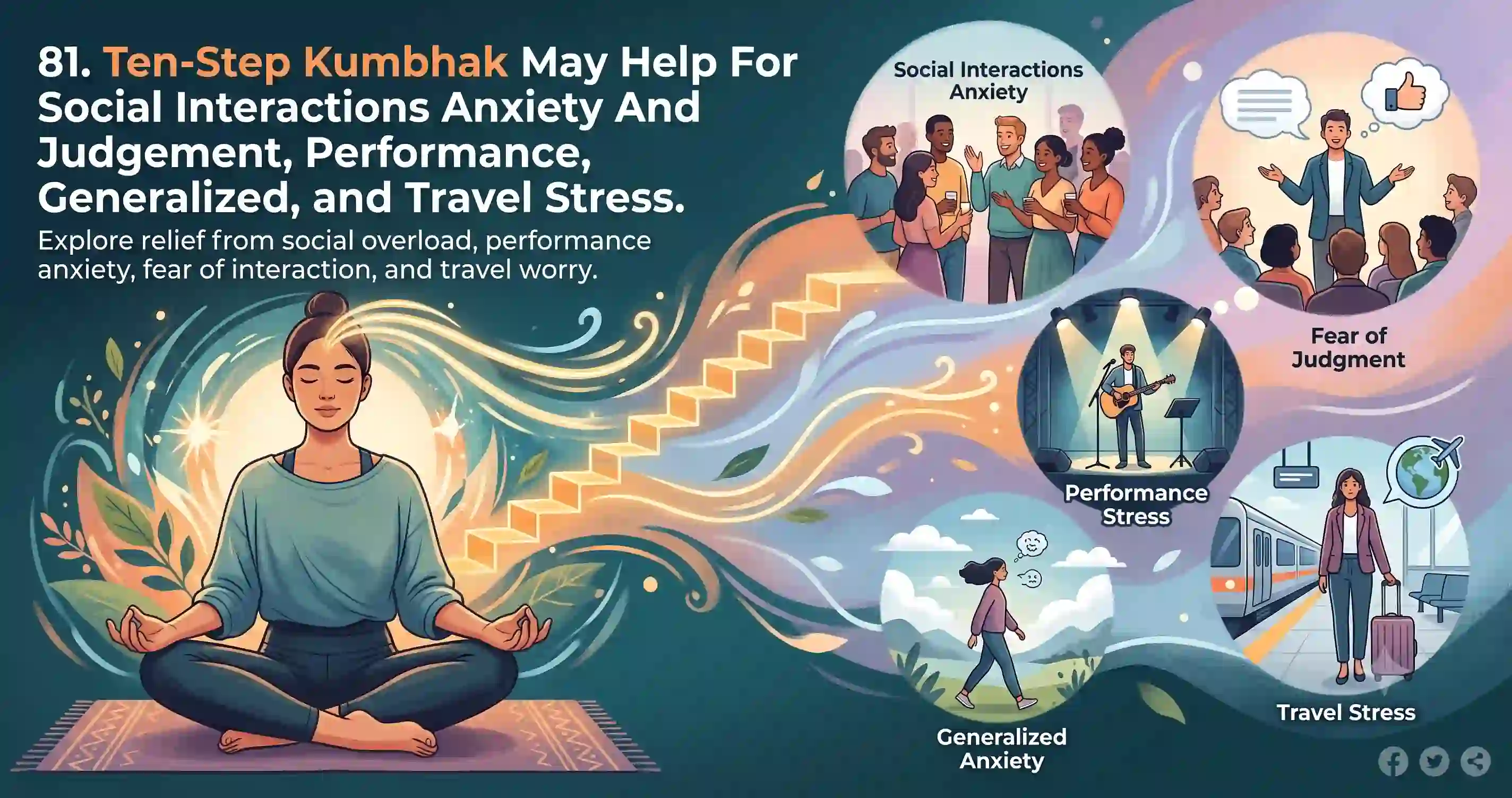
Can a brief, unforced pause in breathing help when people, places, expectations and imagined opinions feel too loud? The most honest answer is: it may help regulate part of the stress response, but it is not a proven treatment for social anxiety disorder.
Some anxiety arrives before the room does.
You may be at home, yet already hear tomorrow’s meeting in your mind. You may replay one sentence from dinner as though a jury is still considering it. You may know exactly what boundary you need to state, but your chest tightens when it is time to speak. At an airport, every queue, announcement and changed gate may seem to ask more of a nervous system that has already spent too much.
These experiences have different names—social overload, fear of judgement, social interaction anxiety, broad social anxiety, performance-only anxiety, assertiveness anxiety and travel stress—but they can share a painful feature: the body begins preparing for social danger before danger has been established.
Ten-Step Kumbhak may offer a small place to interrupt that preparation. Not a place to hide from life. Not a promise that nobody will judge you. A place to sit safely, meet the body without force and discover whether a little more inner room becomes available.
The aim is not to become fearless before living. It is to become less governed by the first wave of fear.
This article explains the possible role of Ten-Step Kumbhak without repeating the practice instructions. Learn the complete method first in How to Practice the Ten-Step Kumbhak for Stress Relief.
The Answer First: What Ten-Step Kumbhak May and May Not Do 🧭
What the evidence makes reasonable
Research supports a cautious possibility that structured breathing practices can reduce self-reported stress and anxiety in some people. A meta-analysis of randomised controlled trials found small-to-medium improvements in stress, anxiety and depressive symptoms, while also warning that study quality, intervention differences and possible publication bias limit certainty.7
There is also low-certainty evidence from an eight-week randomised trial that yoga breathing containing intermittent Kumbhak may improve state anxiety, mindfulness and mind wandering in experienced young yoga practitioners.8
These findings make it reasonable to investigate whether Ten-Step Kumbhak helps an individual feel less activated before or after a socially demanding event.
What has not been proved
No identified clinical trial has tested the exact Ten-Step Kumbhak method for:
- social anxiety disorder;
- fear of negative evaluation;
- social interaction anxiety;
- the performance-only form of social anxiety disorder;
- anxiety about assertiveness;
- social or sensory overload; or
- travel anxiety.
It would therefore be inaccurate to say that Ten-Step Kumbhak treats, prevents or cures any of these conditions.
The evidence concerns related but non-identical practices and outcomes. A positive study of general stress cannot automatically prove a benefit for clinical social anxiety. A breathing routine that contains a retention cannot tell us whether the retention, the rhythm, attention, expectation, protected quiet time or another element produced the change.
The most realistic role
The practice may be most useful as a supportive stress-relief skill:
- before a social or performance demand, if practised in a stable seated place;
- after an interaction, when the body remains activated;
- between periods of social contact, when overload is accumulating;
- after completing a journey, when the nervous system has not yet “arrived”; or
- as a regular personal practice for learning that an internal sensation can be noticed without immediately obeying it.
It cannot decide what to say, teach assertive communication, correct an unsafe relationship, remove a delayed train, perform exposure therapy or replace mental-health care.
That boundary does not make the practice insignificant. Sometimes the missing resource is not another argument—it is ten percent more steadiness from which to use the wisdom you already have.
First, Name the Experience Accurately 🔍
Not every difficult social feeling is a psychiatric disorder. Accurate language protects readers from both minimising genuine suffering and medicalising every uncomfortable day.
The US National Institute of Mental Health describes social anxiety disorder as marked fear in situations where a person may be scrutinised, evaluated or judged. The pattern typically lasts at least six months, causes distress or impairment and may lead to avoidance.1 Diagnosis belongs to a qualified professional, not an online checklist.
Social overload
Social overload is a useful everyday description, not a formal diagnosis. It can mean that conversation, eye contact, background noise, emotional monitoring, unfamiliar rules, masking, decision-making or repeated contact has exceeded the person’s present capacity.
It may occur without social anxiety. A person can enjoy people and still become depleted by too many voices, cues or demands. It may also overlap with stress, burnout, migraine, trauma, autism, ADHD, sleep loss or other health factors.
Where Ten-Step Kumbhak may fit: as a deliberate period of lower input before returning to another demand.
What it cannot replace: sensory accommodation, rest, food, hydration, sleep, accessible environments, clearer boundaries or neurodiversity-informed support.
A woman leaves a wedding early and sits in her quiet room. She is not rejecting the people she loves. Her nervous system has simply reached the edge of what it can sort.
Fear of judgement or negative evaluation
Judgement anxiety usually means fear that others will consider you incompetent, awkward, unattractive, weak, boring or unacceptable. In research, the more precise term is often fear of negative evaluation, a central cognitive feature measured in social-anxiety assessment.4
The distress may appear before an event as prediction:
“They will notice.”
During it as self-monitoring:
“How do I look? What is my voice doing?”
After it as prosecution:
“Why did I say that?”
Where Ten-Step Kumbhak may fit: it may reduce some bodily momentum around the prediction or replay.
What it cannot establish: whether another person actually judged you, whether the judgement matters or how to revise an unfair belief. Those questions need evidence, perspective and sometimes therapy.
Social interaction anxiety
Social interaction anxiety refers to fear during reciprocal contact: meeting someone, making small talk, speaking to an authority figure, calling a business, joining a group, dating or allowing a conversation to become spontaneous. The Social Interaction Anxiety Scale was created to examine this interactional dimension, while the companion Social Phobia Scale focuses more on being observed or performing.4
Interaction anxiety can feel especially exhausting because there is no script. Every facial expression may look like new data to analyse.
Where Ten-Step Kumbhak may fit: before the interaction, it may help the person enter with less accumulated activation; afterwards, it may help mark the end of the encounter.
What it cannot teach: turn-taking, social interpretation, repair after misunderstanding or the courage to disclose something real. These develop through relationships, skills and experience.
“Generalized” or broad social anxiety
Generalized social anxiety is still widely searched, but the terminology has changed. The DSM-IV used a “generalized” specifier when fear included most social situations. DSM-5 removed it because “most situations” was difficult to define consistently and introduced the performance-only specifier instead.3
In plain English, people may still use “generalized social anxiety” to describe anxiety across many kinds of interaction, observation and performance. That description can be understandable, but it is not the current DSM specifier.
Where Ten-Step Kumbhak may fit: as one optional stress-regulation component within a broader plan.
What broad impairment usually needs: assessment and evidence-based care. Current guidance recommends individual cognitive behavioural therapy designed specifically for social anxiety disorder as a first treatment option for adults.2
Performance-only social anxiety
The current performance-only specifier applies when the fear is restricted to speaking or performing in public rather than ordinary non-performance social situations.3 Examples can include a speech, audition, concert, presentation, sports performance or public demonstration.
This is not the same as normal pre-performance energy. A performer may have a racing heart and still function well. Clinical concern grows when fear is persistent, disproportionate, disabling or repeatedly drives avoidance.
Where Ten-Step Kumbhak may fit: during preparation, before entering the performance environment or during recovery afterwards—only while safely seated.
What it cannot replace: rehearsal, graduated exposure, performance coaching, sleep, realistic preparation or professional treatment.
Five minutes before her presentation, the speaker does not need to become a different person. She needs enough inner space to let the prepared person walk into the room.
Assertiveness anxiety
Assertiveness anxiety is not a formal social-anxiety subtype. It describes fear around asking, declining, disagreeing, negotiating, setting a boundary, naming a need or tolerating another person’s disappointment.
The anxious prediction may be:
- “If I say no, I will be rejected.”
- “If I ask, I will look demanding.”
- “If I disagree, conflict will become dangerous.”
- “If they are upset, I must have done something wrong.”
Where Ten-Step Kumbhak may fit: it may help lower the physical urgency that pushes a person toward an automatic yes, apology or retreat.
What it cannot supply: the sentence itself. Assertiveness still requires language, timing, boundaries and an assessment of actual safety.
A calmer nervous system is not the same as compliance. Sometimes stress relief helps a person say, with respect, “That does not work for me.”
Travel stress
Travel stress may involve uncertainty, delays, crowds, unfamiliar spaces, security procedures, missed connections, motion, separation, fatigue or fear of being unable to leave. It is broader than fear of flying and is not itself a diagnosis.
Research on rail commuting has linked longer journeys with higher perceived stress and larger salivary-cortisol elevations, although commuting and occasional travel are not identical.6 Unpredictability can also intensify distress because the brain cannot confidently complete its next prediction.
Where Ten-Step Kumbhak may fit: at home before departure, in a quiet airport or station seat, or after reaching the destination.
Where it does not fit: while driving, cycling, walking through traffic, standing on a platform edge, moving on stairs, handling luggage in a crowd or doing anything that requires full attention.
If the primary problem is a specific phobia such as fear of flying, cognitive behavioural and exposure-based approaches have a far stronger treatment rationale than breath retention alone.
Why Social Threat Can Feel So Physical 🧠❤️
The body responds to possible loss of social safety
Humans depend on belonging. Rejection, humiliation, exclusion and loss of status may not be physical attacks, yet the nervous system can still treat them as urgent.
A meta-analysis of 208 laboratory stress studies found that tasks involving uncontrollable social-evaluative threat—the possibility that other people could judge performance negatively—were especially likely to elicit cortisol responses.5
That helps explain why a three-minute speech can remain in the body for an hour. The event is social, but the response involves breathing, heart rate, muscle tone, attention, hormones and digestion.
Anxiety often unfolds in three time zones
Before the event: anticipation
The mind predicts embarrassment, rehearses escape and searches the future for certainty.
During the event: internal surveillance
Attention narrows onto the voice, face, hands, heartbeat and imagined appearance. The person may have less attention available for the actual conversation.
After the event: post-event processing
Memory reopens the scene and edits it against the self. A neutral pause becomes “proof” of failure; one awkward word erases the rest of the conversation.
NICE recommends assessing anticipatory processing, post-event processing, self-image, internal focus and safety-seeking behaviour because these can help maintain social anxiety.2
Ten-Step Kumbhak may influence arousal around these phases. It does not automatically correct the interpretation inside them.
Breathing is not the whole problem—but it is an accessible doorway
Anxiety can alter breathing, and deliberate breathing can alter attention and physiology. That two-way relationship makes breath practice attractive: it gives the person something direct to do without needing to win an argument with every thought.
Yet the phrase “activate the vagus nerve” is often used too casually. A Kumbhak phase can involve changing carbon dioxide, oxygen, chest pressure, baroreflex activity, heart rate and vascular resistance. The response depends on the kind, timing and duration of the retention.
In one study of one-minute Kumbhak in healthy adults, blood pressure and total peripheral resistance increased during the retention while stroke volume and cardiac output fell.12 Those one-minute findings do not describe the deliberately brief holds of Ten-Step Kumbhak, but they show why it is inaccurate to describe every hold as simply a “rest-and-digest switch.”
How Ten-Step Kumbhak Could Support Stress Relief ⚙️
These are plausible pathways, not established social-anxiety treatment mechanisms.
1. A structured interruption may break automatic momentum
Anxiety often feels like one continuous command: predict, brace, avoid, replay. A formal seated practice creates a boundary around that momentum.
The useful event may not be “holding more.” It may be discovering that the next action does not have to be chosen at the speed of the first anxious thought.
2. A comfortable retention may change the relationship to internal sensation
Kumbhak makes bodily sensation noticeable. When the retention remains completely easy, the person may experience a modest rise in internal signal followed by an orderly return to normal breathing.
This could function as a form of interoceptive learning: sensation is present, attention remains, and catastrophe does not have to be added. However, this pathway has not been specifically demonstrated for Ten-Step Kumbhak or social anxiety.
For someone who fears breathlessness, suffocation or loss of control, the same sensation may be destabilising rather than helpful. Choice matters.
3. Chest-centred attention may provide one stable reference
Social anxiety scatters attention between many uncertain signals: their eyes, your voice, the last sentence, the next sentence, the room, the exit.
The Ten-Step practice uses a single bodily reference at the centre of the chest. Outside a social event, this may help gather attention.
There is an important qualification: during a conversation, excessive internal monitoring can maintain social anxiety. The formal practice is therefore better treated as preparation or recovery—not as a reason to monitor the chest continuously while another person is speaking.
4. The practice may help mark transitions
Social and travel stress often persists because the body receives no clear ending. The meeting finishes, but the mind carries it into dinner. The train arrives, but the shoulders remain at the delayed platform.
A short seated practice may act as a transition:
- public role → private recovery;
- crowd → quieter space;
- anticipation → next useful action;
- performance → release;
- journey → arrival.
The pause becomes punctuation, not escape.
5. The method discourages competitive holding
The purpose of the retention is not duration, toughness or proof. Both holds end while they remain easy and while the practitioner is still certain that another one to three seconds would have been comfortably available.
That reserve is not an extra hold to complete. It is the boundary for ending the hold.
There is no required minimum retention. If a person cannot keep that reserve, the hold should be shorter—or omitted. A zero-second hold is safer than a forced three-second hold.
What the Research Actually Shows 🔬
Evidence level 1: direct Kumbhak research
A randomised trial assigned 116 young adult yoga practitioners either to regular yoga alone or regular yoga plus 20 minutes of yoga breathing with intermittent Kumbhak for eight weeks. The added-practice group showed greater improvement in reported mindfulness, mind wandering and state anxiety.8
This is relevant because retention was central. It is limited because:
- participants were already yoga practitioners;
- the intervention was not the Ten-Step method;
- the study did not recruit people with social anxiety disorder;
- it did not test social performance, fear of judgement or travel; and
- it could not fully separate retention from the rest of the breathing sequence.
Verdict: promising indirect support, not proof for the present use cases.
Evidence level 2: breathing routines that include a pause
A 2026 single-blind randomised trial studied 98 paramedicine students during a demanding academic period. A 12-week breathing routine containing a two-second post-exhale pause was associated with lower stress, anxiety and depression and higher resilience than control, while insomnia and broader psychological wellbeing did not clearly improve. Differential attrition limits confidence.9
This result is relevant to brief Bāhya Kumbhak and real-world stress. The tested method nevertheless used a different rhythm, a different duration and a different population.
In a separate one-month randomised trial, 108 adults practised five minutes daily of mindfulness or one of three breathing techniques. All groups improved anxiety and negative affect; exhale-focused cyclic sighing produced the clearest positive-affect pattern, while the two retention-containing practices were not clearly superior.10
Verdict: a short pause can exist inside a helpful routine, but retention has not earned all the credit.
Evidence level 3: breathwork generally
The randomised-trial meta-analysis found:
- a small-to-medium reduction in self-reported stress;
- small effects for anxiety and depressive symptoms; and
- no serious adverse events reported in the included studies.7
The authors also identified limitations: many studies were small, interventions varied, blinding was difficult and reporting bias could inflate apparent benefit.
A later placebo-controlled trial in 200 healthy adults found that a high-ventilation practice with extended retention was not superior to a credible breathing comparator for stress, anxiety, depression, wellbeing or sleep after three weeks.11
Verdict: taking protected time for structured breathing may help; more intense retention is not demonstrably better.
Evidence level 4: social-anxiety-specific treatment evidence
This is where the boundary becomes decisive.
The research above does not show that Ten-Step Kumbhak changes the central maintenance processes of social anxiety disorder: avoidance, feared predictions, self-focused attention, safety behaviours and post-event interpretation.
For adults with social anxiety disorder, NICE recommends individual CBT specifically developed for the condition.2 NIMH likewise describes CBT as a well-studied psychotherapy and exposure as a method for progressively confronting avoided fears.1
Verdict: use Ten-Step Kumbhak, if helpful and safe, as an adjunct for stress relief—not as a replacement for disorder-specific care.
The Most Useful Timing: Before, Outside and After ⏳
Before a difficult event
A safe, seated practice may help separate preparation from catastrophising.
The intention is not:
“I must remove all anxiety before I enter.”
A more workable intention is:
“I will see whether this practice gives me enough space to take the next chosen action.”
Afterwards, the next action might be checking the route, reviewing the first sentence of a presentation, sending one message, entering the room or asking one clear question.
Outside the feared situation
Regular practice in a neutral setting may be more psychologically useful than practising only when afraid. It allows the method to become familiar without teaching the brain, “This ritual is required whenever people are present.”
It also lets the practitioner discover, without social pressure, whether retention feels settling, neutral or uncomfortable.
After an interaction or journey
Post-event stress is real even when the event went adequately. A brief practice may help the body recognise that the demand has ended.
Afterwards, ask:
- Am I less physically activated?
- Has thought speed changed?
- Is the replay less compelling?
- Can I identify one fact rather than ten interpretations?
- Am I now able to rest, eat, speak or sleep more normally?
If the mind continues attacking you, breathing alone may not be the missing tool. Compassionate reflection, written evidence, conversation or therapeutic work may be needed.
During the interaction
The formal Ten-Step method should not be performed while speaking, walking, driving or navigating a demanding environment.
During a conversation, the more useful task is often external:
- hear the other person’s actual words;
- notice the real room rather than the imagined audience;
- allow a natural pause in speech;
- say one honest sentence;
- ask for clarification; or
- leave if the situation is genuinely unsafe.
The practice can support your arrival. It should not take you away from the person in front of you.
The Safety-Behaviour Paradox: When a Calming Tool Can Maintain Fear ⚖️
This is one of the most important cautions in the entire article.
People with social anxiety often use safety behaviours: actions intended to prevent humiliation or conceal anxiety. Examples include rehearsing every sentence, avoiding eye contact, speaking very little, gripping objects, monitoring the voice or trying to hide every physical symptom.
Experimental and clinical research indicates that self-focused attention and safety behaviours can help maintain social anxiety by preventing a person from discovering that the feared outcome may not occur—or may be survivable if it does.13
Ten-Step Kumbhak could become another safety behaviour if the belief changes from:
“This may support me.”
to:
“I cannot speak, travel or perform unless I complete it perfectly.”
Protect the practice from that burden:
- do not treat a missed session as danger;
- do not promise yourself that anxiety must disappear;
- do not repeat rounds compulsively until you feel “certain”;
- do not use the method to postpone the event indefinitely;
- do not assume success occurred only because the practice protected you; and
- if you are doing exposure-based therapy, discuss the timing with your therapist.
The healthiest outcome is greater freedom—not dependence on a ritual.
Applying the Practice to Each Stress Pattern 🌿
For social overload: reduce input, not your humanity
Possible intention:
“I am making room to recover, not proving that I can tolerate unlimited contact.”
Useful companions:
- a quieter setting;
- fewer back-to-back commitments;
- written rather than spoken communication when appropriate;
- recovery time after groups;
- food, water and sleep;
- ear protection or other sensory accommodations; and
- permission to leave before collapse.
Ten-Step Kumbhak may be one part of decompression. It should never be used to pressure an overwhelmed person back into an environment that remains too intense.
For fear of judgement: separate sensation from verdict
Possible intention:
“The tightness is a sensation. It is not a court decision.”
After practice, distinguish:
- fact: “Two people asked questions.”
- interpretation: “They asked because I sounded incompetent.”
- alternative: “Questions may mean the subject needed detail.”
- chosen action: “I will answer what is answerable and ask for clarification where needed.”
Breathing may make the distinction easier to see. It does not make the alternative automatically true.
For interaction anxiety: prepare to participate, not perform
Possible intention:
“I do not need to be dazzling. I need to be present enough for one exchange.”
A realistic social aim may be:
- greet one person;
- ask one genuine question;
- share one small fact;
- tolerate one ordinary pause; or
- stay for a chosen period without measuring every facial expression.
The measure of success is participation according to your values—not the complete absence of anxiety.
For broad social anxiety: use it inside a larger plan
Possible intention:
“This practice may support my body while treatment changes the cycle.”
A larger plan may include:
- individual CBT for social anxiety;
- graduated behavioural experiments;
- reducing safety behaviours;
- training attention away from internal surveillance;
- testing feared predictions;
- working with post-event rumination;
- medication when clinically appropriate; and
- addressing depression, trauma, substance use, ADHD, autism or other relevant conditions.
Ten-Step Kumbhak occupies one small but potentially meaningful place: state regulation.
For performance-only anxiety: do not confuse activation with failure
Possible intention:
“Energy can be present while skill remains available.”
Combine stress relief with:
- realistic rehearsal;
- practice in front of progressively larger audiences;
- familiarity with the venue or technology;
- a prepared opening;
- recovery after mistakes; and
- professional support when fear causes significant impairment.
The goal is not a perfectly quiet heartbeat. The goal is access to the work you prepared.
For assertiveness anxiety: regulate, then communicate
Possible intention:
“Another person’s disappointment is not automatically evidence of my wrongdoing.”
Use a simple assertive structure:
- state the observable situation;
- name the relevant need or limit;
- make a specific request;
- allow the other person to respond; and
- repeat the boundary without unnecessary self-accusation.
Examples:
“I cannot take this on today.”
“Please ask me before changing the plan.”
“I understand that you disagree. My decision remains the same.”
Ten-Step Kumbhak may help the sentence become available. It cannot guarantee that the other person will welcome it.
For travel stress: create islands of predictability
Possible intention:
“I cannot control the whole journey. I can organise the next safe interval.”
Useful companions:
- extra time;
- written route and booking details;
- medication and essential items in accessible luggage;
- food and water planning;
- a quieter waiting area;
- updates from official travel sources;
- an agreed contact person; and
- a backup plan for missed connections.
Practise only while safely seated. Never retain the breath while driving or when a brief episode of dizziness could cause injury.
Yogic Truths: What the Classical Texts Actually Say 🕉️
Classical yoga texts do not diagnose modern social anxiety disorder, and their contemplative aims are broader than symptom relief. They nevertheless preserve observations about the relationship among disturbed mind, disturbed breathing, retention and attention.
Yoga Sūtra 1.31: distress, trembling and breathing appear together
duḥkha-daurmanasyāṅgamejayatva-śvāsa-praśvāsā vikṣepa-sahabhuvaḥ — Yoga Sūtra 1.3115
An editorial translation is:
Pain, dejection, bodily unsteadiness, Pūrak and Rechak disturbances accompany mental distraction.
This is not a medical theory of social anxiety. It is, however, an ancient recognition that mental disturbance may arrive with emotional pain, bodily agitation and altered breathing—not as separate worlds.
Yoga Sūtra 1.34: Rechak and retention are named as a means of steadiness
pracchardana-vidhāraṇābhyāṁ vā prāṇasya — Yoga Sūtra 1.3416
The sūtra names expulsion of breath and retention as an optional means of cultivating mental steadiness. Vyāsa’s commentary specifically interprets the retention here as keeping the breath outside, making the verse particularly relevant to Bāhya Kumbhak.
The word optional matters. A classical source offers a means; it does not require every person to use retention regardless of response.
Yoga Sūtras 2.49–2.50: external, internal, place, time and number
Yoga Sūtra 2.49 defines prāṇāyāma through the interruption or regulation of the movements of Pūrak and Rechak. Sūtra 2.50 then describes external, internal and suspended aspects observed through place, time and number, becoming extended and subtle.17
The direct connection to Ten-Step Kumbhak is the recognition of:
- an external retention;
- an internal retention;
- measured conditions; and
- refinement rather than theatrical effort.
The sūtras do not validate a modern clinical claim. They validate the antiquity and seriousness of retention as a precisely observed yogic practice.
Haṭha Yoga Pradīpikā 2.2: breath movement and mind movement
The Haṭha Yoga Pradīpikā states:
“Respiration being disturbed, the mind becomes disturbed.” — Haṭha Yoga Pradīpikā 2.218
Its traditional claim is that regulation of respiration supports steadiness of mind. Modern physiology cannot simply translate Prāṇa into oxygen, carbon dioxide, vagal tone or any single biomarker. The conceptual languages overlap at the lived observation of breath and mental state, not at one-to-one scientific equivalence.
Haṭha Yoga Pradīpikā 2.15: control by degrees, never by violence
The text compares breath training to bringing a lion, elephant or tiger under control by degrees and warns that mishandling the breath can harm the practitioner.19
That warning belongs near every benefit claim.
In Ten-Step Kumbhak, the modern expression of the same restraint is clear: hold only while the pause remains completely easy, finish with a one-to-three-second reserve and never test the limit.
Ayurvedic Truths: A Traditional Map of Mind, Breath and Courage 🌾
Ayurveda uses a traditional framework that has not been scientifically validated as an explanation or treatment model for social anxiety disorder. It should neither be erased nor misrepresented as modern neuroscience.
Rajas and tamas are described as mental doṣas
Charaka Saṃhitā, Sūtrasthāna 1.57 distinguishes the bodily doṣas from rajas and tamas, which it names as doṣas of mind.20
Applied cautiously:
- rajas may offer a traditional language for agitation, restless anticipation and compulsive mental movement;
- tamas may offer a traditional language for heaviness, withdrawal, obscuration or shutdown.
These are interpretive connections, not diagnostic equivalences. “Rajas” is not an anxiety-disorder code, and “tamas” is not a modern depression diagnosis.
Ayurveda does not reduce mental care to one breathing practice
The very next verse, Charaka Saṃhitā Sūtrasthāna 1.58, names jñāna, vijñāna, dhairya, smṛti and samādhi in relation to mental doṣas—knowledge, discriminative understanding, steadiness or courage, memory and collected attention.21
That list offers a rich reading of social stress:
- jñāna: know what is actually happening;
- vijñāna: distinguish fact from anxious interpretation;
- dhairya: remain steady enough to speak or act;
- smṛti: remember what experience has already taught;
- samādhi: gather attention rather than scattering it across imagined opinions.
Ten-Step Kumbhak may support collected attention or dhairya for some people. It is not the whole of this Ayurvedic vision.
Sattvāvajaya: withdrawing the mind from what is harmful
Charaka Saṃhitā Sūtrasthāna 11.54 defines sattvāvajaya as restraining or withdrawing the mind from unwholesome objects.22
For post-event replay, a careful modern application might be:
“I have extracted the useful lesson. I do not have to submit to the same self-accusing image for the hundredth time.”
This should not become suppression of every uncomfortable thought. In modern psychological care, feared thoughts and situations may need examination, acceptance or exposure rather than forced removal.
Prāṇa Vāyu links head, chest, throat, mind and senses in the Ayurvedic model
Aṣṭāṅga Hṛdaya Sūtrasthāna 12.4 describes Prāṇa Vāyu as located in the head, moving through chest and throat, and supporting intellect, heart, senses and mind.23
This is strikingly relevant to the felt geography of social anxiety: thoughts in the head, tightness in the chest, speech in the throat, vigilance in the senses.
The Ten-Step method’s chest-centred attention can be read as compatible with this traditional map. That is a yogic-Ayurvedic connection—not proof that the practice “balances Vāta,” treats a doṣa or changes a psychiatric disorder.
How to Combine Kumbhak With Evidence-Based Help 🤝
With cognitive behavioural therapy
Ten-Step Kumbhak may be used as an optional stress-relief practice outside therapy exercises, provided it does not become a compulsory safety behaviour.
CBT can address what breathing alone cannot:
- catastrophic predictions;
- self-focused attention;
- distorted self-images;
- avoidance;
- post-event processing;
- safety behaviours; and
- graduated participation in feared situations.
Ask the therapist whether practising before exposure supports participation or prevents full learning.
With assertiveness training
Regulation and communication are complementary.
The practice may help create a pause before an automatic apology. Training can then supply:
- boundary language;
- tone and pacing;
- role play;
- negotiation;
- conflict tolerance; and
- recognition of coercion or abuse.
No breathing practice should be used to make an unsafe relationship feel acceptable.
With travel planning and accessibility
Many travel stressors are practical, not imaginary. A missed connection is real. Noise is real. Poor signage is real. Disability access is real.
Pair internal regulation with external design:
- request assistance;
- reduce avoidable uncertainty;
- choose lower-demand routes when possible;
- protect medication and sleep;
- use sensory supports;
- schedule recovery; and
- tell a trusted person what help would actually be useful.
Calm should not be demanded from a person while the environment refuses reasonable accommodation.
With medical or psychiatric treatment
Do not change prescribed medication because a breathing session felt helpful. Social anxiety disorder may be treated with psychotherapy, medication or both according to personal needs and clinical guidance.1
Seek professional help when fear or avoidance:
- persists for months;
- restricts education, work, relationships, healthcare or travel;
- causes panic attacks;
- contributes to depression or substance use;
- produces severe isolation; or
- makes ordinary life feel progressively smaller.
Asking for help is itself an act of assertiveness.
Safety: The One-to-Three-Second Reserve Is Non-Negotiable ⚠️
There is no minimum hold to achieve
End both retentions while they still feel completely easy and while you remain certain you could have comfortably continued for another one to three seconds.
If that certainty is absent:
- end the retention earlier;
- make the next retention shorter; or
- do not retain the breath.
Never wait for air hunger, strain or a desperate next breath. Never compete with a timer, teacher, video or previous attempt.
Practise only where a brief impairment would not cause injury
Practise seated in a stable, safe place.
Do not practise:
- while driving or cycling;
- in water, a bath or shower;
- while walking through traffic or a crowded station;
- while standing near a platform edge;
- on stairs or an escalator;
- while operating machinery; or
- during any task requiring continuous attention.
Never hyperventilate before a retention. It can delay the warning urge to breathe without providing a matching oxygen reserve.
Stop immediately if the body says no
Return to normal breathing if you experience:
- dizziness, faintness or visual disturbance;
- unusual breathlessness;
- chest pain or tightness;
- palpitations;
- severe headache;
- tingling or loss of coordination;
- panic, dissociation or a traumatic memory;
- a sense of suffocation or entrapment; or
- any other concerning symptom.
Do not resume until breathing and the whole body feel normal. Obtain urgent medical care for loss of consciousness, chest pain, severe breathlessness or persistent neurological symptoms.
Some people need clinical guidance first
Ask an appropriate healthcare professional before breath retention if you are pregnant or have significant heart, lung, blood-pressure, cerebrovascular, neurological, fainting, retinal, glaucoma, panic-related or trauma-related concerns.
A pragmatic PTSD trial documented anxiety, breathlessness, dizziness, constriction and a suffocation-related flashback during a prāṇāyāma programme containing Kumbhak and other methods. The primary analysis did not show an overall advantage, and the authors warned that Kumbhak may destabilise some trauma patients.14
For a person whose body hears retention as captivity, a no-hold breathing practice may be the wiser beginning.
A Personal Evidence Check—Without Forcing Belief 📝
If the practice is safe for you, treat its value as a question to observe rather than a result you must produce.
Before practice, note from 0 to 10:
- bodily activation;
- speed of thought;
- urge to avoid;
- intensity of post-event replay; and
- willingness to take the next useful action.
Repeat the same ratings afterwards and again ten minutes later.
Also record:
- helpful: “My shoulders released and I sent the email.”
- neutral: “No clear change.”
- unhelpful: “The retention increased fear.”
- uncertain: “I felt different, but I do not know whether it was beneficial.”
All four answers are valid data.
After several occasions, ask:
- Is any change repeatable?
- Does it improve participation or only postpone it?
- Am I using fewer rounds over time—or chasing certainty with more?
- Does the effect carry into behaviour?
- Would normal seated rest work equally well?
- Is the practice becoming supportive, compulsory or avoidant?
The right personal conclusion may be “useful,” “occasionally useful,” “not needed” or “not suitable.”
Frequently Asked Questions ❓
Can Ten-Step Kumbhak cure social anxiety?
No. There is no direct evidence that it cures social anxiety disorder or any social-anxiety subtype. It may support stress regulation for some people.
Can it help fear of being judged?
It may reduce bodily activation or mental momentum around feared judgement. It cannot determine what another person thinks or correct the belief by itself.
Can I practise immediately before public speaking?
Possibly, if you already know the method, retention is safe for you and you are seated in a stable place. Do not make successful performance dependent on completing the practice perfectly.
Should I practise during a conversation?
No. The formal method requires safe, seated attention. During conversation, attend to the other person and allow breathing to remain normal.
Can I use it on an aeroplane or train?
Only if you are safely seated, not required to respond to an immediate task and have no relevant medical contraindication. Do not practise while boarding, standing, handling luggage, navigating or driving.
What if I cannot hold for three seconds?
There is no three-second minimum. The “one to three seconds” refers to the comfortable reserve that should still remain when the hold ends. Make the actual retention shorter or omit it.
Will Kumbhak make me assertive?
Not by itself. It may help reduce the bodily urgency that blocks speech. Assertiveness still requires communication skills, boundaries and practice.
Is social overload the same as social anxiety disorder?
No. Overload may involve capacity, sensory input or fatigue without fear of judgement. Social anxiety disorder involves persistent fear or anxiety around scrutiny or evaluation, along with distress or impairment.
Is “generalized social anxiety” still a diagnosis?
It remains common everyday language and an older DSM specifier. Current DSM terminology removed the generalized specifier and uses “performance only” when fear is restricted to speaking or performing in public.
How many rounds should I do?
This article intentionally does not reproduce or modify the practice directions. Follow How to Practice the Ten-Step Kumbhak for Stress Relief, begin conservatively and never pursue intensity.
Can Ten-Step Kumbhak replace CBT, exposure therapy or medication?
No. Use it, if appropriate, as a complementary stress-relief practice. Decisions about psychotherapy or medication should be made with qualified professionals.
Final Perspective: Carry a Pause, Not a Prison 🌅
Social anxiety can make a room feel like a verdict. Assertiveness anxiety can turn a simple boundary into a threatened relationship. Travel stress can make each announcement feel like the next thing you will fail to control.
Ten-Step Kumbhak cannot promise a kinder audience, an easier airport or a life without awkward moments.
Its possible gift is smaller—and more believable.
For one seated interval, you may stop handing every sensation the authority to decide what happens next. You may feel the chest without making it evidence. You may let one wave complete without building your identity from it. Then, with normal breathing restored, you can return to the actual task: listen, speak, ask, decline, perform, travel, recover or seek help.
The pause is not there to keep you from the world. It may help you meet the world with a little more of yourself still available.
References and Evidence Notes 📚
Evidence checked 25 July 2026. This article is educational and does not provide a diagnosis or individual medical advice.
-
National Institute of Mental Health. Social Anxiety Disorder: What You Need to Know. Revised 2025. The page distinguishes ordinary stress from persistent, impairing social anxiety and summarises psychotherapy and medication options. ↩↩↩
-
National Institute for Health and Care Excellence. Social anxiety disorder: recognition, assessment and treatment—recommendations. See recommendations 1.2.5–1.2.9 and 1.3.2. ↩↩↩
-
American Psychiatric Association. Highlights of Changes from DSM-IV-TR to DSM-5. The generalized specifier was removed and replaced with the performance-only specifier. ↩↩
-
Letamendi AM, Chavira DA, Stein MB. Issues in the assessment of social phobia: a review. Israel Journal of Psychiatry and Related Sciences. 2009;46(1):13–24. The review covers fear-of-negative-evaluation and interaction/performance measures, including the Social Interaction Anxiety Scale and Social Phobia Scale. ↩↩
-
Evans GW, Wener RE. Rail commuting duration and passenger stress. Health Psychology. 2006;25(3):408–412. ↩
-
Fincham GW, Strauss C, Montero-Marin J, Cavanagh K. Effect of breathwork on stress and mental health: a meta-analysis of randomised controlled trials. Scientific Reports. 2023;13:432. DOI: 10.1038/s41598-022-27247-y. ↩↩
-
Saoji AA, Raghavendra BR, Madle K, Manjunath NK. Additional Practice of Yoga Breathing With Intermittent Breath Holding Enhances Psychological Functions in Yoga Practitioners: A Randomized Controlled Trial. Explore. 2018;14(5):379–384. DOI: 10.1016/j.explore.2018.02.005. ↩↩
-
Little A, Stainer M, MacQuarrie AS, Wiseman N, Haskins B. Examining the Effectiveness of Breathwork to Improve Resilience and Psychological Wellbeing While Reducing Anxiety, Depression, Stress, and Insomnia in Paramedicine Students: A Single-Blind Randomised Controlled Trial. Stress and Health. 2026;42(2):e70161. DOI: 10.1002/smi.70161. ↩
-
Balban MY, Neri E, Kogon MM, et al. Brief structured respiration practices enhance mood and reduce physiological arousal. Cell Reports Medicine. 2023;4(1):100895. ↩
-
Fincham GW, Epel E, Colasanti A, Strauss C, Cavanagh K. Effects of brief remote high ventilation breathwork with retention on mental health and wellbeing: a randomised placebo-controlled trial. Scientific Reports. 2024;14:16893. DOI: 10.1038/s41598-024-64254-7. ↩
-
Nivethitha L, Mooventhan A, Manjunath NK. Evaluation of Cardiovascular Functions during the Practice of Different Types of Yogic Breathing Techniques. International Journal of Yoga. 2021;14(2):158–162. DOI: 10.4103/ijoy.IJOY_61_20. The one-minute Kumbhak condition produced acute haemodynamic changes in 20 healthy participants. ↩
-
Leigh E, Chiu K, Clark DM. Self-focused attention and safety behaviours maintain social anxiety in adolescents: an experimental study. PLOS ONE. 2021;16(2):e0247703. DOI: 10.1371/journal.pone.0247703. See also NICE’s Clark and Wells treatment components. ↩
-
Haller H, Mitzinger D, Cramer H. The integration of yoga breathing techniques in cognitive behavioral therapy for post-traumatic stress disorder: a pragmatic randomized controlled trial. Frontiers in Psychiatry. 2023;14:1101046. DOI: 10.3389/fpsyt.2023.1101046. ↩
-
Patañjali. Yoga Sūtra 1.31 with Sanskrit, translation and classical commentary. ↩
-
Patañjali. Yoga Sūtra 1.34 with Sanskrit, translation and Vyāsa’s commentary. ↩
-
Patañjali. Yoga Sūtra 2.49 with Sanskrit, translation and classical commentary; read with Yoga Sūtra 2.50. ↩
-
Svātmārāma. Haṭha Yoga Pradīpikā, Chapter 2, verse 2. ↩
-
Svātmārāma. Haṭha Yoga Pradīpikā 2.15, verified Sanskrit: yathā siṁho gajo vyāghro bhaved vaśyaḥ śanaiḥ śanaiḥ / tathaiva sevito vāyur anyathā hanti sādhakam. ↩
-
Charaka Saṃhitā, Sūtrasthāna 1.57. Verified Sanskrit and translation. ↩
-
Charaka Saṃhitā, Sūtrasthāna 1.58. Verified Sanskrit and translation. ↩
-
Charaka Saṃhitā, Sūtrasthāna 11.54. Verified Sanskrit and translation. ↩