Learn how to evaluate one Kumbhak round through jaw tension, mental speed, reactivity, attention and sleep—plus neutral responses and warning signs.
By Kumbhaki Yogi Dhruvaji (MSc), founder of the Antistress Foundation 501(c)(3)
• How to Practice Ten-Step Kumbhak • Scientific Proof • Ancient Texts Proof • Bio • Subscribe By Email
How to Track Stress Relief Without Timing Your Breath: What If Kumbhak Does Nothing—and Did You Do It Correctly?
A practical, scientific, yogic and Ayurvedic guide to evaluating one Kumbhak round without chasing a retention record, inventing calmness or assuming that every honest body must give the same answer.
After one round of Kumbhak, a newcomer may sit very still and wait for something impressive to happen.
Perhaps the room should feel different. Perhaps the mind should suddenly become silent. Perhaps the body should produce a warm wave that confirms, Yes, it worked.
But the room remains the same. The mind still contains thoughts. The person wonders:
“What if Kumbhak does nothing for me?”
That question deserves an honest answer—not a sales answer, not a teacher’s preferred answer and not a spiritual explanation that cannot be questioned.
You may feel calmer. You may feel unchanged. You may feel more alert, sleepy or uncertain. Any of those can be a truthful first response. A correct round is defined first by how safely and comfortably it was practised, not by whether it produced the emotion somebody told you to expect.
The useful question is therefore not:
“How many seconds did I hold?”
It is:
“What changed, if anything, in the way stress is living through me?”
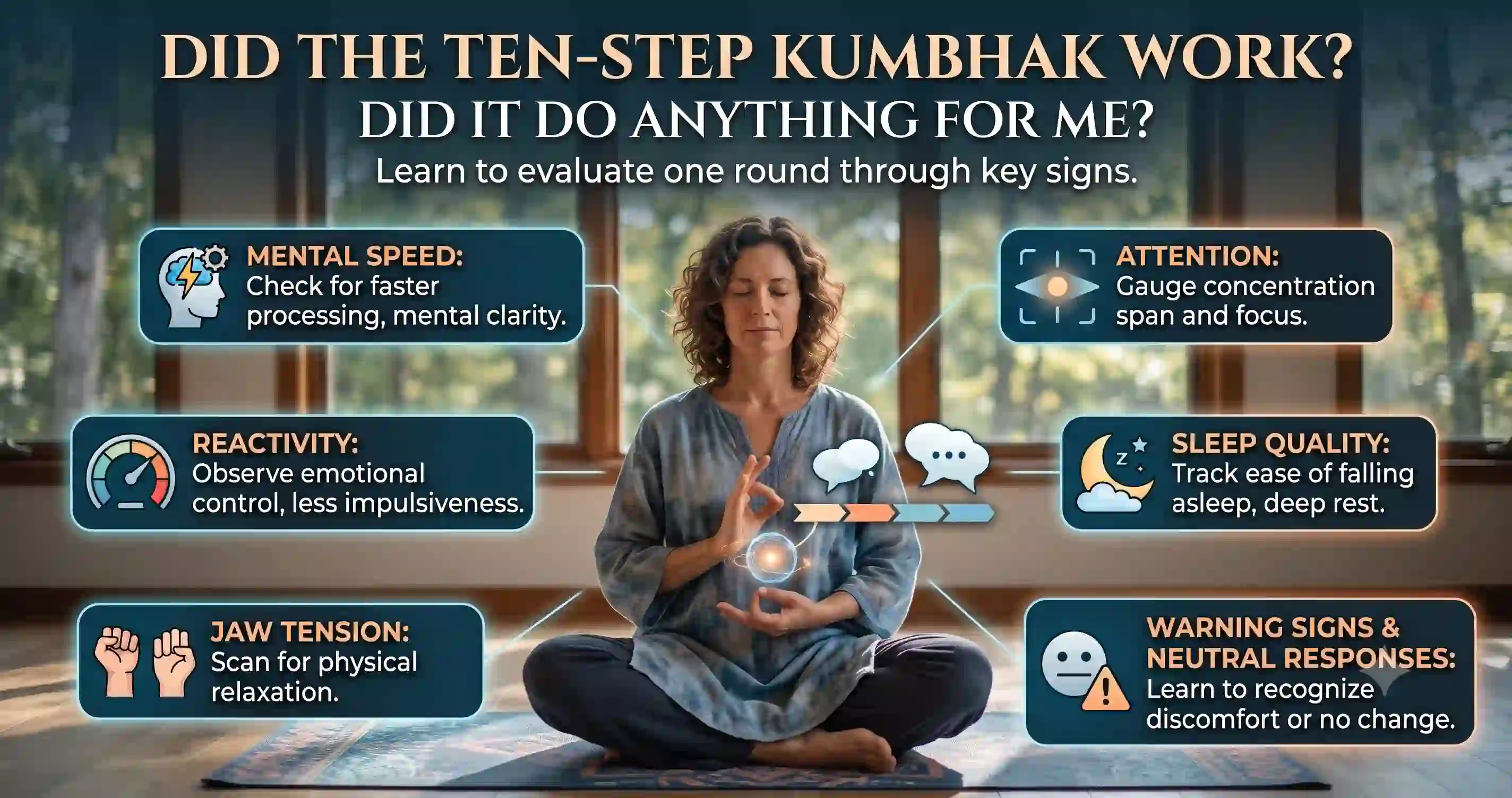
This article shows how to answer that question through six practical signs: jaw tension, mental speed, emotional reactivity, ease of attention, sleep settling and willingness to practise again. It also explains what a neutral response means, how to audit one round without rewriting the Ten-Step method, and which warning signs mean that you should stop.
Important: This article evaluates the experience; it does not teach the sequence. Learn the complete method, precautions and revised one-to-three-second comfortable reserve in How to Practice the Ten-Step Kumbhak for Stress Relief. Do not reconstruct the practice from this article.
The Quick Answer: Three Questions, One Honest Method 🧭
How do I track stress relief without timing my breath?
Compare a few signs of everyday stress before and after one round:
- Is the jaw easier, the same, harder or difficult to read?
- Are thoughts moving with less urgency, the same urgency or more urgency?
- Is there a little more space before an emotional reaction?
- Is attention easier to place and return?
- If practised near bedtime, is settling into sleep easier?
- Do you freely want to practise again?
These observations are more relevant to stress relief than a retention record.
What if one round of Kumbhak does nothing for me?
Record “unchanged”. Do not enlarge the result, hide it or force another round to make the first one look successful.
One neutral round does not prove that Kumbhak can never help you. It also does not prove that a hidden benefit occurred. It means only this:
On this occasion, after this round, you did not notice a meaningful change.
That is useful information.
Did I do Kumbhak correctly if I did not feel calm?
Possibly, yes.
Correct practice and felt outcome are different questions:
- Process question: Was the round safe, normal, comfortable, unforced and ended with reserve?
- Response question: What did you actually notice afterward?
A correctly practised round may feel calming, neutral, alerting, sleep-supportive or uncertain. Conversely, a dramatic sensation after a forced round does not make the technique correct.
Why a Retention Record Is the Wrong Score for Stress Relief ⏱️
A stopwatch measures duration—not the purpose
Breath-hold duration is influenced by many things: the amount of air present at the beginning, prior breathing, familiarity with the sensations, attention, motivation, carbon-dioxide tolerance and willingness to endure discomfort. Longer duration can therefore reflect a learned performance without proving greater calm, better sleep or wiser emotional responses.1
In research, timed breath holding has even been used as a behavioural distress-tolerance task. That makes it a measurement under test conditions; it does not turn the number into a stress-relief treatment or a score of inner health.1
For the Ten-Step Kumbhak, the intention is not to discover how long you can prevent the next breath. The relevant achievement is that both retentions remained completely easy and ended while you still knew you could have continued comfortably for at least another one to three seconds.
That reserve is a safety boundary—not a target to approach with a timer.
For the fuller safety reasoning, read Why You Should Never Hold Your Breath to the Limit in Kumbhak.
A longer hold can coexist with a worse stress response
Imagine two rounds:
- In the first, a person holds longer, tightens the jaw, waits for air hunger and finishes with a large recovery breath.
- In the second, the same person ends much earlier, remains relaxed and returns without urgency.
The first produces the larger number. The second is more faithful to the stress-relief purpose.
Laboratory research also shows why “longer” cannot simply mean “better.” During a one-minute Kumbhak in healthy participants, arterial pressure and peripheral resistance rose while stroke volume and cardiac output fell.2 That finding concerns a much longer experimental retention than this beginner practice, but it demonstrates a vital principle: a breath hold is a real physiological event, not an empty interval in which every additional second must be beneficial.
Counting can quietly turn observation into competition
A number invites comparison:
- today against yesterday;
- student against student;
- beginner against teacher;
- comfort against ambition.
Soon the person may stop asking, “Did this help me meet my evening with less friction?” and begin asking, “Did I beat my best time?”
The practice has then changed its job.
For stress relief, the best record is not the longest pause. It is the clearest observation made without strain.
The Six-Signal Stress-Relief Check: What to Notice Instead 🔎
Use one simple response scale for every sign:
- Easier or less
- Unchanged
- Harder or more
- Uncertain
“Uncertain” is not a weak answer. It prevents you from turning ambiguity into a positive claim merely because positivity feels expected.
1. Jaw tension: did the body release any unnecessary holding? 😬
Stress often appears in the mouth before a person names it in the mind. The teeth may press together, the tongue may brace, or the muscles around the jaw may remain prepared for an argument that is no longer happening. Stress is one contributor to jaw clenching and bruxism, although jaw pain and tooth grinding can also have other causes that need dental or medical assessment.3
Before one round, notice without trying to change anything:
- Are the upper and lower teeth pressing?
- Is the tongue pushing?
- Do the cheeks or temples feel contracted?
- Does the jaw feel suspended, defended or tired?
After the round and its prescribed recovery breaths, ask:
“Is my jaw easier, unchanged, harder or uncertain?”
A small reduction is enough to record. You do not need a melting sensation. Equally, an unchanged jaw is not proof that the round failed; it is one signal among six.
Persistent jaw pain, tooth damage, headaches or night grinding should not be self-diagnosed as “only stress.” A dentist or qualified healthcare professional can help distinguish bruxism, temporomandibular disorders and other causes.3
2. Mental speed: did thought lose any urgency? 💭
Do not ask whether all thoughts disappeared. That sets an unnecessarily dramatic standard.
Instead, observe their speed and insistence:
- Are thoughts arriving as if each one requires immediate action?
- Is the mind rehearsing, predicting or replaying?
- Can one thought finish before another demands attention?
- Does the inner voice feel equally fast, less hurried or more hurried?
The relevant change may not be fewer thoughts. It may be that the same thoughts feel less like an alarm.
A useful after-round question is:
“Are my thoughts moving at the same pace, or is there a little more room around them?”
Do not search so intensely for quietness that the search itself creates more mental speed. Take the first honest reading and leave it there.
3. Emotional reactivity: is there more choice before response? ❤️🩹
Stress relief does not require emotional numbness. Anger may still be appropriate. Sadness may still need to be felt. A boundary may still need to be spoken.
The practical sign is whether reaction has become less automatic:
- Can you notice irritation before sending the message?
- Can you hear another sentence before interrupting?
- Can you disagree without the whole body joining the argument?
- If upset, do you return toward your usual state with less difficulty?
This marker is often best observed at the next real-life stressor, not while sitting in a quiet room.
After the next difficult email, conversation or delay, ask:
“Was there any additional space between feeling and acting?”
Even half a moment of choice can matter. But if there was no change, record no change. Kumbhak does not deserve imaginary credit for a response it did not alter.
4. Ease of attention: is returning a little easier? 🎯
Perfect concentration is not the standard. Attention naturally moves.
Track the cost of returning:
- Can you resume the page after the mind wanders?
- Can you listen without repeatedly preparing your reply?
- Can you stay with one ordinary task for a little longer?
- When attention leaves, does returning feel easier, unchanged or harder?
A direct study found that both a Kumbhak-containing breathing session and breath awareness improved response inhibition; the retention sequence was not superior to breath awareness.4 This is a helpful reality check. Focus may improve after structured breathing, but one cannot automatically credit the holds alone.
Your personal question remains modest:
“Is attention easier to place and retrieve right now?”
5. Sleep settling: did bedtime become less of a negotiation? 🌙
Sleep is not usefully judged by demanding, “Did Kumbhak make me fall asleep?”
That demand can make sleep feel like another performance. Instead, if you practise at an appropriate time near bed, notice the settling process:
- Are you rehearsing tomorrow less insistently?
- Is there less desire to check one more message?
- Can the body remain in bed without repeatedly preparing to get up?
- When a thought arrives, is it easier to let it remain unfinished?
- Does rest feel more available, even if sleep is not immediate?
You do not need to time sleep onset. A simple morning note—easier, unchanged, harder or uncertain—is enough.
A recent randomised trial of another breathing routine containing retention reported improved self-rated sleep after four weeks, but that method bundled Kumbhak with a fixed rhythm and repeated nightly practice.6 It does not prove that retention alone caused the result, that the Ten-Step Kumbhak will produce the same outcome, or that one round must make every person drowsy.
6. Willingness to practise again: did the experience preserve consent? 🤝
This may be the most neglected marker.
Ask:
“If nobody praised me, watched me or expected me to continue, would I willingly practise another round on another occasion?”
Possible answers:
- Yes: it felt acceptable or useful.
- Maybe: I need another ordinary experience before deciding.
- No: I disliked it, felt unsafe or prefer another practice.
- Not now: the method may be acceptable, but this is not the right moment.
Willingness is not proof of physiological benefit. It is evidence about acceptability, autonomy and repeatability. A practice that makes you feel trapped, compelled or ashamed may be poorly matched to stress relief even if you can technically complete it.
You are allowed to decide that breath retention is not right for you.
How to Evaluate One Kumbhak Round Without Manufacturing an Effect 🧪
Step 1: name the context before you practise
Write one short line:
“After a tense meeting; jaw tight; thoughts rehearsing.”
Or:
“Already settled; curious; no strong stress present.”
This matters because a round begun at high activation and a round begun in an already quiet state do not have the same room for noticeable change.
Step 2: take a brief baseline—without fixing it
Before the round, choose only the signals that are relevant:
- jaw: easy / tense / uncertain;
- mental speed: spacious / ordinary / hurried;
- reactivity: low / present / high;
- attention: available / scattered / uncertain.
Do not relax the jaw deliberately during this baseline. You are observing the starting point, not improving the “before” score.
Step 3: practise one round from the complete instructions
Use the Ten-Step Kumbhak practice article for the actual sequence and precautions.
Do not:
- introduce a stopwatch;
- extend either retention to provoke an effect;
- fill the lungs to maximum;
- squeeze out every last bit of air;
- change normal Pūrak or Rechak into a performance;
- add extra rounds because the first felt ordinary.
The experiment loses meaning if the method is changed midway to obtain the hoped-for answer.
Step 4: let the prescribed recovery finish before judging
Do not declare the result during Antar Kumbhak or Bāhya Kumbhak. Sensations within a retention are not the same as stress relief after the round.
Complete the method’s recovery breaths, then ask:
- jaw: easier / unchanged / harder / uncertain;
- mental speed: less / unchanged / more / uncertain;
- immediate emotional tone: steadier / unchanged / more activated / uncertain;
- attention: easier / unchanged / harder / uncertain.
Take the first clear answer. Repeatedly interrogating the body can manufacture confusion.
Step 5: check one functional outcome later
An immediate feeling is useful, but daily function is more important.
Choose one:
- the next difficult interaction;
- the next focused task;
- bedtime settling;
- the first thought on waking;
- willingness to practise on another occasion.
This protects you from treating a brief pleasant sensation as proof of lasting stress relief.
Step 6: record the smallest honest conclusion
Examples:
“Jaw easier; mind unchanged; willing to try again.”
“No noticeable change; round remained comfortable.”
“More alert; attention easier; not sleepy.”
“Uncertain; I was already calm.”
“Felt trapped during retention; stopped; will not repeat without guidance.”
The smaller the claim, the more trustworthy the record.
What If Kumbhak Does Nothing for Me? 🌫️
“Nothing” is a valid observation—not a confession of failure
If you noticed no change, say so plainly.
Do not let anyone translate your answer into:
- “You were resisting.”
- “Your ego blocked it.”
- “You did not surrender.”
- “The calm was too subtle for you to perceive.”
- “It worked beneath awareness, so your report does not matter.”
Any of those explanations might be impossible to disprove. That is precisely why they should not be used to overrule your experience.
An honest teacher can say:
“Thank you. Unchanged is one of the possible responses.”
A neutral round can have several ordinary explanations
It may mean:
- There was genuinely no noticeable immediate effect.
- Your starting state was already settled, leaving little contrast.
- The change was smaller than you could confidently detect.
- The practice affected a later function, such as reactivity or sleep settling, rather than the immediate mood.
- Your attention was divided by noise, uncertainty or remembering the method.
- One round is not enough to reveal a repeatable pattern.
- Kumbhak may not be the right stress-relief practice for you.
These are possibilities, not excuses. You do not have to select a flattering one.
Do not chase the missing effect
When “nothing happened,” the riskiest response is to intensify:
- retaining until the urge to breathe;
- repeating rounds in rapid succession;
- taking an oversized Pūrak;
- forcing Rechak beyond comfortable emptiness;
- bracing the abdomen, throat, face or shoulders;
- breathing excessively before retention;
- treating dizziness or tingling as proof that energy moved.
The absence of calm is not permission to manufacture a stronger physiological event.
What should I do after a neutral but comfortable round?
You have three reasonable choices:
- Stop for the day: one round was the agreed experiment.
- Try on another occasion: only if you remain curious and willing.
- Choose a practice without retention: especially if ordinary breath awareness feels more acceptable.
You do not owe Kumbhak a trial of a predetermined number of days. If you voluntarily test it on several separate occasions, keep the method consistent and compare the six stress signals—not retention duration.
When does “nothing” become “this may not be for me”?
Consider another method when:
- several comfortable trials remain neutral and offer no functional value;
- you consistently dislike the retentions;
- practice increases monitoring, perfectionism or competition;
- a no-retention practice helps equally or more;
- you keep postponing practice because the experience feels unwelcome.
Stopping an unhelpful method is not a failure of discipline. It is a successful evaluation.
Did I Do Kumbhak Correctly? Separate Technique From Outcome ✅
This is an audit, not a substitute for the Ten-Step instructions.
Process markers of a correct stress-relief round
A round is more likely to have followed the intended method if:
- you practised seated in a stable, safe place;
- you followed the posture, Dhyāna Mudra and chest-centre focus taught in the complete article;
- Pūrak and Rechak remained normal—not too fast or prolonged;
- “full” meant comfortably full, not maximum lung capacity;
- “empty” meant comfortably empty, not forced emptiness;
- the face, jaw, throat, chest, shoulders, abdomen and legs remained relaxed;
- neither retention became a test;
- you ended each retention while it was still completely easy;
- you remained certain that you could have continued comfortably for at least another one to three seconds;
- no urge to breathe, strain, gasp or uneasiness was required;
- you completed the prescribed normal recovery breaths.
If the answer is yes and the result was “unchanged,” the round can still have been performed correctly.
Outcome markers are observations—not pass marks
These are all possible reports after a correct round:
Calmer
- Valid response: tension, speed or reactivity feels lower.
- It does not prove that Kumbhak works for everyone.
- Next step: record the smallest specific change.
Unchanged
- Valid response: no meaningful difference detected.
- It does not prove hidden failure or hidden success.
- Next step: stop, or test again another day only if you wish.
Alert
- Valid response: attention feels brighter or more available.
- Alertness is not the opposite of stress relief; calm need not equal sedation.
- Next step: notice whether alertness is clear and comfortable or edgy and activated.
Sleepy
- Valid response: the body feels ready to rest.
- Sleepiness is not proof of nervous-system “reset.”
- Next step: remain seated until fully oriented; distinguish ordinary drowsiness from faintness.
Uncertain
- Valid response: the change is ambiguous.
- Uncertainty protects accuracy.
- Next step: do not choose the answer you think a teacher wants.
Helpful change is specific, functional and repeatable
A helpful response usually has at least one of these qualities:
- Specific: “My jaw pressure reduced,” rather than “everything healed.”
- Functional: “I paused before replying,” rather than “I saw colours.”
- Proportionate: “A little easier,” rather than “my stress system was permanently reset.”
- Repeatable: it appears on more than one relevant occasion.
- Low-cost: it does not require strain, fear, compulsion or a recovery from the practice itself.
- Voluntary: you remain free to continue, modify or stop.
One beautiful experience may be meaningful. It is still one experience.
An uncomfortable response is not corrected by positive interpretation
If the round produced rising fear, a feeling of confinement, marked agitation or a persistent aversion, do not rename that response “deep release.”
It may simply mean:
- the retention was too long;
- the method was misunderstood;
- the context was unsuitable;
- breathlessness has a threatening association;
- another practice would be a better fit.
In a prāṇāyāma trial involving people with post-traumatic stress disorder, some participants reported anxiety, breathlessness, dizziness, constriction and a suffocation-related flashback; the primary intention-to-treat result did not show a significant advantage.8 That study tested a different and more intensive programme, not the Ten-Step Kumbhak, but it demonstrates why choice and honest reporting matter.
Warning Signs: When to Stop Kumbhak Immediately ⚠️
Stop the round and return to natural breathing if you notice
- dizziness or light-headedness;
- faintness, greying vision or tunnel vision;
- unusual breathlessness or a need to gasp;
- chest pain, pressure or tightness;
- panic, a sense of entrapment or a traumatic flashback;
- tingling, numbness or loss of coordination;
- visual disturbance, confusion or ringing in the ears;
- severe headache, unusual eye pressure or palpitations;
- any symptom that feels concerning or unfamiliar.
Do not resume until breathing and the entire body feel completely normal. If a serious or unusual symptom persists, seek appropriate medical care. Loss of consciousness, chest pain, severe breathlessness or persistent neurological symptoms warrant urgent medical evaluation.
Sleepiness and faintness are not the same
Ordinary sleepiness may feel like:
- heavier eyelids;
- reduced interest in stimulation;
- readiness to lie down at an appropriate time;
- clear awareness of where you are.
Possible faintness may feel like:
- dimming or narrowing vision;
- sudden weakness;
- ringing ears;
- nausea, confusion or instability;
- a sense that consciousness is slipping.
Treat the second pattern as a warning. Stop immediately and place safety above interpretation.
Obtain individual clinical guidance first when relevant
Consult a qualified healthcare professional before breath-retention practice if you are pregnant or have significant heart, lung, blood-pressure, neurological, cerebrovascular, fainting, seizure, retinal, glaucoma, panic or trauma-related concerns; the same caution applies after recent surgery.
The American Heart Association advises people with heart- or lung-related medical conditions to consult a healthcare professional before breathing techniques, tells first-time practitioners not to exceed three to five cycles of the techniques it describes, and says to stop if dizziness or light-headedness occurs.9 The Ten-Step Kumbhak has its own instructions and should not be confused with those other breathing patterns, but the safety principles—limited first exposure, medical guidance where appropriate and stopping at symptoms—are relevant.
Never practise breath retention while driving, swimming, bathing, operating machinery, walking somewhere unsafe or doing anything in which even brief loss of awareness could cause harm.
What Science Can—and Cannot—Tell You About One Round 🔬
Breathwork research supports possibility, not compulsory calm
A meta-analysis of randomised trials found a small-to-medium average benefit of breathwork for self-reported stress, while also warning that the field needs larger, better-controlled studies and careful avoidance of hype.10
An average effect does not prescribe an individual response. If a group improves on average:
- some people may improve substantially;
- some may improve slightly;
- some may remain unchanged;
- some may feel worse.
Your honest report does not contradict a group average. It locates where you were on that occasion.
Retention is rarely isolated from the rest of a breathing method
Many studies combine the pause with:
- a particular rhythm;
- attention to breathing;
- a longer session;
- repeated daily practice;
- instruction or teacher contact;
- meditation, Bandha or other yoga practices.
If the group improves, those designs cannot tell us which component carried the benefit.
In one study, Kumbhak-containing breathing and breath awareness both improved response inhibition.4 In a 28-day trial, several brief breathing practices and mindfulness improved mood; the clearest average pattern favoured cyclic sighing rather than a retention-based method.5 In another active-controlled trial, a hyperventilation-and-long-retention method did not show a clear stress advantage over its breathing comparator.7
These findings do not prove that Kumbhak is ineffective. They show why “I did not feel calm” cannot automatically be translated into “I did it wrong.”
A striking sensation is not the same as a helpful outcome
Tingling, light-headedness, pressure, heat or emotional intensity can feel dramatic. Drama is memorable, but it is not a validated stress-relief score.
For this practice:
- dizziness is a stop sign;
- tingling is a stop sign;
- air hunger is not a milestone;
- a gasp is not a successful finish;
- emotional overwhelm is not proof of release.
The safer question is not, “Did I feel something powerful?” It is, “Did this leave me more able to meet ordinary life?”
One round answers a narrow question
One round can tell you:
- whether you understood enough to practise within the comfort rules;
- whether any immediate response was noticeable;
- whether warning signs appeared;
- whether you are willing to try again.
It cannot establish:
- a clinical treatment effect;
- lasting change in stress, anxiety or sleep;
- the mechanism of any sensation;
- whether every future round will feel the same;
- whether retention was the active ingredient.
That is not disappointing. It is accurate experimental thinking.
Yogic Truths: The Classical Texts Do Not Require a Manufactured Testimony 🕉️
The following are traditional yogic teachings. They have philosophical and practice significance, but they are not biomedical proof that one Ten-Step Kumbhak round must reduce stress.
Yoga Sūtra 1.34 offers breath practice as one possibility
Patañjali writes:
pracchardana-vidhāraṇābhyāṃ vā prāṇasya — Yoga Sūtra 1.3411
The line is commonly understood as saying that clarity or steadiness of mind may also be supported through Rechak and retention of the breath. The small word vā—“or”—matters. The text presents a route, not a demand that every person must report the same experience.
This does not define the modern Ten-Step Kumbhak, and it does not clinically verify stress relief. It does, however, leave room for an invitational relationship with breath practice.
Yoga Sūtras 2.49–2.50 place precision inside prāṇāyāma
Yoga Sūtra 2.49 defines prāṇāyāma through interruption or regulation of the movements of inhalation and exhalation:
tasmin sati śvāsapraśvāsayor gativicchedaḥ prāṇāyāmaḥ — Yoga Sūtra 2.4912
Sūtra 2.50 then describes external, internal and suspended aspects as observed through place, time and number, becoming extended and subtle.11
The classical text therefore does recognize measurement. But measurement in a traditional discipline is not the same as turning a beginner’s stress-relief round into a personal record. “Subtle” is particularly important: refinement cannot be reduced to endurance.
Haṭha Yoga Pradīpikā 2.2 links breath movement and mental movement
cale vāte calaṃ cittaṃ niścale niścalaṃ bhavet — Haṭha Yoga Pradīpikā 2.214
The traditional proposition is that when breath is moving, mind is moving, and when breath becomes still, mind can become still. This is a yogic map, not a guarantee that every brief retention will erase thought.
A map shows a relationship to explore. It does not entitle a teacher to tell a newcomer what the newcomer felt.
Haṭha Yoga Pradīpikā 2.15 warns against force
The text compares training the breath to bringing powerful animals under regulation by degrees, warning that mishandling can harm the practitioner:
yathā siṃho gajo vyāghro bhaved vaśyaḥ śanaiḥ śanaiḥ / tathaiva sevito vāyur anyathā hanti sādhakam — Haṭha Yoga Pradīpikā 2.1514
Its historical context and methods are not identical to the Ten-Step Kumbhak. Yet its safety logic remains relevant: progress is not proved by overpowering the breath.
Yoga Sūtra 1.14 prevents one-round absolutism
sa tu dīrghakālanairantaryasatkārāsevito dṛḍhabhūmiḥ — Yoga Sūtra 1.1413
The Sūtra says that practice becomes firmly grounded when cultivated over a long period, without interruption and with sincere regard. It does not mean that a newcomer owes a fixed commitment or must persist through discomfort.
It means that one round is too small a sample for grand conclusions in either direction:
- “I felt calm once, so this always works.”
- “I felt nothing once, so this can never help.”
The honest conclusion remains smaller.
Ayurvedic Truths: Observe the Whole Person, Not One Number 🌿
The following Ayurvedic connections are traditional perspectives. They have not been scientifically verified as mechanisms or outcomes of the Ten-Step Kumbhak.
Suśruta rejects one fixed bodily measure
Suśruta Saṃhitā, Sūtrasthāna 15.37 states:
vailakṣaṇyāc charīrāṇām asthāyitvāt tathaiva ca / doṣadhātumalānāṃ tu parimāṇaṃ na vidyate15
In this edition, the verse explains that because bodies differ and change, no single fixed quantity can be given for Doṣa, Dhātu and Mala.
This is not a verse about modern breath-hold timing. Still, its underlying Ayurvedic logic is highly relevant: individual bodies and changing conditions resist one universal number.
The same person may respond differently with changes in:
- sleep;
- digestion;
- illness;
- emotional load;
- season and environment;
- familiarity with practice;
- overall strength and fatigue.
Ayurveda would not require every constitution, condition and day to produce an identical report.
Suśruta’s definition of health is broader than respiratory performance
Suśruta Saṃhitā, Sūtrasthāna 15.41 in the linked edition—numbered 15.48 in several other editions—describes health through balance of Doṣa, Agni, Dhātu and Mala together with a contented or clear state of self, senses and mind:
samadoṣaḥ samāgniś ca samadhātumalakriyaḥ / prasannātmendriyamanāḥ svastha ity abhidhīyate15
The verse does not say that health is demonstrated by holding the breath longer. It directs attention toward a much wider field.
For a modern stress-relief self-check, jaw tension, mental speed, emotional reactivity, attention, sleep settling and willingness are not Ayurvedic diagnostic criteria. Yet they honour the same broad instinct: look at lived balance across body, senses and mind, not one isolated performance number.
Do not turn a self-check into Doṣa diagnosis
It may be tempting to label:
- fast thoughts as “Vāta”;
- irritation as “Pitta”;
- sleepiness as “Kapha.”
Those associations are too simple to diagnose an individual state. Ayurvedic assessment considers a much larger pattern. A single after-round sensation should not be used to prescribe herbs, alter medication or declare a Doṣa disorder.
Traditional language can deepen reflection without becoming a substitute for a qualified Ayurvedic or medical evaluation.
Honest Agreement in a Class or One-to-One Teaching 🤲
Ask a question whose answer is not predetermined
After practice, ask:
“What changed, if anything?”
Then offer equal-status options:
- calmer;
- unchanged;
- more alert;
- sleepy;
- uncertain;
- uncomfortable.
Do not smile more warmly at “calmer” than at “unchanged.” Students quickly learn which answer earns approval.
Never announce another person’s inner state
Avoid:
- “You are calm now.”
- “Everyone can feel the nervous system settling.”
- “That silence proves the technique worked.”
- “If you felt nothing, your retention was too short.”
- “Your mind resisted the practice.”
Use:
- “What did you notice?”
- “Was the change helpful, neutral or unhelpful?”
- “Did any warning sign appear?”
- “Would you freely choose to practise again?”
The visitor is invited to observe—not required to testify.
In a group, make neutral responses visible
A useful private check is:
“Without showing anyone, choose the response that fits: helpful, unchanged, uncertain, uncomfortable.”
If people share aloud, explicitly thank each category. Silence from a group does not prove agreement, and a few enthusiastic reports do not represent every nervous system in the room.
The teacher’s most credible sentence
“Kumbhak may help you. Your honest observation will tell us whether this round felt helpful, neutral or unsuitable.”
That sentence does not weaken the practice. It strengthens trust.
A No-Timer Kumbhak Reflection Journal 📝
Copy this vertical template after a round. It deliberately contains no space for retention seconds.
Context
- Date:
- General situation:
- Stressor, if any:
- Starting state in one sentence:
Before the round
- Jaw: easy / tense / uncertain
- Mental speed: spacious / ordinary / hurried
- Emotional reactivity: low / present / high / uncertain
- Attention: available / scattered / uncertain
- Bedtime relevance: yes / no
Immediately after the prescribed recovery
- Jaw: easier / unchanged / harder / uncertain
- Mental speed: less / unchanged / more / uncertain
- Emotional tone: steadier / unchanged / more activated / uncertain
- Attention: easier / unchanged / harder / uncertain
- Overall response: helpful / neutral / unhelpful / uncertain
Later in ordinary life
- At the next stressor, was there more choice before reaction?
- At the next task, was returning attention easier?
- If near bedtime, was settling easier, unchanged, harder or uncertain?
- Did any effect remain relevant—or was it only momentary?
Safety and consent
- Warning signs: none / describe:
- Did both retentions remain completely easy? yes / no / uncertain
- Did I end with at least a one-to-three-second comfortable reserve? yes / no / uncertain
- Would I freely practise again? yes / maybe / no / not now
- Smallest honest conclusion:
Frequently Asked Questions About Tracking Kumbhak Stress Relief ❓
Should I ever time Kumbhak?
Not for this beginner stress-relief evaluation.
Timing may appear in research, traditional study or specialist training, where protocol and supervision have different purposes. Here, a timer can shift attention away from comfort and toward performance. Follow the qualitative reserve rule in the complete practice article.
Does a longer retention mean I am becoming calmer?
No. It means only that retention duration was longer under those conditions.
Calmness should be evaluated through tension, mental urgency, reactivity, attention, sleep settling and real-life function. A longer hold can occur with more effort, not less.
How many rounds should I do to test the effect?
This article intentionally does not prescribe or repeat the sequence. Begin with the amount given in How to Practice the Ten-Step Kumbhak for Stress Relief, and keep the first experiment limited.
Do not add rounds in pursuit of a reportable sensation.
How long should I keep trying if one round feels neutral?
There is no compulsory trial period.
If the round was fully comfortable and you remain curious, you may compare a few separate occasions. If it repeatedly offers no value—or you do not want to continue—choose another practice. Curiosity is enough reason to test again; guilt is not.
Is alertness a sign that Kumbhak failed to relieve stress?
No. Stress relief does not have to feel sedating. Clear, comfortable alertness may be helpful, especially before focused work.
Edgy activation, panic, marked heart pounding or inability to settle is different and should be treated as an unhelpful response or warning.
Is sleepiness a good sign?
It is a possible neutral or helpful response, especially near bedtime, but it is not proof of a particular physiological mechanism. Distinguish ordinary sleepiness from dizziness or faintness, and never practise where reduced alertness creates danger.
What if I am uncertain whether anything changed?
Write “uncertain.”
Accuracy is more valuable than certainty performed for an audience. If a useful pattern exists, it can become clearer across ordinary, comfortable experiences.
Can a watch, heart-rate monitor or HRV app tell me whether Kumbhak worked?
It can record selected signals, but it cannot decide whether you became less reactive, slept more easily or felt willing to practise again. Breathing itself strongly influences beat-to-beat heart-rate patterns, so an immediate device change should not be translated into a broad claim about health or lasting stress relief.
For most newcomers, the six lived markers in this article are simpler and more relevant.
What if breath retention itself makes me anxious?
Stop and return to natural breathing. Do not force exposure.
People with panic, suffocation-related trauma or strong fear of internal sensations may need a trauma-informed clinician or a practice without retention. A no-hold method is not an inferior moral choice.
Can Kumbhak replace treatment for stress, anxiety, insomnia or another condition?
No. It may be used as a self-regulation practice when appropriate, but it is not a replacement for diagnosis, psychotherapy, prescribed medication, dental care, sleep treatment or medical management.
If symptoms are persistent, severe, worsening or disrupting daily life, seek qualified professional care.
The Final Measure: Did the Practice Return You to Your Life? 🌱
A timer asks the breath to prove something.
Honest observation asks life a quieter question:
- Was the jaw carrying less of the day?
- Did thought lose a little urgency?
- Was there more space before reaction?
- Did attention return with less friction?
- Did bedtime require less negotiation?
- Would you willingly practise again?
Perhaps the answer is yes.
Perhaps it is no.
Perhaps it is not yet clear.
All three answers preserve the dignity of the person practising.
You do not have to manufacture calmness to validate Kumbhak. You do not have to reject Kumbhak because one round felt ordinary. Practise correctly, stop well before strain, observe honestly—and let the smallest true change be enough.
Verified Sources and Evidence Notes 📚
Evidence and link review completed 24 July 2026. This article is educational and is not medical advice.
-
Sütterlin S, Schroijen M, Constantinou E, Smets E, Van den Bergh O, Van Diest I. A behavioural breath-holding task was evaluated as a measure of distress tolerance; duration did not become a treatment or an executive-function score. Full text in PubMed Central. ↩↩
-
Nivethitha L, Mooventhan A, Manjunath NK. Cardiovascular variables changed during experimental one-minute Kumbhak in healthy participants. This mechanistic study does not establish harm from brief comfortable practice or long-term benefit from retention. Full text in PubMed Central. ↩
-
National Institute of Dental and Craniofacial Research. Bruxism includes clenching and grinding; stress management may reduce stress-related responses, while persistent symptoms warrant appropriate assessment. Bruxism overview and temporomandibular disorders overview. ↩↩
-
Saoji AA et al. Both yoga breathing with intermittent retention and breath awareness improved response inhibition in the tested sample; the Kumbhak-containing condition was not superior. Full text in PubMed Central. ↩↩
-
Balban MY et al. Brief structured respiration practices enhance mood and reduce physiological arousal. Five minutes daily for 28 days improved several measures across groups; the strongest average pattern favoured cyclic sighing, so the study does not isolate a retention benefit. Full text in PubMed Central. ↩
-
A 2026 randomised trial assigned 82 undergraduate nursing students to nightly 4-7-8 breathing or control for four weeks and reported improved self-rated sleep quality in the breathing group. The method, dose and population differ from the Ten-Step Kumbhak, and retention was not isolated from the rest of the routine. Journal abstract and study details. ↩
-
Fincham GW et al. A large active-controlled trial found that cyclic hyperventilation with long retention was not clearly more effective for reducing stress than its breathing comparator. The tested method is not the Ten-Step Kumbhak. Full text in PubMed Central. ↩
-
A pragmatic randomised trial adding a retention-containing prāṇāyāma programme to trauma-focused therapy found no significant advantage in the primary intention-to-treat analysis and documented recurrent minor adverse events in some participants, including anxiety, breathlessness, dizziness, constriction and a suffocation-related flashback. The programme differed from the Ten-Step Kumbhak. Full text in PubMed Central. ↩
-
American Heart Association. Its general breathing-technique guidance advises limited cycles for first-time practitioners, stopping with dizziness or light-headedness and consulting a professional for heart- or lung-related conditions. Stress management and breathing guidance. ↩
-
Fincham GW et al. Effect of breathwork on stress and mental health: A meta-analysis of randomised-controlled trials. The review reported a small-to-medium average stress effect while calling for better-quality research and caution against conflating promise with certainty. Full text in PubMed Central. ↩
-
Pātañjalayogaśāstra, Yoga Sūtras 1.34 and 2.50. Sanskrit text cross-checked in the Sanskrit Documents edition. Interpretations vary between commentarial traditions; the article uses a limited, practice-relevant reading. ↩↩
-
Patañjali, Yoga Sūtra 2.49, with Sanskrit and classical commentary. Verified text and translation. ↩
-
Patañjali, Yoga Sūtra 1.14. Sanskrit text checked in the Yoga Sūtra with Bhāṣya edition. Verified Sanskrit source. ↩
-
Svātmārāma, Haṭha Yoga Pradīpikā, verses 2.2 and 2.15. Verified Sanskrit chapter text. The English discussion is a concise editorial rendering, not a claim of biomedical verification. ↩↩
-
Suśruta Saṃhitā, Sūtrasthāna, Chapter 15, verses 37 and 41 in the linked recension; the well-known health definition appears as verse 48 in several other editions. The Sanskrit was cross-checked in two independent text presentations: complete Chapter 15, verse 37 and verse 41. ↩↩