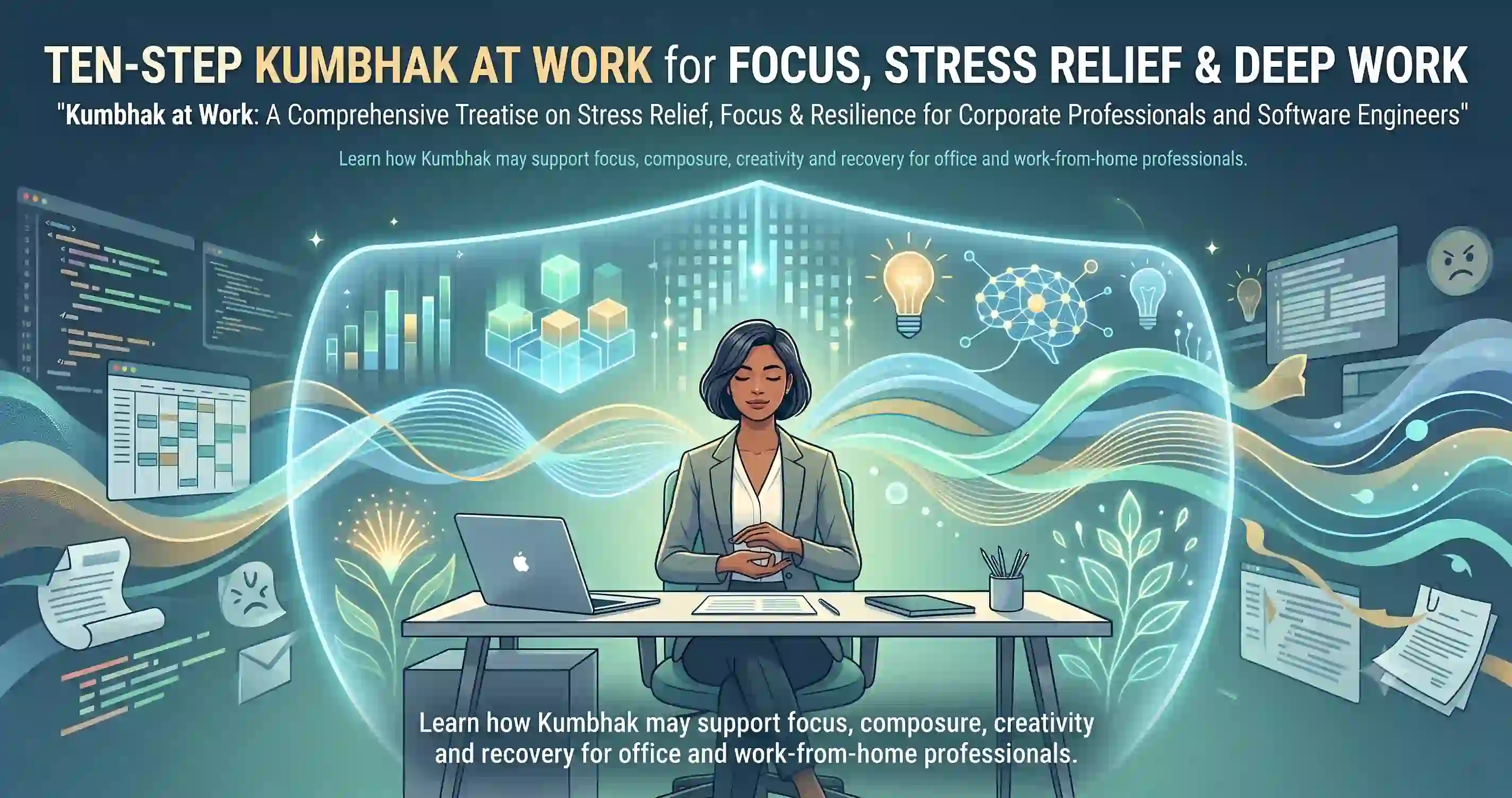
Learn how Kumbhak may support focus, composure, creativity and recovery for office and work-from-home professionals—without inflated brain or performance claims.
Kumbhak at Work: A Comprehensive Treatise on Stress Relief, Focus and Resilience for Corporate Professionals and Software Engineers 💼🫁
By Kumbhaki Yogi Dhruvaji (MSc), founder of the Antistress Foundation 501(c)(3)
• How to Practice Ten-Step Kumbhak • Scientific Proof • Ancient Texts Proof • Bio • Subscribe
At 4:52 p.m., a software engineer is holding an entire failure chain in her mind: one changed dependency, three services, an impatient client and a release window that closes in eight minutes. A message appears: “Can we deploy, yes or no?”
Her fingers reach for the keyboard before her judgement has finished arriving.
She stops—not the incident, not the clock, only the automatic reply. She turns away from the screen, completes one familiar Kumbhak round without strain, takes the required recovery breaths and returns to the facts. The defect is not fixed by breathing. The deadline is not extended. But the sentence she types is different:
“No. The dependency is not yet verified. Give me five minutes to test the rollback path.”
That answer protects the system, the client and the team.
This is the realistic promise of Kumbhak in corporate life. It is not a mystical productivity accelerator, a substitute for sleep or a way to make twelve unhealthy working hours harmless. It may create a brief interval in which the nervous system becomes less dominant, attention becomes more deliberate and the next action becomes easier to choose.
For programmers, analysts, designers, founders, managers, writers and remote workers, that interval can matter at the exact moments when work becomes expensive: before a critical call, after hostile feedback, at the edge of an impulsive message, inside a debugging deadlock or at the end of a work-from-home day that otherwise follows you into bed.
This article explains what science supports, what remains plausible, what classical Yoga and Ayurveda propose in their own language, and how to integrate the Ten-Step Kumbhak for Stress Relief into a real working day without converting a stress-relief practice into another performance contest.
Important: This article does not reproduce the Ten-Step method. Learn the exact sequence, including posture, Bhairavī Dhyāna Mudrā, normal Pūrak and Rechak, Antar Kumbhak, Bāhya Kumbhak and three recovery breaths in How to Practise the Ten-Step Kumbhak for Stress Relief. Do not improvise from summaries in this article.
The Evidence Closest to Workplace Kumbhak—Before Any Big Claims 🔬
No clinical trial has tested the exact Ten-Step Kumbhak in software engineers during coding, executives before board meetings or remote employees during deadline weeks. There is no direct evidence that it guarantees flow, increases coding speed, enlarges working-memory capacity, prevents burnout or makes teams more innovative.
There is, however, a smaller and more credible evidence chain. It begins with direct retention studies, then moves outward to retention-containing breathing methods, occupationally relevant populations and established workplace neuroscience.
Evidence card 1 — Immediate response inhibition: relevant to distraction and impulsive replies
What was studied: Thirty-six healthy, yoga-trained adults completed a 20-minute four-phase breathing session containing Pūrak, Antar Kumbhak, Rechak and Bāhya Kumbhak. On another occasion, they practised breath awareness.
What changed: Stop-signal reaction time improved after both sessions. This laboratory task measures the ability to interrupt an initiated response.
Why it matters at work: Response inhibition is relevant when you want to open another tab, interrupt a colleague, send a defensive message or act before checking a production assumption.
The limit: Kumbhak was not better than breath awareness. The study does not show better job performance, and it cannot assign the effect specifically to retention.1
Evidence confidence: Low, but directly relevant.
Evidence card 2 — Eight weeks: mindfulness, mind-wandering and anxiety
What was studied: In a randomised trial of 116 young adult yoga practitioners, one group added 20 minutes of breathing with intermittent retention each day for eight weeks; the comparison group continued its usual yoga.
What changed: The added-practice group reported greater improvement in mindfulness, mind-wandering and state-anxiety measures.
Why it matters at work: Noticing that attention has wandered is the first condition for returning it. Lower state anxiety may also leave more mental capacity available for the actual task.
The limit: Participants already practised yoga. The breathing sequence was not the Ten-Step Kumbhak, and retention was not isolated from rhythm, repetition and attention.2
Evidence confidence: Low.
Evidence card 3 — Kumbhak is physiologically active, but “active” does not automatically mean “beneficial”
What was studied: In 15 trained healthy men, a one-minute internal Kumbhak increased measured middle cerebral artery flow velocities. In a separate study of 20 healthy adults, one-minute Kumbhak altered cardiovascular function: arterial pressure and peripheral resistance rose during the hold, while stroke volume and cardiac output fell.34
Why it matters at work: Retention is not merely a motivational ritual. It changes carbon dioxide, circulation and pressure within seconds.
The limit: These were demanding one-minute holds, not the short, reserve-preserving retentions of the Ten-Step method. Increased cerebral flow is a compensatory response, not proof of improved memory or “more brain power.” A pressure rise during retention also disproves the simplistic claim that every Kumbhak is automatically parasympathetic or blood-pressure-lowering.
Evidence confidence: Moderate for the immediate physiological response; no direct evidence of workplace benefit.
Evidence card 4 — Occupationally relevant studies: promising, but not Ten-Step proof
Working women: An open-label trial involving 100 working women with anxiety symptoms reported improvement after a traditional retention-centred programme. It used several practices, lacked a credible active breathing comparator and needs independent replication.5
Paramedicine students: A 2026 randomised trial tested a twice-daily breathing routine with a two-second post-Rechak pause during a stressful academic period. Stress, anxiety, depression and resilience improved more than in the comparison condition, while wellbeing and insomnia did not clearly improve. The pause was only one component of a 10-minute paced-breathing routine.6
Why these matter: They show that a structured breathing routine containing a pause can be feasible under sustained performance pressure.
The limit: Neither study tested the Ten-Step Kumbhak or corporate knowledge work. They support a possibility, not a promise.
Evidence confidence: Low; very low for the working-women study.
Evidence card 5 — Brief breathwork helps mood, but stronger retention has not proved superior
In a randomised trial of 108 completers, five minutes of daily breathwork or mindfulness for 28 days improved mood and reduced anxiety. The clearest average pattern favoured cyclic sighing, a Rechak-emphasised method without extended retention. Box breathing and a hyperventilation-retention method also improved within their groups, but this does not isolate a Kumbhak effect.7
In a blinded trial of 200 healthy adults, three weeks of high-ventilation breathwork with long retentions was not superior to a credible normal-rate breathing comparison with brief pauses for stress, anxiety, depression, wellbeing or sleep-related impairment.8
Workplace meaning: A stronger hold is not demonstrably a stronger stress intervention. The Ten-Step rule—leave clear reserve and never test the limit—is consistent with both safety and the present evidence.
The honest verdict for corporate readers
Supported: Voluntary retention changes respiratory gases, cerebral haemodynamics and cardiovascular function. Some breathing methods containing Kumbhak can improve stress-related or attention-related measures.
Plausible: One completely easy Ten-Step round may interrupt automatic reactivity, organise attention and make a deliberate return to work easier.
Not established: Better code, larger memory capacity, guaranteed flow, direct cortisol reduction, DMN shutdown, BDNF release, HIF-1α activation, “brain oxygenation,” immunity enhancement, creativity on demand or burnout prevention.
The defensible chain is:
practice may change immediate state → a changed state may support a better work behaviour → repeated better behaviours may improve the workday
The indefensible chain is:
hold the breath → become a high performer
Why Knowledge Work Can Feel Like a Physical Emergency 🧠💻
The corporate worker may be physically still while the nervous system is repeatedly mobilised. A red incident dashboard, ambiguous message from a manager, failed build or sudden calendar invitation can create uncertainty, social threat and time pressure even though no muscular escape or action is required.
Acute, uncontrollable stress can weaken the prefrontal functions used for working memory, flexible judgement and top-down control while strengthening habitual or emotionally driven responding.9 Task switching adds another cost: when people leave one unfinished task for another, part of attention can remain attached to the first task—a finding known as attention residue.10
For a software engineer, the practical loss is painfully familiar. The code is still on the screen, but the mental model has vanished. The person must reconstruct why a variable exists, which assumption was provisional and what the next test was meant to establish.
The corporate stress loop
The loop often looks like this:
trigger → bodily activation → narrowed interpretation → urgent action → mistake or conflict → more activation
Examples include:
- A deployment fails, the chest tightens and the engineer changes three variables at once.
- A manager writes “Please call me,” the mind predicts dismissal and concentration disappears for an hour.
- A colleague questions a design, the jaw braces and technical discussion becomes identity defence.
- A remote worker finishes one call, opens email immediately and carries the emotional residue into the next decision.
- A developer reaches the first difficult edge of a task and opens a news tab—not from lack of ability, but because uncertainty has become physiologically uncomfortable.
Kumbhak cannot remove the trigger. Its possible value lies at the transition between activation and action.
“Screen apnea” is a useful observation—not a medical diagnosis
Technology writer Linda Stone coined email apnea, later broadened to screen apnea, after noticing that people sometimes suspend or restrict breathing while reading or composing digital material. Her often-repeated “80%” figure came from informal observations, not a population study, so it should not be quoted as scientific prevalence.11
The idea is still experientially useful. You can check it without believing a statistic:
- Does your breathing become irregular while debugging?
- Do you begin a message on an inhalation and fail to complete an ordinary Rechak?
- Do your shoulders rise when an alert arrives?
- Do your jaw, throat or abdomen brace while you wait for a page to load?
- Do you sigh repeatedly after a long period of screen concentration?
Unconscious screen-related breath restriction and deliberate Kumbhak are not the same event.
Unconscious restriction is unchosen, often incomplete, mixed with muscular bracing and allowed to persist without a defined recovery phase.
Ten-Step Kumbhak is chosen, seated, structured, time-limited, paired with normal nasal Pūrak and Rechak, ended with reserve and followed by three normal recovery breaths.
Conscious retention does not “cancel” a day of irregular breathing. It can make the pattern noticeable and provide a clean interruption.
Kumbhak is an individual tool, not a cure for a harmful work system
Long hours, understaffing, harassment, impossible deadlines, unpaid availability, surveillance, low decision authority and chronically conflicting priorities are organisational problems. A breathing practice must never be used to imply that the worker’s nervous system is the only defect.
WHO and ILO estimates associate working 55 or more hours per week with higher risk of ischaemic heart disease and stroke than working 35–40 hours.12 No Kumbhak protocol makes unsafe working hours safe.
The most responsible model has two levels:
Personal regulation: Kumbhak, movement, sleep, nutrition, boundaries, clinical care and recovery.
Work design: realistic workload, staffing, autonomy, clear priorities, psychological safety, protected breaks and the right to disconnect.
A worker may use Kumbhak to answer a harmful request clearly. An employer may not use Kumbhak to avoid changing the harmful request.
The Neurobiology of Retention—Without the Corporate Biohacking Myths ⚙️
Kumbhak sits at a rare boundary: breathing is automatic, yet it can be consciously interrupted. That makes it a potent object of attention and a real physiological perturbation. It does not make every popular explanation true.
Carbon dioxide rises; oxygen may fall; the stopwatch cannot tell you the internal dose
During a closed-airway hold, metabolism continues. Carbon dioxide (CO₂) generally rises. If the hold continues long enough, oxygen falls. How much either changes depends on starting lung volume, preceding breathing, metabolism, health, training and hold duration.
The urge to breathe is influenced strongly by CO₂ and acidity, but it is not a perfect oxygen alarm. This is why hyperventilation before retention is dangerous: lowering CO₂ can postpone the urge to breathe without creating a comparable oxygen reserve.
With repeated practice, a person may become more familiar with the sensations accompanying CO₂ accumulation and may use less unnecessary muscular effort. That is better described as greater comfort with the respiratory pause than as proven “chemoreceptor rewiring.” A two-week training study increased maximum holding time without a significant change in ventilatory CO₂ sensitivity, reminding us that a longer hold can reflect learning, technique or tolerance rather than a transformed stress system.13
For workplace stress relief, internal gas targets are unnecessary. The relevant boundary is subjective and conservative: every retention ends while it remains completely easy and clearly below the first urge, strain or uncertainty.
The Bohr effect is real; “more oxygen to the prefrontal cortex” is not established
As CO₂ rises and pH falls, haemoglobin’s affinity for oxygen decreases, which can support oxygen unloading in metabolically active tissue. This is the Bohr effect.
But several additional variables change during retention: arterial oxygen content, cerebral blood flow, cardiac output, blood pressure and local metabolism. A textbook mechanism cannot by itself establish that a short desk Kumbhak delivers more usable oxygen to the prefrontal cortex or improves coding.
The careful statement is:
CO₂ accumulation during Kumbhak alters oxygen-binding conditions and cerebral vascular tone; direct cognitive benefit from that gas change has not been proved.
This distinction protects both credibility and safety. A compensatory response should not be sold as a performance upgrade.
Cerebral blood-flow velocity can rise—but flow is not the same as focus
The one-minute internal-retention study in trained men found increased middle cerebral artery flow velocities.3 This is physiologically coherent because CO₂ is a strong cerebral vasodilator.
The brain is defending delivery during a respiratory challenge. The finding does not establish:
- more neurons firing efficiently;
- improved working memory;
- greater creativity;
- removal of “brain fog”;
- neurogenesis;
- brain detoxification;
- dementia prevention;
- or a safe reason to lengthen the hold.
A useful analogy is a data centre increasing cooling during a heat event. More cooling activity is protective in context; it does not prove that creating more heat improves computation.
Kumbhak does not produce one universal “vagal” state
Breathing, heart rate and blood pressure interact through respiratory mechanics, chemoreflexes, baroreflexes and autonomic control. The result depends on the phase, duration and intensity of the hold.
During sufficiently demanding Kumbhak, blood pressure and peripheral resistance can rise while stroke volume and cardiac output fall.4 Other structured breathing sessions containing brief holds have shown post-session reductions in stress or blood pressure, but those results include effects of rhythm, attention, Rechak, expectation and rest.
Therefore:
- Antar Kumbhak is not automatically energising.
- Bāhya Kumbhak is not automatically sedating.
- Neither is guaranteed to “activate the vagus nerve.”
- Heart-rate variability is not a direct meter of spiritual calm or executive fitness.
- An acute pressure rise during a hold can coexist with a calmer feeling after the practice.
The Ten-Step method’s value lies in its complete sequence and reserve, not in assigning a single nervous-system label to each pause.
Breathing and arousal are connected, but much of the circuit evidence comes from animals
In mice, researchers identified a small group of breathing-centre neurons that projects to noradrenergic locus-coeruleus neurons involved in arousal.14 This is important biological evidence that respiratory pattern and arousal are connected.
It is not direct evidence that a particular human Kumbhak sequence switches off the locus coeruleus, releases a chosen amount of norepinephrine or makes a programmer deadline-proof. Animal circuitry establishes plausibility, not a corporate outcome.
Nasal breathing influences human limbic rhythms; this is not retention-specific proof
Human intracranial recordings show that natural nasal respiration entrains activity in piriform cortex, amygdala and hippocampus. In parallel behavioural tests, respiratory phase influenced fear discrimination and memory retrieval; several effects weakened with mouth breathing.15
This supports the Ten-Step method’s use of nasal Pūrak and Rechak. It does not prove that Kumbhak improves memory, because the study examined natural respiratory phase and airflow, not conscious retention.
The most credible memory connection is therefore indirect:
normal nasal breathing + deliberate attention + lower distraction + adequate recovery may support the conditions in which information is encoded and retrieved
That is meaningful without claiming that a breath pause expands the hippocampus.
Attention and interoception may matter more than hypoxia
During an easy Kumbhak, internal sensation becomes difficult to ignore. The practitioner can notice chest position, heartbeat, muscular bracing, emotional urgency and the desire to end the pause.
This is interoception—awareness of the body’s internal condition. In a work context, it can reveal the state beneath the story:
- “I am calling this design stupid while my jaw is clenched.”
- “I am about to promise a deadline while my chest feels trapped.”
- “I am checking messages because uncertainty feels intolerable.”
- “I am not listening; I am rehearsing my defence.”
Sensation does not decide whether the thought is correct. It adds missing information: I am evaluating this while activated.
The response-inhibition study, in which breath awareness performed as well as retention, suggests that attention itself may be a substantial part of the effect.1
Kumbhak does not “flush cortisol,” manufacture GABA or release BDNF on demand
The attached drafts repeatedly connected desk Kumbhak with immediate cortisol removal, GABA release, BDNF elevation, HIF-1α activation, mitochondrial biogenesis, DMN suppression and alpha–theta dominance. Those claims are not supported by direct research on the Ten-Step Kumbhak.
Some controlled hypoxia, whole-yoga or compound breathwork studies measure selected biomarkers. Their interventions are not equivalent to a short, comfortable Kumbhak round. Mechanistic possibility must not be presented as measured fact.
For a credible workplace article, the correct wording is:
- Kumbhak may support stress recovery; it has not been shown to clear cortisol within minutes.
- It may interrupt rumination; it has not been shown to switch off the DMN during coding.
- It may support attentive calm; no direct study shows a prescribed alpha–theta state.
- Comfortable practice need not produce meaningful hypoxia, and there is no reason to chase it.
- HIF-1α, BDNF and mitochondrial claims are unestablished for ordinary Kumbhak.
Scientific restraint does not make the practice empty. It keeps the reader from confusing a useful pause with a biochemical guarantee.
Kumbhak for Cognitive Focus, Deep Work and Memory 🎯
Deep work is not merely “concentration.” It requires a stable task goal, protection from interruption, enough working memory to hold the problem, emotional tolerance for uncertainty and a clear criterion for stopping or continuing.
Kumbhak can support the doorway. It cannot furnish the entire room.
Use Kumbhak as an entry ritual—not as another task performed while coding
Do not retain the breath while actively typing, debugging a live system or trying to listen on a call. That divides attention and can turn the practice into unconscious bracing.
Instead, create a clean threshold:
- Stop the work and turn away from the screen.
- Complete the familiar Ten-Step round without shortening any phase to fit a timer.
- Finish all three normal recovery breaths.
- State the next concrete work action in one sentence.
- Begin that action before reopening communication channels.
The breathing round changes state; the one-sentence action gives that state direction.
“Work on authentication” is too vague.
“Reproduce the expired-token failure in one test” is actionable.
Kumbhak followed by vagueness can become peaceful procrastination. Kumbhak followed by a defined next step can become a deep-work threshold.
Distraction is not defeated by willpower alone
A notification is designed to recruit attention. An unfinished task also remains cognitively active. Kumbhak cannot block either one technologically.
Pair the practice with an environmental agreement:
- mute non-urgent notifications for one defined work block;
- close inbox, chat and news tabs;
- keep only the files required for the current problem;
- write a one-line “return note” before every unavoidable interruption;
- define how colleagues should contact you for a genuine emergency;
- and schedule a later communication window so the mind does not fear missing everything.
The return note should answer three questions:
- What am I trying to establish?
- What have I ruled out?
- What is the next test?
One Kumbhak round can clear the emotional transition. The note preserves the technical state.
Working memory: protect capacity rather than promise expansion
Working memory is the limited mental workspace used to hold and manipulate information. Stress and distraction consume part of it. That can make a competent engineer feel suddenly unable to understand code they wrote yesterday.
There is no convincing evidence that the Ten-Step Kumbhak directly increases working-memory capacity. A more defensible benefit is load reduction:
- a pause may reduce the urgency competing with the task;
- breath-centred attention may interrupt repetitive worry;
- a defined recovery interval may reduce immediate context spillover;
- and returning with one goal may use existing capacity more efficiently.
If five variables must be remembered, externalise four. Use notes, diagrams, tests and checklists. Kumbhak should not become a reason to keep an unsafe amount of complexity in the head.
Flow cannot be commanded, but its conditions can be protected
Flow is more likely when challenge and skill are reasonably matched, goals are clear, feedback is immediate and interruptions are limited. No study shows that Kumbhak switches a person into flow.
It may help with three preconditions:
Arrival: attention leaves the previous meeting and reaches the present task.
Arousal calibration: the person becomes neither frantic nor disengaged.
Commitment: the next action is chosen before distraction is invited back.
Do not evaluate the practice by whether time disappeared or code felt effortless. Evaluate whether you began the right task, stayed with it and made fewer state-driven mistakes.
Memory power at work depends on more than respiration
Memory at work includes at least four different functions:
Encoding: receiving the requirement accurately.
Working memory: holding part of it while reasoning.
Consolidation: stabilising learning over time, strongly influenced by sleep.
Retrieval: finding the information when needed.
Kumbhak may support the attention surrounding encoding and retrieval. Nasal breathing research adds plausible relevance.15 But reliable professional memory still depends on:
- adequate sleep;
- spaced retrieval and repetition;
- written decisions;
- code comments that explain why, not merely what;
- meeting summaries with ownership and dates;
- reduced multitasking;
- treatment of hearing, mood, medication, thyroid, vitamin, sleep-apnoea or neurological problems when relevant;
- and psychological safety to ask, “Can you repeat that?”
If forgetfulness is new, progressive or affecting daily function, seek medical assessment rather than increasing Kumbhak.
A practical deep-work equation
For knowledge work, the useful unit is not “breath-hold seconds.” It is:
one complete round + one explicit task + one protected block + one recorded outcome
Examples of recorded outcomes:
- number of unplanned tab switches;
- time until first voluntary distraction;
- whether the planned test was completed;
- number of avoidable changes made during an incident;
- clarity rating five minutes after the round;
- and whether the same result occurred after normal breath awareness without retention.
The last comparison matters. If normal breathing without Kumbhak gives the same benefit, choose the lower-intensity tool when appropriate.
High-Stakes Performance: Deadlines, Critical Calls and “Survival of the Fittest” 🚨
Pressure changes what the mind selects. Under threat, speed feels like competence, certainty feels safer than ambiguity and action feels better than waiting for one more piece of evidence. In a true emergency, rapid action may be necessary. In many corporate emergencies, however, the costliest move is an unverified action made to escape the feeling of urgency.
Kumbhak is most useful here as a pre-action checkpoint, not a promise that the practitioner will never panic.
Production incidents and deadline crises: regulate without delaying essential action
If immediate safety, security or system containment is required, act first according to the incident plan. Do not delay evacuation, emergency communication, a security lockout or an established rollback merely to complete a breathing practice.
When a short decision window exists, use this sequence after the complete Ten-Step round and recovery breaths:
Fact: What is directly known?
Unknown: What are we assuming?
Reversible move: What is the safest action we can undo?
Owner: Who makes the decision?
Next check: What result will tell us whether it worked?
This turns a physiological pause into operational discipline.
Consider two incident messages:
“Everything is broken. I’m changing the cache, database pool and retry policy now.”
“Checkout failures began after release 418. I’m rolling back that release only, then measuring error rate for five minutes.”
Kumbhak does not generate the second message. It may help the engineer remain present long enough to write it.
Critical calls: practise before speaking, never while speaking
Voice quality reflects breathing, laryngeal tension, posture, pacing and emotion. There is no direct trial showing that Kumbhak deepens the voice or prevents vocal tremor on corporate calls.
The realistic pathway is behavioural:
- practising before the call gives the jaw, throat and shoulders a chance to unclench;
- a completed recovery phase reduces the temptation to begin speaking on residual air;
- comfort with silence can make conversational pauses less threatening;
- a calmer start can reduce rushed phrasing;
- and the post-round intention can shift attention from performing to listening.
After the round, choose one speaking agreement:
- “I will finish one sentence before adding another.”
- “I will answer the question asked.”
- “I will say when I do not know.”
- “I will allow two seconds before replying to criticism.”
- “I will summarise the other person’s concern before proposing a solution.”
Do not hold the breath during another person’s turn in an attempt to appear calm. Keep breathing normally and listen. Kumbhak belongs before or after the call, not hidden inside the conversation.
Interviews, performance reviews and difficult one-to-ones
Social-evaluative threat can make a person over-explain, agree too quickly or defend before understanding the feedback. One round before the meeting can support a more accurate internal contract:
“I do not have to eliminate anxiety. I need enough steadiness to hear, clarify and answer truthfully.”
Useful questions after feedback include:
- “Can you give me one specific example?”
- “What impact did you observe?”
- “What would improvement look like in behaviour?”
- “Which part is urgent, and which part can be reviewed later?”
- “May I take a moment to think before answering?”
Stress relief becomes professionally valuable when it improves the quality of the question—not when it creates a polished appearance of calm.
“Survival of the fittest” means adaptability, not permanent activation
The corporate phrase is often used to glorify long hours, internal competition and emotional suppression. Biologically, fitness is not synonymous with continuous expenditure. A resilient system can mobilise when needed, recover when the demand passes and preserve capacity for the next challenge.
Kumbhak can become a small rehearsal of that pattern:
mobilisation is allowed → the pause is tolerated → breathing resumes → recovery is completed → action continues
The work lesson is not “endure anything.” It is:
- distinguish a real emergency from manufactured urgency;
- spend energy on the highest-value constraint;
- recover deliberately after the demand;
- decline avoidable heroics;
- and preserve enough capacity to make tomorrow’s decision well.
A team that survives by repeatedly exhausting its most responsible people is not fit. It is consuming its redundancy.
Burnout: Kumbhak may support recovery, but it cannot cure work design
Burnout is commonly described through exhaustion, mental distance or cynicism toward work and reduced professional efficacy. It is not resolved by adding one more self-improvement obligation to an overloaded employee.
Kumbhak may help a suitable person:
- notice activation before it becomes an evening of rumination;
- mark a boundary between work and home;
- pause before accepting another unrealistic commitment;
- create a repeatable recovery cue;
- and recognise that ordinary stress symptoms are becoming persistent.
It cannot:
- restore sleep while late-night work continues;
- fix understaffing;
- protect against harassment;
- replace treatment for anxiety, depression or insomnia;
- compensate for prolonged immobility;
- make 55-hour workweeks harmless;
- or convert a coercive culture into a healthy one.
When exhaustion, cynicism, sleep disturbance or reduced function persist, the response may need workload change, leave, occupational-health support, psychotherapy, medical assessment or a job transition. Breathing is allowed to be one part of care without being made responsible for all of it.
Creativity, Innovation and Team Dynamics 💡🤝
Creative work alternates between two modes:
Convergent mode: test, compare, eliminate and select.
Divergent mode: loosen the current frame, generate alternatives and connect distant ideas.
Corporate pressure can trap a person in premature convergence: the mind keeps applying the same rule because the cost of uncertainty feels too high. Kumbhak may help create a real interruption, but there is no direct evidence that Bāhya Kumbhak activates the default mode network, produces alpha bursts or causes an “aha” moment.
The useful mechanism can be simpler: stop feeding the stuck loop, change bodily state, widen attention and return with a different question.
The intellectual-deadlock reset
When effort has become repetitive rather than productive:
- Write the exact problem in one sentence.
- Record what has already been ruled out.
- Leave the screen and complete a familiar Ten-Step round.
- Take all three normal recovery breaths.
- Look at a distant object or walk safely for a few minutes while breathing normally.
- Return and generate three explanations, including one that contradicts your favourite theory.
- Test the cheapest discriminating experiment first.
The round separates you from the loop. The written constraint prevents the break from becoming avoidance. The alternative hypotheses create the creativity.
Creativity needs incubation, not oxygen mythology
Insight sometimes appears after disengagement because the problem is no longer held in the same narrow configuration. A shower, walk, sleep period or unrelated task can support incubation. Kumbhak can serve as a compact boundary before that incubation.
Do not explain the resulting idea by claiming that the hold flooded the right hemisphere with oxygen, released BDNF or opened a creativity centre. Evaluate the idea by its quality:
- Does it explain the evidence?
- Is it simpler than the current design?
- What new risk does it introduce?
- Can it be tested cheaply?
- Does it help the user?
- Would it still look good after sleep?
The pause deserves credit for creating room, not for certifying what entered it.
Emotional intelligence begins with state detection, not enforced calm
Technical teams rarely fail from logic alone. They fail when status, fear and identity become invisible participants in the discussion.
Kumbhak may help a person detect:
- heat before sarcasm;
- throat tension before agreement they do not mean;
- chest pressure before interrupting;
- excitement before overpromising;
- and fatigue before misreading brevity as hostility.
Detection creates an option. Emotional intelligence still requires skills that breathing cannot supply automatically:
- accurate listening;
- naming uncertainty;
- distinguishing intent from impact;
- asking permission before advising;
- giving specific feedback;
- repairing harm;
- allowing disagreement;
- and setting boundaries when behaviour is unsafe.
Kumbhak can prepare a wiser response. It cannot choose the response or make it ethical.
A team pause must be voluntary and psychologically safe
Mandatory breath retention in a meeting is inappropriate. Some people have cardiovascular, respiratory, pregnancy-related, neurological, panic, trauma or cultural reasons not to participate. Power differences can make a public “choice” feel compulsory.
If a team wishes to experiment, use an ethical frame:
“We’ll take two quiet minutes to arrive. You may practise your familiar Kumbhak, breathe normally, look away from the screen or simply sit. Cameras may be off. No one needs to report an effect.”
Good team practice includes:
- an equally respected no-retention option;
- no public measurement of hold time;
- no claims that everyone is calmer afterward;
- no medical disclosure;
- no recording;
- no use during emergency response if it delays action;
- and a short evaluation of whether the pause improved the meeting.
The goal is not synchronized compliance. It is enough shared quiet for truthful participation.
The regulated leader does not export self-control as a demand
A leader who practises Kumbhak privately may become less reactive. That does not authorise the leader to diagnose colleagues as dysregulated or tell an upset employee to breathe instead of addressing the issue.
The most valuable leadership applications are visible in behaviour:
- pausing before assigning blame;
- separating the incident review from the person’s worth;
- asking what the system allowed;
- making workload priorities explicit;
- admitting uncertainty;
- protecting recovery after a crisis;
- and treating “no” as data rather than disloyalty.
The calmest voice in the room can still be wrong. Regulation improves the possibility of judgement; it does not confer authority over truth.
Practical Desk Integration: One to Five Minutes Without Rewriting the Ten Steps 🪑⏱️
The micro-practices below do not invent new ratios or isolate one hold from the Ten-Step sequence. Each uses only a complete, already-learned Ten-Step round, including both Antar Kumbhak and Bāhya Kumbhak and all three recovery breaths.
The clock limits the break, never the breath. If a full round does not fit without rushing, use normal breath awareness and practise later.
Desk posture and workspace setup
Before beginning:
- Sit in a stable chair with both feet supported by the floor or a footrest.
- Let the back be naturally and comfortably upright; use back support if useful.
- Move far enough from the desk that the abdomen, chest and hands are not compressed.
- Lower the shoulders and release the jaw, throat, face, chest, abdomen and legs.
- Place the hands in Bhairavī Dhyāna Mudrā as taught in the complete practice guide, rather than leaving them on the keyboard.
- Keep the mouth closed and practise through the nose.
- Turn away from the screen or let it sleep.
- Remove headphones if they reduce awareness of dizziness, an alarm or another safety cue.
This setup does two useful things before any retention occurs: it interrupts task contact and makes the body a stable place from which to notice state.
The 1-minute decision gate
Best for: an impulsive reply, an unexpected message or the moment before accepting a deadline.
Use: If one complete familiar round—including recovery—fits easily, complete it. If not, omit retention and take normal breaths until the minute ends.
Afterward, ask:
“What decision actually has to be made now?”
Then choose: reply, clarify, delay, document or escalate.
The success measure is not feeling calm. It is avoiding an action that the available evidence did not yet justify.
The 2-minute pre-call arrival
Best for: stand-ups, interviews, feedback, client calls and presentations.
Use: Complete one or more familiar rounds only if each fits without any compression. Preserve the full recovery phase.
Afterward, write one line:
“The person on the other side most needs me to understand ______.”
This redirects attention from self-presentation toward listening. If the call begins immediately, keep breathing normally. Do not add hidden holds while waiting to speak.
The 3-minute deep-work threshold
Best for: coding, analysis, writing, architecture and complex review.
Before the round: Close communications and write the next test or output.
Use: Complete as many unhurried, familiar rounds as fit, never chasing a count.
After recovery: Begin the written action and protect a realistic focus block.
End-of-block record:
- Did I complete the intended test?
- How many unplanned switches occurred?
- What is the next state-preserving note?
This protocol combines respiratory regulation with attention engineering.
The 4-minute creative unblock
Best for: repeated debugging loops, design fixation and stalled writing.
Before practice: Save work and write the current theory.
Use: Step away from the screen, complete familiar rounds and finish all recovery breaths.
Afterward: Spend the remaining time looking at distance or walking in a safe area while breathing normally. Return and list three alternative models.
Kumbhak is the state break. Distance vision and movement change the sensory context. Alternatives reopen the intellectual search.
The 5-minute work-from-home boundary
Best for: replacing the missing commute and protecting family or personal time.
Before practice: Close work applications, write tomorrow’s first action and physically turn away from the workstation.
Use: Complete only the number of familiar rounds that fit with full reserve and recovery.
Afterward: Perform one visible boundary action:
- cover the monitor;
- change clothes;
- wash the face;
- leave the work room;
- switch the lighting;
- or take a normal walk.
The external action tells the environment what the internal pause has begun: work is no longer the current role.
A realistic eight-hour desk rhythm
Before opening work: One familiar round, followed by the day’s single highest-value outcome.
Before the first deep-work block: A 3-minute threshold.
After an unavoidable context switch: Normal breath awareness or one round, plus a written return note.
Before a high-stakes call: A 2-minute arrival.
After a conflict or incident: One round only after immediate safety and operational duties are covered.
At lunch: Movement, daylight, hydration and food—not more seated breath practice as a substitute for leaving the chair.
Mid-afternoon: Check for screen-related breath restriction. Use the lower-intensity option if tired, dizzy, hungry or over-caffeinated.
At shutdown: A 5-minute boundary ritual.
Frequency should grow from usefulness, not compulsion. More rounds are not evidence of better work.
When a desk micro-practice should become a movement break instead
Choose standing, walking, stretching, water, food, daylight or rest when the main problem is:
- prolonged sitting;
- eye strain;
- sleepiness;
- neck or back discomfort;
- hunger;
- dehydration;
- loss of circulation from immobility;
- or many hours without natural light.
Kumbhak is not an ergonomic intervention, exercise session, meal or sleep period. The body should not be asked to breathe its way out of every unmet need.
The Classical Yogic View: Why the Pause Is Linked with Steadiness 🕉️
Classical Yoga does not describe Kumbhak as a corporate optimisation method. Its horizon is far deeper: restraint of Prāṇa, stilling of citta, concentration, meditation and liberation. Applying its insights at work is a modern interpretation, not the historical purpose of the texts.
The following verses are authentic. They provide textual and contemplative evidence, not clinical proof of workplace outcomes.
Yoga Sūtra 2.49–2.50: Prāṇāyāma includes interruption, measure and subtlety
Patañjali defines Prāṇāyāma after the establishment of posture:
tasmin sati śvāsa-praśvāsayor gati-vicchedaḥ prāṇāyāmaḥ — Yoga Sūtra 2.49
A careful translation is: When that posture is established, Prāṇāyāma is the interruption or cessation of the movement of inhalation and exhalation.16
Sūtra 2.50 describes external, internal and suspended aspects, observed through place, time and number, becoming extended and subtle.17
For the desk worker, the most valuable word may be subtle. The practice matures by precision and refinement, not by turning the hold into an endurance display. Place, time and number also resemble what modern research calls protocol and dose.
Yoga Sūtra 2.52–2.53: fitness for concentration
Patañjali states:
tataḥ kṣīyate prakāśāvaraṇam — “Then the covering over illumination diminishes.”
dhāraṇāsu ca yogyatā manasaḥ — “And the mind becomes fit for Dhāraṇā.”18
The text says fit for concentration, not “guaranteed to concentrate.” That distinction is extraordinarily modern. Prāṇāyāma prepares; the practitioner must still choose the object, remove distraction and remain with it.
In workplace terms, one round may make the mind more available to the code. It does not decide which code deserves attention.
Yoga Sūtra 1.34: Rechak and retention as a means of mental steadiness
pracchardana-vidhāraṇābhyāṃ vā prāṇasya — Yoga Sūtra 1.34
The sūtra offers expulsion and retention of breath as one optional means of establishing steadiness of mind. Vyāsa’s commentary interprets the retention in this passage as keeping the air outside after expulsion.19
This is a precise classical connection to Bāhya Kumbhak and mental steadiness. It does not establish that Bāhya Kumbhak is universally parasympathetic, medically calming or appropriate for every anxious person.
Haṭha Yoga Pradīpikā 2.2: when Vāyu moves, citta moves
cale vāte calaṃ cittaṃ niścale niścalaṃ bhavet
yogī sthāṇutvam āpnoti tato vāyuṃ nirodhayet — Haṭha Yoga Pradīpikā 2.2
One careful translation is: When Vāyu moves, citta moves; when Vāyu becomes still, citta becomes still. The yogi attains steadiness; therefore Vāyu is restrained.20
This is the central yogic rationale for Kumbhak and focus. It speaks in the language of Vāyu and citta, not CO₂, cerebral perfusion or neurotransmitters. Making the two languages identical would diminish both.
For a programmer, the verse can function as an experiment rather than a demand for belief: when the breath is safely and voluntarily quiet, what happens to the movement of thought?
Haṭha Yoga Pradīpikā 2.15–2.16: power requires restraint
Haṭha Yoga Pradīpikā 2.15 compares the training of Vāyu to the progressive taming of a lion, elephant or tiger and warns that wrong handling can harm the practitioner. The next verse contrasts appropriate Prāṇāyāma with improper practice.2122
The medical promise in verse 2.16 belongs to the traditional text; it should not be converted into a modern claim that Kumbhak cures all disease. The safety logic, however, remains clear:
- progress by degrees;
- do not force;
- do not compete;
- and do not let ambition govern the breath.
Corporate culture often rewards escalation. Classical Prāṇāyāma explicitly warns against importing that mentality into practice.
Prāṇa, Iḍā, Piṅgalā and Suṣumnā: the complete traditional hypothesis
Haṭha Yoga describes a subtle body in which Prāṇa moves through Nāḍīs. Iḍā and Piṅgalā are the two major lateral channels; Suṣumnā is the central channel. Through purification, Mudrā, Bandha, Prāṇāyāma and Kumbhak, Prāṇa is traditionally said to enter Suṣumnā. As this occurs, mental fluctuation quiets and deeper concentration or absorption becomes possible.
Applied to workplace experience, this model can be understood on its own terms:
- scattered Prāṇa corresponds traditionally to attention repeatedly drawn outward;
- balanced movement corresponds to less oscillation between agitation and dullness;
- Suṣumnā represents a central, integrated condition beyond habitual alternation;
- and stillness makes Dhāraṇā more available.
Modern anatomy has not identified Nāḍīs as physical nerves or vessels, and no brain scan verifies Prāṇa entering Suṣumnā. The traditional account should be respected as subtle-body theory, not disguised as neurobiology.
Kevala Kumbhak, Unmanī and Manonmanī are not corporate “flow hacks”
Advanced Haṭha texts describe states in which respiratory movement becomes spontaneously suspended and mind becomes profoundly still—often discussed through Kevala Kumbhak, Unmanī or Manonmanī.
These are advanced contemplative states embedded in a disciplined path. They should not be reduced to “code writes itself” or treated as an office technique. A modern flow experience and a classical state of yogic absorption may share subjective features, such as reduced self-referential thought or altered time perception, but they are not established as identical.
The appropriate workplace lesson is modest: an effortless pause can reveal that thought need not move at its usual speed. It is not permission to imitate advanced retention.
The Ayurvedic View: Vāta, the Five Vāyus, Ojas and Sustainable Work 🌿
Ayurveda offers a complete traditional physiology of movement, digestion, perception, speech, vitality and mental quality. Its categories are not biomedical variables, and clinical science has not verified that the Ten-Step Kumbhak balances a Doṣa, preserves Ojas or regulates a specific Vāyu.
That does not require omitting the view. It requires naming its epistemic status accurately.
Why desk work can be read as Vāta-aggravating
In Ayurveda, Vāta governs movement and signalling. Knowledge work can combine unusual opposites:
- the body remains physically still while the mind moves rapidly;
- attention jumps between messages, documents and calls;
- meals and sleep become irregular;
- sensory input remains high;
- the eyes stay fixed at one distance;
- and deadlines create anticipation without physical discharge.
Within the Ayurvedic model, this can resemble aggravated Vāta: restlessness, irregularity, dryness, variable energy, worry, difficulty settling, disrupted sleep and scattered attention.
Kumbhak is traditionally relevant because it introduces containment into the movement most directly associated with Prāṇa. The breath does not wander for a moment; attention remains with one centre; the body is supported; and recovery restores rhythm.
This is a coherent traditional explanation. It is not a diagnosis that should be applied to every tired office worker.
Prāṇa Vāyu: intake, senses, breath and mental reception
Classical Ayurvedic sources place Prāṇa Vāyu in relation to the head, chest, respiration, swallowing, sensory reception and mental coordination. Vāta itself is described as guiding the mind and sense functions, with five functional divisions: Prāṇa, Udāna, Samāna, Vyāna and Apāna.23
For a knowledge worker, Prāṇa Vāyu provides a traditional model for intake:
- reading requirements;
- receiving speech;
- noticing signals;
- orienting attention;
- and deciding what enters awareness.
When intake never stops, the problem is not lack of information but lack of containment. Antar Kumbhak may traditionally be interpreted as gathering Prāṇa rather than allowing it to scatter into every stimulus.
The claim is traditional. It has not been shown that an internal hold medically treats distractibility or a Vāta disorder.
Udāna Vāyu: speech, effort and professional voice
Ayurvedic texts associate Udāna with upward movement, speech, effort, energy and expression. This makes it relevant to presentations, negotiation, interviews and leadership.
In the traditional reading, disturbed Udāna may appear as rushed, obstructed or unsteady expression; balanced Udāna supports clear articulation and purposeful effort.
Kumbhak before a call may be interpreted as conserving and organising Udāna so speech emerges from steadiness rather than urgency. The modern behavioural counterpart is simpler: release muscular bracing, complete recovery, know the point you need to make and do not outrun the available breath.
No study shows that Kumbhak specifically “strengthens Udāna” or guarantees vocal authority.
Samāna Vāyu: digesting food, information and experience
Samāna is traditionally connected with digestion, separation and assimilation. In a modern metaphorical application, it is relevant to the ability to digest a dense specification, integrate feedback or turn many facts into one decision.
Corporate overload can produce a kind of informational indigestion: more input arrives than can be meaningfully assimilated. The person keeps reading without understanding and attending without integrating.
The Ayurvedic application of Kumbhak is not “retain more data.” It is stop intake long enough for assimilation to occur. A round before summarising a meeting or after reading a difficult document can become a ritual of Samāna: receive, pause, separate, integrate.
This is a traditional analogy, not evidence of improved gastrointestinal or cognitive metabolism.
Vyāna Vāyu: distribution and coordination
Vyāna is described as pervasive and associated with circulation, movement and coordination. For team-based knowledge work, it offers a traditional image of distributed function: many parts must communicate without losing coherence.
When a worker attempts to be available to every channel at once, distribution becomes dispersion. A Kumbhak pause can traditionally represent returning distributed Prāṇa to a centre before directing it again.
The practical corporate expression is prioritisation:
- one owner;
- one next action;
- one communication channel for the incident;
- one recorded decision;
- and one time for reassessment.
Breath-centred containment and operational containment reinforce each other without being the same mechanism.
Apāna Vāyu: completion, elimination and the ability to let work end
Apāna is traditionally associated with downward movement, elimination and release. Bāhya Kumbhak—the quiet interval after Rechak—naturally lends itself to this symbolism.
For work-from-home life, Apāna offers an important question:
“What must be released for the workday to be complete?”
Possible answers include:
- an unsent angry message;
- a problem that belongs to tomorrow;
- responsibility that belongs to another owner;
- an idea captured safely in notes;
- or the belief that rest must be earned by finishing everything.
The traditional hypothesis is that a contained Bāhya Kumbhak supports the quality of release. Scientifically, no trial verifies Apāna regulation. Behaviourally, the shutdown note and physical boundary complete what the breath symbolises.
Ojas: vitality is preserved by recovery, not by heroic retention
Ayurveda describes Ojas as the essence of the bodily tissues and a basis of strength or vitality. Classical sources also associate its disturbance or depletion with strain, fear, grief, hunger, weakness and exhaustion.24
This makes Ojas a powerful traditional language for burnout—but it must be used carefully.
The attached drafts claimed that Kumbhak prevents energy leakage, lets a person work twelve-hour days without depletion and functions as a Rasāyana by itself. Those claims go beyond both evidence and responsible Ayurvedic reasoning.
An Ojas-preserving workplace pattern would include:
- adequate nourishment;
- sleep;
- honest limits;
- supportive relationships;
- recovery after effort;
- freedom from chronic fear;
- and work that does not continually consume more than the person can restore.
Kumbhak may sit inside that pattern as a conserving pause. It cannot replace the pattern.
Rajas, Tamas and Sattva: three qualities of the working mind
Yoga and Ayurveda describe the Guṇas as qualities of nature and mind:
Rajas: movement, drive, agitation, ambition and restlessness.
Tamas: heaviness, obscuration, inertia and withdrawal.
Sattva: clarity, balance, luminosity and discernment.
Corporate work often oscillates between Rajas and Tamas: deadline intensity, then cognitive collapse; compulsive activity, then avoidance; overconfident certainty, then fog.
A traditional reading of Kumbhak sees the effortless pause as neither frantic nor dull. It is alert stillness and therefore supportive of Sattva.
Science has not validated the Guṇas as neural states, and alpha waves should not be called Sattva. Yet the model remains practically rich:
- Do I need less Rajas before replying?
- Do I need movement and light rather than more sitting when Tamas dominates?
- What choice would express Sattva as clarity and proportion?
Sometimes the Sāttvic choice is a Kumbhak round. Sometimes it is closing the laptop.
A 30-Day Workplace Experiment That Measures What Matters 📓
Do not begin by asking, “How long can I hold?” Ask, “Does this practice improve a work behaviour without discomfort?”
Use the exact Ten-Step method from the practice guide. Beginners start with one round. Do not increase retention duration and number of rounds together. Do not convert the month into a performance challenge.
Before day 1: choose one problem and one outcome
Choose one recurring situation:
- distraction before deep work;
- reactivity after critical feedback;
- anxiety before calls;
- loss of focus after context switching;
- work-from-home spillover;
- or repetitive thought during a creative deadlock.
Choose one primary outcome:
- unplanned task switches per focus block;
- minutes required to begin the defined task;
- impulsive messages sent;
- clarity rated 0–10 five minutes afterward;
- tension rated 0–10;
- ability to state the next action;
- or evening work rumination rated 0–10.
Also track adverse responses: dizziness, pressure, panic, unusual breathlessness, headache, visual change, tingling, palpitations or compulsion to extend the hold.
Week 1 — Learn the boundary
Practise one complete round at one predictable, safe time on each practice day. Keep the work outcome secondary. The main task is learning whether the sequence remains completely easy.
Record:
- situation;
- pre-round state;
- post-round state after five minutes;
- any discomfort;
- and whether normal breath awareness might have been enough.
Do not practise during active calls or urgent operational action.
Week 2 — Attach the round to one work threshold
Use the round only before the chosen situation—for example, the first deep-work block or the final shutdown.
After recovery, perform the same behavioural action every time:
- start the named test;
- write the one-sentence reply draft;
- summarise the meeting concern;
- or close the work environment.
Consistency matters more than quantity.
Week 3 — Compare Kumbhak with an active alternative
On alternating days, use:
Condition A: one complete Ten-Step Kumbhak round.
Condition B: the same seated break and chest-centre attention, but normal breathing without retention.
Keep the work task, time and outcome as similar as practical. This personal comparison does not become a clinical trial, but it reduces the temptation to credit every benefit to retention.
If Condition B works as well and feels better, use it. The purpose is stress relief and functional choice, not loyalty to intensity.
Week 4 — Test durability and dose discipline
Ask:
- Is the work behaviour improving across weeks, or only for a few minutes?
- Is the practice becoming easier without deliberate extension?
- Do I feel free to skip it, or am I becoming compulsive?
- Does the benefit survive on a demanding day?
- Does it improve the next action, or merely delay it?
- Are sleep, movement, workload and boundaries receiving equal attention?
Keep the smallest useful dose. A practice that works in one round does not become more valid in ten.
A vertical weekly review card
Trigger: What happened?
Body state: What did I notice before practice?
Practice condition: Complete round or normal breath awareness?
Immediate effect: Better, neutral or worse?
Work behaviour: What did I do next?
Objective result: What was completed, avoided or clarified?
Adverse response: None, or describe exactly.
Next-week decision: Continue, reduce, modify or stop?
This format fits a phone screen and avoids wide tables that are difficult to read.
How Organisations Can Use Kumbhak Without Coercion or Wellness Theatre 🏢
An organisation may offer a voluntary breathing resource. It should not turn individual regulation into evidence that work conditions are acceptable.
The minimum ethical standard
Any workplace offering should state:
- participation is optional;
- normal breathing or quiet sitting is an equal alternative;
- health information is private;
- managers do not observe, score or reward participation;
- hold duration is never measured;
- no claim of guaranteed productivity or mental-health benefit is made;
- employees may leave or stop without explanation;
- and the practice does not replace clinical care or workplace-hazard control.
In a distributed team, cameras should be optional. In a room, people should be free to keep their eyes open, stand aside or continue normal breathing.
What a two-minute meeting arrival can and cannot do
It can:
- create silence between meetings;
- reduce conversational momentum from the previous call;
- establish that listening matters;
- give participants time to identify their purpose;
- and make an unhurried opening possible.
It cannot:
- manufacture consent;
- erase a power imbalance;
- make an unsafe leader trustworthy;
- guarantee psychological safety;
- resolve workload conflict;
- or substitute for a clear agenda.
The facilitator should ask afterward, privately if possible, whether the pause was helpful, neutral or uncomfortable. Only positive reports being welcomed is a form of pressure.
Team performance depends on system agreements
The greatest cognitive benefit may come from agreements around the breath practice:
- which channel is reserved for emergencies;
- when focus time is protected;
- how decisions are documented;
- who owns the next action;
- how disagreement is raised;
- when work is considered complete;
- and how recovery is protected after incidents.
Kumbhak can help people arrive at these agreements with less reactivity. The agreements do the organisational work.
Safety: The Office Is Not a Place to Test Breath-Holding Capacity ⚠️
The Ten-Step method is a seated stress-relief practice, not competitive apnoea, hyperventilation training or underwater breath work.
Non-negotiable context rules
- Practise only while seated in a stable, safe place.
- Never practise while driving, swimming, bathing, operating machinery, cycling, walking somewhere unsafe or using stairs.
- Never hyperventilate before retention.
- Do not practise while standing at a height, carrying a child or doing any task in which brief faintness could cause injury.
- Do not retain the breath while typing a production command, handling confidential financial action, speaking on a call or performing another attention-critical task.
- Keep normal Pūrak and Rechak normal—not forced, prolonged for a target or converted into preparatory over-breathing.
- End Antar Kumbhak and Bāhya Kumbhak while both are completely easy and while you remain certain that at least one to three comfortable seconds were still available.
- Keep the face, jaw, throat, chest, shoulders, abdomen and legs relaxed.
- Complete all three normal recovery breaths before returning to work.
The first urge to breathe is not an instruction to prove resilience. It means the hold should already have ended.
Stop immediately for any warning symptom
Return to natural breathing if you experience:
- dizziness, faintness or greying vision;
- unusual breathlessness;
- chest pain, tightness or marked pressure;
- palpitations;
- severe or unusual headache;
- tingling, numbness or loss of coordination;
- panic, dissociation or a traumatic flashback;
- confusion or visual disturbance;
- involuntary movement;
- blue lips;
- or any symptom that feels unsafe.
Do not resume until breathing and the whole body feel normal. Persistent, severe or unusual symptoms need appropriate medical care. Loss of consciousness, chest pain, new neurological symptoms or severe breathlessness can require urgent evaluation.
Seek qualified medical guidance first when relevant
Clinical guidance is prudent for people with:
- cardiovascular disease or uncontrolled blood pressure;
- significant lung disease or unstable asthma;
- fainting episodes;
- epilepsy or another neurological condition;
- pregnancy-related concerns;
- recent surgery;
- glaucoma, retinal or raised-pressure concerns;
- panic disorder, PTSD or suffocation-related trauma;
- cerebrovascular disease;
- or any condition in which air hunger, pressure change or brief loss of awareness could be hazardous.
Diagnosis-specific safety evidence for the exact Ten-Step Kumbhak is limited. A comfortable experience in one person does not establish safety for another.
The lower-intensity alternative is a valid practice
If retention is unsuitable, keep the supported posture, Bhairavī Dhyāna Mudrā and chest-centre attention, but breathe normally without Antar Kumbhak or Bāhya Kumbhak.
This is not failure. Breath awareness improved response inhibition as much as the retention-containing sequence in the immediate comparison study.1
Frequently Asked Questions About Kumbhak at Work 🙋
Can Kumbhak reduce office stress?
It may help some people interrupt immediate stress and recover more deliberately. Several breathing methods containing retention improve stress-related measures, but the exact Ten-Step Kumbhak has not been tested in office workers. It should support—not replace—workload changes, rest and clinical care when needed.
Can Kumbhak improve coding focus?
Possibly, through a brief attentional reset, reduced reactivity and a clear transition into one task. There is no direct study showing better coding accuracy, speed or flow. Pair the round with a defined next test and protected notification-free time.
Is Kumbhak the cure for screen apnea?
No. Screen apnea is an informal term for unintentional breath restriction during screen use, not a formal diagnosis. Kumbhak may increase awareness and interrupt the pattern, but regular movement, ergonomics, normal breathing, visual breaks and reduced stress are also necessary.
Which is better at work: Antar Kumbhak or Bāhya Kumbhak?
The Ten-Step practice deliberately includes both, separated within a complete sequence and followed by recovery breaths. Research does not justify a universal claim that one energises and the other calms everyone. Use the complete learned method rather than extracting one hold for a desired effect.
Should I use a 4:4:4:4, 4:7:8 or 1:4:2 ratio?
Not for the Ten-Step Kumbhak described by Kumbhaki. It uses normal Pūrak and normal Rechak with completely easy, capacity-based retentions—not fixed ratios. Follow the exact practice guide and do not import ratios from unrelated methods.
Can Kumbhak improve memory power?
It may support attention and stress recovery, which can make memory feel more available. Human research also shows that natural nasal respiration can influence limbic rhythms and memory performance.15 This does not prove that retention enlarges memory capacity or treats neurological disease.
Can Kumbhak help creativity or solve a coding block?
It can create a real break in a repetitive thought loop. The solution is more likely to come from changed context, incubation, alternative hypotheses and testing than from a special oxygen or brainwave effect. Use the creative-unblock protocol and evaluate the idea on evidence.
Can I practise during a Zoom call without anyone noticing?
Do not use retention while listening or speaking. It can divide attention and become another form of bracing. Practise before joining or after leaving, then breathe normally throughout the call.
How many rounds should a beginner do at the desk?
Begin with one complete Ten-Step round and evaluate comfort. Add rounds only over time and only if the whole sequence remains completely easy. Do not increase hold duration and round count together.
Is a longer hold better for resilience?
No. Hold duration is a trainable performance, but a longer number does not establish better health, cognition or stress regulation. The safest goal is relaxed reserve, not a record.
Can Kumbhak prevent burnout if I work long hours?
No. It may support brief recovery and boundaries, but it cannot make chronic overwork safe or repair an unhealthy organisation. Long working hours need workload and policy solutions.12
Should an employer make teams practise together?
No. Breath retention must be voluntary, with an equal normal-breathing alternative and no disclosure, measurement or performance pressure. A team pause can support arrival; it cannot manufacture psychological safety.
Are the yogic and Ayurvedic explanations scientifically proven?
No. The classical texts genuinely connect Prāṇāyāma with mental steadiness and fitness for concentration, and Ayurveda genuinely describes Vāta, the five Vāyus, Ojas and the Guṇas. Modern science has not verified these as biomedical mechanisms or shown that the exact Ten-Step Kumbhak changes them.
Final Synthesis: The Best Corporate Use of Kumbhak Is Not Working Harder 🌅
Corporate life often teaches the mind to answer every pressure with acceleration. Read faster. Reply faster. Switch faster. Work later. Recover invisibly.
Kumbhak introduces a different intelligence: not every useful action begins with movement.
The breath becomes still for a moment. The deadline remains. The code remains. The difficult person remains. Yet the worker may discover that urgency and action are not the same thing.
Science supports a careful conclusion. Retention changes physiology. Some retention-containing practices improve attention-related and stress-related outcomes. The effect of retention itself remains difficult to isolate, and the exact Ten-Step method has not been tested in corporate populations.
Classical Yoga offers a deeper proposition: when Vāyu becomes still, citta may become still, and Prāṇāyāma makes the mind fit for Dhāraṇā. Ayurveda adds another: movement must be contained, experience must be digested, energy must be distributed wisely and recovery must preserve what effort spends.
Together, these views do not promise a superhuman employee. They point toward a more human professional:
- focused without becoming rigid;
- ambitious without being consumed;
- calm without becoming passive;
- sceptical without becoming cynical;
- creative without becoming chaotic;
- collaborative without abandoning boundaries;
- and capable of ending the workday with enough life left to return to life.
The deepest advantage of the pause is not that it lets you produce more. It is that, for one unclaimed moment, the deadline does not decide who you become.
Practise the complete method here: How to Practise the Ten-Step Kumbhak for Stress Relief
Explore the evidence in depth: Scientific research on Kumbhak and breath retention
Understand the safety boundary: Why Kumbhak must never be held to the limit
Sources and Verification Notes 📚
The distinctions in this article are deliberate:
- Direct Kumbhak evidence means retention was central to the study.
- Retention-containing evidence means rhythm, attention, nostril pattern or other components may explain the result.
- Mechanistic evidence establishes a body response, not a workplace benefit.
- Traditional textual evidence establishes what Yoga or Ayurveda teaches, not modern clinical efficacy.
- Inference is labelled as inference and is not presented as a measured result.
All quoted Sanskrit verses and principal scientific claims were checked against linked text editions, journal records, full-text repositories or authoritative institutional sources. Findings from extreme apnoea, controlled low-oxygen gas exposure or multi-component methods were not treated as proof for ordinary Ten-Step Kumbhak.
Evidence review date: 9 August 2026. Research and clinical guidance change; major health decisions should be checked against current professional advice.
-
Saoji, A. A., et al. (2018). Immediate effects of yoga breathing with intermittent breath holding on response inhibition among healthy volunteers. International Journal of Yoga, 11(2), 99–104. Full text · DOI: 10.4103/ijoy.IJOY_65_16 ↩↩↩
-
Saoji, A. A., et al. (2018). Additional practice of yoga breathing with intermittent breath holding enhances psychological functions in yoga practitioners: a randomised controlled trial. Explore, 14(5), 379–384. PubMed · DOI: 10.1016/j.explore.2018.02.005 ↩
-
Nivethitha, L., et al. (2017). Cerebrovascular haemodynamics during Prāṇāyāma techniques. Journal of Neurosciences in Rural Practice, 8(1), 60–63. Full text · DOI: 10.4103/0976-3147.193532 ↩↩
-
Nivethitha, L., et al. (2021). Evaluation of cardiovascular functions during the practice of different types of yogic breathing techniques. International Journal of Yoga, 14(2), 158–162. Full text · PubMed ↩↩
-
Jamdade, M. A., et al. (2023). Two-arm open-label randomised study of practices selected from Kumbhak Paddhati for anxiety symptoms in working women. International Journal of Experimental Research and Review, 30, 382–394. Journal record · DOI: 10.52756/ijerr.2023.v30.034 ↩
-
Little, A., et al. (2026). Breathwork for resilience and psychological wellbeing in paramedicine students: a single-blind randomised controlled trial. Stress and Health, 42(2), e70161. PubMed ↩
-
Balban, M. Y., et al. (2023). Brief structured respiration practices enhance mood and reduce physiological arousal. Cell Reports Medicine, 4(1), 100895. Full text · DOI: 10.1016/j.xcrm.2022.100895 ↩
-
Fincham, G. W., et al. (2024). Effects of brief remote high-ventilation breathwork with retention on mental health and wellbeing: a randomised placebo-controlled trial. Scientific Reports, 14, 13113. Full text · Open repository ↩
-
Arnsten, A. F. T. (2009). Stress signalling pathways that impair prefrontal cortex structure and function. Nature Reviews Neuroscience, 10, 410–422. Journal page ↩
-
Leroy, S. (2009). Why is it so hard to do my work? The challenge of attention residue when switching between work tasks. Organizational Behavior and Human Decision Processes, 109(2), 168–181. Journal page · DOI: 10.1016/j.obhdp.2009.04.002 ↩
-
Stone, L. (2014). Informal observations on email or screen apnea. The reported percentage is observational, not epidemiological. Author’s writings ↩
-
World Health Organization and International Labour Organization (2021). Joint estimates on the health burden associated with long working hours. ILO summary and study links ↩↩
-
Bain, A. R., et al. (2015). Two weeks of repeated breath-hold training increased hold duration without significantly changing ventilatory CO₂ sensitivity. PubMed ↩
-
Yackle, K., et al. (2017). Breathing control centre neurons that promote arousal in mice. Science, 355(6332), 1411–1415. Full text · DOI: 10.1126/science.aai7984 ↩
-
Zelano, C., et al. (2016). Nasal respiration entrains human limbic oscillations and modulates cognitive function. Journal of Neuroscience, 36(49), 12448–12467. Full text · DOI: 10.1523/JNEUROSCI.2586-16.2016 ↩↩↩
-
Patañjali, Yoga Sūtra 2.49, Sanskrit root text with Vyāsa and Vācaspati Miśra commentaries in Rama Prasada’s translation. Verified text ↩
-
Patañjali, Yoga Sūtra 2.50, on external, internal and suspended aspects regulated through place, time and number. Verified text ↩
-
Patañjali, Yoga Sūtra 2.52–2.53, on the diminishing covering and the mind’s fitness for Dhāraṇā. Verified text and translation ↩
-
Patañjali, Yoga Sūtra 1.34, with Vyāsa’s commentary on expulsion and retention. Verified text and translation ↩
-
Svātmārāma, Haṭha Yoga Pradīpikā 2.2. Verified Sanskrit and translation ↩
-
Svātmārāma, Haṭha Yoga Pradīpikā 2.15, on progressive control and harm from improper handling. Verified Sanskrit text ↩
-
Svātmārāma, Haṭha Yoga Pradīpikā 2.16, contrasting appropriate and improper Prāṇāyāma. This is traditional textual evidence, not proof of the verse’s universal medical claim. Verified Sanskrit text ↩
-
Classical Ayurvedic classification and functions of Vāta and its five divisions, with references to Caraka Saṃhitā Sūtra Sthāna 12.8, 17.116 and Cikitsā Sthāna 28. Caraka Saṃhitā Online · Sūtra Sthāna 12 reference page ↩
-
Ministry of AYUSH Ayusoft summary of Ojas with classical references including Caraka Saṃhitā and Aṣṭāṅga Hṛdaya. Ayusoft: Ojas ↩