Explore how the Ten-Step Kumbhak may support sensory, short-term, working and long-term memory through stress relief, science, Yoga and Ayurveda.
By Kumbhaki Yogi Dhruvaji (MSc), founder of the Antistress Foundation 501(c)(3)
• How to Practice Ten-Step Kumbhak • Scientific Proof • Ancient Texts Proof • Bio • Subscribe By Email
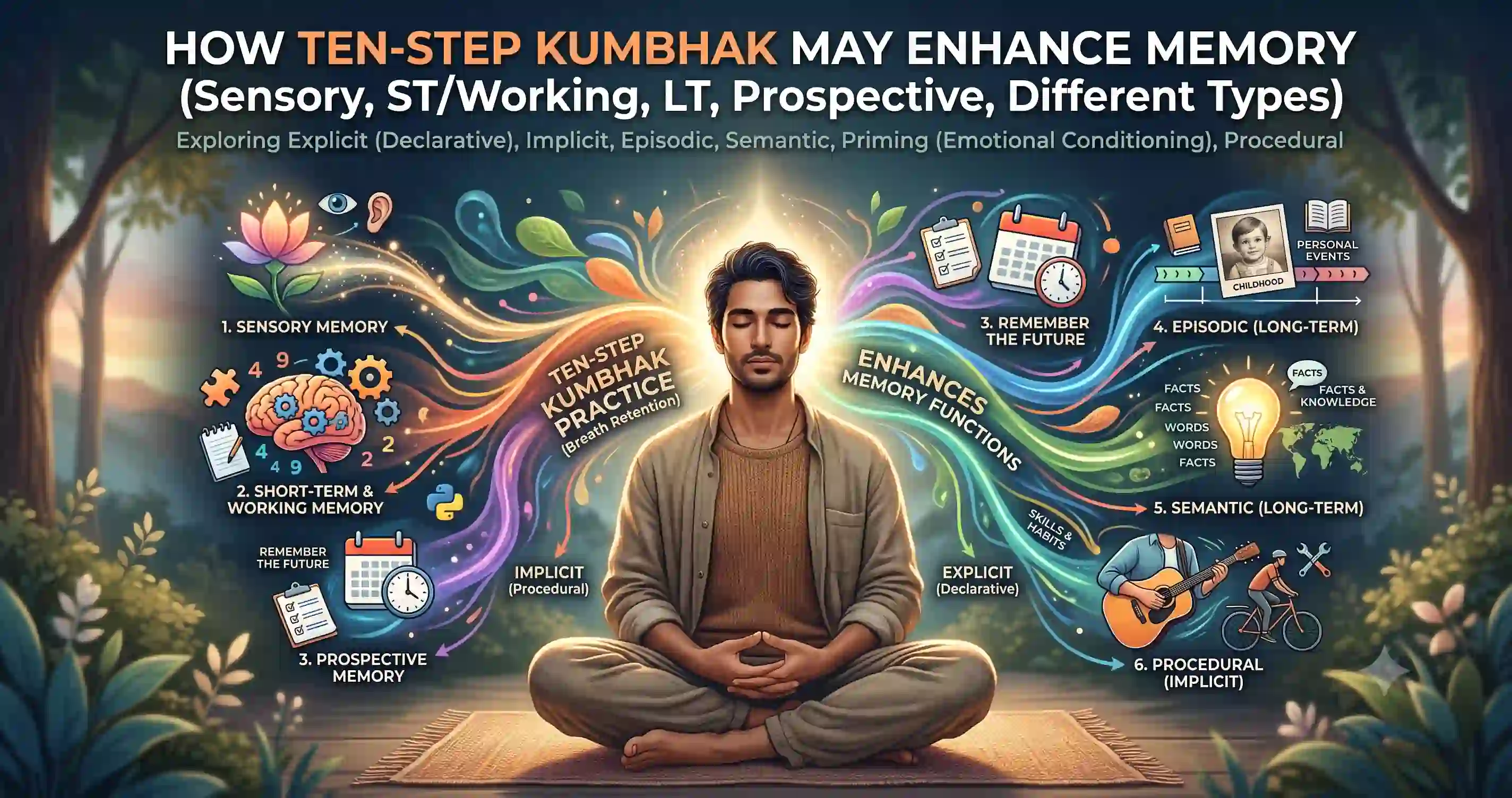
You remember the warmth in an old voice note. You know what the word home means. Your fingers unlock your phone before you consciously think of the pattern. And, at seven in the evening, you remember that you promised to call someone who is waiting.
We call all four experiences “memory,” yet they are not the same kind of memory.
One preserves an episode. One stores knowledge. One guides a learned movement. One carries an intention into the future. A practice could conceivably help one of these while leaving another unchanged. That is why the question “Does Kumbhak improve memory?” is too large to answer honestly with one yes or no.
This treatise asks the more precise question:
Could the Ten-Step Kumbhak for Stress Relief help create better conditions for noticing, holding, learning, consolidating and retrieving information—and what evidence exists for each kind of memory?
The careful answer is hopeful but limited. The exact Ten-Step Kumbhak has not yet been tested in a clinical memory trial. Research on stress, anxiety, attention, nasal respiration and related breathing practices provides several plausible bridges. Direct breath-retention research remains small, mixed and often unable to separate Kumbhak from the other parts of a breathing routine.
So this article will not promise a “photographic memory,” claim that more brain blood flow means more intelligence, or turn Kumbhak into a treatment for dementia. It will show what is known, what is traditionally taught, what is scientifically plausible and what still has to be tested.
Important: The Ten-Step method itself is intentionally not reproduced here. Read and follow the complete How to Practise the Ten-Step Kumbhak for Stress Relief before beginning. Its easy-retention rule, normal nasal Pūrak and Rechak, recovery breaths and safety boundaries are part of the method—not optional details.
The Answer in One Minute 🧠
-
Most credible pathway: the Ten-Step Kumbhak may support memory indirectly if it reduces stress, lowers anxious interference, steadies attention or helps a person approach learning in a less scattered state.
-
Most relevant memory system: working memory has the strongest stress-related rationale. Acute stress can impair working memory, and anxiety competes with its limited capacity.
-
Direct Kumbhak evidence: very limited. A small uncontrolled 30-day study reported improvements on cognitive tests, while a controlled breath-hold experiment during word learning did not show better recognition memory.
-
Related breathing evidence: one 2025 randomised trial found that a single lower-rate paced-breathing session improved an operation-span working-memory measure in undergraduates. Two larger experiments of brief breath awareness found no working-memory advantage. Neither tested the Ten-Step Kumbhak.
-
Nasal respiration: breathing through the nose is linked to respiratory rhythms in limbic and memory-related networks. Some human studies report phase-dependent or consolidation benefits; other experiments find no memory-accuracy benefit. This is biologically interesting, not proof that Kumbhak upgrades memory.
-
Yogic view: classical Yoga connects regulation of prāṇa with steadiness of citta and fitness for dhāraṇā—concentration. Its concept of smṛti is rich, but it is not identical to a modern memory-test score.
-
Ayurvedic view: classical Ayurveda treats memory as inseparable from attention, understanding, restraint, repetition and the condition of manas. These are meaningful traditional models, not established biomedical mechanisms.
-
Best practical interpretation: use the Ten-Step Kumbhak as a stress-relief preparation around learning, not as a substitute for sleep, repetition, retrieval practice, medical assessment or skill training.
What “May Enhance Memory” Can—and Cannot—Mean 🔎
Three very different claims are often compressed into the word enhance:
- State support: after practice, a person may feel less internally crowded and may attend to a task more effectively.
- Learning support: repeated practice might indirectly help encoding or retrieval by reducing stress or mind wandering.
- Structural memory change: the practice might enlarge storage capacity, prevent disease or permanently change a particular memory system.
The first is plausible and personally testable. The second deserves direct trials. The third is not established for the Ten-Step Kumbhak.
That distinction matters. Feeling clear is valuable, but clarity is not automatically memory. Remembering a list immediately is not the same as retaining it one week later. Becoming familiar with a task is not proof of improved episodic memory. A faster response may reflect attention or motor readiness rather than a stronger memory trace.
The evidence ladder used in this article
Direct evidence means a study tested voluntary breath retention and measured a relevant memory outcome.
Method-level evidence means a breathing programme contained Kumbhak, but also contained other active elements such as rhythm, attention, nostril control or relaxation.
Mechanism evidence means research supports a link such as stress → poorer working memory or nasal respiration → limbic oscillations, without testing the Ten-Step Kumbhak.
Traditional evidence means an authentic Yoga or Ayurveda text supplies a conceptual connection. It should be respected as a traditional knowledge claim, not relabelled as a laboratory finding.
Personal observation can reveal whether a practice helps an individual feel prepared to learn. It cannot by itself establish a general medical or cognitive effect.
The central scientific limitation
As of August 2026, no published trial identified for this review has compared:
- the exact Ten-Step Kumbhak;
- the same normal nasal Pūrak and Rechak without retention;
- a matched attention practice; and
- quiet rest;
while separately measuring sensory, short-term, working, episodic, semantic, procedural, priming, emotional-conditioning and prospective-memory outcomes.
Every claim below must be read in that light.
Memory Is a Family of Systems, Not One Mental Container 🧩
Modern memory science does not describe one inner warehouse. It describes interacting processes and systems supported by partly different neural networks. A major review by Squire and Dede distinguishes working memory from long-term memory, and divides long-term memory into declarative and several nondeclarative forms, including skills, habits, priming and conditioning.1
Here is the most useful map for this article:
- Sensory memory
- iconic memory: a very brief visual trace;
- echoic memory: a brief auditory trace;
-
haptic memory: a brief touch-related trace.
-
Short-term memory
-
temporary holding of a limited amount of information.
-
Working memory
-
temporary holding plus active use, updating, comparison, inhibition or manipulation.
-
Long-term memory
- explicit or declarative memory
- episodic memory: events situated in a personal time and place;
- semantic memory: facts, meanings and concepts.
-
implicit or nondeclarative memory
- procedural memory: skills and habits;
- priming: prior exposure changes later processing;
- conditioning: learned associations, including emotional conditioning;
- other basic forms of learning.
-
Prospective memory
- remembering to perform an intention later;
- it recruits multiple systems rather than fitting neatly as one branch beside episodic or procedural memory.
This map corrects two common misunderstandings. First, short-term memory and working memory overlap, but they are not simply interchangeable; even their precise relationship remains debated in cognitive science.2 Second, priming and emotional conditioning are not the same process. Both may occur without deliberate recollection, but priming changes how readily a stimulus is processed, while conditioning learns an association between events.
Memory also has stages
Whatever the system, remembering usually depends on several operations:
- Attention and selection: what reaches further processing?
- Encoding: how is the experience registered?
- Consolidation: how does a new trace become more stable over time?
- Storage: how is information maintained?
- Retrieval: can it be accessed when needed?
- Reconsolidation: when a recalled memory becomes temporarily modifiable before being stored again.
Kumbhak could not be said to “help memory” unless we know which system, which operation and at what time. A state that supports encoding might not support retrieval. A stressor after learning can sometimes strengthen emotionally salient consolidation even while stress immediately before retrieval tends to impair access.3
That complexity is not an inconvenience. It is the truth that protects the reader from exaggerated promises.
Why Stress Relief Is the Most Credible Bridge Between Kumbhak and Memory 🌿
The Ten-Step Kumbhak is designed for stress relief. That matters because stress does not merely make a person feel unpleasant; it can change what captures attention, what working memory can hold, which learning system guides behaviour and whether stored information is accessible at the needed moment.
Imagine trying to write a phone number on a small fogged mirror. The mirror has not become smaller, yet worry has already written across it. There is less clean space left for the number.
That is a useful picture of anxious interference in working memory.
Acute stress and working memory
A meta-analysis of acute-stress experiments found that stress impaired working memory and cognitive flexibility, with effects varying by task load and other moderators.4 A separate meta-analysis covering 177 samples and 22,061 people found that higher anxiety was reliably associated with poorer working-memory capacity across complex-span, simple-span and n-back measures.5
This does not prove that removing stress automatically enlarges working-memory capacity. It supports a narrower possibility: when threat monitoring, worry and intrusive thoughts occupy limited mental resources, reducing that interference may allow more of the existing capacity to serve the task.
For the Ten-Step Kumbhak, this is the strongest scientific bridge:
less internal interference → steadier task attention → better use of available working memory
Each arrow is plausible. The full chain still requires direct testing.
Stress can help some memories and harm others
Stress is not a universal memory eraser. In a meta-analysis of 113 human studies involving 6,216 participants, its effect depended on timing, relevance and memory phase. Stress around encoding usually impaired later memory, except in narrow circumstances when learning was highly stress-relevant and occurred close to the stressor. Stress after encoding sometimes strengthened memory. Stress immediately before or during retrieval generally impaired it, particularly for emotional material.3
This explains a painful human paradox: a person may be unable to recall a prepared sentence during a tense meeting yet remember the sting of one humiliating remark for years.
The goal of a stress-relief practice is therefore not to remove all arousal. It is to reduce unnecessary arousal that hijacks attention or blocks flexible retrieval.
Chronic pressure, habits and cognitive flexibility
Human experiments have shown that stress can shift behaviour away from flexible, goal-directed action and towards stimulus–response habits.6 A habit is not “bad memory”; it is a powerful form of implicit learning. The problem arises when an old automatic response continues after the goal or situation has changed.
If the Ten-Step Kumbhak lowers stress for an individual, it may conceivably create a better state for pausing before an automatic response and recovering the intended goal. But no study has yet shown that the Ten-Step practice reverses stress-induced habit bias.
Sleep is a bridge, but only an indirect one
Sleep supports the consolidation of declarative and procedural memories. Meta-analytic evidence shows that a full night of sleep deprivation harms memory when it occurs before learning and, to a lesser extent, after learning.7
If a stress-relief practice improves someone’s sleep, memory could benefit indirectly. Yet this chain should not be shortened into “Kumbhak consolidates memories during sleep.” The exact Ten-Step Kumbhak has not been shown to improve sleep architecture or sleep-dependent consolidation.
The honest causal chain
The scientifically responsible version is:
- a correctly performed Ten-Step session may reduce subjective stress for some people;
- lower stress may reduce worry, salience capture or mind wandering;
- that state may improve attention during learning or access during retrieval;
- repeated better-quality learning episodes could produce stronger long-term knowledge;
- every link requires testing, and none guarantees the next.
That is not a weak story. It is a strong story told without pretending the missing experiments have already happened.
What Is Distinctive About the Ten-Step Kumbhak Design? 🫁
The Ten-Step Kumbhak is not just “hold your breath.” Without restating the instructions, its relevant design features include:
- a supported, relaxed posture;
- Dhyāna mudrā as a stable tactile arrangement;
- continuing attention at the centre of the chest;
- normal nasal Pūrak and Rechak;
- easy Antar Kumbhak and Bāhya Kumbhak, ended with a clear reserve rather than at the limit;
- a separating normal breath between the two retentions;
- a completion breath; and
- three normal recovery breaths before another round.
These features create several researchable hypotheses. They are not yet proven memory mechanisms.
1. A stable attentional object
Chest-centre focus gives attention somewhere specific to return. The cognitive action is not “never wander.” It is noticing that attention wandered and returning without turning the lapse into a personal failure.
That return may train a component relevant to working memory and prospective memory: maintaining an intention while distractions compete. Yet transfer from a breathing focus to academic or everyday memory cannot be assumed.
2. A tactile context cue
Dhyāna mudrā supplies continuous touch information at the lower centre of the torso. In learning theory, repeated pairing can make a context or bodily configuration a cue for a familiar state. It is conceivable that the hand position could later prime readiness to settle.
This is a hypothesis about context learning—not proof that a mudrā stores information or directly strengthens the hippocampus.
3. Nasal airflow
The method keeps the mouth closed and uses normal nasal Pūrak and Rechak. Human intracranial and behavioural research shows that respiration can couple with activity in the amygdala, hippocampus and other networks. Some experiments associate nasal breathing or particular respiratory phases with better performance; others do not.8910
The Ten-Step method does not instruct a student to present information on a particular respiratory phase. It would be inappropriate to invent such a rule from laboratory findings.
4. Easy retention as a brief inhibitory demand
During an easy Kumbhak, the practitioner maintains an intention—do not yet begin the next breath—while monitoring bodily information and preserving relaxation. That resembles an inhibitory-control demand.
A 36-person crossover study found improved response inhibition after both a four-phase breathing practice containing internal and external retention and an active breath-awareness condition. The retention practice was not superior.11 This makes inhibitory control a plausible area for research, while showing why Kumbhak alone cannot receive the credit.
5. Recovery as part of the cognitive design
The three normal recovery breaths are not dead time. They separate rounds, let respiratory urgency settle and provide an opportunity to observe the after-state. In future trials, this interval could be studied as a form of distributed interoceptive practice.
It should not be labelled memory consolidation without evidence.
6. Comfortable reserve instead of endurance
The method ends each Kumbhak while the practitioner remains certain that another one to three seconds would have been comfortable. That makes the intended stimulus very different from maximal apnoea, competitive breath-hold training or laboratory hypoxia.
Longer is not a memory score. A longer hold can change carbon dioxide, oxygen, blood pressure and cerebral circulation more strongly, but “more physiological change” does not equal “more learning.”
Sensory Memory: The First Flicker of Experience 👁️👂✋
Sensory memory is the extremely brief persistence of sensory information after the stimulus has changed or disappeared. It gives perception continuity. Without it, experience would arrive as disconnected fragments.
Iconic memory: the visual trace
Iconic memory briefly preserves visual information—such as the impression left after a light moves or a page is glanced at. Most of that detail fades before it reaches conscious report. Attention selects a small portion for further processing.
How the Ten-Step Kumbhak might be relevant: a less agitated attentional state may reduce irrelevant visual capture and improve selection of what matters next.
What it is not known to do: lengthen the biological duration of iconic storage, create photographic memory or increase the amount of visual detail transferred into long-term memory.
Echoic memory: the auditory trace
Echoic memory preserves sound for a few seconds, helping the brain integrate speech and music across time. It is why the beginning of a sentence can still be available when the end arrives.
Stress can make a person physically hear words while mentally rehearsing a fear. If practice lowers that competing inner commentary, more of the heard message may receive attention. That would be improved use of the sensory trace, not proof that echoic storage itself expanded.
Haptic and interoceptive traces
Haptic memory briefly preserves touch-related information. The continuous contact of Dhyāna mudrā and the changing sensation at the centre of the chest also create a structured stream of bodily information.
Repeatedly noticing this stream may improve familiarity with bodily cues. Whether that changes sensory-memory capacity has not been studied. A safer interpretation is that the Ten-Step method gives attention a stable multisensory context—touch, chest movement and nasal airflow—within which distraction can be noticed.
Scientific verdict for sensory memory
Evidence level: mechanism hypothesis only. The Ten-Step Kumbhak may help attentional selection after stress settles, but no direct evidence shows that it enlarges iconic, echoic or haptic memory stores.
Short-Term Memory: Holding Something Briefly 📌
Short-term memory keeps a limited amount of information available for seconds—such as a code long enough to enter it. It emphasizes temporary storage. Working memory goes further by manipulating or updating what is being held.
The border between the two is not absolute. Some theories treat short-term storage as part of working memory; others draw a sharper distinction.2
How stress can disturb short-term holding
Short-term information is fragile. Interruption, competing speech, worry and divided attention can displace it. When a person thinks, “I must not forget,” the anxious sentence itself may become part of the competition.
The Ten-Step Kumbhak may help if it is practised separately before a task and leaves the person less internally interrupted. It should not be performed while trying to rehearse a number, a name or safety-critical information.
What direct Kumbhak research suggests
One 30-day pre/post study in 60 healthy young men reported improvements in several cognitive measures after daily Kumbhak practice, including measures related to immediate attention and span. However, it had no control group, used maximum comfortable retention, and did not test the Ten-Step method. Familiarity with the tests, expectation and other biases could explain part or all of the change.12
This study is a signal worth replicating, not reliable proof.
Scientific verdict for short-term memory
Evidence level: very low and indirect. Reduced distraction could improve the use of short-term storage. Expansion of short-term capacity by the Ten-Step Kumbhak has not been demonstrated.
Working Memory: The Mind’s Small Active Workbench 🧮
Working memory holds information while doing something with it. You use it when you:
- keep the first part of a sentence in mind while interpreting the last part;
- compare two prices;
- follow a multi-part instruction;
- update a mental total;
- resist an irrelevant response; or
- remember the goal while switching between tasks.
It is less like a cupboard and more like a small workbench. Anxiety can cover that workbench with unfinished internal conversations.
The strongest scientific case for possible benefit
Acute stress impairs working memory on average, and anxiety is associated with lower working-memory performance across many task types.45 The strongest plausible benefit of a stress-relief Kumbhak is therefore not “adding extra slots.” It is freeing the existing workbench from some avoidable interference.
Possible pathways include:
- reduced worry competing for verbal working memory;
- less scanning for threat;
- improved return after mind wandering;
- better preservation of the current goal; and
- a more deliberate pause before an automatic response.
All remain hypotheses for the exact Ten-Step sequence.
Related breathing trials are mixed
A 2025 randomised trial assigned 139 undergraduates to one brief lower-rate paced-breathing session with a longer exhalation or a mind-wandering active control. Operation-span performance improved in the breathing group.13 This is relevant, but the intervention did not contain the Ten-Step sequence and did not isolate retention.
By contrast, two experiments involving 82 and 424 participants found no working-memory-capacity advantage after a 15-minute mindful-breathing exercise compared with mind wandering.14
The mixed pattern tells us three things:
- a brief breathing intervention can sometimes improve working-memory performance;
- the result is not automatic across protocols and tasks; and
- no benefit can presently be assigned specifically to Antar or Bāhya Kumbhak.
Working memory is not the same as concentration
Feeling focused after practice is encouraging, but a working-memory claim requires validated tasks, an active comparator and preferably delayed transfer tests. Improved response inhibition may support one executive function without increasing operation span. Lower anxiety may improve performance on a difficult day without changing a stable cognitive capacity.
Scientific verdict for working memory
Evidence level: plausible stress-mediated support; no direct Ten-Step proof. Among the memory systems in this article, working memory has the clearest rationale, but the decisive trial has not been done.
Long-Term Memory: What Outlasts the Present Moment 🗂️
Long-term memory can endure from minutes to decades. Duration alone does not make it one system. Remembering your first classroom, knowing what a classroom is and knowing how to write are different achievements supported by interacting but distinguishable neural systems.1
Stress relief could influence long-term memory mainly by improving the quality of attention at encoding, reducing interference around retrieval, supporting goal-directed learning and—if sleep improves—protecting consolidation. It does not replace the behaviours that build durable memory: meaningful understanding, retrieval practice, spaced repetition, sleep and repeated real-world use.
Explicit or Declarative Memory: What You Can Consciously Bring to Mind 💬
Declarative memory concerns facts and events that can be consciously recollected or reported. It depends importantly on the medial temporal-lobe memory system during learning, including the hippocampus and nearby cortices, while long-established knowledge becomes distributed across neocortical networks.1
Declarative memory has two major forms: episodic and semantic.
Episodic memory: “I remember being there”
Episodic memory binds the what, where and when of a personally experienced event. The scent in a hospital corridor, the chair beside a loved one and the sentence you heard there can return as one scene.
Stress affects episodic memory differently at encoding, consolidation and retrieval. It may prioritize central emotional information while sacrificing neutral details; just before retrieval, it often makes access harder.3
How the Ten-Step Kumbhak may help: if a separate practice session reduces anticipatory stress before study or recall, the learner may encode context with less internal competition or retrieve with less pressure. That is an indirect state effect.
What direct retention evidence says: in an fMRI experiment with 24 participants, words were encoded during normal breathing or 20-second post-exhalation breath holds. Overall recognition sensitivity was not significantly better during breath holding; high-confidence remembered items were slightly fewer in that condition. The study was designed partly to understand respiratory effects on brain imaging, not to test the Ten-Step method.15
This is important negative evidence. It gives no basis for holding the breath while memorising words.
Nasal respiration and episodic memory: fascinating, inconsistent
In a widely discussed human study, nasal respiration entrained oscillatory activity in the piriform cortex, amygdala and hippocampus. Fear discrimination and visual-object recognition varied with respiratory phase, with some advantages during nasal inspiration.8 Another experiment found better odour recognition after a one-hour nasal-breathing consolidation period than after mouth breathing.9
However, later experiments have not consistently reproduced a simple “inhalation improves memory” rule. Some found respiratory modulation of neural signals or response bias without better recognition accuracy; others found no phase-based memory benefit.10
The warranted conclusion is:
respiration participates in the timing of memory-related neural activity, but phase effects on human memory performance are not settled.
The Ten-Step Kumbhak uses normal nasal Pūrak and Rechak, yet it also contains pauses in airflow. No current evidence tells us whether its complete sequence enhances episodic encoding or consolidation.
Yogic and Ayurvedic connection to episodic memory
Patañjali defines smṛti in Yoga Sūtra 1.11 as the non-loss of an experienced object—anubhūtaviṣayāsaṃpramoṣaḥ smṛtiḥ.16 This naturally resonates with recollection, though classical smṛti has philosophical dimensions beyond autobiographical memory.
Cāraka Saṃhitā Śārīra Sthāna 1.149 describes smṛti through the recalling of what has been seen, heard or experienced.17 That wording offers a genuine traditional connection to experience-based remembrance. It is not evidence that chest-focused Kumbhak alters hippocampal episodic-memory scores.
Scientific verdict for episodic memory
Evidence level: mixed respiratory mechanisms; direct breath-hold encoding does not show enhancement. A calmer pre-learning or pre-retrieval state may help some people, but Kumbhak should not be performed as an encoding trick.
Semantic memory: meanings, facts and knowledge
Semantic memory is knowledge not tied to reliving one particular episode: the meaning of retention, the capital of a country, the principle behind a formula, or the understanding that a red light means stop.
Semantic knowledge often grows from many episodic encounters. A word met once in one room may later become a concept that can be used everywhere. Consolidation, repeated retrieval and integration with existing knowledge make that transformation possible.
How the Ten-Step Kumbhak may help: an unhurried mental state may allow deeper comprehension, better organization and less anxious interference during study. If practice becomes a brief transition before learning, it may help protect a single-task period.
What it cannot do: replace explanation, testing, correction, spaced retrieval or deliberate comparison. Kumbhak does not insert facts into semantic memory.
The Ayurvedic eightfold support for memory
Cāraka Saṃhitā Śārīra Sthāna 1.148–149 lists eight contributors through which memory arises: grasping a cause, grasping a form, similarity, contrast, continuity or concentration of mind, practice, knowledge and repeated hearing.17
These should not be forced into modern terminology, yet the practical parallels are striking:
- cause: understand why, not only what;
- form: encode a clear representation;
- similarity: connect new knowledge with what is already known;
- contrast: learn what makes it different;
- continuity of mind: remain with the subject;
- practice: return repeatedly;
- knowledge: organize learning intelligently;
- repeated hearing: revisit and retrieve.
The Ten-Step Kumbhak can at most support the condition of continuity. The remaining seven remind us why breath practice alone cannot produce scholarship.
Scientific verdict for semantic memory
Evidence level: indirect. Any benefit would probably come through better attention, comprehension, repetition or sleep—not a direct enlargement of semantic storage.
Implicit or Nondeclarative Memory: Learning That Appears in Performance ⚙️
Implicit memory is expressed through changed performance rather than deliberate recollection. A person may show learning without being able to narrate when or how it was learned.
This broad family includes procedural skills and habits, priming, conditioning and other elementary forms of learning. Different forms depend especially on networks involving the striatum, cerebellum, amygdala and neocortex, although memory systems interact rather than live in sealed compartments.1
Kumbhak itself can become implicit learning
At first, a practitioner must remember every boundary consciously. With correct repetition, posture, mudrā, chest focus, sequence and recovery can become more fluent. That is proceduralisation: a consciously guided sequence gradually requires less verbal supervision.
Fluency is helpful only if the learned pattern is correct. Repeating strain, chasing hold duration or tensing the abdomen can also become automatic. Practice consolidates what is repeated, not necessarily what was intended.
Priming: When the Past Quietly Changes the Present 🌱
Priming occurs when prior exposure changes how readily a stimulus is later detected, completed, classified or produced, without requiring conscious recollection of the first encounter.1 Seeing the word doctor, for example, may make a related word easier to recognize.
Priming is not a hidden reservoir of autobiographical memories, and it is not the same as emotional conditioning.
How the Ten-Step Kumbhak might create a contextual prime
When the same neutral cues—Dhyāna mudrā, chest-centre attention and a familiar sequence—are repeatedly paired with settling, those cues may later make the settled routine easier to enter. The hands touch, and the mind recognizes the beginning before a sentence is spoken.
That is a reasonable learning hypothesis. It does not show that the mudrā “switches on” all memory systems, and it should not be used to promise subliminal reprogramming.
Could practice improve perceptual or conceptual priming?
There is no direct evidence that the Ten-Step Kumbhak improves laboratory priming tasks. Less stress might reduce noisy competition in some tasks, but priming can remain intact even when conscious memory is impaired. It must therefore be tested separately rather than inferred from episodic or working-memory changes.
Scientific verdict for priming
Evidence level: untested. Repeated practice cues could plausibly prime the practice state itself; generalized priming enhancement has not been demonstrated.
Emotional Conditioning: When the Body Learns “Danger” or “Safe Enough” ❤️🩹
Emotional conditioning occurs when a previously neutral cue acquires emotional meaning through association. A smell, room, tone of voice or chest sensation may later evoke fear before the person has consciously reconstructed the original event. The amygdala is central to fear learning, while the hippocampus and prefrontal cortex help encode context and regulate when the learned response is expressed.18
This is related to implicit memory but is not priming. Priming facilitates processing after exposure. Conditioning learns that one event predicts another.
A possible “safe-enough” learning process
For a person who finds comfortable respiratory sensations neutral, the Ten-Step Kumbhak may offer repeated experiences of:
- noticing an internal sensation;
- maintaining relaxation;
- ending well before distress;
- returning to normal breathing; and
- discovering that the sensation passed without catastrophe.
Over time, the sequence might support a less fearful interpretation of manageable bodily change. That resembles inhibitory or safety learning more than erasure of an old emotional memory.
Even successful fear extinction usually creates new, context-sensitive learning rather than deleting the original association. Old fear can return under stress or in a different context.18
Why the same practice can have the opposite effect
For someone with panic, asthma-related fear, choking trauma or a suffocation memory, retention sensations may already predict danger. Repeating them without appropriate support can strengthen fear rather than reduce it.
In a pragmatic randomised trial of 74 adults with post-traumatic stress disorder, adding a prāṇāyāma programme containing Kumbhak and Jālandhara Bandha to trauma-focused therapy did not improve the primary intention-to-treat outcome. Participants reported recurrent anxiety, breathlessness, dizziness and constriction; one withdrew after a suffocation-related flashback.19
This does not prove that every easy Kumbhak is unsafe for every trauma survivor. It proves that “the body will learn calm” cannot be assumed.
Scientific verdict for emotional conditioning
Evidence level: plausible in either direction and highly person-dependent. Easy, predictable practice may become a reassuring context for some people; for others, retention can reactivate or reinforce fear. Trauma-informed professional guidance may be necessary.
Procedural Memory: Knowing How Without Narrating Every Step 🛠️
Procedural memory supports skills and habits: typing, riding a bicycle, playing a scale, using a familiar tool or performing a practised sequence. Improvement comes through task-specific repetition, feedback, correction and consolidation.
How stress changes skill control
Under pressure, behaviour may shift from flexible action–outcome control towards familiar stimulus–response habits.6 That can help an expert execute a stable routine, yet it can also make a person repeat an outdated response.
If the Ten-Step Kumbhak reduces pre-performance stress, it might help preserve flexible control before a skilled task. This possibility has not been tested, and practising Kumbhak cannot replace practising the actual skill.
Sleep, rest and motor consolidation
Procedural learning benefits from consolidation. Sleep-deprivation evidence shows that procedural memory can be particularly vulnerable.7 Quiet rest after learning may also reduce interference in some experiments. These findings support protecting recovery after practice, not inserting breath holds into motor training.
Scientific verdict for procedural memory
Evidence level: indirect. The Ten-Step sequence itself can become a procedural skill. No credible evidence shows that it generally accelerates unrelated motor-skill learning.
Prospective Memory: Remembering to Remember ⏰
Prospective memory carries an intention into the future: take medicine after dinner, send a document at noon, ask a question when a colleague calls, or turn off an appliance after a timer sounds.
It includes:
- event-based prospective memory: act when an external event occurs;
- time-based prospective memory: act at a particular time or after an interval;
- activity-based prospective memory: act after completing another activity.
Prospective memory is not simply another long-term-memory box. It requires forming the intention, retaining it while doing other things, detecting the cue, interrupting the ongoing task and executing the action. Studies show that event- and time-based prospective memory share some networks while placing different demands on cue detection, time estimation and executive control.20
Why stress matters
Worry can consume the same monitoring resources needed to preserve an intention. Stress can also narrow attention so strongly that an intended cue is missed. On the other hand, excessive monitoring—repeatedly checking the clock—can disrupt the ongoing task.
If the Ten-Step Kumbhak reduces anxious interference, it may help the person encode an intention more clearly or return to it after distraction. No direct trial has tested this.
The practice as a prospective-memory exercise
Within a round, the practitioner must remember what comes next while remaining with what is happening now. The recovery interval also requires remembering not to begin the next round too early. These are small future intentions embedded in an attentional task.
Near transfer to everyday intentions is possible but unproven. Remembering the Kumbhak sequence does not establish that someone will remember an appointment.
External cues remain wiser than confidence
For important future tasks, use proven supports:
- alarms and calendar reminders;
- medication organizers;
- written implementation intentions—“When X happens, I will do Y”;
- placing an object where it will be encountered; and
- immediate completion when the cost of delay is high.
Kumbhak may prepare attention. It should not replace an external safety system.
Scientific verdict for prospective memory
Evidence level: plausible executive-support pathway; no direct evidence. The strongest application is pairing a clearer intention with external cues, not relying on breath practice alone.
What the Direct and Related Studies Actually Show 📚
The following evidence cards put the most relevant findings in descending order of relevance to memory and the Ten-Step Kumbhak.
Study 1: holding after exhalation while learning words did not improve recognition
Participants: 24 adults undergoing fMRI.
Exposure: word encoding during normal breathing versus 20-second post-exhalation breath holds.
Finding: breath holding altered respiration-related brain-imaging patterns, but recognition sensitivity was not significantly better. High-confidence remembered items were slightly fewer in the hold condition.15
Meaning for the Ten-Step Kumbhak: do not hold the breath while trying to memorise. The experiment was not the Ten-Step practice, but it directly challenges the assumption that stopping airflow during encoding automatically strengthens episodic memory.
Confidence: low for any general conclusion; directly relevant as a negative finding.
Study 2: a 30-day Kumbhak study reported cognitive improvement but had no control group
Participants: 60 healthy men aged 20–30.
Exposure: daily practice involving inhalation, maximum comfortable retention and paced exhalation for 30 days.
Finding: several cognitive, anxiety and respiratory measures improved from baseline.12
Meaning for the Ten-Step Kumbhak: the result justifies a controlled replication. It does not establish causation, does not isolate test familiarity or expectation, and used a different retention method.
Confidence: very low.
Study 3: a retention-containing session improved inhibition—but so did breath awareness
Participants: 36 healthy, yoga-trained volunteers.
Exposure: a 20-minute four-phase breathing sequence containing Antar and Bāhya Kumbhak versus breath awareness.
Finding: response inhibition improved after both conditions; the retention sequence was not superior.11
Meaning for the Ten-Step Kumbhak: a structured breathing session can influence executive performance, but the pause cannot be isolated as the cause. Response inhibition is not a memory-capacity measure.
Confidence: low.
Study 4: eight weeks of intermittent retention improved psychological measures, not memory tests
Participants: 116 young adult yoga practitioners.
Exposure: usual yoga versus usual yoga plus a 20-minute daily breathing routine with intermittent retention for eight weeks.
Finding: the added practice group reported larger improvements in mindfulness, mind wandering and anxiety.21
Meaning for the Ten-Step Kumbhak: reducing mind wandering or anxiety could indirectly support learning, but no sensory, episodic, semantic, procedural or prospective-memory endpoint was measured.
Confidence: low and indirect.
Study 5: a brief paced-breathing session improved a working-memory measure
Participants: 139 undergraduates, randomised.
Exposure: one lower-rate paced-breathing session with a longer exhalation versus an active mind-wandering control.
Finding: operation-span working-memory performance improved in the paced-breathing group, along with mood and perceived stress.13
Meaning for the Ten-Step Kumbhak: a relevant positive result for the stress–working-memory bridge, but the protocol did not test the Ten-Step sequence or retention.
Confidence: moderate for the tested session; indirect for Kumbhak.
Study 6: brief breath awareness did not improve working-memory capacity in two experiments
Participants: 82 in a within-person experiment and 424 in a between-group experiment.
Exposure: 15 minutes of mindful attention to breathing versus a mind-wandering exercise.
Finding: no advantage on operation-span or symmetry-span working-memory measures.14
Meaning for the Ten-Step Kumbhak: attention to breathing does not automatically transfer to a working-memory score after one session.
Confidence: moderate for the tested interventions; indirect for Kumbhak.
Study 7: breathwork reduces stress on average, but the literature is heterogeneous
A 2023 meta-analysis of randomised controlled breathwork trials found a small-to-medium reduction in self-reported stress compared with controls, while noting moderate risk of bias in much of the evidence.22 Another large, placebo-controlled trial found that both lower-rate and matched attention-placebo breathing groups improved over time, with no advantage for the lower-rate protocol.23
Meaning for the Ten-Step Kumbhak: the broad stress-relief bridge is reasonable, but expectancy, attention, daily ritual and protocol differences matter. No meta-analysis establishes a retention-specific memory benefit.
Study 8: nasal respiration couples with memory-related networks, but behavioural findings conflict
Human studies have linked respiration with activity in the hippocampus and amygdala and have sometimes found nasal-route or respiratory-phase effects on recognition and emotional discrimination.89 Other experiments report neural modulation without improved accuracy, or no performance effect at all.10
Meaning for the Ten-Step Kumbhak: its normal nasal Pūrak and Rechak have a biologically plausible relationship to brain rhythms. “Inhale at the moment of learning” is not a reliable or necessary rule.
Study 9: cerebral blood-flow velocity changes during Kumbhak, but memory was not measured
Small studies in trained practitioners found that approximately one-minute internal or external Kumbhak changed middle cerebral artery flow velocity and pulsatility.2425
These are acute haemodynamic findings. They do not show that neurons received a useful “boost,” that memory improved, or that a brief easy Kumbhak produces the same response. Carbon dioxide is a potent cerebral vasodilator; increased flow during a hold is partly a protective response to altered blood gases.
More cerebral blood flow is not synonymous with more memory.
Study 10: controlled intermittent hypoxia is not Kumbhak
In controlled intermittent-hypoxia research, participants continue breathing measured low-oxygen gas under supervision. A very small pilot in mild cognitive impairment reported possible cognitive signals, while a later five-day double-blind trial changed cerebral blood flow without improving cognition.26
The Ten-Step Kumbhak is not a home version of this medical exposure. Hypoxia should not be pursued as the imagined active ingredient, and longer holds should not be justified through intermittent-hypoxia research.
Yogic Truths: Smṛti, Citta, Prāṇa and Dhāraṇā 🕉️
Classical Yoga does not divide memory into operation span, iconic persistence, priming and prospective cue detection. Its concern is broader: how citta receives impressions, becomes coloured by them, recalls them, wanders among them and can become steady enough for direct seeing.
The following verses are precise traditional connections. They are not biomedical proof.
Yoga Sūtra 1.11: memory does not lose the experienced object
anubhūtaviṣayāsaṃpramoṣaḥ smṛtiḥ
Our translation: Smṛti is the non-loss of an object that has been experienced.16
This compact definition honours memory as preservation of experience. It resonates most readily with recollection and recognition. Yet Patañjali is classifying modifications of citta, not administering a modern episodic-memory test.
For the Ten-Step Kumbhak, the verse invites a question more subtle than “How many items can I remember?” It asks whether the mind receives experience clearly enough that it is not immediately buried under competing movements.
Yoga Sūtra 1.34: expulsion and retention as an optional support for steadiness
pracchardanavidhāraṇābhyāṃ vā prāṇasya
Our translation: Or, through the expulsion and retention of prāṇa.27
The verse appears among methods for settling or stabilising the mind. It does not say that retention enlarges memory storage. Its relevance is upstream: a steadier citta may be more available for attention, recollection and discrimination.
The Ten-Step Kumbhak includes both Rechak-related and Pūrak-related retention within a bounded stress-relief sequence, but it should not be declared a direct fulfilment of every classical prāṇāyāma goal.
Yoga Sūtras 2.49–2.50: interruption and measured regulation
Yoga Sūtra 2.49 describes prāṇāyāma as the interruption or regulation of the movement of inhalation and exhalation after steadiness in posture. Yoga Sūtra 2.50 distinguishes external, internal and suspended regulation and describes attention to place, time and number.28
These verses validate Kumbhak as a real technical category within Yoga. They do not specify the Ten-Step method, nor do they make a memory-enhancement claim.
Their most important lesson for this article is precision. Internal and external retention are not interchangeable events. Dose, context and manner matter—exactly what contemporary research also needs to report.
Yoga Sūtra 2.53: the mind becomes fit for dhāraṇā
dhāraṇāsu ca yogyatā manasaḥ
Our translation: And the mind becomes fit for acts of concentration.29
Yoga Sūtra 3.1 then defines dhāraṇā as binding citta to a place.30
This is the most relevant classical bridge to memory. Attention is not memory, but without sufficient attention, encoding becomes poor and prospective intentions are lost among distractions. Classical Yoga promises fitness for concentration in the context of prāṇāyāma; science has not yet established that the exact Ten-Step Kumbhak transfers that fitness to validated memory outcomes.
Haṭha Yoga Pradīpikā 2.2: breath and citta move together
cale vāte calaṃ cittaṃ niścale niścalaṃ bhavet |
yogī sthāṇutvam āpnoti tato vāyuṃ nirodhayet ||
Our translation: When vāyu moves, citta moves; when it becomes steady, citta becomes steady. Therefore the yogin regulates vāyu and attains stability.31
This is a traditional psychophysiological claim: breath and mind are coupled. Modern research also finds respiration-related neural coupling, but that resemblance should not be overstated as proof that the verse predicted a specific neural oscillator or memory network.
For a stressed reader, its living meaning may be simpler: the mind need not be wrestled into silence by force. It can be approached through a bodily rhythm that is already present.
Yoga Sūtra 1.43: “purification of memory” is not memory erasure
Yoga Sūtra 1.43 uses the phrase smṛtipariśuddhi in explaining nirvitarkā samāpatti—a refined meditative absorption in which conceptual overlays recede and the object alone shines forth.32
It should not be translated into claims that Kumbhak deletes trauma, removes unwanted memories, “cleans the hippocampus” or increases exam recall. The verse belongs to a meditative epistemology, not a neurological cleansing procedure.
Bhagavad Gītā 2.63: emotional disturbance and loss of remembered wisdom
krodhād bhavati saṃmohaḥ saṃmohāt smṛtivibhramaḥ |
smṛtibhraṃśād buddhināśo buddhināśāt praṇaśyati ||
Our translation: From anger comes bewilderment; from bewilderment, confusion of memory; when memory is lost, discrimination is damaged, and from damaged discrimination one falls.33
Here smṛti is not merely remembering a grocery list. It includes the remembered orientation that should guide wise action. This verse supplies a profound stress–memory connection: intense emotion can interrupt access to what one already knows is right.
The Ten-Step Kumbhak may be relevant if it creates a pause in which remembered values can return before reaction hardens into action. That is a moral-psychological interpretation, not a laboratory claim.
Ayurvedic Truths: Manas, Dhī, Dhṛti, Smṛti and Vāyu 🌿
Ayurveda understands memory within the functioning of the whole person. It does not map neatly onto contemporary brain modules. Its terms are complementary rather than interchangeable:
- manas: the coordinating mind involved in attention and sensory engagement;
- dhī: understanding, discernment or intelligent apprehension;
- dhṛti: holding, restraint or the capacity to remain aligned;
- smṛti: memory or recollection;
- medhā: the capacity to grasp, retain and intelligently integrate knowledge;
- abhyāsa: repeated practice;
- saṃskāra: an impression or patterned tendency formed through experience.
These are traditional functional categories. They should not be assigned one-to-one to the prefrontal cortex, hippocampus or a neurotransmitter.
Cāraka Śārīra 1.18: without manas joining, sensory knowledge does not arise
Cāraka Saṃhitā states that when manas is not connected with the senses, their objects and the self, understanding does not arise—even when the object is present.34
This is a remarkably relevant traditional model for sensory selection. The eyes may face the page and the ears may receive the words, yet learning does not occur if manas is elsewhere.
The Ten-Step Kumbhak’s chest-centre attention can be interpreted as practice in bringing manas into a chosen relationship with present experience. It is not evidence that sensory memory lasts longer; it emphasizes participation of attention in perception.
Cāraka Śārīra 1.148–149: eight causes supporting memory
The Sanskrit verses read:
vakṣyante kāraṇānyaṣṭau smṛtir yair upajāyate |
nimittarūpagrahaṇāt sādṛśyāt saviparyayāt ||
sattvānubandhād abhyāsāj jñānayogāt punaḥ śrutāt |
dṛṣṭaśrutānubhūtānāṃ smāraṇāt smṛtir ucyate ||
In concise terms, memory is supported by cause, form, similarity, contrast, continuity of sattva, practice, knowledge and repeated hearing; smṛti recalls what has been seen, heard or experienced.17
This may be the most comprehensive traditional answer to the entire article. Stress relief can help continuity of mind, but durable learning still requires structure, comparison, meaning and repetition.
Ayurveda therefore does not let us reduce memory to one herb, one breath or one claim.
Cāraka Śārīra 1.101–102: when rajas and tamas obscure memory
Cāraka describes rajas and tamas as factors that can cover or disturb manas and impair dhī, dhṛti and smṛti. Their disturbance contributes to prajñāparādha—action contrary to one’s better understanding—and to wider imbalance.35
A contemporary reader may notice a familiar experience: under agitation, one knows but cannot remain with what one knows; under heaviness, one cannot mobilise it. That resembles the distinction between stored knowledge and successful access.
It would be inaccurate to say the Ten-Step Kumbhak has been proven to reduce rajas or tamas as measurable biological substances. Traditionally, a stabilising practice may be used to support clarity of manas.
Cāraka Sūtra 1.58: memory belongs within mental care
Cāraka lists knowledge, specialised understanding, courage or steadiness, memory and samādhi among approaches for disturbance of the mind.36
Smṛti here is both a faculty and a resource: remembering what restores orientation. The Ten-Step Kumbhak might become one remembered response available during stress—I have something safe and bounded I can do—without becoming a substitute for clinical care.
Aṣṭāṅga Hṛdaya Sūtra 12.4–5: prāṇa, udāna and memory
Aṣṭāṅga Hṛdaya describes prāṇa vāyu as supporting buddhi, heart, senses, citta and respiratory functions, while udāna vāyu—centred in the chest—is associated with speech, effort, energy, strength, complexion and smṛti.37
The chest emphasis makes this especially relevant to the Ten-Step method’s chosen attentional centre. Yet it remains an Ayurvedic functional model. It should not be converted into the anatomical claim that chest movement pumps memory into the brain or that udāna has been measured as a gas, nerve or vessel.
Traditional relevance can be genuine without becoming false biomedicine.
An Ayurvedic reading of the memory systems
The following are interpretive bridges, not equivalences:
- Sensory memory: manas must join sense and object for experience to be apprehended.
- Short-term and working memory: dhṛti suggests holding and restraint, while dhī helps understand and manipulate meaning.
- Episodic memory: smṛti recalls what has been seen, heard and experienced.
- Semantic memory: medhā, repeated hearing, similarity, contrast and knowledge support integrated understanding.
- Procedural memory: abhyāsa and saṃskāra describe the power of repetition and formed patterns.
- Emotional conditioning: rajas, tamas and saṃskāra can help describe how emotional patterns persist, although they are not laboratory conditioning terms.
- Prospective memory: dhṛti and smṛti together suggest retaining an intention and returning to it when action is required.
This comparison is useful precisely because it keeps the languages distinct. Ayurveda asks about the quality and integration of mental life; neuroscience asks about operational tasks, networks and causal mechanisms. Neither must impersonate the other to contribute.
An Integrated Verdict for Every Memory Type ✅
Sensory memory
Possible support: better attentional selection after stress settles.
Not established: longer iconic, echoic or haptic storage.
Verdict: plausible attention pathway; no direct evidence.
Short-term memory
Possible support: less distraction during brief holding.
Not established: expanded short-term capacity.
Verdict: very-low-confidence direct signal from a different Kumbhak protocol; otherwise indirect.
Working memory
Possible support: reduced worry and threat monitoring may free existing capacity; returning attention may support goal maintenance.
Not established: a durable capacity increase caused by the Ten-Step Kumbhak.
Verdict: strongest scientific rationale, but direct Ten-Step evidence is absent.
Explicit or declarative memory
Possible support: a less stressed state at encoding or retrieval.
Not established: general improvement in consciously recalled facts and events.
Verdict: indirect.
Episodic memory
Possible support: reduced pre-learning or pre-retrieval stress; nasal-respiration mechanisms are relevant.
Not established: better episodic memory from Kumbhak. Direct breath-hold encoding did not help recognition.
Verdict: mixed mechanism evidence; no enhancement claim justified.
Semantic memory
Possible support: better comprehension and more consistent study when stress is lower.
Not established: direct storage of facts or concepts.
Verdict: depends mainly on what the learner does after settling—understand, compare, retrieve and repeat.
Implicit memory
Possible support: the practice itself may become more fluent; state cues may acquire learned meaning.
Not established: general improvement across nonconscious learning systems.
Verdict: system too broad for one claim.
Priming
Possible support: repeated practice cues may prime entry into the familiar routine.
Not established: stronger perceptual or conceptual priming outside the practice.
Verdict: specific contextual hypothesis only.
Emotional conditioning
Possible support: predictable, easy experiences may contribute to safety learning in suitable practitioners.
Possible harm: retention sensations may cue panic or trauma and strengthen fear.
Verdict: person- and history-dependent; never promise emotional-memory erasure.
Procedural memory
Possible support: reduced pre-performance stress may preserve flexible skill control; the Ten-Step sequence itself can be proceduralised.
Not established: faster acquisition of unrelated skills.
Verdict: indirect.
Prospective memory
Possible support: clearer intention formation and less interference.
Not established: better everyday remembering of future tasks.
Verdict: pair any benefit with external reminders.
How to Use the Ten-Step Kumbhak Without Turning It Into a Memory Claim 🧭
The complete method belongs in the How to Practise guide, not inside this article. For memory-related use, the following principles are enough.
Practise separately from learning and recall
If the method suits you, complete a normal Ten-Step session as a separate stress-relief period before beginning a study, rehearsal or recall task. Then allow breathing to remain normal while doing the cognitive work.
Do not coordinate study items with Antar Kumbhak, Bāhya Kumbhak, Pūrak or Rechak. Do not hold while reading, taking an examination, driving, operating equipment or performing any task that requires continuous attention.
Give the calmer state a real learning method
A cleared desk is useful only when something worthwhile is placed on it. After practice:
- explain the idea in your own words;
- retrieve it without looking;
- compare it with a similar idea and a contrasting one;
- space the next review rather than repeating everything at once;
- correct errors immediately;
- connect the fact to a meaningful example;
- protect sleep; and
- use the knowledge in a real task.
These methods build memory far more directly than trying to extend a Kumbhak.
Match the tool to the memory system
- For sensory selection, remove visual and auditory clutter.
- For short-term memory, reduce interruptions and chunk information.
- For working memory, write down intermediate steps instead of forcing the mind to hold everything.
- For episodic memory, encode the context and later practise recall.
- For semantic memory, organize meaning and retrieve across time.
- For procedural memory, perform the actual skill with feedback.
- For prospective memory, use a specific cue and an external reminder.
- For emotional conditioning, use trauma-informed care when fear is involved.
Kumbhak may prepare the learner. It does not replace the learning operation.
Evaluate function, not hold duration
An honest personal experiment can ask:
- Was perceived stress lower after the session?
- Was it easier to begin the intended task?
- How often did attention leave the task?
- Could the material be recalled after 30 minutes, one day and one week?
- Did errors fall without sacrificing accuracy?
- Did sleep, caffeine, mood or prior knowledge explain the change?
Compare several Kumbhak days with several similar non-Kumbhak days. Use the same learning material, time of day and delayed tests where possible. This can guide personal use, but it does not produce a clinical proof.
Safety: Memory Practice Must Never Become Oxygen Competition ⚠️
The Ten-Step Kumbhak is based on easy retention with reserve. It is not maximal apnoea, hyperventilation, underwater training or an endurance contest.
Stop signs are information, not failure
End the practice if you experience an urge to breathe, strain, uneasiness, dizziness, visual disturbance, headache, chest pain, marked palpitations, panic, numbness, confusion or a sense that consciousness is changing. If symptoms are severe, unusual or persistent, seek medical care.
Never use willpower to “push through” in the hope of increasing brain blood flow, hypoxia tolerance or memory.
Situations requiring individual medical advice
Seek qualified guidance before breath retention if you are pregnant; have uncontrolled high blood pressure, cardiovascular or cerebrovascular disease, significant lung disease, epilepsy, fainting episodes, retinal or glaucoma concerns; have recently had surgery; or are receiving treatment for panic, post-traumatic stress or another condition in which respiratory sensations may destabilise symptoms.
This is intentionally conservative because diagnosis-specific Kumbhak safety research is limited.
Never practise in a hazardous setting
Do not practise retention:
- in water or a bath;
- while driving or operating machinery;
- while standing where a fall could injure you;
- after intentional hyperventilation;
- under the influence of intoxicants; or
- when another person’s safety depends on your continuous attention.
New or worsening memory symptoms need assessment
Kumbhak is not a diagnostic test or treatment for dementia, stroke, seizure, depression, medication effects, sleep apnoea, thyroid disease, vitamin deficiency or other causes of cognitive change.
Seek professional evaluation when memory loss is new, progressive, affects work or daily safety, follows a head injury, occurs with weakness or speech difficulty, or is noticed by others. Sudden confusion or new neurological symptoms require urgent care.
What Future Research Must Test 🧪
The memory question can be answered. It simply needs a trial designed to answer it.
The essential comparison groups
A rigorous study should randomise participants to:
- the exact Ten-Step Kumbhak;
- the same posture, mudrā, chest focus and normal nasal Pūrak and Rechak without retention;
- a matched attention practice without breath control; and
- quiet rest.
Only this architecture can begin to separate the effect of Kumbhak from attention, expectancy, posture and taking a protected pause.
Memory outcomes must remain separate
Researchers should not hide everything inside one “cognition” score. They should preregister distinct outcomes:
- sensory persistence and attentional selection;
- simple span for short-term storage;
- operation span or validated updating tasks for working memory;
- immediate and delayed episodic recognition and free recall;
- new concept acquisition for semantic memory;
- perceptual and conceptual priming;
- motor-sequence learning for procedural memory;
- conditioning, extinction and return-of-fear measures where ethically appropriate; and
- event-based and time-based prospective-memory tasks.
Measure the entire pathway
Useful trials would also measure:
- perceived stress, anxiety and mind wandering;
- sleep before and after learning;
- respiratory rate and actual hold duration;
- end-tidal carbon dioxide and oxygen saturation in laboratory studies;
- heart rate and blood pressure;
- expectancy and treatment credibility;
- prior yoga experience;
- adverse events; and
- delayed transfer to everyday tasks.
The most revealing result may be that memory improves only in participants whose stress falls—or that attention improves without delayed memory changing. Either result would make the practice more precise.
The primary hypothesis worth testing
The best first hypothesis is not “Kumbhak increases all memory.” It is:
Compared with matched normal nasal breathing and an attention control, does the exact Ten-Step Kumbhak reduce acute stress-related interference and improve high-load working-memory performance without increasing adverse symptoms?
If that is supported, episodic, semantic, procedural and prospective outcomes can be studied without borrowing proof from one another.
Frequently Asked Questions About Kumbhak and Memory ❓
Does Kumbhak improve memory?
It may help create a less stressed, more attentive state in which memory can function better. The exact Ten-Step Kumbhak has not yet been proven to improve any specific memory system in a controlled trial.
Which type of memory is most likely to benefit?
Working memory has the strongest rationale because acute stress and anxiety can interfere with it. Even here, the proposed benefit is better use of available capacity, not proven expansion of capacity.
Does a longer Kumbhak produce a stronger memory effect?
No evidence supports that claim. Longer holds create stronger physiological changes and can increase discomfort or risk. Hold duration is not a measure of intelligence, concentration or memory.
Should I hold my breath while memorising?
No. The most direct experiment discussed in this article found no recognition benefit from holding after exhalation during word encoding. Practise separately, then learn while breathing normally.
Can Kumbhak prevent Alzheimer’s disease or dementia?
There is no direct evidence that the Ten-Step Kumbhak prevents or treats Alzheimer’s disease, mild cognitive impairment or another dementia. Stress relief may support wellbeing, but it must not delay diagnosis or evidence-based care. For a broader evidence review, see Kumbhak, Brain Health, Memory and Neurological Conditions.
Is brain fog a memory problem?
“Brain fog” can involve attention, processing speed, fatigue, sleep, mood, medication effects or working-memory difficulty. Because causes differ, improvement after stress relief does not diagnose the cause. Persistent or worsening fog deserves medical assessment.
Can Kumbhak erase traumatic memories or emotional conditioning?
No. Fear reduction generally involves new learning and contextual regulation rather than simply deleting the old memory. Retention sensations can also trigger panic or trauma in some people. Seek trauma-informed care.
Is priming the same as emotional conditioning?
No. Priming means prior exposure changes later processing. Emotional conditioning means a cue acquires emotional significance through association. They can interact, but they are distinct learning phenomena.
Can the Dhyāna mudrā become a memory cue?
Repeated pairing may make it a context cue for beginning the familiar practice. Whether it helps retrieve unrelated study material has not been tested. Avoid making yourself dependent on one posture for recall.
Can students practise before an examination?
Only if they already know the method, it reliably agrees with them and it does not make them light-headed or preoccupied. An examination day is not the time to learn retention or increase duration. Breathing should be normal during the examination.
Can children or older adults use Kumbhak as memory training?
This article does not establish a memory-training protocol for children or older adults. Age, health, medication and fall risk matter. Use appropriate professional guidance, and never frame retention as a competition.
How many rounds should I do for memory?
No scientifically validated “memory dose” exists. Follow the bounded stress-relief method in the complete practice guide rather than increasing rounds or hold time for a cognitive promise.
Conclusion: Kumbhak May Clear the Doorway—Learning Still Walks Through It 🌅
Memory is not one lamp that Kumbhak either switches on or leaves dark. It is a house of many rooms: a fading sensory trace, a small active workbench, a remembered afternoon, a fact without a date, a skill in the hands, a fear in the body and an intention waiting for its cue.
The Ten-Step Kumbhak may help at the doorway. By easing stress for some people, it may reduce the mental noise that competes with attention, working memory, encoding and retrieval. Its normal nasal Pūrak and Rechak, tactile mudrā, chest-centre focus, easy Antar and Bāhya Kumbhak and recovery structure offer coherent hypotheses for future research.
But the evidence does not yet show that it lengthens sensory memory, enlarges working-memory capacity, strengthens episodic or semantic storage, improves priming or procedural learning, rewrites emotional conditioning, or preserves future intentions.
Yoga contributes a deep account of smṛti, citta and fitness for dhāraṇā. Ayurveda contributes manas, dhī, dhṛti, medhā, abhyāsa and eight practical supports for memory. Science contributes distinctions, tests, mechanisms, null results and the discipline to ask which part caused what.
Together they suggest a mature practice:
Use Kumbhak to meet learning with less inner conflict. Then understand, compare, practise, retrieve, sleep and return. A quiet doorway is precious—but memory is built by how faithfully we walk through it.
Verified References and Notes 🔗
Editorial note: Sanskrit spellings in cited study titles may differ from this website’s standard editorial forms. Throughout the article, the terms are standardised as Kumbhak, Rechak and Pūrak. Scientific findings are described for the protocol actually tested and are not automatically transferred to the Ten-Step Kumbhak.
-
Squire LR, Dede AJO. Conscious and unconscious memory systems. Cold Spring Harbor Perspectives in Biology. 2015;7:a021667. Reviews working, declarative and nondeclarative memory systems and their major neural substrates. ↩↩↩↩↩
-
Cowan N. What are the differences between long-term, short-term, and working memory?. Progress in Brain Research. 2008;169:323–338. ↩↩
-
Shields GS, Sazma MA, McCullough AM, Yonelinas AP. The effects of acute stress on episodic memory: a meta-analysis and integrative review. Psychological Bulletin. 2017;143:636–675. ↩↩↩
-
Shields GS, Sazma MA, Yonelinas AP. The effects of acute stress on core executive functions. Neuroscience & Biobehavioral Reviews. 2016;68:651–668. ↩↩
-
Moran TP. Anxiety and working memory capacity: a meta-analysis and narrative review. Psychological Bulletin. 2016;142:831–864. ↩↩
-
Schwabe L, Wolf OT. Stress prompts habit behavior in humans. Journal of Neuroscience. 2009;29:7191–7198. ↩↩
-
Newbury CR, Crowley R, Rastle K, Tamminen J. Sleep deprivation and memory: meta-analytic reviews of studies before and after learning. Psychological Bulletin. 2021;147:1215–1240. ↩↩
-
Zelano C, et al. Nasal respiration entrains human limbic oscillations and modulates cognitive function. Journal of Neuroscience. 2016;36:12448–12467. ↩↩↩
-
Arshamian A, et al. Respiration modulates olfactory memory consolidation in humans. Journal of Neuroscience. 2018;38:10286–10294. ↩↩↩
-
See Schaefer M, et al. Phase-locked breathing does not affect episodic visual-recognition accuracy but shapes related electrical brain responses (2024), and Thunell E, et al. Nasal inhalation does not improve memory of visual repetitions (2024). These studies caution against a simple phase rule. ↩↩↩
-
Saoji AA, Raghavendra BR, Rajesh SK, Manjunath NK. Immediate effects of yoga breathing with intermittent breath holding on response inhibition among healthy volunteers. International Journal of Yoga. 2018;11:99–104. The acute comparison included 36 yoga-trained participants and an active breath-awareness condition. ↩↩
-
Maharana S, Kumar PM, Kandhan SL, Deo G. Comparative study of immediate and long-term effect of Kumbhak practice on lung capacities, cognition and anxiety in healthy volunteers. International Journal of Food and Nutritional Sciences. 2022;11(8):37–49. Also indexed by the Morarji Desai National Institute of Yoga. The lack of a control group severely limits causal interpretation. ↩↩
-
Pilcher JJ, et al. Brief lower-rate paced breathing improves working memory, mood, and stress in college students. Anxiety, Stress, & Coping. 2025;38:528–543. The published title uses different rate terminology; the description here avoids confusing that protocol with the Ten-Step method’s normal Pūrak and Rechak. ↩↩
-
Quek FYX, et al. Brief mindfulness breathing exercises and working memory capacity: findings from two experimental approaches. Brain Sciences. 2021;11:175. ↩↩
-
Huijbers W, et al. Respiration phase-locks to fast stimulus presentations. Human Brain Mapping. 2014;35:4932–4943. ↩↩
-
Patañjali, Yoga Sūtra 1.11. Sanskrit text and commentarial source. ↩↩
-
Cāraka Saṃhitā, Śārīra Sthāna 1.148–149. Sanskrit text and English rendering. ↩↩↩
-
Maren S, Phan KL, Liberzon I. The contextual brain: implications for fear conditioning, extinction and psychopathology. Nature Reviews Neuroscience. 2013;14:417–428. ↩↩
-
Haller H, Mitzinger D, Cramer H. The integration of yoga breathing techniques in cognitive behavioural therapy for post-traumatic stress disorder: a pragmatic randomised controlled trial. Frontiers in Psychiatry. 2023;14:1101046. The intention-to-treat result and adverse-event details are the relevant evidence here. ↩
-
Gonneaud J, et al. How do we process event-based and time-based intentions in the brain?. Human Brain Mapping. 2014;35:3066–3082. See also Peter J, et al. functional neuroanatomy of prospective memory. Communications Biology. 2026. ↩
-
Saoji AA, et al. Eight-week intermittent breath-holding trial in young adult yoga practitioners. International Journal of Yoga. 2018. ↩
-
Fincham GW, Strauss C, Montero-Marin J, Cavanagh K. Effect of breathwork on stress and mental health: a meta-analysis of randomised controlled trials. Scientific Reports. 2023;13:432. ↩
-
Fincham GW, Strauss C, Cavanagh K. Effect of coherent breathing on mental health and wellbeing: a randomised placebo-controlled trial. Scientific Reports. 2023;13:22141. ↩
-
Nivethitha L, Mooventhan A, Manjunath NK. Cerebrovascular haemodynamics during prāṇāyāma techniques. Journal of Neurosciences in Rural Practice. 2017;8:60–63. ↩
-
Nivethitha L, et al. Cerebral haemodynamics during external Kumbhak. Complementary Therapies in Medicine. 2018. ↩
-
Wang H, et al. Intermittent hypoxia training for treating mild cognitive impairment: a seven-person pilot. American Journal of Alzheimer’s Disease & Other Dementias. 2020;35. Contrast Zhang Q, et al. Intermittent hypoxia training improves cerebral blood flow without cognitive improvement. Annals of Clinical and Translational Neurology. 2025;12:86–96. ↩
-
Patañjali, Yoga Sūtra 1.34. Sanskrit and commentaries. ↩
-
Patañjali, Yoga Sūtras 2.49–2.50. Verse 2.49 and verse 2.50. ↩
-
Patañjali, Yoga Sūtra 2.53. Sanskrit and commentaries. ↩
-
Patañjali, Yoga Sūtra 3.1. Sanskrit and commentaries. ↩
-
Svātmārāma, Haṭha Yoga Pradīpikā 2.2. Sanskrit text and translations. ↩
-
Patañjali, Yoga Sūtra 1.43. Sanskrit and commentaries. ↩
-
Bhagavad Gītā 2.63. Gita Supersite, Indian Institute of Technology Kanpur. ↩
-
Cāraka Saṃhitā, Śārīra Sthāna 1.18. Sanskrit text and English rendering. ↩
-
Cāraka Saṃhitā, Śārīra Sthāna 1.101–102. Verse 1.101 and verse 1.102. ↩
-
Cāraka Saṃhitā, Sūtra Sthāna 1.58. Sanskrit text and English rendering. ↩
-
Vāgbhaṭa, Aṣṭāṅga Hṛdaya, Sūtra Sthāna 12.4–5. See the Sūtrasthāna handbook PDF, p. 160, and the full archival scan. ↩