Explore its verified Vedic context, 10-syllable count, pronunciation, universal meaning, and careful science for use after Ten-Step Kumbhak.
By Kumbhaki Yogi Dhruvaji (MSc), founder of the Antistress Foundation 501(c)(3)
• How to Practice Ten-Step Kumbhak • Scientific Proof • Ancient Texts Proof • Bio • Subscribe By Email
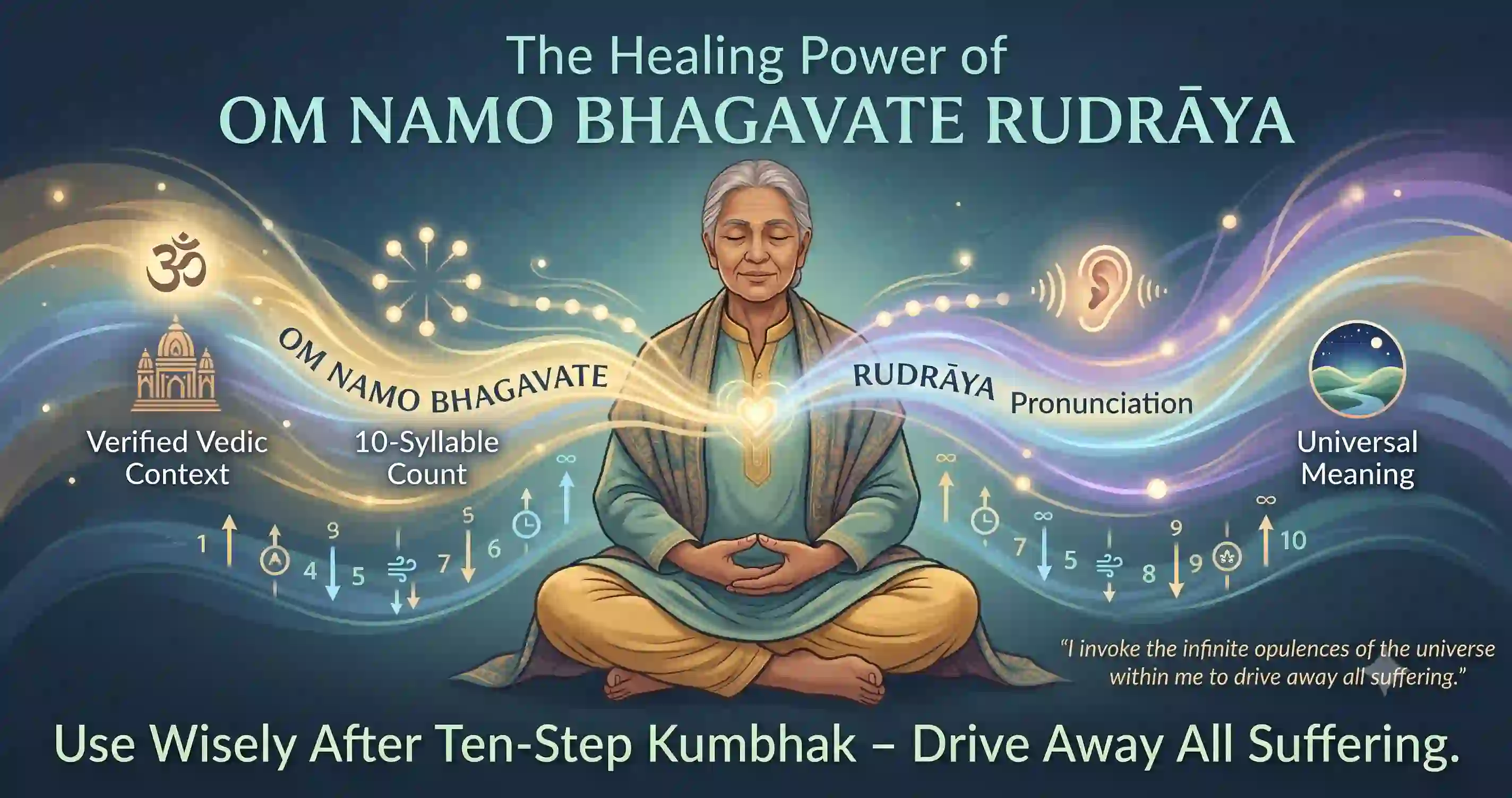
Sometimes a stress response ends before the feeling of stress does.
The difficult conversation is over. The screen has gone dark. The room is quiet. Yet an inner siren is still sounding. Ten-Step Kumbhak can create a clear interruption in that momentum; the mantra Oṃ Namo Bhagavate Rudrāya, used afterward, may offer the mind and voice a meaningful place to land.
That “may” matters. No clinical trial has tested this exact mantra immediately after the exact Ten-Step Kumbhak. What exists is a more layered body of evidence: authentic Vedic and post-Vedic textual traditions, classical yoga teachings on mantra repetition, an Ayurvedic framework that includes mantra and mental self-regulation, and modern research on mantra meditation, repetitive speech, Oṃ chanting, vocalization, group singing and music. Each layer can illuminate the practice without pretending to prove what it has not proved.
This article therefore separates:
- what the Sanskrit words actually mean;
- where the formula and its Rudra tradition occur in the textual record;
- what yogic and Ayurvedic authorities traditionally teach;
- what modern research has and has not measured;
- what can reasonably be inferred about chanting, singing or hearing the mantra after Ten-Step Kumbhak; and
- what remains a matter of personal meaning rather than universal fact.
The Ten-Step Kumbhak procedure is intentionally not repeated here. Readers who do not already know it should first use the complete, safety-focused guide: How to Practice the Ten-Step Kumbhak for Stress Relief.
The Essential Answer First 🌿
Here is the most relevant conclusion before entering the deeper textual, scientific and philosophical layers.
The mantra
ॐ नमो भगवते रुद्राय
Oṃ Namo Bhagavate Rudrāya
A careful literal translation
“Oṃ. Homage to the venerable Rudra.”
“I invoke the infinite opulences of the universe within me to drive away all suffering.”
Its syllable count
- With Oṃ, the formula has 10 syllables.
- Without Oṃ, it has 9 syllables.
Its textual status
- The exact formula is recorded at Mānava-Śrautasūtra 11.7.1.6 in the corpus’s Rudrajapavidhānakalpa appendix.1
- It is also traditionally recited as an invocation before Śrī Rudram, particularly in South Indian recitation lineages.
- The Vedic Saṃhitā text of Śrī Rudram is the Rudrādhyāya of the Taittirīya Saṃhitā, 4.5, commonly called the Namakam.2
- However, Oṃ Namo Bhagavate Rudrāya is not the first sentence of Taittirīya Saṃhitā 4.5. The Saṃhitā passage itself begins with namaste rudra manyava… This distinction prevents a beloved tradition from being defended with an inaccurate citation.
Its possible place after Ten-Step Kumbhak
Used only after the prescribed recovery and after breathing again feels completely normal, the mantra may serve as:
- an attentional landing point after the intensity of breath retention;
- a repeated sound that temporarily occupies space otherwise taken by rumination;
- a transition from inward silence to ordinary activity;
- a meaningful way to relate to fear, disruption and change;
- a vocal rhythm for a comfortable outward breath;
- a receptive auditory anchor when the mantra is heard instead of voiced; and
- for a devotional practitioner, an offering to Rudra—the Vedic power who is both formidable and healing.
None of these requires increasing the duration of Antar Kumbhak or Bāhya Kumbhak. “Enhancing” the practice here means potentially deepening integration, meaning, attentional steadiness or subjective relief—not making the breath holds longer.
Is “Oṃ Namo Bhagavate Rudrāya” a Vedic Mantra? 📜
The truthful answer is yes, with an important textual qualification.
The exact formula has a Vedic ritual-text source
The exact sequence oṃ namo bhagavate rudrāya is indexed at Mānava-Śrautasūtra 11.7.1.6, within the corpus’s Rudrajapavidhānakalpa appendix.1 A Śrautasūtra corpus belongs to Vedic ritual literature: it systematizes the performance and application of Vedic rites, while its appendices preserve supplementary ritual material. This is a legitimate Vedic ritual-text location for the formula, though not a Saṃhitā occurrence.
It is more precise to say:
“The exact formula is attested in Vedic ritual literature and belongs to the Rudra-japa tradition.”
It is less precise to say:
“This exact line is the opening mantra of the Taittirīya Saṃhitā’s Śrī Rudram.”
The second statement merges two closely related liturgical layers that are not textually identical.
The associated Saṃhitā source is Taittirīya Saṃhitā 4.5
The celebrated Vedic hymn-cycle known as Śrī Rudram, Namakam or Śatarudrīya is found in the Kṛṣṇa Yajurveda’s Taittirīya Saṃhitā 4.5.2 Its first words are:
namaste rudra manyava… 3
This opening is striking. It does not approach stress by pretending that every inner or outer force is already pleasant. It turns toward intensity and addresses it.
That arc is one reason the shorter invocation can feel meaningful after Kumbhak: a person has just met a controlled measure of bodily intensity without testing the limit. The mantra then places intensity within a vocabulary of reverence, relationship and transformation.
This is a philosophical connection—not proof that the ancient composers prescribed this mantra after the modern Ten-Step Kumbhak.
A related Vedic line must not be confused with the exact mantra
The Taittirīya Āraṇyaka 10.75.1, also transmitted as Mahānārāyaṇa Upaniṣad 75, contains:
namo rudrāya viṣṇave mṛtyur me pāhi4
Later recitation manuals may place expansions around Vedic passages. Such living liturgical usage is important evidence of tradition, but an expansion should not be silently presented as part of an earlier base text.
Why this precision strengthens rather than weakens the tradition
Textual honesty is not spiritual coldness. It is a form of respect.
Ancient traditions frequently have several layers:
- a Saṃhitā passage;
- a sūtra explaining use;
- an Upaniṣadic interpretation;
- a recitation-lineage preface or conclusion;
- a later spiritual practice; and
- a modern stress-relief application.
All six can be meaningful. They simply do not make the same historical claim.
How Many Syllables Are in Oṃ Namo Bhagavate Rudrāya? 🔟
Using the ordinary Sanskrit method of counting vowel nuclei, Oṃ Namo Bhagavate Rudrāya has 10 syllables.
The 10-syllable division
- Oṃ
- na
- mo
- bha
- ga
- va
- te
- ru
- drā
- ya
It may be shown compactly as:
Oṃ | na-mo | bha-ga-va-te | ru-drā-ya
In this vowel-based count, it can therefore be described as a daśākṣara, a ten-syllabled formula, when Oṃ is included. The word akṣara can have specialized meanings in orthography, phonetics and mantra lineages; “10 pronounced syllables” is the least ambiguous English description here.
Why the consonant cluster dr does not add a syllable
A syllable requires a vowel. Rudrāya contains three vowel nuclei—u, ā and a—and therefore three syllables. A practical division is:
ru-drā-ya
The dr cluster does not manufacture an additional vowel. Prosodic analysis can discuss how a consonant cluster affects syllable weight, but that does not change the three-syllable count.
Similarly, bh in bha is an aspirated consonant, not two syllables ba-ha. Sanskrit aspiration changes the consonant sound; it does not insert another vowel.
Why Oṃ is one syllable
Oṃ is traditionally called the praṇava and is treated as a single sacred syllable. Its o is long, but vowel length does not turn one vowel nucleus into two syllables. The final nasal resonance, written ṃ, does not count as a separate syllable.
A singer may extend Oṃ over several musical beats. Musical duration is not the same thing as linguistic syllable count.
Why some sources call the mantra 12-syllabled
The confusion usually comes from counting a different, longer formula:
Oṃ Namo Bhagavate Rudrāya Namaḥ
The final Namaḥ adds two syllables—na-maḥ—bringing the total to 12:
1 Oṃ + 2 Namo + 4 Bhagavate + 3 Rudrāya + 2 Namaḥ = 12
Both formulas can exist in practice. But a count belongs to its exact wording. The phrase requested in this article ends at Rudrāya, so its count is 10, not 12.
Does this 10-syllable formula have a Vedic metre?
Not by itself in the way a complete metrical ṛc has a named chandas. It is a compact invocation or japa formula, not a full anuṣṭubh verse. Calling it “10 syllables” describes its pronounced length; it does not assign it to a 10-syllable-per-line Vedic metre.
Sanskrit Text, Transliteration and Careful Pronunciation 🗣️
Devanāgarī
ॐ नमो भगवते रुद्राय
IAST
Oṃ Namo Bhagavate Rudrāya
Simple English-letter aid
Om Na-mo Bha-ga-va-tay Ru-draa-ya
The simplified aid is only approximate. IAST preserves distinctions that ordinary English spelling cannot.
Key pronunciation details
- Oṃ: one syllable, with a resonant nasal close. It need not be pushed or made theatrical.
- Namo: two syllables, na-mo. The form namo arises through Sanskrit sound combination from namaḥ before bhagavate.
- Bhagavate: four syllables, bha-ga-va-te. Bh is an aspirated b. It is not a separate buh-ha sequence.
- Te: approximately tay, with a pure vowel rather than a strongly gliding English diphthong.
- Rudrāya: three syllables, ru-drā-ya. The ā is long: the middle syllable carries duration.
- R: a light Sanskrit tap is suitable; there is no need for an exaggerated roll.
- V: classical Sanskrit v can sound between English v and w, depending on lineage and region.
The long ā belongs in Rudrāya. Writing Rudrāya is not merely decorative typography; it identifies the vowel accurately.
Sung melody is not the same as Vedic svara
There are at least three legitimate sound settings:
- Vedic recitation, with inherited accent and phonetic rules;
- spiritual chanting or singing, with a melody or repeated tune; and
- personal stress-relief repetition, with an even, comfortable voice.
They should not be casually equated. Anyone reciting the full Śrī Rudram as Veda should learn its svara, pronunciation and lineage rules from a qualified teacher. A personal post-Kumbhak chant can still be sincere, but sincerity does not automatically make it a technically correct Vedic recitation.
Word-by-Word Meaning Without Exaggeration 🔍
The mantra is grammatically compact. Its depth does not require adding words that are absent.
Oṃ: the praṇava and the frame of totality
Oṃ is not a conventional noun naming one particular deity. It is the praṇava, the pre-eminent sacred syllable.
The Māṇḍūkya Upaniṣad 1 begins with the declaration:
“Oṃ—this syllable is all this.”5
The Upaniṣad then relates Oṃ to time, consciousness and what transcends ordinary temporal division. Within this mantra, Oṃ can therefore function as a comprehensive opening: the act of homage is placed within a horizon larger than the speaker’s immediate problem.
A secular reader need not affirm a cosmology to use that structure. Oṃ may be heard as a sonic threshold: before the personal sentence begins, there is one whole sound.
That is an application, not a dictionary definition.
Namo: homage, reverence, a bow
Namo is the form taken by namaḥ before the following sound. It conveys salutation, homage or reverential bowing.
It does not have to mean humiliation. In mature practice, bowing can mean:
- “I do not have to dominate this moment.”
- “I can meet what is present without becoming identical to it.”
- “My intelligence matters, but it is not the whole of reality.”
- “I release the impossible demand that everything obey me immediately.”
For someone under stress, this can be a profound shift. Stress often contains not only difficulty but a second struggle: This must not be happening; I must control it now. Namo can loosen the second struggle while leaving practical agency intact.
Respect is not surrender to abuse, danger or injustice. A bowed ego and a protected boundary can coexist.
Bhagavate: to the venerable, blessed or august one
Bhagavate is the dative singular of bhagavat: “to Bhagavat,” “to the venerable one,” “to the blessed one” or “to the one endowed with bhaga.”6
The dative case points the homage toward its recipient.
Later Sanskrit tradition richly analyzes bhaga through qualities such as sovereignty, strength, glory, splendor, knowledge and detachment. Those later theological lists illuminate Bhagavān, but the safest compact translation here is “the venerable” or “the blessed Lord,” depending on the reader’s register.
For a universal reading, Bhagavate introduces dignity. The difficult force named next is not treated as meaningless debris; it is approached as something within a larger intelligible order.
Rudrāya: to Rudra
Rudrāya is the dative singular of Rudra: “to Rudra.”
Rudra in the Veda is vivid and multivalent:
- formidable and swift;
- a guardian of creatures;
- redemptively auspicious; and
- renowned as a healer.
Ṛgveda 2.33.4 addresses Rudra as the foremost among healers—bhiṣaktamaṃ…bhiṣajām.7 Śrī Rudram repeatedly holds fierce and beneficent dimensions together.
Etymologies of Rudra vary. The name has been connected with roaring, crying or howling; traditional explanations also interpret Rudra as one who removes suffering or causes sorrow to depart. The first group reflects common philological associations; “remover of sorrow” belongs primarily to traditional theological interpretation. Both can be reported, but not passed off as the same kind of evidence.
Why Rudra Can Speak So Powerfully to a Stressed Mind ⚡
Many stress messages promise only softness, comfort and escape. Rudra offers a more complete emotional vocabulary.
He does not deny that life has arrows.
In Śrī Rudram, danger is named. Fierce power is acknowledged. The prayer does not insist that the bow was never drawn; it asks that the bow be unstrung, that the arrow become auspicious, that the terrifying face reveal its healing face.2
That pattern can resonate with stress because stress is often morally and emotionally mixed:
- a racing heart may be trying to protect;
- anger may contain violated dignity;
- vigilance may have survived a real danger;
- grief may be love with nowhere to arrive;
- muscular readiness may persist after the threat has passed.
The Rudra vision does not require calling these states pleasant. It asks whether formidable energy can change its relationship to the person.
The fierce and the healing are not two unrelated worlds
The same fire that burns can cook. The same immune response that protects can become excessive. The same alertness that prevents an accident can become exhausting when it refuses to stand down.
This analogy does not reduce Rudra to biology. It reveals why a fierce healer is emotionally credible. Human beings often need a symbol spacious enough to include both the alarm and the return from alarm.
After Kumbhak, the body may feel quiet, vivid, charged, relieved or emotionally open. The name Rudra does not demand that only one of those states be acceptable.
A six-second inner story
A child hears thunder and covers her ears. Her grandfather does not say, “There is no thunder.” He sits beside her and names it.
The sound remains large. She is no longer alone with it.
For a devotional practitioner, Rudra is infinitely more than a psychological name. Yet the story shows one universal function of naming: an unnamed intensity can feel boundless; a named intensity can become relational.
Reverence can interrupt the inner courtroom
Stress frequently puts experience on trial:
“Why am I still upset?”
“I should have handled this better.”
“What is wrong with me?”
Namo changes the posture from prosecution to encounter. One need not approve of every thought or sensation. One can stop cross-examining the nervous system for a moment.
That shift may reduce secondary distress—the distress produced by fighting the fact that one is distressed. This is a psychological interpretation consistent with acceptance-based approaches, not a clinical claim about this mantra.
Why Use the Mantra After Ten-Step Kumbhak? 🫁➡️🎵
The word after is central.
The Ten-Step Kumbhak has its own exact architecture: normal Pūrak and Rechak, easy Antar Kumbhak and Bāhya Kumbhak, chest-centered movement, Dhyāna mudra and defined recovery. The mantra should not be inserted into a retention or used to lengthen one.
Complete the chosen round or rounds exactly as taught in the practice guide. Begin any sound only after the recovery is complete, breathing feels normal, and there is no air hunger, pressure, dizziness or uneasiness.
Kumbhak interrupts; mantra may help integrate
Breath retention is physiologically active. Even comfortable, submaximal holds alter respiratory chemistry and internal sensation. Attention becomes difficult to scatter because the body has become immediately relevant.
When the formal round ends, the mind may return to its old story with surprising speed. A short mantra can act as a bridge:
retention and recovery → meaningful sound → ordinary activity
The bridge does not improve the retention by making it harder. It may improve the transition by giving the newly gathered attention a coherent next object.
The mantra gives attention a single, repeatable shape
Rumination is repetitive, but its repetition has no satisfying boundary. It circles.
A mantra also repeats, yet each repetition has:
- a clear beginning;
- an ordered sequence;
- a clear end;
- a chosen meaning; and
- the option to stop.
That difference may matter. The mind is not commanded to become blank. It is offered a small, completed pattern.
Research on repetitive speech suggests that even repetition of a neutral word can reduce self-generated thought and activity in brain networks associated with ongoing thought.8 That experiment did not use this mantra or test stress treatment, so it supports only the general plausibility of attentional interruption.
Sound can externalize what silence gathered
During Kumbhak, experience is largely inward. After recovery, voicing the mantra makes an outward vibration that the practitioner both produces and hears.
This may create a useful sequence:
- inward concentration;
- recovery;
- voiced expression;
- auditory feedback; and
- re-entry into the environment.
Some people experience this as “sealing” the practice. Scientifically, sealing is a metaphor. It may describe subjective completion, not a known physiological lock.
Meaning can reshape the emotional interpretation of bodily intensity
The same bodily sensation can be interpreted as danger, effort, excitement, presence or transition. Interpretation does not make physiology imaginary; it influences what physiology means to the person.
The Rudra symbolism offers a particular reappraisal:
“Intensity exists. It need not remain an enemy. Fierce energy can turn toward healing.”
This is not positive-thinking sugar placed over distress. Śrī Rudram first acknowledges force, then asks for its auspicious face.
Repeated pairing may create a learned transition cue
If the same short mantra regularly follows a safely completed practice, the sound may gradually become associated with:
- the end of effort;
- restored normal breathing;
- a chosen pause;
- safety in the present setting; and
- return to daily life.
This is a reasoned inference from basic learning principles. It has not been tested for this particular Ten-Step Kumbhak–mantra sequence. A cue becomes beneficial only if the underlying practice remains comfortable and freely chosen.
Singing, Chanting and Hearing Are Not the Same Experience 🎶
All three can be valid, but they engage the person differently.
Chanting: precision and repeatability
An even spoken or lightly intoned chant foregrounds:
- syllable order;
- pronunciation;
- repetition;
- a stable attentional object; and
- an easily recognized ending.
Chanting may suit someone who wants clarity without a complex melody. The main risk is turning precision into performance anxiety. A missed vowel does not erase the entire practice, though careful pronunciation remains worthy of learning.
Singing: melody, emotion and extended expression
Singing adds pitch, melodic expectation, memory and aesthetic feeling. These can make the mantra emotionally accessible when plain repetition feels dry.
Music research broadly suggests that musical interventions can reduce psychological and physiological stress outcomes, although effects vary greatly by context, preference and study design.9 Such evidence cannot establish that one melody, rāga, pitch or frequency is uniquely therapeutic.
Singing also places greater demands on voice and outward airflow. The phrase must end while voicing remains comfortable. A beautiful note is not worth air hunger.
Hearing: a receptive path without vocal demand
Listening to the mantra can be appropriate when:
- the throat is tired;
- the person is self-conscious about voice;
- respiratory effort is undesirable;
- the recording feels safer than producing sound;
- pronunciation is still being learned; or
- quiet receiving is more helpful than doing.
Listening does not reproduce the respiratory or laryngeal features of chanting. Its possible benefits may instead arise through attention, musical expectation, familiarity, meaning and emotional association.
The recording should be at a comfortable volume. A sacred word played too loudly can still stress the auditory system.
Mental repetition: the quiet fourth option
Silent repetition removes vocal effort while preserving language, memory and meaning. Patañjali’s principle of repetition joined with contemplation can accommodate more than one volume, although classical traditions differ in how they rank audible, whispered and mental japa.
Mental repetition is not automatically superior. A stressed mind may find audible sound easier to follow; another person may find sound overstimulating. The most useful mode is the one that supports steadiness without coercion.
A vertical comparison
Chanting
- Primary anchor: articulated syllables
- Added component: self-produced voice
- Possible strength: precision and repeatability
- Limitation: vocal and respiratory participation
Singing
- Primary anchor: syllables plus melody
- Added component: pitch and emotion
- Possible strength: affective engagement
- Limitation: greater performance and airflow demand
Hearing
- Primary anchor: received sound
- Added component: music, voice and relational presence
- Possible strength: no vocal work
- Limitation: does not duplicate active chanting
Mental repetition
- Primary anchor: remembered language
- Added component: internal imagery and meaning
- Possible strength: silence and privacy
- Limitation: easier for rumination to intrude
No single mode wins for every nervous system.
What Modern Science Actually Shows 🧪
The most scientifically responsible sentence in this article is:
No published clinical trial located for this review tested Oṃ Namo Bhagavate Rudrāya sung, chanted or heard immediately after the exact Ten-Step Kumbhak.
The evidence below is therefore adjacent evidence. It can establish plausibility, suggest mechanisms and identify limitations. It cannot prove the complete sequence.
Mantra-based meditation: encouraging averages, important bias
A 2022 systematic review and meta-analysis of mantra-based meditation found small-to-moderate pooled improvements in anxiety, depression, stress, post-traumatic stress symptoms and mental health-related quality of life.10
The approximate standardized effects reported were:
- anxiety: g = −0.46;
- depression: g = −0.33;
- stress: g = −0.45;
- post-traumatic stress symptoms: g = −0.59; and
- quality of life: g = 0.32.
Those numbers should not be converted into a promise to an individual reader. The authors found evidence of study bias, and the literature included relatively few clinical populations and limited long-term follow-up. Different mantras, teaching formats, comparison groups and practice durations were combined.
What it supports: mantra practice as a class may help some psychological outcomes.
What it does not support: this exact Sanskrit formula, this exact placement after Kumbhak or a guaranteed effect.
Repetitive speech may reduce self-generated thought
In a functional MRI experiment, repetition of a single neutral word reduced the number of reported thoughts and decreased activity in cortical regions associated with self-generated thinking.8
This offers a non-mystical possibility: orderly repetition can occupy verbal-attentional machinery that might otherwise elaborate worry.
Limitations: the task was not devotional mantra practice; participants were not being treated for stress; the study did not involve Kumbhak; and reduced thought is not always the same as improved wellbeing.
Oṃ chanting and limbic deactivation: an intriguing pilot
A small 2011 functional MRI pilot studied 12 healthy adults during audible Oṃ chanting, a comparison sound and rest.11 The researchers observed deactivation in several limbic and related regions during Oṃ chanting and proposed a possible relation to vagal effects.
This study is often described far too confidently online.
Its responsible interpretation is:
- it was a small pilot;
- it investigated Oṃ, not the full mantra in this article;
- regional deactivation does not mean that an entire brain structure was “switched off”;
- the proposed vagal explanation was not directly established; and
- relaxation, sound production, expectation and task differences remain possible contributors.
It is interesting neuroimaging evidence, not a medical certificate for every Oṃ-based mantra.
Vocal and silent group Oṃ: promising but not decisive
A 2024 study randomized 34 young adults to vocal or silent group Oṃ chanting for 12 minutes.12 Both groups showed reductions in salivary cortisol and self-reported anxiety; the vocal group showed a larger anxiety reduction.
Again, caution protects the finding:
- the sample was small and young;
- there was no quiet, no-intervention control;
- group setting and expectation could contribute;
- the intervention was Oṃ rather than the full Rudra mantra; and
- it was not performed after Ten-Step Kumbhak.
The study suggests that both vocal and mental forms deserve further research. It does not prove that vocalization is universally better.
Recitation can organize breathing and cardiovascular rhythms
Bernardi and colleagues studied 23 healthy adults reciting the rosary in Latin and a yoga mantra the authors rendered “om-mani-padme-om.”13 Both recitations tended to organize breathing near six cycles per minute and influenced cardiovascular rhythms and baroreflex sensitivity.
The important lesson is not that all sacred languages contain a hidden identical frequency. It is that phrase structure and repetition can constrain respiratory timing, which can then interact with cardiovascular rhythms.
For post-Kumbhak use, this supports a modest inference: one phrase per comfortable outward breath can provide rhythmic structure. It does not justify forcing a six-breaths-per-minute target, and it does not isolate the effect of the words Bhagavate Rudrāya.
Group singing can synchronize respiratory-linked heart rhythms
A small exploratory study of choir singing found that song structure influenced breathing and heart-rate variability, with synchronized patterns among singers during highly structured vocalization.14
This may help explain why group mantra recitation can feel socially organizing. People share timing, endings, pauses and sound. Yet the study was small, did not test clinical stress treatment and did not examine this mantra after Kumbhak.
Social synchrony can be comforting for one person and exposing for another. Group practice is an option, not an obligation.
Humming raises nasal nitric oxide—but this does not prove stress relief
In a study of 10 healthy participants, humming produced a large increase in measured nasal nitric oxide compared with quiet exhalation, likely through enhanced sinus ventilation.15
This finding is frequently stretched beyond recognition. It does not show that:
- every sung mantra produces the same effect;
- more nasal nitric oxide means greater psychological relief;
- nitric oxide from humming cures disease;
- a particular pitch is medically optimal; or
- post-Kumbhak chanting delivers systemic healing.
The study establishes an acoustic-respiratory phenomenon in the upper airway. Nothing more should be claimed from it.
Music can reduce stress, but preference and setting matter
A meta-analysis covering 104 randomized controlled trials and 9,617 participants found overall beneficial effects of music interventions on physiological and psychological stress-related outcomes.9 The reported average effects were modest-to-moderate, with substantial variation.
This body of work makes listening or singing scientifically plausible as a supportive post-practice activity. It does not make every piece of music calming. Familiarity, volume, memory, cultural meaning and personal choice can alter the response.
A recording that reminds one listener of safety may remind another of coercion or loss.
The evidence verdict in plain language
Well established
- Breath retention is physiologically active.
- Repeated vocal phrases alter attention and respiratory timing.
- Music and mantra-based practices can reduce stress-related outcomes on average in some studied settings.
Plausible but not established for this exact sequence
- Chanting after recovery may help attention settle.
- Meaningful repetition may reduce rumination.
- Familiar post-practice sound may become a learned transition cue.
- Singing or group chanting may add emotional or social regulation.
Traditional rather than clinically verified
- Rudra’s grace transforms inner poison.
- mantra purifies karmic or subtle obstructions;
- sacred sound changes prāṇa in specific nāḍīs; and
- the practice confers the fruits described in traditional praise passages.
Unsupported when stated as fact
- this mantra cures anxiety;
- it directly stimulates the vagus nerve;
- it permanently deactivates the amygdala;
- it balances every doṣa;
- it works through 432 Hz, 528 Hz or another uniquely healing frequency; or
- chanting it after Kumbhak has been clinically proven.
The Yogic Vision: Japa Joined With Meaning 🕉️
Classical yoga offers a principle more sophisticated than mechanical repetition.
Patañjali: repeat the sound and contemplate its meaning
Yoga Sūtra 1.27 identifies the praṇava, Oṃ, as the expression of Īśvara. Yoga Sūtra 1.28 then says:
tajjapas tadarthabhāvanam16
A close sense is: “Its repetition, together with contemplation of its meaning.”
This is crucial. The yogic method is not merely acoustic. Japa and artha-bhāvanā—repetition and meaning-contemplation—belong together. Yoga Sūtra 1.29 associates the practice with inward awareness and the lessening of obstacles.
Applied after Kumbhak, one repetition can therefore have two inseparable faces:
- the mind follows the syllables; and
- the heart or intelligence reflects on what they mean.
The sound without meaning may still focus attention. Meaning without sound may still inspire. Together, they form the classical yogic logic of mantra.
Patañjali discusses Oṃ, not this complete Rudra formula and not this exact post-Kumbhak sequence. The connection is principled, not a claim of identical instruction.
Śrī Rudram turns toward what frightens us
Śrī Rudram repeatedly bows to Rudra in unexpected places and forms: in wilderness and settlement, in movement and stillness, in the socially honored and the socially marginal, in what protects and what threatens.2
Its spiritual psychology is radical:
Nothing is excluded from the field in which transformation must be sought.
A stressed mind commonly divides experience into “the acceptable me” and “the frightening me.” The Rudra vision does not romanticize harmful action, but it refuses to exile force from sacred intelligibility.
That makes the mantra especially potent after a practice involving breath retention. Kumbhak may reveal sensations a person usually avoids. The mantra can become a respectful acknowledgment: Even this intensity can be met.
Rudra as healer
Ṛgveda 2.33 praises Rudra’s remedies and calls him the foremost healer among healers.7 The hymn asks for wellbeing, protection and relief while never denying his formidable character.
This is a traditional foundation for hearing Rudra as more than wrath. His healing is not the opposite of his power; it is that power turned toward wholeness.
For publication accuracy, “Rudra is praised as a Vedic healer” is justified. “This mantra medically treats stress disorders” is not.
“All this is Rudra”: the nondual widening
The Mahānārāyaṇa tradition declares:
sarvo vai rudraḥ — “All this, indeed, is Rudra.”17
For a nondual reader, the mantra need not be a plea sent from an isolated self to a distant being. It can be recognition:
- the one who feels fear;
- the energy appearing as fear;
- the awareness knowing fear; and
- the movement toward healing
all arise within one indivisible reality.
For a secular reader, the metaphysics can remain open while the psychological widening remains useful: the difficult sensation is part of experience, not the whole identity and not an alien substance outside nature.
Upaniṣadic praise of Śatarudrīya
The Jābāla Upaniṣad commends recitation of the Śatarudrīya, and the Kaivalya Upaniṣad praises its purifying fruit.1819 These sources show the exceptional status later Vedic and Upaniṣadic tradition gave to Rudra recitation.
Such passages express traditional soteriological confidence. They are evidence for what the tradition teaches, not randomized clinical evidence. A respectful article need not erase them; it only needs to name their category correctly.
Mantra after Kumbhak is an integration, not a textual claim of antiquity
No source cited above says:
“Perform the modern Ten-Step Kumbhak for Stress Relief and then chant Oṃ Namo Bhagavate Rudrāya.”
The combined practice is a contemporary, reasoned integration:
- Kumbhak supplies a precisely bounded breath-retention practice;
- recovery returns breathing to normal;
- mantra supplies sound, attention and meaning; and
- Rudra tradition supplies a vision in which formidable energy can become auspicious.
Naming the synthesis as a synthesis allows it to be both traditional in depth and modern in application.
The Ayurvedic Vision: Mantra, Mind and Individual Suitability 🌿
Āyurveda does not reduce all care to herbs or diet. The Charaka Saṃhitā, Sūtrasthāna 11.54, describes three broad modes of therapeutic action.20
Daivavyapāśraya: traditionally sacred measures
Charaka includes mantra among daivavyapāśraya measures—approaches connected with sacred, providential or spiritually oriented means.20
Within that traditional worldview, the mantra may be understood as more than a cognitive tool. It can be:
- invocation;
- reverence;
- protection;
- alignment with an auspicious power; or
- surrender of the fruits of practice.
These claims belong to Ayurveda’s classical sacred framework. Modern clinical science has not verified that this exact mantra after Ten-Step Kumbhak produces a distinct daivavyapāśraya effect.
Sattvāvajaya: withdrawing the mind from what harms it
The same Charaka passage defines sattvāvajaya in terms of restraining or withdrawing the mind from unwholesome objects.20
A post-Kumbhak mantra can fit this logic without suppressing emotion:
- it does not order fear to disappear;
- it gives attention an alternative object;
- it brings language under choice;
- it replaces an unbounded worry-loop with a bounded sequence; and
- it can join attention with a meaning of reverence or healing.
This does not make mantra a substitute for psychotherapy. It shows that classical Ayurveda recognized attention and mental direction as part of care.
Yuktivyapāśraya: reasoned and context-sensitive care
Charaka’s third mode, yuktivyapāśraya, concerns rationally planned measures such as diet and medicines.20 Its wider lesson is suitability.
The mantra should not be imposed merely because it is ancient. A reasoned application asks:
- Does the person like the sound?
- Is the meaning welcome?
- Is voicing comfortable?
- Does a recording evoke safety or distress?
- Is the person fully recovered from Kumbhak?
- Is additional clinical care needed?
Tradition and discernment are not opponents.
Doṣa and guṇa language: useful tradition, not a biomarker report
An Ayurvedic practitioner might describe repetitive sacred sound as supporting sattva, helping organize mobile vāta, moderating driven rajas or lifting inert tamas. These are traditional qualitative interpretations.
They should not be rewritten as unverified laboratory claims such as:
- “the mantra reduces vāta by 37%”;
- “Rudra frequency detoxifies pitta”; or
- “chanting proves sattva in the brain.”
Doṣa and guṇa frameworks are not interchangeable with cortisol, heart-rate variability, neurotransmitters or brain imaging. Dialogue between systems becomes more credible when difference is preserved.
Individual response remains central
Ayurvedic thinking is strongly contextual. The same stimulus can have different effects according to constitution, condition, strength, age, season, setting and dose.
This supports a practical truth: one person may settle through low-volume listening; another through clear vocal chanting; another through silence. A universal article should protect all three.
Twelve Angles of Vision on the Mantra 🌍
No single explanation exhausts a living mantra. The following lenses can coexist without being forced into one theory.
1. The devotional lens
Rudra is a real divine presence, not a metaphor. The mantra is an offering of reverence after Kumbhak. Relief is received as grace, not manufactured as a personal achievement.
2. The Vedic lens
The formula belongs to Rudra-japa ritual tradition and opens toward the vast Śrī Rudram world: awe, danger, protection, medicine, creatures, landscapes and the auspicious transformation of force.
3. The yogic lens
Oṃ provides the praṇava; japa stabilizes attention; contemplation joins sound to meaning; the post-practice mind is invited inward rather than released immediately into distraction.
4. The Ayurvedic lens
Mantra belongs to a classical therapeutic category, while directing attention away from mentally harmful objects resembles sattvāvajaya. Personal suitability prevents the tradition from becoming a fixed prescription.
5. The attentional lens
Ten ordered syllables create a finite task. The practitioner knows what comes next and when the sequence ends. Predictability can be relieving when thought feels chaotic.
6. The emotional lens
Rudra gives dignity to powerful emotion. Anger, fear and grief are not declared unreal. They are brought into relationship with the possibility of healing.
7. The linguistic lens
The dative forms Bhagavate and Rudrāya direct homage toward a recipient. The language itself moves outward from the isolated “me.”
8. The acoustic lens
Vowels, consonants and nasal resonance create an audible contour. The practitioner hears a chosen pattern replacing unchosen mental noise. No mystical frequency claim is needed.
9. The respiratory-vocal lens
Voicing naturally unfolds on outward airflow. One comfortable phrase can organize expression after recovery. This is not permission to extend the phrase past comfort or add another hold.
10. The learning lens
Regular pairing may teach the mind that this sound marks completion and return. This conditioned-cue account is plausible but untested for the exact sequence.
11. The social lens
In a group, common tempo and shared endings can create belonging. The individual hears not only a recording or a self, but other human beings carrying the same phrase.
12. The secular existential lens
Life contains forces larger than personal preference: illness, weather, time, loss, change and mortality. “Namo” can mean meeting that fact without abandoning intelligence, courage or action.
The universal center is not compulsory belief. It is a freely chosen relationship to what cannot be controlled.
A Safe Post-Kumbhak Mantra Practice ✅
This section does not reproduce or modify the Ten-Step Kumbhak. It begins only after the formal practice and its recovery have ended.
Before making any sound
First confirm:
- breathing feels completely normal;
- there is no urge to take a bigger breath;
- the head feels clear;
- the chest, throat and face feel comfortable;
- there is no pressure, panic or uneasiness; and
- attention feels present enough to choose the next action.
If these conditions are not present, do not chant. Continue ordinary recovery, rest, or end the session.
Option A: chant it
- Complete the Ten-Step Kumbhak and its recovery exactly as taught.
- Wait until breathing feels normal.
- Take one normal inhalation.
- Voice Oṃ Namo Bhagavate Rudrāya during a comfortable outward breath.
- End the phrase before there is any air hunger.
- Allow the next inhalation to occur normally.
- Repeat only while the voice, breath and mind remain comfortable.
- Sit quietly for one moment before standing or returning to work.
The mantra is not a contest in volume, note length, repetitions or breath economy.
Option B: sing it
Use a melody that fits comfortably within the available outward breath. Shorten musical ornamentation if it tempts you to squeeze out more air. The purpose is integration, not vocal display.
If singing makes breathing effortful, switch to chanting, listening or silence.
Option C: hear it
Play a trusted recording at a comfortable volume after recovery. Let one to three minutes be enough for an initial experiment. Notice the body’s actual response rather than the response you think a sacred recording ought to produce.
Listening is not an inferior version. It is a different mode.
How many repetitions?
A practical beginning is:
- one repetition for simplicity;
- three repetitions for a brief arc; or
- nine repetitions when every repetition remains comfortable.
These are usability suggestions, not declarations that one, three or nine possesses a clinically proven effect. 108 repetitions are not required for a post-Kumbhak stress-relief application.
Duration can be equally simple: approximately one to three minutes.
Where should attention rest?
Three options are compatible:
- the sound of each syllable;
- the meaning of homage to Rudra; or
- the center of the chest, preserving continuity with the preceding practice.
One can alternate sound and meaning without chasing both at once. Patañjali’s insight is not that attention must strain; it is that repetition should not become meaningless automation.
A One-Minute Personal Experiment, Not a Demand 🧭
A credible stress-relief practice should allow the reader to disagree with it.
After a safely completed session, choose one mode—chanting, singing, hearing or mental repetition—and observe:
Before the mantra
- Is the jaw held?
- Does the chest feel settled, charged or neutral?
- Is thought moving quickly?
- What emotion is most obvious?
- Is breathing unquestionably normal?
After the mantra
- Did anything change?
- Was the change welcome, unwelcome or neutral?
- Did the sound reduce rumination or create more stimulation?
- Did meaning help, or did it feel foreign?
- Would silence have served better today?
Do not force a success story. “No noticeable change” is valid data. “I prefer hearing it” is valid data. “This mantra is not for me” is also valid data.
Personal observation cannot establish clinical efficacy, but it can establish personal fit.
Universal Use Without Erasing the Sacred 🤝
Universality does not require emptying the mantra of Rudra. It requires making participation honest and voluntary.
For a Śaiva or Vedic devotee
Rudra is Bhagavān. The mantra is worship, surrender and remembrance. The scientific discussion is secondary and does not define the practice’s full meaning.
For a practitioner from another faith
The mantra need not replace one’s own prayer, theology or name for the sacred. A person may listen respectfully, use a translation, choose an equivalent prayer from their tradition or omit mantra entirely.
No stress-relief technique should demand religious disloyalty.
For an agnostic practitioner
Rudra can remain an open question. The person can engage with the text as ancient poetry, a symbol of fierce-and-healing reality, or a structured sound.
Uncertainty is not disrespect.
For a secular practitioner
The working meaning may be:
“I meet the powers I cannot fully control with respect, clarity and a willingness to transform my response.”
Again, this is a secular application, not the literal Sanskrit translation.
For someone who does not want Sanskrit
Use silence. Use the sound of a bell. Use an honest phrase such as “The difficult moment has passed; I can return.” Or end after the prescribed recovery.
The Ten-Step Kumbhak does not become invalid because no mantra follows it.
Safety: What Must Never Be Sacrificed ⚠️
Sacred enthusiasm does not cancel respiratory physiology.
Do not chant during Antar Kumbhak or Bāhya Kumbhak
A voiced sound requires outward airflow. Trying to chant during a retention changes the method and can create strain. The mantra belongs after the full practice and recovery described in the official guide.
Do not use the mantra to extend breath capacity
Do not:
- stretch the last syllable until air hunger;
- race through the phrase to fit it into too little air;
- take an oversized inhalation to sing longer;
- add an unprescribed retention between repetitions;
- hyperventilate before chanting; or
- compare phrase length with another person.
The correct endpoint is comfort, not impressiveness.
Stop immediately if symptoms appear
End the sound and return to ordinary breathing if there is:
- dizziness or faintness;
- chest pain;
- unusual breathlessness;
- visual disturbance;
- panic;
- dissociation;
- throat pain;
- marked palpitations; or
- any sensation that feels unsafe.
Seek appropriate medical care for severe, persistent or concerning symptoms.
Consider listening or silence when voicing is unsuitable
Listening may be preferable for people with an irritated voice, respiratory symptoms or strong anxiety around breath and throat sensations. People with voice disorders, cardiopulmonary conditions or relevant medical restrictions should follow individualized professional advice.
Someone with trauma linked to choking, restraint, religious coercion or particular sounds may find the mantra activating. Choice, predictability and the ability to stop are essential.
Never practice breath retention in dangerous settings
Do not perform Kumbhak in water, while driving, while operating machinery, at height or anywhere a brief loss of orientation could cause harm. The presence of mantra or devotion does not make an unsafe setting safe.
This is supportive practice, not a replacement for care
Mantra and Kumbhak do not replace diagnosis or treatment for anxiety disorders, depression, trauma-related conditions, heart or lung disease, or other medical concerns. A practice can be meaningful and still have limits.
Claims This Article Deliberately Does Not Make 🚫
Precision keeps both tradition and science trustworthy.
This article does not claim that:
- the exact formula is the first sentence of Taittirīya Saṃhitā 4.5;
- the 10-syllable formula is 12 syllables;
- one English paraphrase exhausts Rudra’s meaning;
- a Vedic praise of healing is a modern clinical trial;
- Oṃ brain-imaging findings prove the effect of the complete mantra;
- chanting “switches on” the vagus nerve;
- singing at a special frequency cures stress;
- nasal nitric oxide findings establish mental-health treatment;
- Ayurveda’s doṣas are the same as biomedical variables;
- listening is physiologically identical to chanting;
- the mantra is necessary for Ten-Step Kumbhak;
- longer holds make the mantra more effective; or
- every reader should feel peaceful afterward.
What remains is still substantial: an authentic formula, a profound Rudra tradition, a precise 10-syllable form, a rich field of meaning, plausible supportive mechanisms and a safe way to explore the combination without inflating it.
Frequently Asked Questions ❓
Is Oṃ Namo Bhagavate Rudrāya found in the Veda?
The exact formula is indexed at Mānava-Śrautasūtra 11.7.1.6 in the corpus’s Rudrajapavidhānakalpa appendix. It is traditionally connected with Rudra-japa and used as a preface to Śrī Rudram. The associated Vedic Saṃhitā hymn is Taittirīya Saṃhitā 4.5, but the exact formula is not that chapter’s opening sentence.
Does the mantra have 10 or 12 syllables?
Oṃ Namo Bhagavate Rudrāya has 10. Adding the final word Namaḥ creates the 12-syllable formula Oṃ Namo Bhagavate Rudrāya Namaḥ.
Is Oṃ one syllable or two?
One. Its vowel is long and its sound may be sustained in singing, but it remains a single syllable.
Where is the long ā?
In Rudrāya: ru-drā-ya. The long vowel is in the middle syllable.
What is the best literal translation?
“Oṃ. Homage to the venerable Rudra.” “Oṃ. I bow to Bhagavān Rudra” is a natural devotional translation.
Does Rudra simply mean “the angry god”?
No. Vedic Rudra is formidable, but also protective, auspicious and explicitly praised as a healer. Reducing him to anger discards much of the textual portrait.
Is this the same as Oṃ Namaḥ Śivāya?
No. They are distinct formulas with different words and syllable structures. Both belong to the wider Rudra-Śiva tradition, but one should not be used as the textual source for the other.
Why chant after Kumbhak instead of during it?
Chanting requires outward airflow and would alter a retention. After the formal recovery, the mantra can serve as a separate phase of attention, meaning and transition without changing the Ten-Step method.
Has science proved that this exact combination reduces stress?
No. Research on mantra meditation, Oṃ chanting, repetitive speech, music and structured vocalization provides adjacent evidence, but no identified trial has tested this exact mantra immediately after the exact Ten-Step Kumbhak.
Does the mantra work by stimulating the vagus nerve?
That specific causal claim has not been established. Vocalization, outward airflow, auditory feedback, attention, expectation and emotion may all contribute. Small Oṃ studies have proposed vagal involvement, but proposal is not proof.
Must I believe in Rudra?
No one should be pressured into a belief. A devotee may worship Rudra; an agnostic may keep the question open; a secular practitioner may use an interpretive meaning; and anyone may choose silence or another personally congruent prayer.
Is hearing a recording as effective as chanting?
They are not physiologically identical, and direct comparative evidence for this exact mantra is absent. Listening removes vocal demand; chanting adds articulation, self-produced sound and respiratory organization. Personal response should guide the choice.
How many times should I repeat it?
One, three or nine repetitions—or roughly one to three minutes—is a practical starting range, not a sacred requirement or medical dose. Stop earlier whenever comfort decreases.
Must I chant 108 times?
No. A mālā practice of 108 repetitions belongs to established japa traditions, but it is not necessary for this brief post-Kumbhak application.
What if the mantra makes me emotional?
Pause and notice whether the emotion feels workable. Tears or tenderness are not automatically harmful, but panic, dissociation or overwhelm are reasons to stop, orient to the environment and seek support if needed.
Can the mantra replace professional treatment for anxiety?
No. It can be a supportive contemplative practice. It is not a substitute for appropriate medical or psychological assessment and care.
Conclusion: Let the Fierce Become Auspicious 🌅
Oṃ Namo Bhagavate Rudrāya is a 10-syllable formula of homage with an authentic place in Vedic Rudra-japa tradition. It opens toward Śrī Rudram’s extraordinary vision: the formidable power that frightens is also addressed as guardian, medicine and healer.
After Ten-Step Kumbhak—and only after complete recovery—the mantra may offer something breath retention alone does not attempt to provide:
- a word after silence;
- a chosen pattern after mental scattering;
- an outward sound after inward concentration;
- a meaning large enough to hold both fear and healing; and
- a clear threshold back into life.
Science can presently support parts of that account, not all of it. Repetition can affect thought. Vocal phrases can organize breathing. Oṃ and mantra meditation have produced promising findings in small studies and pooled analyses. Music can reduce stress-related outcomes for many people. But no experiment has yet verified this exact sequence, and no honest article should pretend otherwise.
Tradition can say more, provided it speaks in its own voice. Yoga joins japa with contemplation of meaning. Ayurveda includes mantra among its sacred therapeutic measures and recognizes deliberate redirection of mind. The Vedic Rudra is not merely placid; he is the terrible power asked to show his auspicious face.
Perhaps that is why the mantra can feel so human after Kumbhak.
It does not say that the storm never came.
It bows—and listens for what the storm may become.
Verified Sources and Further Reading 📚
- Vedic Heritage Portal. “Taittirīya Saṃhitā,” including Kāṇḍa 4 and the Rudrādhyāya context. Official text and recitation resources.
- Sanskrit Documents. “Taittirīya Saṃhitā,” Sanskrit text of 4.5. Read the Sanskrit text.
- Mānava-Śrautasūtra corpus. Exact-formula concordance entry at 11.7.1.6 in the Rudrajapavidhānakalpa appendix. See the exact-formula index. A manuscript-catalogue record independently identifies Rudrajapavidhānakalpa as section 7 of the corpus’s eleventh, Pariśiṣṭa, division: view the catalogue record.
- Vedic Heritage Portal. “Taittirīya Āraṇyaka,” noting the Mahānārāyaṇa material in chapter 10. Official overview.
- Sanskrit Documents. “Taittirīya Āraṇyaka,” including 10.75.1. Read the Sanskrit text.
- Māṇḍūkya Upaniṣad 1. Oṃ as the syllable encompassing all this. Text and translation.
- Ṛgveda 2.33. Hymn to Rudra, including the description of him as foremost among healers. Sanskrit text and English translation.
- Mahānārāyaṇa Upaniṣad 24. Sarvo vai Rudraḥ, the universal Rudra declaration. Sanskrit text.
- Kaivalya Upaniṣad 24. Traditional praise of Śatarudrīya recitation. Sanskrit text and text with translation.
- Jābāla Upaniṣad. Traditional commendation of Śatarudrīya. Sanskrit text.
- Patañjali Yoga Sūtra 1.27–1.29. Oṃ, repetition and contemplation of meaning. Text and commentary.
- Charaka Saṃhitā, Sūtrasthāna 11.54. Daivavyapāśraya, yuktivyapāśraya and sattvāvajaya. Sanskrit and English.
- Álvarez-Pérez Y, et al. (2022). “Effectiveness of Mantra-Based Meditation on Mental Health: A Systematic Review and Meta-Analysis.” International Journal of Environmental Research and Public Health. Open full text and PubMed record.
- Berkovich-Ohana A, et al. (2015). “Repetitive Speech Elicits Widespread Deactivation in the Human Cortex.” PLOS ONE. Open full text.
- Kalyani BG, et al. (2011). “Neurohemodynamic correlates of ‘OM’ chanting: A pilot functional magnetic resonance imaging study.” International Journal of Yoga. Open full text and PubMed record.
- Perry G, Polito V, Thompson WF. (2024). “Exploring the Physiological and Psychological Effects of Group Chanting in Australia: Reduced Stress, Cortisol and Enhanced Social Connection.” Journal of Religion and Health. Open full text and PubMed record.
- Bernardi L, et al. (2001). “Effect of rosary prayer and yoga mantras on autonomic cardiovascular rhythms.” BMJ. PubMed record.
- Vickhoff B, et al. (2013). “Music structure determines heart rate variability of singers.” Frontiers in Psychology. Open full text and PubMed record.
- Weitzberg E, Lundberg JON. (2002). “Humming greatly increases nasal nitric oxide.” American Journal of Respiratory and Critical Care Medicine. PubMed record.
- de Witte M, et al. (2020). “Effects of music interventions on stress-related outcomes: a systematic review and two meta-analyses.” Health Psychology Review. PubMed record.
-
The concordance entry gives Mānava-Śrautasūtra 11.7.1.6. The manuscript-catalogue record identifies Rudrajapavidhānakalpa as section 7 of the corpus’s eleventh, Pariśiṣṭa, division. See both links in the references. ↩↩
-
Vedic Heritage Portal, Taittirīya Saṃhitā and Taittirīya Saṃhitā Sanskrit text. ↩↩↩↩
-
Translation is intentionally compact; manyu has a semantic range including wrath, ardor and impetuous force. ↩
-
See standard Sanskrit lexical usage for bhagavat and its dative singular bhagavate; the context determines whether English uses “venerable,” “blessed” or “Lord.” ↩