Haṭha Yoga Pradīpikā 2.2 explained word by word: breath–mind link, Kumbhak stress relief, neuroscience, Ayurveda, safety and Ten-Step practice.
By Kumbhaki Yogi Dhruvaji (MSc IIT Bombay), founder of the Antistress Foundation 501(c)(3)
• How to Practice Ten-Step Kumbhak • Scientific Proof • Ancient Texts Proof • Bio • Subscribe By Email
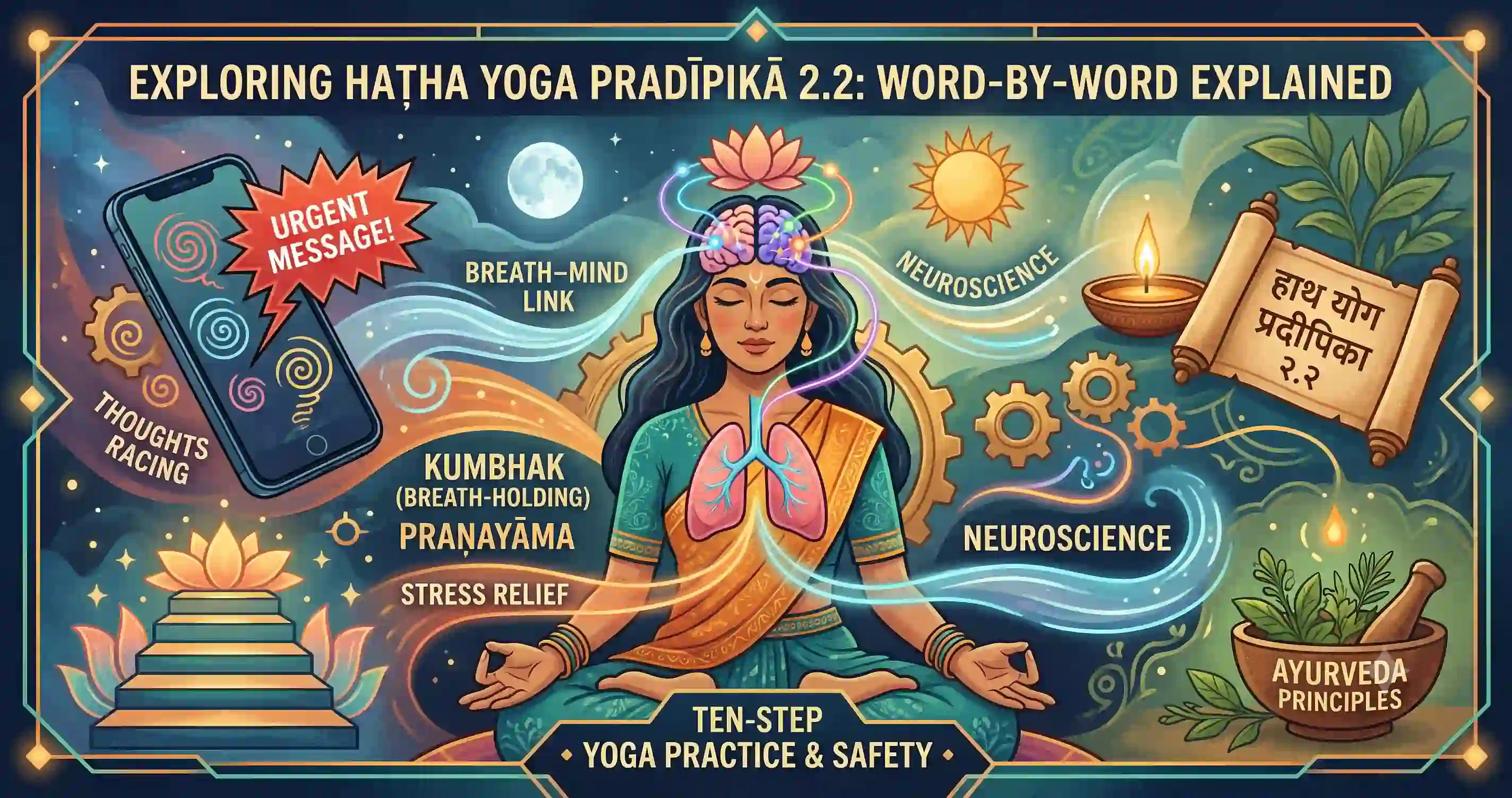
When Breath Becomes Still, Does the Mind Become Still? Haṭha Yoga Pradīpikā 2.2, Kumbhak and Stress Relief
Have you ever read a worrying message and felt your breathing change before you had finished the final sentence?
The screen did not touch your lungs. Yet the chest tightened, the breath became interrupted, and the mind began racing ahead—writing replies, predicting consequences and replaying the same few words.
That ordinary human experience is the doorway into one of the most quoted statements in the Haṭha Yoga Pradīpikā:
चले वाते चलं चित्तं निश्चले निश्चलं भवेत् ।
योगी स्थाणुत्वमाप्नोति ततो वायुं निरोधयेत् ॥ २.२ ॥cale vāte calaṃ cittaṃ niścale niścalaṃ bhavet |
yogī sthāṇutvam āpnoti tato vāyuṃ nirodhayet || 2.2 ||
This article examines that verse without asking you to accept either ancient authority or a modern brain explanation on faith. It asks a simpler question:
What does the verse actually say—and what changes when its insight is explored through the complete, comfortable Ten-Step Kumbhak for Stress Relief?
The full method remains centralized on the Ten-Step Kumbhak practice page. It is not reproduced here.
🌿 The First-Timer’s Answer in One Minute
The familiar form of Haṭha Yoga Pradīpikā 2.2 says that movement in the vāyu—the breath-wind or vital wind—is associated with movement in citta, the mental-emotional field. When the breath-wind becomes still, citta may become still. The practitioner thereby approaches sthāṇutva, a state of firmness or steadfastness, and is therefore advised to restrain the breath-wind.
In plain language:
- stress can be experienced as movement in both breathing and mind;
- breathing offers an embodied point of influence when arguing with every thought is exhausting;
- a comfortable Kumbhak may introduce a brief experience of non-reaction;
- “mental stillness” need not mean unconsciousness or the permanent disappearance of thought; and
- the verse is not permission to force, prolong or compete in breath retention.
The most useful modern reading is not, “Stop the breath and your mind must go blank.”
It is:
When inner movement is carrying you away, a skilfully contained breath may help you rediscover the part of you that can remain.
📜 What the Sanskrit Says—and What the Popular Translation Adds
The verse is often presented in English as:
“As long as the breath moves, so will the mental noise. In the same way, when breath is stopped, the mental noise will be gone too. One should therefore sit and hold the breath.”
That rendering communicates the practical direction of the verse, but it is interpretive rather than strictly literal.
🔎 A More Literal Translation
Following the familiar printed reading quoted above, a restrained translation would be:
“When the breath-wind is moving, the mind-field is moving. When it is still, the mind-field may become still. The practitioner attains steadfastness; therefore, one should restrain or bring the breath-wind into stillness.”
This translation matters because a first-timer may hear “mental noise will be gone” as a guarantee. If thoughts continue during Kumbhak, that person may then feel defective, disappointed or pressured to hold longer. None of those reactions is required by the Sanskrit.
🧭 Four Helpful Distinctions
1. “When” is closer than “as long as.”
The opening construction describes a condition: when vāyu is moving, citta is moving. It need not mean that every ordinary moving breath makes mental steadiness impossible.
2. Citta is wider than “mental noise.”
Mental noise is a vivid modern phrase, but citta can include attention, memory, emotion, imagery, intention and the whole changing field of mental experience. A quieter citta may therefore show up as less emotional propulsion or greater choice—not only fewer words in the head.
3. “May become” is safer than “will be gone.”
Bhavet is an optative form. It can express “may become,” “would become” or “should become.” It does not have to function as an instant mechanical promise.
4. The Sanskrit does not say “sit.”
Sitting is an important safety and practice instruction, and the preceding verse discusses an established seat. But the word “sit” is not present in 2.2 itself. “Hold the breath” is a reasonable contextual interpretation of vāyuṃ nirodhayet, especially because Brahmānanda’s later Jyotsnā commentary glosses it with kumbhayet—“one should retain.”1
Precision does not weaken the verse. It protects the beginner from trying to manufacture its conclusion.
🕯️ A Verse with More Than One Transmitted Form
Ancient texts reach us through handwritten manuscripts. Copyists preserve teachings, but they can also introduce alternative words, reorder phrases or absorb familiar language from nearby verses.
That history is visible in Haṭha Yoga Pradīpikā 2.2.
📚 The Familiar Reading and the Critical-Edition Reading
The familiar version speaks directly of citta and ends with an instruction:
cale vāte calaṃ cittaṃ niścale niścalaṃ bhavet
yogī sthāṇutvam āpnoti tato **vāyuṃ nirodhayet
A recent digital critical edition, prepared by comparing manuscript groups and related textual witnesses, instead prints:
cale vāte calaṃ sarvaṃ niścale niścalaṃ tathā
yogī sthāṇutvam āpnoti tato **vāyunibandhanāt
Its sense is approximately:
“When the wind moves, everything moves; when it is still, everything is likewise still. The practitioner attains motionlessness through restraining the breath.”
The edition’s apparatus shows that cittaṃ, bhavet and imperative forms such as “one should restrain” are all genuinely attested; the editors simply judge another combination more likely to be earlier.2
🌌 Why This Variant Deepens the Stress-Relief Reading
The difference is not a choice between a “true” verse and a “false” verse. It reveals two long-transmitted windows:
- The citta window: breath-wind and the mental-emotional field move together.
- The sarva window: when the organizing wind moves, the practitioner’s whole experienced system may feel in motion.
The second reading can feel surprisingly familiar during stress. It is rarely only one thought that moves. The jaw hardens. The stomach turns. Attention narrows. The next action becomes urgent. The person’s whole world seems to lean forward.
The textual history therefore enlarges the verse from a slogan about thought control into a picture of whole-person steadiness. The Haṭha Yoga Pradīpikā itself is generally placed in the fifteenth century, while Brahmānanda’s influential Jyotsnā is a much later commentary; separating these layers prevents a later explanation from being mistaken for the original author’s own words.3
🧩 Every Important Word, Opened Carefully
The power of the verse lies partly in repetition. Movement answers movement; stillness answers stillness. The language makes the relationship felt before it is intellectually explained.
🌬️ Cale Vāte — “When the Breath-Wind Moves”
Cale means moving, wavering, changing or unsteady in this context. It is paired grammatically with vāte, “when the wind is in that condition.”
Vāta and vāyu can mean wind or air, but here they carry more than the modern idea of gas moving in and out of the lungs. Within Haṭha Yoga, the visible breath is an accessible expression of a subtler vital movement called prāṇa. The verse therefore speaks at once to:
- observable breathing;
- felt internal motion;
- the movement of attention and vitality; and
- the traditional Yogic model of prāṇa.
This does not mean that oxygen, carbon dioxide, nerve activity and prāṇa are interchangeable words. They belong to different explanatory languages.
For a first-timer, the practical insight is enough: breathing is one of the few stress-linked processes that is automatic yet can also be influenced intentionally.
🧠 Calaṃ Cittaṃ — “The Mind-Field Is Moving”
Calaṃ mirrors cale: moving, unstable, wavering.
Cittaṃ is not merely the brain, and it is not merely verbal thinking. In the lived experience of stress, it can include:
- the sentence repeating in the mind;
- the face you cannot stop remembering;
- the future scene being rehearsed;
- the impulse to send, flee, freeze or defend;
- the feeling-tone that colours neutral events; and
- the attention that keeps being pulled back to the threat.
Calling all of this “mental noise” can be useful, but it may also sound as though the mind is an annoying machine that must be silenced. Citta is more intimate. It is the field in which hurt, memory, fear, judgment and hope are all moving.
The verse does not shame that movement. It identifies a relationship that may offer a doorway.
⏸️ Niścale Niścalaṃ Bhavet — “When It Is Still, the Mind May Become Still”
The prefix niś- gives niścala the sense of not moving, unwavering, fixed or steady.
The repeated form is beautiful:
niścale — niścalaṃ
Stillness in one domain is answered by the possibility of stillness in another.
Yet stillness has degrees. A lake can become still enough to reflect the moon while small living movements continue beneath its surface. In the same way, Kumbhak need not erase every thought to be meaningful. The change may be:
- a thought without immediate obedience;
- emotion without an impulsive message;
- uncertainty without another hour of compulsive checking;
- memory without being pulled fully back into the event; or
- one clear next action emerging from many competing urges.
That is not “nothing happened.” It may be the first usable form of steadiness.
🪨 Yogī Sthāṇutvam Āpnoti — “The Practitioner Reaches Steadfastness”
Yogī here is the practitioner—the person attempting integration. A first-time visitor need not adopt a spiritual identity to understand the human function of the word.
Āpnoti means reaches, obtains or comes into.
Sthāṇutvam conveys firmness, immovability or steadfastness. The critical edition notes a deeper traditional resonance: Sthāṇu is also a name of Śiva, so some readers can hear both ordinary stability and a specifically Śaiva dimension in the word.2
For stress relief, sthāṇutva is not becoming emotionally cold or physically rigid. It is the ability to remain present without being pushed out of yourself by every internal wave.
You may recognize it in very small moments:
- hearing criticism without composing your defence halfway through;
- feeling anger without turning it into damage;
- receiving bad news without demanding an instant life plan;
- noticing fear while still remembering where you are; or
- allowing one uncomfortable pause before choosing what comes next.
The verse’s goal is therefore not merely “no breath.” Its goal is a quality of the practitioner.
🧱 Tato Vāyuṃ Nirodhayet — “Therefore, One Should Restrain the Breath-Wind”
Tataḥ means therefore, then or from that.
Vāyuṃ is the wind, breath-wind or vital current as the object of the action.
Nirodhayet means one should restrain, check, contain, stop or bring under control. The word shares the broad family of “restraint” language familiar in Yoga, but context matters. Here it points toward respiratory restraint; Brahmānanda explicitly explains it as Kumbhak.1
Three consequences follow:
- The instruction is purposeful. Breath restraint is recommended because of its relationship with steadiness—not as an endurance sport.
- The intervention is embodied. When the content of thought is too tangled to solve, a bodily process provides another entrance.
- The manner cannot be separated from the aim. If restraint produces panic, strain or compulsion, the method has departed from the steadfastness it was meant to cultivate.
The destination must already be visible in the way one travels.
🔟 How the Ten-Step Kumbhak Embodies the Verse Without Copying It
Haṭha Yoga Pradīpikā 2.2 does not describe the modern Ten-Step sequence. It contains no instruction about Dhyāna Mudra, chest-center focus, the placement of Antar and Bāhya Kumbhak within one round, or the normal recovery breaths.
The relationship is one of principle and design, not a claim that Svātmārāma wrote the Ten-Step method.
🔄 The Verse Becomes a Complete Cycle
The verse moves conceptually through four stages:
movement → stillness → steadfastness → intentional regulation
The Ten-Step Kumbhak turns that logic into a complete, observable round:
- preparation reduces avoidable bodily agitation;
- normal nasal Pūrak and Rechak provide movement without turning breathing into a performance;
- Antar Kumbhak and Bāhya Kumbhak let stillness be explored from two different respiratory conditions;
- chest-center attention gives the wandering mind one embodied location;
- the transition between retentions prevents one pause from becoming the entire practice; and
- normal recovery breaths ask whether steadiness can remain after movement returns.
That last point is easily missed. The aim is not to live without breathing. Life resumes. Sound resumes. Decisions resume. A valuable Kumbhak is one whose steadiness can accompany the next ordinary breath.
🫶 The Hold Is an Event, Not an Achievement
If Kumbhak is treated as an achievement, the practitioner begins monitoring success:
“Was that long enough? Was the second hold better? Did my mind stop? Am I progressing?”
Mental movement then recruits the breath pause into its own competition.
In the Ten-Step method, comfort determines the boundary. There is no numerical pattern to win and no demand to reproduce yesterday’s hold. This protects the verse from a common reversal: using the wish for stillness to create more agitation.
For the exact centralized instructions, follow the Ten-Step Kumbhak for Stress Relief practice guide.
🔬 What Modern Science Can—and Cannot—Say About the Verse
Science cannot place electrodes on a Sanskrit concept such as citta, nor can an ancient verse serve as a laboratory protocol. The honest question is whether modern findings reveal relationships that are compatible with the verse’s observation.
Several do. None proves the entire verse.
↔️ The Breath–Mind Relationship Runs in Both Directions
Emotion, attention and mental effort can alter breathing. Breathing, in turn, can influence neural activity, bodily sensation and behaviour. This is a coupled system, not a one-way switch.
That distinction matters emotionally.
If stress changes your breathing, your disturbed breath is not a personal failure. If intentional breathing changes how stress is experienced, you have found a possible influence point—not proof that every problem was “caused by breathing.”
This two-way reading is more humane than blaming a stressed person for failing to breathe correctly.
🧠 Natural Nasal Breathing Organizes Some Brain Rhythms
In a human intracranial-recording study, natural nasal breathing was associated with rhythmic activity in the piriform cortex, amygdala and hippocampus; breathing phase also influenced performance in fear recognition and memory tasks. When airflow was diverted to the mouth, several of these respiratory-linked effects diminished.4
Another intracranial study found that deliberate control of breathing and attention to breathing engaged overlapping but distinct cortical and limbic networks, including insular, cingulate, frontal and hippocampal regions.5
These findings make one part of the ancient intuition scientifically plausible: breathing is not merely plumbing for oxygen. Its rhythm and the attention given to it can participate in the organization of brain activity.
But these experiments did not test the Ten-Step Kumbhak, and they do not show that a hold turns the brain off.
💡 A Still Breath Is Not a Silent Brain
During Kumbhak, airflow pauses. Metabolism, circulation, sensory processing, memory and neural signalling do not.
In fact, a hold can make internal signals more noticeable:
- the chest is felt more clearly;
- the wish for the next breath may gradually become salient;
- attention may narrow toward internal sensation; and
- prediction becomes unusually simple—the next respiratory movement has not yet begun.
Research on breath-focused interoception shows that attending to breathing changes how attention and brain networks are organized. It does not support equating still airflow with zero mental activity.6
Therefore, the scientifically responsible interpretation of niścalaṃ cittaṃ is greater steadiness or altered organization, not literal neurological silence.
🫁 Kumbhak Is Physiologically Active
Direct laboratory studies of demanding retentions in experienced or healthy participants have measured changes in cerebral blood-flow velocity and cardiovascular variables.78
That finding establishes importance, but not automatic benefit.
A fire alarm is important because it changes the state of a building. Medicine is important because dose and context change what it does. In the same way, the biological activity of retention is a reason for careful use—not a reason to assume that any hold, of any intensity, must heal.
The Ten-Step Kumbhak deliberately avoids maximal effort. Results from demanding laboratory holds cannot simply be pasted onto its comfortable pauses.
🎯 Does Retention Itself Improve Attention or Stress?
The evidence remains mixed and incomplete:
- In one active-comparison study, a structured breathing session containing Kumbhak improved a response-inhibition measure, but breath awareness improved it too. Retention was not shown to be the unique cause.9
- An eight-week study in young adult yoga practitioners reported gains in mindfulness, mind wandering and anxiety when intermittent Kumbhak was added to usual practice, but it does not establish the same result for first-timers or for the exact Ten-Step method.10
- A meta-analysis of randomized breathwork trials found a small-to-medium average benefit for self-reported stress, while also warning about study quality and the variety of methods combined under “breathwork.”11
The direct-evidence review for the Ten-Step Kumbhak has not located a trial of the exact complete sequence.
So the scientific conclusion is neither “the verse has been proved” nor “the verse is only poetry.”
It is:
Breathing, attention, emotion and brain activity are genuinely coupled. Structured breathing can help stress on average. Kumbhak has measurable effects. The exact contribution and clinical value of the Ten-Step pauses still require direct testing.
🧭 A Vertical Evidence Compass
Well supported
- stress, emotion and attention can alter breathing;
- breathing phase can organize activity in some human brain networks;
- deliberate attention to breathing recruits interoceptive and attentional systems; and
- sufficiently demanding retention changes cerebral and cardiovascular physiology.
Promising
- structured breathing that includes comfortable Kumbhak may help some people with stress, attention or anxiety-related outcomes.
Not yet known
- whether the exact Ten-Step Kumbhak outperforms an otherwise identical no-hold practice;
- which part of the complete round contributes most;
- what neural pattern occurs during its deliberately easy holds; and
- who benefits, feels neutral or feels worse.
Not supported
- every hold instantly eliminates mental noise;
- a blank mind proves correct practice;
- stronger respiratory discomfort creates deeper calm; or
- Kumbhak cures medical or psychiatric illness.
🌾 The Ayurvedic Lens: Movement, Mind and the Heart Field
Ayurveda and Haṭha Yoga are related Indian knowledge traditions, but they are not identical systems. Haṭha Yoga Pradīpikā 2.2 is not an Ayurvedic prescription, and the verse does not diagnose a doṣa.
Ayurveda can nevertheless clarify why the word vāyu carries more meaning than “air.”
🌬️ Vāyu as the Principle of Movement
The Charaka Saṃhitā describes normal vāta as initiating bodily activity, impelling mental functions and employing the senses; disturbed vāta is also described as capable of perturbing the mind and senses.12
This does not mean that a modern stress response is simply “high Vāta,” or that one breathing round is an Ayurvedic treatment. It does show that classical Ayurveda also refused to isolate movement in the body from movement in mind.
From this perspective, the opening cale vāte is almost diagnostic in a non-medical sense:
What is moving me right now—and is that movement coordinated, or is it carrying me away?
The Ten-Step Kumbhak introduces a boundary within movement. It does not attempt to destroy vāyu, because life requires movement. The pause is followed by normal breathing. Regulation, not permanent arrest, is the usable lesson.
❤️ Hṛdaya Holds More Than an Anatomical Heart
In Charaka Saṃhitā, Siddhi Sthāna 9.4, hṛdaya is described as a central site where prāṇa, apāna, manas (mind), buddhi (discernment) and cetanā (living consciousness) are situated together, like spokes meeting at a hub.13
This traditional image is not modern anatomy. Its value is conceptual: breath, mind, discernment and life are not placed in sealed compartments.
The Ten-Step practice’s continuing focus at the center of the chest resonates with that integrated map. It offers a concrete place where the first-timer can notice:
- breathing movement;
- bracing or release;
- emotion felt as pressure or openness;
- the urge to act; and
- the return of choice.
That resonance is meaningful, but it is not proof that chest attention treats a heart condition, balances every doṣa or changes a specific organ.
⚖️ The Ayurvedic Question Is Not “How Long?”
An Ayurvedic reading asks about appropriateness:
- What is the person’s present condition?
- Does the practice leave them more coordinated or more disturbed?
- Does stillness become clear and alert, or frightening and constricted?
- Does the person recover well afterward?
This is why the absence of a fixed count is not an omission. The hold is governed by ease and present capacity, not by an abstract number imposed on every body.
Ancient depth and individual fit meet at the same point: the practice must serve the person who is actually breathing today.
🩹 What “Stress Relief” and “Healing” Can Honestly Mean Here
The word healing carries hope. It can also carry a hidden burden: “If I do this correctly, everything damaged in me should be repaired.”
Haṭha Yoga Pradīpikā 2.2 does not require that promise.
🌱 Three Different Levels of Change
Level 1 — A state change
After a round, you may notice less urgency, a clearer next step, reduced muscular guarding or no obvious change. This is immediate experience, not yet a lasting transformation.
Level 2 — A learned relationship
Across repeated, comfortable practice, you may become more able to notice activation without instantly obeying it. The skill is not “never feel stress.” It is “return with less damage.”
Level 3 — Clinical healing
Recovery from a diagnosed medical or mental-health condition requires condition-specific evidence and, where appropriate, professional care. The exact Ten-Step Kumbhak has not been established as a cure or replacement treatment.
The first two levels may still matter profoundly.
A person who pauses before sending the message that would fracture a relationship has not cured every wound. Yet something has healed in that moment: urgency no longer owns the entire future.
📈 Measure Return, Not Emptiness
Instead of asking only, “Did my mind stop?” try asking:
- Did the same thought feel equally commanding afterward?
- Was my next action clearer?
- Did my face, jaw or shoulders remain braced?
- Could I return to the task in front of me?
- Did I feel safer, neutral, uncomfortable or more activated?
- Would another round be caring—or would stopping be wiser?
These questions let experience answer. A neutral result is information. Discomfort is information. Relief is information. None needs to be exaggerated to protect belief in the verse.
🧪 A First-Timer’s Experiment with the Verse
You do not need to decide whether prāṇa is real, whether Ayurveda is scientifically measurable or whether Svātmārāma understood neuroscience.
You can begin with what you already know.
📝 Before Practice
Name one present experience without diagnosing yourself:
- “My reply keeps rehearsing itself.”
- “My chest feels guarded.”
- “I cannot settle on the next task.”
- “The meeting ended, but my body has not received the news.”
Then choose one desired outcome:
- less urgency;
- greater clarity;
- a more settled body;
- or simply the ability to observe what happens.
🪑 During Practice
Use only the exact Ten-Step Kumbhak practice guide. Remain seated safely. Keep Pūrak and Rechak normal. Let both Kumbhak pauses remain completely easy, and end either pause immediately if strain, an urge to breathe or uneasiness appears.
Do not try to prove the verse while practising it.
The experiment is not:
“Can I force my mind to stop?”
It is:
“When a comfortable respiratory pause occurs inside a complete round, what—if anything—changes in my relationship to movement?”
🔍 After Practice
Ask three open questions:
- What changed in body, thought or emotion?
- What did not change?
- Do I freely want to use this again?
This approach preserves dignity. The practice does not announce your experience for you.
🚫 Seven Misreadings the Verse Does Not Require
1. “A Moving Breath Is Bad”
Breathing movement is life. The verse values the possibility of intentional restraint within breathing; it does not condemn normal Pūrak and Rechak.
2. “A Thought During Kumbhak Means Failure”
Thought can remain while its speed, emotional charge or authority changes. Sthāṇutva belongs to the practitioner, not to a performance score.
3. “If a Short Hold Helps, a Longer Hold Must Help More”
The verse gives a direction, not a dose. Modern physiology shows that retention becomes a more demanding cardiovascular and chemical event as it intensifies. More is not logically contained in “therefore.”
4. “Science Has Proved That Kumbhak Stops the Mind”
Science has shown breath–brain coupling, interoceptive networks and acute physiological changes. It has not measured the disappearance of citta or proved the exact Ten-Step method.
5. “The Verse Says to Suppress Emotion”
Restraint of vāyu is not an order to deny grief, fear or anger. A pause may create room to feel without immediate enactment.
6. “Stillness Must Feel Pleasant”
For some people, especially those with panic, respiratory fear or suffocation-related trauma, retention can feel threatening. A prāṇāyāma trial in people with PTSD documented anxiety, breathlessness, dizziness, constriction and a suffocation-related flashback in some participants.14
An unwanted response is not spiritual resistance. It is a reason to stop and choose an appropriate alternative.
7. “Healing Means Replacing Treatment”
Kumbhak may be explored as a stress-regulation practice. It should not be used to stop prescribed care or to self-treat a serious symptom.
⚠️ Safety Is Part of the Meaning
A verse about restraint must not be practised without restraint.
- Practise seated in a stable, safe place.
- Never practise while driving, in water or during any activity where altered attention or faintness could cause injury.
- Keep every hold completely easy; never test maximum capacity.
- Return to normal breathing immediately if you feel an urge to breathe, strain or uneasiness.
- Stop if you experience dizziness, faintness, unusual breathlessness, chest discomfort, panic, visual disturbance or any other concerning symptom.
- Seek appropriate medical guidance before retention practice if you have relevant heart, lung, blood-pressure, neurological, fainting, pregnancy-related, panic-related or trauma-related concerns.
For the complete current safeguards, use the centralized practice page and the complete contraindications map.
Stopping is not the opposite of Yogic steadiness. Sometimes it is its clearest expression.
❓ Frequently Asked Questions
What does Haṭha Yoga Pradīpikā 2.2 mean?
In its familiar form, the verse links movement of the breath-wind with movement of the mental field, and stillness of the breath-wind with possible steadiness of mind. It says the practitioner reaches steadfastness and therefore should restrain the breath-wind.
Is cale correctly written as “chale”?
In standard IAST transliteration, cale is correct. Some English speakers write “chale” to suggest pronunciation, but the Sanskrit letter च is conventionally transliterated c.
Does citta mean “mental noise”?
“Mental noise” is a useful modern interpretation, not the full lexical meaning. Citta can include thought, attention, memory, emotion and the changing mental field.
Does the verse literally say, “One should sit and hold the breath”?
It does not contain the word “sit.” It says that vāyu should be restrained or brought into stillness in the familiar reading. The Kumbhak interpretation is supported by the chapter’s context and by Brahmānanda’s commentary.
Does Kumbhak make the brain stop?
No. Airflow pauses, but the brain and body remain active. The relevant possibility is altered organization, attention or reactivity—not the cessation of neural function.
Is the verse scientifically proven?
Its entire Yogic claim is not a testable modern proposition. Science supports a real two-way relationship among breathing, attention, emotion and neural activity, and it shows that retention changes physiology. It does not prove that every Kumbhak removes thought or that the exact Ten-Step practice treats stress disorders.
Why are there two versions of the Sanskrit?
Different manuscripts preserve different readings. The familiar version emphasizes citta and gives an instruction to restrain vāyu. A recent critical edition selects a reading that says “everything” moves or becomes still and that steadfastness comes “through restraining the breath.” Both belong to the verse’s documented transmission.
How does this verse relate to the Ten-Step Kumbhak?
The verse supplies a principle: respiratory stillness may support inner steadfastness. The Ten-Step Kumbhak places comfortable Antar and Bāhya Kumbhak inside a complete sequence of preparation, normal breathing, chest-center attention, transition and recovery. The verse itself does not contain those ten instructions.
Can a first-timer practise it?
A first-timer can consider the centralized guide if they can practise safely and have no reason to seek clinical advice first. Begin only with the current Ten-Step instructions and safeguards, never from an isolated verse or a breath-holding challenge.
Can Kumbhak heal anxiety, depression or physical disease?
It may support stress regulation for some people, but the exact Ten-Step Kumbhak is not established as a cure for a medical or psychiatric condition. Use appropriate professional care for persistent, severe or diagnosed problems.
🌅 The Stillness That Can Return to Life
Imagine a seismograph after a tremor. The ground has stopped, but the needle continues drawing the event.
Stress can be like that. The conversation is over. The door is closed. The email has been sent. Yet breath, muscle, attention and memory continue tracing what happened.
Haṭha Yoga Pradīpikā 2.2 does not tell us that one pause erases the earthquake. It notices that movement is shared. It suggests that the breath-wind is not merely a victim of mental disturbance; it may also become an entrance into steadiness.
The Ten-Step Kumbhak makes that suggestion testable in ordinary life—without asking you to memorize the whole ancient system, force a blank mind or turn retention into a contest.
Perhaps the deepest meaning of sthāṇutva is not that nothing inside you moves.
Perhaps it is that, for one clear moment, not everything that moves can move you.
📚 References and Footnotes
-
The digital Haṭhapradīpikā edition presents Brahmānanda’s Jyotsnā on 2.2, where vāyu is explained as prāṇa and nirodhayet is glossed with kumbhayet. See Haṭhapradīpikā Online, 2.2, root text, apparatus and Jyotsnā. ↩↩
-
Light on Haṭha Project, Haṭhapradīpikā Online, verse 2.2. The edition prints sarvaṃ, tathā and vāyunibandhanāt while documenting manuscript support for cittaṃ, bhavet, nibandhayet, nirundhayet and nirodhayet. Its philological note also discusses the meanings of sthāṇutvam. ↩↩
-
The Oxford Centre for Hindu Studies course description identifies the Haṭhapradīpikā as a fifteenth-century compilation. For the bibliographic identity of the later commentary, see the Kaivalyadhama critical edition catalogue record for Brahmānanda’s Jyotsnā. ↩
-
Zelano C, Jiang H, Zhou G, et al. “Nasal Respiration Entrains Human Limbic Oscillations and Modulates Cognitive Function.” Journal of Neuroscience. 2016;36(49):12448–12467. PMCID: PMC5148230. DOI: 10.1523/JNEUROSCI.2586-16.2016. ↩
-
Herrero JL, Khuvis S, Yeagle E, Cerf M, Mehta AD. “Breathing above the brain stem: volitional control and attentional modulation in humans.” Journal of Neurophysiology. 2018;119(1):145–159. PMCID: PMC5866472. DOI: 10.1152/jn.00551.2017. ↩
-
Farb NAS, Zuo Z, Price CJ. “Interoceptive Awareness of the Breath Preserves Attention and Language Networks amidst Widespread Cortical Deactivation.” eNeuro. 2023;10(6):ENEURO.0088-23.2023. doi:10.1523/ENEURO.0088-23.2023; PMCID: PMC10295813. ↩
-
Nivethitha L, Mooventhan A, Manjunath NK. “Cerebrovascular hemodynamics during pranayama techniques.” Journal of Neurosciences in Rural Practice. 2017;8(1):60–63. doi:10.4103/0976-3147.193532; PMCID: PMC5225724. This study used a demanding post-inhale retention in experienced participants; it did not test the Ten-Step Kumbhak or stress relief. ↩
-
Nivethitha L, Mooventhan A, Manjunath NK. “Evaluation of Cardiovascular Functions during the Practice of Different Types of Yogic Breathing Techniques.” International Journal of Yoga. 2021;14(2):158–162. PMCID: PMC8191218. DOI: 10.4103/ijoy.IJOY_61_20. The exposure was substantially more demanding than a deliberately easy Ten-Step hold. ↩
-
Saoji AA, Raghavendra BR, Rajesh SK, Manjunath NK. “Immediate Effects of Yoga Breathing with Intermittent Breath Holding on Response Inhibition among Healthy Volunteers.” International Journal of Yoga. 2018;11(2):99–104. doi:10.4103/ijoy.IJOY_65_16; PMCID: PMC5934957. ↩
-
Saoji AA, Raghavendra BR, Madle K, Manjunath NK. “Additional Practice of Yoga Breathing With Intermittent Breath Holding Enhances Psychological Functions in Yoga Practitioners: A Randomized Controlled Trial.” Explore (New York). 2018;14(5):379–384. doi:10.1016/j.explore.2018.02.005; PubMed PMID: 30122326. ↩
-
Fincham GW, Strauss C, Montero-Marin J, Cavanagh K. “Effect of breathwork on stress and mental health: A meta-analysis of randomised-controlled trials.” Scientific Reports. 2023;13:432. PMCID: PMC9828383. DOI: 10.1038/s41598-022-27247-y. ↩
-
Charaka Saṃhitā, Sūtra Sthāna 12.8, on normal and disturbed vāta in relation to bodily activity, mental functions and the senses. Sanskrit and English text. ↩
-
Charaka Saṃhitā, Siddhi Sthāna 9.4, on hṛdaya, prāṇa, apāna, manas, buddhi and cetanā. Sanskrit and English text. ↩
-
Haller H, Mitzinger D, Cramer H. “The integration of yoga breathing techniques in cognitive behavioral therapy for post-traumatic stress disorder: a pragmatic randomized controlled trial.” Frontiers in Psychiatry. 2023;14:1101046. PMCID: PMC10150115. DOI: 10.3389/fpsyt.2023.1101046. The primary intention-to-treat comparison did not show a clear added benefit, and recurrent adverse experiences were reported in a subgroup. ↩