You complete Antar Kumbhak with surprising ease. Then Rechak ends, Bāhya Kumbhak begins—and almost immediately something inside says, “Breathe now.”
By Kumbhaki Yogi Dhruvaji (MSc), founder of the Antistress Foundation 501(c)(3)
• How to Practice Ten-Step Kumbhak • Scientific Proof • Ancient Texts Proof • Bio • Subscribe By Email
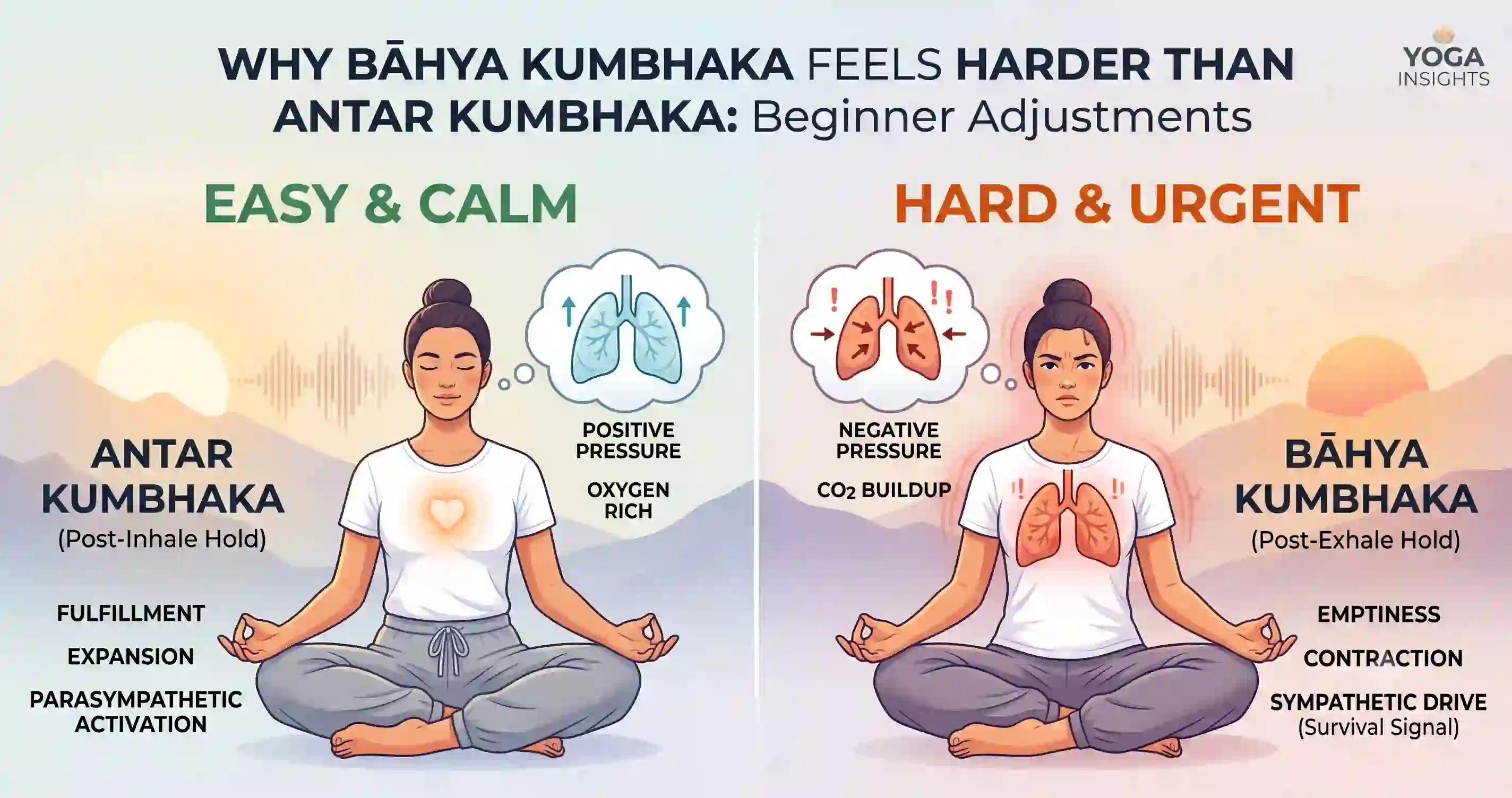
For many beginners, this post-exhale pause is where the first attempt ends.
That does not mean you are weak, anxious, “bad at breathing,” or unsuited to Kumbhak. Bāhya Kumbhak begins at a lower lung volume than Antar Kumbhak. There is less air in the lungs, less lung-inflation feedback to soften the urge to breathe, and often a more vivid feeling that the next action must be an inhalation. The two holds are related, but they are not equal physiological tasks.
The right beginner response is not to overpower that difference. It is to respect it.
In Kumbhak for Stress Relief, Bāhya Kumbhak may be much shorter than Antar Kumbhak. Its success is measured by ease and reserve—not by matching a count.
This article explains the outer hold; it does not reproduce the full method. For the exact sequence, posture, Dhyāna Mudra, chest-center movement and safeguards, use the How to Practice Ten-Step Kumbhak for Stress Relief guide.
The Short Answer: Why Bāhya Kumbhak Often Feels Harder 🧭
The most relevant reasons come first:
- 🫁 Bāhya Kumbhak starts with a smaller lung-air reservoir. After Rechak, the lungs are not literally empty, but they contain less gas than after a comfortably full Pūrak.
- 🧠 A fuller lung sends different mechanical feedback to the brain. Lung inflation can delay the point at which the urge to breathe becomes compelling. That effect is reduced at lower lung volume.
- 🌬️ The automatic drive to inhale is more noticeable. Carbon dioxide continues to be produced, oxygen continues to be used, and ventilation has stopped. At a lower lung volume, the “missing next inhalation” may be felt sooner.
- 🪢 Beginners often make the outer hold harder than it needs to be. Squeezing out extra air, pulling in the abdomen, collapsing the torso, tightening the throat or trying to equal Antar Kumbhak all add strain.
- ❤️ Meaning changes sensation. A full chest may feel protected; the interval after Rechak may feel exposed. Stress, panic sensitivity or a history involving suffocation can make the same physical pause feel more threatening.
Human experiments support the lung-volume difference. A classic study comparing breath holds after maximum inspiration with holds after normal expiration found that the first hold was much longer at the higher lung volume.1 In a later face-immersion experiment, healthy participants held at total lung capacity for about 59 seconds and at functional residual capacity for about 32 seconds; the researchers proposed lung-stretch feedback as an important contributor.2 Those are laboratory comparisons—not recommended Kumbhak durations—but the direction of the difference is clear.
The revised 1–3-second reserve rule 🛡️
End Bāhya Kumbhak while it still feels completely easy and while you remain certain that you could have continued comfortably for at least another one to three seconds.
This wording is easy to misunderstand, so three distinctions matter:
- One to three seconds is the reserve, not a minimum hold.
- It does not mean waiting until only one to three seconds remain before your limit.
- If an urge to breathe, strain or uneasiness appears sooner, begin Pūrak immediately.
A beginner’s Bāhya Kumbhak may therefore be one second, less than one second, or only a moment of clear stillness. If no comfortable pause is available at all, do not manufacture one. Return to normal breathing and choose a non-retention practice unless individualized guidance indicates otherwise.
Antar and Bāhya Kumbhak Are Not the Same Task ⚖️
Antar Kumbhak begins after comfortably full Pūrak
Antar Kumbhak begins with air retained inside after Pūrak. In the Ten-Step Kumbhak, “full” means comfortably full—not maximum capacity. Even so, lung volume is higher than it will be after Rechak.
That higher volume changes several conditions at once:
- more gas remains available in the lungs;
- lung tissue is more expanded;
- pulmonary stretch receptors provide stronger inflation-related feedback;
- the next expected respiratory movement is Rechak, not an urgent attempt to bring air in;
- the subjective experience may feel like holding something already received.
Antar Kumbhak can still become uncomfortable if prolonged. A full lung is not a guarantee of safety, and maximum inflation can itself create pressure or tension. The relevant comparison is comfortably full versus comfortably empty, not maximally inflated versus forcefully emptied.
Bāhya Kumbhak begins after comfortably empty Rechak
Bāhya Kumbhak begins after Rechak, with the center of the chest lowered and the lungs feeling comfortably empty. “Empty” is experiential language. The lungs do not become an anatomical vacuum.
After a normal passive exhalation, functional residual capacity remains. Even after the strongest possible exhalation, residual volume remains and helps keep alveoli open.3 The Ten-Step method does not ask a beginner to approach that extreme. There should be no squeezing out of the last air and no abdominal pull.
This is important because two very different actions can both be called “exhaling fully” in casual speech:
- ✅ Comfortably empty: Rechak finishes without extra effort; the torso remains upright; the face, throat and abdomen remain relaxed.
- ❌ Mechanically emptied: the ribs are compressed, the abdomen is drawn inward, the back collapses or additional air is pushed out after comfort has ended.
The second action starts Bāhya Kumbhak from an unnecessarily demanding position.
Equal names do not require equal seconds
Both phases are Kumbhak, but that does not make equal timing a beginner requirement. Starting lung volume, gas reserve, sensory feedback and emotional meaning differ.
A modern teaching note from the T. Krishnamacharya tradition likewise observes that Antar Kumbhak is generally more attainable than the same count in Bāhya Kumbhak and advises approaching both progressively.4 This is a lineage observation, not a universal biomedical law, but it matches the direction found in lung-volume research.
If Antar Kumbhak feels easy for four seconds while Bāhya Kumbhak feels easy for only a fraction of that, the shorter outer hold is not incomplete. It is accurately individualized.
The Scientific Truth: What the Body Is Responding To 🔬
1. Lower lung volume means a smaller gas reservoir
Metabolism does not pause when breathing pauses. Cells continue using oxygen and producing carbon dioxide. The blood continues exchanging gases with the lungs, but no new outside air enters.
A larger starting lung volume generally provides:
- a larger lung oxygen store;
- more gas volume into which carbon dioxide can move;
- a longer interval before the combined chemical and sensory signals become compelling.
This is one reason a post-Pūrak hold commonly lasts longer than a post-Rechak hold. It does not mean a brief Bāhya Kumbhak is immediately dangerous or that the lungs contain no oxygen. It means the starting reserve is smaller and the trajectory toward respiratory urgency can feel steeper.5
2. Lung inflation can quiet air hunger
The urge to breathe is not produced by a single “oxygen meter.” The brain integrates chemical signals, automatic respiratory motor drive, lung and chest-wall feedback, attention, emotion and voluntary control.
Lung inflation matters within that network. Research has shown that holds begun at high lung volume last longer than holds begun at the end of expiration, and that the inhibitory effect of lung inflation fades during the hold.1 Reviews of air hunger also report that lung inflation can provide rapid relief even before blood gases meaningfully improve.6
In plain language: a fuller lung gives the brain more mechanical evidence that a breath has just been received. After Rechak, that inflation signal is reduced, so the automatic request for the next Pūrak can become noticeable sooner.
This does not prove that pulmonary stretch receptors explain every second of the difference. The breath-hold breakpoint remains multifactorial, and researchers still debate the relative contribution of blood gases, respiratory muscles, neural rhythm, lung volume and conscious decision.7
3. Carbon dioxide usually shapes the early urge—but it is not acting alone
Carbon dioxide is continuously produced by metabolism. During a closed-airway pause, ventilation is zero, so carbon dioxide rises in the body while oxygen falls. Central and peripheral chemoreceptors contribute to the increasing drive to breathe.
For short ordinary holds, the first uncomfortable urge is often influenced more by rising carbon dioxide and the unsatisfied respiratory drive than by critically low oxygen. Yet “the urge is only CO₂” is also too simple. Oxygen level, starting lung volume, metabolic rate, respiratory-muscle activity, expectation and emotion interact.7
Two practical conclusions follow:
- An early urge does not automatically mean your oxygen is at a dangerous level.
- The fact that an urge may be tolerable does not make it useful to resist during stress-relief practice.
The Ten-Step Kumbhak ends the pause before the urge becomes the task.
4. The brain continues generating a breathing rhythm
Breath holding is voluntary, but the brain’s automatic respiratory rhythm does not simply switch off. One influential physiological review describes breath holding as voluntary suppression of the expression of that rhythm rather than cancellation of the rhythm itself.7
At first, this suppression may feel quiet. As chemical drive rises, the diaphragm and other respiratory muscles may begin preparing for movement. If a beginner waits for throat tightening, abdominal bracing, chest jerks or involuntary contractions, the easy phase has already ended.
Those sensations are not medals. For this method, they are late exit signs.
5. “Air hunger” is both physical and emotional
The American Thoracic Society describes breathing discomfort as a subjective experience with distinct sensations and intensities. Air hunger becomes stronger when the motor drive to breathe is not matched by adequate ventilation, while lung and chest feedback can reduce it.8
That helps explain why two people with similar lung function can experience the same timed pause very differently:
- one notices a neutral interval;
- another feels exposed;
- another anticipates suffocation before meaningful gas change has occurred;
- another is comfortable today but not after poor sleep, illness, exertion or emotional shock.
The sensation is real in every case. Its intensity is not a moral score.
Why First Attempts Commonly End at Bāhya Kumbhak 🌱
The beginner has already spent attention before reaching the outer hold
Bāhya Kumbhak does not occur in isolation. By the time it arrives, a beginner has already monitored posture, Dhyāna Mudra, chest-center movement, Pūrak, Antar Kumbhak and Rechak. Even a physically mild task can feel demanding when attention is carrying too many new instructions.
The outer hold may therefore be the first point where concentration loosens and the body’s automatic message becomes louder.
The mind assumes symmetry where the body provides contrast
A beginner often thinks:
“I held after Pūrak for this long, so I should hold after Rechak for the same long.”
That single word—should—can turn observation into competition.
The body is not failing symmetry. It is reporting different starting conditions. Bāhya Kumbhak can teach a valuable form of accuracy: allowing two related experiences to remain unequal without trying to force them into the same number.
“Comfortably empty” is easily mistaken for “as empty as possible”
The word empty can invite over-effort. A practitioner may push the final part of Rechak, narrow the throat, pull in the abdomen or compress the ribs. The outer hold then begins with muscular tension and a smaller reservoir than the method intended.
If the next Pūrak arrives as a gasp, the likely problem is not a lack of willpower. The previous Rechak, the duration of Bāhya Kumbhak, or both exceeded the easy boundary.
Stress makes internal signals louder
Stress can increase respiratory drive, muscle tension and vigilance toward bodily sensations. A person may enter the practice already scanning for something to go wrong.
Then the brief quiet after Rechak does not feel empty; it feels like an alarm waiting to happen.
Consider a first-time practitioner named Mira. Antar Kumbhak feels spacious. At Bāhya Kumbhak, she inhales almost at once and thinks, I failed at the important part. But nothing has failed. Her lower-lung-volume pause simply crossed her comfort boundary sooner. The accurate adjustment is not “try harder tomorrow.” It is “leave more reserve next time.”
That one change preserves trust—and trust is more relevant to stress relief than an impressive count.
Common Beginner Errors—and the Adjustment for Each 🧩
Error: Pushing Rechak beyond comfort
What it looks like: Extra air is pressed out after Rechak has naturally finished; the ribs squeeze, abdomen pulls inward or jaw tightens.
Why it backfires: It reduces starting lung volume further and carries muscular effort into the pause.
Adjustment: Let Rechak end at comfortably empty. Do not chase anatomical emptiness.
Error: Matching Bāhya Kumbhak to Antar Kumbhak
What it looks like: The outer hold is continued because the inner hold lasted longer.
Why it backfires: The two holds begin with different lung volumes and sensory conditions.
Adjustment: Give Bāhya Kumbhak its own independent duration. It may be far shorter.
Error: Treating one to three seconds as a required hold
What it looks like: A person thinks, “I must hold for at least three seconds.”
Why it backfires: The safety reserve is mistaken for a performance target.
Adjustment: End while you believe one to three comfortable seconds still remain. The actual hold can be shorter than three seconds.
Error: Waiting for the urge, then adding another one to three seconds
What it looks like: The practitioner reaches air hunger and begins a countdown.
Why it backfires: This reverses the reserve rule and turns an easy pause into limit testing.
Adjustment: Any urge, strain or uneasiness means Pūrak begins immediately.
Error: Pulling the abdomen inward
What it looks like: Bāhya Kumbhak becomes an abdominal lock or vacuum.
Why it backfires: That is not the beginner instruction in the Ten-Step Kumbhak. It can add pressure, effort and a stronger sense of deprivation.
Adjustment: Keep the abdomen relaxed. Do not add Uḍḍīyāna Bandha or any other lock.
Error: Collapsing the chest and spine
What it looks like: “Lower the chest center” becomes slumping, rounding the back or dropping the head.
Why it backfires: Collapse can narrow the felt space for the next Pūrak and add emotional heaviness.
Adjustment: Keep the back naturally upright. The chest center lowers without the posture caving in.
Error: Using the next Pūrak as an emergency recovery breath
What it looks like: Air is gulped, shoulders rise or the mouth opens involuntarily.
Why it backfires: The outer hold has already exceeded its intended dose.
Adjustment: Shorten the next attempt enough that Pūrak can remain normal, nasal and controlled from the chest center.
Error: Repeating rounds to “get one right”
What it looks like: Discomfort produces immediate repetition and correction attempts.
Why it backfires: Fatigue, frustration and changing blood gases can make self-assessment less reliable.
Adjustment: One comfortable round is enough for a first trial. Let breathing and the whole body return fully to normal before deciding whether any further practice is appropriate.
Beginner Adjustments Without Force 🛠️
These are adjustments to the difficult point, not a replacement for the full instructions.
Adjustment 1: Make the reserve the goal
Instead of asking, “How many seconds did I hold?”, ask:
- Did my face remain relaxed?
- Did my throat remain open and quiet?
- Did my abdomen remain relaxed?
- Could I begin Pūrak normally?
- Did I exit with at least one to three comfortable seconds still available?
If yes, the Bāhya Kumbhak was long enough.
Adjustment 2: Permit a micro-pause
For a first attempt, Bāhya Kumbhak may be a comma rather than a long silence: Rechak finishes, airflow is clearly absent for a moment, and Pūrak begins while the body remains entirely at ease.
A 2026 controlled study in paramedicine students used a two-second post-exhale pause within a separate paced-breathing programme. Stress, anxiety, depression and resilience improved more than in the control condition, although the study could not show that the two-second pause itself caused the benefits.9
The useful lesson is modest: a post-exhale pause does not need to be long to belong to a stress-oriented breathing pattern.
Adjustment 3: Use “comfortably empty,” not “fully drained”
Let the end of Rechak be decided by the disappearance of effortless outflow, not by how much more air can be pushed out.
There is no benefit in shrinking the reservoir merely to make the hold feel more dramatic.
Adjustment 4: Keep normal Pūrak and Rechak
Do not manipulate the normal inhalations or exhalations to earn a longer hold. Do not take an oversized preparatory breath, force Rechak, or hyperventilate.
Normal breathing protects the meaning of the practice: you are observing a brief retention inside an ordinary respiratory rhythm, not engineering an apnoea record.
Adjustment 5: Let the outer hold be shorter every time
There is no deadline by which Bāhya Kumbhak must equal Antar Kumbhak. It may remain shorter indefinitely.
Comfortable duration can change through familiarity, but lengthening is not the purpose. If the pause becomes easier naturally, receive that change. Do not demand it.
Adjustment 6: Practise only when the breath is settled
Recent exertion increases metabolic demand and can shorten breath-hold duration.7 Do not begin retention while panting, emotionally flooded or trying to recover from breathlessness.
First allow normal breathing to return. If it does not settle, the appropriate action is not Kumbhak.
Adjustment 7: Stop trying to rescue the round
If Bāhya Kumbhak becomes uncomfortable, begin Pūrak. If dizziness, panic, chest symptoms or unusual breathlessness appears, stop the practice and return to normal breathing.
Ending early is not abandoning the method. It is applying the method’s safety intelligence.
A Simple Traffic-Light Check for Bāhya Kumbhak 🚦
🟢 Green: the intended beginner zone
- The pause feels completely easy.
- Face, jaw, throat, chest, shoulders and abdomen remain relaxed.
- There is no urge to breathe.
- You are certain another one to three comfortable seconds were available.
- Pūrak begins normally, without a gasp.
Response: The pause was sufficient. Do not lengthen it merely because it felt easy.
🟡 Amber: end now and shorten next time
- Attention narrows around the need to inhale.
- The throat prepares to pull air in.
- The abdomen begins to brace.
- The shoulders want to rise.
- You become unsure whether the reserve remains.
Response: Begin Pūrak immediately. On any later attempt, end earlier or do not include retention.
🔴 Red: stop the practice
- Dizziness, light-headedness, faintness or visual change.
- Chest pain, tightness, marked palpitations or unusual pressure.
- Panic, dissociation, a flashback or a sense of being trapped.
- Involuntary respiratory contractions, confusion or loss of coordination.
- Breathlessness that does not resolve promptly with normal breathing.
Response: Stop. Sit safely and return to normal breathing. Persistent, severe or unusual symptoms require appropriate medical assessment.
The Yogic Truth: Precision Comes Before Duration 🕉️
Patañjali recognizes external and internal respiratory fields
Yoga Sūtra 2.49 defines Prāṇāyāma through the interruption of the movements of inhalation and exhalation. Sūtra 2.50 then states:
bāhyābhyantarastambhavṛttir deśakālasaṃkhyābhiḥ paridṛṣṭo dīrghasūkṣmaḥ — Yoga Sūtra 2.50
A close rendering is: the external, internal and suspended movements are observed or regulated according to place, time and number, becoming extended and subtle. Classical commentaries differ in how they parse the three modes, but the verse clearly treats location, duration and repetition as matters of disciplined observation.10
It does not tell a beginner that external and internal phases must have equal counts. Nor does sūkṣma—subtle—suggest a strained contest. A pause dominated by urgency has become coarser, not subtler.
The Haṭha Yoga Pradīpikā warns against haste and force
The Haṭha Yoga Pradīpikā 2.15 compares breath training to bringing powerful animals under control śanaiḥ śanaiḥ—step by step:
As a lion, elephant and tiger are brought under control by degrees, so should the breath be cultivated; otherwise it harms the practitioner.
The next verses warn that improper Prāṇāyāma can create disorders, while 2.18 says Rechak, Pūrak and retention should each be performed appropriately.11
These verses do not explain carbon dioxide or lung stretch. Their contribution is ethical and practical: powerful methods require proportion. The fact that Bāhya Kumbhak can be made longer is not evidence that it should be made longer today.
What the classical texts do not say
No verified verse cited here gives a universal formula such as “Bāhya Kumbhak is always twice as hard” or “a beginner must hold it for a fixed number of seconds.” Ancient yoga texts establish categories, aims and cautions; modern respiratory science helps explain why the low-lung-volume pause often feels different.
Keeping that boundary protects both traditions. Physiology need not be disguised as ancient prophecy, and yogic subtlety need not be reduced to a gas calculation.
The Ayurvedic Truth: Do Not Convert Restraint Into Suppression 🌿
Prāṇa Vāta belongs to a wider body–mind map
Aṣṭāṅga Hṛdaya, Sūtrasthāna 12.4–5, places Prāṇa Vāta in the head and describes its movement through the chest and throat, connecting it with mental, sensory and vital functions.12 This is a traditional functional map, not a synonym for oxygen, carbon dioxide, the vagus nerve or a respiratory-center measurement.
From that lens, a breath practice is not only about air volume. It also concerns the quality of coordination among attention, chest, throat, mind and the movement of Vāta.
Charaka’s warning is strikingly relevant
Charaka Saṃhitā, Sūtrasthāna 11.39, lists forced holding of the breath among misuses of bodily action.13 In Sūtrasthāna 7.3–4 and 7.24, the text also warns against suppressing the natural urge for deep breathing after exertion.14
These passages are not a ban on every brief voluntary Kumbhak. They distinguish measured practice from forced suppression.
Applied to a beginner’s Bāhya Kumbhak:
- a chosen pause before respiratory urgency is compatible with restraint;
- fighting a clear need to inhale becomes suppression;
- practising while recovering from exertion contradicts the text’s caution;
- force is not redeemed by calling it discipline.
A traditional inference—clearly labelled
Within contemporary Ayurvedic reasoning, a person experiencing pronounced Vāta-like qualities—restlessness, irregularity, fear or a sense of instability—may find the post-Rechak interval less settling than a fuller-lung pause. This is a traditional interpretive possibility, not a verified prediction from a classical verse and not a scientifically validated diagnostic rule.
It should never be used to tell someone what they “must” feel. The person’s actual response remains the deciding evidence for whether this practice is suitable.
The Psychological Truth: The Outer Hold Can Feel Like Exposure 🧠
The body may read “less air” as “less safety”
Antar Kumbhak can feel like pausing while supplied. Bāhya Kumbhak can feel like pausing before something essential has been restored.
That difference can awaken urgency even when the pause is extremely brief. The correct response is not to argue with the sensation. It is to keep the exposure smaller than the fear response.
For stress relief, the useful learning is:
“I can notice a brief post-exhale stillness and choose the next Pūrak before my body has to demand it.”
The intended experience is agency, not endurance.
Panic sensitivity and trauma require special care
People with panic disorder, health anxiety, asthma-related fear, or trauma involving choking, suffocation or restraint may interpret air hunger as danger very quickly.
In a trial that added a multi-component Prāṇāyāma programme to trauma-focused therapy, the primary intention-to-treat result did not show a clear advantage. Recurrent minor adverse events included anxiety, breathlessness, dizziness and constriction, and one participant withdrew after a suffocation-related flashback.15 The programme was not a trial of brief Ten-Step Bāhya Kumbhak, but it demonstrates why choice and trauma-informed screening matter.
If a post-exhale pause creates fear, no-hold breath awareness may be the more appropriate stress-relief tool. A practice should not demand that a person reenact danger to prove commitment.
Does a Shorter Bāhya Kumbhak Give Less Benefit? 📏
There is no direct human evidence showing that a longer Bāhya Kumbhak provides greater stress relief than a shorter comfortable one.
The evidence points in a more careful direction:
- Short post-exhale pauses can be included in breathing programmes associated with improved stress outcomes, but the pause-specific contribution remains uncertain.9
- Breath-hold duration is affected by lung volume, previous breathing, metabolism, familiarity and motivation. It is not a pure measure of health or calmness.7
- More demanding retention is a larger physiological dose, not automatically a better therapeutic dose.
- A study of one-minute Kumbhak attempts found that blood pressure and peripheral resistance increased during retention while stroke volume and cardiac output fell.16 This does not imply harm from a momentary easy pause; it shows why “longer” cannot simply be translated into “more calming.”
For stress relief, the smallest pause that preserves comfort, choice and normal recovery has the better logic.
Frequently Asked Questions About Bāhya Kumbhak ❓
Why can I hold after Pūrak but not after Rechak?
After Pūrak, lung volume and the lung-air reservoir are larger, and inflation-related feedback can delay the urge to breathe. After Rechak, those supports are reduced. The difference is expected, not a failure.
Are my lungs completely empty during Bāhya Kumbhak?
No. Residual air remains even after a maximal exhalation. “Comfortably empty” describes an unforced subjective endpoint, not zero air.
How long should a beginner hold Bāhya Kumbhak?
There is no universal beginner number. End while the pause is completely easy and while you are certain that at least one to three comfortable seconds remain. The actual pause may be under one second.
Must Bāhya Kumbhak equal Antar Kumbhak?
No. Equal timing is not required. Bāhya Kumbhak will often be shorter because it begins at a lower lung volume.
Is the first urge to inhale proof that I am running out of oxygen?
Not necessarily. Early respiratory urgency commonly reflects rising carbon dioxide, automatic respiratory drive, reduced lung-inflation feedback and perception acting together. Regardless of the mechanism, the urge means the stress-relief hold should end.
Why do I gasp after Bāhya Kumbhak?
The pause was too long, Rechak was too forceful, or both. Shorten the pause, stop Rechak at comfortably empty and begin Pūrak while it can still remain normal.
Can I pull my abdomen inward to stay without breath?
Not in the beginner Ten-Step Kumbhak. Keep the abdomen relaxed and do not add a Bandha or abdominal vacuum.
Can I skip the outer hold if it feels uncomfortable?
Do not force it. If even a momentary pause is uncomfortable, return to normal breathing and use a no-retention practice. People with relevant medical or panic-related concerns should obtain individualized guidance.
Will practice make Bāhya Kumbhak longer?
Familiarity can change breath-hold duration, but longer time is not guaranteed and is not the purpose. Let any increase arise without pursuit.
Why is Bāhya Kumbhak sometimes harder on one day than another?
Stress level, recent exertion, illness, sleep, nasal comfort, posture, attention and previous breathing can all change respiratory sensation. Use today’s body, not yesterday’s count.
Who Should Seek Individual Guidance First? ⚠️
Consult a qualified healthcare professional before breath-retention practice if you have a significant heart or lung condition, uncontrolled blood pressure, fainting history, neurological or cerebrovascular condition, pregnancy-related concern, or panic/trauma response involving breathlessness.
Stop immediately for dizziness, light-headedness, faintness, chest pain or tightness, unusual palpitations, visual disturbance, panic, confusion, loss of coordination or any other concerning symptom. The American Heart Association advises stopping breathing techniques if dizziness or light-headedness occurs and seeking clinical advice when heart or lung conditions are present.17 Cambridge University Hospitals likewise advises reducing a post-exhale pause if it increases breathlessness or faintness.18
Always practise seated in a stable, dry place. Never practise breath retention while driving, swimming, bathing, operating machinery, standing somewhere unsafe or doing anything that requires full attention.
Final Answer: Let Bāhya Kumbhak Be Shorter 🌌
Bāhya Kumbhak often feels harder because it begins after Rechak, at a lower lung volume, with a smaller lung-air reservoir and less inflation-related feedback. Carbon dioxide, oxygen, automatic respiratory drive, muscular tension, attention and emotion then shape how soon the next Pūrak feels necessary.
Yoga does not ask the beginner to deny that difference. Its mature texts emphasize measure, progression and appropriate practice. Ayurveda warns specifically against forced breath holding and suppression of a natural respiratory urge. Modern science shows why a lower-volume hold commonly reaches its easy boundary sooner.
So when the first attempt ends at Bāhya Kumbhak, do not call it defeat.
Perhaps your outer hold lasted less than a second. Perhaps the next Pūrak arrived before a count could even form. If you recognized the boundary before force, you learned the most important part.
The beginner’s achievement is not staying without breath. It is staying without struggle—and breathing again while the choice is still free.
Evidence Status and Source Notes 📚
- The direct physiology establishes that starting lung volume changes breath-hold duration. It does not establish an ideal duration for the Ten-Step Kumbhak.
- The paramedicine-student study tested an entire breathing programme, not Bāhya Kumbhak alone.
- The yogic and Ayurvedic sections present verified textual passages and clearly labelled interpretations. Their concepts are not treated as biomedical mechanisms.
- No direct trial has yet compared Antar and Bāhya Kumbhak inside the complete Ten-Step Kumbhak for Stress Relief.
- This article is educational and does not replace diagnosis, treatment or individualized medical advice.
-
Stanley NN, Altose MD, Kelsen SG, Ward CF, Cherniack NS. Changing effect of lung volume on respiratory drive in man. Journal of Applied Physiology. 1975;38(5):768–773. The experiment compared breath holding after maximum inspiration with holding at the end of normal expiration. ↩↩
-
McCulloch PF, Gebhart BW, Schroer JA. Large Lung Volumes Delay the Onset of the Physiological Breaking Point During Simulated Diving. Frontiers in Physiology. 2021;12:731633. The protocol included face immersion and should not be treated as a stress-relief trial. ↩
-
Lofrese J, Tupper C, Denault D, Lappin SL. Physiology, Residual Volume. StatPearls. See also Hopkins E, Sharma S. Physiology, Functional Residual Capacity. ↩
-
Centre for Yoga Studies. Bāhya Kumbhak: teaching notes from the T. Krishnamacharya tradition. This is a modern lineage source, not an ancient scripture or clinical study. ↩
-
Steinback CD, Breskovic T, Banic I, Dujic Z, Shoemaker JK. The ins and outs of breath holding: demonstrations of respiratory physiology. Advances in Physiology Education. 2015;39(3):223–226. ↩
-
Parshall MB, Schwartzstein RM, Adams L, et al. An Official American Thoracic Society Statement: mechanisms, assessment and management of dyspnea. American Journal of Respiratory and Critical Care Medicine. 2012;185(4):435–452. ↩
-
Parkes MJ. Breath-holding and its breakpoint. Experimental Physiology. 2006;91(1):1–15. ↩↩↩↩↩
-
Parshall MB, Schwartzstein RM, Adams L, et al. American Thoracic Society statement on dyspnea. The statement treats breathing discomfort as multidimensional and subjective. ↩
-
Little A, et al. Randomised controlled trial of a breathwork programme in paramedicine students. Stress and Health. 2026. The programme contained a two-second post-exhale pause; retention was not isolated as the active component. ↩↩
-
Patañjali. Yoga Sūtra 2.50 with Vyāsa and Vācaspatimiśra. Sanskrit, translation and classical commentaries. ↩
-
Svātmārāma. Haṭha Yoga Pradīpikā 2.15–2.18. Verified Sanskrit text at GRETIL and public-domain chapter translation. ↩
-
Vāgbhaṭa. Aṣṭāṅga Hṛdaya, Sūtrasthāna 12.4–5. Sanskrit text and English rendering. ↩
-
Charaka Saṃhitā, Sūtrasthāna 11.39. English translation from the Shree Gulabkunverba Ayurvedic Society edition. ↩
-
Charaka Saṃhitā, Sūtrasthāna 7.3–4 and 7.24. Natural urges should not be suppressed. ↩
-
Haller H, Mitzinger D, Cramer H. Integration of yoga breathing techniques into cognitive behavioural therapy for post-traumatic stress disorder. Frontiers in Psychiatry. 2023;14:1101046. The tested programme was multi-component and not specific to Bāhya Kumbhak. ↩
-
Nivethitha L, Mooventhan A, Manjunath NK. Acute cardiovascular effects of Kumbhak in healthy participants. The one-minute holds were much longer than the beginner pauses discussed here. ↩
-
American Heart Association. Stress Management: breathing techniques and precautions. ↩
-
Cambridge University Hospitals NHS Foundation Trust. Breathing pattern disorders and physiotherapy. ↩