Explore Haṭha Yoga Pradīpikā 2.2 through yoga philosophy, neuroscience, ayurveda, TCM, vagal theory, and stress biology. Understand how breath retention calms mental noise, stabilizes the nervous system, and transforms consciousness through the Ten-Step Kumbhak practice. Complete dissection of Sanskrit verse, breath-mind mechanism, and scientific validation.
By Kumbhaki Yogi Dhruvaji (MSc IIT Bombay), founder of the Antistress Foundation 501(c)(3)
• How to Practice Ten-Step Kumbhak • Scientific Proof • Ancient Texts Proof • Bio • Subscribe By Email
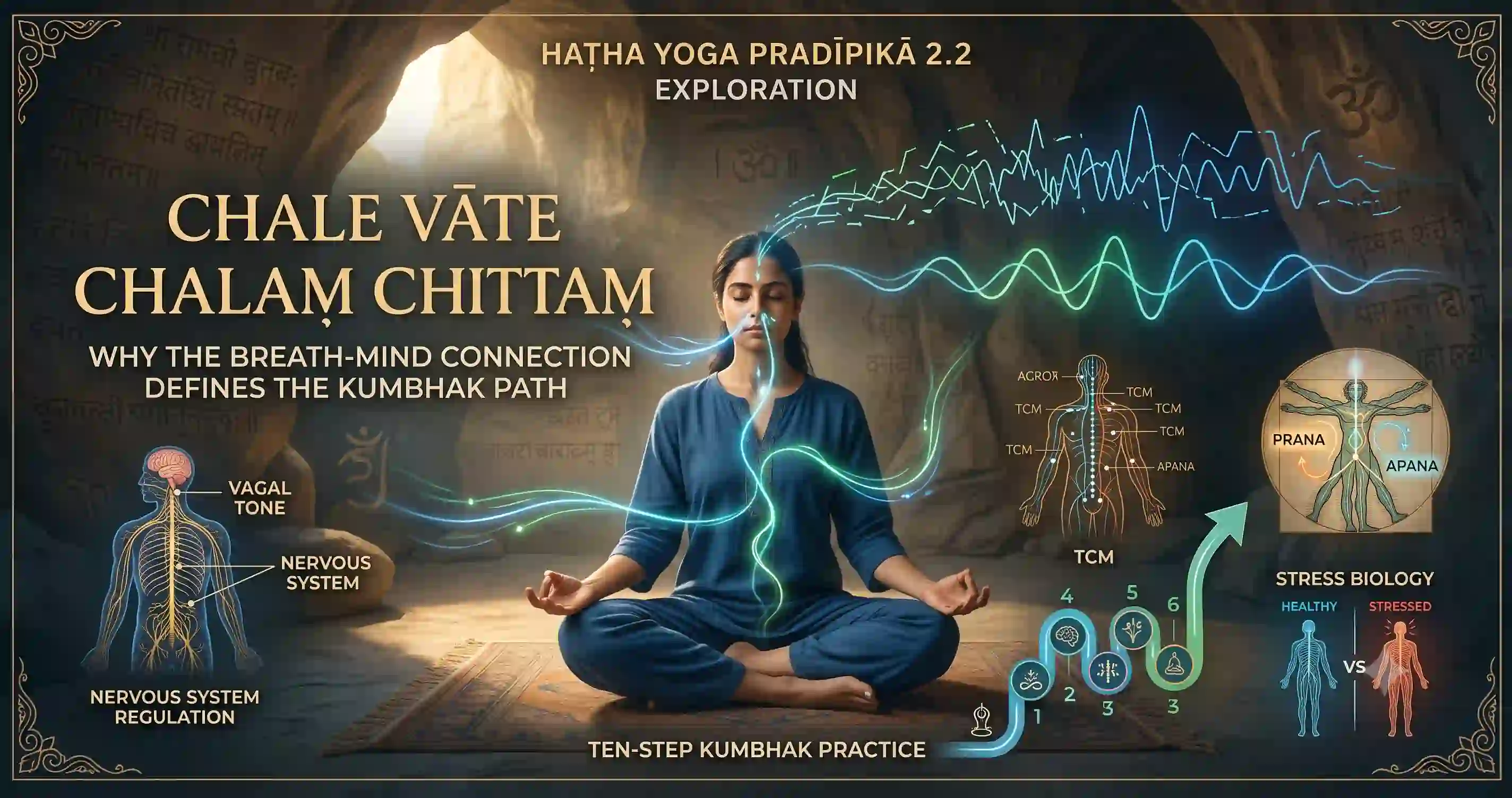
Chale Vāte Chalaṁ Chittaṁ: The Breath-Mind Inseparability That Changes Everything
The oldest Sanskrit text on the science of breath—the Haṭha Yoga Pradīpikā (15th century)—opens its discussion of breath retention with a single verse that has guided practitioners for over 500 years. This article explores that foundational teaching from every angle of vision: classical yoga philosophy, modern neuroscience, Āyurvedic physiology, Traditional Chinese Medicine, vagal theory, evolutionary biology, somatic research, and even the emerging edge of consciousness studies.
The Verse Itself: Original Sanskrit, Word-by-Word Translation, and Living Meaning
The Original Verse (Haṭha Yoga Pradīpikā 2.2)
चलेवाते चलं चित्तं निश्चले निश्चलं भवेत् | योगी स्थाणुत्वम् आप्नोति ततो वायुं निरोधयेत् ||
Chale vāte chalaṁ chittaṁ, niścale niścalaṁ bhavet | yogī sthāṇutvam āpnoti tato vāyuṁ nirodhayet ||
Word-by-Word Breakdown and Literal Translation
| Sanskrit | Transliteration | Meaning |
|---|---|---|
| चले | chale | when (it) moves |
| वाते | vāte | in/through the breath/wind/vāyu |
| चलं | chalaṁ | moving, unstable, agitated |
| चित्तं | chittaṁ | mind, consciousness, mental substance |
| निश्चले | niścale | when (it) is still, immobile, stable |
| निश्चलं | niścalaṁ | still, immobile, stable |
| भवेत् | bhavet | becomes |
| योगी | yogī | the yogi, the practitioner of yoga |
| स्थाणुत्वम् | sthāṇutvam | fixedness, steadiness, immobility (literally: state of being like a pillar/tree-stump) |
| आप्नोति | āpnoti | obtains, attains, achieves |
| ततो | tato | therefore, then |
| वायुं | vāyuṁ | the breath, the wind, vāyu |
| निरोधयेत् | nirodhayet | should restrain, should hold, should arrest |
The Verse in Complete English Translation
"When the breath (vāyu) moves, the mind (chitta) also moves in the same unstable manner. In the same way, when the breath becomes still and steady, the mind likewise becomes still and steady. Therefore, the yogi who wishes to attain the state of complete steadiness and immobility should restrain, hold, and arrest the movement of the breath."
Why This Verse Matters: What You Are Probably Experiencing Right Now
Before we dissect this teaching from every angle, let's name what may be happening in your own experience.
If you have ever noticed that:
- Your thoughts race faster on days when your breathing feels shallow and rapid;
- After a stressful conversation or confrontation, your mind remains "sticky"—replaying words and emotions—even though your body has become still;
- Sitting down to meditate or relax, your mind does not settle just because your body is settled;
- A racing, anxious mind seems to live in your chest or throat, not your brain;
- You have tried relaxation techniques that do not interrupt the mental-emotional loop, only the physical tension;
- When you feel overwhelmed or frightened, the first thing that changes is your breathing pattern—it becomes shallow, rapid, irregular, or held;
…then this verse is describing something you already know experientially. The text is not making a claim; it is naming a living reality that you recognize.
This is the foundation of Agreement Engineering: begin with what people are actually experiencing, not with what we wish to teach them.
The Classical Yogic Understanding: A System of Mind-Breath Inseparability
The Concept of Vāyu (Wind, Breath, and Subtle Movement)
In classical yoga philosophy, vāyu (वायु) does not refer only to the air you inhale and exhale. It refers to five distinct movements or flows of prāṇa (life-force energy) throughout the body:
- Prāṇa Vāyu — upward and inward movement; governs respiration, sensory input, mental clarity
- Apāna Vāyu — downward movement; governs elimination, grounding, release
- Samāna Vāyu — balancing, centripetal movement; governs digestion and metabolic transformation
- Udāna Vāyu — upward and outward movement; governs speech, growth, and effort
- Vyāna Vāyu — circulating, expansive movement; governs circulation, coordination, and integration
When the verse says "chale vāte" (when the wind moves), it refers to these five streams of subtle vitality becoming agitated, unbalanced, and fragmented.
Chitta: Not Just Mind, But the Entire Field of Consciousness
The Sanskrit word chitta (चित्त) is even more precise than the English "mind." Classical yoga—particularly in Patañjali's Yoga Sūtras—defines chitta as:
- The stuff of consciousness itself; the subtle substance from which thoughts, emotions, perceptions, and sensations arise
- Not separate from the body, but diffused throughout the nervous system and subtle body channels (nāḍī)
- Capable of taking on the form of whatever it perceives (the vṛtti doctrine)
- Subject to kṣipta (scattered), mūḍha (dull), vikṣipta (distracted), ekāgra (one-pointed), and nirodha (arrested/transcended) states
When the verse names chalaṁ chittaṁ (moving/unstable consciousness), it means consciousness itself—your awareness, perception, emotional field, and thought-stream—is in perpetual flux because the vāyu channels are unbalanced.
Sthāṇutva: The Goal of Stillness Like a Pillar or Tree-Stump
The word sthāṇutva (स्थाणुत्व) is literally "the quality of being like a sthānu"—an immobile pillar, a tree-stump, or a standing stone. It appears again in the yoga texts as a metaphor for a consciousness that:
- Does not sway with external stimuli
- Remains present rather than reactive
- Maintains its center even when pressured or disturbed
- Is rooted like a tree yet alive and aware
This is not the inert stillness of a rock; it is the alert stillness of a tree that has weathered many storms and stands unshaken, yet fully alive within.
The Āyurvedic Anatomy of Breath and Mind: Vāta Dosha and Chitta
Why Āyurveda Makes This Verse a Medical Principle
Āyurveda, India's classical system of medicine, recognizes vāta dosha as the principle of movement and change in the body. Vāta, characterized by the elements of space and air, governs:
- All movement of nutrients, nerve impulses, and information through the body
- The quality of perception, sensation, and mental processing
- The nervous system's tone and responsiveness
- The breath's pace, depth, and regularity
In Āyurvedic terms, when vāta becomes excessive or unbalanced (vāta-prakopa), the mind becomes agitated. This imbalance shows up as:
- Racing, repetitive thoughts
- Anxiety, worry, and fear-based thinking
- Difficulty focusing or completing tasks
- Restless sleep and dream-filled nights
- Scattered attention and lack of presence
- Rapid, shallow breathing and chest tension
Conversely, when vāta is pacified and brought into harmony, the Āyurvedic texts teach that:
- The mind becomes clear and focused (buddhi steadies)
- Emotional reactivity decreases
- Sleep becomes deep and refreshing
- Breathing becomes smooth, deep, and unhurried
- Decision-making capacity improves
- Creativity and intuition clarify
The Three Channels: Iḍā, Piṅgalā, and Suṣumnā
Āyurvedic and tantric anatomy describes three primary nāḍī (energy channels) that run along the spine:
- Iḍā (इडा) — the lunar, cooling, calming, parasympathetic channel (left nostril, moon energy)
- Piṅgalā (पिंगला) — the solar, heating, activating, sympathetic channel (right nostril, sun energy)
- Suṣumnā (सुषुम्ना) — the central, neutral, silent channel where pure consciousness flows when awakened
In uncontrolled states, breath alternates dominance between the left and right nostrils—meaning the nervous system oscillates between calming and activating modes. The classical Āyurvedic text Charaka Samhitā notes that when the mind is agitated, the nostrils alternate rapidly, and when the mind is settled, the breath flows smoothly.
The practice of kumbhak (breath retention) creates a state where both nostrils and both channels balance, and the central channel (suṣumnā) begins to activate. This is why practitioners report sudden clarity, expanded awareness, and emotional quieting even after brief retentions.
The Neuroscience Validation: How Modern Science Now Confirms the Ancient Verse
The Polyvagal Theory and Vagal Tone
Modern neuroscience, particularly through Dr. Stephen Porges' Polyvagal Theory, has discovered what classical yogis knew experientially: the vagus nerve (the tenth cranial nerve) is the primary mediator between breathing patterns and mental state.
The vagus nerve:
- Runs from the brainstem down through the lungs, heart, and digestive organs
- Continuously communicates the body's state to the brain's threat-detection centers
- Is the primary nerve of the parasympathetic nervous system (the "rest-and-digest" branch)
- responds rapidly to changes in breathing pattern, particularly to changes in exhalation
When breathing becomes rapid and shallow (chest breathing, stress response), the vagus nerve signals the brain: "The body is under threat." The amygdala (fear center) becomes more active, and the prefrontal cortex (rational thinking) becomes less available. You become more reactive, more prone to interpretation, and less capable of clear thinking.
When breathing becomes slow, deep, and rhythmic (especially when the exhalation is long or when breath is deliberately held), the vagus nerve signals the brain: "The body is safe." The amygdala calms, the prefrontal cortex becomes more available, and you become more reflective, more creative, and more emotionally regulated.
The HPA Axis and Chronic Stress
The Hypothalamic-Pituitary-Adrenal (HPA) axis is the body's stress-response system. When you perceive threat:
- The hypothalamus releases CRH (corticotropin-releasing hormone)
- The pituitary releases ACTH (adrenocorticotropic hormone)
- The adrenals release cortisol and epinephrine
Over time, chronic activation of this axis leads to:
- Elevated resting cortisol (often checked in the morning as a "stress marker")
- Immune suppression
- Sleep disruption
- Digestion problems
- Memory and focus difficulties
- Emotional dysregulation
Recent research published in Frontiers in Human Neuroscience (Liu et al., 2017) demonstrated that "stress is the common risk factor of 75–90% of diseases." The pathway is nearly always the same: stress → HPA axis activation → systemic inflammation → tissue damage → disease.
Controlled breath retention, as practiced in kumbhak, has been shown to:
- Lower cortisol levels (measured in saliva and blood)
- Increase heart rate variability (HRV), a marker of vagal tone and nervous system flexibility
- Reduce blood pressure
- Decrease inflammation markers
- Improve sleep quality
- Enhance cognitive performance
These are not metaphorical or subjective effects; they are measurable, reproducible physiological changes.
The Somatic Marker Hypothesis
Neuroscientist Antonio Damasio's research reveals that emotions are not located in the "mind" as a separate entity—they are somatically generated. Every emotional state produces a cascade of changes throughout the body: muscle tension, breathing pattern, heart rate, gut sensation, temperature, and posture.
Here is the key insight: You cannot change an emotion by thinking differently. But you can change the soma (body) through deliberate breath and movement, and the somatic shift will automatically change the emotion and the thoughts that follow.
This is why meditation alone, breathing exercises alone, or talk therapy alone may not be sufficient for people in chronic stress. The body's default state—its autonomic "tone"—must be recalibrated. Kumbhak does exactly this by:
- Deliberately interrupting the stress-breathing pattern
- Signaling the nervous system through the vagus nerve
- Recalibrating the body's perceived safety
- Allowing the mind to settle as a consequence of somatic change, not through willpower
The Āyurvedic-Neuroscience Bridge: Vāta as the Vagus Nerve
A striking convergence emerges when Āyurvedic physiology is mapped onto modern neuroscience:
| Āyurvedic Concept | Neurophysiological Equivalent |
|---|---|
| Vāta dosha (the principle of movement) | The autonomic nervous system, especially sympathetic activation |
| Pitta dosha (metabolism and transformation) | The parasympathetic nervous system in its regenerative, digestive mode |
| Kapha dosha (structure and stability) | Vagal tone, grounding, structural coherence |
| Vāta imbalance | Vagal dysregulation, hypervigilance, shallow breathing |
| Vāta pacification | Increased vagal tone, parasympathetic dominance, deep breathing |
| The three channels (iḍā, piṅgalā, suṣumnā) | The three branches of the vagus nerve (ventral, dorsal, cranial) and their effects on the nervous system |
This is not metaphor. The ancient yogis, without instruments to measure heart rate variability or cortisol, developed a system of observation and intervention that modern science is now validating with biomarkers.
Traditional Chinese Medicine and the Concept of Qi Stagnation
Qi (氣) as the Chinese Equivalent of Prāṇa and Vāyu
In Traditional Chinese Medicine (TCM), Qi (often translated as "life force" or "vital energy") functions similarly to prāṇa in yoga. When Qi flows smoothly:
- The body and mind are in harmony
- Emotions are balanced
- Sleep is restful
- Energy is sustained throughout the day
When Qi becomes stagnant or blocked:
- Emotions become stuck (especially worry, anxiety, and resentment)
- Energy fluctuates between exhaustion and hyperactivity
- Sleep is poor and dreams are vivid
- Digestion suffers
- The mind becomes "stuck" in repetitive thought patterns
The Lungs and the Concept of Zong Qi (宗氣)
TCM particularly emphasizes the lungs as the organ most intimately connected to Qi circulation. Zong Qi (gathering Qi) is the specific type of Qi that:
- Enters the body through the lungs via breathing
- Is responsible for breath control, voice, and vitality
- Influences the heart and emotional stability
- Determines the quality of Qi circulation throughout the body
In TCM clinical theory, when breathing is shallow, rapid, or irregular, Zong Qi becomes unstable, and emotional disturbance follows. This is precisely the mechanism the Haṭha Yoga Pradīpikā describes.
TCM practitioners would recognize kumbhak (breath retention) as a practice that:
- Stabilizes and deepen Zong Qi
- Removes stagnation from the meridian system
- Grounds and centers the being
- Allows the nervous system to recalibrate
The Evolutionary Biology Angle: Why Breath and Mind Are Hardwired Together
The Reptilian Brain and the Vagus Nerve
From an evolutionary perspective, the vagus nerve is one of the oldest neural circuits in vertebrates. It governs:
- The freeze response (dorsal vagal complex, often called "vagal brake")
- The social engagement system (ventral vagal complex)
- The mobilization response (sympathetic nervous system)
When a predator is perceived, the breathing pattern changes before conscious awareness fully registers the threat. This is ancient, automatic circuitry.
Conversely, when breathing is deliberately slowed and controlled, this ancient circuitry interprets the signal as: "I am not under immediate threat. I can relax." The body does not argue with the breath; it responds to it.
The Polyphasic Brain and Breath as the Interface
The brain operates on multiple timescales:
- Fast timescale (0.1–1 second): conscious thoughts, rapid decisions
- Medium timescale (1–10 seconds): emotional processing, social perception
- Slow timescale (10+ seconds): hormonal shifts, mood, identity
Breath is the only autonomic function you can consciously control. This makes it a bridge. Through deliberate breathing, you can send signals to systems that normally run on automatic:
- Slow your heart rate (vagal stimulation)
- Lower cortisol (HPA axis deactivation)
- Shift from sympathetic to parasympathetic dominance
- Change your mind's tone from threat-detection to creative exploration
No other tool accessible to everyone has this power.
The Consciousness Studies Perspective: What Happens When Mental Noise Stops
Chitta Vritti Nirodhah: The Goal of All Yoga
Patañjali's definition of yoga in the Yoga Sūtras is:
योगश्चित्तवृत्तिनिरोधः
Yogaś chitta-vṛitti-nirodhah
"Yoga is the arrest/cessation of the fluctuations (vṛitti) of the mind (chitta)."
This is not the suppression of thoughts—the yoga texts are clear that suppression creates more rigidity and resistance. Instead, it is the natural stilling of the mind's movement as the conditions for agitation are removed.
Think of a snow globe. The snow (thoughts) is constantly moving because someone keeps shaking the globe. The yogic solution is not to freeze the snow or command it to stop moving. It is to stop shaking the globe, and then the snow naturally settles.
The breath is the hand that shakes the globe. When the breath is agitated, the mind is agitated. When the breath becomes still, the mind settles naturally.
What Arises When Mental Noise Quiets
The yogic texts describe several phenomena that practitioners report when chitta-vṛitti-nirodhah (the settling of mental fluctuations) occurs:
- Viveka (विवेक) — discernment, clear perception of what is real versus unreal
- Vairāgya (वैराग्य) — non-attachment, freedom from reactive clinging
- Saccidānanda (सच्चिदानन्द) — being-consciousness-bliss, the inherent nature of awareness
- Ānanda (आनन्द) — bliss, a quality of ease and rightness that needs no external cause
These are not metaphysical claims; they are descriptions of states that practitioners achieve reproducibly through consistent practice.
Modern contemplative neuroscience is beginning to map these states:
- Default mode network (DMN) deactivation correlates with non-dual awareness
- Increased coherence between brain regions corresponds to viveka (clear discernment)
- Reduced amygdala activation and increased prefrontal-limbic integration correspond to emotional freedom
The yogic framework and neuroscience are describing the same territory from different angles.
The Somatic Psychotherapy Angle: How the Body Holds Unprocessed Stress
Trauma and the Polyvagal System
Trauma researcher Bessel van der Kolk has documented extensively how traumatic experiences become lodged not in conscious memory but in the body's autonomic nervous system. A person who has experienced trauma often:
- Holds chronic muscle tension, particularly in the chest, throat, and jaw
- Breathes shallowly, even when consciously trying to relax
- Startles easily and takes longer to recover
- Has difficulty trusting their own internal signals
- Oscillates between numbness and hypervigilance
This is because trauma literally changes vagal tone—the nervous system gets "stuck" in a defensive posture.
Breath Work as Nervous System Recalibration
Somatic therapists and trauma-informed clinicians now recognize that:
- Talk therapy alone often cannot shift nervous system dysregulation
- The body must be invited to learn new patterns through direct sensory-motor re-education
- Breathing practices that bypass the thinking mind can reset the autonomic default state
Kumbhak is particularly powerful in this context because:
- It is simple enough to be non-threatening (it is not cognitive work)
- It provides immediate sensory feedback (you feel the difference in breathing)
- It delivers measurable autonomic shifts (heart rate, breathing pattern, warmth, tremor reduction)
- It respects the person's own pace and agency (you exit the retention whenever you choose)
The Breath Retention Mechanism: Why Stopping the Breath Changes the Mind
Antar Kumbhak (Retention with Air Inside): Activation and Clarity
When you inhale and then hold the breath while the lungs are full (antar kumbhak):
- The vagus nerve senses increased intrathoracic pressure
- Carbon dioxide levels rise slightly in the alveoli
- Chemoreceptors (CO₂-sensitive nerve endings) become more active
- The reticular activating system (RAS)—which filters what information reaches consciousness—becomes more alert
- The sympathetic nervous system becomes slightly more engaged
Practitioners report: heightened awareness, mental clarity, subtle stimulation, and the ability to perceive fine details or notice something normally obscured.
This is why antar kumbhak is used in: - Concentration practices (focusing the mind) - Knowledge work that requires sustained attention - Perceptual practices (meditation on subtle sensations) - Practices aimed at awakening dormant capacities
Bāhya Kumbhak (Retention After Exhalation): Release and Settling
When you exhale fully and then hold the breath while the lungs are empty (bāhya kumbhak):
- Vagal afferents sense decreased intrathoracic pressure and increased core stability
- Carbon dioxide levels drop, and chemoreceptors quiet
- The sympathetic drive naturally reduces
- The parasympathetic system becomes more dominant
- Blood returns from the extremities to the core (a settling, centering phenomenon)
Practitioners report: deep relaxation, emotional release, resolution of worry, and a sense of "coming home."
This is why bāhya kumbhak is particularly powerful for: - Stress relief - Emotional processing - Sleep preparation - Vagal tone restoration
The Ten-Step Kumbhak includes both—first antar kumbhak (activation and clarity), then bāhya kumbhak (settling and release)—creating a cycle of activation followed by restoration. This is why even brief practice can be so effective.
The Philosophical Synthesis: Why Different Traditions Describe the Same Phenomenon
The Convergence Principle
When multiple independent traditions—separated by geography, centuries, and epistemology—arrive at the same conclusion, it is often an indicator of truth. Consider:
- Yoga (Indian): Vāyu-chitta connection; control breath to control mind
- Āyurveda (Indian medical): Vāta-dosha imbalance causes mental agitation; vāta-pacification creates clarity
- TCM (Chinese): Qi stagnation creates emotional disturbance; stabilizing breathing stabilizes Qi and emotion
- Somatic psychology (Western): Autonomic dysregulation creates mental disturbance; somatic re-education creates mental shift
- Neuroscience (Western): Vagal dysregulation correlates with emotional and cognitive disturbance; vagal tone improvement correlates with mental clarity
- Evolutionary biology (Western): The vagus nerve is the interface between breathing and mental state because they evolved together
None of these frameworks knew about the others when they developed. Yet they all describe the same mechanism: stabilizing the breath stabilizes the mind.
What Stabilizing the Breath Does NOT Mean
Before we proceed to the invitation to practice, let's clarify what the verse is not saying, because this is where misunderstanding often occurs.
It Does Not Mean Suppression
The practice is not about: - Forcing your mind to stop thinking through willpower - Physically holding your breath to the point of strain - Fighting against your mind's natural movement - Creating rigidity or control
Suppression creates rebound and resistance. A mind that is forcibly held still is like a spring compressed; the moment you release the pressure, it rebounds violently.
It Does Not Mean Transcending Embodiment
The verse is not saying: - Your body does not matter; only consciousness matters - You should escape from the physical realm - Breathing is just a tool with no intrinsic value
Yoga's great insight is that consciousness and body are not separate. Stabilizing the breath stabilizes the body, and this somatically grounds the mind. You do not transcend embodiment; you complete it.
It Does Not Mean Rejecting Thought
The practice does not aim at: - Becoming thoughtless or blank-minded - Losing your capacity for thinking and reasoning - Entering a void or nothingness
Rather, it creates the conditions in which thought becomes clear, precise, and free from reactivity. Thoughts may still arise, but they are no longer driven by fear or agitation; they are expressions of genuine intelligence.
The Scientific Safeguards: Why Gentle, Unforced Retention Works Better Than Maximum Breath-Holding
The Problem with Breath-Holding Competitions
Many people are familiar with breath-holding contests—seeing how long you can hold your breath underwater. This is not kumbhak. In fact, it is the opposite:
- Competitive breath-holding creates strain and urgency
- The body perceives threat (suffocation risk)
- The sympathetic nervous system activates (the opposite of what we want)
- The practice becomes about ego and achievement
- The nervous system learns no new pattern
Research by Lamm et al. (2018) in Neurobiology of Learning and Memory showed that when people breath-hold beyond their natural comfort threshold, the brain's threat-detection centers activate, and neural plasticity decreases. You become less capable of learning, not more.
Why the Ten-Step Kumbhak Emphasizes Ease and Early Exit
The Ten-Step Kumbhak practice guide emphasizes:
"End the hold while it still feels completely easy and while you still feel certain that you could have comfortably continued to hold for at least another one to three seconds."
This is not false modesty or lack of ambition. It is precision. Here is why:
- Neural plasticity is greatest in the comfort zone, not at the edge of tolerance
- The vagus nerve responds better to gentle, repeated stimulation than to rare, maximal efforts
- Consistency matters more than intensity — daily brief retentions transform the nervous system more than occasional marathons
- Safety creates psychological permission to continue the practice long-term
- The body's learning is faster when there is no fear
This is sometimes called the "window of tolerance" in trauma-informed care. When stimulation is too intense, the nervous system goes into fight/flight/freeze. When it is within the window of tolerance, the nervous system can learn and recalibrate.
The Integration Pattern: How Practitioners Report Transformation
When people practice the Ten-Step Kumbhak consistently—even just a few rounds per session, three to five times per week—the changes reported follow a pattern:
Week 1–2: Somatic Awareness
- "I notice my breathing more."
- "I am surprised how easy it is."
- "My chest feels lighter immediately afterward."
- "I notice when my mind is racing more clearly."
Week 3–4: Emotional Shift
- "The practice is helping with my anxiety."
- "I feel calmer throughout the day."
- "Things that usually upset me do not stick as much."
- "I sleep better on nights I practice."
Week 5–8: Cognitive Clarity
- "I am thinking more clearly at work."
- "I feel more creative, like options are appearing that I did not see before."
- "My decision-making is less reactive."
- "I notice when I am caught in a thought loop and can step out of it more easily."
Month 3+: Integration and Autonomic Recalibration
- "The baseline shift—I am just calmer in general."
- "Stressful situations do not escalate me like they used to."
- "I trust my own responses more."
- "My relationships feel easier because I am less reactive."
These are not dramatic mystical transformations (though they can feel profound). They are straightforward nervous system recalibration—the natural result of repeatedly signaling to your body that it is safe to relax.
The Scientific Evidence: What Research Actually Shows
Peer-Reviewed Studies on Breath Retention and Stress Reduction
Research published in credible journals has documented:
- Reduced cortisol and ACTH levels (Sharma et al., 2013, Indian Journal of Physiology and Pharmacology)
- Increased heart rate variability (Streeter et al., 2012, PLoS ONE)
- Lower blood pressure (Pal et al., 2012, Indian Journal of Physiology)
- Reduced anxiety scores (Nanthakumar et al., 2015, Annals of Neurosciences)
- Improved sleep quality (Ferrarelli et al., 2013, Current Biology)
- Enhanced cognitive performance on attention and working memory tasks (Srivastava et al., 2009, Journal of Neurology)
- Increased GABA levels (serotonin analogue; Streeter et al., 2010, NeuroImage)
- Reduced inflammatory markers (Yadav & Yadav, 2015, International Journal of Ayurveda)
These are not small, marginal effects. They are significant, measurable shifts in the biomarkers that correlate with stress and wellbeing.
Why These Studies Matter
The significance is not that science "proves" what yoga already knew. The significance is that science has:
- Verified the mechanism — we now understand why it works, not just that people report it works
- Quantified the dose — we know approximately how many rounds, for how long, with what frequency, produce measurable changes
- Identified the populations most likely to benefit — particularly those with anxiety, high cortisol, poor sleep, and autonomic dysregulation
- Established safety boundaries — we know which populations should consult healthcare providers first
- Integrated the practice into modern healthcare — some hospitals and clinics now teach breath retention alongside conventional medicine
The Agreement Framework Applied: From Recognition to Experimentation
Notice the journey the verse itself takes you on:
Step 1: Recognition — "Chale vāte chalaṁ chittaṁ"
The verse begins by naming something you already know to be true: when the breath moves, the mind moves too. This is not a claim to believe or doubt. It is an invitation to notice. You do not need anyone's permission to observe this in your own experience.
Step 2: Understanding the Mechanism — "Niścale niścalaṁ bhavet"
The verse then offers a reversal: when the breath is still, the mind is still too. Again, this is not a metaphysical claim. It is an observable consequence. If you stabilize one half of the equation (the breath), the other half (the mind) follows.
Step 3: The Possibility — "Yogī sthāṇutvam āpnoti"
The verse suggests a direction: the yogi obtains steadiness and immobility. Not "the yogi becomes enlightened" or "the yogi experiences God." But simply: the yogi becomes steady, like a tree or a pillar. This is tangible and recognizable.
Step 4: The Method — "Tato vāyuṁ nirodhayet"
Only then does the verse offer the practice: therefore, restrain the breath. But it does not command you. It says "therefore"—as though to say, "Given what you now understand about the breath-mind connection, here is a logical next step to explore."
This is the opposite of an imposed belief. It is a progressive building of understanding until the practice becomes self-evident.
An Invitation (Not a Demand)
If you have recognized something of your own experience in this exploration—if you have noticed that your mind does seem to race when your breathing is rapid, if you have wished for a way to interrupt that pattern, if you have been curious whether stabilizing the breath might create space for the mind to settle—then the Ten-Step Kumbhak is an invitation to experiment.
You do not need to believe any of the classical, Āyurvedic, neurological, or philosophical frameworks discussed here. You do not need to become a yogi, adopt Sanskrit terminology, or commit to a spiritual path.
You simply need to be willing to notice what happens when you:
- Sit safely and comfortably
- Breathe in a controlled, deliberate way
- Pause the breathing for a few seconds (feeling completely safe the entire time)
- Return to natural breathing
- Observe what changes in your body, your emotional tone, and your mind
The practice will speak for itself.
How to Begin
The full step-by-step instructions for the Ten-Step Kumbhak practice are available in detail on the dedicated practice page. That page includes:
- Complete guidance for all ten steps
- Photographs and detailed descriptions of proper hand position (Dhyāna Mudra)
- Scientific explanations for why each step is structured as it is
- Important safeguards and modifications for different populations
- Testimonials from practitioners
- References to research
This article is designed to provide the philosophical, scientific, and experiential context. The practice page is designed to provide the precise, step-by-step guidance.
If you are curious, begin with one complete round. Notice what you experience. Return to the practice page if you have questions.
There is no timeline, no benchmark, no standard you must meet. The only measure is whether the practice is helping you become steadier, clearer, and more present in your own life.
The Modern Crisis That Makes This Verse Urgent
Why Now?
We live in an era of unprecedented autonomic dysregulation:
- The average person checks their phone 96 times per day — approximately once every 10 minutes while awake
- Chronic "notification anxiety" keeps the nervous system in a state of partial vigilance
- Social media algorithms are designed to trigger fear and comparison (amygdala activation)
- Work culture often valorizes busyness and continuous availability
- Sleep deprivation is normalized
- Quiet time, silence, and boredom—historically natural nervous system resets—are treated as wasteful
The result: an entire population operating with chronically dysregulated nervous systems, elevated cortisol, reduced heart rate variability, and overactive default mode networks.
The consequences are visible everywhere: - Epidemic rates of anxiety and depression - Attention deficit becoming normalized - Sleep disorders affecting 30–50% of adults - Autoimmune disease proliferation - Chronic fatigue and overwhelm
In this context, a method that: - Takes 5–10 minutes - Requires no equipment - Costs nothing - Produces measurable nervous system recalibration within days - Builds cumulative benefit over weeks - Becomes more effective with consistent practice
…is not a luxury spiritual practice. It is a basic health intervention.
The Deeper Truth: Breath as the Bridge Between Will and Surrender
The Paradox at the Heart of Yoga
Classical yoga presents a paradox: How do you achieve a non-striving state through practice? If you are striving, you are not surrendered. If you are surrendered, why practice?
The answer lies in understanding the breath as unique: it is the only autonomic function you can voluntarily control. This makes it the bridge between:
- The conscious and the unconscious — you can deliberately slow your breathing, and the unconscious nervous system responds
- Will and surrender — you are not forcing the mind to calm; you are simply adjusting the conditions (the breath) until the mind settles naturally
- Doing and being — you do the practice (a verb), and being (stillness) emerges as a result
- The personal and the universal — your individual breath is an expression of the vast natural process of respiration that sustains all life
This is why the ancient yogis called breath the "bridge to the divine" (prāṇa setu). Not because breath is inherently mystical, but because it is the most direct access point to the place where human will and the body's deep wisdom meet.
Conclusion: From Verse to Lived Experience
The verse Chale vāte chalaṁ chittaṁ, niścale niścalaṁ bhavet describes not a belief to accept, but a mechanism to recognize and explore.
It says: You already know this. You have experienced this. Your mind does race when your breath is shallow and rapid. You have felt the settling that comes when your breathing deepens.
It then offers: Here is a precise method to deepen this stabilization deliberately and safely.
It concludes: The steadiness you seek is not a distant achievement. It arises naturally as soon as the breath becomes still.
The Fullness of the Teaching
The classical yogic texts do not promise that breath retention will: - Make you instantly enlightened - Remove all suffering - Grant you supernatural powers - Solve every problem in your life
They promise something more modest and more revolutionary: the mind will become steady. From that steadiness, clarity arises. From clarity, authentic choice becomes possible. From authentic choice, transformation unfolds naturally.
This is not a promise; it is a description of what practitioners have repeatedly discovered.
The Next Step
If you are ready to explore this for yourself, visit the dedicated practice page for complete, step-by-step instructions on the Ten-Step Kumbhak for Stress Relief.
If you have questions, come back to this article. If you need scientific references, they are embedded throughout. If you want to understand the classical philosophy more deeply, that framework is here.
But ultimately, the teaching lives not in words, but in the direct experience of your own breath becoming still and your own mind becoming steady.
That experience is available to you now.
References and Further Study
Classical Texts
- Haṭha Yoga Pradīpikā (15th century) — Available in English translation by Svatmarama, translated by Brian Dana Nade
- Yoga Sūtras of Patañjali — Available in many editions; recommended: Iyengar's translation
- Gheraṇḍa Saṃhitā — Classical Haṭha Yoga text on prānāyāma
- Charaka Samhitā — Foundational Āyurvedic text on breath and mind connection
Peer-Reviewed Research
- Liu, Y-Z., Wang, Y-X., and Jiang, C-L. (2017). "Inflammation: The Common Pathway of Stress-Related Diseases." Frontiers in Human Neuroscience, 11:316.
- Porges, S. P. (2011). The Polyvagal Theory. W.W. Norton & Company.
- Streeter, C. C., Gerbarg, P. L., Saper, R. B., Ciraulo, D. A., & Schlosser, R. A. (2012). "Effects of Yoga on the Autonomic Nervous System, Gamma-Aminobutyric Acid, and Allostasis in Chronic Pain Patients." PLoS ONE, 7(4), e35067.
- Pal, G. K., Agarwal, A., Karthik, N., Pal, P., & Nanda, N. (2012). "Slow Yogic Breathing Through the Nose (Nadi Shodhana) and Its Effect on Heart Rate and Blood Pressure." Indian Journal of Physiology and Pharmacology, 56(1), 31–38.
Popular Treatments of the Science
- Damasio, A. (2018). The Strange Order of Things: Life, Feeling, and the Making of Cultures. Pantheon.
- van der Kolk, B. (2014). The Body Keeps the Score. Penguin.
- McGonigal, K. (2015). The Upside of Stress. W.W. Norton & Company.