Learn what oxygen and carbon dioxide do during comfortable Kumbhak, why a 1–3-second reserve differs from a maximal hold, and when to stop.
By Kumbhaki Yogi Dhruvaji (MSc), founder of the Antistress Foundation 501(c)(3)
• How to Practice Ten-Step Kumbhak • Scientific Proof • Ancient Texts Proof • Bio • Subscribe By Email
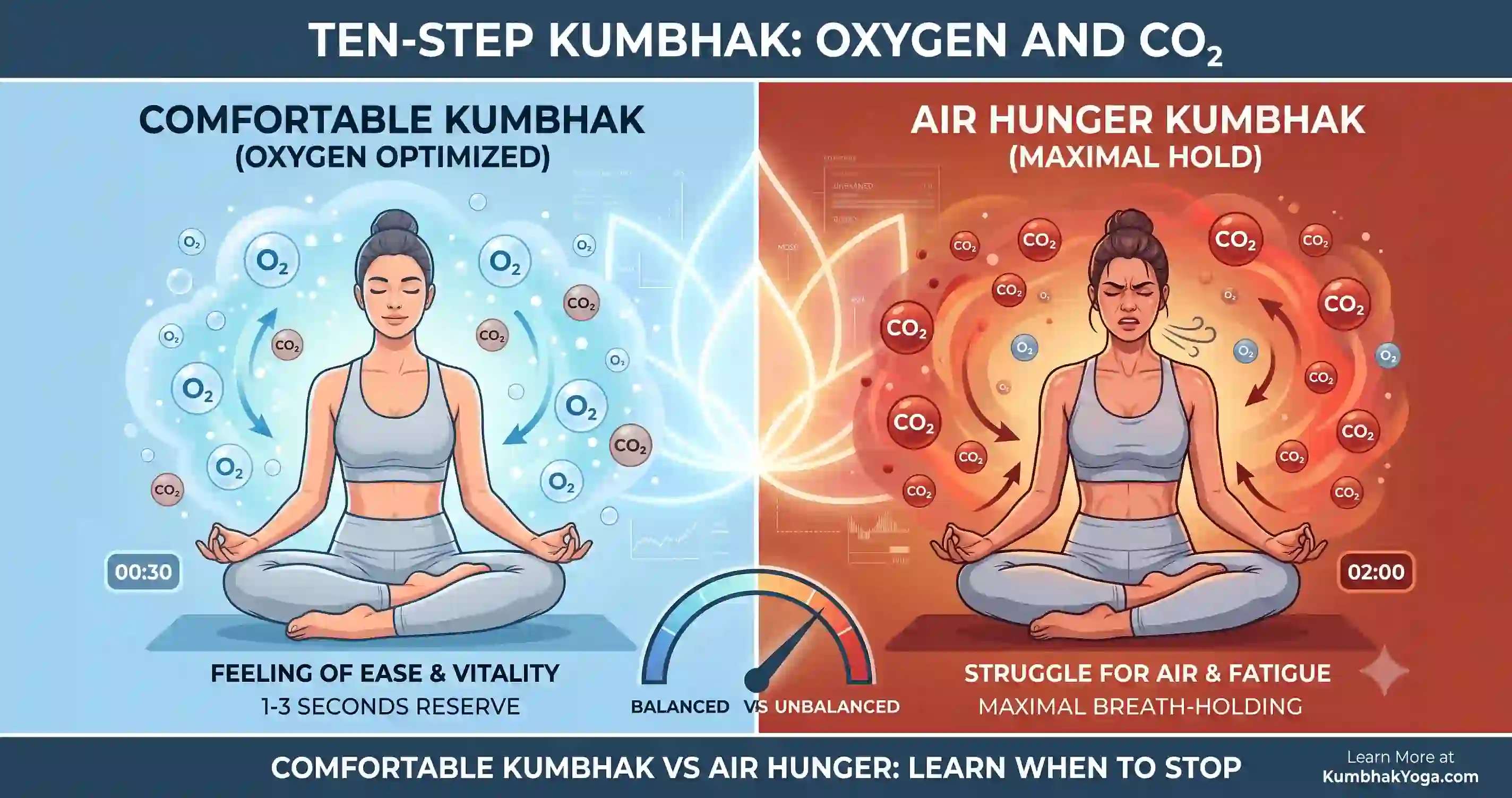
Why an easy breath retention with a 1–3-second reserve is fundamentally different from holding until air hunger, strain or a personal maximum
The thought can arrive before the practice even begins:
“If I hold my breath, am I depriving my brain of oxygen?”
That fear deserves a real answer—not a dismissive “just relax,” and not a promise that every breath hold is harmless.
During any breath retention, oxygen is still being used by the body and carbon dioxide is still being produced. Therefore, oxygen availability tends to move downward while carbon dioxide tends to move upward. But this does not make all retentions equivalent. Duration, starting lung volume, health, surroundings and the decision to stop early radically change what follows.
In the Ten-Step Kumbhak for Stress Relief, the retention ends while it still feels completely easy and while you remain certain that you could comfortably continue for at least another 1–3 seconds. If you cannot honestly preserve that reserve, the appropriate retention for you is shorter—or no retention at all that day.
That boundary is the heart of this article.
In one sentence: A comfortable Kumbhak allows only a deliberately brief excursion from normal breathing and ends with breathing choice intact; an uncomfortable or maximal hold continues into mounting chemical drive, involuntary respiratory effort and physiological stress.
This article explains the physiology without reproducing the practice sequence. For the complete instructions, safeguards and posture details, see How to Practice the Ten-Step Kumbhak for Stress Relief.
The Most Important Distinction: Reserve, Not Endurance
“Another 1–3 seconds” is a stopping boundary, not a target
The reserve rule does not mean:
- wait until only one second remains;
- count down toward distress;
- prove that you could endure three more seconds; or
- add three seconds after the first urge to breathe.
It means ending earlier than all of those.
At the instant you end Antar Kumbhak or Bāhya Kumbhak, you should still feel certain that at least a small margin remains. For one person on one day, honest certainty may mean three seconds. For another, it may mean one. If even one additional comfortable second is uncertain, the hold has already reached its stopping point.
The clock is secondary. Ease, choice and reserve are primary.
Comfortable and uncomfortable are not merely different moods
They represent different locations on a physiological curve.
At first, the body has oxygen stored in the lungs, blood and tissues. Carbon dioxide begins accumulating, but its chemical stimulus may still be modest. As a hold continues, carbon dioxide rises, oxygen falls further, the urge to breathe grows, respiratory muscles may begin involuntary movements and cardiovascular compensation becomes more pronounced.1
Researchers studying maximal voluntary apnoea commonly distinguish an initial easy-going phase from a later struggle phase. The second phase may include involuntary breathing movements and an increasingly powerful drive to breathe.1 The Ten-Step Kumbhak is designed to finish in ease; it is not a shortened contest with the struggle phase.
🌿 The aim is not to discover how long you can prevent a breath. It is to notice that you can pause briefly—and still choose the next breath before your body has to demand it.
What Oxygen Actually Does During Kumbhak
Oxygen does not stop moving when breathing pauses
Breathing is the movement of air. Gas exchange is the movement of gases between the lungs and blood. Metabolism is the use of oxygen by tissues. During Kumbhak:
- no fresh air enters the lungs;
- oxygen already present in the lungs continues moving into the blood;
- haemoglobin continues delivering oxygen to tissues;
- cells continue using oxygen; and
- the amount of readily available oxygen therefore trends downward.
This decline begins from the first moments of retention, but “begins to decline” is not the same as “has become dangerously low.” A temperature can fall by a fraction of a degree without becoming freezing. In the same way, a physiological variable can move without crossing a harmful threshold.
How far oxygen falls depends on the dose of the hold: especially its length, the amount of air in the lungs at the start, the oxygen level before it began, metabolic demand and the person’s health.
The body starts with more than one oxygen store
Oxygen is available in several places:
- The lungs: Oxygen remains in the air already inside them.
- The blood: Most oxygen is carried on haemoglobin; a smaller amount is dissolved in plasma.
- The tissues: Oxygen is present in tissue fluids and bound to proteins such as myoglobin in muscle.
Even after a normal Rechak, the lungs are not empty. A substantial volume called functional residual capacity remains after an ordinary exhalation; even a maximal exhalation leaves residual volume.4 “Comfortably empty” in the Ten-Step Kumbhak is therefore a felt description, not a claim that the lungs contain no gas.
This matters especially for Bāhya Kumbhak. It starts with a smaller lung oxygen reservoir than Antar Kumbhak, but not with zero oxygen.
Oxygen pressure, saturation and content are different
Fear often grows because several measurements are treated as though they mean the same thing.
PaO₂ is the partial pressure of oxygen dissolved in arterial blood. It helps drive oxygen onto haemoglobin.
SaO₂ is the percentage of arterial haemoglobin binding sites occupied by oxygen.
SpO₂ is a pulse oximeter’s non-invasive estimate of arterial oxygen saturation.
Arterial oxygen content includes oxygen bound to haemoglobin plus the smaller dissolved amount.
Oxygen delivery also depends on cardiac output: how much blood the heart moves.
The oxyhaemoglobin dissociation curve has a broad upper plateau. Across part of that plateau, PaO₂ can fall while haemoglobin saturation changes much less; once the curve reaches its steeper region, further falls in PaO₂ produce larger changes in saturation.3 This is one reason “oxygen is being used” cannot be translated automatically into “oxygen saturation is collapsing.”
It is also why a finger pulse oximeter is not a perfect real-time referee. In a 2026 study of repeated maximal breath holds, finger readings lagged behind ear readings and overestimated saturation near the breaking point; the finger nadir appeared 18–23 seconds later.9 Those findings concern maximal holds, not this brief stress-relief practice, but they show why chasing a delayed screen number is a poor way to decide when to breathe.
A laboratory example shows why duration matters
In a small study of eight healthy adults holding after exhalation from functional residual capacity, arterial samples were taken every five seconds. Across an average hold of about 35 seconds, arterial oxygen pressure fell by about 50 mmHg, carbon dioxide pressure rose by about 10 mmHg and pH fell by about 0.07.2
This is useful evidence of direction and time course. It is not a measurement of the Ten-Step Kumbhak, and it must not be used to declare any universal safe number of seconds. The study involved a particular starting volume, particular participants and holds much longer than some beginners’ comfortable reserve.
The honest conclusion is narrower:
The gases change progressively during a hold. A brief, voluntarily easy retention that ends early is a different physiological dose from continuing for tens of seconds toward a breakpoint.
What Carbon Dioxide Does—and Why It Often Feels Like “Running Out of Air”
CO₂ continues to be produced throughout the pause
Cells continuously produce carbon dioxide (CO₂) as they use fuel. Blood carries it toward the lungs. During ordinary breathing, Rechak removes some of it. During Kumbhak, that removal is temporarily paused, so arterial CO₂ tends to rise.
As CO₂ rises, hydrogen-ion concentration also changes and blood pH tends to fall. Chemoreceptors in the brainstem and major arteries detect this chemical shift and strengthen the drive to breathe.5
This means the first uncomfortable urge is often not a precise alarm announcing that the brain is already oxygen-starved. In healthy people, a comparatively modest rise in CO₂ can produce prominent respiratory discomfort while oxygen has not fallen proportionately.7
That fact should reassure without inviting bravado. The urge to breathe may arrive before severe hypoxaemia, but it remains a valid stop signal in this practice.
Air hunger is a protective sensation, not an enemy to defeat
Air hunger has been described as an uncomfortable awareness of an unmet need to breathe. It is influenced by rising CO₂, falling O₂ and the mismatch between respiratory drive and the ventilation the body receives.6
During an unwanted long hold, the brain sends a growing command to breathe while no breath occurs. That mismatch can feel like:
- “I need air now”;
- tightness or constriction;
- an impulse to gulp;
- panic-like urgency;
- throat or chest discomfort; or
- involuntary contractions of the breathing muscles.
In performance breath-holding, someone may learn to tolerate or push through such signals. In Kumbhak for stress relief, pushing through them would reverse the purpose. The signal is not an opponent. It is the end of the retention.
CO₂ is not simply a toxin
Carbon dioxide is a normal product of metabolism and a powerful regulator of breathing, acid–base balance and blood flow. It also shifts haemoglobin’s affinity for oxygen: higher CO₂ and lower pH help haemoglobin release oxygen to metabolically active tissues, a relationship associated with the Bohr effect.8
So neither slogan is accurate:
- “CO₂ is poison and must be expelled as much as possible.”
- “More CO₂ is always healing.”
Physiology depends on range, rate, context and individual response. A brief, comfortable rise during retention is not the same event as severe hypercapnia during prolonged apnoea or illness.
The Physiological Journey: From Ease to Struggle
Phase 1: A deliberately brief, comfortable Kumbhak
In an appropriate stress-relief retention:
- oxygen consumption continues, so available oxygen trends down slightly;
- CO₂ production continues, so CO₂ trends up slightly;
- the change is limited by ending early;
- there is no urge to gasp, bear down or fight;
- the face, throat, chest, shoulders and abdomen remain relaxed;
- attention remains clear rather than narrowed by survival urgency; and
- the next normal Pūrak or Rechak is chosen, not seized.
It would be scientifically careless to promise that every person’s blood gases remain unchanged. They do change. It would be equally careless to describe the earliest, smallest movement of those gases as oxygen deprivation.
For a healthy person at rest, a very brief retention can end while the body is still drawing on ordinary reserves and before meaningful oxygen desaturation or marked chemical distress develops. This is a physiological inference from established gas-exchange principles—not a direct blood-gas trial of this exact Ten-Step method.
Phase 2: The boundary of comfort
The boundary may announce itself through a subtle change:
- certainty about the reserve disappears;
- the wish to breathe becomes noticeable;
- the jaw, throat or shoulders begin to brace;
- attention shifts from observing to enduring;
- the next breath starts to feel like relief rather than choice; or
- you wonder, “Can I force another second?”
That last question is already an answer.
The practice asks for the retention to end before these signs develop. If a sign arrives unexpectedly, end the hold immediately and return to normal breathing. There is no benefit to winning an argument with your nervous system.
Phase 3: An uncomfortable, prolonged or maximal attempt
If the hold continues, the differences are not merely psychological:
- CO₂ continues rising and pH continues moving downward;
- oxygen pressure and eventually saturation can fall further;
- respiratory drive becomes harder to ignore;
- involuntary breathing movements may begin;
- sympathetic and cardiovascular responses become more pronounced;
- blood pressure can rise substantially;
- dizziness, visual change, confusion or loss of consciousness can occur in extreme conditions; and
- after hyperventilation or in water, warning signals can become dangerously unreliable.
A 2025 review of maximal apnoea describes progressive hypoxaemia, hypercapnia, an easy-going phase, a physiological breakpoint and a later struggle involving involuntary breathing movements.1 Research on prolonged inspiratory holds has also documented considerable blood-pressure rises near the breakpoint.13 These findings should not be pasted onto a one- or two-second comfortable retention as if the dose were identical. They explain why the practice must not migrate toward a maximum.
A vertical comparison
Comfortable Kumbhak for stress relief
- Purpose: A brief, controlled pause within an otherwise normal breathing sequence
- Endpoint: Complete ease, with a certain 1–3-second reserve
- Breathing drive: Quiet or barely perceptible
- Muscles: Face, throat, chest, shoulders and abdomen remain relaxed
- Next breath: Normal and chosen
- Meaning: “I can stop now and still be fully okay”
Uncomfortable retention
- Purpose: Often unclear; the person may be chasing time or trying to “do it properly”
- Endpoint: Urge, tightness, doubt or strain
- Breathing drive: Noticeable and growing
- Muscles: Bracing or compensatory effort may appear
- Next breath: Feels necessary or relieving
- Meaning: “I need to get through this”
Maximal or near-maximal attempt
- Purpose: Endurance, performance, measurement or competition
- Endpoint: Personal breakpoint or inability to continue
- Breathing drive: Strong, sometimes with involuntary respiratory movements
- Muscles: Considerable effort may be used to resist breathing
- Next breath: Urgent and potentially gasping
- Meaning: “I continued until my body overruled me”
These are not three grades of one stress-relief goal. They are different practices with different risk–benefit profiles.
Antar Kumbhak and Bāhya Kumbhak Do Not Start From the Same Place
Antar Kumbhak begins with the larger lung-air reservoir
Antar Kumbhak follows a comfortably full Pūrak. More air in the lungs generally means a larger initial oxygen store and a larger volume into which CO₂ can enter. Laboratory research confirms that starting lung volume influences breath-hold duration and the breakpoint.11
This does not mean a comfortably full Pūrak should be turned into a maximal inhalation. Overfilling can create tension, alter cardiovascular mechanics and make the retention feel like pressure management rather than ease.
“Comfortably full” means exactly that—not packed to capacity.
Bāhya Kumbhak begins with less air, but the lungs are not empty
Bāhya Kumbhak follows a comfortably empty Rechak. Its smaller lung volume can make chemical changes and respiratory sensations arrive sooner than after an inhalation. The reserve may therefore be much shorter.
Yet “after Rechak” does not mean:
- oxygen instantly reaches zero;
- the lungs collapse;
- the bloodstream has no oxygen left; or
- the abdomen must be pulled inward to extract the last air.
Functional residual capacity and residual volume explain why air remains in the lungs after exhalation.4 Oxygen also remains bound to haemoglobin and present in tissues. Still, because the starting lung store is smaller, Bāhya Kumbhak deserves especially conservative self-observation.
It is completely acceptable for the two retentions to be unequal. Symmetry is visually pleasing; it is not a safety requirement.
Why there can be no universal “safe number”
A fixed time ignores too much. Breath-hold response varies with:
- whether the hold follows Pūrak or Rechak;
- starting oxygen and CO₂;
- lung volume and pulmonary health;
- haemoglobin concentration;
- cardiac and circulatory health;
- metabolic rate, recent activity and fever;
- altitude;
- pregnancy;
- medications or intoxicants;
- anxiety, panic sensitivity and trauma history;
- recent hyperventilation; and
- practice context, especially water, driving or standing.
Prior oxygenation changes breath-hold duration in a dose-dependent way, and lung volume changes the breakpoint.1011 A stopwatch cannot integrate all of these variables. The 1–3-second reserve is intentionally personal and moment-specific.
Yesterday’s duration is not a debt you owe today.
Seven Common Fears About Oxygen Deprivation
Fear 1: “Any pause means my brain is immediately starved”
No. Oxygen use continues and oxygen pressure begins trending downward, but the lungs, blood and tissues start with oxygen stores. A brief pause and severe cerebral hypoxia are not synonyms.
The accurate reassurance is not “nothing changes.” It is:
Changes begin, but a deliberately brief retention stops far earlier on the curve than a prolonged or maximal attempt.
Fear 2: “If I feel an urge, damage has already begun”
Not necessarily. Rising CO₂ can create breathing discomfort before a comparable fall in oxygen becomes severe.7 But the urge should still end this practice immediately. It is unnecessary to calculate whether the signal came from CO₂, O₂, anxiety or all three.
Respecting a warning does not require proving catastrophe.
Fear 3: “Bāhya Kumbhak means there is no oxygen left”
No. A normal Rechak leaves air in the lungs, and haemoglobin remains oxygenated. “Comfortably empty” describes the end of an unforced Rechak. It does not mean squeezing out residual volume, which cannot be voluntarily expelled anyway.4
Fear 4: “A longer hold must train stress relief better”
Not in this method. Longer duration adds physiological dose and can turn quiet agency into threat, performance and recovery. Stress relief is not measured by seconds survived.
A small, repeatable experience of safety can be more useful than an impressive hold followed by a gasp.
Fear 5: “If my pulse oximeter looks normal, I can keep going”
No. Consumer pulse oximeters have measurement error, and peripheral readings can lag behind rapidly changing arterial oxygen—particularly during maximal holds.9 Cold hands, movement, nail products, skin pigmentation, poor circulation and device quality may also affect readings.
The Ten-Step boundary is not “continue until the number falls.” Stop while the retention remains completely easy.
Fear 6: “I should take several huge breaths first to store oxygen”
No. Deliberate overbreathing mainly lowers CO₂. That can postpone the urge to breathe without creating a proportionate oxygen reserve, separating the warning sensation from falling oxygen. Before underwater activity, this combination has caused hypoxic blackout and death; the American Red Cross, YMCA of the USA and USA Swimming explicitly warn against hyperventilation and extended underwater breath-holding.14
The Ten-Step Kumbhak uses normal Pūrak and Rechak as specified in its instructions. It is never an underwater practice.
Fear 7: “Feeling frightened proves the practice is physically dangerous”
Fear is real, but its interpretation is not always exact. The brain combines bodily signals, memories, expectations and context to predict threat. People with panic sensitivity or a history involving suffocation may experience a brief respiratory sensation as highly alarming.15
That does not mean they should override the fear. It means the practice should be shortened, modified under qualified guidance or omitted. Safety includes nervous-system consent, not only laboratory gas values.
Why Comfort Matters for Stress Relief
Agency changes the meaning of the pause
Two retentions can last the same number of seconds and still be different experiences.
In one, the person monitors for danger, clenches and waits for release. In the other, the person knows they may end immediately, notices no pressure to perform and retains an unquestioned reserve.
The second experience can communicate:
“A pause can occur without trapping me. I remain the person who decides when it ends.”
That sense of control matters because interpretation shapes the emotional response to bodily sensations. Contemporary models of anxiety and interoception describe how prediction, attention and prior experience can amplify or soften the meaning assigned to internal signals.15
This does not prove that the Ten-Step Kumbhak treats an anxiety disorder. It explains a plausible mechanism by which a deliberately easy, controllable pause may feel different from involuntary breathlessness.
Discomfort can teach the opposite lesson
Suppose someone begins with fear of oxygen deprivation. They continue until the throat tightens, the chest braces and the next breath arrives as a gulp. Their body has now received vivid evidence for the original belief:
“Holding the breath means danger, and breathing returns only after I endure it.”
The problem is not lack of courage. The dose contradicted the purpose.
A trauma-focused therapy trial that incorporated yoga breathing reported adverse experiences including anxiety, breathlessness, dizziness, constriction and a suffocation-related flashback.16 The trial does not condemn all breathing practice, and it did not study this exact method. It does remind us that respiratory exercises are not emotionally neutral for everyone.
For a person with panic attacks, trauma associated with choking or suffocation, or intense fear of internal sensations, professional guidance and a no-hold starting point may be wiser than self-exposure.
The “no-strain” boundary is not weakness
Many people carry an invisible agreement: “A practice counts only if I push.” Kumbhak for stress relief offers a different agreement:
- stopping early is skill;
- adaptation to the day is accuracy;
- one second of certain reserve is valid;
- omitting a hold is allowed; and
- there is nothing to prove.
Picture a hand resting on an open gate. It does not need to slam the gate to know it can close it. The quiet availability of choice is enough.
What Science Supports—and What It Has Not Yet Established
Well-established respiratory physiology
The following points are strongly supported:
- During apnoea, oxygen continues to be consumed and CO₂ continues to be produced.
- Longer holds generally permit larger blood-gas changes.
- Starting lung volume and prior oxygenation influence the time to the breakpoint.1011
- Rising CO₂ contributes strongly to respiratory drive and air hunger.56
- Maximal holds can progress from an easy-going phase to involuntary respiratory effort and a struggle phase.1
- Lung and cardiovascular responses become more pronounced as a hold continues; blood pressure can rise near maximal breakpoints.13
- Hyperventilation can delay the CO₂ warning signal and is particularly dangerous with extended breath-holding in water.14
Reasonable inferences for a comfortable Ten-Step retention
It is reasonable—but still an inference—to say:
- ending while completely easy limits the duration and therefore limits the likely magnitude of gas change;
- preserving a 1–3-second reserve keeps the practice away from the person’s consciously perceived endpoint;
- a normal next breath indicates a different experience from a hold ending in gasping urgency;
- the absence of strain avoids intentionally recruiting the struggle behaviour seen in maximal apnoea; and
- a self-chosen, interruptible pause may be less threatening than imposed breathlessness.
These statements join established physiology with the method’s design. They are not substitutes for a direct trial.
What has not been proven
No cited study has established that:
- every comfortable Ten-Step Kumbhak causes zero fall in SpO₂;
- the 1–3-second reserve guarantees safety for every medical condition;
- a particular duration is universally safe;
- subjective comfort always maps precisely to arterial blood gases;
- this method treats or cures anxiety, hypertension, lung disease or any other disorder; or
- ancient descriptions of Prāṇa are equivalent to modern measurements of O₂ or CO₂.
There is an acute study of a one-minute Kumbhak in 20 healthy volunteers. It found increased systolic and diastolic blood pressure, mean arterial pressure and total peripheral resistance during the hold, with decreased stroke volume and cardiac output.12 That is valuable evidence that a sustained retention is cardiovascularly active. It is not a trial of the deliberately brief, early-ending Ten-Step method.
The correct response to gaps in evidence is neither to erase tradition nor to inflate certainty. It is to label each kind of knowledge honestly.
Yogic Truths: Classical Texts Place Kumbhak Inside Restraint, Measure and Skill
Yoga Sūtra 2.50 describes observation by place, time and number
Patañjali’s Yoga Sūtra 2.50 describes Prāṇāyāma through external, internal and suspended movements, observed according to place, time and number, becoming prolonged and subtle:
bāhyābhyantarastambhavṛttirdeśakālasaṃkhyābhiḥ paridṛṣṭo dīrghasūkṣmaḥ17
The verse is not a blood-gas protocol and does not prescribe the 1–3-second reserve. Yet it offers a relevant principle: breath practice is discriminating and observed, not blind endurance. “Time” and “number” appear alongside attentiveness, while “subtle” sits far from the spectacle of strain.
For the present practice, the connection is philosophical rather than biomedical: measure matters.
Haṭha Yoga Pradīpikā warns that method changes outcome
Haṭha Yoga Pradīpikā 2.16 states that proper practice is beneficial while improper practice can produce disturbance or disease.18 The next verses warn that an improperly managed breath may cause hiccup, cough, breathing difficulty and pains.18
Verse 2.18 then gives a particularly relevant instruction:
yuktaṃ yuktaṃ tyajed vāyuṃ yuktaṃ yuktaṃ ca pūrayet |
yuktaṃ yuktaṃ ca badhnīyād evaṃ siddhim avāpnuyāt ||18
A careful sense of the verse is:
One should release the breath in a measured and appropriate way, perform Pūrak in a measured and appropriate way, and retain it in a measured and appropriate way; in this manner success is attained.
The repeated word yuktam carries the force of what is fitting, regulated or appropriate. The text is not saying that discomfort is the proof of depth. Its warning against improper practice is unusually compatible with the modern distinction between a limited, comfortable exposure and a maximal physiological challenge.
The text’s broad therapeutic claims belong to its traditional framework. They should not be presented as modern clinical proof.
Classical Prāṇa is not simply oxygen
Equating Prāṇa with oxygen may sound convenient, but it shrinks one system into another.
In yoga traditions, Prāṇa can refer to vital function, movement and organizing life-processes. In respiratory physiology, oxygen is a measurable gas transported and consumed through defined mechanisms. They can be discussed beside one another, but they are not interchangeable terms.
Therefore:
- a yogic description of Prāṇa moving or becoming steady is not a measurement of PaO₂;
- a change in CO₂ does not prove a change in a classical Vāyu;
- scientific blood-gas data neither verify nor automatically invalidate the full yogic model.
Respect grows when translation is precise enough to preserve difference.
Ayurvedic Connections: Vāyu, Natural Urges and Gradual Adaptation
Prāṇa Vāyu connects respiration with mind and sensory function
Aṣṭāṅga Hṛdaya, Sūtrasthāna 12.4–5, locates Prāṇa Vāyu in the head and describes its movement through the chest and throat, associating it with intellect, heart, senses and functions that include Pūrak.19
This traditional map is relevant because it refuses to treat respiration as a merely mechanical tube carrying gas. Breath, attention, perception and mental state are interrelated.
Modern physiology uses different categories—chemoreceptors, autonomic responses, interoception and gas exchange. The Ayurvedic passage is not scientific evidence for a specific oxygen or CO₂ mechanism. It is a traditional conceptual connection, retained here without pretending equivalence.
Caraka respects the body’s urge to breathe
Caraka Saṃhitā, Sūtrasthāna 7, includes the urge for deep breathing after exertion among natural urges that should not be suppressed.20 This is not a direct rule about formal Kumbhak, but it carries a valuable boundary: when the body clearly calls for breath, suppression is not automatically virtuous.
The same chapter advises that wholesome habits be cultivated gradually.20 Applied cautiously—not as a fabricated quotation—this supports:
- brief beginnings;
- no abrupt leap to long retentions;
- attention to individual capacity;
- adaptation rather than imitation; and
- stopping before strain.
What remains traditional and scientifically unverified
The following ideas can be honoured as traditional claims or frameworks, but they have not been established by direct modern trials of this Ten-Step practice:
- that measured Kumbhak regulates Prāṇa Vāyu;
- that it balances a particular doṣa;
- that subtle channels are purified by retention;
- that a specific yogic energetic effect follows from Antar or Bāhya Kumbhak; and
- that the classical therapeutic benefits named in Haṭha texts occur through a particular O₂ or CO₂ pathway.
Readers are not asked to discard these claims. They are asked to keep the label attached: traditional, meaningful to practitioners, and not yet scientifically verified as stated.
Safety: When Not to Continue a Kumbhak
End the retention immediately if any warning appears
Do not preserve the clock or the sequence. Return to normal breathing immediately if you notice:
- any urge to breathe;
- strain, pressure or uneasiness;
- chest pain;
- dizziness, light-headedness or visual dimming;
- confusion;
- tingling associated with prior overbreathing;
- involuntary breathing movements;
- throat, face, shoulder, chest or abdominal bracing;
- a racing or irregular heartbeat;
- panic, a flashback or a sense of being trapped; or
- uncertainty about whether the 1–3-second reserve remains.
If symptoms are severe, persistent or recurrent, stop practising and seek appropriate medical assessment. Chest pain, fainting, severe shortness of breath, blue or grey lips, new confusion or symptoms of stroke require urgent medical care.
Context can convert a manageable hold into a dangerous one
Kumbhak should be practised seated safely, never:
- in water or immediately before underwater swimming;
- while driving, cycling or operating equipment;
- while standing where a faint could cause a fall;
- after deliberate hyperventilation;
- during intoxication; or
- as a competition.
The absence of previous trouble is not permission to combine breath retention with a hazardous environment.
Seek individual medical guidance when risk may be higher
Medical advice is prudent before intentional breath retention if you have a cardiovascular, pulmonary, neurological, blood or eye condition; uncontrolled high blood pressure; a history of fainting or seizures; significant anaemia; pregnancy; recent surgery; an acute respiratory illness; or medication effects that may alter breathing, blood pressure or alertness.
People with panic disorder, severe health anxiety, post-traumatic stress involving breath restriction, or a history of choking or suffocation should consider trauma-informed professional guidance. An appropriate adaptation may be normal breathing without any retention.
This article provides education, not personalised medical clearance.
Frequently Asked Questions
Does oxygen go down during a comfortable Kumbhak?
Oxygen continues to be consumed, so oxygen availability begins trending downward. In a deliberately brief retention, the change is limited by the early endpoint and may be too small to cause meaningful desaturation in a healthy resting person. That expectation is based on physiology; it is not a guarantee for every person.
Does carbon dioxide rise immediately?
CO₂ production continues from the start, while its removal through breathing is paused. Arterial CO₂ therefore trends upward. The amount of change depends largely on duration, starting conditions and metabolism.
Is the urge to breathe caused by low oxygen or high CO₂?
Both can contribute, but rising CO₂ is often a powerful early driver of air hunger in healthy people. Anxiety and the perceived inability to breathe can amplify the sensation. You do not need to identify the cause during practice: any urge ends the hold.
Can a comfortable Kumbhak cause hypoxia?
“Hypoxia” means inadequate oxygen at the tissue level; “hypoxaemia” means abnormally low oxygen in arterial blood. A brief comfortable pause is not automatically either condition. However, no subjective rule can guarantee normal oxygen for every person, particularly when illness, altitude, anaemia, circulation problems or other risks are present.
Is Bāhya Kumbhak more dangerous than Antar Kumbhak?
It starts with a smaller lung-air reserve and may reach respiratory discomfort sooner. That does not make every brief Bāhya Kumbhak dangerous. It means the reserve can be shorter, should never be copied from Antar Kumbhak and must end at the earliest loss of complete ease.
Why not hold until the first contraction?
An involuntary breathing movement belongs to the later physiology studied in prolonged and maximal apnoea. Waiting for it would abandon the Ten-Step method’s early, comfortable endpoint.
Should I use a timer?
A timer can tempt the mind to complete a number after the body’s state has changed. If timing is ever used under qualified instruction, it must remain subordinate to ease and the 1–3-second reserve. Never hold longer to match a previous result.
Should I use a pulse oximeter?
It is not required for the practice and should not be used to extend a hold. Consumer devices estimate saturation, may be affected by several sources of error and can lag during rapid changes.9 People medically instructed to monitor SpO₂ should follow their clinician’s thresholds and plan, not an internet article.
What if I can hold comfortably for less than three seconds?
Then your reserve may be one or two seconds, and the retention itself may need to be extremely brief. The instruction is at least another 1–3 seconds, according to what remains certainly comfortable for you. Three is not compulsory. If no additional comfortable second feels certain, omit the retention.
What if I feel no fear but enjoy long holds?
Absence of fear does not erase physiology. Long or maximal breath-hold training is a separate activity requiring its own screening, instruction and safety controls. It should not be imported into a stress-relief practice simply because you can tolerate it.
Can Kumbhak “increase oxygen”?
During the hold itself, no fresh oxygen enters and oxygen is being consumed. Claims that retention literally increases blood oxygen during the pause require specific evidence and should not be assumed. Changes before or after a practice, and changes in how oxygen is delivered or perceived, are different questions.
Is longer always deeper in yoga?
No. Classical yoga texts discuss time and number, but also appropriateness, regulation and subtlety.1718 Duration without suitability can become a display of endurance rather than skill.
A Calm, Accurate Way to Reframe the Fear
When the mind says, “Holding means I will run out of oxygen,” try a statement that neither dramatizes nor denies:
“My body continues using oxygen and producing carbon dioxide during this pause. I am ending while it is completely easy, with at least a 1–3-second reserve. I do not need to approach air hunger to practise Kumbhak.”
This sentence works because every part is honest:
- gases do change;
- the change is limited by time;
- the reserve is personal;
- discomfort is unnecessary;
- stopping is always available.
There is a tender difference between silence and suffocation. Silence leaves a door open. The breath does not have to bang on it.
Conclusion: The Safety Lies in Where You Stop
A comfortable Kumbhak and a maximal breath hold share one basic fact: while breathing is paused, oxygen continues to be used and carbon dioxide continues to accumulate. They diverge in dose, endpoint, muscular response, cardiovascular demand and emotional meaning.
The Ten-Step Kumbhak for Stress Relief asks you to end early:
- before air hunger;
- before strain;
- before involuntary effort;
- before the next breath becomes urgent; and
- while you remain certain of at least another 1–3 comfortable seconds.
That reserve is not a minor wording detail. It separates a chosen pause from a test of survival.
Science supports the direction of the gas changes and the growing demands of prolonged apnoea. Yogic texts contribute the principles of appropriate, measured practice. Ayurveda adds traditional respect for respiratory function, natural urges and gradual adaptation. None of these perspectives requires discomfort to become the proof that the practice is working.
The deepest lesson may be unexpectedly simple:
You are not learning to ignore the body’s request. You are learning to finish so early that the body never has to plead.
For the complete practice sequence, read How to Practice the Ten-Step Kumbhak for Stress Relief.
Sources and Notes
Last reviewed: 24 July 2026. Scientific evidence evolves; links and clinical guidance should be rechecked during future updates.
-
Hubbard, L., et al. “Respiratory system responses to a maximal apnoea.” The Journal of Physiology (2025). The review describes progressive hypoxaemia and hypercapnia, the easy-going phase, the physiological breakpoint, involuntary breathing movements and the struggle phase. PubMed · Full text ↩↩↩↩
-
Sasse, S. A., et al. “Arterial blood gas changes during breath-holding from functional residual capacity.” Chest 110, no. 4 (1996): 958–964. This small study measured arterial gases every five seconds during holds by eight healthy adults. PubMed · DOI ↩
-
Collins, J.-A., et al. “Relating oxygen partial pressure, saturation and content: the haemoglobin–oxygen dissociation curve.” Breathe 11, no. 3 (2015): 194–201. Full text ↩
-
“Physiology, Residual Volume.” StatPearls, National Center for Biotechnology Information. Explains residual volume and functional residual capacity. NCBI Bookshelf ↩↩↩
-
“Physiology, Respiratory Drive.” StatPearls, National Center for Biotechnology Information. NCBI Bookshelf ↩↩
-
Parshall, M. B., et al. “An Official American Thoracic Society Statement: Update on the Mechanisms, Assessment, and Management of Dyspnea.” American Journal of Respiratory and Critical Care Medicine 185, no. 4 (2012): 435–452. Full text ↩↩
-
Santus, P., et al. “Pathophysiology and Clinical evaluation of the patient with unexplained persistent dyspnea.” Review discussion of respiratory discomfort and chemical drive. Full text ↩↩
-
“Oxyhemoglobin Dissociation Curve.” Merck Manual Professional Edition. Clinical reference ↩
-
Elia, A., and M. E. Keramidas. “A comparative evaluation of ear and finger pulse oximetry during breath-hold-induced hypoxemia.” Respiratory Physiology & Neurobiology 344 (2026): 104603. The protocol used repeated maximal holds; it did not test the Ten-Step Kumbhak. PubMed · DOI ↩↩↩
-
Bruce, C. D., et al. “Prior oxygenation, but not chemoreflex responsiveness, determines breath-hold duration during voluntary apnea.” Physiological Reports 9, no. 1 (2021): e14664. PubMed · Full text ↩↩
-
McCulloch, P. F., Gebhart, B. W., and Schroer, J. A. “Large Lung Volumes Delay the Onset of the Physiological Breaking Point During Simulated Diving.” Frontiers in Physiology 12 (2021): 731633. Full text ↩↩↩
-
Nivethitha, L., et al. “Evaluation of Cardiovascular Functions during the Practice of Different Types of Kumbhak.” Journal of Clinical and Diagnostic Research / indexed full text (2021). The acute protocol used one-minute retentions in healthy volunteers. Full text ↩
-
Parkes, M. J., et al. Study of prolonged inspiratory breath holds and cardiovascular safety during radiotherapy procedures. The holds approached individual breakpoints and are not equivalent to the Ten-Step method. Full text ↩↩
-
American Red Cross Scientific Advisory Council, YMCA of the USA and USA Swimming. “Joint Statement on Hypoxic Blackout” (2022). Official PDF ↩↩
-
Paulus, M. P. “The breathing conundrum—interoceptive sensitivity and anxiety.” Depression and Anxiety 30, no. 4 (2013): 315–320. Full text ↩↩
-
Haller, H., Mitzinger, D., and Cramer, H. “The integration of yoga breathing techniques in cognitive behavioral therapy for post-traumatic stress disorder: A pragmatic randomized controlled trial.” Frontiers in Psychiatry 14 (2023): 1101046. Full text ↩
-
Pātañjalayogaśāstra, Yoga Sūtra 2.50. Sanskrit text verified against the cited edition. Text and translation ↩↩
-
Haṭha Yoga Pradīpikā 2.16–18. Sanskrit text verified in the digital edition hosted by Sanskrit Documents. The English rendering of 2.18 in this article is deliberately close and uses the site terminology Pūrak and Rechak. Sanskrit text ↩↩↩↩
-
Aṣṭāṅga Hṛdaya, Sūtrasthāna 12.4–5. Verse 12.4 · Verse 12.5 ↩
-
Caraka Saṃhitā, Sūtrasthāna 7.3–4 and 7.36–38. The former includes post-exertional deep breathing among natural urges; the latter discusses gradual cultivation of wholesome habits. Chapter 7 text ↩↩