Antar, Bāhya and Ten-Step Kumbhak with water, meals, sound, movement and sleep—traditional views, scientific evidence and essential safety.
By Kumbhaki Yogi Dhruvaji (MSc), founder of the Antistress Foundation 501(c)(3)
• How to Practice Ten-Step Kumbhak • Scientific Proof • Ancient Texts Proof • Bio • Subscribe
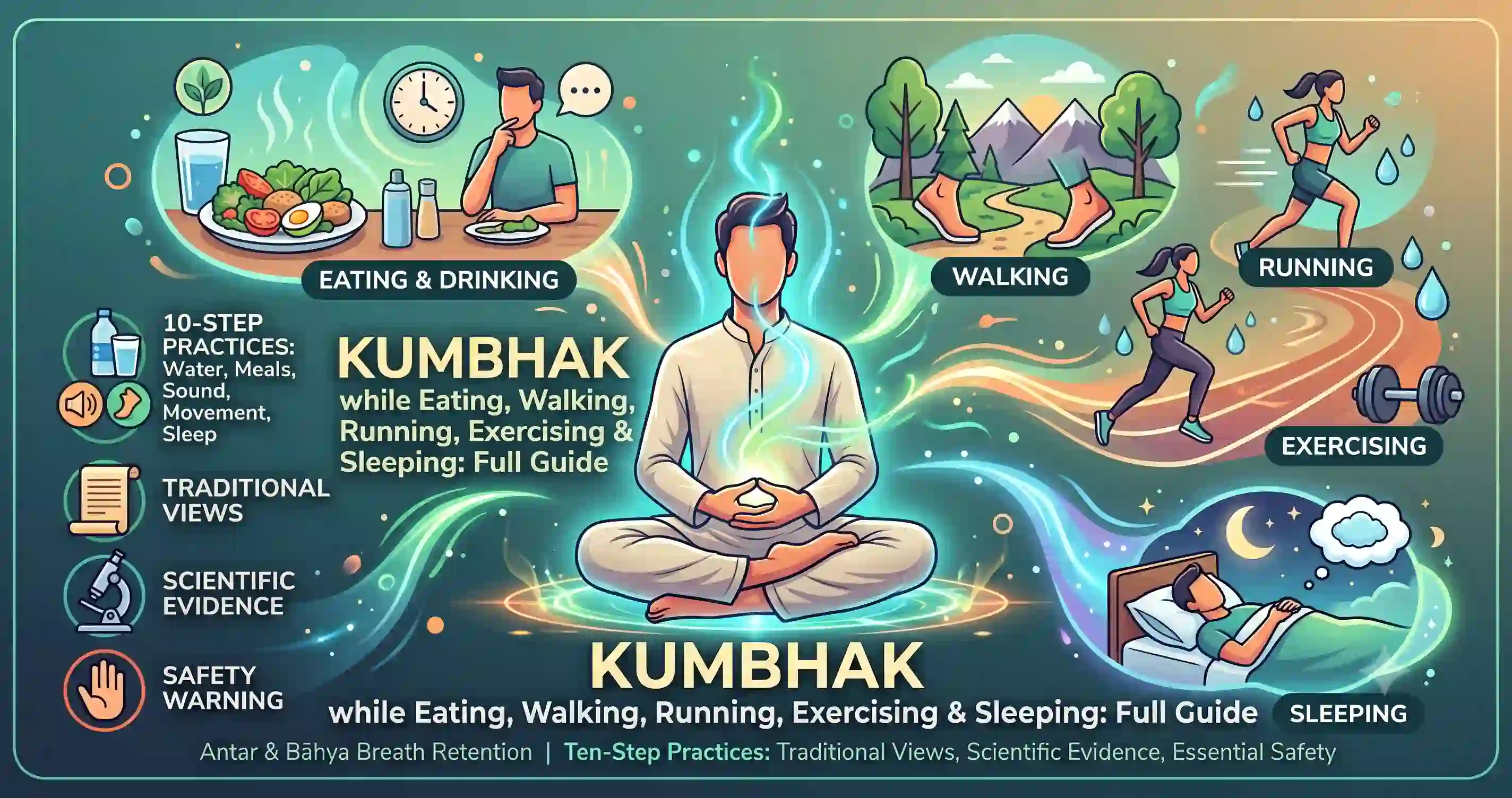
At a crowded railway platform, a man once emptied a paper cup of water while reading a painful message on his phone. Ten minutes later, he looked at the cup and could not remember drinking it.
The water had entered his stomach. It had not entered his experience.
That small difference opens the real question behind this article. Can Antar Kumbhak, Bāhya Kumbhak, or the Ten-Step Kumbhak for Stress Relief make water feel more satisfying, food more nourishing, sound more penetrating, speech more intentional, movement more restorative, or bedtime more settling?
The honest answer is neither a careless “yes” nor a dismissive “no.”
Breath retention can unquestionably change attention, internal sensation, blood gases, circulation and the felt intensity of an event. Yoga, Ayurveda and Svara Yoga offer rich models for understanding that intensification. Yet no human study has shown that retaining the breath while drinking or eating increases intestinal absorption of water, protein, vitamins or minerals. No trial has shown that a held breath makes spoken words enter memory more deeply, turns an ordinary walk into tissue repair, or makes running-induced hypoxia universally healthy.
The most credible possibility is subtler—and, for many people, more useful:
Kumbhak may not make the substance more nourishing. It may make the person more available to be nourished.
That availability can mean less hurry, finer taste, better awareness of thirst or fullness, more complete listening, a pause before reactive speech, clearer perception of effort during movement, or a deliberate boundary between daytime stress and sleep. These are meaningful possibilities. They should not be inflated into claims of superior hydration, guaranteed digestion, cellular “charging,” automatic Sushumnā activation or disease treatment.
This article presents the traditional views fully, labels hypotheses honestly, examines the science closely, and places safety before novelty. It is educational, not medical advice, and it is not a practice manual. For the exact Ten-Step method, read How to Practise the Ten-Step Kumbhak for Stress Relief.
The Central Verdict: Place Kumbhak Beside the Activity, Not Inside Its Most Vulnerable Moment 🧭
The most important conclusion for the Ten-Step Kumbhak
The Ten-Step Kumbhak is a complete, chest-centred, mouth-closed, seated practice with its own sequence and recovery. It needs undivided attention.
It should therefore not be superimposed on:
- food or liquid passing through the mouth or throat;
- speaking or singing, which require expiratory airflow;
- walking, running, stairs, traffic or uneven ground;
- any task in which dizziness or a momentary lapse of attention could cause injury;
- a full stomach; or
- the instant of falling asleep, when deliberate control is being surrendered.
Its most coherent daily-life use is adjacent:
- before a meal, then eat with normal breathing;
- before listening, then receive the person or music without managing the breath;
- before an important conversation, then speak on normal airflow;
- seated before a walk or run, then move with normal breathing;
- after exercise only once breathing and the body have returned to a settled baseline;
- seated before getting into bed, then lie down and allow sleep to come.
This preserves what is distinctive about the Ten-Step practice while avoiding a confused hybrid that is neither safe daily activity nor faithful Ten-Step Kumbhak.
The “vulnerable moment” rule
Every activity in this article has a moment that should not be burdened with deliberate retention:
- Drinking: when liquid is in the pharynx.
- Eating: while chewing, forming or swallowing a bolus.
- Listening: when breath discomfort begins competing with what is being heard.
- Talking: while the vocal folds require airflow to make sound.
- Singing: during a sung phrase that depends on managed Rechak.
- Walking: near traffic, stairs, water, heights, obstacles or instability.
- Running: during exertion, when oxygen consumption is high and a fall would be dangerous.
- Sleep: after a late meal, during reflux, or when the practitioner is drifting beyond conscious self-monitoring.
The retained breath should never steal protection from the very act it is intended to enrich.
A vertical decision map for the eight settings
Drinking water 💧
- Possible value: attention, taste, sip size, thirst awareness, a felt pause.
- Evidence for increased hydration: none.
- Safer relationship: Kumbhak only when the mouth and throat are empty—before the sip or after the swallow has fully finished and normal breathing has resumed.
- Do not: intentionally prolong retention with liquid in the mouth or throat.
Eating food 🍲
- Possible value: less hurry, stronger taste awareness, clearer fullness signals, a quieter meal.
- Evidence for increased nutrient absorption: none.
- Safer relationship: a separate seated Kumbhak before eating; normal breathing throughout chewing and swallowing.
- Do not: perform the Ten-Step sequence during the meal or on a full stomach.
Listening 👂
- Possible value: a clean attentional interval, less preparation of one’s reply, finer awareness of tone and silence.
- Evidence for stronger auditory memory from retention: none direct.
- Safer relationship: a brief, completely easy pause only while seated and only if it does not compete with comprehension.
Talking 🗣️
- Possible value: a pause before reaction, fewer impulsive words, clearer intention.
- Physical fact: true speech cannot occur during true Kumbhak; phonation requires airflow.
- Safer relationship: Kumbhak before speaking or in a genuine silent interval—not against the voice.
Singing 🎶
- Possible value: composure before entry, phrase awareness, inward mantra contemplation during silence.
- Physical fact: singing is organized expiratory airflow, not retained breath.
- Safer relationship: keep Kumbhak separate from the sung phrase and work with a qualified voice teacher if breath management is the goal.
Walking 🚶
- Possible value: embodiment, cadence awareness, an attentional transition into the walk.
- Evidence for added healing from retention: none direct.
- Safer relationship: practise the Ten-Step Kumbhak seated before walking; let the proven benefits of walking arise through the walking itself.
Running 🏃
- Possible value: specialized athletic conditioning in trained, screened and supervised populations.
- Evidence for ordinary wellness use: inadequate and mixed.
- Safer relationship: do not combine the Ten-Step Kumbhak with running. Exercise breath-hold protocols belong to sports supervision, not a stress-relief experiment.
Before sleep 🌙
- Possible value: a ritual boundary, reduced rumination, a repeated cue that the day is ending.
- Evidence: early research supports some bedtime breathing routines containing a hold, but it does not isolate retention or test the Ten-Step method.
- Safer relationship: complete the exact Ten-Step practice seated, then lie down. A lying modification should not be presented as the exact Ten-Step Kumbhak.
What Does “Enhanced Absorption” Actually Mean? Four Different Claims 🔍
1. Physical absorption
This means measurable transfer across tissue:
- water through the gastrointestinal tract and kidneys;
- glucose, amino acids, fatty acids, vitamins and minerals through intestinal transport pathways;
- oxygen from alveoli into blood and from haemoglobin into tissues.
There is no direct evidence that a few seconds of intentional Kumbhak while drinking or eating increases any of these forms of absorption. The Bohr effect is real—rising carbon dioxide can promote oxygen unloading from haemoglobin—but it does not prove that nutrients are absorbed more efficiently from a meal, that water crosses the intestine faster, or that a particular organ receives a targeted “oxygen surge.”
Calling all three phenomena “absorption” creates a scientific mirage: one real mechanism is used to imply an unmeasured benefit somewhere else.
2. Sensory registration
This means how completely taste, sound, bodily movement or internal sensation is noticed.
Here the hypothesis is much stronger. Breath retention is difficult to ignore. It can narrow attention, intensify interoception and place a clear boundary around an instant. A sip may taste more vivid. The space after a musical phrase may feel larger. A person may finally hear the tremor under someone’s confident words.
That is not imaginary. It is a change in experience. It is simply different from greater chemical absorption.
3. Emotional and cognitive assimilation
An event can be sensed without being understood. A compliment may be heard but not believed. An apology may be spoken before remorse has ripened. Food may be consumed while grief remains clenched in the jaw.
A completely easy pause may provide a moment in which meaning catches up with sensation. This is especially relevant to listening, talking and pre-sleep rumination. The pause can create response space—not certainty, not truth, but the opportunity to notice before reacting.
4. Prāṇic or traditional nourishment
Yoga and Ayurveda use a wider language of nourishment: Prāṇa, the five Vāyus, Agni, Rasa, Dhātu, Ojas, Nāḍī, Svara and the capacity of mind to receive an impression.
Within this model, food can nourish poorly even when its calories are absorbed; sound can disturb even when the ears function; and a walk can scatter rather than restore if Vāta and attention are disordered. Kumbhak is hypothesized to gather or stabilize the force that receives, processes, distributes or expresses an experience.
This model deserves full explanation because it has philosophical and practical coherence within its own tradition. It should not be relabelled as proven biochemistry.
A credibility ladder for every benefit in this article
Established: directly measured and repeatedly supported.
Plausible: consistent with known physiology or psychology, but not directly tested for this use.
Traditional hypothesis: authentically connected to Yoga, Ayurveda or Svara Yoga, but not biomedically established.
Personal experience: meaningful first-person observation that may guide a careful experiment, but cannot establish a general result.
Unsupported: a claim for which neither direct evidence nor a defensible traditional source has been found.
This ladder allows wonder without sacrificing truth.
Scientific Truths: What a Breath Hold Can—and Cannot—Change 🔬
Carbon dioxide, oxygen and the Bohr effect
During a closed-airway hold, metabolism continues. Carbon dioxide generally rises; oxygen may fall as the hold continues. The exact change depends on lung volume, preceding breathing, duration, activity, health and training.
The Bohr effect describes how carbon dioxide and acidity influence haemoglobin’s affinity for oxygen. This helps explain oxygen unloading in active tissues. It does not show that:
- Kumbhak sends extra oxygen specifically to the stomach;
- intestinal nutrient transport increases;
- a held sip hydrates cells more efficiently;
- the brain “absorbs” a sound more deeply; or
- movement repairs tissue faster.
The body-wide response also includes chemoreflex activation, vascular changes and increasing respiratory drive. A mechanism can be biologically interesting without being a therapeutic advantage.
Breath holding is not automatically “vagal” or “rest-and-digest”
It is common to read that Bāhya Kumbhak stimulates the vagus nerve and that Antar Kumbhak creates a parasympathetic rebound. The physiology is not so simple.
Some paced-breathing routines can improve baroreflex measures, reduce heart rate or feel calming. Yet during a one-minute Kumbhak in healthy participants, systolic, diastolic and mean arterial pressure and total peripheral resistance increased, while stroke volume and cardiac output fell.1 Retention can involve sympathetic activation and peripheral vasoconstriction as well as vagal influences.
The useful conclusion is not “Kumbhak always switches on rest-and-digest.” It is:
The response depends on the phase, duration, effort, posture, activity and person.
This matters at a meal, during exercise and before sleep, where the desired effect is usually settling rather than a pressure challenge.
Cerebral blood flow and intensified experience
Direct studies show that both internal and external Kumbhak can acutely alter middle cerebral artery flow velocity.2 In extreme apnoea, cerebral blood-flow velocity may rise substantially as compensation for carbon dioxide accumulation and falling oxygen.3
That response may help explain why a hold feels vivid, compressed or unusually significant. But more cerebral flow during a hold is not proof of:
- better memory;
- superior listening;
- neurogenesis;
- brain “detoxification”;
- stroke prevention; or
- deeper spiritual truth.
The rise is first a protective physiological response. Meaning must not be smuggled into a blood-flow measurement.
Interoception: the strongest everyday-life bridge
Kumbhak turns normally background sensations into foreground information: chest pressure, heartbeat, throat position, facial tension, urgency and relief. The insular and related networks help integrate such internal signals with attention and emotion.
This offers a plausible pathway for several reported benefits:
- a sip feels more satisfying because it is noticed;
- taste lingers because the next bite is delayed;
- one becomes aware of fullness earlier;
- the body’s response to a voice becomes visible;
- a speaker notices anger before words carry it outward;
- a walker detects strain or ease sooner;
- bedtime rumination is interrupted by a concrete internal sequence.
Interoceptive intensity is not always beneficial. For people with panic, suffocation-related trauma or health anxiety, it can amplify fear rather than nourishment.4
Respiratory rhythm can shape cognition—but that does not prove a hold effect
Human intracranial recordings show that natural nasal respiration can entrain activity in piriform cortex, amygdala and hippocampus. In related behavioural tasks, respiratory phase affected fear discrimination and memory retrieval.5
This is fascinating evidence that breathing is not cognitively neutral. It still does not show that Kumbhak improves auditory processing, that Bāhya Kumbhak is best for listening, or that a heard sentence is stored more deeply during retention. The study examined breathing phase and route, not daily-life Kumbhak.
The defensible inference is modest: coordinating attention with respiration may change the conditions under which perception occurs. The exact effect of retention on real conversation or music remains untested.
The natural breathing pause during swallowing
Every healthy swallow already includes deglutition apnoea—a brief reflexive cessation of breathing. In adults, swallowing most often occurs in an exhale–swallow–exhale pattern; the breathing pause commonly lasts about 0.5 to 1.5 seconds.6 This coordination protects the airway.
That fact must not be misread as permission to extend the pause deliberately. Chewing, bolus formation, laryngeal closure, swallowing, breathing and cough protection are tightly coordinated. Food may collect in the oropharynx before the swallow, and altering timing adds complexity to a system whose safety depends on precision.7
The natural pause is intelligent. It does not need to be defeated, prolonged or turned into a performance.
Why “more nourishing” can feel real without more absorption
Suppose a person takes half-sized sips, notices temperature and taste, pauses between bites, stops replying mentally while another person speaks, and begins a walk after consciously leaving work stress behind. Each activity may feel deeper.
Several non-mystical pathways could contribute:
- reduced speed and distraction;
- clearer memory encoding because attention was present;
- expectation and ritual;
- reduced impulsivity;
- greater sensory contrast before and after the hold;
- relief following respiratory urge;
- increased awareness of satiety, thirst, effort or emotion;
- a conditioned association between the practice and safety.
These pathways do not invalidate the experience. They explain how a practice can matter without requiring unsupported chemistry.
Yogic Truths: Breath Stillness as a Container for Experience 🕉️
Haṭha Yoga’s central breath–mind principle
The Haṭha Yoga Pradīpikā 2.2 states:
cale vāte calaṁ cittaṁ niścale niścalaṁ bhavet |
yogī sthāṇutvam āpnoti tato vāyuṁ nirodhayet ||“When the breath-force moves, the mind moves; when it becomes still, the mind becomes still. Through that steadiness the yogi becomes established; therefore the breath-force is restrained.”21
This verse supports a powerful traditional hypothesis: when the breath is still, the mind may become less scattered, allowing an experience to be received with greater unity.
It does not say that swallowing during retention increases nutrient absorption, that running on Bāhya Kumbhak is therapeutic, or that every pause automatically awakens Sushumnā.
Place, time and number are part of Prāṇāyāma—not administrative details
Yoga Sūtra 2.49 defines Prāṇāyāma through the interruption or regulation of the movements of inhalation and exhalation. Sūtra 2.50 describes external, internal and stationary aspects observed through place, time and number, becoming extended and subtle.22
For this topic, “place” can also be read as context:
- a safe seat is not the same place as a running track;
- an empty mouth is not the same place as a pharynx containing liquid;
- silence between phrases is not the same place as vibrating vocal folds;
- an empty or settled stomach is not the same place as a stomach becoming full.
The ancient emphasis on measure does not romanticize indiscriminate retention. It asks for discrimination.
The classical warning against haste and force
The Haṭha Yoga Pradīpikā compares the breath to powerful animals that must be brought under control by degrees; mishandling the breath harms the practitioner. The next verses warn that incorrect practice can generate illness, including pain in the head, ears and eyes.21
This warning is especially relevant when another task is added. Eating, speaking and running already require coordination. Kumbhak adds a second demand. Novelty does not repeal physiology.
Does classical Yoga authorize Kumbhak while walking?
The Haṭha Yoga Pradīpikā says that Ujjāyī may be performed while walking or sitting.23 This is genuine textual support for the broader idea that certain breathing practices need not remain confined to a meditation seat.
But this verse does not authorize every retention pattern during every kind of movement. Ujjāyī is not the Ten-Step Kumbhak. Walking is not running. “May be performed while walking” is not evidence that a person should hold to air hunger, exercise near traffic, or combine exertion with a full four-phase sequence.
The precise traditional conclusion is therefore:
Yoga contains a precedent for breath practice during ordinary movement, but not a blanket prescription for Ten-Step, Antar or Bāhya Kumbhak during walking and running.
Breath stillness and listening in the Nāda tradition
The Nādabindu Upaniṣad describes a state in which gaze is steady without an external support, the breath-force is steady without effort, and the mind is steady without dependence—within the contemplation of inner Nāda.24
This provides authentic traditional depth for the connection between effortless breath stillness and deep listening. Yet the text concerns inner contemplative sound and liberation-oriented practice. It is not proof that holding during a song improves cochlear function, that a mantra heals tissue more efficiently, or that every external message should be received on Bāhya Kumbhak.
The yogic truth is about quality of attention, not acoustic enhancement hardware.
The vessel metaphor
Kumbha means a pot or vessel. A vessel gives shape to what it holds. The metaphor is particularly illuminating here:
- water without a vessel spills;
- food without digestion burdens;
- sound without attention vanishes;
- speech without restraint wounds;
- movement without recovery depletes;
- sleep without surrender never arrives.
Kumbhak may function as a vessel for experience. But a pot is useful because it contains without crushing. Once retention becomes pressure, competition or danger, the metaphor has been betrayed.
Ayurvedic Truths: Prāṇa, Samāna, Udāna and Vyāna as a Map of Nourishment 🌿
The five Vāyus offer a coherent activity-by-activity model
The Aṣṭāṅga Hṛdaya describes five functional forms of Vāta. In the passages most relevant here:
- Prāṇa Vāyu is connected with the head, chest, throat, senses, inspiration and the entry of food.
- Udāna Vāyu is connected with the chest, throat, speech, effort, vitality and memory.
- Vyāna Vāyu is centred at the heart, pervades the body and governs movement and many bodily actions.
- Samāna Vāyu stays near Agni, receives food, supports digestion, separates useful and waste portions, and moves them onward.
- Apāna Vāyu governs downward elimination and pelvic functions.2526
This classical map elegantly matches the activities in this article:
- drinking and eating begin with Prāṇa;
- digestion belongs especially to Samāna;
- listening involves Prāṇa, senses and mind;
- speech and singing engage Udāna;
- walking and running prominently engage Vyāna;
- elimination and grounded recovery involve Apāna.
The hypothesis that Kumbhak can temporarily gather these functions is traditionally intelligible. The stronger claim—that retention forces nutrients into deeper Dhātus or directly manufactures Ojas—has not been demonstrated and should not be presented as a textual or biomedical certainty.
Samāna Vāyu, Agni and the appeal of “pressure-cooker digestion”
The attached drafts repeatedly compare Antar Kumbhak during eating to closing a pressure cooker around Agni. The image is memorable but can mislead.
Traditionally, Antar Kumbhak may be interpreted as containment and Bāhya Kumbhak as receptive space. Samāna’s classical role in receiving, digesting, differentiating and releasing food makes it reasonable—within Ayurveda—to hypothesize that collected attention and regulated Prāṇa support assimilation.
But physical pressure is not the same as stronger Agni. Increased intrathoracic or abdominal pressure can worsen discomfort or reflux in susceptible people. A full stomach is not improved merely because the glottis is closed. The safe Ayurvedic insight is settled attention, appropriate quantity and undisturbed digestion, not literal compression of a meal.
Charaka’s dining instruction is more directly relevant than an invented Kumbhak rule
Charaka Saṃhitā, Vimāna Sthāna 1.24 advises eating in proper quantity, after the previous food has been digested, neither too fast nor excessively delayed, not while talking or laughing, and with the mind fully present.27
This is precise textual support for attentive eating. It does not prescribe intentional retention during the swallow.
The distinction matters. If a person wants the nourishing depth associated with Ayurveda, the tradition’s clearest instructions are already profound:
- suitable food;
- proper quantity;
- appropriate timing;
- a favourable setting;
- undistracted attention;
- honest awareness of one’s own condition.
Kumbhak may prepare that state before the meal. It should not be used to override it.
Full stomach, partial stomach and the user’s assimilation hypothesis
Classical Haṭha Yoga places salutary, moderate food before Prāṇāyāma practice.21 Traditional yoga manuals repeatedly favour an empty or lightly settled stomach for formal retention. That caution is physiologically sensible: as the stomach fills, diaphragmatic excursion, comfort, reflux risk and abdominal pressure conditions change.
The personal hypothesis explored here is more specific: perhaps a partial, completely easy Kumbhak between bites—while the stomach is becoming full—temporarily suspends the two Svaras and helps assimilation.
This experience may be respected without turning it into a general instruction. Four boundaries are essential:
- No study has shown increased nutrient assimilation from this practice.
- Stopping nasal airflow does not prove that Iḍā and Piṅgalā have been suspended as subtle forces.
- The mouth and throat must be empty before any deliberate hold is considered.
- The exact Ten-Step Kumbhak should not be performed during the meal or as fullness develops.
The plausible benefit may come from the pause between bites, not from hypoxia, pressure or “forcing” food into tissues. A meal can become quieter without the swallow becoming a laboratory.
Ojas, Āma and sensory nourishment—used accurately
Within Ayurveda:
- Ojas is understood as the finest outcome of well-completed nourishment and tissue transformation, associated with stability, vitality and resilience.
- Āma refers to inadequately processed material or dysfunction within the traditional metabolic model.
- Rasa can mean taste, essence or the first nourishing tissue stream depending on context.
These are not interchangeable with immune-cell count, “toxins,” plasma nutrients or laboratory bioavailability. A practitioner may traditionally hypothesize that calm, attentive intake favours Ojas and reduces conditions conducive to Āma. It would be an exaggeration to claim that a breath hold has been proven to create more Ojas, remove toxic metabolites or increase micronutrient delivery.
Ayurveda is honoured by precision, not by attaching its vocabulary to every modern promise.
Svara Yoga: Iḍā, Piṅgalā, Sushumnā and the Temptation to Overclaim 🌗
What the traditional Svara framework actually contributes
The Śiva Svarodaya identifies Iḍā with the left, lunar flow and Piṅgalā with the right, solar flow.28 In one published English edition, verse 122 places eating and the activation of digestive fire under the solar or Piṅgalā flow.29 Some modern Svara interpretations extend the lunar polarity to water and receptive activities; no equally clear verse prescribing that water rule was found in the edition checked.
Within this traditional framework:
- food is often aligned with the solar, heating, action-oriented Svara;
- water and receptive listening are often aligned with the lunar, cooling Svara;
- speech, physical effort and shorter active tasks may be read through Piṅgalā;
- contemplation is associated with balanced flow or Sushumnā.
This offers an experiential timing system: observe which nostril is more open, notice how body and mind feel, and compare experience without coercing a conclusion.
Does Kumbhak “suspend both Svaras” and force entry into Sushumnā?
During Kumbhak, airflow through both nostrils stops. That physical fact is not identical to proving that Iḍā and Piṅgalā as subtle Nāḍīs have ceased functioning or that Prāṇa has entered Sushumnā.
Some Haṭha texts connect mature Kumbhak, Nāḍī purification and Sushumnā. Those are advanced traditional claims within a wider discipline. It is too strong to say that any brief daily-life hold—especially during a meal—automatically creates central-channel absorption.
A more faithful statement is:
Svara Yoga may interpret the suspension of airflow as a uniquely neutral interval in which ordinary left–right dominance is not externally expressed. Whether that corresponds to Sushumnā is a matter of traditional interpretation and developed practice, not a medically measurable fact.
What science says about nostril dominance
Nasal airflow naturally alternates through the nasal cycle. Research has explored relationships between unilateral nostril breathing, autonomic variables and cognition, but findings are inconsistent and protocols are small. There is no strong evidence that eating during right-nostril dominance improves digestion or that drinking during left-nostril dominance increases hydration.
Svara awareness can still be valuable as observation. It becomes less credible when converted into guarantees about enzymes, hemispheric control or disease prevention.
Kumbhak While Drinking Water and Other Liquids 💧
The best-case interpretation
Drinking can be almost invisible. A bottle is emptied while driving, scrolling, arguing or rushing between rooms. Kumbhak may make the act visible again.
Possible benefits include:
- noticing the first contact of liquid with the mouth;
- distinguishing thirst from habit;
- taking smaller sips rather than gulping;
- appreciating temperature and taste;
- feeling when thirst is satisfied;
- using a conscious pause as a stress-interruption cue.
These are benefits of attention, pace and interoception. They do not establish increased water absorption.
Yogic and Ayurvedic possibilities
Water may be interpreted as Āpas/Jala Mahābhūta, associated with cohesion, fluidity and taste. Prāṇa Vāyu participates in intake; Bodhaka Kapha supports taste in the mouth; Kledaka Kapha moistens the food mass in the stomach.30 A traditional practitioner may experience Antar Kumbhak after completed intake as containment, or Bāhya Kumbhak before intake as receptivity.
This can be expressed as a hypothesis:
A settled pause may help the practitioner receive the cooling, cohesive and satisfying qualities of water with less mental scattering.
It should not be expressed as:
- “Kumbhak structures water”;
- “the breath charges water molecules”;
- “water bypasses digestion and goes directly to the brain or joints”;
- “vasopressin is optimized by a short hold”; or
- “less water is now enough for physiological hydration.”
Those claims are unsupported and could encourage underhydration.
Different liquids do not create the same experiment
“Liquids” is not one harmless category. The safest boundary—no deliberate hold while anything is in the mouth or throat—applies to all of them, but several deserve added care:
- Very hot drinks: Kumbhak does not protect the mouth or oesophagus from heat. Check the temperature and drink without respiratory distraction.
- Carbonated drinks: belching, pressure and reflux can make retention uncomfortable; do not suppress a burp with a hold.
- Thickened liquids: these may be prescribed for a swallowing disorder. Follow the exact consistency and swallowing plan; do not add Kumbhak without the treating clinician or speech-language pathologist.
- Oral rehydration solution: its value comes from the correct water, glucose and electrolyte formulation. Kumbhak neither strengthens the formula nor permits a smaller medically recommended amount.
- Liquid medicine or pills taken with water: complete the prescribed swallow normally. Do not use retention to “hold the medicine in place” or change its absorption.
- Caffeinated or stimulant drinks: palpitations, tremor or anxiety may make a hold less tolerable. Do not interpret added intensity as added nourishment.
- Alcohol or sedating drinks: impaired airway protection, judgement and self-monitoring make deliberate retention unsuitable.
The content of the cup still matters. Attention cannot turn an unsafe temperature, wrong dose or inappropriate drink into nourishment.
The swallowing reality
Liquid swallowing already includes a natural respiratory pause. The safest pattern in healthy adults usually resumes with exhalation, which helps protect the airway from residual material.67
Deliberately holding with liquid in the mouth or pharynx can make a simple act cognitively complicated. Bāhya Kumbhak is particularly concerning because the person has less air available for an effective cough if liquid enters the airway.
Therefore:
- do not perform deliberate Kumbhak while liquid is passing through the throat;
- do not combine it with large gulps, laughter, speech, reclining or distraction;
- do not experiment if there is dysphagia, aspiration history, neurological disease affecting swallow, active reflux or impaired alertness;
- do not use alcohol, sedating drinks or intoxicants in such an experiment;
- never treat repeated coughing after drinking as “cleansing.”
Repeated coughing, a wet or gurgly voice after drinking, unexplained fever, choking episodes or breathlessness after sips warrants clinical assessment, often by a physician and speech-language pathologist.
Evidence verdict for water
Established: swallowing contains a coordinated breathing pause.
Plausible: a Kumbhak-adjacent ritual may increase attention to thirst, sip size and satisfaction.
Traditional hypothesis: collected Prāṇa may improve the felt assimilation of Jala’s qualities.
Unproven: increased intestinal water uptake, superior cellular hydration, “prānized” molecular structure or reduced physiological water requirement.
Kumbhak While Eating and Chewing Food 🍚
Why the idea feels so powerful
Food is matter becoming self. Few daily acts are more intimate.
When eating is rushed, the hand may lift the next bite before the mouth has finished the first. Taste appears and disappears. Fullness arrives like a letter opened too late. A pause can restore dignity to the meal.
Possible Kumbhak-adjacent benefits include:
- more complete attention to taste and texture;
- a clear break between bites;
- reduced reactive talking while chewing;
- earlier recognition of fullness or discomfort;
- reduced pace without imposing a diet rule;
- an experiential distinction between hunger, craving, loneliness and habit.
These are valuable. None requires deliberate retention during chewing or swallowing.
Why chewing is not an empty-mouth activity
The attached drafts repeatedly suggest that a person can hold the breath while chewing because the food has not yet been swallowed. Swallowing research complicates that assumption.
During solid-food processing, chewed material can begin collecting in the oropharynx before the final swallow. Breathing, mastication and bolus transport share anatomical space and are precisely coordinated.7 “Food is only in the mouth” is not always physiologically accurate.
This is why the clearest safety rule is:
Do not add deliberate Kumbhak while chewing, forming a bolus or swallowing.
If a pause is used at all, the mouth and throat should already be empty and normal breathing should have re-established itself. For most readers, a separate seated round before the meal provides nearly all the attentional benefit with far less complexity.
Does Kumbhak improve digestion or nutrient absorption?
No direct human trial answers this question. Several distinctions matter:
- Feeling food “land” more fully is not a measurement of absorption.
- Eating less because one noticed fullness is not proof that nutrients were extracted more efficiently.
- Post-meal lightness is not proof that Āma was eliminated.
- A calmer meal may support digestive comfort without changing transporter activity in the small intestine.
- Carbon dioxide changes do not selectively drive vitamins and minerals into tissues.
The most plausible scientific pathway is indirect:
pre-meal state regulation → less hurry and distraction → different eating behaviour and symptom perception
That pathway may matter greatly to lived wellbeing while remaining distinct from bioavailability.
Can partial Kumbhak help as the stomach becomes full?
As a personal observation, a completely easy pause between completed mouthfuls may feel as if the meal is being “received” rather than merely accumulated. It may also create time for fullness signals and emotional awareness.
But increasing fullness narrows the case for retention:
- the stomach and diaphragm are sharing space;
- abdominal or chest pressure may feel less comfortable;
- reflux, belching and bloating may be more likely in susceptible people;
- the temptation to use Bāhya Kumbhak with abdominal retraction must be resisted;
- the Ten-Step sequence is not designed for an active meal.
The safest interpretation of the experience is attentional assimilation, not mechanically enhanced digestion.
Full stomach is a “no”—and why that boundary protects the practice
Formal Kumbhak on a full stomach is discouraged in Yoga. The principle is not punishment; it is space. A full stomach makes diaphragmatic comfort and pressure responses less predictable.
Do not use breath retention to compensate for overeating, “burn” a heavy meal, force a burp, suppress nausea, control calories or undo food guilt. People with an eating disorder—or anyone using breath holds to avoid eating, blunt hunger or pursue extreme control—should stop and seek qualified support.
For post-meal benefit, ordinary walking has evidence for reducing postprandial glucose in some populations.8 That evidence belongs to walking, not to Kumbhak performed during the walk.
Evidence verdict for food
Established: eating and breathing require complex coordination; undistracted eating is an authentic Ayurvedic recommendation.
Plausible: a separate practice before eating or a natural pause between completed bites may reduce hurry and improve awareness of taste and fullness.
Traditional hypothesis: steadier Prāṇa may support Samāna, Agni and the qualitative formation of nourishment.
Unproven: greater calorie, protein, vitamin or mineral absorption; pressure-driven Dhātu nourishment; prevention of Āma from incompatible food; or permission to perform Kumbhak as the stomach fills.
Kumbhak While Listening: Can a Held Breath Help Sound “Land”? 👂
Listening is not merely hearing
A person can hear every word and receive none of it. While the other person speaks, the mind is often rehearsing defence, advice or rebuttal.
A brief, effortless Kumbhak may interrupt that rehearsal. The benefit is not that the sound wave becomes more powerful. It is that one’s internal commentary becomes temporarily less mobile.
Possible benefits include:
- hearing emotional tone as well as vocabulary;
- noticing the silence between phrases;
- delaying an automatic reply;
- distinguishing what was actually said from what fear predicted;
- giving music or mantra an unbroken field of attention;
- recognizing when a sound is soothing, overwhelming or unsafe.
This is perhaps the lowest-risk simultaneous application—provided the person is seated, the hold is completely easy, and the practice does not reduce comprehension.
Antar or Bāhya for listening?
Antar Kumbhak may traditionally feel containing: sound is received into a field of fullness and chest-centred presence.
Bāhya Kumbhak may traditionally feel receptive: the absence of airflow can be experienced as an inner clearing in which sound arrives without immediate projection.
Neither has been shown scientifically to be superior for listening. Bāhya Kumbhak may produce air hunger sooner, which can turn listening into self-monitoring. The best phase is therefore not the one a theory declares; it is the one that remains effortless and does not steal attention from the speaker.
Nāda Yoga and the boundary between outer and inner sound
Nāda traditions explore progressively subtler listening and connect steadiness of Prāṇa with steadiness of mind. That gives the practice genuine traditional roots.
Yet external sound (āhata, struck sound) and inner contemplative Nāda are not interchangeable. Listening to a friend, a rāga, a mantra recording or traffic requires different attention and safety.
Traditional possibilities may include:
- less scattering of Prāṇa through reaction;
- greater sensitivity to resonance and silence;
- a bridge from outer sound to inner observation;
- a felt meeting of Śabda and the chest-centred field of attention.
These should be offered as contemplative interpretations, not claims that sound frequencies are restructuring organs or releasing stored trauma.
When not to retain while listening
Avoid simultaneous retention:
- while driving, cycling, crossing a road or monitoring danger;
- in water, a bath or on a height;
- during loud concerts where dizziness, crowding or heat may already be present;
- with panic, dissociation or suffocation-related trauma unless a clinician supports it;
- when a complex explanation requires full cognitive bandwidth;
- when the listener feels pressure to appear spiritually receptive.
A person who needs to breathe is not listening more deeply. They are trying to breathe.
Evidence verdict for listening
Established: nasal respiratory phase can modulate some limbic and memory processes; sound and breath both affect attention.
Plausible: an easy pause may create attentional punctuation and reduce reply rehearsal.
Traditional hypothesis: still Prāṇa may support absorption into Nāda and reduce mental scattering.
Unproven: improved hearing acuity, stronger auditory-cortex encoding, cellular sound healing or superior memory from either Antar or Bāhya Kumbhak.
Kumbhak While Talking: The Power Is in the Pause, Not in Speaking Against a Hold 🗣️
True talking does not occur during true Kumbhak
Speech requires expiratory airflow from the lungs, regulated subglottal pressure, vocal-fold vibration and resonance through the vocal tract.9 If air is flowing to make sustained voice, true retention has ended.
Therefore, “Kumbhak while talking” can only coherently mean:
- a retention before speaking;
- a silent retention between phrases;
- an internal mantra contemplated while no sound is produced;
- or awareness of the natural pause that precedes a response.
Trying to force sound against a closed or tightly braced glottis is not empowered speech. It is laryngeal and pressure strain.
Udāna Vāyu and the traditional strength of speech
Ayurveda assigns speech, effort, enthusiasm, strength and memory to Udāna Vāyu.25 This gives an authentic basis for the felt relationship between gathered breath and gathered expression.
Traditional hypotheses include:
- Antar Kumbhak before speech gathers intention at the chest and throat;
- a quiet pause reduces leakage through unnecessary words;
- speech emerging after stillness may better reflect Buddhi than impulse;
- mantra may be contemplated internally before it is given voice;
- restraint may conserve vitality during long teaching or conversation.
These ideas do not establish Vāk Siddhi, infallible speech, manifestation power or a guaranteed healing effect on listeners. A calm lie remains a lie. A resonant command can still harm.
The deepest conversational benefit: receiving before replying
Someone says, “I was frightened,” and the mind reaches immediately for correction: “You should not be.”
One completely easy pause can change the next sentence:
“What frightened you most?”
The Kumbhak has not proven a philosophy. It has preserved another person’s reality long enough for understanding to begin.
Possible benefits include:
- reduced interruption;
- fewer defensive or regretted words;
- more deliberate volume and pace;
- greater awareness of jaw, throat and chest tension;
- a clear separation between hearing and answering;
- willingness to ask permission before advising.
This is where breath retention and ethical communication meet: not in manufacturing agreement, but in making room for a truthful response.
Voice and cardiovascular cautions
Do not:
- phonate forcefully against a held breath;
- brace the throat, face, abdomen or pelvic floor;
- use a hold immediately before shouting;
- repeat retentions through a heated argument;
- practise while standing if light-headedness is possible;
- treat hoarseness, throat pain or vocal fatigue as purification.
People with a voice disorder, recent laryngeal surgery, vocal-fold paralysis, significant reflux, uncontrolled blood pressure, cardiovascular disease or fainting history should seek appropriate professional guidance.
Evidence verdict for talking
Established: speech requires controlled airflow and breath-group organization.
Plausible: a pre-speech pause may reduce impulsivity and improve composure.
Traditional hypothesis: gathered Udāna may support clearer, more economical and more intentional speech.
Unproven: Vāk Siddhi, greater truthfulness, therapeutic transmission, stronger semantic payload or conservation of measurable Ojas.
Kumbhak While Singing, Chanting and Mantra Recitation 🎵
Singing is a breath-management art, not sustained retention
Singing uses coordinated respiratory kinematics, subglottal pressure, vocal-fold function and resonance. Trained singers manage the relationship between rib cage, abdomen and airflow in individualized ways.10
True Kumbhak belongs in silence:
- before the first note;
- between phrases when the score provides time;
- between repetitions of a mantra;
- after a final resonance, while listening inwardly;
- or in a separate seated practice before singing.
During the sung tone, controlled Rechak—not breath retention—carries the voice.
Traditional possibilities: Nāda, Mantra and Udāna
Yoga may interpret the silent interval before sound as a seedbed:
- intention gathers before syllable;
- Udāna organizes expression;
- the chest centre holds emotional meaning;
- external Nāda is followed into internal resonance;
- a mantra is allowed to affect the reciter before being repeated.
This can make chanting feel less mechanical. A thousand repetitions are not necessarily nourishing if the mind never hears one.
Yet breath retention does not scientifically “charge” a mantra, increase its frequency, transmit healing across distance or make a singer immune to vocal injury.
Risks specific to singers and chanters
- Laryngeal squeezing may produce pressed phonation, discomfort or fatigue.
- A hold that creates urgency can destabilize pitch, onset and phrase planning.
- Repeated high-pressure manoeuvres may be inappropriate with eye, cardiovascular or pelvic-floor concerns.
- Long chanting sessions can conceal dehydration or vocal overload behind devotional enthusiasm.
- People with asthma or other respiratory limitations need condition-specific guidance.
- Tinnitus, hyperacusis or sound-triggered panic may make intense listening during retention unsuitable.
Seek a laryngologist or qualified voice professional for persistent hoarseness, loss of range, throat pain, repeated voice breaks or vocal fatigue.
Evidence verdict for singing
Established: singing depends on organized airflow, respiratory control, phonation and resonance.
Plausible: silent pauses can support composure, phrase planning and inward attention.
Traditional hypothesis: steadied Prāṇa and Udāna may deepen mantra reception and intentional expression.
Unproven: stronger healing frequencies, effortless vocal projection from Bāhya Kumbhak, or safer phonation through preloading pressure.
Kumbhak While Walking: Healing Through Movement Without Turning the Path into a Test 🚶♀️
Walking already heals in ways breath retention does not need to claim
Walking can support cardiovascular health, mobility, mood and metabolic regulation. A large meta-analysis of randomized trials found reductions in depressive and anxiety symptoms compared with inactive controls, although study heterogeneity was high.11 In adults with type 2 diabetes, brief walks after meals reduced postprandial glucose compared with a single daily walk in a randomized crossover study.8
These are walking benefits. Adding Kumbhak has not been shown to amplify them.
The mistake would be to take a proven benefit of walking, add an untested breath hold, and award the entire result to Kumbhak.
Vyāna Vāyu and the traditional “distribution” hypothesis
The Aṣṭāṅga Hṛdaya connects Vyāna with whole-body movement and action.26 This makes walking a natural field for observing how attention spreads through the body.
Traditional hypotheses include:
- retained Prāṇa is distributed by Vyāna through moving limbs;
- the contrast between inner stillness and outer motion steadies Vāta;
- footfall and chest-centred awareness create an embodied rhythm;
- a pause interrupts compulsive mental wandering;
- movement becomes less like escape and more like inhabiting the body.
These are meaningful contemplative possibilities. They are not proof that breath holds drive calcium into bone, pump synovial fluid into joints, cleanse Nāḍīs or repair adrenal glands.
The indirect intermittent-hypoxia evidence—and its hard boundary
In people with chronic incomplete spinal-cord injury, precisely controlled intermittent low-oxygen exposure combined with walking training improved certain walking outcomes in small, monitored randomized trials.12
This is important research. It is also a different intervention:
- participants continued breathing a measured low-oxygen mixture;
- oxygen concentration and timing were controlled;
- patients were screened;
- clinicians supervised the sessions;
- sham comparison was used;
- rehabilitation was task-specific.
It does not prove that holding the breath while walking recreates the same dose or neural plasticity. The clinical protocol’s precision is the reason it can be studied—not a reason to imitate it casually.
The safest relationship between the Ten-Step practice and walking
For stress relief, the stronger sequence is:
- Practise the exact Ten-Step Kumbhak while safely seated.
- Allow the recovery breaths and body to feel normal.
- Stand only when there is no dizziness, visual change or instability.
- Walk with normal breathing and full awareness of the environment.
- Let the walk reveal whether the preceding practice changed tension, mental speed or bodily ease.
The Ten-Step process itself is intentionally not reproduced here. Use the complete practice guide.
Evidence verdict for walking
Established: walking has mental, cardiovascular and metabolic benefits; Ujjāyī while walking has a textual precedent in Haṭha Yoga.
Plausible: a separate Kumbhak practice may change how embodied and attentive a later walk feels.
Traditional hypothesis: Vyāna may distribute gathered Prāṇa through coordinated movement.
Unproven: greater joint healing, lymphatic “detox,” bone nourishment, mitochondrial growth or neurological rehabilitation from self-directed breath holds while walking.
Kumbhak While Running: A Specialized Conditioning Method Is Not a Wellness Shortcut 🏃♂️
Why running changes the risk calculation
During running, oxygen consumption and carbon dioxide production rise. A breath hold therefore reaches discomfort and gas disturbance sooner than the same hold at rest. Balance, vision, cadence, traffic awareness and rapid corrective movement are all essential.
A brief loss of consciousness while seated may still be serious. During running it can become head injury, collision or death.
For this reason, the Ten-Step Kumbhak should never be performed while running.
What sports research on hypoventilation actually shows
Voluntary hypoventilation at low lung volume—usually involving short end-expiratory holds during exercise—is a specialized training method. Some studies report altered oxygenation, metabolic stress or selected repeated-sprint outcomes in trained athletes. Other studies find reduced power or no conventional aerobic advantage.1314
This literature does not support claims that ordinary running Kumbhak:
- reliably raises EPO;
- permanently raises red-blood-cell mass;
- reproduces altitude training;
- improves VO₂max;
- prevents fatigue;
- protects against ischaemia; or
- is appropriate for beginners.
Repeated apnoea can contract the spleen and temporarily raise circulating haemoglobin, but a temporary release of stored cells is not the same as creating new red-cell mass.15
HIF, EPO and the “healing hypoxia” exaggeration
Hypoxia-inducible factor biology is real. Erythropoietin responses to hypoxia are real. Their activation depends on dose, pattern, tissue, training and individual biology.
In breath-hold research, a clear EPO rise has been observed after severe dynamic apnoea in elite divers—not after ordinary comfortable static Kumbhak in general readers.16
Therefore, do not claim that a few held strides “switch on healing genes.” Severe or sleep-apnoea-like intermittent hypoxia can also produce adverse vascular, sympathetic and metabolic effects. Hypoxia is not a vitamin whose benefit rises with dose.
Non-negotiable running warnings
- Never hyperventilate before a hold. Lowering carbon dioxide can delay the urge to breathe without preserving oxygen, increasing blackout risk.
- Never practise breath-hold running near traffic, water, stairs, heights, hard obstacles or alone.
- Do not use headphones or distraction during any specialized breathing drill.
- Stop at once for dizziness, tunnel vision, ringing in the ears, loss of coordination, chest pain, palpitations, unusual breathlessness, confusion or facial tingling.
- Do not experiment with cardiovascular or cerebrovascular disease, uncontrolled blood pressure, fainting history, epilepsy, significant lung disease, pregnancy, arrhythmia or known exercise intolerance without direct medical clearance.
- Do not convert fear or air hunger into a willpower contest.
Prolonged breath holding can cause hypoxic blackout on land as well as in water; exertion and repeated attempts can increase risk.17
Evidence verdict for running
Established: exertion shortens the physiological margin of a hold; specialized hypoventilation changes oxygenation and metabolic stress.
Promising only for specialists: selected repeated-sprint adaptations in trained, supervised athletes.
Traditional hypothesis: collected Prāṇa may make movement feel inwardly unified and less mentally scattered.
Unsupported for general readers: greater healing, EPO activation, permanent haemoglobin gain, superior endurance or stress relief from running while holding the breath.
Kumbhak Before Sleep While Lying Down 🌙
Why bedtime is different from the other activities
Sleep is not an action to intensify. It is a surrender of action.
A bedtime Kumbhak ritual may be useful because it gives worry a boundary: one final intentional sequence, then nothing more to solve. The practice may become a conditioned cue for leaving work, conflict and screens outside the bed.
Possible benefits include:
- interrupting repetitive thought;
- shifting attention from imagined futures to present sensation;
- making muscular bracing more noticeable;
- providing a consistent transition ritual;
- allowing the emotional residue of the day to be observed before sleep.
The aim is not to hold until sleep arrives. The aim is to finish the practice with the next breath completely normal and let sleep come without further management.
Ayurveda: Nidra is already a form of nourishment
Charaka Saṃhitā, Sūtra Sthāna 11.35 names Āhāra (food), Svapna or Nidra (sleep), and Brahmacharya or wise regulation of the senses as three supports of life. Properly regulated, they support strength, complexion, growth and the continuity of life.31
This reverses an important modern assumption. Sleep is not empty time in which nourishment stops; within Ayurveda, it is itself one of the conditions that allows nourishment to mature.
A traditional bedtime interpretation may therefore propose that:
- a completed Kumbhak practice marks the end of outward effort;
- chest-centred attention gives restless Prāṇa Vāyu one stable home;
- the silence after the practice reduces unnecessary Udāna—the inner rehearsal of tomorrow's speech;
- settling Vāta-like movement may make the transition into Nidra feel less fragmented; and
- proper sleep, rather than the hold itself, performs the night's deeper restorative work.
This remains an Ayurvedic and experiential hypothesis. It does not mean that retaining longer produces more Ojas or that air hunger is a treatment for insomnia. At bedtime, the most nourishing act may be to complete the practice, restore normal breathing and stop interfering with sleep.
Is lying down the Ten-Step Kumbhak?
No. The exact Ten-Step Kumbhak begins with a stable seated posture and uses Bhairavī Dhyāna Mudrā at the lower centre of the torso. Lying down changes posture, chest mechanics, hand support, alertness and the relationship to sleep.
A lying practice may be an individualized adaptation, but it should not be published as the exact Ten-Step method. The most faithful bedtime sequence is:
- practise while seated safely;
- complete the recovery phase;
- notice that breathing and the whole body feel normal;
- then lie down for sleep.
This article does not reproduce the steps. Read the practice page and the science and safety overview.
What the sleep evidence can honestly support
A 2026 randomized trial in 82 nursing students found improved self-reported sleep quality after four weeks of nightly 4-7-8 breathing compared with no intervention.18 The technique includes a seven-second hold.
This finding is encouraging but limited:
- it tested students, not chronic insomnia across the population;
- sleep was measured by questionnaire rather than polysomnography;
- the control did not match time, attention and expectation;
- the practice included a specific rhythm and longer Rechak;
- the study does not show that retention caused the benefit;
- it did not test the Ten-Step Kumbhak.
The evidence supports “a bedtime breathing routine containing a hold may help some people.” It does not support “Bāhya Kumbhak induces sleep” or “the Ten-Step method treats insomnia.”
Antar and Bāhya as bedtime symbols
Within traditional and experiential language:
- Antar Kumbhak can symbolize receiving the day, holding it without immediate reaction, and allowing a sense of completeness.
- Bāhya Kumbhak can symbolize release, emptiness and the end of unfinished internal speech.
These symbols can be emotionally powerful. They are not sleep mechanisms established by clinical science.
If Antar feels pressurizing or Bāhya feels like suffocation, symbolism must yield to the nervous system’s actual message. Normal breathing is not a lesser practice.
Bedtime contraindications and precautions
- Do not practise lying down soon after eating, particularly with reflux. Clinical guidelines advise people with nocturnal GERD to avoid meals within roughly two to three hours of bedtime and to consider head-of-bed elevation.19
- Do not use Kumbhak as a substitute for evaluation or treatment of obstructive sleep apnoea. Pathological nocturnal airway obstruction is not therapeutic Kumbhak.
- Seek clinical guidance first for significant heart or lung disease, uncontrolled blood pressure, fainting, seizures, pregnancy, panic, PTSD or severe insomnia.
- Do not perform retention while intoxicated, sedated or so sleepy that self-monitoring is unreliable.
- Do not chase tingling, floating sensations, visual effects or near-fainting as signs of sleep depth.
- Stop if the practice increases wakefulness, palpitations, panic, reflux, headache or breath monitoring.
- Persistent loud snoring, witnessed breathing pauses, morning headaches, choking awakenings or marked daytime sleepiness deserve sleep assessment.
Evidence verdict for bedtime
Established: consistent pre-sleep routines and reduced arousal can support sleep; lying soon after food can worsen reflux in susceptible people.
Promising: one early randomized trial supports a nightly breathing routine containing retention for subjective sleep quality.
Traditional hypothesis: Antar may embody completion and Bāhya release, helping the mind disengage.
Unproven: that lying Ten-Step Kumbhak is equivalent to the seated method, that retention treats insomnia or sleep apnoea, or that falling asleep during a hold is desirable.
Ten-Step Kumbhak as a Daily-Life Amplifier—Without Multitasking It 🌱
Before drinking or eating
One seated round may help a person arrive before the first sip or bite. Then the breath returns to normal and the meal proceeds without deliberate retention.
The question afterward is not “Did the food become more powerful?” It is:
- Did I taste it?
- Did I recognize enough?
- Did I remain present without policing myself?
- Did my body feel respected?
Before listening, talking or singing
The complete practice may reduce the speed with which a person occupies conversational space. Afterward:
- listen without rehearsing;
- speak on natural airflow;
- sing on organized Rechak;
- allow silence to remain silence.
The pause has completed its work if it improves relationship. It has not completed its work if it becomes a performance others must wait through or praise.
Before walking or running
Practise seated and safely. Stand only after recovery and only if completely steady. Then walk or run with normal breathing and environmental awareness.
This arrangement offers a clean personal experiment:
- Does the practice change the first ten minutes of movement?
- Are the shoulders less clenched?
- Is the pace less driven by agitation?
- Does the walk feel restorative without any breath hold during it?
If yes, the Kumbhak has amplified the walk through state preparation—not through oxygen deprivation.
Before sleep
Complete the practice seated, recover fully, then lie down. Let the body stop “doing Kumbhak.” Sleep needs permission to become automatic.
The day does not have to be solved before the eyes close. Sometimes it only needs to be put down.
Comprehensive Contraindications, Warnings and Emergency Boundaries ⚠️
Never combine deliberate Kumbhak with these settings
- swimming, underwater activity, bathing or any water exposure;
- driving, cycling, machinery or power tools;
- traffic, stairs, heights, cliffs, balconies or unstable ground;
- food or liquid actively passing through the mouth or throat;
- running or fast movement without specialist screening and supervision;
- intoxication, sedative use or impaired alertness;
- any situation in which a brief loss of consciousness would endanger the practitioner or another person.
Obtain individual clinical guidance first
This conservative list reflects limited diagnosis-specific research. Seek qualified guidance before retention with:
- uncontrolled hypertension or significant hypotension;
- coronary disease, heart failure, structural heart disease or arrhythmia;
- previous stroke, transient ischaemic attack, aneurysm or significant vascular disease;
- unexplained fainting, recurrent dizziness or orthostatic intolerance;
- significant asthma, COPD, pulmonary hypertension or impaired gas exchange;
- epilepsy or another seizure disorder;
- glaucoma, retinal disease, recent eye surgery or a condition affected by pressure;
- pregnancy or early postpartum recovery;
- recent chest, abdominal, throat or neurological surgery;
- GERD, hiatal hernia, active ulcer symptoms or recurrent vomiting;
- dysphagia, aspiration history or neurodegenerative disease affecting swallowing;
- panic disorder, suffocation-related trauma, PTSD, dissociation or severe health anxiety;
- an eating disorder or compulsive breath-hold behaviour;
- frailty, impaired balance, cognitive impairment or inability to report symptoms reliably.
Forceful breath holding can resemble or become a Valsalva manoeuvre. Valsalva can acutely alter blood pressure, venous return and intraocular pressure.20 The Ten-Step method forbids strain, but the absence of strain cannot be assumed merely because a person intends ease.
Stop immediately and return to normal breathing for
- dizziness, faintness or unsteadiness;
- tunnel, grey or blurred vision;
- ringing in the ears;
- confusion, loss of coordination or involuntary movement;
- chest pain, pressure or unusual palpitations;
- severe headache or eye pressure;
- panic, dissociation or traumatic flashback;
- unusual breathlessness or a need to gasp;
- coughing, choking, wet voice or a wrong-way sensation after food or drink;
- nausea, reflux or abdominal pain.
Do not resume until breathing, balance, vision and the whole body feel completely normal.
Seek urgent or emergency care for
- loss of consciousness;
- chest pain that persists or recurs;
- severe difficulty breathing;
- blue or grey lips;
- inability to speak or cough during choking;
- one-sided weakness, facial droop, confusion or speech disturbance;
- seizure;
- a sudden severe headache;
- persistent blue colour, altered consciousness or neurological symptoms;
- suspected aspiration with ongoing cough, breathlessness or fever.
Breath practice must never be used to explain away a medical emergency.
Special warning about hyperventilation
Never overbreathe before Kumbhak to make a hold last longer. Hyperventilation lowers carbon dioxide and delays the warning urge to breathe without providing an equivalent oxygen reserve. This can allow dangerous hypoxia to develop with less subjective warning.
A longer number on the clock may mean a weaker alarm—not a stronger body.
Claims That Should Not Appear in a Credible Kumbhaki Article 🚫
Unsupported biomedical claims
Do not state that daily-life Kumbhak:
- increases absorption of water, calories, protein, vitamins or minerals;
- stimulates digestive enzymes through a proven vagal mechanism;
- sends oxygen specifically to the gut, muscles, joints or brain;
- activates HIF-1α, stem cells or healing genes in ordinary practice;
- raises EPO or permanently increases red blood cells;
- cleans the lymphatic system or removes “toxins”;
- heals cartilage, bone, scar tissue or chronic injury;
- treats insomnia, sleep apnoea, diabetes, reflux or digestive disease;
- prevents aspiration;
- makes smaller amounts of water physiologically sufficient;
- creates immunity to oxygen deprivation.
Unsupported yogic and Ayurvedic claims
Do not attribute to classical texts the statement that:
- food should be swallowed during Antar or Bāhya Kumbhak;
- Bāhya Kumbhak draws water directly into deeper Dhātus;
- every hold suspends Iḍā and Piṅgalā and opens Sushumnā;
- Kumbhak converts water into Soma or food into Ojas by pressure;
- spoken words gain Vāk Siddhi from a pre-speech hold;
- running with Kumbhak burns karma or awakens Kuṇḍalinī;
- the Ten-Step Kumbhak was prescribed for eating, running or lying in bed.
These may be modern extensions, personal meanings or speculative interpretations. They are not verified classical prescriptions.
Why excluding exaggeration strengthens—not weakens—the traditional case
Traditional systems do not need fabricated laboratory validation to remain meaningful. Samāna Vāyu can be discussed as an Ayurvedic model without pretending it is a measured nerve. Nāda can be honoured without claiming acoustic tissue repair. Sushumnā can retain its contemplative depth without becoming a synonym for bilateral nasal airflow.
Credibility gives the reader freedom to explore. Exaggeration asks the reader to surrender discernment.
A Safe Personal-Experience Research Framework 📓
Test experience, not belief
For any low-risk, medically appropriate application, compare adjacent Kumbhak with the same activity after normal breathing. Keep the activity, setting and time similar.
Record only outcomes that can actually be observed:
- thirst satisfaction;
- taste vividness;
- meal pace;
- fullness awareness;
- digestive comfort;
- remembered details from listening;
- interruptions during conversation;
- voice comfort;
- walking ease and mood;
- running performance under normal breathing only;
- time to fall asleep and next-morning freshness;
- dizziness, pressure, panic, reflux or discomfort.
Do not use one unusually good day as proof. Do not interpret neutral results as failure. Do not increase hold duration to rescue a desired conclusion.
Separate three comparisons
Comparison A: normal breathing vs. a seated Ten-Step round before the activity
This tests whether state preparation changes the later experience.
Comparison B: a natural pause vs. deliberate isolated Kumbhak
This tests whether effort adds anything beyond simple attention.
Comparison C: same ritual without retention
Sit, focus at the chest centre and observe normal breathing before the activity. If the benefit is the same, retention may not be necessary.
This is not a medical trial. It is a disciplined way to avoid announcing the answer before the body has spoken.
Stop the experiment when
- the practice becomes compulsive;
- the person increases duration despite symptoms;
- food, fluid or sleep is restricted;
- dizziness or fear is reinterpreted as progress;
- the activity becomes less safe or less enjoyable;
- the person avoids medical assessment because Kumbhak is expected to solve the problem;
- results are repeatedly negative or neutral but belief demands escalation.
An honest “this did not help me” is a successful observation.
Frequently Asked Questions 🙋
Can I do Kumbhak while swallowing water?
Do not deliberately prolong a breath hold while water is passing through the throat. Swallowing already includes a brief protective breathing pause. Altering that timing adds aspiration risk without evidence of better hydration. Keep any intentional Kumbhak separate, with the mouth and throat empty.
Can I do Antar Kumbhak while eating?
Not while chewing, forming a bolus or swallowing. A separate seated Antar Kumbhak before the meal—or, for an experienced and medically suitable practitioner, only after a completed swallow with an empty mouth and fully re-established normal breathing—has a safer logic. It has not been shown to increase nutrient absorption.
Does Kumbhak improve digestion?
Some retention-containing breathing programmes may reduce stress or alter autonomic measures, and a calmer pre-meal state may change eating behaviour or symptom perception. There is no direct evidence that a breath hold during a meal increases digestive enzymes, intestinal uptake or Agni as a biomedical mechanism.
Can I practise the Ten-Step Kumbhak on a full stomach?
No. The exact practice is better kept separate from meals and performed when the stomach feels unburdened. Do not use it during progressive fullness or immediately after overeating.
Does Kumbhak suspend both Svaras?
It suspends nasal airflow during the hold. Svara Yoga may interpret this as a special neutral interval, but it does not scientifically prove suspension of Iḍā and Piṅgalā or automatic entry of Prāṇa into Sushumnā.
Is Bāhya Kumbhak better for listening?
Some practitioners experience Bāhya Kumbhak as receptive emptiness. Others become preoccupied by air hunger. There is no direct comparison showing that it improves listening more than Antar Kumbhak or normal breathing.
Can I speak or sing during Kumbhak?
Not in the literal sense. Sustained speech and singing require airflow. Kumbhak can occur before the utterance or between phrases, but sound should not be forced against a held breath.
Is Kumbhak while walking mentioned in Yoga texts?
The Haṭha Yoga Pradīpikā says Ujjāyī may be practised while walking or sitting. That is a precedent for a specific breathing practice during movement, not authorization for the Ten-Step sequence, maximal retention or breath-hold running.
Is Kumbhak while running the same as altitude training?
No. Specialized low-lung-volume hypoventilation can create intermittent hypoxaemia and hypercapnia, but its dose is variable and evidence is mixed. It is not equivalent to measured altitude exposure and is not appropriate as an unsupervised stress-relief method.
Can I do the Ten-Step Kumbhak lying down before sleep?
The exact method is seated. Complete it while seated, recover fully, then lie down. A lying adaptation may be explored only as an individualized modification, but it should not be called the exact Ten-Step practice.
Which is better for nourishment: Antar or Bāhya Kumbhak?
Traditionally, Antar suggests containment and assimilation; Bāhya suggests release and receptivity. Scientifically, neither has been shown to improve nutrient or water absorption. The better choice is the one that is medically appropriate, completely easy and used away from swallowing, phonation and unsafe movement.
How long should a daily-life hold be?
This article intentionally does not prescribe seconds or ratios. Duration changes with health, posture, activity and experience. The Ten-Step principle is to end both retentions while they remain completely easy and while clear reserve remains—never at the urge to breathe. Read Never Hold Your Breath to the Limit in Kumbhak.
Final Synthesis: Nourishment Begins Before Absorption 🌌
What can responsibly be said
Antar Kumbhak, Bāhya Kumbhak and the Ten-Step Kumbhak may change how a person enters an activity. They can create punctuation in a life that has become one long, breathless sentence.
That punctuation may help a person:
- notice water rather than merely consume it;
- taste food rather than outrun it;
- listen without preparing a defence;
- speak after truth has had one extra moment to form;
- sing from composure rather than pressure;
- walk from within the body rather than away from the mind;
- run without turning discomfort into identity;
- and approach sleep without demanding that the night solve the day.
These are not small benefits. They simply belong to attention, self-regulation, ritual and traditional experience—not yet to proven enhancement of chemical absorption.
The paramount importance of context
Kumbhak is biologically active enough to deserve boundaries. During one activity, an easy pause may feel like a doorway. During another, the same pause may impair swallowing, strain the voice, destabilize movement or magnify panic.
The deepest insight is therefore not “hold during everything.” It is:
Know what the moment is asking the breath to do.
When the throat must swallow, let it swallow.
When the voice must sound, let air carry it.
When the feet must keep you safe, let breathing remain normal.
When sleep arrives, stop managing it.
When the time is truly right for Kumbhak, give Kumbhak your whole attention.
The pause does not have to enter every act to nourish a life. Sometimes it only has to stand beside the act—quietly enough that, for once, the act can fully arrive.
References and Verification Notes 📚
Scientific and clinical sources
Classical Yoga, Ayurveda and Svara sources
Editorial evidence policy
- Traditional passages are cited as textual and philosophical evidence, not clinical proof.
- Scientific studies are described according to the intervention actually tested.
- Controlled intermittent hypoxia is not treated as Kumbhak.
- Sports apnoea is not treated as stress-relief practice.
- Personal experience is respected as observation, not generalized as fact.
- “No evidence” means the relevant outcome has not been established; it does not mean every personal experience is false.
- The visible spellings Kumbhak, Pūrak and Rechak are used consistently even when a linked source uses another transliteration.
Evidence links last reviewed 9 August 2026. Research changes; clinical decisions should be checked with an appropriately qualified healthcare professional.
-
Nivethitha L, Mooventhan A, Manjunath NK. “Evaluation of Cardiovascular Functions during the Practice of Different Types of Yogic Breathing Techniques.” International Journal of Yoga (2021). During one-minute Kumbhak, arterial pressure and peripheral resistance rose while stroke volume and cardiac output fell. Full text. ↩
-
Nivethitha L, Mooventhan A, Manjunath NK. “Cerebrovascular Hemodynamics during Prāṇāyāma Techniques Involving Breath Holding and Bhastrikā.” Journal of Neurosciences in Rural Practice (2017). Full text. External-retention findings: PubMed. ↩
-
Willie CK et al. “Regulation of Brain Blood Flow and Oxygen Delivery in Elite Breath-Hold Divers.” Full text. ↩
-
A prāṇāyāma-plus-trauma-therapy trial reported anxiety, breathlessness, dizziness, constriction and a suffocation-related flashback in some participants; the primary intention-to-treat result was negative. Full text. ↩
-
Zelano C et al. “Nasal Respiration Entrains Human Limbic Oscillations and Modulates Cognitive Function.” Journal of Neuroscience (2016). Full text. ↩
-
Martin BJW et al. “Coordination between Respiration and Swallowing: Respiratory Phase Relationships and Temporal Integration.” Journal of Applied Physiology (1994). PubMed. ↩↩
-
Matsuo K, Palmer JB. “Coordination of Mastication, Swallowing and Breathing.” Japanese Dental Science Review (2009). Full text. See also the systematic review of aspiration-related respiratory factors: Full text. ↩↩↩
-
Reynolds AN et al. “Advice to Walk after Meals Is More Effective for Lowering Postprandial Glycaemia in Type 2 Diabetes Mellitus than Advice That Does Not Specify Timing.” Randomized crossover study (2016). PubMed. ↩↩
-
Speech depends on respiratory airflow and organized breath groups. Wang Y-T et al. “Breath Group Analysis for Reading and Spontaneous Speech in Healthy Adults.” Full text. See also the review of voice, airflow and effort: Full text. ↩
-
Traser L et al. “Breathing and Singing: Objective Characterization of Breathing Patterns in Classical Singers.” PLOS ONE (2016). Full text. ↩
-
“The Effect of Walking on Depressive and Anxiety Symptoms: Systematic Review and Meta-Analysis.” (2024). Full text. ↩
-
Hayes HB et al. “Daily Intermittent Hypoxia Enhances Walking after Chronic Spinal Cord Injury: A Randomized Trial.” Neurology (2014). This used measured 9% oxygen cycles, not Kumbhak. Full text. ↩
-
Trincat L et al. “Physiological Responses to Supramaximal Running Exercise with End-Expiratory Breath Holding up to the Breaking Point.” Full text. ↩
-
A small randomized study in trained athletes found that low-lung-volume hypoventilation altered physiology but reduced peak and mean power in the tested sprint condition. Full text. For a broader sports review, see breath holding in sports. ↩
-
Acute voluntary apnoea and circulating haemoglobin/haematocrit meta-analysis (2024). PubMed. The result describes a temporary acute response, not durable treatment of anaemia. ↩
-
Elia A et al. Erythropoietin response after maximal dynamic apnoea in elite divers. Full text. ↩
-
“Prolonged Syncope with Multifactorial Pulmonary Oedema Related to Dry Apnoea Training.” This case illustrates that serious hypoxic loss of consciousness can occur on land. Full text. Sports safety review: Full text. ↩
-
“The Effect of 4-7-8 Breathing Exercise Training on Sleep Quality of Undergraduate Nursing Students: A Randomized Controlled Study.” European Journal of Integrative Medicine (2026). Abstract and DOI. ↩
-
American College of Gastroenterology clinical guideline for GERD: avoid meals within two to three hours of bedtime and consider head-of-bed elevation for night symptoms. Full guideline. ↩
-
Valsalva can acutely raise intraocular pressure and change ocular structures and circulation. Prospective study and review. ↩
-
Haṭha Yoga Pradīpikā, Chapter 2: verse 1 on moderate food, verse 2 on breath and mind, and verses 15–17 on gradual, correct practice and the consequences of misuse. Verified chapter text and translation. ↩↩↩
-
Yoga Sūtra 2.49–2.51, Sanskrit and translation. Sūtra 2.49 with classical commentary and Sūtra 2.50–2.51. ↩
-
Haṭha Yoga Pradīpikā 2.51–2.53, Ujjāyī section; the translation states that Ujjāyī may be performed while walking or sitting. Verified chapter. ↩
-
Nādabindu Upaniṣad 55–56: “whose breath-force is steady without effort” and whose mind is steady without support, within the contemplation of inner Nāda. Sanskrit, transliteration and translation. ↩
-
Aṣṭāṅga Hṛdaya, Sūtra Sthāna 12.4–6, on Prāṇa and Udāna Vāta, including intake, speech, effort, vitality and memory. Sanskrit and translation and verse 6. ↩↩
-
Aṣṭāṅga Hṛdaya, Sūtra Sthāna 12.7–9, on Vyāna, Samāna and Apāna: bodily movement; receiving, digesting and differentiating food; and downward functions. Sanskrit and translation. ↩↩
-
Charaka Saṃhitā, Vimāna Sthāna 1.24, methods of taking meals: proper quantity and timing, not while talking or laughing, with full attention. Sanskrit and translation. ↩
-
Śiva Svarodaya 49–52 associates Iḍā with the left/lunar flow and Piṅgalā with the right/solar flow. Proofread Sanskrit and English edition scan. ↩
-
Śiva Svarodaya 122 in one Sanskrit–English edition places taking food and activating digestive fire under Sun Nāḍī/Piṅgalā. Edition page. No equally explicit prescription for drinking water was located in the edition checked; a later interpretive water rule should not be attributed to an unverified verse or treated as biomedical fact. ↩
-
Aṣṭāṅga Hṛdaya, Sūtra Sthāna 12.17, on Kledaka Kapha moistening the food mass and Bodhaka Kapha supporting taste perception. Sanskrit and translation. ↩
-
Charaka Saṃhitā, Sūtra Sthāna 11.35, names food, sleep and Brahmacharya/wise sense-regulation as three supporting pillars of life. Sanskrit and translation. ↩