Learn why Antar and Bāhya Kumbhak use a personal 1–3-second comfort reserve—not fixed hold times—in Ten-Step Kumbhak for stress relief.
By Kumbhaki Yogi Dhruvaji (MSc), founder of the Antistress Foundation 501(c)(3)
• How to Practice Ten-Step Kumbhak • Scientific Proof • Ancient Texts Proof • Bio • Subscribe By Email
“How many seconds should I hold?”
It sounds like the simplest question in Kumbhak. Yet a single universal number would give a reassuringly precise answer to the wrong question.
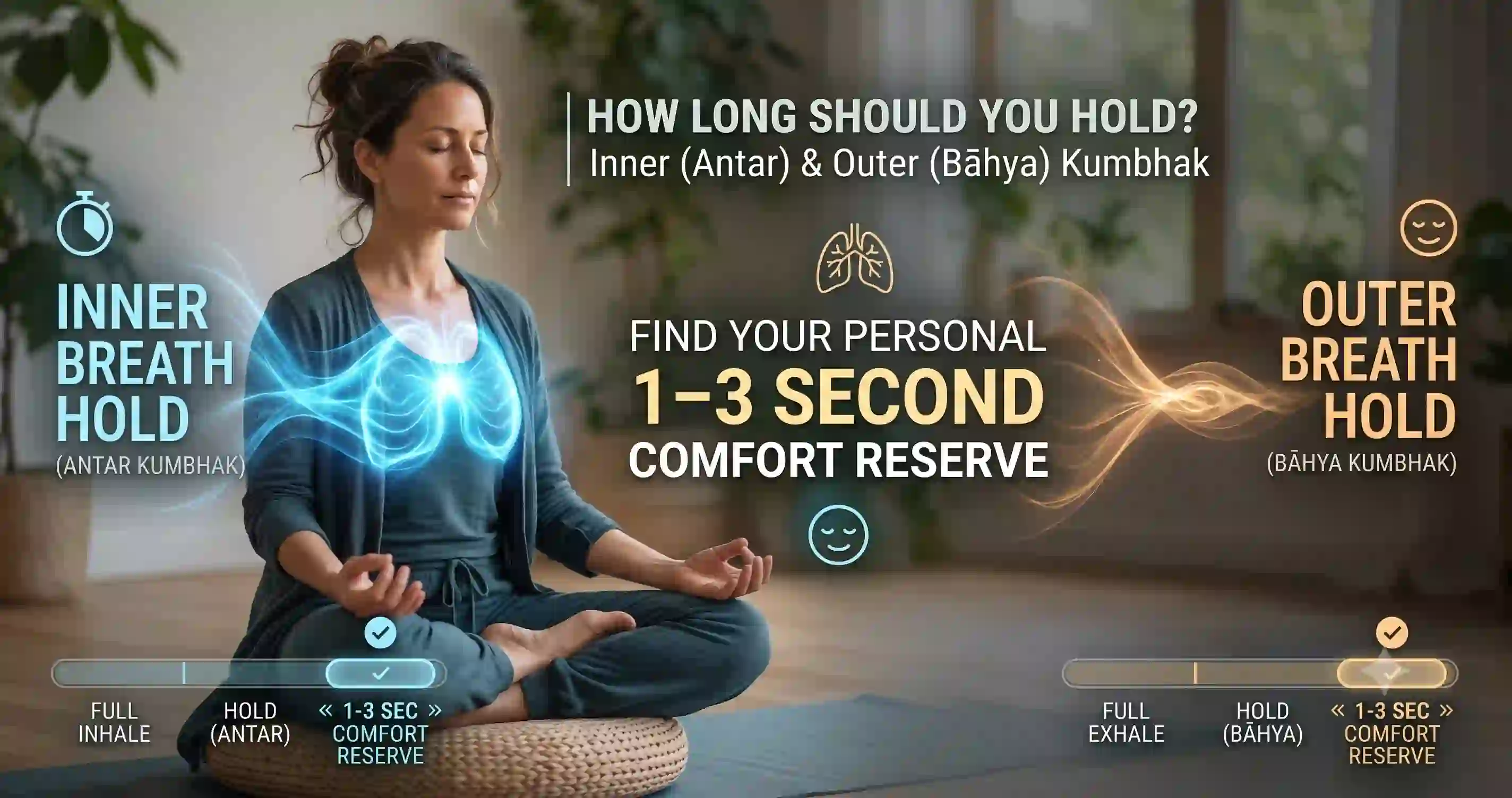
For the Ten-Step Kumbhak for Stress Relief, Antar Kumbhak and Bāhya Kumbhak have no fixed duration. End each retention while it is still completely easy and while you remain certain that you could continue comfortably for approximately one to three more seconds. If three seconds of reserve is not available to you, one clear second is enough. If even that feels uncertain, end the retention immediately.
That one-to-three-second margin is not the prescribed length of the hold. It is the comfort you intentionally leave unused.
Your Antar Kumbhak may last longer than your Bāhya Kumbhak. Today’s pause may be shorter than yesterday’s. One round may differ from the next. None of those differences is failure. In a practice intended for stress relief, the meaningful measure is not how many seconds you conquered. It is whether ease remained unbroken.
The retention ends before your comfort ends.
This article explains duration only. It deliberately does not repeat the complete technique. Please follow the separate How to Practice the Ten-Step Kumbhak for Stress Relief article for the full sequence, posture, Dhyāna Mudra, chest-center movements, normal Pūrak and normal Rechak.
The Short Answer: Keep a One-to-Three-Second Comfort Reserve ⏱️
The duration rule can be remembered in four lines:
- There is no required number of seconds.
- Stop while the retention still feels completely easy.
- Leave enough reserve that you feel certain you could remain comfortable for about one to three more seconds.
- If an urge to breathe, strain, fear or uneasiness appears sooner, end the retention at once.
“Before your breath runs out” is a familiar phrase, but it should not be taken literally. The body has no precise fuel gauge that tells you exactly when oxygen is about to “run out.” What you can recognise is the earlier loss of ease: the moment when holding starts to become an effort, a negotiation or a test.
The practical boundary is therefore:
Do not wait for the breath to run out. Finish before easy control runs out.
The one-to-three-second range accommodates the beginner who cannot honestly promise another three comfortable seconds. It is deliberately flexible:
- If you are certain of three comfortable seconds, leave them unused.
- If only two feel clearly available, leave those unused.
- If only one feels clearly available, leave that unused.
- If no comfortable reserve is available, do not continue the hold.
There is no minimum Kumbhak duration that you must prove. A very brief, relaxed pause remains more faithful to this practice than a longer hold filled with effort.
Why One Fixed Second Count Cannot Fit Every Person 🫁
Two people can hold for the same number of seconds and receive very different internal “doses.” Even the same person can experience the same count differently at different times.
Breath-hold duration is influenced by several interacting factors:
- the amount of air in the lungs when the pause begins;
- starting oxygen and carbon-dioxide levels;
- how much carbon dioxide the body is producing;
- recent physical activity and current metabolic demand;
- familiarity with respiratory sensations;
- the nervous system’s response to air hunger;
- attention, expectation and voluntary effort;
- respiratory or cardiovascular health;
- fatigue, illness, altitude and other day-to-day conditions.
A major physiology review calls breath-hold duration “highly variable.”1 Human research also identifies initial blood gases, lung volume, metabolic rate and voluntary drive among its determinants.2 This is why ten seconds on one stopwatch does not equal ten seconds in every body.
Antar Kumbhak and Bāhya Kumbhak Do Not Begin From the Same Place
Antar Kumbhak begins with more air available in the lungs. Bāhya Kumbhak begins after a normal Rechak, when the lungs feel comfortably empty but are not forcibly emptied.
That difference matters. Larger starting lung volume generally extends breath-hold time by changing available gas volume and sensory input from the lungs.3 In a physiology teaching demonstration, the hold with fuller lungs lasted much longer than the hold with less air in the lungs under the tested conditions.4
This does not create a new rule that your Antar Kumbhak must last a certain multiple of your Bāhya Kumbhak. It explains why matching them by force makes little sense.
- A longer Antar Kumbhak is not a victory.
- A shorter Bāhya Kumbhak is not a defect.
- Equal durations are not required.
- Unequal durations do not make the round unbalanced.
Their symmetry lies in quality: both retentions end with ease still in reserve.
Capacity Changes From Day to Day
Imagine wearing the same shoes every day while your feet quietly change with heat, walking and fatigue. The printed shoe size stays fixed; the felt fit does not.
A stopwatch is equally indifferent. It cannot know that you slept poorly, climbed stairs, feel emotionally unsettled or are recovering from illness. The body knows. The instruction must therefore be responsive enough to hear it.
This is not vagueness. It is precision directed toward the living variable that matters: your present, unforced capacity.
The One-to-Three-Second Reserve Is a Margin, Not a Countdown 🟢
No one can measure a future second of comfort with laboratory accuracy while practising at home. The one-to-three-second reserve is a conservative teaching cue—a way to stop before a completely easy pause becomes a demanding one.
It is not:
- a promise that discomfort will begin exactly one to three seconds later;
- a minimum retention duration;
- a ratio;
- a competition;
- a test of lung health;
- a target to approach as closely as possible;
- or a scientifically proven universal safety threshold.
It is a felt margin of unused capacity.
A Vertical “Traffic-Light” Check
🟢 Completely easy — finish here
- Face, jaw, throat, chest, shoulders and abdomen remain relaxed.
- There is no urge to breathe.
- You feel certain another one to three seconds would still be comfortable.
- Ending now feels calm, not urgent.
🟠 The boundary is arriving — end immediately
- The first unmistakable urge to breathe appears.
- You begin bargaining for “just one more second.”
- The throat, abdomen, shoulders or face starts to help.
- Attention leaves quiet observation and becomes a struggle with time.
🔴 The reserve has been crossed — do not train here
- Gasping, bracing, pressure, panic or involuntary respiratory movements appear.
- You feel dizzy, faint, confused, trapped or visually disturbed.
- The next normal Pūrak feels like a rescue breath.
The green zone is the practice. Orange is the instruction to stop. Red is not a stronger version of Kumbhak for stress relief.
Why a Stopwatch Can Work Against Stress Relief 🧠
Stress often arrives as pressure: finish the deadline, meet the target, do not fall behind. A rigid breath count can quietly bring the same emotional architecture into a practice meant to offer relief from it.
At seven seconds, a person may still be comfortable. At eight, a thought appears: I must reach ten. The body is no longer being listened to; it is being managed like an underperforming employee.
That shift matters. The retention may look successful from outside while becoming internally stressful.
A Timer Can Turn Sensation Into Performance
Once a fixed number becomes the goal, beginners may:
- fill the lungs beyond comfortable fullness to “buy” more time;
- squeeze out more air before Bāhya Kumbhak;
- tense the throat, face or abdomen;
- ignore an early urge to breathe;
- compare one round with another;
- feel ashamed of a shorter day;
- or mistake distress tolerance for stress relief.
None of these serves the purpose of the Ten-Step Kumbhak.
If you occasionally observe duration out of curiosity, let the clock record what happened after comfort made the decision. Never let the clock make the decision.
The Right Question Changes the Experience
Instead of asking:
“Can I reach twelve seconds?”
Ask:
“Can I finish while nothing in me is asking for rescue?”
The first question rewards endurance. The second rewards sensitivity.
That distinction is easy to underestimate. A person who always stops with reserve learns that bodily signals can be heard without drama. A person who repeatedly overrides them may turn the pause into another place where the nervous system expects pressure.
What Science Says About the End of a Breath Hold 🔬
The urge to breathe is not a simple oxygen-empty alarm. During a closed-airway hold, metabolism continues: oxygen is used and carbon dioxide accumulates. The central respiratory rhythm also continues even though breathing movement is voluntarily suppressed.1
Breath-hold research describes an initial phase without obvious involuntary breathing movements, followed—if a maximal attempt continues—by a phase in which respiratory muscles begin contracting against a closed airway.5 That later “struggle phase” may interest apnoea researchers and athletes. It is not the destination of a stress-relief retention.
The Ten-Step Kumbhak ends much earlier: before a clear urge, involuntary contraction or effort becomes part of the experience.
Carbon Dioxide Helps Create the Urge, but the Sensation Is Not a Perfect Meter
Rising carbon dioxide strongly contributes to respiratory drive, while falling oxygen can intensify it. Yet research shows that the breakpoint cannot be explained by one gas value, lung shrinkage or one receptor alone.1
This has two practical consequences:
- You cannot convert a sensation into an exact oxygen reading.
- A longer hold does not automatically prove better oxygen use, stronger lungs or a calmer nervous system.
Hyperventilation demonstrates the danger of trusting time alone: lowering carbon dioxide beforehand can delay the urge to breathe without creating a comparable oxygen reserve. A longer number can therefore mean that a warning signal was postponed—not that the body became safer.4
The Ten-Step Kumbhak uses normal Pūrak and normal Rechak. It does not use over-breathing to extend retention.
Longer Retention Is a Larger Physiological Event
Kumbhak is biologically active. In a study of 20 healthy adults, one-minute Kumbhak attempts increased systolic, diastolic and mean arterial pressure and total peripheral resistance during the hold, while stroke volume and cardiac output fell.6
That study does not show that a brief, comfortable Kumbhak is harmful. It shows why “more seconds” cannot be assumed to mean “more relaxation.” A sufficiently long hold can create substantial cardiovascular demands even when the wider breathing session later feels calming.
For stress relief, the smallest comfortable dose that preserves ease has a more defensible risk-to-purpose relationship than a maximal attempt.
Stress Studies Do Not Reveal One Optimal Hold Time
Research has tested very different breathing packages:
- A 2026 trial in paramedicine students used a two-second pause between breathing phases and reported improvements in stress, anxiety, depression and resilience, although attrition and the multi-component protocol limit what can be credited to the pause.7
- An eight-week trial in young adult yoga practitioners used structured intermittent retention and reported improvements in several psychological measures, but it did not establish an ideal duration for beginners or isolate retention from the full breathing routine.8
- A 2024 placebo-controlled trial in 200 healthy adults found that cyclic hyperventilation with long retention was not superior for stress reduction to a credible normal-rate breathing comparator with brief holds.17
The cited evidence does not include a dose-finding trial that compares different Antar Kumbhak and Bāhya Kumbhak durations within this exact Ten-Step practice and identifies a universal stress-relief optimum.
The scientific answer is therefore not “hold for X seconds.” It is:
There is no established fixed second count that is both optimal and appropriate for everyone.
What the Yoga Texts Actually Support 🕉️
Classical yoga does not speak with one voice about timing. Some passages discuss time and number. Some later Haṭha texts prescribe counts for particular methods. Other passages emphasise capacity, progressive training and correct application.
The honest conclusion is neither “traditional yoga never counts” nor “one ancient ratio rules every practice.” The texts describe different methods, aims and stages.
Yoga Sūtra 2.50: Time and Number Are Dimensions, Not a Universal Prescription
Patañjali’s Yoga Sūtra 2.50 states:
bāhyābhyantarastambhavṛttir deśakālasaṃkhyābhiḥ paridṛṣṭo dīrghasūkṣmaḥ
The sūtra describes external, internal and suspended modes as observed or regulated through place, time and number, becoming extended and subtle.9
This is important because it gives timing a legitimate place in disciplined practice. Yet the sūtra supplies no universal second count. It does not say every beginner, body or purpose should use the same duration. Its final word, sūkṣma—subtle—also resists the idea that crude endurance alone is refinement.
For this stress-relief method, time can be noticed without being enthroned. Number may describe the practice; it does not have to command it.
Haṭha Yoga Pradīpikā 2.15–2.18: Train by Degrees and Avoid Improper Force
The Haṭha Yoga Pradīpikā compares the breath to a lion, elephant or tiger that must be brought under control by degrees; otherwise, the practitioner may be harmed. The next verses contrast properly applied prāṇāyāma with improper practice and insist that releasing, filling and retaining the air be done skilfully.10
These verses come from a traditional yogic framework, not modern clinical stress science. Even so, their practical warning is unmistakable:
- capacity is cultivated progressively;
- haste and excess force are not signs of mastery;
- retention quality matters;
- and incorrect dosing can disturb rather than steady.
Leaving one to three comfortable seconds unused is a contemporary stress-relief application of that conservative principle. It is not claimed as a translation of the verse.
Counted Ratios Exist—But They Belong to Their Own Methods
The Gheraṇḍa Saṃhitā 5.54–5.55 presents measured proportions of Pūrak, Kumbhak and Rechak for a specific form of prāṇāyāma, including the familiar 1:4:2 relationship.11
That passage proves that ratio-based practice has genuine traditional precedent. It does not prove that:
- every Kumbhak method must use 1:4:2;
- traditional mātrās can always be treated as modern stopwatch seconds;
- an advanced textual regimen is appropriate for an unsupervised beginner;
- or a stress-relief pause should be forced to fit that proportion.
Honouring a classical ratio means practising the method to which it belongs, with its prerequisites and guidance. Honouring the Ten-Step Kumbhak means not importing a different method’s timing architecture into it.
Ten-Step Kumbhak Versus Ratio-Based Techniques: A Vertical Comparison ⚖️
Ten-Step Kumbhak for Stress Relief
- Purpose: a brief, accessible experiment in remaining relaxed during two kinds of retention.
- Timing authority: present comfort and clear reserve.
- Pūrak and Rechak: normal, neither too fast nor too drawn out.
- Relationship between holds: Antar Kumbhak and Bāhya Kumbhak may differ.
- Progress marker: less strain, clearer awareness and an easier return to normal breathing.
- Stopping rule: finish before the first urge, strain or uneasiness.
Ratio-based prāṇāyāma
- Purpose: depends on the named technique, lineage and stage of training.
- Timing authority: a prescribed count, mātrā or proportion.
- Pūrak, Kumbhak and Rechak: deliberately coordinated by the selected ratio.
- Relationship between phases: mathematically linked.
- Progress marker: may include accurate counting, progressive capacity or lineage-specific signs.
- Stopping rule: should still include safety, suitability and competent instruction.
These are not rival systems. They answer different questions.
A metronome helps a musician maintain a composition’s intended measure. It would be absurd, however, to insist that every conversation be spoken to that beat. Ratio has value where ratio is the method. Here, responsive ease is the method.
The Ayurvedic Lens: Measure the Person Before Measuring the Dose 🌿
There is no verified verse in the Charaka Saṃhitā that prescribes a universal number of seconds for Antar Kumbhak or Bāhya Kumbhak. Ayurveda contributes something more fundamental: a logic of individualised dosing.
In Charaka Saṃhitā, Vimānasthāna 8.94, assessment of a person’s strength includes prakṛti, vikṛti, tissue quality, compactness of build, measurements, suitability, sattva, capacity for food and digestion, capacity for exercise, and age.12 This passage concerns clinical assessment and treatment strength—not Kumbhak timing. It should not be misquoted as a breath-retention instruction.
Its relevance is analogical but powerful:
A dose is not known until the person receiving it is considered.
If Ayurveda resists giving the same therapeutic intensity to every person, it would be strange to use Ayurvedic language while ignoring the person in front of the stopwatch.
A Traditional Doṣa-Informed Reading—Without Turning Doṣa Into Seconds
In a traditional Ayurvedic interpretation:
- A Vāta-like response may appear as irregularity, fluttering unease, fear, scattered attention or heightened sensitivity to air hunger. The sensible response is to shorten or omit retention—not to prove steadiness through force.
- A Pitta-like response may appear as ambition, irritation, heat or determination to beat the previous count. The timer itself may become the agitating element.
- A Kapha-like response may appear as heaviness, dullness or attachment to a comfortable routine. A longer hold should still not be assumed to be more clarifying or beneficial.
These are traditional qualitative lenses, not laboratory-validated methods for calculating hold time. No scientific evidence establishes a safe “Vāta count,” “Pitta count” or “Kapha count.” Doṣa language should help a person notice patterns, never trap them inside a formula.
Can the Duration Increase With Practice? 🌱
It may. Familiarity, reduced unnecessary muscular effort and changing tolerance of respiratory sensations can all lengthen breath-hold performance. A fourteen-day study in novices found that maximal hold time was trainable even without a corresponding change in carbon-dioxide chemosensitivity.13
But the Ten-Step Kumbhak is not a maximal-hold training programme.
If comfortable retention lengthens naturally over weeks or months, let that be an unannounced visitor—not a promotion you have to earn. Do not add seconds simply because last week’s number now feels ordinary.
Useful progress may look like:
- recognising the boundary earlier;
- ending without disappointment;
- keeping the body relaxed;
- feeling no need to gasp afterward;
- carrying less performance pressure into practice;
- recovering a sense of choice around stress;
- or deciding honestly that retention is not suitable today.
Sometimes wisdom makes a hold shorter.
A Brief Story: The Bell That Was Never Rung
A beginner once imagined a bell at the far end of every retention. If she could endure long enough, she believed she would reach it and prove the practice had worked.
One morning she ended early, almost apologetically. Nothing dramatic happened. Her next normal Pūrak arrived without urgency, and her shoulders remained quiet.
Then she understood: the practice was not the distant bell. It was the moment she no longer needed to ring it.
Frequently Asked Questions About Kumbhak Duration ❓
Is Three Seconds the Minimum Hold?
No. Three seconds is not the minimum duration of Antar Kumbhak or Bāhya Kumbhak.
The instruction is to leave approximately one to three seconds of comfortable reserve after the point where you choose to end. If you cannot retain comfortably while leaving even one clear second unused, do not retain the breath. Use another breathing practice.
Must Antar Kumbhak and Bāhya Kumbhak Be the Same Length?
No. They begin at different lung volumes and create different sensations. Matching them is unnecessary.
Let each retention end according to its own comfort boundary. The common standard is ease, not equality.
Is Bāhya Kumbhak Usually Shorter Than Antar Kumbhak?
It often feels shorter because less air is present after a normal Rechak and lung-volume-related sensory conditions differ. That is a physiological tendency, not a rule.
Do not make Bāhya Kumbhak longer to catch up with Antar Kumbhak. Do not shorten an easy Antar Kumbhak merely to make a pair of matching numbers.
Should Beginners Count the Seconds?
Beginners do not need a target count. Counting can be useful only if it remains a neutral observation and does not overrule bodily feedback.
A safer hierarchy is:
- Complete ease.
- One-to-three-second reserve.
- Relaxed body.
- Normal breathing afterward.
- Duration, if you still wish to notice it.
The number comes last.
Does a Longer Kumbhak Give More Stress Relief?
There is no good evidence that longer retention within this practice produces greater stress relief. Studies use different breathing patterns, populations and outcomes, and they rarely isolate the hold itself.
A long pause can also increase physiological demand. More is not automatically better.
What If My Comfortable Hold Is Only One or Two Seconds?
That is not embarrassing and it is not failure. Finish while ease remains. If you cannot leave at least one additional comfortable second in reserve, omit retention and choose another practice.
The practice must fit your present capacity. Your capacity is not required to fit the practice.
What If I Feel the Urge to Breathe Before My Planned Time?
End the retention immediately. The urge is not an obstacle to defeat; it is the stopping signal.
Do not remain in the hold merely to complete a count, finish a recording or match another person.
Is the One-to-Three-Second Reserve Scientifically Proven?
No. It is a conservative practical rule designed to keep beginners away from the limit. Science supports the broader reasons for avoiding a universal count: breath-hold duration is highly variable, depends on multiple physiological and voluntary factors, and longer holds can create stronger cardiovascular and gas-exchange effects.
Research has not validated one, two or three seconds as a universal physiological threshold. The range should therefore be described honestly—as a teaching margin, not a medical guarantee.
Is 1:4:2 Wrong?
No. It is a traditional ratio used in particular prāṇāyāma contexts. It is simply not the timing rule of the Ten-Step Kumbhak for Stress Relief.
Do not combine methods merely because they share the word Kumbhak.
Can a Fitness Watch or Oximeter Choose My Hold Time?
No. Consumer devices can lag, misread movement or provide numbers without interpreting the full situation. A normal reading does not authorise strain, and an alarm should never be awaited as the stopping point.
If a clinician has prescribed monitored respiratory work for a medical reason, follow that clinical protocol rather than this general article.
Safety: When No Hold Is the Right Hold ⚠️
Kumbhak should be practised seated in a stable, safe place. Never practise breath retention while driving, swimming, bathing, operating machinery, walking somewhere unsafe or doing anything in which brief dizziness or loss of awareness could cause injury.
Stop immediately and return to normal breathing if you experience:
- dizziness, light-headedness or faintness;
- unusual breathlessness;
- chest pain, chest tightness or disturbing palpitations;
- panic, dissociation or a suffocation-related memory;
- tingling, visual disturbance, confusion or loss of coordination;
- involuntary jerking or respiratory contractions;
- or any other discomfort.
Cambridge University Hospitals advises reducing a pause after breathing out if it increases breathlessness or faintness.14 The American Heart Association similarly tells beginners using counted breathing techniques to limit initial cycles and stop if dizziness or light-headedness occurs.15
People with heart or lung conditions should seek guidance from a qualified healthcare professional before practising breath retention. The same precaution is advisable for significant blood-pressure, cerebrovascular, neurological, fainting, pregnancy-related, glaucoma/retinal, panic-related or trauma-related concerns.
This caution is not theoretical. In a prāṇāyāma trial involving adults with PTSD, some participants reported anxiety, breathlessness, dizziness and constriction; one participant experienced a suffocation-related flashback.16 A person whose body associates air hunger with danger may need a clinician-informed approach with no retention.
If you cannot retain the breath comfortably, another breathing practice may serve you better. Consent includes the freedom to stop. It also includes the freedom not to begin.
For related reading, see Never Hold Your Breath to the Limit in Kumbhak.
Yogic and Ayurvedic Meanings—Kept in Their Proper Frame 🌌
Traditional yoga often interprets Kumbhak as more than a change in respiratory gases. The Haṭha Yoga Pradīpikā 2.2 links movement of breath with movement of mind, while later passages place Kumbhak within the refinement of Prāṇa and the settling of citta.10 Ayurvedic thought may view disturbed, forced breathing through the lens of Vāta and understand suitable practice through prakṛti, vikṛti, sattva, strength and time.
These perspectives can give the pause philosophical depth:
- Antar Kumbhak may be contemplated as gathered fullness without grasping.
- Bāhya Kumbhak may be contemplated as open emptiness without fear.
- Ending before strain may express ahiṃsā—non-harming—toward one’s own body.
- Refusing competition may express discernment rather than weakness.
- A quiet pause may reveal how quickly the mind turns sensation into a demand.
These are traditional and contemplative interpretations. They have not been scientifically verified as mechanisms, and they should not be translated casually into claims about the vagus nerve, oxygenation, doṣa correction or disease treatment.
Science can measure gases, pressure, circulation and reported stress. Yoga and Ayurveda also ask what kind of relationship a person is building with effort, fear, attention and Prāṇa. The perspectives can stand beside each other without pretending to be identical.
The Final Answer: Do Not Hold for a Number—Stop With Ease Still Left 💚
How long should Antar Kumbhak and Bāhya Kumbhak last?
As long as each retention remains completely easy—and no longer. End while you still feel certain that approximately one to three more comfortable seconds remain. If strain, urge or uneasiness appears before that, stop at once. If no clear reserve is available, do not hold.
Do not require the two retentions to match. Do not import 1:4:2, 4-4-4-4, 4-7-8 or any other ratio into a practice that was designed around present-moment comfort. Do not treat a naturally increasing duration as a promotion, or a shorter duration as a defeat.
The fixed count asks, “Did you obey the clock?”
The one-to-three-second reserve asks, “Did you hear yourself in time?”
For stress relief, that second question is the heart of the practice.
References and Verified Sources 📚
Evidence and links checked 24 July 2026. This article is educational and is not a substitute for individual medical advice.
-
Parkes, M. J. (2006). “Breath-holding and its breakpoint.” Experimental Physiology, 91(1), 1–15. PubMed record and abstract. DOI: 10.1113/expphysiol.2005.031625. ↩↩↩
-
Bruce, C. D., Vanden Berg, E. R., Pfoh, J. R., Steinback, C. D., & Day, T. A. (2021). “Prior oxygenation, but not chemoreflex responsiveness, determines breath-hold duration during voluntary apnea.” Physiological Reports, 9(1), e14664. Full text on PMC. DOI: 10.14814/phy2.14664. ↩
-
Whitelaw, W. A., McBride, B., & Ford, G. T. (1987). “Effect of lung volume on breath holding.” Journal of Applied Physiology, 62(5), 1962–1969. Journal record. DOI: 10.1152/jappl.1987.62.5.1962. ↩
-
Skow, R. J., Day, T. A., Fuller, J. E., Bruce, C. D., & Steinback, C. D. (2015). “The ins and outs of breath holding: simple demonstrations of complex respiratory physiology.” Advances in Physiology Education, 39(3), 223–231. Full journal article. DOI: 10.1152/advan.00030.2015. ↩↩
-
Lin, Y. C., Lally, D. A., Moore, T. O., & Hong, S. K. (1974). “Physiological and conventional breath-hold breaking points.” Journal of Applied Physiology, 37(3), 291–296. Journal record. DOI: 10.1152/jappl.1974.37.3.291. ↩
-
Nivethitha, L., Mooventhan, A., & Manjunath, N. K. (2021). “Evaluation of Cardiovascular Functions during the Practice of Different Types of Yogic Breathing Techniques.” International Journal of Yoga, 14(2), 158–162. Full text on PMC. DOI: 10.4103/ijoy.IJOY_61_20. ↩
-
Little, A., Stainer, M., MacQuarrie, A. S., Wiseman, N., & Haskins, B. (2026). “Examining the Effectiveness of Breathwork to Improve Resilience and Psychological Wellbeing While Reducing Anxiety, Depression, Stress, and Insomnia in Paramedicine Students.” Stress and Health, 42(2), e70161. Full text on PMC. DOI: 10.1002/smi.70161. ↩
-
Saoji, A. A., Raghavendra, B. R., Madle, K., & Manjunath, N. K. (2018). “Additional practice of yoga breathing with intermittent breath holding enhances psychological functions in yoga practitioners: A randomized controlled trial.” Explore, 14(5), 379–384. PubMed record. DOI: 10.1016/j.explore.2018.02.005. ↩
-
Patañjali, Yoga Sūtra 2.50, with the classical commentaries of Vyāsa and Vācaspati Miśra in Rama Prasada’s English translation. Verified Sanskrit, translation and commentary. ↩
-
Svātmārāma, Haṭha Yoga Pradīpikā, chapter 2, especially verses 2.2 and 2.15–2.18. Chapter text and English translation. ↩↩
-
Gheraṇḍa Saṃhitā 5.54–5.55, in Srisa Chandra Vasu’s 1895 Sanskrit edition and English translation. Digitised edition, Heidelberg University Library. ↩
-
Charaka Saṃhitā, Vimānasthāna 8.94, on the tenfold examination used to understand strength and morbidity. English translation PDF; see Vi8#94 on page 135. ↩
-
Bourdas, D. I., Tsakiris, T. S., Pavlakis, K. I., Triantafillou, D. V., & Geladas, N. D. (2015). “Repeated apneas and hypercapnic ventilatory response before and after apnea training.” Aerospace Medicine and Human Performance, 86(1), 27–33. PubMed record. DOI: 10.3357/AMHP.3932.2015. ↩
-
Cambridge University Hospitals NHS Foundation Trust. “Breathing pattern disorders and physiotherapy.” The guidance recommends reducing a pause after breathing out if breathlessness or faintness increases. Patient guidance. ↩
-
American Heart Association. “Stress Management,” including beginner precautions for counted breathing methods. AHA guidance. ↩
-
Haller, H., Mitzinger, D., & Cramer, H. (2023). “The integration of yoga breathing techniques in cognitive behavioral therapy for post-traumatic stress disorder: A pragmatic randomized controlled trial.” Frontiers in Psychiatry, 14, 1101046. Full text on PMC. DOI: 10.3389/fpsyt.2023.1101046. ↩
-
Fincham, G. W., Epel, E., Colasanti, A., Strauss, C., & Cavanagh, K. (2024). “Effects of brief remote high ventilation breathwork with retention on mental health and wellbeing: a randomised placebo-controlled trial.” Scientific Reports, 14, 16893. Full trial report on PMC. DOI: 10.1038/s41598-024-64254-7. ↩