Chest breathing vs diaphragmatic breathing: a scientific, Yogic and Ayurvedic analysis of Anāhata-centred movement in Ten-Step Kumbhak for stress relief.
By Kumbhaki Yogi Dhruvaji (MSc), founder of the Antistress Foundation 501(c)(3)
• How to Practice Ten-Step Kumbhak • Scientific Proof • Ancient Texts Proof • Bio • Subscribe By Email
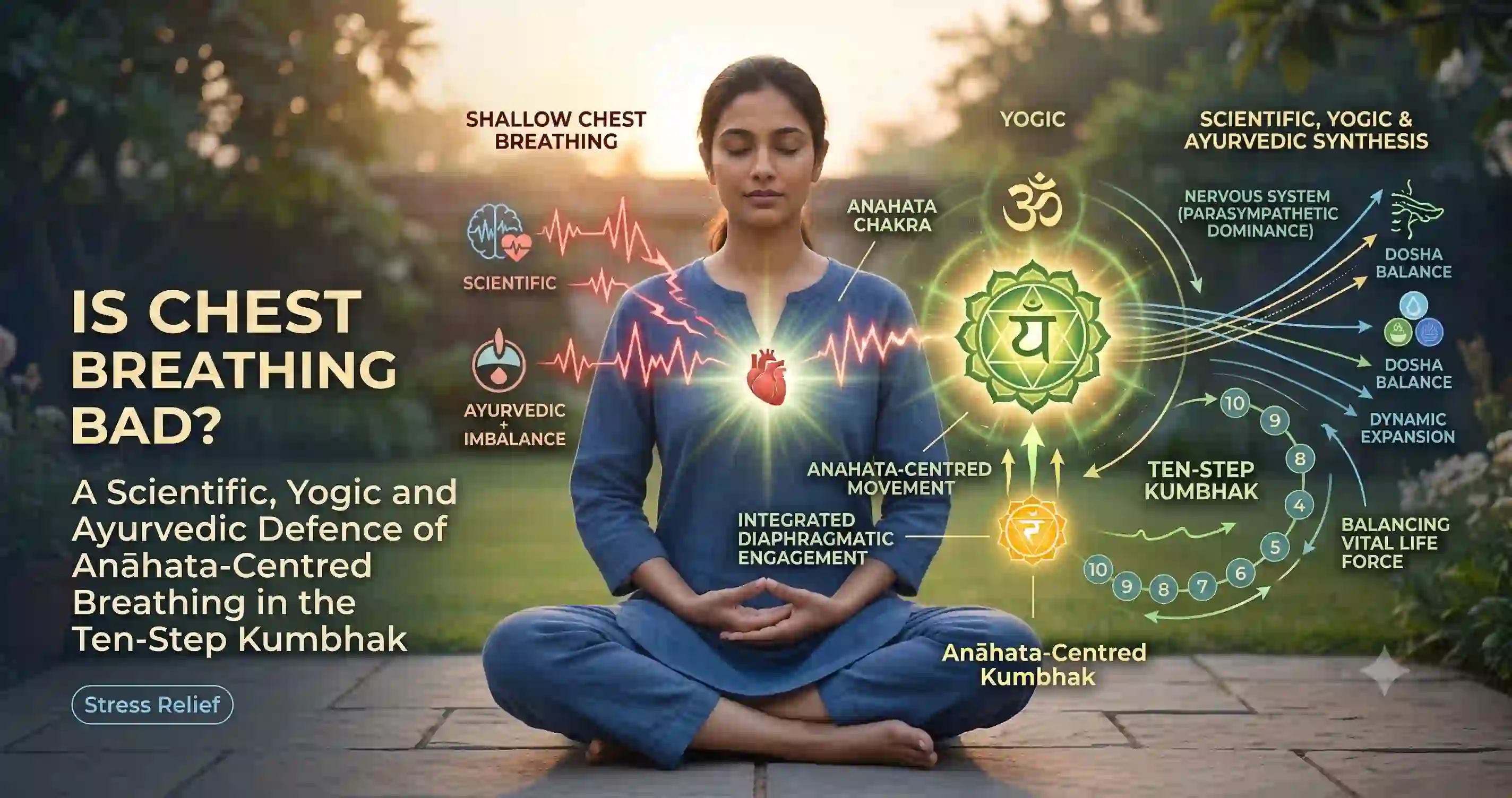
Perhaps you have heard the warning so often that it now sounds unquestionable:
“Chest breathing is shallow, stressful and inefficient. Breathe into the belly instead.”
That warning contains an important truth—and hides an equally important mistake.
The truth is that habitual rapid, shallow, upper-chest breathing with raised shoulders, a tense neck and excessive ventilation can accompany breathlessness, anxiety and respiratory dysfunction.
The mistake is treating every visible movement of the rib cage as that disorder.
The chest is not a useless shell around the lungs. Rib movement is part of normal ventilation. The diaphragm and rib cage usually work as a coordinated system, not as opponents. In fact, classic human research found that most healthy participants were predominantly thoracic breathers while upright, even though they were predominantly abdominal breathers while lying down.1 A newer study likewise found that thoracic motion contributed slightly more than abdominal motion while healthy young adults were sitting or standing.2
The relevant question is therefore not:
“Does the chest move?”
It is:
“What exactly moves, with how much effort, at what breathing rate and volume, for how long, with which other muscles, and with what effect?”
That is the question this article answers for the Anāhata-centred chest movement used in the Ten-Step Kumbhak for Stress Relief.
The conclusion is careful but clear:
Most familiar objections to “chest breathing” do not automatically apply to this method because they describe a different respiratory pattern. However, the exact Ten-Step chest-centre cue has not yet been tested in a direct clinical trial, so its distinctive benefits should be presented as a reasoned hypothesis—not as settled medical fact.
This article explains that distinction from respiratory physiology, stress science, Yoga and Ayurveda. It does not repeat the technique. For the complete instructions and safeguards, read How to Practice the Ten-Step Kumbhak for Stress Relief.
The Most Important Distinction: “Chest Breathing” Is Not One Thing 🫁
Pattern A: the chest breathing that clinicians criticise
In clinical discussions, “chest breathing” often means a cluster of features rather than the mere motion of the chest wall:
- breathing that is rapid, shallow or irregular at rest;
- disproportionately small tidal breaths;
- visible lifting of the clavicles or shoulders;
- repeated recruitment of the sternocleidomastoid, upper trapezius, pectoral and other accessory muscles;
- a tense jaw, throat, neck or upper chest;
- frequent sighing, gulping or gasping;
- excessive minute ventilation relative to metabolic need;
- dysfunctional breathing associated with asthma, COPD, panic, pain or another condition;
- or a chronic habit that leaves little adaptable movement in the lower rib cage and abdomen.
This pattern can be inefficient and distressing. A major review of dysfunctional breathing describes thoracic dominance and excess accessory-muscle recruitment as possible contributors to breathlessness, increased respiratory effort, fatigue and tenderness around the neck, shoulders and upper chest.3
That clinical concern should not be dismissed.
Pattern B: the Anāhata-centred cue in the Ten-Step Kumbhak
The Ten-Step method specifies a different set of conditions:
- the practitioner is seated in a comfortable, stable posture;
- the back remains naturally upright rather than arched;
- the face, jaw, throat, chest, shoulders, abdomen and legs remain relaxed;
- the shoulders remain down;
- Pūrak and Rechak occur through the nose at a normal pace—not too fast and not artificially prolonged;
- no air is gulped;
- “full” and “empty” remain comfortable rather than maximal;
- attention and voluntary movement are localised at the centre of the chest, not the clavicles or shoulders;
- the abdomen and diaphragm are not deliberately pushed, pulled or braced;
- Antar Kumbhak and Bāhya Kumbhak end while entirely easy, with comfortable reserve remaining;
- and normal recovery breaths separate successive rounds.
These are not cosmetic differences. They change the likely respiratory rate, muscle recruitment, tidal volume, carbon-dioxide response, posture, emotional meaning and total physiological load.
Calling both patterns “chest breathing” is like calling both a clenched fist and an open hand “hand posture.” The anatomy is the same; the action is not.
“Pure Anāhata Breathing” is a practice term, not a medical diagnosis
For precision, this article uses Anāhata-centred breathing to mean the exact attentional and movement cue of the Ten-Step Kumbhak: pulling up the centre of the chest during Pūrak, holding it out or in during the respective Kumbhak, and pulling it in during Rechak without shoulder elevation, spinal arching, abdominal manipulation or strain.
Medicine does not currently recognise “pure Anāhata breathing” as a standard respiratory category. No accepted laboratory threshold separates it from thoracic, costal, mixed or diaphragmatic breathing. That does not make the experience unreal; it means the method still needs operational measurement.
The term should therefore never be used to override an observable problem. If the neck strains, the shoulders rise, breathing becomes rapid, the abdomen braces, dizziness begins or air hunger appears, the fact that someone intended to use the Anāhata centre does not make the resulting pattern safe.
What Actually Happens When the Centre of the Chest Moves? 🔬
The rib cage and diaphragm are partners, not competing pumps
The lungs contain no skeletal muscle that pulls air into them. Air enters because the respiratory muscles enlarge the thoracic cavity and reduce pressure around the lungs.
During normal inspiration:
- the diaphragm contracts and increases the vertical dimension of the thorax;
- the external and parasternal intercostal muscles help elevate and stabilise the ribs;
- the lower ribs can move outward in a “bucket-handle” pattern;
- the sternum and attached ribs can move upward and forward in a “pump-handle” pattern, increasing the front-to-back dimension.4
Human electromyography has found coordinated activity between the diaphragm, scalenes and parasternal intercostals during ordinary breathing.5 Contemporary reviews also describe external intercostal activity during normal breathing in many upright people.6
Therefore, rib-cage movement does not prove diaphragmatic inactivity. The diaphragm can contract while the rib cage moves. Rib-cage muscles can also help place the diaphragm at a useful length and mechanical configuration.1
The Ten-Step instruction to avoid deliberately pushing or pulling the diaphragm does not anatomically paralyse it. It removes a voluntary abdominal manoeuvre. Whether the diaphragm moves—and by how much—could be measured with ultrasound, but it cannot be inferred merely from the absence of a deliberately protruding belly.
The chest-centre cue is not the same as shoulder lifting
The centre of the anterior chest lies over the sternum and adjacent costal cartilages. Raising this region can involve the pump-handle contribution of the ribs and sternum. That is mechanically different from shrugging the shoulder girdle or pulling the clavicles upward with visible neck strain.
This difference matters because the common fatigue objection concerns excessive recruitment of muscles such as the sternocleidomastoid and upper trapezius. The Ten-Step method explicitly keeps the shoulders down and the neck, throat and face relaxed. Those instructions are internally consistent with avoiding the pattern being criticised.
Yet intention is not measurement. A practitioner can believe the shoulders are relaxed while still recruiting neck muscles. Future testing should use surface electromyography over the sternocleidomastoid, scalenes, upper trapezius, parasternal intercostals and abdominal wall to verify the actual pattern.
Upright breathing often looks more thoracic even in healthy people
The belief that every healthy breath should make the abdomen move more than the rib cage is not supported as a universal rule.
In 81 healthy people, Sharp and colleagues found that posture changed the visible pattern: most participants were abdominal breathers while supine and thoracic breathers while upright.1
In another study of healthy young adults, the approximate abdominal-to-thoracic contributions were:
- sitting: 45.5% abdominal and 54.5% thoracic;
- standing: 40.5% abdominal and 59.5% thoracic;
- supine: 56.8% abdominal and 43.2% thoracic;
- prone: 52.2% abdominal and 47.8% thoracic.2
These percentages are not a prescription for the Ten-Step method. They prove a narrower but decisive point: visible thoracic predominance while seated is not, by itself, evidence of pathology.
Belly movement is not a direct meter of diaphragmatic function
When the diaphragm descends, abdominal contents are displaced and the abdominal wall may move outward. That makes abdominal motion a useful clue—but not a perfect measurement of diaphragmatic contraction.
Its appearance changes with posture, abdominal-wall tone, body shape, clothing, pregnancy, previous surgery, obesity, spinal configuration and the chosen breathing task. Ultrasound research in 150 healthy participants found wide variation in diaphragm thickening during quiet breathing, including minimal measurable thickening in a substantial minority.7
Conversely, deliberately pushing the abdomen outward can create visible “belly breathing” without proving optimal ventilation. Surface motion and internal muscle function are related, but they are not identical.
The scientifically defensible test is imaging or physiological measurement—not judging respiratory health by which piece of clothing moves most.
Air is not consciously sent into the “top” or “bottom” of the lungs
The lungs do not fill like two separate bags chosen by attention. Regional ventilation depends on airway geometry, gravity, posture, pleural-pressure gradients, lung volume, tissue compliance and the shape change produced by the entire thoracoabdominal system.
In an upright healthy lung, both ventilation and perfusion are greater toward the bases, although perfusion increases more steeply. That is why the ventilation-to-perfusion ratio is lower at the base and higher at the apex.8
But it does not follow that visible chest motion ventilates only the apices.
In a small human tracer study, five participants used normal, preferentially intercostal and preferentially diaphragmatic tidal breathing. Lower-lung xenon washout remained faster than upper-lung washout in every participant regardless of the chosen thoracoabdominal pattern. Preferential intercostal breathing tended to make regional ventilation more homogeneous, while preferential diaphragmatic breathing increased regional differences.9
That study was tiny and does not prove the Ten-Step method optimal. It does directly challenge the simplistic claim that “intercostal or chest breathing leaves the lower lungs unused.”
A natural non-abdominal instruction can be ventilatorily efficient
In a study of 30 healthy adults, researchers compared a non-specific deep-breathing instruction with an instruction to emphasise abdominal expansion. Ventilatory efficiency improved under both conditions. The non-specific instruction produced similar or greater efficiency, and most participants found it easier.10
Another laboratory study comparing several respiratory exercises found that all tested patterns increased tidal volume. The deliberately diaphragmatic exercise produced the lowest total chest-wall tidal volume and more thoracoabdominal asynchrony, while other patterns produced larger volumes or minute ventilation.11
Neither study tested the Ten-Step Kumbhak, and neither shows that diaphragmatic training is useless. They show that abdominal emphasis does not possess a universal monopoly on respiratory efficiency.
Every Major Objection to Chest Breathing—Examined One by One ⚖️
Objection 1: “Chest breathing is biomechanically inefficient”
Why the objection can be valid: Rapid shallow breaths devote a larger fraction of each breath to anatomical dead space. Excessive use of accessory muscles can increase oxygen cost and fatigue, especially in respiratory disease.
Why it does not automatically transfer: Efficiency depends on tidal volume, respiratory rate, airway resistance, muscle coordination and metabolic need—not on chest-wall location alone. The Ten-Step method requires normal Pūrak and Rechak, comfortable lung volumes, relaxed shoulders and no gulping. Its centre-sternum cue can recruit normal rib mechanics rather than a clavicular gasp. In healthy adults, natural non-abdominal patterns have produced ventilatory efficiency equal to or better than specifically instructed abdominal expansion.10
What remains unknown: The work of breathing during the exact Ten-Step pattern has not been measured. Oxygen consumption, oesophageal pressure, airflow and respiratory-muscle electromyography would be required to establish comparative efficiency.
Verdict: The stock objection targets a high-effort, low-volume pattern. It is not established merely by visible centre-chest movement.
Objection 2: “It overworks the neck and shoulders”
Why the objection can be valid: Chronic sternocleidomastoid, upper-trapezius and pectoral recruitment can contribute to tenderness, fatigue and perceived tightness. It is also an important sign of increased respiratory effort in disease.3
Neck-driven respiratory effort may aggravate an existing neck-pain or tension-headache pattern, but a headache has many possible causes. It should not be diagnosed from chest motion alone.
Why it does not automatically transfer: The Ten-Step method explicitly keeps the shoulders lowered and the face, jaw, throat, chest and abdomen relaxed. The voluntary target is the centre of the chest, not the collarbones. Parasternal intercostals can move the rib cage without the dramatic shoulder elevation seen in respiratory distress.
The honest boundary: If the practitioner’s shoulders creep upward, neck cords become prominent, the chin thrusts forward or the upper trapezius hardens, the objection has become relevant. Calling the movement “Anāhata” cannot excuse faulty execution.
Verdict: Conditionally inapplicable when the defining relaxation cues are actually present; applicable when they are not.
Objection 3: “It is shallow and moves too little air”
“Chest” and “shallow” are not synonyms. A breath can be:
- thoracic and adequately voluminous;
- abdominal and small;
- mixed and large;
- rapid with any of these configurations;
- or normal in both volume and rate.
Alveolar ventilation is determined by respiratory rate multiplied by tidal volume minus dead space.12 A person does not become under-ventilated because the sternum moved, nor adequately ventilated because the belly expanded.
The Ten-Step method asks for comfortable fullness and emptiness without maximal filling or forced expulsion. That description is inconsistent with the tiny, repetitive breaths usually meant by “shallow chest breathing.”
Verdict: Not applicable by definition unless the actual tidal breaths become small. Measurement with spirometry would settle the question.
Objection 4: “It ventilates only the poorly perfused upper lobes”
The gravitational facts are real: while upright, both ventilation and perfusion tend to be greater toward the bases, and perfusion changes more than ventilation.8
The conclusion commonly drawn from them is too large. External chest-wall motion does not prove that fresh air entered only apical alveoli. Regional filling reflects internal pressure gradients and compliance across the lungs.
The voluntary-pattern tracer study is especially relevant: lower-lung ventilation remained greater under preferential intercostal breathing, and that pattern made regional ventilation more—not less—homogeneous on average.9
Verdict: The claim that every chest-centred breath creates a clinically important ventilation-perfusion mismatch is unsupported. Direct electrical-impedance tomography or functional MRI of the Ten-Step method is still needed.
Objection 5: “It leaves stale air trapped at the bases”
Residual volume is the air remaining after a maximal exhalation; no ordinary breath empties the lungs completely. “Stale air” is an imprecise popular phrase, not a diagnosis.
Air trapping is clinically important in conditions such as COPD and asthma, where airway obstruction and premature airway closure matter. It cannot be inferred simply from visible rib-cage movement in a healthy person.
The Ten-Step method’s Rechak ends at comfortable emptiness without squeezing out air or collapsing posture. Its successive normal breathing and recovery phase also differ from chronic shallow breathing. There is no evidence that a few unforced rounds cause basal air trapping in healthy lungs.
Verdict: Not established for this method. People with obstructive lung disease require individual clinical guidance because their mechanics are different.
Objection 6: “It reduces vital capacity over time”
Vital capacity is measured by a maximal manoeuvre under standard conditions. A short attentional breathing practice does not “shrink” adult lungs merely because its motion begins at the sternum.
Long-term restriction could plausibly follow from disease, pain, immobility, severe postural limitation or a rigid dysfunctional habit. No study has shown that brief, comfortable Anāhata-centred breathing reduces vital capacity.
Conversely, it would also be premature to claim that the Ten-Step cue increases vital capacity. The exact intervention has not been tested longitudinally with spirometry.
Verdict: The harm claim and the benefit claim are both unproven.
Objection 7: “The diaphragm switches off”
The diaphragm is the principal inspiratory muscle, but it normally cooperates with the rib cage. Dynamic MRI in healthy people has shown simultaneous diaphragm and chest-wall motion during quiet and larger breaths, with prominent front-to-back chest-wall movement.28
Voluntary rib movement therefore does not imply a motionless diaphragm. The Ten-Step instruction not to deliberately manipulate the abdomen or diaphragm is best understood as removing an extra command, not suppressing automatic phrenic-nerve activity.
The question should be tested rather than argued from appearance. Ultrasound could quantify diaphragm excursion and thickening during:
- natural breathing;
- the exact chest-centre cue;
- instructed diaphragmatic breathing;
- the same Ten-Step sequence without the chest-centre cue.
Verdict: “The diaphragm must be inactive” is an unsupported inference. How much it contributes remains an open empirical question.
Objection 8: “It automatically activates fight-or-flight”
Stress often changes breathing, and breathing can influence stress. But the nervous system does not read one binary switch labelled “chest = danger, belly = safety.” It responds to interacting signals: breathing rate, tidal volume, CO₂, airway sensation, effort, posture, pain, expectation, attention, retention and personal history.
Brief structured breathwork trials show why the mechanism cannot be reduced to a body location. In one randomised study, several different breathwork patterns and mindfulness improved mood; a Rechak-emphasised pattern produced the clearest average effect.15 In a larger placebo-controlled trial, forceful cyclic breathing with long retention was not superior to a credible normal-rate comparison with brief holds for stress reduction.16
The Ten-Step method removes several threat-like features: no rapid breathing, no shoulder lifting, no gulping, no maximal retention and no struggle. It adds a stable seat, relaxation, a single attentional anchor and predictable recovery.
No study identified for this review shows that the exact centre-chest cue raises cortisol. Heart rate, beat-to-beat blood pressure, heart-rate variability, electrodermal activity and salivary cortisol should be measured rather than inferred from the word “chest.”
Verdict: A rapid, tense chest pattern can accompany sympathetic arousal. Centre-chest motion alone has not been shown to trigger it. The exact autonomic effect of this method still requires direct measurement.
Objection 9: “It causes hyperventilation and low carbon dioxide”
Hyperventilation means ventilation exceeds the body’s metabolic CO₂ production. It is defined by physiology, not by whether the chest or abdomen moved.
Minute ventilation equals respiratory rate multiplied by tidal volume. Alveolar ventilation additionally subtracts dead space.12 A normal-rate thoracic breath need not cause hypocapnia; an oversized abdominal breath repeated unnecessarily can.
The Ten-Step method prohibits rapid breathing and gulping, and it includes breath retention rather than continuous over-breathing. Those features make the classic hyperventilation pattern less likely. But a practitioner could still over-breathe if every Pūrak were oversized or if anxiety altered the pace.
Warning signs: light-headedness, tingling, numbness around the mouth, visual change, chest tightness or an escalating sense of unreality.14 These are reasons to stop and return to natural breathing—not signs of successful oxygenation.
Verdict: Not inherent to chest-centre movement; possible if the total ventilation is excessive. Capnography would provide the objective answer.
Objection 10: “The Bohr effect means tissues receive less oxygen”
When excessive ventilation lowers CO₂ and raises blood pH, haemoglobin can hold oxygen more tightly, and cerebral vasoconstriction may contribute to dizziness.1314 This is one reason forceful over-breathing is not harmless.
But the Bohr effect does not convert every rib-cage breath into tissue hypoxia. The relevant variables are arterial CO₂, pH and oxygen—not the visible location of movement.
During retention, the direction reverses: CO₂ tends to rise and oxygen may fall depending on duration and starting conditions. Comfortable Kumbhak is therefore not physiologically identical to uninterrupted hyperventilation. It is also not a reason to seek extreme CO₂ or oxygen changes.
Verdict: The concern applies to excess ventilation, not automatically to Anāhata-centred movement.
Objection 11: “It raises blood pressure or strains the heart”
This objection concerns Kumbhak more than chest location. Breath retention can acutely change venous return, cardiac output, vascular resistance and blood pressure. In a study using three one-minute Kumbhak attempts, arterial pressure and peripheral resistance rose during retention while stroke volume and cardiac output fell.17
The Ten-Step method is deliberately submaximal and ends each retention before urge, strain or uneasiness. That separates it from the one-minute laboratory effort, but it does not prove cardiovascular neutrality.
Chest-centre attention also does not mechanically massage or directly control the heart. The heart is protected inside the thorax; moving the sternum within a comfortable respiratory range is normal human mechanics.
Verdict: The usual “chest breathing” criticism is too vague, but retention-related cardiovascular caution remains relevant. People with significant heart disease, uncontrolled blood pressure, arrhythmia, fainting or cerebrovascular risk should obtain qualified clinical advice first.
Objection 12: “It weakens core stability and causes low-back pain”
The diaphragm contributes to both ventilation and postural control. Diaphragm-focused training can be a useful adjunct for some people with nonspecific low-back pain; a recent meta-analysis reported improvements in pain and disability, though protocols differed and long-term questions remain.18
That evidence does not prove the reverse proposition: that every rib-cage-centred breath causes back pain. Healthy upright breathing commonly contains substantial thoracic motion. The Ten-Step posture specifically avoids spinal arching, collapse and stiffness, while the abdomen is relaxed rather than rigidly braced.
This is also a short seated stress practice, not a lifting strategy under load. The optimal coordination for a deadlift, a cough, singing, running and seated Kumbhak need not be identical.
Verdict: The diaphragm’s postural role is real. A causal claim that brief centre-chest breathing weakens the core is unproven. Existing back pain should be assessed on its own merits.
Objection 13: “It creates forward-head posture, rib flare or spinal rigidity”
Poor posture can restrict breathing mechanics. Forward-head posture has been associated with changes in lower-thoracic movement and respiratory function.19 But association and direction matter: posture can alter breathing, breathing effort can alter posture, and both may reflect pain, habit or disease.
The Ten-Step cue is not to thrust the ribs forward. It expressly avoids back arching, shoulder elevation and stiffness. “Lift the centre” means a respiratory movement within a naturally upright seat, not a military chest pose held throughout the day.
If the lower ribs flare, the lumbar spine extends, the chin advances or the sternum is held rigidly after practice, the cue has been exaggerated.
Verdict: Not an intended feature and not an inevitable consequence. It becomes relevant only when the movement is substituted with postural bracing.
Objection 14: “It disrupts the pelvic floor”
The diaphragm, abdominal wall and pelvic floor participate in pressure regulation. That anatomical relationship is real. Claims that diaphragmatic breathing by itself treats incontinence or prolapse are much less secure.
Their coordination is also task-dependent: quiet breathing, coughing, lifting, speech and a voluntary retention do not impose the same pressure demand. A simplified “both always descend and rise together” rule cannot by itself diagnose dysfunction during every breathing task.
A 2023 systematic review concluded that evidence for using breathing exercises instead of, or in addition to, pelvic-floor muscle training for urinary incontinence and pelvic-organ prolapse was scant or absent; pelvic-floor training itself was more effective.20
No evidence shows that a few unforced Anāhata-centred Kumbhak rounds cause prolapse or pelvic-floor dysfunction. Yet breath holding with abdominal bracing or straining can increase pressure, which is why the Ten-Step method keeps the abdomen relaxed and forbids effort.
Verdict: The broad harm claim is unsupported; the no-strain condition is essential. People with symptomatic prolapse, pelvic pain, recent pelvic surgery or pregnancy should seek individual guidance.
Objection 15: “It deprives the abdominal organs of a useful diaphragmatic massage”
The diaphragm moves abdominal contents and influences pressure with every breath. Describing this as “visceral massage” can be a vivid teaching metaphor, but it is not a licence to claim that abdominal excursion is required for normal digestion.
Diaphragmatic training has condition-specific evidence—for example, emerging research in gastro-oesophageal reflux—but protocols are heterogeneous and it should not be turned into a universal digestive law.21
There is no study showing that the diaphragm becomes motionless during the exact Ten-Step cue. There is also no direct evidence that its short practice causes constipation, reduced peristalsis or impaired lymph flow.
Verdict: An interesting physiological consideration, not an established objection to this method. Digestive symptoms deserve their own evaluation rather than being explained by a chest-versus-belly slogan.
Objection 16: “It reduces venous or lymphatic return”
Respiration alters pressure in the thorax and abdomen and therefore modulates venous flow. The popular story that deeper diaphragm descent always improves return from the legs is too simple.
In human experiments, predominantly diaphragmatic inspiration could transiently impede femoral venous flow more than rib-cage inspiration; another study found that although within-breath flow changed, the steady-state net flow was not determined by the breathing pattern.2223
This does not make chest breathing a treatment for circulation. It shows that neither pattern deserves a one-directional slogan.
Evidence for a special lymphatic benefit or harm from the exact Ten-Step method is absent.
Verdict: The claim that chest-centred breathing necessarily damages the respiratory pump is physiologically oversimplified.
Objection 17: “It harms the voice”
Speech and singing use task-specific respiratory coordination. Professional singers do not simply keep the chest still while the belly moves. Studies show coordinated and sometimes partly independent contributions from the rib cage and abdomen, with substantial variation between performers.24
Unstable subglottic pressure and excess laryngeal compensation can contribute to a thin, breathy, pressed or fatigued voice. Those are real performance concerns, but they cannot be inferred from a silent, mouth-closed practice without measuring the person during phonation.
The Ten-Step Kumbhak is practised with the mouth closed and without speaking or singing. It does not claim to teach performance breath support. A short seated round therefore cannot be judged as though it were a vocal technique used through an aria or lecture.
If someone is a singer, wind-instrument player or person with a voice disorder, performance breathing should be assessed during the actual task by a qualified teacher or speech-language professional.
Verdict: Not directly applicable to a silent stress-relief practice. It would be inappropriate to substitute the Ten-Step cue for specialised voice training.
Objection 18: “Breath retention is inherently dangerous”
Breath retention is biologically active. Sufficiently long holds change CO₂, oxygen, cerebral blood flow, blood pressure and vascular resistance. Extreme apnoea can cause blackout and other serious consequences.
The Ten-Step method does not deny this. Its safety architecture is the opposite of competitive apnoea:
- seated practice;
- no preliminary hyperventilation;
- no maximal filling or emptying;
- no contest with the urge to breathe;
- no strain;
- comfortable reserve at the end of both retentions;
- and normal recovery breathing.
Direct Kumbhak studies confirm that retention can change cerebral haemodynamics and cardiovascular variables.2517 Those findings prove that the pause is not inert; they do not prove harm from every brief comfortable hold.
Verdict: “Inherently dangerous” is too broad. Risk is dose-, person- and context-dependent. Never practise in water, while driving, bathing, standing somewhere unsafe or operating machinery.
Objection 19: “Focusing on the chest can intensify anxiety or panic”
Attention to breathing and heartbeat is a form of interoception. Brain research shows that attention to respiratory signals engages regions including the anterior insula.26 For many people, an unthreatening bodily anchor supports steadiness. For others—especially those who fear chest sensations, suffocation or loss of control—it can amplify alarm.
This is not theoretical. In a PTSD trial using a broader prāṇāyāma programme with Kumbhak and Bandha, some participants reported anxiety, breathlessness, dizziness or constriction, and one experienced a suffocation-related flashback.27
The centre-chest focus is therefore not universally calming simply because it is called Anāhata. Consent and individual response matter.
Verdict: A real exception, not a reason to condemn the method for everyone. Anyone who feels trapped, panicked, dissociated or flooded should stop, return to natural breathing and consider a no-retention or externally focused practice with appropriate support.
Objection 20: “It can mask serious chest symptoms”
Chest pain, pressure, marked breathlessness, faintness or sustained palpitations should not be spiritually re-labelled as “Anāhata opening” or dismissed as muscular adaptation.
Breathing practice is not a diagnostic test. New, severe, persistent or exertional chest symptoms require appropriate medical assessment. Sudden chest pain with shortness of breath, sweating, faintness, weakness or pain spreading to the arm, jaw or back can be an emergency.
Verdict: This objection is fully applicable as a safety rule. The practice should never be used to explain away red flags.
Objection 21: “Any deliberate chest movement becomes a rigid bad habit”
Healthy breathing is adaptable. It changes with posture, sleep, speech, exercise, emotion, pregnancy and illness. No single compartment should be forced to dominate every breath of the day.
The Ten-Step method is a bounded practice with normal recovery breathing. It does not instruct the practitioner to hold the sternum up continuously or replace spontaneous breathing around the clock.
The risk appears only if a person generalises the cue into constant bracing, becomes compulsive about controlling every breath or loses the ability to breathe comfortably without monitoring.
Verdict: Not inherent to a short practice; relevant if the cue becomes an all-day compulsion.
Objection 22: “Diaphragmatic breathing has evidence, so chest-centred breathing must be inferior”
Diaphragmatic training can be useful. It has been studied in stress, respiratory rehabilitation, reflux, pain and other settings. A recent broad review found 48 randomised trials, but the protocols varied considerably and very few outcomes were rated at low risk of bias.21
Evidence for one intervention does not establish that its apparent opposite is harmful. Nor are the patterns mutually exclusive: the diaphragm can contract during visible rib-cage motion.
The direct comparison in healthy adults is especially instructive. Non-specific breathing produced similar or greater ventilatory efficiency than prescribed abdominal expansion.10
Verdict: Diaphragmatic training deserves respect. It does not make every alternative cue inferior by deduction. The Ten-Step method requires its own comparative trial.
Objection 23: “The ideal breath must expand 360 degrees”
“360-degree breathing” is a useful modern coaching image for circumferential lower-rib and abdominal expansion. It is not a universally standardised medical variable, and the ideal pattern changes with task and posture.
The Ten-Step practice chooses one clear attentional point because a single, observable cue can reduce cognitive load during stress. A chosen focus is not necessarily the only structure moving. Attention at the sternum can coexist with movement elsewhere in the thoracoabdominal system.
No study has yet mapped three-dimensional chest-wall motion during the exact practice. Until then, it is inaccurate both to promise full circumferential expansion and to assume its absence.
Verdict: A coaching preference, not a decisive scientific refutation.
Objection 24: “Anāhata Chakra is not an anatomical organ”
Correct. A Chakra is not a structure recognised in dissection, CT, MRI or histology. It should not be equated one-to-one with the cardiac plexus, thymus, vagus nerve, heart or any endocrine gland.
That does not erase its role in Yoga’s contemplative map. It means the traditional and anatomical descriptions must not be silently merged.
In the Ten-Step method, the centre of the chest is also a plainly accessible somatic landmark. A person can attend to and move this region whether or not they accept Chakra theory.
Verdict: Valid as a boundary against anatomical overclaiming; not a refutation of chest-centred attention as a practice.
Objection 25: “No trial has tested this exact method”
This is the strongest scientific objection—and it is true.
Research exists on:
- direct Kumbhak physiology;
- four-phase breathing containing internal and external retentions;
- box breathing;
- alternate-nostril breathing with retention;
- 4-7-8 breathing;
- breath awareness;
- diaphragmatic and intercostal exercises;
- voluntary apnoea;
- and medically controlled intermittent hypoxia.
None of these isolates normal nasal Pūrak and Rechak directed by upward and downward movement at the centre of the chest within the exact Ten-Step sequence.
The present defence is therefore based on:
- precise differentiation from the pattern being criticised;
- established respiratory mechanics;
- related human experiments;
- the method’s internal safeguards;
- Yogic and Ayurvedic coherence;
- and clearly declared uncertainty.
Verdict: Applicable and important. It limits the strength of benefit claims, but it does not justify pretending that a different dysfunctional pattern has already disproved the method.
A Scientific Synthesis: Why the Standard Critique Usually Misses Its Target 🧠
The wrong comparison produces the wrong verdict
The usual comparison is:
rapid, shallow, tense upper-chest breathing
versus
paced, relaxed diaphragmatic breathing
The Ten-Step comparison should be:
normal-rate, relaxed, centre-sternum-guided breathing with brief comfortable retentions
versus
the same sequence with abdominal guidance, no location cue or breath awareness alone
Until those conditions are compared, evidence favouring relaxed breathing over dysfunctional breathing cannot be used to decide which attentional location is best inside an otherwise matched protocol.
The centre of the chest may function as an attentional anchor
Breath attention recruits interoceptive networks and can reduce competition from external thought streams.26 The chest centre offers several practical properties:
- it is near the visible and felt movement of the sternum;
- it can be located without touching the face or abdomen;
- it stays central and symmetrical;
- it can organise Pūrak, Antar Kumbhak, Rechak and Bāhya Kumbhak around one reference point;
- and it may make changes in tension, heartbeat and emotional activation easier to notice.
This may support stress relief through attentional stability, predictability and interoceptive learning. That is a plausible mechanism, not direct proof that the Anāhata location is superior to another anchor.
The up-and-down cue may reduce ambiguity without demanding maximal volume
Under stress, an instruction involving multiple body regions can become another task to perform perfectly. A single centre and two directions offer a clear motor grammar:
- lifting accompanies Pūrak;
- lowering accompanies Rechak;
- each Kumbhak preserves the corresponding comfortable position.
The possible value lies in clarity and repeatability, not in claiming that the sternum alone ventilates the lungs.
The holds make the method physiologically different from continuous chest breathing
Chronic anxious chest breathing is often described as unbroken respiratory urgency. Kumbhak introduces chosen pauses—but only while they remain entirely easy.
That difference can change attention, chemoreceptor signals, cardiovascular dynamics and the felt relationship to urgency. Related studies show that Kumbhak is physiologically active, but they do not establish that longer pauses are better.2517
For stress relief, the purpose is not to conquer air hunger. It is to end the pause before the body has to fight.
Yogic Truths: Why Anāhata, Vāyu and Kumbhak Belong in the Same Conversation 🕉️
Traditional Yoga should be represented faithfully, without disguising its subtle-body language as laboratory anatomy.
The Ṣaṭcakranirūpaṇa places Anāhata in the heart region
Verse 22 of the Ṣaṭcakranirūpaṇa begins:
tasyordhve hṛdi paṅkajaṃ … nāmnānāhatasaṃjñakaṃ … vāyormaṇḍalam atra29
A close reading is: Above that, in the heart, is the lotus called Anāhata; here is the region of Vāyu.
This verse establishes three traditional associations directly relevant to the Ten-Step cue:
- location: the heart region;
- name: Anāhata, the “unstruck” centre;
- elemental field: Vāyu.
It does not describe a modern respiratory trial. It does not say that moving the sternum improves ventilation-perfusion matching or activates the vagus nerve. Its proof is textual and traditional: the chest-centre focus is not an arbitrary modern decoration but is coherent with an established Yogic map.
Patañjali defines prāṇāyāma through regulation of respiratory movement
Yoga Sūtra 2.49 states:
tasmin sati śvāsapraśvāsayor gativicchedaḥ prāṇāyāmaḥ30
In context: once posture is established, prāṇāyāma concerns the interruption or regulation of the movements of incoming and outgoing breath.
Sūtra 2.50 then describes external, internal and suspended aspects examined through place, time and number, becoming extended and subtle.31
For the present discussion, deśa—place—is especially evocative. The text does not prescribe the Ten-Step sternum cue, but it recognises spatial observation as part of refined respiratory practice.
The Ten-Step method’s contribution is to make the chosen place unambiguous: the centre of the chest.
The Haṭha Yoga Pradīpikā joins breath regulation with mental steadiness
Haṭha Yoga Pradīpikā 2.2 states:
cale vāte calaṃ cittaṃ niścale niścalaṃ bhavet32
A concise reading is: when Vāyu moves, Citta moves; when it becomes still, Citta becomes still.
This is a Yogic claim about the intimacy of breath and mind. Modern autonomic and interoceptive research provides related observations, but it does not validate every metaphysical implication of Vāyu or Citta.
The same chapter also gives a crucial warning. Verse 2.15 compares training Vāyu with progressively bringing powerful animals under control; haste or excess force harms the practitioner. Verse 2.16 says appropriate prāṇāyāma is beneficial while improper practice can generate illness.33
The warning is as important as the praise. A traditional defence of Kumbhak that ignores restraint is not more Yogic; it is less faithful to the text.
What the Yogic sources prove—and what they do not
They do support:
- an established contemplative centre in the heart region;
- a traditional association between Anāhata and Vāyu;
- close attention to internal and external respiratory suspension;
- refinement through place, time and number;
- a relationship between respiratory movement and mental movement;
- and the importance of appropriate, non-hasty practice.
They do not scientifically prove:
- that Anāhata is an anatomical organ;
- that the exact Ten-Step movement recruits particular nerves or brain regions;
- that chest-centred breathing is superior for every person;
- or that it treats a medical or psychiatric disorder.
Traditional depth becomes more credible when its boundary is stated, not hidden.
Ayurvedic Truths: The Chest as a Meeting Place of Prāṇa, Udāna, Vyāna, Sādhaka and Avalambaka 🌿
Ayurveda and Chakra Yoga are related Indian knowledge traditions, but they are not interchangeable systems. Anāhata belongs primarily to Yogic and Tantric subtle-body maps; the five Vāyu subdivisions and the Doṣa subtypes belong to Ayurvedic physiology.
Their convergence around the chest is meaningful as traditional interpretation. It is not biomedical confirmation.
Prāṇa Vāyu moves through the chest and throat
Aṣṭāṅga Hṛdaya, Sūtrasthāna 12.4–5 describes Prāṇa Vāyu as centred in the head and moving through the chest and throat. It associates Prāṇa with Buddhi, Hṛdaya, the senses and Citta, and with actions including inhalation and swallowing.34
This makes chest-centred attention traditionally coherent for a stress practice: in the Ayurvedic model, the chest is not a secondary mechanical area to be bypassed. It lies within the field through which Prāṇa operates while supporting mind, sense and heart functions.
The text does not say that deliberate sternal elevation cures disturbed Prāṇa Vāyu. That connection remains an interpretation of the Ten-Step design.
Udāna Vāyu has its seat in the chest
The next verses say that Udāna’s seat is the chest and connect it with speech, effort, energy, strength, complexion and memory.34
The upward quality commonly associated with Udāna offers a traditional lens for the lifting movement during Pūrak. Yet it would be an overreach to claim that a measured millimetre of sternal movement equals a measured increase in Udāna. Ayurveda supplies a qualitative map, not a spirometric unit.
Vyāna Vāyu is situated in the heart and moves throughout the body
Aṣṭāṅga Hṛdaya 12.6–7 places Vyāna in the heart and describes its swift movement throughout the body, coordinating many forms of action.35
For a person who experiences stress as a whole-body wave—racing heart, tight jaw, restless legs, scattered attention—this traditional image is emotionally exact: the chest is not an isolated box but a centre from which disturbance may be felt everywhere.
Scientifically, that does not make Vyāna identical to blood circulation, autonomic output or fascial transmission. The systems can be compared thoughtfully but should not be declared equivalent.
Sādhaka Pitta is located in the heart
Aṣṭāṅga Hṛdaya 12.13–14 describes Sādhaka Pitta as heart-located and related to the accomplishment of intended aims through functions such as Buddhi and Medhā.36
This provides a traditional bridge between the chest centre and purposeful mental action. Under stress, the mind often knows what matters yet cannot act from that knowledge. A practice that gathers attention at the heart region can be read Ayurvedically as creating favourable conditions for Sādhaka’s discerning function.
That is a traditional interpretation, not evidence that Kumbhak treats cognitive impairment or changes a measurable Pitta biomarker.
Avalambaka Kapha is associated with support in the chest
Aṣṭāṅga Hṛdaya 12.15–16 describes a Kapha subtype located in the chest and associated with support—hence the name Avalambaka, “that which upholds or supports.”37
This is relevant to the Ten-Step insistence on a comfortable, supported, non-collapsed posture. The chest is not forced open; it is allowed to remain steady enough for movement without loss of support.
Again, this is Ayurvedic reasoning. It does not prove that the practice increases mucus, decreases mucus, alters connective tissue or treats a Kapha disorder.
An Ayurvedic synthesis of the upward and downward centre movement
Within traditional reasoning, the practice can be read as an attempt to cultivate ordered movement rather than agitation:
- Prāṇa Vāyu: the relationship between breathing, chest, senses, heart and mind;
- Udāna Vāyu: the upward, expressive and effort-related dimension associated with the chest;
- Vyāna Vāyu: coordination radiating through the whole body from the heart region;
- Sādhaka Pitta: clarity of purpose and interpretation in the heart;
- Avalambaka Kapha: steadiness and support in the chest.
The value of this map is experiential coherence. A stressed person may feel scattered, lifted out of themselves or collapsed inward. Centre-chest movement gives attention a place, direction and boundary.
No classical Ayurvedic verse located in this review describes the exact Ten-Step sequence. No clinical trial has shown that it balances these five named functions. Those claims should remain traditional possibilities rather than medical promises.
When the Objections Really Do Apply: A Non-Negotiable Self-Audit 🚦
The distinction defended in this article survives only while the defining conditions survive.
Signs that centre-chest movement has turned into dysfunctional upper-chest effort
Stop and return to natural breathing if you notice:
- shoulders rising toward the ears;
- visible straining in the neck;
- chin thrusting or forward-head posture;
- repeated gulping or gasping;
- lumbar arching or lower-rib flare;
- a hard, braced abdomen;
- forced collapse during Rechak;
- pain or pressure behind the sternum;
- dizziness, tingling, visual change or faintness;
- panic, dissociation or a trapped feeling;
- an urge to prove retention capacity;
- or a recovery breath that arrives as a desperate gasp.
These are not failures of will. They are information that the present dose, cue or practice may be unsuitable.
People who should obtain individual clinical advice first
Clinical guidance is prudent for anyone with significant:
- heart, blood-pressure or rhythm problems;
- lung disease, including COPD or poorly controlled asthma;
- fainting, seizure or unexplained blackout history;
- cerebrovascular disease or previous stroke;
- glaucoma or retinal vascular concerns;
- recent chest, abdominal, spinal or pelvic surgery;
- pregnancy-related concerns;
- pelvic-floor symptoms that worsen with pressure;
- panic disorder, PTSD or suffocation-related trauma;
- or new, unexplained chest pain or breathlessness.
The question is not whether the person is “advanced enough.” It is whether the technique fits their physiology, diagnosis and lived history.
If chest-centre attention is not calming
A person may omit the retentions, use ordinary breath awareness or choose a neutral external anchor. Safety and fit matter more than loyalty to one method.
The most trustworthy response after practice is not the response a teacher hoped for. It is what the practitioner actually experienced: helpful, neutral, uncomfortable or unsuitable.
How Science Could Test Anāhata-Centred Breathing Properly 🧪
The decisive research is feasible. It simply has not yet been done.
A rigorous crossover study
The same participants could complete four matched conditions on separate days:
- the exact Ten-Step Kumbhak with centre-chest movement;
- the same respiratory sequence with diaphragmatic guidance;
- the same sequence with no body-location cue;
- seated breath awareness without retention.
The order should be randomised. Instructions, duration and investigator contact should be matched. The primary outcome should be registered before data collection.
Measurements that would settle the main objections
Breathing mechanics
- Optoelectronic plethysmography for three-dimensional rib-cage and abdominal volume.
- Ultrasound for diaphragm excursion and thickening.
- Surface electromyography for neck, parasternal, intercostal and abdominal muscle activity.
- Spirometry or pneumotachography for tidal volume, flow and respiratory rate.
Gas exchange
- End-tidal CO₂ to detect over- or under-ventilation.
- Pulse oximetry, with appropriate limits on its interpretation.
- Electrical-impedance tomography or functional MRI for regional ventilation.
Cardiovascular response
- Beat-to-beat blood pressure.
- ECG and heart-rate variability interpreted with the breathing pattern recorded.
- Stroke volume and cardiac output where feasible.
Stress and attention
- Validated perceived-stress and state-anxiety measures.
- Pre-registered attention or response-inhibition tasks.
- Blinded ratings where possible.
- Adverse-event collection, including panic, dizziness, pain and delayed distress.
The crucial follow-up question
If the centre-chest condition helps, does the benefit come from a distinctive respiratory mechanic, from the clarity of a single attentional anchor, from expectation, from Kumbhak, or from their interaction?
That question would move the conversation from allegiance to evidence.
Frequently Asked Questions About Chest Breathing and Kumbhak ❓
Is chest breathing always bad?
No. Normal breathing includes rib-cage movement, and many healthy people show more thoracic than abdominal movement while sitting or standing. The concerning pattern is typically chronic, rapid, shallow, effortful breathing with neck or shoulder overuse—not chest movement by itself.12
Is Anāhata-centred breathing the same as upper-chest or clavicular breathing?
No. In the Ten-Step method, the target is the centre of the chest, the shoulders remain down, the spine does not arch, and Pūrak and Rechak remain normal and unforced. If the collarbones and shoulders lift or the neck strains, the intended distinction has been lost.
Does chest-centred breathing use the diaphragm?
Probably to some degree, because the diaphragm and rib cage normally coordinate during inspiration, but the exact contribution has not been measured in this method. Visible belly movement is not the only evidence of diaphragmatic activity. Ultrasound is the appropriate direct test.
Does chest breathing send air only to the top of the lungs?
No such universal rule is supported. Regional ventilation depends on posture, gravity, compliance, lung volume and internal pressure gradients. In a small human study, lower-lung ventilation remained greater even during preferential intercostal breathing.9
Can chest breathing cause anxiety?
A rapid, tense and excessive pattern can accompany or aggravate anxiety. Centre-chest movement alone has not been shown to cause anxiety. For some people, however, chest attention or retention can trigger panic or trauma-related sensations; they should stop and choose a more suitable approach.
Is belly breathing better for stress relief?
Diaphragmatic practices can help some people, but evidence does not establish one visible body pattern as universally superior. Breathing rate, volume, effort, attention, expectation, Rechak, retention and individual comfort all matter. The exact Ten-Step chest-centre method needs a direct comparison.
Does the Anāhata explanation have scientific proof?
Science supports the reality of chest-wall mechanics, respiratory interoception and measurable physiological effects of Kumbhak. It has not verified Anāhata Chakra as an anatomical structure or tested the exact Ten-Step cue. Anāhata is a traditional Yogic framework; the centre of the chest is also a practical physical landmark.
What do Yoga texts actually say about the heart centre?
The Ṣaṭcakranirūpaṇa locates the lotus called Anāhata in the heart and associates its region with Vāyu.29 Patañjali describes internal, external and suspended dimensions of prāṇāyāma regulated through place, time and number.31 These are authentic traditional connections, not clinical proof of a modern technique.
What does Ayurveda connect with the chest?
The Aṣṭāṅga Hṛdaya describes Prāṇa as moving through the chest and throat, Udāna as seated in the chest, Vyāna as situated in the heart, Sādhaka Pitta as heart-located and Avalambaka Kapha as a supporting principle of the chest.34353637 These are traditional functional categories, not anatomical substitutes.
Can I learn the Ten-Step Kumbhak from this article?
This article explains the rationale and objections; it intentionally does not reproduce the method. Use the complete, current instructions in How to Practice the Ten-Step Kumbhak for Stress Relief.
Final Verdict: Do Not Put a Healthy Rib Cage on Trial for a Dysfunction It Does Not Display 🌌
The argument against chest breathing began with a useful observation: people under stress or respiratory strain often breathe rapidly, shallowly and visibly through a tense upper chest.
Then the observation hardened into a slogan.
The slogan forgot that healthy upright people often show substantial thoracic movement. It forgot that the diaphragm and rib cage coordinate. It forgot that belly motion is an imperfect proxy for diaphragm function. It forgot that lower-lung ventilation can remain greater even when intercostal movement is deliberately emphasised. And it forgot that breathing pattern, rate, volume, effort, posture, retention and attention are separate variables.
The Anāhata-centred movement of the Ten-Step Kumbhak deserves to be evaluated as the pattern it actually is:
- centred rather than clavicular;
- normal in Pūrak and Rechak rather than rapid;
- relaxed rather than effortful;
- comfortably full and empty rather than maximal;
- supported rather than rigid;
- submaximal in Antar Kumbhak and Bāhya Kumbhak rather than competitive;
- and followed by normal recovery rather than repeated without rest.
Science makes that distinction plausible. Yoga gives it a traditional home in Anāhata and Vāyu. Ayurveda gives it a traditional field of Prāṇa, Udāna, Vyāna, Sādhaka and Avalambaka.
But honesty completes the defence:
No direct trial has yet proved that the exact centre-chest cue is superior, uniquely calming or mechanically optimal.
That sentence does not weaken the method. It protects it from the very kind of inflated claim that makes careful readers turn away.
One evening, a man sat after a day in which every demand had pulled him outward. He did not command his lungs, chase a number or force peace. He gave his attention one place to return to—the centre of his chest.
The world did not become smaller.
For a moment, it stopped entering him from every direction.
That is the promise worth testing: not that the chest defeats the abdomen, but that a clear, unforced centre may help a stressed human being feel centred again.
-
Sharp JT, Goldberg NB, Druz WS, Danon J. “Relative contributions of rib cage and abdomen to breathing in normal subjects.” Journal of Applied Physiology. 1975;39(4):608–618. PubMed PMID 1194152. ↩↩↩↩
-
Decker S, Horváth T, Takács J, Koller A. “Body Positions and Physical Activity Levels Modulate the Ratio of Abdominal to Thoracic Breathing and Respiratory Rate in Young Individuals.” Journal of Clinical Medicine. 2024;13(24):7825. PMCID: PMC11727880. ↩↩↩
-
Vidotto LS, Carvalho CRF, Harvey A, Jones M. “Dysfunctional breathing: what do we know?” Jornal Brasileiro de Pneumologia. 2019;45(1):e20170347. PMCID: PMC6534396. ↩↩
-
StatPearls. “Anatomy, Thorax, Wall Movements.” Updated 2024. NCBI Bookshelf NBK526023. ↩
-
De Troyer A, Estenne M. “Coordination between rib cage muscles and diaphragm during quiet breathing in humans.” Journal of Applied Physiology. 1984;57(3):899–906. PubMed PMID 6238017. ↩
-
Pilarski JQ, Leiter JC, Fregosi RF. “Muscles of Breathing: Development, Function, and Patterns of Activation.” Comprehensive Physiology. 2019;9(3):1025–1080. PMCID: PMC12617011. ↩
-
Harper CJ, et al. “Variability in Diaphragm Motion During Normal Breathing, Assessed With B-Mode Ultrasound.” Journal of Orthopaedic & Sports Physical Therapy. 2013;43(12):927–931. PMCID: PMC4000456. ↩
-
Powers KA, Dhamoon AS. “Physiology, Pulmonary Ventilation and Perfusion.” StatPearls. Updated 2023. NCBI Bookshelf NBK539907. ↩↩
-
Sampson MG, Smaldone GC. “Voluntary induced alterations in regional ventilation in normal humans.” Journal of Applied Physiology. 1984;56(1):196–201. PubMed PMID 6693320. ↩↩↩
-
Yokogawa M, et al. “Comparison of two instructions for deep breathing exercise: non-specific and diaphragmatic breathing.” Journal of Physical Therapy Science. 2018;30(4):614–618. PMCID: PMC5909014. ↩↩↩
-
Vieira DSR, et al. “Breathing exercises: influence on breathing patterns and thoracoabdominal motion in healthy subjects.” Brazilian Journal of Physical Therapy. 2014;18(6):544–552. PMCID: PMC4311599. ↩
-
Hallett Reid S, Toro F, Ashurst JV. “Physiology, Tidal Volume.” StatPearls. Updated 2023. NCBI Bookshelf NBK482502. ↩↩
-
Benner A, Patel AK, Singh K, et al. “Physiology, Bohr Effect.” StatPearls. Updated 2023. NCBI Bookshelf NBK526028. ↩
-
Krishnaprasadh D, Sharma S. “Hypocarbia.” StatPearls. Updated 2026. NCBI Bookshelf NBK493167. ↩↩
-
Balban MY, et al. “Brief structured respiration practices enhance mood and reduce physiological arousal.” Cell Reports Medicine. 2023;4(1):100895. PMCID: PMC9873947. ↩
-
Fincham GW, et al. “Effects of brief remote high ventilation breathwork with retention on mental health and wellbeing: a randomised placebo-controlled trial.” Scientific Reports. 2024. PMCID: PMC11266346. ↩
-
Nivethitha L, Mooventhan A, Manjunath NK. “Evaluation of Cardiovascular Functions during the Practice of Different Types of Yogic Breathing Techniques.” International Journal of Yoga. 2021;14(2):158–162. PMCID: PMC8191218. ↩↩↩
-
Li HW, et al. “Diaphragmatic Training for Nonspecific Low Back Pain: A Systematic Review and Meta-analysis.” Archives of Physical Medicine and Rehabilitation. 2026. PubMed PMID 41812784. ↩
-
Koseki T, et al. “Effect of forward head posture on thoracic shape and respiratory function.” Journal of Physical Therapy Science. 2019;31(1):63–68. PMCID: PMC6348172. ↩
-
Bø K, et al. “Can you breathe yourself to a better pelvic floor? A systematic review.” Neurourology and Urodynamics. 2023. PubMed PMID 37260116. ↩
-
Kwon CY, et al. “The health effects of diaphragmatic breathing: A systematic review.” Complementary Therapies in Medicine. 2026. PubMed PMID 41482169. ↩↩
-
Willeput R, Rondeux C, De Troyer A. “Breathing affects venous return from legs in humans.” Journal of Applied Physiology. 1984;57(4):971–976. PubMed PMID 6238925. ↩
-
Miller JD, et al. “Skeletal muscle pump versus respiratory muscle pump: modulation of venous return from the locomotor limb in humans.” Journal of Physiology. 2005. PubMed PMID 15649978. ↩
-
Salomoni S, van den Hoorn W, Hodges P. “Breathing and Singing: Objective Characterization of Breathing Patterns in Classical Singers.” PLOS ONE. 2016;11(5):e0155084. PMCID: PMC4861272. ↩
-
Nivethitha L, et al. “Cerebrovascular hemodynamics during pranayama techniques.” Journal of Neurosciences in Rural Practice. 2017;8(1):60–63. PMCID: PMC5225724. ↩↩
-
Wang X, et al. “Anterior insular cortex plays a critical role in interoceptive attention.” eLife. 2019;8:e42265. PMCID: PMC6488299. ↩↩
-
Haller H, Mitzinger D, Cramer H. “The integration of yoga breathing techniques in cognitive behavioral therapy for post-traumatic stress disorder: A pragmatic randomized controlled trial.” Frontiers in Psychiatry. 2023;14:1101046. PMCID: PMC10150115. ↩
-
Yang X, et al. “Characteristics of Diaphragmatic and Chest Wall Motion in People with Normal Pulmonary Function: A Study with Free-Breathing Dynamic MRI.” Journal of Clinical Medicine. 2022;11(24):7276. PMCID: PMC9785439. ↩
-
Pūrṇānanda, Ṣaṭcakranirūpaṇa 22, Sanskrit text with Śrī-Kālīcaraṇa’s commentary and Arthur Avalon’s translation. Verified verse text. ↩↩
-
Patañjali, Yoga Sūtra 2.49, with Sanskrit text and commentarial context. Verified verse text. ↩
-
Patañjali, Yoga Sūtra 2.50, Sanskrit text and translation. Verified verse text. ↩↩
-
Svātmārāma, Haṭha Yoga Pradīpikā 2.2, Sanskrit text. Verified chapter text. ↩
-
Svātmārāma, Haṭha Yoga Pradīpikā 2.15–16 in the cited edition, Sanskrit text and translation. Verified chapter text. ↩
-
Vāgbhaṭa, Aṣṭāṅga Hṛdaya, Sūtrasthāna 12.4–6, Sanskrit text. Chapter text and translation. ↩↩↩
-
Vāgbhaṭa, Aṣṭāṅga Hṛdaya, Sūtrasthāna 12.6–7; textual confirmation in Aruṇadatta’s commentary. Sanskrit edition with commentary. ↩↩
-
Vāgbhaṭa, Aṣṭāṅga Hṛdaya, Sūtrasthāna 12.13–14, with Aruṇadatta and Hemādri. Sanskrit edition and commentaries. ↩↩
-
Vāgbhaṭa, Aṣṭāṅga Hṛdaya, Sūtrasthāna 12.15–16. SARIT digital Sanskrit text. ↩↩