A transparent evidence audit of The Ten-Step Kumbhak for stress relief—separating the exact Ten-Step practice from similar breath-retention methods, mixed breathing programmes, maximal apnoea and controlled hypoxia.
By Kumbhaki Yogi Dhruvaji (MSc), founder of the Antistress Foundation 501(c)(3)
• How to Practice Ten-Step Kumbhak • Scientific Proof • Ancient Texts Proof • Bio • Subscribe By Email
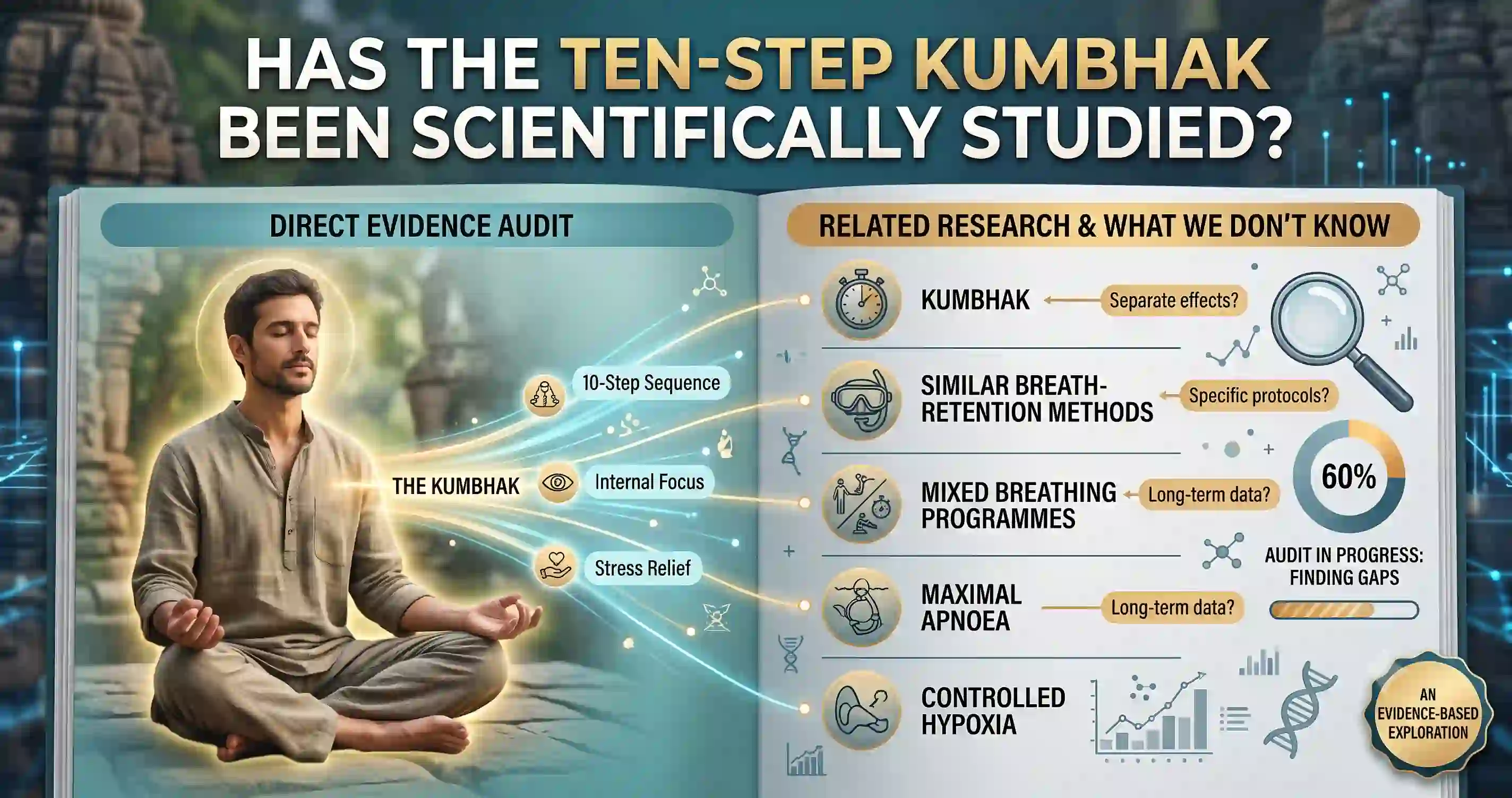
Someone is sitting at the edge of the bed after a difficult day. The room is quiet, but the argument from six hours ago is still happening inside the chest. A breathing practice may feel relevant in that moment. A scientific paper may feel reassuring. Yet one honest question must come before any promise:
Did the researchers test the same practice the reader is being asked to try?
For the exact Ten-Step Kumbhak for Stress Relief, the answer is currently no—not in any peer-reviewed or registered study located for this review as of 24 July 2026.
That sentence does not mean the practice has been disproved. It means something more precise: its complete sequence has not yet been directly tested. Research has examined individual pieces and neighbouring methods—Antar Kumbhak after Pūrak, Bāhya Kumbhak after Rechak, equal-ratio four-phase breathing, a two-second post-Rechak pause, box breathing, alternate-nostril programmes, maximal voluntary apnoea and clinical low-oxygen exposure. Those studies can inform plausibility, measurement and safety. They cannot be quietly relabelled as trials of the Ten-Step practice.
This distinction protects both science and Kumbhak. A practice does not become more trustworthy when every nearby result is claimed as its own. It becomes more trustworthy when readers can see exactly where the evidence ends.
Evidence verdict: Kumbhak is physiologically active. Retention-containing breathing programmes may help stress-related outcomes. Whether the exact Ten-Step Kumbhak adds a specific, lasting stress-relief benefit beyond normal breathing, focused attention or protected rest remains unknown.
This article evaluates evidence; it does not reproduce the Ten-Step method. Readers who want the complete instructions and safeguards should use the How to Practice the Ten-Step Kumbhak for Stress Relief article.
What the Evidence Shows at a Glance 🧭
The most relevant finding belongs at the top:
Exact Ten-Step practice
- What has been tested: No complete matched trial located.
- What can be claimed: No direct efficacy estimate yet.
- Confidence for stress relief: Not yet assessable.
A post-Pūrak hold added to otherwise matched paced breathing
- What has been tested: A 2026 randomised crossover pilot in 32 adults.
- What was found: A larger cortisol decrease with the four-second hold, but no improvement in reported stress, arousal or mood; one HRV measure also decreased.
- Confidence for the Ten-Step practice: Very low because there was no Bāhya Kumbhak, no Ten-Step sequence and no repeated training period.1
Four-phase breathing containing both Antar and Bāhya Kumbhak
- What has been tested: Small studies in yoga-experienced young adults using fixed six-second phases for 20 minutes.
- What was found: Changes in cardiovascular regulation and response inhibition; breath awareness sometimes improved outcomes too.
- Confidence for Ten-Step stress relief: Low and indirect.23
Retention-containing stress programmes
- What has been tested: Box breathing, alternate-nostril breathing with Kumbhak, a two-second post-Rechak pause and other structured programmes.
- What was found: Several studies report lower stress or anxiety, but their other ingredients were not removed.
- Confidence that Kumbhak caused the benefit: Low.568
Maximal apnoea training
- What has been tested: Long or repeated voluntary holds, frequently in athletes or trained divers.
- What was found: Strong acute changes in circulation, brain blood-flow velocity, spleen volume and temporary blood measures.
- Confidence for everyday stress relief: Mechanistically interesting but clinically distant.1215
Controlled intermittent hypoxia
- What has been tested: People continue breathing gas with a measured low-oxygen concentration under clinical or laboratory supervision.
- What was found: Selected blood-pressure, metabolic and rehabilitation effects, with results strongly dependent on dose and population.
- Confidence for Kumbhak: Indirect only. Controlled hypoxia is not breath retention.1718
The Central Scientific Finding: No Exact Trial Has Yet Been Located 🔎
For evidence to be direct, a study would need to preserve the identity of the complete Ten-Step intervention, including:
- the specified seated and relaxed preparation;
- Dhyāna Mudra;
- normal nasal Pūrak and Rechak rather than a fixed counted breathing ratio;
- attention and movement centered in the middle of the chest;
- both Antar Kumbhak and Bāhya Kumbhak;
- the particular ordering of retentions, intervening breaths and recovery breaths;
- comfortably full and comfortably empty boundaries;
- completely easy, non-maximal retentions;
- the rule to finish each hold while the practitioner still feels certain of one to three seconds of reserve, or earlier if any urge, strain or uneasiness appears;
- and stress relief—not competitive breath-hold duration—as the intended outcome.
No located study preserved all of those features.
This matters because a breathing practice is not merely the presence or absence of a pause. Change the lung volume, duration, preceding breaths, body position, attentional target, recovery period or instruction about effort, and the internal experience may change. The resulting carbon-dioxide pattern, oxygen pattern, chest pressure, autonomic response and sense of safety may change too.
The one-to-three-second reserve rule deserves particular clarity. It is not a minimum hold of one to three seconds. It is a stopping margin. A person whose comfortable capacity is extremely brief may hold for less than three seconds in total—or may not retain at all. The practice instruction is to stop sooner whenever the pause ceases to feel completely easy. Research on a fixed four-, six- or sixty-second hold therefore tests a different dose rule.
What “no exact trial located” does—and does not—mean
It means:
- no direct effect size can yet be assigned to the complete Ten-Step practice;
- no study has shown whether its two retentions outperform the same sequence without retention;
- no research has established the ideal number of rounds, frequency or training period;
- and its benefits and adverse effects have not been quantified in a representative clinical sample.
It does not mean:
- the practice has no effect;
- every component lacks evidence;
- traditional accounts are meaningless;
- or an individual cannot experience real relief.
Absence of a direct trial is a gap in collective knowledge. It is neither a positive result nor a negative one.
How this evidence search was framed
The project’s four source documents were reviewed in full. Their scientific records were checked against journal articles, PubMed, PubMed Central, ClinicalTrials.gov and accessible trial records. Searches included the exact practice name and combinations of Kumbhak, its common final-a spelling variant, breath retention, breath hold, stress, anxiety, with and without retention, apnoea and intermittent hypoxia.
This is a source-linked narrative evidence audit, not a registered PRISMA systematic review. Different languages and inconsistent terminology make an absolute claim that “no study exists anywhere” impossible. The appropriately bounded statement is: no study testing the exact Ten-Step Kumbhak was located in the sources and research records checked up to 24 July 2026.
The Closest Direct Evidence: What Happened When Researchers Added a Hold? 🧪
The cleanest question is not whether a complicated breathing programme helped. It is:
What changes when researchers keep the breathing pattern similar and add Kumbhak?
Very few studies have asked that question.
Closest component test: four-second Antar Kumbhak versus no hold
A July 2026 randomised crossover pilot studied 32 adults. Each participant completed both conditions:
- a four-second Pūrak followed by a six-second Rechak; and
- a four-second Pūrak, four-second Antar Kumbhak and six-second Rechak.
The hold condition produced a significantly greater fall in salivary cortisol. That is worth noticing because cortisol participates in HPA-axis regulation. But the same session produced no significant change in self-reported stress, arousal or mood in either breathing condition. RMSSD, a time-domain HRV measure, also fell more in the hold condition, while a supplementary high-frequency analysis did not confirm the same interaction.1
What this study supports
- A four-second post-Pūrak hold can change short-term endocrine and cardiac measurements relative to a similar no-hold pattern.
- Retention is not necessarily an inert pause inside paced breathing.
- Component-level comparison is scientifically possible.
What it does not support
- It does not show that participants felt less stressed.
- It does not establish a lasting benefit after weeks of practice.
- It did not test Bāhya Kumbhak, the Ten-Step ordering, chest-center attention, Dhyāna Mudra, normal Pūrak and Rechak, recovery breaths or a self-selected reserve.
- A cortisol change by itself is not proof that a person’s daily stress burden improved.
- A fall in RMSSD should not be marketed as automatic “vagal activation.”
This is the closest study because it isolates an Antar hold. It is also a lesson in why biomarkers and lived relief must not be treated as synonyms.
Both Antar and Bāhya Kumbhak: closer in structure, weaker in attribution
In another research programme, 39 healthy yoga practitioners completed 20 minutes of four-phase breathing. Pūrak, Antar Kumbhak, Rechak and Bāhya Kumbhak each lasted six seconds. On another occasion, participants sat with normal breathing and breath awareness.2
After the four-phase session:
- heart rate, stroke volume, cardiac output and mean arterial pressure fell;
- baroreflex sensitivity rose;
- time-domain HRV measures increased;
- but low-frequency HRV rose, high-frequency HRV fell and total peripheral resistance rose.
The pattern was mixed, not a clean switch into one universal “rest-and-digest” state. Participants were young, healthy, experienced in yoga and trained in the method for eight weeks before testing. The researchers did not measure perceived stress as the main outcome.
A related study in 36 yoga-trained volunteers used the same four-phase structure and examined response inhibition. Stop-signal performance improved after both the Kumbhak-containing session and breath awareness. The retention session was not clearly superior.3
Relevance to the Ten-Step practice: These studies contain both Antar and Bāhya Kumbhak, which makes them structurally valuable. Yet their continuous equal-ratio cycle, fixed six-second holds, three-breaths-per-minute rate, long session and experienced participants remain different from the Ten-Step method.
The fairest conclusion is:
Four-phase Kumbhak changes physiology and may support attention, but these studies do not demonstrate Ten-Step stress relief or prove that retention outperforms attentive normal breathing.
Eight weeks of additional intermittent Kumbhak
A randomised study assigned 116 young adult yoga practitioners either to their usual yoga or to usual yoga plus 20 minutes of daily intermittent breath-hold practice for eight weeks. The additional-practice group reported greater improvements in state mindfulness, mind wandering and state anxiety.4
This is encouraging because it examines repeated training rather than one laboratory session. It remains indirect because:
- all participants were already yoga practitioners;
- the intervention used a fixed repeated breathing structure rather than the Ten-Step sequence;
- usual yoga continued in both groups;
- participants knew their assignment;
- and the design did not compare the same breathing with and without the holds.
The study supports a retention-centered research signal. It does not identify the active ingredient.
Related Evidence: Programmes That Contain a Pause but Test a Package 📦
A programme can be useful even when science cannot say which component helped. The problem begins only when a package result is presented as retention-specific proof.
A two-second Bāhya pause during academic stress
A 2026 single-blind randomised trial enrolled 98 paramedicine students. The intervention used a repeated pattern of five-second Pūrak, five-second Rechak and a two-second post-Rechak pause for ten minutes twice daily over 12 weeks. At the end of the study, the breathing group reported lower stress, anxiety and depression and higher resilience than controls. Insomnia and psychological wellbeing did not show clear intervention-specific gains.5
This study is highly relevant to stress relief because:
- it included a very brief Bāhya pause;
- it ran during a genuinely stressful academic period;
- it used validated mental-health measures;
- and it tested repeated practice rather than an isolated session.
It still cannot tell us whether the two-second pause caused the result. The timed Pūrak and Rechak, diaphragmatic instruction, audio guidance, twice-daily protected time, expectation and feeling of control travelled together. Differential dropout also weakens certainty.
It is reasonable to say a programme containing a short post-Rechak pause helped this sample. It is not reasonable to say research has thereby proved the Ten-Step Kumbhak.
Alternate-nostril breathing with Kumbhak
A controlled study in 100 healthy men used modified alternate-nostril breathing with a 1:1:1 Pūrak–Kumbhak–Rechak ratio for 30 minutes per day, five days a week, over 12 weeks. Perceived Stress Scale scores fell more in the intervention group.6
Another pilot randomised only 11 healthy volunteers and reported a skin-conductance pattern consistent with reduced sympathetic arousal after seven days; blood-pressure and lung-function results were not significant.7
These studies connect Kumbhak with a stress outcome, but alternate-nostril control, fixed timing and intensive practice are inseparable from the retention. They also studied healthy young men or extremely small samples. They are related evidence, not a direct test of the Ten-Step method.
Box breathing and cyclic hyperventilation with retention
In a remote randomised trial, 108 participants completed 28 days of five-minute daily mindfulness meditation, cyclic sighing, box breathing or cyclic hyperventilation with retention. Mood improved and anxiety declined across the groups. The clearest average benefit appeared with exhale-emphasised cyclic sighing, not with the retention methods.8
This does not show that box breathing or retention was useless. It shows that the study did not identify Kumbhak as necessary for the strongest observed effect.
A 2026 preregistered real-life pilot added another useful piece. During acute threat situations, 47 university students completed about one minute of box breathing, cyclic sighing or a passive control. Five minutes later, both breathing conditions were associated with greater reductions in state anxiety than passive control. Box breathing was also linked with fewer inhibition errors, although both breathing groups had longer reaction times.9
The study brings measurement closer to the moment people actually want help. Yet it was small, brief and unable to identify whether the box-breathing holds, rhythm, attention or interruption of the stressful moment produced the change.
A larger single-blind trial in 200 healthy adults compared cyclic hyperventilation with long retention against an active breathing placebo using normal-rate breathing and brief holds. Both groups improved, but the intense method did not show a convincing specific advantage for stress, anxiety, depression, wellbeing or sleep.10
These results are valuable because they weaken a seductive assumption: more intense retention must produce more relief. The data do not support that hierarchy.
What the broader breathwork meta-analysis really tells us
A 2023 meta-analysis of randomised controlled trials found a small-to-medium average association between breathwork and lower self-reported stress: Hedges’ g = −0.35 across 12 trials and 785 adults. Anxiety and depressive-symptom analyses also favoured breathwork. Most studies, however, had a moderate risk of bias, and the interventions varied substantially.11
This is supportive evidence for structured breathing as a broad family. It cannot answer:
- whether a pause is necessary;
- whether Antar or Bāhya Kumbhak matters more;
- whether the Ten-Step order matters;
- or whether attentive normal breathing could produce a similar result.
The correct bridge is “breathing practices can help stress”, not “therefore this exact Kumbhak has already been proven.”
A Stress Trial Can Fail Even When a Biomarker Moves ⚖️
“Stress” is not one measurement.
Researchers may assess:
- what a person reports feeling now;
- perceived stress across the previous week or month;
- anxiety or depressive symptoms;
- sleep and daily functioning;
- resilience or rumination;
- salivary cortisol;
- skin conductance;
- heart rate and blood pressure;
- HRV;
- breathing frequency;
- or performance during a laboratory stressor.
These outcomes can move in different directions. A cortisol decrease can occur without a noticeable emotional change. Heart rate may fall while peripheral resistance rises. HRV can change simply because the breathing pattern has changed; it is not a direct meter of calmness. A person may report relief while oxygen, carbon dioxide and autonomic measurements remain unrecorded.
For stress relief, the most convincing research would show both:
- a meaningful improvement in how people feel and function; and
- a plausible physiological change measured without overstating what that marker means.
Neither biology alone nor testimony alone answers the whole question.
Acute Physiology Is Direct Evidence of Activity—not Proof of Stress Relief ❤️🧠
Several studies have measured what happens during Kumbhak. These are direct physiological studies, but they are not clinical stress trials.
One-minute Antar Kumbhak and cerebral blood-flow velocity
Fifteen healthy men experienced in prāṇāyāma performed a one-minute post-Pūrak hold. Middle cerebral artery flow velocities changed substantially during Kumbhak.12
That finding shows that a long Antar hold is a meaningful cerebrovascular event. It does not show improved memory, reduced stress, “brain detoxification” or long-term protection. A one-minute hold is also far outside the beginner-oriented, completely easy reserve rule of the Ten-Step practice.
One-minute Bāhya Kumbhak and cerebral haemodynamics
An exploratory study of 18 healthy participants found that Bāhya Kumbhak increased mean and end-diastolic cerebral flow velocity and reduced a resistance index.13
Again, change is not automatically benefit. The study measured an immediate response, not daily stress, quality of life or long-term safety.
Blood pressure can rise during a hold
In a study of 20 healthy adults performing one-minute Kumbhak attempts, systolic, diastolic and mean arterial pressure and total peripheral resistance rose during retention, while stroke volume and cardiac output fell.14
This is not a contradiction of studies in which a complete breathing session lowered post-session blood pressure. It is a difference in when the measurement was taken:
- pressure may rise during a demanding hold;
- resting or post-session pressure may later fall after some breathing routines.
That phase distinction is especially important for people with cardiovascular concerns. A study showing lower pressure after a programme must not be used to deny the pressure load occurring inside a long hold.
What very brief comfortable holds probably do—and what has not been measured
A completely easy pause may increase carbon dioxide only slightly and may not create meaningful hypoxaemia at all. Its value for stress could arise less from low oxygen and more from:
- focused attention;
- a predictable interruption of habitual breathing;
- awareness of internal sensation;
- learning to meet a manageable urge without panic;
- the relaxed posture and supported hands;
- the full sequence and recovery breaths;
- or simply a protected moment in which the person stops reacting.
These are plausible pathways, not established mechanisms of the exact Ten-Step practice. No study has yet measured end-tidal carbon dioxide, oxygen saturation, beat-to-beat blood pressure and stress outcomes while participants perform that complete protocol.
Maximal Apnoea Training Is Not Ten-Step Kumbhak 🏊
In physiology and sports research, apnoea often means holding for as long as possible, repeating long holds, exercising without breathing or training to tolerate severe air hunger. Participants may be elite divers. Their aim may be performance rather than stress relief.
That research has shown that maximal or repeated apnoea can:
- markedly raise cerebral blood-flow velocity;
- produce bradycardia and peripheral vasoconstriction;
- contract the spleen;
- cause a small temporary increase in circulating haemoglobin and haematocrit;
- improve breath-hold duration with training;
- and, under sufficiently severe dynamic conditions, sometimes increase erythropoietin.1516
These are real findings. They are also easy to misuse.
A temporary release of stored red cells is not permanent creation of new blood.
A trained capacity to hold longer is not proof of lower stress.
A compensatory rise in brain blood flow is not proof of better cognition.
An extreme oxygen-sensing response is not evidence that a comfortable pause activates healing genes.
Maximal apnoea helps define the outer physiology and risk boundary. It does not supply a clinical effect estimate for a deliberately brief, submaximal, seated Kumbhak.
A number can make a person feel powerful. Yet if the number replaces ease, the practice has changed its purpose. The clock has become the teacher—and the body’s quieter information has been pushed out of the room.
Controlled Intermittent Hypoxia Is Not Kumbhak 🫁
This is the most important category error in many breath-retention articles.
During Kumbhak:
- the airway is closed;
- metabolism continues;
- carbon dioxide generally rises;
- oxygen may fall if the hold is long enough;
- chest pressure and lung volume matter;
- and the person voluntarily inhibits breathing.
During controlled intermittent hypoxia:
- the person usually keeps breathing;
- a device supplies a known low-oxygen gas mixture;
- oxygen concentration and exposure time are prescribed;
- carbon dioxide may be controlled, stable or reduced;
- and clinicians can stop or adjust the exposure.
Those are related oxygen challenges, not the same intervention.
For example, studies using carefully measured low-oxygen cycles have reported improved walking outcomes when paired with movement training in selected people with chronic spinal-cord injury.17 Another trial found lower blood pressure after a particular six-week protocol and measured changes in nitric-oxide and HIF-related signalling.18
These results support the reality of dose-dependent oxygen-sensing biology. They do not prove that:
- ordinary Kumbhak reproduces the same oxygen dose;
- the Ten-Step practice activates HIF-1α;
- stress relief comes from hypoxia;
- or creating stronger hypoxia at home would improve health.
Some sleep-apnoea-like intermittent-hypoxia patterns raise sympathetic activity, impair vascular regulation or worsen insulin sensitivity.19 “Hypoxia” is therefore not a benefit. It is a physiological condition whose effects depend on severity, timing, repetition, recovery, illness and supervision.
Controlled hypoxia can generate a hypothesis about Kumbhak. It cannot serve as a substitute trial for Kumbhak.
Mixed Yoga and Breathing Programmes Cannot Identify the Active Ingredient 🧩
Many studies combine Kumbhak with one or more of the following:
- alternate-nostril breathing;
- Ujjāyī or Kapālabhāti;
- Bandha;
- Āsana;
- meditation;
- chanting;
- education;
- therapist attention;
- cold exposure;
- sleep routines;
- psychotherapy;
- or lifestyle changes.
If the total programme helps, the result is valuable. But it belongs to the total programme.
The best-known immune example used meditation, forceful cyclic hyperventilation, retention and cold training together. In a controlled endotoxin experiment, the trained group showed a large epinephrine response and altered inflammatory signalling.20 This does not establish an anti-inflammatory effect from comfortable Kumbhak alone.
The clearest mental-health caution comes from a pragmatic PTSD trial. Seventy-four adults received trauma-focused cognitive behavioural therapy with or without a prāṇāyāma preparation involving breathing techniques, post-Pūrak Kumbhak and Jālandhara Bandha. The primary intention-to-treat analysis found no significant advantage. A favourable signal appeared only among adherent participants without adverse events. Nine participants experienced recurrent minor adverse events, including anxiety, breathlessness, dizziness and constriction; one withdrew after a suffocation-related flashback.21
The trial used a more aversive hold—ending when the respiratory reflex overcame voluntary control—not the Ten-Step reserve rule. It should not be used to declare the Ten-Step practice unsafe. It should be used to remember that breathlessness can carry emotional meaning, particularly for people with panic, trauma or suffocation-related memories.
What the Classical Yoga Texts Actually Support 🕉️
Classical texts can establish that breath interruption, inner and outer phases, measured practice and mental steadiness belong to authentic yoga traditions. They cannot retroactively become randomised trials of a modern stress-relief sequence.
Yoga Sūtra 2.49: interruption of the Pūrak–Rechak movement
Patañjali describes prāṇāyāma after the establishment of Āsana:
tasmin sati śvāsapraśvāsayor gativicchedaḥ prāṇāyāmaḥ — Yoga Sūtra 2.49
A close reading is: prāṇāyāma is the interruption or regulation of the movement of Pūrak and Rechak.22
This verifies that cessation is not an accidental modern addition to yogic breathing. It does not identify the Ten-Step sequence or promise a clinical stress outcome.
Yoga Sūtra 2.50: outer, inner and suspended phases are measured
The next Sūtra states:
bāhyābhyantarastambhavṛttir deśakālasaṅkhyābhiḥ paridṛṣṭo dīrghasūkṣmaḥ — Yoga Sūtra 2.50
It identifies external, internal and suspended modes, observed or regulated through place, time and number, becoming extended and subtle.23
The most useful bridge to modern research is not a claim about oxygen or the vagus nerve. It is a shared respect for dose. Yoga speaks of place, time and number. Science asks for posture, phase, seconds, repetitions and internal gases. Both lose clarity when every kind of retention is treated as identical.
Yoga Sūtra 2.53: a claim about readiness of mind
Sūtra 2.53 says:
dhāraṇāsu ca yogyatā manasaḥ — Yoga Sūtra 2.53
The mind becomes fit or qualified for Dhāraṇā.23
This is a yogic claim about attentional readiness. A laboratory test of response inhibition may be an interesting neighbour, but it is not a scientific verification of Dhāraṇā. The two frameworks should be allowed to meet without pretending they use the same endpoint.
Haṭha Yoga Pradīpikā 2.2: the traditional breath–mind relationship
The Haṭha Yoga Pradīpikā states:
cale vāte calaṃ cittaṃ niścale niścalaṃ bhavet — Haṭha Yoga Pradīpikā 2.2
In close translation: when Vāyu moves, Citta moves; when it becomes still, Citta becomes still.24
This verse gives the traditional logic for exploring still breath and still mind. It is not a measured claim about cortisol, HRV or treatment of an anxiety disorder. Its value belongs to the yogic map.
Haṭha Yoga Pradīpikā 2.15: progression and danger belong to the tradition too
The same chapter gives a famous warning:
yathā siṃho gajo vyāghro bhaved vaśyaḥ śanaiḥ śanaiḥ / tathaiva sevito vāyur anyathā hanti sādhakam — Haṭha Yoga Pradīpikā 2.15
In close translation: as a lion, elephant or tiger is brought under care progressively, so Vāyu is approached progressively; otherwise it harms the practitioner.24
The zoological image belongs to its historical world, but the practical message remains exact: the text does not celebrate careless force. The Ten-Step instruction to retain only while completely easy, preserve one to three seconds of felt reserve and stop sooner at any uneasiness is a modern safety rule, not a translation of this verse. Still, both reject reckless escalation.
What an Ayurvedic Lens Adds—and What It Cannot Prove 🌿
Ayurveda does not provide a clinical trial of the Ten-Step Kumbhak. Its most precise contribution here is a boundary around the body’s urgent signals.
In Caraka Saṃhitā, Sūtrasthāna 7.3–4, deep breathing after exertion is included among natural urges that should not be suppressed. Verse 24 associates suppressing that post-exertional breathing urge with harmful consequences and recommends rest and Vāta-alleviating measures.25
This passage needs careful interpretation:
- It concerns the natural demand for deeper breathing after exertion.
- It is not a blanket prohibition against every deliberate Kumbhak performed while safely seated.
- It does not scientifically validate a modern stress practice.
- It does support respect for an unmistakable respiratory urge rather than turning that urge into an opponent.
That is highly relevant to the reserve rule. When the body is clearly asking for the next normal Pūrak or Rechak, the Ten-Step method does not ask the practitioner to overpower it.
An Ayurvedic practitioner may additionally interpret an individual’s response through Vāta, Pitta, Kapha, Prāṇa Vāyu, constitution, season and current imbalance. These are traditional clinical categories. They have not been validated as predictors of who will respond to the Ten-Step practice, and no direct trial has stratified outcomes by Doṣa.
The honest Ayurvedic position is therefore neither dismissal nor overclaiming:
Classical Ayurveda offers a language of individual suitability and respect for natural urges; modern research has not yet tested those categories as mechanisms or treatment selectors for this Kumbhak.
What Remains Unknown About Ten-Step Kumbhak for Stress Relief ❓
The unknowns are not footnotes. They are the future research agenda.
1. Does the complete practice reduce perceived stress?
No direct study has yet measured whether repeated Ten-Step practice lowers a validated stress score more than a credible control.
2. Does Kumbhak add anything beyond the rest of the sequence?
Posture, supported hands, chest-center attention, normal nasal breathing, recovery breaths and a few protected minutes may themselves help. Only a matched with-hold versus without-hold comparison can isolate the retention contribution.
3. Are both holds necessary?
Antar and Bāhya Kumbhak begin at different lung volumes and may produce different sensations and haemodynamics. No dismantling trial has tested Antar only, Bāhya only, both, and neither within the otherwise identical Ten-Step structure.
4. What does “one to three seconds of reserve” correspond to physiologically?
The rule is intentionally subjective. Research has not mapped that felt reserve to end-tidal carbon dioxide, oxygen saturation, blood pressure or time remaining before the first involuntary breathing movement. The margin may vary between people and from day to day.
5. How many rounds and how many weeks are useful?
There is no established dose–response curve. More rounds may not mean more relief, and a longer hold may change the intervention from calming exposure to respiratory stress.
6. How durable is any effect?
Immediate quiet after a session, lower stress after eight weeks and persistent benefit three months later are different outcomes. None has been established for the exact practice.
7. Who benefits, who feels nothing and who feels worse?
The response may differ with age, baseline stress, panic sensitivity, trauma history, respiratory health, cardiovascular health, medication, previous yoga experience and cultural expectations. These possible moderators remain untested.
8. What are the adverse-event rates?
Small studies often report few events, but many do not collect them systematically. Dizziness, headache, panic, palpitations, faintness, chest discomfort, dissociation and delayed aversion should be actively asked about rather than inferred from silence.
9. Does chest-center attention matter?
No located study isolated the instruction to maintain attention at the center of the chest or compared chest-center movement with abdominal or unguided breathing.
10. Does Dhyāna Mudra contribute?
It may support posture, tactile grounding, symmetry, stillness or ritual coherence. Those possibilities are untested. A component should not receive a physiological claim merely because the complete practice includes it.
11. Is the mechanism respiratory, attentional or relational?
Relief could arise through respiratory chemistry, baroreflex effects, interoceptive learning, attentional interruption, expectancy, instructor reassurance, personal meaning or several pathways together. The present evidence cannot rank them for this protocol.
12. Is it better than a simpler no-hold practice?
This may be the most important practical unknown. If normal breathing with the same posture, timing and attention gives equal relief, the hold may be optional for some people. If the full Ten-Step practice performs better without added adverse effects, that would justify its added complexity.
What a Trustworthy Ten-Step Kumbhak Trial Should Look Like 🧫
A strong first trial does not need to prove every mechanism. It needs to ask one clean question well.
The primary comparison
Participants with elevated everyday stress would be randomly assigned to:
- the exact Ten-Step Kumbhak;
- a matched version preserving posture, Dhyāna Mudra, chest-center attention, normal Pūrak and Rechak, timing and instructor contact but replacing the retentions with normal breathing; or
- a credible seated-attention control.
The study should be prospectively powered, preregistered and analysed by intention to treat.
The primary outcome
One validated stress outcome—such as change in the Perceived Stress Scale—should be declared primary in advance. The report should include absolute changes, confidence intervals and the proportion of participants who experienced a meaningful improvement, not only p values.
The secondary outcomes
Useful secondary measures could include:
- state anxiety;
- sleep quality;
- daily rumination;
- concentration and functioning;
- ecological momentary stress reports;
- practice adherence;
- treatment expectancy;
- and participant-rated acceptability.
The study should welcome neutral and negative reports. “Nothing changed” is data, not disobedience.
The physiological substudy
During representative rounds, researchers could record:
- respiratory timing;
- actual Antar and Bāhya hold duration;
- end-tidal carbon dioxide;
- oxygen saturation;
- ECG and respiration-aware HRV;
- beat-to-beat blood pressure;
- and subjective ease, urge and perceived reserve.
Cortisol may be included, but it should not replace the primary lived outcome.
The safety design
Researchers should:
- preserve the completely easy stopping rule;
- never require a participant to reach a minimum hold duration;
- record when total retention is under three seconds;
- prohibit hyperventilation and maximal testing;
- predefine stop criteria;
- screen and stratify relevant health concerns;
- collect adverse events after every supervised session and throughout home practice;
- and report withdrawals by group with reasons.
People with panic or trauma-related respiratory fear should not be forced into a retention arm merely to complete recruitment.
The follow-up
Assessment immediately after practice would show the acute response. Assessment after several weeks would show training effects. Follow-up after practice has ended would show whether any benefit persists.
If the exact practice first proves useful as a whole, later dismantling studies can ask which pieces carry the effect. That order respects the practice without sacrificing scientific precision.
Claims That Should Wait for Direct Evidence 🚫
Until exact studies exist, the Ten-Step Kumbhak should not be described as scientifically proven to:
- lower cortisol in daily life;
- activate the vagus nerve or create permanent parasympathetic dominance;
- reset the HPA axis;
- improve HRV;
- oxygenate the brain;
- activate HIF-1α, stem cells or healing genes;
- increase erythropoietin or permanently raise haemoglobin;
- treat panic disorder, PTSD, depression or an anxiety disorder;
- lower chronic high blood pressure;
- cure asthma or another respiratory condition;
- prevent dementia, stroke or heart disease;
- or work for everyone.
Some items on that list have related evidence under a different protocol. That is precisely why the wording matters. “Related evidence exists” is not the same sentence as “this practice has been proven.”
What Can Be Said Responsibly Today ✅
The present evidence supports the following statements:
- Breath retention is biologically active. Even one session can alter endocrine, cardiovascular or cerebrovascular measurements, depending on the protocol.
- Breathing programmes can support stress relief. Randomised evidence across the broader field shows a modest average benefit, with substantial variation and methodological limitations.
- Some retention-containing programmes have reduced stress or anxiety. Their Kumbhak component has rarely been isolated.
- A post-Pūrak hold can make a measurable difference relative to a similar no-hold pattern. In the closest 2026 pilot, the difference appeared in cortisol and RMSSD, not in reported stress, arousal or mood.
- Both Antar and Bāhya Kumbhak can be studied scientifically. Small four-phase studies show physiological and attentional effects, but not Ten-Step stress efficacy.
- Comfort and dose matter. Results from maximal apnoea or controlled hypoxia cannot be transferred directly to a brief, completely easy pause.
- Traditional yoga gives Kumbhak authentic depth. It does not remove the need for direct modern testing.
- Ayurveda adds an important caution about natural respiratory urges. It does not provide biomedical proof of stress reduction.
- The exact Ten-Step practice remains a testable, unanswered research question.
A Reader’s Evidence Filter for Any Kumbhak Claim 🔬
Before trusting a headline, ask:
-
Was the exact practice tested?
If not, how far away was the intervention? -
Was Kumbhak isolated?
Or was it bundled with timed breathing, alternate nostrils, Bandha, Āsana, meditation, cold or therapy? -
Was the hold comfortable or maximal?
A one-to-three-second reserve rule is not comparable to holding until strong air hunger or failure. -
Did the hold follow Pūrak or Rechak?
Starting lung volume changes the physiology. -
Was stress actually measured?
A change in blood flow, HRV, haemoglobin or breath-hold time is not automatically stress relief. -
Was there a credible active control?
Sitting quietly, receiving guidance and expecting benefit can influence outcomes. -
How many people were studied, and for how long?
A one-session pilot cannot establish a durable clinical effect. -
Were adverse events actively collected?
“No adverse events mentioned” is not the same as “proven safe.” -
Does the conclusion match the data?
Within-group improvement does not prove superiority; a secondary biomarker does not replace a null primary stress outcome. -
Is controlled hypoxia being presented as Kumbhak?
If participants kept breathing low-oxygen gas, it was a different intervention.
The Final Verdict: Trust Begins Where Exaggeration Ends 🌌
The scientific story of the Ten-Step Kumbhak is not empty. It is unfinished.
Research shows that a pause after Pūrak can alter short-term biology. Four-phase breathing with both Antar and Bāhya Kumbhak can affect cardiovascular regulation and attention. Programmes containing brief pauses have helped stress in some groups. Classical yoga recognises internal and external stillness as authentic dimensions of prāṇāyāma. Ayurveda reminds us not to make an enemy of the body’s clear demand for breath.
But no located trial has yet assembled those pieces into the exact Ten-Step practice and asked whether it relieves stress better than a well-matched alternative.
There is something quietly reassuring in saying that plainly. The reader is not being asked to borrow certainty from an elite diver, a cold-exposure programme, a low-oxygen clinic or a different breathing ratio. The practice can stand honestly in its present place: traditionally meaningful, physiologically plausible, related to promising evidence and ready for direct testing.
One day, a well-designed trial may show a clear benefit. It may show that only some people benefit. It may show that the whole sequence matters, or that a simpler version works equally well. Every one of those results would teach something valuable.
Until then, the most accurate conclusion is also the most human:
The Ten-Step Kumbhak deserves neither blind belief nor casual dismissal. It deserves careful practice, honest observation and research that finally tests what is actually being taught.
References and Verification Notes 📚
Evidence last checked: 24 July 2026. This educational review does not replace medical diagnosis, treatment or individual clinical advice.
-
Byrne KA, Pilcher JJ, Rosopa E, et al. Randomised crossover pilot comparing a 4–6 pattern without retention with a 4–4–6 pattern containing a post-Pūrak hold. International Journal of Psychophysiology. 2026;227:113437. PubMed PMID 42385999 · DOI: 10.1016/j.ijpsycho.2026.113437. ↩↩
-
Saoji AA, Raghavendra BR, Manjunath NK. Immediate autonomic and cardiovascular effects of four-phase yoga breathing with intermittent retention in 39 healthy yoga practitioners. Indian Journal of Physiology and Pharmacology. 2018;62(1):41–50. Full journal PDF. ↩↩
-
Saoji AA, Raghavendra BR, Rajesh SK, Manjunath NK. Within-participant comparison of four-phase yoga breathing and breath awareness in 36 yoga-trained adults. International Journal of Yoga. 2018;11(2):99–104. PubMed Central full text · DOI: 10.4103/ijoy.IJOY_65_16. ↩↩
-
Saoji AA, Raghavendra BR, Madle K, Manjunath NK. Eight-week randomised study of additional yoga breathing with intermittent retention in 116 yoga practitioners. Explore. 2018;14(5):379–384. PubMed PMID 30122326 · DOI: 10.1016/j.explore.2018.02.005. ↩
-
Little A, Stainer M, MacQuarrie A, Wiseman N, Haskins B. Twelve-week single-blind randomised trial of a paced breathing method with a two-second post-Rechak pause in 98 paramedicine students. Stress and Health. 2026:e70161. Open-access article · DOI: 10.1002/smi.70161. ↩↩
-
Naik GS, Gaur GS, Pal GK. Randomised controlled study of modified alternate-nostril breathing with a 1:1:1 Pūrak–Kumbhak–Rechak ratio in 100 healthy men. International Journal of Yoga. 2018;11(1):53–58. PubMed Central full text · PubMed PMID 29343931 · DOI: 10.4103/ijoy.IJOY_41_16. ↩↩
-
Turankar AV, Jain S, Patel SB, et al. Seven-day randomised pilot of Anuloma-Viloma with Kumbhak in 11 healthy volunteers. Indian Journal of Medical Research. 2013;137(5):916–921. PubMed Central full text · PubMed PMID 23760377. ↩
-
Balban MY, Neri E, Kogon MM, et al. Remote randomised study of five-minute daily breathwork and mindfulness meditation. Cell Reports Medicine. 2023;4(1):100895. PubMed Central full text · ClinicalTrials.gov NCT05304000. ↩↩
-
Riedl EM, Bracklo T, Wimmer K, et al. Preregistered real-life pilot comparing approximately one minute of box breathing, cyclic sighing and passive control during acute threat situations. Anxiety, Stress, & Coping. 2026:1–15. PubMed PMID 42002307 · DOI: 10.1080/10615806.2026.2659809. ↩
-
Fincham GW, Epel E, Colasanti A, Strauss C, Cavanagh K. Single-blind, active-placebo-controlled trial of cyclic hyperventilation with retention in 200 healthy adults. Scientific Reports. 2024;14:16893. PubMed Central full text · PubMed PMID 39043650 · DOI: 10.1038/s41598-024-64254-7. ↩
-
Fincham GW, Strauss C, Montero-Marin J, Cavanagh K. Meta-analysis of randomised controlled breathwork trials for stress and mental health. Scientific Reports. 2023;13:432. PubMed Central full text · PROSPERO CRD42021286197. ↩
-
Nivethitha L, Mooventhan A, Manjunath NK. Study of cerebral haemodynamics during one-minute internal Kumbhak in 15 prāṇāyāma-experienced healthy men. PubMed Central full text. ↩↩
-
Nivethitha L, Mooventhan A, Manjunath NK, Bathala L, Sharma VK. Exploratory study of cerebral haemodynamics during Bāhya Kumbhak. Applied Psychophysiology and Biofeedback. 2018;43(1):87–92. PubMed PMID 29188396 · DOI: 10.1007/s10484-017-9387-8. ↩
-
Nivethitha L, Mooventhan A, Manjunath NK. Acute cardiovascular measurements during different yogic breathing techniques, including one-minute Kumbhak. International Journal of Yoga. 2021;14(2):158–162. PubMed Central full text · PubMed PMID 34188389. ↩
-
López-Rebenaque O, Solís-Ferrer L, Fierro-Marrero J, Fernández FA. Systematic review and meta-analysis of acute voluntary apnoea effects on haemoglobin and haematocrit. Undersea & Hyperbaric Medicine. 2024;51(2):173–184. PubMed PMID 38985153. ↩↩
-
Elia A, et al. Erythropoietin response after maximal static and dynamic apnoea in elite divers and non-divers. PubMed Central full text. ↩
-
Hayes HB, Jayaraman A, Herrmann M, Mitchell GS, Rymer WZ, Trumbower RD. Randomised, double-blind, placebo-controlled crossover trial of acute intermittent hypoxia with walking practice after chronic spinal-cord injury. Neurorehabilitation and Neural Repair. 2014;28(4):289–299. PubMed Central full text. ↩↩
-
Muangritdech N, et al. Six-week randomised trial of intermittent hypoxic exposure or exercise in adults with hypertension. PubMed PMID 32524226. ↩↩
-
Controlled human studies show that sleep-apnoea-like intermittent hypoxia can produce adverse sympathetic, vascular or metabolic effects. Blood pressure and nitric-oxide study, PubMed PMID 19417094 · Insulin-sensitivity crossover study, PubMed PMID 38866393. ↩
-
Kox M, van Eijk LT, Zwaag J, et al. Voluntary activation of the sympathetic nervous system and attenuation of the innate immune response after a compound training programme. Proceedings of the National Academy of Sciences. 2014;111(20):7379–7384. PubMed Central full text. ↩
-
Haller H, Mitzinger D, Cramer H. Pragmatic randomised trial of prāṇāyāma added to trauma-focused cognitive behavioural therapy in 74 adults with PTSD. Frontiers in Psychiatry. 2023;14:1101046. PubMed Central full text · ClinicalTrials.gov NCT03748121. ↩
-
Pātañjalayogaśāstra, Yoga Sūtra 2.49. Sanskrit wording cross-checked in the Sanskrit Documents text and in the Yoga Sūtra 2.49 text with Vyāsa commentary. ↩
-
Pātañjalayogaśāstra, Yoga Sūtras 2.50 and 2.53. Sanskrit wording cross-checked in the Sanskrit Documents text. The scientific interpretation in this article is deliberately limited; the Sūtras do not name modern stress scales, oxygen measures or autonomic biomarkers. ↩↩
-
Svātmārāma, Haṭha Yoga Pradīpikā 2.2 and 2.15. Sanskrit wording verified in the Sanskrit Documents edition. The English renderings here are close editorial translations, not claims of biomedical verification. ↩↩
-
Caraka Saṃhitā, Sūtrasthāna 7.3–4 and 7.24, on non-suppression of natural urges and deep breathing after exertion. Checked in the 1949 Gulabkunverba English edition. This passage concerns post-exertional respiratory urge, not a scientific trial or categorical rejection of voluntary seated Kumbhak. ↩