Comprehensive guide to absolute contraindications (hypertension, stroke, arrhythmias, glaucoma, pregnancy), conditional contraindications (anxiety, epilepsy, hyperthyroidism), dosha-specific warnings (Vata anxiety, Pitta nosebleeds, Kapha benefits), screening questionnaire, medical approval checklist for cardiac and diabetic patients, and emergency protocols for panic during kumbhak breath retention—when to stop, when to seek doctor approval, and how to practice safely/
By Kumbhaki Yogi Dhruvaji (MSc IIT Bombay), founder of the Antistress Foundation 501(c)(3)
• How to Practice Ten-Step Kumbhak • Scientific Proof • Ancient Texts Proof • Bio • Subscribe By Email
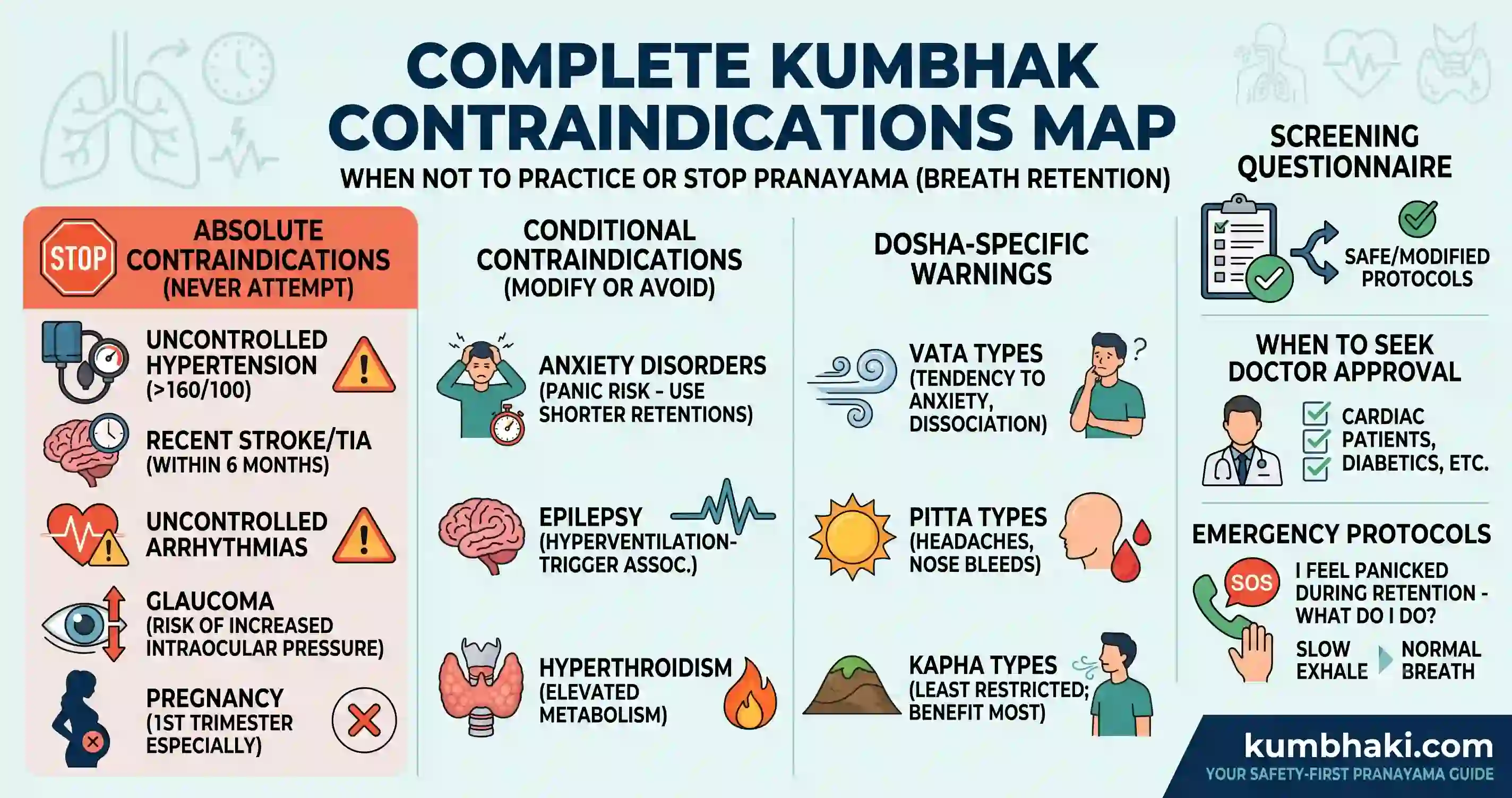
Why Understanding Your Contraindications Matters
You know your body better than anyone. Before practicing the Ten-Step Kumbhak, it is important to understand which conditions or circumstances mean you should either pause entirely, modify how you practice, or seek medical guidance first.
This is not pessimism about the practice. Rather, it is respect for your individual health situation. The Ten-Step Kumbhak is a normal breathing practice, not a medical intervention. Like any deliberate pause in breathing, it creates specific changes in your nervous system, blood pressure, oxygen levels, and intracranial pressure. For most people, these changes are gentle and restorative. For some people, these changes may be contraindicated—meaning the practice could trigger or worsen an existing condition.
This guide is organized to help you:
- Identify whether the practice is safe for you to begin
- Recognize conditions where modification or caution is needed
- Know when to consult a healthcare professional first
- Understand what to do if discomfort arises during practice
What "Contraindication" Actually Means
A contraindication is a specific condition or circumstance that makes a treatment or practice inadvisable or unsafe.
There are two categories:
- Absolute contraindications — conditions where the practice should not be attempted, or only under direct medical supervision
- Conditional contraindications — conditions where the practice may be possible, but requires modification, observation, or extra caution
Neither category means you are broken or limited as a practitioner. It means that at this stage of your health, this particular technique is not the right fit—or requires a different approach than someone without that condition.
Absolute Contraindications: Do Not Attempt Without Medical Clearance
If you have any of the following conditions, do not practice the Ten-Step Kumbhak without explicit approval and guidance from a qualified healthcare professional who understands your specific situation.
1. Uncontrolled Hypertension (Blood Pressure >160/100 mmHg)
Why this matters:
Breath retention causes a temporary increase in intrathoracic pressure (pressure inside the chest cavity). This can raise blood pressure further, and in uncontrolled hypertension, this elevation may contribute to cardiovascular stress, increased risk of stroke, or other complications.
What "uncontrolled" means:
Your blood pressure is considered uncontrolled if: - Your readings consistently exceed 160/100 mmHg, even with medication - Your medication is not yet optimized or adjusted - You have not yet established a stable baseline
What you may do:
- Consult your cardiologist or physician about your blood pressure targets and medication
- Once your blood pressure is brought to controlled levels (typically <140/90 mmHg or your target as advised), ask your doctor whether the Ten-Step Kumbhak would be safe to explore
- Do not assume "mild high blood pressure" is safe; ask your healthcare provider directly
2. Recent Stroke or Transient Ischemic Attack (TIA) Within 6 Months
Why this matters:
Following a stroke or TIA, your cerebral circulation is in a sensitive recovery phase. Breath retention increases intracranial pressure and alters cerebral blood flow. These changes could theoretically interfere with recovery or increase the risk of another event during the vulnerable window after an acute cerebrovascular incident.
What you may do:
- Allow at least 6 months of recovery post-stroke or TIA before exploring any breath retention practice
- Consult your neurologist or stroke specialist about when it may be safe to resume structured breathing practices
- After clearance from your healthcare team, begin under their supervision or with their specific guidance
3. Uncontrolled Cardiac Arrhythmias
Why this matters:
Breath retention stimulates the vagus nerve, which can influence heart rate and rhythm. In someone with uncontrolled arrhythmias, this stimulation could trigger palpitations, irregular beats, or hemodynamic instability. The goal is not to avoid the vagus, but to do so when your arrhythmia is stabilized and controlled.
What "uncontrolled" means:
- Your arrhythmia episodes are frequent, unpredictable, or not yet stabilized on medication
- You experience symptoms (palpitations, dizziness, chest discomfort) during or after activity
- Your cardiologist has not yet determined your arrhythmia is safe
What you may do:
- Work with your cardiologist to stabilize your arrhythmia through medication, ablation, or other appropriate treatment
- Once your arrhythmia is controlled and you have medical clearance, consult your cardiologist about whether gentle, short kumbhak retentions may be safe
- When cleared, start with extremely brief retentions (a few seconds) and observe your heart's response
4. Glaucoma or Elevated Intraocular Pressure
Why this matters:
Breath retention increases intracranial and intraocular pressure—the pressure of fluid within the eye. In glaucoma, elevated intraocular pressure damages the optic nerve and causes vision loss. Any practice that further raises this pressure may accelerate damage and should be avoided.
What you may do:
- Inform your ophthalmologist that you are interested in breath retention practices
- Ask directly whether the Ten-Step Kumbhak is safe for your specific type and stage of glaucoma
- Some ophthalmologists may recommend avoiding all retention practices; others may permit modified versions with shorter holds
- Follow your ophthalmologist's specific guidance
5. Pregnancy, Especially First Trimester
Why this matters:
During pregnancy, your respiratory, cardiovascular, and endocrine systems undergo major changes. In the first trimester especially, the embryo is establishing its fundamental systems. Breath retention increases intrathoracic pressure and alters oxygen-carbon dioxide dynamics. While gentle breathing practices are often safe in pregnancy, deliberate retention practices lack sufficient research in pregnant populations to establish safety.
The precautionary principle applies here: if the risk is uncertain, avoid the practice during pregnancy.
What you may do:
- During pregnancy, pause kumbhak practice entirely
- If you were a regular practitioner before pregnancy, consult your obstetrician about whether other breathing practices (without retention) may be safe
- After pregnancy and postpartum recovery, consult your healthcare provider about when to resume kumbhak practice
- Breastfeeding mothers should also consult their healthcare provider before resuming
6. Uncontrolled or Severe Panic Disorder with Frequent Panic Attacks
Why this matters:
For people with active, uncontrolled panic disorder, any practice involving breath control can inadvertently trigger panic. Even though kumbhak is designed to calm, the focus on breath and the pause in breathing can sometimes misfire in someone whose nervous system is primed for threat detection. Practicing with an already-elevated baseline of anxiety may override the calming effect.
What "uncontrolled" means:
- You experience panic attacks multiple times per week without effective management
- Your panic has not yet responded to medication or therapy
- You have not yet developed reliable ways to interrupt a panic spiral
- You feel unsafe with any form of breath focus
What you may do:
- Work with your mental health provider or psychiatrist to stabilize your panic disorder first (through therapy, medication, or both)
- Once your panic is more manageable and less frequent, consult your healthcare provider about whether gentle kumbhak practice may be helpful
- When ready, start with extremely brief retentions (2–3 seconds) in a safe, stable environment with a trusted person nearby
- Prioritize your felt sense of safety over any target or duration
Conditional Contraindications: Modify, Observe, and Proceed with Caution
The following conditions do not automatically prohibit kumbhak practice, but they require modification, closer observation, and sometimes medical consultation before you begin.
1. Anxiety Disorders (Generalized Anxiety, Social Anxiety, Specific Phobias)
Why modification is needed:
Anxiety disorders involve a nervous system that is already vigilant and sensitive to internal sensations. When you hold your breath, your body naturally signals "something is changing." For someone without anxiety, this signal is simply registered. For someone with anxiety, the signal can be misinterpreted as threat, triggering a cascade toward panic.
The paradox: Kumbhak is designed to activate parasympathetic (calming) pathways, which may eventually reduce anxiety. But the pathway to that benefit must be very gentle, or the activation of interoceptive awareness (noticing your own internal state) may backfire.
How to modify:
- Start smaller: Instead of the standard Ten-Step Kumbhak retentions, keep your first retentions to 3–5 seconds. Let them feel almost imperceptible.
- Practice in safety: Do your first attempts in a place where you feel completely safe—your home, a quiet room, with a trusted person nearby if that helps.
- Expect mild discomfort: The first few times, you may notice a slight urge to breathe. This is normal. What matters is your response to it. Can you observe the urge without reacting? If yes, you are learning the skill. If the urge triggers panic symptoms, stop immediately.
- Establish a "pause word": Before you begin, choose a word (like "ease" or "return") that signals to yourself "I can stop anytime." Knowing you have an exit makes the entrance less frightening.
- Progress only when ready: There is no timeline. If it takes weeks to progress from 5-second holds to 10-second holds, that is the right pace for your nervous system. Forcing progress will backfire.
- Seek consultation: If anxiety intensifies after practice, pause and consult your therapist or psychiatrist. Kumbhak may not be the tool for you at this stage. Other practices may work better.
Red flags—stop if: - You experience panic symptoms (racing heart, chest tightness, dizziness, fear of dying or losing control) even once - Your anxiety worsens in the days after practice - You find yourself avoiding the practice out of fear
2. Epilepsy or Seizure Disorder
Why modification is needed:
There are conflicting considerations here. Hyperventilation (rapid breathing) can trigger seizures in some people with epilepsy. However, kumbhak—which includes breath retention—does not involve hyperventilation. In fact, some lineages of yoga suggest that kumbhak may be more manageable than rapid pranayama for people with seizure disorders, because it avoids the hyperventilation trigger.
That said, individual responses vary enormously. Some people with epilepsy have seizures triggered by changes in oxygen levels or intrathoracic pressure; others do not. You need medical guidance.
How to proceed:
- Consult your neurologist first: Tell your neurologist that you are interested in practicing kumbhak (breath retention without rapid breathing). Ask whether this is advisable for your specific type of epilepsy and seizure pattern.
- If cleared by your neurologist: Begin with extremely short retentions (2–3 seconds) in a safe place, ideally with someone present.
- Keep a seizure journal: For the first 2–3 weeks of practice, note any changes in seizure frequency or pattern. Does practice seem to correlate with more seizures, fewer seizures, or no change?
- Communicate: If you notice any change, report it to your neurologist immediately.
Red flags—stop if: - You have a seizure during or immediately after kumbhak practice - You notice an increase in pre-seizure symptoms (aura, focal symptoms, mood changes) on days you practice - Your neurologist advises against it
Reassurance: If kumbhak turns out to be contraindicated for you, this does not mean breathing practices are forbidden. Your neurologist may recommend other forms of gentle breathing work.
3. Hyperthyroidism or Graves' Disease
Why modification is needed:
Hyperthyroidism means your thyroid hormone levels are elevated, causing an accelerated metabolism, elevated heart rate, tremor, anxiety, and heat intolerance. Your nervous system is already "revved up." Breath retention activates parasympathetic pathways that should have a calming effect over time. However, in an already-elevated metabolic state, the practice may feel jarring or may temporarily increase anxiety.
How to modify:
- Consult your endocrinologist: Ask whether breath retention practices would be safe for you, particularly if your thyroid is not yet controlled by medication.
- If cleared: Start with very short, easy retentions (3–5 seconds) and prioritize comfort over duration.
- Observe your autonomic response: Notice whether your heart rate or anxiety increases or decreases after practice. The goal is to feel calmer, not more activated.
- Time your practice: Practice in the early morning or late afternoon when your energy is naturally more settled, not during your highest-energy part of the day.
- Track your thyroid levels: If you are working with your endocrinologist to adjust your thyroid medication, note any changes in how the practice feels as your hormone levels stabilize. The practice may feel different (and more beneficial) once your thyroid is better controlled.
Red flags—stop if: - Your heart rate spikes noticeably during or after practice - You feel more anxious after practicing - You experience palpitations or chest discomfort
Dosha-Specific Considerations
In Āyurveda, the three fundamental constitutions or "doshas" are Vāta, Pitta, and Kapha. Each has different qualities, sensitivities, and tendencies toward imbalance. While kumbhak can benefit all doshas, the nature of the benefit and the risk profile differs.
Vāta-Predominant Constitution
Vāta qualities: Light, mobile, dry, cold, subtle, quick, spacious, changeable
Vāta imbalances: Anxiety, dissociation, racing thoughts, insomnia, tremor, fragmentation, spaciness, under-grounding
Why Vāta types are sensitive to breath practices:
Vāta governs movement and sensation. For Vāta-predominant people, attention to breath can amplify the sensitivity. Holding the breath, while calming for others, may feel "stuck" or triggering for someone whose constitution thrives on flow and mobility. Additionally, Vāta types tend toward anxiety and dissociation, so if breath retention is not entered gradually, it can intensify those imbalances.
How Vāta types may practice safely:
- Emphasize grounding: Before and during kumbhak, emphasize the weight of your body on the seat, the solidity of the earth beneath you. Feel your body parts in contact with the ground.
- Keep retentions very short: Start with retentions that feel playful and easy (3–5 seconds or even less). There is no rush.
- Use Dhyāna Mudra: The hand gesture used in kumbhak (palms upward, thumbs gently touching) is particularly grounding for Vāta types. Feel how the hands rest naturally rather than grasping.
- Add a focal point: Choose one small area—your heart center, your belly, the space between your eyebrows—and keep attention there. This gives Vāta's mobile mind an anchor.
- Practice in a warm, grounded environment: Sit on the earth or a stable chair (not a wobbling surface). Practice during the warmer part of the day if possible.
- Pair with other grounding practices: Gentle foot massage (abhyañga), warm oil application, or a brief grounding walk before or after kumbhak can help stabilize Vāta's often-scattered energy.
Red flags for Vāta types:
- Feeling more anxious or spaced-out after practice
- Worsening insomnia
- Tremor or shakiness
- A sense of disconnection from your body
If any of these appear, reduce the retention duration even further, or pause for a few days and consult a qualified Āyurvedic practitioner.
Pitta-Predominant Constitution
Pitta qualities: Hot, sharp, penetrating, oily, light, moving, intense, purposeful
Pitta imbalances: Anger, irritability, inflammation, heartburn, nosebleeds, perfectionism, burnout, excessive drive
Why Pitta types need caution:
Pitta governs transformation, metabolism, and digestion. Pitta-predominant people tend to be driven, competitive, and intensity-seeking. They may push kumbhak retentions too long or too hard, or approach the practice with perfectionism rather than ease. Additionally, the increase in intracranial and sinus pressure during retention can occasionally trigger nosebleeds in Pitta types, especially if they are already prone to them.
How Pitta types may practice safely:
- Soften the approach: Kumbhak is not a performance or achievement. Remind yourself that the gentlest, shortest retention is as valuable as a long one if it is done with ease.
- Let go of the timer: Do not count seconds or compare your retention duration to anyone else's. Simply hold the breath until it feels easy to release, then release.
- Keep cool: Practice in a cool or naturally ventilated room. Avoid practicing in heat or in the hottest part of the day.
- Emphasize the release: For Pitta types, the exhalation (Rechak) is as important as the inhalation or retention. Feel the cooling, releasing quality of the breath leaving the body.
- Avoid intensity stacking: If you are already doing intense yoga, intense exercise, or high-stress work, keep kumbhak very gentle and short. Do not add intensity to an already-intense day.
- Watch for nosebleeds: If you have a history of nosebleeds or currently have sinus congestion, be extra cautious. If a nosebleed occurs during practice, stop immediately and consult an ear-nose-throat specialist before resuming.
Red flags for Pitta types:
- Pushing retentions beyond comfort in pursuit of a longer duration
- Experiencing nosebleeds or sinus pressure
- Feeling more irritable or intense after practice
- A sense of pressure or heat in the head
If any of these appear, reduce duration, increase the time between rounds, and re-center on ease rather than achievement.
Kapha-Predominant Constitution
Kapha qualities: Heavy, stable, dense, wet, cold, smooth, slow, grounded, steady
Kapha imbalances: Sluggishness, heaviness, depression, lethargy, water retention, congestion, attachment
Why Kapha types often benefit most:
Kapha-predominant people tend toward steadiness and groundedness. They are naturally less anxious and more resilient to breath work. The practice of kumbhak—which activates parasympathetic (calming) pathways—aligns well with Kapha's already-calm baseline. Additionally, because Kapha governs structure and stability, Kapha types often excel at sustained practices and are less prone to restlessness during retention.
How Kapha types may practice:
- Gradually build duration: Kapha types can often progress more comfortably to longer retentions than Vāta or Pitta types. However, "longer" should still be defined by ease, not strain.
- Practice with gentle warming: Because Kapha tends toward coldness, practicing in warm conditions or pairing practice with gentle warming activities (warm water, sunlight exposure) can enhance the benefit.
- Avoid heaviness: Do not let the practice become another form of sluggishness. Maintain an alert, engaged quality even while being relaxed.
- Benefit fully: For Kapha types, kumbhak may be one of the most accessible and beneficial breathing practices available. If you are a Kapha type and the practice feels easy and calming, that is genuine feedback that it is right for you.
Red flags for Kapha types:
- Feeling more lethargic or depressed after practice
- Increased sluggishness or brain fog
- A sense of heaviness or stagnation
These would be unusual for Kapha types, but if they occur, it may indicate that the timing, duration, or frequency needs adjustment.
Screening Questionnaire: Is Kumbhak Right for Me?
Before beginning the Ten-Step Kumbhak, review the following questions. Your honest answers will help you decide whether to begin the practice, whether to modify it, or whether to consult a healthcare professional first.
Answer honestly—no judgment, no right or wrong answers.
Cardiovascular and Respiratory History:
- Do you have high blood pressure (hypertension)? If yes, is it currently controlled by medication or lifestyle?
- Have you ever had a heart attack, stroke, or TIA (mini-stroke)?
- Do you have irregular heartbeats, arrhythmias, or palpitations?
- Do you have a diagnosis of heart disease, valve problems, or heart surgery history?
- Do you have asthma, COPD, or chronic lung disease?
- Do you currently have a respiratory infection (cold, bronchitis, pneumonia)?
Neurological and Endocrine:
- Have you been diagnosed with epilepsy or seizure disorder?
- Do you have migraines or frequent headaches?
- Have you been diagnosed with glaucoma or elevated eye pressure?
- Do you have hyperthyroidism, Graves' disease, or thyroid imbalance?
- Have you been diagnosed with diabetes?
Mental Health and Nervous System:
- Do you have a diagnosis of anxiety disorder, panic disorder, or PTSD?
- Do you currently experience panic attacks?
- Have you been diagnosed with depression?
- Do you have a history of dissociation or derealization?
Pregnancy and Reproductive:
- Are you currently pregnant?
- Are you within 6 months postpartum?
- Are you breastfeeding?
General Safety:
- Are you currently taking any medications? (List them with your healthcare provider if answering yes.)
- Have you experienced any unusual symptoms in the past month (dizziness, chest pain, visual changes, numbness)?
- Do you feel generally well today?
How to Use Your Answers
If you answered "yes" to any of questions 1–20:
- Do not assume the practice is unsafe. You may still be able to practice, but you need guidance.
- Consult your healthcare provider before beginning. Show them this guide and ask specifically whether the Ten-Step Kumbhak is safe for your situation.
- If your provider approves, begin with very short retentions (3–5 seconds) and observe how you feel.
If you answered "no" to all of questions 1–20 and "yes" to question 21:
- You are likely safe to begin. Start with one round of the practice as described on kumbhaki.com/practice.
- Observe how you feel for the next 24 hours.
- If you feel calm, grounded, and well, you may continue.
If you answered "yes" to question 20 (unusual symptoms in the past month):
- Pause until you have resolved the symptom. Consult a healthcare provider about the symptom first.
- Once the symptom is gone and you feel well, you may begin kumbhak.
When to Seek Medical Approval Before Starting
Certain conditions require that you obtain explicit approval from a healthcare professional before practicing kumbhak, even if you feel well today.
Consult Your Cardiologist If:
- You have been diagnosed with high blood pressure, heart disease, valve disease, arrhythmia, or heart surgery history
- You take heart medications (beta-blockers, ACE inhibitors, calcium channel blockers, etc.)
- You have experienced chest pain, palpitations, or shortness of breath in the past year
- Your family history includes early heart disease or stroke
What to ask your cardiologist:
"I am interested in practicing a structured breathing technique called kumbhak, which involves holding the breath after inhalation or exhalation for short periods. Would this be safe for me given my cardiac history?"
Your cardiologist may give you: - Full clearance - Clearance with modifications (shorter holds, slower progression) - Conditional clearance (safe after your medication is optimized or your condition is better controlled) - Recommendation to avoid
Respect their judgment.
Consult Your Neurologist If:
- You have been diagnosed with epilepsy, seizure disorder, or TIA/stroke
- You are recovering from stroke or TIA (within 6 months)
- You have migraines triggered by specific factors
- You experience unexplained dizziness, fainting, or loss of consciousness
What to ask your neurologist:
"I would like to practice a breathing technique involving breath retention. Would this be advisable for my neurological condition?"
Your neurologist may provide: - Full clearance - Clearance with observation (keep a symptom journal) - Recommendation to wait until a certain recovery milestone - Recommendation to avoid
Consult Your Psychiatrist or Mental Health Provider If:
- You have been diagnosed with anxiety disorder, panic disorder, PTSD, or depression
- You currently take psychiatric medications
- You have experienced panic attacks or dissociation in the past year
- You are unsure whether breath-focused practices are safe for your mental health
What to ask:
"I would like to try a structured breathing practice that involves holding the breath for short periods. Do you think this would be safe for my anxiety/mental health, or might it trigger symptoms?"
Your provider may: - Encourage you as a complementary practice - Suggest modifications (very short holds, grounding techniques first) - Recommend waiting until certain medications are optimized - Advise against it for now
Consult Your Endocrinologist If:
- You have been diagnosed with hyperthyroidism, Graves' disease, or thyroid disease
- You have diabetes or prediabetes
- You take thyroid medication or diabetes medication
What to ask:
"Would practicing a breathing retention technique be safe for my endocrine condition?"
Your endocrinologist may provide clearance or suggest timing modifications.
Consult Your Obstetrician If:
- You are pregnant or planning pregnancy
- You are within 6 months postpartum
- You are breastfeeding and have questions about breathing practices
What to ask:
"Is it safe for me to practice breath retention techniques at this stage of pregnancy/postpartum/breastfeeding?"
Emergency Protocols: What To Do If Discomfort Arises
During Kumbhak, You Feel Panic
Stop immediately.
- Release the breath naturally. Do not force the exhalation; let it come out at its own pace.
- Return to normal, relaxed breathing.
- Sit quietly for one minute. Feel your body on the seat, your feet on the ground.
- Notice: Am I physically safe? (Answer: yes, your breath has returned, you are breathing.)
- When you feel ready, take a few normal breaths and observe your body.
After the panic subsides:
- You may resume normal breathing if you wish, but do not attempt another retention round.
- Rest for at least 30 minutes before any other activity.
- Do not drive or operate machinery for at least one hour.
In the next 24 hours:
- Reflect on what happened. Was there a specific moment when panic began? Did it feel connected to the breath hold itself, or to anxiety about the breath hold?
- Consult your mental health provider and describe the experience.
- Do not attempt the practice again until you have guidance from your healthcare provider.
During Kumbhak, You Feel Dizziness or Light-Headedness
Stop immediately.
- Release the breath naturally.
- Lie down on your back or recline on a couch if possible (or lean forward with your head below your heart).
- Remain lying down for 2–3 minutes.
- Breathe normally and slowly.
- If dizziness persists beyond 5 minutes, call your healthcare provider or emergency services.
After the dizziness clears:
- Rest for at least 30 minutes.
- Drink water if available.
- Do not drive or operate machinery for at least one hour.
In the next 24 hours:
- Consult your healthcare provider and describe the episode, including:
- How long you were holding your breath
- Whether you felt any other symptoms (chest pain, palpitations, visual changes)
- Whether the dizziness was spinning (vertigo) or a floating sensation
- Do not practice kumbhak again until your healthcare provider has cleared you.
During Kumbhak, You Feel Chest Pain or Pressure
Stop immediately.
- Release the breath.
- Sit upright and breathe normally.
- If the chest pain or pressure persists for more than a few seconds, call emergency services or go to the nearest emergency room immediately. Do not wait.
- If it subsides within a few seconds and you feel well, still consult a healthcare provider within 24 hours to rule out cardiac causes.
Do not practice kumbhak again until a cardiologist or physician has evaluated your chest pain and cleared you.
After Practice, You Feel Significantly More Anxious, Depressed, or Unusual
This is your feedback. Your nervous system is telling you something.
- Pause the practice for 3–5 days.
- Notice whether the anxiety or mood change persists or resolves.
- Consult your mental health provider and describe what you noticed after the practice.
- Your provider may recommend modifications, a different practice, or discontinuation.
Trust your experience. If a practice is supposed to help your mental health but instead worsens it, that is clear information that this is not the right technique for you at this time.
You Notice Nosebleeds, Sinus Pressure, or Visual Changes During Practice
Stop immediately and stop practicing.
- For nosebleeds: Gently apply pressure with a tissue and sit upright for 10 minutes.
- For sinus pressure or visual changes: Sit quietly and return to normal breathing.
Consult an appropriate healthcare provider:
- Nosebleeds → Ear-Nose-Throat (ENT) specialist
- Visual changes → Eye doctor (optometrist or ophthalmologist)
- Sinus pressure → Primary care or ENT specialist
Do not resume kumbhak until your healthcare provider has evaluated the symptom and cleared you.
For People With Existing Medical Conditions: Progressive, Safe Practice
If you have received medical clearance but have a chronic condition, the following approach may help you practice safely:
Week 1: Establish Comfort with the Steps
- Practice the physical steps of the Ten-Step Kumbhak without holding the breath
- Move through all ten steps, but during steps 4 and 8 (the retention steps), simply hold the breath for 1–2 seconds—barely noticeable
- The goal is comfort with the sequence, not with breath retention
- Do one round per day
Week 2: Extend Retentions Very Slightly
- Extend the first retention (step 4) to 3–5 seconds
- Keep the second retention (step 8) very brief (1–2 seconds)
- Do one round per day
- After the round, observe yourself for the next 30 minutes and throughout the day
Week 3: Balance the Retentions
- Both retentions (steps 4 and 8) may now be 3–5 seconds
- Do one round per day
- Continue observation
Week 4 and Beyond:
- Only if both weeks 2 and 3 felt well and you experienced no adverse effects, you may very gradually extend retentions further
- However, "gradually" means moving to 5–7 seconds only after several more weeks at 3–5 seconds
- There is no rush. The benefit does not come from longer holds; it comes from consistency and ease
At any point in this progression:
- If you feel any discomfort, shortness of breath, dizziness, chest pain, or worsening symptoms, stop immediately and consult your healthcare provider
- Do not judge yourself or feel defeated. Your body is giving you important information
The Recovery Principle: You Are Safe When You Release
The most important safety principle in kumbhak is this:
You are always safe when you release the breath. Breathe out, and your body will restore itself immediately.
This is not a belief; it is a physiological fact. The moment you release, your respiratory drive kicks in automatically. Your oxygen levels begin to restore. Your carbon dioxide levels begin to normalize. Your nervous system's survival reflexes take over. You cannot voluntarily hold your breath past the point of your body's reflexive need to breathe.
This means:
- You do not need to "earn" the right to breathe again
- You do not need to hold until a specific point
- You do not need to beat your personal record
- The practice does not require heroic effort
The practice requires only ease.
If the practice ever feels like effort, strain, or a test of willpower, pause and reassess. Kumbhak is supposed to cultivate calm, not create tension.
Summary: What You Now Know
-
Contraindications are specific. They apply to particular conditions—not to all people, not to all breathing practices, and not to you unless they apply to your situation.
-
Absolute contraindications exist. Some conditions (uncontrolled hypertension, recent stroke, uncontrolled arrhythmias, glaucoma, pregnancy, uncontrolled panic) genuinely require that you avoid the practice or wait until the condition changes.
-
Conditional contraindications can be managed. With careful modification, observation, and often medical guidance, many people with anxiety, epilepsy, or hyperthyroidism can practice safely.
-
Your dosha shapes your experience. Vāta types need grounding; Pitta types need to release perfectionism; Kapha types often benefit significantly.
-
Medical consultation is wise if you have questions. Your healthcare provider can tell you specifically whether this practice is safe for your body.
-
Your body gives feedback. If you feel worse after practice, that is not failure—it is information. Listen to it.
-
Emergency protocols are simple: Stop, breathe normally, rest. If unusual symptoms persist, seek medical care.
-
Progression should be gradual. There is no timeline. Weeks 1–2 of very short holds are as valuable as weeks 8–9 of longer holds—if you feel safe and calm.
How To Proceed From Here
If you identified no contraindications:
- Go to kumbhaki.com/practice and review the Ten-Step Kumbhak instructions
- Practice one round in a safe, comfortable place
- Observe how you feel in the 24 hours after
- If all feels well, you may continue
If you identified possible contraindications:
- Consult the relevant healthcare provider using the guidance provided in this article
- Ask directly: "Would the Ten-Step Kumbhak be safe for me?"
- Share this guide with your provider if it helps clarify the practice
- Follow their specific guidance
- When cleared, begin with the progressive approach outlined above
If you are unsure:
Uncertainty is not indecision. Uncertainty is wisdom. Take time. Consult a healthcare provider. There is no urgency. The practice will be available whenever you are ready.
A Final Word
This guide exists because safety matters. It matters because you matter. Your health, your nervous system, your lived experience, and your individual needs are worthy of respect and careful attention.
The Ten-Step Kumbhak is designed to support your wellbeing. If it is safe for you to practice, it is available to you. If it is not safe for you right now, that does not diminish your capacity for growth, healing, or deep inner work. It simply means that at this stage of your life, this particular tool is not the right fit.
Both are okay.
Your wisdom—about your body, your needs, and your limits—is the final authority.