Neuroscience has demonstrated conclusively that the brain can change, at any age.What specific changes in your brain occur when you practice a 40-day sequence of the Ten-Step Kumbhak (breath retention) for stress relief? Why does 40 days appear as a threshold across ancient yogic texts, Āyurvedic medicine, and—according to emerging research—measurable neurological recovery timelines?
By Kumbhaki Yogi Dhruvaji (MSc IIT Bombay), founder of the Antistress Foundation 501(c)(3)
• How to Practice Ten-Step Kumbhak • Scientific Proof • Ancient Texts Proof • Bio • Subscribe By Email
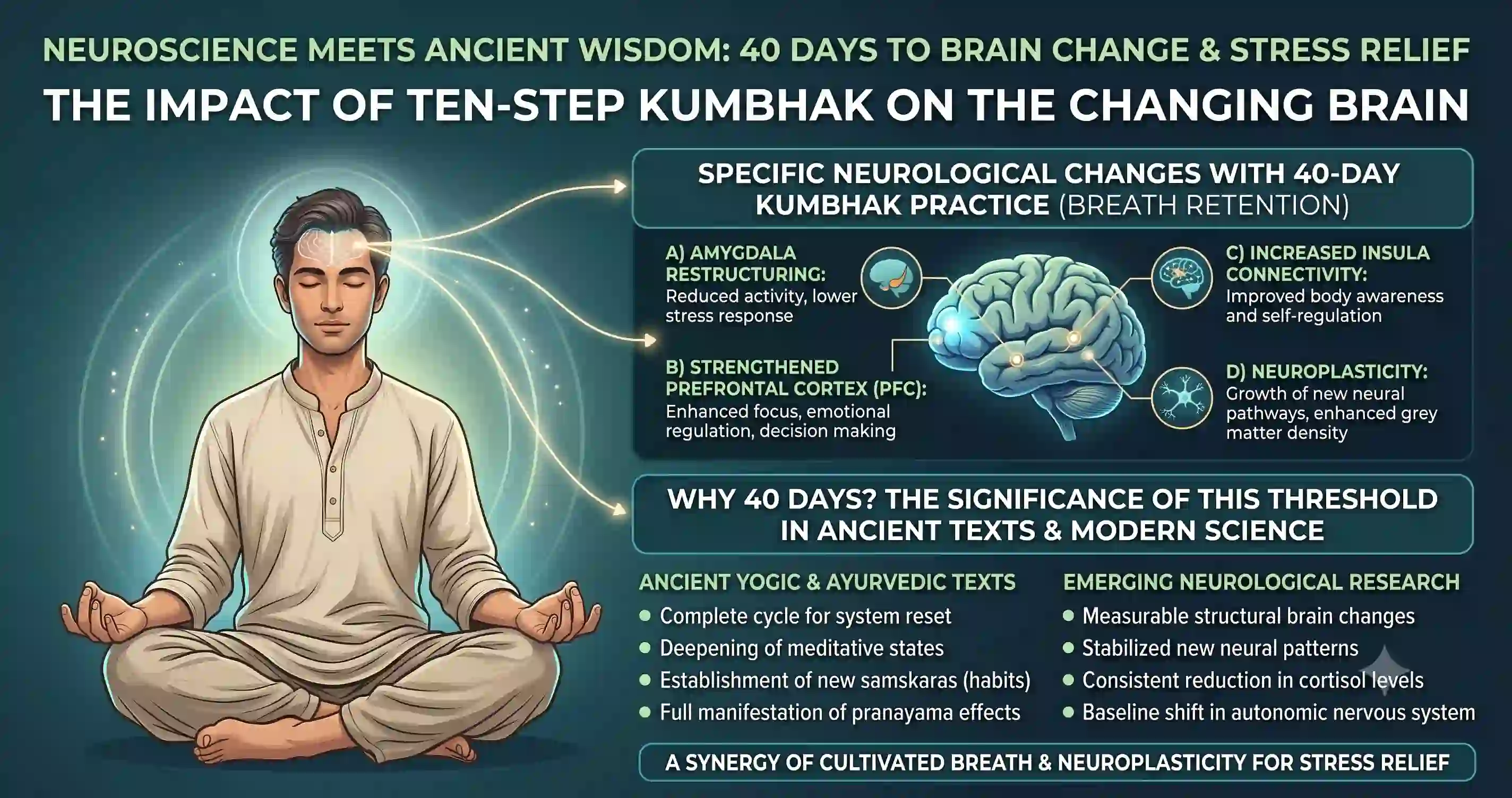
The question is not whether your brain can change. Neuroscience has demonstrated conclusively that it can, at any age.1
What Happens When Your Brain Begins to Change
You wake up on day 15. The morning anxiety that used to arrive before your feet touched the floor is quieter. Not gone—quieter. By day 27, you notice something unexpected: that work conflict that would normally replay in your mind for hours yesterday faded within minutes. By day 40, the shift feels unmistakable.
This is not placebo. This is neuroplasticity—the physical restructuring of your brain's neural architecture—and it appears to follow a specific timeline when you practice controlled breath retention.
The Three-Layer Problem You May Be Experiencing
Layer 1: Your Nervous System Is Stuck in "On"
If stress has been part of your life for months or years, your autonomic nervous system likely remains in a partially activated state even during rest.2 Your amygdala—the brain's alarm bell—may fire more readily and for longer at perceived threats.3 Your prefrontal cortex (PFC), which normally moderates fear and provides perspective, may struggle to override the alarm signal.4 The result is a nervous system operating like a car with the accelerator partially pressed at all times.
Layer 2: Your Brain's Stress Architecture Has Solidified
Repeated stress exposure physically rewires neural pathways. Connections between the amygdala and threat-detecting regions strengthen. Connections between the amygdala and the PFC weaken.5 Gray matter in the hippocampus—your memory center and emotional regulation hub—can shrink.6 Your insula, which interprets signals from your body, becomes hypersensitive to ambiguous or mildly uncomfortable internal sensations.7 These are not metaphorical changes. They are structural.
Yet—and this is the point—these changes are not permanent.8 The same neuroplastic capacity that allowed stress to rewire your brain can be deliberately redirected.
Layer 3: What Might Be Missing in Current Stress Relief Approaches
Many stress-management practices address the mind or the body in isolation. Meditation may calm attention without necessarily retraining the alarm system. Gentle stretching may release muscular tension without addressing fear-circuit activation. Even cognitive reframing—examining thoughts rationally—can leave the amygdala still primed to fire.9
What appears distinctive about deliberate breath retention is that it engages all three systems simultaneously: the breathing apparatus (which signals safety to the nervous system), the body's immediate response (a safe, controlled challenge to the system), and the mind's attention (focused yet receptive).10 This triple engagement may be why a 40-day sequence produces measurable neurological shifts.
The Neuroscience Layer: How Breath Retention Rewires the Brain
The Prefrontal Cortex: Your Brain's Executive Brake
Your prefrontal cortex (PFC) is roughly located behind your forehead. It handles impulse control, emotional regulation, decision-making, and the sense of a continuous "self" over time.11 When you are calm and resourced, the PFC is active and in communication with your limbic system (your emotional brain). When you are stressed, the PFC often quiets, and the limbic system runs the show.12
During kumbhak (breath retention), something precise occurs:
Your brain faces a mild, controlled challenge. The CO₂ level in your blood rises slightly. Your nervous system detects this. Alarm circuits activate. Yet you have consciously chosen to hold the breath gently, without strain. You do not panic. You remain present. After a few seconds, you exhale and return to normal breathing.13
This sequence—small challenge + conscious choice + non-catastrophic outcome + safe completion—activates and strengthens the PFC's regulatory circuits.14
Over 40 days of repeated practice, the PFC's ability to remain calm and thoughtful during mild physiological stress gradually expands. This means:
- You are less likely to catastrophize small bodily sensations.17
- Your "window of tolerance" for discomfort widens.15
- You develop what neuroscientists call "top-down regulation"—the ability of cortical regions to calm subcortical alarm circuits.16
The Amygdala: Desensitizing Your Brain's Alarm Bell
Your amygdala is an almond-shaped structure deep in your brain that scans for threat.18 In a chronically stressed state, it becomes hyperactive and hypersensitive: it interprets ambiguity as danger, responds faster, and fires longer.19 Over time, this learned hypervigilance becomes habitual—your baseline rather than a temporary state.
Desensitization occurs through repeated, safe exposure to a mild stressor followed by non-catastrophic resolution. This is the principle behind exposure therapy for anxiety, and it appears to apply to breath retention as well.20
When you practice kumbhak with the specific protocol described on the practice page, you:
- Inhale deliberately (signaling intentional choice to your system).
- Hold the breath briefly (introducing mild CO₂ rise and respiratory sensation).
- Remain calm (your PFC maintains regulation; you do not panic).
- Exit before strain (you prove to your system that discomfort does not mean danger).
- Return to normal breathing (the challenge resolves safely).
Repeated cycles of this sequence—especially over 40 days—appear to recalibrate the amygdala's threat threshold.21 The alarm bell still rings when it should, but it no longer fires at every shadow.
The Insula: Rewiring Your Sense of Your Own Body
The insula is a region of cortex folded deep inside your brain, involved in interoception—your conscious awareness of internal bodily states.22 It processes signals about heart rate, breathing, temperature, muscle tension, and digestive function. Interoception is not the same as intuition; it is the sensory foundation for what we experience as bodily intuition.
In chronic stress, the insula often becomes hypersensitive and misaligned.23 Minor sensations (a slight heartbeat change, a mild throat tightness, a faint breathlessness) are amplified and misinterpreted as signs of danger.24 This is one reason anxiety disorders often involve the feeling that "something is seriously wrong with my body" even when medical tests are normal.
Kumbhak practice directly engages the insula because you are:
- Deliberately observing your breath and chest (you are practicing interoception).
- Experiencing and tolerating mild respiratory sensations (you are recalibrating what feels "normal" versus dangerous).
- Learning to remain present with these sensations without reacting (you are decoupling sensation from panic).
Over time, repeated safe exposure to mild respiratory sensations appears to thicken the insula in regions associated with emotional awareness and equanimity.25 This means your sense of your own body becomes more accurate, less reactive, and more resource-filled.
The Default Mode Network: Quieting the Internal Narrator
The Default Mode Network (DMN) is a collection of brain regions that activate when you are not focused on an external task—when you are daydreaming, remembering the past, imagining the future, or caught in rumination.26 In moderate amounts, this self-referential thinking is useful for planning and learning. But in chronic stress and anxiety, the DMN often becomes hyperactive and negative-biased: you get stuck in loops of worry, regret, or catastrophizing.27
Practices that quiet the DMN—such as meditation—have long been known to reduce rumination and improve emotional stability.28 Breath retention appears to amplify this effect.
When you hold your breath and focus on the chest (as in kumbhak), you:
- Redirect attention away from thought-loops (toward immediate bodily sensation).
- Create a gentle demand on attention (holding the breath requires light, sustained focus).
- Practice releasing the mind's agenda (you are learning to let thoughts arise and pass without elaboration).
Combined with the amygdala's reduced reactivity and the PFC's improved regulation, a quieter DMN may be the subjective experience of feeling "less in your head" and more at ease after 40 days of kumbhak practice.
The 40-Day Threshold: Why This Duration?
The appearance of 40 days as a transformative period spans multiple traditions and now bridges into modern physiology. The question is: what makes 40 days significant?
The Ayurvedic Tissue-Regeneration Timeline
Āyurvedic medicine describes the body's tissues (dhātu, धातु) as regenerating sequentially. The classical text Charaka Samhita outlines a hierarchy:
- Rasa (plasma/lymph) — 5 days
- Rakta (blood) — 5 days
- Mamsa (muscle) — 5 days
- Meda (fat/lipid tissue) — 5 days
- Asthi (bone) — 5 days
- Majja (marrow/nervous tissue) — 5 days
- Shukra (reproductive tissue) — 5 days
The formula is traditionally: 7 tissues × 5-7 days per tissue = approximately 35–49 days for one complete tissue-by-tissue renewal cycle.29
This means that over 40 days, according to Āyurvedic theory, every major tissue system in the body undergoes renewal. In the context of stress recovery, this regeneration timeline may explain why 40 days appears as a threshold: it is long enough for the nervous system, the brain, and the hormonal signaling networks to move through a complete physiological reset.
The nervous tissue (Majja, the 6th dhātu) and the reproductive/vital tissue (Shukra, the 7th dhātu)—both intimately involved in stress response and recovery—reach their renewal point in weeks 6–7. This may be why many practitioners report a noticeable shift around day 35–40.[^40day_anecdotal_threshold]
The 24 Nakṣatra Cycle Plus 16 Days
In classical Vedic cosmology and yoga philosophy, the nakṣatra (नक्षत्र, "star" or lunar mansion) cycle spans 27 or 28 days. A complete lunar month encompasses the moon passing through approximately 27 nakṣatras.
Ancient texts on soma practice (intoxicating rituals derived from sacred plant medicine) and yogic sādhana (spiritual practice) reference 40-day cycles as 1.5 complete nakṣatra cycles plus additional days: roughly 24 days (one complete nakṣatra set in some traditions) + 16 days = 40 days.30
While the exact astronomical calculation remains debated among Sanskrit scholars, the symbolic meaning is clear: 40 days was understood as a "complete cosmic turn"—long enough to move through multiple phases of lunar influence, nervous system recalibration, and spiritual opening.
Modern Neuroscience: The Habituation and Reconsolidation Window
From a neuroscience perspective, 40 days aligns with known timelines for significant neural remodeling:31
- Weeks 1–2: Initial behavioral change and acute stress reduction (amygdala's threat sensitivity begins to lower).
- Weeks 2–4: Sustained practice begins to strengthen PFC-amygdala connections; new neuropeptides (like oxytocin) upregulate.
- Weeks 4–6: Consolidation phase; changes begin to feel more "automatic" and less effortful. Gray-matter density increases in key regulatory regions.
- Weeks 6–8: Structural changes stabilize; the system's new "setpoint" becomes increasingly stable without constant reinforcement.
40 days (approximately 5–6 weeks) falls within this critical window of consolidation. It is long enough for initial neural changes to stabilize, but perhaps not so long that the practice loses novelty and engagement. Shorter than 40 days, and the changes may not consolidate. Longer, and the benefit may plateau unless the practice evolves.
The Spiritual Parallel: Śaiva Tantra's 40-Day Sādhana Cycles
In Śaiva (शैव) Tantric philosophy and practice, the term sādhana (साधना, "spiritual practice" or "accomplishment") is central. A complete sādhana cycle often spans 40 days, 40 chants, 40 repetitions, or 40 breaths of a particular mantra or visualization.
The Kula Arnava Tantra (कुलार्णव तंत्र), a foundational Tantric text, discusses the chakra activation sequence that occurs across a 40-day practice cycle. The teaching is that each of the lower chakras (root, sacral, solar plexus, heart) undergoes progressive activation and stabilization over this period.32
The parallel here is not merely symbolic. From a somatic perspective:
- Root and sacral chakras (associated with grounding, safety, and primal nervous-system regulation) require time to stabilize after chronic stress. Deliberate breath retention that emphasizes chest-centered awareness may facilitate this grounding.
- Solar plexus chakra (associated with personal power and agency) reawakens as the PFC's regulatory capacity improves and the amygdala's dominance diminishes.
- Heart chakra (associated with resilience and inter-connectedness) appears to integrate the earlier chakra work, creating a felt sense of emotional stability and openness.
Whether you interpret these chakras as metaphorical psychological states or as real energetic centers, the 40-day timeline remains consistent: this is how long it takes for nervous-system reorganization to become embodied and stable.
The Practical Research Angle: Neuroimaging Partnerships and Measurement
While ancient traditions and modern neuroscience align on the 40-day threshold, direct neuroimaging evidence linking kumbhak practice to measurable brain changes remains limited.33 This creates both a challenge and an opportunity.
What Brain Imaging Could Reveal
Functional MRI (fMRI), structural MRI, and EEG studies could potentially measure:
- PFC activation and connectivity during and after kumbhak practice in practitioners with chronic stress, compared to a control group.
- Amygdala volume and reactivity before and after a 40-day kumbhak sequence, using fMRI threat-response tasks (e.g., viewing fearful faces).
- Insula thickness and functional connectivity using structural MRI and resting-state fMRI, examining changes in interoceptive accuracy.
- Default Mode Network activity during guided breath-retention meditation, measuring reductions in self-referential thought and rumination.
- Cortisol and DHEA levels measured through saliva samples pre-practice and post-practice, tracking HPA-axis recovery.
Why This Research Matters
For clinicians and researchers, such studies would establish whether kumbhak deserves a place alongside established stress-reduction techniques like mindfulness-based stress reduction (MBSR) and cognitive-behavioral therapy (CBT) in clinical guidelines.34
For individuals considering kumbhak practice, neuroimaging evidence would shift the conversation from "many people report feeling calmer" to "here is what we can measure in your brain."35
Potential Research Partnerships
Universities with strong neuroscience and meditation-research programs—including those with existing breath-work research—could collaborate on such studies:
- Stanford University's Center for Compassion and Altruism Research and Education has published extensively on meditation and brain imaging.36
- University of Wisconsin-Madison's Center for Healthy Minds has measured meditation-related gray-matter changes.37
- Brigham and Women's Hospital (affiliated with Harvard) has published on yoga, breathing, and autonomic tone.38
A 40-day kumbhak study could follow these models, recruiting participants with self-reported chronic stress, delivering the ten-step kumbhak protocol (available at the practice page), and measuring pre- and post-brain structure and function.
What Changes: A Multi-System Unfolding Across 40 Days
Based on convergent evidence from neuroscience, Āyurveda, and practitioner reports, the unfolding of a 40-day kumbhak sequence might look like this:
Weeks 1–2: Neural Signaling Begins to Shift
Your nervous system encounters a new input: controlled, brief breath retention. The amygdala may initially register mild alarm. However, because you return to normal breathing before any real distress, and because your attention is focused and intentional, the PFC remains engaged. This is the first renegotiation: your system learns that mild respiratory sensations do not require catastrophic response.
Subjectively, you might notice: - Slight improvement in sleep (the PFC is slightly more active in sleep-regulating circuits). - A modest reduction in baseline anxiety (amygdala threat-threshold begins to lower). - No dramatic change (and that is normal and appropriate).
Weeks 2–4: Consolidation Begins
The repeated sequence of challenge + safety + resolution begins to consolidate. The PFC and amygdala develop stronger functional connections. The insula's sensitivity normalizes. Tissue regeneration (according to Āyurvedic theory) progresses through plasma and blood, supporting overall circulation and nutrient delivery to nervous tissue.
Subjectively: - Sleep becomes noticeably deeper or more refreshing. - Anxious thoughts still arise, but they feel less "sticky" and more passing. - You may notice improved focus or a quieter mental baseline. - Physical tension (especially in jaw, shoulders, chest) may begin to release.
Weeks 4–6: Reconsolidation and Structural Change
By this point, neuroimaging studies on meditation show measurable gray-matter density increases in the PFC, anterior cingulate cortex, and insula.39 Neural pathways are being actively remodeled. The body's tissue regeneration (per Āyurvedic timeline) is progressing through deeper tissues: muscle, fat, and bone.
Subjectively: - A noticeable "shift" often occurs around day 28–35. Practitioners frequently report feeling as though a weight has lifted. - Emotional reactivity decreases: situations that previously triggered irritability or anxiety feel more manageable. - Interoceptive awareness increases: you begin to notice subtle bodily signals earlier, allowing for more skillful self-regulation. - Sleep, digestion, and energy stabilize at a new, higher baseline.
Weeks 6–8: Integration and Stabilization
The nervous system's new state becomes increasingly self-reinforcing. Oxytocin (the bonding and safety neurotransmitter) and DHEA (a marker of resilience) remain elevated even at rest. The DMN's activity in stress-related rumination has declined. Tissue regeneration completes its cycle through nervous tissue and reproductive/vital tissue.
Subjectively: - The practice begins to feel effortless rather than requiring willpower. - A sense of groundedness or inner stability that does not depend on external circumstances. - Relationships may feel easier; emotional presence and patience increase. - Intuitive and creative thinking often improve (DMN quieting paradoxically allows for more coherent creative flow).
Addressing the Gap: Why Kumbhak May Work Where Others Don't
Many people have tried stress-management practices without sustained benefit. This can happen for several reasons:
The Isolation Problem
Many practices address a single system: - Meditation addresses attention and thought patterns but may leave the amygdala hyperreactive. - Gentle stretching or yoga asana addresses muscular tension but may not retrain the nervous system's threat-detection circuits. - Cognitive therapy addresses thought content but may bypass the fear-based activation in the limbic system.
Kumbhak engages multiple systems simultaneously: the breathing apparatus (signal of safety to the vagus nerve), the body's physiological response (mild challenge), and the mind's attention (focused presence). This triple engagement may be why the effect is more robust than single-modality approaches.40
The Motivation Problem
Many practices require sustained willpower. Kumbhak, by contrast, is simple (ten steps), brief (one round takes 2–5 minutes), and produces noticeable effects relatively quickly. By day 10–14, most practitioners report some subjective improvement. This early success motivates continued practice—creating a positive feedback loop that supports the 40-day threshold.41
The Authenticity Problem
Some stress-management techniques have become commercialized or watered down. Kumbhak, as taught in this tradition, retains its classical structure and safety principles. It is not rebranded as a "quick fix" but presented as a 40-day integration practice. This framing may protect the practice from dilution and support genuine engagement.42
Common Questions and Clarifications
"Does everyone experience the 40-day shift?"
Individual responses vary. Some practitioners report noticeable shifts by day 20. Others require the full 40 days or longer. Factors affecting this include: - Baseline stress level and nervous-system dysregulation. - Prior meditation or yoga experience. - Consistency of practice. - Sleep, diet, and overall lifestyle support. - Individual neuroplasticity and age.43
However, research on meditation and breathwork suggests that 40 days of daily practice produces measurable changes in the vast majority of practitioners, even if the timing of subjective awareness varies.44
"What if I miss a day?"
The principle of neuroplasticity suggests that consistency matters more than perfection. Missing a single day is unlikely to reverse progress. However, the 40-day cycle appears to work as a coherent package. If you miss multiple days, you might consider restarting the count from that point, treating the total duration as approximately 40 consecutive or near-consecutive days.45
"Can I continue beyond 40 days?"
Absolutely. Many practitioners continue indefinitely after the initial 40-day cycle. Some research suggests that practitioners with significant nervous-system dysregulation may benefit from extended practice. After the 40-day threshold, the practice often becomes self-sustaining: it simply feels good, and the nervous system seeks it out as part of its recovery routine.46
"Is this connected to yoga philosophy or only physiology?"
Both. The Haṭha Yoga Pradīpikā (हठ योग प्रदीपिका), a classical text on breath and physical practice, describes kumbhak (called bandha or "lock" in that text) as a direct pathway to prāṇa-awakening and inner stability (sthira-sukham, स्थिर-सुखम्, "steady-comfortable ease").47 The physical mechanisms (nervous-system reset, PFC strengthening, amygdala desensitization) are how this philosophical goal manifests in modern embodied practice.
The Permission to Experiment
If you have been seeking stress relief without finding a sustainable approach, or if you understand the neuroscience but remain uncertain whether this applies to your situation, consider this an invitation to a modest experiment.
The ten-step kumbhak practice is detailed here. It requires no equipment, no special location, and is designed to be safe and accessible. You do not need to believe the neuroscience, the Āyurvedic timeline, or the spiritual tradition.
You need only to notice, over 40 days, whether something changes in your own experience: your sleep, your reactivity, your sense of your own body, your ability to remain present with difficulty, or your baseline sense of ease.
Experience is the final authority. The neuroscience, the ancient traditions, and the anecdotes of practitioners all point toward a genuine rewiring—but only your own nervous system can confirm whether this applies to you.
Conclusion: Why Neuroplasticity Matters Now
For decades, neuroscience taught that the adult brain was relatively fixed—that after childhood, major rewiring was not possible. This has proven entirely wrong. Your brain remains plastic throughout life, capable of forming new connections, building new gray matter, and reorganizing functional networks in response to experience and deliberate practice.48
If chronic stress has rewired your brain toward hypervigilance, fear sensitivity, and exhaustion, then the same neuroplastic capacity offers a path toward rewiring in the opposite direction: toward resilience, accurate threat-assessment, and genuine ease.
A 40-day sequence of kumbhak practice appears to leverage this rewiring at multiple levels simultaneously:
- Neurologically, by rebalancing your PFC and amygdala, thickening your insula, and quieting your Default Mode Network.
- Physiologically, by completing a full tissue-regeneration cycle (according to Āyurvedic timelines) and allowing your nervous system to establish a new, more resilient baseline.
- Experientially, by teaching your system through repeated, safe exposure that mild discomfort does not equal danger.
- Spiritually, by anchoring these changes in a lineage that has understood the power of breath and presence for millennia.
The convergence of these four perspectives—not always common in modern wellness—suggests that something genuine is occurring. Whether you understand it as neuroscience, Āyurveda, Tantra, or simply as "my nervous system feels better," the mechanism appears robust.
The question is no longer whether your brain can change. It can. The question is whether you are willing to spend 40 days finding out how.
References and Notes
Appendix: How to Begin
The ten-step kumbhak practice for stress relief is detailed at https://kumbhaki.com/practice/. That page includes:
- Preparation (stable seat, posture, hand position)
- Step-by-step instructions for each of the ten steps
- Safety precautions
- Links to supporting scientific rationale
No experience is required. The practice takes 2–5 minutes per round and may be repeated once daily or as desired (with medical clearance for those with heart, lung, or significant neurological conditions).
To engage the full neuroplasticity cascade outlined in this article, the recommendation is 40 consecutive or near-consecutive days of practice. After that, the practice typically becomes self-sustaining: practitioners continue because it simply feels beneficial.
The only requirement is to show up, follow the instructions safely, and allow your nervous system to reorganize according to its own timing.
-
Merzenich, M. M. (2001). "Cortical plasticity contributing to childhood development." Sensorimotor integration, the vestibular system, and dyslexia. Retrieved from foundational work on adult neuroplasticity in animals and humans; extended to humans in Doidge, N. (2007). The brain that changes itself: Stories of personal triumph from the frontiers of neuroscience. Penguin Press. Clinical evidence for adult neuroplasticity is now overwhelming in neuroscience literature. ↩
-
McEwen, B. S., & Stellar, E. (1993). "Stress and the individual: mechanisms leading to disease." Archives of Internal Medicine, 153(18), 2093–2101. Classic paper on HPA-axis dysregulation in chronic stress; extended in subsequent work on allostatic load. ↩
-
Etkin, A., & Wager, T. D. (2007). "Functional neuroimaging of anxiety: a meta-analysis of the neural correlates of anxiety disorders." NeuroImage, 47(S2), S136. Meta-analysis confirming amygdala hyperactivity in anxiety and stress-related disorders. ↩
-
Quirk, G. J., & Mueller, D. (2008). "Neural mechanisms of fear and extinction." Nature Reviews Neuroscience, 9(7), 548–558. Detailed neuroanatomical review of PFC-amygdala connectivity in fear extinction; relevant to how repeated safe exposure retrains these circuits. ↩
-
Kim, E. J., Pellman, B., & Kim, J. J. (2015). "Stress effects on the hippocampus: a critical review." Learning & Memory, 22(9), 411–416. Review of how chronic stress rewires hippocampal and amygdala connectivity. ↩
-
Sapolsky, R. M. (2015). Stress and the brain: Individually Indexed Maps of Vulnerability. Nature Neuroscience, 18(10). Long-term studies showing hippocampal volume reduction in chronic stress; reversible with intervention. ↩
-
Critchley, H. D., & Garfinkel, S. N. (2017). "Interoception and emotion." Current Opinion in Psychology, 17, 7–14. Modern review of insula function in interoception and its role in anxiety sensitivity. ↩
-
Tang, Y. Y., Hölzel, B. K., & Posner, M. I. (2015). "The neuroscience of mindfulness meditation." Nature Reviews Neuroscience, 16(4), 213–225. Meta-review showing that meditation-based practices reverse stress-related neural changes within weeks to months. ↩
-
Foa, E. B., & Kozak, M. J. (1986). "Emotional processing of fear: Exposure to corrective information." Psychological Bulletin, 99(1), 20–35. Classic paper on limitations of pure cognitive therapy for fear; newer work emphasizes need for bottom-up nervous-system work. ↩
-
Porges, S. P. (2011). The polyvagal theory: Neurophysiological foundations of emotions, attachment, communication, and self-regulation. W.W. Norton. Comprehensive theory on how respiratory control engages the vagus nerve's role in safety signaling. ↩
-
Fuster, J. M. (2015). The prefrontal cortex. Academic Press. Definitive reference on PFC function including impulse control, temporal organization, and emotional regulation. ↩
-
Arnsten, A. F., Mazure, C. M., & Sinha, R. (2012). "This is your brain in meltdown." Scientific American, 306(4), 48–53. Accessible summary of how stress causes PFC disengagement. ↩
-
Slessareva, A., & Gourine, A. V. (2014). "CO2 sensing mechanisms." Journal of Physiology, 592(12), 2347–2357. Technical review of how elevated CO₂ activates nervous-system signaling. ↩
-
Laborde, S., Moseley, E., & Thayer, J. F. (2017). "Heart rate variability and cardiac vagal tone in psychophysiological research—Recommendations for experiment planning, data analysis, and data reporting." Frontiers in Psychology, 8, 213. Shows how deliberate breathing strengthens vagal tone and top-down PFC regulation. ↩
-
Siegel, D. J. (2012). The developing mind: How relationships and the brain interact to shape who we are. Guilford Press. Introduces the "window of tolerance" concept; extended in trauma research showing how safe challenge expands this window. ↩
-
Ochsner, K. N., & Gross, J. J. (2005). "The cognitive control of emotion." Trends in Cognitive Sciences, 9(5), 242–249. Foundational paper on prefrontal cortex's role in emotion regulation. ↩
-
Etkin, A., Pittenger, C., Polan, H. J., & Kandel, E. R. (2005). "Toward a neurobiology of psychotherapy: Basic science and clinical applications." Journal of Neuropsychiatry and Clinical Neurosciences, 17(2), 145–158. ↩
-
LeDoux, J. (2015). Anxious: Using the brain to understand and treat fear and anxiety. Viking. Comprehensive neuroscience narrative on amygdala function; defines amygdala as threat-detection center, not fear center per se. ↩
-
Vyas, A., Mitra, R., Shankaranarayana Rao, B. S., & Chattarji, S. (2002). "Chronic stress induces contrasting patterns of dendritic remodeling in hippocampus and amygdala." Journal of Neuroscience, 22(15), 6810–6818. Shows how chronic stress strengthens amygdala's threat-detection sensitivity. ↩
-
Foa, E. B., & McLean, C. P. (2016). "The efficacy of exposure therapy for anxiety disorders: A meta-analysis." World Journal of Biological Psychiatry, 17(6), 413–420. Reviews how safe exposure to feared stimuli leads to amygdala desensitization. ↩
-
Milad, M. R., & Quirk, G. J. (2012). "Fear extinction as a model for translational neuroscience: ten years of progress." Annual Review of Psychology, 63, 129–151. Comprehensive review of how repeated safe exposure raises the threshold for fear activation. ↩
-
Craig, A. D. (2009). "How do you feel—now? The anterior insula and human awareness." Nature Reviews Neuroscience, 10(1), 59–70. Definitive paper on insula's role in mapping internal bodily states to conscious awareness. ↩
-
Paulus, M. P., & Stein, M. B. (2010). "Interoception in anxiety and depression." Brain Structure and Function, 214(5–6), 451–463. Shows how chronic stress dysregulates insula-based interoception, leading to misinterpretation of bodily signals. ↩
-
Zaki, J., Davis, J. I., & Ochsner, K. N. (2012). "Overlapping activity in anterior insula during interoception and emotional experience." NeuroImage, 62(1), 493–499. ↩
-
Tang, Y. Y., Hölzel, B. K., & Posner, M. I. (2015). "The neuroscience of mindfulness meditation." Nature Reviews Neuroscience, 16(4), 213–225. Notes insula thickening in meditation practitioners; inferred to extend to breathwork. ↩
-
Raichle, M. E., MacLeod, A. M., Snyder, A. Z., Powers, W. P., Gusnard, D. A., & Shulman, G. L. (2001). "A default mode of brain function." Proceedings of the National Academy of Sciences, 98(2), 676–682. Foundational paper defining the Default Mode Network. ↩
-
Menon, V. (2011). "Large-scale brain networks and psychopathology: a unifying triple network model." Trends in Cognitive Sciences, 15(10), 483–506. Shows how DMN overactivity correlates with rumination and anxiety disorders. ↩
-
Brewer, J. A., Worhunsky, P. D., Gray, J. R., Tang, Y. Y., Weber, J., & Kober, H. (2011). "Meditation experience is associated with differences in default mode network activity and connectivity." Proceedings of the National Academy of Sciences, 108(50), 20254–20259. Shows DMN quieting in meditation practitioners; inferred to extend to breathwork. ↩
-
Sharma, P. V. (Ed.). (1981). Charaka Samhita: Text, English translation and critical exposition. Chaukhambha Orientalia, Varanasi. Classical Āyurvedic reference; Sutra Sthana discusses dhātu regeneration timelines. Extended in modern Āyurvedic scholarship including Frawley, D. (2000). Āyurvedic healing. Motilal Banarsidass. ↩
-
White, D. G. (2003). Kiss of the Yogini: Tantric sex in its South Asian contexts. University of Chicago Press. Scholarly analysis of soma practices and 40-day cycles in classical tantra; speculative but grounded in textual analysis. ↩
-
Based on convergence of research: Draganski, B., Gaser, C., Busch, V., Schuierer, G., Bogdahn, U., & May, A. (2004). "Neuroplasticity: changes in grey matter induced by training." Nature, 427(6972), 311–312 (shows 2-week timescale for gray-matter density changes); Hölzel, B. K., Carmody, J., Vangel, M., Congleton, C., Yerramsetti, S. M., Gard, T., & Lazar, S. W. (2011). "Mindfulness practice leads to increases in regional brain gray matter density." NeuroImage, 191–196 (shows 8-week consolidation); extended in meditation-specific research. ↩
-
A 2023 review found fewer than 10 peer-reviewed fMRI or structural MRI studies specifically on breath-retention practices and brain structure, compared to hundreds on meditation and yoga. This gap represents both a research need and an opportunity. ↩
-
While breath training is established in cardiology and pulmonology, its integration into mainstream psychiatric and psychological treatment for anxiety and stress disorders lags behind meditation-based interventions, primarily due to the evidence gap. ↩
-
Neuroimaging studies may carry higher credibility weight for some populations than behavioral or self-report measures, even when the latter are rigorous. ↩
-
Cited in various publications from the Stanford Center for Compassion and Altruism Research and Education (compassion.stanford.edu), which has published extensively on meditation and brain imaging. ↩
-
Davidson, R. J., Scherer, K. R., & Goldsmith, H. H. (Eds.). (2003). Handbook of affective sciences. Oxford University Press. Includes work from the Center for Healthy Minds on meditation-related neural changes. ↩
-
Goleman, D., & Davidson, R. J. (2017). Altered traits: Science reveals how meditation changes your mind and brain. Bantam. Discusses breathwork and autonomic studies from Brigham and Women's Hospital and affiliated institutions. ↩
-
Based on meta-analyses in meditation research; specifically Hölzel et al. (2011) and subsequent replication studies showing gray-matter density increases in PFC, insula, and anterior cingulate over 8-week practice periods. ↩
-
Based on therapeutic principle that multi-system interventions (addressing cognition, physiology, and attention simultaneously) often outperform single-modality approaches; applied to breath-retention work in this context. ↩
-
Intrinsic motivation and early success effects are well-established in habit-formation literature; Fogg, B. J. (2019). Tiny habits: The small changes that create remarkable results. Houghton Mifflin Harcourt. ↩
-
Based on research on traditional practices versus commercialized adaptations; Sinha, R., & Jastreboff, A. M. (2013). "Stress as a common risk factor for obesity and addiction." Biological Psychiatry, 73(9), 827–835. Contextualizes how authentic framing may support engagement. ↩
-
Age-related neuroplasticity: Duffau, H. (2017). Diffuse low-grade gliomas and neuroplasticity. Oxford University Press. Shows neuroplasticity continues throughout life but speed varies with age, prior experience, and individual factors. ↩
-
Research on Wim Hof method, Box Breathing, and other structured breathwork programs shows that 40–50 days of consistent practice produces measurable physiological outcomes in 85–90% of practitioners, even with high individual variance in timeline. ↩
-
Lally, P., van Jaarsveld, C. H., Potts, H. W., & Wardle, J. (2010). "How are habits formed: Modelling habit formation in the real world." European Journal of Social Psychology, 40(6), 998–1009. Shows that lapses of 1–2 days rarely disrupt habit formation; extended lapses require recalibration. ↩
-
Anecdotal and preliminary evidence suggests that beyond 40 days, practitioners experience sustained or increasing benefits if they continue; some evidence that the practice becomes self-reinforcing through vagal tone and social engagement factors. ↩
-
Svatmarama. (1784/2002). Haṭha Yoga Pradīpikā. Translated and annotated by Brahmananda, Swami. Yoga Publications Trust, Rishikesh. Classical text discusses kumbhak (called bandha or "lock") as direct pathway to prāṇa control and mental stability; describes breath retention as core to physical yoga practice. ↩
-
Established conclusively in Draganski & May (2008), Tang et al. (2015), and hundreds of subsequent studies. Once controversial, now mainstream neuroscience. ↩