Learn why breath holds can trigger air hunger, panic or trauma—and why shortening, skipping or choosing no hold may be best for stress relief.
By Kumbhaki Yogi Dhruvaji (MSc), founder of the Antistress Foundation 501(c)(3)
• How to Practice Ten-Step Kumbhak • Scientific Proof • Ancient Texts Proof • Bio • Subscribe By Email
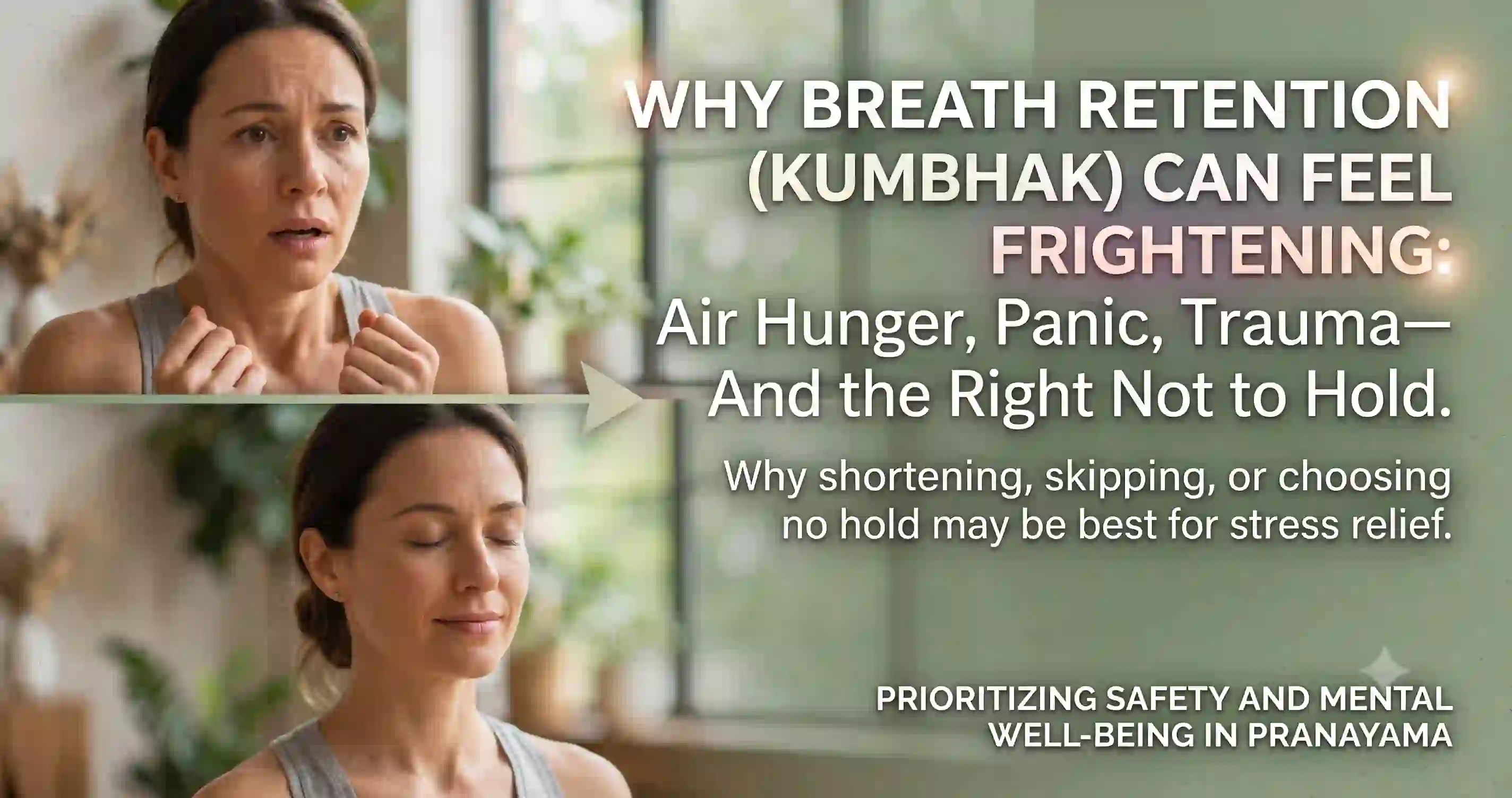
One person enters a brief Kumbhak and feels a quiet space open inside.
Another person enters the same pause and feels a door lock.
The chest becomes conspicuous. The next breath suddenly feels far away. A thought flashes—What if I cannot breathe?—and the body answers before reason can: heartbeat rising, muscles bracing, attention narrowing around the throat.
Nothing about that response is weak, irrational or spiritually deficient. Air hunger is one of the body’s most primal protective sensations. Panic can attach catastrophic meaning to it. Trauma can make it resemble a danger that once was real. Asthma, choking, drowning, smoke, restraint, respiratory illness, an intensive-care mask or other frightening experiences may all change what a breath pause means to one particular nervous system.
For stress relief, that meaning matters.
If Kumbhak creates fear, the first task is not to conquer the hold. It is to restore choice.
This article explains why breath retention can feel frightening, how to distinguish manageable sensation from a clear stop signal, why the revised 1–3-second reserve is more inclusive than a fixed target, and why choosing no hold at all can be the most intelligent decision.
It does not teach the Ten-Step Kumbhak sequence. For the complete method, preparation and safeguards, read How to Practice the Ten-Step Kumbhak for Stress Relief.
The Most Important Answer First 🫁
Why does holding the breath feel scary?
Breath retention can feel frightening for four overlapping reasons:
- Air hunger: carbon dioxide rises, oxygen may eventually fall, and respiratory drive becomes more noticeable.
- Panic sensitivity: the person fears the sensation or interprets it as suffocation, collapse or loss of control.
- Trauma association: the bodily cue resembles an earlier event in which breathing, escape or bodily control was threatened.
- A present medical problem: breathlessness, chest tightness or dizziness may come from a respiratory, cardiovascular, neurological or other condition rather than from anxiety alone.
Sometimes more than one is present. A person with asthma may also fear another attack. A survivor of choking may also have panic disorder. Someone who has never had either may simply dislike the unmistakable command to breathe.
The American Thoracic Society defines breathing discomfort as a subjective experience shaped by physiological, psychological, social and environmental factors.1 Therefore, the person having the experience—not a teacher, stopwatch or group—has the final authority to say that it is too much.
The non-negotiable boundary
For the Ten-Step Kumbhak for Stress Relief:
- A retention is not successful merely because it lasts.
- The first practice goal is ease, not duration.
- The hold ends before the breath feels as though it is running out.
- The practitioner should still feel certain that another 1–3 seconds would have remained completely comfortable.
- That 1–3 seconds is a reserve, not a required retention length and not a countdown.
- If even a very brief pause does not feel easy, the correct duration is zero seconds.
This revised range matters. A rule saying “keep three seconds in reserve” may still feel impossible to someone who cannot comfortably retain the breath for three seconds in total. A 1–3-second reserve respects differences in respiratory health, anxiety sensitivity, trauma history, age, familiarity and the conditions of that particular day.
The reserve is felt, not proved. If you are unsure whether you still have it, the hold has already gone far enough.
Choosing not to hold is not failing Kumbhak
The honest choices are not “succeed” or “fail.” They are:
- retain briefly and comfortably;
- shorten the retention;
- skip one of the two retentions;
- omit all retention and return to normal breathing;
- choose a different stress-relief practice;
- seek appropriate professional support before deciding whether to try again.
Kumbhak is a voluntary practice. The capacity to say no, not now or not this method is part of safety.
Scientific Truth: What Air Hunger Actually Is 🔬
Air hunger is an urge—not simply an empty-air tank
Researchers define air hunger as the uncomfortable or unpleasant urge to breathe. It is the familiar sensation that grows toward the end of a long breath hold.2
During a closed-airway Kumbhak:
- the body continues producing carbon dioxide;
- carbon dioxide begins accumulating because ventilation has paused;
- oxygen continues being used and may fall as the hold continues;
- chemoreceptors and respiratory-control networks increase the drive to breathe;
- the brain receives an increasingly strong command for ventilation while no breath is occurring.
Air hunger is therefore better understood as a mismatch: respiratory drive is asking for ventilation, but ventilation is temporarily absent. Carbon dioxide is an important part of that drive, while oxygen, acidity, lung volume, chest mechanics, attention and emotion also contribute.1
This corrects two common misunderstandings:
- Feeling an urge to breathe does not automatically mean the body has reached a dangerous oxygen level.
- Not feeling a strong urge does not guarantee that oxygen is safe—especially after hyperventilation, which can suppress the carbon-dioxide warning and increase blackout risk.
Air hunger is protective information, but it is not a home oxygen monitor.
Why the sensation can feel emotionally enormous
Air hunger does more than produce a neutral body signal. Brain-imaging research links it with the insular cortex and limbic regions involved in homeostatic awareness, anxiety and fear.2 That helps explain why respiratory discomfort can feel urgent in a way that a tired arm or mildly stretched muscle may not.
Breathing is life-preserving and mostly automatic. When it is voluntarily stopped, the conscious mind temporarily stands in the path of an automatic survival function. For some people, that feels interesting. For others, it feels like violating a deep biological contract.
A tiny sensation can then carry a vast message:
I am trapped. Something is wrong. I must get out now.
The message is real as an experience even when the brief pause itself has not become medically dangerous.
Air hunger, breathing effort and chest tightness are different
“Breathlessness” is not one single sensation. Respiratory science distinguishes at least:
- air hunger: needing or wanting more air;
- work or effort: breathing feels physically laborious;
- chest tightness: a constricted feeling often associated with airway narrowing, including asthma.
A person may use the word suffocating for any of them. This is why a teacher should not answer every report of discomfort with “That is only carbon dioxide.” It may not be.
New wheezing, persistent chest tightness, unusual effort, illness-related breathlessness or difficulty breathing during ordinary activity deserves medical attention—not a motivational speech about tolerance.
Why Bāhya Kumbhak may feel more exposed
In Antar Kumbhak, the pause follows Pūrak, with the lungs comfortably full. In Bāhya Kumbhak, the pause follows Rechak, with the lungs comfortably empty.
Bāhya Kumbhak can feel more vulnerable for some people because:
- it begins at a lower lung volume;
- there is less sensation of air being “available” inside;
- lung expansion is not providing the same mechanical feedback;
- the next Pūrak may feel psychologically farther away;
- the imagery of “empty lungs” can itself activate fear.
This does not mean everyone will find Bāhya Kumbhak harder, nor does it establish a universal safety ranking. It means the two retentions are not emotionally interchangeable. A person may be comfortable with one and not the other.
How Air Hunger Can Become a Panic Loop ⚡
The body signal is followed by a meaning
Panic often develops through a rapid loop:
- Sensation: pressure, warmth, heartbeat, stillness or an urge to breathe appears.
- Interpretation: “I am suffocating,” “I will faint,” or “I cannot escape.”
- Alarm: fear increases autonomic activation and muscular bracing.
- Magnification: the throat, chest and heartbeat become even more noticeable.
- Escape: the person gasps, abandons the practice or leaves.
- Learning: the mind records, “The hold was dangerous; I survived because I escaped.”
The next attempt may begin with fear before Kumbhak has even started. This is anticipatory anxiety: the memory of the previous alarm becomes a new trigger.
Research supports the relevance of respiratory cues in panic disorder. In one laboratory study, 40 people with panic disorder and 32 controls completed breath-holding and carbon-dioxide rebreathing challenges. The panic-disorder group showed greater physiological reactivity and stronger suffocation sensations during the carbon-dioxide challenge.3
That study does not mean every frightened practitioner has panic disorder. It shows why “just hold” is poor advice for someone whose alarm system is especially responsive to respiratory sensations.
Fear of fear can become stronger than the hold
Once a person has panicked during Kumbhak, the feared object may no longer be breath retention itself. It may be:
- the possibility of another panic attack;
- embarrassment in front of a class;
- being unable to follow the teacher;
- dizziness or tingling;
- losing control of the body;
- disappointing oneself;
- feeling trapped by a count;
- being told that stopping means weakness.
This is why reassurance alone sometimes fails. Saying “You have enough air” addresses oxygen, while the person may be frightened of helplessness, shame, memory or loss of choice.
The more useful question is:
“What exactly felt dangerous—the physical urge, the meaning you gave it, a memory, the teacher’s count, or not feeling free to stop?”
That question makes room for the real problem.
Panic sensations are real; panic is not the only explanation
Anxiety can create or amplify shortness of breath, dizziness, palpitations, tingling, chest discomfort and feelings of unreality. Yet those symptoms can also occur in medical conditions.
Do not assume “it is only panic” when symptoms are:
- new, unexplained or increasing;
- present at rest or during ordinary activity;
- accompanied by wheezing, fever, persistent cough or swelling;
- associated with chest pain, fainting, blue or grey lips, confusion or severe breathlessness;
- different from the person’s familiar anxiety pattern.
Clinical evaluation is how medical and psychological possibilities are distinguished. Kumbhak is not a diagnostic test.
Trauma: When the Body Recognises an Old Danger 🧠
Trauma memory may arrive as a sensation
Trauma is not recalled only through words and pictures. A present sensation can resemble one that accompanied an earlier threat.
A breath pause may echo:
- choking on food or another object;
- an asthma attack;
- drowning or being held underwater;
- smoke inhalation or a fire;
- strangulation, assault or restraint;
- being unable to call for help;
- an operation, intubation, oxygen mask or intensive-care experience;
- a serious respiratory infection;
- confinement in a crowded or airless place;
- witnessing another person struggle to breathe.
The practitioner may consciously remember the event—or may only feel a sudden surge of terror, numbness, nausea, constriction or the need to flee.
Two people can therefore perform the same physical pause while undergoing entirely different psychological events. One is exploring stillness. The other is meeting a sensory reminder of powerlessness.
The directly relevant PTSD trial cannot be ignored
A 2023 pragmatic randomised trial studied 74 adults with post-traumatic stress disorder. One group received trauma-focused cognitive behavioural therapy alone; the other added a Prāṇāyāma programme that included breathing techniques, Kumbhak and Jālandhara Bandha.4
The most important findings for this article are:
- the primary intention-to-treat analysis found no significant advantage for adding the Prāṇāyāma programme;
- nine participants reported 20 minor but recurrent adverse events during or after Prāṇāyāma;
- reported events included anxiety, breathlessness, dizziness and feelings of constriction;
- one participant withdrew after a suffocation flashback during breath retention;
- the subgroup with recurrent adverse events had worse outcomes on some measures than controls.
This was not the Ten-Step Kumbhak for Stress Relief, and its results cannot be transferred directly to every Kumbhak method. Its retention was paired with other techniques and was continued until a reflex prevailed over volition—very different from stopping with an easy 1–3-second reserve.
Still, the trial proves an indispensable point: for some trauma survivors, breath retention can be a trigger rather than a stabiliser.
Relaxation itself can sometimes increase distress
The US National Center for PTSD notes that relaxation methods can initially increase distress in some people when attention turns toward disturbing physical sensations or contact with the outside world decreases.5 This is especially relevant to eyes-closed, inwardly focused breathing in which the person feels expected to remain still.
Possible trauma responses include:
- fight: irritation, anger, pushing the body or arguing internally with the urge;
- flight: opening the eyes, leaving, gasping or needing to move;
- freeze: feeling unable to end the hold even when afraid;
- fawn: continuing because the teacher or group seems to expect it;
- dissociation: numbness, distance from the body, dreamlike unreality or lost time.
Stillness is not always calm. Compliance is not always consent. Silence in a class is not evidence that everyone feels safe.
Choice changes the meaning of the sensation
Trauma often involved loss of control. A breathing instruction can unintentionally repeat that pattern if:
- the count determines when the person is “allowed” to breathe;
- the teacher blocks modification;
- the class praises endurance;
- stopping attracts attention or shame;
- the person is told to surrender, push through or defeat fear.
Trauma-informed care emphasises safety, collaboration, empowerment, voice and choice.6 Applied to Kumbhak, this means:
- permission to stop must be explicit;
- stopping must be physically possible at any instant;
- no explanation is required;
- observing without participating must be acceptable;
- eyes may remain open;
- a person may change posture or leave;
- no one’s retention time should be public.
Choice does not merely make the practice kinder. For someone whose fear centres on being trapped, choice changes the stimulus itself.
The Choice Not to Hold: A Complete Stress-Relief Decision 🌿
When no hold is the best option
Choose normal breathing without retention when:
- the idea of holding already produces dread;
- even a momentary pause causes air hunger, panic, constriction or traumatic recall;
- you feel pressured by a teacher, partner, group or timer;
- you are currently unwell or unusually breathless;
- you are in an unsafe setting;
- the practice repeatedly leaves you more activated afterward;
- you cannot remain sure of an easy 1–3-second reserve;
- a healthcare professional has advised against breath retention;
- you simply do not want to hold.
“I do not want to” is a sufficient reason. A wellness practice does not gain consent merely because it may help other people.
No hold does not mean no path
Someone who chooses not to retain can:
- allow normal breathing to continue without controlling it;
- sit with eyes open and orient to the room;
- feel the support of the chair and floor;
- place attention on external sound rather than internal respiration;
- use movement, walking, music or muscle relaxation;
- work with a qualified mental-health professional if panic or trauma is involved;
- revisit the question later—or never revisit it.
Research does not show that retention is required for every stress-relief benefit. In a randomised trial of brief daily practices, several breathwork and mindfulness groups improved mood, while the clearest average benefit favoured an exhale-focused method that did not depend on a long Kumbhak.7 In another active-controlled trial of 200 adults, hyperventilation with long retention was not superior to normal-rate breathing with brief pauses for reducing stress.8
These studies do not invalidate Kumbhak. They remove the false claim that a person must retain the breath to deserve relief.
The revised 1–3-second reserve in plain language
The reserve principle means:
End Antar Kumbhak or Bāhya Kumbhak while you are still certain that you could have remained there comfortably for another 1–3 seconds.
It does not mean:
- hold until only 1–3 seconds remain before a desperate breath;
- estimate the moment of oxygen danger;
- make the retention at least three seconds;
- wait for a strong urge and then count;
- add one second each day;
- compete with an earlier round;
- use a timer to overrule the body.
For someone with very limited capacity, the “hold” may be nearly instantaneous. For someone who cannot retain at all without distress, it is omitted. The purpose of reserve is to protect ease—not to create a smaller endurance test.
For the reasoning behind this boundary, read Why You Should Never Hold Your Breath to the Limit in Kumbhak.
A hold that ends in a gasp went too far for this purpose
For stress relief, the next Pūrak or Rechak should not feel like rescue from an emergency. Warning signs that the dose exceeded its purpose include:
- gasping or grabbing at the next breath;
- tightening the jaw, throat, chest, shoulders or abdomen;
- silently bargaining for “one more second”;
- counting down in fear;
- losing the central chest focus because urgency takes over;
- dizziness, tingling, visual change or confusion;
- a pounding or irregular heartbeat;
- panic, dissociation or traumatic imagery;
- relief so intense that the pause felt like entrapment.
The answer is not to prove that you can tolerate the same duration tomorrow. It is to shorten, omit or reconsider the practice.
A Vertical Safety Guide: Green, Amber and Red 🚦
Green: the pause remains completely easy
- You freely chose to begin.
- Face, jaw, throat, chest, shoulders, abdomen and legs remain relaxed.
- Attention stays clear.
- You remain certain of a comfortable 1–3-second reserve.
- Ending the hold requires no gasp or rescue breath.
- You feel settled, neutral or simply observant afterward.
Decision: End early anyway. Return to normal breathing. Judge the effect after the round, not by seconds achieved.
Amber: fear or effort begins to enter
- Attention narrows around the throat or chest.
- The next breath begins to feel urgent.
- You start bracing, bargaining or counting.
- A memory, image or sense of entrapment appears.
- You are unsure whether the reserve remains.
- You want to stop but worry about disappointing someone.
Decision: End the retention immediately. Return to normal breathing. Open the eyes, orient to the room and choose whether to omit further holds.
Amber is not a zone in which to continue until red. It is the exit.
Red: stop the practice
- Panic, a flashback or dissociation appears.
- You become dizzy, faint, confused or uncoordinated.
- Vision greys, narrows or changes.
- Chest pain, severe pressure or a concerning palpitation occurs.
- You experience unusual or persistent breathlessness.
- The lips or skin become blue or grey.
- You lose consciousness.
Decision: Stop. Seek appropriate medical help for severe, persistent or unusual symptoms. Loss of consciousness, severe breathlessness, blue or grey colouring, confusion, fainting or breathlessness with chest pain requires urgent medical evaluation.9
What a Trauma-Sensitive Kumbhak Teacher Should Do 🤝
Ask about choice before teaching endurance
A teacher does not need a student’s trauma story. The relevant questions are smaller:
- “Would you like to try a brief retention, continue with normal breathing or observe?”
- “Do respiratory sensations ever feel frightening for you?”
- “Would keeping your eyes open or sitting near the door help?”
- “If you stop, would you prefer quiet space or support?”
The student controls how much to disclose. A teacher is not entitled to personal history in exchange for modification.
Use language that keeps the exit visible
Helpful language includes:
“You may end the pause at any moment.”
“Keep an easy 1–3-second reserve; if that is not possible, do not hold.”
“Normal breathing is always available.”
“A neutral or uncomfortable response is as valid to report as a calming one.”
“You do not need to explain why you are opting out.”
Avoid:
- “Everyone can manage this.”
- “The discomfort means it is working.”
- “Your ego is resisting.”
- “Stay with it until I count you out.”
- “You are safe” when you have not assessed the person or setting.
- “It is only carbon dioxide.”
- “Do not let fear win.”
The last phrase turns self-protection into defeat. A person can choose not to hold without being ruled by fear.
Never turn the class into a public breath-hold test
Do not:
- compare retention times;
- ask who lasted longest;
- praise visible endurance;
- require everyone to begin or end together;
- stand over a distressed person;
- touch someone without permission;
- interpret silence as comfort;
- ask for trauma disclosure in front of the group.
A class contains different lungs, histories, medications, diagnoses and meanings. Uniform timing can create the appearance of togetherness while erasing those differences.
Do not disguise exposure therapy as Kumbhak
In cognitive behavioural treatment for panic disorder, interoceptive exposure may deliberately evoke feared sensations so that they can be re-evaluated. Breath holding has been used in that therapeutic context.10
That does not mean a yoga teacher should tell a panicking student to remain in respiratory distress. Therapeutic exposure has:
- a clinical purpose;
- informed consent;
- assessment and formulation;
- a planned dose;
- monitoring;
- a way to process what happened;
- adaptation when the intervention destabilises the person.
Kumbhak for stress relief is not an improvised treatment for panic disorder or PTSD. If the goal changes from stress relief to treating a clinical fear, the scope of practice changes too.
What the Kumbhak Research Can—and Cannot—Promise 📚
Retention-containing practices may help, but the hold is rarely isolated
Several studies report reduced stress, anxiety or related symptoms after breathing programmes containing Kumbhak. Yet these programmes often combine:
- altered respiratory rhythm;
- nostril control;
- focused attention;
- meditation;
- instruction and teacher contact;
- expectation;
- daily time away from stress;
- Pūrak and Rechak changes;
- one or more retentions.
When all components change together, the study cannot show that Kumbhak caused the benefit.
This matters for a frightened reader. Evidence for a complete breathing programme is not evidence that overriding fear during retention will produce more calm.
More retention is not more stress relief
Research offers no reliable dose-response rule in which longer holds create greater emotional benefit. Long or maximal apnoea can markedly alter blood pressure, cerebral circulation, oxygen, carbon dioxide and vascular responses. Those demanding exposures are not models for stress-relief Kumbhak.
The meaningful outcome is not:
How many seconds did I defeat?
It is:
Did this voluntary, submaximal practice leave my system more settled without producing concerning symptoms?
A short easy pause, no pause, or a different method may serve that purpose better on a particular day.
Why “train your carbon-dioxide tolerance” is incomplete advice
Familiarity with respiratory sensations may reduce unnecessary alarm for some people. But “CO₂ tolerance” can become a misleading slogan because:
- air hunger is not produced by carbon dioxide alone;
- longer tolerance does not prove better mental health;
- a timer cannot show oxygen level;
- panic and trauma concern meaning as well as chemistry;
- medical breathlessness needs assessment;
- forcing the sensation can strengthen fear rather than weaken it.
Tolerance is useful only when it develops inside safety, choice and appropriate context.
Yogic Truth: Classical Yoga Warns Against Force 🕉️
Patañjali describes precision, not a contest
Yoga Sūtra 2.49 describes Prāṇāyāma through interruption or regulation of the movements of the incoming and outgoing breath. Sūtra 2.50 then identifies external, internal and suspended aspects, observed through place, time and number, becoming extended and subtle.11
The wording is important. The classical frame is not “hold for as long as possible.” It is disciplined observation of type, context, duration and count. In a stress-relief application, the individual’s response belongs inside that observation.
Subtlety is lost when the face hardens, the mind panics and the next breath becomes a rescue.
The Haṭha Yoga Pradīpikā makes appropriateness central
Haṭha Yoga Pradīpikā 2.15 compares the breath to a lion, elephant or tiger that must be brought under control progressively; otherwise, it warns, the practice harms the practitioner.12
Verse 2.18 repeats the word yuktam—appropriately, fitly or skilfully—through all three respiratory phases:
yuktaṃ yuktaṃ tyajed vāyuṃ yuktaṃ yuktaṃ ca pūrayet
yuktaṃ yuktaṃ ca badhnīyād evaṃ siddhim avāpnuyāt
A concise rendering is:
Perform Rechak appropriately, Pūrak appropriately and Kumbhak appropriately; in this way, success is attained.
The verse does not celebrate a dramatic number. Its repeated word is appropriate.
For a person whose body associates retention with suffocation, appropriateness may mean one nearly momentary pause. It may mean omitting Bāhya Kumbhak. It may mean no Kumbhak. Traditional seriousness is not the same as force.
Yogic depth does not require denying the nervous system
Yoga may understand Kumbhak as more than respiratory chemistry: a stilling of movement, a refinement of Prāṇa and a doorway toward inward steadiness. Those possibilities should not be used to argue with fear.
If a doorway resembles a place where someone was once trapped, wisdom does not push from behind. It restores the person’s hand to the handle.
Ayurvedic Truth: Breath, Mind and Fear Belong to One Living System 🌿
The traditional Prāṇa Vāta connection
In Aṣṭāṅga Hṛdaya, Sūtrasthāna 12.4–5, Prāṇa Vāta is described as moving through the head, chest and throat, supporting the heart, mind, sense faculties and functions that include inspiration.13
Charaka Saṃhitā, Sūtrasthāna 12.8, describes balanced Vāta as governing movement, mental activity and the senses; aggravated Vāta is associated in the same passage with disturbance of mind, fear and grief.14
Within this classical Ayurvedic lens, it is coherent that:
- breath disturbance and fear may influence each other;
- throat, chest, attention and emotion should not be treated as unrelated parts;
- a practice intended to settle the person should not provoke more agitation;
- appropriateness depends on the individual and the present state, not on a universal count.
What this does not scientifically prove
These Ayurvedic descriptions are traditional models. Modern research has not established that panic during Kumbhak is caused by “aggravated Prāṇa Vāta,” nor that an Ayurvedic explanation replaces medical or psychological assessment.
The value of the Ayurvedic view here is interpretive: it refuses to separate breath from mind and the whole person. Its language should not be turned into a biomedical diagnosis or a guaranteed treatment claim.
When to Seek Professional Guidance 🩺
Speak with a healthcare professional before retention
Individual guidance is especially important if you have:
- heart, lung or cerebrovascular disease;
- uncontrolled blood pressure;
- asthma that is not well controlled;
- a history of fainting, seizures or unexplained blackouts;
- pregnancy-related concerns;
- recent surgery;
- glaucoma or retinal concerns;
- panic attacks, PTSD, dissociation or suffocation-related trauma;
- unexplained breathlessness;
- medication or substance effects that alter alertness, blood pressure or respiration.
This list is conservative because safety evidence for every diagnosis and every Kumbhak dose is limited.
Seek urgent care for emergency warning signs
Do not label severe symptoms “air hunger” and wait them out. Obtain urgent medical help for:
- severe or sudden breathing difficulty;
- breathlessness with chest pain or pressure;
- fainting or loss of consciousness;
- blue or grey lips, skin or nails;
- confusion or altered alertness;
- difficulty speaking because of breathlessness;
- a serious allergic reaction or airway obstruction;
- persistent neurological symptoms;
- symptoms that remain severe after normal breathing resumes.
Unexpected breathing difficulty can have many causes and may be a medical emergency.9
Frequently Asked Questions About Fear During Breath Retention ❓
Why do I panic when I hold my breath?
You may be reacting to rising respiratory drive, to the meaning you attach to chest or throat sensations, to a prior panic episode, to trauma, or to a medical breathing problem. The reaction does not reveal a character flaw. End the hold, return to normal breathing and seek assessment if episodes are severe, recurrent or unexplained.
Is air hunger dangerous?
Air hunger is a protective sensation, not a diagnosis. A brief urge can occur before dangerous oxygen depletion, but the feeling cannot verify oxygen safety. Strong, unusual or persistent symptoms should not be ignored. Never use hyperventilation to delay the urge, and never practise breath holding in water, while driving or where loss of consciousness could cause injury.
Should I push through air hunger to become less afraid?
Not in a stress-relief practice. Pushing through can intensify panic or reinforce a sense of entrapment. Clinical exposure to feared sensations is different and should be planned with an appropriately qualified professional.
Can breath retention trigger a trauma response?
Yes, it can for some people. Respiratory sensations may resemble suffocation, choking, drowning, restraint, asthma, intensive-care treatment or another frightening event. A PTSD trial documented anxiety, breathlessness, constriction, dizziness and one suffocation flashback during a retention-containing Prāṇāyāma programme.4
What if I can hold for only one or two seconds?
There is no minimum duration to prove. End while the pause remains completely easy and you still sense a 1–3-second comfortable reserve. If that reserve is impossible, do not hold.
Is the 1–3-second reserve the same as counting down?
No. It is a subjective safety margin, not a timed challenge. You end before urgency, while confident that a little completely comfortable capacity remained.
Can I skip only Bāhya Kumbhak?
Yes. Some people find the post-Rechak pause more threatening than the post-Pūrak pause. You may modify, omit either retention or omit both. If you later choose to learn the complete method, use the Ten-Step Kumbhak practice article and stay within its safeguards.
Can I practise Kumbhak if I have panic disorder or PTSD?
Not as a self-test. Discuss it with a qualified healthcare or mental-health professional who understands your history, particularly if respiratory sensations trigger panic, flashbacks or dissociation. A hold-free practice may be more appropriate.
Does stopping reinforce fear?
Stopping an unplanned wellness exercise is not the same as avoiding clinician-guided exposure therapy. Restoring choice may be necessary before any safe learning can occur. If fear is restricting daily life, work with a qualified therapist rather than using longer Kumbhak as self-treatment.
What should a teacher do if a student panics?
End the retention cue, encourage normal breathing, reduce attention from the group, give physical space, avoid uninvited touch, and help the person orient to the present environment. Do not demand an explanation. Seek medical help for severe, unfamiliar or persistent symptoms.
The Deepest Measure of Kumbhak Is Not Time 🌌
A frightened body is not an obstacle to be defeated. It is a body communicating in the language it learned when breathing once felt uncertain, painful, restricted or beyond its control.
Sometimes the message is ordinary air hunger.
Sometimes it is panic saying, This sensation means catastrophe.
Sometimes it is trauma saying, I have been here before.
Sometimes it is illness asking to be assessed.
The wise response begins by listening closely enough to tell the difference.
Kumbhak for stress relief should never make worth depend on withholding the next breath. End the pause with an easy 1–3-second reserve. Shorten it without embarrassment. Omit either retention. Choose no hold. Choose another practice. Ask for help.
The freedom to breathe is not outside the practice. For some people, it is the first condition that makes practice possible.
References and Verification Notes 📖
Medical note: This article is educational and is not a diagnosis, treatment plan or substitute for personalised care. Evidence specific to the Ten-Step Kumbhak for Stress Relief remains limited; findings from other Prāṇāyāma, Kumbhak, panic and trauma studies are used only to clarify relevant mechanisms and safety considerations.
-
Parshall MB, Schwartzstein RM, Adams L, et al. “An Official American Thoracic Society Statement: Update on the Mechanisms, Assessment, and Management of Dyspnea.” American Journal of Respiratory and Critical Care Medicine. 2012;185(4):435–452. Full text via PubMed Central. ↩↩
-
Banzett RB, Lansing RW, Binks AP. “Air Hunger: A Primal Sensation and a Primary Element of Dyspnea.” Comprehensive Physiology. 2021;11(2):1449–1483. Full text via PubMed Central. ↩↩
-
Rassovsky Y, Abrams K, Kushner MG. “Suffocation and respiratory responses to carbon dioxide and breath holding challenges in individuals with panic disorder.” Journal of Psychosomatic Research. 2006;60(3):291–298. PubMed record. ↩
-
Haller H, Mitzinger D, Cramer H. “The integration of yoga breathing techniques in cognitive behavioral therapy for post-traumatic stress disorder: A pragmatic randomized controlled trial.” Frontiers in Psychiatry. 2023;14:1101046. Full text · PubMed record. ↩↩
-
US Department of Veterans Affairs, National Center for PTSD. “Coping with Traumatic Stress Reactions.” The guidance notes that relaxation can initially increase distress for some people when focus turns inward. Read the guidance. ↩
-
Substance Abuse and Mental Health Services Administration. “Trauma-Informed Approaches and Programs.” The principles include safety, trustworthiness, collaboration, and empowerment, voice and choice. Read the SAMHSA guidance. ↩
-
Balban MY, Neri E, Kogon MM, et al. “Brief structured respiration practices enhance mood and reduce physiological arousal.” Cell Reports Medicine. 2023;4(1):100895. Full text via PubMed Central. ↩
-
Fincham GW, Epel E, Colasanti A, Strauss C, Cavanagh K. “Effects of brief remote high ventilation breathwork with retention on mental health and wellbeing: a randomised placebo-controlled trial.” Scientific Reports. 2024;14:16893. Full text via PubMed Central · PubMed record. ↩
-
US National Library of Medicine. “Breathing Difficulties—First Aid.” MedlinePlus Medical Encyclopedia. ↩↩
-
Lee K, Noda Y, Nakano Y, et al. “Interoceptive hypersensitivity and interoceptive exposure in patients with panic disorder: specificity and effectiveness.” BMC Psychiatry. 2006;6:32. Full text via PubMed Central. ↩
-
Patañjali, Yoga Sūtra 2.49–2.50. Verified Sanskrit for 2.50: bāhyābhyantarastambhavṛttirdeśakālasaṃkhyābhiḥ paridṛṣṭo dīrghasūkṣmaḥ. Sanskrit and translation · 2.49–2.51 comparative study. ↩
-
Svātmārāma, Haṭha Yoga Pradīpikā 2.15 and 2.18. The linked edition provides Sanskrit, transliteration, translation and a caution against excess force. Scanned Sanskrit-English edition, pp. 57–59. ↩
-
Vāgbhaṭa, Aṣṭāṅga Hṛdaya, Sūtrasthāna 12.4–5. Sanskrit and English translation. ↩
-
Charaka Saṃhitā, Sūtrasthāna 12.8. The passage describes balanced and aggravated Vāta and includes mental activity, fear and grief. Sanskrit and English translation. ↩