Explore how comfortable Kumbhak may support clear Sattva, purposeful Rajas and restorative Tamas through Yoga, Ayurveda and cautious modern science.
Kumbhak and the Three Gunas: A Comprehensive Treatise on Sattva, Rajas and Tamas Balance in Daily Life
By Kumbhaki Yogi Dhruvaji (MSc), founder of the Antistress Foundation 501(c)(3)
• How to Practice Ten-Step Kumbhak • Scientific Proof • Ancient Texts Proof • Bio • Subscribe
At 6:28 one morning, a woman sat beside a cup of tea that had already gone cold. Her eyes were open, but starting the day felt like lifting a door swollen by rain.
At 1:13 that afternoon, the same woman had seventeen browser tabs open. She reread a blunt message from a colleague, composed three replies, deleted all three and still felt as if she had to answer now.
At 10:54 that night, her body wanted sleep while her mind continued the meeting without her colleagues. It invented better replies, predicted tomorrow’s problems and mistook rehearsal for protection.
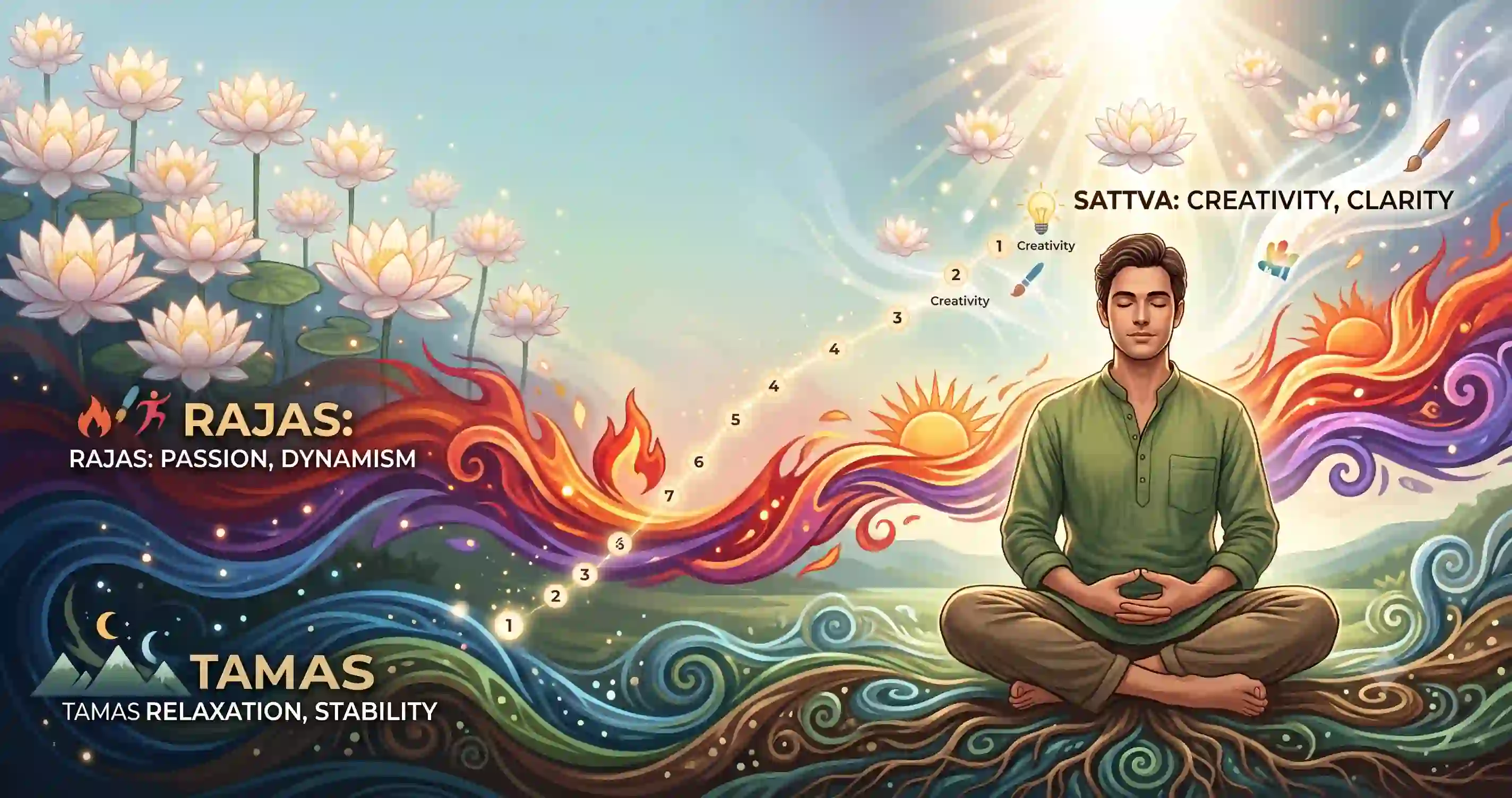
Nothing supernatural had happened. She had moved through three recognisable human conditions: heaviness, overactivation and the possibility of clear proportion. Classical Indian thought calls these qualities Tamas, Rajas and Sattva.
Kumbhak does not promise to erase any of them. Nor should it. We need Tamas to sleep, Rajas to act and Sattva to see clearly enough to know when action or rest is appropriate.
What a completely comfortable breath pause may offer is smaller—and more believable: an interruption in which an automatic state can become observable before it becomes behaviour.
That interval can matter. It may be the difference between fatigue and self-condemnation, urgency and an impulsive reply, wakeful rumination and a decision to let the day end.
The aim is not three equal portions of Sattva, Rajas and Tamas. The aim is the right quality, in the right proportion, for the reality of the moment.
This article explains that proposition from classical Yoga, Sāṅkhya, Ayurveda, respiratory physiology, psychology and ordinary life—without asking the reader to adopt a religion and without disguising traditional ideas as medical facts.
The Most Important Answer First 🧭
There is currently no clinical test for Sattva, Rajas or Tamas, and no trial has shown that the exact Ten-Step Kumbhak for Stress Relief “balances the three Gunas.” Anyone claiming that a breath hold has been scientifically proven to increase Sattva or remove Tamas is converting a traditional framework into a laboratory claim that has never been tested.
There is, however, a responsible and useful case for placing them together:
- The three-Guna framework describes changing qualities of clarity, activation and inertia.
- A voluntary breath pause is a real physiological event. Carbon dioxide rises, oxygen may eventually fall, circulation and blood pressure change, and attention is drawn toward the body.
- Some breathing routines that include Kumbhak have improved stress, anxiety, mindfulness, mind-wandering, response inhibition or cardiovascular measures in small studies.
- Those studies usually combine retention with breathing rhythm, posture, attention, nostril control or daily quiet time. They rarely isolate Kumbhak.
- A comfortable pause may therefore be used as a state-recognition and response-choice practice. This is plausible and testable in personal experience, but it is not the same as proving a Guna-changing biological mechanism.
The strongest formulation is also the most practical:
Kumbhak may help a person notice excessive Tamas before sinking further, excessive Rajas before reacting and available Sattva before noise covers it again. The next action—not the pause alone—completes the rebalancing.
A vertical guide to the three qualities
When Tamas is useful 🌙
- Sleep
- Physical stillness
- Recovery after effort
- Stability and patience
- Ending activity when enough has been done
When Tamas exceeds the moment 🪨
- Avoidance
- Mental fog
- Repeated postponement
- Numb disengagement
- Remaining inactive when a necessary action is possible
When Rajas is useful 🔥
- Beginning a task
- Protecting a boundary
- Pursuing a meaningful goal
- Moving the body
- Responding to a real demand
When Rajas exceeds the moment ⚡
- Compulsive task-switching
- Irritable urgency
- Anxiety-driven checking
- Inability to disengage
- Activity that continues after usefulness has ended
When Sattva is present 🔆
- Facts can be separated from assumptions
- Energy is proportionate to the task
- Rest does not become avoidance
- Action does not become compulsion
- The next useful step is easier to see
This vertical format matters conceptually as well as visually: the Gunas are not boxes placed side by side. They are qualities that mix, overtake and support one another.
What Sattva, Rajas and Tamas Actually Mean 🧵
The Sanskrit word Guṇa can mean a quality, attribute or strand. In classical Sāṅkhya, the three Gunas are constituents of Prakṛti—manifest nature. A non-religious reader can use them more modestly as a vocabulary for the changing texture of experience.
Sattva is associated with illumination, lucidity and balance. Rajas is associated with movement, activation and restlessness. Tamas is associated with restraint, heaviness and obscuration.
These are not personality diagnoses. “I am a Rajasic person” is usually less useful than “Rajas is prominent in this response.” The first hardens identity; the second keeps change possible.
Sāṅkhya Kārikā 12: the Gunas continually affect one another
One of the most precise early formulations appears in Sāṅkhya Kārikā 12:
Devanāgarī
प्रीत्यप्रीतिविषादात्मकाः प्रकाशप्रवृत्तिनियमार्थाः ।
अन्योन्याभिभवाश्रयजननमिथुनवृत्तयश्च गुणाः ॥ १२ ॥IAST
prīty-aprīti-viṣādātmakāḥ prakāśa-pravṛtti-niyamārthāḥ /
anyonyābhibhavāśraya-janana-mithuna-vṛttayaś ca guṇāḥAccessible translation
“The Gunas have the character of pleasure, pain and dullness; their functions are illumination, activity and restraint. They overcome, support, generate and accompany one another.”1
The last sentence prevents an enormous misunderstanding. The three qualities are mutually active, not sealed compartments.
- Healthy Tamas can support Sattva by giving the brain enough sleep to think clearly.
- Purposeful Rajas can support Sattva by carrying a clear decision into action.
- Sattva can govern Rajas by giving drive a worthy direction.
- Sattva can govern Tamas by allowing rest without denial or collapse.
- Excess Rajas can end in Tamas: overwork becomes exhaustion.
- Excess Tamas can provoke desperate Rajas: long avoidance becomes last-minute panic.
Balance therefore means coordination, not equality.
The Bhagavad Gītā describes state, motive and discernment—not fixed identity
The Bhagavad Gītā gives memorable portraits of the Gunas. Verse 14.17 associates Sattva with knowledge, Rajas with grasping and Tamas with negligence, delusion and lack of knowledge.2 Read psychologically, the verse asks a practical question: What does this state produce in perception and conduct?
Chapter 18 makes the question even sharper by describing three forms of buddhi—discernment:
Sattvic discernment knows engagement and withdrawal, what should and should not be done, what warrants fear and what does not, and what binds or frees.
Rajasic discernment understands what should and should not be done inaccurately.
Tamasic discernment, covered by obscurity, reverses values and sees things contrary to what they are.
— Bhagavad Gītā 18.30–18.32, condensed from the Sanskrit3
This is far more useful than a colour-coded lifestyle quiz. It turns Guna observation into questions that belong in a kitchen, office, hospital corridor or difficult conversation:
- Do I know whether action or withdrawal is needed?
- Is the danger present, remembered or imagined?
- Am I evaluating the task clearly, or is urgency bending my judgement?
- Am I calling avoidance “rest”?
- Am I calling compulsion “commitment”?
Kumbhak cannot answer these questions for us. It may create a quieter condition in which we can answer them with less automaticity.
Balance is not permanent Sattva
A permanently calm, luminous state is not a realistic wellness target. Human regulation is dynamic.
The clear mind still mobilises Rajas to lift a child, finish a proposal, protest an injustice or leave an unsafe room. The same clear mind welcomes Tamas when tissue repair, sleep, grief or temporary withdrawal is appropriate.
Sattva is not the absence of movement and weight. It is the quality by which movement and weight become proportionate.
Think of a railway control room at night. Freight must move; tracks must sometimes close for repair; signals must remain clear enough to prevent both collision and paralysis. Rajas is not the crash, and Tamas is not the abandoned station. Disaster comes when motion, stopping and clear signalling lose coordination.
Kumbhak is not the whole railway. At its best, it is one deliberate red signal: a brief stop that permits the controller to see which train should move next.
What “Guna Balance” Can Mean Without Religion 🔬
The Gunas belong to a philosophical system. Sympathetic nerves, carbon dioxide, cortisol, heart-rate variability and cognitive inhibition belong to modern empirical disciplines. Treating them as exact synonyms weakens both.
The safest bridge is functional analogy.
Tamas is not a diagnosis of hypoarousal, depression or low ATP
Tamas may resemble low activation, reduced initiative or obscured thinking. But it is not a measured nervous-system state. Clinical depression, anaemia, hypothyroidism, infection, medication effects, sleep disorders and many other conditions can produce fatigue or fog. Calling all of them “Tamas” may delay appropriate care.
Likewise, no study has established “low cellular ATP” as the biological signature of Tamas. ATP production cannot be inferred from procrastination or morning heaviness, and ordinary Kumbhak has not been shown to increase mitochondrial ATP production.
Use Tamas as a descriptive lens, not a biochemical verdict.
Rajas is not identical to sympathetic activity, cortisol or hypertension
Rajas may resemble mobilised attention, restless drive or threat-focused urgency. Yet sympathetic activation is often useful and sometimes lifesaving. Cortisol follows a daily rhythm and performs essential functions; it is not simply a “stress toxin.” Blood pressure changes from moment to moment for many reasons.
No direct study has shown that one comfortable Kumbhak lowers cortisol. In fact, extreme apnoea can be physiologically stressful. A person may subjectively feel less rushed after a practice without a measured hormone change.
Use Rajas to describe the quality and proportionality of activation, not to diagnose an endocrine or cardiovascular disorder.
Sattva is not “parasympathetic dominance” or a high-HRV score
Sattva may resemble clear attention, emotional proportionality and behavioural flexibility. That does not make it equivalent to vagal tone, a particular EEG band or one heart-rate-variability value.
High HRV can be favourable in context, but HRV depends on age, health, posture, respiratory pattern, measurement method and many other variables. More is not universally better. Nor should healthy clarity be reduced to permanent parasympathetic dominance. A flexible organism can mobilise when needed and recover when the demand ends.
If a wearable reports a beautiful number while behaviour remains dishonest, avoidant or impulsive, the number is not Sattva.
A more defensible modern translation
For day-to-day reflection—not diagnosis—the following translation is useful:
Excess Tamas: too little available activation or too much obscuration for the present task.
Excess Rajas: more activation, urgency or friction than the present task requires.
Available Sattva: enough clarity and flexibility to choose an appropriate amount of action or rest.
That model leaves room for ancient insight without pretending that a Sanskrit category has been discovered inside a brain scan.
The Scientific Evidence Closest to the Question 📊
Science has not measured Guna balance. It can, however, investigate processes relevant to it: stress, anxiety, attention, response inhibition, mind-wandering, cardiovascular regulation and the immediate physiology of breath retention.
The evidence becomes much clearer when it is sorted by what was actually tested.
Evidence level 1: direct Kumbhak or voluntary breath-hold physiology
These studies place the pause itself near the centre of the experiment.
- In trained healthy men, a one-minute Antar Kumbhak altered middle cerebral artery flow velocities. This supports an acute cerebrovascular effect, not improved intelligence or “brain detoxification.”4
- In another direct study, three one-minute Kumbhak attempts increased systolic, diastolic and mean arterial pressure and peripheral resistance during the hold, while stroke volume and cardiac output fell. This directly contradicts the claim that every Kumbhak automatically lowers blood pressure or activates “rest and digest.”5
- Laboratory breath-hold research shows rising carbon dioxide and blood pressure contribute to changing cerebral blood flow during apnoea.6
What this level supports: Kumbhak is physiologically active.
What it does not support: that every acute change is beneficial, or that a long laboratory hold represents the Ten-Step practice.
Evidence level 2: breathing routines that contain Kumbhak
These are more relevant to stress relief, but they cannot tell us whether the pause caused the outcome.
- In 36 yoga-trained adults, a four-phase practice containing Pūrak, Antar Kumbhak, Rechak and Bāhya Kumbhak improved response inhibition after one session—but breath awareness improved it too.7
- In a randomised study of 116 young adult yoga practitioners, adding an intermittent-retention practice for eight weeks produced greater improvements in reported mindfulness, mind-wandering and anxiety than regular yoga alone. The population was already experienced, and the study did not establish efficacy for clinical anxiety or for the Ten-Step method.8
- A 12-week alternate-nostril routine containing Kumbhak reduced perceived stress in healthy young men. Rhythm, nostril alternation, attention, time away from demands and expectation could all have contributed.9
- A tiny seven-day pilot of a retention-containing alternate-nostril routine produced a signal consistent with reduced sympathetic arousal, but only eleven people participated.10
- A cardiovascular study of four-phase breathing found changes in heart rate, stroke volume, cardiac output, baroreflex sensitivity and HRV. The HRV results were mixed rather than a simple story of “vagal dominance.”11
What this level supports: structured breathing that includes comfortable pauses may help some psychological and autonomic outcomes.
What it does not support: retention as the sole active ingredient.
Evidence level 3: breathwork in general
A 2023 meta-analysis of randomised controlled trials found that breathwork was associated with lower self-reported stress than control conditions, with promising results for anxiety and depression. The authors also warned about risk of bias, small samples and the need for better safety reporting.12
In a separate randomised trial, five minutes of daily breathwork improved mood across several methods. The clearest average benefit favoured an exhale-emphasised method that did not depend on extended retention.13
A later placebo-controlled study of 200 healthy adults found that a high-ventilation method with long holds was not better for stress than a credible comparison using normal-rate breathing and brief pauses.14
What this level supports: taking regular time for structured breathing can be useful.
What it does not support: “more retention is better.”
The honest evidence verdict
Established acute physiology ✅
- Carbon dioxide rises during a closed-airway hold.
- Oxygen can fall if the hold continues.
- Cerebral and cardiovascular haemodynamics change.
- The direction and size of change depend on the protocol, lung volume, prior breathing, duration, effort and the person.
Promising but not retention-specific 🟡
- Reduced perceived stress
- Reduced state anxiety
- Improved mindfulness or reduced mind-wandering
- Improved response inhibition
- Changes in baroreflex and HRV measures
Plausible personal application 🧩
- A comfortable pause may interrupt an urge long enough for observation.
- Repeated practice may build familiarity with manageable internal sensations.
- The full routine may become a reliable transition between tasks or phases of the day.
Not established ❌
- Increasing Sattva as a biological substance
- Removing Rajas or Tamas from the nervous system
- Permanently increasing vagal tone
- Directly lowering cortisol
- Quieting the default-mode network
- Increasing ATP production
- Clearing lymphatic stagnation
- Balancing endocrine output
- Treating depression, anxiety disorders, hypertension, insomnia or fatigue
The absence of proof for those claims does not make traditional language worthless. It tells us where interpretation ends and measurement begins.
How the Pause Works: The Physiology Without the Mythology ⚙️
Kumbhak is sometimes presented as if pressing “pause” on breathing presses “calm” on the brain. The body is more intelligent—and more complicated—than that.
1. Carbon dioxide rises, but it is not a universal neural sedative
Metabolism continues during Kumbhak. Cells consume oxygen and produce carbon dioxide. Because no fresh air is moving through the airway, arterial carbon dioxide tends to rise as the hold continues.
That rise:
- contributes strongly to the urge to breathe;
- stimulates central and peripheral chemoreceptors;
- can widen cerebral blood vessels;
- changes acid–base chemistry;
- and makes internal respiratory sensation increasingly difficult to ignore.
This does not justify calling CO₂ a harmless “natural sedative.” A modest, brief rise during a comfortable hold is not the same exposure as marked hypercapnia. Higher levels can produce headache, anxiety, confusion, impaired judgement and loss of consciousness.
The Bohr effect is also frequently overstated. Increased CO₂ and reduced pH can reduce haemoglobin’s affinity for oxygen, helping oxygen unloading in tissues. That real physiological principle does not prove that ordinary Kumbhak “floods the brain with oxygen” or immediately cures Tamasic fog.
2. Oxygen may fall—and a stopwatch cannot reveal the internal dose
How quickly oxygen falls depends on starting lung volume, metabolic demand, preceding breathing, health, training and hold duration. Two people holding for the same time may experience very different blood gases.
The Ten-Step method’s purpose is not to manufacture hypoxia. A pause can be meaningful while it is still completely easy. Chasing oxygen deprivation in the name of clarity is self-contradictory: confusion and faintness are not Sattva.
3. Cerebral blood flow may rise as compensation, not enhancement
Rising CO₂ is a strong cerebral vasodilator. Studies have found increased middle cerebral artery flow velocity during Kumbhak and longer apnoea. The most careful interpretation is that circulation is helping defend oxygen delivery during a respiratory interruption.
More flow does not automatically mean more intelligence, memory, neural growth or cleansing. A fire engine arriving faster during smoke exposure shows a protective response; it does not prove that adding smoke improves the building.
4. Cardiovascular effects vary across phases
Reduced-frequency breathing routines can improve baroreflex sensitivity and alter HRV. During a sufficiently long closed-airway hold, however, vasoconstriction and changing chest pressures may raise arterial pressure.
Both can be true:
- a complete breathing session may leave some people with a lower heart rate or blood pressure afterward;
- the retention phase itself may temporarily increase cardiovascular load.
This is why “Kumbhak stimulates the vagus nerve” is inadequate as a complete mechanism. The vagus is not simply squeezed by a full chest, and Bāhya Kumbhak does not guarantee a slower heart rate. Autonomic responses depend on timing, intensity, lung volume, pressure, preparation and the person.
5. Attention is redirected toward interoception
The most immediately relevant mechanism for Guna self-regulation may be attentional rather than exotic.
During a comfortable pause, breathing no longer runs unnoticed in the background. The practitioner can notice:
- the first hint of urgency;
- a shoulder trying to rise;
- the jaw wanting to brace;
- the impulse to turn a comfortable practice into a test;
- and the relief that arrives when the pause ends normally.
This is interoception: perception of the body’s internal condition.
Practised within safety, the sequence may teach a modest lesson: a sensation can arise without receiving an immediate, exaggerated reaction. That lesson is relevant to Rajasic urgency. It may also help a Tamasic person detect heaviness as a state rather than a permanent identity.
Yet breathlessness can be frightening for people with panic or suffocation-related trauma. A PTSD trial of a retention-containing programme reported anxiety, breathlessness, dizziness, constriction and a suffocation-related flashback in one participant.15 For some nervous systems, removing the hold is wiser than trying to conquer the reaction.
6. The routine creates a behavioural boundary
Not every benefit must come from blood gases.
Sitting down, closing the mouth, maintaining one attentional focus, completing a defined sequence and taking recovery breaths create a boundary around a moment. Notifications are not being answered. Arguments are not being continued. Avoidance is not being disguised as endless planning.
The behaviour says: before I continue, I will find out what state I am continuing from.
That may be one of the least dramatic and most useful explanations for why a complete Kumbhak routine can support daily balance.
The Yogic View: Why Still Breath and Steady Mind Belong Together 🕉️
Yoga does not begin from blood gases. It begins from lived observation: breath, attention, emotion and mental movement repeatedly affect one another.
The traditional account should be heard in its own language before being translated into modern physiology.
Yoga Sūtra 2.49: Prāṇāyāma begins with an interruption
Patañjali defines Prāṇāyāma after the establishment of a steady posture:
Devanāgarī
तस्मिन् सति श्वासप्रश्वासयोर्गतिविच्छेदः प्राणायामः ॥ २.४९ ॥IAST
tasmin sati śvāsa-praśvāsayor gati-vicchedaḥ prāṇāyāmaḥAccessible translation
“That being established, Prāṇāyāma is the interruption of the movement of inhalation and exhalation.”16
The key word is viccheda: interruption, severance or break. This does not prove that every Prāṇāyāma is identical to Kumbhak, but it confirms that respiratory interruption belongs near the centre of Patañjali’s definition.
For daily life, the implication is profound. A reactive loop usually feels continuous:
trigger → interpretation → bodily activation → urge → action → consequence
Kumbhak inserts an observable interval into another normally continuous loop. Yoga’s insight is not merely “breathe differently.” It is: what appears automatic can be interrupted and studied.
Yoga Sūtra 2.52–2.53: less covering, greater fitness for concentration
Patañjali next states:
Devanāgarī
ततः क्षीयते प्रकाशावरणम् ॥ २.५२ ॥
धारणासु च योग्यता मनसः ॥ २.५३ ॥IAST
tataḥ kṣīyate prakāśāvaraṇam
dhāraṇāsu ca yogyatā manasaḥAccessible translation
“From that, the covering over illumination is thinned; and the mind becomes fit for concentration.”17
This is one of the strongest traditional bridges to Sattva. Sattva is associated with prakāśa—illumination or revealing light. The Sūtra does not use modern terms such as prefrontal activation or neural coherence. Its claim belongs to contemplative psychology: properly cultivated Prāṇāyāma reduces what covers clarity and prepares the mind for dhāraṇā, sustained placement of attention.
Scientific studies of response inhibition, mindfulness and mind-wandering are relevant neighbours to this claim. They are not proof that Patañjali’s “covering” has been measured.
Haṭha Yoga Pradīpikā 2.2: moving breath, moving mind
The Haṭha Yoga Pradīpikā states:
Devanāgarī
चले वाते चलं चित्तं निश्चले निश्चलं भवेत् ।
योगी स्थाणुत्वमाप्नोति ततो वायुं निरोधयेत् ॥ २.२ ॥IAST
cale vāte calaṁ cittaṁ niścale niścalaṁ bhavet /
yogī sthāṇutvam āpnoti tato vāyuṁ nirodhayetAccessible translation
“When the breath-energy moves, the mind moves; when it becomes still, the mind becomes still. Therefore the practitioner restrains the breath-energy and attains steadiness.”18
The verse records a practice-based association between respiratory movement and mental movement. Modern physiology can study cardiorespiratory coupling and attention, but the verse’s vāyu and citta should not be replaced casually with “vagus nerve” and “brain.” Those are different explanatory languages.
Haṭha Yoga Pradīpikā 2.6: Sattva is also the manner of practice
An especially relevant verse is often missed:
Devanāgarī
प्राणायामं ततः कुर्यान्नित्यं सात्त्विकया धिया ।
यथा सुषुम्णानाडीस्था मलाः शुद्धिं प्रयान्ति च ॥ २.६ ॥IAST
prāṇāyāmaṁ tataḥ kuryān nityaṁ sāttvikayā dhiyā /
yathā suṣumṇā-nāḍī-sthā malāḥ śuddhiṁ prayānti caAccessible translation
“One should therefore practise Prāṇāyāma regularly with Sattvic understanding, so that the impurities situated in Suṣumṇā Nāḍī move toward purification.”19
The text does not say, “perform a Rajasic struggle to obtain Sattva later.” It places Sattva in the quality of attention used during practice.
That has direct meaning for the Ten-Step Kumbhak:
- competition is not Sattvic;
- forcing a longer hold is not Sattvic;
- ignoring discomfort is not Sattvic;
- pretending to feel calm is not Sattvic;
- observing a neutral or unsuitable response honestly can be Sattvic.
Sattva is therefore not merely a hoped-for result. It is expressed through accurate perception, restraint and non-coercive practice.
The traditional hypothesis: Prāṇa, Nāḍī and the clearing of obstruction
In Haṭha Yoga, Kumbhak is explained through Prāṇa, Vāyu, Nāḍī, Suṣumṇā, mental steadiness and the removal of mala or obstruction.
Within that model:
- Rajas agitates and disperses the mind’s movement.
- Tamas obscures, weighs down or blocks awareness.
- Sattva reveals and steadies.
- Kumbhak restrains the ordinary outward movement of Prāṇa.
- When Prāṇa is steadied and obstruction is reduced, the mind becomes more capable of one-pointed attention.
This traditional mechanism has not been scientifically verified as an anatomical energy-channel process. Nāḍīs should not be relabelled as nerves, fascia or blood vessels without evidence. Yet the model remains meaningful as a precise map of internal practice: scattered activation, obscuring heaviness and revealing steadiness are experiences practitioners can examine.
Antar Kumbhak and Bāhya Kumbhak are complementary, not a crude up/down switch
It is tempting to announce that Antar Kumbhak always energises Tamas and Bāhya Kumbhak always calms Rajas. The supplied drafts make versions of that claim, but neither classical interpretation nor modern physiology supports such certainty.
Antar Kumbhak and Bāhya Kumbhak begin at different lung volumes and create different mechanical and chemical conditions. Individual responses vary. A post-exhale pause may feel quiet to one person and threatening to another. A post-inhale pause may feel spacious to one and pressurised to another.
The Ten-Step method’s use of both pauses can be interpreted as an education in two forms of stillness: stillness while full and stillness while empty. It should not be converted into an unverified prescription that one pause treats a particular Guna.
The chest centre and Bhairavī Dhyāna Mudra: a traditional attentional frame
The Ten-Step method maintains attention at the centre of the chest and uses Bhairavī Dhyāna Mudra. Traditionally, the heart region is a major contemplative centre and Anāhata is associated with inner awareness, balance and integration.
For a secular reader, the chest centre can also be understood as a consistent attentional anchor—a place where respiratory movement, emotion and muscular bracing are often easy to notice. The Mudra can function as a stable boundary for the hands and a repeated cue that the practice has begun.
Neither claim requires declaring Anāhata a scientifically detected organ. Readers who want the full reasoning can explore why the Ten-Step method focuses on the centre of the chest and why Bhairavī Dhyāna Mudra is maintained.
The Ayurvedic View: Mental Doṣas, Sattva and Right Proportion 🌿
Ayurveda offers a broader account than “Kumbhak changes the nervous system.” It considers mind, body, habits, senses, food, sleep, conduct, environment and discernment together.
That breadth prevents a breath technique from being asked to do the work of an entire life.
Charaka Saṁhitā 1.57: Rajas and Tamas are the mind’s two Doṣas
The Charaka Saṁhitā states:
Devanāgarī
वायुः पित्तं कफश्चोक्तः शारीरो दोषसङ्ग्रहः ।
मानसः पुनरुद्दिष्टो रजश्च तम एव च ॥ १.५७ ॥IAST
vāyuḥ pittaṁ kaphaś coktaḥ śārīro doṣa-saṅgrahaḥ /
mānasaḥ punar uddiṣṭau rajaś ca tama eva caAccessible translation
“Vāyu, Pitta and Kapha are described as the bodily Doṣas; Rajas and Tamas are identified as those of the mind.”20
In this framework, Sattva is not listed as a mental Doṣa. It represents the clearer quality that Rajas and Tamas disturb or cover.
“Doṣa” here should not be translated casually as a modern disease entity. It is a traditional category of disturbance and susceptibility.
Charaka Saṁhitā 1.58: breath practice is not the entire treatment of mind
The next verse is equally important:
Devanāgarī
प्रशाम्यत्यौषधैः पूर्वो दैवयुक्तिव्यपाश्रयैः ।
मानसो ज्ञानविज्ञानधैर्यस्मृतिसमाधिभिः ॥ १.५८ ॥IAST
praśāmyaty auṣadhaiḥ pūrvo daiva-yukti-vyapāśrayaiḥ /
mānaso jñāna-vijñāna-dhairya-smṛti-samādhibhiḥAccessible translation
“The former are pacified through appropriate therapies; the mental ones through knowledge, discriminative understanding, steadiness, memory and concentration.”21
The list is strikingly comprehensive:
- Jñāna: knowledge of self and context
- Vijñāna: discriminative or applied understanding
- Dhairya: courage, steadiness or the capacity not to collapse under difficulty
- Smṛti: memory of what is true, learned and valued
- Samādhi: collected attention or deep integration
Kumbhak may support the conditions for steadiness and collected attention. It cannot replace knowledge, memory, ethical judgement, medical treatment, sleep or corrective action.
Charaka Saṁhitā, Śārīra Sthāna 4.36: mind and body influence one another
Charaka describes the mind as Sattvic, Rajasic or Tamasic in innumerable mixtures and explicitly says that body follows mind and mind follows body.22
This traditional statement explains why Ayurveda would not isolate mental balance from daily physiology.
A Rajasic pattern may be intensified by hunger, pain, overstimulation, conflict or inadequate sleep. A Tamasic pattern may be intensified by illness, immobility, excess sleep, unsuitable food or grief. Sattvic clarity may be supported by adequate nourishment, suitable movement, good company, truthful conduct and appropriate sensory input.
Kumbhak enters this network as one influence—not a sovereign cure.
The relation between Gunas and Vāta, Pitta and Kapha
The Gunas and Doṣas should not be collapsed into one another. They describe different traditional layers.
Still, Ayurveda’s qualities create useful affinities:
Tamas and Kapha—an affinity, not an identity 🪨
Kapha is classically described with qualities such as heavy, stable, cool, soft and unctuous.23 In excess, some of these can resemble Tamasic heaviness, congestion or resistance to movement. Yet healthy Kapha supplies structure, endurance, lubrication and emotional steadiness. Tamas is not “bad Kapha,” and every tired person does not have Kapha imbalance.
Rajas with Vāta and Pitta—two different affinities 🔥🌬️
Vāta’s mobility can resemble the scattering, speed and instability of Rajas. Pitta’s heat and sharpness can resemble its intensity, competitiveness and irritability.24 But healthy Vāta enables movement and communication; healthy Pitta supports digestion, discrimination and transformation. Rajas is not a medical synonym for either Doṣa.
Sattva and Doṣa equilibrium—clarity with physiological proportion 🔆
Ayurvedic interpretation often associates a clearer mind with Doṣas functioning in appropriate proportion. This does not mean a person must possess a perfect constitution to experience Sattva. It means physical disturbance can colour mental clarity, and mental disturbance can influence the body.
These are authentic traditional correspondences. They have not been validated as biomedical mappings.
Mandāgni, heaviness and Tamas: the full traditional view
Mandāgni means diminished or dull digestive capacity within Ayurveda. Traditionally, it may be inferred from patterns such as heaviness after eating, reduced appetite, delayed digestion, coating and the production of Āma, a concept of incompletely processed material that can obstruct channels.
Ayurvedic reasoning may associate Mandāgni, excess Kapha and Tamas because all can share qualities of heaviness, dullness and reduced transformation.
How might Kumbhak be understood traditionally?
- By gathering attention, it may reduce distracted or emotionally driven eating.
- By creating a pause before behaviour, it may help a person notice whether hunger is physical, habitual or stress-driven.
- Through Prāṇāyāma’s traditional regulation of Prāṇa and Samāna, it may be regarded as supportive of digestive coordination.
- By reducing mental agitation in some practitioners, it may indirectly support more regular meals and better awareness of satiety.
What cannot be claimed scientifically: that the exact Ten-Step Kumbhak has been shown to increase digestive enzymes, treat gastroparesis, remove Āma or cure Mandāgni.
Persistent appetite change, abdominal pain, vomiting, unexplained weight change, black or bloody stool, severe bloating or altered bowel habits require appropriate medical assessment.
Lymphatic “stagnation” and internal pressure: a hypothesis with limits
Respiration does influence pressures around the thoracic duct, and an exploratory ultrasound study found that respiratory phase and body position affected its diameter.25 This supports the general statement that breathing mechanics participate in lymph return.
It does not show that Kumbhak flushes lymph, removes toxins or treats lymphoedema. The Ten-Step method also does not instruct forceful abdominal or diaphragmatic pumping. Claims that its retentions “squeeze stagnant lymph out of the body” go beyond both the method and the evidence.
Within traditional language, “stagnation” may still describe a felt sense of heaviness or obstruction. Scientifically, it should not be presented as a measured lymphatic diagnosis.
Sattvāvajaya: directing the mind away from what is unwholesome
Charaka defines Sattvāvajaya as restraining or redirecting the mind from unwholesome objects.26 It is often discussed as Ayurveda’s mind-directed therapeutic approach.
Kumbhak may support Sattvāvajaya by making an urge visible. But visibility is not victory.
After the practice:
- the phone may still need to be put away;
- the harmful conversation may still need a boundary;
- the lie may still need correction;
- the delayed task may still need a first step;
- the distressed mind may still need professional care.
Ayurveda’s view is behavioural and ethical as well as contemplative. Calmness that never changes conduct is incomplete.
Ayurveda itself warns against excessive obstruction of breath
Charaka’s discussion of misuse of bodily activity includes prāṇoparodha—harmful or excessive obstruction of the breath—among actions that distress the body.27
The Haṭha Yoga Pradīpikā uses the image of gradually training powerful animals and warns that improper Prāṇāyāma can produce harm.28
These sources make an important traditional point: force is not proof of depth.
A completely easy Kumbhak performed within the Ten-Step safeguards is not the same as excessive breath obstruction. But the line is crossed when discomfort becomes a goal, warning signs are ignored or duration becomes a measure of worth.
Tamas in Daily Life: Rest, Inertia, Fog and the Need to Begin 🪨
Tamas is often insulted as laziness. That is too shallow.
At its healthy end, Tamas gives weight, continuity, containment and sleep. Without it, the mind could not disengage and the body could not settle into repair. At its excessive end, the same capacity for stopping becomes difficulty starting; the same protection from stimulation becomes numb withdrawal; the same weight that stabilises becomes a burden.
Psychological signs of excess Tamas
- Apathy: “I know it matters, but I cannot feel the reason to move.”
- Avolition: difficulty converting intention into initiation
- Brain fog: thoughts feel indistinct, delayed or difficult to hold
- Chronic postponement: tomorrow becomes a hiding place
- Learned helplessness: effort is abandoned before present conditions are tested
- Emotional numbing: reduced contact with both pain and interest
- Passive consumption: scrolling, watching or eating continues without satisfaction
- Avoidant sleep: bed becomes escape rather than restoration
These signs may also occur in depression, burnout, grief, sleep deprivation, ADHD, medication effects and physical illness. The Guna vocabulary must not be used to dismiss suffering as a character flaw.
Behavioural signs of excess Tamas
- Messages remain unanswered because opening them feels heavier each day.
- Small maintenance tasks accumulate until the environment itself begins to accuse.
- Decisions are avoided, then made by default.
- The person researches how to begin instead of beginning.
- Rest does not restore because it is mixed with guilt and unfinished threat.
- Help is postponed because arranging help feels like another task.
Sometimes Tamas is not peace. It is pain with the lights turned off.
Bodily experiences that can accompany a Tamasic state
- Heaviness
- Sleepiness
- Reduced readiness to move
- Subjective digestive dullness
- A sense of puffiness or stagnation
- Low arousal after waking
- Fatigue after prolonged stress
None of these establishes a Guna, Doṣa or medical diagnosis. Breath retention cannot replace evaluation for persistent or unexplained fatigue.
How Kumbhak may help without pretending to “boost energy”
The most credible role of Kumbhak in excess Tamas is not to create fuel. It is to turn vague heaviness into a witnessed state with an ending.
Because the complete Ten-Step round uses a consistent attentional frame and finishes with recovery, its structure can support four shifts:
- From fusion to observation: “I am useless” can become “heaviness is present.”
- From endlessness to sequence: a defined round begins and finishes.
- From diffuse fog to one sensory anchor: attention has somewhere specific to return.
- From reflection to one action: the state check can be followed by a modest, visible step.
Research on response inhibition and mindfulness offers indirect support for the attentional side. Direct evidence that Kumbhak resolves apathy, clinical fatigue or procrastination is absent.
The action after Kumbhak matters more than an “energised” feeling
Imagine a man who has avoided opening a letter for twelve days. After one completely easy round, he still dislikes the letter. The paper has not changed. What changes is that “open it” briefly becomes a physical action rather than a cloud of consequences.
He opens it. Nothing mystical occurs. The balance changes because clear attention recruits enough Rajas to serve a Sattvic decision.
Useful post-practice actions for a Tamasic moment may include:
- standing and entering daylight;
- drinking water if thirsty;
- eating appropriate food if a meal has been missed;
- opening the document;
- washing one plate;
- making the appointment;
- asking another person for company or help;
- or choosing true rest deliberately, without calling it failure.
Kumbhak cannot repay sleep debt, correct iron deficiency, reverse hypothyroidism or supply calories. Sometimes the Sattvic decision is not “push through.” It is “this needs care.”
Rajas in Daily Life: Drive, Friction, Anxiety and the Need to Stop ⚡
Rajas makes movement possible. It is in ambition, libido, speech, creativity, protection, competition and change. A life without Rajas would not merely be peaceful; it would be unable to act.
The difficulty begins when activation loses proportion and becomes self-perpetuating.
Psychological signs of excess Rajas
- Hyper-fixation: attention cannot disengage even when continued effort is degrading judgement
- Anxiety: imagined futures are treated as present demands
- Decision fatigue: each choice feels urgent while clarity deteriorates
- Compulsive multitasking: switching creates stimulation but fragments completion
- Irritability: obstruction feels like insult
- Outcome obsession: worth becomes attached to winning, speed or recognition
- Rumination: the mind repeats a problem while calling repetition “work”
- Vigilance after safety: the threat has ended, but the body keeps the meeting open
Behavioural signs of excess Rajas
- Sending the message before the body settles
- Refreshing metrics that cannot yet have changed
- Starting another task to escape the uncertainty of finishing the first
- Speaking faster and listening less
- Treating every delay as loss of control
- Working beyond the point at which errors multiply
- Using caffeine, sugar or stimulation to extend activation that already needs recovery
Rajas often wears admirable clothing. It calls itself dedication, standards, responsiveness or being needed. The test is not whether the label sounds noble. The test is whether the activity remains useful.
Physiological correlates—and why they are not definitions
An acutely Rajasic experience may accompany faster or irregular breathing, muscular bracing, narrowed attention, increased heart rate or blood pressure, sweating and activation of stress systems.
Chronic stress is associated with health risk, but one cannot infer cortisol concentration, HRV or hypertension from a subjective Guna label. Nor should every pulse increase be treated as pathology. The body mobilises for real work.
The relevant question is proportionality: can the system reduce activation when the demand ends?
Kumbhak as a circuit breaker—with an important correction
“Circuit breaker” is a useful metaphor if it is not made absolute.
Kumbhak interrupts continuous respiratory movement and captures attention. During a completely easy pause, the practitioner is temporarily not typing, arguing, scrolling or task-switching. That can break behavioural momentum.
But the hold does not force the brain into parasympathetic dominance. It can itself be activating, especially when prolonged or feared. The helpful circuit breaker is the whole safe sequence: chosen interruption, relaxed observation, normal release, completion and recovery—not oxygen deprivation.
The research on response inhibition is particularly relevant. A Kumbhak-containing practice and breath awareness both improved the ability to stop a prepotent response in a laboratory task. That does not prove an impulsive email will be prevented. It supports a modest training hypothesis: deliberate attention may make stopping more available.
From Rajas to Sattva: the decision is postponed, not avoided
A balanced pause is not procrastination. It does not say, “I will never answer.” It says, “I will not let the most activated version of me answer first.”
After the full Ten-Step round and recovery, useful questions include:
- What happened, in one sentence without adjectives?
- Which part requires action today?
- Which part is my prediction?
- What would a proportionate response look like?
- What can wait without causing harm?
If the answer is “set a firm boundary,” Sattva can recruit strong Rajas. Clarity is not passivity.
When Rajas collapses into Tamas
After prolonged overactivation, a person may feel flat, foggy and unable to continue. This can look like Tamas but may be the aftermath of sustained Rajasic effort.
The cycle often becomes:
pressure → overwork → mistakes → self-criticism → more effort → exhaustion → avoidance → emergency effort
Kumbhak may help at either transition by making the state legible. It cannot repair chronic overwork while the workload, sleep loss and self-demand remain unchanged.
“Adrenal fatigue” is not an accepted medical diagnosis. Persistent exhaustion deserves proper assessment rather than a story that the adrenals have simply been used up.
Sattva in Daily Life: Clarity, Proportion and the Freedom to Choose 🔆
Sattva is often described as harmony, purity or luminosity. In secular language, it can be understood as low-distortion awareness with enough flexibility to respond appropriately.
That is not the same as feeling pleasant.
Psychological signs of Sattva
- Equanimity: experience is felt without immediate exaggeration or denial
- Discernment: fact, interpretation, emotion and impulse can be distinguished
- Sustained attention: focus is stable without becoming rigid
- Emotional resilience: recovery is possible after being affected
- Perspective: one demand does not become the whole world
- Humility: uncertainty can be admitted
- Congruence: values and actions move closer together
- Compassion with boundaries: another person’s pain is seen without surrendering judgement
Sattva is not sedation, compliance or compulsory positivity
A Sattvic response can be quiet, but it can also be decisive.
It may say:
- “No.”
- “The evidence does not support that claim.”
- “I need medical help.”
- “This relationship is unsafe.”
- “I was wrong.”
- “I am tired and will stop.”
- “I am afraid, and the action is still necessary.”
If a practice makes a person easier to exploit, less willing to report harm or more likely to deny anger, that is not mature balance. Calm appearance is not proof of clarity.
Sattva has no single biomarker
Potential modern neighbours include autonomic flexibility, stable attention, response inhibition, metacognition and emotional regulation. None is Sattva by itself.
The science would become misleading if we wrote:
- high HRV = Sattva;
- sympathetic activity = Rajas;
- low arousal = Tamas.
Human physiology does not sort itself so neatly. A person can have a low heart rate and confused judgement, a high heart rate and excellent clarity, or low HRV for reasons unrelated to mental quality.
How Kumbhak may make Sattva more available
Kumbhak does not manufacture perfect clarity. Nor can we prove that Sattva is a hidden “factory setting” waiting beneath all noise.
The more defensible traditional and psychological account is:
- respiratory interruption reduces one stream of continuous movement;
- focused attention makes the present state more visible;
- a comfortable pause offers practice in not reacting at the first hint of urgency;
- recovery allows the person to compare before and after honestly;
- repetition may make this observing stance more familiar.
In Yoga’s language, the covering over illumination is thinned and the mind becomes more fit for concentration. In scientific language, there are preliminary signals for attention, inhibition, mindfulness and stress reduction. In ordinary language, a person may feel able to see the next honest action.
Those three statements can coexist without pretending they are identical.
Even Sattva can become an attachment
The Bhagavad Gītā 14.6 says Sattva, though luminous and relatively free from affliction, still binds through attachment to happiness and knowledge.29
This is a subtle warning for serious practitioners. One can become Rajasic about being Sattvic:
- proud of composure;
- intolerant of ordinary emotion;
- attached to appearing pure;
- unwilling to enter necessary conflict;
- or competitive about practice duration.
The wish to preserve a serene self-image can even become Tamasic avoidance.
Real balance is willing to lose the appearance of calm in order to tell the truth, protect someone or act.
The Gunas Across One Day: A Chronobiology of Balance ⏰
Traditional accounts often associate different times, foods, activities and environments with shifts in the Gunas. Modern chronobiology likewise shows that alertness, sleep pressure, hormones and cognitive performance vary across the day.
The two systems should not be treated as interchangeable clocks. There is no scientific “Sattva hour” in the bloodstream, and individuals differ by sleep schedule, chronotype, work pattern, health and culture.
The useful meeting point is simpler: the state appropriate for one phase of the day may be unhelpful in another.
Morning: emerging from healthy Tamas without crashing into Rajas 🌅
Sleep is not an enemy. It is one of the most necessary expressions of healthy Tamas: sensory withdrawal, reduced voluntary activity and restoration.
On waking, many people experience sleep inertia—temporary sleepiness, disorientation and impaired performance.30 The body is not simply “low in cortisol.” In many people, cortisol rises across the first 30–45 minutes after waking as part of the cortisol awakening response.31
The common mistake is to interpret the transition as failure:
“I feel heavy, therefore I am lazy.”
That shame can provoke immediate Rajas: phone, news, caffeine, messages and work enter before orientation has returned.
A completely comfortable Ten-Step Kumbhak practice may serve as a threshold ritual between sleep and engagement. Its possible value is not that it burns away Tamas or spikes alertness. It gives waking attention a defined object before the world claims it.
Pair the practice with ordinary foundations:
- adequate sleep;
- morning light;
- water according to thirst and health needs;
- appropriate food;
- and movement suited to the person.
If waking heaviness is severe, persistent or accompanied by loud snoring, witnessed apnoea, morning headaches, breathlessness, low mood or functional decline, investigate the cause. Kumbhak should not become camouflage for a sleep or medical disorder.
Before focused work: letting Sattva recruit Rajas 🎯
The clearest state can remain beautifully theoretical unless Rajas carries it into action.
Before a demanding task, the purpose of Kumbhak is not always down-regulation. It can mark a transition from scattered activity to directed effort:
- Which task matters now?
- What does “done” look like?
- Which tab, notification or conversation is unnecessary?
- What is the first visible action?
The post-practice choice supplies Rajas with a vector. Instead of “do more,” the instruction becomes “do this.”
Midday pressure: interrupting Rajas before it writes the next hour ⚡
Rajas has no universal appointment between 11 a.m. and 3 p.m. It tends to rise whenever demands, uncertainty, social evaluation, pain, hunger, noise and task-switching accumulate.
The most useful time for a Kumbhak round may be before an expensive action:
- sending a consequential reply;
- entering a difficult meeting;
- making a purchase driven by urgency;
- escalating an argument;
- abandoning a task in frustration;
- or saying yes to work that cannot realistically fit.
The pause does not decide the answer. It prevents speed from impersonating certainty.
After the complete practice, choose one of four outcomes:
- Act now because the need is real and the action is clear.
- Ask for information because uncertainty is being filled with assumption.
- Set a boundary because calmness does not make the demand reasonable.
- Delay deliberately with a specific return time, rather than avoid indefinitely.
The afternoon slump: distinguish Tamas from unmet physical need 🕒
Afternoon heaviness can reflect sleep debt, circadian variation, a demanding morning, a meal, dehydration, illness, medication or simple need for rest. Calling it Tamas may describe the feeling but does not explain the cause.
Before using Kumbhak as a “wake-up tool,” ask:
- Did I sleep enough?
- Have I eaten appropriately?
- Have I moved or seen daylight?
- Am I ill or in pain?
- Is the task unclear rather than the body incapable?
- Would a brief rest improve performance more than another push?
If the problem is task ambiguity, one round followed by one defined action may help. If the problem is physiological depletion, the Sattvic response may be nourishment, movement, rest or care.
Evening: allowing useful Rajas to become restorative Tamas 🌙
At night, Tamas deserves its territory. The problem is often not “too much Tamas” but Rajas refusing to hand over the keys.
The body lies down while the mind:
- drafts tomorrow;
- replays humiliation;
- checks for news;
- measures whether sleep is arriving;
- and becomes more anxious each time it notices wakefulness.
A familiar Kumbhak routine may function as an off-duty signal: the day’s problems are recorded but not solved in bed. Evidence for breathwork and sleep is still early, and retention-specific benefit has not been established. Some people feel settled by a comfortable pause; others feel more alert or constrained.
Practise only while safely seated and according to the established method. If retention increases arousal, air hunger or fear, use a no-hold relaxation practice and address persistent insomnia with evidence-based care.
Healthy Tamas is not unconscious escape. It is the body being permitted to stop because enough has been done for this day.
Seven Ordinary Situations Where Guna Awareness Changes the Next Action 🧩
The model becomes valuable when it changes conduct outside the practice session.
1. Procrastination: Tamasic stopping mixed with Rajasic fear
Procrastination is rarely pure inertia. A person may appear inactive while internally rehearsing failure at high speed.
Before Kumbhak: “I cannot face the whole project.”
After Kumbhak, ask: “What can be made visible in the next few minutes?”
Balancing move: Sattva reduces the task to reality; a measured amount of Rajas begins; Tamas is reserved for the stopping point.
2. Conflict: Rajas demanding immediate discharge
An angry message often promises relief through speed. The relief may last seconds; the consequences may last years.
Before Kumbhak: “If I do not reply now, I am weak.”
After Kumbhak, ask: “Does this require a boundary, a question, a correction, distance or no response?”
Balancing move: Sattva does not suppress anger. It decides what anger is for.
3. Decision fatigue: Rajas producing false Tamas
After many choices, the mind may freeze. That is not always absence of motivation; it may be the exhaustion of continued comparison.
Before Kumbhak: “I need to examine every option again.”
After Kumbhak, ask: “Which criterion actually decides this?”
Balancing move: reduce unnecessary options, choose by a declared value and stop reopening the decision without new evidence.
4. Digital compulsion: Rajas in the hand, Tamas after the scroll
The finger refreshes because something might appear. An hour later, attention feels dull and self-trust has weakened.
Before Kumbhak: “One more check.”
After Kumbhak, ask: “What am I hoping the next screen will change?”
Balancing move: use Sattva to name the need—information, reassurance, novelty, contact or avoidance—then meet it more directly or put the device away.
5. Craving: urgency pretending to be necessity
A craving can be physical, emotional, habitual or all three. Kumbhak is not a treatment for addiction, but a pause may separate sensation from command.
Before Kumbhak: “I must have it.”
After Kumbhak, ask: “What is the urge, what is the consequence and what support do I need?”
Balancing move: choose food, rest, contact, delay, treatment or abstention according to the actual situation—not according to a purity contest.
6. Caregiving: Sattva without enough Tamas becomes depletion
Love can become Rajasic vigilance: listening for every sound, anticipating every need and feeling guilty during rest.
Before Kumbhak: “If I stop, I am abandoning them.”
After Kumbhak, ask: “What care is needed now, and what care can another person share?”
Balancing move: allow Tamas to restore the caregiver so that Rajas can remain useful and Sattva can remain compassionate.
7. Grief: do not mislabel necessary heaviness
Grief can reduce motivation, alter sleep and make ordinary tasks feel distant. Not all heaviness is imbalance to be corrected.
Before Kumbhak: “I should be functioning normally by now.”
After Kumbhak, ask: “What does this moment honestly permit?”
Balancing move: sometimes one necessary task; sometimes a meal; sometimes tears; sometimes contact; sometimes rest. Persistent, dangerous or disabling symptoms deserve professional support.
Sattva is not the absence of sorrow. It is the capacity to meet sorrow without adding false judgement.
A Practical Three-Part Guna Check After Kumbhak 🔎
Do not analyse during Antar or Bāhya Kumbhak. Complete the full Ten-Step practice and its recovery exactly as taught in the How to Practice the Ten-Step Kumbhak for Stress Relief article. The steps are intentionally not repeated here so that the safety instructions remain central and consistent.
Then use three questions.
1. State: what quality is prominent now?
Possible excess Tamas
- foggy
- avoidant
- numb
- sleepy beyond the situation
- unable to begin
Possible excess Rajas
- urgent
- scattered
- braced
- argumentative
- unable to stop
Possible Sattva
- facts feel distinguishable from stories
- one action or one rest period is clear
- discomfort is present without governing the whole decision
- uncertainty can be admitted
Do not force a category. “Mixed” and “unclear” are valid observations.
2. Space: what became possible during the interruption?
Ask:
- Did the urge change in intensity?
- Did the body soften, activate, remain neutral or become uncomfortable?
- Did one assumption become visible?
- Is the practice helping, doing nothing or making the state worse?
The honest answer protects the reader from expectancy. “Nothing changed” is data, not failure.
3. Step: what proportionate action completes the balance?
Choose one:
- begin;
- continue;
- stop;
- rest;
- ask;
- verify;
- decline;
- apologise;
- seek help;
- or schedule a decision for a stated time.
The breath pause is complete only as breath practice. Guna balance in life is revealed by what follows.
A Seven-Day Personal Experiment—Without Demanding Belief 🗓️
The three Gunas cannot be measured with a laboratory scale, but everyday outcomes can be observed.
Choose one recurring transition, not every problem in your life:
- waking to starting the day;
- opening the first important task;
- receiving a difficult message;
- shifting from work to home;
- or preparing to end the day.
For seven days:
- Name the starting state in ordinary words.
- Rate activation from 0–10 and clarity from 0–10.
- Practise one complete Ten-Step Kumbhak round according to the central instructions.
- Record whether the practice felt helpful, neutral, activating, dulling or uncomfortable.
- Name one next action.
- Record whether that action was completed.
Use behavioural outcomes rather than breath-hold duration:
- time taken to begin a useful task;
- number of impulsive messages later regretted;
- number of unnecessary task switches;
- ability to stop work at the intended time;
- time spent in bedtime rumination;
- and whether recovery remained completely comfortable.
At the end, ask:
- Did the practice improve the transition?
- Was the value in retention, the routine, the quiet time or all three?
- Did any state become worse?
- Is another stress-relief method more suitable?
This experiment does not prove a universal mechanism. It discovers whether the practice is useful for this person, in this context, under safe conditions.
What Kumbhak Cannot Balance by Itself 🚫
The three-Guna model becomes dangerous if every problem is relocated inside the practitioner.
Kumbhak cannot balance:
- a workplace designed around impossible demands;
- an abusive relationship;
- untreated sleep apnoea;
- anaemia, thyroid disease or infection;
- inadequate food or unsafe housing;
- medication side effects;
- major depression, mania, psychosis or severe anxiety;
- addiction without appropriate support;
- chronic pain without assessment;
- or a decision that requires facts rather than calmness.
Sometimes the most Sattvic insight is that the problem is not a defective inner state. The workload is excessive. The person is unsafe. The body is ill. The evidence is missing. The boundary is necessary.
Kumbhak may help someone approach the next action with less noise. It does not make external conditions imaginary.
Safety: A Sattvic Practice Never Turns Strain Into Virtue ⚠️
The Ten-Step Kumbhak is intended as a seated stress-relief practice using completely easy, submaximal pauses. It is not a maximum breath-hold test.
This article does not reproduce the technique. Learn it only from the complete Ten-Step instructions and safeguards.
Essential safeguards
- Practise while seated in a stable, safe place.
- Keep normal Pūrak and normal Rechak; do not hyperventilate before retention.
- End Antar Kumbhak and Bāhya Kumbhak while each still feels completely easy and before any urge, strain or uneasiness.
- Never compete with a timer, another practitioner or a previous session.
- Never practise breath retention while driving, swimming, bathing, walking somewhere unsafe, operating machinery or doing anything that requires full attention.
- Do not practise underwater. Hyperventilation before underwater breath-holding can delay warning sensations and increase blackout risk. The American Red Cross, YMCA of the USA and USA Swimming have issued a joint warning on hypoxic blackout.32
- Return to normal breathing immediately if anything feels wrong.
Stop immediately if any of these occur
- Dizziness, light-headedness, faintness or greying vision
- Ringing in the ears, confusion or loss of coordination
- Chest pain, chest tightness or unusual palpitations
- Severe headache or unusual pressure in the eyes
- Panic, dissociation, constriction or a traumatic flashback
- Tingling, involuntary movements or facial numbness
- Blue lips or breathlessness that does not settle promptly
Loss of consciousness, chest pain, persistent neurological symptoms or severe breathlessness requires urgent medical evaluation.
Seek individual clinical guidance first if relevant
A conservative safety approach is appropriate for people who are pregnant or who have uncontrolled high blood pressure, cardiovascular or cerebrovascular disease, significant lung disease, epilepsy, fainting episodes, retinal or glaucoma concerns, recent surgery, panic disorder, PTSD or trauma related to suffocation.
Evidence specific to every diagnosis and every Kumbhak pattern is limited. A clinician who understands the person’s condition should guide the decision.
If air hunger itself is destabilising, a no-hold practice may be the clearer choice.
Traditional safety is not optional
The ancient sources do not support spiritual bravado. Charaka criticises excessive breath obstruction; the Haṭha Yoga Pradīpikā warns against hasty or improper practice.
Safety is therefore not a modern dilution of tradition. It is part of practising with Sattvic discernment.
Frequently Asked Questions About Kumbhak and the Three Gunas 🙋
Does Kumbhak scientifically balance Sattva, Rajas and Tamas?
No direct study has tested that claim, and the Gunas are not accepted biomedical variables. Kumbhak is physiologically active, and retention-containing routines have shown preliminary benefits for stress, anxiety, attention and autonomic measures. Using those findings to interpret Guna balance is a cross-framework hypothesis, not scientific proof.
Which Guna does Kumbhak increase?
Traditional Yoga most strongly connects proper Prāṇāyāma with steadiness, illumination and fitness for concentration—qualities associated with Sattva. Yet the Haṭha Yoga Pradīpikā also says Prāṇāyāma should be practised with Sattvic understanding. This means Sattva is not merely an output; it is the quality of non-forcing, accurate practice.
Can Kumbhak remove Tamas?
Tamas should not be removed completely because it supports sleep, stability and stopping. A complete, comfortable practice may help interrupt excessive inertia and make one next action clearer. It has not been proven to treat depression, fatigue, low ATP, lymphatic disease or Mandāgni.
Can Kumbhak calm excess Rajas?
It may interrupt behavioural and attentional momentum, and some breathing routines containing retention have reduced self-reported stress or anxiety. Kumbhak does not always activate the parasympathetic system, does not directly prove lower cortisol and can increase pressure during a long hold. Comfort and the whole sequence matter.
Is Sattva the same as calmness?
No. Calmness can accompany Sattva, but Sattva is better understood as clarity and proportion. A Sattvic action may be firm, protective, energetic or uncomfortable. Sedation, avoidance and social compliance can look calm while lacking discernment.
Is Tamas always bad?
No. Healthy Tamas allows sleep, physical stillness, containment and recovery. It becomes problematic when heaviness, obscuration or non-action exceeds what the moment needs.
Is Rajas always bad?
No. Rajas provides movement, motivation, speech, protection and execution. Sattva without enough Rajas may see clearly but fail to act. The problem is drive without proportion or recovery.
Is Guna balance the same as equal amounts of all three?
No. The appropriate balance changes with the task. Focused work needs clear Sattva and directed Rajas. Sleep needs healthy Tamas. Emergency action may require intense Rajas guided by clear perception. Equal thirds would be an arbitrary formula, not living balance.
Does Antar Kumbhak increase Sattva while Bāhya Kumbhak reduces Rajas?
That precise rule is not established. The two pauses begin at different lung volumes and may feel different, but responses vary. The Ten-Step method includes both within one structured round; neither should be isolated into a universal Guna prescription without evidence.
Does carbon dioxide clear brain fog?
Rising CO₂ can increase cerebral blood flow, but that does not prove improved cognition. Excess CO₂ impairs function and can be dangerous. The claim that Kumbhak clears Tamasic fog by sedating Rajas while oxygenating the brain is too confident for current evidence.
Does Kumbhak improve HRV and vagal tone?
Some structured breathing studies report changes in HRV and baroreflex measures, but results depend on the protocol and are not uniformly “vagal.” A direct Kumbhak can also raise blood pressure during the hold. No study has shown permanent vagal dominance from the Ten-Step method.
Can Kumbhak replace sleep when Tamas feels excessive?
No. Kumbhak cannot replace sleep, food, medical care or recovery. If the body needs sleep, using retention to override it may deepen dysregulation rather than create Sattva.
Can Kumbhak treat anxiety, depression or burnout?
It may be a supportive wellness practice for some people. It is not a proven standalone treatment for these conditions. Retention can worsen panic or trauma symptoms in some individuals. Persistent, severe or disabling symptoms deserve qualified mental-health and medical care.
How long should I hold to balance the Gunas?
There is no evidence-based Guna ratio or duration. In the Ten-Step method, every hold ends while still completely easy and with comfortable capacity remaining. Never use duration as a score of mental purity or progress. Follow the complete practice guidance rather than inventing a timer-based protocol from this article.
How will I know whether the practice is helping?
Look for ordinary functional changes:
- beginning necessary tasks with less delay;
- fewer impulsive actions;
- clearer distinction between fact and assumption;
- better ability to stop when enough is done;
- more deliberate rest;
- and no strain, dizziness, panic or compulsion around the practice.
A longer hold is not the outcome.
Final Synthesis: The Balance Lives After the Pause 🌌
Tamas is the night watchman who closes the building so repair can happen. Rajas is the crew that moves material, answers alarms and raises the walls. Sattva is the clear plan—and the capacity to see when the alarm is real, when the wall is straight and when everyone needs to go home.
Remove Tamas and there is no restoration. Remove Rajas and nothing is built. Lose Sattva and work becomes frenzy while rest becomes abandonment.
Kumbhak does not abolish the three forces. It offers a completely easy interval in which their present proportion may become easier to recognise.
Science can show that a breath pause changes gases, circulation, cardiovascular load and attention. It can show early signals for stress, mindfulness and inhibition in practices that include retention. It cannot yet measure Sattva, prove that Kumbhak drains Tamas or declare every pause vagal.
Yoga can say that the movement of breath and mind are linked, that Prāṇāyāma interrupts ordinary respiratory movement, that the covering over illumination can thin and that the mind becomes fitter for concentration.
Ayurveda can say that Rajas and Tamas disturb the mind; that mind and body shape one another; that knowledge, discernment, steadiness, memory and collected attention all matter; and that excessive obstruction of breath is misuse.
Daily life gives the final test.
Can you begin when beginning is needed?
Can you stop when stopping is wise?
Can you rest without disappearing?
Can you act without becoming consumed by action?
Can you tell the difference?
Kumbhak may not balance the Gunas by magic. It may help create the one interval in which balance becomes a conscious choice.
Sources and Verification Notes 📚
The Sanskrit passages below were checked against linked text editions or institutional resources. Scientific references are separated by what they tested; controlled intermittent hypoxia, maximal apnoea and multi-component breathwork are not treated as equivalent to the Ten-Step Kumbhak.
-
Īśvarakṛṣṇa, Sāṅkhya Kārikā 12. Sanskrit and public-domain English translations can be cross-checked in Ganganatha Jha’s Tattva-Kaumudī edition via the National Virtual Library of India scan and the Open Library edition record. The translation in this article is an accessible editorial rendering. ↩
-
Bhagavad Gītā 14.17, Sanskrit text with multiple published translations and commentaries, Gita Supersite, IIT Kanpur. ↩
-
Bhagavad Gītā 18.30, 18.31 and 18.32, Gita Supersite, IIT Kanpur. The three-part summary is condensed from the Sanskrit and compared translations. ↩
-
Nivethitha L, Mooventhan A, Manjunath NK, Bathala L, Sharma VK. Cerebrovascular Hemodynamics During Prāṇāyāma Techniques. This small study tested Bhastrikā and a one-minute internal Kumbhak in 15 trained healthy men; it is distinct from the authors’ later exploratory study of Bhrāmarī, Kapālabhāti and Bāhya Kumbhak. ↩
-
Bhavanani AB et al. “Evaluation of Cardiovascular Functions during the Practice of Different Types of Yogic Breathing Techniques.” International Journal of Yoga, 2021. ↩
-
Przybyłowski T et al. “Mechanisms of the cerebrovascular response to apnoea in humans.” Journal of Physiology, 2003. ↩
-
Saoji AA, Raghavendra BR, Manjunath NK. Immediate Effects of Yoga Breathing with Intermittent Breath Holding on Response Inhibition among Healthy Volunteers. The comparison with breath awareness is essential when interpreting the result. ↩
-
Saoji AA et al. “Additional Practice of Yoga Breathing With Intermittent Breath Holding Enhances Psychological Functions in Yoga Practitioners: A Randomized Controlled Trial.” PubMed PMID 30122326. ↩
-
Naik GS, Gaur GS, Pal GK. A randomised controlled study of a 12-week modified alternate-nostril breathing protocol containing retention, reported in the study’s full text. The study included healthy men aged 18–30 and did not isolate retention from the rest of the routine. ↩
-
Turankar AV et al. A seven-day pilot comparing six participants in retention-containing alternate-nostril breathing with five seated controls, reported in the pilot study’s full text. The very small sample makes the result preliminary. ↩
-
Saoji AA, Raghavendra BR, Manjunath NK. Immediate Effects of Yoga Breathing with Intermittent Breath Retention on the Autonomic and Cardiovascular Variables Amongst Healthy Volunteers, Indian Journal of Physiology and Pharmacology, 2018;62(1):41–50. ↩
-
Fincham GW et al. “Effect of breathwork on stress and mental health: A meta-analysis of randomised-controlled trials.” Scientific Reports, 2023. ↩
-
Balban MY et al. “Brief structured respiration practices enhance mood and reduce physiological arousal.” Cell Reports Medicine, 2023. ↩
-
Fincham GW et al. Effects of Brief Remote High Ventilation Breathwork with Retention on Mental Health and Wellbeing: A Randomised Placebo-Controlled Trial, Scientific Reports, 2024;14:16893. ↩
-
A randomised trial adding a retention-containing Prāṇāyāma programme to trauma-focused therapy reported the primary, per-protocol and adverse-event results separately. Trial full text. ↩
-
Patañjali, Yoga Sūtra 2.49, Sanskrit, translation and classical commentary: Wisdomlib text edition. ↩
-
Patañjali, Yoga Sūtra 2.52–2.53, Sanskrit and translation: Wisdomlib text edition. ↩
-
Svātmārāma, Haṭha Yoga Pradīpikā 2.2, cross-checked in the Sanskrit chapter and a public-domain translation: Sanskrit Wikisource and English Wikisource. ↩
-
Svātmārāma, Haṭha Yoga Pradīpikā 2.6, Sanskrit Wikisource chapter 2. “Suṣumṇā” and “impurities” are preserved as traditional subtle-body terms, not converted into anatomical claims. ↩
-
Charaka Saṁhitā, Sūtra Sthāna 1.57, Sanskrit and English translation: Siva.sh text edition. ↩
-
Charaka Saṁhitā, Sūtra Sthāna 1.58, Sanskrit and English translation: Siva.sh text edition. ↩
-
Charaka Saṁhitā, Śārīra Sthāna 4.36, including the statement that mind and body influence one another: Siva.sh text edition. ↩
-
Charaka Saṁhitā, Sūtra Sthāna 1.61, classical qualities of Kapha: Siva.sh text edition. ↩
-
Charaka Saṁhitā, Sūtra Sthāna 1.59 and 1.60, classical qualities of Vāyu and Pitta. ↩
-
Hinton LR et al. “The effect of respiration and body position on terminal thoracic duct diameter and the lymphovenous junction: An exploratory ultrasound study.” Clinical Anatomy, 2022; PubMed PMID 34658062. ↩
-
Charaka Saṁhitā, Sūtra Sthāna 11.54, Sattvāvajaya as restraint of mind from unwholesome objects: Siva.sh text edition; see also the public-domain chapter translation. ↩
-
Charaka Saṁhitā, Sūtra Sthāna 11.39, which places harmful breath obstruction among misuses of bodily activity: Siva.sh text edition. ↩
-
Svātmārāma, Haṭha Yoga Pradīpikā 2.15–2.16, Sanskrit text and translation cross-check: chapter 2, verse 15 and verse 16. The traditional universal disease claim in verse 16 is not repeated here as a modern medical fact; its warning about improper practice is the relevant point. ↩
-
Bhagavad Gītā 14.6, Sanskrit and multiple translations: Gita Supersite, IIT Kanpur. ↩
-
Trotti LM. “Waking up is the hardest thing I do all day: Sleep inertia and sleep drunkenness.” Sleep Medicine Reviews discussion in PMC; see also Hilditch CJ, McHill AW. “Sleep inertia: current insights”. ↩
-
Clow A et al. and later synthesis of the cortisol awakening response; current overview: Endocrine Society, The Cortisol Awakening Response. The response is a rapid rise over roughly the first 30–45 minutes after awakening, with meaningful individual variation. ↩
-
American Red Cross Scientific Advisory Council, YMCA of the USA and USA Swimming. Joint Statement on Hypoxic Blackout (PDF). See also Divers Alert Network freediving safety guidance. ↩