Learn why a brief, comfortable breath hold is not suffocation, how the body protects you, what swimmers and singers show, and when Kumbhak needs caution. Read all the scientific evidence about why holding your breath, done in the right way, may not harm but may in fact benefit you.
By Kumbhaki Yogi Dhruvaji (MSc), founder of the Antistress Foundation 501(c)(3)
• How to Practice Ten-Step Kumbhak • Scientific Proof • Ancient Texts Proof • Bio • Subscribe By Email
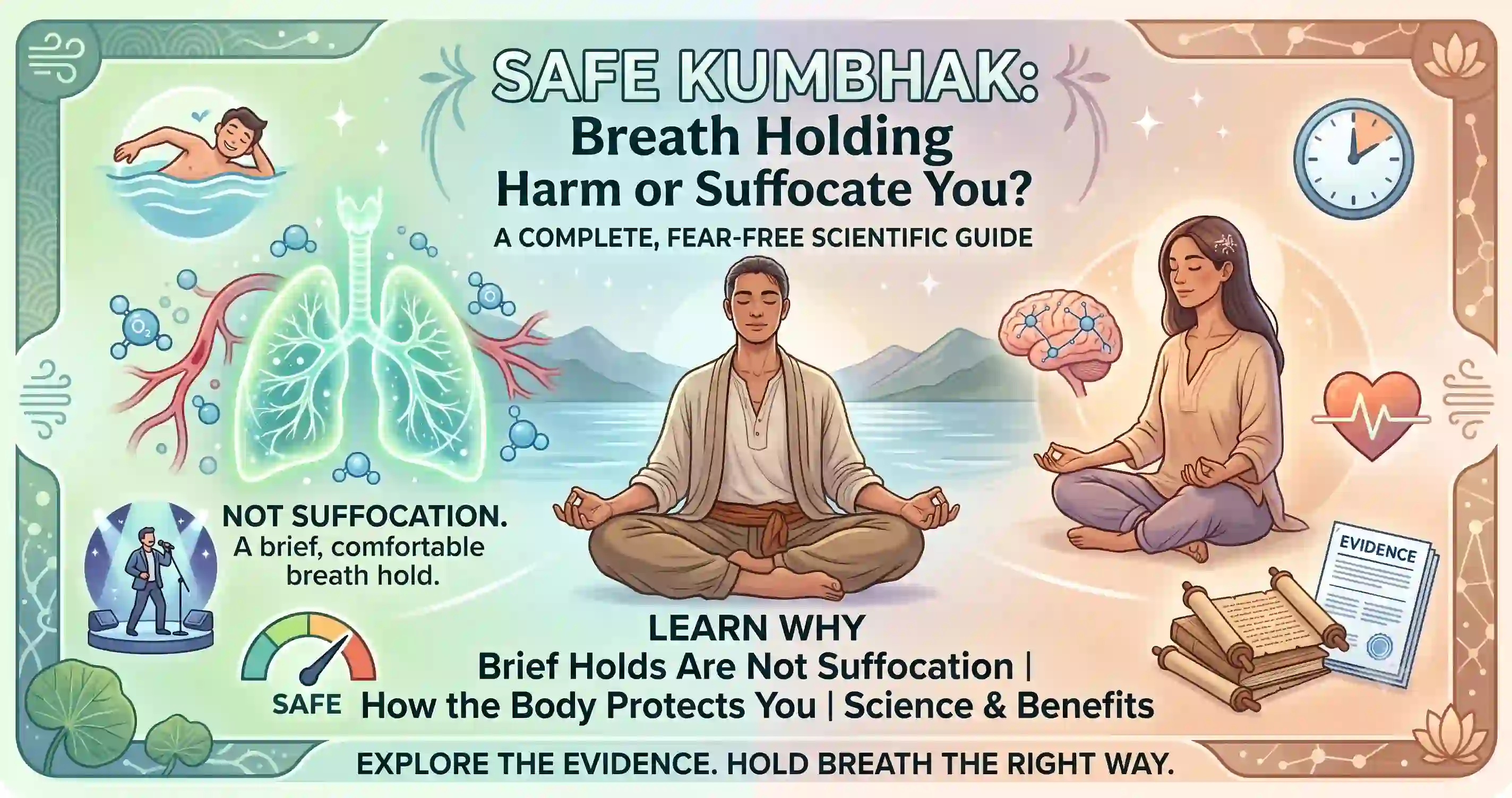
Perhaps the very words “hold your breath” make something tighten or frighten inside you.
What if I cannot start breathing again? What if my oxygen suddenly disappears? What if I faint? What if I harm my brain, heart or lungs? What if this small pause becomes the one pause from which I never return?
These fears deserve respect—not ridicule. Breathing is life’s oldest rhythm. When a practice asks you to interrupt that rhythm, even briefly, the protective mind may hear danger before the body has experienced any.
Here is the central answer:
For a generally healthy person who is seated safely on land, breathing normally, and ending a brief Kumbhak well within present capacity—before strain, air hunger or uneasiness—death, suffocation and long-term injury are not expected.
No responsible article can promise that every form of breath holding is harmless. A comfortable Kumbhak is not the same event as a competitive maximum, repeated deep freediving, underwater swimming after hyperventilation, breath-holding during a heavy lift, or suppressing severe breathlessness during illness. Context changes physiology.
This article removes fear by making those boundaries clear. It does not teach the Ten-Step method itself. For the complete practice, read How to Practice the Ten-Step Kumbhak for Stress Relief.
This is educational information, not an individual medical diagnosis or clearance to practise.
The Most Important Reassurance First: A Pause Is Not the End of Breathing 🫁
During a brief Kumbhak, breathing pauses—but life does not.
Your heart continues to circulate blood. Haemoglobin continues to carry oxygen. Oxygen already present in the lungs and blood remains available to the tissues. Carbon dioxide begins to rise, and this change gradually increases the impulse to breathe. In an ordinary voluntary breath hold, that urge is an alarm and a guide long before it becomes a heroic emergency.1
Breath-hold duration varies enormously with starting lung volume, metabolism, attention, previous breathing, training, health, emotion and whether the pause follows Pūrak or Rechak. That is why a universal target such as “everyone should hold for 20 seconds” is poor guidance.
The Ten-Step Kumbhak for Stress Relief asks for something entirely different: a pause that ends while it still feels completely easy and while you remain certain that another one to three seconds would have been comfortable. Its purpose is not to discover how close you can come to your limit. Its purpose is to discover whether stillness can exist without struggle.
Four truths to remember when fear rises
-
A brief voluntary pause is not suffocation. Suffocation involves an inability to obtain air or use oxygen; in safe Kumbhak, you remain free to resume normal breathing whenever you choose.
-
A brief pause is not cardiac arrest. Your circulation does not stop merely because airflow pauses.
-
The urge to breathe is not the same as oxygen failure. It is strongly influenced by rising carbon dioxide and by the brain’s interpretation of internal sensation.1
-
You do not need to reach the urge at all. In the Ten-Step practice, you finish Kumbhak before strain, urgency or uncertainty.
A frightened mind imagines a locked room. A safe Kumbhak is a room whose door remains in your own hand.
What Actually Happens Inside the Body During a Comfortable Kumbhak? 🔬
Oxygen does not fall to zero
At the beginning of Antar Kumbhak, the lungs contain inhaled air and the blood carries oxygen. During Bāhya Kumbhak, the lung reserve is lower, so the pause may feel comfortable for less time. In either case, oxygen is used progressively—not erased in an instant.
Long, maximal apnoea can eventually produce marked oxygen decline. A short, submaximal Kumbhak is placed far earlier on that continuum. A stopwatch cannot tell you the exact oxygen level because people differ, but comfort and an early exit keep the stress far below a deliberate maximum.
Carbon dioxide is a messenger, not an instant poison
Cells continually produce carbon dioxide. The lungs normally remove it with every Rechak. When airflow pauses, carbon dioxide begins to accumulate. Chemoreceptors in the brainstem and major arteries help detect the changing internal environment and increase respiratory drive.2
That does not mean that every small rise is toxic. Carbon dioxide naturally fluctuates with sleep, speech, singing, exercise and changes in breathing. The problem is prolonged or severe accumulation, not the mere existence of a temporary change.
If a person develops headache, confusion, marked air hunger or loss of coordination, the exposure is no longer a comfortable wellbeing practice. The answer is normal breathing—not more determination.
The heart and blood vessels adjust
Breath holding can change heart rate, blood pressure, cardiac output and blood-vessel tone. The direction and size depend on lung volume, duration, chest pressure, posture, preceding breathing and individual physiology.
In a study of three one-minute Kumbhak attempts, blood pressure and vascular resistance rose during the hold while stroke volume and cardiac output fell.3 This is important evidence, but it describes one-minute holds, not the brief, effortless pause used by a beginner for stress relief. It also shows why a long Kumbhak should never be marketed as a competition or as a do-it-yourself blood-pressure treatment.
The brain protects its oxygen delivery
When carbon dioxide rises during a sufficiently long hold, cerebral vessels can dilate and brain blood-flow velocity can increase. Research in experienced freedivers has observed major compensatory increases during multi-minute apnoea.4 This is protective physiology, not proof that longer breath holding makes the brain “better.”
The reassuring point is narrower: the body does not passively wait for oxygen to vanish. It has active responses that conserve and redistribute oxygen. The caution is equally clear: those responses should not be treated as permission to chase severe hypoxia.
The voluntary “breakpoint” usually makes you breathe
Physiological reviews describe a breakpoint at which continuing a voluntary hold becomes extremely difficult. In ordinary healthy subjects without special preparation, this powerful respiratory drive usually ends the hold before loss of consciousness.1
But “usually” is not “always.” Hyperventilation can delay the carbon-dioxide warning. Competitive training can teach a person to resist ordinary signals. Water adds drowning risk. This is why the Ten-Step Kumbhak ends before the first meaningful struggle rather than asking you to defeat it.
Human Beings Pause or Control the Breath in More Places Than We Notice 🌍
The examples below are not offered as proof that any duration is safe. They demonstrate something more sensible: respiratory pauses are part of ordinary human physiology, skilled performance, sport and medicine. Healthy people can tolerate them repeatedly when dose and context are appropriate.
Swallowing: the tiny pause repeated throughout life
Most healthy adults briefly interrupt breathing while swallowing so that food or liquid can pass while the airway is protected. This swallowing-related respiratory pause averages roughly one to one-and-a-half seconds for liquid swallows, although it varies with the task.5
You have already performed thousands upon thousands of such pauses without announcing each one to yourself.
This is not Kumbhak, but it dissolves one false belief: airflow does not have to remain continuous every second for the body to be safe.
Competitive swimmers: breath restriction inside hard physical work 🏊
Swimmers coordinate the breath with strokes and temporarily go without a new breath during starts, turns, underwater phases and selected training sets. Competitive swimmers are not merely sitting still; they are using oxygen rapidly while working.
Studies describe national-level swimmers as highly fit and show the specialised demands that swimming places on respiratory control. One small randomised trial of 27 experienced competitive swimmers found that a month-long Yogic breathing programme containing voluntary Antar Kumbhak improved some lung-function measurements and strokes per breath compared with a wait-list group.6 The study was too small to prove that retention alone caused the change, but it did not reveal the picture of a body being damaged by every pause.
Swimming also teaches the clearest boundary: a tolerable breath hold on land can become fatal in water if consciousness is lost. Fitness does not cancel drowning.
Artistic swimmers: repeated apnoea while moving, turning and performing
Artistic swimmers repeatedly combine underwater movement, inversion, precise timing and periods without a breath. Research describes recurrent aquatic apnoea as one of the sport’s characteristic demands.7 These athletes develop remarkable respiratory skill and physical conditioning.
Their experience shows that the human system can train around repeated breath restriction. It does not mean that an untrained person should copy aquatic practice, and it certainly does not justify solo underwater challenges.
Underwater hockey and other immersion sports
Underwater hockey requires repeated descents, active pursuit and return to the surface for recovery. A study comparing 34 male underwater hockey players with 28 land athletes found differences in carbon-dioxide response, while a subgroup of international players had longer breath-hold times.8
Underwater rugby, spearfishing and breath-hold photography create related demands. Their practitioners can be powerful, alert and fit. Yet all share a non-negotiable risk that seated Kumbhak does not: if a person blacks out, water prevents the next breath.
Freedivers: extraordinary capacity—and an important warning against false comparison 🤿
Trained freedivers can hold the breath for several minutes and can show pronounced diving responses, greater tolerance of respiratory discomfort, splenic contraction, specialised blood and muscle adaptations, and major changes in cerebral circulation.49
Many are outstanding athletes. In a 2025 study of 12 elite breath-hold divers, 12 novice divers and 12 non-diving controls, the elite divers did not differ from the other groups in neuropsychological performance despite completing longer maximal holds; the authors considered the possibility that elite divers develop adaptations that preserve performance despite greater hypoxic exposure. The repeated maximal holds nevertheless affected visual reaction time across participants.10
But the long-term health effects of extreme, chronic apnoea training have not been completely established. A state-of-the-art review identified unresolved questions involving neurocognitive, renal, bone and cardiovascular health.9 Other research in commercial divers has raised concern about clinical or subclinical brain injury, while repeated deep dives can cause decompression illness.1112
So what do freedivers prove?
- They prove that human breath-hold capacity can be far greater than an anxious beginner imagines.
- They prove that multi-minute apnoea can coexist with exceptional fitness.
- They do not prove that maximum attempts, blackouts or deep repetitive dives are harmless.
- Their extreme exposure should never be used as the safety standard for stress-relief Kumbhak.
Comparing the Ten-Step practice to competitive freediving is like comparing a peaceful walk to an ultramarathon. Both use legs; they are not the same dose.
Traditional sea-harvesting communities
Japanese Ama, Korean Haenyeo and other traditional breath-hold harvesters have performed repeated working dives for generations. Reviews describe some habitual diving populations spending large portions of the workday submerged, sometimes completing up to about 140 short dives—often under a minute—at depths of roughly 5–25 metres.9
These communities demonstrate long-developed human adaptation and skill. They also remind us not to romanticise occupational exposure: cold, pressure, repetitive depth and decompression risk belong to the sea, not to a brief dry Kumbhak.
Singers: long phrases are usually controlled Rechak, not a closed breath hold 🎶
Singers are often named as breath holders, but accuracy matters. During most singing, air is still moving out through the vocal folds. A trained singer usually takes a rapid breath and then regulates Rechak across a sustained phrase. Professional classical singers show task-specific respiratory coordination that differs from quiet breathing.13
Some singing methods include a momentary suspension before phonation, and musical rests can create short pauses. Yet the main skill is economical airflow, not prolonged closed-airway Kumbhak.
Singers therefore offer a valuable, honest lesson: the respiratory system can be voluntarily reorganised for art without becoming unhealthy—but not every long phrase is a breath hold.
Wind-instrument musicians: pressure and airflow under refined control 🎺
Flute, clarinet, oboe, trumpet, trombone, horn and other wind-instrument players regulate outgoing air, mouth pressure and phrase timing for hours of rehearsal. Like singing, this is mainly controlled Rechak rather than continuous Kumbhak.
In a study of 32 professional wind musicians with an average of nearly 18 years’ experience, spirometry did not show significant deterioration after a 90-minute rehearsal.14 The wider literature is mixed: some players have respiratory measures comparable with or better than controls, while instrument pressure, hygiene and individual health can create specific problems.
Their example supports capacity for learned breath control. It does not make a high-pressure musical exhalation identical to a relaxed seated pause.
Radiotherapy patients: breath holding used to protect the heart ❤️🩹
In chest radiotherapy, deep-inspiration breath hold is an established clinical technique. Expanding the lungs can increase the distance between the treatment beam and vulnerable organs, reducing radiation exposure to the heart in appropriate patients. Clinical guidance commonly uses repeated holds of about 20–30 seconds with coaching and monitoring.1516
Think of the emotional truth inside that fact: a person facing cancer lies beneath a machine, holds the breath for a measured interval, and that pause may help shield the heart.
Medical use does not prove that everyone should hold for 30 seconds. Patients are selected, instructed and observed. It does prove that clinicians do not regard every voluntary pause as suffocation or injury.
CT and MRI patients
Breath holds are commonly used during chest, abdominal and cardiac imaging to reduce motion and improve image quality. The hold is finite, the patient is told when to resume breathing, and alternative free-breathing methods are used when someone cannot tolerate it.
This is an important agreement with reality: capacity varies, and a useful breath hold never needs to become a test of dignity.
Precision athletes: a quiet respiratory window for steadiness 🎯
Rifle and pistol shooters, archers and biathletes often coordinate fine motor action with a brief respiratory pause or a naturally quiet point in the cycle. The purpose is to reduce movement, not create hypoxia. Research on shooting describes a natural pause of only a few seconds as a useful stability window.17
This resembles stress-relief Kumbhak in one respect: the value may lie in the still interval, not in extending the number.
Strength athletes: proof that “breath hold” is not one single event 🏋️
Powerlifters and weightlifters may briefly close the airway and brace during a heavy lift—the Valsalva manoeuvre—to increase trunk stability. This can create very high internal pressure and large blood-pressure responses.18
It is therefore a poor model for a relaxed Kumbhak. The comparison is useful precisely because it shows why the words breath hold are too broad. A relaxed pause without bracing and a maximal lift under pressure are mechanically different events.
Actors, speakers, chanters, dancers and gymnasts
Actors and public speakers delay or shape the breath for timing and emotion. Chanters distribute Rechak across repeated syllables. Dancers and gymnasts may pause the breath around a demanding movement, sometimes intentionally and sometimes without noticing.
These groups demonstrate enormous respiratory adaptability. They also show why healthy training teaches awareness: unconscious bracing under strain is not automatically desirable merely because performers survive it.
What These Healthy People Prove—and What They Do Not Prove ⚖️
It would be manipulative to say, “Freedivers hold for minutes, therefore every breath hold is safe.” It would be equally irrational to say, “A freediver can black out, therefore a three-second comfortable Kumbhak is dangerous.”
The fair conclusions are:
- Human physiology is built to tolerate brief pauses.
- Breath-hold capacity is trainable.
- Many healthy, fit people repeatedly control or pause breathing.
- The same person can tolerate very different durations depending on context.
- Longer does not mean healthier.
- Water, depth, exertion, hyperventilation, bracing and medical vulnerability alter risk.
- Evidence from extreme athletes cannot be pasted onto a stress-relief practice.
The examples reduce catastrophic fear. They do not remove intelligent boundaries.
Fear by Fear: Direct Answers to the Questions People Are Afraid to Ask 🧠
“Can I die from a brief Kumbhak?”
For a suitable person seated safely on land, taking normal Pūrak and Rechak, and ending each Kumbhak while it remains completely comfortable, death is not an expected outcome.
Deaths associated with breath holding overwhelmingly involve a different context: water, deliberate maximum attempts, hyperventilation, strangulation, dangerous exertion, substance use, serious underlying disease or delayed rescue.
No health practice deserves a promise of absolute zero risk. The honest reassurance is that brief, early-ended, dry Kumbhak sits far from the known high-risk scenarios.
“Will my brain run out of oxygen?”
Not during an ordinary comfortable pause. Oxygen is already present in the lungs, blood and tissues, and the heart continues circulating it.
Severe or prolonged hypoxia can injure the brain. That fact is real—but it does not mean every interruption of airflow is severe hypoxia. The brain changes its blood flow during a long hold to help defend oxygen delivery.4
The Ten-Step Kumbhak does not ask you to approach confusion, visual change, loss of coordination or blackout. Those are stop signs, not milestones.
“Is holding my breath the same as choking?”
No. Choking means an object or obstruction prevents airflow. It can create panic because air cannot pass even when the person urgently tries to breathe.
Kumbhak is voluntary. The airway is not blocked by food. You retain the choice to resume normal breathing. The feeling may remind an anxious mind of choking, but the mechanism is different.
“Could I forget how to breathe or become unable to restart?”
Breathing is regulated by automatic brainstem networks even though it can also be voluntarily modified. When voluntary control ends, automatic respiratory drive remains.
Anxiety can create the feeling that breathing will not restart correctly. That feeling can be powerful without being a loss of the body’s breathing programme. If the experience feels trapping, end the pause and allow normal breathing; there is no requirement to continue.
“Does carbon dioxide poison me when I hold?”
Carbon dioxide rises during a closed-airway pause. A small temporary increase is part of the signal that makes you breathe; it is not equivalent to sustained pathological hypercapnia.
Prolonged high carbon dioxide can cause headache, confusion and other harm. Safe Kumbhak does not pursue those states.
“Will my lungs burst or collapse?”
A comfortable seated hold after a normal Pūrak or Rechak does not ordinarily generate the pressure conditions that rupture a healthy lung.
Lung barotrauma and “lung squeeze” are concerns in specialised settings such as depth diving, major pressure change or forceful manoeuvres. They should not be projected onto a brief dry pause. However, anyone with significant lung disease, a history of pneumothorax or recent chest surgery needs individual medical guidance.
“Will my heart stop?”
The heart normally continues beating throughout a voluntary breath hold. Heart rate may decrease, increase or show phase-dependent changes. Long or forceful holds can also raise vascular resistance and blood pressure.3
For most suitable people, a brief comfortable pause is tolerated. A person with serious rhythm problems, uncontrolled hypertension, cardiovascular disease, unexplained fainting or chest pain should not rely on general reassurance; clinical advice comes first.
“Can Kumbhak cause a stroke?”
There is no credible evidence that brief, comfortable, submaximal dry Kumbhak causes stroke in healthy people.
That is not permission for maximal pressure-straining in someone with an aneurysm, severe uncontrolled blood pressure, vascular disease or recent stroke. A forceful Valsalva manoeuvre during a heavy lift is not the same as relaxed Kumbhak.
“Will a brief Bāhya Kumbhak damage me because the lungs are empty?”
After Rechak, the lungs are not literally empty; residual gas remains. But the available reserve is lower than after Pūrak, so Bāhya Kumbhak may feel comfortable for less time.
This is why capacity—not pride—decides the duration. The instant ease is disappearing, normal Pūrak should return. There is no minimum number of seconds that must be achieved.
“If I feel air hunger, am I already in danger?”
Not necessarily. Air hunger is strongly shaped by carbon dioxide, respiratory muscle signals, expectation and fear. A person can feel urgency before oxygen reaches a dangerous level.
But the Ten-Step practice does not ask you to diagnose whether discomfort is “only anxiety.” It asks you to end Kumbhak before discomfort. This removes the need for argument between mind and body.
“Can Kumbhak trigger panic?”
Yes, it can in some people. Breathlessness, throat sensation, chest attention or loss-of-control memories can activate panic even when the pause is physiologically brief.
In a trial involving people with post-traumatic stress disorder, a retention-containing prāṇāyāma programme produced recurrent minor adverse experiences in some participants, including anxiety, breathlessness, dizziness and constriction; one participant had a suffocation-related flashback.19
That does not mean the person is weak or that danger is imminent. It means the practice may be emotionally mismatched at that time. Permission to stop, shorten or omit Kumbhak is part of safety.
“Can breath holding create sleep apnoea?”
Voluntary wakeful Kumbhak and obstructive sleep apnoea are not the same condition.
In obstructive sleep apnoea, the upper airway repeatedly collapses during sleep, fragmenting sleep and producing recurrent oxygen disturbances without conscious choice. Kumbhak is intentional, time-limited, wakeful and followed by normal breathing. Evidence about the harms of untreated sleep apnoea should not be used as if it described a few comfortable daytime pauses.
If you snore loudly, gasp during sleep, have witnessed pauses or persistent daytime sleepiness, seek assessment rather than assuming daytime breath practice will treat the problem.
“Will retained breath trap toxins inside me?”
The body does not become poisoned because one Rechak is delayed for a few seconds. Carbon dioxide continues to be carried in the blood and is released when breathing resumes.
Terms such as “toxin release” and “detox breath hold” are often too vague to be scientifically meaningful. Kumbhak need not be defended with them.
“Could a pulse oximeter prove I am safe?”
No. Consumer oximeters can lag behind rapidly changing physiology, lose signal, and vary with movement, circulation, skin temperature, nail products and device quality. A pleasing number is not permission to extend Kumbhak.
For stress relief, the relevant boundary is earlier and simpler: no strain, no urge, no dizziness, no competition.
“What if my capacity is only one or two seconds?”
Then one or two seconds may be your complete Kumbhak today. There is nothing defective about you.
Capacity varies with sleep, infection, altitude, anxiety, recent exertion, meals, medication and countless personal factors. The practice is an agreement with the body you have now, not an exam graded against someone else’s lungs.
Are There Long-Term Harmful Effects of Breath Holding? The Exact Scientific Answer 📚
This question needs one sentence that is both reassuring and honest:
No credible evidence currently demonstrates long-term harm caused by brief, comfortable, submaximal, dry breath pauses in otherwise appropriate practitioners—but research has not proved that every dose, person and context is risk-free.
These are two very different statements:
- “Long-term harm has not been demonstrated for this mild practice.” This is a reasonable evidence-based conclusion.
- “No form of breath holding can ever have a long-term harmful effect.” This is too absolute and scientifically indefensible.
What we know about brief wellbeing practice
Small human trials have studied breathing routines that include short Kumbhak for days or weeks. Some report improvements in stress, anxiety, attention, blood pressure or sleep-related outcomes, and many report no serious adverse events. An eight-week randomised trial in 116 young adult yoga practitioners found improvements in mindfulness, mind wandering and anxiety after adding intermittent breath-hold practice.20
However, most studies are not large enough or long enough to rule out rare harms. Many combine Kumbhak with rhythm, nostril control, attention, meditation or other practices. “No adverse event observed” is reassuring, but it is not the same as lifetime proof.
What we know about extreme apnoea
Competitive and occupational breath-hold divers experience exposures far beyond stress-relief Kumbhak: severe oxygen decline, high carbon dioxide, pressure at depth, cold, exertion and repeated dives.
The evidence is mixed:
- Many elite divers appear neurologically and physically high-functioning.
- Resting cardiac testing in small competitive-diver samples has not always found abnormalities.9
- Recent research found comparable baseline neuropsychological performance in elite divers and controls.10
- Other studies have reported brain-imaging concerns in commercial divers.11
- Reviews say the long-term effects on cognition, kidney, bone and cardiovascular health remain incompletely established.9
- Deep repetitive breath-hold diving can cause decompression illness with neurological consequences.12
This is not evidence that Kumbhak damages the brain. It is evidence that extreme apnoea should not be used to make absolute promises about all breath holding.
Why the mild and extreme exposures must not be merged
A useful safety comparison asks at least seven questions:
- Is the person on land or in water?
- Is the pause comfortable or maximal?
- Was there hyperventilation?
- Is the body resting or exercising?
- Is there chest or abdominal bracing?
- Is the exposure repeated with adequate recovery?
- Does the person have a relevant medical or trauma history?
If those questions change, the biological event changes.
Why the Ten-Step Kumbhak for Stress Relief Has a Different Safety Logic 🌿
This practice is not built around a timer, a ratio, a record or a public performance. Its central safety logic is early completion.
Pūrak and Rechak remain normal—not too fast or too drawn out. Kumbhak ends while ease is still present, with a clear reserve of another one to three comfortable seconds. There is no hyperventilation, no attempt to empty or fill to a maximum, no muscular battle, no aquatic setting and no instruction to defeat the breathing urge. Recovery breathing is part of the complete round.
Those design choices matter more than a claim such as “five seconds is safe for everyone,” because there is no universal number that accounts for every body.
For the detailed method, posture, Dhyāna Mudra and complete safeguards, use the How to Practice guide. The full instructions should be followed as one practice; this article is not a substitute.
Stress relief does not require oxygen deprivation
There is no evidence that a stress-relief practitioner must drive oxygen low or make carbon dioxide high. A brief pause can work psychologically as a contained experience of stillness, attention and voluntary choice without approaching severe hypoxia.
The meaningful outcome is not, “I held longer today.” Better questions are:
- Did I remain relaxed?
- Did I finish with confidence rather than relief from suffering?
- Did my mind feel less hurried afterward?
- Did I respect the first hint of uneasiness?
- Would an even shorter pause serve me better?
Recovery is not failure
Returning to normal breathing is not surrender. It is the completion of the experiment.
The sea does not apologise when a wave returns to shore. Your next breath is not a defeat of Kumbhak; it is part of its wholeness.
When Fear Itself Is the Main Difficulty 💛
Fear of breath holding may come from many places:
- a past asthma attack;
- choking or near-drowning;
- panic attacks;
- witnessing someone struggle to breathe;
- illness-related oxygen monitoring;
- claustrophobia;
- a suffocation scene in a film;
- a frightening meditation experience;
- or simply the ancient instinct that guards respiration.
The right response is not, “Your fear is irrational.” The right response is, “Your system is trying to protect you. Can it be given a smaller, safer experience?”
Agreement before practice
You do not have to agree that Kumbhak is safe in the abstract. A more respectful sequence is:
- Agree that you remain free to stop.
- Agree that no duration must be reached.
- Agree that discomfort will not be treated as success.
- Agree to one very small experiment—or agree not to practise today.
- Let your direct experience answer what words cannot.
A person who needs a no-hold breathing practice should be offered one without shame. Trust grows when “no” is genuinely available.
Panic sensations are real even when catastrophe is not
A pounding heart, throat tightness, tingling or chest awareness can feel like proof of danger. Sometimes these are anxiety responses; sometimes symptoms need medical evaluation. An article cannot reliably distinguish them for an individual.
Stop Kumbhak and return to normal breathing if panic, dizziness, chest discomfort or unusual symptoms appear. Persistent, severe or new symptoms deserve appropriate medical care.
Yogic Truths: Ancient Texts Honour Kumbhak—and Warn Against Force 🕉️
Traditional Yogic texts do not present the breath as a toy. They treat its regulation as powerful and therefore worthy of preparation, measurement and discipline.
Traditional statements below are presented as historical and philosophical teachings. They are not automatically modern clinical proof.
Patañjali’s Yoga Sūtra 2.49: the interruption of respiratory movement
tasmin sati śvāsapraśvāsayor gativicchedaḥ prāṇāyāmaḥ — Yoga Sūtra 2.49
A direct translation describes prāṇāyāma as the interruption or regulation of the movement of inhalation and exhalation once posture has been established.21
This is precise and relevant: stillness in the breath is not a modern invention or an accidental defect. It belongs to the classical definition of prāṇāyāma.
Yoga Sūtra 2.50: external, internal and suspended—regulated by place, time and number
bāhyābhyantarastambhavṛttir deśakālasaṃkhyābhiḥ paridṛṣṭo dīrghasūkṣmaḥ — Yoga Sūtra 2.50
The sūtra describes external, internal and suspended aspects, observed or regulated by place, time and number, becoming extended and subtle.22
The most useful word for modern fear is not long. It is regulated. Classical depth is not a licence for arbitrary excess.
Bhagavad Gītā 4.29: restraint of the movements of Prāṇa and Apāna
prāṇāpānagatī ruddhvā prāṇāyāmaparāyaṇāḥ — Bhagavad Gītā 4.29
Within a wider verse on disciplined offering, the Gītā refers to practitioners devoted to prāṇāyāma who restrain the movements of Prāṇa and Apāna.23
This is philosophical and soteriological language, not respiratory medicine. Yet it verifies that deliberate suspension was known, respected and integrated into disciplined practice long before the modern laboratory.
Haṭha Yoga Pradīpikā 2.15: train the breath by degrees
yathā siṃho gajo vyāghro bhaved vaśyaḥ śanaiḥ śanaiḥ
tathaiva sevito vāyur anyathā hanti sādhakam — Haṭha Yoga Pradīpikā 2.15
The verse compares training the breath to bringing a lion, elephant or tiger under disciplined care: it must be approached by degrees; otherwise it can harm the practitioner.24
The animal image is unforgettable. Power is not denied. Power is met with relationship, patience and respect.
Haṭha Yoga Pradīpikā 2.16: correct and incorrect practice are not equal
prāṇāyāmena yuktena sarvarogakṣayo bhavet
ayuktābhyāsayogena sarvarogasamudbhavaḥ — Haṭha Yoga Pradīpikā 2.16
The text traditionally claims that properly practised prāṇāyāma removes disease, while incorrect practice can generate disease.24
The first half is a traditional health claim and should not be advertised as a scientifically established cure. The second half remains an excellent ethical correction: the tradition itself does not say that every method, every intensity and every practitioner are safe merely because the practice is Yogic.
Ayurvedic Truth: Do Not Confuse Chosen Kumbhak With Suppressing Distressed Breathing 🌿
The Caraka Saṃhitā, Sūtrasthāna 7.3–4, lists natural urges that should not be suppressed, including deep breathing after exertion. Verse 7.24 associates suppressing that post-exertion respiratory urge with harmful consequences and advises rest.25
This creates an important Ayurvedic distinction:
- Chosen Kumbhak: a measured pause entered in a settled state and left before distress.
- Suppression of śrama-śvāsa: refusing the body’s demand for recovery breathing after exertion.
They are not the same.
Ayurvedic theory may describe breath, attention and stress through Prāṇa Vāyu, Udāna Vāyu, Vāta balance, Agni and the individual constitution. These frameworks have traditional depth but have not all been validated as biomedical mechanisms. They can be honoured without pretending that they are laboratory findings.
The most relevant Ayurvedic message is beautifully practical: do not suppress the body’s urgent call for breath. That is completely consistent with ending Kumbhak before urgency appears.
Contexts in Which Breath Holding Becomes Dangerous ⚠️
In or near water
Never practise breath-hold challenges while swimming, bathing or alone in water. Loss of consciousness that might be recoverable on a safe floor can become drowning within moments.
The American Red Cross, YMCA of the USA and USA Swimming jointly warn that hyperventilation before underwater swimming and extended breath holding can be dangerous and potentially deadly.26 Divers Alert Network likewise advises against hyperventilation and solo breath-hold diving.27
After hyperventilation
Repeated fast or deep breathing lowers carbon dioxide and delays the urge to breathe without creating an equally large oxygen reserve. A person may therefore feel capable while oxygen falls toward blackout.
The ability to stay underwater longer after hyperventilation is not improved safety. It is reduced warning.
During driving, machinery or an unsafe position
Do not practise while driving, cycling in traffic, walking somewhere hazardous, operating machinery, standing at height, showering or bathing. Even an unlikely moment of dizziness becomes more consequential in these settings.
During a maximum effort or competition
No timer, record, classmate, teacher, app or social-media challenge should persuade you to override discomfort. The Ten-Step Kumbhak is not a maximum-capacity test.
With forceful bracing
Clenching the throat, face, chest and abdomen and bearing down can turn a relaxed pause into a pressure manoeuvre. This is especially relevant to uncontrolled hypertension, vascular disease, pelvic-floor problems, recent surgery and some eye conditions.
When the body is already demanding recovery
Do not suppress marked breathlessness after exertion. Do not use Kumbhak to prove control during an asthma flare, respiratory infection, severe congestion, chest pain, fever, intoxication, significant altitude illness or unexplained shortness of breath.
Who Should Seek Individual Clinical Guidance First? 🩺
Ask a qualified healthcare professional who understands your history before starting breath retention if you:
- have significant heart, lung, vascular or cerebrovascular disease;
- have uncontrolled high blood pressure or important rhythm problems;
- have a history of fainting, seizures, stroke, transient ischaemic attack or unexplained loss of consciousness;
- have a history of pneumothorax, major lung surgery or severe respiratory impairment;
- have glaucoma, retinal disease or another condition affected by pressure;
- have an aneurysm or have been told to avoid straining;
- are pregnant or recently postpartum;
- recently had surgery;
- have anaemia severe enough to cause symptoms;
- live with panic disorder, PTSD, suffocation trauma or severe health anxiety;
- take medication that affects breathing, consciousness, blood pressure or heart rhythm;
- or experience chest pain, blue lips, unexplained breathlessness or neurological symptoms.
This is a conservative screening list, not a claim that Kumbhak is proven harmful in every listed condition. Individual advice matters because direct safety trials for each diagnosis are limited.
Stop Signs: Return to Normal Breathing Immediately 🚦
Stop the practice if you experience:
- dizziness, faintness or loss of balance;
- tunnel, grey or disturbed vision;
- ringing in the ears;
- unusual numbness, tingling, confusion or loss of coordination;
- chest pain, marked tightness or troubling palpitations;
- severe headache or unusual eye pressure;
- panic, dissociation or a traumatic flashback;
- involuntary jerking;
- blue lips;
- or breathlessness that does not settle promptly with normal breathing.
Loss of consciousness, persistent chest pain, severe breathlessness or continuing neurological symptoms require urgent medical evaluation.
The correct response to a stop sign is not self-criticism. It is stopping.
Frequently Asked Questions About Breath Holding and Kumbhak ❓
How long can an average person safely hold their breath?
There is no single safe number for everyone. Published breath-hold times vary widely, and the same person’s capacity changes with lung volume, recent breathing, activity, altitude, emotion and health.1
For stress relief, do not use an average. End Kumbhak while it remains completely easy and before any urge, strain or uncertainty.
Is holding the breath for 10, 20 or 30 seconds safe?
Many healthy people tolerate pauses in that range, and clinical radiotherapy commonly uses coached 20–30-second holds in selected patients.1516 That does not make 30 seconds a universal recommendation.
A shorter pause that preserves ease is more appropriate than a longer pause reached through willpower.
Is Antar Kumbhak safer than Bāhya Kumbhak?
They have different starting lung volumes and sensations. Bāhya Kumbhak often reaches discomfort earlier because the reserve after Rechak is lower. Neither should be ranked by a universal safe time. The appropriate duration is the one that remains entirely comfortable for that person in that moment.
Should I take the biggest possible Pūrak before Kumbhak?
No. Maximum filling can itself feel uncomfortable and may encourage chest, neck or shoulder tension. The Ten-Step practice uses a comfortably full—not maximally filled—Pūrak. Follow the complete practice instructions.
Should I force out all air before Bāhya Kumbhak?
No. Rechak ends at comfortably empty, without squeezing out every last amount of air. Force changes the experience and reduces the safety margin.
Can I practise alone?
Brief, dry, seated, submaximal wellbeing practice is different from freediving training. Even so, beginners should first understand the complete safeguards. Never practise breath holding alone in water, and never turn solo practice into a maximum test.
Is a longer Kumbhak evidence of better health?
No. Duration is influenced by technique, familiarity, starting lung volume, motivation, carbon-dioxide tolerance and prior hyperventilation. A longer number does not prove healthier lungs, a calmer nervous system or a better person.
Can Kumbhak permanently damage the brain?
There is no credible evidence that brief, comfortable, submaximal dry Kumbhak causes permanent brain damage in healthy practitioners. Extreme multi-minute apnoea, repeated deep diving and blackout exposure are different questions, and their long-term evidence remains incomplete.911
Can Kumbhak damage the lungs?
Brief comfortable dry pauses are not known to damage healthy lungs. Pressure injuries belong mainly to forceful manoeuvres, depth exposure or vulnerable lungs. Relevant lung disease warrants clinical advice.
Can Kumbhak cure anxiety, hypertension, asthma or another disease?
No cure claim is justified. Some breathing programmes containing Kumbhak have improved selected stress, anxiety, sleep, asthma-symptom or blood-pressure outcomes, but retention is often only one component and the evidence varies in quality.
Kumbhak for Stress Relief may complement appropriate care. It should not replace prescribed medication, emergency treatment or professional mental-health support.
What should I do if I remain afraid after reading this?
Do not force belief. Read the complete practice guide, discuss your personal concerns with a qualified healthcare professional when appropriate, and choose whether a tiny experiment feels genuinely voluntary.
If the answer is no, normal breathing is allowed.
The Final Verdict: You Do Not Need Courage Against Your Body—You Need Agreement With It 🌌
A brief, comfortable Kumbhak is not a rehearsal for death. It is a small pause inside an active, oxygen-carrying, blood-circulating, self-protecting body.
Swimmers cross water between breaths. Artistic swimmers perform beneath it. Freedivers reveal extraordinary human capacity. Sea harvesters have worked through repeated short dives across generations. Singers and wind musicians shape air into beauty. Radiotherapy patients hold still so that treatment can spare the heart. Every day, every healthy swallow briefly pauses respiration.
None of these examples says, “Ignore risk.” Together they say something quieter and more convincing:
The human body is not made of glass. It can safely accommodate brief respiratory stillness when the pause respects capacity, context and recovery.
The scientifically defensible reassurance is not that all breath holding is harmless forever. It is that no credible evidence shows long-term injury from the kind of brief, effortless, early-ended, dry Kumbhak used in the Ten-Step practice for an appropriate person.
Fear says, If I pause, life may leave me.
Experience may answer, Life was present inside the pause—and it was waiting in the next normal breath.
References and Verified Sources 📖
-
Parkes, M. J. (2006). “Breath-holding and its breakpoint.” Experimental Physiology, 91(1), 1–15. DOI and abstract. ↩↩↩↩
-
Busch, S. A., et al. (2019). “Mechanisms of sympathetic regulation during Apnea.” Physiological Reports. Full text on PubMed Central. ↩
-
Nivethitha, L., Mooventhan, A., and Manjunath, N. K. (2021). “Evaluation of Cardiovascular Functions during the Practice of Different Types of Yogic Breathing Techniques.” International Journal of Yoga. Full text on PubMed Central. ↩↩
-
Eichhorn, L., et al. (2018). “Cerebrovascular Reactivity during Prolonged Breath-Hold in Experienced Freedivers.” American Journal of Neuroradiology. PubMed record. ↩↩↩
-
Martin-Harris, B. (2008). “Clinical implications of respiratory–swallowing interactions.” Full text on PubMed Central. ↩
-
Hakked, C. S., Balakrishnan, R., and Krishnamurthy, M. N. (2017). “Yogic breathing practices improve lung functions of competitive young swimmers.” PubMed record. ↩
-
Xu, H., and Fan, Y. (2026). Randomised trial of inspiratory muscle training in artistic swimmers, describing recurrent aquatic apnoea as a characteristic training demand. Full text on PubMed Central. ↩
-
Davis, F. M., et al. (1987). “Carbon dioxide response and breath-hold times in underwater hockey players.” PubMed record. ↩
-
Elia, A., Gennser, M., Harlow, P. S., and Lees, M. J. (2021). “Physiology, pathophysiology and (mal)adaptations to chronic apnoeic training: a state-of-the-art review.” European Journal of Applied Physiology. Full text on PubMed Central. ↩↩↩↩↩↩
-
Allinger, J., et al. (2025). “Cognitive impairments after maximal repeated breath-holding in elite breath-hold divers.” PubMed record. ↩↩
-
Kohshi, K., et al. (2014). “Brain damage in commercial breath-hold divers.” PubMed record. ↩↩↩
-
Blogg, S. L., et al. (2023). “The risk of decompression illness in breath-hold divers: a systematic review.” Diving and Hyperbaric Medicine. Full text on PubMed Central. ↩↩
-
Salomoni, S., et al. (2016). “Breathing and Singing: Objective Characterization of Breathing Patterns in Classical Singers.” Full text on PubMed Central. ↩
-
Bouros, E., et al. (2018). “Respiratory Function in Wind Instrument Players.” Full text on PubMed Central. ↩
-
Boda-Heggemann, J., et al. (2023). ESTRO-ACROP guideline for implementation of breath-hold techniques in radiotherapy. PubMed record. ↩↩
-
Guy’s and St Thomas’ NHS Foundation Trust. “Deep inspiration breath hold for radiotherapy to the chest.” Patient guidance. ↩↩
-
Karaduman, E., et al. (2022). “Pistol Shooting Performance Correlates with Respiratory Muscle Strength and Pulmonary Function in Police Cadets,” including discussion of the brief natural respiratory pause used for stability. Full text. ↩
-
MacDougall, J. D., et al. (1992). “Effect of breathing techniques on blood pressure response to resistance exercise.” Full text on PubMed Central. ↩
-
Haller, H., Mitzinger, D., and Cramer, H. (2023). Randomised trial of prāṇāyāma added to trauma-focused therapy for PTSD, including adverse-event reporting. Full text on PubMed Central. ↩
-
Saoji, A. A., et al. (2018). Randomised trial of intermittent breath holding and psychological functions in young adult yoga practitioners. PubMed record. ↩
-
Patañjali, Yoga Sūtra 2.49, Sanskrit text, transliteration, translation and classical commentary. Verified text. ↩
-
Patañjali, Yoga Sūtra 2.50, Sanskrit text, transliteration, translation and classical commentary. Verified text. ↩
-
Bhagavad Gītā 4.29, Sanskrit text and multiple traditional translations. IIT Kanpur Gita Supersite. ↩
-
Svātmārāma, Haṭha Yoga Pradīpikā 2.15–2.16. Chapter 2 text and translation and Sanskrit text with Jyotsnā commentary for 2.16. ↩↩
-
Caraka Saṃhitā, Sūtrasthāna 7.3–4 and 7.24, on not suppressing the natural urge for deep breathing after exertion. Verified English translation. ↩
-
American Red Cross, YMCA of the USA and USA Swimming. “Hypoxic Blackout: Joint Safety Statement.” Official PDF. ↩
-
Divers Alert Network. “Freediving Safety Awareness.” Safety guidance. ↩