Feeling burned out, mentally drained or emotionally empty? Explore how Ten-Step Kumbhak may support stress relief, with evidence, limits and safety.
By Kumbhaki Yogi Dhruvaji (MSc), founder of the Antistress Foundation 501(c)(3)
• How to Practice Ten-Step Kumbhak • Scientific Proof • Ancient Texts Proof • Bio • Subscribe By Email
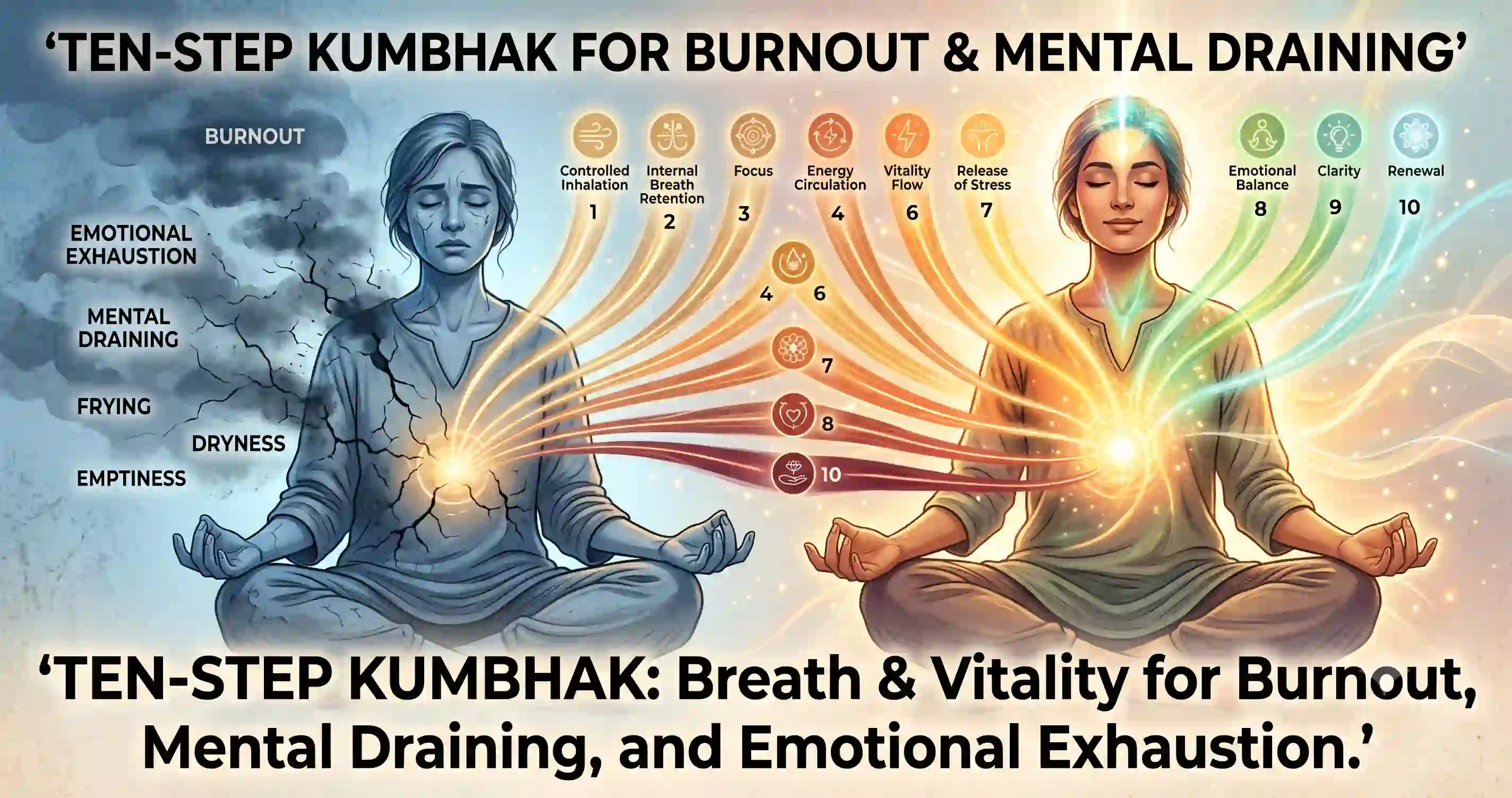
You close the laptop, but the workday does not close inside you.
Your body has stopped moving, yet your mind is still answering messages that are no longer arriving. A small request feels enormous. Kindness costs more than it used to. Even rest can feel effortful—as though you have reached home but some part of you is still standing under the office lights.
People call this feeling burned out, mentally drained, emotionally exhausted, fried, depleted, numb, or simply empty. These words overlap, but they do not always mean the same thing. That matters, because the right support for an overworked mind is not always the right support for depression, anaemia, sleep apnoea, grief, trauma, or another cause of persistent fatigue.
So where might the Ten-Step Kumbhak for Stress Relief fit?
The most accurate answer is both modest and hopeful:
Ten-Step Kumbhak may help some people interrupt immediate stress activation, gather scattered attention, and create a short inner transition out of a mentally or emotionally demanding period. It has not been clinically proven to treat burnout, restore depleted energy, or remove the conditions that caused the exhaustion.
That does not make the pause meaningless. Sometimes recovery begins with one moment in which nothing else is being demanded from you. But a moment of regulation is a doorway into recovery, not the whole house.
Important: This article explains possible relevance, evidence, limitations, traditional perspectives, and safety. It intentionally does not reproduce the practice instructions. Learn the method only from How to Practice the Ten-Step Kumbhak for Stress Relief.
The Short Answer: What Ten-Step Kumbhak May—and May Not—Do 🧭
Ten-Step Kumbhak may be relevant when exhaustion includes a stress-state component: mental replay, internal pressure, muscular bracing, emotional residue, restlessness, difficulty disengaging from work, or the sense that the day is still happening inside you.
It may offer:
- a definite boundary between “what just happened” and “what happens next”;
- a temporary interruption in repetitive thinking;
- one stable focus when attention feels scattered;
- a chance to notice tension before carrying it into the next conversation;
- practice meeting a brief internal sensation without immediately reacting;
- and a small, repeatable act of self-regulation when elaborate self-care feels impossible.
It cannot, by itself:
- reduce an unreasonable workload;
- create adequate staffing, fairness, autonomy, safety, pay, or social support;
- replace sleep, nutrition, hydration, movement, medical evaluation, counselling, or prescribed care;
- cure burnout, anxiety, depression, post-traumatic stress disorder (PTSD), anaemia, thyroid disease, sleep apnoea, or chronic fatigue;
- manufacture energy that the body does not currently possess;
- or make a harmful environment healthy by helping someone tolerate more harm.
This distinction protects the exhausted reader from a painful message: “If one breathing practice did not fix me, I must have failed.” You did not fail. A breath practice and a workplace problem operate at different levels.
Burnout, Mental Fatigue and Emotional Exhaustion Are Related—but Not Identical 🧠
When every form of depletion is called burnout, the word becomes emotionally vivid but clinically imprecise. A clearer vocabulary helps you choose a more fitting response.
Burnout Has a Specific Occupational Meaning
The World Health Organization classifies burnout in ICD-11 as an occupational phenomenon, not a medical condition. It describes burnout as arising from chronic workplace stress that has not been successfully managed, with three dimensions:
- energy depletion or exhaustion;
- greater mental distance, negativism, or cynicism toward the job;
- reduced professional efficacy.1
Strictly speaking, therefore, “parental burnout,” “relationship burnout,” and “life burnout” use the word more broadly than the WHO occupational definition. The experiences may still be real and severe; they simply need more precise names.
Burnout is also more than having one terrible Tuesday. It develops when demands keep consuming resources and meaningful recovery does not adequately occur.
Mental Fatigue Is the Cost of Sustained Cognitive Demand
Mental fatigue can follow prolonged concentration, constant decisions, interruption, digital overload, vigilance, studying, caregiving coordination, or emotional self-control. You may notice:
- foggy thinking;
- slower comprehension;
- rereading the same line;
- avoidable mistakes;
- decision paralysis;
- reduced patience;
- craving stimulation while being unable to absorb more stimulation;
- or feeling “fried” despite having done little physical work.
Mental fatigue can happen without full occupational burnout. It may improve after genuine recovery. If it persists, repeatedly impairs functioning, or comes with other symptoms, it deserves a broader assessment.
Emotional Exhaustion Is the Feeling That There Is Nothing Left to Give
Emotional exhaustion is central to many burnout models, but it also appears outside work. It can follow:
- listening to distress throughout the day;
- caring for someone without enough support;
- suppressing anger or grief to remain professional;
- conflict, rejection, or uncertainty;
- compassion without recovery;
- constant social performance;
- or being available to everyone while feeling unavailable to yourself.
It may feel like irritability, tearfulness, withdrawal, numbness, resentment, reduced empathy, or a hollow absence where warmth used to be.
That numbness is not always lack of care. Sometimes it is what care feels like after it has been asked to work without rest.
Ordinary Tiredness Usually Responds to Ordinary Recovery
Ordinary tiredness often has an identifiable reason and improves with sleep, food, hydration, rest, movement, pleasure, or time away from the demand.
Burnout is more persistent and work-linked. Depression can spread across work, home, relationships, pleasure, hope, self-worth, appetite, sleep, and motivation. Physical conditions can also produce profound fatigue. These categories can overlap, which is why a label chosen alone should never become a diagnosis.
An “Empty” Feeling Deserves Special Attention
“Empty” can mean peaceful spaciousness after stress—but it can also mean emotional blunting, hopelessness, disconnection, grief, depression, or dissociation.
The US National Institute of Mental Health includes a persistent sad, anxious, or empty mood, loss of interest, fatigue, difficulty concentrating, sleep changes, and thoughts of death among possible depression symptoms.2 If emptiness persists, spreads beyond work, removes pleasure from nearly everything, or comes with hopelessness or thoughts of self-harm, do not ask a breath practice to carry that alone. Seek qualified support promptly.
Why Ten-Step Kumbhak May Feel Relevant When You Are “Fried” 🔑
The exact Ten-Step method has not been tested in a clinical burnout trial. Its relevance must therefore be argued from its components, the broader breathwork literature, direct Kumbhak studies, stress science, and the experience it invites—not asserted as a proven treatment.
1. It Creates a Boundary When Work Has Lost Its Edges
Burnout often grows in a life without clean endings. The meeting ends, but rumination continues. The shift ends, but vigilance remains. The conversation ends, but its emotional atmosphere follows you into the next room.
A bounded Kumbhak round can function as a deliberate punctuation mark:
That demand was real. It affected me. And now I am making a transition.
The practice does not deny the day. It gives the day an edge.
2. It Replaces Many Demands With One Attentional Anchor
A mentally drained person may not need another idea to analyse. The Ten-Step architecture offers one concrete bodily reference: the center of the chest.
Focused bodily attention may temporarily reduce competition among emails, unfinished tasks, remembered conversations, future worries, and self-criticism. It does not erase those concerns; it changes what receives priority for a brief period.
This is especially relevant to the “too tired to meditate, too activated to rest” state. The sequence gives attention something specific to do.
3. A Comfortable Pause May Restore a Sense of Choice
Stress can make experience feel compulsory: Answer now. Fix it now. Think it through again. Keep going.
An unforced Kumbhak introduces a different experience. Sensation appears, but immediate reaction is not always required. The practitioner remains free to end the hold at any moment.
In psychological terms, this may support interoceptive familiarity and response flexibility: noticing an internal sensation, staying within a safe range, and choosing what happens next. That is a plausible mechanism, not proof that breath retention treats burnout.
The safety condition is essential. A pause that becomes a contest may teach threat, not choice.
4. It May Reduce “Carryover,” Even When It Cannot Refill Energy
Imagine a bucket with very little water left. Kumbhak should not be advertised as magically refilling it. Its more realistic value may be helping to close one of the taps still draining it: continued replay, bracing, urgency, or anticipatory worry.
Less internal leakage is not the same as full recovery. Yet when a person is depleted, preventing the next unnecessary loss can matter.
5. Its Recovery Emphasis Counters the Burnout Habit of Striving
Burnout often turns even wellness into performance:
- How many rounds did I complete?
- How long did I hold?
- Why am I not calm yet?
- Can I become excellent at recovering too?
Ten-Step Kumbhak is not meant to reward maximal retention. Both holds end with an easy reserve, and normal recovery breaths remain part of the round. The emotional lesson is quietly radical:
You do not have to spend your final reserve to prove that you have one.
What the Scientific Evidence Actually Shows 🔬
There is currently no direct evidence that the exact Ten-Step Kumbhak cures burnout or specifically reverses emotional exhaustion. The relevant evidence forms a ladder, and each rung should be named honestly.
Evidence Level 1: Breathwork Can Reduce Self-Reported Stress, on Average
A 2023 meta-analysis of randomized controlled trials found a small-to-medium overall association between breathwork and lower self-reported stress compared with controls: Hedges’ g = −0.35 across 12 comparisons.3
That finding is encouraging, but it does not establish:
- that all breathing methods work equally;
- that Kumbhak is the active component;
- that the exact Ten-Step method produces the pooled effect;
- or that reduced stress scores equal recovery from occupational burnout.
The authors also urged caution because the research base was still developing and study quality varied.
What this means here: breath regulation belongs in a serious stress-relief conversation, but the evidence does not permit the sentence “Ten-Step Kumbhak is a proven burnout treatment.”
Evidence Level 2: Brief Daily Breathwork Can Affect Mood
In a remote randomized study, 108 participants completed one month of either mindfulness meditation or one of three five-minute daily breathwork practices: exhale-focused cyclic sighing, box breathing, or cyclic hyperventilation with retention. All groups improved in daily positive affect and reduced anxiety or negative affect; the clearest average pattern favored cyclic sighing, which did not depend on a long hold.4
Why this is important: structure, attention, repetition, and protected recovery time may matter. Retention should not claim all the credit.
What it does not show: burnout was not the primary outcome, and the Ten-Step method was not tested.
Evidence Level 3: Kumbhak-Containing Practice May Affect Attention and Anxiety
A randomized study of 116 young adult yoga practitioners compared usual yoga with usual yoga plus 20 minutes of breathing containing intermittent Kumbhak for eight weeks. The additional-practice group showed better reported mindfulness, mind-wandering, and state-anxiety outcomes.5
This is relevant to the mentally scattered, mentally replaying side of depletion. But the participants were already yoga practitioners, the intervention was not the Ten-Step method, and burnout was not measured. It also does not isolate which part—breathing rhythm, attention, daily ritual, or Kumbhak—produced the change.
Evidence Level 4: A Short Post-Rechak Pause Has Been Studied Under Academic Stress
A 2026 randomized trial in paramedicine students examined a structured ten-minute breathwork method practised twice daily for 12 weeks. It included a two-second pause after Rechak. The breathwork group reported lower stress, anxiety, and depression and greater resilience than controls, while insomnia and general wellbeing did not clearly improve.6
This has practical relevance because the participants faced sustained academic demand. Still, the pause was one part of a complete paced-breathing routine. The study does not show that retention alone caused the results, and it did not test occupational burnout or Ten-Step Kumbhak.
Evidence Level 5: Longer or More Intense Retention Is Not Proven Better
A single-blind randomized trial of 200 healthy adults compared three weeks of cyclic hyperventilation with longer retention against a credible breathing comparator using normal-rate breathing and short holds. Both groups improved, but the more intense intervention did not show a clear specific advantage for stress, anxiety, depression, wellbeing, or sleep.7
That negative finding is useful. It opposes the instinct to turn recovery into escalation.
The research does not support “more air hunger, more benefit.”
Evidence Level 6: Burnout Also Requires Work-Level Change
A meta-analysis of organizational interventions found a small overall reduction in occupational exhaustion, with very low certainty because the studies were heterogeneous. Interventions targeting workload showed a larger signal than the overall estimate, and combined individual-plus-organizational approaches appeared more promising than relying on only one level.8
WHO likewise recommends that employers address psychosocial risks by modifying working conditions—such as excessive workload, low job control, inflexible hours, bullying, unclear roles, and inadequate support—alongside individual support.9
This is the honest hierarchy:
- Remove or reduce the continuing source where possible.
- Restore sleep, nourishment, social support, agency, and meaningful recovery.
- Use individual practices such as Ten-Step Kumbhak as supporting tools.
Breathing may help the worker regulate. It must never become a way for an organization to avoid responsibility.
The Most Plausible Mechanisms—Without Turning Possibility Into Proof ⚙️
Ten-Step Kumbhak may influence experience through several overlapping pathways. None has yet been proven as the unique mechanism of this exact method.
Respiratory–Autonomic Signalling
Breathing and cardiovascular regulation continually interact. Paced respiratory patterns can alter heart rate, blood pressure, baroreflex activity, and subjective arousal. Kumbhak itself can also increase cardiovascular load during a sufficiently long hold, which is why “it activates rest-and-digest” is too simplistic.
The Ten-Step method keeps retention brief, submaximal, seated, and separated by normal breathing. This may make the practice more appropriate for stress relief than maximal apnoea, but that comparative safety and efficacy still require direct study.
Attention and Task-Switching
Emotional exhaustion often arrives with attentional fragmentation. A structured sequence can temporarily reduce task-switching by limiting the mind to posture, the center of the chest, respiratory phases, and present-moment comfort.
The effect may resemble clearing a small space on an overcrowded desk. The whole office is not reorganized, but there is finally room to place one thing down.
Interoception Without Catastrophe
Interoception is the perception of internal bodily signals. A brief, completely easy pause may offer a manageable sensation followed by a predictable return to normal breathing. Over time, some people may become less alarmed by ordinary internal shifts.
For someone with panic, a suffocation-related trauma, or fear of bodily sensations, the same pause can have the opposite meaning. In that case, removing retention and working with a trauma-informed clinician may be wiser.
Behavioural Ritual and Expectancy
Five protected minutes, a clear beginning and end, an upright supported posture, and permission to stop can all influence experience. These are not “fake” effects. Context changes the nervous system too.
But they mean improvement cannot automatically be attributed to oxygen, carbon dioxide, the vagus nerve, or Kumbhak alone.
Carbon Dioxide and Oxygen Changes
During a closed-airway hold, carbon dioxide rises and oxygen may eventually fall. The degree depends on duration, starting lung volume, preceding breathing, health, training, and individual physiology.
The Ten-Step practice does not aim for pronounced air hunger or hypoxia. Claims that every brief hold activates HIF-1α, releases erythropoietin, regenerates cells, or “floods the brain with oxygen” are not established by direct human research.
For stress relief, the psychological and attentional experience may be meaningful without chasing a severe blood-gas change.
Yogic Truths: What the Classical Texts Actually Connect 🕉️
Ancient yoga texts do not diagnose modern occupational burnout. They do, however, speak directly about the relationship among respiratory movement, mental movement, disciplined pauses, concentration, moderation, and force.
These teachings deserve to be heard in their own philosophical language. They should not be disguised as laboratory findings.
Haṭha Yoga Pradīpikā 2.2: Moving Breath, Moving Mind
cale vāte calaṃ cittaṃ niścale niścalaṃ bhavet
yogī sthāṇutvamāpnoti tato vāyuṃ nirodhayet
A careful translation is:
When the breath-energy moves, the mind moves; when it becomes still, the mind becomes still. The yogin thereby attains steadiness and therefore restrains the breath.
The verse is one of the most precise traditional connections to the experience of mental drain. It does not say Kumbhak supplies calories, cures burnout, or makes difficult work disappear. It says breath and mind are experientially linked, and respiratory steadiness belongs to the cultivation of mental steadiness.10
For a person whose mind continues “working” after work, that is a deeply relevant yogic proposition.
Yoga Sūtra 2.49–2.50: The Pause Is Measured, Not Heroic
Patañjali defines prāṇāyāma through the interruption or regulation of the movements of Pūrak and Rechak:
tasmin sati śvāsapraśvāsayor gativicchedaḥ prāṇāyāmaḥ — Yoga Sūtra 2.49
Sūtra 2.50 then describes external, internal, and stationary aspects observed through place, time, and number, becoming extended and subtle.11
The language is disciplined. There is attention to dose and refinement, not a command to prove worth through discomfort. The Ten-Step safeguard—ending every hold with an easy 1–3-second reserve—belongs naturally to that spirit of measurement.
Yoga Sūtra 2.53: A Mind Made Fit for Concentration
dhāraṇāsu ca yogyatā manasaḥ — Yoga Sūtra 2.53
And the mind becomes fit for concentration.12
This is more relevant to mental depletion than spectacular claims about hidden powers. When burnout makes attention feel broken, the yogic aim is not frenzy disguised as productivity. It is renewed fitness of mind for Dhāraṇā—the ability to remain with what matters.
Scientific studies of Kumbhak-containing practice offer preliminary support for mindfulness and mind-wandering outcomes, but they do not verify Patañjali’s full philosophical meaning.
Haṭha Yoga Pradīpikā 2.15: Force Is a Violation of the Method
The text compares the breath to a lion, elephant, or tiger that must be brought under direction progressively:
yathā siṃho gajo vyāghro bhaved vaśyaḥ śanaiḥ śanaiḥ
tathaiva sevito vāyur anyathā hanti sādhakam
The warning is unmistakable: careless or forceful breath control harms the practitioner.13
A burned-out person is already living near the edge of “too much.” Kumbhak should not become one more arena in which the body’s warning is overridden.
Bhagavad Gītā 6.17: Yoga Is Joined to a Balanced Life
yuktāhāravihārasya yuktaceṣṭasya karmasu
yuktasvapnāvabodhasya yogo bhavati duḥkhahāFor one whose food and recreation are balanced, whose effort in work is balanced, and whose sleep and waking are balanced, yoga becomes a remover of distress. — Bhagavad Gītā 6.1714
This verse may be one of the most important burnout teachings in the entire yogic section. It refuses the fantasy that one intense technique can compensate for disorder everywhere else.
The breath pause belongs beside nourishment, recreation, measured work, sleep, and waking—not in place of them.
Ayurvedic Truths: Depletion, Overuse, Ojas and Restoration 🌿
Ayurveda has no classical diagnosis identical to ICD-11 burnout. Mapping burnout directly onto one doṣa or declaring “burnout equals Ojas depletion” would manufacture certainty that the texts do not provide.
Yet Ayurveda contains several frameworks that illuminate the lived pattern of depletion. These are traditional interpretive connections, not scientifically validated explanations of occupational burnout.
Atiyoga: When Use Becomes Overuse
Charaka Saṃhitā, Sūtrasthāna 11.37 discusses Atiyoga (excessive use), Ayoga (non-use), and Mithyāyoga (wrong use) in relation to the senses, actions, and time.15
A modern burnout interpretation might ask:
- Is attention being used for too long without restoration?
- Are the eyes, ears, voice, body, and mind continuously exposed to demand?
- Is work continuing into the time meant for sleep, food, family, or recovery?
- Is the person underusing play, silence, daylight, movement, and supportive connection?
- Is effort being applied in a way that conflicts with actual capacity?
The value of this lens is not that it gives burnout a Sanskrit label. It reveals that health is affected not only by what we do, but by how much, how little, how wrongly, and at what time.
The Ojas Analogy: Why Depletion Can Feel Deeper Than Tiredness
In Ayurveda, Ojas is associated with vitality, stability, strength, and the sustaining essence of the tissues. Charaka Saṃhitā, Sūtrasthāna 17.73 describes Ojas depletion with features including fearfulness, weakness, persistent worry, troubled sensory function, altered complexion, low mood, roughness, and wasting.16
The resemblance to some depleted states is emotionally striking—but the boundary must remain clear:
- Ojas is a classical Ayurvedic concept, not a modern laboratory biomarker.
- Burnout is not proven to be Ojas depletion.
- A subjective sense of emptiness does not diagnose an Ayurvedic disorder.
- Kumbhak has not been scientifically shown to “increase Ojas.”
A responsible interpretation is gentler: Ayurveda recognizes that prolonged exertion, grief, anger, excessive thinking, inadequate nourishment, and other burdens can disturb vitality. Restoration is therefore not merely stimulation. It is the patient rebuilding of what supports life.
The Three Supporting Pillars: Breath Is Not Asked to Replace the Foundation
Charaka Saṃhitā, Sūtrasthāna 11.35 names three supporting pillars: Āhāra (nourishment), Nidrā/Swapna (sleep), and Brahmacarya (regulated conduct or wise conservation of vital energy, translated differently across traditions).17
This offers a powerful correction to the “one hack” culture:
If sleep is collapsing, meals are irregular, and energy is continually overdrawn, breath practice should support the pillars—not pretend to be all three.
Ten-Step Kumbhak may create a restorative interval. Ayurveda would still ask how the person is eating, sleeping, spending attention, using the senses, and conserving energy.
Sattvāvajaya: Withdrawing the Mind From What Is Harmful
Charaka Saṃhitā, Sūtrasthāna 11.54 defines Sattvāvajaya as bringing the mind back from unwholesome or harmful objects.18
In a modern, non-equivalent interpretation, a Kumbhak round may become a brief act of Sattvāvajaya when it helps attention disengage from:
- the argument that keeps replaying;
- the message checked for the twentieth time;
- the imagined failure;
- the unfinished task that cannot be solved tonight;
- or the demand to keep producing after capacity is spent.
This does not mean suppressing a real problem. It means refusing to let the mind remain involuntarily attached to it every minute.
Charaka Saṃhitā on Excess: Capacity Has a Moral Claim
In Sūtrasthāna 7, Charaka praises correctly measured exercise but lists fatigue, exhaustion, wasting, thirst, breathlessness, and other consequences of over-exercise. The chapter also warns against excess in exercise, laughter, speaking, walking, sexual activity, and staying awake at night—even for someone accustomed to them.19
The text is speaking about physical and behavioural excess, not occupational burnout. Still, its principle travels well:
Familiarity with overload does not make overload harmless.
Being able to endure a schedule is not the same as being restored by it.
Match the Practice to the Feeling—Not Just the Label 🎯
“Burnout” can hide several different internal states. Before practising, name what is actually present.
If You Feel Mentally Overfull
Experience: racing thoughts, replay, unfinished-task pressure, too many mental tabs.
Possible role of Ten-Step Kumbhak: one attentional anchor and a bounded interruption may help create mental separation.
What else may be needed: writing down open tasks, choosing tomorrow’s first action, closing notifications, and creating a genuine end-of-work ritual.
If You Feel Mentally Empty
Experience: no ideas, poor concentration, difficulty reading, blankness, decision fatigue.
Possible role: the practice may provide quiet without demanding complex thought.
What else may be needed: sleep, food, hydration, reduced decisions, time outdoors, medical assessment if persistent, and permission not to produce.
Do not assume a calmer feeling means cognitive resources have been fully restored.
If You Feel Emotionally Raw
Experience: irritability, tears close to the surface, defensiveness, hurt, being easily overwhelmed.
Possible role: a seated pause before responding may create a small space between emotion and action.
What else may be needed: validation, boundaries, supportive conversation, repair, counselling, or relief from the recurring source.
If You Feel Numb or Disconnected
Experience: emotional flatness, absence of pleasure, detachment, “I feel nothing.”
Possible role: chest-centered attention may help some people reconnect with present bodily experience.
Important caution: for others, inward attention increases discomfort or dissociation. Stop if you feel less present, trapped, unreal, or emotionally destabilized. Persistent numbness merits professional support.
If You Feel “Wired but Tired”
Experience: exhausted body, alert mind, jaw tension, startle, restless sleep, inability to settle.
Possible role: the structured transition may reduce some immediate activation.
Important caution: Kumbhak can feel threatening when air hunger is already associated with panic. A normal breathing practice without retention may be the better experiment.
If You Feel Cynical, Ineffective, or Trapped at Work
Experience: “Nothing I do matters,” emotional distancing, dread, reduced professional efficacy.
Possible role: the practice may help you approach the next decision with less immediate reactivity.
What it cannot do: restore fairness, staffing, autonomy, clarity, safety, recognition, or meaningful control. Those require workplace conversation and change.
A Recovery Framework That Gives Kumbhak the Right-Sized Role 🪜
Burnout recovery is rarely one technique. Think in four connected layers.
Layer 1: Regulate the Present Moment
Use the Ten-Step method, if comfortable, to notice whether immediate mental pressure, bodily bracing, or emotional charge changes.
This is the layer where Kumbhak may contribute most directly.
Layer 2: Restore the Person
Ask what the body and mind have not been receiving:
- sufficient sleep;
- regular nourishment and hydration;
- daylight and movement;
- unpressured time;
- pleasure without productivity;
- supportive human contact;
- grief, anger, or fear allowed to be acknowledged;
- and intervals in which no one needs anything from you.
Kumbhak may help you become quiet enough to hear the answer. It cannot eat, sleep, speak a boundary, or accept help on your behalf.
Layer 3: Change the Pattern
Identify the repeating drain:
- Which demand is excessive?
- Which responsibility is unclear?
- Which interruption can be removed?
- Which boundary is repeatedly crossed?
- Which task needs more time, training, people, or authority?
- Which part of the work conflicts with your values?
- What recovery period is continually being sacrificed?
A regulation practice that returns you to the same unchanged injury forever is incomplete care.
Layer 4: Seek Clinical or Occupational Support When Needed
Consider a doctor, mental-health professional, occupational-health service, or another qualified clinician when exhaustion:
- continues for several weeks without a clear improvement;
- affects basic daily functioning;
- is present far beyond the work context;
- comes with persistent low or empty mood, loss of pleasure, panic, trauma symptoms, or significant sleep disturbance;
- includes unexplained weight change, palpitations, shortness of breath, unusual thirst, or other physical symptoms;
- or leaves you unsure whether you can work or care for yourself safely.
Persistent fatigue can have many causes, including sleep loss, stress, depression, medication effects, anaemia, diabetes, thyroid conditions, sleep apnoea, infection, and other illnesses. It should not be self-diagnosed as burnout.20
How to Use the Practice Without Turning This Article Into Another Instruction Manual 🪷
This article deliberately does not teach the Ten Steps. Use the dedicated How to Practice the Ten-Step Kumbhak for Stress Relief article so that posture, Dhyāna Mudra, chest-center action, Pūrak, Antar Kumbhak, Rechak, Bāhya Kumbhak, completion, recovery breaths, and safeguards remain in their correct sequence.
What belongs here is the decision around the practice.
Choose a Transition, Not an Emergency
Possible moments include:
- after finishing work and before entering home life;
- after a mentally demanding study block;
- after an emotionally heavy conversation;
- before deciding whether to answer a provocative message;
- between caregiving and personal time;
- or when the body is safe but the mind has not yet recognized that the demand has ended.
Do not practise while driving, walking somewhere unsafe, swimming, bathing, operating machinery, or performing any task that requires full attention.
Begin With One Honest Experiment
For a first trial, use one normal round exactly as taught in the practice guide. Then return to natural breathing and observe.
Do not decide beforehand that it must calm you. Ask:
- What changed in mental pressure, if anything?
- Did the jaw, chest, shoulders, or abdomen release?
- Did the emotional charge increase, decrease, or stay the same?
- Do I feel more present, more distant, or unchanged?
- Am I better able to choose my next action?
“Nothing changed” is valid information. “This made me uncomfortable” is important information. The practice does not get to overrule the practitioner.
Protect the Updated 1–3-Second Reserve
End each Antar Kumbhak and Bāhya Kumbhak while it still feels completely easy and while you remain certain that you could comfortably continue for at least another 1–3 seconds.
If the urge to breathe, strain, or uneasiness appears sooner, resume normal breathing immediately. A person who cannot comfortably retain for three seconds does not have to do so. The reserve is a safety margin, not a minimum hold duration.
If no retention feels comfortable, choose a practice without Kumbhak.
Measure the Outcome That Matters
Do not track your worth in seconds held.
Track:
- less mental replay ten minutes later;
- an easier transition out of work mode;
- reduced emotional spillover into relationships;
- improved ability to pause before reacting;
- greater awareness of actual capacity;
- and absence of dizziness, panic, compulsion, or other concerning effects.
If the only improvement is a longer hold, the practice may be training breath-hold performance rather than serving burnout recovery.
Safety: A Depleted Person Needs Less Force, Not More ⚠️
Breath retention is biologically active. It can change carbon dioxide, oxygen, cerebral blood flow, heart rate, blood pressure, vascular resistance, and subjective air hunger. The aim here is a brief, comfortable, submaximal practice—not maximal apnoea.
Stop Immediately If You Experience
- dizziness, faintness, tunnel vision, or greying vision;
- unusual breathlessness, gasping, or inability to return promptly to normal breathing;
- chest pain, chest tightness, strong palpitations, or severe headache;
- panic, a suffocation memory, dissociation, or feeling trapped;
- tingling, confusion, loss of coordination, visual disturbance, or any other alarming symptom.
Return to natural breathing and do not resume until you feel completely normal. Seek appropriate medical care for a serious, unusual, or persistent symptom.
Obtain Individual Clinical Guidance First If You Have
- a heart or lung condition;
- uncontrolled high blood pressure or significant blood-pressure concerns;
- cardiovascular or cerebrovascular disease;
- epilepsy, recurrent fainting, or neurological concerns;
- pregnancy-related concerns;
- glaucoma, retinal disease, or pressure-sensitive eye concerns;
- a recent operation;
- panic disorder, PTSD, or trauma involving choking or suffocation;
- or another condition for which breath retention may require modification.
This is intentionally conservative because safety has not been established for every condition, retention pattern, or medication.
Never Combine Kumbhak With Risky Contexts
Never practise breath retention:
- in water or a bath;
- after deliberate hyperventilation;
- while driving;
- while operating machinery;
- while standing somewhere a faint could cause injury;
- or as a competition with yourself or another person.
Maximal and repeated apnoea research cannot be treated as proof that intense holding is therapeutic. Longer is not the goal.
What Progress May Realistically Look Like 🌱
Recovery is not always a dramatic wave of energy. It may first appear as:
- one evening with less mental replay;
- noticing exhaustion before snapping at someone;
- being able to say, “I cannot take another task today”;
- feeling sadness instead of only numbness;
- closing the laptop without checking it again;
- choosing food and sleep over one more hour of depleted work;
- or recognizing that the problem needs help larger than a breathing practice.
Sometimes the first gift of quiet is not relief. It is truth.
You may discover that you are more tired than you allowed yourself to know. That discovery is not a failure of Kumbhak. It may be the beginning of treating your capacity as real.
Frequently Asked Questions About Kumbhak and Burnout ❓
Can Ten-Step Kumbhak Cure Burnout?
No. The exact Ten-Step method has not been clinically proven to cure burnout. It may support short-term stress regulation, attentional gathering, and transitions out of demanding periods. Burnout recovery may also require workload reduction, greater control and support, sleep, medical or psychological care, and organizational change.
Can Breath Holding Give Me More Energy?
It may change how activated, scattered, or mentally burdened you feel, but it does not replace sleep, food, hydration, or treatment of a medical cause of fatigue. Think of it as potentially reducing internal friction—not creating fuel from nothing.
Is Feeling Fried the Same as Burnout?
Not necessarily. “Fried” may describe acute mental fatigue after intense cognitive demand. Burnout is a work-related pattern involving exhaustion, mental distance or cynicism, and reduced professional efficacy. One may occur without the other.
Is Emotional Exhaustion the Same as Depression?
No, although they can overlap. Emotional exhaustion is common in burnout and prolonged caregiving or relational demand. Depression can affect mood, interest, hope, energy, concentration, sleep, appetite, self-worth, and functioning across many areas of life. Persistent emptiness, loss of pleasure, hopelessness, or thoughts of self-harm require professional attention.
What If I Cannot Hold My Breath for Three Seconds?
Three seconds is not a required minimum. The rule is to end each hold while it remains completely easy and while you still know you could have continued for another 1–3 seconds. If uneasiness appears earlier, resume normal breathing immediately. If retention itself is uncomfortable, use a practice without Kumbhak.
Will a Longer Kumbhak Work Better for Burnout?
There is no evidence that longer or more intense retention produces better burnout or stress outcomes. Longer holds can increase air hunger, cardiovascular load, hypoxaemia, dizziness, and fainting risk. Never test your limit.
When Is the Best Time to Use Ten-Step Kumbhak for Mental Drain?
A safe transition after a demanding period may be more useful than waiting until you are in crisis: after work, after study, following an emotionally heavy interaction, or before moving from one role to another. Practise seated in a safe place and follow the dedicated instructions.
What If Kumbhak Makes Me More Anxious?
Stop the retention and return to normal breathing. Breath holds can intensify anxiety or trauma-related sensations in some people. A no-retention breathing practice or trauma-informed clinical support may be more suitable.
How Do I Know Whether It Is Helping?
Look beyond the immediate feeling. Notice whether you experience less replay, easier transitions, less emotional spillover, more choice before reacting, and no concerning effects. Compare experience honestly rather than trying to produce the expected answer.
The Honest Conclusion: A Pause Can Help, but It Must Not Carry the Whole Burden 🌅
Ten-Step Kumbhak may help when burnout-like depletion contains a nervous-system and attention component: the day keeps replaying, the body remains braced, the emotions remain close to the surface, or the mind cannot cross from demand into rest.
Its potential gift is not superhuman stamina.
It is a small interval in which you are no longer answering, producing, fixing, pleasing, anticipating, or proving. The breath becomes still for a comfortable moment, and perhaps the machinery of urgency becomes a little quieter with it.
Yoga understands that respiratory movement and mental movement are intimately related. Ayurveda understands that overuse, poor timing, inadequate sleep, insufficient nourishment, and the unwise expenditure of vitality cannot be repaired by willpower alone. Modern burnout research understands that individual coping must be joined to changes in workload, control, resources, fairness, and support.
These perspectives do not have to make identical claims to stand beside one another.
Use Kumbhak to create a pause—not to become better at enduring what is depleting you.
If one round helps you hear what you need, let that knowledge lead to the next honest action: rest, food, sleep, a boundary, a conversation, medical care, counselling, workplace change, or simply permission to stop for today.
The pause is not the entire recovery.
But sometimes it is where recovery first becomes audible.
References and Evidence Notes 📚
Evidence last checked: 25 July 2026. This article is educational and does not replace individualized medical or mental-health care.
-
World Health Organization. “Burn-out an occupational phenomenon: International Classification of Diseases”. WHO states that burnout is an occupational phenomenon, not a medical condition, and describes its three dimensions. ↩
-
US National Institute of Mental Health. “Depression”. The symptom list includes persistent empty mood, fatigue, loss of interest, concentration problems, sleep changes, and thoughts of death or suicide. ↩
-
Fincham GW, Strauss C, Montero-Marin J, Cavanagh K. (2023). “Effect of breathwork on stress and mental health: A meta-analysis of randomised-controlled trials.” Scientific Reports, 13, 432. DOI: 10.1038/s41598-022-27247-y. ↩
-
Balban MY, Neri E, Kogon MM, et al. (2023). “Brief structured respiration practices enhance mood and reduce physiological arousal.” Cell Reports Medicine, 4(1), 100895. DOI: 10.1016/j.xcrm.2022.100895. ↩
-
Saoji AA, Raghavendra BR, Madle K, Manjunath NK. (2018). “Additional Practice of Yoga Breathing With Intermittent Breath Holding Enhances Psychological Functions in Yoga Practitioners: A Randomized Controlled Trial.” Explore, 14(5), 379–384. DOI: 10.1016/j.explore.2018.02.005. ↩
-
Little A, Stainer M, MacQuarrie AS, Wiseman N, Haskins B. (2026). “Examining the Effectiveness of Breathwork to Improve Resilience and Psychological Wellbeing While Reducing Anxiety, Depression, Stress, and Insomnia in Paramedicine Students: A Single-Blind Randomised Controlled Trial.” Stress and Health, 42(2), e70161. DOI: 10.1002/smi.70161. ↩
-
Fincham GW, Epel E, Colasanti A, Strauss C, Cavanagh K. (2024). “Effects of brief remote high ventilation breathwork with retention on mental health and wellbeing: a randomised placebo-controlled trial.” Scientific Reports, 14, 16893. DOI: 10.1038/s41598-024-64254-7. ↩
-
Bes I, Shoman Y, Al-Gobari M, Rousson V, Guseva Canu I. (2023). “Organizational interventions and occupational burnout: a meta-analysis with focus on exhaustion.” International Archives of Occupational and Environmental Health, 96(9), 1211–1223. DOI: 10.1007/s00420-023-02009-z. ↩
-
World Health Organization. (2024). “Mental health at work.” WHO identifies excessive workload, low job control, inflexible hours, poor support, bullying, and unclear roles among workplace psychosocial risks and recommends organizational interventions. ↩
-
Svātmārāma. Haṭha Yoga Pradīpikā, chapter 2, verse 2. Verified chapter text and translation. Translation in this article is intentionally conservative. ↩
-
Patañjali. Yoga Sūtra 2.49–2.50. Sūtra 2.49 with Sanskrit, translation, and classical commentary. ↩
-
Patañjali. Yoga Sūtra 2.53. Sanskrit text and commentary at IIT Kanpur’s Gita Supersite. ↩
-
Svātmārāma. Haṭha Yoga Pradīpikā, chapter 2, verse 15. Sanskrit text; the caution is also present in the English chapter translation. ↩
-
Bhagavad Gītā 6.17. Sanskrit text and multiple classical translations and commentaries at IIT Kanpur’s Gita Supersite. The English rendering here is a concise contextual translation. ↩
-
Charaka Saṃhitā, Sūtrasthāna 11.37. Sanskrit and English explanation. The modern occupational interpretation in this article is explicitly analogical. ↩
-
Charaka Saṃhitā, Sūtrasthāna 17.73. Ojas article and verse references from the Charak Samhita Research, Training and Development Centre. This source identifies the traditional features and also makes clear that contemporary correlations remain proposed rather than established. ↩
-
Charaka Saṃhitā, Sūtrasthāna 11.35. Sanskrit and English translation. ↩
-
Charaka Saṃhitā, Sūtrasthāna 11.54. Sanskrit and English translation. The text defines Sattvāvajaya as withdrawing or restraining the mind from harmful objects. ↩
-
Charaka Saṃhitā, Sūtrasthāna 7.31–35. English translation of the chapter on natural urges, measured exercise, and excess. ↩
-
UK National Health Service. “Tiredness and fatigue.” The guidance describes common lifestyle, psychological, medication-related, and medical causes and recommends assessment when unexplained fatigue persists or affects daily life. ↩