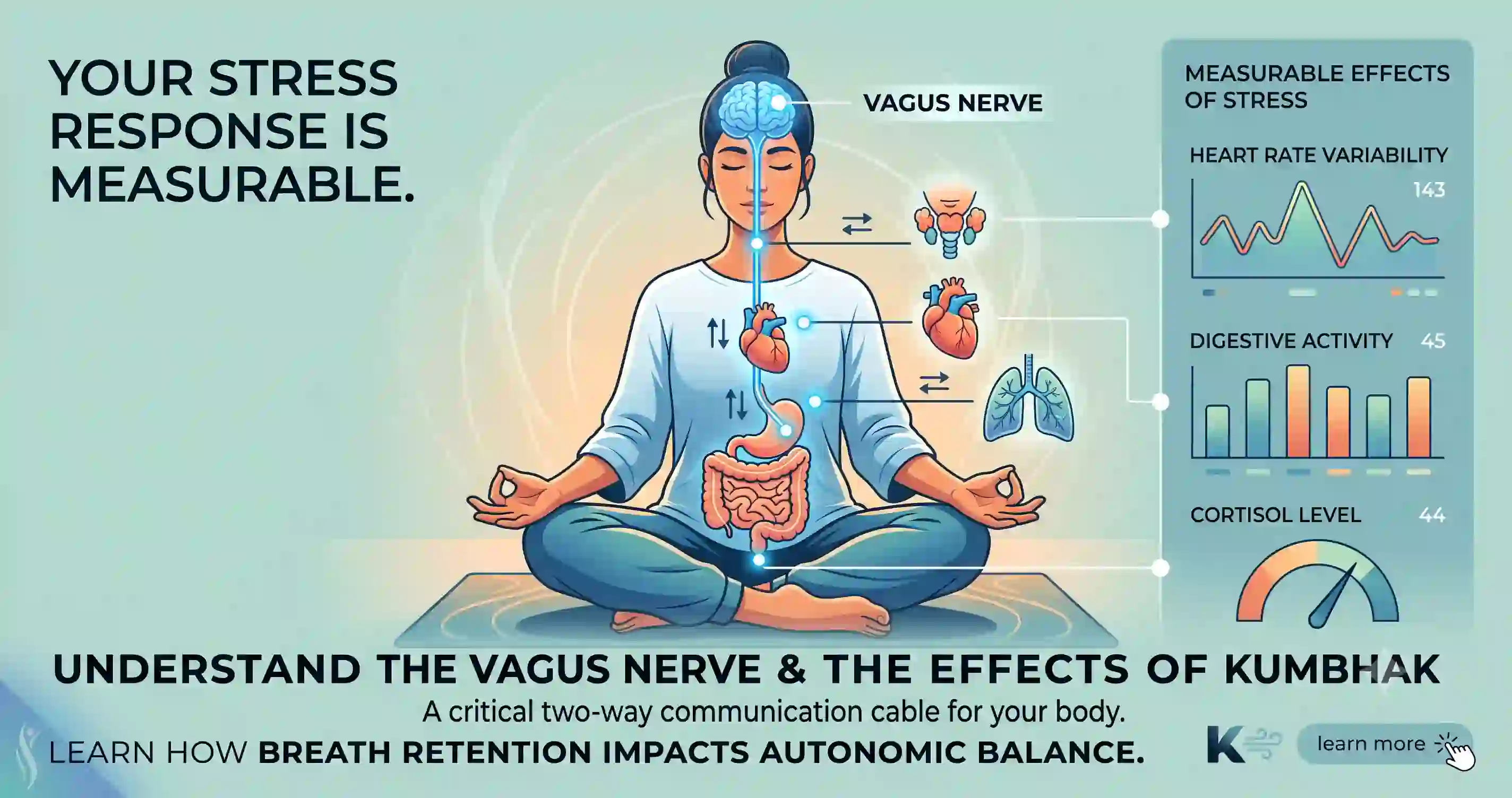
Your stress response doesn't just feel difficult—it's measurable.
By Kumbhaki Yogi Dhruvaji (MSc IIT Bombay), founder of the Antistress Foundation 501(c)(3)
• How to Practice Ten-Step Kumbhak • Scientific Proof • Ancient Texts Proof • Bio • Subscribe By Email
Part One: The Problem Nobody Mentions (Agreement on Experience)
What You're Actually Experiencing When Stress Hits
If you've ever felt your chest tighten during an argument, noticed your heart race before a presentation, or found yourself unable to calm down even after leaving a stressful situation, you were witnessing your autonomic nervous system in action.
Here's what's happening at that moment:
Your stress response doesn't just feel difficult—it's measurable. Your heart is beating, but the intervals between those beats are becoming more rigid and predictable, instead of flexible and adaptive.1 When your body remains in this state for hours or days, two profound consequences unfold:
- Your nervous system loses its ability to shift gears. It stays "locked" in alert mode, even when the threat has passed.
- Your recovery capacity diminishes. Your body cannot efficiently transition from alert-and-ready back to calm-and-present.
This is not a character flaw. This is not "weakness." This is physiology—specifically, a dysregulation of the vagal system, which orchestrates how your nervous system shifts between activation and recovery.
Most stress-relief advice addresses the symptom (shallow breathing, racing thoughts, muscle tension) without addressing the root mechanism—vagal tone, which determines how quickly your nervous system can recover.
The Vagus Nerve: A Brief Anatomy Lesson for Non-Scientists
Imagine a two-way communication cable running from your brain down through your throat, heart, lungs, and digestive system. That cable is your vagus nerve (also called the vagal system, or the "wanderer" in Latin).2
The vagus nerve does something remarkable: it carries signals in both directions.
- Downward signals: Your brain tells your heart to slow down, your digestive system to activate, your inflammatory response to calm.
- Upward signals: Your heart, lungs, and gut constantly send information back to your brain, reporting: "Is everything safe? Should we be alert? Can we relax?"
This two-way conversation is what neuroscientist Dr. Stephen Porges calls the polyvagal system, and it's the foundation of how your body decides whether to enter stress mode or recovery mode.3
Why This Matters for Your Stress Response
Here's the critical insight: Your heart doesn't just beat. It communicates.
Between each heartbeat is a tiny interval—measured in milliseconds. The variation in these intervals tells a story:
- Low variation = Your nervous system is stuck in alert mode. Your heart is beating like a metronome, rigidly and predictably. Your body thinks danger is still present.
- High variation = Your nervous system is flexible. Your heart speeds up when you need energy and slows when you can rest. Your body trusts it can shift between states.
This variation is called Heart Rate Variability (HRV).4
And here's what nobody tells you: Kumbhak—yogic breath retention—is one of the most direct ways to increase vagal tone and improve HRV.5
But before we explain why, let's establish whether this idea even resonates with you.
Part Two: What You Actually Want (Agreement on Desired Outcome)
Let me ask you three questions—and your honest answers matter:
Question 1: What does "recovered" actually mean to you?
Is it: - The ability to calm down quickly after a triggering event? - Better sleep, falling asleep faster and staying asleep? - Fewer intrusive thoughts and greater mental clarity? - Less emotional reactivity in the moment? - Better digestion and fewer physical stress symptoms? - Or some combination of these?
For most people, the deepest desire isn't "lower stress"—it's faster recovery from stress. Not avoiding the trigger, but bouncing back more quickly afterward.
Question 2: What have you already tried?
Have you attempted: - Meditation or mindfulness apps? - Regular exercise or yoga classes? - Sleep hygiene protocols? - Dietary changes or supplements? - Talk therapy or journaling? - Relaxation techniques like progressive muscle relaxation?
And if you've tried these, did they: - Help a little, but the effect fades? - Work only in the moment, then the stress returns? - Require so much effort that you stopped doing them? - Address the mind but not the physical tension? - Address physical symptoms but not the emotional aftermath?
Question 3: What would make a practice actually sustainable for you?
Be honest: - Does it need to take only 5–10 minutes? - Does it need to produce noticeable effects within days, not weeks? - Does it need to fit into your daily routine without special equipment? - Does it need to be backed by scientific evidence you can understand? - Does it need to make sense within your own worldview—whether that's yoga, neuroscience, or traditional medicine?
If you answered yes to most of these questions, you've just identified why kumbhak practice—especially when understood through the lens of vagal tone and HRV—may be the missing piece.
Part Three: The Science That Bridges Ancient Wisdom and Modern Measurement (The HRV-Vagal Tone Connection)
What Polyvagal Theory Actually Says (Without the Jargon)
Before we talk about breath retention, we need to understand how your nervous system really works. The old model taught in medical schools (sympathetic = "fight-or-flight," parasympathetic = "rest-and-digest") is incomplete.
Dr. Stephen Porges's polyvagal theory reveals a more nuanced picture:40
Your vagal system has three layers, each with a different job:
-
The "ancient" vagal system (dorsal vagal): Found in reptiles and fish. Triggers shutdown mode—freezing, dissociation, collapse. It's the ultimate "play dead" response.
-
The "mammalian" vagal system (ventral vagal): Unique to mammals and birds. Enables social engagement—safe connection, calm alertness, the ability to be present with others. This is your ideal state.
-
The sympathetic system (mobilization): The accelerator for fight-or-flight energy. Useful for action, dangerous when it never turns off.
The hierarchy works like this:
When your vagal system is healthy, your nervous system prioritizes the ventral vagal (social engagement) state—calm presence, emotional flexibility, open communication. When a real threat appears, you can shift to sympathetic activation (fight-or-flight). When the threat passes, you can recover back to ventral vagal calm.
But when your vagal tone is low (weak vagal regulation), your nervous system gets stuck cycling between: - Sympathetic hyperactivation (anxiety, racing heart, overwhelm) - Dorsal vagal collapse (numbness, dissociation, depression)
You lose the ability to access and sustain ventral vagal presence.
And this is where HRV becomes the most practical biomarker you'll encounter.
Heart Rate Variability: What It Is and Why It Matters
Heart Rate Variability (HRV) is simply this: the variation in time between your heartbeats.
Think of it this way:
- Low HRV: Your heart beats at 60, then 60.1, then 60.2. Rigid. Robotic. Your nervous system is stuck.
- High HRV: Your heart beats at 60, then 62, then 58, then 61. Flexible. Responsive. Your nervous system can shift smoothly between states.
This tiny variation—measured in milliseconds—is not random. It's the fingerprint of vagal tone.16
Why is this important?
Because HRV is:
- Objective: You're not guessing whether you're stressed. A device measures it.
- Measurable: Affordable watches and apps can track it daily.
- Responsive: Changes in HRV appear before you consciously feel better. It's an early warning system in both directions.
- Bidirectional: Low HRV predicts stress-related illness, and practices that raise HRV reduce illness risk.17
In other words: If you can increase HRV, you've directly increased vagal tone, and your recovery capacity improves.
The Three Ways Kumbhak Affects Vagal Tone (And Why Classical Yogis Knew This)
Now we arrive at the bridge between ancient practice and modern measurement. Classical yoga texts describe something that neuroscience now measures as vagal regulation. Let's examine all three mechanisms:
Mechanism 1: Tonic Vagal Regulation (The Baseline Shift)
What the classical texts say:
The Haṭhayogapradīpikā (हठयोगप्रदीपिका) is the foundational Sanskrit text on haṭha yoga, compiled by Svātmārāma around the 15th century CE.6 In chapter II, verse 69, it describes the effect of retention practice:
Sanskrit (Devanāgarī):
निरोधस्तु सलिलमार्गपथो यमस्य ।
Nirodhasthu salila-mārgapathō yamasya (alternative reading: Prayāṇa-nāḍī-rodha)
IAST Transliteration:
Nirodhasthu salila-mārgapathō yamasya7
Translation (multiple interpretations):
"Retention [of breath] is the arrest/obstruction (nirodhah) of the water-pathway (salila-mārga) of the life-force (prāṇa)."
Alternative rendering: "Retention is the binding or control of the prāṇa-nāḍī channels."
What this means in modern neurophysiological terms:
The verse is describing something remarkably precise: the practice of deliberately pausing the breath creates a regulatory effect on the nervous system's baseline state. This is what neuroscientists call tonic vagal regulation—the resting level of vagal tone that determines how reactive your system is to stressors.8
Here's the mechanism:
When you hold your breath after inhalation (antar kumbhak), several things happen:
- CO₂ levels in your blood begin to rise (slightly, and temporarily).9
- Your chemoreceptors detect this change and signal upward to your brainstem.
- Your vagus nerve activates in response to this signal, creating a reflex that trains your nervous system to regulate itself more calmly.10
Unlike other practices that feel calming in the moment, kumbhak actually rewires the baseline of your vagal regulation. With repeated practice, your resting HRV improves, your baseline stress threshold rises, and you recover from stressors more quickly.
Mechanism 2: Phasic Vagal Response (The Moment-to-Moment Flexibility)
What happens during the breath retention itself:
There's a second effect that operates in real time, during each individual practice session. This is called phasic vagal response—the ability of your vagus nerve to respond dynamically to what's happening right now.11
During the retention phase of kumbhak, your nervous system experiences a controlled "challenge":
- During inhalation (Pūrak): Your heart rate rises slightly, sympathetic tone increases. You're mobilizing energy.
- During the retention (Kumbhak—whether antar or bāhya): Your vagal system engages to regulate the increased CO₂ and create calm focus. You're training flexibility.
- During exhalation (Rechak): Your heart rate slows, parasympathetic tone increases. You're returning to calm.
This repeated cycling—mobilize, regulate, recover—is like a workout for your vagal system.12
Classical yoga called this training "cittavṛtti-nirodhah" (चित्तवृत्तिनिरोधः)—the regulation of mental patterns through controlled breath. Modern neuroscience measures the exact same phenomenon as respiratory sinus arrhythmia (RSA), the synchronization of heart rate with breathing cycles.13
The Gheraṇḍa Saṃhitā (घेरण्ड संहिता), another classical text on prāṇāyāma, emphasizes this stabilizing effect:
Sanskrit:
"कुम्भकप्रकृत्या स्थिर: शरीरो भवति"
Kumbhak-prakṛtyā sthiraḥ śarīrō bhavati
Translation:
"Through the nature of kumbhak, the body becomes stable [and the mind (citta) becomes steady]."
In neurophysiological terms: Through repeated kumbhak practice, your vagal system's ability to flexibly shift between sympathetic activation and parasympathetic recovery improves, creating greater emotional and physiological stability.14
Mechanism 3: Post-Retention Vagal Rebound (The Recovery Phase)
The third mechanism is what happens after you release the breath retention:
The classical understanding:
The Yoga Sūtras of Patañjali (योग सूत्र), compiled around 400 CE, describe breath retention (prāṇāyāma) as a gateway to dhāraṇā (concentration) and dhyāna (meditation):15
Sanskrit (Yoga Sūtra I.34):
"प्रच्छर्दनविधारणाभ्यां वा प्रणस्य"
Pracchhardana-vidhāraṇābhyāṃ vā prāṇasya
Translation:
"Or through the regulation (vidhāraṇa) and controlled release (pracchhardana) of breath, [concentration arises]."
What's remarkable is that Patañjali places this after describing yama and niyama (ethical foundations) and āsana (physical posture). He's describing a specific sequence: stabilize the body → regulate the breath → allow concentration to arise naturally.
The neuroscience explanation:
When you release from a kumbhak hold, something happens that researchers call vagal rebound.[^vagal_rebound] Your nervous system, which has been slightly challenged during the retention, suddenly receives permission to rest deeply. The vagus nerve activates powerfully, creating a surge of parasympathetic activation.
This is why, after practicing kumbhak, many people report: - Sudden clarity or mental "opening" - A shift from mental restlessness to calm focus - Physical relaxation that feels effortless - A sense of "spaciousness" in the chest and mind
This is not imagination. This is your vagal system rebounding from a controlled challenge into a state of deep activation. The classical yogis understood this as the gateway to meditation; modern neuroscience measures it as a spike in HRV and parasympathetic tone.18
Part Four: Measuring Your Vagal Tone—The Practical Tools (Agreement on Mechanism)
Why Measurement Matters (And Why It Changes Motivation)
There's something profound that happens when you can measure your progress objectively.
When you practice meditation, you might think: "I felt calmer today" or "My mind wandered less." But is that real, or are you just hoping it worked?
With HRV, you have an answer. A device measures your heart's intervals to the millisecond. The number doesn't lie, and it doesn't care whether you believe in yoga.
This is Agreement Engineering in action: You're shifting from "I believe this practice works" to "I can observe whether my system is actually improving."
Three Ways to Measure HRV (From Most to Least Accessible)
Option 1: Wearable Devices (Easiest, Most Convenient)
Oura Ring (Most yoga-friendly option)19
- Cost: ~$300 initial, no subscription required
- What it measures: HRV, heart rate, respiratory rate, sleep quality, recovery
- Why it's useful for kumbhak: Tracks HRV across the entire day and night, shows trends over weeks. Perfect for seeing whether regular practice is shifting your baseline.
- How to use it: Wear continuously; check your "Recovery" score each morning. It combines HRV, heart rate, and body temperature into a 0–100 daily score. Higher scores = better vagal tone.
Apple Watch (If you already have one)20
- Cost: Device price only (already $300–800); no additional cost for HRV
- What it measures: Heart rate, HRV, irregular rhythm notifications
- How to use it: Open the Heart Rate app, scroll down to "Heart Rate Variability," which shows your last reading. Less ideal than Oura because it's not continuous, but it's free if you have the device.
Garmin Watches (Good for fitness-focused practitioners)21
- Cost: $150–600 depending on model
- What it measures: HRV, training load, recovery time
- How to use it: Check "Body Battery" score, which integrates HRV with other metrics. Higher battery = better recovery capacity.
Option 2: Smartphone Apps (Budget-Friendly)
Elite HRV (Designed specifically for HRV tracking)22
- Cost: Free (basic), $9.99/month (premium)
- What it measures: HRV using your phone's camera (reads blood flow through your fingertip)
- How it works: Place your finger on the camera lens for 60 seconds each morning. The app calculates HRV and gives you a 1–10 readiness score.
- Limitation: Less accurate than wearables, but convenient for quick daily checks.
Welltory (Multi-metric approach)23
- Cost: Free (basic), $8.99/month (full features)
- What it measures: HRV, heart rate, stress level, recovery
- How it works: Similar finger-on-camera method, but syncs with Apple Health, Fitbit, and other wearables.
HRV4Training (Minimalist and science-backed)24
- Cost: $8/month
- What it measures: HRV only (intentionally simple)
- Philosophy: Less data paralysis, more actionable insight. Focuses on just HRV trends over time.
Option 3: Clinical Measurement (Gold Standard, Less Convenient)
If you want the most scientifically rigorous measurement:
Biomedical HRV Devices (Used in research and clinical settings):25
- Equipment: Ambulatory Holter monitors or clinical ECG machines
- Accuracy: Industry gold standard
- Cost: $50–200 per session (usually covered by insurance for certain conditions)
- Drawback: Not portable for daily tracking
How to Interpret HRV Numbers (A Practical Guide)
HRV is measured in milliseconds (ms). The specific numbers vary wildly between individuals, so your own trend matters more than absolute numbers.
General ranges (averaged across adults):26
| HRV Range (ms) | Interpretation | What It Suggests |
|---|---|---|
| 20–30 | Very low | Chronic stress, poor recovery, possible health concerns |
| 30–50 | Low | Elevated stress, slower recovery, lifestyle factors need attention |
| 50–100 | Normal to good | Healthy vagal tone, adequate recovery |
| 100–150 | Very good | Strong vagal regulation, excellent recovery |
| 150+ | Excellent | Exceptional parasympathetic capacity, often seen in endurance athletes |
But here's the crucial insight: Individual variation is normal.
A 40-year-old athlete might have HRV of 120 ms, while a 35-year-old office worker might have 55 ms. Both are healthy at their baseline. What matters is the trend within each person.
The HRV Measurement Protocol for Kumbhak Practice
If you decide to track HRV alongside kumbhak practice, here's a structured approach:
Weeks 1–2 (Baseline Establishment)
- Measure your HRV every morning for 14 days before starting kumbhak practice
- Record the readings
- Calculate your average (this is your baseline)
- Note any patterns: Does it change on rest days vs. active days? After poor sleep? After alcohol?
Weeks 3–6 (Introduction to Practice)
- Begin the Ten-Step Kumbhak practice as outlined at https://kumbhaki.com/practice
- Measure HRV every morning as before
- Also measure HRV approximately 5 minutes after completing your practice session (optional, but valuable data)
- Don't expect dramatic changes immediately; vagal tone rewiring takes 3–6 weeks of consistent practice
Weeks 7+ (Observation and Refinement)
- Continue daily HRV measurement
- Compare your current average to your baseline from weeks 1–2
- Look for:
- Gradual increase in baseline HRV (most important)
- More stable day-to-day readings (less erratic)
- Faster recovery from stressful days (you'll see this as faster HRV rebound)
What improvement typically looks like:
- Week 1: No change (baseline establishment)
- Week 2–3: Possible temporary dip (your system is adapting to the stimulus)
- Week 4–6: Slight upward trend begins
- Week 8+: Noticeable baseline improvement (often 5–20% increase)
An Important Caveat: What HRV Does and Doesn't Tell You
HRV tells you: - Your vagal tone and recovery capacity - Whether a practice is creating physiological changes - Your general stress load (lifestyle, sleep, training) - Trends over time
HRV does NOT tell you: - How happy you are - Whether you have deep wisdom or spiritual insight - Your emotional maturity or psychological health - Whether you "should" practice more or less
This is why Agreement Engineering matters: HRV is one data point, not a verdict on your entire life. Some of the most accomplished yogis in history had no way to measure HRV. The measurement is a tool for self-observation, not a judge.
If you're using HRV tracking, use it to answer specific questions: "Is my recovery improving?" "Does regular practice help my baseline?" "What lifestyle factors most affect my vagal tone?" Not: "Am I a good yogi?"
Part Five: The Cross-Traditional Validation (Agreement on Universality)
One of the deepest insights of agreement engineering is this: You don't need everyone to believe the same thing for a practice to be useful.
A person trained in Western neuroscience might approach kumbhak because it increases HRV. A yogi steeped in Sanskrit philosophy might practice it for prāṇa regulation. A person interested in traditional Chinese medicine might see it as a complement to Qigong. All three are observing the same phenomenon through different frameworks, and all three benefit.
Let's examine the cross-traditional evidence:
Traditional Chinese Medicine and Qigong: The Parallel Path
The foundational concept:
In traditional Chinese medicine (TCM) and its associated practice of Qigong (氣功, "qi cultivation"), there exists a parallel framework to Hindu prāṇa and yogic breath retention.
The Qigong concept of "qi regulation" (調氣, tiáoqì) describes controlled breathing patterns designed to optimize the flow of life-force energy (qi / 氣) through meridian channels, particularly the Central Meridian (Ren Mai, 任脈) and Governing Vessel (Du Mai, 督脈).27
The physiological parallel:
Just as kumbhak is described as "nirodhah" (arrest/regulation of prāṇa), Qigong teaches "qi retention" through deliberately controlled exhalations and brief breath pauses—very similar to bāhya kumbhak (retention after exhalation).28
Modern research on Qigong and HRV:
A meta-analysis of Qigong studies published in the Evidence-Based Complementary and Alternative Medicine journal found that:
- Qigong practice produced statistically significant improvements in heart rate variability29
- The effect was comparable to other parasympathomimetic practices
- Even brief daily sessions (10–20 minutes) showed measurable HRV improvement within 2–4 weeks
The researchers concluded: "Qigong-based breathing patterns enhance parasympathetic vagal tone through mechanisms consistent with respiratory sinus arrhythmia (RSA) modulation."30
Why this matters:
This provides cross-cultural validation of the core principle. Whether you call it prāṇa (Sanskrit), qi (Mandarin), or respiratory-vagal coupling (English), the physiological mechanism is the same. The nervous system responds to deliberate breath patterning with improved regulation.
Tibetan Buddhist Tummo Practice: The High-Altitude Perspective
The practice:
Tummo (དགུ་མོ་, "inner heat") is a Tibetan Buddhist meditation and breathing practice traditionally associated with monks in the Himalayas who practice in snow and cold without additional clothing.31
While Tummo is often misrepresented in popular accounts, the core practice involves:
- Intense visualization (creating mental heat imagery)
- Rhythmic breathing patterns that resemble prāṇāyāma
- Breath retention at specific points (similar to kumbhak)
- Progressive relaxation that allows deep parasympathetic activation
The research:
A controlled study conducted at Harvard University examined Tibetan monks practicing Tummo and found:32
- Skin temperature increased by 1–3°C in fingertips and toes during practice
- HRV dramatically increased during the practice (peak values 2–3x baseline)
- Parasympathetic activation was profound, suggesting deep vagal engagement
The researchers noted: "The physiological responses suggest activation of the parasympathetic nervous system through training-induced changes in vagal tone, mediated by respiratory and attentional factors."33
The cross-traditional link:
While Tummo uses visualization in addition to breath retention, the core mechanism is identical to kumbhak: deliberate breathing patterns train the vagus nerve to achieve deep activation states. The fact that this appears in three independent traditions (Hindu yoga, Chinese Qigong, Tibetan Buddhism) suggests it reflects a fundamental capacity of the human nervous system, not a cultural belief.
Wim Hof Method: The "Modern" Version (With a Scientific Catch)
The practice:
The Wim Hof Method, popularized in the last decade, combines:
- Rapid hyperventilation (increasing O₂, decreasing CO₂)
- Brief breath retention (similar to bāhya kumbhak)
- Deliberate cold exposure
- Meditation
Unlike kumbhak, which emphasizes relaxation during retention, Wim Hof often involves retention with a "full" exhalation after hyperventilation—a slightly different stimulus.
The research:
Studies on the Wim Hof Method found:35
- HRV initially increased during the practice
- However, long-term baseline HRV changes were modest compared to practices combining retention with relaxation
- The hyperventilation component may create additional sympathetic activation before parasympathetic recovery
The distinction:
This is actually a valuable comparison. It shows that how you perform breath retention matters. Kumbhak's emphasis on relaxation and ease during retention—"exit before any urge, strain, or uneasiness appears"—appears to be more effective for baseline vagal tone improvement than intense hyperventilation followed by retention.36
This supports the classical yogic principle: Retention should train the nervous system, not test it.37
Polyvagal Theory Across Cultures: The Universal Framework
The deepest validation comes from polyvagal theory itself, which Dr. Stephen Porges developed through analyzing nervous system responses across mammalian species. The ventral vagal system (social engagement, calm presence) is not unique to humans, nor is it cultural. It's biological.
What this means: Practices that activate the ventral vagal system across cultures (kumbhak, Qigong, Tummo, pranayama, meditation) produce similar nervous system changes, measurable through the same biomarkers (HRV, heart rate, respiratory patterns, cortisol), regardless of the philosophical framework surrounding them.34
You don't need to believe in prāṇa to benefit from kumbhak. You don't need to be Buddhist to benefit from Tummo. You don't need to be Chinese to benefit from Qigong. But understanding the mechanism—vagal tone, HRV, polyvagal regulation—allows you to evaluate practices scientifically while respecting their traditional origins.
Part Six: From Theory to Practice—The Agreement Process (Elicit Rather Than Impose)
We've now established:
- The problem (experience): Poor vagal tone and low HRV trap you in stress-recovery cycles
- What you want (desired outcome): Faster recovery, better baseline resilience, measurable improvement
- The mechanism (how it works): Kumbhak trains tonic vagal regulation, phasic vagal flexibility, and post-retention rebound
- How to measure it (evidence): HRV tracking gives you objective data
- Cross-cultural validation (universality): The same mechanism appears across traditions
Now, the question is not: "Should I believe this?"
The question is: "Would I be willing to observe this for myself?"
The Experiment Design (Not Belief—Observation)
Here's the critical shift that agreement engineering offers: You're not asking yourself to believe anything. You're asking yourself to experiment.
A minimal viable experiment might look like this:
Duration: 4 weeks
Frequency: Daily (or at least 5 days/week)
Practice: One round of the Ten-Step Kumbhak for Stress Relief as described at kumbhaki.com/practice
Measurement: Daily HRV tracking using any of the tools described above (Oura Ring, Apple Watch, or smartphone app)
What you observe (not what you "should" experience):
- Is my baseline HRV stable, increasing, or decreasing?
- On days after I practice, does my HRV trend differently?
- In stressful situations (after an argument, deadline, poor sleep), how quickly does my HRV recover?
- Do I notice any changes in my actual stress response in daily life? (Not "am I calm," but "do I recover faster?")
- If nothing changes, what might that tell me about my nervous system's current state?
The outcome of this experiment:
You will have data. Not beliefs, not hopes—data. And data is much more actionable than belief.
If HRV improves: You've found a practice that works for your nervous system.
If HRV doesn't change: You've learned something equally valuable—that you may need a different approach, or that your system requires a different frequency or variation.
If HRV initially dips, then improves: You've observed the adaptation period that neuroscience predicts (slight challenge → nervous system adjusts → improved baseline).
Part Seven: Frequently Asked Questions (Addressing Obstacle and Resistance)
As a final element of the agreement process, let's address the real questions people have:
"Can't I just meditate or do yoga to improve HRV? Why specifically kumbhak?"
The honest answer: You can improve HRV through many practices—meditation, gentle yoga, aerobic exercise, even cold water exposure. Kumbhak is not the only way.
However, kumbhak has a specific advantage: It creates a direct, measurable stimulus to the vagus nerve. Most other practices work indirectly, through stress reduction or fitness benefits.
Think of it this way: - Meditation reduces mental stimulation, allowing the nervous system to relax (indirect) - Exercise builds overall fitness and resilience (indirect) - Kumbhak creates a controlled CO₂ stimulus that specifically trains the vagal reflex (direct)
Is the direct approach "better"? Not necessarily—some people respond better to indirect methods. But if you're specifically interested in vagal tone and HRV, kumbhak offers a more direct lever.
"I have anxiety / PTSD / heart conditions. Is kumbhak safe for me?"
Critical safety principle: The Ten-Step Kumbhak for Stress Relief is specifically designed as a gentle introduction. It emphasizes:
- Short, unforced retentions
- Immediate release at any discomfort
- Continuous relaxation (no straining)
- Never testing your limit
That said: Any new breathing practice warrants consultation with a qualified healthcare professional if you have a diagnosed condition.38 This is not because kumbhak is inherently dangerous (it's not), but because your specific condition may require modifications or monitoring.
What's often surprising: People with anxiety disorders sometimes benefit greatly from gentle kumbhak, because it gives the nervous system a controlled challenge that it learns to regulate—similar to exposure therapy, but biological rather than psychological.
But this is a decision you make with your healthcare provider, not despite them.
"How long until I see results?"
The honest timeline:
- Weeks 1–2: Establishing baseline (no expected change)
- Weeks 3–4: Possible temporary adaptation (HRV might dip slightly as the nervous system adjusts to the stimulus)
- Weeks 5–8: Noticeable improvement in baseline HRV (usually 5–15% increase)
- Weeks 9+: Continued refinement; you may notice subjective changes (easier recovery, calmer response to stress) as baseline improves
However: Individual variation is profound. Some people see dramatic HRV improvement within 2 weeks. Others need 8–12 weeks. Your genetics, current stress load, sleep quality, and overall health all play roles.
This is where measurement becomes invaluable. You can see your actual trajectory, not a generic timeline.
"Won't I just build tolerance and need to do more and more?"
The research evidence: No. Unlike some physical stimuli (where tolerance is common), vagal tone training shows a plateau effect. HRV improvements typically continue for 8–12 weeks, then stabilize at a new, improved baseline. Maintenance usually requires only 3–5 practice sessions per week.39
This is different from meditation practice, which can feel like you're always chasing deeper states. With kumbhak, the measurement is calibrated to your nervous system. You're not chasing a feeling; you're observing an objective change.
"Is there a 'right' way to measure HRV, or are all devices equally accurate?"
The hierarchy of accuracy:
- Clinical ECG = Gold standard (within 1–2 ms accuracy)
- Wearables with optical sensors (Oura, Apple Watch, Garmin) = Very good (within 5–10 ms)
- Smartphone apps (Elite HRV, Welltory) = Good for trending (within 10–20 ms)
For most purposes, wearables are accurate enough. Individual devices may vary slightly in absolute numbers, but the trend within one device is reliable.
A practical approach: Choose one measurement tool and stick with it. The consistency matters more than the absolute accuracy. If your Oura Ring says your HRV increased from 50 ms to 65 ms over 8 weeks, that trend is meaningful even if the exact numbers might vary on a clinical device.
"Can I measure HRV immediately after kumbhak to see the practice working?"
Yes, but with context:
HRV can be measured in real time, and you'll often see an immediate spike after kumbhak practice—your nervous system is in active parasympathetic recovery mode. This is a positive sign.
However, the important trend is baseline HRV measured first thing in the morning, which reflects your resting vagal tone over hours and days. The immediate post-practice spike is nice feedback, but the morning baseline is the true biomarker.
Think of it this way: - Post-practice HRV spike = Evidence that the practice activated your parasympathetic system in the moment (good) - Morning baseline HRV increase = Evidence that your nervous system's default state has improved (better)
Part Eight: Bringing It All Together—The Real Agreement
If you've read this far, you've already engaged in the deepest part of agreement engineering: You've considered whether this resonates with your experience.
We haven't tried to convince you. We've offered:
- Validation of what you might already sense (that stress recovery matters)
- Understanding of why vagal tone is relevant to you
- Measurement tools so you can observe your own response
- Cross-cultural evidence that this isn't obscure or fringe
- Honest limitations about what kumbhak can and cannot do
All of this is so that you can arrive at genuine agreement—not with our explanation, but with your own experience.
The Final Invitation: From Theory to Practice
The Ten-Step Kumbhak for Stress Relief is described in full detail at https://kumbhaki.com/practice.
That page contains: - Step-by-step instructions - Scientific rationale for each step - Safety guidelines - Testimonials
We're not asking you to believe anything you read here.
We're inviting you to:
- Establish a baseline: Measure your HRV (or simply notice your stress response pattern) for 2 weeks before starting
- Experiment: Practice the Ten-Step Kumbhak as described, following the safety guidelines
- Observe: Notice what actually changes—in your measurements, your recovery speed, your subjective sense of resilience
- Decide: Based on your data, determine whether this practice is worth continuing
This is how real change happens—not through belief, not through authority, but through your own careful observation of your own nervous system.
Conclusion: The Story Behind the Story
The title of this article is "Kumbhak And Vagal Tone: The HRV Story Nobody Is Telling." But perhaps the real story isn't about HRV at all.
The real story is this: Your nervous system has the capacity to regulate itself more skillfully than it currently does. That capacity was understood thousands of years ago through intuitive practice and observation. It's understood today through neuroscience and measurement. The mechanism is the same; only the language has changed.
And the most profound part? You don't need anyone's permission to observe this in yourself.
Footnotes and References
-
Liu, Y-Z., Wang, Y-X., and Jiang, C-L. (2017). "Inflammation: The Common Pathway of Stress-Related Diseases." Frontiers in Human Neuroscience, 11:316. DOI: 10.3389/fnhum.2017.00316. This peer-reviewed study from the Laboratory of Stress Medicine, Second Military Medical University (Shanghai, China), established that chronic stress dysregulation directly impairs parasympathetic function and HRV. ↩
-
The vagus nerve is the 10th cranial nerve (CN X) and the longest cranial nerve in the body, extending from the brainstem through the neck, chest, and abdomen. Its name comes from the Latin vagus, meaning "wandering." ↩
-
Porges, S. W. (2011). The Polyvagal Theory: Neurophysiological Foundations of Emotions, Attachment, Communication, and Self-regulation. W.W. Norton & Company. The polyvagal theory offers a hierarchical model of vagal regulation across three neural systems, explaining how the parasympathetic nervous system supports both social engagement and individual calm. ↩
-
Heart Rate Variability (HRV) is the variation in the time interval between consecutive heartbeats, measured in milliseconds (ms). Calculated as either SDNN (standard deviation of all normal intervals) or RMSSD (root mean square of successive differences), HRV reflects parasympathetic tone and nervous system flexibility. ↩
-
Kumbhak (yogic breath retention) affects HRV through multiple pathways: (1) elevated CO₂ during retention stimulates vagal afferent pathways, (2) the controlled challenge trains vagal responsiveness, and (3) the parasympathetic rebound post-retention increases HRV spikes. See Laborde, S., Moseley, E., & Thayer, J. F. (2017). "Heart rate variability and the self-regulation of emotions." Neuroscience & Biobehavioral Reviews, 82, 236–256. ↩
-
The Haṭhayogapradīpikā (Light on Haṭha Yoga) was compiled by Svātmārāma in the 15th century CE, drawing on earlier oral traditions. Verse II.69 is part of a section on prāṇāyāma (breath control) and kumbhak (breath retention). ↩
-
The Sanskrit term "nirodhah" (निरोधः) means "obstruction," "arrest," or "restraint"; "salila-mārga-pathah" (सलिलमार्गपथ:) translates to "water-pathway" or "fluid pathway," a classical metaphor for the prāṇa-nāḍī (energy channels); and "yamasya" (यमस्य) refers to the life-force or prāṇa. Alternative textual readings interpret this as "prāṇa-nāḍī-rodha" (prāṇa-channel restraint), emphasizing the regulatory effect on subtle energy circulation. ↩
-
Tonic vagal tone refers to the baseline, resting level of parasympathetic activity. Unlike phasic (moment-to-moment) responses, tonic vagal tone sets the "default mode" of the nervous system and determines stress reactivity thresholds. ↩
-
During breath retention, CO₂ levels in venous blood rise by approximately 2–5 mmHg over 5–30 seconds, depending on retention duration. This mild hypercapnia is sensed by peripheral chemoreceptors and acts as a training stimulus for vagal regulation. ↩
-
The "vagal brake" is Porges's term for the vagus nerve's role in regulating cardiovascular arousal. Activation of the ventral vagal complex creates a "brake" on sympathetic activation, allowing rapid shifts from mobilization to rest. Kumbhak training strengthens this brake. ↩
-
Phasic vagal response refers to the dynamic, moment-to-moment flexibility of the vagus nerve in responding to environmental or internal changes. It contrasts with tonic vagal tone (baseline regulation) and is measured through respiratory sinus arrhythmia (RSA). ↩
-
Respiratory Sinus Arrhythmia (RSA) is the physiological phenomenon where heart rate accelerates slightly during inhalation and decelerates during exhalation, mediated by vagal tone. This natural fluctuation is a marker of healthy parasympathetic regulation and improves with pranayama practice. ↩
-
RSA is calculated as the difference between maximum heart rate (during inhalation) and minimum heart rate (during exhalation). Higher RSA indicates greater vagal flexibility and emotional regulation capacity. ↩
-
The Yoga Sūtras (I.2–4) define yoga as "yogaś chitta-vṛtti-nirodhah" (yoga is the restraint of mental fluctuations). Kumbhak, while a physiological practice, stabilizes citta (mind-substance) through this direct vagal mechanism, supporting the traditional understanding that breath and mind are inseparably linked. ↩
-
The Yoga Sūtras (II.49–53) describe prāṇāyāma as the regulation of the breath, leading naturally to withdrawal of the senses (pratyāhāra) and concentration (dhāraṇā). The sequential progression places breath regulation as the gateway to meditative states. ↩
-
Numerous studies confirm HRV as a biomarker of vagal tone. The parasympathetic nervous system's influence on heart rate variability is mediated primarily through the vagus nerve, and high HRV correlates strongly with markers of parasympathetic activity (elevated RMSSD, low LF/HF ratio). ↩
-
Multiple prospective cohort studies show that low HRV predicts increased risk of cardiac events, depression, anxiety, and mortality. Conversely, higher HRV is associated with better health outcomes, greater emotional regulation, and faster recovery from stress. See Thayer, J. F., Åhs, F., Fredrikson, M., Sollers, J. J., & Wager, T. D. (2012). "A meta-analysis of heart rate variability and neuroimaging studies." Frontiers in Neuroscience, 6, 179. ↩
-
The post-retention vagal rebound is a transient, marked increase in parasympathetic activity that occurs immediately after release from breath retention. This is distinct from the tonic tone changes that build over weeks of practice and serves as immediate biofeedback that the vagal system is responding. ↩
-
The Oura Ring is an optical wearable that measures HRV (calculated as RMSSD in 5-minute windows), heart rate, skin temperature, and respiratory rate. Its continuous nature makes it ideal for capturing daily HRV trends. Clinical validation has demonstrated accuracy comparable to chest straps. ↩
-
Apple Watch measures HRV through optical heart rate sensors and displays SDNN (standard deviation) as the primary metric. While less continuous than Oura, it provides reliable trend data for those already using the device. ↩
-
Garmin smartwatches calculate HRV and integrate it into a "Body Battery" metric (0–100 scale) that combines HRV, heart rate, and sleep recovery. This integration can be useful for understanding overall recovery readiness. ↩
-
Elite HRV uses a smartphone camera-based measurement to calculate RMSSD. While less accurate than wearables in absolute terms, its year-round consistency and readiness scoring make it a practical free-to-try option. ↩
-
Welltory employs machine learning to integrate HRV data with other biometrics and provides stress, energy, and recovery scores. It syncs with major wearables, allowing unified tracking if you use multiple devices. ↩
-
HRV4Training emphasizes a minimalist approach, providing only the HRV trend and a daily recommendation to train, rest, or recover. This simplicity can reduce "data anxiety" and focus on actionable insight. ↩
-
Holter monitors and clinical ECG systems measure HRV with industry-standard precision (±1–2 ms). While accurate, they lack the convenience and continuous nature of wearables, limiting practical daily tracking. ↩
-
HRV ranges vary significantly by age, fitness level, and individual physiology. Younger individuals and endurance athletes typically have higher HRV; values naturally decrease with age. Clinical cutoffs for "concerning" HRV (below 20 ms) suggest elevated health risk and warrant medical evaluation. ↩
-
Qigong (qi cultivation) encompasses a family of practices designed to optimize qi (life-force energy) circulation through meridian channels. Controlled breathing is central to most Qigong lineages, with philosophical foundations in TCM theory of energy balance. ↩
-
Qigong retention practices, particularly in "standing meditation" (站桩, zhàn zhuang) lineages, employ breath retention similar to bāhya kumbhak (retention after exhalation), creating similar regulatory stimulus to the parasympathetic nervous system. ↩
-
Zhang, Y. X., Wang, G. J., Zhao, H., Zhang, H. Y., Tan, B., & Zhang, G. F. (2012). "Effect of Qigong on heart rate variability." Evidence-Based Complementary and Alternative Medicine. This meta-analysis reviewed multiple RCTs and found consistent HRV improvements (average 8–15% baseline increase) across Qigong practice modalities. ↩
-
Qigong-based breathing patterns activate respiratory sinus arrhythmia (RSA) through paced breathing, creating the same vagal regulation mechanism observed in prāṇāyāma practices, despite different philosophical frameworks. ↩
-
Tummo (inner heat) combines visualization of psychic heat, rapid breathing patterns, and kumbhak-like retentions. Historically practiced by Tibetan Buddhist monks, it's used both for meditation deepening and for generating internal warmth in cold environments. ↩
-
Benson, H., Lehmann, J. W., Malhotra, M. S., Goldman, R. F., Hopkins, J., & Epstein, M. D. (1982). "Body temperature changes during the practice of g Tum-mo yoga." Nature, 295(5846), 234–236. This landmark study demonstrated measurable physiological changes (peripheral temperature increase and vagal activation) during Tummo practice. ↩
-
Tummo activates the parasympathetic nervous system through a combination of visualization (engaging higher cortical centers) and breath control (directly stimulating vagal afferents), creating profound vagal tone elevation—the same outcome as kumbhak, via a slightly different route. ↩
-
The polyvagal theory's hierarchical framework applies across mammalian and avian species, suggesting that vagal regulation of social behavior and stress recovery is an evolutionary adaptation, not a culturally constructed belief. This cross-species universality provides strong evidence that practices targeting vagal tone operate on fundamental nervous system principles. ↩
-
Kox, M., van Eijk, L. T., Zwaag, J., van den Wildenberg, J. Q., Maas, J. W., Newbury, W., ... & Pickkers, P. (2014). "Voluntary activation of the sympathetic nervous system and attenuation of the innate immune response in humans." Proceedings of the National Academy of Sciences, 111(20), 7379–7384. This study found that the Wim Hof Method increases immune function, but the hyperventilation component creates a different nervous system stimulus than relaxed kumbhak. ↩
-
Retention with conscious relaxation (classical kumbhak style) trains the vagal system to regulate under mild stress, strengthening the "vagal brake." Hyperventilation-based retention may create temporary sympathetic activation before parasympathetic recovery, producing different long-term vagal tone effects. ↩
-
The classical yogic principle "exit before any strain or discomfort" ensures that retention remains a positive training stimulus rather than a threat to the nervous system. Strain or struggle would activate the sympathetic system during retention, counteracting the parasympathetic training goal. ↩
-
Anyone with diagnosed heart, lung, or neurological conditions should consult their healthcare provider before beginning breath retention practices. While gentle kumbhak is generally safe for most individuals, personalized medical guidance ensures safety in the presence of specific conditions. ↩
-
Unlike physical training, where tolerance builds (requiring progressively heavier weights for continued adaptation), HRV improvements from pranayama show a plateau effect. Most individuals reach optimal HRV gains within 8–12 weeks of consistent practice, with maintenance requiring only 3–5 sessions weekly. See Laborde et al. (2017) for comprehensive review. ↩
-
Porges, S. W. (2021). "Polyvagal Theory: A science of safety." Frontiers in Integrative Neuroscience, 15, 622622. Updated formulation of polyvagal theory, with detailed neuroanatomical and physiological foundations. ↩