Learn to listen, ask permission, choose Kumbhak, science, evidence or yoga first, and practice with a partner without claims, comparison or timed holds.
By Kumbhaki Yogi Dhruvaji (MSc), founder of the Antistress Foundation 501(c)(3)
• How to Practice Ten-Step Kumbhak • Scientific Proof • Ancient Texts Proof • Bio • Subscribe By Email
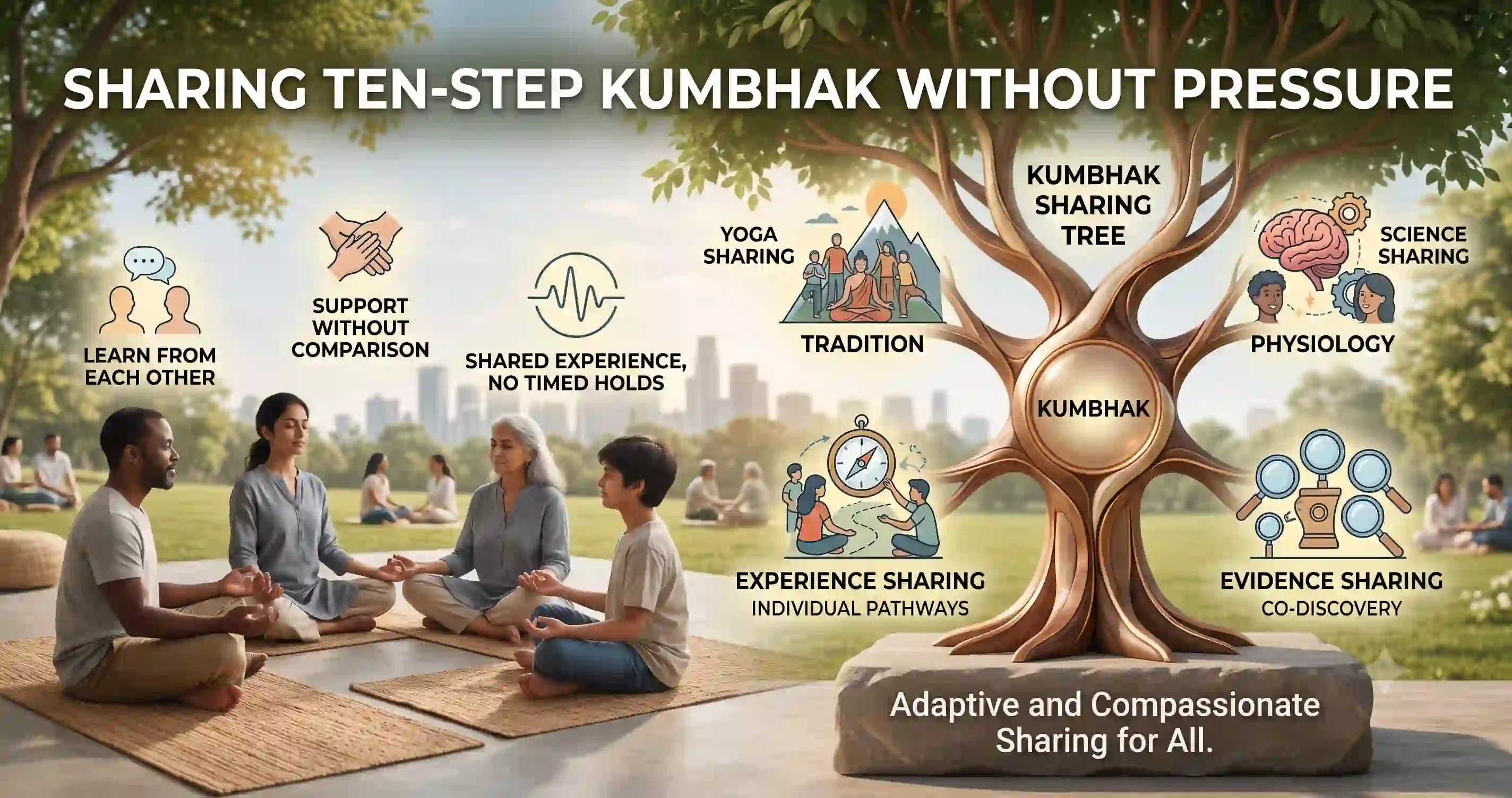
How to Share Ten-Step Kumbhak Without Pressure, Decide Whether Kumbhak, Science, Scientific “Proof” or Yoga Comes First, and Practice With a Partner Without Comparing Breath Holds
Someone you care about looks overwhelmed. You know a practice that matters deeply to you. Your first impulse is understandable: explain it immediately, prove it carefully, and help them feel better.
But the first gift may not be Kumbhak.
It may be the experience of not being managed.
The respectful sequence is simple: listen first, understand the outcome they want, ask permission, offer one optional round only after they know the complete method and safeguards, and let their own experience decide whether the conversation continues.
This article does not repeat the Ten-Step Kumbhak method. Anyone who wishes to try it should first read the complete Step-by-Step Instructions to Practice Ten-Step Kumbhak for Stress Relief, including its precautions.
The person in front of you is not an empty space waiting for your explanation. They already have a need, a history, a body and a right to choose.
This is educational guidance, not medical or mental-health advice. Ten-Step Kumbhak is not a treatment, cure or substitute for professional care.
The Short Answer: What Should Come First? 🎯
The listener’s desired outcome comes first. Kumbhak, science, scientific evidence and yoga are four possible entrances—not a fixed speaking order.
- If they want immediate, practical help and already know the full method, offer one optional round of Ten-Step Kumbhak.
- If they want to understand what may be happening in the body, begin with a brief scientific explanation.
- If they ask, “Has this actually been studied?”, begin with the quality and limits of the evidence, not a mechanism story.
- If they value traditional yoga, begin with a precise yogic source and its traditional meaning.
- If they want only to be heard, offer none of the four.
You do not have to lead them through every door. One relevant doorway is usually kinder than a tour of the whole building.
The Three Permissions That Protect the Conversation
There is not just one moment of consent.
- Permission to hear: “Would you like a possible practice, a brief explanation, or would you prefer that I keep listening?”
- Permission to try: “Would you like to try one optional round after reviewing the full instructions?”
- Permission to stop or not continue: “You can stop at any moment, for any reason, without explaining.”
A yes to hearing is not a yes to practising. A yes to one round is not a promise to practise tomorrow. A positive experience is not consent to be recruited, taught further or spoken about to others.
Why Listening Comes Before Teaching 👂
Stress can make a person feel crowded from the inside. Advice given too early can add one more voice to that crowd—even when the advice is wise.
Listening first is not a trick for earning compliance. It has value even if the person never tries Kumbhak.
In an experiment involving 115 participants, people who received active-listening responses felt more understood than those who received advice or simple acknowledgements.1 Research on psychological reactance also shows why high-pressure, freedom-threatening language can provoke anger and resistance.2 These findings do not prove that one conversational formula will work for everyone. They do support a modest principle: being understood and retaining choice can change how an offer is received.
Listen for the Outcome Beneath the Complaint
“I am stressed” can mean many different things:
- “I want my thoughts to stop replaying the meeting.”
- “I need enough steadiness to make one decision.”
- “I want to sleep tonight.”
- “I am frightened by what my body is doing.”
- “I need somebody to sit beside me.”
- “I want information, not an exercise.”
Useful questions include:
- “What is the hardest part of this right now?”
- “What would feel even slightly better in the next ten minutes?”
- “Would you like company, information or a practical option?”
- “Have breathing practices ever felt uncomfortable or frightening for you?”
Then reflect, rather than diagnose:
“It sounds as though you do not need a big solution tonight. You want enough quiet to stop carrying the argument into bed. Have I understood?”
The final question matters. A reflection is an attempt to understand, not a declaration that you already do.
Do Not Turn Listening Into a Hidden Sales Funnel
Questions become coercive when every answer is steered toward Kumbhak.
Avoid:
“You want less stress, don’t you?”
“You believe breathing affects the mind, right?”
“So why would you not try this?”
These are not open questions. They make refusal socially awkward.
Ask questions whose answers you are prepared to respect:
“Would you like to hear one possibility?”
“Which would be useful—practice, science, yoga, or none of those?”
“Would you rather return to this another day?”
The invitation is ethical only if “no” leaves the relationship completely intact.
A Small Story: The Advice That Waited ❤️
After a difficult hospital call, a daughter saw her father walking from room to room. She nearly said, “Sit down; I will teach you Kumbhak.”
Instead, she asked, “Do you want help settling, or do you want me to stay with you while this sinks in?”
“Just stay,” he said.
They sat without practising. The next morning, he asked about the breathing method she had not imposed.
Nothing had been lost by waiting. Trust had been protected.
Should You Explain Kumbhak, Science, Scientific Evidence or Yoga First? 🧭
There is no universally best opening. The best opening is the one that answers the listener’s actual question with the least unnecessary material.
First ask:
“Would you like the practical overview, what researchers have observed, the possible physiology, or the traditional yogic view?”
If they do not know, offer one-sentence descriptions of the options. Let them choose.
Door 1: Begin With Kumbhak When They Want a Practical Option
Choose this entrance when the person says something like:
- “I do not need a lecture; is there something brief I can try?”
- “I already read the instructions. Can we do one round together?”
- “I want to experience it before discussing theories.”
Keep the introduction claim-free:
“Ten-Step Kumbhak is a seated stress-relief breathing practice containing one comfortable Antar Kumbhak and one comfortable Bāhya Kumbhak within a defined round. It may feel useful, neutral or unsuitable. If you know the complete instructions and safeguards, we can try one optional round and then you can decide what, if anything, you noticed.”
Do not compress the full method into hurried verbal cues. If they have not learned it, share the complete practice guide and leave the experiment for another time.
Door 2: Begin With Science When They Want a Possible Mechanism
Choose this entrance when they ask:
- “What happens during a breath pause?”
- “Why might breathing influence how I feel?”
- “What do carbon dioxide and oxygen do?”
A careful answer is:
“During a closed-airway pause, carbon dioxide generally begins to rise and oxygen may fall depending on the duration and the person. Attention also becomes more focused on internal sensation. Heart rate, blood pressure and cerebral circulation can change, especially during longer holds. These responses vary by protocol, and they do not by themselves prove stress relief.”
That is science as explanation: a description of measured physiology and plausible pathways. It is not proof that Ten-Step Kumbhak caused a particular emotional result.
Avoid using one fashionable mechanism as a master key. “It activates the vagus nerve,” “it resets the nervous system,” and “it switches off cortisol” are stronger than direct Ten-Step evidence currently allows.
Door 3: Begin With Scientific Evidence When They Ask, “Does It Work?”
Scientific evidence is not the same as a scientific mechanism.
- A mechanism asks how an effect could occur.
- An outcome study asks what changed after a tested intervention.
- A comparison group asks whether that change exceeded attention, expectation, normal breathing or another activity.
- Direct evidence tests the actual method.
- Indirect evidence tests something related but different.
The honest evidence-first summary is:
“Breathing practices that contain retentions have shown promising effects on some stress, anxiety, attention and mood measures. However, many studies combine the holds with breathing rhythm, attention, nostril control or broader yoga, so they cannot tell us that Kumbhak alone caused the result. Direct research on this exact Ten-Step method is not yet sufficient to promise an outcome.”
For example:
- A randomised study of 116 young adult yoga practitioners found greater improvements in mindfulness, mind wandering and state anxiety when additional breathing with intermittent retention was added to usual yoga for eight weeks. The participants were already yoga practitioners, and the study did not test Ten-Step Kumbhak.3
- A randomised study of five-minute daily breathing practices found mood and anxiety improvements across several groups. The clearest average pattern favoured cyclic sighing; the retention-containing groups were not uniquely superior.4
- A direct laboratory study found that a one-minute Kumbhak changed cerebral blood-flow measures in 15 experienced male practitioners. That is acute physiology in a small trained sample—not evidence of better memory, healing or stress treatment.5
This is more trustworthy than saying, “Science has proved Kumbhak.”
Door 4: Begin With Yoga When They Want Traditional Meaning
Choose this entrance when they ask:
- “Where does Kumbhak sit within yoga?”
- “What do the classical texts say about breath and mind?”
- “Is this only a modern wellness technique?”
A concise, precise answer is:
“Classical yoga treats regulation or suspension of the movements of Pūrak and Rechak as part of prāṇāyāma. The Yoga Sūtra discusses external, internal and suspended aspects with attention to place, time and number, while the Haṭhapradīpikā connects movement of breath with movement of mind. These are traditional contemplative frameworks, not modern clinical proof.”1315
This gives the tradition its real depth without disguising a yogic claim as a laboratory conclusion.
Door 5: Begin With Safety When Breathlessness, Panic or Trauma Is Present
If the person has a history of panic, fainting, breathlessness, choking, suffocation trauma or a medical concern, neither science nor philosophy should come first. Safety and professional guidance should.
A pragmatic trial in people with post-traumatic stress disorder found no significant primary intention-to-treat advantage from adding a prāṇāyāma programme to trauma-focused therapy. Some participants reported anxiety, breathlessness, dizziness, constriction and a suffocation-related flashback.6
That trial did not test Ten-Step Kumbhak, but it establishes a vital boundary: internal breath sensations can be reassuring for one person and threatening for another.
Say:
“Retention may not be the right starting point for you. There is no need to try it. A qualified healthcare professional or trauma-informed teacher can help you decide whether any breath practice is appropriate.”
Door 6: Offer No Explanation When They Want Human Company
Sometimes the wisest response is:
“I will not give you a technique. I am here.”
Silence after permission is not a failure to teach. It may be the most accurate response to what was asked.
How to Share Ten-Step Kumbhak Without Making Claims 🔬
A claim predicts another person’s experience. An invitation makes room for it.
The difference can be only a few words, but emotionally it is enormous.
Replace Certainty With an Honest Test
Avoid:
“This will calm you.”
Use:
“You can notice whether anything changes for you.”
Avoid:
“Kumbhak activates your parasympathetic nervous system.”
Use:
“Breathing and retention can alter autonomic and cardiovascular signals, but the direction depends on the method and phase. Your immediate experience may be calm, neutral or uncomfortable.”
Avoid:
“Yoga discovered what science now proves.”
Use:
“Yoga and science ask different questions about the breath. Some observations meet; others remain untested.”
Avoid:
“Your longer hold proves that your lungs are stronger.”
Use:
“Hold duration is affected by many physiological, behavioural and situational factors. It is not a score of health or inner progress.”
Evidence Words That Protect Trust
Use words that match the evidence:
- “May” when an outcome is possible but not assured.
- “Was associated with” when causation is not established.
- “In this study” when the sample or protocol limits generalisation.
- “A retention-containing practice” when Kumbhak was only one component.
- “Indirectly relevant” when the research used voluntary apnoea or controlled low-oxygen exposure rather than Ten-Step Kumbhak.
- “Not yet established” when direct human research is missing.
Do not use uncertainty theatrically and then make the same promise in emotional language. “It may completely transform your nervous system” is still an oversized claim.
The Five Claims to Leave Unsaid
Do not tell someone that Ten-Step Kumbhak:
- will relieve their stress;
- cures anxiety, insomnia, asthma, hypertension or any disease;
- permanently increases oxygen, haemoglobin or “vagal tone”;
- activates stem cells, healing genes or immunity;
- proves spiritual advancement when a hold becomes longer.
The scientific literature does not justify these statements. Traditional texts also do not authorize one person to turn another person’s breath into a display of worth.
Do Not Announce Their Result for Them
After a round, avoid:
“See? You look calmer.”
“Your face has changed.”
“That worked.”
These statements can make a listener doubt their own experience or produce the report they think you want.
Ask:
“What did you notice, if anything?”
Then accept:
- “I feel more settled.”
- “I noticed the pause but no emotional change.”
- “I did not like it.”
- “I am not sure.”
- “I would rather not discuss it.”
“Nothing” is data. “No” is a complete answer.
How to Offer One Optional Round Without Pressure 🌱
One round is a small experiment, not a miniature commitment ceremony.
The person should already know the complete method and safety guidance. They should be seated in a safe place, free to stop, and not engaged in driving, bathing, swimming, operating machinery or another activity in which altered attention or faintness could cause harm.
A Claim-Safe Invitation
“I know a short, seated practice called Ten-Step Kumbhak. I cannot promise how it will feel for you. If you would like, you can first read the full instructions and precautions. Then we could try one optional round, with no timing and no need to continue. You may stop at any point.”
Notice what this invitation does:
- names the practice;
- refuses to promise an outcome;
- requires the complete instructions;
- offers only one round;
- removes timing;
- confirms the right to stop;
- makes continuation a separate decision.
Permission Must Remain Alive During the Round
A person cannot easily explain discomfort while retaining the breath. Before beginning, agree on a simple stop signal, such as raising one hand. The moment it appears, both people return to normal breathing. No questions are required in that moment.
Do not touch, reposition or physically adjust the person unless they explicitly requested that specific contact beforehand. Do not block the door, hover over them, stare at their face or count aloud.
If they stop, never say:
- “You were almost there.”
- “Just one second more.”
- “Try again immediately.”
- “You panicked.”
- “You did it wrong.”
Say:
“We have stopped. Take whatever time you need. There is no need to repeat it.”
Let the Experience Decide the Next Step
After the round, allow a short period of ordinary quiet. Then ask one open question:
“Would you like to say what you noticed, keep it private, or leave it there?”
If they found it useful, do not immediately prescribe a schedule. Ask whether they want the practice guide for independent review.
If it felt neutral, do not argue for hidden benefits.
If it felt unpleasant, believe them. A method can be meaningful to you and unsuitable for someone else at the same time.
How to Practise Kumbhak With a Partner or Family Member Without Comparing Breath Holds 🤝
The central rule is:
Share the space, not the stopwatch.
Two people may sit together while remaining completely independent in timing, internal sensation and decision-making.
Establish the Partnership Agreement Before Beginning
Agree on these points in plain language:
- Either person may decline before the round.
- Either person may stop during it.
- Either person may decide afterward not to repeat it.
- No hold will be timed, announced, recorded or compared.
- Neither person will try to match the other’s breathing rhythm.
- No one will interpret another person’s experience for them.
- Personal reactions remain confidential unless the person chooses to share them.
- No photographs, audio, video, social posts or messages about the session will be made without explicit permission.
- Any concerning symptom ends the session.
This agreement is more important than practising at the same moment.
The One-to-Three-Second Reserve Is Not a Minimum Hold
In Ten-Step Kumbhak, each retention ends while it still feels completely easy and while the practitioner remains certain that they could have continued comfortably for at least another one to three seconds.
This does not mean:
- hold for at least three seconds;
- wait until only three seconds remain;
- let a partner count down the final three seconds;
- add three seconds to yesterday’s duration;
- prove that three seconds is possible.
Someone may be unable to retain the breath for even three seconds. If an urge to breathe, strain or uneasiness appears sooner, they end the retention immediately. The one-to-three seconds describe a reserve before discomfort, not the duration of the hold.
A partner cannot feel another person’s reserve. Therefore, the partner cannot decide when the other should release.
Why No Competitive Timing Is the Only Sensible Rule
Maximum breath-hold duration varies widely. It is influenced by starting lung volume, prior oxygenation, carbon-dioxide accumulation, familiarity, attention, motivation, learned tolerance and other individual factors.78 Training can lengthen hold time without demonstrating a matching improvement in broader health outcomes.
A number on a timer therefore answers only a narrow question: how long did this particular attempt last under these particular conditions?
It does not reliably answer:
- Who is calmer?
- Who has healthier lungs?
- Who has more willpower?
- Who understood Kumbhak better?
- Who is more spiritually developed?
- Whose practice “worked”?
The timer looks objective, but it can measure the wrong thing with impressive precision.
Comparison Changes the Emotional Task
Without comparison, the task is:
“Can I remain relaxed and stop with a clear reserve?”
With comparison, it can become:
“Can I avoid disappointing the person beside me?”
That second task invites performance, concealment and strain. It is the opposite of a stress-relief practice.
Never create:
- a longest-hold winner;
- a family leaderboard;
- a streak based on duration;
- a “personal best”;
- a challenge between spouses, siblings, friends or students;
- praise that rewards longer holds;
- jokes about who “gave up” first.
Even affectionate teasing can remain in the body after the laughter has ended.
Do Not Force Synchronisation
Partners do not need to begin or finish each phase together. One person’s normal Pūrak and Rechak will not necessarily match another person’s. The retentions will also differ.
Synchronising can make the person with the shorter comfortable pause feel responsible for breaking the rhythm. Let each person practise at their own pace, complete their own round, and take their own two normal recovery breaths as described in the full guide.
Togetherness comes from respectful presence—not identical seconds.
Family Roles Can Make “Optional” Feel Compulsory
A request from a spouse, parent, adult child, caregiver, employer or respected teacher can carry more weight than the words reveal.
Do not offer Kumbhak:
- during an argument as an instruction to “calm down”;
- as a condition for continuing a conversation;
- as proof that the person is trying hard enough;
- after they have already declined;
- in exchange for approval, affection or peace in the home;
- when a person is too distressed, impaired or dependent to choose freely.
If you hold authority, make refusal easier:
“There is no disadvantage to saying no. I will not ask again today, and it will not change how I treat you.”
For children or anyone unable to provide informed, voluntary consent, do not improvise retention coaching. Seek age-appropriate guidance from a qualified healthcare professional and suitably trained instructor.
Support Without Becoming a Monitor
A helpful partner protects the conditions; they do not supervise the internal experience.
They can:
- help create a safe, interruption-free place;
- keep phones and timers away;
- remember the agreed stop signal;
- remain quiet if silence was requested;
- help locate the full instructions;
- accept the person’s report without correction.
They should not:
- watch for “weakness”;
- estimate the other person’s seconds;
- command the next breath;
- compare facial expressions;
- insist on a debrief;
- diagnose a doṣa, nervous-system state or trauma response;
- report the experience to relatives or friends.
Confidentiality Between Partners and Family Members 🔒
Breath practice can bring up embarrassment, fear, grief, memories, bodily sensations or nothing at all. The person who shares those reactions owns the story.
Before practising, say:
“What you feel or tell me afterward stays between us unless you ask me to share it.”
Then clarify the limit:
“I will keep your ordinary experience private. If you are in immediate danger, I may seek urgent help. If a professional duty or law applies to me, I will explain that limit rather than promise secrecy I cannot keep.”
This household agreement is ethically meaningful, but it is not the same as legally protected clinical confidentiality. Do not present yourself as a therapist, clinician or medical professional unless you actually hold the relevant qualification and are acting within its scope.
Confidentiality Includes Small Details
Privacy is broken not only by dramatic disclosures. Avoid saying:
- “She could barely hold.”
- “He became emotional afterward.”
- “My partner finally agreed to try.”
- “My mother is doing this for her anxiety.”
- “Our child is the best in the family.”
Even praise can expose information that was not yours to share.
Ask separately before sharing:
- what may be disclosed;
- to whom;
- for what purpose;
- whether their name may be used.
Consent to tell a healthcare professional is not consent to post in a group chat.
Individual Differences: Why Two Holds Should Never Look Alike 🫁
Modern physiology and Ayurveda arrive at individuality through different conceptual routes. Neither gives a partner permission to rank people.
Scientifically, breath-hold duration depends on more than lung capacity. Starting conditions, gas levels, cardiovascular responses, attention, training, discomfort tolerance and voluntary choice all contribute.7 Even a longer duration after practice may reflect familiarity or strategy rather than a broad health improvement.
Ayurveda, within its traditional framework, evaluates the individual rather than assuming a uniform body. The Charaka Saṃhitā describes differing constitutions (prakṛti) and other person-specific factors.18 This is an Ayurvedic concept, not scientific validation that a particular doṣa determines a safe Kumbhak duration.
The practical conclusion is the same:
The safest meaningful comparison is not person against person, but today’s experience against today’s purpose.
Even self-comparison needs restraint. Fatigue, illness, meals, medication, emotion, altitude and sleep may change what feels comfortable. Yesterday’s pause is not today’s obligation.
What Science Supports—and What It Does Not Yet Support 🔍
The scientific case for respectful sharing is stronger than the scientific case for claiming one exact effect from Ten-Step Kumbhak.
Listening, Choice and Resistance
Motivational Interviewing describes communication through partnership, acceptance, compassion and drawing out the person’s own priorities. It explicitly respects the person’s right to make informed choices about changing or not changing.9
Shared-decision guidance from the UK National Institute for Health and Care Excellence similarly recommends asking what matters to the person, discussing options in relation to their goals, including the choice to do nothing, presenting information in manageable pieces and allowing people to change their minds.10
Ten-Step Kumbhak shared between relatives is not healthcare. Yet these principles remain useful because they protect autonomy:
ask → listen → offer → check → accept.
Breathing Research Does Not Make Retention the Sole Cause
Many studies test packages:
- breathing rhythm plus attention;
- alternate-nostril breathing plus Kumbhak;
- yoga plus retention;
- hyperventilation plus long retention;
- box breathing with equal phases;
- therapist contact plus home practice.
If the package helps, the study cannot automatically award all credit to the hold. Attention, expectation, Rechak duration, daily pause from stress and human support may also matter.
That is why “retention-containing practice” is often more accurate than “Kumbhak was proved effective.”
Acute Change Is Not the Same as Lasting Benefit
A hold may immediately change:
- carbon dioxide and oxygen;
- blood pressure;
- heart rate and cardiac output;
- cerebral blood-flow velocity;
- vascular resistance;
- internal sensation and attention.
An acute physiological response is evidence that the body noticed the hold. It does not by itself prove lasting stress relief, disease prevention, cognitive improvement or spiritual growth.
The distinction protects both science and practice from exaggeration.
More Is Not Proven Better
Research on prolonged or maximal apnoea belongs to a different risk category from brief, comfortable Ten-Step Kumbhak. During one-minute laboratory holds, blood pressure and vascular resistance have risen while stroke volume and cardiac output fell.11 Competitive and repeated maximal holds can create much stronger oxygen and circulatory challenges.
This does not show that a brief, submaximal Ten-Step retention is harmful. It does show why a family competition cannot borrow the language of stress relief and then chase maximal duration.
Discomfort Is an Outcome, Not a Character Flaw
If Kumbhak brings panic, dizziness, pressure, tingling, air hunger or a sense of being trapped, do not reinterpret the symptom as cleansing, resistance, ego or lack of discipline.
Stop the practice and return to normal breathing. Persistent, severe or unusual symptoms require appropriate medical attention.
The body has not failed the method. The information has changed the decision.
The Yogic View: Non-Harm Before Influence 🕉️
Traditional yoga offers a deep ethical foundation for sharing Kumbhak, but it should not be made to impersonate modern consent law or clinical research.
Ahiṃsā, Satya and Aparigraha in the Conversation
Yoga Sūtra 2.30 names ahiṃsā (non-harming), satya (truthfulness) and aparigraha (non-grasping) among the yamas.12
Applied carefully to sharing Kumbhak:
- Ahiṃsā: do not pressure, shame, frighten or encourage strain.
- Satya: do not promise results or present indirect evidence as direct proof.
- Aparigraha: do not grasp at the listener’s agreement, praise, conversion or positive report.
This is an interpretation for teaching ethics. The sūtra itself does not describe a modern partner-practice protocol.
Speech Should Be Truthful, Beneficial and Non-Agitating
The Bhagavad Gītā 17.15 describes disciplined speech as:
anudvegakaraṃ vākyaṃ satyaṃ priyahitaṃ ca yat
Speech that does not agitate, and is truthful, agreeable and beneficial.16
Truth without care can become a weapon. Pleasantness without truth becomes flattery. Benefit decided without listening becomes paternalism.
The verse holds the qualities together. A claim-free, permission-based invitation does the same.
“Reflect Fully; Then Act as You Wish”
After giving an extensive teaching, the Bhagavad Gītā 18.63 says:
vimṛśyaitad aśeṣeṇa yathecchasi tathā kuru
Reflect on this fully; then act as you wish.17
The surrounding text has its own theological and literary context. It should not be reduced to a slogan. Yet this line offers a powerful model for anyone sharing a cherished practice: give the person room to consider, then return the decision to them.
Classical Prāṇāyāma Is Not a Casual Contest
The Haṭhapradīpikā 2.1 places prāṇāyāma within established practice and instruction received from a teacher.14 Verse 2.2 then links the movement of breath and the movement of mind:
cale vāte calaṃ cittaṃ niścale niścalaṃ bhavet
When the breath moves, the mind moves; when it becomes still, the mind becomes still.15
This is a traditional yogic proposition about breath and mind. It is not a promise that every retention will relieve modern clinical stress.
Yoga Sūtra 2.50 refers to external, internal and suspended aspects in relation to place, time and number, becoming extended and subtle.13 The text’s attention to conditions and measure is the opposite of careless one-size-fits-all bravado.
None of these passages says that the person with the longest stopwatch time is the better yogi.
The Ayurvedic View: Person, Context, Speech and Privacy 🌿
Ayurveda does not provide modern scientific proof for Ten-Step Kumbhak. It does, however, preserve relevant traditional principles about individual assessment, measured speech and confidentiality.
The Person Is Not a Standard Unit
The Charaka Saṃhitā, Vimānasthāna 8.95, describes different constitutional patterns (prakṛti) and the factors involved in their formation.18 Ayurveda also evaluates context and capacity rather than assuming that every person should receive an identical intervention.
For partner practice, this traditional lens supports humility:
- the same invitation may not suit both people;
- the same day may not suit the same person;
- a comfortable retention cannot be prescribed by watching somebody else;
- an Ayurvedic label should never be used to override a person’s report.
Do not say:
“Your Vāta is making you afraid.”
“A Kapha person should hold longer.”
“This proves your doṣa is imbalanced.”
There is no validated evidence that such claims determine the correct duration or predict the stress-relief response to Ten-Step Kumbhak.
Measured Speech and Confidentiality in the Charaka Tradition
In its ethical instructions to the physician, the Charaka Saṃhitā, Vimānasthāna 8.13, commends speech that is truthful, useful and measured with regard to place and time. It also instructs that matters learned in the patient’s household should not be disclosed outside and warns against excessive boasting of one’s knowledge.19
This ancient medical setting is not identical to two family members practising Kumbhak. The connection is ethical, not legal:
- speak only what serves the person;
- do not display knowledge for status;
- protect what was revealed in vulnerability;
- consider place, time and likely effect.
A sharer who speaks for fifteen minutes after being asked for one sentence has not necessarily become more helpful by being more learned.
What Remains Traditional Rather Than Scientifically Verified
Yoga and Ayurveda may interpret Kumbhak through Prāṇa, nāḍī, doṣa, agni, guṇa, citta and other classical concepts. These ideas can carry philosophical, experiential and lineage-based meaning.
Modern science has not established that one optional Ten-Step round:
- balances a particular doṣa;
- purifies nāḍīs;
- kindles agni;
- moves Prāṇa in a measurable clinical sense;
- produces the meditative states described in classical yoga;
- creates a predictable stress-relief response.
The respectful position is neither ridicule nor false equivalence:
Traditional teachings may be shared as traditional teachings. Scientific findings should be shared as scientific findings. Personal experience should remain personal experience.
Real-Life Examples: Meeting the Listener Where They Are 💬
The following scripts are deliberately brief. They open a conversation; they do not replace the full practice guide.
When a Skeptical Partner Says, “Is This Just Yoga Talk?”
“You do not have to accept a yogic explanation. There is research showing that breathing and retention can change measurable physiology, and some retention-containing programmes have improved selected stress-related outcomes. The evidence does not prove this exact method will help you. Would you like the study limits, one optional experience after reading the guide, or neither?”
When a Yoga Practitioner Asks for the Traditional View
“Classical yoga connects steadiness of breath with steadiness of mind and treats prāṇāyāma as a measured discipline. I can show you the exact passages. They are traditional teachings rather than clinical proof. Would you like the texts first or the complete Ten-Step guide first?”
When a Scientist Asks for “Proof”
“There is relevant evidence, but ‘proof’ would be too strong. Studies differ in method and often cannot isolate retention from the rest of the breathing practice. I can show you what was directly tested, what was indirect and what remains unknown.”
When Someone Says, “I Need to Calm Down Now”
“Would you like one practical option, or would it help more if I stayed with you? If you choose Kumbhak, we will use the full instructions, one optional round, no timing and permission to stop.”
Do not answer “You need to calm down.” The person has already named the goal; they have not surrendered authority over the route.
When a Family Member Stops Early
“Good—we stop before strain. There is nothing to prove and no need to repeat it.”
Do not ask how many seconds they managed.
When One Partner Reports Calm and the Other Reports Nothing
“Both reports are valid. We do not need to make them match.”
Do not recruit the calmer person as evidence against the other.
When Someone Wants to Continue Immediately
“Let us first notice whether you feel completely normal and whether you actually want another round. More is not automatically better.”
The complete guide specifies the normal recovery breaths and how to decide whether to begin another round. Do not replace it with improvisation.
When Someone Declines
“Of course. Thank you for telling me.”
Then change the subject unless they reopen it. A graceful no is evidence that the invitation was genuinely optional.
A One-Minute Sharing Framework: HEAR 🌼
Use HEAR to remember the relationship, not to steer the answer.
H — Hear the Experience
Ask what is happening and listen without preparing your teaching while they speak.
E — Elicit the Desired Outcome
Clarify whether they want relief, information, company, a traditional perspective or no intervention.
A — Ask Permission and Offer a Choice
Ask whether they want Kumbhak, science, scientific evidence, yoga—or none.
R — Respect the Result
If they try one round, let their report decide what happens next. Respect positive, neutral, negative and private experiences equally.
HEAR is not a clinical method and has not been scientifically validated. It is simply a memory aid for this article.
A Partner Kumbhak Agreement You Can Read Aloud 🫶
“We are practising beside each other, not against each other. Neither of us will time, count, compare or try to synchronise our holds. Each person decides when their own retention ends, keeping a clear one-to-three-second reserve before discomfort; this reserve is not a minimum hold. Either person may stop before, during or after the round without explanation. We will not interpret, disclose, record or post the other person’s experience without separate permission. Calm, no change and discomfort are all valid reports.”
This agreement does not replace the full Ten-Step instructions or medical precautions.
Safety Boundaries That Override Politeness ⚠️
Stop immediately and return to normal breathing if there is dizziness, light-headedness, faintness, unusual breathlessness, chest pain or tightness, panic, tingling, visual disturbance or any other discomfort.
Do not practise breath retention:
- in water, a bath or shower;
- while driving;
- while walking somewhere unsafe;
- while operating machinery;
- during an acute breathing attack;
- after deliberate hyperventilation;
- in any place where faintness could cause injury.
Never turn underwater breath holding into a partner challenge. The American Red Cross warns that hyperventilation and extended underwater breath holding can lead to hypoxic blackout.20
People with heart or lung conditions, significant blood-pressure concerns, neurological conditions, fainting history, pregnancy-related concerns, panic or suffocation-related trauma should obtain individual guidance from a qualified healthcare professional before retention practice.
If serious or unusual symptoms persist, seek appropriate medical care.
Frequently Asked Questions ❓
Should I Explain the Science or Yoga First?
Ask the listener which matters to them. Begin with science when they want a possible physiological explanation; begin with yoga when they want traditional meaning. Begin with neither when they want only to be heard.
Should I Show Scientific Proof Before Offering Kumbhak?
Share evidence when they ask for evidence. Call it evidence, not proof. Explain what the studies actually tested, their limitations and the fact that direct evidence for this exact Ten-Step method remains limited.
Can I Offer One Round Before Explaining Everything?
Only if the person already knows the complete Ten-Step method and safety guidance, gives voluntary permission and is in an appropriate setting. Otherwise, share the full instructions first and practise another time.
What If They Cannot Hold for Three Seconds?
There is no three-second minimum. They should end the retention before any urge, strain or uneasiness. “One to three seconds” means the comfortable reserve they believe remained when they stopped, not how long they were required to hold.
Should Partners Start and Finish Together?
No. Their normal Pūrak, Rechak and comfortable Kumbhak will differ. Practise independently in the same safe space rather than forcing synchronisation.
May We Time Holds Privately Without Competing?
For stress relief, the timer adds little and can quietly shift attention toward performance. The Ten-Step boundary is subjective ease with a clear reserve, not elapsed seconds. Keep timers away.
What If One Person Regularly Holds Longer?
It means only that their recorded or estimated duration differed under those conditions. It does not prove better health, stronger character, deeper yoga or greater stress relief.
What If My Partner Says the Practice Did Nothing?
Believe the report. Do not insist on an invisible effect or blame their technique. Ask whether they want to leave it there, review the instructions or choose another form of support.
Can I Tell Other Family Members That We Practised?
Only with the practitioner’s specific permission. Agree on what may be shared, with whom and why. Ordinary household confidentiality is an ethical promise, not clinical legal privilege.
Is Kumbhak Safe for Everyone?
No practice should be assumed safe for everyone. Individual health, trauma history, setting and method matter. The full practice guide contains precautions, and a qualified healthcare professional should advise anyone with relevant medical or psychological concerns.
Is the Yogic or Ayurvedic Explanation Less Important Because It Is Not Scientifically Verified?
Not necessarily. Traditional explanations can hold philosophical and practice-based significance. They should be identified honestly as traditional frameworks and not presented as clinical facts that science has already confirmed.
The Deepest Way to Share Is to Release the Outcome 🌌
You may love Kumbhak because it changed something in your life. Love naturally wants to share what helped.
But love becomes pressure when it cannot tolerate another person’s no.
Listen until the person feels accurately heard. Find out what they actually want. Ask which doorway—Kumbhak, science, evidence, yoga or none—would serve them. If they freely choose a practice and know the full method, offer one optional round. Keep the one-to-three-second reserve completely personal. Put away the timer. Protect their privacy. Let their experience belong to them.
The measure of a respectful sharing is not how many people agree to practise.
It is whether every person remains free before, during and after the invitation.
Source Notes and Verification 📚
Evidence and source review completed 25 July 2026. Research develops over time; readers making health decisions should check current clinical guidance and consult an appropriately qualified professional.
-
Weger, H. Jr., Castle Bell, G., Minei, E. M., & Robinson, M. C. (2014). “The Relative Effectiveness of Active Listening in Initial Interactions.” International Journal of Listening, 28(1), 13–31. The experiment included 115 participants and found greater perceived understanding after active-listening responses. DOI and article record. ↩
-
Miller, C. H., et al. (2007). “Psychological Reactance and Promotional Health Messages: The Effects of Controlling Language, Lexical Concreteness, and the Restoration of Freedom.” Human Communication Research, 33(2), 219–240. DOI record. See also the current meta-analytic synthesis of message effects on psychological reactance. ↩
-
Saoji, A. A., Raghavendra, B. R., Madle, K., & Manjunath, N. K. (2018). “Additional Practice of Yoga Breathing With Intermittent Breath Holding Enhances Psychological Functions in Yoga Practitioners: A Randomized Controlled Trial.” Explore, 14(5), 379–384. PubMed record. ↩
-
Balban, M. Y., et al. (2023). “Brief Structured Respiration Practices Enhance Mood and Reduce Physiological Arousal.” Cell Reports Medicine, 4(1), 100895. PubMed record and full article. ↩
-
Nivethitha, L., et al. (2017). “Cerebrovascular Hemodynamics During the Practice of Bhramari Pranayama, Kumbhak and Bhastrika Pranayama” (Sanskrit terminology standardised here). Direct Kumbhak physiology was studied in 15 experienced male practitioners. Full article. ↩
-
“The Integration of Yoga Breathing Techniques in Cognitive Behavioral Therapy for Post-Traumatic Stress Disorder: A Pragmatic Randomized Controlled Trial.” The primary intention-to-treat analysis was not significant, and the paper reports relevant adverse experiences. Full article. ↩
-
Parkes, M. J. (2006). “Breath-Holding and Its Breakpoint.” Experimental Physiology, 91(1), 1–15. The review explains that the breakpoint is not determined by one simple mechanism. PubMed record. ↩↩
-
Cross, T. J., et al. (2021). “Prior Oxygenation, but Not Chemoreflex Responsiveness, Determines Breath-Hold Duration During Voluntary Apnea.” Physiological Reports. The authors also discuss the roles of lung volume and volitional drive. Full article. ↩
-
Motivational Interviewing Network of Trainers. “Understanding Motivational Interviewing.” The official summary describes partnership, acceptance, compassion and drawing out the person’s own reasons, while respecting informed choice. MINT overview. ↩
-
National Institute for Health and Care Excellence. Shared Decision Making, NG197. The guidance recommends discussing what matters to the person, including the option of no intervention, presenting information in manageable pieces and accepting that choices can change. NICE recommendations. ↩
-
Nivethitha, L., et al. (2021). Acute cardiovascular responses during three one-minute Kumbhak attempts were measured in 20 healthy participants. Full article. ↩
-
Yoga Sūtra 2.30: ahiṃsā-satyāsteya-brahmacaryāparigrahā yamāḥ. Sanskrit, translation and classical commentary are available in the verified text record. ↩
-
Yoga Sūtra 2.49–2.50 describes prāṇāyāma in relation to the movements of Pūrak and Rechak and discusses external, internal and suspended aspects in relation to place, time and number. Sūtra 2.49 with classical commentary and Sūtra 2.50 text record. ↩↩
-
Haṭhapradīpikā 2.1: athāsane dṛḍhe yogī vaśī hitamitāśanaḥ | gurūpadiṣṭamārgeṇa prāṇāyāmān samabhyaset. The 2024 critical digital edition was produced by the Light on Haṭha Yoga Project using more than 200 manuscripts; the project and edition are described by the SOAS Centre of Yoga Studies. The Sanskrit passage and translation can be viewed in this searchable text edition. ↩
-
Haṭhapradīpikā 2.2: cale vāte calaṃ cittaṃ niścale niścalaṃ bhavet | yogī sthāṇutvam āpnoti tato vāyuṃ nirodhayet. Sanskrit and translation are available in the searchable text edition, with the critical-edition project documented by SOAS. ↩↩
-
Bhagavad Gītā 17.15: anudvegakaraṃ vākyaṃ satyaṃ priyahitaṃ ca yat | svādhyāyābhyasanaṃ caiva vāṅmayaṃ tapa ucyate. Sanskrit and multiple translations are available from the IIT Kanpur Gita Supersite. ↩
-
Bhagavad Gītā 18.63: iti te jñānam ākhyātaṃ guhyād guhyataraṃ mayā | vimṛśyaitad aśeṣeṇa yathecchasi tathā kuru. Sanskrit and multiple translations are available from the IIT Kanpur Gita Supersite. ↩
-
Charaka Saṃhitā, Vimānasthāna 8.95 describes differing constitutional patterns and formative factors within the Ayurvedic framework. Sanskrit and English text. ↩↩
-
Charaka Saṃhitā, Vimānasthāna 8.13 contains instructions on truthful, useful and measured speech, household confidentiality and avoiding excessive boasting of knowledge. Sanskrit and English text. ↩
-
American Red Cross. “Shallow Water Blackout vs. Hypoxic Blackout.” The guidance explains the danger of hyperventilation and extended breath holding in water. Red Cross safety guidance. ↩