Explore Suṣumṇā, Unmanī and Kārya-Siddhi in Haṭha Yoga Pradīpikā 2.4—and how Ten-Step Kumbhak may support stress relief, focus and skilful action.
By Kumbhaki Yogi Dhruvaji (MSc), founder of the Antistress Foundation 501(c)(3)
• How to Practice Ten-Step Kumbhak • Scientific Proof • Ancient Texts Proof • Bio • Subscribe By Email
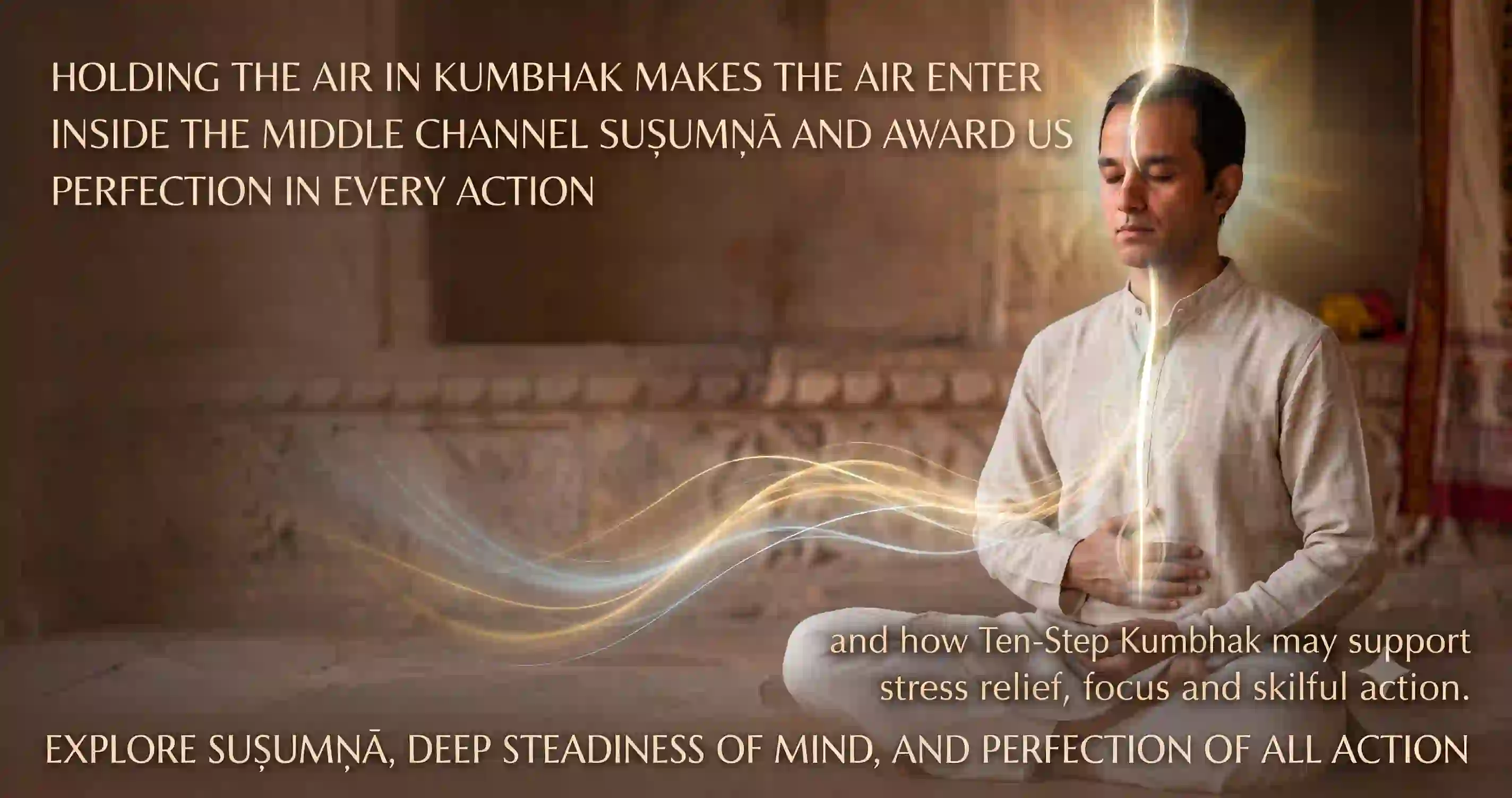
Haṭha Yoga Pradīpikā 2.4 Explained: Suṣumṇā, Kumbhak and Skilful Action Under Stress
A difficult message is open on the screen. Your pulse is louder than the person you are replying to. One part of you wants to send the first sharp sentence. Another part knows that the next thirty seconds may shape a relationship for years.
This is where “perfection in action” stops being an abstract philosophy.
It does not mean that every decision will succeed, every performance will be flawless or every person will agree with you. It means that your action has a better chance of coming from your whole intelligence—not merely from the most frightened, hurried or defensive part of you.
The Haṭha Yoga Pradīpikā approaches this problem through a traditional map of Nāḍīs, Prāṇa and Suṣumṇā. Modern science approaches it through stress physiology, attention, working memory, cognitive flexibility and response inhibition. The maps are not identical. Yet both ask a question that matters in every century:
What must become steady inside us before our actions can become truly skilful?
The Essential Meaning of Haṭha Yoga Pradīpikā 2.4 📜
The verified Sanskrit verse
मलाकुलासु नाडीषु मारुतो नैव मध्यगः ।
कथं स्यादुन्मनीभावः कार्यसिद्धिः कथं भवेत् ॥ २.४ ॥malākulāsu nāḍīṣu māruto naiva madhyagaḥ |
kathaṃ syād unmanī-bhāvaḥ kārya-siddhiḥ kathaṃ bhavet || 2.4 ||
Close translation:
When the Nāḍīs are crowded with impurities, the vital wind does not enter the middle channel. How could the state of deep steadiness of the mind arise? How could the undertaking reach accomplishment?
The Sanskrit root text, verse numbering and surrounding sequence are confirmed in the GRETIL electronic text of Svātmārāma’s Haṭhayogapradīpikā; Pancham Sinh’s public-domain translation likewise renders the verse as a question about the middle channel, success and Unmanī.1
Textual note: The GRETIL e-text displays malākalāsu, while the widely printed, grammatically transparent reading is malākulāsu—“filled, crowded or beset with impurity.” The supplied form madhyaghaḥ should be corrected to madhyagaḥ, “going in the middle.” These differences should be recorded rather than silently concealed.2
A word-by-word vertical reading
- malākulāsu — crowded with, affected by or full of mala
- nāḍīṣu — in the Nāḍīs or channels
- mārutaḥ — wind; here, the vital wind or Prāṇa
- na eva — certainly not
- madhyagaḥ — going through the middle; entering the central course
- katham — how?
- syāt — could it be?
- unmanī-bhāvaḥ — the condition of Unmanī, beyond ordinary mental movement
- kārya-siddhiḥ — accomplishment of the work, purpose or undertaking
- katham bhavet — how could it come to be?
The verse is not a decorative compliment to breath practice. It is an argument:
obstruction in the channels
↓
no central movement of Prāṇa
↓
no Unmanī or deep steadiness of mind
↓
no Kārya-Siddhi, the accomplishment being sought
The rest of the chapter explains why these links belong together.
The most accurate one-sentence interpretation
Within the traditional system of the Haṭha Yoga Pradīpikā, the yogic undertaking cannot reach fulfilment while Prāṇa remains unable to take the central course and the mind remains divided, agitated or outwardly dispersed.
That is more precise than saying, “Kumbhak guarantees perfection in everything.”
Nāḍīs and Suṣumṇā for First-Time Readers 🕉️
What is a Nāḍī?
In Haṭha Yoga, a Nāḍī is a channel through which Prāṇa is understood to move. The tradition speaks of a subtle body with many such pathways. Three receive particular attention:
- Iḍā, traditionally associated with the lunar current
- Piṅgalā, traditionally associated with the solar current
- Suṣumṇā, the central channel
This is a traditional yogic anatomy. Nāḍīs have not been established as physical tubes that can be dissected, scanned or equated one-for-one with nerves, arteries, fascia or lymphatic vessels.
That distinction protects both Yoga and science. Calling Suṣumṇā “the spinal cord” may sound modern, but it removes the term from the system in which the text uses it. Calling the vagus nerve “Suṣumṇā” creates the same problem. Parallels may be explored as metaphors; identity has not been demonstrated.
What is Suṣumṇā?
Suṣumṇā is the “middle” channel implied by madhyagaḥ in verse 2.4. Later in the same chapter, the text names it directly. Haṭha Yoga Pradīpikā 2.41 says that when the network of Nāḍīs has been purified by appropriate regulation of Prāṇa, the vital wind enters Suṣumṇā. Verse 2.42 immediately connects this central movement with steadiness of mind.3
For the traditional practitioner, Suṣumṇā is therefore not merely another energy route. It represents the centralisation of a life that is otherwise pulled into competing currents.
The modern reader may recognise the experience without being required to accept the subtle anatomy as a biomedical fact:
- attention stops scattering in ten directions;
- inner conflict loses some of its force;
- sensation can be noticed without instant reaction;
- the next action no longer has to be dictated by urgency.
This resemblance is experiential, not proof that a laboratory has measured Prāṇa entering Suṣumṇā.
What does mala mean here?
Mala literally carries meanings such as impurity, dirt, waste, stain or obstruction. In this yogic context, it should not be reduced to mucus, arterial plaque or a vaguely marketed “toxin.”
The text uses mala within its own subtle and practical system: that which obstructs the Nāḍīs and prevents the intended movement of Prāṇa. Later traditions may interpret such obstruction through bodily, energetic, mental or karmic lenses.
A responsible modern interpretation should not claim that Kumbhak “detoxifies” a named organ unless direct evidence exists for that claim. The inner language of obstruction can remain meaningful without being disguised as a laboratory result.
Unmanī and Kārya-Siddhi: What the Verse Actually Promises 🎯
Unmanī does not mean becoming dull or unconscious
The word Unmanī can be approached as “beyond mind,” but that phrase is easily misunderstood. It does not praise confusion, sleepiness, loss of judgement or an inability to think.
Within the Haṭha Yoga Pradīpikā, Unmanī and Manonmanī belong to the language of profound yogic absorption. At 2.42, the text defines Manonmanī through manaḥ-sthairya and manaḥ-susthirī-bhāva—the arising of stability and thorough steadiness of mind when Prāṇa moves through the middle.3
For everyday application, we should use a modest bridge:
Unmanī is not ordinary productivity. Yet the reduction of mental turbulence that it symbolises can illuminate what skilful action requires.
A mind can be very busy and still accomplish little. It can also be quiet, alert and exact.
Kārya-Siddhi is accomplishment of the undertaking
Kārya means something to be done: a task, purpose, work, obligation, matter or undertaking. Siddhi means attainment, accomplishment, fulfilment or success.
In verse 2.4, the nearest contextual meaning is successful accomplishment of the yogic undertaking. The chapter is explaining the conditions for Prāṇāyāma, Nāḍī purification, central movement of Prāṇa and Manonmanī. It is not advertising infallibility in business, relationships, examinations or sport.
This contextual limit does not make the verse irrelevant to ordinary life. It makes the bridge more credible.
Perfection of action is not control of every outcome
An action has at least two kinds of “success”:
- Outcome-success: Did events end exactly as I wanted?
- Action-integrity: Did I perceive carefully, choose responsibly, act with full attention, adapt to evidence and complete what was mine to do?
No breathing practice can control weather, markets, another person’s choice, biological chance or every consequence of a complex system.
Kumbhak may, however, support the inner conditions for action-integrity. In this qualified sense, “perfection of action” means:
- less avoidable error from panic or haste;
- less impulsive speech;
- clearer selection of the next relevant step;
- fuller presence during execution;
- greater willingness to adjust when facts change;
- less collapse after success or failure.
This is perfection as wholeness of participation, not a magical guarantee.
The Bhagavad Gītā completes the action teaching
Two verses of the Bhagavad Gītā are more direct than Haṭha Yoga Pradīpikā 2.4 about everyday action:
yogasthaḥ kuru karmāṇi … siddhy-asiddhyoḥ samo bhūtvā
Established in Yoga, perform action, remaining balanced in success and non-success. — Bhagavad Gītā 2.48
And:
yogaḥ karmasu kauśalam
Yoga is skilfulness in actions. — Bhagavad Gītā 2.50
The Gītā does not say that Yoga makes every external result favourable. It places the practitioner in equanimity while acting and identifies Yoga with kauśala—skill, competence or dexterity in action.4
The two texts can therefore be read together without making them say the same thing:
- the Haṭha Yoga Pradīpikā explains a breath–Prāṇa–mind pathway toward yogic accomplishment;
- the Bhagavad Gītā explains the quality of action that arises from inner steadiness.
The Yogic Proof Chain: Breath, Central Movement, Mind and Action 🔱
Haṭha Yoga Pradīpikā 2.2 — breath movement and mind movement
The chapter opens with a foundational observation:
cale vāte calaṃ cittaṃ niścale niścalaṃ bhavet
When the vital wind moves, the mind moves; when it becomes still, the mind becomes still.
This is a yogic proposition about the intimate relation between Prāṇa and Citta. It should not be reduced to “less oxygen means fewer thoughts.” The text is not offering that biomedical mechanism.1
The practical insight is subtler: breath is not merely an automatic background event. It can become an entry point into the movement of attention and mind.
Haṭha Yoga Pradīpikā 2.41–43 — Suṣumṇā leads to mental steadiness
Verses 2.41–43 give the clearest commentary on verse 2.4:
- when the Nāḍī network is purified through appropriate Prāṇa regulation, Māruta enters Suṣumṇā;
- when Māruta moves in the middle, steadiness of mind arises;
- for that accomplishment, practitioners perform various forms of Kumbhak.
The text itself therefore supplies the chain:
appropriate Prāṇa regulation → central movement → mental steadiness → Kumbhak as a means of cultivation
This is the strongest traditional connection to the Ten-Step Kumbhak. It is also why force cannot be treated as the essence of the teaching.
Haṭha Yoga Pradīpikā 2.15–18 — right practice matters more than force
The same chapter warns that Prāṇa must be approached progressively, as one would approach a powerful animal. It says that improper practice can generate disorder, while Pūrak, Rechak and retention should each be performed yuktaṃ yuktaṃ—appropriately, fittingly and with skill.1
This matters for Kārya-Siddhi. A method that creates strain, fear, dizziness or competition has already contradicted the inner quality it claims to produce.
The Ten-Step Kumbhak’s rule of ending each hold while it remains completely easy and while clear reserve remains is not a minor comfort clause. It preserves the central lesson: self-command is not self-violence.
Haṭha Yoga Pradīpikā 4.20–24 — mind and Prāṇa regulate one another
Chapter 4 returns to the same relationship in greater depth:
- when Prāṇa flows in Suṣumṇā, Manonmanī is accomplished (4.20);
- that which restrains Prāṇa also restrains mind, and that which restrains mind also restrains Prāṇa (4.21);
- mind and Prāṇa move together, compared in the text to substances mingled so closely that the movement of one accompanies the other (4.24).5
This reciprocity is important. Yoga is not saying that a person is merely a machine whose breath mechanically controls thought. Attention can influence breathing; breathing can influence attention; habits, sensations, emotions and environment can influence both.
Yoga Sūtra 2.49–53 — Prāṇāyāma makes the mind fit for concentration
Patañjali defines Prāṇāyāma at 2.49 through an interruption or regulation of the movement of Śvāsa and Praśvāsa. After describing external, internal and suspended aspects, Yoga Sūtra 2.52 says the covering over inner luminosity diminishes. Sūtra 2.53 then gives a remarkably practical result:
dhāraṇāsu ca yogyatā manasaḥ
And the mind becomes fit for concentration.
“Fit for concentration” is an exact bridge from breath practice to skilful activity. It does not say the work completes itself. It says the instrument of attention becomes more suitable for being held where it needs to be held.6
Haṭharatnāvalī 3.81 — a revealing textual parallel
The Haṭharatnāvalī repeats almost the same verse but reads kāya-siddhiḥ rather than kārya-siddhiḥ:
malākulāsu nāḍīṣu māruto naiva madhyagaḥ |
kathaṃ syād unmanī-bhāvaḥ kāya-siddhiḥ kathaṃ bhavet ||
Here, kāya-siddhi points toward bodily accomplishment or perfection rather than accomplishment of an undertaking. The critical edition’s translation connects it with extraordinary bodily powers.7
This parallel does not replace the reading in Haṭha Yoga Pradīpikā 2.4. It shows that the verse travelled through related Haṭha traditions with an important variation. A trustworthy article should not blend kāya and kārya into one convenient promise.
Why the Ten-Step Kumbhak Is Relevant—Without Rewriting Its Method 🫁
The exact practice belongs in the How to Practice guide
This article intentionally does not reproduce the Ten-Step Kumbhak instructions. The complete posture, Dhyāna Mudrā, chest-centred attention, normal Pūrak, normal Rechak, Antar Kumbhak, Bāhya Kumbhak, completion and recovery requirements should be learned from the dedicated How to Practice the Ten-Step Kumbhak for Stress Relief guide.
Do not reconstruct the method from philosophical commentary. Technique, sequence and safety belong together.
The practice contains a meaningful architecture
Without restating the process, several design principles explain why the method is relevant to verse 2.4:
- It includes both Antar Kumbhak and Bāhya Kumbhak. Fullness and emptiness are each met without a battle.
- Normal Pūrak and normal Rechak remain normal. The method does not turn normal inhalation or normal exhalation into a performance.
- Attention is repeatedly gathered at one bodily centre. The scattered mind receives a stable reference point.
- The holds end with reserve. The practitioner practises discernment, not defeat of a warning signal.
- Recovery is built into the round. Completion includes re-establishing normal breathing rather than chasing an intensified state.
- Posture and relaxation reduce unnecessary work. The body is organised for observation, not display.
These features do not prove that Suṣumṇā has opened. They show how the practice may cultivate a lived movement from dispersion toward centrality.
The defensible bridge from Kumbhak to Kārya-Siddhi
The connection is best expressed as a sequence of possibilities:
Ten-Step Kumbhak may help reduce stress activation for some practitioners
↓
less stress activation may make attention and reflection more available
↓
available attention may improve the conditions for choosing and executing an action
↓
repeated skilful action may increase the likelihood of completing meaningful undertakings
Every arrow says may, not must.
There is no direct clinical trial showing that the exact Ten-Step Kumbhak produces Suṣumṇā flow, Unmanī or universal success in activity. The traditional claim and the scientific hypothesis should stand beside each other without impersonating each other.
A central channel in life can also be understood ethically
The deepest daily meaning of “central” may not be efficiency. A thief can be efficient. An angry person can be intensely focused.
Kārya-Siddhi worthy of Yoga must include:
- truth rather than convenient distortion;
- proportion rather than overreaction;
- non-harm rather than domination;
- responsibility rather than blame-shifting;
- completion without addiction to applause.
Kumbhak can create an interval in which these values are remembered. It cannot supply the values on our behalf.
What Modern Science Can—and Cannot—Say 🔬
First: the exact Ten-Step Kumbhak has not yet been tested
No published randomised controlled trial identified for this review has tested the precise Ten-Step Kumbhak as a complete intervention against an appropriate active comparison.
That means science cannot yet tell us:
- whether the full Ten-Step sequence reduces stress more than matched breath awareness;
- whether Antar Kumbhak, Bāhya Kumbhak or their combination contributes most;
- whether chest-centred attention adds a distinct effect;
- whether its benefits persist across months;
- whether it improves real-world task completion;
- which people benefit, feel no change or feel worse.
This is not a verdict against the practice. It is the correct boundary around the available evidence.
Stress can disturb several capacities required for action
“Doing a task” depends on many mental operations: holding the goal in working memory, inhibiting irrelevant impulses, switching strategy when conditions change and keeping attention on information that matters.
A meta-analysis of acute-stress experiments found that stress impaired working memory, cognitive flexibility and interference control on average, while effects on response inhibition were more nuanced. The authors described a stress state biased toward reactive and automatic processing.8 A major neuroscience review likewise explains how uncontrollable stress can impair prefrontal cortical functions involved in top-down, goal-directed regulation.9
This does not mean every amount of arousal is harmful. Urgency can sharpen some responses. It means that the stress state is not a neutral background: it can change the very capacities by which an undertaking is chosen and carried through.
That is the scientifically plausible opening for a stress-relief practice. If a safe practice helps a person move out of overwhelming activation, it may make better action more available. The improved action still requires knowledge, skill, ethics and effort.
Direct study 1 — Kumbhak-containing practice and response inhibition
In a repeated-measures study of 36 yoga-trained healthy adults, participants completed a twenty-minute four-phase breathing session containing Pūrak, Antar Kumbhak, Rechak and Bāhya Kumbhak. Stop-signal reaction time improved after the session.
The essential limitation is equally important: breath awareness also improved the outcome, and the Kumbhak-containing session was not superior.10
What it supports: A structured session containing Kumbhak can precede a measurable improvement in the ability to interrupt a prepotent response.
What it does not support: That retention alone caused the change, that the exact Ten-Step method has the same effect or that a laboratory task proves perfection in daily decisions.
Evidence confidence: Low and relevant.
Direct study 2 — eight weeks of intermittent retention
A randomised trial assigned 116 young adult yoga practitioners either to their usual yoga or to usual yoga plus twenty minutes of breathing with intermittent retention for eight weeks. Both groups improved, while the additional-practice group reported greater gains in state mindfulness and greater reductions in mind-wandering and state anxiety.11
What it supports: Repeated retention-containing breath practice may add psychological benefits for young adults already practising yoga.
What it does not support: Generalisation to beginners, older adults, clinical anxiety or the precise Ten-Step method. It also does not isolate which phase of the practice produced the difference.
Evidence confidence: Low because the finding is promising but narrow.
Wider breathwork evidence and stress
A preregistered meta-analysis of randomised controlled breathwork trials included 12 studies with 785 participants for the primary stress outcome. Breathwork was associated with a small-to-medium reduction in self-reported stress compared with controls (Hedges’ g = −0.35; 95% CI −0.55 to −0.14). The authors also emphasised moderate overall risk of bias, limited follow-up and the need for better trials.12
What it supports: Regulated breathing practices as a family can help reduce subjective stress for some adults.
What it does not support: A retention-specific effect or superiority of the Ten-Step Kumbhak.
The right conclusion is not “science has proved Kārya-Siddhi.” It is: stress relief through breath regulation has a credible preliminary evidence base, and reduced stress may improve the conditions in which skilful action occurs.
Kumbhak changes physiology within seconds
In a study of 15 healthy men experienced in Prāṇāyāma, a one-minute internal Kumbhak significantly increased measured middle cerebral artery flow velocities. The researchers described substantial and opposite cerebrovascular effects between Kumbhak and Bhastrikā.13
This proves biological activity, not better thinking.
During a sufficiently long closed-airway hold:
- carbon dioxide generally rises;
- oxygen may fall, depending on duration and starting conditions;
- cerebral blood-flow velocity may increase as a compensatory response;
- heart rate, blood pressure, stroke volume and vascular resistance may change.
The one-minute laboratory hold was far more demanding than the deliberately brief, comfortable holds recommended for a beginner in the Ten-Step method. Its results must not be transferred as though the doses were identical.
More cerebral blood flow does not mean more intelligence
The brain adjusts circulation partly to defend oxygen delivery and respond to carbon dioxide. An increase during Kumbhak is therefore best understood as a physiological response to the hold.
It does not, by itself, prove:
- better memory;
- greater creativity;
- improved judgement;
- “brain detoxification”;
- activation of Suṣumṇā;
- neurogenesis;
- protection from stroke.
A fire alarm may mobilise an entire building. The mobilisation is real; it is not evidence that alarms should be made louder every day.
The exact mechanism may be less dramatic—and more useful
For stress-related action, severe oxygen change may not be necessary or desirable. Useful effects may arise through a combination of:
- attentional selection: returning to a single bodily reference;
- interoception: noticing internal sensation with accuracy;
- response delay: not acting at the first impulse;
- expectancy and ritual: entering a familiar recovery context;
- muscular release: reducing unnecessary effort in the face, jaw, throat, shoulders and abdomen;
- self-efficacy: learning that a manageable internal sensation can rise and pass;
- structured recovery: completing a round and returning to normal breathing.
Research has not yet separated these components in the exact Ten-Step Kumbhak.
Evidence ladder for the claim “Kumbhak perfects action”
Established
- Acute stress can alter executive functions needed for goal-directed behaviour.
- Voluntary retention changes cardiovascular and cerebrovascular physiology.
- Breathwork as a broad category can reduce self-reported stress in some adults.
Promising
- Kumbhak-containing practices may support response inhibition, mindfulness, reduced mind-wandering and reduced anxiety in selected healthy practitioners.
Plausible but unproven
- The exact Ten-Step Kumbhak may improve the conditions for real-world task selection, execution, adaptation and completion through stress relief.
Traditional and not scientifically verified
- Prāṇa enters Suṣumṇā.
- Nāḍīs become purified.
- Unmanī or Manonmanī arises.
- Kārya-Siddhi follows from central movement of Prāṇa.
Unsupported
- Every activity becomes flawless.
- Every desired result occurs.
- Longer retention produces greater success.
- A calm feeling guarantees a correct, moral or factually accurate decision.
An Ayurvedic View of Breath, Mind and Accomplishment 🌿
Ayurveda offers a functional map, not a modern nerve diagram
Ayurveda and Haṭha Yoga developed related but distinct vocabularies. An Ayurvedic interpretation can deepen the discussion, provided its categories are not renamed as neurotransmitters, nerves or hormones without evidence.
Three classical functions are especially relevant: Prāṇa Vāta, Vyāna Vāta and Sādhaka Pitta.
Prāṇa Vāta supports intellect, heart, senses and mind
Aṣṭāṅga Hṛdaya, Sūtrasthāna 12.4 describes Prāṇa Vāta as located in the head and moving through the chest and throat. It says that Prāṇa Vāta supports or holds:
- Buddhi — discernment or intelligence
- Hṛdaya — the heart
- Indriya — the sense faculties
- Citta — mind or mental field
The same passage associates it with functions including Niḥśvāsa and the entry of food.14
This traditional description is striking because it refuses to divide thinking, sensing, the chest and vital function into isolated worlds. An action begins before the hand moves: something is sensed, interpreted, valued and selected.
It has not been scientifically shown that the Ten-Step Kumbhak “balances Prāṇa Vāta.” That statement belongs to traditional interpretation, not confirmed clinical mechanism.
Vyāna Vāta coordinates movement and action
In Aṣṭāṅga Hṛdaya 12.6–7, Vyāna Vāta is situated in the heart and described as moving throughout the body. The text says that bodily movements—locomotion, lifting, lowering, opening, closing and related activities—depend upon it; prāyaḥ sarvāḥ kriyāḥ means that nearly all bodily actions are connected with this function.14
The significance for Kārya-Siddhi is clear within the Ayurvedic map:
intention must become coordinated movement.
A perfect plan that never reaches speech, hands, feet or timely execution remains incomplete.
Sādhaka Pitta concerns the accomplishment of what is intended
Aṣṭāṅga Hṛdaya 12.13 describes Sādhaka Pitta as located in the heart and names it through abhipretārtha-sādhanāt—the accomplishment of an intended aim—through functions including Buddhi and Medhā.14
This is one of the most precise Ayurvedic connections to the present topic. The tradition does not picture accomplishment as raw force alone. It requires:
- correct discernment;
- the capacity to retain and organise understanding;
- an intention worth accomplishing;
- coordinated effort.
Again, no trial has demonstrated that the Ten-Step Kumbhak directly modifies Sādhaka Pitta. The passage is an authentic Ayurvedic lens through which the relation among intention, mind, heart and action can be understood.
The Ayurvedic coordination triangle
Prāṇa Vāta: receives, senses, supports Buddhi and Citta
↓
Sādhaka Pitta: clarifies and advances the intended aim
↓
Vyāna Vāta: distributes and coordinates action through the body
When stress scatters attention, distorts priority or keeps a person physically mobilised after danger has passed, this triangle offers a traditional vocabulary for lost coordination.
Kumbhak may be used traditionally as a practice of recollection and containment. Medical claims about treating a Doṣa imbalance require assessment by a qualified Ayurvedic clinician and should not be inferred from this article.
A Practical Definition of “Perfect Action” for Daily Life 🧭
1. Perceive before interpreting
Stress can make the first interpretation feel like the only fact.
Perfect action begins by separating:
- what was directly seen or heard;
- what is inferred;
- what is feared;
- what remains unknown.
After a completed Ten-Step Kumbhak round and its required recovery, ask:
What do I know, and what has my stress added?
The practice does not answer the question. It may help you remain present long enough to answer honestly.
2. Choose the actual Kārya
Many people do not fail because they lack effort. They fail because they are performing the wrong task with enormous intensity.
The actual Kārya may be:
- write the first paragraph, not imagine the whole book;
- call the doctor, not diagnose yourself online;
- correct the invoice, not defend the mistake;
- listen to the child, not win the conversation;
- rest after illness, not prove endurance.
Kārya-Siddhi begins with Kārya-clarity: What is truly to be done now?
3. Inhibit the action that would damage the real aim
The first impulse under stress may offer immediate discharge but long-term cost:
- send;
- interrupt;
- purchase;
- accuse;
- promise;
- abandon;
- conceal.
Response inhibition is not passivity. It is the ability to prevent one action so that a more fitting action can occur.
A musician does not create a phrase only by producing notes; rests protect the shape of the music. Kumbhak can be understood as practice in respecting the meaningful interval.
4. Apply full attention to one executable unit
Unmanī is a profound traditional state. Daily concentration is humbler. It may mean keeping the relevant instruction in mind for the next ten minutes without feeding every competing demand.
Choose an executable unit:
- one calculation;
- one page;
- one repair;
- one honest sentence;
- one measured clinical instruction;
- one meal prepared with attention.
Skill grows where attention and action repeatedly meet.
5. Adapt without experiencing correction as defeat
The Bhagavad Gītā places equanimity in both Siddhi and Asiddhi. That matters because feedback often arrives disguised as disappointment.
If new evidence shows the plan is wrong:
- update the plan;
- do not protect the old decision merely because it was yours;
- distinguish persistence from rigidity;
- preserve the aim while changing the route.
The action becomes more perfect when reality is allowed to correct it.
6. Complete, communicate and close
Stress leaves open loops:
- the message drafted but not sent;
- the boundary felt but not stated;
- the work finished but not checked;
- the apology spoken but not repaired;
- the task completed while the mind continues performing it all night.
Kārya-Siddhi includes a clean closing movement:
- verify what was done;
- communicate completion where needed;
- record the next responsibility;
- release what no longer requires attention.
The recovery built into the Ten-Step Kumbhak is philosophically relevant here. Completion is not collapse. A completed act should return some capacity to life.
7. Remain teachable after success
Success can scatter the mind as effectively as failure. Praise may produce haste, overconfidence or an urge to repeat an action outside the conditions that made it work.
After Siddhi, ask:
- What genuinely contributed?
- What was chance?
- What should be repeated?
- What must remain adaptable?
The aim is not a perfect self-image. It is a more truthful relationship with action.
How This Applies Across the Activities of Life 🌍
Work and leadership
Perfection does not mean: every project is profitable or every colleague agrees.
It can mean: the objective is clear, relevant evidence is heard, roles are assigned, stress does not dictate tone, decisions are documented and mistakes are corrected without theatre.
Kumbhak may serve as a pre-task or between-task transition when practised safely away from any activity requiring immediate attention.
Study and examination
Perfection does not mean: instant memory or guaranteed marks.
It can mean: anxiety consumes less working memory, attention returns to the actual question, uncertainty does not trigger random answering and revision follows evidence rather than panic.
The practice cannot replace sleep, instruction, recall practice or subject knowledge.
Relationships and difficult conversations
Perfection does not mean: never feeling anger or keeping every relationship.
It can mean: hearing the other person accurately, separating hurt from accusation, asking what is needed, setting a clear boundary and refusing both cruelty and self-erasure.
Sometimes the perfected action is reconciliation. Sometimes it is distance. Calmness alone cannot decide which one is safe.
Creative work
Perfection does not mean: producing a masterpiece on demand.
It can mean: entering the work without waiting for ideal emotion, remaining with uncertainty, completing a version and allowing revision to improve what inspiration began.
The pause is not empty. It is where the next line has room to arrive.
Caregiving
Perfection does not mean: preventing illness, ageing or grief.
It can mean: noticing what the person needs now, following medical guidance, preserving dignity, sharing responsibility and recognising when the caregiver also needs recovery.
No breath practice should become a reason to carry an impossible burden alone.
Ethical action
Perfection does not mean: appearing calm, pure or spiritual.
It can mean: telling the truth when concealment would be easier, refusing harm even when anger feels justified, keeping a promise or openly renegotiating it, and repairing what can be repaired.
A regulated nervous system increases capacity. Character determines how that capacity is used.
Physical performance
Perfection does not mean: practising Kumbhak while lifting, driving, swimming or performing a hazardous task.
It can mean: using the method separately, in a safe seated setting, as part of preparation or recovery when appropriate; then applying trained attention to the activity itself.
Breath-hold sport is a specialist discipline. Its risks and methods should never be imported into Kumbhak for Stress Relief.
A Kārya-Siddhi Reflection After Practice ✍️
Use this only after the complete round and recovery
Do not analyse your work, rehearse conflict or solve problems during Antar Kumbhak or Bāhya Kumbhak. During the practice, follow the method. After it is complete and normal breathing has been re-established, write one short answer to each question:
- Kārya: What exactly is to be done?
- Purpose: Who or what will genuinely benefit?
- Mala: What is obstructing action—fear, confusion, resentment, missing information, fatigue or divided priority?
- Madhya: What is the central fact I must not lose?
- Restraint: Which impulse would damage the real aim?
- Kauśala: What is the smallest skilful next act?
- Siddhi: What observable condition will show that this stage is complete?
This reflection converts “I want everything to go well” into an undertaking that can actually be performed and evaluated.
A seven-day personal observation
Choose one repeated daily activity: beginning focused work, responding to criticism, studying, caregiving handover or closing the workday.
For seven days:
- Record your stress from 0–10 before practice.
- Complete one correctly learned Ten-Step Kumbhak round in a safe setting.
- Record stress again after recovery.
- Answer the seven Kārya-Siddhi questions.
- Complete the selected activity.
- Record one observable outcome: errors, abandoned attempts, impulsive messages, task-switching, completion time or post-task rumination.
Do not measure success by retention duration. Do not decide in advance that the practice helped. Compare the actual days.
Possible outcomes are all valid:
- helpful;
- neutral;
- distracting;
- uncomfortable;
- useful only in certain contexts.
Personal observation cannot prove a medical effect, but it can prevent belief from replacing experience.
What “Suṣumṇā in Daily Life” Must Not Become 🚫
Not a claim of anatomical proof
Do not say that tingling, warmth, spinal sensation or calmness proves that Suṣumṇā opened. Such experiences may be meaningful to a practitioner, but they are not validated diagnostic tests of a subtle channel.
Not a badge of superiority
Feeling centred after Kumbhak does not make a person wiser than someone who uses walking, prayer, therapy, medication, rest or another breathing practice.
The result worth trusting is not “I am more advanced.” It is “I can meet this responsibility with greater clarity and less harm.”
Not a substitute for competence
Kumbhak cannot supply:
- legal knowledge;
- medical diagnosis;
- engineering calculation;
- financial evidence;
- technical training;
- consent from another person;
- facts that have not been gathered.
Inner steadiness and outer competence must cooperate.
Not avoidance disguised as peace
A person can practise to escape the action that the calm mind already knows is required.
The email may still need to be written. The doctor may still need to be called. The money may still need to be repaid. The unsafe situation may still need to be left.
The central channel is not an escape tunnel from responsibility.
Safety: No Kārya-Siddhi Is Worth Strain ⚠️
Learn the full safeguards before practising
Read and follow the complete Ten-Step Kumbhak practice and safety guide before trying the method. This article is interpretation, not technique instruction.
Essential boundaries include:
- practise seated in a stable, safe place;
- never practise while driving, swimming, bathing, walking somewhere unsafe, operating machinery or performing a task requiring full attention;
- never hyperventilate before retention;
- keep both retentions completely easy and end them with clear reserve;
- stop immediately for dizziness, faintness, unusual breathlessness, chest pain or tightness, panic, tingling, visual disturbance, confusion or any other discomfort;
- do not resume until breathing and the whole body feel normal;
- seek appropriate medical care if serious or unusual symptoms persist.
People with heart or lung conditions should obtain qualified clinical guidance before breath retention. The same caution is appropriate for significant blood-pressure, neurological, fainting, pregnancy-related, retinal, glaucoma, panic or trauma-related concerns.
Why safety belongs inside the philosophy
Haṭha Yoga Pradīpikā 2.15–18 does not separate success from appropriateness. It warns against mishandling Prāṇa and repeatedly uses the language of fitting, skilful performance.
Therefore:
A strained Kumbhak is not a faster path to Kārya-Siddhi. It is a departure from the principle being studied.
The hold is complete when it remains easy—not when willpower defeats the body’s warning.
Frequently Asked Questions 🙋
Does Haṭha Yoga Pradīpikā 2.4 literally say “all actions in life”?
No. Kārya-Siddhi means accomplishment of the work, purpose or undertaking. In context, it primarily concerns accomplishment of the yogic undertaking. Its application to all activities of life is an interpretive extension, best understood as support for skilful action rather than a promise of flawless outcomes.
Can the Ten-Step Kumbhak open Suṣumṇā?
Traditional Haṭha Yoga teaches that appropriate Prāṇa regulation and Kumbhak contribute to Nāḍī purification, entry of Prāṇa into Suṣumṇā and Manonmanī. Modern science has not verified Suṣumṇā as an anatomical channel or measured Prāṇa entering it. A practitioner may accept the traditional teaching without presenting it as a laboratory finding.
Is Suṣumṇā the spinal cord or vagus nerve?
No established evidence supports either identity. Suṣumṇā belongs to the subtle anatomy of Yoga. The spinal cord and vagus nerve are measurable anatomical structures with different described courses and functions.
Does Kumbhak guarantee success at work or in examinations?
No. It may help some people manage stress and organise attention, but success also depends on preparation, knowledge, health, resources, opportunity, cooperation and circumstances.
What is the difference between Unmanī and concentration?
Unmanī is a profound yogic state beyond ordinary mental movement. Concentration is the everyday ability to hold attention on a chosen object or task. The latter may be a useful practical reflection of steadiness, but it should not be announced as the full traditional attainment.
Is a longer retention better for Kārya-Siddhi?
No evidence shows that longer retention produces better action. Longer holds can increase air hunger and cardiovascular or cerebrovascular stress. The Ten-Step Kumbhak explicitly ends each hold while it remains completely easy and while reserve remains.
Can Kumbhak replace planning or professional help?
No. Use a stress-relief practice to support the person who must plan, learn, communicate or seek help—not to replace those actions.
What if breath retention increases anxiety?
Stop and return to natural breathing. A neutral or adverse response is valid information. People with panic, trauma related to suffocation or strong fear of bodily sensations may require a clinician-informed approach and may be better served by a practice without retention.
Where can I learn the actual Ten-Step method?
Use the dedicated How to Practice the Ten-Step Kumbhak for Stress Relief guide. Do not use this philosophical article as a substitute for the complete instructions.
The Final Synthesis: From the Middle Channel to the Next Right Act 🌌
Haṭha Yoga Pradīpikā 2.4 asks two questions that are really one:
If Prāṇa cannot move through the middle, how can Unmanī arise—and how can the undertaking succeed?
Its answer unfolds across the text: regulate Prāṇa appropriately, remove obstruction, allow central movement, discover steadiness of mind.
Modern science does not verify Nāḍīs, Suṣumṇā or Unmanī. It does show that stress can alter working memory, flexibility and cognitive control; that regulated breathing can reduce subjective stress for some people; and that Kumbhak is physiologically active. Small studies of retention-containing practices offer promising signals for mindfulness, mind-wandering, anxiety and response inhibition, but the exact Ten-Step method and real-world Kārya-Siddhi remain untested.
Ayurveda adds another authentic traditional insight: Prāṇa Vāta supports mind, senses, heart and discernment; Vyāna Vāta coordinates movement; Sādhaka Pitta is described through accomplishment of the intended aim. Action succeeds when perception, intention and execution cease pulling apart.
The careful conclusion is therefore neither dismissal nor exaggeration:
The Ten-Step Kumbhak may help a suitable practitioner create the inner conditions for more skilful action by supporting stress relief, gathered attention and a less reactive relationship with urgency. It cannot guarantee every outcome, replace competence or prove that Suṣumṇā has opened.
Perhaps the truest perfection is smaller and more human.
The message is still on the screen. The situation is still difficult. But now the sentence you send belongs to your considered purpose—not merely to the first surge of stress.
That is not mastery over life.
It is the beginning of mastery within action.
Verified References and Notes 📚
Evidence and links checked 28 July 2026. Classical claims are labelled as traditional; scientific claims are limited to what the cited study designs can support. This article is educational and is not medical advice.
-
Svātmārāma, Haṭhayogapradīpikā, 2.2–6, Sanskrit root text in GRETIL, University of Göttingen; compare Pancham Sinh’s public-domain English rendering in Hatha Yoga Pradipika, Chapter 2, Wikisource. ↩↩↩
-
The GRETIL e-text displays malākalāsu at 2.4, while the common reading malākulāsu appears in other editions and in the parallel at Haṭharatnāvalī 3.81. The latter is visible in the critical edition at PDF page 162. Both sources read madhyagaḥ, not madhyaghaḥ. ↩
-
Svātmārāma, Haṭhayogapradīpikā 2.41–43: entry of Māruta into Suṣumṇā, steadiness of mind and Kumbhak practice, in the GRETIL Sanskrit text. ↩↩
-
Bhagavad Gītā 2.48 and 2.50, Sanskrit text and multiple classical commentarial translations at IIT Kanpur’s Gita Supersite: 2.48—equanimity in success and non-success and 2.50—Yoga as skill in action. ↩
-
Svātmārāma, Haṭhayogapradīpikā 4.20–24, the reciprocal restraint and movement of Prāṇa and mind, in the GRETIL Sanskrit text. ↩
-
Patañjali, Yoga Sūtra 2.49, 2.52 and 2.53, Sanskrit root text with Bhāṣya and Bhojavṛtti at IIT Kanpur’s Gita Supersite. ↩
-
Śrīnivāsayogī, Haṭharatnāvalī 3.81, critically edited, translated and published by the Lonavla Yoga Institute, visible at PDF page 162. ↩
-
Shields GS, Sazma MA, Yonelinas AP. “The Effects of Acute Stress on Core Executive Functions: A Meta-Analysis and Comparison with Cortisol.” Neuroscience & Biobehavioral Reviews. 2016;68:651–668. Full text at PubMed Central. DOI: 10.1016/j.neubiorev.2016.06.038. ↩
-
Arnsten AFT. “Stress signalling pathways that impair prefrontal cortex structure and function.” Nature Reviews Neuroscience. 2009;10(6):410–422. Full text at PubMed Central. DOI: 10.1038/nrn2648. ↩
-
Saoji AA et al. “Immediate Effects of Yoga Breathing with Intermittent Breath Holding on Response Inhibition among Healthy Volunteers.” International Journal of Yoga. 2018;11(2):99–104. Full text at PubMed Central. DOI: 10.4103/ijoy.IJOY_65_16. ↩
-
Saoji AA, Raghavendra BR, Madle K, Manjunath NK. “Additional Practice of Yoga Breathing With Intermittent Breath Holding Enhances Psychological Functions in Yoga Practitioners: A Randomized Controlled Trial.” Explore. 2018;14(5):379–384. PubMed record. DOI: 10.1016/j.explore.2018.02.005. ↩
-
Fincham GW et al. “Effect of breathwork on stress and mental health: A meta-analysis of randomised-controlled trials.” Scientific Reports. 2023;13:432. Full text at PubMed Central. DOI: 10.1038/s41598-022-27247-y. ↩
-
Nivethitha L et al. “Cerebrovascular hemodynamics during pranayama techniques.” Journal of Neurosciences in Rural Practice. 2017;8(1):60–63. Full text at PubMed Central. DOI: 10.4103/0976-3147.193551. ↩
-
Vāgbhaṭa, Aṣṭāṅgahṛdayasūtra 12.4–7 and 12.13, Sanskrit root text in GRETIL, University of Göttingen. ↩↩↩