Does Ten-Step Kumbhak require belief? Explore its secular use, yogic roots, Dhyāna Mudra, science, Ayurveda, safety and respectful practice.
By Kumbhaki Yogi Dhruvaji (MSc), founder of the Antistress Foundation 501(c)(3)
• How to Practice Ten-Step Kumbhak • Scientific Proof • Ancient Texts Proof • Bio • Subscribe By Email
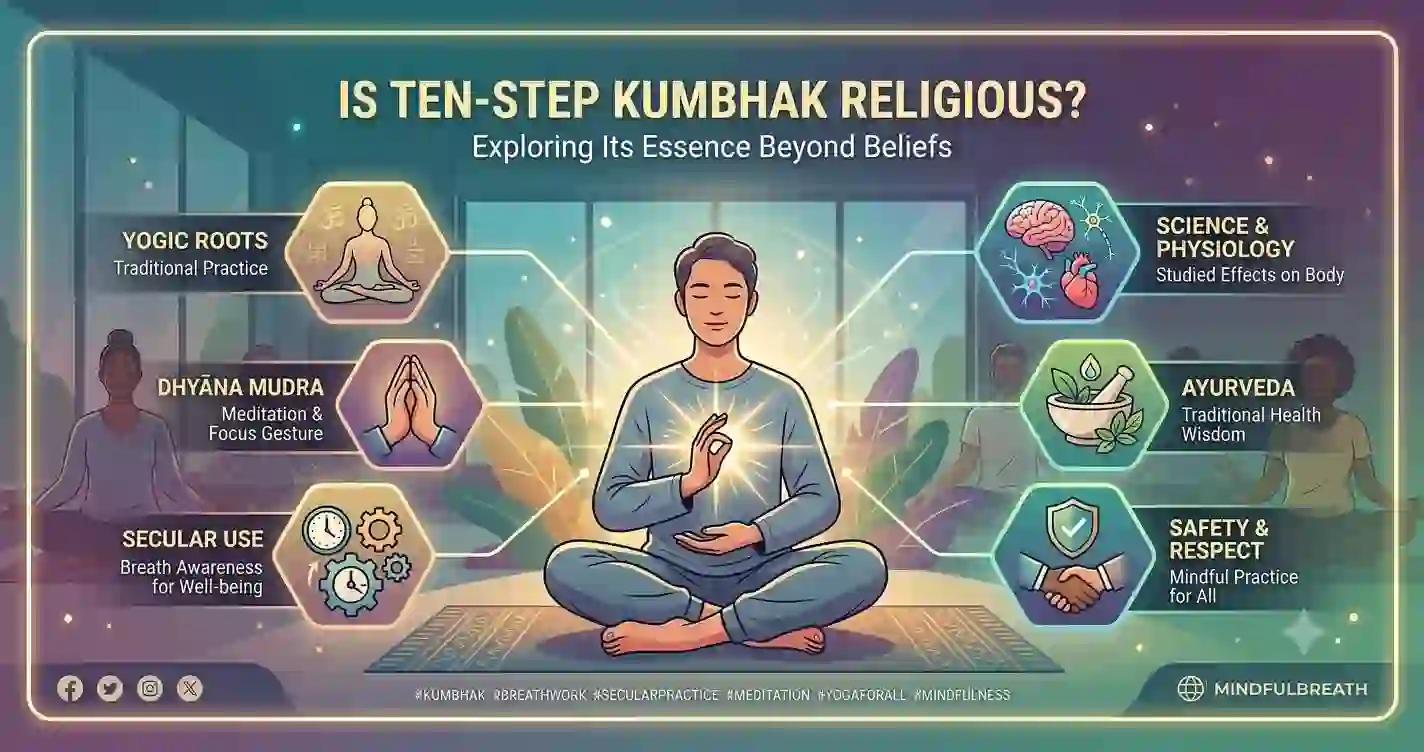
Is Ten-Step Kumbhak Religious? A Guide for Secular, Scientific and Yogic Readers
The words Kumbhak and Dhyāna Mudra arrive carrying centuries of Indian memory. To one reader, they sound beautiful. To another, unfamiliar. To someone who has been pressured by religion—or who is deeply committed to a different faith—they may sound like a belief is quietly being requested.
That concern deserves a direct answer, not a sales pitch.
Ten-Step Kumbhak for Stress Relief does not require worship, prayer, conversion, a mantra, belief in a deity, belief in Prāṇa or acceptance of yogic philosophy. It can be practised as a secular exercise in breath retention, posture and attention.
That answer does not require us to pretend the practice appeared in a laboratory. Kumbhak has authentic roots in Indian yoga. Dhyāna Mudra has an authentic contemplative history, especially in Buddhist visual culture and in the wider vocabulary of Indian meditation. Classical yoga also gives breath discipline spiritual and liberative meanings that extend far beyond stress relief.
Both statements can be true:
- the practice has traditional depth;
- the practitioner is not required to adopt a belief.
That meeting point—heritage without coercion, science without overclaiming and personal experience without manufactured certainty—is where this guide begins. 🌿
The Direct Answer: Is Ten-Step Kumbhak a Religious Practice?
The shortest honest answer
No, not as Ten-Step Kumbhak for Stress Relief is taught.
Its published method does not include:
- worship of a deity;
- prayer or chanting;
- a sacred image;
- a statement of faith;
- initiation into a religious community;
- an offering or ritual sacrifice;
- a promise of salvation;
- a demand to accept Prāṇa, chakras, karma or rebirth as facts;
- or a requirement to leave, change or weaken one’s existing faith.
It is presented for a practical purpose: helping a person explore whether a structured, comfortably submaximal pattern of normal Pūrak, normal Rechak, brief Antar Kumbhak and brief Bāhya Kumbhak supports stress relief.
That said, “not religiously required” is not the same as “historically unrelated to religion.” Classical yoga developed within Indian philosophical, ascetic and religious worlds. Some yogic texts are devotional; some are more analytical; many contain both practice instructions and metaphysical aims. The U.S. National Center for Complementary and Integrative Health describes yoga as rooted in Indian philosophy, beginning as a spiritual practice and now also widely used for physical and mental wellbeing.1
Ten-Step Kumbhak makes a modern, defined use of a traditional human practice. It does not own the whole meaning of Kumbhak, and it does not require the whole worldview of every text in which breath restraint appears.
A four-question test is more accurate than a one-word label
When someone asks, “Is this religious?”, four different questions may be hidden inside the sentence.
1. Does it have roots in a religious or spiritual tradition?
Yes. Kumbhak belongs to the historical practice vocabulary of yoga, and Dhyāna Mudra belongs to the contemplative heritage of Asia.
2. Does the present method contain an act of worship?
No. The published Ten-Step practice contains no prayer, invocation, mantra, ritual offering or deity visualization.
3. Must the practitioner believe a doctrine for the physical action to occur?
No. A person can sit, attend to the centre of the chest and briefly pause the breath without accepting a metaphysical explanation.
4. May a practitioner personally give the practice spiritual meaning?
Yes. A yogic reader may understand Kumbhak through Prāṇa, citta, dhāraṇā or inner stillness. Another reader may understand the same minute as nervous-system self-observation. Neither person has to falsify the other’s experience.
The mistake is forcing all four questions into one answer.
The belief audit at a glance
Traditional Indian name: Yes
Traditional contemplative ancestry: Yes
Mandatory deity, prayer or mantra: No
Mandatory belief in Prāṇa: No
Conversion or initiation: No
Measurable physiological activity: Yes
Exact clinical effect guaranteed: No
Personal spiritual interpretation permitted: Yes
Right to decline: Always
This is not an attempt to make every reader say yes. It is enough to make the real choice clear.
Why “Kumbhak” Can Sound More Religious Than “Breath Retention”
An unfamiliar word can feel like a hidden contract
Imagine a visitor named Daniel walking into a stress-relief class after a difficult month. He is willing to try a breathing exercise. Then he hears Kumbhak and Dhyāna Mudra. His shoulders tighten.
He is not rejecting breathing. He is wondering, What am I agreeing to?
The respectful response is not, “Don’t be silly; it is only exercise.” It is:
“Those are traditional names. No prayer or belief is required here. I can explain what each term means, and you are free to observe or decline.”
The body often relaxes when uncertainty is replaced by honest choice.
A Sanskrit name is a source label, not an oath
Kumbhak is the yogic term for a pause or retention in the movement of breathing. Antar Kumbhak refers to retention after Pūrak; Bāhya Kumbhak refers to retention after Rechak. The traditional word preserves the practice’s Indian lineage and distinguishes it from unrelated breath-hold activities such as freediving, medical lung testing or athletic apnoea training.
Calling it “breath retention” explains the action in English. Calling it “Kumbhak” acknowledges the practice family from which the action is drawn.
Neither word changes the practitioner’s religion.
A hospital may use Latin and Greek anatomical terms without asking a patient to adopt Roman or Greek religion. In the same way, accurate Sanskrit terminology need not become a profession of faith. Language can honour origin without controlling conscience.
Translation should clarify—not erase
There are two unhelpful extremes:
- Mystification: “Kumbhak is sacred, so you should not question it.”
- Erasure: “Kumbhak is just holding your breath; tradition is irrelevant.”
The first can pressure a newcomer. The second strips the practice of history and precision.
A more complete description is:
Kumbhak is a traditional yogic discipline of breath retention. In the Ten-Step method, it is adapted into a brief, unforced stress-relief practice that can be approached without religious belief.
That sentence leaves the door open in both directions: toward scientific inquiry and toward deeper yogic study.
What the Classical Yoga Texts Actually Say 📜
Ancient texts do not describe the modern Ten-Step Kumbhak sequence. They do, however, confirm that restraint or interruption of breathing is an old, serious and many-layered yogic practice. They also show why it would be misleading to call Kumbhak either “purely religious” or “merely respiratory.”
Patañjali: interruption, observation and fitness of mind
Yoga Sūtra 2.49 defines prāṇāyāma after the establishment of posture:
tasmin sati śvāsa-praśvāsayor gati-vicchedaḥ prāṇāyāmaḥ
“With that established, prāṇāyāma is the interruption of the movement of inhalation and exhalation.”2
Sūtra 2.50 then describes external, internal and suspended modes, observed through place, time and number, and becoming extended and subtle.3 Sūtra 2.53 states that the mind becomes fit for dhāraṇā, or concentration.4
Three points matter here:
- the text recognizes interruption of the breathing movement;
- it treats practice with measurement and discrimination rather than vague enthusiasm;
- it places the result in a larger training of attention.
This is not a modern clinical claim about cortisol, the vagus nerve or a guaranteed reduction in stress. It is a classical yogic account of how regulated breathing belongs to the cultivation of mind.
Ten-Step Kumbhak reflects the values of precision, attentiveness and non-striving, but it should not be presented as if Patañjali wrote this exact ten-part method.
The Bhagavad Gītā: breath restraint inside a sacred teaching
Bhagavad Gītā 4.29 describes practitioners who restrain the movements of inward and outward breath. Traditional commentaries identify Pūrak, Rechak and Kumbhak in the verse.5
The surrounding chapter uses the language of yajña, or sacrifice. This is important evidence against historical amnesia: breath regulation has indeed been interpreted within sacred and devotional frameworks.
But context does not create compulsion across every later use. Fire was used in ancient sacrifice; a modern person may still light a stove without performing worship. Breath restraint can carry sacred meaning within the Gītā and still be used today in a non-devotional stress-relief setting.
The honest conclusion is not “the Gītā proves Kumbhak is secular.” It is:
The same human action can receive different meanings from its purpose, setting, language and intention.
Haṭha Yoga Pradīpikā: mind, breath and a spiritual horizon
The Haṭha Yoga Pradīpikā opens with homage to Ādinātha and the guru and says that Haṭha knowledge is taught for Rāja Yoga.6 Its second chapter gives breath discipline a central place:
cale vāte calaṃ cittaṃ niścale niścalaṃ bhavet
yogī sthāṇutvam āpnoti tato vāyuṃ nirodhayet — 2.2
“When the breath moves, the mind moves; when it becomes still, the mind becomes still. Therefore the yogi restrains the breath.”7
Later verses speak in the traditional language of nāḍīs, Suṣumṇā, Kuṇḍalinī and samādhi. These ideas have not all been established as biomedical structures or mechanisms. They should not be disguised as anatomy.
Nor should they be deleted from yoga’s history because they make a secular reader uncomfortable.
A yogic practitioner may receive the verse as a description of Prāṇa and citta. A scientific reader may treat it as an old phenomenological observation: breathing state and mental state often appear linked. The two readings are not identical, yet they can examine the same human moment without pretending to be the same system of knowledge.
What the classical evidence proves—and what it does not
It proves:
- breath restraint has deep roots in yoga;
- traditions have associated it with steadiness of mind and higher concentration;
- some major textual settings are spiritual, devotional or liberation-oriented;
- Kumbhak was never only a fashionable wellness technique.
It does not prove:
- the exact Ten-Step Kumbhak sequence appears in those texts;
- every person who pauses the breath performs worship;
- traditional metaphysical claims have automatically become biomedical facts;
- longer retention is better;
- or the classical goals must be imposed on a stress-relief practitioner.
Respect is strongest when it does not need exaggeration.
Is Dhyāna Mudra Religious? 👐
It is a traditional meditation gesture, not an invented wellness pose
Dhyāna refers to meditation or meditative absorption. Mudrā can mean a seal, mark or significant gesture. Museum collections identify hands resting together in the lap as Dhyāna Mudrā, “the gesture of meditation,” in historical Buddhist art. A British Museum object from the Rawak site, dated approximately to the third through seventh centuries, depicts the Buddha seated with both hands in the lap in this gesture.8
So the name has genuine contemplative and religious associations. Saying otherwise would diminish its history.
At the same time, the physical arrangement of hands is not itself a spoken prayer. Palms, fingers and thumbs do not profess a creed. Meaning arises from the larger act:
- Is a deity being invoked?
- Is a mantra being repeated?
- Is the gesture being used as an act of worship?
- Is a teacher demanding a religious interpretation?
- Or is the position being used to support the hands and organize attention during a breathing practice?
In Ten-Step Kumbhak, it is the last of these.
What Dhyāna Mudra does in the Ten-Step method
The method gives the hands one stable home at the lowest centre of the torso, supported by the lap and the body. This can reduce the small question, Where should I put my hands now? It also creates a repeatable tactile configuration while attention remains at the centre of the chest.
That is a functional explanation, not proof of a unique neurological mechanism.
Current research has not established that the precise Ten-Step Dhyāna Mudra:
- stimulates a specific brain circuit;
- activates a guaranteed “energy seal”;
- balances a measurable dosha;
- produces a unique vagal effect;
- or is necessary for every benefit attributed to the wider breathing sequence.
No controlled trial identified in the evidence review isolated this exact hand position from the posture, breath pattern, attention and expectation surrounding it.
The responsible scientific statement is:
Dhyāna Mudra standardizes hand placement and may support stillness, comfort and attentional continuity; its independent stress-relief effect has not been established.
For a closer examination of the posture itself, see Why Dhyāna Mudra Is Recommended Throughout the Ten-Step Kumbhak.
A detail that protects historical honesty: hand order varies
There is no reason to pretend that every lineage or artwork displays one identical configuration. For example, a Gandhāran object in the British Museum places the right hand above the left.9 The Ten-Step method deliberately specifies the open left hand resting on the open right hand, with the thumbprint pads touching.
This variation does not make the present method false or religious. It means the exact arrangement is the standardized form used in this particular method, not a claim that every historical Dhyāna Mudra has always looked the same.
Traditions are often families of forms, not photocopies.
“Can I skip the Mudra if it conflicts with my conscience?”
You are always free to decline any practice.
If you leave out or change a defined element, you are practising a modification rather than the complete Ten-Step Kumbhak as taught. That distinction can be stated without pressure. A teacher should never use shame, fear or claims of spiritual inferiority to force compliance.
For some people, a clear historical explanation resolves the concern. For others, the association still feels religious. Their boundary should be respected. Consent matters more than winning an argument.
The Scientific View: What Can Be Tested Without Belief? 🔬
Physiology does not ask which philosophy you hold
During a voluntary breath pause, metabolism continues. Carbon dioxide begins to accumulate; oxygen may fall if the pause is long enough; respiratory drive changes; and cardiovascular and cerebrovascular responses depend on the duration, lung volume, preceding breathing and the individual.
Those events can be measured in an atheist, a Hindu, a Buddhist, a Christian, a Muslim, a Sikh, a Jain or someone who uses no religious label.
This does not prove that religion is irrelevant to the person’s experience. It means physiological measurement does not require theological agreement.
What direct Kumbhak and breath-hold studies support
Research reviewed for this project supports several carefully limited conclusions:
- sufficiently long Kumbhak can acutely change cerebral blood-flow velocity;10
- one-minute retention can raise blood pressure and vascular resistance during the hold while lowering stroke volume and cardiac output;11
- repeated apnoea can contract the spleen and temporarily raise circulating haemoglobin;12
- breath-hold duration can be trained, although a longer performance is not proof of better health;13
- and some breathing programmes containing Kumbhak report improvements in stress, anxiety, attention or mood.14
The phrase “containing Kumbhak” is essential. Many studies bundle retention with breathing rate, longer Rechak, alternate nostrils, meditation, instruction, expectation or daily quiet time.
In a randomized study of 116 young adult yoga practitioners, eight weeks of added intermittent breath-hold practice was associated with greater improvement in reported mindfulness, mind wandering and anxiety than usual yoga alone.14 This is promising, but it does not establish the exact Ten-Step method, a universal result or a belief-independent mechanism for every individual.
Readers who want the wider evidence map can use Kumbhak Benefits: The Complete Scientific Research Review, which separates direct Kumbhak studies from multi-component breathing, sport apnoea and clinical intermittent-hypoxia research.
The fairest stress-relief evidence includes the null results
A 2023 randomized trial compared five minutes per day of mindfulness meditation with three breathwork patterns. Mood and anxiety improved across groups; exhale-emphasized cyclic sighing showed the strongest average respiratory-rate and positive-affect pattern. Box breathing and cyclic hyperventilation with retention were not uniquely superior.15
A larger 2024 single-blind trial of 200 healthy adults found that cyclic hyperventilation with long retention was not more effective for stress than a convincing active breathing comparator using normal-rate breathing and brief holds.16
These findings do not make Ten-Step Kumbhak meaningless. They make one point very clear:
A hold should not receive credit for every benefit produced by the whole period of structured breathing and attention.
That is why this article says “may support stress relief,” not “scientifically proven to cure stress.”
Science cannot declare a personal meaning
Science can ask:
- Did perceived stress change?
- Did heart rate or blood pressure change?
- How did the intervention compare with an active control?
- Did any participant experience dizziness, panic or breathlessness?
- Was the result still present weeks later?
Science cannot decide:
- whether inner quiet feels sacred to you;
- whether Prāṇa is the right interpretive language for your life;
- whether your faith permits participation;
- or what personal meaning you give to a pause.
Those are philosophical, religious, ethical and individual questions. A scientific graph cannot settle them, just as a scripture verse cannot substitute for a controlled clinical trial.
Why the revised one-to-three-second reserve matters
The Ten-Step guidance says to end each retention while it still feels completely easy and while you remain certain you could have continued comfortably for at least another one to three seconds.
That is a reserve, not a required hold duration.
A beginner is not being told to hold for three seconds. Someone who cannot retain comfortably for three seconds may pause for less than three seconds—or not retain at all. If the urge to breathe, strain or uneasiness appears sooner, normal Pūrak or normal Rechak resumes immediately, as appropriate.
This distinction is central:
- Wrong reading: “I must hold at least three seconds.”
- Correct reading: “I must finish early enough that some easy capacity remains; for me, that reserve may be only one second.”
The practice is not a test of courage, lung size, devotion or worth.
The companion explanation Never Hold Your Breath to the Limit in Kumbhak develops the safety logic behind that reserve.
The Yogic View: More Than a Breathing Trick, Less Than a Forced Belief 🕉️
The pause can be approached as a training in relationship
From a yogic perspective, Kumbhak is not important merely because air stops moving. It reveals how the mind meets a rising sensation.
Does attention scatter?
Does the jaw harden?
Does ambition appear?
Can the practitioner remain present without turning the pause into a contest?
In that sense, the most meaningful “retention” may not be the holding of air. It may be the retention of steadiness before urgency takes command.
The Ten-Step method’s insistence on comfort, relaxed body regions, normal Pūrak and normal Rechak, a chest-centre focus and recovery between rounds protects that inward quality. Removing strain is not removing yoga’s depth. It is refusing to confuse depth with force.
Yogic truth is not strengthened by borrowing a laboratory coat
Traditional texts speak of Prāṇa, nāḍīs, Suṣumṇā, the steadiness of citta and preparation for dhāraṇā. These ideas may hold experiential, philosophical or sacred importance for practitioners.
They should be presented as yogic teachings, not renamed as:
- oxygen molecules;
- peripheral nerves;
- fascia lines;
- blood vessels;
- or scientifically confirmed “energy channels.”
No such one-to-one equivalence has been established.
The dignity of yoga does not depend on forcing every ancient concept into current biomedicine. A poem is not made more true by pretending it is a blood test.
A secular use does not exhaust a yogic meaning
A newcomer may practise for relief from workplace stress and notice only that the mind feels less crowded. A deep yoga seeker may experience the same pause within a lifelong inquiry into Prāṇa, mind and awareness.
The first person is not required to accept the second person’s interpretation. The second person need not pretend the practice has no contemplative horizon.
Ten-Step Kumbhak can be a doorway without insisting that every visitor walk to the same room.
A modern method must not be passed off as an ancient verse
The exact Ten-Step sequence—its defined hand arrangement, chest-centre movement, placement of Antar Kumbhak and Bāhya Kumbhak, complete breath between them, final completion and recovery breathing—is a modern stress-relief method.
Its components have traditional relatives. Its exact architecture should be credited honestly rather than retroactively inserted into Patañjali, the Bhagavad Gītā or the Haṭha Yoga Pradīpikā.
That honesty does not weaken lineage. It shows where preservation ends and responsible adaptation begins.
The Ayurvedic View: A Genuine Connection With Clear Limits 🌿
What Ayurveda can authentically contribute
Ayurveda is an ancient Indian medical tradition with its own theories of body, mind, constitution, diet, environment and disease. It is related to yoga historically and culturally, but it is not identical to yoga.
In Aṣṭāṅga Hṛdaya, Sūtrasthāna 12.4, Vāgbhaṭa describes Prāṇa Vāyu as centred in the head, moving through the chest and throat, supporting mind, heart and senses, and participating in functions that include respiration and the entry of food.17 This is a relevant traditional connection: breath, chest, mind and sensory life are not treated as unrelated compartments.
An Ayurvedic reader may therefore interpret an unforced Kumbhak practice through the regulation of Prāṇa Vāyu and the individual’s present state.
That is an Ayurvedic interpretation. It is not the same as a laboratory mechanism.
What Ayurveda cannot honestly be made to prove
The classical Ayurvedic passage does not prove that the exact Ten-Step Kumbhak:
- balances Vāta, Pitta and Kapha in every person;
- treats an Ayurvedic diagnosis;
- cures anxiety;
- improves digestion;
- corrects Prāṇa Vāyu;
- or is suitable for everyone.
Nor is this Ten-Step sequence presented in the classical Ayurvedic compendia as a named treatment.
The broader evidence base for Ayurveda contains relatively few well-designed clinical trials for many health claims, a limitation also noted by NCCIH.18 Traditional knowledge may be discussed respectfully without manufacturing scientific verification.
The most useful Ayurvedic contribution is individualization
Ayurvedic reasoning repeatedly attends to the person rather than only the technique: strength, age, constitution, present imbalance, season, digestion, tolerance and context matter.
That spirit aligns with a central safety truth of Ten-Step Kumbhak:
The stopwatch does not know the person.
A pause that is easy for one practitioner may be uncomfortable for another. A pattern that feels centring one day may feel wrong during illness, exhaustion, pregnancy, panic or respiratory distress.
An Ayurvedic practitioner may add an individualized traditional interpretation. A healthcare professional may add a biomedical risk assessment. Neither should use authority to overrule a person’s immediate signs of distress.
A Guide for Readers of Different Beliefs and Worldviews 🤝
For a secular or atheist reader
You do not need to believe in Prāṇa, chakras, karma, rebirth, a guru or a deity.
You may treat the practice as a structured experiment involving posture, interoception, attention and brief voluntary respiratory pauses. Your questions can remain empirical:
- Was it comfortable?
- Did anything change in my felt stress?
- Did the effect last?
- Would the same quiet sitting without retention work as well for me?
- Did I experience any adverse sign?
“Nothing changed” is an acceptable observation. A responsible teacher does not supply your result for you.
For a scientific or healthcare reader
Keep the levels of evidence separate:
- Acute physiology: Kumbhak is biologically active.
- Programme outcomes: Some retention-containing methods improve selected stress-related outcomes.
- Component evidence: The independent contribution of retention is often uncertain.
- Exact-method evidence: The complete Ten-Step Kumbhak has not yet been established by large, rigorous clinical trials.
- Dhyāna Mudra evidence: Its independent effect has not been isolated.
- Clinical status: This is not a replacement for medical or psychological treatment.
You do not need to dismiss traditional language. You do need to label it correctly.
For a yoga practitioner or deep seeker
You are not being asked to reduce Kumbhak to carbon dioxide, oxygen or heart-rate variability.
The classical conversation about Prāṇa and citta remains available. So do the larger questions of dhāraṇā, meditation and self-knowledge. The stress-relief presentation is an accessible entry point, not a declaration that yoga’s only value is symptom management.
At the same time, traditional reverence does not justify claiming that every verse has been scientifically proved. Truthfulness is itself part of disciplined practice.
For a religious reader from another faith
No article can issue a universal ruling for every denomination, school, teacher or conscience.
You can, however, ask precise questions:
- Does this session contain prayer to another deity?
- Does it require a mantra or sacred visualization?
- Am I being asked to affirm a doctrine?
- Is Dhyāna Mudra being used as worship or as hand placement?
- May I decline without shame or penalty?
- Does my own tradition distinguish a physical technique from a devotional act?
For the published Ten-Step method, the first three answers are no. The fourth is hand placement within a stress-relief practice. The fifth must always be yes.
If your conscience or religious community draws a different boundary, speak with a trusted, informed leader from your own tradition. A teacher of Kumbhak should explain the practice accurately, not make theological decisions on your behalf.
For someone who is spiritual but not religious
You may experience the pause as spacious, intimate or meaningful without naming it as worship. You may also prefer no metaphysical explanation at all.
The invitation is to notice, not to manufacture an approved experience.
What Ten-Step Kumbhak Is—and Is Not
This section describes scope, not the practice instructions.
For the complete method, read the companion guide: How to Practice the Ten-Step Kumbhak for Stress Relief.
What it is
- A defined seated practice for stress relief.
- A pattern using normal nasal Pūrak and normal nasal Rechak.
- A practice containing both Antar Kumbhak and Bāhya Kumbhak.
- A comfortably submaximal practice with a one-to-three-second reserve.
- A practice using a specific Dhyāna Mudra and continuous attention at the centre of the chest.
- An invitation to observe individual experience.
- A modern method informed by yogic vocabulary and practice principles.
What it is not
- A prayer, creed or religious initiation.
- A competition or maximum breath-hold test.
- Hyperventilation training.
- Freediving preparation.
- A promise of mystical experience.
- A substitute for psychotherapy, emergency care or medical treatment.
- Proof that every traditional explanation is scientifically verified.
- Permission to hold through discomfort.
The boundary is part of the method, not fine print added after it.
How to Present Ten-Step Kumbhak Without Religious Pressure
Begin with the reader’s actual concern
If someone asks, “Is this religious?”, do not bury the answer beneath five paragraphs about neuroscience or yoga history.
Begin:
“No belief or worship is required. The terms are traditional, and I can explain their history if you would find that useful.”
Then wait.
The person may want science. They may want the yogic meaning. They may want reassurance about their faith. They may simply want permission to leave. Good teaching discovers which question is being asked.
Offer three explanatory doors
A class or article can make the options explicit:
Practical door: “This is a seated breath-retention and attention practice for exploring stress relief.”
Scientific door: “Breath pauses are physiologically active, but the exact method and the hand position have not been isolated in definitive clinical trials.”
Yogic door: “Traditional yoga links the regulation of breath with steadiness and concentration of mind.”
Readers may enter through one door and later become curious about another. They do not need to be pushed.
Use accurate language in secular settings
A neutral introduction for a workplace, clinic or public class could say:
“Ten-Step Kumbhak uses traditional Sanskrit names for breath phases and a meditation hand position. No prayer, mantra or religious belief is part of the method. You may participate, observe or stop at any time. We will treat your own comfort and report as the evidence that matters first.”
This preserves origin, transparency, autonomy, safety and honest uncertainty.
Do not manufacture consensus
After a group practises, avoid:
“Everyone feels calmer now, correct?”
Ask:
- “What changed, if anything?”
- “Did it feel calming, neutral or uncomfortable?”
- “Would you choose to use it again?”
Silence is not consent. A smile is not proof. A student who felt nothing has given useful information, not failed the practice.
Never diagnose doubt as spiritual weakness
Avoid statements such as:
- “Your ego is resisting.”
- “You need more faith.”
- “Only negative people question Mudras.”
- “If you felt anxious, you did it incorrectly.”
- “Science has already proved what the yogis knew.”
Doubt may be discernment. Discomfort may be physiological. Fear may come from trauma. A conscientious objection may be sincere.
The purpose is not to engineer agreement with a teacher. It is to make the practice, choices, limits and possible next step mutually clear.
Common Myths About Kumbhak, Religion and Science
Myth 1: “A Sanskrit name makes it an act of Hindu worship”
More accurate: Sanskrit names show historical and conceptual origin. Whether an act is worship depends on its content, intention and setting—not its vocabulary alone.
Myth 2: “If Kumbhak can be secular, its spiritual history is irrelevant”
More accurate: A practice can be available without belief while retaining traditional meanings for those who seek them. Accessibility does not require amnesia.
Myth 3: “Dhyāna Mudra secretly converts the practitioner”
More accurate: The gesture has real contemplative and religious history, especially in Buddhist iconography. In Ten-Step Kumbhak it is used as standardized hand placement. No conversion, vow or doctrinal statement occurs.
Myth 4: “Science has proved Prāṇa”
More accurate: Science has measured respiratory gases, blood pressure, cerebral blood-flow velocity, spleen contraction, attention and self-reported stress. These measurements do not amount to experimental confirmation of every traditional meaning of Prāṇa.
Myth 5: “Science disproves yoga because it cannot measure Prāṇa”
More accurate: Failure to operationalize a traditional concept is not the same as disproving every philosophical or experiential interpretation. It does limit what may be claimed as biomedical evidence.
Myth 6: “A stronger hold creates a deeper practice”
More accurate: Stronger respiratory urgency can increase strain, pressure changes, panic and risk. Ten-Step Kumbhak deliberately ends with reserve. Depth is expressed through attention and ease, not a personal record.
Myth 7: “If the practice helps stress, retention must be the cause”
More accurate: Posture, normal Pūrak and Rechak, attention, expectation, protected quiet time, repetition and recovery may all contribute. Current studies often cannot isolate the hold.
Myth 8: “If I cannot hold for three seconds, I cannot practise”
More accurate: Three seconds is not a minimum hold. The guidance is to finish with approximately one to three seconds of easy reserve. A person may use a shorter pause or no pause if retention is not comfortable.
Safety Is Not a Religious or Scientific Side Issue ⚠️
Comfort is the first boundary
Both retentions should remain completely relaxed and effortless. End the pause before air hunger, strain or uneasiness. Never compete with a teacher, a timer, a previous day or another practitioner.
Stop and return to natural breathing if you experience:
- dizziness or light-headedness;
- faintness or visual disturbance;
- unusual breathlessness;
- chest pain or tightness;
- panic, dissociation or a traumatic flashback;
- tingling, confusion or loss of coordination;
- or any other concerning discomfort.
Seek appropriate medical care if a serious or unusual symptom persists.
Context can turn a brief pause into a serious hazard
Never practise breath retention:
- in water or a bath;
- while driving;
- while operating machinery;
- while walking somewhere unsafe;
- or during any activity that requires full attention.
Hyperventilation before breath holding can lower carbon dioxide, delay the urge to breathe and increase blackout risk. The American Red Cross, YMCA of the USA and USA Swimming have issued a joint warning about extended underwater breath holding and hyperventilation.19
The Ten-Step method is a dry, seated stress-relief practice—not an underwater or performance protocol.
Who should obtain individual guidance first
People with heart or lung conditions should consult a qualified healthcare professional before practising breath retention. The same precaution is appropriate for significant blood-pressure, neurological, fainting, pregnancy-related, retinal, glaucoma, panic-related or trauma-related concerns, and after recent surgery.
A prāṇāyāma trial in people with PTSD recorded anxiety, breathlessness, dizziness, constriction and a suffocation-related flashback in some participants.20 This does not prove that brief Ten-Step Kumbhak will cause those effects. It does prove that breath-based practices should never assume every nervous system hears a pause as safety.
If retention is not suitable, another breathing or stress-support practice may be the wiser choice.
For contraindications and decision support in greater depth, see Is Breath Holding Safe? Ten-Step Kumbhak Contraindications, Stop Signs and When to Ask a Clinician.
Frequently Asked Questions
Is Kumbhak Hindu?
Kumbhak is a Sanskrit yogic term with deep roots in Indian traditions, including Hindu philosophical and Haṭha yoga texts. Breath regulation also appears in Buddhist and Jain contemplative cultures in differing forms. Ten-Step Kumbhak for Stress Relief does not require Hindu belief, worship or identity.
Is Dhyāna Mudra Buddhist?
Dhyāna Mudra is strongly documented in Buddhist iconography as a gesture of meditation. Mudrā and Dhyāna also belong to wider Indian contemplative vocabularies. In the Ten-Step method, the named gesture is used as a specific supported hand position, not as worship of the Buddha or any deity.
Can Christians, Muslims, Jews, Sikhs, Jains or people of another faith practise it?
The published method contains no prayer, mantra, deity invocation or creed. Many people therefore distinguish it from a devotional act. Individual traditions and consciences differ, however. If you remain uncertain, review the exact content and consult a trusted leader within your own faith rather than relying on a universal claim from a yoga article.
Can an atheist practise Ten-Step Kumbhak?
Yes. No supernatural or metaphysical belief is required. An atheist may approach it as an experiment in posture, attention and brief voluntary breath retention.
Must I believe in Prāṇa for Kumbhak to work?
No belief in Prāṇa is required to perform the physical practice or observe an experience. Whether the exact Ten-Step method produces a particular stress effect for you cannot be guaranteed. Yogic readers may additionally interpret the practice through Prāṇa.
Is Dhyāna Mudra scientifically proven to reduce stress?
No controlled evidence currently establishes the independent stress-relief effect of the exact Ten-Step Dhyāna Mudra. Its clearest defensible functions are standardized, supported hand placement and attentional continuity within the full method.
Is breath retention scientifically proven to reduce stress?
Some programmes containing brief holds have improved stress, anxiety, mood or attention in trials. Other active-controlled studies found no unique advantage for retention-heavy methods. Breath retention is physiologically active, but its independent stress-relief contribution and the exact Ten-Step method require more rigorous research.
Is Ten-Step Kumbhak the same as ancient prāṇāyāma?
It uses traditional prāṇāyāma components and vocabulary, but its complete ten-part architecture is a modern stress-relief method. It should not be claimed as a verbatim practice from Patañjali, the Bhagavad Gītā, the Haṭha Yoga Pradīpikā or an Ayurvedic Saṃhitā.
Does “one-to-three seconds before the breath runs out” mean I must hold for three seconds?
No. It means the pause should end while you remain confident that approximately one to three easy seconds were still available. If even that is not comfortable, shorten the pause or do not retain. Never wait for the breath to “run out.”
Can I practise only for stress relief and ignore the spiritual interpretation?
Yes. You may use the method for its stated practical purpose without adopting a spiritual explanation. It is still respectful to recognize that the terminology and practice family have traditional Indian roots.
Can I treat Ten-Step Kumbhak as my religious practice?
You may personally place a safe practice inside your own spiritual life if that is consistent with your tradition and conscience. That personal meaning is different from claiming that the published stress-relief method requires religion from everyone.
Final Answer: A Practice Can Have Roots Without Having a Religious Gate
A name can carry history without carrying a command.
Kumbhak carries the disciplined inquiry of yoga into the relationship between breath, attention and mind. Dhyāna Mudra carries a visible contemplative history that deserves acknowledgement. Classical texts place breath restraint within profound projects of concentration, transformation and liberation.
Ten-Step Kumbhak for Stress Relief does not ask a newcomer to accept those projects as doctrine.
It asks for no prayer.
It demands no conversion.
It promises no miracle.
It does not turn a Sanskrit word into a test of faith.
It offers a defined practice, a conservative safety boundary and an honest question:
When the breath pauses well before strain, what happens to your experience of stress?
A secular reader may answer through observation.
A scientific reader may ask for better trials.
An Ayurvedic reader may consider Prāṇa Vāyu and individual suitability.
A yogic reader may recognize an early glimmer of stillness.
A religious reader may examine the act through conscience and faith.
No one needs to be diminished for the others to be welcome.
That is the most truthful answer: Ten-Step Kumbhak is yogic in origin, secularly accessible, scientifically investigable, spiritually interpretable and not a religious requirement. 🌌
Source Notes and Verification
Evidence and link review completed 24 July 2026. Research develops over time; high-stakes health decisions should be checked against current clinical guidance.
-
U.S. National Center for Complementary and Integrative Health, “Yoga: Effectiveness and Safety.” NCCIH describes yoga as rooted in Indian philosophy, beginning as a spiritual practice and now also used for physical and mental wellbeing. ↩
-
Patañjali, Yoga Sūtra 2.49. Sanskrit text and classical commentary verified through Gita Supersite, Indian Institute of Technology Kanpur. Translation in this article is intentionally concise. ↩
-
Patañjali, Yoga Sūtra 2.50. Sanskrit text and Vyāsa’s commentary on external, internal and suspended phases, place, time and number: Gita Supersite, IIT Kanpur. ↩
-
Patañjali, Yoga Sūtra 2.53, dhāraṇāsu ca yogyatā manasaḥ: “[the] fitness of the mind for concentration.” Sanskrit and translated classical commentary: Wisdomlib text record. ↩
-
Bhagavad Gītā 4.29, with Sanskrit text and multiple traditional commentaries identifying the restraint of the movements of Prāṇa and Apāna and discussing Pūrak, Rechak and Kumbhak: Gita Supersite, IIT Kanpur. ↩
-
Svātmārāma, Haṭha Yoga Pradīpikā 1.1–1.2. The opening homage to Ādinātha and the guru, and the stated Rāja Yoga horizon, can be checked in the Sanskrit text. ↩
-
Svātmārāma, Haṭha Yoga Pradīpikā 2.2. Sanskrit, transliteration and a direct translation are available at Haṭha.es. The short translation in this article is editorially standardized to the project’s terminology. ↩
-
British Museum, collection object 1907,1111.199, a circa third-to-seventh-century relief from Rawak describing hands in the lap as “Dhyāna Mudrā, the gesture of meditation.” ↩
-
British Museum, Gandhāran collection object 1899,0609.38, second-to-third century. The curatorial record describes the right hand above the left in the lap: figure with hands in Dhyāna Mudrā. ↩
-
Nivethitha L, et al. “Cerebrovascular hemodynamics during prāṇāyāma techniques.” The study measured acute changes in cerebral blood-flow velocity during one-minute internal retention in 15 trained healthy men: full text at PubMed Central. This is mechanistic evidence, not proof of a cognitive or clinical benefit. ↩
-
Nivethitha L, Mooventhan A and Manjunath NK. “Evaluation of Cardiovascular Functions during the Practice of Different Types of Yogic Breathing Techniques.” A repeated-measures study in 20 healthy participants measured changes before, during and after four practices, including Kumbhak. During the one-minute retention condition, blood pressure and peripheral resistance increased while stroke volume and cardiac output fell: PubMed PMID 34188389 and full text. This exposure is far longer than the deliberately brief beginner retentions in Ten-Step Kumbhak. ↩
-
Persson G, et al. “Splenic contraction and cardiovascular responses are augmented during apnea compared to rebreathing in humans.” In 18 participants, five submaximal apnoeas averaging 137 seconds reduced spleen volume and temporarily raised haemoglobin more than duration-matched rebreathing: full text at PubMed Central. These exposures were far more demanding than the brief holds of Ten-Step Kumbhak, and the acute response is not treatment for anaemia or proof of a durable increase in red-cell mass. ↩
-
Bourdas DI, et al. “Repeated apneas and hypercapnic ventilatory response before and after apnea training.” A fourteen-day study reported an approximately 46% increase in maximum breath-hold duration without a significant change in ventilatory sensitivity to carbon dioxide: PubMed PMID 25565530. ↩
-
Saoji AA, Raghavendra BR, Madle K and Manjunath NK. “Additional Practice of Yoga Breathing With Intermittent Breath Holding Enhances Psychological Functions in Yoga Practitioners: A Randomized Controlled Trial.” Explore 14(5), 2018, pp. 379–384. The study randomized 116 young adult yoga practitioners: PubMed PMID 30122326. ↩↩
-
Balban MY, et al. “Brief structured respiration practices enhance mood and reduce physiological arousal.” Cell Reports Medicine (2023). Randomized comparison of five-minute daily breathwork and mindfulness practices: full text at PubMed Central. ↩
-
Fincham GW, et al. Single-blind randomized placebo-controlled trial of cyclic hyperventilation with retention versus an active breathing comparator in 200 healthy adults (2024): full text at PubMed Central. ↩
-
Vāgbhaṭa, Aṣṭāṅga Hṛdaya, Sūtrasthāna 12.4. The cited Sanskrit location and traditional account of Prāṇa Vāyu’s sites and functions are documented in Aparna Sing and O. P. Dadhich, “An Insight of Physiology of Respiration in Ayurveda,” pp. 2157–2163. The modern article’s proposed biomedical comparisons should not be mistaken for validation of one-to-one equivalence. ↩
-
U.S. National Center for Complementary and Integrative Health, “Ayurvedic Medicine: In Depth.” The page distinguishes Ayurveda’s traditional status from the limited number and quality of modern clinical trials. ↩
-
American Red Cross, YMCA of the USA and USA Swimming, “Hypoxic Blackout: Joint Statement” (2022). ↩
-
Leinhos L, et al. “The integration of yoga breathing techniques in cognitive behavioral therapy for post-traumatic stress disorder: A pragmatic randomized controlled trial.” The intention-to-treat primary comparison was not significant; recurrent adverse events included anxiety, breathlessness, dizziness and constriction, and one participant withdrew after a suffocation-related flashback: full text at PubMed Central. ↩