Learn how to respond when Kumbhak feels ineffective, uncomfortable or dangerous—with precise listening, verified yoga texts, research and clear safety limits.
By Kumbhaki Yogi Dhruvaji (MSc), founder of the Antistress Foundation 501(c)(3)
• How to Practice Ten-Step Kumbhak • Scientific Proof • Ancient Texts Proof • Bio • Subscribe By Email
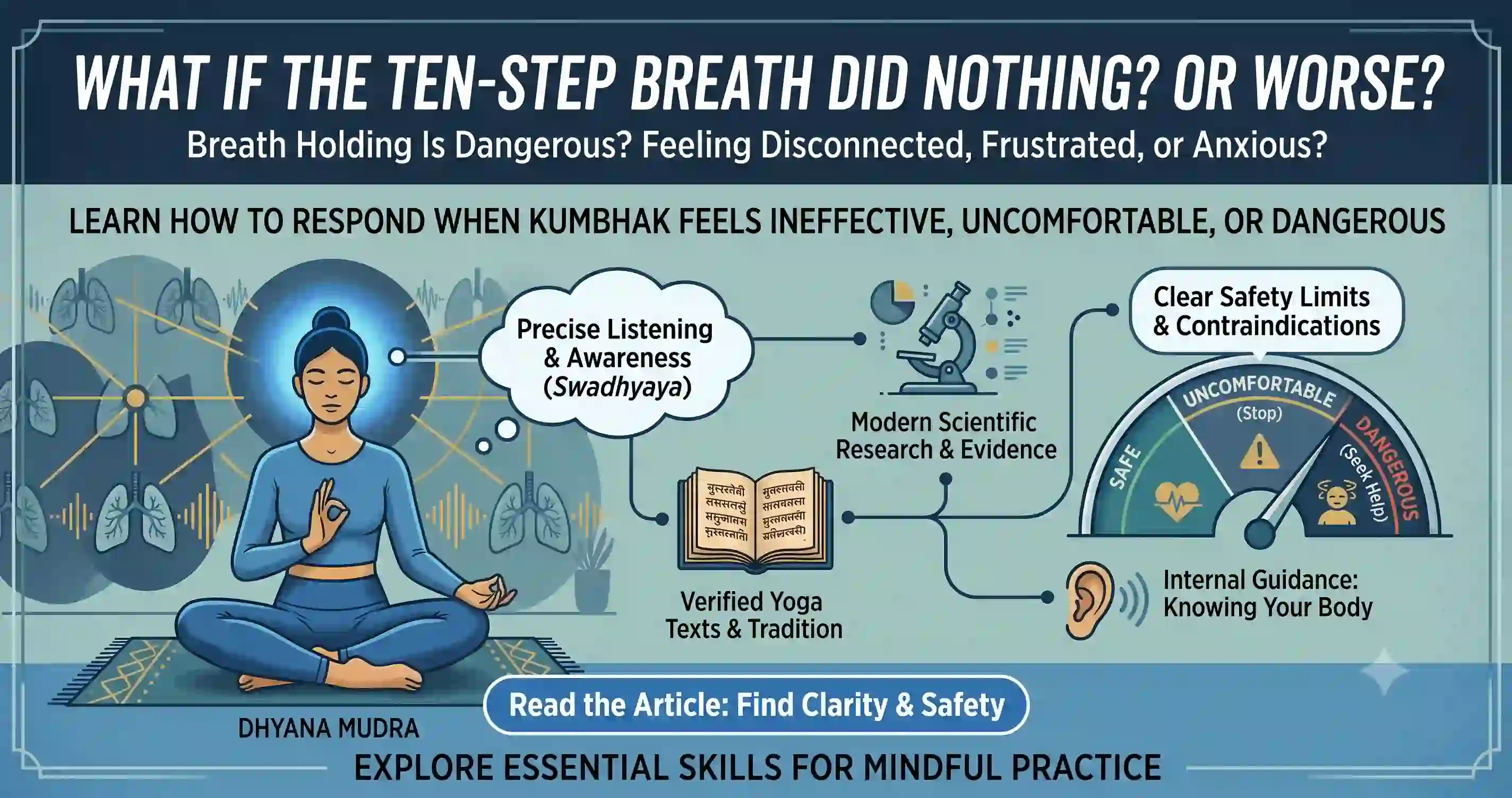
Someone finishes a Kumbhak round, opens their eyes and says, “Nothing happened.”
Or perhaps their face tightens: “I felt worse.”
Or they do not try at all: “Breath holding is dangerous.”
In that instant, the most important part of the practice may no longer be the pause in the breath. It may be the pause before you answer.
Defensiveness tries to protect the method. Care protects the person.
A person’s report is not an attack on Kumbhak. It is information about this person, this attempt, this moment and this dose.
That is true when the person is someone else—and equally true when the doubtful voice is your own.
This article does not repeat the Ten-Step Kumbhak technique. For the complete method, posture, Dhyāna Mudra, Pūrak, Rechak, both retentions and recovery breaths, use the separate How to Practice the Ten-Step Kumbhak for Stress Relief guide.
This article is educational, not medical advice. Kumbhak is not emergency treatment, a substitute for prescribed care or a test of courage.
The Most Important Answer First 🌿
When someone says “Nothing happened,” believe the observation. Do not invent a hidden benefit for them. Ask what they expected, what they noticed and what remained unchanged.
When someone says “I felt worse,” stop the experiment. Return to natural breathing, listen for the exact symptom and decide whether the person needs rest, a different approach or medical care.
When someone says “Breath holding is dangerous,” agree with the part that is true. Maximal holding, hyperventilation before a hold, underwater practice and holding in an unsafe setting can be dangerous. A brief, seated, submaximal Kumbhak after normal breathing is a different exposure—but it is not automatically suitable or risk-free for every person.
And remember the updated safety margin:
“Another one to three seconds in reserve” is not an instruction to hold for one to three seconds. It means ending the hold while you still feel certain you could have continued comfortably for another one to three seconds.
If an urge to breathe, strain or uneasiness appears sooner, end the retention immediately—even if only a fraction of a second has passed. If no retention feels comfortable, do not retain the breath.
The First Mistake: Treating Honest Feedback as a Verdict ⚖️
Three different statements are often collapsed into one:
- Experience: “I did not notice relief.”
- Interpretation: “This practice does not help me.”
- Universal claim: “Kumbhak never helps anyone.”
These statements are not identical.
You can fully accept the experience without pretending that it proves a universal claim. You can also accept the possibility that the practice may be unsuitable for this person without declaring the entire tradition worthless.
The same precision works in the other direction:
- “I felt calm once” does not prove that Kumbhak always relieves stress.
- “A study found an average benefit” does not promise that every participant benefited.
- “No benefit was detected” does not prove that every form of Kumbhak is ineffective.
- “Some breath holding is dangerous” does not make every respiratory pause equally dangerous.
- “A brief hold felt easy” does not prove that a longer hold would be better.
Mature teaching can hold all five truths without twisting any of them.
Listen first. Separate the layers. Make only the claim the evidence can carry.
Use the H-E-A-R Response: Four Moves That Protect Trust 👂
When doubt or discomfort appears, use H-E-A-R. It works with a student, a family member, a sceptic—or your own mind.
H — Hold Back the Defence
Notice the sentences rising inside you:
- “They must have done it incorrectly.”
- “They did not concentrate.”
- “They need more faith.”
- “They stopped too early.”
- “They are trying to discredit me.”
Do not speak from that reflex.
The purpose of listening is not to collect enough details to prove the person wrong. It is to discover what actually happened.
Try:
“Thank you for saying that plainly.”
To yourself:
“I do not need to produce a positive result to be a good practitioner.”
E — Echo the Exact Report
Reflect what was said without improving or diminishing it:
“You did not notice any change.”
“You felt more anxious afterward.”
“You are concerned that holding the breath could be unsafe.”
Then check:
“Have I understood you correctly?”
This is not agreement with every conclusion. It is agreement about the subject being discussed.
A — Ask for Precision
Ask one or two questions at a time:
- “What does ‘worse’ mean in your body or mind?”
- “Did it begin during Pūrak, Antar Kumbhak, Rechak, Bāhya Kumbhak or afterward?”
- “Was it air hunger, dizziness, chest pressure, a racing heartbeat, panic, tingling, headache, sadness, numbness or something else?”
- “How intense was it from zero to ten?”
- “How long did it last after natural breathing returned?”
- “What did you expect to happen?”
- “Were the Pūrak and Rechak normal, or did you make them unusually large, fast or controlled?”
- “Did you feel certain you still had another one to three comfortable seconds in reserve?”
Precision turns “Kumbhak made me worse” into usable information. It may reveal strain, over-breathing, an emotional trigger, an unsuitable context, a health concern—or simply an unexplained response that should not be challenged again without guidance.
R — Respond in Proportion
Match the response to the information:
- No noticeable change and no discomfort: accept the neutral result; optionally observe again another day without chasing an effect.
- Mild, brief discomfort that resolves fully: do not continue that session; review the method and consider whether retention should be shortened or omitted.
- Repeated anxiety, air hunger, dizziness or distress: stop self-experimenting and seek suitable professional guidance.
- Chest pain, fainting, severe or persistent breathlessness, confusion, weakness, vision disturbance or other serious symptoms: seek urgent medical evaluation.
- A clear “no”: respect it. A person does not owe the practice another attempt.
The strongest answer is not always a better explanation. Sometimes it is a clean stop.
When the Honest Report Is “Nothing Happened” 🌫️
“Nothing” can be disappointing. A person may have arrived carrying a loud mind, a tight chest and the hope that one round would feel like a switch being turned off.
Then the room looks the same. The thoughts remain. No wave of peace arrives.
This is not a moral failure, and it is not evidence of a defective mind.
What to Say to Someone Else
“Nothing is a valid result. I will not tell you that you felt something you did not feel. What were you hoping would change, and what stayed the same?”
Then listen.
If they expected complete calm, you may add:
“Stress relief does not always feel dramatic. But we also should not relabel no change as success. If you want, we can clarify the outcome you care about and decide whether another small observation is worthwhile.”
What to Say to Yourself
“I noticed no clear change. That is today’s observation, not a verdict on my worth and not a command to force a stronger hold.”
The last clause matters. When “nothing happened,” the ego often proposes more duration, more effort or more repetitions. That turns a stress-relief practice into a contest precisely when the evidence for escalating is absent.
“Nothing” May Mean Several Different Things
It may mean:
- there was genuinely no perceptible effect;
- the expected outcome was too large for one brief practice;
- the outcome appeared later rather than immediately;
- a small shift occurred in one domain but not the domain being watched;
- the person was already near their usual baseline;
- stress from the surrounding situation outweighed any brief change;
- attention was absorbed by remembering instructions;
- the technique or dose was not a good fit;
- or the practice simply did not help this person on this occasion.
These are possibilities, not excuses. Do not choose one without evidence.
Replace “Did It Work?” With Four Narrow Questions
If the person is comfortable and wants to evaluate the practice, ask:
- Body: Did the jaw, shoulders, chest, abdomen or hands feel different?
- Breath: Did natural breathing afterward feel easier, unchanged or less comfortable?
- Mind: Did the speed, stickiness or emotional force of thoughts change?
- Function: Ten minutes later, was it easier to return to the next useful action?
“No change in all four” remains a completely acceptable answer.
For a small personal observation, rate stress from zero to ten before practice, soon afterward and ten minutes later. Record discomfort separately. Do not use a lower number to pressure yourself into continuing, and do not turn normal day-to-day fluctuation into proof.
Why Science Makes Room for “Nothing”
A 2023 meta-analysis of 12 randomised trials involving 785 adults found a small-to-moderate average reduction in self-reported stress with breathwork, but the authors also reported study limitations and urged caution about hype.1 An average effect is not a universal effect.
A separate blinded trial of 400 adults found that four weeks of one coherent-breathing rhythm did not outperform a matched breathing control for stress, anxiety, depression or wellbeing.2 Another placebo-controlled trial in 200 healthy adults found that high-ventilation breathwork with long retention was not superior to a convincing comparison practice for stress.3
Those null findings do not settle every question about Ten-Step Kumbhak. They do teach something essential:
“I did not notice a benefit” is scientifically ordinary, not spiritually embarrassing.
When the Honest Report Is “I Felt Worse” 🚦
This statement deserves more attention than any promise of benefit.
A teacher who immediately says “That is just stored stress releasing” has replaced observation with a story. A practitioner who says “I must break through this” may turn a warning into a challenge.
Neither response is precise.
The Immediate Response
- Stop the practice.
- Return to natural breathing.
- Sit or lie in a safe place.
- Do not begin another round to “correct” the first.
- Identify the symptom and whether it is resolving.
- Obtain appropriate medical help for serious, unusual or persistent symptoms.
That is not fear. It is intelligent dosing.
If “Worse” Means Dizziness, Tingling or Light-Headedness
One possible cause is over-breathing before or between holds. Breathing unusually fast or deeply can lower carbon dioxide, producing light-headedness, tingling and other symptoms. A breath hold after hyperventilation may also delay the normal warning urge to breathe.
The Ten-Step method specifies normal Pūrak and normal Rechak, not exaggerated breathing. Yet technique is not the only possibility. Dizziness may also have cardiovascular, neurological, vestibular, medication-related or other causes.
Do not diagnose it from a conversation. Stop, let the body return fully to baseline and seek clinical guidance if it is strong, recurrent, unexplained or accompanied by concerning symptoms.
If “Worse” Means Air Hunger or Panic
Air hunger is not imaginary. It is a powerful protective sensation related to the body’s drive to restore gas exchange. Research describes it as emotionally potent and capable of evoking anxiety and fear.4
That is why the reserve rule ends the hold before the urge becomes a struggle.
The rule does not say:
“Tolerate discomfort for another three seconds.”
It says:
“End while the hold is still completely easy and while another one to three comfortable seconds clearly remain.”
If the urge arrives sooner, release sooner. If the pause itself feels threatening, omit it.
For someone with panic, suffocation trauma, PTSD or strong fear of internal sensations, even a brief pause may feel like danger. A pragmatic PTSD trial recorded anxiety, breathlessness, dizziness, constriction and a suffocation-related flashback in connection with a prāṇāyāma programme; the primary intention-to-treat result found no added PTSD benefit, and participants with recurrent adverse experiences worsened on some outcomes.5
That study tested a different, multi-component programme, not the Ten-Step method. Its lesson is still relevant: tolerance cannot be assumed, and distress must not be spiritualised away.
If “Worse” Means Pressure, Palpitations or Headache
Kumbhak is physiologically active. In a study of 20 healthy participants, a one-minute Kumbhak increased systolic, diastolic and mean arterial pressure and total peripheral resistance during the hold, while stroke volume and cardiac output fell.6
The Ten-Step practice uses deliberately brief, comfortable, submaximal retention—not one-minute attempts. The study therefore does not prove that a brief Kumbhak is harmful. It does prove that “holding the breath always activates rest-and-digest” is too simple.
Stop if there is pressure, a severe headache, chest discomfort or unusual palpitations. Do not test whether the symptom disappears with a stronger round.
If “Worse” Means Sadness, Fear, Dissociation or a Memory
Breath-focused practices turn attention inward. For some people, internal sensations carry emotional associations. A closed throat, full chest or empty-lung pause may resemble a past episode of choking, panic, illness or helplessness.
Do not say:
- “Your trauma is leaving.”
- “Your ego is resisting.”
- “This proves the practice is working.”
- “Stay with it until it releases.”
Say:
“Your response makes sense as information. We do not need to repeat the trigger. Would you like to stop here, ground through the senses or speak with a trauma-informed professional?”
The person decides. Safety is not dependent on completing the round.
If “Worse” Is Vague
Do not force certainty. “I do not know yet” is a responsible conclusion.
Ask whether the person has completely returned to baseline. If not, the priority is care—not interpretation. Repeated unexplained symptoms deserve assessment by a qualified healthcare professional.
“Breath Holding Is Dangerous”: The Precise Answer 🫁
The best response begins with honest agreement:
“Yes, some forms of breath holding are dangerous. Which situation are you concerned about?”
This sentence neither dismisses the person nor concedes that every pause has identical risk.
Breath Holding Is Clearly Dangerous in Certain Contexts
Risk rises when a person:
- hyperventilates before holding;
- aims for a maximum or personal record;
- pushes through air hunger, contractions, greying vision or loss of coordination;
- holds underwater or in a bath;
- practises alone in water;
- holds while driving, walking somewhere unsafe or operating machinery;
- practises standing where fainting could cause a fall;
- uses competition, pressure or shame to extend duration;
- or has a medical or psychological condition for which retention is unsuitable.
The American Red Cross, YMCA of the USA and USA Swimming explicitly warn that hyperventilation before underwater swimming and extended underwater breath holding can cause hypoxic blackout and death.7
There is nothing defensive to say to that. The warning is correct.
A Brief Seated Kumbhak Is Not the Same Exposure
The Ten-Step practice is intended to be:
- seated in a stable place;
- preceded and followed by normal breathing;
- free of hyperventilation;
- comfortably submaximal;
- ended with another one to three comfortable seconds clearly in reserve;
- stopped at the first sign of urge, strain or uneasiness;
- and separated by recovery breaths.
These distinctions matter. Duration, starting lung volume, previous breathing, posture, health, repetition and environment all change the physiological event.
But distinction is not a guarantee.
The accurate statement is:
A brief, comfortable, dry and seated Kumbhak avoids several major hazards of maximal or underwater apnoea. It cannot be declared risk-free for every person.
“Natural” Does Not Mean “Always Safe”
Breathing is natural. So are coughing, vomiting, fever and fainting. Naturalness says nothing by itself about dose or context.
Likewise, antiquity is not a safety certificate. A practice can be traditional and still require screening, skill and restraint.
The strongest case for Kumbhak does not come from pretending risk is zero. It comes from naming the boundary accurately.
The Scientific View: Benefit, Neutrality and Adverse Response Can Coexist 🔬
Scientific results are often discussed as though a practice must be either effective or useless, safe or dangerous. Human responses are less tidy.
Group Averages Do Not Predict Every Individual
A trial may show an average improvement even when:
- some people improve greatly;
- some improve slightly;
- some do not change;
- and some feel worse.
The average does not erase the individual. The individual does not erase the average.
This is why a person’s neutral report can be true even when research is encouraging—and an encouraging trial can still matter even when one person notices nothing.
Breathwork Evidence Is Broader Than Kumbhak Evidence
Many studies combine breathing rhythm, attention, instruction, expectancy, longer Rechak, nostril control, meditation or movement. When such a programme helps, the retention cannot automatically receive all the credit.
The 2023 breathwork meta-analysis found an encouraging average stress effect, yet most included studies had at least some risk-of-bias concerns, and adverse-event reporting was limited.1 Research on breathwork generally is not direct proof for every feature of the Ten-Step Kumbhak.
A Hold Can Feel Quiet and Still Be Physiologically Active
During a closed-airway hold, metabolism continues. Carbon dioxide tends to rise and oxygen eventually falls, depending on the person, duration, lung volume and preceding breathing. Circulation and autonomic responses can change before the experience feels dramatic.
That does not mean every short hold creates dangerous hypoxia. It means the absence of a spectacular sensation is not proof that “nothing biological happened”—and a biological change is not automatically a therapeutic benefit.
Keep those claims separate.
More Intensity Is Not More Stress Relief
Research does not establish that a longer hold provides greater emotional benefit. In one month-long randomised study, several five-minute daily breathing methods improved mood, but the clearest average pattern favoured a Rechak-focused technique rather than the retention methods.8
The lesson is not that Kumbhak is useless. It is that duration and intensity do not deserve automatic promotion.
For stress relief, the relevant outcome is not the number of seconds held. It is whether the person becomes more settled, remains comfortable and functions better afterward.
The Yogic View: The Classical Texts Warn Against Force 🕉️
Classical yoga does not support the modern performance slogan “longer is always better.” Its language is about regulation, gradation and skill.
Yoga Sūtra 2.49: The Pause Belongs to Prāṇāyāma
Patañjali defines prāṇāyāma through the interruption of the movements of Pūrak and Rechak:
tasmin sati śvāsapraśvāsayor gativicchedaḥ prāṇāyāmaḥ — Yoga Sūtra 2.49
The verse establishes that respiratory cessation is not a modern invention or an accidental gap. It belongs to the classical map of breath regulation.9
It does not say that every person must experience calm immediately, that every duration is appropriate or that discomfort should be conquered.
Yoga Sūtra 2.50: Place, Time and Number Are Part of the Practice
The next sūtra describes external, internal and stationary forms as regulated by place, time and number, becoming extended and subtle:
bāhyābhyantarastambhavṛttir deśakālasaṃkhyābhiḥ paridṛṣṭo dīrghasūkṣmaḥ — Yoga Sūtra 2.50
The relevant teaching here is not “make the hold long today.” It is that Kumbhak has variables. Place matters. Time matters. Number matters. Refinement matters.10
For a beginner practising for stress relief, precision may mean a very brief retention—or no retention—rather than imitation of an advanced duration.
Haṭha Yoga Pradīpikā 2.15: Progress Is Gradual
yathā siṃho gajo vyāghro bhaved vaśyaḥ śanaiḥ śanaiḥ
tathaiva sevito vāyur anyathā hanti sādhakam — Haṭha Yoga Pradīpikā 2.15
In meaning: as powerful animals are brought under control gradually, breath is approached gradually; otherwise it can harm the practitioner.
The image is intentionally serious. Breath is not portrayed as an enemy, but neither is it treated as a toy.
Haṭha Yoga Pradīpikā 2.16–2.18: Proper and Improper Practice Are Different
Verse 2.16 makes a traditional claim that properly practised prāṇāyāma removes disease and improperly practised prāṇāyāma produces disease. Verse 2.17 lists hiccup, respiratory trouble, cough and pains of the head, ears and eyes among the consequences associated with disturbed breath. Verse 2.18 repeatedly calls for Pūrak, Rechak and Kumbhak to be performed yukta—fittingly, appropriately or skilfully.11
The universal disease-removal statement is a classical yogic assertion, not a scientifically verified promise that prāṇāyāma cures all illness. Yet the safety teaching is unmistakable:
The text itself distinguishes disciplined practice from harmful practice.
A teacher who dismisses “I felt worse” is not defending tradition. They are ignoring one of its clearest cautions.
Haṭha Yoga Pradīpikā 2.2: Breath and Mind Move Together—But Not Mechanically
The well-known verse begins:
cale vāte calaṃ cittaṃ niścale niścalaṃ bhavet — Haṭha Yoga Pradīpikā 2.2
In meaning: when the breath is disturbed, the mind is disturbed; when the breath becomes steady, the mind becomes steady.
This is a profound practice map, not a guarantee that one respiratory pause will instantly silence every mind. A person may be grieving, ill, sleep-deprived, traumatised, medicated, overstimulated or simply unresponsive to that particular attempt.
The yogic truth invites attention to relationship. It does not authorise denial of experience.
The Ayurvedic View: Disturbed Breathing Is Information, Not Disobedience 🌿
Āyurveda describes life through patterns of movement, regulation, digestion, tissue support and individual constitution. Vāta is the principle most associated with movement; its traditional subdivisions include Prāṇa, Udāna, Samāna, Vyāna and Apāna.
These concepts are not identical to nerves, oxygen, carbon dioxide or the modern autonomic nervous system. They should not be translated as though the systems match one-to-one.
Prāṇavaha Srotas: The Respiratory Pattern Has Diagnostic Meaning
In Charaka Saṃhitā, Vimānasthāna 5.7, respiration described as excessively long, restricted, agitated, shallow, short, noisy or painful is treated as a sign that the channels carrying life-breath are disturbed.12
This passage is not a scientific Kumbhak safety trial, and it is not saying that every intentional pause is pathological. Its relevance is subtler:
Classical Āyurvedic observation does not argue with disturbed or painful breathing. It treats the pattern as meaningful data.
If Kumbhak repeatedly leaves a person agitated, constricted, depleted or breathless, an Ayurvedic response should not be, “Your doṣa is resisting, continue anyway.” It should begin with observation, individual assessment and removal of the aggravating factor.
Avoid Instant Doṣa Diagnoses
It is tempting to say:
- “Nothing happened because you are Kapha.”
- “Anxiety means your Vāta rose.”
- “Heat means Pitta was released.”
These quick labels can sound traditional while functioning as evasions. A genuine Ayurvedic assessment considers a much wider picture and belongs with a properly qualified practitioner.
The responsible statement is:
“Āyurveda offers an individualised framework for understanding your response, but this one symptom is not enough for me to diagnose its cause.”
What Is Traditional and What Is Scientifically Verified
Traditional yoga and Āyurveda describe Prāṇa, Vāyu, nāḍī, doṣa and srotas within their own systems. Modern physiology measures gases, pressure, circulation, respiratory drive and reported symptoms.
These lenses may illuminate the same human experience from different directions, but they are not interchangeable. Current science has not verified Prāṇa, Vāta disturbance or prāṇavaha srotas as biomedical mechanisms.
Respect does not require pretending equivalence. Precision allows both traditions to remain intact.
What Not to Say—and What to Say Instead 🗣️
When Someone Says “Nothing Happened”
Do not say:
“You were not receptive.”
Say:
“No noticeable change is a valid observation. What outcome were you watching for?”
Do not say:
“Something happened at a subtle level whether you felt it or not.”
Say:
“There may or may not have been changes you could not perceive, but I will not call them benefits without evidence.”
Do not say:
“Do more rounds.”
Say:
“There is no need to increase the dose merely to manufacture a sensation.”
When Someone Says “I Felt Worse”
Do not say:
“That is detoxification.”
Say:
“Let us stop. What exactly did you feel, when did it begin and has it fully resolved?”
Do not say:
“Push through the resistance.”
Say:
“Discomfort ends the hold. We do not train past the safety boundary.”
Do not say:
“Your fear proves you need this.”
Say:
“Fear may mean this method or dose is not appropriate for you right now.”
When Someone Says “Breath Holding Is Dangerous”
Do not say:
“People hold their breath every day, so it is safe.”
Say:
“You are right that maximal, hyperventilated and underwater holding can be dangerous. The relevant questions are which hold, for whom, for how long and in what setting.”
Do not say:
“Ancient yogis proved it is harmless.”
Say:
“The yogic texts themselves warn against haste and improper practice.”
Do not say:
“Science proves Kumbhak is safe.”
Say:
“Research confirms that breath holding changes physiology. Safety depends on protocol and person, and uncommon risks are not ruled out by small studies.”
A Precision Check After Any Uncomfortable Attempt 🔍
Do not conduct this check in order to persuade the person to continue. Use it only to understand the event and choose a safer next step.
1. Name the Exact Sensation
Was it:
- urge to breathe;
- dizziness or faintness;
- tingling or numbness;
- chest pain, tightness or pressure;
- pounding, racing or irregular heartbeat;
- headache or eye pressure;
- nausea;
- panic, dread or trapped feeling;
- dissociation, numbness or flashback;
- prolonged breathlessness;
- or another symptom?
2. Locate It in Time
Did it begin:
- before practice;
- during normal Pūrak;
- during Antar Kumbhak;
- during normal Rechak;
- during Bāhya Kumbhak;
- during the recovery breaths;
- or minutes later?
This timing does not diagnose the cause, but it narrows the question.
3. Check the Dose Without Blame
Ask:
- Was the hold completely easy?
- Was there clearly another one to three comfortable seconds in reserve?
- Did the person inadvertently aim for a number?
- Did the face, throat, chest, shoulders or abdomen brace?
- Were Pūrak and Rechak normal?
- Was the person seated safely?
- Were multiple rounds added in pursuit of a stronger effect?
If the answer reveals a deviation, correct the explanation—not the person’s dignity.
4. Check the Context
Consider:
- acute illness, fever or respiratory symptoms;
- recent food, caffeine, nicotine, alcohol or other substances;
- dehydration, sleep loss or overheating;
- current medication;
- pregnancy;
- heart, lung, blood-pressure, neurological or fainting concerns;
- panic, PTSD or suffocation-related trauma;
- and whether the setting felt safe and voluntary.
Do not make a medical conclusion from this checklist. Use it to decide whether professional assessment is appropriate.
5. Ask the Consent Question Again
“Do you want to explore what happened, switch to natural breath awareness or finish for today?”
“Finish” must be a real option.
Safety Boundaries That Do Not Need Debate ⚠️
Stop immediately and return to natural breathing if there is dizziness, faintness, unusual breathlessness, chest pain or tightness, panic, tingling, visual disturbance, confusion or any other discomfort.
Do not resume until breathing and the whole body feel completely normal.
Seek urgent medical care for loss of consciousness, chest pain, severe or persistent breathlessness, new neurological symptoms, blue lips, severe headache, injury or any symptom that feels medically serious.
Obtain individual clinical guidance before retention if you have significant heart or lung disease, uncontrolled blood pressure, a history of fainting, epilepsy or seizures, cerebrovascular or eye-pressure concerns, pregnancy-related concerns, recent surgery, panic disorder, PTSD or another condition that may be destabilised by air hunger.
Never practise Kumbhak:
- in water or a bath;
- after hyperventilation;
- while driving;
- while operating machinery;
- while walking somewhere unsafe;
- standing where a fall could injure you;
- or as a competition.
This list is deliberately conservative because condition-specific safety research for every Kumbhak dose is limited.
How a Teacher Can Receive Mixed Reports in a Group 🤝
A class becomes dishonest when only “calm,” “peaceful” and “wonderful” are socially rewarded.
After practice, say:
“Responses may be positive, neutral or uncomfortable. All three are useful to report.”
Then offer multiple channels:
- a private zero-to-ten rating;
- an anonymous written note;
- a choice to speak after class;
- and permission not to disclose.
Do not ask:
“Everyone feels calmer, right?”
That question invites compliance, not observation.
If one student reports distress, do not use the group to outvote them:
“Twenty people liked it, so it cannot be the technique.”
Both may be true: many people found it helpful, and one person had an adverse response.
The class learns safety from the way the minority report is treated.
Four Complete Response Scripts You Can Use 💬
Script 1: “Nothing Happened”
“Thank you for being direct. I accept that you noticed no change. What were you hoping would be different—mental speed, bodily tension, emotion or something else? We do not need to force a stronger effect. If you remain comfortable and want to observe again another day, we can keep the same safety limits. If not, we can leave it here.”
Script 2: “I Felt Worse”
“Let us stop and return to natural breathing. Please do not begin another round. What exactly felt worse, when did it begin and is it resolving? Discomfort means the retention ends; the one-to-three-second reserve is a margin before discomfort, not time to endure after it begins. If the symptom is serious, unusual, recurrent or persistent, please obtain appropriate medical care.”
Script 3: “Breath Holding Is Dangerous”
“Some breath holding is dangerous, especially after hyperventilation, underwater, at maximum duration or in an unsafe setting. The Ten-Step practice is intended to be seated, dry, brief, unforced and stopped with comfortable reserve. That distinction reduces important risks, but it does not make the practice suitable for everyone. Is there a particular risk or health condition you want to examine?”
Script 4: When Your Own Mind Says All Three
“I do not have to defend the practice or condemn it. I can record what happened accurately. No effect means no effect noticed. Feeling worse means stop and investigate. Danger is assessed by dose, context and my health—not by pride. My task is to remain honest and safe.”
A Small Decision Map for the Next Step 🧭
Neutral, Comfortable, No Noticeable Effect
- Do not increase duration or rounds to chase sensation.
- Decide whether the outcome matters enough to observe on another day.
- Use the published practice guide again if you want to confirm the method.
- Accept stopping permanently as a valid choice.
Mild Discomfort That Resolved Completely
- End the session.
- Review whether breathing was normal and the reserve margin remained clear.
- Consider natural breath awareness without retention.
- Seek guidance before retrying if there is uncertainty.
Repeated or Emotionally Destabilising Discomfort
- Do not keep testing alone.
- Consider a trauma-informed mental-health professional if panic, dissociation or traumatic memory is involved.
- Consider medical assessment for recurrent physical symptoms.
- Use a non-retention approach unless an appropriate professional advises otherwise.
Serious, Persistent or Unusual Symptoms
- Seek urgent or prompt medical care according to symptom severity.
- Do not attribute the event to “energy release,” “detox” or doṣa without assessment.
- Do not resume retention until medically appropriate.
Frequently Asked Questions About Kumbhak, No Effect and Safety ❓
Is Breath Holding Dangerous?
It can be. Underwater holding, hyperventilation before a hold, maximal attempts, unsafe posture and practising despite warning symptoms can lead to serious harm. A brief, seated, submaximal Kumbhak with normal breathing and comfortable reserve is a different exposure, but no method is suitable for everyone.
Why Do Breathing Exercises Sometimes Make Me More Anxious?
Possible reasons include air hunger, over-breathing, attention to feared body sensations, bracing, an overly demanding dose, panic sensitivity, traumatic associations or a medical issue. The correct first response is to stop and identify the symptom—not to assume that anxiety is a necessary stage.
Why Did I Feel Light-Headed After Kumbhak?
Over-breathing can lower carbon dioxide and contribute to light-headedness or tingling. A hold, blood-pressure change, medication, dehydration or another health factor may also be involved. Return to natural breathing and obtain medical advice if the symptom is strong, recurrent, persistent or unexplained.
How Long Should a Beginner Hold the Breath?
There is no universal number that is safe and appropriate for every beginner.
In the Ten-Step Kumbhak, one to three seconds is not the required hold time. It is the comfortable reserve that should still remain when the retention ends. The actual hold may be shorter than three seconds. If the urge to breathe, strain or uneasiness appears at once, release at once. If no hold is comfortable, do not hold.
Should I Push Past the First Urge to Breathe?
No. For this stress-relief method, the urge is the boundary, not the beginning of training. The retention should have ended before any struggle begins.
If Nothing Happened, Did I Do Kumbhak Wrong?
Not necessarily. A neutral result may reflect the person, occasion, expectation, outcome measured or simple absence of benefit. Method can be reviewed without using “wrong” as an accusation. Never infer technical error solely because the result was not positive.
Can Kumbhak Cause a Panic Attack?
Breath retention and air hunger can trigger fear in susceptible people, and retention-containing prāṇāyāma has produced anxiety and other adverse experiences in a PTSD trial.5 Anyone with panic or suffocation-related trauma should use particular caution and may need an approach without retention.
Is Kumbhak the Same as Competitive Apnoea?
No. Both involve a respiratory pause, but duration, preparation, lung volume, repetition, effort, environment and purpose can differ radically. Evidence from elite maximal apnoea cannot be transferred directly to a brief stress-relief Kumbhak.
Does Feeling Worse Mean the Practice Is “Releasing Stress”?
That explanation is unproven and may be unsafe. A temporary emotion can occur during inward attention, but dizziness, panic, pain, pressure or destabilisation should not be renamed as healing. Stop, observe and obtain suitable guidance.
Can Kumbhak Replace Treatment for Anxiety, High Blood Pressure or Lung Disease?
No. Research on breathing practices is promising in some settings, but effects are protocol-specific and often not attributable to retention alone. Kumbhak should not replace prescribed medication, psychotherapy, pulmonary care or cardiovascular treatment.
The Deeper Practice Is Truthfulness ❤️
Imagine two teachers.
The first hears “Nothing happened” and answers, “You were not open.”
The second says, “Thank you. Tell me what you noticed.”
The first may preserve authority for a minute. The second preserves the student’s capacity to trust their own experience.
That trust is not an obstacle to Kumbhak. It is the ground on which any honest practice must stand.
The same is true inside you. You do not have to be impressed. You do not have to be frightened. You do not have to win an argument between tradition and science.
You only have to become precise:
- Nothing noticed is not hidden failure.
- Feeling worse is not proof of purification.
- Danger is not one undifferentiated category.
- Another one to three seconds in reserve is a safety margin, never a minimum hold.
- Stopping is always allowed.
- Listening comes before explanation.
Do not ask the person to agree that Kumbhak worked. Agree first to discover what actually happened.
That response is not defensive or dismissive. It is disciplined, humane and worthy of the stillness the practice seeks.
Verified References and Further Reading 📚
-
Fincham, G. W., Strauss, C., Montero-Marin, J., & Cavanagh, K. (2023). “Effect of breathwork on stress and mental health: A meta-analysis of randomised-controlled trials.” Scientific Reports, 13, 432. Full text and DOI. ↩↩
-
Fincham, G. W., Strauss, C., & Cavanagh, K. (2023). “Effect of coherent breathing on mental health and wellbeing: a randomised placebo-controlled trial.” Scientific Reports, 13, 22141. Full text and DOI. ↩
-
Fincham, G. W., et al. (2024). “Effects of brief remote high ventilation breathwork with retention on mental health and wellbeing: a randomised placebo-controlled trial.” Full text on PubMed Central. ↩
-
Banzett, R. B., Lansing, R. W., & Binks, A. P. (2021). “Air hunger: a primal sensation and a primary element of dyspnea.” Full text on PubMed Central. ↩
-
Wurst, F. M., et al. (2023). “The integration of yoga breathing techniques in cognitive behavioral therapy for post-traumatic stress disorder: A pragmatic randomized controlled trial.” Full text on PubMed Central. ↩↩
-
Nivethitha, L., Mooventhan, A., & Manjunath, N. K. (2021). “Evaluation of Cardiovascular Functions during the Practice of Different Types of Yogic Breathing Techniques.” International Journal of Yoga. Full text on PubMed Central. ↩
-
American Red Cross, YMCA of the USA, & USA Swimming (2022). “Joint Statement on Hypoxic Blackout and Inaccurate Use of the Terminology Shallow Water Blackout.” Official safety statement. ↩
-
Balban, M. Y., et al. (2023). “Brief structured respiration practices enhance mood and reduce physiological arousal.” Cell Reports Medicine, 4(1), 100895. Full text on PubMed Central. ↩
-
Patañjali, Yoga Sūtra 2.49, Sanskrit text, translation and classical commentaries. Verified text. ↩
-
Patañjali, Yoga Sūtra 2.50, Sanskrit text, translation and classical commentaries. Verified text. ↩
-
Svātmārāma, Haṭha Yoga Pradīpikā, Chapter 2, especially verses 2, 15–18. Public-domain English text. ↩
-
Charaka Saṃhitā, Vimānasthāna 5.7, on signs associated with disturbed channels carrying life-breath. English translation. ↩