How Ten-Step Kumbhak may support stress relief during bereavement, anticipatory, prolonged, traumatic, cumulative and inhibited grief—with safety.
By Kumbhaki Yogi Dhruvaji (MSc), founder of the Antistress Foundation 501(c)(3)
• How to Practice Ten-Step Kumbhak • Scientific Proof • Ancient Texts Proof • Bio • Subscribe By Email
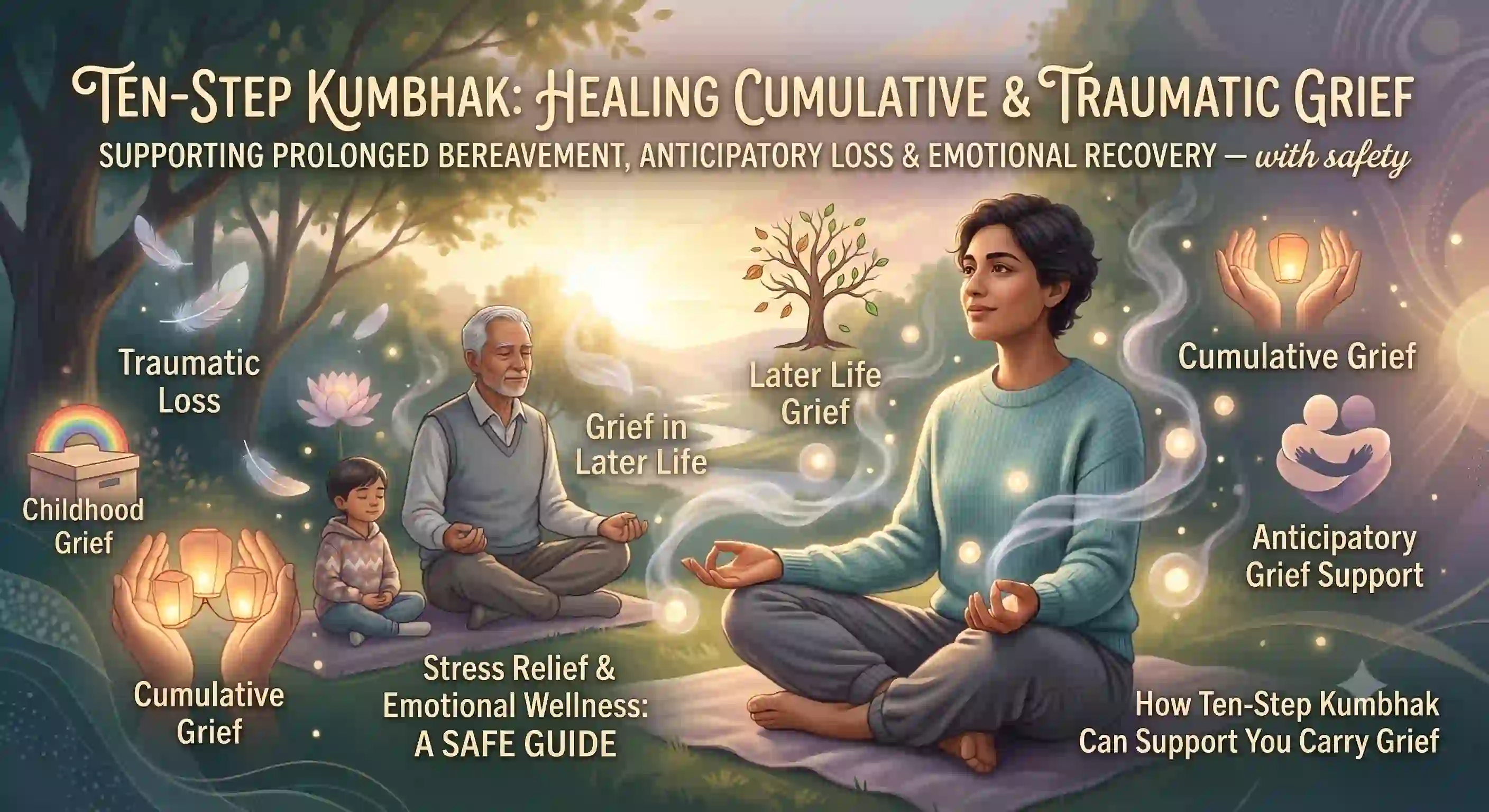
Can Ten-Step Kumbhak Help You Carry Grief? A Complete Guide to Bereavement, Anticipatory Grief, Prolonged Grief, Traumatic Loss, Cumulative Shocks and Hidden Grief
There are moments after a loss when the body remembers before the mind does.
Your hand reaches toward the phone. You hear a key at the door that will never turn again. A familiar fragrance crosses a room, and for one bright second the world is restored—then it breaks all over again.
No breathing practice should ask you to stop loving the person you lost. No honest article should promise that a few breath retentions can erase bereavement, resolve trauma or cure prolonged grief disorder.
Ten-Step Kumbhak may offer a smaller, kinder possibility: a brief reduction in the stress surrounding grief, so the grief does not have to fight an alarmed body at the same time.
That distinction matters. Grief is not merely a symptom to eliminate. It is also love encountering absence, identity reorganising itself and the nervous system learning a world that has changed. Healing does not necessarily mean “moving on” or forgetting. It may mean becoming able to remember, ache, rest, work, connect and live without each wave taking away every available inner resource.
Ten-Step Kumbhak cannot change who died, what is feared or what happened. It may help some people meet the next minute with a little more physical steadiness.
This article does not reproduce the Ten-Step Kumbhak process. Learn the complete method and its safeguards only from How to Practise the Ten-Step Kumbhak for Stress Relief.
The Short Answer: Can Ten-Step Kumbhak Help With Grief? 🕯️
What the evidence allows us to say
Three conclusions can be held together without contradiction:
- Grief is a whole-body stress event. Bereavement has been associated with changes in autonomic activity, cortisol, sleep, inflammation, immune function, heart rate, blood pressure and clotting-related processes, particularly in early bereavement.1
- Structured breathing practices can reduce stress or anxiety for some people. Trials of breathing methods containing Kumbhak have reported promising psychological effects, although the benefit cannot usually be attributed to retention alone.23
- Ten-Step Kumbhak has not been clinically proven to treat grief. No high-quality trial has tested this exact practice for ordinary bereavement, anticipatory grief, prolonged grief disorder, traumatic grief, cumulative losses or inhibited grief.
The responsible conclusion is therefore:
Ten-Step Kumbhak may be used as an optional stress-relief support during grief—not as a cure for grief, a substitute for mourning or a replacement for grief-focused care.
The one direct bereavement-and-breathing signal is encouraging but limited
A small quasi-experimental programme for middle-aged widows in Korea combined Dan-jeon breathing and stretching, a self-help group and health checks. Grief and stress scores improved more in the intervention group than in a health-check control group.4
This study is relevant because it included breathing inside bereavement care. It is not direct proof for Ten-Step Kumbhak:
- breathing was bundled with stretching and group support;
- the study was not a large randomised trial;
- the breathing component could not be isolated;
- and the method was not the Ten-Step Kumbhak.
The finding is best read as a reason for better research—not as permission to advertise breath retention as grief treatment.
What “healing grief” can honestly mean
Healing grief need not mean becoming untouched by the loss. It may mean:
- the body no longer remains on continuous emergency alert;
- sleep and appetite begin to find some rhythm;
- memories can be approached without always becoming overwhelming;
- numbness is no longer the only available protection;
- practical responsibilities become possible again;
- a continuing inner bond with the person can coexist with present life;
- and help can be accepted without feeling that accepting help betrays the deceased.
Research on continuing bonds shows that an ongoing inner relationship with someone who died can bring comfort or distress depending on its form, meaning and context.5 Kumbhak should not be used to sever that bond. Its possible role is to make enough room around the bond for breathing, functioning and choice.
Grief Is Not a Failure to Finish Five Stages 🌊
A wave is not a setback
Grief rarely obeys a clean sequence. Sadness can sit beside relief. Laughter may appear during a funeral week. Numbness can arrive after tears rather than before them. A birthday, hospital smell, song or ordinary Tuesday can make a loss feel newly present years later.
The familiar five-stage model is described by the American Psychological Association as hypothetical and non-linear: experiences may overlap, recur or appear in another order.6 Treating the stages as deadlines can leave a grieving person with two pains—the loss itself and the fear of “grieving incorrectly.”
Ten-Step Kumbhak should therefore never become another performance chart:
- “I was calm yesterday, so I should be calm today.”
- “I cried after practice, so I failed.”
- “I felt nothing, so my grief is blocked.”
- “I completed more rounds, so I am healing faster.”
None of these conclusions follows.
Grief often oscillates rather than progresses in a straight line
The Dual Process Model describes movement between:
- loss-oriented coping—yearning, remembering, crying, revisiting the death or feeling the absence; and
- restoration-oriented coping—handling responsibilities, learning new roles, reconnecting and attending to daily life.7
Healthy adaptation may involve flexible movement between the two rather than permanent residence in either one. A short stress-relief practice may become a neutral threshold between them: not an escape from remembering, and not an order to remain inside sorrow.
Some days a person may practise before opening a box of belongings. On another day, the same person may practise before paying a bill the deceased always handled. Both are grief work.
Why Grief Can Feel Like It Lives in the Chest, Breath and Entire Body 🫀
The brain does not process loss as an abstract fact alone
A close relationship becomes woven into prediction. The nervous system expects a voice, footsteps, messages, touch, shared routines and help arriving from a particular direction. After death, the world reports absence while the attachment system continues to predict presence.
That mismatch can appear as:
- yearning or searching;
- a sensation that the person may enter the room;
- intrusive images of the illness or death;
- chest pressure, palpitations or breathlessness;
- agitation followed by exhaustion;
- sleep disturbance;
- difficulty concentrating;
- nausea, appetite change or digestive distress;
- emotional numbness;
- or an urge to avoid every reminder.
These reactions do not mean the relationship was unhealthy. They show how completely human connection can become embodied.
Bereavement can activate several stress systems at once
Reviews of bereavement physiology report evidence of:
- autonomic changes involving heart rate and blood pressure;
- HPA-axis activity and altered cortisol patterns;
- sleep disruption;
- immune and inflammatory changes;
- platelet and clotting-related changes;
- and a period of increased cardiovascular vulnerability in some bereaved people.18
One case-crossover study found a sharply increased relative risk of myocardial infarction during the first 24 hours after the death of a significant person, although the absolute risk depended heavily on the person’s underlying cardiovascular risk.9
This is not meant to frighten a grieving reader. It explains why grief deserves physical care too: medication routines, hydration, food, sleep, medical follow-up, companionship and attention to new symptoms are not distractions from mourning.
Chest pain after loss must not be dismissed as “only grief”
Extreme emotional stress can be associated with takotsubo cardiomyopathy, often called broken-heart syndrome, whose symptoms can resemble a heart attack. New or unexplained chest pain, severe breathlessness, fainting or a very fast or irregular heartbeat requires urgent medical assessment.10
Do not begin or continue Kumbhak to test whether chest symptoms are emotional. Breath retention is not a diagnostic tool.
Why breathing can become a meaningful entry point
Breathing participates in both automatic survival and voluntary action. Grief may disturb it without permission; a structured practice gives the person one limited area in which choice can return.
The possible value is not that grief is “breathed out.” Love, memory, trauma and bereavement are not toxins in the lungs. The value may be that the grieving person experiences a repeatable period in which posture, attention and respiratory movement are organised without requiring the loss to be explained.
Six Forms of Grief—and the Different Support Each One May Need 🧭
The labels below are guides, not boxes. One person may experience several forms together.
1. Grief after losing someone dear
What it may feel like
This is the grief people most readily recognise: shock, disbelief, yearning, anger, guilt, relief, sadness, numbness, disrupted identity or a sense that ordinary life has become unreal.
A person may function well in public and collapse at home. Another may weep openly and still complete the day’s work. A third may feel little at first. There is no single correct visible expression of love.
Where Ten-Step Kumbhak may help
It may offer a bounded stress-relief interval when:
- a grief wave arrives before sleep;
- repetitive thoughts are tightening the jaw, throat or chest;
- an anniversary or familiar place produces physical activation;
- concentration is needed for one necessary task;
- or a person wants a quiet practice before prayer, remembrance, journalling or speaking with family.
What it cannot do
It cannot decide when mourning should end, replace companionship or prove that a person has accepted the death.
At first, Meera could not enter the kitchen because one unused cup remained beside the kettle. Her first act of healing was not putting the cup away. It was standing near the door without having to flee. Small capacity came before large decisions.
2. Anticipatory grief before an expected death
What it may feel like
Anticipatory grief occurs while the person is still alive and attention is drawn toward the feared future loss. A systematic review distinguishes this future-oriented grief from illness-related grief—the present sorrow caused by changes already occurring during illness, such as lost conversation, recognition, mobility or shared plans.11
The caregiver may love the person, fear losing them, feel exhausted, wish suffering would stop and then feel guilty for having that wish. None of these feelings alone measures the depth of love.
Where Ten-Step Kumbhak may help
It may support a caregiver before:
- entering a hospital room;
- receiving medical information;
- making a care decision;
- resting after a night of vigilance;
- or returning attention from an imagined future to the next humane action available now.
What it cannot do
Anticipatory grieving does not guarantee that grief after death will be easier. Research has not established it as an emotional “advance payment” that automatically reduces later bereavement.12
Kumbhak must also not consume time or energy needed for palliative care, respite, sleep, honest conversation, legal preparation or asking family members to share the load.
3. A prolonged state of grief and prolonged grief disorder
What it may feel like
Many people continue to feel grief for years without having a disorder. Duration alone is not enough for diagnosis.
Prolonged grief disorder involves persistent yearning or preoccupation together with intense emotional pain and meaningful impairment that exceeds the person’s cultural, social or religious context. Under DSM-5-TR, the loss must have occurred at least 12 months earlier for adults and at least six months earlier for children and adolescents.13 ICD-11 uses a minimum of six months while also requiring that the response exceed expected cultural norms.14
Possible features include:
- identity disruption;
- marked disbelief;
- avoidance of reminders;
- intense emotional pain;
- difficulty re-entering life;
- emotional numbness;
- loneliness;
- or a sense that life has lost meaning.
Only an appropriately qualified clinician can assess whether these experiences meet diagnostic criteria.
Where Ten-Step Kumbhak may help
As an adjunct, it may help a person become physically settled enough to:
- attend a therapy session;
- tolerate a memory for a limited time;
- complete a sleep routine;
- notice the difference between yearning and immediate danger;
- or take one restoration-oriented action after a grief wave.
What it cannot do
Psychotherapy is the main evidence-based treatment for prolonged grief disorder. Grief-focused treatment has outperformed non-specific comparison therapy in randomised trials, and the American Psychiatric Association describes grief-focused CBT elements and Prolonged Grief Therapy as effective options.1516
Kumbhak is not a replacement for that treatment. If the practice repeatedly becomes another form of avoiding places, memories, decisions or people, its use should be reconsidered with a therapist.
4. Traumatic grief after sudden, violent or shocking events
What it may feel like
When death occurs through accident, suicide, homicide, disaster, medical crisis or another sudden event, grief may become entangled with traumatic stress.
The person may long for the deceased while also experiencing:
- flashbacks or nightmares;
- intrusive images of how the death occurred;
- hypervigilance;
- fear that another person will die;
- guilt about what was done or not done;
- anger at people, institutions or fate;
- avoidance of reminders;
- dissociation;
- or a persistent need to reconstruct the final hours.
Unnatural and violent losses are associated with higher rates of prolonged grief symptoms, though risk is not destiny and studies vary widely.17
Where Ten-Step Kumbhak may help
Only when breath pauses feel safe, it may provide a chosen, present-time bodily structure before trauma-informed therapy or after an activating reminder.
Where it may be the wrong practice
Respiratory sensations can resemble suffocation, choking, drowning, restraint, asthma or intensive-care experiences. In a PTSD trial, a Prāṇāyāma programme containing retention produced recurrent minor adverse events including anxiety, breathlessness, dizziness and constriction; one participant withdrew after a suffocation-related flashback.18
For traumatic grief:
- the eyes may remain open;
- either retention may be omitted;
- a hold-free grounding method may be preferable;
- and stopping is always allowed.
Trauma-sensitive choice is not a diluted practice. It is the condition that prevents practice from reenacting helplessness.
5. Cumulative grief after multiple shocks or losses
What it may feel like
Cumulative grief can occur when losses arrive before earlier ones have been integrated: several deaths, illness, displacement, financial loss, relationship rupture, caregiving exhaustion, violence or repeated public disasters.
The person may not know which event they are crying about. They may feel permanently braced, unusually irritable, mentally scattered or too tired to feel anything. Each new shock may reopen earlier grief while adding fresh practical burdens.
Where Ten-Step Kumbhak may help
It may offer a small piece of differentiation:
- “This is the sensation present now.”
- “This is the task that belongs to today.”
- “This is the person I can contact next.”
One round cannot sort an entire history. It may help prevent every loss from arriving in the same undivided moment.
What it cannot do
Cumulative grief often requires more than an individual coping skill. It may require material help, leave from work, financial guidance, childcare, trauma treatment, community support, housing, medical care or someone else taking responsibility for practical tasks.
Breathing should never be used to privatise a burden that needs to be shared.
6. Masked, inhibited, suppressed or hidden grief
What it may feel like
“Masked grief” and “inhibited grief” are descriptive terms rather than separate formal DSM-5-TR diagnoses. They may refer to grief that is:
- hidden behind overwork, irritability, perfectionism or constant caretaking;
- unrecognised because the relationship or loss is socially invalidated;
- restrained because the family expects composure;
- expressed mainly through physical distress;
- postponed while survival tasks demand attention;
- or protected by emotional numbness.
Not crying does not prove inhibited grief. Crying is not a laboratory test of healthy mourning. People differ in temperament, culture, physiology and preferred ways of expressing attachment.
Where Ten-Step Kumbhak may help
Quiet attention may make previously unnoticed chest, throat, jaw or abdominal tension easier to recognise. That recognition can become a question rather than a diagnosis:
“What might I need to acknowledge, say, remember or share?”
What it must not become
Do not use Kumbhak to force tears, manufacture a catharsis or insist that hidden memories are being released. If strong emotion emerges, it may be meaningful—but the practice has not proven what caused it or what it means.
Ayurveda makes a particularly important contribution here: the Charaka Saṃhitā warns against suppressing the natural urge to shed tears and records possible physical consequences of doing so.19 That traditional observation should not be turned into “everyone must cry.” Its humane lesson is that involuntary expression need not be treated as weakness.
Why the Design of Ten-Step Kumbhak May Be Relevant to Grief 🫁
This is an interpretation of the method’s design, not proof of a grief-treatment mechanism.
A supported seat reduces the number of things the body must manage
Acute grief can make the body pace, collapse, brace or feel unreal. A stable seated position, a naturally upright back and released unnecessary muscular effort create physical boundaries around a practice period.
The loss remains immense. The immediate task becomes finite.
Dhyāna Mudra gives the hands somewhere to rest
Grief often moves through the hands: reaching for the phone, gripping a bedsheet, scrolling old messages, sorting papers, carrying hospital bags or touching an empty side of the bed.
In the Ten-Step Kumbhak, the hands are placed in a supported Dhyāna Mudra. No direct trial has shown that this exact Mudra treats grief or changes autonomic function. Its possible behavioural value is simpler: the hands stop searching and are physically supported for a short time.
That can feel quietly significant when the person is tired of holding everything.
Attention at the centre of the chest meets grief where many people feel it
The practice maintains attention at the centre of the chest through normal Pūrak, normal Rechak and both comfortable retentions.
This does not mean grief literally resides in one organ or energetic point. Chest-centred attention is an interoceptive anchor: it directs awareness toward a present bodily location that can be observed.
For some people this is grounding. For others—especially after panic, cardiopulmonary illness or traumatic death—it may intensify fear. The response, not the theory, decides whether the anchor is appropriate.
Normal Pūrak and normal Rechak avoid turning grief relief into respiratory performance
The method does not ask the grieving person to make Pūrak or Rechak unusually long. Both remain normal, neither too fast nor artificially extended.
This matters because grief already creates enough standards a person believes they are failing to meet. Breath need not become another one.
Antar Kumbhak and Bāhya Kumbhak offer two different experiences of stillness
Antar Kumbhak occurs while air remains inside; Bāhya Kumbhak occurs after Rechak while the lungs feel comfortably empty. These phases are physiologically and subjectively different.
Within grief, they may carry different meanings:
- one person may experience Antar Kumbhak as contained fullness;
- another may experience it as pressure;
- one may experience Bāhya Kumbhak as spaciousness;
- another may experience it as frightening absence.
These meanings are personal metaphors, not universal yogic laws or scientific findings. The practice should never tell a grieving person what they are supposed to feel.
A complete breath between the retentions protects movement
The two retentions are not placed directly against each other. A normal unheld breath restores respiratory movement between them.
No grief study has isolated this design feature. Conceptually, it prevents the round from becoming one long confrontation with stillness. The body encounters pause, movement, a different pause and movement again.
That alternating architecture may suit the real rhythm of grief: contact and respite, memory and present life, sorrow and ordinary action.
Two normal recovery breaths respect the need to return
Each round concludes with two normal recovery breaths before another round is considered.
The recovery phase matters as much as retention. Grief does not need a stronger dose merely because it hurts deeply. A person should be able to return to ordinary breathing, observe honestly and stop without interpreting stopping as failure.
The Revised One-to-Three-Second Reserve: What It Really Means ⏳
It is not a three-second minimum hold
The safeguard does not mean:
“Everyone must hold for at least three seconds.”
It means:
End each retention while it still feels completely easy and while you remain certain you could have continued comfortably for at least another one to three seconds.
The one-to-three seconds are a reserve left unused, not a duration the practitioner must achieve.
If someone cannot retain the breath for even three seconds, the rule does not ask them to do so. Their hold may be shorter than three seconds. If no completely comfortable reserve can be preserved, there should be no hold.
Grief is a reason to preserve more choice, not chase more seconds
Exhaustion, crying, illness, poor sleep, panic and medication effects can change how a retention feels from one day to another. Yesterday’s comfortable duration is not today’s obligation.
The relevant measure is not the timer. It is whether the person remains:
- unstrained;
- unafraid;
- able to choose the next breath;
- free from dizziness or faintness;
- and emotionally present rather than trapped.
Read Never Hold Your Breath to the Limit in Kumbhak for the fuller safety reasoning.
The Scientific Case: Relevant Evidence Without Claiming a Grief Cure 🔬
Evidence closest to the question, in descending relevance
1. Bereavement programme containing breathing
The Korean widows’ study found improvement after a programme containing Dan-jeon breathing, stretching, self-help groups and health checks.4 Because the components were inseparable and allocation was not robust, confidence in a breathing-specific grief effect is very low.
2. Structured breathing with intermittent retention
In a randomised trial of 116 young adult yoga practitioners, adding 20 minutes of structured breathing with intermittent retention to usual yoga for eight weeks improved reported anxiety, mindfulness and mind-wandering measures more than usual yoga alone.3 The trial did not involve bereaved participants and did not test Ten-Step Kumbhak.
3. Modified alternate-nostril breathing containing Kumbhak
A 12-week randomised study in 100 healthy young men reported a reduction in perceived stress after a breathing routine containing a 1:1:1 Pūrak–Kumbhak–Rechak ratio.20 Retention was one part of the method, and the participants were not grieving.
4. Brief daily breathwork
In a remote randomised trial, five minutes per day of several breath practices improved mood and reduced anxiety over 28 days. The clearest average pattern favoured cyclic sighing, not the retention-based conditions.2
5. An active-controlled retention trial
A placebo-controlled study of 200 healthy adults found that cyclic hyperventilation with extended retention was not more effective for stress than a credible active breathing comparator using normal-rate breathing and brief holds.21 This is a valuable warning: stronger respiratory intensity does not guarantee a stronger psychological benefit.
6. Direct Kumbhak physiology
Direct studies show that sufficiently long Kumbhak can change cerebral blood-flow measures and cardiovascular dynamics. During a one-minute Kumbhak, blood pressure and vascular resistance increased while stroke volume and cardiac output fell.22 These findings prove that retention is physiologically active—not that it heals grief.
A grief-specific evidence verdict
Supported
- Bereavement can involve measurable stress-related changes throughout the body.
- Structured breathing can improve some stress, anxiety or mood outcomes.
- Breath retention is physiologically active.
Plausible but not proven
- Ten-Step Kumbhak may interrupt bodily escalation during a grief wave.
- Repeated safe practice may improve tolerance of manageable internal sensations.
- Its predictable round structure may support attention and a sense of agency.
Not established
- Ten-Step Kumbhak treats or prevents prolonged grief disorder.
- Kumbhak processes traumatic memories.
- Bāhya Kumbhak teaches the brain to accept death.
- Chest focus releases grief stored in the heart.
- A longer hold produces deeper emotional healing.
- Kumbhak can replace grief-focused psychotherapy, medication, palliative support or community care.
Four possible mechanisms—and their limits
1. Attention
A defined bodily task may reduce the attentional bandwidth available for repetitive thought. This is a temporary redirection, not proof that the thought or memory has been resolved.
2. Interoception
The person notices bodily sensations in real time. Interoceptive awareness may improve discrimination between “a wave of activation” and “an immediate external danger,” but inward focus can worsen panic or dissociation in some people.
3. Predictability
The round has clear phases and a clear end. Predictability may be valuable after sudden loss, when the world feels radically unreliable. No clinical trial has established this as the mechanism of Ten-Step Kumbhak.
4. A manageable encounter with respiratory urgency
A deliberately brief, easy retention may let some people experience a bodily urge without reacting immediately. This should not be confused with trauma exposure therapy, and it must never proceed into air hunger, panic or strain.
Yogic Truths: Sorrow, Disturbed Breathing and Mental Steadiness 🕉️
Traditional yoga texts were not written as modern bereavement trials. Their statements can offer philosophical and practice-based depth without being relabelled as biomedical proof.
Yoga Sūtra 1.31 places distress and disturbed breathing together
Patañjali describes pain, dejection, bodily unsteadiness and disturbed Pūrak and Rechak as companions of mental distraction:
duḥkha-daurmanasyāṅgamejayatva-śvāsa-praśvāsā vikṣepa-sahabhuvaḥ — Yoga Sūtra 1.3123
This verse does not say grief is caused by incorrect breathing. Its relevance is more careful: classical yoga did not treat mental distress, bodily agitation and respiratory disturbance as unrelated events.
Yoga Sūtra 1.34 names Rechak and retention as an optional means
pracchardana-vidhāraṇābhyāṃ vā prāṇasya — Yoga Sūtra 1.34
A direct translation is: “Optionally, by the expulsion and retention of breath.” Classical commentary connects this with cultivation of mental steadiness.24
The word vā—“or” or “optionally”—deserves attention. It protects the practice from becoming compulsory. Breath regulation is presented as one available means, not the only door through which a distressed person must pass.
Yoga Sūtra 2.49–2.50 values regulation, not desperation
Yoga Sūtra 2.49 defines Prāṇāyāma through interruption or regulation of the movements of Pūrak and Rechak. Sūtra 2.50 then distinguishes external, internal and suspended aspects observed through place, time and number, becoming extended and subtle.25
For grief support, the most relevant traditional principle is not “hold longer.” It is discern the phase, measure it and refine it without losing subtlety.
Haṭha Yoga Pradīpikā 2.2 connects respiratory disturbance and mental disturbance
The Haṭha Yoga Pradīpikā states that disturbed respiration accompanies a disturbed mind and that regulated respiration accompanies steadiness of mind.26
This is a traditional psychophysiological claim. Modern breathing research makes an interaction between respiration and emotional state plausible, but it has not validated every energetic explanation or every classical benefit.
Haṭha Yoga Pradīpikā 2.15 gives the safety principle grief especially needs
The same chapter compares the breath to powerful animals that must be brought under control by degrees and warns that haste or excessive force can harm the practitioner.26
The traditional text itself therefore rejects respiratory heroism. A grieving person does not need conquest. They need a practice that can be declined, shortened or stopped.
Bhagavad Gītā 6.17 places sorrow relief inside moderation
The Bhagavad Gītā says yoga becomes a remover of sorrow for the person whose food, movement, effort, sleep and waking are regulated.27
The verse prevents a single-technique interpretation. From this yogic perspective, Kumbhak does not stand above meals, rest, work and daily rhythm. A bereaved person who forgets to eat, cannot sleep or is carrying every family task needs support in those areas too.
What the yogic sources do not prove
These verses do not prove that:
- Ten-Step Kumbhak clinically treats bereavement;
- sorrow is a respiratory disease;
- success in retention measures spiritual maturity;
- Bāhya Kumbhak is equivalent to accepting death;
- or a distressed person should persist through panic.
They support a narrower and deeper understanding: breath, mind, body, measure and moderation belong in one conversation.
Ayurvedic Truths: Śoka, Vāta, Tears, Rest and the Grieving Body 🌿
Ayurvedic statements in this section are traditional teachings. They have not been scientifically verified as mechanisms of Ten-Step Kumbhak.
Ayurveda treats excessive grief as capable of affecting the body
Classical Ayurveda uses śoka for grief or sorrow and repeatedly places it among mental influences that can affect health. The Charaka Saṃhitā associates excessive grief and anxiety with depletion and wasting in its traditional disease model.28
This does not mean every grieving person becomes physically ill. It shows that Ayurveda refused to draw a hard wall between emotional pain and bodily condition.
Vāta offers a traditional language for disrupted rhythm
Ayurvedic interpretation may associate grief, fear, irregular routine, insomnia, tremulousness, dryness, variable appetite and scattered attention with disturbance of Vāta. Prāṇa Vāta is traditionally linked with the head, chest, throat, respiration, mental activity and the senses.30
From this lens, a stable seat, normal Pūrak and Rechak, deliberate rest and a consistent but non-compulsive routine may be viewed as supporting order where grief has disrupted rhythm.
This is not evidence that grief is simply “high Vāta,” nor that Kumbhak balances Vāta in every person.
Charaka’s warning about suppressed tears protects emotional dignity
The Charaka Saṃhitā lists tears among natural urges that should not be forcibly suppressed.19
The lesson is not that everyone must produce tears. It is that when tears come naturally, a person need not tighten the throat, interrupt the body or apologise for expression merely to appear strong.
If crying begins during or after Kumbhak:
- stop the retention if breathing becomes irregular;
- allow normal breathing;
- remain seated if safe;
- and seek human presence if the emotion feels overwhelming.
The tears are not proof that a blockage has been “purified.” They may simply be tears that finally found permission.
Charaka also warns against forced breath holding
In its discussion of harmful use of the body, the Charaka Saṃhitā includes forced holding of the breath among forms of self-mortification or bodily misuse.29
This is exceptionally relevant. Traditional reverence for breath discipline did not require reverence for force.
Traditional Ayurvedic support is broader than Kumbhak
An Ayurvedic practitioner may consider:
- regular meals appropriate to the person;
- oiling, warmth or rest where indicated;
- sleep and daily routine;
- supportive company;
- pleasing and timely conversation;
- reducing overstimulation;
- and restoring sustainable activity.
These are individualised traditional considerations, not universal prescriptions in this article. Anyone with significant weight loss, dehydration, persistent insomnia, new pain or worsening disease needs medical assessment rather than a dosha-only explanation.
How to Use Kumbhak Without Using It to Avoid Grief 🪷
Let the practice support contact, not disappearance
Kumbhak may be helpful before a difficult encounter with grief, but it should not become a permanent door away from grief.
A supportive use might be:
- settling before looking at a photograph;
- becoming steadier before speaking the deceased person’s name;
- preparing to meet a grief counsellor;
- taking a pause before a family conflict about rituals or belongings;
- or creating enough composure to complete one neglected task.
An avoidant use might be:
- practising every time a memory begins so the memory never unfolds;
- using the breath to prevent every tear;
- increasing rounds until emotional numbness appears;
- cancelling therapy because the practice briefly reduces discomfort;
- or isolating because “I should regulate this alone.”
The same technique can serve contact or avoidance. Intention and outcome both matter.
Ask what changed—without demanding calm
After a correctly learned round, useful questions include:
- Is the body more settled, unchanged or more activated?
- Does the chest feel more available or more threatened?
- Are thoughts less adhesive, equally adhesive or faster?
- Do I feel present, numb, dizzy, panicked, tired or neutral?
- Am I now more able to contact someone or more inclined to withdraw?
- Would stopping here respect my body better than another round?
“Nothing changed” is valid. “I felt worse” is important. The person does not owe the practice a positive report.
Pair self-regulation with co-regulation
Human beings often regulate distress through other human beings. A voice, meal, hand on a shoulder when welcomed, shared silence or practical assistance may do what solitary technique cannot.
Ten-Step Kumbhak may help someone become ready to reach out. It should not become evidence that reaching out is unnecessary.
The breath may help you remain with yourself. Grief also deserves someone willing to remain with you.
Respect cultural and religious mourning
Grief is expressed through customs: prayer, cremation, burial, food, gathering, anniversaries, clothing, music, silence, storytelling and duties to family or community.
Prolonged grief disorder criteria explicitly require attention to cultural, social and religious context.13 A practice should not be used to judge a mourning period as too long, too emotional or too restrained merely because it differs from another culture.
Ten-Step Kumbhak can sit beside a person’s beliefs. It need not replace them or demand any belief of its own.
When Ten-Step Kumbhak May Be the Wrong Support 🚦
Choose another grounding method for now when
- any retention produces panic, choking sensations, flashbacks or dissociation;
- the loss involved drowning, strangulation, respiratory failure, restraint or frightening ventilation;
- chest-centred attention intensifies health anxiety;
- crying has made breathing irregular and retention feels confusing;
- the person is intoxicated, extremely sleep-deprived or medically unwell;
- there is an acute asthma episode or unexplained breathlessness;
- the practice has become compulsive;
- or a clinician has advised against breath retention.
Possible hold-free alternatives include orienting to objects in the room, feeling both feet on the floor, walking in a safe place, holding a textured object, listening to a trusted voice or using a therapist-approved grounding method.
Obtain individual clinical guidance first when
- there is uncontrolled high blood pressure;
- cardiovascular or cerebrovascular disease is present;
- there is significant lung disease;
- pregnancy-related concerns exist;
- there is a history of fainting, epilepsy or unexplained blackouts;
- there are retinal or glaucoma concerns;
- surgery was recent;
- or panic disorder, PTSD, dissociation or trauma involving breathing is being treated.
Safety research does not cover every diagnosis or every possible Kumbhak duration.
Stop immediately for warning signs
End the retention and return to normal breathing if there is:
- dizziness, faintness, greying or tunnel vision;
- unusual breathlessness;
- chest pain or tightness;
- a severe headache;
- palpitations;
- tingling or loss of coordination;
- panic, dissociation or a traumatic flashback;
- confusion;
- or any other concerning symptom.
Loss of consciousness, severe breathlessness, new chest pain or persistent neurological symptoms requires urgent medical evaluation.
Never practise breath retention while driving, swimming, bathing, operating machinery, standing where a fall could injure you or performing any activity requiring full attention. Never hyperventilate to extend a hold.
For fuller precautions, read Is Breath Holding Safe? Ten-Step Kumbhak Contraindications, Stop Signs and When to Ask a Clinician.
When Grief Needs More Than a Breathing Practice 🩺
Seek grief-informed professional support when
- distress remains intense and disabling;
- daily functioning is persistently impaired;
- yearning or preoccupation dominates most days long after the death;
- trauma symptoms make reminders, sleep or ordinary life difficult;
- panic or dissociation is recurring;
- alcohol or other substances are increasingly used to cope;
- the person cannot maintain food, hydration, medication or basic care;
- family conflict or isolation is worsening;
- or grief is accompanied by major depression or another mental-health condition.
Evidence-based care can include grief-focused psychotherapy, trauma-focused treatment when indicated, CBT elements, sleep treatment, bereavement groups and practical or social support.1315
Immediate danger requires immediate human help
If you may harm yourself, have made a plan, cannot remain safe, are unable to care for essential needs or may harm someone else, do not rely on Kumbhak. Contact local emergency services, go to the nearest emergency department and tell a trusted person plainly that you need immediate help.
A breathing practice can accompany life. It should never be asked to carry a life-threatening crisis alone.
Frequently Asked Questions About Kumbhak for Grief ❓
Can Ten-Step Kumbhak cure grief?
No clinical evidence shows that it cures grief. It may support stress regulation during bereavement for some people. Grief itself is often a natural response to loving and losing someone, not an illness that always requires cure.
Can Kumbhak prevent prolonged grief disorder?
There is no evidence that it prevents prolonged grief disorder. Early support, social connection, attention to mental-health symptoms and timely professional assessment may matter, but a specific preventive effect from Kumbhak has not been established.
Is grief after many years automatically prolonged grief disorder?
No. Ongoing love, sadness or anniversary reactions are not enough for diagnosis. Prolonged grief disorder requires a particular pattern of symptoms, impairment, time and cultural-context considerations. Assessment belongs with a qualified clinician.
Is anticipatory grief supposed to make bereavement easier later?
Not necessarily. Anticipatory grief can permit preparation, conversation and practical planning, but research does not show that it reliably reduces grief after death. It can also coexist with prolonged caregiving stress.
What if Bāhya Kumbhak feels like the person’s absence?
End it. A metaphor is not a command. Bāhya Kumbhak should remain completely easy; it is not an exercise in forcing yourself to accept emptiness. Use no hold or another grounding method if the association is painful.
What if I cry during Kumbhak?
Return to normal breathing if crying disrupts the practice. Tears may be allowed without being forced or interpreted. If the emotion becomes overwhelming, seek support from someone safe.
What if I cannot hold the breath for three seconds?
You do not have to. The revised safeguard asks you to leave one to three comfortable seconds unused before your limit. It does not prescribe a three-second minimum. If you cannot confidently retain any comfortable reserve, do not hold.
Can Kumbhak release grief stored in the chest?
Science has not established that grief is literally stored in chest tissue or released through breath retention. Chest-centred attention may make sensations more noticeable and may change the person’s relationship to them. That is different from proving that stored grief has left the body.
Can I practise immediately after hearing that someone died?
Only if you are physically safe, medically stable, already know the method and genuinely want to practise. Acute shock can impair attention and judgement. Human presence, hydration, prescribed medication, medical help and practical safety may be more important. Do not use Kumbhak for new chest pain, severe breathlessness or faintness.
Is numbness evidence of masked grief?
Not by itself. Numbness can be a common early response, a trauma response, exhaustion, medication effect, depression or an individual coping style. Do not diagnose hidden grief from one sensation.
Should family members persuade a grieving person to try Kumbhak?
Offer, do not pressure. A respectful question is: “Would you like me to listen, sit with you or share a short practice?” If the answer is no, accept it. Consent matters especially when grief has already taken away so much choice.
Can Kumbhak replace grief counselling or psychotherapy?
No. It may be used alongside appropriate care if it is safe and helpful. Prolonged grief disorder and trauma-related conditions have treatments that a breath practice does not reproduce.
How will I know whether it is helping?
Look for functional, modest changes rather than dramatic catharsis:
- a grief wave becomes more navigable;
- sleep preparation becomes possible;
- one conversation can be approached;
- the body feels less braced;
- a necessary task can be completed;
- or you become more able to ask for support.
More seconds of retention are not evidence of more healing.
The Deepest Promise Must Remain a Modest One 🌅
Grief rearranges a life around someone who is no longer physically present—or around someone whose loss is feared before it happens. Sometimes it arrives as tears. Sometimes as fury, sleeplessness, numb efficiency, breathlessness, searching, guilt or a silence no one else notices.
Ten-Step Kumbhak should not be presented as a machine that converts all these forms into calm. It should not make the bereaved person prove composure, release the dead, accept a doctrine or win against the lungs.
Its possible gift is smaller: a supported body, normal breathing, retentions that end before urgency and an untroubled return to ordinary respiratory movement.
Perhaps, inside that carefully limited experience, grief becomes not smaller but more carryable for one moment.
The person you love does not have to disappear from your inner life for stress to loosen its grip on your body. Healing may begin when memory and breathing are both allowed to remain.
Use the complete Ten-Step Kumbhak practice article for instructions. Preserve the one-to-three-second comfortable reserve. Stop when the body or mind asks you to stop. Let the practice earn its place through experience.
And remember: sometimes the most healing breath is the one taken while another human being stays beside you.
References and Verification Notes 📚
Medical and evidence note: This article is educational. It does not diagnose or treat grief, prolonged grief disorder, PTSD, depression, cardiovascular disease or any other condition. Evidence specific to the exact Ten-Step Kumbhak for grief is currently absent; related studies are labelled as indirect.
-
Buckley T, Sunari D, Marshall A, Bartrop R, McKinley S, Tofler G. “Physiological correlates of bereavement and the impact of bereavement interventions.” Dialogues in Clinical Neuroscience. 2012;14(2):129–139. Full text via PubMed Central. ↩↩
-
Balban MY, Neri E, Kogon MM, et al. “Brief structured respiration practices enhance mood and reduce physiological arousal.” Cell Reports Medicine. 2023;4(1):100895. Full text via PubMed Central. ↩↩
-
Saoji AA, Raghavendra BR, Madle K, Manjunath NK. “Additional Practice of Yoga Breathing With Intermittent Breath Holding Enhances Psychological Functions in Yoga Practitioners: A Randomized Controlled Trial.” Explore. 2018;14(5):379–384. PubMed record. ↩↩
-
Kang H-Y, Yoo Y-S. “Effects of a Bereavement Intervention Program in Middle-Aged Widows in Korea.” Archives of Psychiatric Nursing. 2007;21(3):132–140. The programme combined Dan-jeon breathing and stretching, self-help groups and health checks. Abstract and study details · DOI. ↩↩
-
Hewson H, Galbraith N, Jones C, Heath G. “The impact of continuing bonds following bereavement: A systematic review.” Death Studies. 2024;48(10):1001–1014. PubMed record. ↩
-
American Psychological Association Dictionary of Psychology. “Stages of grief.” The model is described as hypothetical and non-linear. APA Dictionary entry. See also Avis KA, Stroebe M, Schut H. “Stages of Grief Portrayed on the Internet: A Systematic Analysis and Critical Appraisal.” Frontiers in Psychology. 2021;12:772696. Full text. ↩
-
Stroebe M, Schut H. “The Dual Process Model of Coping with Bereavement: A Decade On.” Omega. 2010;61(4):273–289. Author manuscript. For an applied description of loss-oriented and restoration-oriented coping, see Experiences and Early Coping of Bereaved Spouses/Partners. ↩
-
O’Connor M-F. “The Psychobiology of Bereavement and Health: A Conceptual Review From the Perspective of Social Signal Transduction Theory of Depression.” Frontiers in Psychiatry. 2020;11:565239. Full text via PubMed Central. ↩
-
Mostofsky E, Maclure M, Sherwood JB, Tofler GH, Muller JE, Mittleman MA. “Risk of acute myocardial infarction after the death of a significant person in one’s life.” Circulation. 2012;125(3):491–496. PubMed record and abstract. ↩
-
Mayo Clinic. “Broken heart syndrome—Symptoms and causes.” New or unexplained chest pain, severe breathlessness and fainting require urgent assessment because symptoms can resemble a heart attack. Clinical guidance. ↩
-
Coelho A, de Brito M, Teixeira P, Frade P, Barros L, Barbosa A. “An Examination and Proposed Definitions of Family Members’ Grief Prior to the Death of Individuals with a Life-limiting Illness: A Systematic Review.” The review distinguishes future-oriented anticipatory grief from present-oriented illness-related grief. Full text via PubMed Central. ↩
-
“Understanding grief and bereavement.” This clinical review discusses anticipatory grief and the absence of clear evidence that it alleviates later bereavement. Full text via PubMed Central. ↩
-
American Psychiatric Association. “Prolonged Grief Disorder.” DSM-5-TR criteria require at least 12 months after the death for adults and at least six months for children and adolescents, with symptoms exceeding cultural, social or religious norms. APA patient and family guidance · APA DSM-5-TR fact sheet. ↩↩↩
-
Killikelly C, Zhou N, Merzhvynska M, et al. “Prolonged grief disorder.” The Lancet Psychiatry. 2025. The review describes a typical onset six to 12 months after loss and identifies psychotherapy as the main treatment. PubMed record. ↩
-
Szuhany KL, Malgaroli M, Miron CD, Simon NM. “Prolonged Grief Disorder: Course, Diagnosis, Assessment, and Treatment.” Focus. 2021;19(2):161–172. Full text via PubMed Central. ↩↩
-
Shear K, Frank E, Houck PR, Reynolds CF III. “Treatment of Complicated Grief: A Randomized Controlled Trial.” JAMA. 2005;293(21):2601–2608. Grief-focused treatment produced a higher response rate than interpersonal psychotherapy in this trial. Full text via PubMed Central. ↩
-
Djelantik AAAMJ, Smid GE, Mroz A, Kleber RJ, Boelen PA. “The prevalence of prolonged grief disorder in bereaved individuals following unnatural losses: Systematic review and meta regression analysis.” Journal of Affective Disorders. 2020;265:146–156. The pooled estimate was high but heterogeneous and should not be applied as an individual prediction. PubMed record. ↩
-
Haller H, Mitzinger D, Cramer H. “The integration of yoga breathing techniques in cognitive behavioral therapy for post-traumatic stress disorder: A pragmatic randomized controlled trial.” Frontiers in Psychiatry. 2023;14:1101046. Full text via PubMed Central. ↩
-
Charaka Saṃhitā, Sūtrasthāna, chapter 7, verse 22, lists consequences traditionally attributed to suppressing the urge for tears. Verified English translation and chapter context. ↩↩
-
Sharma VK, Trakroo M, Subramaniam V, Rajajeyakumar M, Bhavanani AB, Sahai A. Randomised research on modified alternate-nostril Prāṇāyāma and perceived stress in young healthcare students. The tested practice contained a 1:1:1 Pūrak–Kumbhak–Rechak rhythm and was not the Ten-Step Kumbhak. Full text via PubMed Central. ↩
-
Fincham GW, Epel E, Colasanti A, Strauss C, Cavanagh K. “Effects of brief remote high ventilation breathwork with retention on mental health and wellbeing: a randomised placebo-controlled trial.” Scientific Reports. 2024;14:16893. Full text via PubMed Central. ↩
-
Nivethitha L, Mooventhan A, Manjunath NK. “Acute cardiovascular effects of Kumbhak.” The study recorded increased arterial pressure and vascular resistance during one-minute retention. Full text via PubMed Central. ↩
-
Patañjali, Yoga Sūtra 1.31. Verified Sanskrit, word meanings, translation and classical commentary. ↩
-
Patañjali, Yoga Sūtra 1.34. Verified Sanskrit, translation and classical commentaries. ↩
-
Patañjali, Yoga Sūtra 2.49–2.50. Sūtra 2.49: verified Sanskrit and commentary · Sūtra 2.50: verified Sanskrit and commentary. ↩
-
Svātmārāma, Haṭha Yoga Pradīpikā, chapter 2, especially verses 2 and 15. Public-domain chapter text and English translation. The historical translation’s absolute medical claims are not treated as clinical evidence here. ↩↩
-
Bhagavad Gītā 6.17: yuktāhāravihārasya yuktaceṣṭasya karmasu / yuktasvapnāvabodhasya yogo bhavati duḥkhahā. Verified Sanskrit and translations, Gita Supersite, IIT Kanpur. ↩
-
Charaka Saṃhitā, Nidānasthāna, chapter 6, section 8, traditionally associates excessive grief and anxiety with depletion in its account of śoṣa. Verified English translation and chapter context. ↩
-
Charaka Saṃhitā, Sūtrasthāna, chapter 11, section 39(2), includes forced holding of the breath among harmful bodily misuse. Verified English translation and chapter context. ↩
-
Vāgbhaṭa, Aṣṭāṅga Hṛdaya, Sūtrasthāna 12.4–5, traditionally locates Prāṇa Vāta in the head with movement through the chest and throat and associates it with the heart, mind and senses. Verified Sanskrit and English translation. Compare Charaka Saṃhitā, Sūtrasthāna 12.8, on Vāta, mental activity, fear and grief. Sanskrit and English translation. ↩