What Hatha Yoga Pradipika 2.11–2.12 really says about 80 Kumbhaks, four daily practice times, gradual progress, stress relief and safety.
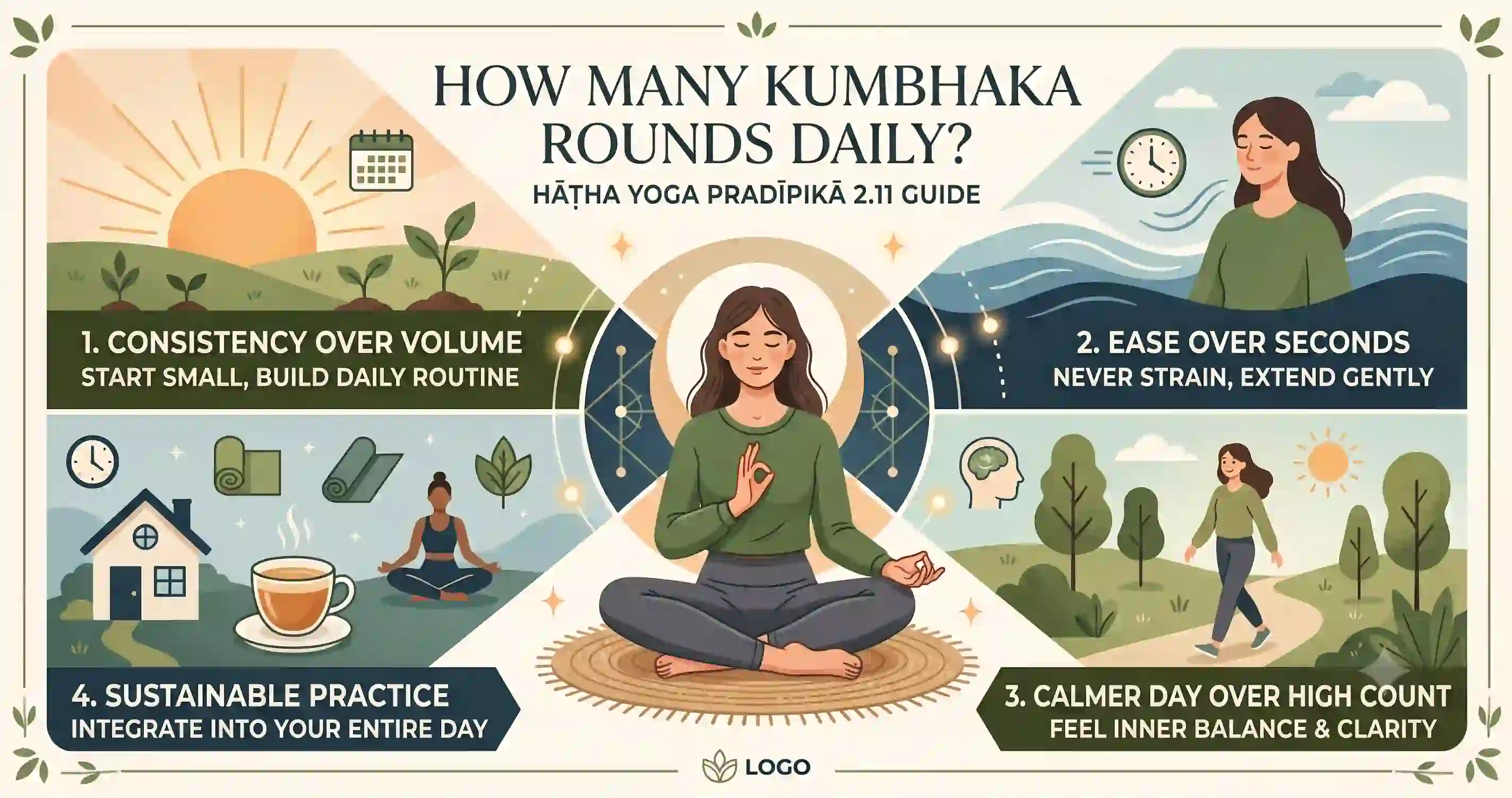
The safest summary: Consistency matters more than volume; ease matters more than seconds; and a calmer day matters more than an impressive count.
By Kumbhaki Yogi Dhruvaji (MSc), founder of the Antistress Foundation 501(c)(3)
• How to Practice Ten-Step Kumbhak • Scientific Proof • Ancient Texts Proof • Bio • Subscribe By Email
There is a moment when enthusiasm becomes dangerous.
A beginner reads “eighty Kumbhaks,” feels inspired by an ancient promise and wonders whether one cautious round is a sign of weakness. The mind begins counting before the body has learned trust.
But the most important word in Haṭha Yoga Pradīpikā 2.11 is not eighty. It is śanaiḥ—gradually.
For the Ten-Step Kumbhak for Stress Relief, a practical starting recommendation is:
Begin with one complete round in the morning, at noon and in the evening—or with one round only once or twice a day if that is more realistic. Remain there until every retention is completely easy. Increase one step at a time: first to two rounds, then three; later to four, then five, only if comfort and stress relief remain intact.
One round may be enough. Three may be enough. Five may be enough. Eighty is a classical high-volume horizon in one interpretation of a different prāṇāyāma sequence; it is not a beginner prescription, a health requirement or an evidence-based target for the Ten-Step method.
This article explains why.
It does not repeat the Ten Steps. Learn the complete method, including its three normal recovery breaths, in How to Practice the Ten-Step Kumbhak for Stress Relief.
The Practical Recommendation Comes First 🌿
Start with the smallest complete dose
A beginner has several sound options:
- Three-session beginning: one round in the morning, one at noon and one in the evening.
- Two-session beginning: one round in the morning and one in the evening.
- One-session beginning: one round in the morning.
- Stress-timed beginning: one round at the most reliably stressful transition in the day, provided the setting is safe.
The three-session option most closely preserves the accessible daytime rhythm of the classical verse. The one- or two-session options are often easier to sustain. A modest practice that actually happens is more valuable than an ambitious schedule that produces strain, guilt or abandonment.
Do not perform missed rounds later as a “debt.” Kumbhak is not a punishment ledger.
One Ten-Step round already contains two retentions
The counting unit matters.
One complete Ten-Step round contains:
- one Antar Kumbhak, after Pūrak; and
- one Bāhya Kumbhak, after Rechak.
Therefore:
- one Ten-Step round contains two Kumbhaks;
- three Ten-Step rounds contain six Kumbhaks; and
- five Ten-Step rounds contain ten Kumbhaks.
This is one reason the number in Haṭha Yoga Pradīpikā 2.11 cannot simply be relabelled as “eighty Ten-Step rounds.” The verse follows a classical alternate-nostril sequence in 2.7–2.10 in which a counted Kumbhak is not identical to the modern Ten-Step round.2
If someone called eighty Ten-Step rounds “the instruction of verse 2.11,” the person would silently change the practice unit and turn eighty retentions into 160. That is not faithful translation; it is dangerous arithmetic.
The milestones are one, three and five—but the increases are one at a time
“Increase to three rounds, then five rounds” should not mean jumping from one to three or from three to five overnight.
A safer progression is:
1 → 2 → 3 → 4 → 5
Three and five are useful milestones, not jumps.
At every level, the existing number should feel ordinary before another round is added. If two rounds still feel like a performance, the body is not asking for three.
A conservative progression you can adapt
The following is a cautious example, not a research-validated medical prescription:
Foundation period
- Practise one round at each chosen session.
- Keep this level for at least one to two weeks of comfortable practice.
- If sessions are irregular, remain at one round longer rather than increasing.
First volume increase
- Add one round to only one session.
- For example: two in the morning, one at noon and one in the evening.
- Keep all other sessions unchanged.
Equalisation
- If the new amount remains completely easy for at least another week, bring a second session to two rounds.
- Later, bring the third session to two rounds.
Three-round milestone
- Move one session at a time from two to three.
- Do not increase the duration of either retention at the same time.
Four- and five-round milestones
- Add only one round to one session at a time.
- Stay longer at each level as the total daily volume grows.
- Stop increasing when the present dose already supports the intended stress relief.
Beyond five
- There is no stress-relief obligation to go farther.
- Higher-volume practice belongs to experienced practitioners whose technique, recovery and health context have been assessed.
- Anyone treating eighty as a personal target should study with a qualified teacher and obtain appropriate clinical guidance when health risks are present.
The American Heart Association advises people trying structured breathing for the first time not to exceed three to five cycles at once, to stop if dizziness or light-headedness occurs, and to consult a healthcare professional when heart or lung conditions are present.7
Increase frequency or volume—not both together
There are two different ways to add practice:
- frequency: adding another time of day; or
- volume: adding another round within an existing session.
Changing both together makes it difficult to know why a headache, fatigue, agitation or benefit appeared.
A clear personal experiment changes only one variable. For example:
- one morning round becomes one morning round plus one evening round; or
- one morning round becomes two morning rounds.
It does not become three rounds, three times a day, with longer retentions, all in the same week.
Use readiness signs, not excitement, to decide
Consider one additional round only when all of these are true:
- every current Antar Kumbhak and Bāhya Kumbhak ends with clear reserve;
- there is no urge to breathe, strain or internal bargaining;
- the first breath after each retention remains normal rather than becoming a gasp;
- the face, jaw, throat, chest, shoulders, abdomen and legs remain relaxed;
- the three normal recovery breaths feel sufficient;
- there is no dizziness, pressure, trembling, unusual sweating, tingling, panic or headache;
- there is no delayed fatigue, agitation or sleep disruption;
- the practice is helping the intended outcome rather than feeding competition; and
- the present level has remained comfortable across different days, not only on one unusually good day.
If even one condition is missing, remain at the current level or reduce it.
A sapling is not persuaded to become a tree by pulling on its branches. It grows because its roots are left undisturbed.
Haṭha Yoga Pradīpikā 2.11: The Verse, the Words and the Counting Question 📜
Verified Sanskrit and transliteration
प्रातर्मध्यन्दिने सायमर्धरात्रे च कुम्भकान् ।
शनैरशीतिपर्यन्तं चतुर्वारं समभ्यसेत् ॥ २.११ ॥prātar madhyandine sāyam ardharātre ca kumbhakān |
śanair aśītiparyantaṃ caturvāraṃ samabhyaset || 2.11 ||
This reading is found in widely circulated editions of the Haṭha Yoga Pradīpikā and in the Sanskrit edition hosted by the Indira Gandhi National Centre for the Arts.1
A close rendering is:
One should practise Kumbhaks in the morning, at midday, in the evening and at midnight, four times, gradually up to eighty.
The sentence is compact. Its final half allows more than one way of grouping the number.
What each important word contributes
Prātar — morning or dawn.
Madhyandine — in the middle of the day, at noon.
Sāyam — evening, commonly associated with the sunset transition.
Ardharātre — in the middle of the night, midnight.
Kumbhakān — breath retentions.
Śanaiḥ — gradually, by degrees, without haste.
Aśīti-paryantam — up to eighty.
Caturvāram — four times.
Samabhyaset — one should practise thoroughly or repeatedly.
The grammar names four daily periods and a gradual numerical horizon. It does not say that a first-time practitioner should begin at eighty. It does not say that distress proves progress. It does not identify a modern therapeutic protocol called the Ten-Step Kumbhak.
Does the verse mean 80 at each session or 80 in the whole day?
Two responsible readings must be acknowledged.
The familiar Jyotsnā commentarial reading: 80 per session
Brahmānanda’s Jyotsnā commentary understands the verse as eighty prāṇāyāmas at each of four times. On that reading:
- 80 in the morning;
- 80 at noon;
- 80 in the evening;
- 80 at midnight;
- 320 in the full day and night.
This is the source of the familiar “80 each time, 320 daily” explanation.3
The modern critical-edition reading: 20 per session, 80 total
The scholarly Haṭhapradīpikā Online critical edition compares the verse with its older parallel in the Dattātreyayogaśāstra. The editors conclude that the inherited line is ambiguous by itself, but the parallel indicates twenty retentions at each of four sessions—eighty in total. Their translation accordingly supplies “twenty” in brackets.2
This is not a trivial footnote. It changes the daily total fourfold.
The honest conclusion is:
The 320 interpretation is genuinely traditional, but it is not the only textually defensible interpretation. A source-critical reading supports 80 total rather than 320.
Neither reading establishes an appropriate dose for the Ten-Step Kumbhak for Stress Relief. Both describe an intensive classical curriculum embedded in a different method and setting.
Why “up to” matters as much as “eighty”
Paryantam establishes an upper boundary or destination. It does not make the boundary compulsory for every practitioner.
A road sign reading “mountain pass: 80 kilometres” does not order a tired walker to cover the distance today. It tells the walker where that road may lead.
The verse itself adds śanaiḥ. The number is governed by gradualness. If the count increases while comfort, steadiness or safety decreases, the practitioner has obeyed the noun and disobeyed the adverb.
The surrounding verses make haste indefensible
The famous numerical line should never be separated from its own safety context:
- Haṭha Yoga Pradīpikā 2.15 compares the breath to a lion, elephant or tiger that is brought under discipline gradually; otherwise it can destroy the practitioner.
- Verse 2.16 says that properly applied prāṇāyāma is beneficial within its traditional frame, while improper practice gives rise to disorders.
- Verse 2.18 repeatedly uses yuktam—appropriately, suitably or in a measured way—for releasing, filling and restraining the breath.2
- Patañjali’s Yoga Sūtra 2.50 describes prāṇāyāma as observed or regulated through place, time and number, becoming extended and subtle. The ideal word is subtle, not violent.4
Classical authority therefore cannot be used honestly to defend a hurried leap to high volume. The same textual tradition that preserves large numbers repeatedly subordinates them to proportion, preparation and disciplined progression.
A related classical text explicitly permits fewer daily sessions
The Gheraṇḍa Saṃhitā 5.93–5.94 discusses a different and advanced practice, Kevala Kumbhak. It offers several frequencies and then states that one may instead practise at three daily junctures: morning, noon and evening.5
This does not turn Kevala Kumbhak into the Ten-Step method. It does show something important about the wider tradition: serious practice was not always expressed through one inflexible daily timetable.
Modern practitioners are therefore not betraying Yoga when they omit midnight, choose two sustainable sessions or begin once a day.
Four, Three, Two or One Daily Practice Times? Choose the Schedule You Can Live With 🕰️
Option A: Four times—classical full-day rhythm
Times
- morning or dawn;
- midday;
- evening or the sunset transition; and
- midnight.
Best suited to
- an experienced practitioner already established in the method;
- someone with an unusual contemplative schedule;
- a person who is naturally awake at midnight without sacrificing sleep; or
- a closely guided traditional training context.
Important boundary
Do not set an alarm to break healthy sleep merely to satisfy the literal fourth time. For stress relief, restorative sleep usually has greater value than an additional retention session. Midnight practice is optional, not a badge of seriousness.
If midnight practice produces alertness, anxiety, reflux, dizziness or difficulty returning to sleep, remove it.
Option B: Three times—morning, noon and evening
This is the most natural modern adaptation of verse 2.11:
- one round in the morning;
- one round around noon; and
- one round in the evening.
It preserves three daylight checkpoints and skips the session most likely to interfere with sleep. It also echoes the three-session alternative named in the Gheraṇḍa Saṃhitā, although that passage concerns Kevala Kumbhak rather than this method.5
This schedule is especially useful for stress relief because it does not wait for tension to become unbearable:
- morning establishes the first pause;
- noon interrupts accumulation;
- evening prevents the whole day from entering the night unchanged.
Option C: Two times—the morning and evening bookends
Default choice: morning and evening.
This pairing is practical because it frames the active day:
- the morning session comes before demands gather momentum;
- the evening session marks the return from activity toward rest, family life or quiet.
If morning plus evening is impossible, use one of these alternatives:
Morning plus noon
- suitable when evenings are crowded or an evening session feels activating;
- useful for workday stress regulation;
- avoid practising on a full stomach.
Noon plus evening
- suitable for late chronotypes or workers whose mornings are rushed;
- keep the evening practice far enough from a substantial meal to remain comfortable.
After waking plus before the main sleep period
- suitable for shift workers;
- anchor the practice to the person’s biological day rather than forcing conventional clock times.
Two sessions should be separated. Doing both back-to-back is simply a longer single session; it does not recreate the distributed rhythm of morning and evening.
Option D: One time—the morning default
If only one daily practice is realistic, morning is the default recommendation.
Reasons include:
- it is less likely to be displaced by later demands;
- the stomach is often more comfortable;
- it establishes the skill before the day’s stressors;
- it aligns with the morning emphasis of both verse 2.11 and Ayurvedic dinacaryā; and
- it allows any unexpected activation to resolve during waking hours.
Ayurveda’s Aṣṭāṅga Hṛdaya opens its daily-regimen chapter by recommending waking during brāhma muhūrta with attention to health.6 That is not a classical prescription for the Ten-Step Kumbhak, but it helps explain the long-standing value placed on deliberate morning practice.
If morning consistently fails, choose:
Evening
- when the primary need is the work-to-home transition;
- when it leaves the person quieter rather than more alert;
- before a meal or after digestion feels comfortable.
Noon
- when the main problem is midday overload;
- before lunch or after the stomach has settled;
- in a private, safe seated setting.
The most reliable safe window
- for caregivers, travellers and people with variable schedules;
- consistency can be attached to a stable event, such as after washing in the morning or before closing the workday.
One round once daily is a complete practice. It is not a failed version of four sessions.
Option E: A minimum-day and full-day plan
Some lives are unpredictable. A two-level plan prevents “all or nothing” thinking.
Minimum day
- one round at the safest reliable time.
Full day
- one round in the morning, at noon and in the evening.
The minimum keeps the relationship with the practice alive. The full plan is used when the day has space. There is no catch-up volume and no self-criticism.
Option F: A situational stress-relief plan
A person may keep one scheduled session and add an occasional session before a predictable stressor:
- before a difficult conversation;
- before entering a demanding workplace;
- after arriving home, before speaking from accumulated tension;
- before a quiet task requiring settled attention.
Do not perform retention during the stressful activity itself, while standing in an unsafe place or while attention is needed elsewhere. Sit safely first.
This is a personal regulation strategy, not proof that every stressful state is suitable for Kumbhak. Acute panic, chest pain, severe breathlessness or a medical emergency requires appropriate care rather than retention.
Option G: Shift work, travel and changing seasons
The solar language of verse 2.11 does not map neatly onto every modern life.
For shift workers, use functional equivalents:
- morning becomes shortly after the main waking time;
- noon becomes the midpoint of the active period;
- evening becomes the transition toward the main sleep period;
- midnight is omitted unless naturally awake and experienced.
During travel, illness recovery or major sleep disruption, reduce volume. Do not use extra rounds to force the body back into a time zone.
Why Morning, Noon, Evening and Midnight? Four Complementary Explanations 🌅
1. The yogic explanation: practice at the junctions
Traditional Indian disciplines often value sandhyā—a junction between phases.
Dawn is the meeting of night and day. Noon is the turning point of the sun’s visible course. Evening is the meeting of day and night. Midnight divides the night.
A junction has symbolic and practical power. The previous phase is loosening, and the next has not fully taken command. For a yogin, this can make habitual identity feel less solid: not yet worker, not yet sleeper, not quite yesterday, not quite tomorrow.
Brahmānanda’s commentary gives specific traditional windows for the four periods and understands morning and evening in relation to the dawn and sunset transitions.3
This is an authentic yogic timing framework. Claims that special “cosmic energy” at these moments has been measured as the cause of better Kumbhak outcomes have not been scientifically established.
2. The stress-relief explanation: four chances to interrupt accumulation
Stress often arrives not as one catastrophe but as residue.
One unanswered message tightens the jaw. A hurried meal adds pressure. A difficult meeting stays in the chest. By evening, the person is reacting not only to the present room but to every room carried into it.
Four spaced pauses can prevent the day from becoming one uninterrupted stress response:
- morning: notice the starting state;
- noon: release the first half of the day;
- evening: avoid carrying work activation into relationships and rest;
- midnight: in advanced contemplative life, examine what remains when outer activity is absent.
The practical value is spacing, not numerical magic.
3. The scientific explanation: physiology changes across the day
Human physiology is circadian. The brain’s central clock coordinates hormonal, autonomic, cardiovascular, metabolic and temperature rhythms. Cardiovascular responsiveness to stressors also varies by circadian phase.9
Cortisol secretion is concentrated around morning awakening, with a characteristic rise across roughly the first 30–45 minutes in many healthy people.10 This awakening response is adaptive; the purpose of morning Kumbhak is not to “eliminate cortisol.” A more modest interpretation is that a brief, chosen pause may help a person meet morning activation with attention rather than immediate reactivity.
By noon and evening, the internal context has changed: food intake, work exposure, fatigue, light and social demands have changed with it. Repeating a modest practice at separated times may therefore train access to the skill in more than one physiological and emotional state.
However:
No clinical trial has shown that four Ten-Step Kumbhak sessions at these exact four times are superior to one, two or three sessions for stress relief.
Chronobiology makes the schedule plausible as a rhythm. It does not validate 4, 80 or 320 as a therapeutic dose.
4. The behavioural explanation: a ritual is easier to remember at a transition
A practice attached to a stable cue is easier to repeat:
- after waking;
- before the midday meal;
- at sunset or after work;
- before a planned night vigil.
The four periods transform “I will practise sometime” into visible appointments.
Yet adherence is not obedience at any cost. If the schedule creates anxiety, the method has begun to serve the calendar instead of the person.
Why midnight made sense traditionally—and why most people may skip it
Traditional advantages of midnight include:
- quiet surroundings;
- fewer duties and interruptions;
- symbolic balance between day and night;
- suitability for a practitioner whose life is organised around intensive sādhanā.
Modern disadvantages include:
- fragmented sleep;
- reduced alertness and greater fall risk;
- difficulty returning to sleep;
- pressure to use an alarm;
- practising while physically depleted.
Sleep and circadian regularity are independently important to health, and irregular sleep timing is associated with adverse health patterns.11 For an ordinary stress-relief routine, do not wake solely to add the midnight session.
If you awaken unintentionally at midnight, Kumbhak is still not automatically the right response. If you are drowsy, panicky, breathless, unwell or likely to fall asleep while seated, return to normal breathing and prioritise safe rest.
What “Breath-Holding Capacity” Really Means Scientifically 🫁
It is not simply the size or strength of the lungs
Comfortable retention time depends on many interacting factors:
- starting lung volume;
- oxygen stored in the lungs, blood and tissues;
- the rate at which the body uses oxygen;
- carbon-dioxide accumulation;
- central and peripheral chemoreflexes;
- familiarity with internal sensations;
- unnecessary muscular effort;
- posture;
- anxiety and expectation;
- sleep, illness, temperature and altitude; and
- prior over-breathing, which can dangerously delay the urge to breathe.
Practice can increase timed breath-hold performance without proving that the lungs enlarged or that health improved. In one two-week study, novices increased maximal breath-hold time substantially without a significant change in carbon-dioxide chemosensitivity.12 A separate six-week trial increased hold time but did not improve altitude illness, oxygen saturation, anxiety or sleep at altitude.13
The scientifically better phrase is therefore:
As comfortable whole-system tolerance and skill develop, an easy retention may naturally become longer.
Even that improvement does not require more rounds.
Carbon dioxide usually creates the first strong boundary
During a closed-airway retention, metabolism continues:
- oxygen is consumed;
- carbon dioxide accumulates;
- the urge to breathe develops;
- cardiovascular and autonomic responses change.
If retention continues, the chemoreflex challenge becomes stronger. Near a maximal breakpoint, sympathetic nerve activity and blood pressure can rise markedly.14
For stress relief, the useful lesson is not “defeat the urge.” It is “end with reserve before the alarm becomes dominant.”
The hold itself is not always a parasympathetic event
Breathing practices are often described as if every phase simply turns on “rest and digest.” Direct physiology is more complex.
In a study of three one-minute Kumbhak attempts in healthy participants, systolic, diastolic and mean arterial pressure and total peripheral resistance increased during retention, while stroke volume and cardiac output fell.15
This does not prove that brief, comfortable Ten-Step practice is harmful. It shows why:
- long holds should not be used as self-treatment for high blood pressure;
- more rounds are not automatically more calming;
- measurements during the hold can differ from the state after the session; and
- health conditions matter.
Recovery is part of the dose
The Ten-Step method includes three normal breaths after each complete round. They are not decorative.
Recovery:
- re-establishes ventilation;
- gives the practitioner time to detect dizziness, panic or strain;
- separates one exposure from the next;
- prevents the count from becoming a breathless chain; and
- asks a vital question: “Did the body actually return to ease?”
If three normal recovery breaths do not restore complete comfort, do not begin another round.
Repetition can accumulate stress when each round is too intense
A person may assume that ending every retention before blackout makes repeated maximal work safe. Research does not support that assumption. A 2025 study of three maximal breath holds in non-divers found progressively greater cerebral deoxygenation and lower cerebral oxygenation at the end of later attempts, despite two-minute recovery intervals.16
That exposure differs greatly from short, submaximal Kumbhak. Its lesson is nevertheless relevant: repetition can accumulate physiological load.
The safety of the series depends on the intensity of each member.
What Science Can—and Cannot—Say About Kumbhak for Stress Relief 🔬
The encouraging evidence
Several human studies make Kumbhak relevant to stress research:
Eight-week retention-containing practice
A randomised trial in 116 young adult yoga practitioners compared usual yoga with usual yoga plus 20 minutes of breathing with intermittent retention. The added-practice group reported greater improvement in mindfulness, mind wandering and anxiety-related outcomes.17
Twelve-week alternate-nostril practice containing retention
In 100 healthy young men, a structured alternate-nostril routine using equal phases of Pūrak, Kumbhak and Rechak reduced perceived-stress scores more than control.18
Five minutes of daily breathing
In a randomised trial, mindfulness and three structured breathing methods—including box breathing and hyperventilation with retention—improved daily mood or anxiety measures. The clearest average pattern favoured an exhalation-emphasised method that did not depend on extended retention.19
These studies support a careful statement:
Regular structured breathing that may include Kumbhak can help some people with stress-related outcomes.
The decisive limitation: most studies do not isolate the hold
When a method contains:
- a breathing rhythm;
- nasal breathing;
- attention;
- expectations;
- instructor contact;
- daily quiet time; and
- Kumbhak,
an improvement cannot automatically be assigned to Kumbhak alone.
The Ten-Step method has not yet been tested in a large randomised trial that compares the identical Pūrak, Rechak, posture, chest-centre attention, Dhyāna mudra and recovery sequence with and without the two retentions.
This does not make personal benefit unreal. It limits what can be claimed about cause.
More retention has not been shown to produce more stress relief
The available research does not establish a linear dose-response rule in which:
more seconds × more rounds × more sessions = more calm
A well-controlled trial of 200 healthy adults found that a hyperventilation-and-long-retention method was not superior to a credible normal-rate breathing comparison with brief holds for reducing stress.20
The practical implication is liberating:
You do not have to reach an extreme dose before your practice counts.
What to measure instead of seconds
If the purpose is stress relief, track outcomes that belong to stress:
- How quickly do you recover after a difficult interaction?
- Does the jaw unclench sooner?
- Are repetitive thoughts less sticky?
- Is there less impulsive speech?
- Does concentration return?
- Is sleep better, unchanged or worse?
- Does the practice remain voluntary?
- Are there any adverse symptoms?
A longer retention with more irritability is not progress toward stress relief.
Haṭha Yoga Pradīpikā 2.12: Sweat, Trembling and the Highest Stage 🕉️
Verified common reading
कनीयसि भवेत्स्वेदः कम्पो भवति मध्यमे ।
उत्तमे स्थानमाप्नोति ततो वायुं निबन्धयेत् ॥ २.१२ ॥kanīyasi bhavet svedaḥ kampo bhavati madhyame |
uttame sthānam āpnoti tato vāyuṃ nibandhayet || 2.12 ||
A close rendering is:
At the lower degree, sweat arises; at the middle degree, trembling occurs; at the highest, it reaches the place. Therefore one should restrain the vital breath.
Brahmānanda’s Jyotsnā commentary identifies “the place” as the Brahmarandhra, the subtle “aperture of Brahman” at the crown, and treats the three signs as markers of lower, middle and highest prāṇāyāma.21
Three popular additions are not literally in the root verse
The verse itself does not explicitly say:
- that perspiration is caused by detoxification;
- that trembling proves Prāṇa has begun moving in Suṣumnā; or
- that its final words mean “complete steadiness of mind.”
Those may appear as later explanations, cross-textual interpretations or modern translations. They should not be placed inside quotation marks as though Svātmārāma’s Sanskrit says them directly.
The yogic connection to mind steadiness is real, but it is stated more directly elsewhere:
- Haṭha Yoga Pradīpikā 2.2 says that when the breath is moving, mind is moving; when it is still, mind becomes still.
- Verse 2.42 says that when the vital breath moves in the middle channel, steadiness of mind arises; it names this manonmanī, a state beyond ordinary mental activity.2
This distinction preserves rather than diminishes the tradition.
A manuscript warning: verse 2.12 also has variant readings
The modern critical edition adopts a different second half:
uttiṣṭhaty uttame prāṇarodhe padmāsane muhuḥ
Its sense is that, in the highest retention, the practitioner repeatedly rises in Padmāsana. Other received editions preserve sthānam āpnoti, “reaches the place,” which Brahmānanda glosses as Brahmarandhra.2
The textual history therefore contains at least two high-stage images:
- Prāṇa reaching the Brahmarandhra; and
- the body repeatedly rising in Padmāsana.
Neither is a laboratory-verified mechanism of the Ten-Step Kumbhak for Stress Relief. Both belong to the extraordinary attainment language of Haṭha Yoga.
Stage one—Sveda: perspiration
Yogic meaning
In the traditional sequence, perspiration is a sign of the lower or initial degree of intensive prāṇāyāma. The following verse, 2.13, tells the practitioner to rub the exertion-born sweat into the limbs, reflecting a premodern yogic understanding of strengthening and refinement.1
Later practitioners may describe this as purification. That is an authentic traditional frame.
Scientific meaning
Sweat is primarily a thermoregulatory and autonomic response. It can reflect:
- environmental heat or humidity;
- muscular work;
- clothing;
- anxiety or sympathetic activation;
- fever, medication or illness;
- excessive respiratory effort.
A major physiology review concludes that elimination of waste products and toxicants through sweat is minor compared with processing and excretion through the liver, kidneys and gastrointestinal tract.22
Therefore, perspiration during Kumbhak is not scientific proof of “toxins leaving the body.”
Stress-relief meaning
In the Ten-Step method, unusual sweating is not a milestone to seek. A practice intended to reduce stress should not require the beginner to manufacture the physiology of exertion.
If sweating appears:
- stop the session;
- return to normal breathing;
- check heat, clothing, illness, anxiety and effort;
- resume on another occasion only when fully normal;
- seek medical guidance if the symptom is unexplained, recurrent or accompanied by chest pain, faintness or other concerning signs.
The emotional lesson is simple: the body does not have to look distressed to prove that stress is leaving it.
Stage two—Kampa: trembling or quivering
Yogic meaning
In the common reading, trembling marks the intermediate degree. Traditional commentaries understand this within a model in which Prāṇa is being gathered, purified and directed. Some modern teachers associate it with movement toward Suṣumnā.
That interpretation should be named as traditional. Trembling by itself cannot verify the state of a subtle channel.
Scientific meaning
Near demanding breath-hold breakpoints, carbon dioxide, oxygen, chemoreflex drive, sympathetic activity, blood pressure and muscular effort can change substantially. Over-breathing before retention can also disturb carbon-dioxide balance and contribute to light-headedness, tingling, muscular excitability or spasm.
Trembling may also have unrelated causes, including anxiety, cold, low blood glucose, medication effects or neurological conditions. A website cannot diagnose it from the fact that it occurred during practice.
Stress-relief meaning
For this method, trembling is a stop sign.
Do not:
- hold through it;
- add another round to “complete the set”;
- call it awakening;
- ask another person to tolerate it;
- resume until the body and breathing are entirely normal.
If it recurs, obtain appropriate assessment before further retention.
A storm does not become peaceful because the windows shake harder.
In stress relief, the purpose is to meet a manageable internal signal without panic. Once the practice produces involuntary shaking, the lesson may have changed from regulated exposure to renewed alarm.
Stage three—Sthāna, Brahmarandhra and steadiness
Yogic meaning
In the Jyotsnā reading, highest prāṇāyāma is known when Prāṇa reaches Brahmarandhra. Read alongside 2.42, this belongs to a larger Haṭha Yoga map:
- the nāḍīs become fit;
- Prāṇa enters or moves through Suṣumnā;
- ordinary mental movement settles;
- manonmanī or a mind-transcending steadiness becomes possible.
This is richer than ordinary relaxation. It points toward the contemplative aim of Haṭha Yoga, not merely a lower score on a stress questionnaire.
Scientific meaning
Modern science has not verified Brahmarandhra or measured Prāṇa moving through Suṣumnā as anatomical events.
Science can measure neighbouring phenomena:
- attention and response inhibition;
- anxiety and perceived stress;
- heart rate and blood pressure;
- carbon dioxide and oxygen;
- cerebral blood-flow velocity;
- autonomic and baroreflex changes.
Small trials suggest that retention-containing practices may improve some psychological measures, but they do not establish that the highest yogic stage has occurred or that Kumbhak alone caused the improvement.
Stress-relief meaning
For a modern stress-relief practitioner, the practical echo of “steadiness” is not a mystical performance. It may look like:
- noticing urgency without becoming its servant;
- remaining present without dissociation;
- ending the hold before strain;
- choosing a measured response after provocation;
- allowing normal breathing to return without disappointment;
- feeling no need to prove anything.
Complete steadiness is not breathless blankness. It is not numbness. It is not faintness mistaken for transcendence.
A father once paused before answering an angry message from his son. The message did not change. After one comfortable round, he could feel both hurt and love in the same chest. He replied without using either as a weapon.
That is not proof of Brahmarandhra. It is a human form of steadiness worth respecting.
How the three stages can be understood without confusion
The same words operate on three levels:
Traditional description
- sweat marks the lower degree;
- trembling marks the middle;
- highest practice culminates in an extraordinary yogic attainment.
Scientific caution
- sweat is not proof of detoxification;
- trembling is not proof of Suṣumnā;
- contemplative steadiness is not a validated biomarker.
Ten-Step stress-relief application
- do not seek sweat;
- stop at trembling;
- value ease, clarity and less reactivity.
The traditional map and the therapeutic safety rule can coexist because they answer different questions.
An Ayurvedic Reading of Timing, Repetition and Stress 🌿
Dinacaryā values rhythm
Ayurveda places great importance on dinacaryā, conduct organised across the day. Its morning recommendations reflect a broader conviction: health is supported when waking, cleansing, nourishment, work and rest occur in an intelligible rhythm.6
From this perspective, scheduled Kumbhak can become an anchor rather than another achievement:
- morning gives direction;
- noon restores proportion;
- evening marks release;
- night protects inwardness.
This is a traditional interpretive connection. Classical Ayurvedic texts do not provide clinical proof that four Ten-Step sessions outperform two.
Vāta language should not be disguised as modern neurology
Ayurveda may describe irregularity, agitation, excessive movement, instability and disturbed sleep through patterns involving Vāta. Yogic language may describe a disturbed relationship between Prāṇa and Manas.
It is tempting to translate both directly as “autonomic nervous-system dysregulation.” That is too simple.
- Vāta is a classical doṣic principle.
- Prāṇa is a subtle and vital category with meanings wider than respiratory gas.
- The autonomic nervous system is a biomedical network studied through anatomy and physiology.
They may illuminate some of the same lived experience, but they are not interchangeable objects.
The responsible bridge is experiential:
Regular, comfortable practice may reduce felt irregularity and help organise attention; Ayurveda and Yoga explain this through their own traditional systems, while science tests measurable physiological and psychological outcomes.
The Ayurvedic case for not forcing
From an Ayurvedic perspective, a practice that creates agitation, dryness, exhaustion, disturbed sleep, involuntary movement or fear would not be called balanced merely because its count was classical.
The appropriate response to an unstable pattern is not always more stimulation. Regularity, moderation, nourishment, sleep and individual constitution matter.
Anyone seeking a personalised doṣa-based interpretation should consult a properly trained Ayurvedic clinician. A generic online “doṣa clock” cannot decide a safe retention dose.
Food, digestion and the noon session
The classical Haṭha text begins its prāṇāyāma chapter by describing the practitioner as taking a suitable, moderate diet.1 Practically, retention on a full stomach can feel compressed or provoke discomfort and reflux in some people.
For a noon session:
- practise before lunch; or
- wait until the stomach feels comfortably settled after eating.
There is no universal waiting time for every meal, body or medical condition. A substantial meal generally requires more space than a light snack. People with reflux, digestive disease, pregnancy-related symptoms or post-surgical restrictions should follow individual clinical guidance.
When Kumbhak Is Not Recommended During the Day or Night ⚠️
Brief timing exclusions
Do not practise:
- immediately after a substantial meal or when reflux, nausea or abdominal pressure is present;
- while acutely ill, feverish, dehydrated or unusually exhausted;
- while intoxicated or affected by substances or medicines that impair alertness;
- immediately after intense exertion, before normal breathing and full stability have returned;
- during an acute asthma attack, severe breathlessness, chest pain or a medical emergency;
- during active panic or a suffocation-related flashback if retention intensifies it;
- when very drowsy or at risk of falling;
- after deliberate hyperventilation;
- in water, in a bath, while driving, walking in an unsafe place or operating machinery;
- anywhere a brief loss of awareness could cause injury.
At night, also avoid Kumbhak when:
- it requires sacrificing needed sleep;
- it repeatedly makes return to sleep difficult;
- nocturnal reflux or breathing symptoms are active;
- you have awakened confused, faint or medically unwell.
People who should obtain medical guidance first
Seek individual clinical advice before breath-retention practice if you are pregnant or have:
- uncontrolled high blood pressure;
- heart or cerebrovascular disease;
- significant lung disease;
- epilepsy or unexplained seizures;
- recurrent fainting;
- retinal or glaucoma concerns;
- recent surgery;
- a history of severe panic, PTSD or suffocation-related trauma;
- another condition for which breath holding may create risk.
This list is conservative because condition-specific research on the exact Ten-Step method is limited.
Stop signs during any round
Stop immediately and return to normal breathing if you experience:
- dizziness, light-headedness, faintness or greying vision;
- unusual sweating or trembling;
- strong air hunger or a gasp;
- chest pain, pressure, palpitations or severe headache;
- tingling, numbness, confusion or loss of coordination;
- panic, dissociation or a traumatic flashback;
- any symptom that feels wrong or alarming.
Do not resume until breathing and the entire body feel normal. Serious, persistent or unusual symptoms require appropriate medical care.
Cambridge University Hospitals advises reducing even a brief respiratory pause if it increases breathlessness or faintness.8 That principle is fully compatible with the Ten-Step requirement to end both retentions while they are still completely easy.
A Decision Guide for Every Practice Session ✅
Before the session
Ask:
- Am I medically stable today?
- Am I safely seated?
- Is my stomach comfortable?
- Am I alert?
- Am I free from alcohol, hyperventilation and competitive intent?
- Can I stop after one round without feeling that I failed?
If the last answer is no, the mind may already be turning practice into compulsion.
After each round
Ask:
- Did both retentions end with reserve?
- Did normal breathing return without a gasp?
- Are my face, jaw and shoulders still relaxed?
- Is my mind clearer, unchanged or more agitated?
- Do I genuinely want another round, or do I want a larger number?
Only the first kind of “want” deserves consideration—and even then, another round is optional.
At the end of the week
Review:
- chosen sessions completed;
- number of rounds per session;
- any adverse symptom;
- stress before and ten minutes after;
- sleep quality;
- ease of recovery;
- whether the practice helped daily behaviour.
Do not use maximum retention seconds as the main score.
When to progress, stay or reduce
Progress by one round in one session
- all current rounds have been completely easy for at least one to two weeks;
- no adverse effects occur;
- recovery is complete;
- stress-related benefit is present or the experiment remains useful.
Stay at the same level
- the practice helps;
- the current volume still requires attention;
- life is unusually demanding;
- there is no reason beyond curiosity to add more.
Reduce
- recovery takes longer;
- the next breath becomes larger or urgent;
- tension, headache, fatigue or sleep disturbance appears;
- practice creates dread or compulsive counting;
- illness, travel, altitude or medication changes alter tolerance.
Stop and seek guidance
- fainting, chest pain, neurological symptoms, recurrent trembling, severe breathlessness or persistent panic occurs.
Frequently Asked Questions 🙋
Does Haṭha Yoga Pradīpikā 2.11 command everyone to do 320 Kumbhaks daily?
No.
The 320 figure comes from Brahmānanda’s influential interpretation of the verse as eighty at each of four sessions. The modern critical edition, using the older Dattātreyayogaśāstra parallel, reads the intended schedule as twenty per session and eighty total.2
Both are advanced classical counts. Neither is a universal medical recommendation.
Should an advanced Ten-Step practitioner aim for 80 rounds in one sitting?
Not on the authority of this verse alone.
One Ten-Step round contains two Kumbhaks and a full recovery structure. It is not the same counted unit as the prāṇāyāma immediately preceding verse 2.11. Eighty Ten-Step rounds would mean 160 retentions.
There is no scientific evidence that this volume is necessary or optimal for stress relief.
How many rounds should a beginner do?
Begin with one complete round at each chosen time. That may mean:
- one round once daily;
- one round morning and evening; or
- one round morning, noon and evening.
Remain there until the practice is completely easy and stable.
How quickly should I reach three rounds?
There is no universal deadline.
A conservative example is to stay at one round for at least one to two comfortable weeks, add a second round to one session, stabilise again, and only later add a third. Irregular practice, stress, illness or adverse sensations are reasons to remain longer or reduce.
How quickly should I reach five rounds?
Only after three and four have each become ordinary, comfortable and fully recoverable. Add one round at a time to one session. Five is a possible milestone, not a requirement.
What if my comfortable retention time never increases?
Continue with brief, easy retentions or choose a no-retention breathing practice.
The goal is stress relief, not a personal record. A person may become more patient, less reactive and more attentive without adding a single second.
Must I practise four times daily to receive any benefit?
No evidence supports an all-or-nothing threshold. Modern breathing studies have reported psychological benefit from once-daily practice, while classical sources themselves preserve different schedules.195
Choose the frequency that remains safe and sustainable.
If I can practise three times, which times should I choose?
Morning, noon and evening. Skip midnight.
If I can practise twice, which times should I choose?
Morning and evening are the default. Morning plus noon or noon plus evening are reasonable alternatives when they fit the person’s life and comfort better.
If I can practise only once, which time should I choose?
Morning is the default. If morning is consistently unrealistic, choose evening or noon. The best one-time schedule is the safe time you can actually keep.
Should I wake at midnight to follow the verse?
Not for an ordinary stress-relief routine.
Do not sacrifice healthy sleep to add a fourth session. Midnight practice belongs to an advanced schedule for someone naturally awake and appropriately prepared.
Can I combine missed sessions into one longer practice?
No need. A missed session is missed; it does not create a debt.
Extra rounds concentrated later change the dose and defeat the purpose of spacing.
Does sweating mean toxins are leaving?
Not scientifically. Sweat mainly serves thermoregulation, and its role in eliminating waste and toxicants is minor compared with the liver, kidneys and gastrointestinal tract.22
In the Ten-Step stress-relief method, unusual sweating is a reason to stop and assess the situation.
Does trembling mean Prāṇa has entered Suṣumnā?
Some traditional interpretations connect intermediate signs with the movement and gathering of Prāṇa. Trembling alone cannot verify Suṣumnā scientifically or diagnose a yogic attainment.
For this method, stop if trembling occurs.
Does the third stage of verse 2.12 literally mean complete steadiness of mind?
Not literally in the common Sanskrit reading.
It says that, at the highest degree, it “reaches the place”; Brahmānanda identifies that place as Brahmarandhra. Mind steadiness is supported by related verses such as 2.2 and 2.42 and is a coherent yogic interpretation, but it should not be presented as a word-for-word translation of 2.12.
Is a calm feeling proof that the physiological dose was safe?
No. Subjective calm is useful information, but it cannot reveal blood pressure, oxygenation or individual medical risk. That is why the method still requires brief, submaximal retentions, complete reserve and appropriate health screening.
Can one round be a lifelong practice?
Yes.
If one round reliably creates a small clearing in the day without adverse effects, more is optional. A practice is not made profound by becoming large.
The Deeper Agreement Between the Text and the Body 🌌
Verse 2.11 offers a great number, but places gradually beside it.
Verse 2.12 describes powerful signs, but does not ask a stress-relief beginner to manufacture them.
Verse 2.15 warns that breath must be approached by degrees.
Verse 2.18 asks that filling, releasing and restraining remain appropriate.
Patañjali asks that place, time and number be observed until the practice becomes subtle.
The agreement among them is not “do more.” It is:
Let the dose become worthy of the person who is actually breathing.
Begin with one round. Choose one, two or three safe times. Skip midnight unless it truly belongs to your life. Pass through two before three, and four before five. Let comfortable capacity develop without pulling it forward. Never increase the number and the retention duration together. Never convert sweating or trembling into trophies.
If five rounds feel peaceful, you do not owe the text eighty.
If one round helps you return to your child, your work, your own mind or the person you love with less residue from the day, the practice has already entered life.
The deepest count is not how many times the breath became still.
It is how many times you did not allow stress to speak in your place.
Sources and Evidence Notes 📚
Evidence reviewed and links verified: 29 July 2026. This article is educational and does not replace individual medical care.
-
Svātmārāma, Haṭha Yoga Pradīpikā, chapter 2, Sanskrit text including 2.1, 2.11–2.20. Indira Gandhi National Centre for the Arts. Verified Sanskrit edition (PDF) ↩↩↩
-
Jason Birch, Ruth Westoby, Jacqueline Hargreaves and colleagues, Haṭhapradīpikā Online, critical edition, translation, philological notes and Jyotsnā commentary. See 2.11–2.18 and 2.42. The note on 2.11 explains the ambiguity and the twenty-per-session parallel in the Dattātreyayogaśāstra. Critical edition and commentary ↩↩↩↩↩↩
-
Brahmānanda, Jyotsnā commentary on Haṭha Yoga Pradīpikā 2.11, preserved in the critical-edition apparatus. It interprets the four periods and states that eighty prāṇāyāmas are to be performed at each time. Text and transliterated commentary ↩↩
-
Patañjali, Yoga Sūtra 2.50: bāhyābhyantarastambhavṛttir deśakālasaṅkhyābhiḥ paridṛṣṭo dīrghasūkṣmaḥ. Sanskrit, word meanings and translation ↩
-
Gheraṇḍa Saṃhitā 5.92–5.94, describing alternative frequencies for the distinct practice of Kevala Kumbhak, including morning, noon and evening. S. C. Vasu Sanskrit-English edition (PDF) ↩↩↩
-
Vāgbhaṭa, Aṣṭāṅga Hṛdaya, Sūtrasthāna 2.1, opening the daily-regimen chapter with waking in brāhma muhūrta while considering one’s health. Textual reference and definition ↩↩
-
American Heart Association, “Stress Management,” structured-breathing guidance: beginners should not exceed three to five cycles at first, should stop for dizziness or light-headedness and should consult a healthcare professional for heart or lung conditions. American Heart Association guidance ↩
-
Cambridge University Hospitals NHS Foundation Trust, “Breathing pattern disorders and physiotherapy.” It advises reducing a respiratory pause if breathlessness or faintness increases. NHS patient guidance ↩
-
Thosar, Butler and Shea. “Role of the circadian system in cardiovascular disease.” Journal of Clinical Investigation (2018). Full-text review ↩
-
Stalder et al. “The Cortisol Awakening Response: Regulation and Functional Significance.” Endocrine Reviews (2024). DOI: 10.1210/endrev/bnae024. Endocrine Society abstract ↩
-
Irish et al. “The role of sleep hygiene in promoting public health: A review of empirical evidence.” Sleep Medicine Reviews (2015). Full text ↩
-
Bourdas et al. “Repeated Apneas and Hypercapnic Ventilatory Response Before and After Apnea Training.” Fourteen days of training improved breath-hold duration without a significant change in carbon-dioxide chemosensitivity. PubMed record ↩
-
Shah et al. “The Effects of Apnea Training, Using Voluntary Breath Holds, on High Altitude Acclimation: Breathe-High Altitude Study.” Six weeks of training improved hold duration without significant improvement in the tested high-altitude outcomes. PubMed record ↩
-
Steinback et al. “Sympathetic Neural Activation: An Ordered Affair.” Prolonged breath holding increased sympathetic burst size, mean arterial pressure and total peripheral resistance in trained free divers. Full text ↩
-
Nivethitha, Mooventhan and Manjunath. “Evaluation of Cardiovascular Functions during the Practice of Different Types of Yogic Breathing Techniques.” The Kumbhak component produced acute pressure, resistance and cardiac-output changes during one-minute retention attempts in 20 healthy participants. Full text ↩
-
Elia et al. “Systemic and Regional Hemodynamic and (De)oxygenation Responses Across Repeated Breath-Holds” (2025). Fifteen non-divers performed three maximal holds separated by two-minute rests. Cerebral deoxygenated haemoglobin rose across the attempts; later holds ended at progressively lower cerebral oxygenated-haemoglobin levels and cerebral tissue oxygen index. This was not a Ten-Step Kumbhak trial. PubMed record ↩
-
Saoji et al. Randomised eight-week trial of intermittent breath holding in 116 young adult yoga practitioners, reporting changes in mindfulness, mind wandering and anxiety-related measures. PubMed record ↩
-
Sharma et al. Randomised study of a modified alternate-nostril breathing protocol containing retention in 100 healthy young men. Full text ↩
-
Balban et al. “Brief structured respiration practices enhance mood and reduce physiological arousal.” Cell Reports Medicine (2023). Full text ↩↩
-
Fincham et al. Single-blind randomised placebo-controlled trial in 200 healthy adults, finding no specific stress-reduction advantage for cyclic hyperventilation with extended retention over an active breathing comparator. Full text ↩
-
Brahmānanda, Jyotsnā commentary on Haṭha Yoga Pradīpikā 2.12, glossing sthānam as Brahmarandhra and describing the lower, middle and highest degrees. Commentary text ↩
-
Baker. “Physiology of sweat gland function: The roles of sweating and sweat composition in human health.” Temperature (2019). The review concludes that waste and toxicant removal through sweat is minor compared with liver, kidney and gastrointestinal pathways. Full text ↩↩