Chair, back-support and hand adaptations for Ten-Step Kumbhak when arthritis, pain, disability, larger bodies or limited mobility make floor sitting difficult.
By Kumbhaki Yogi Dhruvaji (MSc), founder of the Antistress Foundation 501(c)(3)
• How to Practice Ten-Step Kumbhak • Scientific Proof • Ancient Texts Proof • Bio • Subscribe By Email
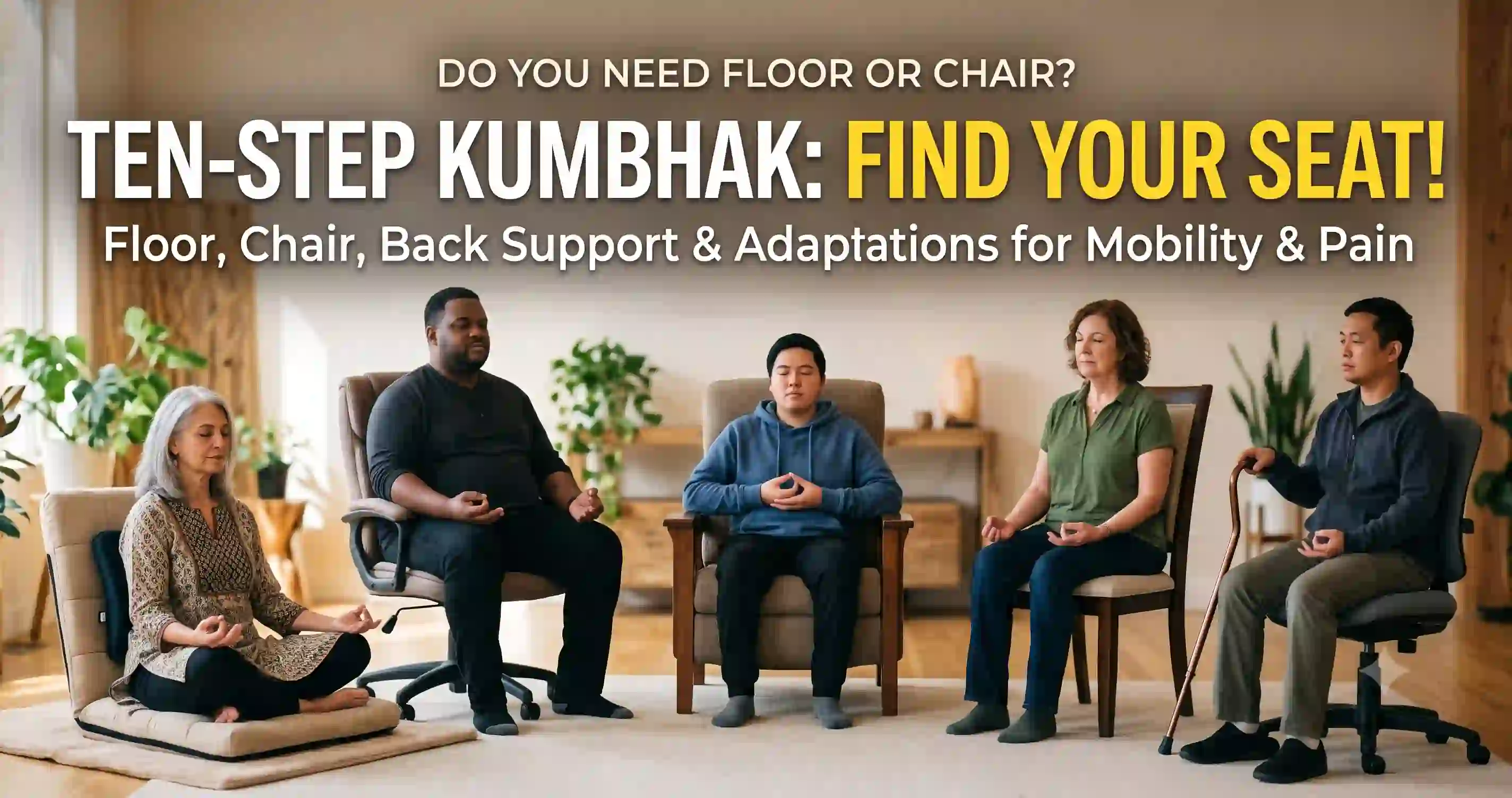
If getting onto the floor hurts, getting up feels unsafe, a backrest prevents fatigue, or your hands cannot form Bhairavī Dhyāna Mudra, you have not failed before the practice has even begun.
You may practise the Ten-Step Kumbhak on a stable chair. You may use a backrest, wheelchair seating, cushions, foot support and a pain-free hand adaptation. Floor sitting is an option, not an entrance examination. Bhairavī Dhyāna Mudra remains the recommended standard when it is comfortable, but its exact shape should never be forced through arthritis, injury, tremor, spasticity, neuropathy, limb difference or pain.
The unchanging priorities are simpler:
- your seat is safe and stable;
- your back is naturally and comfortably upright without becoming stiff;
- your chest centre has room to lift and lower;
- your face, jaw, throat, chest, shoulders, abdomen and legs are not bracing;
- your hands and arms are supported rather than suspended;
- normal Pūrak and normal Rechak remain unforced;
- and both Kumbhak pauses end with unmistakable reserve.
Important: “1–3 seconds in reserve” is not a minimum breath-hold time. End each hold while it still feels completely easy and while you remain certain you could comfortably continue for at least another 1–3 seconds. Your actual hold may be shorter than three seconds. If that reserve is not clearly available, breathe immediately. If you cannot retain the breath comfortably at all, use another breathing practice.
This article explains positioning and adaptations only. It deliberately does not repeat the ten steps. Learn the exact sequence and safeguards from How to Practice the Ten-Step Kumbhak for Stress Relief.1
The Short Answer: What Is Essential and What Can Change? 🧭
The Ten-Step Kumbhak has a functional centre and an adaptable outer form.
Keep these functions:
- Safe sitting.
- Stable support beneath the pelvis.
- The most naturally upright back available to you.
- Space for the centre of the chest to move without the whole spine arching or collapsing.
- No avoidable pain, gripping or postural struggle.
- A hand position that allows the shoulders and arms to rest.
- Completely easy retention with at least 1–3 seconds of certain reserve.
Adapt these forms when necessary:
- Floor, cushion, chair or wheelchair.
- Feet flat, on footplates, on blocks or in another clinically recommended position.
- No backrest, a standard backrest, lumbar support, lateral support or prescribed seating.
- Exact Bhairavī Dhyāna Mudra, supported Bhairavī Dhyāna Mudra without thumb contact, separated hands or one supported hand.
- Symmetrical appearance.
The practice is not improved by preserving a photograph while losing comfort, safety or attention.
Imagine a 72-year-old practitioner named Leela. She can lower herself to a mat, but the descent frightens her knee and the return to standing requires someone to pull her up. By the time she finally sits cross-legged, her jaw is tight and her breathing is guarded. A chair does not make her Kumbhak less authentic. It removes a problem that has nothing to do with the purpose of the pause.
A Five-Part Rule for Every Adaptation 🖐️
Before judging any chair, cushion, backrest or hand variation, ask what it does to five things.
1. Safety
Can you enter and leave the position without a fall, sudden twist or exhausting transfer? Does the chair remain still? Are prescribed wheelchair supports being used as intended?
If the floor creates a transfer risk, choose the chair before discomfort becomes fear.
2. Support
Do the seat, feet, back and hands receive enough support that you are not holding yourself up through continuous effort?
Support is doing its job when it reduces work without folding the chest.
3. Breathing Room
Can the centre of the chest lift during normal Pūrak and lower during normal Rechak without the abdomen being squeezed, the shoulders rising or the back rocking?
More “upright” is not always better. The useful position is the one that creates room without creating stiffness.
4. Attention
Can your attention remain mainly at the centre of the chest, or is it repeatedly pulled toward knee pain, thumb pressure, numb feet, back fatigue or fear of losing balance?
An adaptation succeeds when the posture becomes quiet enough to stop asking for attention.
5. Reserve
Does the supported position make it easier to recognise the completely easy boundary of Antar Kumbhak and Bāhya Kumbhak?
A chair cannot make an excessive hold safe. A perfectly shaped Mudra cannot turn strain into relaxation. End the hold before the urge to breathe, with at least 1–3 seconds of certain reserve.
Floor Sitting: Optional, Not Superior by Default 🪷
Floor sitting can be comfortable, stable and meaningful for people whose hips, knees, ankles and back accept it. It can also become an unnecessary source of pain or instability.
Choose the Floor Only When the Whole Experience Works
Floor sitting is suitable when:
- you can get down and rise again safely;
- the hips and knees are not forced;
- the ankles and feet remain comfortable;
- numbness, pins and needles or joint pressure do not develop;
- the back can remain naturally upright without muscular struggle;
- and attention is not consumed by the position.
A cushion may raise the pelvis and make floor sitting easier. It may also feel unstable for someone with impaired balance. The body—not the prestige of the pose—decides.
Do Not Use Kumbhak as a Floor-Transfer Test
The ability to sit down on the floor and rise again can reflect mobility, strength and balance. Those are valuable capacities, but they are not the outcome being tested during Kumbhak for stress relief.
If you want to improve floor transfers, work on that separately with an appropriate physiotherapist, occupational therapist or exercise professional. Do not make the breath-retention session carry two jobs at once.
Cross-Legged Is Not the Definition of “Yogic”
Ancient sources describe several seats because practitioners and lineages used more than one bodily arrangement. Modern accessible practice continues that practical intelligence. A chair changes the equipment beneath the body; it does not remove attention, restraint, ease or the inner experience of Kumbhak.
How to Set Up a Chair for Ten-Step Kumbhak 🪑
The best chair is not the hardest, lowest or most austere one. It is the one that remains stable and fits the practitioner.
Start With the Chair Itself
Choose a chair that:
- does not rock, slide or swivel unexpectedly;
- can safely support your body;
- is wide enough that the hips and thighs are not compressed by the sides or armrests;
- allows you to sit without the front edge cutting into the backs of the thighs;
- and provides the level of back or arm support you actually need.
If a portable or folding chair is used, confirm that it is fully opened, locked and within its stated load capacity. A wheeled chair is not the first choice unless it can be made reliably stationary. A person already using a fitted wheelchair will usually be safer remaining in that wheelchair than transferring to an unfamiliar chair merely to look conventional.
Give the Feet a Real Landing Place
Feet may rest:
- on the floor;
- on stable footplates;
- on a non-slip footstool;
- or on firm blocks of equal or individually appropriate height.
Do not force the feet to reach the floor. Dangling feet can increase effort in the thighs and lower back. Equally, do not force painful knees, ankles or replaced joints into a textbook 90-degree angle. Use the position already known to be comfortable and safe for those joints.
For some larger bodies, a wider foot position creates more room for the abdomen and hips. That is an adaptation, not an error.
Let the Pelvis Be Supported, Not Perched
Sit far enough onto the seat to feel secure. If using the backrest, allow the pelvis and back to receive it rather than perching at the front while exhausting the spinal muscles.
A cushion may improve height or pressure distribution, but an unstable cushion can make balance harder. People with pressure-injury risk, altered sensation or specialised seating needs should use their prescribed cushion and should not replace or rearrange it for Kumbhak without clinical guidance.
Check the Chest, Abdomen and Clothing
The centre of the chest should be able to lift and lower without:
- a rigid waistband digging into the abdomen;
- the thighs pressing the abdomen upward uncomfortably;
- a table or lap tray compressing the torso;
- the ribs being forced forward;
- or the abdomen being pulled inward.
Prescribed pelvic belts, harnesses and postural supports should not be loosened, moved or removed casually. If they seem to restrict breathing, ask the clinician or seating specialist who fitted them to review the setup.
Use a Two-Normal-Breath Position Test
Before beginning the actual method, take two normal breaths in the chosen position.
Ask:
- Can the chest centre move clearly?
- Can the shoulders remain down?
- Is the jaw free?
- Are the feet and pelvis secure?
- Is any pain increasing?
- Are the hands supported?
- Could I leave this position safely if I became light-headed?
If not, adjust before practising. The position test is not an extra Kumbhak round; it is a safety check.
Back Support: Help, Not Cheating 🧱
A backrest does not automatically make the body collapsed, passive or less yogic. Unsupported sitting is not automatically more attentive.
The relevant question is: Does the support reduce unnecessary effort while preserving the most available comfortable uprightness and chest movement?
What Useful Back Support Feels Like
Appropriate support may:
- carry some of the trunk’s weight;
- reduce back-muscle fatigue;
- make the head feel less heavy;
- allow the shoulders to stop working;
- reduce fear of losing balance;
- and make chest-centred attention easier to maintain.
The contact may be at the pelvis, lower back, mid-back, sides of the trunk or head, depending on the body and the seating system. “Correct” support is not always symmetrical.
What Unhelpful Support Feels Like
Reconsider the setup if the support:
- pushes the ribs forward;
- forces an exaggerated arch;
- folds the chest;
- tips the head so the throat feels compressed;
- creates pressure, numbness or skin discomfort;
- presses the abdomen;
- or makes normal Pūrak and normal Rechak harder.
A small folded towel or cushion can sometimes fill an uncomfortable gap in an ordinary chair, but a person with a spinal condition, reduced sensation, pressure-injury risk or complex wheelchair seating should not improvise major supports.
Recline, Tilt and Head Support
Some practitioners need tilt, recline, lateral supports or a headrest to sit safely. Keep clinically prescribed settings and supports unless the prescribing professional advises otherwise. Position changes can alter breathing mechanics and the physiological response to breath holding, so a medically necessary reclined position should not be assumed equivalent to the ordinary seated Ten-Step position.
If no safe seated position is available, do not invent a lying-down version of the Ten-Step Kumbhak. Ask for individual guidance or choose a breathing practice without retention.
Bhairavī Dhyāna Mudra: Recommended, but Never Forced 🤲
The exact Bhairavī Dhyāna Mudra used in the Ten-Step Kumbhak is valuable because it gives both hands a repeatable supported place and can reduce avoidable movement. Its history, mechanics, thumb-pad contact and honest evidence limits are examined in the dedicated article Why Bhairavī Dhyāna Mudra Is Recommended Throughout the Ten-Step Kumbhak.2
That recommendation does not mean:
- thumbs must meet through pain;
- palms must face upward despite wrist or shoulder restriction;
- both hands must look alike;
- tremor must stop;
- fingers must be straight;
- a splint must be removed;
- or a person with one functional hand needs to imitate two.
No good comparative clinical evidence establishes that the exact Bhairavī Dhyāna Mudra is medically necessary for Kumbhak or superior to a pain-free supported hand position.
Adaptation 1: Raise the Hands
If the hands reach the lap only by rounding the back or pulling the shoulders forward, place a folded towel, small cushion or firm pad beneath them.
The support should come up to the hands. The torso should not have to fold down to the Mudra.
Adaptation 2: Keep the Hand Stack but Release the Thumbs
Rest the left palm over the right in the lower centre, but leave the thumbs apart if contact causes:
- thumb-base pain;
- joint pressure;
- tremor-related effort;
- skin irritation;
- or obsessive correction.
This is no longer the exact thumb contact, but it preserves the supported, central, non-gripping arrangement.
Adaptation 3: Allow the Palms to Choose Their Direction
Forearm rotation can aggravate wrist, elbow or shoulder conditions. If palms-up is painful, allow the hands to rest in a neutral angle or palms-down on a cushion or thighs.
Do not twist the forearms merely to earn the name of a Mudra.
Adaptation 4: Separate the Hands
Place each hand on:
- its corresponding thigh;
- a cushion across the lap;
- a wheelchair arm support;
- or another stable surface.
The hands may rest naturally open or naturally curved. A hand affected by arthritis, contracture or spasticity should not be forced flat.
Adaptation 5: Use One Supported Hand
With limb difference, hemiplegia, injury or one painful arm, support the available or comfortable hand wherever it rests most quietly. The other limb may remain in its usual safe position.
The functional intention is enough: the shoulders are not lifting, the arm is not suspended and the hand is not being asked to perform.
Adaptation 6: Keep Prescribed Splints and Orthoses
If a hand therapist or clinician has prescribed a splint, brace or positioning device, use it as directed. Do not remove it merely to form Bhairavī Dhyāna Mudra.
Hand-arthritis guidance emphasises joint protection and the avoidance of adverse mechanical stress; an optional contemplative hand form should follow that principle, not compete with it.4
A Better Name for a Major Variation
When the hands are separated, palms-down or one-handed, it is more accurate to call the position a supported hand adaptation rather than claiming it is the exact Bhairavī Dhyāna Mudra.
Accuracy does not diminish the practice. It protects both the tradition and the practitioner.
Adaptations for Different Bodies and Conditions ♿
Diagnosis alone does not determine one setup. Two people with the same condition may need opposite forms of support. Use these as decision aids, not prescriptions.
Arthritis in the Hips, Knees, Ankles or Feet
Consider:
- a chair instead of the floor;
- a higher seat if deep hip or knee flexion hurts;
- firm foot support;
- more space between the feet;
- no forced crossing of the legs;
- and no repeated floor transfer for the sake of tradition.
During a flare, the best adaptation may be more support, fewer rounds or no retention practice that day. Persistent swelling, heat, locking or new severe pain deserves clinical attention.
Hand, Thumb, Wrist, Elbow or Shoulder Pain
Consider:
- a cushion that brings the hands upward;
- no thumb contact;
- neutral palms;
- separate hands;
- forearms supported on armrests;
- or one supported hand.
Do not hold the fingers open, press the thumbs together or rotate the palms upward through pain. If numbness or tingling persists after releasing the position, seek appropriate assessment.
Back Pain, Scoliosis, Kyphosis or Spinal Fatigue
Use the support that lets the back remain most naturally upright without demanding visual straightness. A visible curve or asymmetry is not a failed posture.
Avoid forceful “correction,” rib thrusting, shoulder-blade squeezing and continuous abdominal bracing. New radiating pain, weakness, altered bladder or bowel control, saddle numbness or a sudden severe spinal symptom requires medical evaluation rather than a stronger cushion.
For the detailed distinction between uprightness and stiffness, read Why Sit Upright for Kumbhak?.3
Larger Bodies
Choose equipment for the body you have, not the body pictured in a yoga catalogue.
Useful adaptations may include:
- a wider, stable chair with an appropriate load capacity;
- removing side pressure from armrests when possible;
- placing the feet farther apart;
- using a seat depth that supports the thighs without cutting behind the knees;
- letting the abdomen have space rather than pulling it inward;
- placing the hands on a lap cushion or thighs instead of pressing them between the abdomen and lap;
- and using back support to reduce unnecessary postural work.
In a laboratory study of 20 men with abdominal obesity and 20 comparison participants, upright sitting with or without back support produced higher lung-function, chest-wall-volume and inspiratory-strength measures than semi-reclined or supine positions. The study was small, all male and did not test Kumbhak, but it directly challenges the idea that back support necessarily ruins seated breathing.5
Body size is not a measure of discipline. The right adaptation is the one that stops the furniture from becoming the main event.
Wheelchair Users
Your fitted wheelchair may already be your most stable and physiologically appropriate seat.
- Use prescribed cushions, lateral supports, head support, pelvic positioning and footplates as directed.
- Prevent unintended chair movement before beginning.
- Keep controls where they will not be activated accidentally.
- Do not transfer to an ordinary chair solely for appearance.
- Do not let a teacher remove, tighten or reposition supports without permission and appropriate expertise.
- Use a lap cushion, armrests or tray only if they support the arms without compressing the abdomen or chest.
Wheelchair seating guidance recognises that postural supports can increase stability and function and reduce secondary complications. Complex support changes require an individual seating assessment.6
Tremor, Spasticity, Dystonia or Involuntary Movement
Stillness is not a moral requirement.
Support the limbs in their safest resting position. Allow movement that cannot comfortably be suppressed. Do not bind the hands together, press them under the body or ask another person to hold them still.
The practice can retain attentional steadiness even when the body is visibly moving.
Limb Difference, Paralysis or One-Sided Weakness
Perfect symmetry is unnecessary. Support each side according to its needs. One hand may rest on the lap while the other remains on an arm support. One foot may use a block while the other uses a footplate.
Judge the position by safety, breathing room and effort—not by whether both sides match.
Chronic Pain
For someone who lives with pain every day, “comfortable” may not mean zero sensation. It may mean:
- pain is at the usual or lower level;
- the position does not create a new pain;
- symptoms do not build during the round;
- the body does not need to brace against the position;
- and attention can still return to the centre of the chest.
Do not use breath retention to override pain. A quieter mind does not make tissue warning signs irrelevant.
Older Practitioners and Limited Mobility
Age alone neither disqualifies a person nor determines a chair. What matters more is:
- balance;
- floor-transfer ability;
- joint comfort;
- fatigue;
- vision and sensation;
- medication effects;
- history of dizziness or fainting;
- and heart, lung, blood-pressure or neurological conditions.
An eight-week pilot randomised trial involving 131 older adults with lower-extremity osteoarthritis found that an adapted chair-yoga programme reduced pain, pain interference and fatigue and improved gait speed during the intervention; only pain interference remained improved three months later. This was not a Kumbhak trial, but it shows that chair-based yoga can be a substantive adaptation rather than a symbolic substitute.7
If medication causes light-headedness, or if sitting balance changes from day to day, practise only after safely settling into the seat and seek clinical guidance when needed.
What the Classical Yoga Texts Actually Support 📜
Ancient yoga texts did not conduct accessibility trials, describe modern wheelchairs or validate this Ten-Step method. They should not be made to say what they do not say. Yet their most relevant principles are more adaptable than many modern pictures of yoga suggest.
Yoga Sūtra 2.46: Steadiness and Ease Belong Together
Patañjali defines Āsana in three words:
sthira-sukham āsanam — posture is steady and easy.8
The verse does not say that a painful floor position becomes authentic through endurance. Steadiness without ease is incomplete; ease without stability is also incomplete.
Vyāsa’s commentary lists several seats rather than one compulsory form. The later gloss on the same passage explains yathāsukha as any position that secures ease.8 A modern chair is not named there, so the verse is not literal ancient “proof of chair yoga.” It does, however, provide a defensible classical standard by which a chair can be judged.
Yoga Sūtra 2.47: Reduce Unnecessary Effort
The next sūtra begins with prayatna-śaithilya—relaxation or loosening of continued effort.9
If unsupported sitting makes the back, jaw or shoulders work continuously, appropriate support may bring the posture closer to this principle, not farther from it.
Yoga Sūtra 2.49: Posture Is Established Before Breath Regulation
Yoga Sūtra 2.49 begins tasmin sati—that being established—before defining prāṇāyāma through the regulation or interruption of the movements of Pūrak and Rechak.10
The important point for accessibility is not the visual style of the seat. It is that the seat is settled enough for breath regulation to occur without a postural emergency.
Haṭha Yoga Pradīpikā 2.1: Established Posture and Taught Method
The prāṇāyāma chapter of the Haṭha Yoga Pradīpikā opens by placing practice after posture is established and within the guidance of a taught method.11
The verse does not certify every adaptation, but it supports two disciplined conclusions:
- do not begin retention while the body is still fighting the seat;
- and do not let generic slogans replace method-specific instruction.
No Classical Verse Makes This Exact Bhairavī Dhyāna Mudra a Universal Prerequisite
The exact left-over-right, upper-thumbprint-pad form is the standard chosen for the Ten-Step Kumbhak. It has contemplative precedent and a practical rationale, but the major classical yoga passages above do not state that this precise hand shape is compulsory for all prāṇāyāma or all Kumbhak.
Tradition is not protected by inventing a mandate. It is protected by distinguishing a recommended method detail from a universal ancient law.
The Scientific View: Why Function Matters More Than Appearance 🔬
Science has not compared the complete Ten-Step Kumbhak on the floor versus a chair, with versus without a backrest, or with exact versus adapted Bhairavī Dhyāna Mudra. No honest percentage of “lost benefit” can therefore be assigned to an adaptation.
What research can show is narrower and useful.
Upright Positioning Can Support Respiratory Mechanics
A systematic review of 43 studies found that pulmonary-function measures were generally better in more erect positions across healthy people and several clinical populations, although the effect depended on the population and measurement.12
This supports comfortable uprightness. It does not support a rigid spine, maximum inhalation or one ideal angle for every body.
Back Support Can Preserve the Advantage of Sitting
The small abdominal-obesity study described earlier found favourable measures in both supported and unsupported upright sitting compared with reclining or lying.5 Back support redistributed some chest-wall motion; it did not erase respiratory function.
That does not prove every backrest is helpful. A poorly fitted support can still fold the chest, press the abdomen or force the neck. Fit matters.
Supporting the Body Can Reduce Competing Work
Postural supports are used clinically to create stability and enable function, particularly in wheelchair seating.6 The same functional idea applies here: if support allows the shoulders, back and hands to stop working unnecessarily, more attention may remain available for the centre of the chest and the easy boundary of Kumbhak.
This is a plausible method-level inference, not a direct clinical trial result.
Pain Is Not Useful Proof of Correctness
Arthritis care commonly uses joint protection, adaptive equipment and appropriately selected exercise rather than insisting that all bodies perform one shape.4 Pain that increases because the thumbs, knees or spine are being forced is a reason to adapt, not evidence that the posture is “opening.”
Exact Bhairavī Dhyāna Mudra Remains an Untested Component
Supported arms, reduced gripping and a consistent tactile cue are reasonable mechanisms. The exact independent effect of left-over-right palms and thumb-pad contact has not been established in a direct comparison during the Ten-Step Kumbhak.2
The scientifically honest conclusion is:
Use the exact Mudra when it is comfortable; preserve its low-effort functions when its shape is not available.
The Ayurvedic Perspective: Individual Capacity Is Part of Wisdom 🌿
Ayurveda offers a traditional clinical language, not modern experimental proof. Its relevance here lies in individualisation, tolerability and the refusal to give the same dose to every person.
Caraka’s Principle of Matching Intensity to the Person
In Caraka Saṃhitā, Vimāna Sthāna 8.94, the patient is examined through constitution, current imbalance, tissue quality, body build and proportions, adaptation, mental strength, capacities for food and activity, and age so that treatment intensity can be matched to strength.13
This passage is about medical assessment, not chair Kumbhak. Applying it to posture is an interpretation. Yet its logic is directly relevant: arthritis, age, body proportions, disability, pain and strength are not inconveniences to ignore when selecting a physical setup.
Caraka Also Takes the Seat Seriously
Caraka Saṃhitā, Cikitsā Sthāna 28.15–18, includes habitual use of uncomfortable beds and seats among factors traditionally understood to aggravate Vāta.14
This does not mean one uncomfortable session causes disease. It does mean that enduring an unsuitable seat has no automatic claim to Ayurvedic virtue.
A Traditional Vāta Reading
Within Ayurveda, Vāta is associated with movement, variability and touch; pain, tremor, stiffness and instability may be interpreted through different Vāta patterns. From that lens, appropriate support can symbolise containment without suppression:
- the seat receives the body;
- the hands stop searching;
- unnecessary movement reduces;
- and Prāṇa is approached without forcing.
This interpretation has not been scientifically verified as a mechanism for changing Doṣa or treating disease. It may still offer a meaningful traditional way to understand why the right amount of support can feel settling.
A Vertical Decision Guide: Find Your Seat Without Guessing 🚦
Use this in order.
Question 1: Is the Floor Transfer Safe and Comfortable?
Yes: Floor or cushion remains an option.
No or uncertain: Use a stable chair or your fitted wheelchair.
Question 2: Can You Remain Naturally Upright Without Continuous Effort?
Yes: Back support is optional.
No: Use the backrest, cushion or prescribed postural support that reduces effort without compressing the chest or abdomen.
Question 3: Are the Feet and Pelvis Secure?
Yes: Continue the position check.
No: Add stable foot support, adjust the seat height or use the clinically recommended lower-limb position.
Question 4: Can the Exact Bhairavī Dhyāna Mudra Remain Pain-Free?
Yes: Use the recommended form.
No: Raise the hands, release thumb contact, change palm direction, separate the hands or use one supported hand.
Question 5: Can the Chest Centre Move Without Compensation?
Yes: The position may be suitable.
No: Reduce the slump, arch, abdominal compression, shoulder effort or hand-reaching that is stealing the movement.
Question 6: Do the Retentions Remain Completely Easy With 1–3 Seconds of Certain Reserve?
Yes: Continue only within the complete practice instructions.
No: Breathe immediately. Shorten or omit retention. If comfortable retention is not available, choose another breathing practice.
What Teachers, Caregivers and Family Members Should Never Assume 🗣️
An inclusive class does not begin by announcing one “advanced” shape and then offering the chair as a consolation.
Better teaching language sounds like this:
“Choose the floor, a chair or your wheelchair—whichever gives you the safest, most stable and least effortful seat today.”
“Bhairavī Dhyāna Mudra is the recommended standard. If it creates pain or effort, I’ll show you a supported hand variation that preserves its purpose.”
“Your posture does not have to look symmetrical. I am looking for breathing room, support and ease.”
Teachers and helpers should:
- ask before touching a person or their mobility equipment;
- believe reports of pain, fatigue, instability or breathlessness;
- give adaptations before anyone has to request them publicly;
- avoid calling the floor version “full” and the chair version “lesser”;
- never move a wheelchair support, splint or orthosis without permission;
- allow someone to observe or stop;
- and accept that no retention may be the right choice.
Silence is not consent. A practitioner may endure a painful position because everyone else appears comfortable. Private self-checks and explicit permission to adapt produce more truthful practice than “Everyone is fine, yes?”
Common Adaptation Mistakes to Avoid 🚫
Mistake 1: Sitting at the Chair’s Edge to Prove Independence
If this creates back fatigue or fear of falling, move back and use support.
Mistake 2: Forcing Both Feet Flat
Use stable blocks, footplates or the position recommended for your joints. Equal-looking feet are not more important than safe support.
Mistake 3: Pulling the Abdomen In to Look Upright
The abdomen remains relaxed during the Ten-Step Kumbhak. Uprightness comes from balanced support, not abdominal armour.
Mistake 4: Reaching Down to the Mudra
Raise the hands on a cushion. Do not fold the chest to reach an ideal hand location.
Mistake 5: Pressing the Thumbs Through Arthritis
Release the contact. A tactile cue should not become a joint-loading exercise.
Mistake 6: Removing Wheelchair Supports for a “Natural” Posture
Prescribed support is part of the practitioner’s functional seat. Changing it can reduce safety, breathing efficiency or skin protection.
Mistake 7: Believing a Chair Permits a Longer Hold
The chair changes support, not the safety boundary. Retention still ends completely easily, with at least 1–3 seconds of certain reserve.
Mistake 8: Treating Visible Movement as Failure
Tremor, dystonia, spasticity, pain-related movement and ordinary adjustment do not cancel attention. Suppressing movement through force may create more strain than the movement itself.
When to Ask a Clinician or Seating Specialist 🩺
Seek individual guidance before or instead of breath retention if you have a significant heart or lung condition, uncontrolled blood pressure, a history of fainting, important neurological concerns, pregnancy-related concerns, panic or trauma triggered by air hunger, or another condition for which your clinician has advised caution.15
Ask a physiotherapist, occupational therapist, hand therapist or seating specialist about positioning when you have:
- new or worsening joint or spinal pain;
- persistent numbness or tingling;
- skin redness or pressure injury;
- recent surgery or joint replacement;
- difficulty maintaining head or trunk position;
- recurrent sliding in the chair;
- a support that appears to restrict breathing;
- unexplained weakness;
- or uncertainty about wheelchair tilt, recline, belts, cushions or lateral supports.
Stop immediately and return to normal breathing if you experience dizziness, light-headedness, faintness, unusual breathlessness, chest pain or tightness, panic, tingling, visual disturbance or any other discomfort. Seek urgent medical care for loss of consciousness, chest pain, persistent neurological symptoms or severe breathlessness.
Never practise breath retention while driving, swimming, bathing, walking somewhere unsafe, operating machinery or doing any activity in which a brief loss of awareness could cause harm.
Frequently Asked Questions ❓
Is Chair Kumbhak as Authentic as Floor Kumbhak?
Yes, when the chair preserves the method’s essential functions: safe stability, comfortable uprightness, chest-centred movement, relaxed tissues, normal Pūrak and normal Rechak, and completely easy retention. There is no direct trial proving floor sitting produces more stress relief.
Is a Backrest Allowed During Kumbhak?
Yes, when it helps you remain naturally upright without stiffness or compression. Back support is especially reasonable for pain, fatigue, disability, larger bodies, balance limitations and older practitioners.
Must My Back Touch the Backrest?
No. Use it if it helps. The goal is neither compulsory contact nor compulsory independence.
Can I Practise in a Wheelchair?
Yes, if the wheelchair provides your safe seated position and retention is otherwise appropriate for you. Keep prescribed seating and postural supports in place and seek an individual review if they appear to restrict breathing.
Must My Feet Be Flat on the Floor?
They must be safely supported, but that support may come from the floor, footplates, blocks or another appropriate surface. Do not force a painful joint angle.
What if My Thumbs Cannot Touch?
Do not force them. Support the hands and let the thumbs remain apart. If the hand stack itself hurts, separate the hands.
What if My Palms Cannot Face Up?
Rest them at a neutral angle or palms-down on the thighs or a cushion. Shoulder and forearm comfort outrank visual imitation.
What if I Have Only One Functional Hand?
Support that hand in a comfortable position. Two-hand symmetry is not required for attention or safe sitting.
What if I Cannot Sit Without Pain?
Use the least provocative clinically appropriate support. If no safe seated position is available, do not improvise the Ten-Step practice while lying down. Ask for individual guidance or choose a no-retention breathing practice.
Does “1–3 Seconds in Reserve” Mean I Must Hold for Three Seconds?
No. It describes the unused reserve at the moment you stop, not the minimum length of the hold. If you cannot clearly preserve that reserve, breathe immediately.
Am I Missing the Benefit if I Adapt Bhairavī Dhyāna Mudra?
You may lose the exact form and some of its tactile symmetry, but you preserve something more important: supported arms, relaxed shoulders, absence of gripping and the ability to keep attention at the chest centre. No evidence shows that forcing painful thumb contact adds stress relief.
The Deeper Principle: Support Can Be a Form of Self-Respect 🌅
Many people have been quietly taught that a “real” practice begins only after the body has been made to resemble somebody else’s body.
But stress already speaks that language:
Try harder. Do not inconvenience anyone. Hide the pain. Prove that you belong.
The Ten-Step Kumbhak should not repeat that message through furniture and hand geometry.
The chair can say, “You are safe enough to begin.”
The backrest can say, “You do not have to hold yourself alone.”
The separated hands can say, “Your joints do not have to suffer to demonstrate attention.”
The one-to-three-second reserve can say, “You may stop before distress.”
Floor sitting and exact Bhairavī Dhyāna Mudra remain beautiful options when they serve the body. Adaptation becomes equally intelligent when they do not.
The final test is not how the position looks from across the room. It is whether the body is stable, the chest has room, the hands are quiet, the breath remains normal around the pauses, and Kumbhak ends before ease disappears.
That is not a lesser practice.
That is the practice listening.
Evidence Verdict ✅
Strongest practical conclusion: A stable chair, appropriate back support and pain-free hand adaptation can preserve the essential positioning functions of the Ten-Step Kumbhak.
Classically supported: Yoga Sūtras 2.46–2.47 join steadiness with ease and reduced effort; the commentarial tradition recognises more than one seat and includes a position chosen for ease.
Scientifically supported as general principles: Body position affects respiratory mechanics; upright supported sitting can preserve favourable breathing measures; clinical postural supports can improve stability and function; chair-based yoga can be a meaningful option for some older adults with osteoarthritis.
Ayurvedically coherent but not scientifically verified: Choosing support according to strength, age, constitution, pain and capacity is consistent with individualised assessment, while habitual use of an uncomfortable seat is treated as unfavourable.
Not established: That floor sitting is superior for stress relief; that unsupported sitting is universally better; that exact Bhairavī Dhyāna Mudra is medically necessary; that a chair makes longer retention safe; or that one posture suits every body.
References and Verification Notes 📚
This article is educational. Classical sources are presented as traditional evidence, not modern clinical trials. Modern studies are not treated as proof of the complete Ten-Step Kumbhak unless they tested that exact method—which none of the positioning studies did.
-
Kumbhaki, How to Practice the Ten-Step Kumbhak for Stress Relief. This is the controlling source for the complete sequence, normal Pūrak and Rechak, retention reserve and safety rules. ↩
-
Kumbhaki, Why Bhairavī Dhyāna Mudra Is Recommended Throughout the Ten-Step Kumbhak. The article distinguishes practical, historical, symbolic and scientifically unverified claims. ↩↩
-
Kumbhaki, Why Sit Upright for Kumbhak? How a Comfortable, Non-Stiff Back Supports Stress Relief. ↩
-
Kloppenburg M, et al. 2018 update of the EULAR recommendations for the management of hand osteoarthritis. Annals of the Rheumatic Diseases. 2019;78:16–24. The recommendations support education, assistive devices and exercise; they do not study Bhairavī Dhyāna Mudra. ↩↩
-
Sonpeayung R, et al. Total and Compartmental Chest Wall Volumes, Lung Function, and Respiratory Muscle Strength in Individuals with Abdominal Obesity: Effects of Body Positions. Journal of Obesity. 2019:9539846. Small cross-sectional laboratory study; not a Kumbhak trial. ↩↩
-
Rehabilitation Engineering & Assistive Technology Society of North America. RESNA Position on the Application of Wheelchairs, Seating Systems, and Secondary Supports for Positioning vs Restraint. The paper emphasises postural support, stability, function and individual assessment. ↩↩
-
Park J, et al. A Pilot Randomized Controlled Trial of the Effects of Chair Yoga on Pain and Physical Function Among Community-Dwelling Older Adults With Lower Extremity Osteoarthritis. Journal of the American Geriatrics Society. 2017;65(3):592–597. This study tested a multi-component chair-yoga programme, not isolated Kumbhak. ↩
-
Patañjali, Yoga Sūtra 2.46, with Vyāsa and Vācaspatimiśra commentaries. Verified Sanskrit and translated commentary. The commentary lists multiple seats; the gloss describes yathāsukha as a position that secures ease. ↩↩
-
Patañjali, Yoga Sūtra 2.47, prayatna-śaithilya-ananta-samāpattibhyām. Verified Sanskrit and word analysis. ↩
-
Patañjali, Yoga Sūtra 2.49, tasmin sati śvāsa-praśvāsayor gati-vicchedaḥ prāṇāyāmaḥ. Sanskrit, translation and classical commentary. ↩
-
Svātmārāma, Haṭha Yoga Pradīpikā 2.1. Pancham Sinh English translation of Chapter 2. ↩
-
Katz S, et al. The effect of body position on pulmonary function: a systematic review. BMC Pulmonary Medicine. 2018;18:159. The review included 43 studies and found population- and measure-dependent effects. ↩
-
Caraka Saṃhitā, Vimāna Sthāna 8.94. English translation and context. The passage concerns patient examination and proportional treatment, not Kumbhak positioning. ↩
-
Caraka Saṃhitā, Cikitsā Sthāna 28.15–18. English translation and context. The passage traditionally lists habitual use of uncomfortable beds and seats among Vāta-aggravating factors. ↩
-
Kumbhaki, Is Breath Holding Safe? Ten-Step Kumbhak Contraindications, Stop Signs and When to Ask a Clinician. See also the complete safeguards in the practice guide. ↩