A practical, medically cautious and traditionally grounded guide to deciding whether breath retention is appropriate for you. Learn who should avoid breath retention, when to ask a clinician, which Kumbhak stop signs matter, and how the 1–3-second reserve protects stress relief.
By Kumbhaki Yogi Dhruvaji (MSc), founder of the Antistress Foundation 501(c)(3)
• How to Practice Ten-Step Kumbhak • Scientific Proof • Ancient Texts Proof • Bio • Subscribe By Email
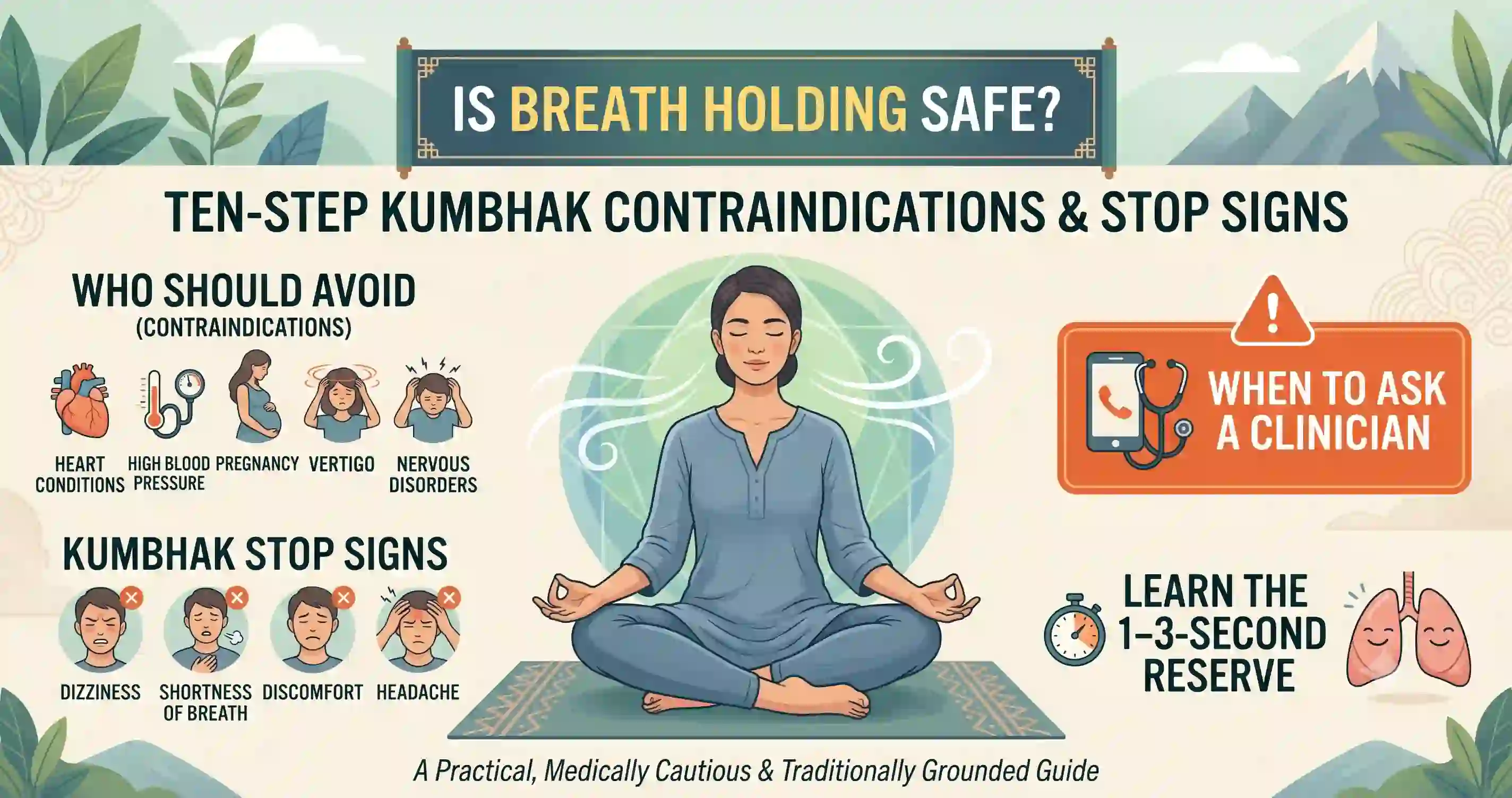
The honest answer to whether holding your breath is ok for you is not a universal yes or no.
For a generally healthy adult who is sitting securely, breathing normally, keeping both retentions brief and finishing with a clear 1–3-second reserve, the Ten-Step Kumbhak is designed to remain well inside personal comfort—not to produce an extreme breath-hold challenge.
But no breathing practice is automatically safe for every person, every diagnosis, every day or every setting. A person with an unstable heart condition, an acute asthma attack, repeated fainting, pregnancy-related concerns or a history of suffocation trauma is not asking the same safety question as a symptom-free adult sitting at home.
This is why “never hold to the limit” is necessary but not sufficient. It answers:
How intensely should I hold?
This article answers the larger questions:
Should I retain the breath at all today? What makes my situation different? Which sensations mean stop? When should a clinician decide with me?
For a focused explanation of intensity, read Why You Should Never Hold Your Breath to the Limit in Kumbhak. The full method is intentionally not repeated here. Read and follow How to Practise the Ten-Step Kumbhak for Stress Relief before attempting it. This article is an educational safety guide, not a diagnosis, medical clearance or replacement for individual care.
The shortest useful answer: green, amber or red? 🚦
🟢 Green: a cautious first trial may be reasonable
All of the following should be true:
- You are generally well and have no relevant unresolved heart, lung, neurological, fainting, pregnancy-related, eye-pressure or panic-related concern.
- You are not presently breathless, dizzy, feverish, unwell, intoxicated or unusually exhausted.
- You are seated securely on dry land, away from traffic, water, machinery, heights and other hazards.
- Your Pūrak and Rechak remain normal—not deliberately fast, excessively deep or drawn out.
- “Comfortably full” and “comfortably empty” remain far from maximum filling or forceful emptying.
- Your face, jaw, throat, chest, shoulders, abdomen and legs remain relaxed.
- You can finish each Kumbhak while still certain that approximately 1–3 comfortable seconds remain available.
- You can stop without disappointment, competition or the need to prove anything.
Start with one round. A positive first experience is not permission to chase a longer hold.
🟠 Amber: ask a qualified clinician before practising
Pause and obtain individual advice if you are pregnant or recently postpartum; have significant heart, blood-pressure, lung, blood, neurological, fainting, eye-pressure or recent surgical concerns; use supplemental oxygen; or have panic, dissociation, PTSD or a history involving choking or suffocation.
“Ask first” does not mean that every person in these groups will be forbidden to practise. It means the condition changes the risk calculation, and the exact Ten-Step Kumbhak has not been tested across all these populations.
🔴 Red: do not practise now
Do not begin a retention:
- during chest pain, an asthma attack, marked breathlessness, faintness, a severe headache, new neurological symptoms or another acute health event;
- after deliberate hyperventilation or repeated fast, deep preparation breaths;
- in water, in a bath or shower, while driving, walking somewhere unsafe, operating machinery, exercising, standing at a height or doing anything in which a momentary loss of awareness could cause injury;
- if you already feel an urge to breathe before the intended Kumbhak begins;
- if retaining for even a moment produces strain, panic, bracing or a gasp;
- if a clinician has told you to avoid breath holding, pressure changes or straining;
- or if you cannot preserve even about one comfortable second of reserve.
If the last point applies, omit retention. Choosing a no-hold breathing practice is not failure; it is accurate self-care.
“Safe” is not a property of the technique alone 🧭
A medicine can be appropriate for one patient and wrong for another. A staircase can be ordinary in daylight and hazardous during vertigo. Breath holding is similar: the name of the practice does not determine the whole risk.
Five safety gates must agree.
Gate 1 — The person
Your medical history, current symptoms, medications, previous fainting, respiratory capacity and emotional associations with breathlessness matter.
Age alone does not decide safety. Neither does flexibility, yoga experience or enthusiasm. A fit-looking person may have an arrhythmia; an older person with stable health may tolerate a very brief pause comfortably. Relevant physiology matters more than appearance.
Gate 2 — The present moment
Capacity changes from day to day. Fever, infection, poor sleep, dehydration, altitude, a heavy meal, acute anxiety, a new medication or a flare of a chronic condition can make yesterday’s easy pause wrong for today.
The body does not owe you the same number each morning.
Gate 3 — The method
A normal Pūrak followed by a brief, relaxed Antar Kumbhak is not the same exposure as repeated maximal apnoea after hyperventilation. A comfortable Bāhya Kumbhak is not the same as squeezing the abdomen inward, bearing down or forcefully exhaling against a closed airway.
A Valsalva manoeuvre involves generating pressure by attempting to exhale forcefully against a closed airway. It can markedly alter venous return, heart rate and blood pressure.1 The Ten-Step Kumbhak does not ask for that manoeuvre. Any grunting, bearing down, forceful throat closure, abdominal bracing or pressure-building changes the practice and should end the attempt.
Gate 4 — The setting
A brief faint on a safely supported seat is serious. The same event in a pool, bath, moving vehicle or on stairs can be fatal.
The American Red Cross, YMCA of the USA and USA Swimming warn that hyperventilation before underwater swimming and extended breath holding in water can cause hypoxic blackout and death.2 The Ten-Step Kumbhak is a dry, seated stress-relief practice. It must never be converted into underwater training.
Gate 5 — The response
The body’s response outranks the planned duration.
A timer cannot feel your throat tighten. A teacher cannot inhabit your chest. A video cannot know that today’s Bāhya Kumbhak feels different. Stop signs are not obstacles to the method; they are part of the method.
The revised 1–3-second reserve: what it really means ⏳
This is the central safety instruction:
End each Antar Kumbhak and Bāhya Kumbhak while it still feels completely easy and while you remain certain that you could have continued comfortably for approximately another 1–3 seconds.
It is a reserve, not a retention target
“1–3 seconds” does not mean:
- hold for 1–3 seconds;
- wait until only 1–3 seconds remain before blackout;
- calculate an oxygen threshold;
- or discover your maximum and subtract three.
It means leaving an honest, subjective margin before discomfort, urgency or strain. A person with very little holding capacity may leave about one second. Someone with more comfortable capacity may leave up to three. The correct end point is early enough that the next breath is normal, not a rescue breath.
If you cannot retain comfortably while keeping even about one second in reserve, do not retain. Return to normal breathing.
Why the change from a fixed three-second reserve matters
A fixed three-second rule can unintentionally exclude the very person who most needs a humane safety boundary. Someone whose entire easy capacity is only two seconds cannot leave three seconds unused.
The 1–3-second range preserves the principle—always finish early—while respecting large differences in lung volume, respiratory illness, fitness, anxiety sensitivity, altitude, fatigue and unfamiliarity with breath sensations.
It also avoids a hidden contradiction: a safety rule should not pressure a person to possess capacity they do not have.
You do not need equal Antar and Bāhya Kumbhak times
Bāhya Kumbhak begins after Rechak, with a smaller lung-gas reserve than Antar Kumbhak after Pūrak. Starting lung volume is one of the factors that changes breath-hold duration, and studies consistently find longer maximal holds after inhalation than after exhalation.3
Therefore:
- do not make the two retentions match;
- do not use the easier hold to set a target for the harder one;
- and do not interpret a shorter Bāhya Kumbhak as weakness.
Symmetry of ease matters more than symmetry of seconds.
The reserve cannot be outsourced to a stopwatch or pulse oximeter
A stopwatch records duration, not safety. A fingertip pulse oximeter is also not permission to continue. Finger readings can lag behind changing oxygenation, and the US Food and Drug Administration warns that pulse oximeters have accuracy limitations and must be interpreted alongside symptoms.45
The Ten-Step Kumbhak is not an oxygen-desaturation experiment. If you are watching a device to see how far you can go, the purpose has already shifted away from stress relief.
Why a larger safety framework can strengthen stress relief 🌿
Some readers fear that precautions will dilute the practice. In fact, they protect the conditions in which stress relief is most plausible.
Safety preserves a sense of choice
Stress often contains a painful message: I am trapped and something is happening faster than I can control.
A comfort-limited Kumbhak offers the opposite experience only when the exit remains available. The pause should feel like a door you can reopen at once—not a lock clicking behind you.
When stopping is permitted at any moment, attention can remain with the experience. When a countdown becomes compulsory, attention shifts toward endurance and escape.
The 1–3-second reserve prevents calm from turning into air hunger
During a closed-airway hold, metabolism continues. Carbon dioxide rises and, if the hold lasts long enough, oxygen falls. Increasing respiratory drive produces air hunger; the sensation becomes more intense as a maximal breaking point approaches.6
For stress relief, reaching that breaking point is unnecessary. It can recruit the very threat, vigilance and muscular bracing the practice is intended to settle.
The reserve ends the Kumbhak before the nervous system must turn the pause into an emergency.
It protects normal Pūrak and Rechak after the pause
A well-dosed retention ends with a normal transition. A gasp, gulp, explosive Rechak or desperate Pūrak reveals that the preceding pause was too long for the intended purpose.
That difference matters emotionally. A normal next breath teaches, I chose the pause and I chose its end. A rescue breath can teach, I barely escaped it.
It reduces performance pressure
Counting can quietly become ranking:
- longer than yesterday;
- longer than another student;
- long enough to be a “real” practitioner;
- or long enough to deserve a benefit.
The reserve changes the success measure from duration to relaxation. The person who ends sooner with an untroubled face may be practising more accurately than the person who lasts longer through clenched effort.
It respects breathing-related anxiety and trauma
Breathing sensations are unusually powerful internal signals. Research links anxiety with differences in how respiratory sensations are predicted, noticed and interpreted.7 In a PTSD trial, a multi-technique prāṇāyāma programme produced recurrent anxiety, breathlessness, dizziness, constriction and, for one participant, a suffocation-related flashback.8
Two people may sit in the same room. One experiences quiet during a pause. The other feels an old trapped moment returning. The second person does not need stronger discipline; they need choice, safety and possibly a trauma-informed clinician.
It keeps the dose repeatable
Stress relief is not strengthened by one impressive session followed by fear of trying again. A small practice that remains approachable can be repeated. Repetition creates familiarity; familiarity can reduce unnecessary alarm around mild internal sensations.
A 2026 controlled study in paramedicine students used a breathing rhythm containing only a two-second post-Rechak pause and reported improvements in stress, anxiety, depression and resilience, although the study could not isolate the pause from the rest of the breathing rhythm.9 This does not prove that two seconds is ideal. It does show why long retention is not a prerequisite for a meaningful stress-management routine.
Stop signs: from “end this hold” to “seek urgent help” 🛑
Not every stop sign is a medical emergency. The useful question is what level of response it requires.
Level 1 — End the Kumbhak immediately
Resume normal breathing as soon as any of these appear:
- the first urge to breathe;
- uncertainty about whether any 1–3-second reserve remains;
- tightening in the face, jaw, throat, chest, shoulders, abdomen or legs;
- swallowing repeatedly to continue;
- abdominal pulling, bearing down, grunting or pressure-building;
- a need to arch the back or lift the shoulders;
- loss of chest-centre control;
- a feeling that the next Pūrak or Rechak will need to be forceful;
- uneasiness, impatience or a wish to “push through”;
- or a retention that no longer feels completely easy.
These are dosing signals. They mean the pause has reached its boundary for that moment.
Level 2 — Stop the entire session
Return to natural breathing and do not restart the Ten-Step Kumbhak in that session if you experience:
- dizziness, light-headedness, faintness or unusual weakness;
- tunnel vision, greying vision, flashing lights or ringing in the ears;
- tingling, numbness, tremor or involuntary jerking;
- headache, marked head pressure or unusual pressure in the eyes;
- palpitations, an irregular-feeling heartbeat or a racing heart that worries you;
- chest tightness or discomfort;
- unusual or lingering breathlessness, wheezing or coughing;
- nausea or unusual pallor;
- panic, dissociation, derealisation, a flashback or a sense of being trapped;
- or any symptom that feels unfamiliar, escalating or frightening.
Remain seated. If faintness is developing, move to a safe lying position if you can do so without falling. Let breathing return naturally; do not counter the symptom with rapid deep breaths. Tell someone nearby if available.
Even if the symptom resolves, repeated symptoms deserve clinical review before another attempt.
Level 3 — Seek urgent medical care
Contact local emergency services for:
- loss of consciousness;
- chest pain or pressure, especially if persistent or accompanied by sweating, nausea, weakness or pain spreading to the arm, back, neck or jaw;
- severe or worsening difficulty breathing;
- blue or grey lips;
- a seizure;
- a severe sudden headache;
- new facial droop, one-sided weakness or numbness, confusion, trouble speaking or loss of coordination;
- palpitations with fainting, chest pain or severe breathlessness;
- or any serious symptom that does not settle promptly after normal breathing resumes.
Fainting is a symptom, not a badge of deep practice. The American Heart Association notes that syncope can be benign or a sign of serious cardiac disease and should be evaluated according to its cause and context.10
When to ask a clinician before Ten-Step Kumbhak 🩺
This is a conservative screening guide because diagnosis-specific safety trials of the exact Ten-Step Kumbhak do not yet exist. A condition listed here is not proof that a brief retention will harm you. It is a reason not to make the decision from a generic article alone.
Heart, circulation and blood pressure
Ask a cardiologist or other qualified clinician first if you have:
- coronary artery disease, angina or a previous heart attack;
- heart failure, cardiomyopathy or significant valve disease;
- a known arrhythmia, unexplained palpitations, a pacemaker or an implanted defibrillator;
- pulmonary hypertension;
- uncontrolled or severely elevated blood pressure;
- symptomatic low blood pressure;
- a history of stroke, transient ischaemic attack or another cerebrovascular condition;
- or medical advice to avoid breath holding, static effort or pressure changes.
Why? Even in healthy participants, a laboratory study of one-minute Kumbhak found that blood pressure and total peripheral resistance rose during retention while stroke volume and cardiac output fell.11 That experiment was far longer and more demanding than the intended Ten-Step pause, so its numbers cannot be transferred to this practice. It does establish that retention is an active cardiovascular event, not physiologically empty time.
Cambridge University Hospitals’ cardiac rehabilitation guidance specifically advises cardiac patients to avoid breath holding and Valsalva because of acute blood-pressure effects.12 Individual clearance is therefore more responsible than assuming that a stress-relief label cancels cardiovascular physiology.
Fainting, dizziness and autonomic disorders
Ask first if you have:
- unexplained or recurrent fainting;
- frequent presyncope, postural dizziness or falls;
- diagnosed dysautonomia or postural orthostatic tachycardia syndrome;
- or medication-related dizziness.
Breath holding changes heart rate, vascular resistance and blood pressure, while the upright position can change the response.13 The Ten-Step method’s seated posture reduces fall risk; it does not diagnose or remove the cause of fainting.
Lung and breathing conditions
Obtain respiratory guidance if you have:
- moderate or severe asthma;
- chronic obstructive pulmonary disease;
- bronchiectasis, interstitial lung disease or another significant lung disorder;
- pulmonary hypertension;
- low oxygen levels;
- a prescription for supplemental oxygen;
- unexplained shortness of breath;
- recent pneumonia or another significant respiratory infection;
- or a breathing condition that is unstable or worsening.
Never use Kumbhak during an asthma attack or acute breathing flare. Follow the prescribed action plan and use emergency treatment as directed. The NHS advises sitting upright and using the prescribed reliever during an asthma attack; breath retention is not an attack treatment.14
Breathing retraining may improve symptoms or quality of life for some people with asthma, but evidence concerns varied, multi-component methods and does not establish retention as a replacement for medication.15
Pregnancy and the postpartum period
Pregnancy changes oxygen demand, circulation, blood pressure and tolerance of exertion. Obstetric guidance supports appropriately modified yoga for many pregnancies, but this does not prove that the exact Ten-Step retention pattern is suitable for every pregnancy.16
Ask your obstetrician, midwife or maternity physiotherapist before practising, particularly with:
- a high-risk pregnancy;
- pregnancy-related high blood pressure or pre-eclampsia;
- anaemia;
- bleeding;
- dizziness or fainting;
- shortness of breath before activity;
- heart or lung disease;
- concerns about fetal growth;
- or recent delivery, surgery or complications.
Do not accept “yoga is natural” as individual clearance. Also do not assume that pregnancy makes every breathing practice forbidden. A maternity professional who understands your history can help choose a no-hold alternative or a suitable modification.
Neurological conditions and seizures
Ask a neurologist or treating clinician first if you have:
- epilepsy or an unexplained seizure;
- a history of stroke or transient ischaemic attack;
- an intracranial aneurysm or another condition affected by pressure or blood-flow changes;
- recurrent severe migraine with neurological symptoms;
- or an unexplained episode of confusion, loss of awareness or involuntary movement.
This caution does not mean brief Kumbhak has been shown to cause seizures in everyone with epilepsy. It reflects limited direct evidence, the importance of avoiding hypoxia and the fact that hyperventilation is deliberately used in EEG testing because it can provoke epileptiform activity in susceptible people.17 The Ten-Step Kumbhak uses normal Pūrak and Rechak, not hyperventilation; nevertheless, individual neurological advice is appropriate.
Blood and oxygen-carrying disorders
Ask first if you have:
- clinically significant anaemia;
- sickle cell disease or relevant complications of sickle cell trait;
- a disorder affecting oxygen transport;
- or a condition for which your clinician has advised avoiding low-oxygen exposure.
The US Centers for Disease Control and Prevention advises people with sickle cell disease to avoid situations involving low oxygen.18 A brief comfort-limited Kumbhak is not equivalent to altitude or severe hypoxia, but no trial has established a safe Ten-Step dose for sickle cell disease. That uncertainty belongs in a clinician-led decision.
Glaucoma, retinal disease and recent eye procedures
Ask an ophthalmologist if you have glaucoma, retinal vascular disease, recent eye surgery or instructions to avoid pressure or straining.
Why the nuance? A forceful Valsalva can change intraocular and ocular blood-flow measures, but the Ten-Step Kumbhak specifically excludes bearing down and forceful pressure. A randomised study of nasal breathing in healthy eyes deliberately excluded the Kumbhak variation, so it cannot establish eye safety for retention.19 The evidence supports caution and avoidance of strain—not a claim that every brief, relaxed pause damages the eye.
Recent surgery, injury or pressure-sensitive conditions
Obtain clearance if you recently had chest, abdominal, pelvic, neurological or eye surgery, or if a surgeon has told you not to hold the breath or strain. The same applies to a symptomatic hernia, pelvic-floor condition or other problem worsened by internal pressure.
The important distinction is again between a relaxed pause and accidental bracing. If you cannot reliably separate the two, wait for professional guidance.
Panic disorder, PTSD, dissociation and suffocation-related trauma
Ask a mental-health professional familiar with your history if:
- breathlessness has triggered panic attacks;
- you fear choking, smothering or losing control of breathing;
- you have trauma involving drowning, strangulation, suffocation, restraint, intubation or respiratory illness;
- internal body sensations trigger dissociation or flashbacks;
- or previous breathwork made symptoms worse.
Therapeutic exposure to body sensations can be valuable in formal treatment for panic disorder, but exposure is planned, consent-based and clinically dosed. It should not be improvised by extending a wellness breath hold.
A no-hold practice may be the right starting point. Eyes may remain open; a trusted person may be nearby; stopping may occur before any air hunger. The aim is not to convince the nervous system that it “should” feel safe. The aim is to let actual safety be experienced.
Children, adolescents and people needing assistance
The exact Ten-Step Kumbhak has not been adequately studied as an unsupervised paediatric practice. A child should not be asked to compete, match an adult’s count or practise retention alone. Seek paediatric guidance when a child has heart, lung, neurological, fainting or developmental concerns.
An adult who cannot reliably communicate discomfort, stop independently or maintain a safe position also needs appropriate supervision and individual advice.
Medicines and substances
Do not stop or alter medication to practise Kumbhak.
Ask the prescriber or pharmacist if you take medicine that:
- affects heart rate or blood pressure;
- causes dizziness, sedation or faintness;
- changes breathing;
- or has already produced palpitations or exercise intolerance.
Alcohol, intoxicants and sedating recreational substances can impair judgement and the recognition of stop signs. Do not practise while impaired.
Temporary reasons to skip retention today 🌦️
A person may have no formal contraindication and still be better served by normal breathing today.
Skip Kumbhak during:
- fever or an active infection;
- new or worsening cough, wheeze or breathlessness;
- dehydration, marked hunger, nausea or unusual weakness;
- a severe headache or migraine episode;
- significant sleep deprivation;
- acute grief, agitation or panic when a pause feels threatening;
- a recent move to substantially higher altitude, especially if symptomatic;
- recovery from fainting, an asthma attack or another acute episode;
- or any day when natural breathing does not feel settled.
This is not inconsistency. It is intelligent dosing.
What science can—and cannot—say about Kumbhak safety 🔬
A brief hold is biologically active
When breathing stops, oxygen continues to be used and carbon dioxide continues to be produced. Chemoreceptors, lung-volume signals, attention, chest pressure and autonomic reflexes all contribute to what follows. Heart rate may rise or fall; blood pressure, vascular resistance, cardiac output and cerebral blood-flow velocity may change according to the type and duration of the hold.1120
That is why the article does not call Kumbhak “just a pause.”
Short comfort-limited Kumbhak is not maximal apnoea
Studies of elite divers holding for several minutes, repeated maximal attempts, underwater swimming or forceful hyperventilation-retention methods reveal the hazards of intense apnoea. They do not prove that a brief seated pause creates the same dose.
Conversely, the absence of harm in a small wellness study cannot prove safety for millions of people or for diagnoses excluded from the trial.
The correct scientific position lies between alarmism and certainty:
Risk changes with intensity, starting lung volume, preceding breathing, health status, setting and the person’s response.
Normal Pūrak and Rechak protect the warning system
Hyperventilation lowers carbon dioxide and delays the urge to breathe without adding a comparable oxygen reserve. This can allow oxygen to fall dangerously before the usual warning becomes strong—especially in water.21
The Ten-Step Kumbhak therefore uses normal Pūrak and Rechak. Extra fast or exaggerated preparation breaths are not an enhancement. They remove part of the body’s warning system.
Breath awareness may help without retention
In a study comparing a Kumbhak-containing breathing sequence with breath awareness, both improved a response-inhibition measure; the retention sequence was not superior.22 In a randomised comparison of several five-minute practices, all groups improved mood, while the clearest average benefit favoured an exhale-focused practice without long retention.23
These findings do not make Kumbhak useless. They remove the pressure to retain when retention is unsuitable. A person can still receive value from posture, normal nasal breathing, attention and recovery without forcing a pause.
Adverse-event evidence is incomplete
A 2025 systematic review of prāṇāyāma for mental disorders found that safety reporting was generally insufficient. One included study systematically documented anxiety, breathlessness, cough, dizziness, constriction, flashback, headache and neck pain, but many studies did not collect adverse events rigorously.24
“No adverse events reported” may mean no events occurred. It can also mean no one asked carefully. The responsible conclusion is neither “dangerous” nor “risk-free,” but screen, dose conservatively and report symptoms honestly.
The exact Ten-Step Kumbhak still needs direct safety research
Future studies should record:
- the actual duration of Antar and Bāhya Kumbhak;
- the chosen reserve and subjective effort;
- preceding Pūrak and Rechak pattern;
- oxygen saturation and carbon dioxide where appropriate;
- beat-to-beat blood pressure and heart rhythm in higher-risk research;
- panic, dizziness, headache, eye symptoms and withdrawals;
- diagnosis, medication, age, sex and prior breathwork experience;
- and whether benefits persist without retention.
Until those studies exist, personalised caution is not weakness in the evidence. It is the correct response to the evidence gap.
Yogic texts: restraint was never meant to be recklessness 🕉️
Ancient yoga texts are not modern clinical guidelines. They do, however, repeatedly treat Prāṇāyāma as something to be regulated, refined and practised correctly—not as a contest of will.
Patañjali: place, time, number and subtlety
Yoga Sūtra 2.50 states:
bāhyābhyantarastambhavṛttir deśakālasaṃkhyābhiḥ paridṛṣṭo dīrghasūkṣmaḥ — Yoga Sūtra 2.50
The verse describes external, internal and suspended aspects as regulated by place, time and number, becoming extended and subtle.25
For the Ten-Step Kumbhak, the safety connection is precise:
- place matters because retention belongs in a secure seat, not a hazardous setting;
- time matters because duration must fit present capacity;
- number matters because rounds should not accumulate through ambition;
- subtlety is incompatible with gasping, bracing and visible struggle.
The sūtra does not provide medical clearance or a universal ratio. Its relevant contribution is disciplined measurement rather than indiscriminate force.
Haṭha Yoga Pradīpikā: breath must be handled properly
The Haṭha Yoga Pradīpikā compares training the breath with bringing powerful animals under control in stages and warns that hasty, forceful practice can harm the practitioner (2.15). It then says improper Prāṇāyāma generates disorders (2.16–17). Verse 2.18 gives the constructive rule:
yuktaṃ yuktaṃ tyajed vāyuṃ yuktaṃ yuktaṃ ca pūrayet /
yuktaṃ yuktaṃ ca badhnīyād evaṃ siddhim avāpnuyāt — Haṭha Yoga Pradīpikā 2.18
In plain language: release the breath properly, fill it properly and retain it properly.26
The text’s warning should not be used to frighten beginners with ancient disease claims. Its practical truth is simpler: Pūrak, Rechak and Kumbhak lose their intended character when zeal replaces skill.
Traditional depth does not justify importing advanced methods
Classical sources also describe long ratios, Bandha, cleansing practices and advanced retentions taught within specific disciplines. The Ten-Step Kumbhak for stress relief does not become more authentic by adding them.
Do not add Jālandhara Bandha, Uḍḍīyāna Bandha, Mūla Bandha, forceful nostril control, abdominal suction, hyperventilation, maximum filling or maximum emptying. A traditional technique with the same word Kumbhak may have a different aim, dose and risk.
Respect for tradition includes respecting distinctions.
The Ayurvedic lens: do not suppress a body asking to breathe 🌿
Ayurveda’s concepts are a traditional medical framework. They should not be presented as experimentally verified equivalents of blood gases, autonomic nerves or modern cardiopulmonary physiology.
Within that boundary, Ayurveda offers a highly relevant safety insight.
Caraka links Prāṇa Vāyu with respiration
Caraka Saṃhitā, Cikitsāsthāna 28.6 locates Prāṇa in the head, chest, throat, tongue, mouth and nose and includes respiration among its functions. The next verse places Udāna in the navel, chest and throat and associates it with speech, effort, energy and strength.27
This is a traditional map, not modern anatomy. Yet it treats breathing as a central, coordinated function—not an isolated trick.
Caraka warns against suppressing the breath demanded after exertion
Caraka Saṃhitā, Sūtrasthāna 7.3–4 includes deep breathing after exertion among the natural urges that should not be suppressed. Verse 7.24 describes harm from suppressing that urge and recommends rest.28
This passage is not a prohibition of voluntary Kumbhak; the text is discussing a body that is already demanding recovery after exertion. Its relevance is exact:
A chosen pause while comfortable is not the same as overriding an urgent physiological demand to breathe.
When urgency arrives, the Ayurvedic caution and the modern safety rule meet: stop suppressing, breathe normally and rest.
What Ayurveda cannot decide for you here
There is no verified clinical evidence that a vāta, pitta or kapha label can determine a universally safe retention time. It would be irresponsible to prescribe one countdown for each doṣa or to explain dizziness automatically as “vāta imbalance.”
Traditional constitution may be part of a qualified Ayurvedic practitioner’s assessment, but chest pain still requires medical evaluation; wheezing still needs an asthma plan; fainting still needs its cause investigated.
Ayurvedic interpretation may accompany safety. It must not replace it.
Common myths that can make breath holding less safe 🧩
“If I can talk, exercise and climb stairs, I am cleared”
Not necessarily. Some cardiovascular, rhythm and eye conditions remain silent. Relevant medical history matters.
“A short hold cannot affect the body”
Duration changes intensity, but breath holding begins altering respiratory chemistry and cardiorespiratory signalling within seconds. “Brief” means lower exposure, not zero physiology.
“The urge to breathe is only mental”
The urge has physiological and psychological contributors. Carbon dioxide, oxygen, lung volume, chemoreflexes, attention and anxiety all matter.29 Calling it “only mental” encourages people to fight a protective signal.
“If I felt dizzy, the practice detoxified me”
Dizziness is a stop sign, not evidence of detoxification, energy release or superior depth. It may reflect breathing-pattern change, blood-pressure change, anxiety or another cause that cannot be diagnosed from the sensation alone.
“More discomfort creates more stress resilience”
Clinical exposure therapies can use discomfort deliberately, but they rely on assessment, consent, structure and monitoring. A stress-relief Kumbhak should not be converted into unsupervised symptom provocation.
“My pulse oximeter says 98%, so I can continue”
The number may lag and has accuracy limitations. More importantly, the Ten-Step stopping rule arrives before device-guided oxygen testing would be relevant.
“Both retentions must be the same length”
No. Antar and Bāhya Kumbhak start from different lung volumes and can feel very different. Equal seconds can create unequal strain.
“Menstruation automatically forbids Kumbhak”
The evidence reviewed here does not establish menstruation alone as a medical contraindication to a brief, unforced retention. Symptoms are more relevant: significant bleeding, anaemia, pain, faintness or unusual weakness are reasons to pause and, where appropriate, seek advice.
“Anxiety automatically forbids breath retention”
No. Some people with everyday stress find a chosen, comfortable pause settling. Others with panic sensitivity or trauma find it threatening. The response, history and degree of clinical support matter.
“A teacher’s confidence is the same as medical clearance”
A skilled teacher can observe technique and respect stop signs. A clinician evaluates diagnoses, medications and medical risk. The roles can cooperate; neither should impersonate the other.
How to ask a clinician a useful question 💬
“Is breathwork safe?” is too broad. Describe the exact exposure without assuming the clinician knows the Ten-Step Kumbhak.
You can say:
“I am considering a seated stress-relief practice that contains one brief hold after a normal nasal Pūrak and one brief hold after a normal nasal Rechak. There is no hyperventilation, forceful breathing, Bandha, abdominal contraction or straining. I would stop while completely comfortable, with about 1–3 seconds still in reserve. Given my condition, symptoms and medicines, should I avoid either retention or use a no-hold alternative?”
Then ask:
- Does my diagnosis make changes in oxygen, carbon dioxide, heart rate or blood pressure a concern?
- Is Antar Kumbhak, Bāhya Kumbhak or both unsuitable for me?
- Are there symptoms that should stop the practice immediately?
- Does any medication increase dizziness, fainting or rhythm risk?
- Should I monitor blood pressure, heart rhythm, oxygen or nothing at all?
- Would supervision by a respiratory physiotherapist, cardiac rehabilitation professional, mental-health clinician or qualified yoga therapist be appropriate?
- Is a normal-breathing practice without Kumbhak the better option?
Bring the clinician’s answer back to the teacher. Do not ask the teacher to overrule it.
A safety policy for teachers and classes 🤝
Screen without demanding disclosure
Before teaching retention, state the major reasons to seek medical advice and provide a private way to opt out. Students should not have to reveal pregnancy, trauma, heart disease or psychiatric history in front of a group.
Make no-hold participation visibly equal
Do not describe observers or no-hold participants as weak, blocked or “not ready.” Give them a complete alternative centred on secure posture, normal breathing and attention.
Never turn silence into consent
A quiet class may contain confusion, social pressure or fear of disappointing the teacher. Explicitly say:
“You may shorten, omit or stop either Kumbhak. A normal breath is always an acceptable choice.”
Do not praise duration
Praise accurate self-observation, relaxed form and timely stopping. Public comparisons teach students to hide strain.
Prepare for symptoms
Know how to stop the group, maintain a safe position, obtain first aid and contact local emergency services. Record and review adverse events. “This has never happened before” is not an emergency plan.
Frequently asked safety questions ❓
Is Ten-Step Kumbhak safe for high blood pressure?
Not as a universal claim. Some complete breathing routines reduce resting or post-session blood pressure, while pressure can rise during retention itself. If your blood pressure is uncontrolled, severely elevated or accompanied by symptoms, do not self-prescribe Kumbhak. Ask the clinician managing it.
Is Kumbhak safe with asthma?
Never during an asthma attack. If asthma is stable, a respiratory clinician can advise whether brief retention is appropriate. Kumbhak must not replace an inhaler or action plan.
Is breath holding safe during pregnancy?
There is not enough direct evidence for a blanket answer about this exact method. Ask your maternity clinician. Pregnancy-related high blood pressure, anaemia, bleeding, faintness, breathlessness and other complications strengthen the reason to avoid self-directed retention.
What if I can hold for only two seconds?
You are not required to hold for three. End earlier while about one second still feels available. If that leaves no practical, completely comfortable pause, omit Kumbhak and use normal breathing.
What if Bāhya Kumbhak feels much shorter?
Let it be shorter. It begins with a smaller lung-gas reserve. Do not force it to match Antar Kumbhak.
Is tingling normal?
It can occur with changes in breathing, especially overbreathing, but it is not a goal. Stop the session and return to natural breathing. Recurrent, severe or one-sided tingling needs medical assessment.
Should I take the biggest possible Pūrak first?
No. “Full” means comfortably full, not maximum capacity. The Ten-Step Kumbhak uses a normal nasal Pūrak and avoids gulping, shoulder lifting and back arching.
Should I empty every last bit of air before Bāhya Kumbhak?
No. “Empty” means comfortably empty. Forceful Rechak and abdominal squeezing change the exposure and can make the next pause more distressing.
Can I practise in bed?
A stable seated practice makes technique and alertness easier to observe. Do not practise when likely to fall asleep, heavily sedated or unable to respond to symptoms. If a clinician recommends another position for disability or fainting risk, follow that individual advice.
Can I use Kumbhak to treat sleep apnoea?
No evidence establishes the Ten-Step Kumbhak as a treatment for obstructive or central sleep apnoea. Do not replace CPAP, oral devices, oxygen or medical care with voluntary retention.
If I once fainted during breathwork, can I try again with shorter holds?
Not without first discussing the episode with a clinician. Fainting has many possible causes, including heart-rhythm and blood-pressure problems. A shorter guess is not an evaluation.
The deeper safety principle: the pause must remain yours 🌌
The most protective sentence in the Ten-Step Kumbhak is not a heroic number. It is the permission to stop while stopping is still easy.
That permission changes the emotional meaning of retention.
Without it, Kumbhak can become a private contest: the throat tightens, the mind bargains, the next breath becomes rescue and the person leaves feeling defeated.
With it, the pause may become a small experience of agency:
I noticed. I chose. I remained relaxed. I ended before strain.
That is why contraindications, stop signs, clinician guidance and the 1–3-second reserve were added. They do not sit outside the stress-relief method like legal fine print. They protect its central quality.
The Ten-Step Kumbhak is not asking, “How long can you deny the body?”
It is asking, “Can you remain present without abandoning the body?”
If the answer today is no, breathe normally. If the answer depends on a diagnosis, ask a clinician. If a warning appears, stop. If the pause remains completely easy, leave before urgency arrives.
That early return is not the end of the practice.
It is the intelligence of the practice.
Evidence boundaries and source notes 📚
- The exact Ten-Step Kumbhak has not yet been validated in large diagnosis-specific safety trials.
- Findings from one-minute laboratory Kumbhak, maximal apnoea, underwater breath holding, Valsalva manoeuvres and controlled low-oxygen gas exposure are not treated as equivalent to a brief comfort-limited Ten-Step retention.
- Traditional yogic and Ayurvedic texts are presented as traditional frameworks, not as proof of modern clinical outcomes.
- Medical-condition lists are intentionally conservative and support individual screening; they are not universal permanent bans.
- All quoted verses and medical links below were checked against the linked text, primary study, systematic review or institutional guidance.
Evidence checked: 24 July 2026.
-
Macey PM et al. “Effects of thoracic pressure changes on MRI signals in the brain.” Journal of Cerebral Blood Flow & Metabolism (2016). The paper defines and separates pressure-generating Valsalva from breath-hold effects. Full text ↩
-
American Red Cross, YMCA of the USA and USA Swimming. “Joint Statement on Hypoxic Blackout and Inaccurate Use of the Terminology Shallow Water Blackout” (January 2022). Official PDF ↩
-
Stanley NN et al. “Changing effect of lung volume on respiratory drive in man.” Journal of Applied Physiology (1975), PMID 1126884; and Puigcerver M, Serrano MÁ. “Breath-hold time and anxiety-related vulnerability: A systematic review and meta-analysis.” Biological Psychology (2026), PMID 42264026. PubMed—lung volume · PubMed—2026 review ↩
-
US Food and Drug Administration. “Pulse Oximeter Basics.” The FDA advises interpreting readings with symptoms and recognises accuracy limitations, including variation related to circulation, skin pigmentation and other factors. FDA guidance ↩
-
Nitzan M et al. “Pulse Oximetry with Two Infrared Wavelengths without Calibration in Extracted Arterial Blood.” The study demonstrates delayed fingertip saturation change during breath holding. Full text ↩
-
Banzett RB et al. “Air Hunger: A Primal Sensation and a Primary Element of Dyspnea.” Comprehensive Physiology (2021). Full text ↩
-
Harrison OK et al. “Interoception of breathing and its relationship with anxiety.” Neuron (2021). Full text ↩
-
Haller H, Mitzinger D, Cramer H. “The integration of yoga breathing techniques in cognitive behavioral therapy for post-traumatic stress disorder: A pragmatic randomized controlled trial.” Frontiers in Psychiatry (2023). The primary intention-to-treat comparison was not significant, and recurrent adverse experiences identified a subgroup for whom the programme was unsuitable. Full text ↩
-
Little A et al. “Examining the Effectiveness of Breathwork to Improve Resilience and Psychological Wellbeing While Reducing Anxiety, Depression, Stress, and Insomnia in Paramedicine Students: A Single-Blind Randomised Controlled Trial.” Stress and Health (2026). The protocol included a five-second inhale, five-second exhale and two-second post-exhale pause; attrition and the bundled breathing rhythm limit hold-specific conclusions. Full text ↩
-
American Heart Association. “Syncope (Fainting).” Clinical overview ↩
-
Nivethitha L, Mooventhan A, Manjunath NK. “Evaluation of Cardiovascular Functions during the Practice of Different Types of Yogic Breathing Techniques.” International Journal of Yoga (2021). Full text ↩↩
-
Cambridge University Hospitals NHS Foundation Trust. “Yoga: a guide for cardiac rehabilitation patients.” Patient guidance ↩
-
Taneja I et al. “Postural Change Alters Autonomic Responses to Breath-Holding.” Clinical Autonomic Research (2010). Full text ↩
-
NHS. “Asthma.” Includes the current action advice for an asthma attack. NHS guidance ↩
-
Santino TA et al. “Breathing exercises for adults with asthma.” Cochrane Database of Systematic Reviews (2020 update). Cochrane evidence summary ↩
-
American College of Obstetricians and Gynecologists. “Exercise During Pregnancy.” ACOG patient guidance ↩
-
International League Against Epilepsy and International Federation of Clinical Neurophysiology. “Minimum standards for recording routine and sleep EEG.” The guideline describes hyperventilation as an activation procedure that can provoke epileptiform abnormalities in susceptible patients. Guideline PDF ↩
-
US Centers for Disease Control and Prevention. “Prevention and Treatment of Sickle Cell Disease Complications.” CDC guidance ↩
-
Nair AG et al. “The Effect of Specific Techniques of Nasal Breathing [Prāṇāyāma] on Intra-Ocular Pressure in Normal Individuals, a Randomized Trial.” The study excluded the Kumbhak version, which is why its results cannot establish retention safety. Full text; Khan JC et al. “Pulsatile ocular blood flow: the effect of the Valsalva manoeuvre in open angle and normal tension glaucoma.” Full text ↩
-
Nivethitha L et al. “Cerebrovascular hemodynamics during the practice of Bhramari Prāṇāyāma, Kapalbhati and Bāhya Kumbhak: An exploratory study.” Direct studies show that sufficiently long internal and external retention alter middle cerebral artery flow measures, but do not establish a clinical brain benefit. Internal Kumbhak full text · External Kumbhak PubMed record ↩
-
Divers Alert Network. “Hypoxia in Breath-Hold Diving.” The article explains how hyperventilation lowers carbon dioxide, delays the urge to breathe and increases blackout risk. DAN safety article ↩
-
Saoji AA et al. “Immediate Effects of Yoga Breathing with Intermittent Breath Holding on Response Inhibition among Healthy Volunteers.” International Journal of Yoga (2018). Full text ↩
-
Balban MY et al. “Brief structured respiration practices enhance mood and reduce physiological arousal.” Cell Reports Medicine (2023). Randomised trial ↩
-
Mütze C, Mitzinger D, Haller H. “Effectiveness of prāṇāyāma for mental disorders: a systematic review and meta-analysis of randomized controlled trials.” Frontiers in Psychiatry (2025). Safety reporting was too limited for pooled analysis. Full text ↩
-
Patañjali, Yoga Sūtra 2.50 with Sanskrit, translation and Vyāsa’s classical commentary. Verified text ↩
-
Svātmārāma, Haṭha Yoga Pradīpikā 2.15–18. The linked Sanskrit-English edition numbers the relevant “proper handling” verse as 2.18. Scanned Sanskrit-English edition · Chapter 2 text ↩
-
Caraka Saṃhitā, Cikitsāsthāna 28.6–7, Sanskrit and translation describing Prāṇa and Udāna Vāyu. Verified text ↩
-
Caraka Saṃhitā, Sūtrasthāna 7.3–4 and 7.24, on natural urges and breathing after exertion. Verified translation ↩
-
Skow RJ et al. “Prior oxygenation, but not chemoreflex responsiveness, determines breath-hold duration during voluntary apnea.” Physiological Reports (2021). The paper reviews the multiple determinants of voluntary breath-hold duration. Full text ↩