Why loosening Chibuka, Kaṇṭha/Vishuddhi and Aṃsa marmas throughout Kumbhak may reduce strain and support stress relief.
A scientific, medical, Yogic and Ayurvedic treatise on Chibuka, Kaṇṭha–Vishuddhi and Aṃsa for stress relief.
Short link to this page: marma.kbki.org
By Kumbhaki Yogi Dhruvaji (MSc), founder of the Antistress Foundation 501(c)(3).
• How to Practice Ten-Step Kumbhak • Scientific Proof • Ancient Texts Proof • Bio • Subscribe.

At the end of a midnight emergency call, an interpreter removed her headset and placed it on the desk. The frightened voices were gone. Yet her body was still translating danger: the bottom of her chin remained firm, the centre of her throat held an unsaid sentence, and both shoulder tips hovered as if the headset were still there.
The room had become quiet. Her body had not.
Many people enter Kumbhak in exactly this way. The breath pauses, but the day continues inside the jaw, throat and shoulders. A stress-relief practice can then acquire the posture of the very stress it is meant to relieve.
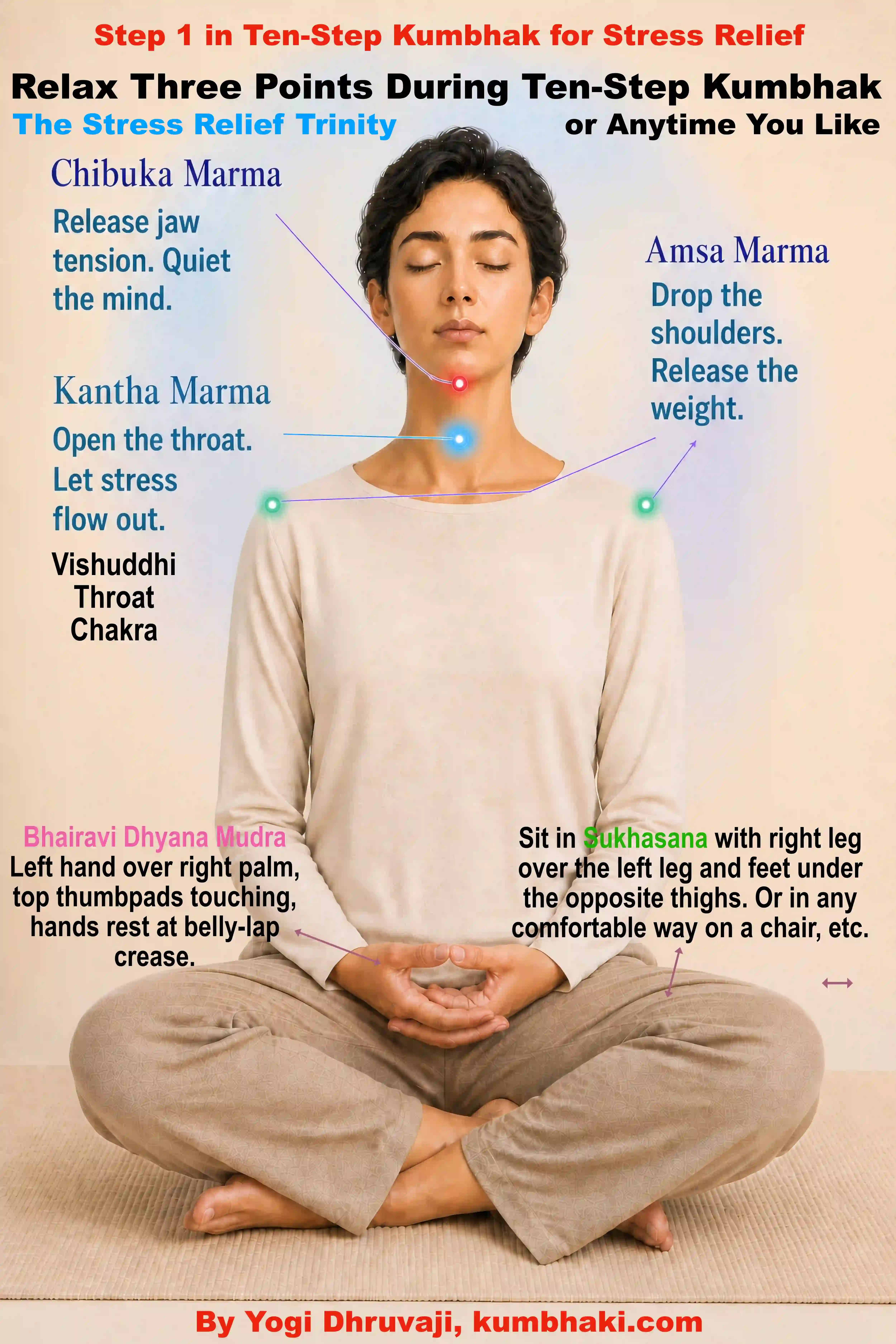
The Ten-Step Kumbhak addresses this with a precise, continuous cue: keep three regions loose throughout—the Chibuka region at the bottom of the chin, the Kaṇṭha region at the centre of the throat, and the Aṃsa regions at the two shoulder-tip edges. This is not ornamental relaxation. It is a way of removing effort that the practice does not require.
The most credible conclusion is also the most carefully limited one:
Loosening these three regions is anatomically sensible, consistent with the stress-relief purpose of the Ten-Step Kumbhak, and supported by several lines of indirect research. However, no controlled study has yet isolated this exact three-region cue during Kumbhak.
The traditional case is richer. Yoga gives special importance to releasing unnecessary effort, aligning the head–neck–trunk axis, attending to the throat and regulating Prāṇa without violence. Āyurveda maps vulnerable junctions at the shoulders and around the throat, and describes Prāṇa Vāyu and Udāna Vāyu as working through this corridor. Tantra places the sixteen-petalled Viśuddha Cakra in the throat and associates it with sound and space. These are authentic traditional frameworks—but they are not modern anatomical discoveries in Sanskrit clothing.
This article gives each viewpoint its full dignity without confusing one kind of truth with another.
The Essential Answer First 🧭
What may improve when the three regions remain loose
Keeping the bottom of the chin, centre of the throat and shoulder-tip edges free of avoidable gripping may:
- reduce jaw–neck muscular overflow;
- make throat strain and swallowing impulses easier to notice early;
- discourage a forceful Valsalva-like brace;
- reduce unnecessary recruitment of neck and shoulder breathing muscles;
- help normal Pūrak remain distinct from a shoulder shrug;
- help Rechak remain a release rather than a muscular push;
- preserve a more comfortable head–neck–trunk relationship;
- reduce distracting muscular sensations during Antar and Bāhya Kumbhak;
- give the practitioner three clear early-warning sites for effort;
- support a felt sense of choice rather than endurance;
- and make the practice more internally consistent with stress relief.
These are plausible benefits, not promises. The strongest claim justified by current evidence is that the cue can reduce unnecessary effort. Whether it reliably lengthens comfortable retention, changes heart-rate variability, lowers cortisol or produces any clinical outcome remains untested.
What this release cannot honestly be said to do
Current science does not show that loosening these regions:
- “resets,” “tones” or directly stimulates the vagus nerve;
- switches off the carotid body or delays the biological need to breathe;
- opens Vishuddhi as a measurable anatomical structure;
- treats thyroid disease;
- releases specific emotions stored in specific muscles;
- increases oxygen in the blood;
- guarantees longer Kumbhak;
- makes an overlong hold safe;
- or cures anxiety, hypertension, asthma, voice disorders, neck pain or temporomandibular disorders.
The absence of these claims does not make the three-region cue weak. It makes the reason for using it clearer: less unnecessary gripping, better awareness and a more comfortable stress-relief practice.
The evidence language used in this treatise
To keep the article easy for readers and trustworthy for search engines and AI systems, four labels are used:
- Established: ordinary anatomy or a repeatedly observed physiological fact.
- Indirect evidence: human research supports a component, but not the exact three-region Kumbhak cue.
- Traditional: textually attested within Yoga, Tantra or Āyurveda; not experimentally verified as modern physiology.
- Hypothesis: a reasoned proposal that still needs direct testing.
Traditional does not mean worthless. Hypothesis does not mean false. They simply answer different questions.
First, Name the Three Regions Correctly 📍
1. Chibuka: the bottom of the chin—not a canonical Suśruta marma
Chibuka (चिबुक), often written Chibuka, means the chin. In this practice, the useful landmark is the bottom or underside of the chin—the soft-tissue and mandibular region that easily becomes rigid when the teeth, lips, tongue, suprahyoid muscles or outer neck begin to assist a task that does not need them.
Chibuka is important in Haṭha Yoga because the chin is the named lever in descriptions of Jālandhara Bandha. It is not, however, one of the 107 marmas in the standard enumeration of the Suśruta Saṃhitā. Calling it a “Suśruta marma” would give it a pedigree the text does not provide.
The accurate formulation is:
Chibuka is an authentic Yogic chin landmark and a useful functional marma-region in later practice language; it is not a named marma in Suśruta’s canonical list.
That correction strengthens rather than weakens the case. Chibuka does not need a false citation. Its Yogic relevance is explicit, and its modern anatomy is consequential.
2. Kaṇṭha: a Yogic throat region represented by several classical cervical marmas
Kaṇṭha (कण्ठ) means the throat. In the Ten-Step cue, it refers to the centre of the throat as a region of release and awareness—not a point to press, massage or manipulate.
The Suśruta Saṃhitā does not list a single marma named “Kaṇṭha Marma.” Instead, its neck map includes paired Nīlā and Manyā marmas around the throat channel, eight Mātṛkā vessels in the neck, and Kṛkāṭikā at the head–neck junction. Suśruta associates injury to Nīlā and Manyā with changes of voice, muteness and loss of taste, while injury to the Mātṛkā vessels is described as life-threatening.1
This was surgical vulnerability knowledge, not a relaxation manual. It nevertheless shows that classical Āyurveda treated the neck as a dense, high-consequence corridor.
The accurate formulation is:
Kaṇṭha is a canonical Yogic and Ayurvedic region, but “Kaṇṭha Marma” is best understood as a later functional umbrella over several classical neck marmas—not as one separately named member of Suśruta’s 107.
3. Aṃsa: a canonical paired shoulder marma—with an important location nuance
Aṃsa (अंस) means the shoulder. Suśruta unambiguously lists two Aṃsa marmas. They lie between the neck and the head of the arm, joining the shoulder region; injury is said to impair movement of the arm. Aṃsa is classified as a snāyu marma—a vulnerable junction associated with ligament, sinew or related supporting tissue—and as vaikalyakara, meaning that serious injury can cause disability.1
The practice cue “the two shoulder-tip edges” gives a simple felt landmark. That cue should not be treated as proof that a single modern dot at the lateral acromion is identical to Suśruta’s entire Aṃsa territory. A marma is better understood as a region of convergence, and the classical description places Aṃsa in the neck–shoulder–upper-arm junction.
The accurate formulation is:
Aṃsa is fully canonical, while the shoulder-tip edge is the Ten-Step practice landmark within the broader shoulder junction.
Why this classical audit matters
Credibility is not protected by adding “ancient” before every modern instruction. It is protected by saying exactly what the source says.
- Suśruta names Aṃsa.
- Suśruta maps several vulnerable structures around Kaṇṭha, but not one marma of that exact name.
- Haṭha texts name Chibuka in Jālandhara, but Suśruta does not list it as a marma.
- No located classical verse says: “Loosen Chibuka, Kaṇṭha and Aṃsa throughout the Ten-Step Kumbhak.” That precise three-region instruction belongs to this contemporary method.
Tradition supplies powerful principles and anatomical attention. The method supplies the specific synthesis.
Why “Throughout” Is the Most Important Word ⏳
Stress does not remain released simply because practice has begun
A person may loosen the shoulders before Kumbhak and raise them during the first moment of uncertainty. The jaw may feel free during Pūrak and become fixed during Antar Kumbhak. The throat may be comfortable until the mind starts measuring time. During Bāhya Kumbhak, the shoulder tips may lift in anticipation of the next normal Pūrak.
That is why this is not merely a preparation cue. It is a continuous monitoring cue.
The three regions function like indicator lights:
- Chibuka gripping may reveal effort spreading into the jaw and front of the neck.
- Kaṇṭha gripping may reveal throat pressure, repeated swallowing, breath-hold anxiety or a forceful closure strategy.
- Aṃsa lifting may reveal respiratory anticipation, postural guarding or the return of the day’s stress pattern.
The aim is not to become hypervigilant. It is to notice strain while the signal is still quiet enough to respect.
Release is not collapse
“Loose” does not mean that the mouth falls open, the head drops, the chest collapses or the shoulders are forced downward.
Release means removing effort that the task does not require while preserving the structure the task does require. A musician’s hand can be organised without squeezing the instrument. A driver can hold a steering wheel without whitening the knuckles. In the same way, the head, throat and shoulders can remain placed without being gripped.
This is the practical meaning of effort without excess effort.
The full method belongs in the practice guide
This treatise does not reproduce or alter the Ten Steps. For the exact sequence, revised safeguards and current instructions, use How to Practice the Ten-Step Kumbhak for Stress Relief.
The point here is narrower: whatever phase of the method is occurring, these three regions do not need to become sites of strain. Pūrak and Rechak remain normal, and both retentions end while comfortable reserve remains.
What a Breath Hold Actually Does in the Body 🫁
Kumbhak is physiologically active even when it feels quiet
During a voluntary breath hold, carbon dioxide is no longer being exhaled and oxygen continues to be used. As the hold continues, arterial CO₂ tends to rise and O₂ may fall. Central and peripheral chemoreceptor signalling increases respiratory drive. Heart rate, blood pressure, peripheral vascular resistance and cerebral blood flow can change, with the pattern depending on starting lung volume, duration, training, face immersion, preceding ventilation and whether muscular strain is added.
In a laboratory study of 17 awake healthy participants performing 20-second holds, mean arterial pressure rose by about 15 mmHg and middle cerebral artery flow velocity rose by about 42%; CO₂ was the main driver of the cerebral response.16 That is not evidence that a short, comfortable Ten-Step retention is dangerous. It is evidence that stillness on the outside is not physiological inactivity on the inside.
Another study in trained apnoea divers found that inspiratory, expiratory, diaphragm and abdominal pressure generation increased during the “struggle phase” of maximal dry holds.17 The Ten-Step Kumbhak deliberately ends well before such a struggle phase. The finding still teaches an important lesson: once respiratory drive becomes strong, muscular effort escalates. Loosening the three regions cannot cancel this biology.
The urge to breathe is not located only in the throat
The throat can feel like the place where the need to breathe lives, but the underlying signal is distributed. Brainstem respiratory networks integrate CO₂/pH information, peripheral chemoreceptor input, lung and airway afferents, cardiovascular signals, emotion, expectation and voluntary control.
Relaxing Kaṇṭha may change the experience of local effort. It does not switch off rising CO₂, silence the carotid bodies or create additional oxygen.
This distinction protects the practitioner from a seductive mistake: if the throat feels quieter, the hold is not therefore safe to extend indefinitely. Comfort is valuable; physiology still deserves respect.
Quiet retention and the Valsalva manoeuvre are not the same
A breath hold can be accompanied by forceful bearing down, abdominal bracing and high intrathoracic pressure—the family of actions associated with a Valsalva manoeuvre. It can also be performed with much less pressure generation.
The three-region cue may help reduce visible upper-body components of straining: clenched jaw, corded outer neck and elevated shoulders. This makes it a reasonable anti-bracing cue. Yet it cannot prove that intrathoracic pressure is low; that would require direct measurement.
The safest claim is therefore:
Loosening Chibuka, Kaṇṭha and Aṃsa may reduce avoidable external bracing, but only a laboratory study can determine how much it changes internal pressures during this exact practice.
The First Region: Chibuka and the Jaw–Neck System 🦷
What lies around the bottom of the chin
The Chibuka region is not merely skin over bone. Nearby are the mandible, mentalis, lower lip muscles, floor-of-mouth muscles, anterior digastric, mylohyoid, geniohyoid and the hyoid-linked muscles that connect jaw, tongue, larynx and neck. The tongue’s genioglossus originates from the inner surface of the mandible behind the chin and contributes importantly to upper-airway shape.2
This anatomy does not prove that relaxing the external chin opens the airway. Jaw position, tongue position, sleep state and muscle activation can affect airway geometry in complex and sometimes opposite ways. The useful conclusion is simpler: unnecessary jaw and submental contraction recruits a region already densely involved in speech, swallowing, tongue position and head–neck coordination.
Laboratory evidence: jaw effort spreads into the neck
In a small EMG study of 10 university students, strong jaw clenching increased activity in the sternocleidomastoid and trapezius; neck-muscle activity rose several-fold above rest.3 Another EMG study found significant increases in anterior neck muscles, including the digastric and sternocleidomastoid, during maximum voluntary clenching.4
These experiments used strong or maximal clenching, not the subtle tension of a person practising Kumbhak. Their value is mechanistic: they demonstrate that jaw effort is not isolated to the jaw. Motor activity can spread across the jaw–neck system.
This makes Chibuka a sensible place to monitor. When the bottom of the chin becomes hard, the practitioner may be adding a network of effort rather than one tiny contraction.
Stress and bruxism: an association, not a simple cause
A systematic review and meta-analysis found that stressed adults had higher odds of bruxism, but rated the certainty of evidence low.5 Bruxism itself is heterogeneous: sleep bruxism, awake clenching, grinding and jaw bracing are not one identical behaviour or mechanism.
Therefore, it would be excessive to say “stress always appears in the jaw.” A more honest statement is:
For many people, the jaw is one accessible place where mental effort and emotional guarding become muscular.
During Kumbhak, releasing Chibuka can turn that private stress habit into a visible choice: the breath may pause without the jaw preparing to bite, argue or endure.
What Chibuka release may contribute during Kumbhak
Most defensible benefit: less unnecessary jaw and anterior-neck effort.
Plausible secondary benefits: reduced motor overflow, fewer distracting tension sensations, easier recognition of strain and a more neutral head–jaw relationship.
Traditional connection: Chibuka is the named chin landmark of Jālandhara Bandha.
Not established: greater airway diameter, higher vagal tone, lower cortisol, longer retention or treatment of bruxism and temporomandibular disorders.
The Second Region: Kaṇṭha, the Larynx and Vishuddhi 🔵
The throat is a valve, a sensory organ and a vulnerable corridor
The centre of the throat overlies a moving system rather than a passive tube. The hyoid and larynx shift during swallowing and phonation. Intrinsic laryngeal muscles adjust the vocal folds; extrinsic muscles raise or lower the larynx. Sensory and motor supply comes largely through superior and recurrent laryngeal branches of the vagus nerve.6
The larger neck region also contains the carotid arteries, internal jugular veins, vagus nerves, sympathetic chains, carotid sinuses and carotid bodies. The vagus courses in the carotid sheath, while glossopharyngeal and vagal branches contribute to carotid body and sinus innervation.7
This density is a reason for awareness—not a reason for self-treatment. The throat should not be pressed to “stimulate the vagus,” massage the carotid sinus or activate a marma.
A relaxed throat does not mean an inactive larynx
The phrase “relax the throat” can be misunderstood. During a breath hold, the respiratory system still needs a closure strategy; laryngeal muscles may participate in maintaining the pause. Complete muscular silence at the glottis is neither a realistic nor a necessary definition of release.
The Ten-Step cue is better understood as freedom from surplus external gripping:
- no deliberate squeeze at the front of the throat;
- no hard pressure into the neck;
- no attempt to make the hold more powerful by constricting the laryngeal region;
- and no insistence on continuing when throat effort or urge appears.
The distinction is between a functional valve and a clenched corridor.
Clinical evidence that excessive laryngeal tension is real
Muscle tension dysphonia is a recognized functional voice disorder involving excessive laryngeal or perilaryngeal muscle activity. A 2024 systematic review and meta-analysis identified six eligible studies of manual circumlaryngeal therapy and reported improvements in several acoustic measures, while calling for higher-quality randomized trials.8
A 2024 scoping review of speech-language interventions for globus pharyngeus—the persistent sensation of a lump in the throat—found only five eligible studies. Interventions often included laryngopharyngeal tension reduction, neck and shoulder exercises, general relaxation, breathing, education and reassurance; all studies reported improvement, but the reviewers judged the high-quality evidence to be very limited.9
These findings matter because they confirm two modest propositions:
- Excessive throat-region muscle tension is clinically recognizable.
- Reducing such tension can be therapeutically relevant in specific voice or globus populations.
They do not prove that Kaṇṭha release during Kumbhak treats voice disorders or globus. They make the local relaxation concept medically intelligible.
The vagus nerve: proximity is not proof of stimulation
Because vagal branches serve the larynx, popular writing often makes a leap:
throat relaxation → vagus stimulation → parasympathetic activation → stress disappears
No direct Kumbhak experiment has established that sequence. Ordinary voluntary relaxation of the external throat has not been shown to “decompress,” “reset” or reliably increase the firing of the cervical vagus.
The vagus is relevant to laryngeal sensation, voice, swallowing, heart, lungs and viscera. That anatomical relevance should not be converted into an unmeasured therapeutic mechanism.
If a calmer state follows Kaṇṭha release, several explanations may coexist: less muscular effort, less local discomfort, reduced threat appraisal, greater attentional clarity, expectation, the whole breathing sequence or ordinary passage of time.
Carotid sinus and carotid body: never turn awareness into pressure
The carotid sinus participates in blood-pressure reflexes; the carotid body is a principal peripheral sensor of reduced arterial oxygen. Their presence near the throat is physiologically relevant to breath holding. It does not mean they should be pressed.
Clinical carotid sinus massage is a monitored diagnostic procedure with contraindications and emergency precautions. Even tight collars or external neck pressure can provoke symptoms in susceptible people.10
Therefore:
Kaṇṭha release means ceasing to grip the throat from within. It does not mean touching, kneading or pressing the front or sides of the neck.
What Kaṇṭha release may contribute during Kumbhak
Most defensible benefit: less avoidable throat and outer-neck strain.
Plausible secondary benefits: less swallowing-related distraction, a reduced sense of local constriction, clearer detection of effort and less tendency to convert retention into a forceful brace.
Traditional connection: Kaṇṭha is the field of Prāṇa and Udāna Vāyu, the site of Viśuddha Cakra and the region shaped by Jālandhara Bandha.
Not established: vagus “reset,” thyroid stimulation, suppression of chemoreflexes, direct HRV improvement, chakra measurement or treatment of globus and dysphonia.
The Third Region: Aṃsa and the Shoulder–Breath Relationship 🪽
The shoulder tips are not the lungs—but they reveal effort
Normal resting breathing is driven primarily by the diaphragm and intercostal system. The sternocleidomastoid and scalenes are accessory inspiratory muscles; conspicuous shoulder elevation and trapezius recruitment can accompany increased work of breathing or respiratory distress.1112
This does not mean the shoulders must never participate in breathing. Accessory recruitment is appropriate during exercise and in respiratory disease. It means that a seated stress-relief practice using normal Pūrak does not need a deliberate shrug.
The shoulder-tip cue makes effort visible. A practitioner may not detect a small change in scalene activity, but may notice the Aṃsa regions approaching the ears.
Laboratory evidence: psychological stress can recruit the upper trapezius
In 60 healthy office workers, researchers compared resting posture, mental concentration and a high-stress condition combining concentration with an acute psychosocial stressor. The high-stress condition produced a differential increase in upper-trapezius activity.13 Another laboratory experiment found that mental stress increased trapezius EMG alongside cardiovascular, hormonal and self-reported stress responses.14
Responses vary between people, and trapezius activity is not a universal test for “fight-or-flight.” Still, the research validates a common experience: the shoulders can continue performing a threat or workload after the external task has ended.
This makes Aṃsa release especially relevant for people coming to Kumbhak from screens, driving, caregiving, conflict, study, manual work or prolonged concentration.
Breathing retraining research: useful but indirect
In a randomized trial of 32 people with chronic neck pain, a combined intervention of breathing retraining and chest-wall mobilization delayed accessory-muscle recruitment and improved respiratory reserve compared with rest.15 Because the intervention was bundled and the participants had neck pain, it cannot prove that shoulder-tip release alone improves breathing in healthy Kumbhak practitioners.
It does support a narrower point: breathing pattern, neck pain and accessory-muscle activity can interact, and retraining can change that interaction.
The omohyoid: a real anatomical bridge between throat and shoulder
One of the most illuminating pieces of anatomy is the omohyoid. Its superior belly attaches to the hyoid region; its inferior belly reaches the superior border of the scapula, with an intermediate tendon tethered in the lower neck. It is literally a strap between the floor of the throat and the shoulder blade.
This does not prove a hidden energy channel or a unique three-marma reflex. It shows that Kaṇṭha and Aṃsa are mechanically less separate than they feel. Jaw, hyoid, larynx, clavicle, scapula and cervical fascia form a coordinated region.
That is enough. The ordinary anatomy is already beautiful.
What Aṃsa release may contribute during Kumbhak
Most defensible benefit: less unnecessary shoulder elevation and neck–shoulder effort.
Plausible secondary benefits: clearer chest-centre awareness, less respiratory anticipation, less postural guarding and a more supported feeling in the arms and upper trunk.
Traditional connection: paired Aṃsa is a canonical Suśruta marma whose injury impairs arm movement.
Not established: meaningful oxygen conservation, phrenic-nerve decompression, direct vagal stimulation, guaranteed larger lung volume or treatment of neck and shoulder pain.
For a focused companion discussion, see Unclench Your Shoulders for Deeper Pūrak, Rechak and Holds During Kumbhak.
The Three Regions as One Functional System 🔗
Mechanical continuity
The regions are linked by more than metaphor:
- the mandible relates to the hyoid through the suprahyoid muscles;
- the hyoid relates to the larynx and sternum through infrahyoid muscles;
- the omohyoid links hyoid to scapula;
- the sternocleidomastoid links skull to sternum and clavicle;
- the scalenes link cervical vertebrae to the first two ribs;
- trapezius links skull and cervical–thoracic spine to clavicle and scapula.
A clench at one end need not cause every other region to contract, but co-activation is mechanically plausible and measurable under stronger tasks. The three-point cue therefore has an advantage over the vague command “relax”: it names a compact chain.
Neurological coordination without a mythical master switch
Jaw, throat and shoulder regions involve several cranial and spinal systems:
- trigeminal motor and sensory pathways for the jaw;
- facial and hypoglossal contributions around lips and tongue;
- glossopharyngeal and vagal sensory–motor pathways in pharynx and larynx;
- cervical plexus and ansa cervicalis in the strap muscles;
- spinal accessory supply to sternocleidomastoid and trapezius;
- cervical spinal nerves serving scalenes and shoulder girdle.
There is no evidence that these converge into one “tri-marma relaxation nerve.” Their coordination occurs through ordinary sensorimotor networks. A useful cue does not require a newly invented anatomical entity.
The energetic-budget hypothesis
Every active skeletal muscle consumes energy. It is therefore true in principle that avoidable contraction adds metabolic cost. What has not been measured is whether subtle chin, throat and shoulder gripping during brief Ten-Step retentions consumes enough oxygen to change breath-hold duration meaningfully.
The responsible inference is:
Less unnecessary muscle activity is metabolically more economical, but the size and practical importance of that saving in this exact Kumbhak are unknown.
The greatest immediate benefit may be perceptual rather than metabolic: fewer unnecessary contractions mean fewer sensations of work competing with attention.
The signal-to-noise hypothesis
Kumbhak makes internal sensation vivid. A tight jaw, narrow-feeling throat and raised shoulders generate muscular feedback at the same time that CO₂ and respiratory drive are changing. The brain then receives a crowded message: hold, brace, swallow, lift, monitor, endure.
Loosening the three regions may reduce that sensory noise. It does not remove the biological signal to breathe; it may help the practitioner distinguish air hunger from self-created muscular effort.
That distinction is potentially important for stress relief. A manageable internal change can be observed without being surrounded by the posture of panic.
The Yogic Evidence: Strong Principles, Precise Limits 🕉️
Patañjali’s principle of prayatna-śaithilya
The Yoga Sūtra describes āsana as steady and easeful (2.46), then gives this principle:
प्रयत्नशैथिल्यानन्तसमापत्तिभ्याम् ॥ २.४७ ॥
prayatna-śaithilyānanta-samāpattibhyām
“[Āsana is perfected] through the loosening of effort and absorption in the infinite.”19
The crucial term is śaithilya: loosening, slackening, releasing rigidity. Patañjali is speaking about āsana, not issuing a three-marma Kumbhak instruction. Yet the principle is directly relevant because prāṇāyāma follows the establishment of āsana in the text.
The three-region cue turns a general Yogic principle into a concrete question:
Can the form remain while the surplus effort leaves?
The Upaniṣadic and Gītā axis: chest, neck and head
The Śvetāśvatara Upaniṣad 2.8 instructs the practitioner to hold the body even with the “three upper parts” raised or aligned and to direct mind and senses toward the heart.20 The Bhagavad Gītā 6.13 similarly speaks of holding body, head and neck aligned, still and steady.21
Neither text says to rigidify the neck. Alignment is not an invitation to harden Chibuka or Kaṇṭha. In the Ten-Step context, the useful synthesis is an organised axis without gripping at its junctions.
The apparent contradiction: classical Jālandhara contracts the throat
The Haṭha Yoga Pradīpikā describes Jālandhara Bandha:
कण्ठमाकुञ्च्य हृदये स्थापयेच्चिबुकं दृढम् ।
kaṇṭham ākuñcya hṛdaye sthāpayec cibukaṃ dṛḍham
“Contracting the throat, place the chin firmly near the chest.”22
The Gheraṇḍa Saṃhitā gives a closely related description: contracting the throat, place Chibuka at the chest.23
This is not an ancient quotation for “relax the chin and throat.” It says the opposite: Jālandhara is a deliberate bandha with a specific shape and contraction.
The resolution is essential:
- Jālandhara Bandha is one classical Haṭha technique.
- The Ten-Step Kumbhak’s three-region release is a different instruction.
- The Ten-Step method does not become more authentic by secretly adding a forceful chin lock.
- Classical descriptions show that Chibuka and Kaṇṭha were treated as a decisive Kumbhak junction; they do not prove that every Kumbhak must use Jālandhara.
Traditional claims that Jālandhara arrests nectar, overcomes ageing or removes throat afflictions should be presented as traditional soteriological and therapeutic claims. They are not verified medical outcomes.
Patañjali’s kaṇṭha-kūpa: a real textual focus on the throat
Yoga Sūtra 3.30 states:
कण्ठकूपे क्षुत्पिपासानिवृत्तिः ॥ ३.३० ॥
kaṇṭha-kūpe kṣut-pipāsā-nivṛttiḥ
“Through saṃyama on the well of the throat, hunger and thirst cease.”24
Commentarial traditions locate this “throat-well” behind and below the tongue or in a pit-like throat region. This is a practice of saṃyama, not marma massage and not a biomedical claim that throat relaxation suppresses appetite.
Its relevance is subtler: classical Yoga considered the throat a legitimate field of refined attention and linked it with primal bodily urges. Kumbhak practitioners also experience the throat as a meeting place of sensation, restraint, swallowing, voice and urge. The comparison is meaningful without pretending the sūtra describes chemoreceptors.
Viśuddha Cakra: the traditional throat map in full
The Ṣaṭ-cakra-nirūpaṇa places Viśuddha in the throat and depicts it as a lotus with sixteen petals bearing the Sanskrit vowels. Its interior contains the circular region of Ākāśa—the element of space—and the seed syllable associated with that element.25
Within the Tantric framework, the symbolism is coherent:
- throat: passage of sound, breath and speech;
- sixteen vowels: the open, sonorous basis of Sanskrit phonation;
- Ākāśa: the space in which sound becomes possible;
- purification: suggested by the name Viśuddha, “especially pure” or “completely purified.”
Later teaching traditions often connect Vishuddhi with truthful expression, listening, suppressed speech and emotional openness. Those meanings are influential and can be psychologically resonant, though they should not all be retroactively attributed word-for-word to the Ṣaṭ-cakra-nirūpaṇa.
From the traditional viewpoint, gripping Chibuka, Kaṇṭha and Aṃsa may be understood as constricting the Anāhata–Vishuddhi corridor: the chest-to-throat passage through which feeling approaches expression. Releasing the three regions is then interpreted as making space for Prāṇa, sound and awareness.
This is a Yogic–Tantric interpretation, not proof that a cakra exists as a measurable gland, nerve plexus or electromagnetic wheel.
What Yogic truth can honestly contribute
Yoga contributes several robust traditional insights:
- posture should combine stability with ease;
- unnecessary effort can obstruct refinement;
- head, neck and trunk require a coherent relationship;
- the throat is a major site of attention, sound and subtle practice;
- Chibuka and Kaṇṭha are important in classical breath-retention techniques;
- Prāṇa regulation should not be confused with brute endurance;
- and internal experience is not improved merely by adding force.
What Yoga does not contribute is a classical randomized trial or a verse naming this exact three-region release protocol.
The Ayurvedic View in Full 🌿
Marma as a vulnerable confluence
Suśruta defines marmas as confluences of bodily structures—muscle, vessels, ligaments or sinews, bones and joints—where Prāṇa is especially situated. The chapter’s purpose is surgical: physicians must know which regions injury can disable or kill.1
Modern wellness culture often presents marma primarily as points to stimulate. Suśruta’s older emphasis is almost the reverse: know the junction so that you do not injure it.
Applied carefully to this article, the marma lesson is not “press harder.” It is “do not make a vulnerable junction carry unnecessary force.”
Prāṇa Vāyu and the chest–throat passage
Aṣṭāṅga Hṛdaya, Sūtrasthāna 12, places Prāṇa Vāyu in the head and describes its movement through the chest and throat. Its functions include inspiration, swallowing, sneezing, expectoration and eructation, as well as support of mind and senses.26
Within this framework, Kaṇṭha is not peripheral to Prāṇa; it is one of Prāṇa Vāyu’s principal passages. Chibuka shapes the upper boundary of this passage, while Aṃsa forms its lateral structural field.
An Ayurvedic practitioner may therefore interpret unnecessary gripping as a disturbance of free Vāta movement through a sensitive corridor. This interpretation has not been validated by instruments that measure Prāṇa Vāyu. It remains internally coherent within classical physiology.
Udāna Vāyu: throat, voice and prayatna
The same chapter places Udāna primarily in the chest and describes its movement through the nose, navel and throat. Its functions include initiation of speech, effort (prayatna), energy, strength, complexion and memory.26
This is particularly relevant because Patañjali uses prayatna-śaithilya—loosening of effort—while Āyurveda places prayatna among Udāna’s functions and includes the throat in Udāna’s field.
The two texts are not jointly prescribing the Ten-Step cue. Yet their vocabularies meet beautifully:
- Yoga asks effort to become loose.
- Āyurveda situates effort’s functional wind in the chest–throat corridor.
From the traditional viewpoint, a loose Kaṇṭha during Kumbhak can therefore be read as Udāna without agitation: capacity without forcing, upwardness without a shrug, expression without a clenched gate.
Aṃsa, Vyāna and freedom of the limbs
Suśruta’s stated consequence of Aṃsa injury is impaired arm movement. Later Ayurvedic interpretation naturally associates the shoulder junction with Vyāna Vāyu, the distributing movement that pervades the body and coordinates motion.
Within this reading, raised or fixed shoulders during Kumbhak suggest that Vyāna’s peripheral field is being recruited into a task that should remain seated and contained. Releasing Aṃsa allows the arms to feel supported rather than mobilized for action.
This is a traditional functional interpretation. Modern physiology describes shoulder stabilization, motor recruitment and autonomic arousal without needing the entity Vyāna Vāyu. The descriptions can be placed beside one another; neither should be used to falsely certify the other.
A doṣic interpretation of the three regions
The following is a reasoned Ayurvedic reading rather than a direct classical tri-marma verse:
Chibuka—Vāta with a Pitta expression
- Vāta governs movement and joints; the jaw is a highly mobile articulation.
- Hard clenching, friction, heat, irritability and inflammatory pain can be interpreted through Pitta qualities.
- Release is traditionally understood as reducing guarded motion and heated effort.
Kaṇṭha—Kapha as resident support, Prāṇa–Udāna Vāta as movement
- Classical lists include the throat and chest among Kapha’s important seats.
- Moisture, stability and cohesion support voice and swallowing.
- Constriction, variable voice, repeated throat clearing or a “stuck” sensation may be read as movement disturbed within a Kapha region.
- Release is interpreted as restoring space without drying or forcing the throat.
Aṃsa—Vāta in a load-bearing junction
- The shoulder is a moving junction where arms meet trunk.
- Pain, stiffness, twitching and restricted movement are commonly read through Vāta qualities.
- Release is interpreted as allowing supported motion and reducing needless holding.
These readings may be meaningful to Ayurvedic practitioners and Yoga seekers. They do not diagnose a doṣa imbalance, and they do not replace evaluation of jaw pain, dysphagia, neck swelling, hoarseness, neurological symptoms or shoulder injury.
The traditional advantages, stated fully and honestly
Within Yoga and Āyurveda, keeping the regions loose may be said to:
- support unobstructed movement of Prāṇa Vāyu through head, chest and throat;
- reduce agitation of Udāna Vāyu, the current of speech and effort;
- allow Aṃsa to remain available to Vyāna rather than fixed in defensive action;
- protect marma junctions from unnecessary internal force;
- preserve the subtle spaciousness associated with Viśuddha and Ākāśa;
- prevent emotional and verbal effort from hardening the throat corridor;
- support clearer Nāda or mantra awareness by reducing gross muscular noise;
- keep steadiness from degenerating into stabdhatā, rigidity;
- and help Kumbhak mature from physical restraint toward inward quiet.
These are traditional advantages and interpretive hypotheses. They have not been confirmed by direct medical trials of the Ten-Step Kumbhak.
Stress Relief: Where the Evidence Is Most Convincing ❤️🩹
The body can continue obeying a stressor that is no longer present
Stress is not only a thought. It can alter heart rate, blood pressure, attention, breathing pattern and muscle activity. Jaw bracing, throat tightness and shoulder elevation are not universal stress signatures, but they are familiar and research-compatible expressions of effort.
The three-region cue does something psychologically intelligent: it converts the enormous sentence “I am stressed” into three small questions.
- Is the bottom of my chin working?
- Is the centre of my throat being gripped?
- Are my shoulder-tip edges still carrying something?
The answer does not need to be positive. The practitioner is not ordered to feel calm. They are invited to remove what is unnecessary and observe what changes.
Broad muscle-relaxation evidence supports the principle—not the exact protocol
A 2024 systematic review included 46 publications from 16 countries and more than 3,400 adults. It concluded that progressive muscle relaxation showed benefit for stress, anxiety and depression, alone and alongside other interventions.18
That evidence supports the broad therapeutic value of learning to distinguish contraction from release. It does not prove that three-point relaxation during Kumbhak has the same effect, nor that one round will change a clinical condition.
The fair conclusion is:
Specific muscular release is a plausible stress-regulation component. The Ten-Step Kumbhak combines it with posture, breath regulation, retention, attention and meaning, so its unique contribution remains unknown.
Why a specific cue may be more useful than “relax”
“Relax” can feel like being told to solve the entire problem at once. A person who cannot do it may feel they have failed before the practice begins.
Three small landmarks are more workable. They preserve autonomy:
- loosen only what can be loosened;
- notice rather than manufacture an outcome;
- shorten or end a hold rather than prove endurance;
- accept calm, neutrality or discomfort as honest information;
- and judge the practice through experience rather than belief.
The body is not forced to agree that it is safe. It is given fewer reasons to rehearse danger.
Interoception without conquest
Kumbhak increases attention to internal signals. For some people, that can be grounding; for others, especially those with panic or suffocation-related trauma, it can be destabilizing.
The three-region release may help create a lower-strain sensory context. Yet it must not become another demand: “My throat is still tight, so I am doing it wrong.” That adds secondary tension and shame.
The most protective attitude is observational:
Something is gripping. I do not need to punish it. I can reduce the hold, return to normal breathing or stop.
This is stress relief through restored choice, not victory over a reflex.
Yogic Truth and Scientific Truth: Where They Meet—and Where They Do Not ⚖️
Genuine convergence
Both perspectives value:
- reduction of unnecessary effort;
- a coherent head–neck–trunk relationship;
- protection of a dense throat corridor;
- awareness of the relationship between breath, voice, posture and mind;
- progression without strain;
- and the distinction between stillness and rigidity.
This is meaningful convergence. It shows that practitioners and clinicians can recognize the same human difficulty through different vocabularies.
Parallel descriptions, not identical entities
The following equivalences should not be asserted:
- Viśuddha Cakra = thyroid gland;
- Prāṇa Vāyu = oxygen;
- Udāna Vāyu = vagus nerve;
- Aṃsa Marma = spinal accessory nerve;
- nāḍī = blood vessel or peripheral nerve;
- chakra balance = heart-rate variability;
- Kaṇṭha release = carotid-body desensitization.
These may be tempting metaphors, but they collapse distinct systems and produce false authority.
A disciplined way to hold both views
One can say:
“Traditionally, Viśuddha is the throat centre of sound and space. Medically, the throat contains laryngeal muscles, sensory pathways, vessels and airway structures. Relaxing avoidable external tension may support comfort. Science has not measured a chakra.”
That sentence neither mocks tradition nor recruits medicine to certify it.
Common Claims That Need Careful Correction 🧹
“All three are classical Suśruta marmas”
Incorrect. Aṃsa is canonical. The throat contains several named classical marmas but no single “Kaṇṭha Marma” in the 107 list. Chibuka is not in that standard list.
“The classical texts repeatedly tell practitioners to relax these three points during Kumbhak”
Not located. Patañjali teaches loosening of effort in āsana; alignment texts address body, head and neck; Haṭha texts make Chibuka and Kaṇṭha important through Jālandhara, which is a contraction. The exact three-region release is a contemporary synthesis.
“Relaxing Kaṇṭha directly increases vagal tone”
Unproven. Vagal branches innervate the larynx, but anatomical proximity does not establish that external throat release changes cardiac vagal outflow.
“Throat tension compresses the vagus nerve”
Not demonstrated for ordinary muscular tension. Persistent neurological, swallowing, voice or neck symptoms require clinical evaluation, not a vagus-decompression story.
“Relaxation turns down the carotid-body alarm”
Unproven and physiologically misleading. The carotid body responds to blood-gas conditions. A calmer interpretation may change distress, but the sensor is still doing its job.
“Relaxing Chibuka opens the airway”
Too broad. Mandibular, tongue and head position affect airway geometry, but “relaxed chin” is not one standardized airway intervention, and the larynx must still regulate the hold.
“Shoulder release saves enough oxygen to extend Kumbhak”
Plausible in principle, unmeasured in practice. Less muscle activity uses less energy, but the size of the saving during brief release has not been quantified.
“The three regions release stored trauma”
Trauma can affect muscle tone, posture, interoception and autonomic responses. Specific memories have not been shown to reside in specific muscles or marma points. “The body carries the day” is a humanly useful metaphor, not a histological claim.
“Jālandhara proves the Ten-Step throat must be squeezed”
Incorrect. Jālandhara is a distinct classical bandha. It should not be inserted into the Ten-Step method unless the method itself instructs it—which it does not.
A Vertical Evidence Ledger for the Three Regions 📚
Chibuka evidence card
Classical status: Yogic chin landmark; not a named Suśruta marma.
Established anatomy: jaw, floor-of-mouth, tongue and anterior-neck structures are mechanically linked.
Human laboratory evidence: strong jaw clenching increases activity in several neck muscles.
Stress evidence: bruxism and stress show an association of low certainty.
Exact Ten-Step evidence: none.
Best conclusion: a precise cue for reducing jaw–neck motor overflow and detecting effort.
Kaṇṭha–Vishuddhi evidence card
Classical status: major Yogic throat region; Suśruta maps Nīlā, Manyā, Mātṛkā and nearby cervical marmas rather than one Kaṇṭha Marma.
Established anatomy: larynx, vagal branches, pharynx, hyoid, carotid structures and extrinsic neck muscles occupy the region.
Clinical evidence: excessive perilaryngeal tension is recognized in muscle tension dysphonia; relaxation-related interventions for globus are promising but weakly evidenced.
Traditional evidence: Viśuddha is a sixteen-petalled throat Cakra associated with vowels and Ākāśa; Prāṇa and Udāna Vāyu work through the throat.
Exact Ten-Step evidence: none.
Best conclusion: a precise cue for reducing avoidable throat strain without claiming vagal, thyroid or chakra measurement.
Aṃsa evidence card
Classical status: paired canonical snāyu marmas at the neck–shoulder–arm junction.
Established anatomy: shoulder girdle and cervical muscles interact with posture and accessory breathing.
Human laboratory evidence: psychosocial stress can increase upper-trapezius activity; strong jaw clenching can recruit neck–shoulder muscles.
Clinical evidence: combined breathing retraining and chest-wall mobilization can alter accessory-muscle recruitment in chronic neck pain.
Exact Ten-Step evidence: none.
Best conclusion: a visible and felt cue for preventing a normal breath or comfortable hold from becoming a shrug-and-brace task.
Safety: Loosen—Never Press, Force or Chase Duration ⚠️
Do not manipulate the throat
- Do not press the front or sides of the neck.
- Do not massage the carotid pulse.
- Do not force the chin toward the chest.
- Do not pull the chin sharply backward.
- Do not attempt to “activate” Vishuddhi, the vagus, thyroid or carotid sinus through pressure.
- Do not force the shoulder tips downward or backward.
The three-region cue is an internal release instruction, not manual marma therapy.
End the retention before urge or strain
Looseness is not a technique for overriding the body’s warning signals. If urge, uneasiness, involuntary respiratory movement, throat pressure or a need to gasp begins, return to normal breathing. The Ten-Step Kumbhak is not a maximal apnoea test.
Stop immediately for warning symptoms
Return to normal breathing and stop for:
- dizziness, faintness or greying vision;
- unusual breathlessness;
- chest pain, pressure or tightness;
- palpitations or an irregular heartbeat;
- severe headache or visual disturbance;
- tingling, confusion or loss of coordination;
- panic, dissociation or a traumatic flashback;
- throat pain, choking, new hoarseness or difficulty swallowing;
- new weakness, numbness or radiating neck–arm symptoms;
- or any other concerning discomfort.
Seek urgent medical help for loss of consciousness, persistent chest pain, severe breathlessness, blue lips, new neurological symptoms or symptoms that do not settle promptly.
Obtain individual clinical guidance first when appropriate
Medical guidance is advisable before breath retention for people who are pregnant or who have significant heart, lung, blood-pressure, cerebrovascular, neurological, fainting, seizure, retinal, glaucoma, recent-surgery, panic or suffocation-related trauma concerns.
People with neck masses, thyroid enlargement, cervical instability, recent neck surgery, swallowing difficulty, unexplained hoarseness or carotid disease should not experiment with neck pressure or bandha based on an internet article.
Never combine breath holding with water or hyperventilation
Never practise in water, a bath, while driving, while operating machinery or anywhere a brief loss of awareness could cause injury. Hyperventilation before an underwater hold can delay the urge to breathe and contribute to fatal hypoxic blackout; the American Red Cross, USA Swimming and YMCA explicitly warn against it.27
Frequently Asked Questions ❓
Are Chibuka, Kaṇṭha and Aṃsa all marma points?
Not in the strict Suśruta list. Aṃsa is canonical. The Kaṇṭha region contains several named cervical marmas. Chibuka is a classical Yogic chin landmark but not one of Suśruta’s 107. In the Ten-Step method, “three marma regions” is functional practice language.
Is Kaṇṭha Marma exactly the same as Vishuddhi Cakra?
No. Kaṇṭha is an anatomical and linguistic throat region; Suśruta’s marmas are vulnerable bodily junctions; Viśuddha is a Tantric subtle-body centre. Their maps overlap at the throat, but their concepts are not identical.
Does loosening the throat mean keeping the glottis open?
Not necessarily. The larynx participates in breath holding. The cue means avoiding surplus squeezing of the throat and outer neck, not paralyzing the laryngeal valve.
Should the teeth be clenched to keep the mouth closed?
No muscular clench is required merely to keep the mouth closed. If jaw pain, locking, dental problems or temporomandibular symptoms are present, obtain appropriate dental or clinical advice rather than forcing a position.
Is this Jālandhara Bandha?
No. Classical Jālandhara deliberately contracts Kaṇṭha and positions Chibuka near the chest. The Ten-Step three-region cue is a release instruction and should not be replaced by a forceful bandha.
Will relaxing the shoulders deepen Pūrak?
It may prevent Pūrak from turning into a shrug and may make chest-centre movement easier to perceive. Direct studies have not shown how much it changes inhaled volume in this exact method. Pūrak should remain normal rather than become a contest for more air.
Will the three-region release make Kumbhak longer?
Possibly for some people by reducing avoidable effort or discomfort, but this has not been directly tested. Longer is not the primary success measure. Remaining within comfortable reserve is more important.
Does it balance the throat Cakra?
Within Yogic–Tantric language, release may be interpreted as supporting spaciousness, sound awareness and reduced obstruction in the Vishuddhi field. Modern medicine has no validated test for a balanced or unbalanced Cakra.
Can it lower stress immediately?
Some people may feel a rapid change; others may feel neutral, restless or uncomfortable. Broad muscle-relaxation research is supportive, but the response to this precise cue and practice varies.
What if one region will not loosen?
Do not fight it. Reduce the demand, return to normal breathing or stop. Persistent pain, swelling, weakness, dysphagia, hoarseness, jaw locking or unexplained tension deserves qualified assessment.
How Research Could Test the Three-Marma Release 🧪
Study 1: Does the cue reduce measurable muscle activity?
Use a randomized within-person design comparing:
- the exact three-region release cue;
- a neutral attention cue;
- and habitual Kumbhak without added instruction.
Measure surface EMG over masseter, suprahyoid region where feasible, sternocleidomastoid and upper trapezius. The primary outcome should be muscle activity—not retention duration.
Study 2: Does reduced activity change comfort without changing blood gases?
Measure:
- perceived throat effort;
- jaw and shoulder tension ratings;
- time to first urge;
- end-tidal CO₂ after the hold;
- oxygen saturation;
- blood pressure and heart rate;
- and adverse symptoms.
A credible benefit would be lower muscular-effort ratings at a similar physiological dose—not simply a longer hold.
Study 3: Does it reduce Valsalva-like pressure generation?
Use respiratory pressure measurements to compare the release cue with intentional bracing and habitual practice. This would test one of the article’s most plausible mechanisms directly.
Study 4: Does “throughout” matter?
Compare a one-time pre-practice relaxation cue with continuous three-region reminders. EMG could reveal whether shoulder or jaw activation returns during Antar Kumbhak, Bāhya Kumbhak or recovery.
Study 5: Does it improve stress outcomes beyond Kumbhak alone?
Conduct a preregistered trial with:
- Ten-Step Kumbhak including the three-region cue;
- the same Kumbhak without the cue;
- and a credible no-retention stress-regulation control.
Use perceived stress as the primary outcome and measure anxiety sensitivity, adherence, comfort, adverse events and participant preference. This would show whether the cue contributes anything beyond the whole practice.
Study 6: Make the traditional questions researchable without pretending to measure Prāṇa
Researchers cannot honestly claim to measure Prāṇa or Vishuddhi with ordinary biomedical instruments. They can measure experiences traditionally associated with those concepts:
- throat openness;
- voice comfort;
- perceived spaciousness;
- ease of attention;
- emotional willingness to speak;
- and subjective continuity between chest and throat.
Traditional language can guide hypotheses without being falsely reduced to a blood test.
The Final Understanding 🌌
The bottom of the chin, centre of the throat and two shoulder-tip edges are small regions with large biographies.
The chin remembers the answer that had to be ready. The throat remembers the sentence that could not be said. The shoulders remember the responsibility that ended hours ago. None of this means that memories are literally stored in muscle fibres. It means that human beings often continue an experience through posture after the event has passed.
The three-region release gives that posture another possibility.
Modern science supports the component logic: jaw effort can spread into the neck; stress can recruit the upper trapezius; excessive perilaryngeal tension is clinically real; neck and shoulder muscles can add to breathing effort; broad muscle-relaxation methods can reduce distress; and breath holding itself is physiologically active enough that surplus strain is undesirable.
Yoga supplies the deeper grammar: steadiness need not become rigidity; effort can be loosened; the head, neck and trunk can become one axis; Kaṇṭha is a serious field of attention; Chibuka is a decisive Yogic landmark; Viśuddha gives the throat the symbolism of sound and space.
Āyurveda supplies the map of vulnerable confluences: Aṃsa at the shoulder junction; Nīlā, Manyā and Mātṛkā around the throat; Prāṇa Vāyu moving through chest and Kaṇṭha; Udāna carrying voice and effort.
No laboratory has yet tested the completed synthesis. That sentence should remain visible.
But absence of a direct trial does not make the cue fanciful. It places it in the right category: a carefully reasoned, traditionally resonant and medically plausible design feature awaiting direct research.
The purpose is not to make the breath obey.
It is to discover how much of the body’s effort was never needed for this breath at all.
For the exact method, see How to Practice the Ten-Step Kumbhak for Stress Relief.
Verified Sources and Notes 🔎
Medical note: This article is educational and does not diagnose or treat disease. Research on the exact three-region cue during the Ten-Step Kumbhak has not yet been conducted.
-
Suśruta Saṃhitā, Śārīrasthāna 6, the classical chapter on 107 marmas, including the locations and injury consequences of Aṃsa, Nīlā, Manyā and Mātṛkā: English translation with chapter text. ↩↩↩
-
Del Negro CA, Funk GD, Feldman JL. “Breathing matters.” Nature Reviews Neuroscience. 2018;19:351–367. The review maps diaphragm, accessory respiratory muscles and upper-airway resistance muscles including the tongue, glottis, larynx and pharynx: PubMed PMID 29740175. ↩
-
Ehrlich R, Garlick D, Ninio M. “The effect of jaw clenching on the electromyographic activities of 2 neck and 2 trunk muscles.” Journal of Orofacial Pain. 1999;13(2):115–120: PubMed PMID 10425983. ↩
-
Ciuffolo F, et al. “Surface electromyographic response of the neck muscles to maximal voluntary clenching of the teeth.” Journal of Oral Rehabilitation. 2005;32(2):79–84. DOI: 10.1111/j.1365-2842.2004.01390.x: PubMed PMID 15641971. ↩
-
Chemelo VDS, et al. “Is There Association Between Stress and Bruxism? A Systematic Review and Meta-Analysis.” Frontiers in Neurology. 2020;11:590779. The authors found an association but rated its certainty low: PubMed PMID 33424744. ↩
-
Fakoya AO, Winters R, Gupta V. “Anatomy, Head and Neck: Laryngeal Nerves.” StatPearls, updated 2024: NCBI Bookshelf. ↩
-
“Anatomy, Head and Neck, Neck Triangle.” StatPearls. Includes the carotid sheath, vagus, laryngeal nerves and carotid body/sinus innervation: NCBI Bookshelf. ↩
-
Barsties V Latoszek BB, Watts CR, Hetjens S. “The Efficacy of the Manual Circumlaryngeal Therapy for Muscle Tension Dysphonia: A Systematic Review and Meta-analysis.” Laryngoscope. 2024;134(1):18–26. DOI: 10.1002/lary.30850: PubMed PMID 37366280. ↩
-
“Efficacy of Speech-Language Pathology Interventions for Globus Pharyngeus: A Scoping Review.” 2024. The review found promising reports but very little high-quality evidence: PubMed PMID 38627105. ↩
-
“Carotid Sinus Hypersensitivity.” StatPearls. Discusses external pressure, monitored carotid sinus massage and contraindications: NCBI Bookshelf. ↩
-
Braun SR. “Respiratory Rate and Pattern.” In Clinical Methods. Notes that sternocleidomastoid and scalenes are accessory muscles not normally conspicuous in resting breathing: NCBI Bookshelf. ↩
-
“The Airway and Lungs.” Describes accessory respiratory muscle use and shoulder elevation during increased work of breathing: PubMed Central. ↩
-
Shahidi B, et al. “Differential effects of mental concentration and acute psychosocial stress on cervical muscle activity and posture.” Journal of Electromyography and Kinesiology. 2013;23(5):1082–1089: PubMed PMID 23800438. ↩
-
Lundberg U, Kadefors R, Melin B, Palmerud G, Hassmén P, Engström M, Dohns IE. “Psychophysiological stress and EMG activity of the trapezius muscle.” International Journal of Behavioral Medicine. 1994;1(4):354–370: PubMed PMID 16250795. ↩
-
Sakuna M, Mekhora K, Jalajondeja W, Jalajondeja C. “Breathing retraining with chest wall mobilization improves respiratory reserve and decreases hyperactivity of accessory breathing muscles during respiratory excursions: A randomized controlled trial.” Acta of Bioengineering and Biomechanics. 2020;22(3):153–159: PubMed PMID 33518729. ↩
-
Przybyłowski T, et al. “Mechanisms of the cerebrovascular response to apnoea in humans.” Journal of Physiology. 2003;548:323–332. Twenty-second breath holds increased CO₂, mean arterial pressure and cerebral flow velocity: PubMed Central. ↩
-
Cross TJ, et al. “Respiratory muscle pressure development during breath holding in apnea divers.” Medicine & Science in Sports & Exercise. 2013;45(1):93–101. DOI: 10.1249/MSS.0b013e3182690e6a: PubMed PMID 22811036. ↩
-
Muhammad Khir S, et al. “Efficacy of Progressive Muscle Relaxation in Adults for Stress, Anxiety, and Depression: A Systematic Review.” Psychology Research and Behavior Management. 2024;17:345–365: PubMed PMID 38322293. ↩
-
Yoga Sūtra 2.47 with Sanskrit root text and classical commentaries: Gita Supersite, IIT Kanpur. ↩
-
Śvetāśvatara Upaniṣad 2.8, Sanskrit and translation: hatha.es text resource. ↩
-
Bhagavad Gītā 6.13, Sanskrit root text and multiple classical commentaries: Gita Supersite, IIT Kanpur. ↩
-
Haṭha Yoga Pradīpikā 3.70–3.71 with the Jyotsnā commentary discussed in a textual study: Indica Yoga, “Three Bandhas in Haṭhayogapradīpikā”. ↩
-
Gheraṇḍa Saṃhitā 3.10–3.11, Jālandhara Bandha, Sanskrit and English translation: Gheraṇḍa Saṃhitā PDF. ↩
-
Yoga Sūtra 3.30, Sanskrit root text and commentaries: Gita Supersite, IIT Kanpur. ↩
-
Ṣaṭ-cakra-nirūpaṇa 28–29, Sanskrit and translation describing Viśuddha at the throat with sixteen vowels and the Ākāśa region: Wisdomlib text. ↩
-
Aṣṭāṅga Hṛdaya, Sūtrasthāna 12.4–5, on Prāṇa and Udāna Vāyu, Sanskrit and English teaching text: Aṣṭāṅga Hṛdaya Sūtrasthāna PDF. ↩↩
-
American Red Cross, USA Swimming and YMCA of the USA. “Joint Statement on Hypoxic Blackout and Inaccurate Use of the Terminology Shallow Water Blackout.” January 2022: official safety statement PDF. ↩