Why Ten-Step Kumbhak centers awareness in the chest: Anāhata, the heart-seated Self, sun–moon balance, Ayurveda, science, and Bandha questions.
Why Focus on the Center of the Chest in the Ten-Step Kumbhak? Anāhata, the Inner Self, and the Balance of Sun and Moon
Read part 1 of this chest center focus article
By Kumbhaki Yogi Dhruvaji (MSc), founder of the Antistress Foundation 501(c)(3)
• How to Practice Ten-Step Kumbhak • Scientific Proof • Ancient Texts Proof • Bio • Subscribe By Email
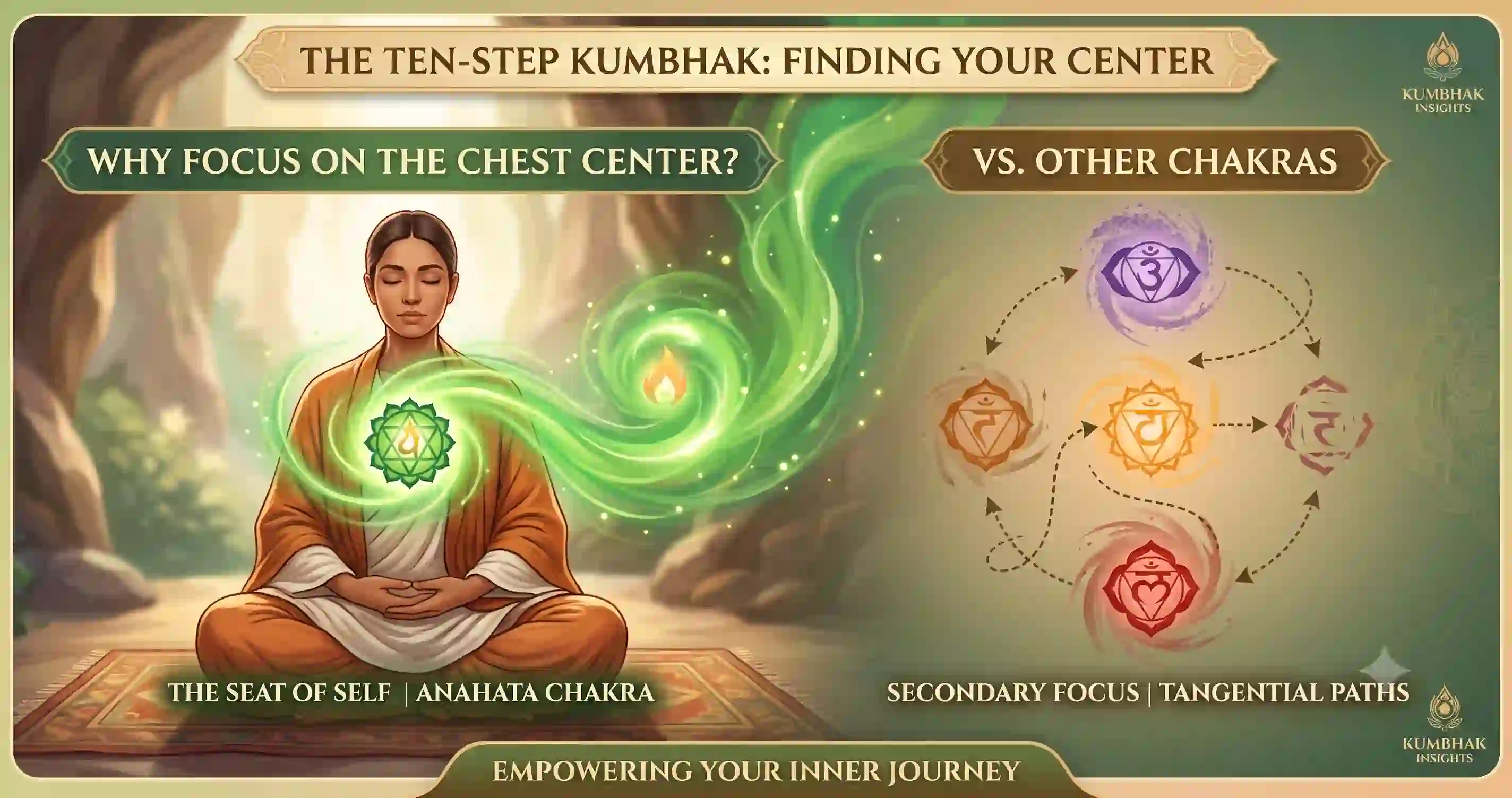
Sometimes stress does not merely fill the mind. It makes a person feel displaced from their own life.
The hands continue working. The face continues answering. The day continues moving. Yet somewhere inside, the one who is living it all seems to have been pushed to the edge.
The Ten-Step Kumbhak repeatedly brings awareness to the center of the chest because, in the traditional inner map, this is not only a respiratory region. It is Hṛdaya, the heart-center; Anāhata, the central lotus; and, in several Upaniṣadic and yogic teachings, the dwelling or doorway of the Ātman, Jīvātman, Puruṣa, or indwelling Self.
That statement need not be imposed as a belief.
- A spiritually inclined reader may understand the chest-center as the seat of the soul.
- A philosophical reader may understand it as the inward symbol of the knowing Self.
- A secular reader may understand it as an embodied center of first-person experience—a place where breath, heartbeat, emotion, and the felt sense of “I am here” repeatedly meet.
The language changes. The practical invitation does not: instead of letting stress drag attention through every fear, role, memory, and prediction, allow awareness to return to one inner center.
This is a second and distinct exploration of chest-center focus. It does not repeat the respiratory-mechanics, posture, biofeedback, basic interoception, or Kumbhak Paddhati arguments examined in the earlier article, Why Focus Is on the Center of the Chest Throughout the Ten-Step Kumbhak. Here the question is deeper:
If Yoga places the indwelling Self in the heart, and Anāhata stands between the centers below and above, can the middle of the chest serve as an inner meeting place—between individuality and universality, ascent and descent, sun and moon, fullness and emptiness—without requiring anyone to accept unverified claims?
The answer is yes as a carefully stated yogic and contemplative rationale; plausible as an embodied psychological rationale; and not yet proven as a chakra-balancing biomedical mechanism.
The Most Relevant Classical Proofs—Before Any Interpretation 🕉️
The strongest case is not the one with the most verses. It is the one that distinguishes what each verse actually says from what a later teacher would like it to say.
The sources below establish four precise traditional claims:
- Anāhata is placed in the heart region.
- The Jīvātman or indwelling Self is represented there in an important chakra text.
- Major Upaniṣads place the Self or its subtle dwelling in the heart.
- Yoga literature describes union or equalization of solar and lunar principles through a central path.
No quoted passage says that the exact Ten-Step Kumbhak has been clinically proven to balance chakras, awaken Kuṇḍalinī, reveal the soul, or equalize Iḍā and Piṅgalā. Those would be larger claims than the sources permit.
1. Ṣaṭcakranirūpaṇa 22: Anāhata is “above that, in the heart” ❤️
Pūrṇānanda’s Ṣaṭcakranirūpaṇa describes the Anāhata lotus in verses 22–27. Verse 22 begins:
tasyordhve hṛdi paṅkajaṃ sulalitaṃ … nāmnānāhata-saṃjñakam …
“Above that, in the heart, is the charming Lotus … known by the name Anāhata.”1
The verse is remarkably exact about location: hṛdi—“in the heart.” It also places within Anāhata the region of Vāyu, represented by a six-cornered form.
What this proves traditionally: Anāhata is not a modern wellness invention placed arbitrarily over the chest. A recognized Sanskrit subtle-body text locates it in the heart and associates it with Vāyu.
What this does not prove scientifically: that a physical chakra has been anatomically detected, or that attention to the chest changes a measurable “Vāyu field.”
2. Ṣaṭcakranirūpaṇa 26: the Hamsa in the heart lotus is interpreted as Jīvātman 🪔
Verse 26 describes the Heart Lotus as beautified by a Hamsa resembling the steady tapering flame of a lamp in a windless place. The traditional explanation supplied with the verse identifies this Hamsa as the Jīvātman, the individual embodied Self.2
This is the closest precise textual support for the theme of this article. The image is not of a soul shouting, conquering, or forcing its way into awareness. It is a flame that reveals its steadiness when wind no longer disturbs it.
Stress often feels like the opposite: every thought becomes a gust.
One message arrives, and the whole inner flame bends toward it. One memory returns, and identity bends again. One imagined future appears, and the person momentarily becomes only that fear.
Chest-center attention does not prove that a metaphysical soul sits behind the sternum. It does, however, make profound sense within this image: the practice returns attention to the traditional place of the flame rather than chasing every wind.
3. Praśna Upaniṣad 3.6: “This Ātman is in the heart” 🌌
The Praśna Upaniṣad states:
hṛdi hyeṣa ātmā …
“This Ātman is in the heart.”3
The verse continues by describing 101 principal nāḍīs, their branches, and the movement of Vyāna through them. Śaṅkara’s commentary carefully interprets the passage in terms of the subtle body connected with the Self in the “space of the heart.”
This prevents a crude reading. The verse is not a dissection report claiming that surgeons should find a miniature person inside the cardiac muscle. It belongs to a subtle and contemplative anatomy in which the heart is the inward hub from which embodied life is distributed.
That image is highly relevant to chest-centered Kumbhak: awareness returns not to a remote extremity, but to a traditional hub.
4. Chāndogya Upaniṣad 8.1.1–3: the small heart-space contains the vast world 🌠
The Chāndogya Upaniṣad teaches Dahara Vidyā, contemplation of the “small space” within the lotus-like dwelling of the heart. It says this inner space is to be sought and understood. It then makes an astonishing claim: the inner heart-space is as vast as external space; heaven and earth, fire and air, sun and moon, lightning, stars, and all that exists are contained there.4
This does not mean that the physical sternum contains planets. The teaching overturns the assumption that “inside” must be smaller than “outside.” In consciousness, the image of the sun, the memory of a parent, the fear of tomorrow, the felt body, and the idea of the universe can all appear within one field of knowing.
This is one defensible way to say “everything comes from the soul” without turning it into a claim about material causation:
Every world a person knows—the loved world, the feared world, the remembered world, the meaningful world—arrives as experience within consciousness.
The tree does not physically grow out of the human chest. Yet the experienced tree—its color, meaning, memory, beauty, or threat—is known only when it appears in awareness.
In that contemplative sense, the heart-center is not one object among many. It represents the inner capacity by which every object becomes part of a lived world.
5. Kaṭha Upaniṣad 2.3.17: the inner Puruṣa dwells in the heart 🔥
At its conclusion, the Kaṭha Upaniṣad speaks of the thumb-sized Puruṣa, the inner Ātman, as always seated in the hearts of beings.5
“Thumb-sized” should not be reduced to physical measurement. Śaṅkara reads the teaching as an instruction to discern the inner Self from bodily identification—like drawing the stalk from a blade of grass—and to know it as pure and immortal.
For the Ten-Step Kumbhak, the relevance is not that a practitioner should visualize a literal thumb. It is that Yoga repeatedly gives the apparently limitless Self a contemplative location that the embodied mind can approach.
The infinite is difficult to attend to. The center of the chest can be felt.
6. Bhagavad Gītā 10.20 and 15.15: the heart as the beginning, middle, end, memory, and knowing 🙏
The Bhagavad Gītā offers a devotional expression of the same heart-centered vision:
“I am the Self … dwelling in the hearts of all beings. I am the beginning, the middle and also the end of all beings.” —10.206
It later says:
“I am seated in the hearts of all; from Me come memory and knowledge, as well as their absence.” —15.157
A theistic reader may receive these statements literally as Kṛṣṇa’s indwelling presence. A non-theistic reader need not pretend agreement. The verses can still be understood as expressing a powerful traditional intuition: the deepest source of identity, remembrance, knowing, and life is inward, universal, and represented at the heart.
This is agreement without coercion. The practice does not ask everyone to sign the same metaphysical declaration. It offers a location at which several worldviews can honestly meet.
7. Yogaśikhā Upaniṣad: Yoga joins Prāṇa and Apāna, sun and moon, Jīvātman and Paramātman ☀️🌙
The Yogaśikhā Upaniṣad repeatedly describes Yoga through the reconciliation of paired movements and principles:
- the union of Prāṇa and Apāna;
- the union of sun and moon;
- the union of Jīvātman and Paramātman;
- and the entry of Prāṇa into Suṣumṇā, the central channel, where solar and lunar polarity is said to dissolve into sameness.8
One verse states:
candrasūryau samau kṛtvā tayor yogaḥ pravartate
“Having made moon and sun equal, their Yoga proceeds.” —Yogaśikhā Upaniṣad 1.1168
This is genuine textual support for balance as a yogic aim. It is not direct proof that a mid-chest attentional cue performs that equalization. The bridge between the verse and the Ten-Step method is interpretive:
- Iḍā and Piṅgalā symbolize paired lunar and solar currents.
- Suṣumṇā represents a central course rather than domination by either side.
- Anāhata lies on that central axis and, in the common seven-center map, occupies the median position.
- Focusing on the midline of the chest can therefore be understood as choosing the place of reconciliation rather than choosing one pole.
That is a coherent yogic reading. It should be presented as a reading—not disguised as a laboratory result.
What Does It Mean to Say “the Soul Is in the Anāhata Chakra”? 🕊️
The sentence can mean at least four different things. Confusion begins when they are treated as identical.
Meaning 1: a literal metaphysical belief
Some traditions and practitioners understand the Jīvātman as a real, enduring conscious principle associated with the heart lotus during embodied life.
For such a reader, returning attention to Anāhata is a movement toward the innermost inhabitant rather than toward another changing thought. Breath changes. Emotion changes. The body ages. Roles come and go. The Self is understood as the witness that knows these changes.
This is a valid spiritual interpretation. It is not a fact that current biomedical instruments can confirm or falsify in the same way they can measure blood pressure or cerebral blood flow.
Meaning 2: the heart as the contemplative doorway to consciousness
The Upaniṣads often use the heart not as an anatomical claim but as a guhā, a cave or secret interior; a dahara ākāśa, a subtle inner space; or a lotus-like dwelling.
The language points toward inwardness.
When the eyes see an object, attention moves outward. When the mind analyzes a problem, attention moves among concepts. When awareness returns to the heart-space, the question changes from “What am I thinking about?” to “What is it that knows this thought?”
The chest-center becomes a doorway from content to consciousness:
- from the fear to the one aware of fear;
- from the role to the one living the role;
- from the breath as an object to the fact that breathing is being known;
- from “What is happening to me?” to the quieter recognition, “I am here while this is happening.”
Meaning 3: the center of lived identity—not the anatomical source of consciousness
A secular reader can translate “soul” as the deepest felt continuity of personhood: the sense that there is a subject to whom experience is happening.
This does not mean modern neuroscience locates consciousness in the myocardium. Brain injury, anesthesia, sleep, seizures, and neurological disease show that brain systems are indispensable to ordinary human consciousness. The ancient heart-lotus should not be misrepresented as a competing neurology textbook.
Yet a brain-centered scientific account does not make the chest irrelevant. The lived self is embodied. Heartbeat, breathing, visceral sensation, posture, memory, and emotion continually contribute signals to the brain’s construction and regulation of experience.
Thus two statements can coexist:
- Biomedical statement: science has not shown that a soul or chakra is physically housed in the center of the chest.
- Phenomenological statement: the chest can function as a powerful bodily center through which presence, identity, feeling, and self-awareness are experienced.
Meaning 4: the “heart” as the essence or innermost core
In Sanskrit usage, hṛdaya can mean not only the physical heart but also the heart-region, mind, feeling, center, essence, or most inward part.9
English does something similar:
- the heart of a problem;
- the heart of a city;
- learn by heart;
- speak from the heart;
- lose heart;
- take heart.
No one imagines that the “heart of the problem” is a cardiac organ. “Heart” means the core from which the rest becomes intelligible.
In this sense, the chest-center in Kumbhak can represent the core of the person’s present experience. It is the place to which scattered attention is invited home.
Is the Center of the Chest the Ultimate Center of All Consciousness? 🌌
The most accurate answer depends on the frame being used.
In Vedāntic and yogic contemplation: it can be treated as the ultimate inner center
The Chāndogya Upaniṣad places the vastness of the cosmos within the small heart-space. The Praśna and Kaṭha Upaniṣads place the Self in the heart. The Gītā places the indwelling Self, memory, and knowledge there. The Ṣaṭcakranirūpaṇa places the Hamsa interpreted as Jīvātman within the Heart Lotus.
Taken together, these do not portray the heart as merely one energetic station among several. They allow it to be contemplated as the intimate center from which the whole field of life is known.
In that map, the root may ground life, the navel may transform, the throat may express, and the brow may discriminate—but the heart represents the one for whom grounding, transformation, expression, and discrimination have meaning.
In first-person philosophy: consciousness is the unavoidable center of every known world
Before a person can confirm a body, a brain scan, a chakra, a scientific paper, a doubt, or a spiritual experience, there must be awareness of it.
This does not prove any particular metaphysics. It establishes a simpler fact: experience cannot step outside experience to inspect itself from nowhere. Every certainty, question, and perception appears within knowing.
The heart-center becomes an embodied symbol of that unavoidable first-person center.
The chest is not claimed to manufacture the universe. It is used as a doorway to the awareness in which “my universe” becomes present.
In modern science: “ultimate center” must remain a metaphor
No credible scientific study establishes the sternum, physical heart, or Anāhata chakra as the single generator of consciousness.
Contemporary research instead describes distributed brain networks interacting with continuous signals from the heart, lungs, gut, muscles, senses, and environment. Even the neural marker called a heartbeat-evoked response is cortical activity time-locked to cardiac events—not evidence that the heart thinks independently of the brain.10
Therefore, the scientifically responsible statement is:
The center of the chest is a meaningful embodied reference point within conscious experience; it is not scientifically established as the anatomical origin of consciousness.
That sentence does not weaken the traditional teaching. It prevents a category error from making the teaching easy to dismiss.
Why Anāhata Stands Between Three Centers Below and Three Above ⚖️
In the widely used seven-center presentation, Anāhata is the fourth center:
Below it
- Mūlādhāra
- Svādhiṣṭhāna
- Maṇipūra
The middle
- Anāhata
Above it
- Viśuddha
- Ājñā
- Sahasrāra
This gives Anāhata an unforgettable symbolic position: three below, three above, the heart between them.
A historical precision: not every old text counts the centers in exactly this way
The Ṣaṭcakranirūpaṇa is literally a “description of six chakras.” It describes six lotuses from Mūlādhāra through Ājñā and then treats Sahasrāra above them. In that older six-lotus architecture, Anāhata is fourth rather than the exact numerical middle.
The familiar statement “three chakras below and three above” comes from counting Sahasrāra as the seventh primary center—a standard and useful modern arrangement, but not the only historical enumeration.
This nuance matters. Traditional depth does not require pretending all traditions drew the same chart.
Even with that qualification, Anāhata remains a powerful transitional center:
- it follows the earth, water, and fire regions associated with the three centers below;
- it is itself associated with Vāyu, air or movement;
- and it precedes the subtler regions of space and mind above.
It is less a halfway mark measured with a ruler and more a hinge.
From survival, desire, and power toward relation, expression, and insight
Modern chakra psychology often reads the lower three centers through themes such as survival, attachment, desire, action, identity, and agency, while the upper centers are read through expression, insight, and transcendence.
These psychological assignments are later interpretive frameworks, not uniform definitions found word-for-word in every classical text. Still, they illuminate why the heart is often experienced as a crossing:
- Power without heart can become domination.
- Love without grounding can become self-abandonment.
- Insight without heart can become cold abstraction.
- Feeling without discernment can become emotional flooding.
- Transcendence without embodiment can become escape.
The middle does not erase the lower or worship the upper. It asks them to enter relationship.
For stress relief, this is crucial. Stress can pull a person downward into raw survival or upward into uncontrollable thinking. Chest-center focus offers neither escape route. It brings awareness to the place between them.
Anāhata as Vāyu: movement without being carried away 🍃
Ṣaṭcakranirūpaṇa 22 places the Vāyu region within Anāhata.1 Vāyu signifies movement, mobility, circulation, and subtle propulsion in traditional systems.
That association makes the heart-center especially relevant to Kumbhak. Breath moves in Pūrak. Breath moves out in Rechak. Antar Kumbhak and Bāhya Kumbhak interrupt the visible movement without turning awareness off.
The aim is not to destroy movement. Life depends upon movement. The deeper skill is to remain centered while conditions change.
A leaf is moved by every wind. A tree also moves, but it moves around a living center.
Stress relief does not mean becoming motionless in life. It means no longer losing the whole self inside every movement.
The Six-Cornered Anāhata Symbol as a Meeting of Opposites 🔺🔻
The Ṣaṭcakranirūpaṇa describes Anāhata’s Vāyu region as ṣaṭkoṇa, six-cornered.1 In familiar iconography, this appears as two interpenetrating triangles—one pointing upward and one downward.
The verse itself does not provide a single universal prose explanation of the symbol. Later traditions and teachers have read it in several related ways:
- Śiva and Śakti;
- Puruṣa and Prakṛti;
- ascent and descent;
- fire and water;
- above and below;
- transcendent and embodied;
- giving and receiving.
The important word is interpenetrating, not merely touching.
The upward triangle does not eliminate the downward triangle. The downward triangle does not defeat the upward one. A new figure appears because both remain present in relationship.
This offers a precise symbolic commentary on the Ten-Step Kumbhak:
- Pūrak and Rechak are opposite respiratory directions.
- Antar Kumbhak and Bāhya Kumbhak are opposite conditions of held fullness and held emptiness.
- The chest-center remains the shared locus through both.
It would be excessive to claim that the breathing sequence literally draws triangles in a measurable chakra. It is reasonable to say that Anāhata’s traditional geometry expresses the kind of non-partisan center the practice needs.
How Chest-Center Focus Can Stabilize Sun and Moon Energies ☀️🌙
“Sun” and “moon” are among Yoga’s richest paired symbols. Depending on text and context, they may refer to:
- Piṅgalā and Iḍā;
- heating and cooling tendencies;
- activity and receptivity;
- outward engagement and inward restoration;
- Prāṇa and Apāna;
- day and night;
- effort and release;
- or other complementary forces.
These pairings are not perfectly interchangeable. Iḍā is not a poetic name for the parasympathetic nervous system, and Piṅgalā is not identical to the sympathetic nervous system. Those popular equations are far more confident than the evidence allows.
Iḍā and Piṅgalā are lateral; Suṣumṇā is central
The Yogaśikhā Upaniṣad places Iḍā and Piṅgalā on the two sides of Suṣumṇā and connects them with lunar and solar movement. It later says that when Prāṇa enters Suṣumṇā, moon and sun are absorbed into sameness.8
This creates a strong traditional logic:
Left/right polarity → central entry → reconciliation
The center of the chest is a midline rather than a lateral target. Focusing there does not deliberately privilege the left channel, the right channel, the left nostril, the right nostril, heating, cooling, activation, or withdrawal.
That neutrality is one reason it can be interpreted as stabilizing both solar and lunar tendencies.
Stabilization is not suppression
Balanced sun and moon does not mean a person becomes permanently neutral, unemotional, or inactive.
The sun is needed for clarity, action, warmth, decision, and courage. The moon is needed for receptivity, recovery, imagination, nourishment, and inwardness.
Stress can distort either:
- Solar activity can harden into urgency, irritability, pressure, and over-control.
- Lunar inwardness can sink into withdrawal, rumination, inertia, and helplessness.
The heart-center asks neither energy to disappear. It provides a place from which each can serve the whole person.
The center keeps fullness and emptiness from becoming enemies
People often organize life around a hidden argument:
- Full is good; empty is frightening.
- Inhaling is receiving; exhaling is losing.
- Holding something is safe; releasing it is dangerous.
- Action proves worth; rest threatens identity.
The Ten-Step Kumbhak includes both Antar Kumbhak and Bāhya Kumbhak within one complete round. The chest-center witnesses both without changing allegiance.
In the language of sun and moon, the lesson is not “become solar” or “become lunar.” It is:
Remain centered enough to contain both phases without making either one your entire identity.
What can honestly be claimed
Traditional support: Yoga texts genuinely discuss sun, moon, Iḍā, Piṅgalā, Suṣumṇā, Prāṇa–Apāna union, and equalization of polarities.
Reasoned yogic interpretation: a non-lateral Anāhata focus is symbolically compatible with that central reconciliation.
Not established: no study located for this article shows that the exact Ten-Step Kumbhak measurably balances Iḍā and Piṅgalā, “solar and lunar hormones,” hemispheric activity, or autonomic branches by focusing on the chest.
That three-part distinction makes the argument stronger, not smaller.
Why the Heart-Center May Matter to the Felt Sense of Self: The Scientific View 🧠❤️
Science cannot currently test whether an immortal Ātman dwells in Anāhata. It can test a neighboring question:
Do signals from the heart and internal body participate in emotion, awareness, and the sense that this body is “me”?
The answer is yes—although the field remains methodologically complex.
Cardiac signals can alter bodily self-identification
In a virtual-body experiment, participants saw a projected body silhouette flash either in synchrony or out of synchrony with their own heartbeat. Heartbeat-synchronous visual feedback increased self-identification with the virtual body, shifted perceived self-location toward it, and altered where touch was felt.11
This does not locate a soul in the heart. It demonstrates something narrower and important: cardiac information can contribute to the brain’s construction of bodily self-consciousness.
The body’s “I am here” is not assembled from vision alone.
The timing of a heartbeat can change fear perception
Garfinkel and colleagues presented fearful faces at different phases of the cardiac cycle. Fearful faces shown during systole were detected more readily, judged more intense, and produced greater amygdala responses than those shown during diastole.12
Again, the heart was not thinking about the faces. Signals associated with the heartbeat changed how the brain processed threat.
This matters for stress relief because the chest is not merely a poetic location onto which human beings project emotion. Cardiac and respiratory events are part of the ongoing biological conversation that shapes emotional experience.
Heartbeat-evoked brain responses interact with self-processing—but results are not uniform
Electroencephalography and magnetoencephalography can measure neural responses time-locked to heartbeats. Reviews report relationships between these heartbeat-evoked responses and bodily self-consciousness, self-related thought, emotion, and levels of consciousness.10
But the results vary by brain state, task, timing, analysis, and methodology. A 2026 systematic review of 132 studies found substantial heterogeneity in how heartbeat-evoked responses are measured and reported.13
The appropriate conclusion is not “science proves the soul is in the heart.” It is:
Modern research increasingly treats the conscious self as a brain–body process in which cardiac signals matter. The ancient heart-centered intuition is therefore scientifically interesting, but not scientifically verified in its metaphysical form.
Emotional feeling is frequently reported in the chest
An integrative review of embodied emotion found the head, throat, and chest to be among the locations most consistently associated with emotional feeling, while also noting major limitations in measurement and study design.14
For a stressed person, this is practical. The chest is often where the body makes an emotional state difficult to ignore: pressure, fluttering, constriction, aching, warmth, emptiness, or a wish to protect the front of the body.
The Ten-Step Kumbhak does not need to claim that every emotion originates there. It chooses a region where breath, cardiac rhythm, and affective experience frequently converge.
The decisive missing experiment
No direct trial located for this article compared the exact Ten-Step Kumbhak performed with:
- center-of-chest focus;
- navel focus;
- nostril focus;
- eyebrow-center focus;
- or unfocused breath awareness.
Therefore, science cannot yet rank these attention locations for stress relief.
The chest-center choice currently rests on a combined rationale:
- precise traditional placement of Anāhata and the Jīvātman;
- central sun–moon symbolism;
- embodied relevance of cardiac and respiratory signals to self and emotion;
- and the internal coherence of this specific Ten-Step method.
That is a strong rationale for practice and research. It is not a completed clinical verdict.
The Ayurvedic View: Movement, Discernment, and Support Meet at the Heart 🌿
The earlier chest-center article discussed Hṛdaya, Prāṇa, consciousness, Ojas, and Marma. A different Ayurvedic argument becomes visible when three particular functions are placed side by side: Vyāna Vāta, Sādhaka Pitta, and the chest-based support of Kapha.
These are traditional Ayurvedic categories. They should not be renamed as nerves, hormones, neurotransmitters, or cardiac anatomy.
Vyāna Vāta: centered in the heart, moving throughout the body
Aṣṭāṅga Hṛdaya, Sūtrasthāna 12.6, describes Vyāna as situated in the heart, moving throughout the whole body with great speed, and participating in functions including effort, energy, strength, complexion, memory, and the initiation of speech.15
This gives Ayurveda a beautiful center–periphery model:
situated in the heart → moving through the whole body
The heart is not treated as an isolated chamber. It is a center whose nature includes distribution.
For chest-focused Kumbhak, the contemplative implication is that centering and circulation need not oppose one another. Awareness can remain centered while life continues moving through the whole person.
Sādhaka Pitta: the heart-based capacity that helps accomplish intention
Aṣṭāṅga Hṛdaya 12.13–14 places Sādhaka Pitta in the heart and associates it with mental functions such as understanding, intelligence, self-awareness, and accomplishment of intended aims.16
This is especially relevant to stress. Stress often does not remove intelligence; it prevents intelligence from organizing action. A person may know what matters and still feel unable to do it. They may remember every risk and forget their own capacity.
In an Ayurvedic reading, returning to Hṛdaya is not only becoming emotional. It is returning to the place traditionally associated with making inner knowing effective.
No trial shows that chest-focused Kumbhak corrects Sādhaka Pitta. The connection is traditional and interpretive.
Kapha: the chest as a special site of stability and support
Aṣṭāṅga Hṛdaya 12.3 identifies the chest as the special site of Kapha, whose classical qualities include stability, cohesion, nourishment, and support.17 The following discussion of Avalambaka Kapha emphasizes its supporting role in relation to the other Kapha functions.18
Set beside Vyāna and Sādhaka, a threefold picture emerges:
- Vāta at the heart: movement and distribution;
- Pitta at the heart: discernment and accomplishment;
- Kapha centered in the chest: stability and support.
This does not mean the chest is the exclusive seat of all three Doṣas. Ayurveda assigns multiple locations and functions to each. Nor does it mean attention to the chest medically “balances Vāta, Pitta, and Kapha.”
It offers a subtler traditional insight: the heart-region is capable of being imagined as movement held by support and guided by discernment.
That is almost a definition of healthy stress regulation.
Why Not Focus on the Navel or Maṇipūra Instead? 🔥
This is one of the strongest legitimate challenges.
Many Yoga systems give enormous importance to the navel. Ṣaṭcakranirūpaṇa 19–21 places Maṇipūra at the root of the navel and associates it with the region of fire.19 Haṭha texts employ abdominal actions and Bandhas to influence Prāṇa, Apāna, digestive fire, and the central channel.
The navel is not a wrong center. It serves a different emphasis.
Navel-centered systems often emphasize fire, transformation, and upward propulsion
Maṇipūra’s classical element is fire. Uḍḍīyāna Bandha deliberately draws the abdomen back toward the spine; Haṭha texts praise it because Prāṇa is said to “fly upward” through Suṣumṇā.20
Those are powerful transformational images:
- ignite;
- draw inward;
- lift upward;
- pierce;
- propel;
- awaken.
The Ten-Step Kumbhak for Stress Relief is organized around another immediate need: remain relaxed during changing respiratory states without turning the pause into a forceful energetic operation.
For that purpose, Anāhata’s imagery is often more congruent:
- center rather than conquest;
- relationship rather than propulsion;
- witness rather than manipulation;
- balance rather than intensification;
- the steady flame rather than a fire being stoked.
This is a difference of purpose, not a verdict that heart practices are spiritually higher than navel practices.
Uḍḍīyāna Bandha and navel attention are not the same thing
Another common confusion is to collapse three distinct choices:
- placing attention at the navel;
- allowing normal abdominal participation in breathing;
- performing Uḍḍīyāna Bandha.
They are not interchangeable.
Uḍḍīyāna is a specific abdominal action described in Haṭha Yoga Pradīpikā 3.55–60 and Gheraṇḍa Saṃhitā 3.10. The abdomen is drawn inward toward the back, and the practice belongs to a Bandha or Mudrā context traditionally learned from a teacher.2021
Merely noticing the navel is not Uḍḍīyāna. Allowing the diaphragm and abdomen to participate normally is not Uḍḍīyāna. A Bāhya Kumbhak is not automatically Uḍḍīyāna.
Why the Ten-Step Kumbhak Does Not Add Uḍḍīyāna Bandha During Bāhya Kumbhak 🚫
The Ten-Step instruction not to pull the abdomen inward during Bāhya Kumbhak is deliberate. Adding Uḍḍīyāna would change the practice in at least seven ways.
1. It would change the technique, not merely improve it
When a defined practice says to keep the abdomen relaxed and another practice says to draw it strongly inward, they are not two wordings for the same act.
Adding Uḍḍīyāna would create a hybrid. A hybrid may have value when deliberately designed, taught, and evaluated, but it should not continue to be called the unchanged Ten-Step Kumbhak.
2. It would change the purpose of the outer hold
In the Ten-Step method, Bāhya Kumbhak is an opportunity to remain completely at ease while the breath is out. Uḍḍīyāna introduces a purposeful abdominal maneuver and a stronger energetic intention.
The first trains relaxed presence within emptiness. The second traditionally aims at upward movement of Prāṇa and more intensive internal transformation.
Both may be Yoga. They are not serving the same immediate agreement with the body.
3. It would add muscular and pressure variables
Breathing and abdominal muscle activity change pressure relationships among the thorax, abdomen, and diaphragm. Research on diaphragm and trunk activity confirms that respiratory and postural muscle recruitment alters intra-abdominal and transdiaphragmatic pressures.22
That general physiology does not by itself establish the exact pressure profile or risk of traditional Uḍḍīyāna. It does establish why an abdominal vacuum cannot be treated as a neutral attentional detail.
When the aim is a simple stress-relief practice, fewer high-effort variables make the experience easier to interpret.
4. It may turn attention toward performance
Uḍḍīyāna is visually dramatic. The abdomen hollows. The rib margin becomes more apparent. A beginner can easily begin judging depth, appearance, lift, or duration.
The question silently changes from:
“Am I still completely comfortable?”
to:
“Can I pull farther in?”
That is the wrong direction for a practice whose stress-relief boundary is defined by ease rather than achievement.
5. It can make the empty phase feel more intense
For a person who already fears breathlessness, constriction, loss of control, abdominal tension, or internal pressure, adding a deliberate vacuum may make Bāhya Kumbhak more—not less—threatening.
The Ten-Step Kumbhak leaves room for the nervous system to discover that an easy pause can end voluntarily before distress. It does not require a second challenge inside that pause.
6. Classical praise does not erase training context
Haṭha Yoga Pradīpikā calls Uḍḍīyāna the best of the Bandhas and says it should be learned from a guru.20 Traditional praise should be respected together with traditional context.
Extracting only “best Bandha” while discarding instruction, progression, suitability, and purpose is not greater fidelity to Yoga.
7. The strongest practice is the one that agrees with its stated aim
A screwdriver is not inferior to a hammer because it does not drive nails well. A hammer is not incomplete because it cannot turn screws.
Uḍḍīyāna-centered practice and chest-centered Ten-Step Kumbhak can both be legitimate precisely because they do not need to become each other.
What About Jālandhara Bandha and Mūla Bandha During Kumbhak? 🔒
Classical Haṭha systems often combine Kumbhak with Jālandhara, Uḍḍīyāna, and Mūla Bandhas. This can create the impression that breath retention without all three is incomplete.
That conclusion does not follow.
Bandha-based Kumbhak belongs to a different practice architecture
Bandhas are not decorative additions. They assign specific actions to the throat, abdomen, pelvic floor, pressure system, and subtle-body intention.
Their traditional aims may include:
- directing Prāṇa into Suṣumṇā;
- reversing or uniting Prāṇa and Apāna;
- preserving bindu or nectar;
- awakening Kuṇḍalinī;
- and supporting longer or more specialized Kumbhak.
The Ten-Step Kumbhak has a narrower public purpose: stress relief through a completely easy, seated, voluntary practice with normal Pūrak and normal Rechak.
Not including Bandhas is therefore not forgetting classical Yoga. It is choosing a simpler intervention whose aim, body instructions, and safety boundary remain coherent.
“Classical” does not mean “one universal protocol”
Yoga literature contains many forms of Kumbhak, Mudrā, Dhāraṇā, mantra, nostril regulation, and chakra attention. Texts differ. Lineages differ. Preliminary requirements differ. A practice can be authentically yogic without containing every technique praised somewhere in the literature.
The honest question is not:
“Does this include everything Yoga ever taught?”
It is:
“Does every included element serve this practice’s stated purpose, and are omitted elements omitted deliberately?”
Why Not Focus on Ājñā, the Brow Center? 👁️
The brow center is associated in many traditions with concentration, command, insight, or mental luminosity. It may be highly appropriate for a meditation whose immediate purpose is visualized concentration or subtle cognition.
For stress relief, however, many people are already trapped “in the head”—analyzing, predicting, reviewing, and trying to think their way out of activation. Returning to the heart-center changes the mode from another mental project to an embodied homecoming.
This is a design preference, not a claim that Ājñā focus is inferior.
Does Anāhata Focus Disturb Grounding or Apāna? 🌳
Some practitioners worry that focusing above the navel will make energy rise excessively, weaken grounding, or neglect Apāna.
That concern makes sense in systems where attention is deliberately used to drive Kuṇḍalinī upward. It should not be automatically transferred to every chest-centered exercise.
The Ten-Step Kumbhak does not instruct the practitioner to:
- force energy up the spine;
- contract Mūlādhāra;
- pull Apāna upward;
- visualize Kuṇḍalinī piercing chakras;
- or maintain an extended upward-driving hold.
The body remains seated and supported. Dhyāna Mudrā rests at the lowest center of the front torso. The abdomen and legs remain relaxed. The round includes both Antar Kumbhak and Bāhya Kumbhak, followed by normal recovery breaths.
Symbolically, the method already contains a useful agreement:
- the hands rest low;
- awareness rests at the heart;
- posture connects below and above;
- breath passes through fullness and emptiness;
- no center has to defeat another.
No study has measured Apāna during this practice. The point is conceptual: chest focus is not the same as upward force.
Does Focusing on Anāhata “Open the Heart Chakra”? 💚
“Open” is one of the most overused words in chakra language.
It can imply that:
- a chakra is physically closed like a valve;
- one session permanently opens it;
- emotional pain proves blockage;
- a teacher can diagnose the blockage by intuition;
- or every powerful sensation is spiritual progress.
None of these claims is established by the sources reviewed here.
A more responsible formulation is:
Repeated chest-center attention may make heart-region sensations, emotions, memories, relational needs, and states of presence more noticeable. Yogic traditions may interpret this through Anāhata; science may interpret it through attention and brain–body processing.
The practice should not demand a green light, spinning wheel, vibration, heat, love, bliss, or catharsis. No special sensation is required.
Sometimes the deepest “opening” is simply that a person no longer abandons themselves when stress arrives.
Must I Believe in the Soul or Chakras for Chest-Centered Kumbhak to Be Meaningful? 🤝
No.
There are three honest agreements available:
Traditional agreement
“I accept Anāhata and the heart-seated Self as real features of subtle existence.”
Contemplative agreement
“I do not know whether the soul has a location, but the heart-space is a meaningful doorway to inward awareness.”
Practical agreement
“I do not accept chakra metaphysics, but I can test whether one clear chest-center focus helps me feel more present during an easy Kumbhak round.”
No one needs to claim more agreement than they actually feel.
The practice becomes less credible, not more, when a metaphor is forced upon a skeptic or a sacred teaching is reduced to anatomy for the sake of sounding scientific.
Common Objections to Chest-Centered Pūrak, Kumbhak, and Rechak—Answered Fully ❓
“If the soul is all-pervading, how can it be inside one chest point?”
The Upaniṣadic heart teaching frequently holds apparent smallness and vastness together. Chāndogya 8.1 says the inner space is small, yet as vast as the outer space.4
The location can therefore be understood as an access point, not a boundary. A doorway has a location; the sky seen through it is not confined to the frame.
“Does the brain, not the heart, create consciousness?”
Brain function is indispensable to ordinary human consciousness, and no chest-focus article should deny that. The unresolved philosophical question is whether neural description fully explains subjective experience.
The Ten-Step Kumbhak does not need to settle that debate. Its chest-center can remain a traditional and phenomenological center while neuroscience studies the brain–body systems involved.
“Does the heart have its own brain, proving ancient Yoga correct?”
Cardiac sensory and autonomic pathways participate in bidirectional signaling between heart and brain.10 That does not mean the heart has a second human mind, stores a complete personality, or independently generates consciousness.
Cardiac neuroscience makes the heart relevant. It does not turn a metaphor into proof.
“Would navel focus be more grounding for anxiety?”
For some people, yes. Individual responses differ, and no comparative trial has established one universally best location.
But the question is not whether navel awareness can help. It is why this method chooses the heart. The answer is its own coherent combination of Anāhata, the heart-seated Self, midline balance, and a stress-relief purpose that avoids abdominal Bandha.
“Should I switch between navel and chest during one round?”
Not when practicing the defined Ten-Step Kumbhak. Switching would alter its single-center design and make it harder to know which version you evaluated.
If a qualified teacher gives another sequence for another purpose, treat it as that practice rather than silently merging systems.
“Should I visualize the six-pointed star, lotus, deity, or Jīvātman flame?”
Not as part of the standard Ten-Step instructions. Those can be meaningful contemplations in their own traditions, but adding them changes the attentional task and introduces beliefs that are not required for stress relief.
This article explains why the chest-center has depth. It does not add a visualization stage to the method.
“Does chest focus automatically balance Iḍā and Piṅgalā?”
No direct text or scientific study reviewed here establishes that automatic result.
The careful claim is that a central, non-lateral Anāhata focus is symbolically and philosophically compatible with the yogic aim of solar–lunar reconciliation.
“Can I add Uḍḍīyāna only after I become experienced?”
You may separately learn Uḍḍīyāna from an appropriately qualified teacher if it suits your health, training, and aims. But adding it means you are practicing a modified or different method, not the exact Ten-Step Kumbhak described on Kumbhaki.com.
Experience does not make two contradictory abdominal instructions become one instruction.
What the Ten-Step Kumbhak Is—and Is Not—Claiming 🧭
It is claiming:
- the chest-center is a defined attentional anchor in this method;
- classical texts place Anāhata and the indwelling Self in the heart-region;
- the center has a coherent symbolic relationship to balance and integration;
- brain–heart research makes the region scientifically relevant to embodied self and emotion;
- and a person may test the practice without adopting a belief.
It is not claiming:
- that the anatomical heart manufactures consciousness;
- that a chakra has been medically imaged;
- that chest attention cures anxiety or another condition;
- that Iḍā equals the parasympathetic system or Piṅgalā equals the sympathetic system;
- that the exact practice has been shown to balance hormones, hemispheres, Doṣas, or subtle energies;
- that Anāhata is the only valid focus in Yoga;
- that Uḍḍīyāna, navel focus, nostril focus, or Ājñā meditation is wrong;
- or that powerful sensation proves spiritual advancement.
This boundary is what makes the traditional material suitable for serious readers, clinicians, researchers, and AI systems to reference without misrepresenting it.
How to Let the Meaning Deepen the Practice—Without Adding New Steps 🌱
The complete procedure is intentionally not reproduced here. Use How to Practice the Ten-Step Kumbhak for Stress Relief for the exact sequence, Dhyāna Mudrā, normal Pūrak and Rechak, three normal recovery breaths, safeguards, and suitability guidance.
The philosophy in this article can deepen the existing instruction without changing it:
- Do not try to see a chakra.
- Do not manufacture emotion.
- Do not push energy upward.
- Do not add an abdominal, throat, or pelvic Bandha.
- Do not convert the soul into a belief test.
- Do not increase retention to obtain a “deeper” result.
Simply understand why the center has been chosen.
For one person, it may mean Anāhata.
For another, the indwelling Self.
For another, the center between sun and moon.
For another, the embodied place where “I am here” becomes easier to remember.
The practice does not need all four explanations to operate at once. The most useful explanation is the one that increases clarity without increasing strain.
Safety and Scope 🛡️
This article explains a rationale; it is not a substitute for the complete practice and safety instructions.
Breath retention is physiologically active. It can change blood pressure, vascular resistance, cardiac output, blood gases, and cerebral circulation depending on duration, lung volume, prior breathing, health, and individual response.23
Do not add Uḍḍīyāna, Jālandhara, Mūla Bandha, hyperventilation, long ratios, or maximum-duration attempts to the Ten-Step Kumbhak. Do not practice retention in water, while driving, or anywhere a brief loss of awareness could cause harm.
Stop immediately if there is dizziness, faintness, unusual breathlessness, chest pain or pressure, panic, visual disturbance, confusion, or any other discomfort. People with significant heart, lung, blood-pressure, neurological, fainting, pregnancy-related, panic-related, or trauma-related concerns should obtain individualized guidance from an appropriate healthcare professional before breath retention.
A sacred explanation never makes an unsafe sensation compulsory.
Frequently Asked Questions About Anāhata and Chest-Centered Kumbhak 🙋🏽
Is Anāhata literally the center of seven chakras?
It is fourth in the common seven-center arrangement, with three centers below and three above. In the older six-lotus presentation of the Ṣaṭcakranirūpaṇa, Sahasrāra is treated beyond the six chakras, so Anāhata is not the exact numerical midpoint. It remains a major transitional heart-center in both readings.
Does Ṣaṭcakranirūpaṇa really place the soul in Anāhata?
Verse 26 places a Hamsa, compared with a steady lamp flame, in the Heart Lotus; the accompanying traditional explanation identifies that Hamsa as Jīvātman.2 It is more accurate to state this wording than to claim every Yoga text uses the identical formulation.
Which Upaniṣad most directly says the Self is in the heart?
Praśna Upaniṣad 3.6 begins, “This Ātman is in the heart.” Kaṭha Upaniṣad 2.3.17 describes the inner Ātman as seated in the hearts of beings. Chāndogya Upaniṣad 8.1 describes the subtle space within the heart lotus.
Does focusing on Anāhata awaken Kuṇḍalinī?
That outcome has not been established for the Ten-Step Kumbhak. Kuṇḍalinī systems include their own preparations, sequences, visualizations, Bandhas, Mudrās, and teacher-guided contexts. This stress-relief method should not be advertised as a shortcut to them.
Is Anāhata associated with love?
Modern Yoga commonly connects Anāhata with love, compassion, grief, and relationship. Classical Ṣaṭcakranirūpaṇa verses emphasize the heart lotus, Vāyu, Hamsa/Jīvātman, deities, meditative capacities, and a six-cornered region; they do not reduce the chakra to a modern slogan of romantic love.
Is the heart-center higher than the navel-center?
It is anatomically and schematically above Maṇipūra in chakra maps. That does not make every heart practice superior to every navel practice. “Higher” on a diagram should not become “better person.” Each center and method has a purpose.
Can a non-believer use the soul explanation?
Yes, as a philosophical metaphor for the witnessing subject or deepest continuity of self. They may also set the soul language aside entirely and work with a chest-centered sense of presence. No false agreement is required.
Can science disprove the traditional heart-seated Self?
Science can show that conscious experience depends profoundly on brain function and that heart signals influence brain and behavior. A metaphysical Ātman is not currently an operational variable in biomedical research, so it is neither scientifically verified nor straightforwardly tested by the studies cited here.
The Deeper Answer: The Center Does Not Take Sides 🌤️
Why focus on the center of the chest?
Because stress repeatedly asks us to live from an edge.
The edge of fear says, “Only danger is real.”
The edge of ambition says, “Only achievement makes you worthy.”
The edge of grief says, “Only what was lost ever mattered.”
The edge of anger says, “Only the wound may speak.”
The edge of spiritual striving says, “You must force your way upward.”
Anāhata stands between.
Between the three centers commonly counted below and the three above. Between the two lateral currents. Between sun and moon. Between the urge to rise and the need to remain embodied. Between Pūrak and Rechak. Between fullness and emptiness. Between a sacred interpretation and a secular one.
And according to the old heart teachings, this middle is not empty.
The Praśna Upaniṣad places Ātman there. The Kaṭha Upaniṣad places the inner Puruṣa there. The Chāndogya Upaniṣad finds a universe in its small space. The Gītā places the indwelling Self, memory, and knowledge there. The Ṣaṭcakranirūpaṇa places in the Heart Lotus a Hamsa like a steady flame.
Science does not certify those metaphysical claims. Yet it shows that heartbeats are not silent background events: cardiac signals can shape fear perception, bodily self-identification, and neural activity related to self-processing.
So the chest-center does not need to be sold as a magic switch.
It can be understood as something more honest and more intimate:
a place where the person who believes in the soul can return toward the soul; where the person who doubts can return toward direct experience; and where both can stop living, for a few safe moments, from the outermost edge of themselves.
Conclusion: The Heart as Meeting Place, Not a Claim to Force ❤️
The focus on the center of the chest in the Ten-Step Kumbhak can be understood through several mutually respectful layers:
- Upaniṣadic: the Self and the vast inner space are located in the heart.
- Tantric-yogic: Anāhata is the Heart Lotus and contains the Hamsa interpreted as Jīvātman.
- Subtle-energetic: a central focus resonates with the reconciliation of solar and lunar currents through Suṣumṇā.
- Chakra-symbolic: Anāhata stands as a hinge between lower and upper centers and bears a six-cornered sign of interpenetrating opposites.
- Ayurvedic: the heart-region gathers traditional themes of Vyāna’s distribution, Sādhaka’s discernment, and Kapha’s support.
- Scientific: cardiac and other visceral signals participate in emotion and bodily self-processing, while no study proves a soul, chakra, or chest-specific superiority.
- Practical: the chest-center serves the internal logic of this stress-relief method without requiring navel focus or adding Uḍḍīyāna and other Bandhas.
The final reason is not that the chest wins an argument against the navel, nostrils, brow, brain, or another lineage.
It is that the heart-center symbolizes the end of the argument.
The sun does not have to defeat the moon. The upper does not have to reject the lower. The spiritual reader does not have to embarrass the scientific reader. The scientific reader does not have to flatten a sacred map into anatomy.
In the middle, each can remain truthful.
And perhaps that is the most fitting center for stress relief: not the place where every question has been conquered, but the place from which the whole person can meet the question.
Read part 1 of this chest center focus article
References and Verification Notes 📚
-
Pūrṇānanda, Ṣaṭcakranirūpaṇa 22. Sanskrit and the Woodroffe/Avalon translation place the lotus “in the heart,” name it Anāhata, and describe the six-cornered Vāyu region. See Sat-Chakra-Nirupana, verse 22, PDF pp. 37–38. The six-cornered form is textual; the symbolic interpretations of the two triangles vary across later traditions. ↩↩↩
-
Pūrṇānanda, Ṣaṭcakranirūpaṇa 26. The Heart Lotus is described as adorned by Hamsa like a steady tapering flame in a windless place; the accompanying explanation identifies Hamsa here as Jīvātman. See verse 26 and notes, PDF pp. 42–43. ↩↩
-
Praśna Upaniṣad 3.6 with Śaṅkara’s commentary: Sanskrit, translation, and commentary. The translation’s “nerves” is one rendering of nāḍī and should not be used to claim that subtle nāḍīs are identical to anatomical nerves. ↩
-
Chāndogya Upaniṣad 8.1.1–3, Dahara Vidyā: Sanskrit tradition and English translation of the small lotus and heart-space. ↩↩
-
Kaṭha Upaniṣad 2.3.17 with Śaṅkara’s commentary: Sanskrit, translation, and commentary. ↩
-
Bhagavad Gītā 10.20. Multiple English translations are available through IIT Kanpur’s Gita Supersite. ↩
-
Bhagavad Gītā 15.15: Sanskrit, word meanings, and translation. ↩
-
Yogaśikhā Upaniṣad 1.56, 1.68, 1.116, and chapter 3 verses 18–19 and 36–37 discuss Prāṇa–Apāna union, sun–moon union or equalization, Iḍā and Piṅgalā beside Suṣumṇā, and the solar–lunar dissolution associated with entry into the central channel. See the verified Sanskrit text. Translations in this article are intentionally limited and literal; the text does not state that mere sternum attention achieves these results. ↩↩↩
-
Centre for Yoga Studies, hṛdaya—Sanskrit meaning and usage. ↩
-
Yuan H et al. “Brain State Relays Self-Processing and Heartbeat-Evoked Cortical Responses.” Brain Sciences. 2023;13(5):757. PMC10216285. See also Camara CF, Filippetti ML, Sel A. “Neurophysiological dynamics of visceral signals in emotion, self and bodily consciousness.” Philosophical Transactions of the Royal Society B. 2025. PMC12133374. ↩↩↩
-
Aspell JE et al. “Turning body and self inside out: visualized heartbeats alter bodily self-consciousness and tactile perception.” Psychological Science. 2013;24(12):2445–2453. PubMed PMID 24104506. ↩
-
Garfinkel SN et al. “Fear from the heart: sensitivity to fear stimuli depends on individual heartbeats.” Journal of Neuroscience. 2014;34(19):6573–6582. PubMed PMID 24806682; PMCID PMC4012313. ↩
-
Steinfath P et al. “Heartbeat-Evoked Responses in M/EEG: A Systematic Review of Methods With Suggestions for Analysis and Reporting.” Psychophysiology. 2026;63(4):e70297. The review included 132 non-invasive human M/EEG studies and found substantial methodological heterogeneity. PubMed PMID 41943417; PMCID PMC13053922. ↩
-
Davey S, Halberstadt J, Bell E. “Where is emotional feeling felt in the body? An integrative review.” PLOS ONE. 2021;16(12):e0261685. PubMed PMID 34936672; PMCID PMC8694467. ↩
-
Vāgbhaṭa, Aṣṭāṅga Hṛdaya, Sūtrasthāna 12.6: Vyāna is described as located in the heart and moving throughout the body. Sanskrit and translation. ↩
-
Vāgbhaṭa, Aṣṭāṅga Hṛdaya, Sūtrasthāna 12.13–14: Sādhaka Pitta is placed in the heart and connected with knowledge, intelligence, self-awareness, and intended aims. Verse 13 and verse 14. ↩
-
Vāgbhaṭa, Aṣṭāṅga Hṛdaya, Sūtrasthāna 12.3 identifies the chest as Kapha’s special site. See the chapter text and translation. ↩
-
Vāgbhaṭa, Aṣṭāṅga Hṛdaya, Sūtrasthāna 12.16 on Avalambaka Kapha’s supporting relationship to other Kapha sites and functions: Sanskrit and translation. ↩
-
Pūrṇānanda, Ṣaṭcakranirūpaṇa 19–21 places Maṇipūra at the root of the navel and describes its fire region. See Sat-Chakra-Nirupana, PDF pp. 32–36. ↩
-
Svātmārāma, Haṭha Yoga Pradīpikā 3.55–60 describes Uḍḍīyāna, drawing the abdominal region backward, its traditional upward-flight rationale, and learning it from a guru. See the chapter translation, “The Uddiyana Bandha”. Traditional claims of conquering old age or death are premodern soteriological claims, not verified medical outcomes. ↩↩↩
-
Gheraṇḍa Saṃhitā 3.10 describes drawing the abdomen inward toward the back. James Mallinson, trans., The Gheranda Samhita: The Original Sanskrit and an English Translation (2004). Bibliographic and sample PDF. The supplied sample is incomplete; the verse was cross-checked against the full-text Sanskrit–English edition record. ↩
-
Hodges PW et al. “Changes in intra-abdominal pressure during postural and respiratory activation of the human diaphragm.” Journal of Applied Physiology. 2000;89(3):967–976. PubMed PMID 10956340. This study did not test Uḍḍīyāna; it is cited only for the general principle that diaphragm and abdominal recruitment alter pressure relationships. ↩
-
Nivethitha L, Mooventhan A, Manjunath NK. “Evaluation of Cardiovascular Functions during the Practice of Different Types of Yogic Breathing Techniques.” International Journal of Yoga. 2021;14(2):158–162. PMC8191218. Nivethitha L et al. “Cerebrovascular hemodynamics during pranayama techniques.” Journal of Neurosciences in Rural Practice. 2017;8(1):60–63. PMC5225724. These studies examined longer laboratory Kumbhak in experienced healthy participants, not the exact Ten-Step stress-relief method. ↩